Category: Road trip movie

Wild Strawberries (1957)

Wild Strawberries (1957)

An aged doctor reflects on his past regrets and failures, in Bergman’s strangely optimistic masterpiece

Director: Ingmar Bergman

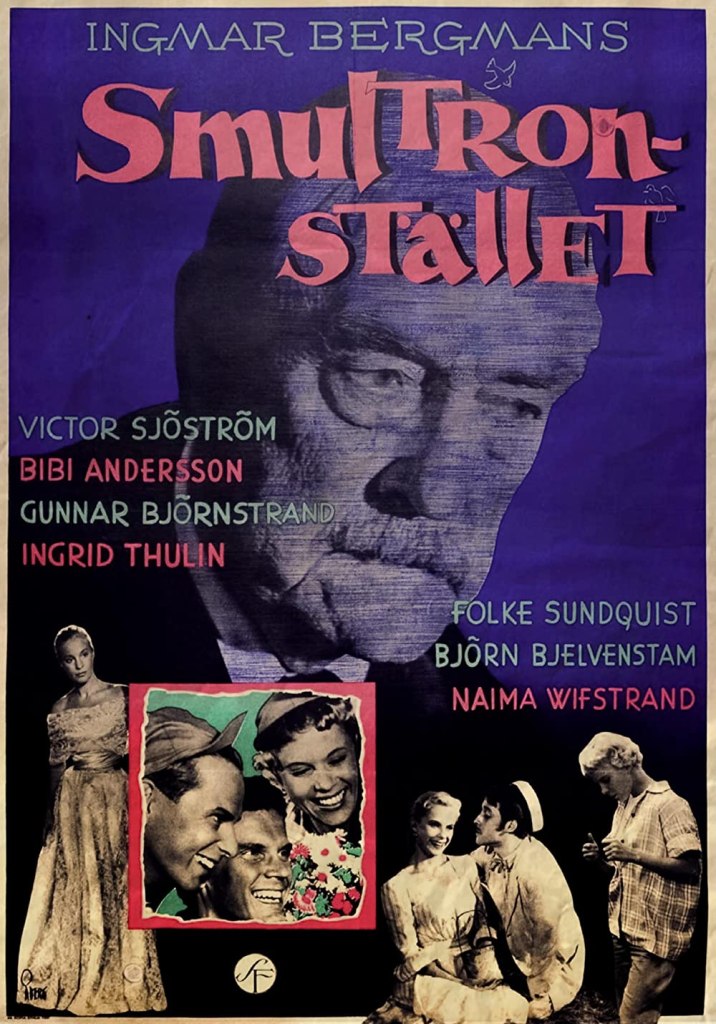
Cast: Victor Sjöström (Professor Isak Borg), Bibi Andersson (Sara/Sara Borg), Ingrid Thulin (Marianne Borg), Gunnar Björnstrand (Evald Borg), Jullan Kindahl (Mrs Agda), Folke Sundquist (Anders), Björn Bjelfvenstam (Viktor), Naima Wifstrand (Isak’s Mother), Gunnel Broström (Berit Alman), Gunnar Sjöberg (Sten Alman/Examiner), Max von Sydow (Henrik Åkerman), Ann-Marie Wiman (Eva Åkerman), Gertrud Fridh (Karin Borg), Åke Fridell (Karin’s lover), Per Sjöstrand (Sigfrid Borg)

Is anything in life more painful than regret? When we look back at our past mistakes, the things we wish had played out differently, the roads not taken, it’s difficult to accept there is nothing we can do about it. It’s the theme of Bergman’s beautiful, strangely optimistic Wild Strawberries (his third consecutive masterpiece, cementing him as one of the most distinctive, visionary directors in the world). Wild Strawberries is filmed with a virtuoso assurance, that still finds a genuine sense of optimism, despite the pain of the past.

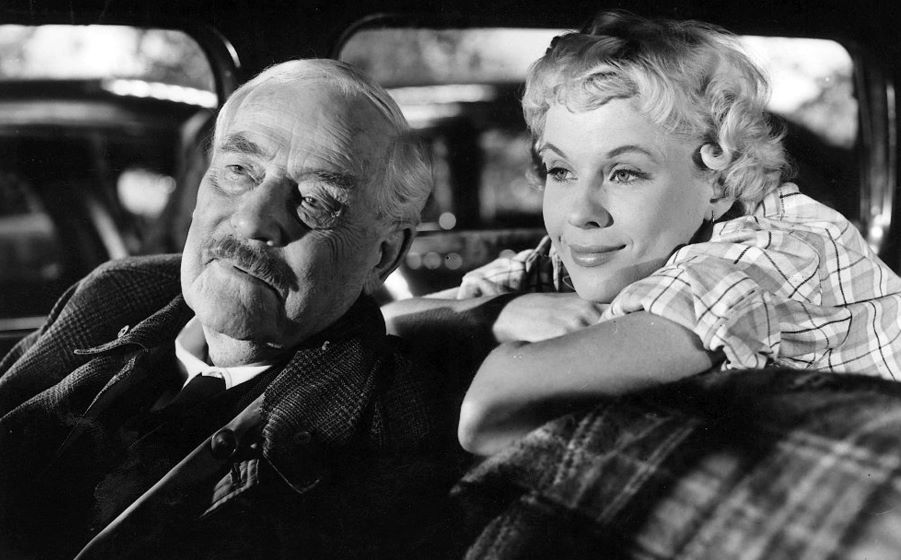
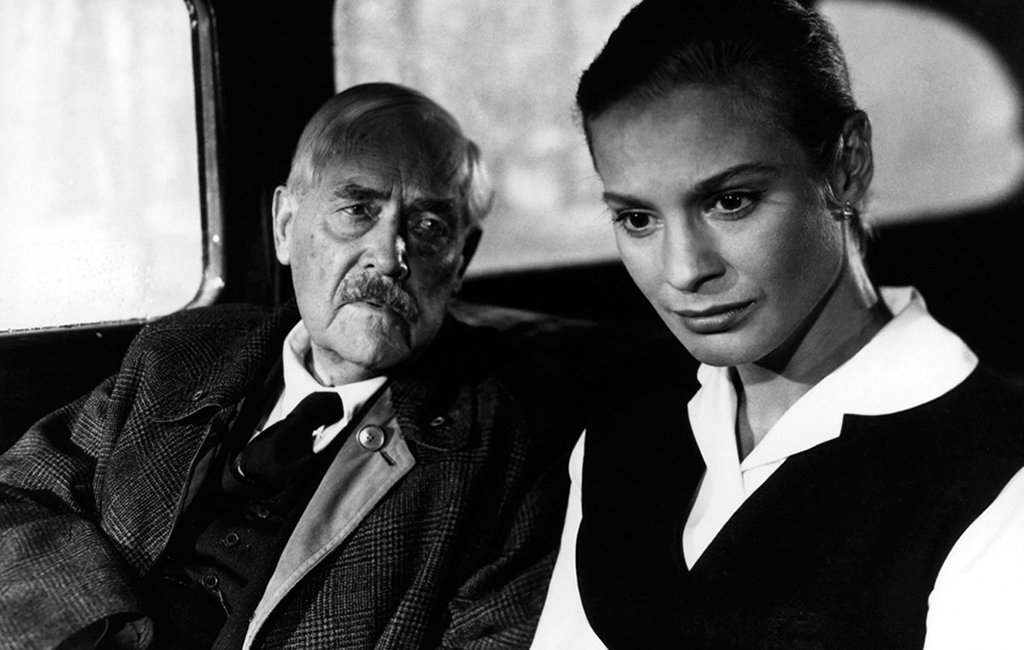
It’s about a long, single-day, road trip taken by famed, retired, medic Professor Isak Borg (Victor Sjöström, Sweden’s legendary father of cinema and Bergman’s idol) and his daughter-in-law Marianne (Ingrid Thulin). Isak is receiving an honorary doctorate in Lund but, after a bad dream, spontaneously decides to drive there. They drop by places with huge personal significance: the country chalet where he loved and lost his cousin Sara (Bibi Andersson) and the home of his mother (Naima Wifstand), who perhaps never really wanted him. Along they way they pick up a trio of young hitchhikers, one of whom, Sara (Bibi Andersson again), reminds him of his lost love. Will Isak come to terms with his regrets and failures?

The Wild Strawberries were collected by Sara on the birthday of her and Isak’s uncle. They are touch points in Isak’s memories, a reminder of the summer when Sara broke off her engagement with him to marry his more fun brother Sigfrid (Per Sjöstrand). Did that moment set Isak on the path of distant, judgmental coolness that defined his whole life? Or was he always bound to become who was, especially since his mother matches him for chilly distance? Is the cycle destined to continue, as Isak’s son Evald (Gunnar Björnstrand, full of cold nihilism) is just as austere as his father?

Bergman‘s radiant memory piece, explores all this without casting judgment. Wild Strawberries profoundly studies the regrets that come with facing your mortality. Isak becomes so lost in his memories, he literally becomes a silent witness in them. Sjöström’s beautifully expressive face lights up with a mixture of powerless pleasure, sadness and longing as he sees Sara once more – its implied the only woman (or indeed person) he has allowed himself to purely love.

What’s striking though, is that Isak’s memory of her – flirting with Sigfrid and then tearfully telling another cousin that Isak is so nice but… – is not a memory he can possibly have. He was never there: it can only be his supposition. It’s the same with the birthday party of his uncle (Bergman fills this with some great comedy, not least two gossipy pre-teens who talk simultaneously), an event he was not present at. Isak clings to these as memories, but they are imaginings. It’s not a card the film plays heavily: but Isak is, essentially, an unreliable narrator showing us his version of the past. It makes you wonder: are we all unreliable narrators of our own memories?

Is Wild Strawberries actually a dream piece? These recollections are daydreams, helping Isak accept his choices, and begin to find peace. The film opens with a striking surreal – and chillingly horror tinged – dream sequence that inspired hundreds of imitators: Isak walks an abandoned street, clocks lack hands, a faceless man collapses into water, a hearse overturns and when Isak investigates his own hand emerges to pull him in. (The unsettling artifice of this sequence is so masterful, it makes you realise Bergman could have become the king of terror if he’s wanted to).

A series of sequences take place halfway between dream and memory. In one he’s challenged by a cold and formal Examiner (a mirror of Isak himself?) with unanswerable questions, diagnosed with guilt and loneliness and then taken to witness his most vivid memory – watching his wife in the throws of passion with another man. The memory changes from reality to dream as Isak’s wife (an unsettling Gertrud Fridh) – who loathes him – sits up and dispassionately recounts their conversation later when she confessed/rubbed-his-face-in her infidelity. These aren’t straight memories.

Isak’s reminiscences creep up on him. It’s started by his daughter-in-law Marianne flatly telling him she can’t stand his aloofness and self-satisfied smugness. He seems unmoved: but does it prompt him to take her to the chalet of his childhood, to try and prove her wrong? Surely it can’t be a complete coincidence he awakes from a dream of Sara, by another Sara (Bibi Andersson brilliantly distinguishes between these two very different women, who both speak to repressed romantic yearnings in Isak) or asks for a lift? My private theory: I think Bergman is implying only Isak sees these two people as identical in appearance, like he plops past-Sara’s face on hitch-hiker-Sara’s body. It’s another walking semi-memory-dream.

Sara is one of several people prompting Isak’s reflection and changing our perceptions. Why did he become a man so detached he barely bats an eyelid when his daughter-in-law rubbishes him? A feuding couple the group pick up after a road accident – whose abuse of each other gets so personal and cruel, Marianne throws them out of the car – could almost be past versions of Isak and his wife. How miserable must his marriage have been? When Isak is feted as a doctor at a small village (a neat Max von Sydow cameo), how much does his sad observation that perhaps he should never have left further trigger his softening character?  As hiker-Sara talks about romance and opportunity, how much does this make Isak think about the staid, loveless respectability of his own life?

Our understanding of Isak is also partly filtered through Marianne’s perception of him. Ingrid Thulin is glorious as a woman whose marriage (to a knock-off prototype of his father) is on the rocks due to her husband’s callous loathing of the world. When she meets Isak’s mother, Thulin’s face radiates understanding of how this woman shaped Isak, who in turn shaped his son. As Isak begins to talk about his past and his fears, it prompts her own willingness to confide in him – something she would never have considered at the film’s start. As Marianne changes her perceptions, so do we.

Wild Strawberries benefits most of all from the wonderfully valedictory performance of Victor Sjöström. Bergman begged his mentor to take the role on, and it produces a cinematic wonder. Sjöström is in every scene and his face fills with such powerful emotion – from distraught regret to wistfulness to confusion to a peaceful radiance – that Bergman allows it to dominate the frame at key points. Its an unforced, gentle and underplayed performance with real emotional force.

Not least because, at heart, this is an optimistic film that tells us its never too late. Sure, we can regret mistakes and lost opportunities: but it shouldn’t close our hearts. Isak learns he has been wrong in closing his heart: there is life, warmth and happiness out there for the taking. It comes together in a final dream/memory, as Isak rediscovers a happy memory of his parents (all the more powerful for how few and far these must be) and Bergman’s camera (shot with majesty by Gunnar Fischer) trains one final time on Sjöström’s face and we understand that he has, at last, come to terms with his life. For a director famed as the master of misery, Wild Strawberries shows he could also frame a story of optimism, growth and understanding, making Wild Strawberries one of his most affecting movies.

As Good As It Gets (1997)

As Good As It Gets (1997)

Sparks fly in this straight-forward sitcom set up from James L. Brooks

Director: James L Brooks

Cast: Jack Nicholson (Melvin Udall), Helen Hunt (Carol Connelly), Greg Kinnear (Simon Bishop), Cuba Gooding Jnr (Frank Sachs), Skeet Ulrich (Vincent Lopiano), Shirley Knight (Beverly Connelly), Jesse James (Spencer Connelly), Yeardley Smith (Jackie Simpson), Harold Ramis (Dr Martin Bettes)

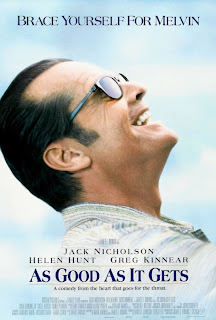
Melvin Udall (Jack Nicholson) is the rude, misanthropic writer of Mills and Boon style novels who suffers from an OCD that sees him keep to a strict series of routines. One of the most important is always having breakfast at the same table of the same restaurant, where the only waitress who will serve him is Carol Connelly (Helen Hunt). Carol is caring for her young son Spencer, who suffers from chronic asthma. All starts to change when the homophobic Melvin is persuaded to look after the dog of his neighbour, gay artist Simon Bishop (Greg Kinnear), after he is assaulted during a robbery. Melvin finds himself getting closer to the dog – and before he knows it, starts to reluctantly build a friendship with Simon and a romantic relationship with Carol.

If you thought that sounds rather like the set-up for a sitcom… you’d basically be right. James L Brooks demonstrates his TV roots again with what could almost be an extended pilot for a TV series, shot with his characteristic functionality. While its an attempt to show how different people can struggle to overcome barriers to connect with each other – be those psychological, social or health – it squeezes this into a trope-filled plot set-up, that swims in sentimentality and gives opportunities for actors to enjoy scenery-chewing, attention-grabbing parts.

None more so than Jack Nicholson, winning his third Oscar as Melvin. To be honest, what Nicholson does he is essentially portray a less complex version of Victor Meldrew from One Foot in the Grave. Melvin is a man who doesn’t suffer fools gladly, and delights in using his wealth to excuse him from saying a host of unacceptable things about everyone he meets (not a single gender, sexuality or race escapes his quick-witted bile).

Of course, the audiences know that it’s alright because it’s Jack, and while he might be a rogue he’s basically got his heart in the right place. Discovering that is basically the purpose of the film: of course, all that rudeness and cruelty is a front to protect an insecure man from the dangers of emotional commitment. Not to mention that the first thing to melt his shell is that most familiar (and sweet) of Hollywood props, a dog. Brooks does manage to demonstrate that Jack’s acts of kindness are at first partly about making life easy for himself – securing an expensive doctor for Carol’s son is about ensuring she doesn’t leave his restaurant and agrees to keep talking to him – but the film is determined to show everyone is basically “decent” and “kind” even if they don’t know it.

Inevitably, the best way of doing this is for that familiar old development, the road trip: for contrived reasons connected to Simon needing to ask his parents in Baltimore for help with medical bills, Melvin, Carol and Simon climb into a car for a cross-country drive. Needless to say, the predictable clashes, confessions, break-ups and reconciliations take place. It being a Brooks movie, this all takes place over an extended two and a half hour run time (indulgent for such a traditional set-up).

What makes it work is that the acting of the three principles is fiercely committed. Oscar-winning Nicholson eats up the cutting dialogue but also manages to mine a lot of “little boy lost” vulnerability from Melvin, a man who throws up barriers of rudeness, aggression and misanthropy to protect himself from getting hurt. Helen Hunt (who won another Oscar) hones years of experience in delivering fast-paced, witty dialogue from Mad About You, also shows real depth making Carol a similarly guarded person, using sass and cynicism as a shield against a world she expects to bite her. Greg Kinnear is a fragile artist, hiding behind his art, tortured by denial about his problems and desperate for an emotional connection.

That theme of the defensive barriers – and crippling effects of our own mental hang-ups – is the deeper message that Brooks manages to bring to the film. Melvin might seem, on the surface, the most obviously maladjusted but at least he’s vaguely happy in his skin at the start of the film. The other characters wear smiles of contentment, but only to hide deep stress and turmoil. It’s Brooks’ TV roots that turns all this into a series of “learning” lessons, where every scene in the final act is accompanied by someone making a profound choice, making a new start or letting something go.

As Good As It Gets is about making the best of things. And Brooks makes a pretty good fist of making this a decent (overlong) romantic comedy with a touch of depth. But its still mired in predictable tropes. Melvin’s OCD expresses itself in the most amusing filmic way possible, essentially as a form of charming eccentricity rather than the crippling disease it can actually be (it ticks all the predictable boxes, from light-switches, to compulsive hand cleaning to not stepping on cracks in the pavement). The film also, rather worryingly, suggests OCD can be overcome just like any other personality problem, simply by opening your heart and learning those lessons.

It’s fine, but you can watch it now and wonder how a film that’s essentially an over-extended dramedy TV-show pilot ended up scooping so many prizes. Entertaining, with some interesting perspectives, with committed acting, but very little that’s new and a lot that’s rather tired.

Nebraska (2013)

Bruce Dern excels in Alexander Payne’s masterful Nebraska

Director: Alexander Payne

Cast: Bruce Dern (Woody Grant), Will Forte (David Grant), June Squibb (Kate Grant), Bob Odenkirk (Ross Grant), Stacy Keach (Ed Pegram), Mary Louise Wilson (Aunt Martha), Angela McEwan (Peg Nagy), Rance Howard (Uncle Ray), Devin Ratray (Cole), Tim Driscoll (Bart)

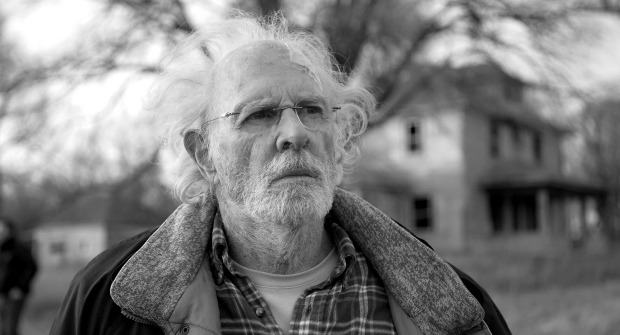
Woody Grant (Bruce Dern) is an ageing alcoholic on the edge of senility. Receiving a circular from a magazine company, he becomes convinced he has won a million-dollar sweepstake – despite his family telling him he definitely hasn’t. Eventually, son David (Will Forte) agrees to drive him to Lincoln, Nebraska, to ‘claim’ the prize. Along the way, they visit Woody’s family in Hawthorne, Nebraska – and the whole town swallows whole the idea that Woody has won the sweepstakes. Despite the best efforts of David, his mother Kate (June Squibb) and brother Ross (Bob Odenkirk), both family members and townsfolk come forward with claims for this fictional money. All this while the family themselves come to understanding about each other and their past.

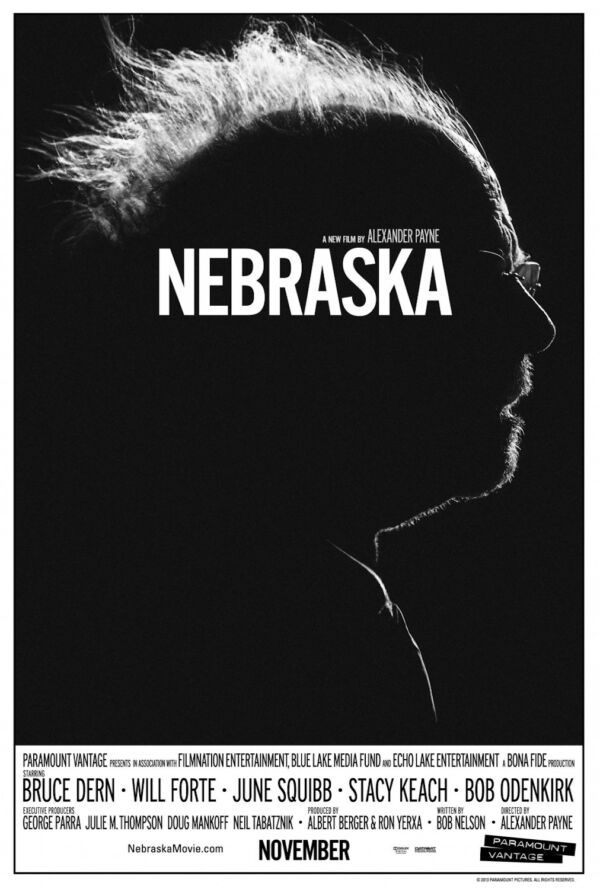
Alexander Payne’s Nebraska is gently paced, meditative, but has lasting impact. Shot in a gorgeous black-and-white, this is a road movie, an odd buddy film, a family drama and a comedy of misunderstandings. All this comes together, in a way perhaps only Payne could do it, into something that at first seems like a bitter-sweet look at a dysfunctional family, but slowly reveals itself into something far more heartfelt than you expect. Nebraska carefully builds a portrait of a family that feuds, but is fundamentally loyal, even while carrying private resentments.

It all revolves around Woody himself, who at first seems to be the typical bad Dad: distant from his sons, dismissive of his wife, a history of drinking. His marriage to Kate seems based more on longevity rather than any love. Approaching senility has only accentuated, it seems, his stubbornness and self-obsession. He’s crochety and fixated on his own needs. But, despite all this – and this is a huge credit to Dern’s sympathetic performance – there is a gentleness to him. For all his negatives, he’s vulnerable and even naïve. He assumes people are telling him the truth. Later Kate will angrily denounce his grasping family, has Woody never said ‘no’ to anything he was asked to for. And you can believe it. He is a character who we see in more and more of a human light.

It comes across in the relationship with David. In an equally beautifully judged performance by Will Forte, David’s motivations for this road journey change. At first it seems an attempt to end an idee fixee, but it becomes more and more about spending time with a man he realises he loves more than he thought. Perhaps that’s because Forte’s sad-sack gentleness has more of an echo of the inner meekness of Dern’s Woody. David has more than a few similarities to Woody – a disappointing career, a failed relationship (unlike Woody’s generation, separation is a lot more feasible), a sense that his life has been a disappointment. But Payne’s film flourishes, because it becomes about David’s discovery of a kindred with his father he hasn’t acknowledged for years.

A lot of that comes from seeing the world his father grew up. A small American town, with more than a touch of The Last Picture Show, where everyone seems either stuck-in-a-rut or happy to drift. Everyone knows everyone, and there are no entertainments except feuds and sharing every piece of gossip. But, above that, David also discovers more about his father’s background: his hopes and dreams, his acts of kindness but also his acts of selfishness. His awkward relationship with his family, and the reasons behind his dysfunctional but strangely contented relationship with his wife.

All this comes together in that very Payne-ish way that is both heart-warming, slightly sentimental but genuinely moving. Above all it works, because everyone one in it feels very relatable and true. David is a highly understandable guy, a quiet fellow who hasn’t quite cracked how life works, but wants to rekindle a relationship with his father. Woody wants to cling to anything that might help him feel he has control over his own life. The saga of the fictional money starts as an item pushing the two men apart, but actually draws them closer as others in the town seek to take advantage (most nastily, the excellent Stacy Keach, claiming to be a former business partner).

That’s what helps make, what could have been a comedy about a clueless Quixote and his reluctant Sancha Panza, into something really moving. Payne may tease Woody – and even allow him to say some quite unpleasant things (his indifference as a young man to having children is a tough thing for any father to say to his son) – but he never makes him a joke. He’s just a man who seems to be looking back at his life, not quite sure how he got there. With David as an audience surrogate, wondering the same thing in turn – and half wondering whether he is going the same way.

And, of course, the film is funny. Woody and David make a wonderful flying trip to Mt Rushmore (“It looks unfinished…Lincoln hasn’t even got an ear” is Woody’s summary of it). June Squibb is very funny as David’s surprisingly foul-mouthed mother, for whom a road trip is a wonderful chance to remember all the conquests she might have made back in the day. David’s constant pleas for Woody to not mention his “win” – and the town’s total buying of this urban rumour – is very well done.

But it mixes with genuinely moving moments. Squibb’s Kate may be frustrated and fed-up with Woody, but she will defend him to the end and tenderly kisses his forehead while he sleeps. It mixes with genuine touches of regret: the extended Grant family sit and watch football together, mutely starring at the television, barely communicating. This isn’t nostalgic, but it is faintly sad about how life so quickly life can trap us into familiar patterns.

And the performances are of course sensational. Dern is incredibly heartfelt, communicating huge amounts of little dialogue and watery eyes. Fonte is superb as a man who believes he has had enough of his father, only to have his perceptions change. Squibb is both funny and heart-breaking, Odenkirk exasperated but tender, Keach a bully scared of his own empty life. It’s one of Payne’s signature works, a gentle character study that starts giving you one perception and develops into giving you a very different one. It’s one of his finest films.

No Country for Old Men (2007)

Javier Bardem is terrifying in the Coen’s Oscar-winning No Country for Old Men

Director: Joel & Ethan Coen

Cast: Tommy Lee Jones (Sheriff Ed Tom Bell), Javier Bardem (Anton Chigurh), Josh Brolin (Llewelyn Moss), Woody Harrelson (Carson Wells), Kelly Macdonald (Carla Jean Moss), Garret Dillahunt (Deputy Wendell), Tess Harper (Loretta Bell), Barry Corbin (Ellis), Stephen Root (Wells’ Hirer)

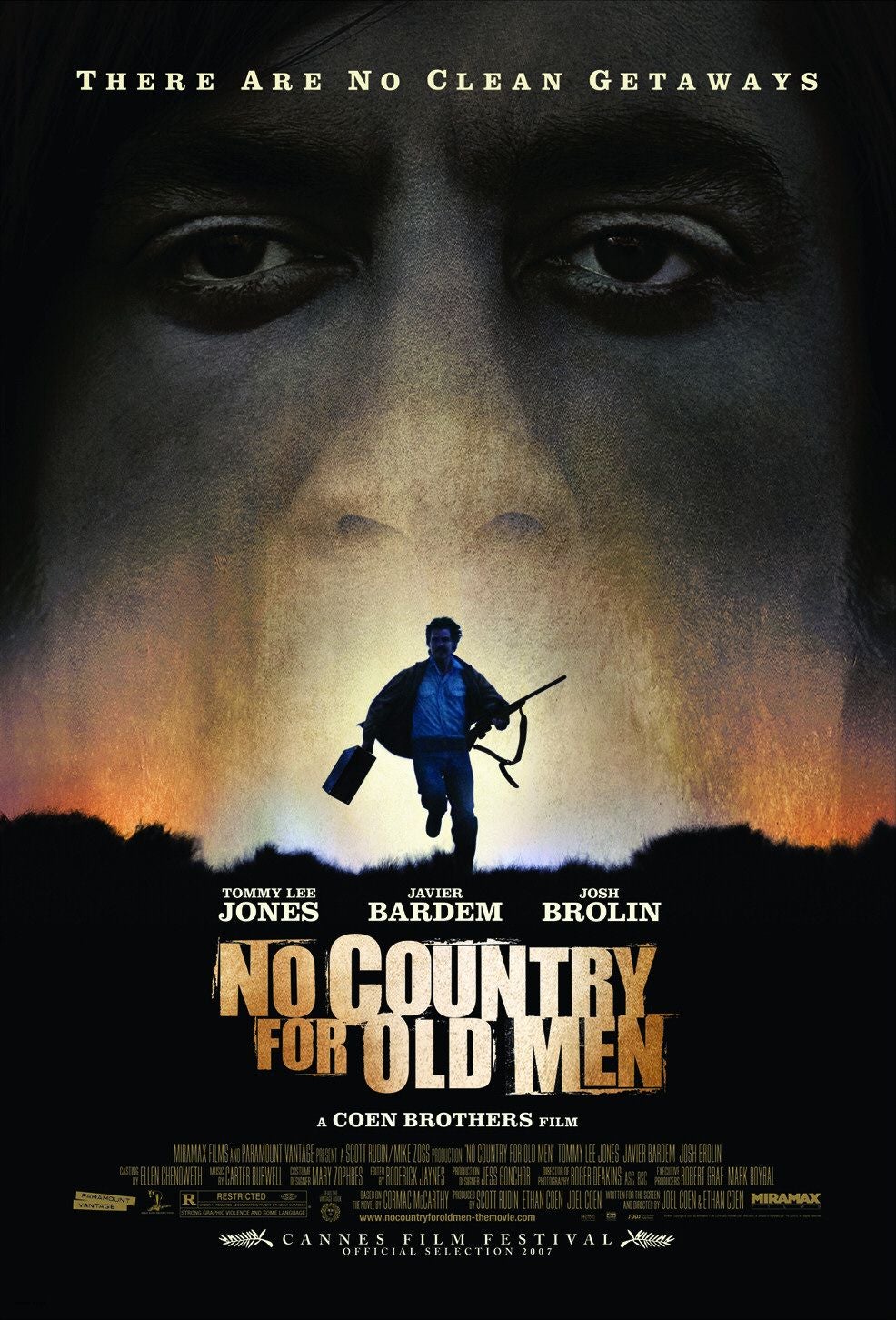
The borderlands of America. A vast panoramic countryside, where times may change but the underlying violence and savagery continues to lurk just under those dusty plains. It’s ground the Coens have explored before, but perhaps never with such mastery as in No Country For Old Men, a film that mixes the style of a classic Western with the nihilism and bleakness of their most challenging work, all capped with just a hint of their incomparable quirky black humour. A pitch-perfect adaptation of Cormac McCarthy, No Country For Old Men scooped four Oscars, including Best Picture.

In the border Terrell County in Texas in 1980, a Vietnam-vet and welder Llewelyn Moss (Josh Brolin) stumbles across a drug deal gone wrong in the desert: several dead men, a truck full of drugs and a suitcase containing $2 million. Taking the case, Moss sends his wife Carla Jean (Kelly MacDonald) to her mother’s for safety and flees first to Del Rio then Mexico to try and keep the money. Unfortunately, he’s being followed by relentless, psychotic hitman Anton Chigurh (Javier Bardem) who will stop at nothing to fulfil his contract – and heaven help anyone who gets in the way. Trailing in their wake is worn-out Sheriff Ed Tom Bell (Tommy Lee Jones), who feels increasingly adrift in a violent world he no longer understands.

The Coen’s film is a bleak, pessimistic and doom-laden look at man’s inhumanity to man – all of it watched with a weary sadness by Jones’ tired Sheriff, in a hauntingly gentle performance. The vision the Coens present is a world that may have moved on in decades from the Wild West, but still has that era’s cavalier regard for life. Life is very cheap in No Country For Old Men and even the slightest mistake, hesitation or act of kindness can have horrific consequences. It’s a film where death is a constant, terrible surprise – so much so it claims the life of one significant character entirely off-screen and can be handed out on the basis of a coin toss.

That coin toss will come at the prompting of Chigurh. Played with an Oscar-winning calm voidness, by an unworldly Javier Bardem, Chigurh is relentless, merciless and completely detached from humanity. Emotion is a complete stranger to him, other than a pride in his work and a capability for being irritated by a non-co-operative target. Chigurh sees himself as an instrument as fate, a nihilistic view where individual choice is removed from the equation. In one chillingly memorable scene, he relentlessly but with a terrifying calm gets a gas station attendant to call a coin toss: the attendant struggles to understand what he’s wagering, but it’s all too clear to us – and in case we miss the point, Chigurh urges him to keep the coin afterwards as it’s a momentously lucky object.

There’s a possibility that this is how Chigurh rationalises the world to himself. He is absolved of all moral consequences for his actions, as everything is pre-ordained, objects and people travelling to predetermined outcomes. It’s a viewpoint another character invited to toss a coin late in the film will firmly reject, saying all Chigurh’s actions are a choice. They’re probably also right. Chigurh kills throughout the film partly because it’s the most expedient way to get what he needs – from a car, to escaping a police station – but also because of the pride he takes in his work being the best, and anything obstructing that should be punished. He has no regard or interest in the money or even for his employers, all of them disposable in the pursuit of doing his job well. It’s perhaps not a surprise that a survey by psychologists named him the purest psychopath caught on film.

Pity those who cross his path. Compared to him, Woody Harrelson’s professional hitman is just that: a guy doing a job rather than an elemental, unstoppable force of nature (Harrelson is superb as a charming, slightly cocky pro, who accidentally gets in over his head). In many ways, it makes it even easier to root for Josh Brolin’s Llewelyn Moss as he tries to stay one step ahead of him with his ill-gotten gains. In a breakout role, Brolin makes Moss the quintessential everyman, with just enough touches of grace and decency to make us overlook the fact that he’s an opportunist putting himself and his family at risk to steal drug money. Moss is such an underdog – but also so ingenious and determined – he becomes the perfect person to root for.

The film largely chronicles the battle of wits between Llewelyn and Chigurh across Texas and Mexico, the two of them carrying out a hunter-tracker dance that has echoes of similar duels from directors like Leone. In one set-piece moment after another, we see their coolness under fire, as well as their focused determination to get what they want, regardless of cost. Brolin’s performance is a superb slice of taciturn Texan-ness, with just enough decency to get him in trouble: from protecting his wife, to taking water back for an injured man, to rejecting the advances of a poolside floozy. It’s interesting that he invariably ends up in more trouble when he tries to do something good – but such behaviour sets him aside from Chigurh and lets us know he’s one of us.

All this bleakness is followed with sad-sack sorrow by Tommy Lee Jones’ sheriff, whose eyes speak of endless, uncountable horrors that fresh ones don’t even seem to shock him anymore. Jones bookends the film with two superb monologues, that reflect on what seems like the increasing brutality of the modern world. But the Coens are smart enough to know that this sentimentality is misleading – Bell’s uncle Ellis (a fine cameo by Barry Corbin) tells him frankly that the world was ever thus and its naïve to think otherwise. This is also one of Jones’ finest performances, a tragic Homer, totally ineffective, reduced to following around and picking up the pieces.

All of this plays out without hardly any trace of a music score – Carter Burwell’s scant score makes use of everyday sound and hints of music at a few dry moments – hammering home the coldness and bleakness of it all. Excellently shot by Roger Deakins, whose classic, restrained, pictorially beautiful presentation of the West brings back a truckload of cinematic memories, the Coen’s film still finds room for dashes of dry humour. Sure, it ends with a nihilistic comment on the horrors of the world and our hopelessness in them, but there are small shoots of hope growing in there if you look closely. They are well hidden, but they are there.

No Country for Old Men is perhaps the Coens’ most fully rounded, morally complex, intriguing and dynamic film, a wonderful mix of the style of their earlier work with the bleakness of Fargo and just some touches of the wit they displayed elsewhere. Cormac McCarthy is the perfect match for two masters, whose direction is as faultless as their script. It’s a film that rewords constant viewing and is constantly shrewd and terrifying in its analysis of the human condition. Essential watching.

Driving Miss Daisy (1989)

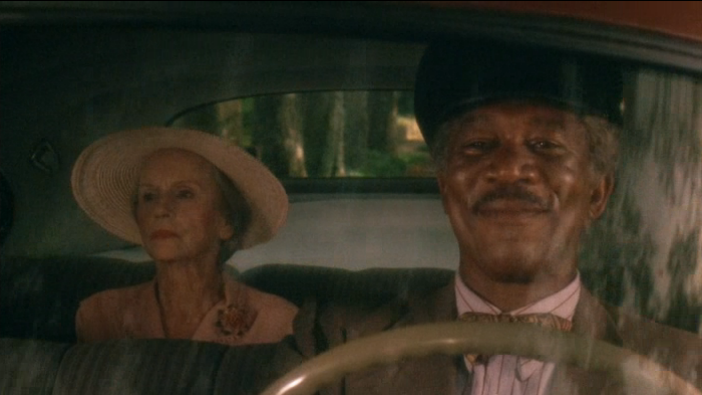
Jessica Tandy and Morgan Freeman drive through the South in Driving Miss Daisy

Director: Bruce Beresford

Cast: Morgan Freeman (Hoke Colburn), Jessica Tandy (Daisy Werthan), Dan Aykroyd (Boolie Werthan), Patti LuPone (Florine Werthan), Esther Rolle (Idella)

Retired Jewish teacher Daisy Wethan (Jessica Tandy) crashes her car while trying to drive down to the store. Her wealthy businessman son Boolie (Dan Aykroyd) decides she’s too old to drive herself, so hires black chauffeur Hoke Colburn (Morgan Freeman) for the job of Driving Miss Daisy. At first Daisy resists this new servant in her life but, doncha know it, over the next 23 years the two of them grow closer together as they deal with the ups-and-downs of life and find out that, heck, under the surface maybe we are all more alike than we think.

It’s been a recurrent theme that some films (like Shakespeare in Love or The Greatest Show on Earth) have found themselves actually diminished by the burden of being an “Oscar Winning Film”. Driving Miss Daisy joins them, an impossibly slight little puff of air film which could be blown away by the faintest breeze. It won out in a year where the most exciting movies of the year (sex, lies and videotape and most strikingly of all Do the Right Thing) failed to get nominated. It seemed a particular slap in the face that a film which looks at racial relations with such a cozy, nostalgic view as this one should triumph in the year Spike Lee made a film that exposed how close America was to racial tensions erupting into violence (worst of all this wouldn’t be the last time for Lee).

Driving Miss Daisy wants no part of that though. This is the Downton Abbey of racial dramas, a nostalgic and overwhelmingly “nice” film that uses odd-couple drama to make us feel good about ourselves. In this vision of the south, the Whites (and I am not buying the film’s pained attempts to suggest anti-Semitic mutters here and there is on a par with lynching) are mostly paternalistic masters, and the blacks forelock tugging servants hoping for a better life but grateful for the support of their betters. There isn’t a single black character (bar Hoke’s niece who appears wordlessly in the final minutes of the film) who isn’t a domestic servant, and not a single white person who isn’t genteel (bar a single racist cop 52 minutes into the film).

Not a single black character is ever angry, complains about injustice or is anything less than patient, noble and humble. It’s all part of a film designed to make us feel better about the South’s appalling record of racism and segregation by presenting it as exactly the sort of genteel Gone-with-the-Wind-good-old-cause fantasy many people remain comfortable with today, where black people needed to be looked after because (as even Daisy puts it in the film) they are basically children.

Now saying that, the film is of course light, fluffy, inoffensive and (there is no better word for it) nice. You can sit down and let the gentleness wash over you, no problem at all. I can see why it was a word-of-mouth hit in 1989, and why the Oscars gave it the big one. It’s well made and very faithful to the Pullitzer winning play it’s based on. Beresford’s genteel direction lets the dialogue and actors do the work (he didn’t get a nomination – though even he modestly said later he didn’t really feel he deserved one).

Freeman and Tandy do decent work with these incredibly simple characters. Tandy could have played this cookie-cutter “cantankerous-but-loveable-old-lady” role standing on her head. But she does it well (again, drawing those Downton parallels, this is exactly the same role Maggie Smith has in that series) and nails a little speech where she wistfully remembers visiting the sea then stops as if embarrassed by her self-indulgence. She won the Oscar.

Freeman here (and in Glory) invents a screen persona. He’s kindly, worldly-wise (but not bookly wise – he ain’t never had time to learn readin’), patient, long-suffering but full of dignity. But, with his repeated “Yassums”, his non-complaining acceptance of his position and status and his deferential nature, he’s pretty close to a sort of fantasy Uncle Tom-ish figure. Sure, Freeman can sell those quiet moments, where it’s clear Hoke has learned to bury feelings of fear (his brief confrontation with a racist cop – and his controlled fear – is the film’s most effective moment) but the whole performance feels like a carefully constructed lie.

It’s in line with the film, where the black experience has been cut down and filtered in such a way to make white people feel good about themselves. Because we can watch the film and go “oh yeah I’d be like Daisy and Boolie, they’re so sweet” and we wait 52 minutes before an unpleasant character turns up and uses the n word – and then he’s mean to Daisy as well for being Jewish and heck gosh darn it we are all the same after all, what a relief, pass the popcorn. You come out of Driving Miss Daisy and you have learned nothing.

Worse than that, you’ve been shown a cuddly fantasy world. We never see Hoke outside of the setting of his master’s homes (there is no other way of putting it) and learn nothing about his life or experiences. We see him melt the heart of an already-fundamentally-decent woman, but their relationship always has boundaries. Driving Miss Daisy would be fine as an escapist piece of fluff – but time has shown it increasingly to be a film designed to make us feel reassured that history wasn’t as distressing as it might have been. And I’m not sure that’s a good thing.

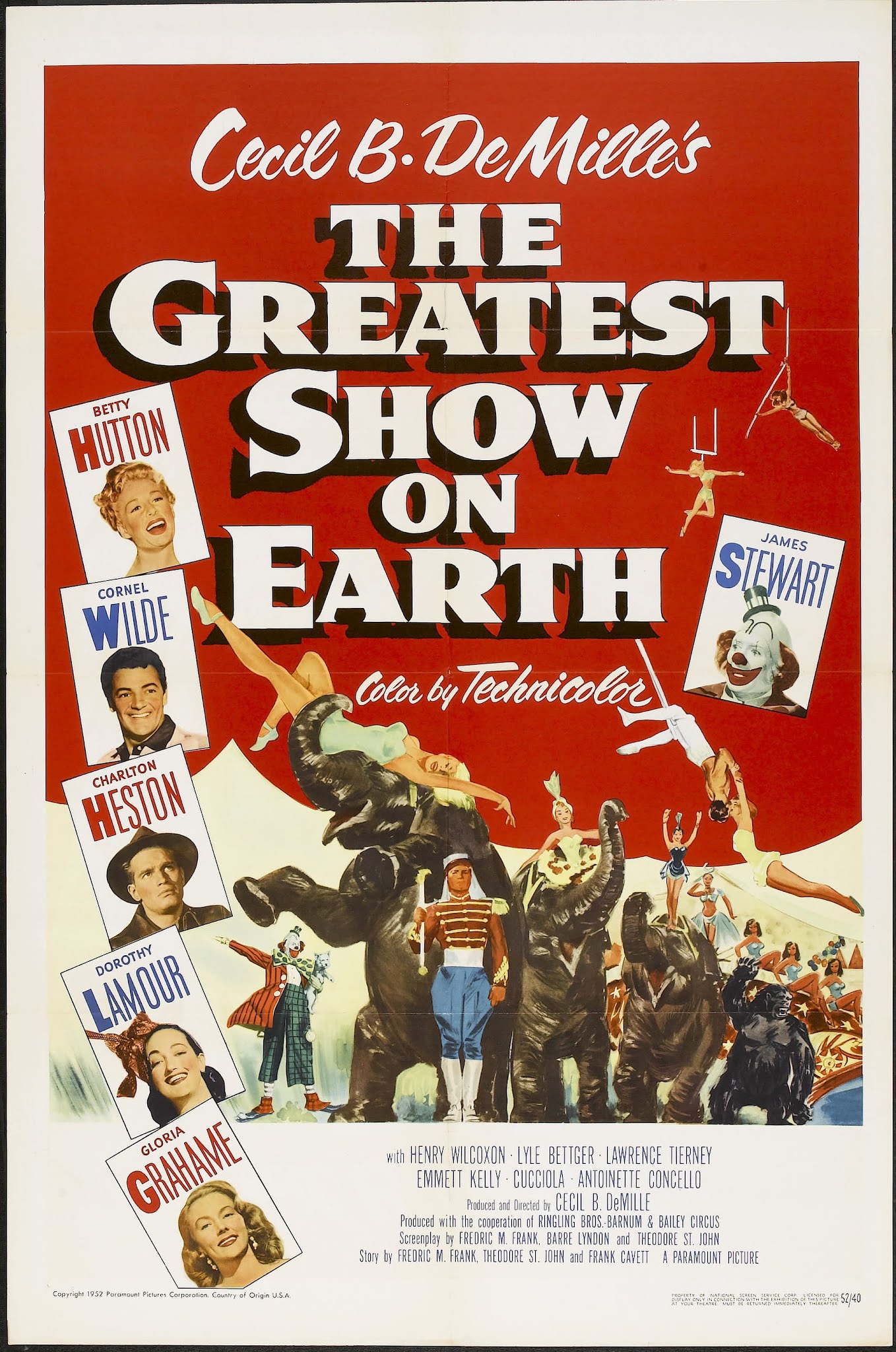
The Greatest Show on Earth (1952)

Charlton Heston and James Stewart in the infamous (and rightly so) The Greatest Show on Earth

Director: Cecil B De Mille

Cast: Betty Hutton (Holly), Cornel Wilde (The Great Sebastian), Charlton Heston (Brad Braden), James Stewart (Buttons), Dorothy Lamour (Phyllis), Gloria Grahame (Angel), Henry Wilcoxon (Agent Gregory), Lawrence Tierney (Henderson), Lyle Bettiger (Klaus)

When Crash was named Best Picture, did The Greatest Show on Earth do a backflip of celebration? Finally, when the topic “What is the worst Best Picture winner of all time?” came up, the answer would no longer immediately be “Well The Greatest Show on Earth of course”. Now, there could be an actual debate. Hard to believe but this film was the biggest hit of 1952. Its reputation has been shredded since: it’s proof that winning Best Picture can destroy a film’s reputation as much as it can raise it. Greatest Show is, of course, a pretty bad film. But it’s not catastrophically atrocious. It’s merely pretty bloody awful.

Anyway, it’s all set in a Ringwood circus. Manager Brad Braden (Charlton Heston) is so in love with the circus, he has “sawdust in his blood” (drink every time some variation of this phrase comes up, and you’ll be pissed by the hour mark – which might be the best way to watch the rest). To bring in the crowds he hires famed acrobat The Great Sebastian (Cornel Wilde) – which means shunting previous acrobat star (and Brad’s girlfriend) Holly (Betty Hutton) to support act. It’s a rivalry – but wouldn’t you know it, sparks fly and a love triangle forms. In fact, it quickly becomes a love pentagon as elephant artiste Angel (Gloria Grahame) has past with Sebastian, is in love with Brad (who’s interested) and is fending off the interests of fellow elephant artiste Klaus (Lyle Bettiger). Oh, and James Stewart plays a clown who never removes his make-up because he is actually a doctor in hiding for euthanising his wife (“He killed the thing he loved!” a newspaper headline screams).

All this is packaged together with the puffed-up self-important portentousness that DeMille bought to his Biblical epics. Cecil himself even delivers a grand voiceover at life-changing events like the raising of the big top and the loading of a train. It’s packaged together with endless stagings of assorted circus acts (this film is very slim in plot, but very long in runtime), all accompanied by continual cuts to the circus audience “oohing” and “aahing” as appropriate, or asking such inane questions as “What’s going to happen next?” (a question no one watching the film is likely to be interested in asking). It makes The Greatest Show even more of a museum piece, a recording of a certain type of grand entertainment that doesn’t really exist anymore.

Away from the big budget and long filming of circus acts, we have a dull, derivative and tedious soapy plotline where ridiculous cliches abound and barely a line of dialogue escapes clunking to the floor with the same heaviness as the Great Sebastian when he (inevitably) falls from the trapeze. No single opportunity for heavy-handed foreshadowing is missed, from that accident to the film’s big train-wreck ending, to the numerous hints dropped about Buttons’ tragic background. It’s all packed into a crude series of homages to the glories of small town America (who appreciate the delights of the circus in the way the big city suits never can) and the glorious romance of not even letting death and a train wreck get in the way of the show going on.

At the centre you get the tedious love pentagon. The central figures of this – Hutton, Heston and Wilde – seem to be involved in a private competition for who can give the worst performance. Heston (in a very early role) is wooden beyond belief, the granite self-importance that made him a perfect Moses ridiculously overbearing for the job of circus manager. He and Hutton play most of their scenes with an absurd energy, throwing themselves into poses. Hutton’s performance is bubbly, chirpy and endlessly irritating. Betty is the worst kind of simpering mess, which culminates in her holding herself responsible for Sebastian’s decision to perform without a net. Wilde is saddled with a bizarre accent (where is he meant to be from? I guess “Europe”), and acts with all the comfort and skill of a vertigo-suffering acrobat.

But then to be honest pretty much everyone in this film is awful. I’ll cut a bit of slack for Gloria Grahame, who gives Angel more charm than all three of the leads put together, and James Stewart who can play the melodramatic crap he’s saddled with standing on his head. But literally everyone else in this film is dire: hammy, over-blown, cartoonish and mugging. There is not a single moment of performance or story-telling that is remotely memorable, and everyone is introduced with a clunky, trailer-friendly line of dialogue.

Nothing will remotely surprise you about the plotline – other than that they manage to stretch something as insipid and uninspired as this out for nearly 150 minutes. Though of course most of that is circus acts, or watching circus marches, or listening to Betty Hutton or Dorothy Lamour sing. (In what passes for wit in the film, while Lamour sings the camera cuts to Crosby and Hope, her old co-stars, watching in the stands hammily chewing popcorn.) There is a certain academic interest in watching these circus acts (performed by real circus artistes – although the actors trained so they could get involved), but after a while you are only reminded that it’s not as interesting or exciting as actually being there.

Maybe that’s why the plot becomes so overblown to try and compensate. Love triangles! Falls from a great height! Gangsters muscling in on the circus! A clown on the run from the cops, meeting his mother during the show once every year! A spurned lover who decides to destroy the circus in revenge! No wonder, after the opening scenes focus on the cost of staging the show and importance of staying in profit to continue the tour, our initial set-up, never gets mentioned again. How could it compete with this bizarre parade of nonsense?

It culminates in a train wreck – and of course Buttons is given “the terrible choice” of letting a man die or revealing his medical knowledge (and identity) to save his life. The train wreck has some decent model work. DeMille certainly looks happier dealing with that than attempting to make anything among his romantic sub-plots feel light, fun or natural.

The Greatest Show on Earth is all about show – and whenever it tries to do anything intimate, it invariably falls flat on its face. There are worse films out there, but attaching the mantle of “Best Picture” to this makes it feel worse than it actually is – and its pretty bad on its own merits. When all is said and done, still possibly the worst Best Picture winner ever.

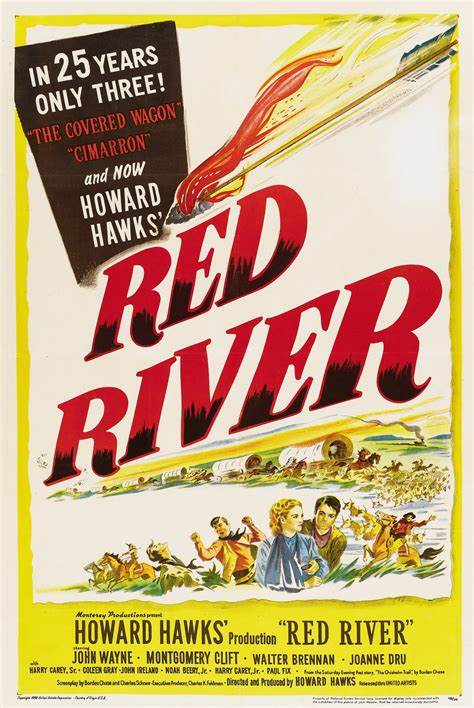
Red River (1948)

John Wayne and Montgomery Clift as duelling surrogate father and son in Red River

Director: Howard Hawks

Cast: John Wayne (Thomas Dunson), Montgomery Clift (Matt Garth), Joanna Dru (Tess Millay), Walter Brennan (Groot), Coleen Gray (Fen), Harry Carey (Melville), John Ireland (Cherry Valance), Noah Beery Jnr (Buster McGee), Harry Carey Jnr (Dan Latimer), Chief Yowlachie (Quo)

Some say Red River is, even more than Citizen Kane, the masterpiece in American film. That’s pushing it. But Red Rivercertainly is a prime slice of beefy entertainment. Hawks’ first Western (and how odd a director so associated with them didn’t turn his hand to them until late in his career – and then only made six), there is no greater compliment to make than to say you could mistake it for John Ford.

In fact, Ford was beyond impressed, famously observing of Wayne “I didn’t know the big son of a bitch could act”. Act he certainly does here as monolithic obsessive Thomas Dunson (surely a forerunner to the equally troubled – and troubling – Ethan Edwards in The Searchers). Dunson has spent almost two decades building his Texan cattle empire. Unfortunately, the Civil War means the bottom has dropped out of the Texas beef market. To make good his investment, Dunson needs to take the cattle (all 9,000 of them!) up north to Missouri (over a thousand miles) to sell at a good price. Along the way, Dunson’s ruthlessly focused ambition tips into tyranny, with Dunson (literally) judge, jury and executioner among his team. Can his more liberal adopted son, Matt Garth (Montgomery Clift), stop Dunson from destroying everything around him?

Red River covers the movement of cattle up the Chisholm Trail, a huge economic migration that saw millions of cattle moved from Texas to where their price was increased by a factor of ten. But the film has only a passing interest in the history – and the romantic, nostalgic look at it here, as a sort of boys-own adventure that goes wrong, is far more about the movies than social history. What the film is really focused on is the personal clash between two generations of men: one a relic of the first years of the new frontier, the other younger, more modern in his thinking, with a streak of humanity the other has beaten down.

Hawks’ film mixes this up with some terrific location footage. How did they wrangle all those cattle? The film is very strong in capturing the sense of excitement in the Frontier – the setting off on the trail, with its quick shot cacophony of horse-backed men whooping with joy, is full of a sense of adventure. The film is a triumph of quick-quick-slow story-telling. The 15 years of Dunson’s empire-building passes by with montage and Wayne voiceover which begins and ends with Wayne in the same position, but the actor considerably aged. Context is skilfully and swiftly given to us, but the tensions between Dunson and Matt are grow and develop naturally, simmering for a good hour-plus before erupting. Transition text between sequences bridges us from scene to scene, and is especially effective in charting Dunson’s descent into tyranny.

Tyranny is what it is all about. This is one of Wayne’s darkest – but also greatest – roles. Hawks taps into the despotic rigidity in this slab of Americana. Dunson is a man utterly and completely convinced not only of his invulnerability, but his rightness, embodying American manifest destiny. Claiming swathes of land as his own, Dunson is a man on the move, constantly striding forward (Hawks often shoots him in progressive, shark-like motion). He’ll leave behind him everything from the woman he loves (with a shocking toughness, as he looks back on the burning remains of the wagon train he left her in) to the land he claimed, to anyone who lets him down.

Dunson is also a ruthless embodiment of a time before law. No one seems to question the way he executes those who cross him. Practically the first thing he does on arrival in Texas is out-draw and kill the man sent to question his arrival. His farmstead has a full graveyard. A dark comic touch is added with his insistence in “reading the words” over graves of men he’s killed. On the trail he has those who back out, run away or question his leadership whipped or shot. Wayne’s certainty as an actor tips into a (literally) black-hatted despotism. His manly focus and ability to outdraw anyone turns him in the end into a nightmare avenger, a Western Terminator.

Opposite him is Clift (equally superb) as a more modern minded kid. Matt is the sort of man who knows that at times a bit of bend and a sympathetic ear gets better results than a beating. Hawks brilliantly builds the love-hate relationship between these two men who have very little in common, other than mutual affection. (Clift and Wayne themselves were polar opposites in acting style, social views and personalities.) There is a real love there – which makes it all the more inevitable Dunson will view Matt’s questioning of him as a betrayal nothing less than blood will redeem. The two of them, and their clash (like the clash between two sides of America) dominate the film, not letting too many other characters have a look-in.

Of the rest, Walter Brennan is a very good as Dunson’s loyal number 2, who may not always agree with the chief but largely (if reluctantly) sticks by him (for all he mutters to him “You’re wrong Mr Dunson”). John Ireland’s cocky gunslinger, who joins the trail because he admires Dunson’s no bullshit attitude, promises much at first but fails to deliver on much-hyped clashes. (Possibly because Ireland fell out with Hawks over a competition for the affections of his future wife Joanna Dru, his role later cut to ribbons in revenge.) There is however a strange, almost homoerotic, link between Clift and Ireland – mutual respect leading to an admiration love-in and much fondling of each other’s firearms during competitive rock shootings.

Red River’s ending has gained some criticism – largely because the film builds its sense of violence between the two leads so well that it feels a bit of a disappointment that they are effectively told to pull themselves together (by a woman of all things!). But, for all the film mines the clashes between two different outlooks, it never loses track of their very real affection. Sure Dunson may talk about killing Matt – but he certainly won’t in cold blood (even if he happily guns down anyone who gets in the way) and at the end of the day, he’s still the closest thing he’ll ever know as a son. Matt is emotionally mature enough to know Dunson is to-all-intents-and-purposes his father, even if he’s not above throwing a few punches at him. The clash is effectively a narrative dead-end – for all it would be exciting to see them take shots at each other, this is a family. And most families fight and make-up, not plug each other with bullets.

And it distracts from the grand entertainment of Red River, its excited love for the open country (the late act scenes inside are as disconcerting for us as they are the characters). This is a western of psychological depth successfully mixed with grand adventure. It’s hugely entertaining but also feels very true. It has two wonderful performances from Wayne and Clift. It’s not the Great American Film, but it’s directed by a superb understander of cinematic narrative and a hard film not to love.

Midnight Special (2016)

Michael Shannon is the loyal dad in Midnight Special

Director: Jeff Nichols

Cast: Michael Shannon (Roy Tomlin), Joel Edgerton (Lucas), Kirsten Dunst (Sarah Tomlin), Adam Driver (Paul Sevier), Jaeden Lieberher (Alton), Sam Shepard (Pastor Calvin Meyer), Bill Camp (Doak), Scott Haze (Levi), Paul Sparks (Agent Miller)

At some point around its original release, someone attached the label “Spielberg-esque” to Midnight Special. I suppose this may be due to its father-son central relationship and its rough similarities to Close Encounters. But it’s a label that does the film no favours. JJ Abrahms would create a Spielberg-esque film, but Jeff Nichols? Pull the other one. Instead Jeff Nichols creates a sci-fi film that wilfully avoids explanations and turns its back as often as it can on any sentimentalism. It’s more like James Cameron crossed with existential philosophy. It certainly won’t be offering up easy entertainment.

Roy Tomlin (Michael Shannon) is on the run from the law with his son Alton (Jaeden Lieberher), helped only by his friend Lucas (Joel Edgerton). Alton has mysterious powers – glowing eyes, elements of telekinesis and the ability to intercept electrical signals – that have made him a target for everyone from the government to a cult that has kept him under lock and key for years, believing he holds the key to surviving the inevitable apocalypse. Alton has an aversion to sunlight which means our heroes can only travel at night, heading towards a secret location, trying to stay one step ahead of the dangerous figures following them.

Nichols film is almost too elliptical for its own good. But then I think this is partly Nicholls point. He’s looking to subvert a few expectations here. To create a sci-fi, other-world chase movie that’s wrapped itself up in enigmas. Sadly, I think to have enigmas like this become truly engaging, you need to form a connection with the film itself – and Midnight Special fails too much here.

It keeps its cards extremely close to its chest – it only begins to dive into any sort of explanation about what’s going on over halfway into the film, and even then this is kept vague and undefined. There is virtually no exploration given of most of the characters of their backstory, bar a few key points. It’s a chase movie which frequently slows down to a crawl. It’s a science fiction film that’s largely confined to the ‘real’ world. It’s a father-and-son on the run film, which separates these two characters for a large chunk of its runtime. All this makes it very difficult to form an emotional attachment with, in the way you do with, say, Close Encounters or The Terminator (both of which leave traces in this film’s DNA).

Not that I think Nicholls will mind, as this is an attempt to do something different, more of an existential musing on humanity. Its unfortunate that this was exploration of personal regrets and tragedies against a backdrop of earth-shattering sci-fi revelations was done more absorbingly in Arrivalamong others. Compared to that, Nicholls film seems almost a little too pleased with its deep (and in the end slightly empty) mysteries and its opaque characters, many of them defined more by actions and plot functions rather than personality traits.

There’s strong work from Shannon as a father desperate to do the right thing and Lieberher as young boy who becomes calmer and more in control as the film progresses. But we never quite learn enough – or understand enough – about either of them to really invest in their fates.

And without that investment, its hard to worry in the same way about what might happen to them – or to really care about the revelations they are seeking to discover by the films conclusion. The film could counterbalance this if the ideas behind it were fascinating enough. But I am not sure they are. It touches upon questions of faith, parental love, destiny and human nature – but it studies them like they were under a microscope. Ideas are there to be excavated from it, but that doesn’t always make for great story-telling. Take the cult: there are fascinating ideas about the honesty (and pervasions) of faith, contrasting this perhaps with the overwhelming faith the father has in his son’s fate. The film introduces this – and then doesn’t really give it any depth.

It’s a problem all across the film. It’s partly a meditation on human progress and enlightenment – but the film never makes a compelling case or intellectual argument about it. Again there’s some great opportunities here, not least with Adam Driver’s fine performance as a sceptic turning believer – but it even that plotline eventually gets reduced to simply allowing someone to move from A to B for plot purposes. The film – for all the skill it’s made with and the obvious talent of Nicholls – is cold and distant.

And a cold and distant film is eventually going to get that reaction from a lot of its audience. Those who can see its merits, but never engage with it – or care about it – enough to really seek it out.

The Eagle (2011)

eagle header
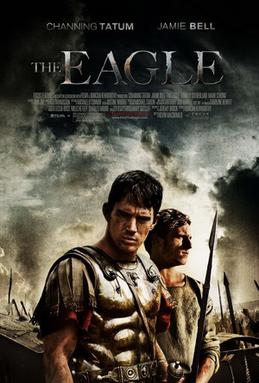
Jamie Bell and Channing Tatum on a spectacularly un-fun adventure in The Eagle

Director: Kevin Macdonald

Cast: Channing Tatum (Marcus Flavius Aquila), Jamie Bell (Esca), Donald Sutherland (Marcus’ Uncle), Mark Strong (Guern/Lucius Caius Metellus), Tarah Rahim (Prince of the Seal People), Denis O’Hare (Centurion Lutorius), Douglas Henshall (Cradoc), Paul Ritter (Galba), Paul Ritter (Galba), Dakin Matthews (Legate Claudius), Pip Carter (Tribune Placidus), Ned Dennehy (Chieftan)

Rosemary Sutcliff’s The Eagle is one of the classic young adult stories of all time. An enjoyable odd-couple-turned-brothers-in-arms series, with plenty of action and adventure it arrives on screen as a dark, gloomy and above all not-really-fun-at-all story that doesn’t seem to know whether it’s aiming for a boys-own yarn or an adult adventure. It basically fails to make either work.

In Roman Britain AD 140, Marcus Flavius Aquila (Channing Tatum) is a young centurion whose father was one of the commanders of the Ninth Legion, which disappeared twenty years before somewhere in the North. Now Marcus is working to save his family honour – but his career as a centurion is cut short after he is injured almost single-handedly saving his garrison from attack. Depressed, he resolves to head north to try and find his father’s legion’s missing eagle standard – accompanied only by his strong-willed slave Esca (Jamie Bell), who hates Rome but owes his life to Marcus who saved him from execution in the gladiatorial ring. Heading North they find the eagle is in the hands of a savage tribe of warriors, who take no quarter.

Kevin Macdonald’s film probably should work like a Bernard Cornwell novel remixed in Roman Britain – or, better yet, like a proto-Simon Scarrow novel. There should be a growing sense of odd-couple bond – or at least chemistry – between Marcus and Esca as unlikely allies who become even more unlikely friends. Sadly, Macdonald misjudges the mood and instead turns the film into a grimly serious, mud spattered and miserable travel saga, which slowly drains any sense of enjoyment out of the story and its mission.

Instead, Esca and Marcus seem to hate each other’s guts for most of then movie until the plot finally absolutely demands that they lay down their lives for each other – at which point, an unearned switch takes part. Rather than an amusing “opposites attract”, men on a mission banter that the film sort of needs, instead everything is morose, angry and very, very serious. By the time the film hits the sort of banter tone it needed at the start, the credits start to roll.

It’s not helped by the choices of the two lead actors. Tatum is at his most “serious” here, with none of the playfulness and lightness that can make him an engaging presence. Instead he’s muscle bound and frowning, dispatching enemies without a second thought and forever gloomily reflecting on his father’s lost honour. Bell gets the tone slightly more on point, but he’s given almost nothing light to work with, instead having to juggle guilt and resentment at the oppression his people face and his part in it. With the dreary photography, all this misery finally starts to wear the viewer down.

Where’s the enjoyment of all this adventure? I get the film wants to make a serious point about the cost of empire and conquest, but did that have to be at the cost of any sense of fun? At least the film does take an interesting decision to make all the Romans American – reflecting the fact that America is “the new Rome” – but it doesn’t really take these revelations anywhere.

Not that you would really want it too as this is supposed to be an adventure story. Instead it’s a gloomy trip of two angry people in extreme cold and mud to grab a metal eagle, punctured by darkly framed fights, dully assembled dialogue scenes and a bubbling dislike between the two lead characters that never flowers into respect until far too late. By making neither of the two lead characters particularly likeable, we never really invest in their journey – and in the end just plain don’t care about what happens to them or if they ever get that eagle at all. For an adventure story, this is one trip you’ll insist you’d rather stay at home and guard the base.

Around the World in Eighty Days (1956)

Around the world header
David Niven and Cantinflas head Around the World in Eight Days in this Oscar-winning epic

Director: Michael Anderson

Cast: David Niven (Phileas Fogg), Cantinflas (Passepartout), Shirley MacLaine (Princess Aouda), Robert Newton (Inspector Fix), Charles Boyer (Monsieur Gasse), Joe E. Brown (Stationmaster), John Carradine (Colonel Proctor), Charles Coburn (Steamship clerk), Ronald Colman (Railway official), Melville Cooper (Mr Talley), Noel Coward (Roland Hesketh-Baggott), Finlay Currie (Andrew Stuart), Marlene Dietrich (Hostess), Fernandel (Paris coachman), Hermione Gingold (Sporting lady #1), Cedric Hardwicke (Sir Francis Cromarty), John Gielgud (Foster), Trevor Howard (Denis Fallentin), Glynis Johns (Sporting lady #2), Evelyn Keyes (Paris flirt), Buster Keaton (Train conductor), Beatrice Lille (Revivalist), Peter Lorre (Steward), Victor McLaglen (SS Henrietta helmsman), John Mills (London coachman), Robert Morley (Gauthier Ralph), Jack Oakie (SS Henrietta captain), George Raft (Bouncer), Frank Sinatra (Piano player), Red Skelton (Drunk), Harcourt Williams (Hinshaw)

In the 1950s, cinema struggled to encourage people to come out of their homes and leave that picture box in the corner behind. Big technicolour panoramas and famous faces was what the movies could offer that TV couldn’t. This led to a trend in filmmaking that perhaps culminated in 1956 with Around the World in Eighty Days triumphing among one of the weakest Best Picture slates ever seen at the Oscars. Around the World had everything cinema knew it could do well: big, screen-filling shots of exotic locations filmed in gorgeous colour; and in almost every frame some sort of famous name the audience could have fun spotting. It’s perhaps more of a coffee table book mixed with a red carpet rather than a narrative film: entertaining, but overlong.

Faithfully following Jules Verne’s original novel (with added balloon trips), Phileas Fogg (David Niven) is a punctilious and precise Englishman of the old school, whose life is run like clockwork and whose only passion is whist. Nevertheless he accepts a challenge from his fellow members of the Reform Club (among them Trevor Howard, Robert Morley and Finlay Currie) to circumnavigate the globe in 80 days or less. Setting off with his manservant – the recently hired, accident prone Passeportout (Cantinflas) – Fogg races around the world, from Paris to Cairo to India to Hong Kong to Japan to San Francisco. Along the way he rescues Princess Aouda (Shirley Maclaine) from death by human sacrifice in India and has to confront the suspicions of Inspector Fix (Robert Newton) who is convinced that Fogg is responsible for a huge theft at the Bank of England. Can Fogg make it back to the Reform Club hall on time to win his bet?

Around the World was the brain-child of its producer Michael Todd. A noted Broadway producer, Todd had been looking to make a similar splash in the movies. Perhaps it’s no surprise that he decided the finest way to do this (after the mixed success of a movie version of Oklahoma) was to produce something that‘s pretty much akin to a massive Broadway variety show. Around the World – as you would expect – is an incredibly episodic film, seemingly designed to be broken down into a number of small sequences either to showcase the scene’s guest star or to provide comic opportunities for Cantinflas to display his Chaplinesque physical comedy.

That and lots of opportunities for some lovely scenic photography. Nearly every major sequence is bridged with luscious photography capturing some exotic part of the world – from the coast of Asia to the Great American Plains. It’s pretty clear this is a major attraction of the film: come to the movies and see those parts of the world you’ve always dreamed of, just for the price of a movie ticket! Surely introduction of a hot air balloon to allow Fogg and Cantinflas to travel from Paris to Spain was purely to allow lovely aerial shots of the French countryside and chateaux. It’s the sort of film that proudly trumpeted in its publicity the number of locations (112 in 13 countries!), the vast number of extras (68,894!) and even the number of animals (15 elephants! 17 fighting bulls! 3,800 sheep!). It’s all about the scale.

That scale also carries across to the guest cameos. Between enjoying the scenic photography, viewers can have fun spotting cameos. Can that really be Noel Coward running that employment agency! The chap who owns the balloon, I’d swear that’s Charles Boyer! Wait that steward: that’s Peter Lorre! Good lord that’s Charles Coburn selling Fogg tickets for the steamer! Oh my, Buster Keaton is helping them to their seats on the train! Marlene Dietrich is running that saloon – and good grief that’s Frank Sinatra playing the piano! Most of the stars enter into the spirit of the thing, even if they frequently start their shots with backs to the camera, before turning to reveal their star-studded magnificence. Sadly time has faded some of the face recognition here, not helped by David Niven (perfectly cast as the urbane and profoundly English Fogg, so precise that his idea of romantic talk is to recount past games of whist) probably today being one of the most famous people in it.

Todd marshals all this with consummate showman skill. It’s handsome, very well mounted and generally entertaining – even if it is painfully long (it’s not quite told in real time, but can feel like it at points). The film is nominally directed by Michael Anderson. However, I think it’s pretty clear his job was effectively to point the camera at the things Michael Todd had lined up (be they location or stars) – Todd had already dismissed the original director, John Farrow, after a day’s shooting for not being sufficiently ”co-operative”. To be honest it’s fine as this is an entertainment bereft of personality, instead focused on being “more is more”.

Part of its extended runtime is due to the long comedic sequences given to Cantinflas. A charming performer – and possibly the most famous comedian in Latin-America at the time – Cantinflas can be seen doing everything from bicycle riding, to bull fighting (for a prolonged time), to gymnastics to horseback riding. (Far different from the unflappable and spotless English gentleman Niven is playing.) Your enjoyment of this may depend on how far your patience lasts. I’m not sure mine quite managed to last the course. Sadly one of Cantinflas’ greatest comedic weapons, his Spanish wordplay, was completely lost in translation.

There are some decent sections. The iconic balloon flight is well mounted and gives the most impressive images (the famously vertigo-suffering Niven was replaced by a double for much of this). Others, like the bullfight or an interminable parade in San Francisco go on forever. The casting of Shirley MacLaine as an Indian princess is an uncomfortable misstep (even at the time MacLaine felt she was painfully miscast), made worse by an offensive “human sacrifice” storyline – that got cut when the film was screened in India. Robert Newton though is very good value as the misguided but officious Inspector Fix.

Around the World in Eighty Days is grand, handsomely mounted entertainment. But to consider it as a Best Picture winner feels very strange. It’s not a lot more than an entertaining variety show, its plot impossibly slight (made to feel even more so by its vastly over-extended run time). While you can enjoy it in pieces, it finally goes on too long for its own good. Entertainingly slight as it is, it’s still one of the weakest Best Picture winners ever.