Category: Romance

Sergeant York (1941)

Sergeant York (1941)

Patriotic flag-waver with a great performance from Cooper and plenty of genuine heart

Director: Howard Hawks

Cast: Gary Cooper (Alvin C. York), Walter Brennan (Pastor Rosier Pile), Joan Leslie (Gracie Williams), George Tobias (“Pusher” Ross), Stanley Ridges (Major Buxton), Margaret Wycherly (Mother York), Ward Bond (Ike Botkin), Noah Beery Jr. (Buck Lipscomb), June Lockhart (Rosie York), Dickie Moore (George York), Clem Bevans (Zeke), Howard Da Silva (Lem), Charles Trowbridge (Cordell Hull)

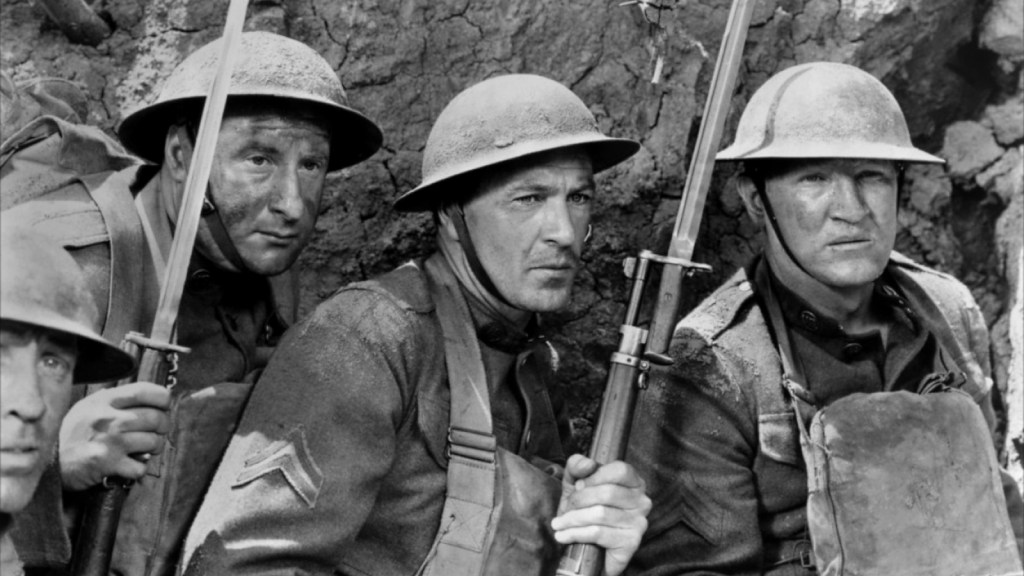
In 1941, after Japanese bombs landed on Pearl Harbor, America needed patriotic big-screen heroes. Few stood out more than Alvin York. A young man (over ten years younger than Gary Cooper) who had lived a youth of drunken rough-and-tumble before he found the light. When America joined the First World War, the 30-year-old York was called up. A gifted sharp-shooter, York was perfect for soldiering – but had to wrestle with his conviction to stick to the Commandments from the Good Book. Finding a solution to his moral quandary, York fought in France where his sharp-shooting instincts saw him almost single handedly capture a German machine gun embankment and 132 Germans (it’s an achievement that sounds pure Hollywood, but is in fact entirely true).

It’s an inspiring hero story that Warner Brothers bought to the screen at the perfect time, it’s release seeing tales of streams of young men walking from the cinema straight to the enlistment office. Producer Jesse L Lasky spent no less than twenty-two years attempting to persuade the notoriously publicity-shy and modest York (just as in the film, the real York couldn’t wait to leave the glitz and glamour of his triumphant homecoming behind and return to his fiancé, farm and work with the Church) to grant him the film rights to his life. York agreed only with the advance of Hitler, a hefty payment to his Church and a promise that no-less than Gary Cooper would play.

Cooper was reluctant – pointing out he was far too old to play this national hero – but really no other actor could have done it. Cooper won his first Oscar for the role, and it’s his understated sincerity and decency that really sells the film. He turns what could otherwise by a potentially cloyingly perfect man into someone utterly sympathetic and endearing. There is an aw shucks quality to Cooper, as he captures York’s modesty, his shrugging off his accomplishments as no more than his duty, his palpable discomfort with attention (be it from congressmen or his fellow Tennessee farmers commending his shooting) and a deep-rooted genuineness in his love for his beau Gracie (Joan Leslie giving a commendable performance of endearing brightness that helps you overlook she was 24 years younger than Cooper – thankfully she doesn’t look it).

Cooper’s performance powers a sprightly, very enjoyable film by Howard Hawks (who picked up his only Oscar nomination for this) that manages to transcend the danger of being an overbearing flag-waver. (Don’t get me wrong though – this film waves the flag so much, you can practically feel the strain in its arms). Hawks produces a film that in many ways owes as much to The Adventures of Robin Hood as an heroic All Quiet on the Western Front. Despite the patriotic focus being the final few Acts, as York carries out his act of astonishing heroism, the film’s real heart is in the opening half and the conversion of a man who is never-too-naughty into one who casts aside the demon drink, works hard to earn what he has, and puts his faith and the good of others before his own concerns.

Hawks shoots this part of the film with a palpable energy and a rough-and-tumble sense of humour. It’s there from the film’s opening as Walter Brennan (in a role he invests with all his wheezy, twinkly dignity) finds his sermon constantly interrupted by the gunplay of the drunken York and his buddies. There is a light humour when Margaret Wycherly – a little too ethereal for my taste as York’s saintly mum (although her casting does make York and White Heat’s Cody Jarrett siblings) – archly observes that, even when drunk, her son’s accuracy with a shooter is second to none. That’s the skill of Sergeant York there: in it’s end is it’s beginning, York is already deeply skilled and as his slightly embarrassed reaction shows when he sobers up, reformation is not a long journey.

A large part of the success is making York one of us. Striving to save the money he needs to buy the farmland of his dreams, Hawks provides a sweet montage of York undertaking no end of backbreaking, thankless work and returning home to tick off his slowly accumulating dollars under the smiling approval of Ma. When, after all his work, he finds the land has nevertheless been sold (because the owner never believed this previously idle lush could hold on to his hard-earned pennies), his outrage at the breaking of another man’s word is a clarion call to all of us who have played by the rules and been shafted. When his conversion comes, it’s not as out-of-the-blue as it could seem, but a logical conclusion for a journey we’ve watched him go on.

It’s undercut with scenes that drip with Hawksian skill. A marksmanship competition is crammed with a playful Robin Hoodesque skill. A bar-fight that the drunken York gets wrapped up in is so full of comedic tumbles and prat falls it’s hilarious. York’s constantly being fetched for various tasks by his kid brother is expertly played for subtle laughs. Alongside this, the romance between York and Gracie (and the off-screen slapping he hands out to a rival who treats her with disrespect) is beautifully handled.

The only real Hawksian touch missing is that little slice of cynicism, that ability to look under the skin of a legend (like with Wayne in Red River) and see a more flawed person. York basically is perfect, and in a film dripping with patriotism there can’t be any fault with either the army or the moral question of whether gunning down your fellow humans is alright in the service of your country. There is a version of Sergeant York where his commanding officer’s invitation that he take some time and read his way through the history of America (a replacement good book) was an act of naked manipulation of a guileless man. Or where we see the sort of guilt at his taking of life that the real York felt, play out across Cooper’s face. There’s none of that here.

In fact, after the vibrant, playful, heartfelt first few acts, you feel Hawks felt less interested in the war itself. There is a functionality about the final acts of Sergeant York as York aces his shooting tests on the range (although the flabbergasted reaction of his training officer and York’s apologetic manner at his failure to only manage five dead-on bulls-eyes on his first time using an army-issue rifle are funny). Hawks spices it up with York’s turkey-shoot metaphor, and a warm supporting turn from George Tobias (as a New Yorker soldier) and York’s gobble-gobbles to distract his German opponents. But, for all the realism of the trenches, there is an air of duty about this sequence.

But then Sergeant York works not because of the deed, but the man. And the film’s success in investing us in a man who could very easily have been all-too-perfect, in a playful and energetic first half works wonders. With a very fine, perfectly judged performance by Gary Cooper, this may not be Hawks most characterful work – but as the sort of film to showcase a man who inspires you to achieve acts of heroism, it hits the target perfectly.

Moonstruck (1987)

Moonstruck (1987)

Charmingly romantic comedy with little touches of Shakespeare in its celebration of family love

Director: Norman Jewison

Cast: Cher (Loretta Castorini), Nicolas Cage (Ronny Cammareri), Olympia Dukakis (Rose Castorini), Vincent Gardenia (Cosmo Castorini), Danny Aiello (Johnny Cammareri), Julie Bovasso (Rita Cappomagi), Louis Goss (Raymond Cappomagi), John Mahoney (Perry), Feodor Chaliapin (Old man), Antia Gilette (Mona)

People do strange things all the time. We don’t always understand why, so why not say it’s a midsummer madness caused by the moon. Moonstruck seizes that old superstition of blaming the position of our nearest celestial neighbour for sending us all a bit barmy, and weaves it into a film that’s both a playfully eccentric romantic comedy and a sweet tribute to the power of a family’s loving bonds. John Patrick Shanley’s (Oscar-winning) script pulls these strings together so well, it’s not a surprise it’s the sort of a film that frequently ends up on people’s ‘favourite film’ lists.

Loretta Castorini (Cher) is an Italian-American widow, living with her parents, who is starting to wonder if she is cursed with spinsterhood. As the moon reaches its bright zenith, she agrees to marry her terminally dull, utterly unromantic boyfriend Johnny (Danny Aiello), because anything’s better than nothing (despite the fact he seems to see her as much a substitute for his mother as a romantic partner). She agrees to mend the bad blood between him and his younger brother Ronny (Nicolas Cage). Ronny is a picture-postcard of an eccentric, a one-handed baker (blaming his brother for that) prone to melodramatic fits of rage and outbursts of Operatic passion. Loretta and Ronny – blame that moon – are instantly smitten with each other. Who is going to sort that out?

It all pulls together into a sort of modern fairy tale, where everything has an air of gently heightened reality. It’s also the sort of thing that wouldn’t seem out-of-place in Shakespeare’s lightest comedies: people fall in love on a sixpence, feuds are fixed in minutes, cheating spouses instantly return to their wives and jilted suitors smile and join in the celebratory drinks. In this world of theatrical, fairy-tale comedy, it’s quite easy to buy that an exceptionally bright moon is sending everyone a little bit crazy (like Shakespeare’s Dream lovers in the forests outside Athens, going through one crazy doped-up night before settling suddenly into two loving couples) and eventually you just run with it in Jewison’s charming film.

With a script full of witty lines and theatrical bits of bombast (which Cage in particular, inevitably, rips through), Moonstruck is also one of those endlessly charming, relaxing and pleasant films where fundamentally everyone is at-heart decent. Sure, mistakes are made throughout; harsh words and truths are spoken, but within a film where everyone cares for each other. Ronny may (rather unjustly) blame his brother for briefly distracting him at work into losing his hand, but deep down he’s just waiting for an excuse to forgive his brother. Loretta may have a prickly relationship with her mother, but it’s roots are really firm and based around both protecting the other from knowledge of the knee-jerk philandering of her father. It takes the influence of the moon to suddenly spark these people into a few days of crazy behavior that changes their lives and leads them to re-address their relationships with each other.

It also makes Loretta, in an Oscar-winning comedic turn from Cher, face up to the fears about where her life is going. In a performance that is remarkably unglamourous – Cher plays every inch of the reliable window settling into spinsterhood and the film never falsely ‘transforms’ her – Cher invests Loretta with a deep fear and resignation below her surface of reliability and unflappability. Loretta is so used to being practical and dependable, organising the lives of everyone (even patiently instructing the confused Johnny on how to propose marriage), part of her romantic relief with Ronny is being able to let rip a more sensual and vulnerable part of herself. Cher lets the mask slip, as if having had love potion dripped into her eyes, letting her express her deeper feelings.

It makes sense then that she should fall in love with someone as self-willed and resistant to being mothered as Ronny. In an early role that straight away captures Nicolas Cage’s willingness to rip into a scene (what other actor would feel like such a natural fit for a lovably blow-hard, one-handed, baker melodramatically prone to threatening no end of harm on himself?), Ronny has all the sort of wildness and uncontrolled energy and excitement the rest of Loretta’s life doesn’t have. And he doesn’t want her to fill a surrogate role for another family member – he wants her to be part of an equal relationship on her own terms with him.

It’s probably the sort of relationship Loretta’s parents had at one point. Before her mother Rose (another Oscar-winner, Olympia Dukakis) become cynical and shut-off from her husband Cosmo (Vincent Gardenia). Cosmo has let his decency get squashed under a fear of growing old, clinging to a younger girlfriend (Anita Gillette) who he conducts an affair more out of habit more anything. No wonder Rose considers flirting with John Mahoney’s constantly-jilted professor (in a touch that hasn’t aged well, he keeps trying to date his students), but not going the whole hog, while Cosmo tries to feel young again by doubling-down on his quietly dying affair.

What’s surprising then is that Moonstruck bubbles all this romantic back-and-forth into a warm celebration of familial love. While romantic bonds are firey, they are transient – the bonds of family last. Moonstruck culminates in the family putting the sort of romantic divisions that have kept them apart aside to come together in a warm celebration: like Shakespeare’s lovers they have woken up and found out everything is in fact fine. There’s something really reassuring and hopeful about this – that our feuds and divisions can bring us together as much as they can tear us apart.

It’s another reason as well why this is a popular film. It’s helped of course by John Patrick Shanley’s well-crafted script, and the terrific playing of the actors. Cher and Cage both have great chemistry and get the tone of the eccentric but touchingly tender unlikely romance just right. Dukakis and Gardenia are both funny and sweet as their parents, Aiello gives a very generous performance as a dutiful-boy-who-never-grew-up and there’s a scene-stealing cameo from Feodor Chalipin as Loretta’s eccentric grandfather. Above all, Moonstruck is a playful, feel-good film that doesn’t take itself too seriously and lives you feeling hopeful that everything can work itself out – even when the magic of the moon sends us a little crazy.

Alibi (1929)

Alibi (1929)

Early talkie as flashes of interest here-and-there as it awkwardly adapts to sound

Director: Roland West

Cast: Chester Morris (Chick Williams), Harry Stubbs (Buck Buchanan), Mae Busch (Daisy Thomas), Eleanor Griffin (Joan Manning Williams), Regis Toomey (Danny McGann), Purnell Pratt (Sergeant Pete Manning), Irma Harrison (Toots)

After a long stretch, Chick Williams (Chester Morris) is finally out of the slammer – and he’s celebrating by getting married to Joan Manning (Eleanor Griffin), who just happens to be the daughter of Police Sergeant Pete Mannings (Purnell Pratt). But it’s all fine, because Chick is going straight. And when the police are convinced Chick killed a police officer during a bungled burglary, Joan is certain he didn’t. In fact, she can give him a cast iron alibi – they were at the theatre together and, even if the killing did happen when they were separated during the interval, he definitely didn’t do it. Or did he?

Alibi (an early nominee for Best Picture) is another classic example of both Hollywood adapting a melodramatic Broadway murder-drama hit to the screen and a silent film hurriedly (and sometimes awkwardly) retrofitted to sound. It makes it a strange beast, a hodgepodge of different acting styles with scenes ranging from dynamic and experimental camera movement with flashes of intriguing sound usage to painfully awkward dialogue scenes where most of the actors stand very still and enunciate very slowly and clearly to make sure the mics pick up every word.

We get an explosion of sound at the start – films of this era knew audiences were gripped by such humdrum audio marvels as prisoners marching out of cells, bells ringing and police rhythmically tapping nightsticks against a wall. West does shoot this with quite a bit of interest – in particular the sudden appearance of the prisoners from behind a row of doors that swing shut. It’s handsomely designed by William Cameron Menzies and there are the odd moments of flair: a camera that tracks from a low-angle into the hotel Chick and his associates use for their base of operations; a stool pigeon crumbling into panic with a nightmare vision of his interrogator’s heads swirling around him; a drunk leaning in towards a massive bottle in close-up; shadows are cast behind doors; there are some dynamic fights and punches and an impressive rooftop flight.

But it’s mixed with some painfully stilted dialogue scenes, with most of the cast shown up in a bad light. Scenes involving Sergeant Manning and his police cronies seem to take hours as the actors trudge painfully slowly through the dialogue, their voices at time sounding like the film has been caught in a projector reel. You really notice the difference when the actors do something silently, their bodies moving with a swift confidence they lose as soon as they speak. Several actors – most notably Eleanor Griffin – still rely on tried-and-trusted silent reactions, signposting reactions they are also communicating with dialogue.

It stands out when the film does use dialogue well. The stool pigeon interrogation sees the interrogators repeat “Who killed O’Brien” and “Come on, come on” over and over again with an increasing rhythmic pace which really captures the mood of relentless interrogation. A scene involving a police switchboard sees a line of operators all speaking, but each sentence we catch forms a coherent narrative whole. There are some relatively ambitious song and dance numbers in Chick’s club. It’s just a shame so many of the core dialogue sequences are so dire.

Alibi does throw in a few decent twists here and there. Today we are not a jot surprised that Chick is in fact a villain, but the film manages to play its cards fairly close to its twist. That’s largely due to Chester Morris’ (an Oscar nominee) very effective performance, easily the finest in the film. Morris has the air of a cocky James Stewart, a false small-town bonhomie covering his greed and arrogance. He plays the humble suitor well – but his smug grin to Sergeant Manning when Joan reaffirms her complete faith in Chick is a great insight to who he is. He’s also a bully and, it transpires, a complete coward – Morris nails a great breakdown scene late in the film where his assurance disappears in a cloud of begging.

Morris is probably slightly better than much of the film deserves. He’s also luckier than Regis Toomey, whose ‘drunken acting’ as booze-hound criminal (truly some of the worst bits of alcoholic acting I’ve ever seen) is still not really excusable, even when you find out it’s a double bluff on his character’s part. (It’s so awful I’m amazed anyone is fooled). Toomey is also the centre of a death scene so ridiculously overblown, maudlin and sentimental it’s far more likely to illicit laughs than tears today as it stretches out over almost five minutes of screentime.

There is the odd intriguing idea in Alibi. It’s remarkable how critical of the police it is – even if it defaults to framing them as heroes in the end. Joan tells her father she could never marry the copper suitor he favours, because she believes cops to be corrupt bullies. An idea you can see partially borne out when our stool pigeon is made to put his fingerprints on a gun and threatened with judicial fake-self-defence murder unless he confesses. Bullets are fired freely at criminals, who left alone to be roughed up and threatened when arrested. It’s not exactly the most flattering view of law enforcement, who (despite reverting to heroes at the end) are constantly shown to be willing to bend the word of the law.

These moments of interest just about sustain it, added to Morris and West’s touches of flair. But it’s also got some painfully dated, awkward moments as Hollywood still struggled to stumble from silence to sound.

Lost Horizon (1937)

Lost Horizon (1937)

Capra’s well-made Utopian dream lacks any of self-awareness of the flaws in its vision

Director: Frank Capra

Cast: Ronald Colman (Robert Conway), Jane Wyatt (Sondra), Edward Everett Horton (Alexander Lovett), John Howard (George Conway), Thomas Mitchell (Henry Barnard), Margo (Maria), Isabel Jewell (Gloria Stone), HB Warner (Chang), Sam Jaffe (High Lama)

Life can be such a never-ending rat race, the idea of chucking in that relentless pursuit of fortune and glory can be really tempting. Fortunately, it turns out there is a place you can do that: Shangri-La, a halcyon Utopian community buried deep in the Himalayas. There the mountains give it a gloriously perfect climate and preserves its residents youth for potentially hundreds of years. It’s a paradise for legendary diplomat Robert Conway (Ronald Colman), one of a group of Westerners whose plane crashes near-by, all of them invited to make their lives there.

It’s easy to see why this appealed to Frank Capra – even if his real idea of Shangri-La was Small Town America – and he poured years (and millions of dollars) into this dream project (it also took years to make back the investment). Conway is part of a group of mostly British Westerners escaping revolution in China. In Shangri-La, he’s deeply drawn to the peaceful ideology outlined by their host Chang (HB Warner) and Shangri-La’s spiritual leader, the Great Lama (Sam Jaffe). Not to mention the charms of resident Sondra (Jane Wyatt). Problem is, his brother George (John Howard) is desperate to return home. What will Robert choose?

Lost Horizon has a lot to admire about it, in among the incredibly earnest force of its telling, devoid of any drop of cynicism or irony. This is like a 101 of what to expect from Capra? It’s a celebration of the glories of living a simple, pure life without ruthless ambition and realpolitik. It’s filmed on a highly impressive scale by Capra – the gargantuan sets certainly show where the money went. Striking sequences, like a seemingly never-ending torch-lit parade of the people of Shangri-La marching towards Chang’s opulent estate, are breathtaking.

It hosts a fine parade of actors: Colman is perfect as the debonair, world-weary Conway, Horton and Mitchell make their supporting comic double-act genuinely funny (Horton, in particular, litters the film with wonderful bits of comic business using everything from mirrors to jewellery boxes), HB Warner makes a series of infodump ideological sermons more engaging than they deserve and Isabel Jewell creates a great deal of charm in the blousy Gloria. Interestingly, perhaps the most compelling sequence of Lost Horizon occurs before they even arrive, as these characters feud and panic on a hijacked plane taking them in totally the wrong direction.

But there is often something a little too pure about Lost Horizon. Even as the film-making beautifully unspools, it’s hard not to notice that for a huge chunk of this long film very little really happens beyond slightly sanctimonious speechifying comparing ‘our’ civilisation with the peaceful life of Shangri-La. In fact, it’s easy (particularly in our more cynical age) to start feeling a bit twitchy. So earnestly perfect is everything there, with a simplistic and unchallenging view of kindness and brotherly love, it starts to feel like being continually slapped by a SparkNotes copy of Thomas More. Capra uses John Howard’s blowhard George, to put a counter-view – but fills him with such ambition and desire that we are of course never in danger of taking him seriously.

Graham Greene wrote of the film “nothing reveals men’s characters more than their Utopias” before observing the design of Shangri-La resembled nothing more or less than a luxurious Beverly Hills Estate. Rarely has a truer word been spoken: this mountainous paradise, with its carefully designed gardens, well-stocked libraries, grand ballrooms and lush woodland perfect for riding feels like a slice of affluent middle-class Western civilisation in the middle Tibet. It makes for an interesting window into the film today.

Because it’s hard not to see Shangri-La as less of a land of beautiful contentment, and more as a sort of colonialist wet dream. Scratch the surface and it’s a very hierarchical community. Literally at the top of the hill, living in upper-class harmony surrounded by art, books, comfy armchairs and fine dining are the elite (all bar one of them Westerners). At the bottom, in their huts, live the Tibetan natives happily continuing their traditional way of life, happy to live and work (unlike the Chinese revolutionaries who Conway and co flee in the film’s opening) in the shadow of their betters. A smarter film than Lost Horizon might have pointed out the irony that Shangi-La is just a colony where the natives haven’t yet embraced political self-determination – but I’m not sure if such an idea occurred to Capra.

As soon as this crossed my mind, I couldn’t help picking holes in the calamitous internal logic of the film. Shangri-La’s only contact with the outside world is via a group of Tibetan sherpas who trek up and down the mountain once a month bringing supplies from the outside world – presumably its them who have trooped up thousands of books (including the complete works of Robert Conway!), hundreds of mediocre paintings and roomfuls of rococo furniture. The kindly inhabitants of Shangi-La’s palace never considered overseeing the construction of basic plumbing and power generation for the natives living in the valley below them (though they somehow recruited contractors to supply those things to their house on the hill).

In fact, the whole of Shangri-La’s world is set up on maintaining a strict two-tier system that keeps people content by making sure they never think for themselves. (What passes for education, is a series of patronising missionary-style sing-alongs). Even more chilling, the Grand Lama (a softly spoken Sam Jaffe, under mountains of make-up) has dreams of Shangri-La rebuilding global civilisation after its inevitable destruction, the whole world adopting his simplistic ideology. He means well, but I couldn’t help be reminded of Dr Strangelove orgasmically rising from his chair at the thought of creating a fascist Utopia of sexual bliss under an Earth poisoned by nuclear radiation.

None of these ideas enter into Lost Horizon’s simplistic world-view. It sticks with saying what the world needs is to be crafted into a sort of country estate, a sort of Tibetan Downton Abbey, with everyone happy with their assigned place in the chain. Lost Horizon gets as close as it can to any form of social criticism when Conway bemoans 90 ‘whites’ were saved from that opening Chinese revolution while thousands of natives were left to die. But aside from that, is exactly what it says on the tin: there are no flaws in Shangi-La.

And maybe I’m being impossibly cynical. Lost Horizon is a lovely film to bathe in for a while – after all Capra, at his peak, couldn’t make a clanger if he tried. But there is a more complex story on the edges here. If Lost Horizon had showed us more of Conway’s Gulliver-Like return to civilisation, lost in a series of spinning newspaper headlines, it could have given us more of that. But Capra is no Thomas More or Jonathan Swift. The satirical and suppressive elements under a hierarchical Utopia are alien to his mindset. Lost Horizon is a reassuring promise founded on shaky ground indeed.

42nd Street (1933)

42nd Street (1933)

Less a musical, more about a musical – but a delightful love letter to the joy of theatre

Director: Lloyd Bacon

Cast: Warner Baxter (Julian Marsh), Bebe Daniels (Dorothy Brock), George Brent (Pat Denning), Ruby Keeler (Peggy Sawyer), Guy Kibbee (Abner Dillon), Dick Powell (Billy Lawler), Una Merkel (Lorraine Fleming), Ginger Rogers (Anytime Annie), George E Stone (Andy Lee), Ned Sparks (Barry), Robert McWade (Jones), Allen Jenkins (MacElroy)

Jones and Barry are putting on a show! The cry lights up Broadway (in an impressively staged series of quick-cuts, cross fades and super-impositions of the excited souls). And 42nd Street is all about the creation of that show, from the signing of the contracts to the opening night and the spontaneous making of a star. If it feels, watching 42nd Street that it’s made up of nothing but theatrical cliches… then it’s because most of them became cliches from excessive re-use after 42nd Street showed they worked so well – and made such a hugely entertaining film along the way.

The show is Pretty Lady, to be directed by Julian Marsh (Warner Baxter), the finest director (and friendliest tyrant) on Broadway who needs the money after losing a packet in the Crash. He’s not the only one struggling in Depression-era America: the competition to land a job as chorus girl is fierce. So, it’s a lucky chance that debutante Peggy Sawyer (Ruby Keeler) lands a gig. The star is Dorothy Brock (Bebe Daniels), a vaudeville veteran trying to make it as a serious Broadway actor and currently the squeeze of the shows’ wealthy financier Abner Dillon (Guy Kibbee) – although she is still seeing her old partner Pat Denning (George Brent). But will Dorothy make it through the drama to opening night – or will Peggy need to step up to save the day?

It’s not a surprise that of course she does, but then Julian’s final words to her (“You’re going out a youngster, but you’ve got to come back a star!”) is the film’s most famous moment. As well as launching a thousand backstage dramas, 42nd Street is remembered as a musical. But there is actually precious little music in it. We have to wait almost 45 minutes before the first song (Dorothy’s rendition of ‘You’re Getting to Be a Habit with Me’) and the final fifteen until we see the bulk of Busby Berkeley’s choreography. Other than that, this is very entertaining soapy, backstage drama with romantic entanglements. It’s a more film about the stressful theatrical alchemy involved in making a musical, rather than a musical itself – there is no ‘putting my feelings into song’ here.

And it’s taking place in Depression-era desperation. Everyone needs a job – that’s why they are so excited about hearing there is a show in town. That plays into the family atmosphere behind the scenes. After all everyone needs the show to be a success, and if that means roping in a few gangsters to get a wayward star back into line so be it. Much like, in fact, 42nd Street itself, coming to the screen after a glut of musical flops (perhaps that’s why there is so little actual musical content in it). The film zeroes in refreshingly and lovingly on the hard work, dedication and family atmosphere that can grow up in theatre, where everyone is working towards a common goal – and why I, a veteran of more than my share of putting a show on, felt a real soft spot for it growing.

And there is support, for all the bitchy moaning behind the scenes. Julian Marsh may tyrannically insist on absolute perfection – rehearsing through the night, waking the piano player when needed – but, it’s all to service a common goal. When emergency hits, the company flocks around and support each other. When one of their number triumphs there will be more congratulations than there are jealousies: even Dorothy will lay aside any personal feelings to support the new star. 42nd Street really captures the sense that behind the curtain in the theatre a little world of its own is created, one which can be very loving in its own unique way.

It’s also a world, with more than a few sexual escapades, something hard to overlook in a film as full of chorus girl’s legs as this (the chorus girls are largely hired on the basis of how good those legs look). Dorothy is effectively trading her favours for a career leg-up from the clueless Dillner, while sticking with true love Denning. Denning, jealous, conducts his own speculative flirtation with Peggy (in a fun sequence, her landlady throws her out for daring to bring Pat home for a coffee – while behind her another chorus girl smuggles out her lover with an illicit kiss). Anytime Annie didn’t get her nickname for her dancing, Lorraine is happy to leverage her relationship with dance director Andy Lee and Lee himself (it’s implied) is the willing subject of Julian’s attentions.

In the midst of this, poor Peggy feels rather naïve. Sure, she may be bouncing between unlooked for attentions from a young member of the company and leading young man Dick Powell, but a passing possibility of romance with George Brent’s cuckolded partner (in every sense) to Bebe Daniel’s star leaves her flustered. Brent’s intentions may well be noble, but left alone with him in his apartment, Peggy is sweetly nervous and locks her door after she is chivalrously conveyed to the spare bedroom by Brent, as if scared she may give into temptation. Hilariously they are only in his apartment, after his calling on her is mistaken for a dalliance by her landlady, who throws them both out while boasting she never misses a trick – all while, in the back of the shot, another tenant quietly ushes her beau out of the door.

All of this gives some lovely opportunity to its actors, and there are several delightful turns in 42nd Street. Not least in the chorus, where Una Merkel has a wonderfully playful flirtatiousness and Ginger Rogers gives her monocle-clad Anytime Annie a rogueish sexiness. Guy Kibbee’s moronically uncultivated sugar daddy gets several good laughs at his boorish cluelessness. If Ruby Keeler at times seem a bit unnuanced as the lead (there has long been some rather mixed feelings about her slightly heavy-footed dancing) and Dick Powell is eminently forgettable as her love interest, there is more than enough class from Baxter’s stressed out director, George Brent is very fine and Bebe Daniels invests Dorothy Brock with just enough vulnerability under the diva exterior to always leave you rooting for her (she is, after all, just as desperate for work as the meanest chorus girl).

It’s a film put together with flair – the early montage is pacily and flashily assembled – and a great deal of wit (producer Darryl F Zanuck and Berkely often gain the lion’s share of the credit for its pace, wit and zip although I feel some credit must go to experienced director-for-hire Lloyd Bacon). The final dance numbers are expertly done and very well filmed by Berkely, including a point where the camera glides under a parade of leg arches. But above all, it’s a heart-warming and witty tale that pulls back the romantic curtain of theatre to reveal – well an equally romantic view of the camaraderie and magic that brings a show to the stage. But it would be a hard heart that could not find something to smile at here.

A Star is Born (1937)

A Star is Born (1937)

One of the first iterations of the tale, and with two winning performances one of the best

Director: William A Wellman

Cast: Janet Gaynor (Esther Blodgett/Vicki Lester), Fredric March (Norman Maine), Adolphe Menjou (Oliver Niles), May Robson (Lettie Blodgett), Andy Devine (Danny McGuire), Lionel Stander (Matt Libby), Owen Moore (Casey Burke), Peggy Wood (Miss Phillips), Elizabeth Jenns (Anita Regis), Edgar Kennedy (Pop Randall)

A Star is Born wasn’t the first time this story was told and it certainly wasn’t the last. Each generation in Hollywood has produced its own version of the story, not to mention a gallery of other culture creating their own unofficial and otherwise remakes. What Price Hollywood had even effectively told the same story five years earlier, and the entire concept has the air of a medieval ‘fortune’s wheel’ – two souls bound together, one goes up as the other goes down. There may in fact not be nothing new about A Star is Born at all but gave such a bright new polish to the familiar, that we’ve been inspired to come back to it again and again.

In the farmyard sticks, Esther Blodgett (Janet Gaynor) has a dream:  to become one of those stars of Hollywood’s silver screen. With grandma’s (May Robson) money in her pocket (‘What have I got to spend it on?’) she heads to Los Angeles, only to find the city is awash with similarly starry-eyed dreamers desperate for a big break. Esther gets hers in an unusual manner: serving drinks at a Hollywood party she strikes up conversation with famous star Norman Maine (Fredric March). Norman is very taken with Esther – in fact he’s almost immediately in love with her – and arranges a screen test. Soon Esther has a new career, a new name – Vicki Lester – and a new marriage to Norman. Problem is, as her star rises and she becomes the next big thing, Norman stops letting “his acting get in the way of his drinking” and his career slides into oblivion.

It’s high romance, very effectively filmed by Wellman, that requires – and gets – two very strong, highly relatable performances from its leads. Wellman’s film carefully gives both of them the space to grow a relationship that begins shyly and becomes deep and tender. Gaynor is bright, naïve and gentle with just enough ambition and determination to impress. She’s eager to please, but also firm and knows her own mind, far from a pushover in this town of press releases and media spin. Gaynor never lets us forget that under ‘Vicki Lester’ there’s that ordinary Esther Blodgett (could there be a more grounded, less starry name than Blodgett?), a woman with principles in a world of fakes.

Perhaps even better though is Fredric March (it’s the first indication, borne out by nearly all the remakes, that Norman is the better part). March is charismatic, engaging, funny, down-to-earth and everything you would want from a star – while also being a mean drunk with anger management issues. He’s introduced getting into a drunken scuffle at the Hollywood Bowl, and his love of booze makes him just as likely to laugh and flirt with Esther as it can make him take a slug at a guy who looks at him the wrong way. March’s drunk acting is very effectively restrained and he captures extremely well the self-disgust behind Norman at his weakness. March makes him a star who burns away his career through appalling choices, who fervently believes he can stay on the wagon until he can’t. In his hands it becomes a classic tragic piece, a Greek hero destroyed by his fatal flaw, his inability to escape the bottle.

This rich romantic tragedy builds wonderfully, Wellman keeping us deeply invested in this couple. The good times are really endearing: it’s hard not to grin along as they laugh and joke in a camper van after their elopement, or as they cover each other with encouragement and support for their careers. It makes the bad times unbearably painful: Norman’s drunken crashing of Esther’s Oscar win, a shambling monologue of self-pity and resentment, both heartbreaking and excruciatingly embarrassing. Norman’s fateful final decision is full of romantic imagery, as he smiling walks towards a sun-kissed beach, a beautifully staged inversion of a romantic ending.

A Star is Born’s other most interesting feature is its inside glimpse at Hollywood: or at least the version Hollywood was willing to present of itself to people. It even has a meta-theatrical element to it, the film book-marked by images of the shooting script describing the action immediately following or preceding it. Here Hollywood is a ruthless machine, chewing up the dreams of wannabes. An agent bluntly shows Esther the vast numbers of phone calls of wannabe extras they receive every day. Esther struggles just as much as assistant director Danny (Andy Devine) to find regular work. Careers are made and broken by chance, whims or the reaction of the audience to your face on screen. Names in lights one month and being pasted over the next.

Hollywood loves to be cynical about itself. A Star is Born delightedly shows its spin operation as ruthless, cut throat and controlling, planting stories about stars, covering up their misdemeanours (a regular requirement for the drunken Norman) and repackaging their lives into saleable commodities. Lionel Stander, as a heartlessly controlling press agent, is the heart of this, and the film doesn’t hold back on showing the dark powers of these studio fixers in action. But this is just a version of Hollywood: its telling that in A Star is Born while the middle management are condemned, the studio heads are absolved completely. Adolphe Menjou’s Selznick-like producer is an avuncular, uncle-like figure, endlessly caring and supportive of his stars who wouldn’t dream of any funny games to earn some money. This is a portrait of Hollywood where the top man is an affectionate saint – exposure only goes so far.

A Star is Born is also an interesting time capsule. Esther stares in admiration at a host of Hollywood Avenue stars of people must of the viewing public today would struggle to name (Norman Cantor anyone?). Seeking to impress while serving at a dinner party she’ll do impersonations of Garbo, Hepburn, Crawford and Mae West (the last even named). It’s a world where the continual production of content is even more on-going than on Netflix and the studios can start or end careers instantly. It’s a fascinating extra piece of interest in a highly effective, well-staged film. Even with its slightly murky early colour photography (it looks like a colourised black and white film), it’s a well-staged, effective romance with two very winning performances from its leads. Possibly one of the best versions of the story.

Kitty Foyle (1940)

Kitty Foyle (1940)

Odd romantic fable, with a star-turn, that doesn’t seem to fully realise how judgemental and puritanical it is

Director: Sam Wood

Cast: Ginger Rogers (Kitty Foyle), Dennis Morgan (Wynnewood Strafford), James Craig (Dr Mark Eisen), Eduardo Ciannelli (Giono), Ernest Cossart (Pop), Gladys Cooper (Mrs Strafford), Odette Myrtil (Delphine Detaille), Mary Treen (Pat), KT Stevens (Molly)

“Ginger Rogers did everything Fred Astaire did…[but] backwards and in high heels”. So goes the famous quote about the famed dance pairing. But Ginger Rogers also did something Fred Astaire never did: she won an Oscar. That was Best Actress for Kitty Foyle, a reminder that Rogers was the girl-next-door who was a fine actor, accomplished dancer and natural comedienne. Rogers is great in Kitty Foyle, an otherwise fairly average, at times painfully dated ‘women’s picture’ where flashes of wit conceal character flaws the film is unaware of and a series of frequently depressing messages about love and women’s choices.

In the early 1930s, Kitty Foyle (Ginger Rogers) is a young Philadelphia woman enjoying the opportunities the new world of emancipation gives her. Working as a secretary for a small magazine, she and its editor Wynnewood Strafford IV (Dennis Morgan) fall in love – but he lacks the courage to propose to a woman far below his family’s social standing. Moving to New York, Kitty works in a fashionable department store and meets with Dr Mark Eisen (James Craig). The two begin a tentative relationship – until Wyn returns and proposes, which Kitty eagerly accepts.

However, since the film plays out in flashback from 1939, we already know the Wyn-Kitty marriage is doomed to divorce since Wyn is re-married (with a kid!). Indeed, we’ll learn Kitty left her marriage because she felt the social differences between her and Wyn were insurmountable, in her (secretly) divorced state becoming engaged to Dr Mark. Kitty Foyle plays out a cliffhanger question: which of these two men will Kitty choose? Of course, there is zero tension in this decision – is there any chance at all that in a Production Code film, Kitty will choose a rich married family man over a hard-working doctor who we are introduced to tending to the poor of New York gratis?

Nevertheless, Kitty Foyle is structed through a series of snow globe-inspired flashbacks, narrated by Kitty’s reflection (who objects to herself being tempted by Wyn’s offer – hammering home the implicit moral judgement the film soaks in, even Kitty’s reflection thinks she’s a hussy). These snow-globe framed flashbacks are one of the most interesting things about Kitty Foyle today – largely because, if you think of 40’s snow globe flashback films your mind immediately turns to Citizen Kane (both from RKO!). It’s hard not to wonder if Orson Welles and/or Herman J. Mankiewicz remembered the device when they put their script together?

The other most interesting thing about Kitty Foyle is that neither Kitty nor the film can even pretend to raise much interest in its Code-approved romantic figure, Dr Mark. Fair enough, since Dr Mark is a crushing prig and self-important bore. Played with a humour-free smugness by James Craig, he’s the sort of guy who enjoys sitting on buses passing superior medical opinions about those around him. On his first date with Kitty, he unilaterally cancels a dinner to sit at home and play cards – which he later reveals was a moral test for all his first dates to see whether a potential partner is a gold-digger (it’s amazing he’s single). We get very little sense he is remotely interested in the real Kitty, instead preferring an idealised version of her as a potential assistant-in-all-but-name. In nearly every sense, he’s is the sort of stuffy, self-important, worthy man most comedies of the era saw the heroine’s apologetically jilt to enjoy true love with Cary-Grant.

Of course, Wyn is no Cary Grant. Played by Dennis Morgan with a wonderful sense of shallowness, he’s far too easily-led behind his charm for that. Wyn is a weak man, who struggles to take responsibility for (or make) his own choices. That doesn’t change the fact that Kitty has a passion for him she never once raises for Dr Mark. Kitty Foyle essentially agues his weakness and social status as the scion of a banking family (he is, we are not allowed to forget, the third man to bear the name Wynnewood Stafford), could never make him an appropriate match for the reassuringly middle-class Kitty.

There is a real inverted snobbery around Kitty Foyle, where the upper-classes of Philadelphia (represented, among others, by Gladys Cooper as Wyn’s imperious mother) can only-just-about suppress their discomfort about Kitty’s lower standing. (Their suggestion, when presented with the fait accompli of Kitty-Wyn’s marriage is to suggest Kitty attends a finishing school). Saying that, the family don’t object to the marriage and (in their own way) their suggestions are based around helping Kitty. The two-way snobbery is neither they nor Kitty can imagine a middle-ground: she is just as adamant she will not change anything about herself, as they can’t imagine accommodating her middle-class interests. The film wants us to blame Wyn for his upper-class background and spreads a depressing message that the classes should never mix.

Brutal assumptions people make about each other are at the heart of Kitty Foyle – and the film has absolutely no idea about this. The film never once questions the character flaws of certainty that lead Kitty, Wyn and Mark to all reach (false) conclusions about others. Kitty brutally decides, no matter what Wyn says, that she will divorce him because she doesn’t believe he will give him his wealth. And maybe she’s right – but she never asks him and makes a series of selfish decisions about their life that he has every right to be at least involved in. Kitty Foyle sees absolutely no issue with this, which you can bet its bottom dollar it would if the shoe was on the other foot. The is probably the only romance from Hollywood’s golden age that condemns true love in favour of cold-headed pragmatism and sensible (not passionate) choices.

All of this doesn’t mean that Ginger Rogers isn’t very good, as she carries virtually single-handedly the whole film. Kitty is feisty, determined, smart, shrewd, funny and brave. It gives her opportunities for light comedy and serious emotions. She’s very funny in comedy sequences, such as Kitty’s accidental pressing of the burglar alarm rather than stock room button on her first day on the job in a New York department store (I blame the woeful design flaw in putting these poorly-labelled buttons right next to each other!). But she’s also quietly heart-breaking in the film’s final segment where she faces a series of painful events. Rogers invests these with a quietly melancholic sadness laced with real dignity. It’s a fine performance that lifts an otherwise mediocre film.

It’s also a mediocre film that opens with a jaw-droppingly anti-feminist sequence to explain why girls are working. A series of silent flashbacks play out in silent-film-style dumb-show openly mocking suffragettes and the misguided passions of women for freedom that took them away from a live of ease being looked after by doting husbands. The whole point seems to be how unwise they were to fight to be foisted into a world of hard work and not being given a seat automatically on public transportation. It left me wondering how far into this script Katherine Hepburn got before she turned it down?

Dodsworth (1936)

Dodsworth (1936)

A marriage disintegrates in this richly mature, non-judgemental film one of the best of the decade

Director: William Wyler

Cast: Walter Huston (Sam Dodsworth), Ruth Chatterton (Fran Dodsworth), Paul Lukas (Arnold Iselin), Mary Astor (Edith Cortright), David Niven (Captain Lockert), Gregory Gaye (Kurt von Obersdorf), Maria Ouspenskaya (Baroness von Oversdorf), Odette Myrtil (Renée de Penable), Spring Byrington (Matey Pearson), Harlan Briggs (Tubby Pearson), Kathryn Marlowe (Emily), John Payne (Harry)

Marriage is tricky. In the hustle and bustle of everyday life, bringing up a family, running a business and rushing between social events, what if you don’t notice you don’t have much left in common? That’s the theme of Dodsworth, one of the most strikingly modern of 1930s films, that tackles the breakdown of a marriage in a surprising subtle way, avoiding the sort of moral punishment and condemnation you’d expect from the production code. Combined with sharp writing, fine acting and some fluidly creative direction from William Wyler, and you have an overlooked classic.

Dodsworth kicks off with the retirement of car entrepreneur Sam Dodsworth (Walter Huston). Having sold his successful independent factory to a major business, Sam is now effectively retired and suggests that he and his wife Fran (Ruth Chatterton) take that trip to Europe they’d always discussed but never had time to do. The trip, however, starts to reveal fractures in their relationship. Fran isn’t ready to ‘rush towards old age’ like she feels Sam, with his touristy longings and interest in engineering mechanics is. She wants to be part of society and feel the excitement of flirtations (and more) with rakeish European types (from David Niven to Paul Lukas to Gregory Gaye), while Sam ticks off the sites and sits in cafés. Sam, it turns out, has far more in common with Naples-ex-pat Edith (Mary Astor) – but feels duty bound to do whatever he can to preserve his marriage with Fran.

It’s all adapted from Sinclair Lewis’ doorstop novel, skilfully boiled down into a clear dramatic journey by Sidney Howard, from his own theatre adaptation (which also starred Huston). It becomes both slightly sad, watching two people drift apart, while also offering rich vestiges of hope of what the future can hold if you dare to take a chance. It mixes this with dry wit, scenes of compelling narrative interest and an insightful look at two people effectively going through different types of life crisis during a ‘once in a lifetime’ journey. Because nothing can disrupt your thinking about your own life more than changing nearly everything about it in one swift barrage of events.

It’s assembled into a richly involving whole by William Wyler, who lands the film just the right side of melodrama. From the opening shot, tracking towards Sam’s back as he leans against a window looking out over the factory which gave his life meaning, there is a quiet air of its characters living in denial of their own melancholy. Part of Sam is already wondering what on earth he’s going to do without his factory – its why he immerses himself in the most banal details of the sights they will see in Europe, or the engineering of their cruise ship.

Sam feels his journey will give him new opportunities, but it often sees him uncertain and slightly adrift, from not knowing how to tip waiters to finding his mid-Western mindset unable to compute the sexually liberal rules of European high society. Fran claims the journey abroad will mean leaving behind the oppressive parade of the over familiar social scene in their small town. It quickly turns out, she’s only be bored of their small circle not the glamour of social events.

Sam is played with real skill and under-played grace by Walter Huston in one of his finest performances. He’s an overwhelmingly decent man, self-made, confident but hesitant and uncertain out of his element. There’s a fuddy-duddy quality to him you can understand Fran finding grating, but he’s also capable of genuine, unfiltered enthusiasm (watch his joyful spotting of a famous lighthouse during their journey – which hilariously he nearly misses while checking his watch – and the eagerness which he tries to share this with an irritated Fran and a politely bored Niven). What’s superb about Huston’s performance is the awkwardness, shyness and even timidity he brings to a successful man, the quiet air of confused anxiety behind Sam as his certainties melt away.

Both Sam and Fran are convinced everything between them is fine, constantly speaking (increasingly dutifully) about their love, as if trying to convince each other even as it starts to fall apart. Their home already feels invaded by their daughter and her husband, who absent-mindedly serves himself drinks from Sam’s cabinet. They’re in completely different mindsets. Fran is constantly embarrassed by her husband’s tendency to hickness. Sam feels Fran’s upper-class ‘friends’ wouldn’t look twice at her without the cash she can flash. Fran is horrified by Sam’s whimsical statement that they will soon ‘be a couple of old Grandparents’. She’s young at heart, being wooed and won’t give that up.

From a ship-bound flirtation with David Niven’s suave playboy where she seems shocked at his implication that they can take things further (Sam doesn’t help by telling her she only has herself to blame), she swiftly begins an all-but-open affair with Paul Lukas’ smooth gentleman (with Sam turning an embarrassed third-wheel blind eye) even sending Sam home to extend her holiday privately, while he fields awkward questions from their family and re-directs his inner fury at his public cuckolding into grumpy rants about other’s scrabble games covering his desk and fussily reaching for his Encyclopaedia to prove trivial discussion points.

By the time Ruth has convinced herself divorce will lead, inevitably, to a glorious new marriage with much younger aristocrat Gregory Gaye, she’s at the centre of an increasingly delusional mid-life crisis, full of false claims about her age and built on fantasies. Ruth Chatterton is very good, neatly bringing to life a woman who can’t face the idea of becoming old. The film (while siding with Sam) never fully condemns her for her behaviour – even if it maintains an American suspicion of her wealthy European upper classes. In fact, it’s very hard not to feel sorry for Fran when her lover’s mother (played by an imperiously shrewd Oscar-nominated Maria Ouspenskaya) punctures her delusions about the likely future of a relationship with her feckless son.

It’s all beautifully framed by Wyler. How can you not admire the lingering shot of Fran reading a telegram from Sam and letting Lukas’ Iselin set fire to it, the camera following the paper as the wind blows it across the balcony floor to disintegrate like the Dodsworth marriage? Dodsworth is full of such beautifully subtle moments, its imagery (and Oscar winning sets) wonderfully establishing a world in transit as much as the Dodsworths. Wyler also evens the score at points: Sam remains largely sympathetic, but its possible to be irritated by his naïve dullness, just while the frequently infuriating Fran is relatable in tragic fear that her life is behind her.

It’s this mature view of people drifting apart, making mistakes and not always being condemned that makes Dodsworth such a richly intelligent film. Sam would certainly by more happy with Edith (a very moving performance from Mary Astor), just as Fran would be better off without Sam. Dodsworth is largely refreshingly free of the sort of Puritan punishments other films dealing with similar themes would use under the Production Code. Instead Dodsworth is a superbly acted, directed and written melodrama with a serious tone that remains richly rewarding viewing.

A Place in the Sun (1951)

A Place in the Sun (1951)

A great Hollywood romance obscures darker, more sinister implications that its makers seem unaware of

Director: George Stevens

Cast: Montgomery Clift (George Eastman), Elizabeth Taylor (Angela Vickers), Shelley Winters (Alice Tripp), Anne Revere (Hannah Eastman), Keefe Brasselle (Earl Eastman), Fred Clark (Bellows), Raymond Burr (DA Frank Marlowe), Herbert Hayes (Charles Eastman), Shepperd Strudwick (Tony Vickers), Frieda Inescort (Ann Vickers)

It’s based on Theodore Dreiser’s An American Tragedy, but in some ways it feels like very British. After all, few American films are more aware of class than A Place in the Sun and there is something very British about a working-class man pressing his nose up against the window of the wealthy and wishing he could have a bit of that. In some ways, A Place in the Sun’s George Eastman is a more desperate version of Kind Heart’s and Coronets Louis desperate to be a D’Ascoynes or a murderous version of Room at the Top’s Joe Lampton not wanting his girlfriend to get in the way of wooing a better prospect. The most American thing about A Place in the Sun it is that what would be a black comedy or a bitter drama in Britain, becomes a tragic romance in George Steven’s hands.

George Eastman (Montgomery Clift) is from the black sheep working-class side of the Eastman clan, rather than the factory-owning elite side who live among the city’s hoi polloi. George is gifted an entry-level grunt job in the factory but works hard for progression. He absent-mindedly dates production line co-worker Alice (Shelley Winters), who thinks he’s the bee’s knees. Unfortunately for her, George meets Angela Vickers (Elizabeth Taylor), daughter of the wealthy Vickers family, and they fall passionately in love. Just as Alice announces she’s pregnant and asks when George will do the decent thing. Can George thread this needle, rid himself of Alice and marry the willing Angela? Perhaps with the help of the Eastman’s lake side house and Alice’s inability to swim?

You can see the roots of a cynical tale of opportunism and ambition there, but A Place in the Sun wants to become a luscious romance. It is shot with radiant beauty by William C. Mellor, bringing us sensually up-close with Clift and Taylor whose chemistry pours off the screen. It’s soundtracked by a passionately seductive score by Franx Waxman. As we watch these two fall into each other’s arms, the film tricks us (and, I think, itself) into thinking these two lovers deserve to be together. And, by extension, everyone would be much better off if Shelley Winter’s gratingly needy Alice, who can’t hold a candle to Elizabeth Taylor’s grace, charm and beauty, just disappeared. Before we realise it, we and the film are silently rooting for a man with fatal plans to rid himself of this encumbrance.

What’s striking reading about A Place in the Sun is that Clift felt Eastman, far from a sympathetic romantic, was an ambitious social-climber (much like his role in The Heiress) too feckless, weak and cowardly to face up to his responsibilities. Clift’s performance captures this perfectly: at the height of his method-acting loyalty, Clift is sweaty, shifty and increasingly guilt-ridden with Alice, awkwardly mumbling platitudes rather than talking (or taking) action. It’s actually a superb performance of people-pleasing weakness from Clift. Eastman always says what those around him want to hear, whether it overlaps with what he believes or not. He can say sweet nothings to Alice and romantic longings to Angela. This is a great performance of an actor being, in many ways, more clear-eyed than the film about what the story is really about: a man who decides the best way to deal with the inconvenience of a pregnant girlfriend is to drown her.

What Clift didn’t anticipate is how much the power of photography and editing (not to mention the radiance of his and Taylor’s handsomeness) would mean many viewers would end up rooting for the selfish romantic dreams of this weak-willed heel. Steven’s film turns the Clift-Taylor romance into a golden-age Hollywood dream. Taylor, at her most radiant, makes Angela possibly the nicest, kindest, most egalitarian rich girl you can imagine. Their undeniable click is there from their first real encounter (Angela watching George absent-mindedly sink a cool trick shot at an abandoned pool table – how many takes did that take?). The sequences of these two together play out like a classic idyll, from slow-dancing at glamourous parties to lakeside smooching. Everything about what we are seeing is programming us to root for them – and I’m not sure Stevens realises the implications.

If we are being encouraged to relate to Clift and Taylor, everything in Shelley Winter’s Alice is designed to make us see her not want to be her. Winters lobbied for the part, desperate for a role to take her away from shallow romantic parts – ironically her success pigeon-holed her to dowdy, needy second-choice women, deluded wives and desperate spinsters. But she’s superb here, making Alice just engaging enough for us to imagine George would take a break from his self-improvement books, but also so fragile and needy we can believe she’d become both increasingly desperate and annoying. Angela, dancing radiantly at parties, is who we want to be: Alice, sitting up late in her cramped flat with a try-hard birthday dinner and carefully chosen gift waiting for the arrival of an indifferent George, is who we fear we are. If movies are an escape, we don’t choose her.

Steven’s film makes Alice’s pregnancy more and more a trap. (The film carefully skirts the much discussed but never named abortion option). When on the phone together, the camera tracks slowly into George as he huddles against a wall mumbling, the film’s world shrinking with his. In one of the film’s many beautifully chosen Murnau-inspired super-impositions, Alice appears like a ghost over George and Angela at the river. Alice’s increasingly fractious demands that George do his duty and marry her, with increasingly wild threats of social disgrace interspersed with her grating, desperate neediness makes us cringe with him. Possibly because we worry we’d be like her.

A Place in the Sun makes us root for a man plotting murder and guilty, at the very least, of manslaughter. That could make it the most subversive romance of all time – if it wasn’t for the fact that, even in the end, George is presented as the real victim. Even a priest gives him only a few words of criticism, while George is not even punished by losing the love of the faithful and trusting Angela. Even if George didn’t push Alice in, he also didn’t lift a finger to save her life. In the trial, Raymond Burr’s showboating DA helps us pity George as he presents a version of that fateful boat trip that we know isn’t true but is only a few degrees more horrible than what George actually did. Even his guards feel sorry for him, and Steven’s clunkily intercuts between George’s dutifully honest working-class family and the wealth of his rich uncle’s circuit to hammer home the tragedy.

Did Stevens realise all of this as he made the film? I’d argue possible not: that he was as much sucked into the romance as the viewing audience. But some American movies embrace optimism – and an American tragedy in that world is lovers kept apart. A British tragedy is an ambitious man destroying himself and others. There is a smarter, more ruthless film to be made from the material of A Place in the Sun. One where Clift’s George is a truly heartless go-getter and both Alice and Angela are different types of victim. And that would be American to: it would be one which consciously shows us how our longing for fairy tales and the American Dream can lead to perverse, outrageous outcomes. That film would be a masterpiece, rather than the unsettling work A Place in the Sun actually is.

The Paper Chase (1973)

The Paper Chase (1973)

Overlong, shallow mentor-mentee film that never gets anywhere near finding enough depth or humour

Director: James Bridges

Cast: Timothy Bottoms (Hart), Lindsay Wagner (Susan Fields), John Houseman (Professor Charles W Kingsfield Jnr), Graham Beckel (Ford), James Naughton (Brooks), Edward Herrmann (Anderson), Craig Richard Nelson (Bell), David Clennon (Toombs)

It’s a tale as old as time: the ambitious youngster and the domineering mentor they both loath and love. The Paper Chase rolls through this familiar set-up, based on a novel by law professor John Jay Osborn (descendant of that John Jay) who might well have seen a bit of himself in his novel’s stern mentor. That mentor is Professor Charles Kingsfield (John Houseman), an imperiously patrician professor of contract law at Harvard. Kingsfield is a demanding teacher, treating his class with arch disdain, demanding the best from them. Among his class is Hart (Timothy Bottoms), a fiercely hard-working ambitious young man who finds himself not only increasingly admiring Kingsfield but also (unknowingly at first) in an on-again-off-again relationship with Kingsfield’s daughter Susan (Lindsay Wagner).

This forms the meat of James Bridges’ dry, only fitfully engaging Harvard-set film which ambles gently from largely predictable plot-beat to plot-beat. After an initially promising start it swiftly outstays its welcome. The Paper Chase is frequently far-too sombre, slow-paced and unenlightening film which frequently flatters to deceive either as a character study, an insight into the dynamics of the mentor-pupil relationship, a love story or a comedy. It bears considerable, highly unfavourable, comparison with the more modern Whiplash which takes essentially the same set-up (an ambitious student desperate to impress a domineering mentor he loathes and loves) but uncovers far more psychological depth and insight.

The Paper Chase’s main claim to fame is John Houseman’s Oscar-winning performance. Despite his veteran Hollywood status as producer and screenwriter, Houseman was effectively a newcomer with only a brief performance in conspiracy thriller Seven Days in May prior to this. Houseman took on a part turned down by a host of leading actors (James Mason was the original choice, but scheduling ruled him out). He had the advantage of years of experience as an acting coach at the Juilliard School – his students reflecting Kingsfield was not a radical departure from Houseman’s own teaching style – and having a legendary standing in American Theatre not a million miles away from Kingsfield’s standing in the law.

It’s a smooth, eye-catching performance but neither the role (nor Houseman’s performance) are particularly complex, mostly requiring an ability to confidently roll out arch syllables and raise sceptical eyebrows. It’s funny, but a surface delight, the film continuously avoiding any attempt to delve into the character. Does he brutally push his students to prepare them for a brutal profession? To separate the wheat from the chaff? Because he’s a bully? Who really knows. When a student in his class, struggling to keep up, attempts suicide, Kingsfield barely reacts. He’s a stone-eyed enigma to the end, the character all front and no depth. It’s hard not to think Houseman couldn’t have played it standing on his head (he wrote later, he almost felt ashamed about winning an Oscar for what he considered a ten-day vacation from his teaching).

There is a chance for uncovering real psychological interest in Bottom’s role. Unfortunately, Bottoms lacks Houseman’s charisma, making Hart an unengaging, frequently uninteresting character, who it becomes fundamentally hard to care about – a death knell in a film about Hart’s ability to grow up and not depend on the approval and praise of others. Trapped in The Paper Chase is an interesting tale of a man latching onto a father figure – a father figure who tries to teach him that looking for others for approval is a fool’s errand by treating him with disdain throughout. Such a tale never comes into focus.

Neither does the film’s chronicle of the relationship between Hart and Susan – engagingly played by Lindsay Wagner – burst into the sort of witty interplay the script is straining at. Instead it increasingly drags, not helped by the underplaying of both actors. The barrage of bust-ups and disagreements between them keeps promising to burst into life like an updated Hepburn-Tracy vehicle. Instead, it meanders almost pointlessly, neither making interesting points about Hart’s obsession with proving his worth or Susan’s desire herself to defy her father.

A far more interesting film would have delved more into exactly what attracts Hart to Susan. Surely it can’t be a coincidence that Hart feels an intense attraction to the daughter of the law professor he is obsessed with impressing? Are Hart’s feelings sparked by a subconscious awareness from their first meeting of the similarities between Susan and Kingsfield? Freud would go to town on Hart’s continuing desire to both seduce Susan in the bedroom and Kingsfield in the classroom. It could be rich material for the film, but The Paper Chase seems utterly unaware of this engaging subtext, settling instead for the blandly predictable.

Similarly, the film has no interest in exploring any of the interesting questions around teachers like Kingsfield, who rely essentially on intimidation and academic hazing to motivate students, ruthlessly accepting the collateral damage of drop-outs like a badge of pride. Never once does The Paper Chase pause to question the merits or failings of this system or the type of people it produces or behaviours it encourages. The suicide attempt of a classmate at the pressure applied by Kingsfield, doesn’t stop the rest of the cast giving him a round of applause at the end of the semester. Never does it seem to make up its mind whether Hart’s perverse hero-worship of Kingsfield (who effects to have no idea who he is) is Stockholm syndrome or a vindication of Kingsfield’s methods by transforming a potentially mediocre lawyer into A-Grade material.

In fact as the credits rolled on The Paper Chase I was left wondering what on earth I was supposed to take out of this. Does Hart learn to care or not care about what Kingsfield thought of him? Was Kingsfield a heartless law robot or a great teacher or something in between? Sure, it culminates with Hart throwing away his final exam mark sight unseen – but the film is careful to make sure we the audience have seen he’s (of course) aced the class. It’s a sign the film was as blindly in love with Kingsfield as Hart was, vindicating all his methods (deliberate or otherwise). The Paper Chase is slow, unenlightening, nowhere near funny or dramatic enough to sustain interest for a class let alone a whole semester.