Category: Romance

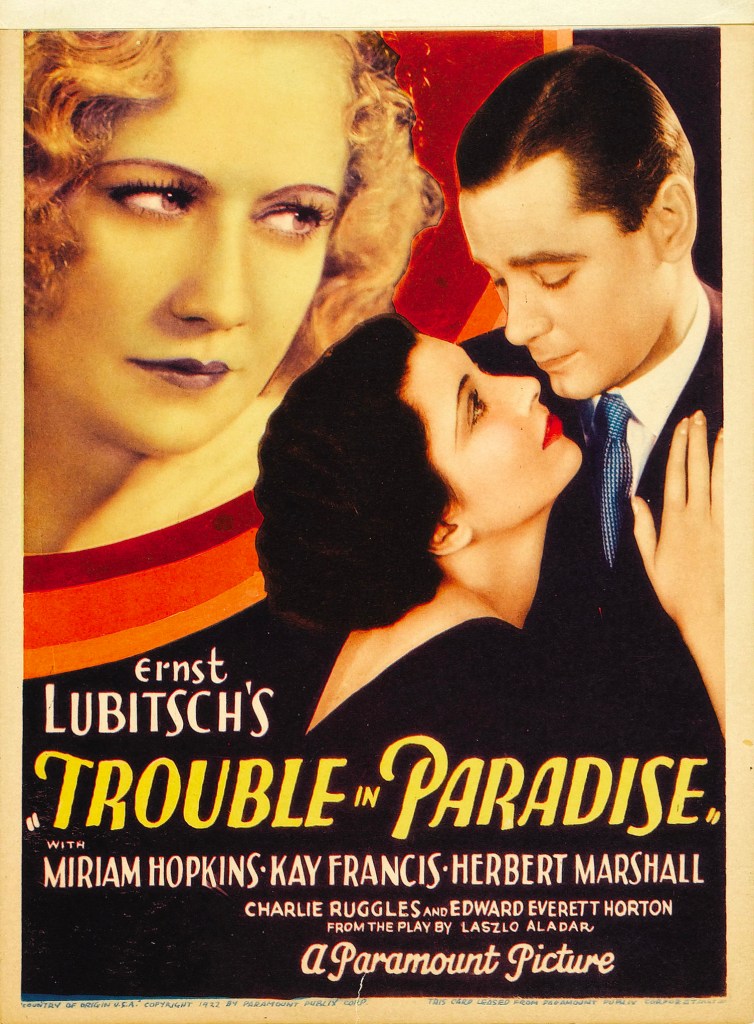
Trouble in Paradise (1932)

Trouble in Paradise (1932)

Stealing, swindling and sex abound in Lubitsch’s masterful – and influential – early Hollywood comedy

Director: Ernst Lubitsch

Cast: Miriam Hopkins (Lily), Kay Francis (Madame Colet), Herbert Marshall (Gaston Monescu), Charles Ruggles (The Major), Edward Everett Horton (Francois Filiba), C. Aubrey Smith (Adolph J Giron), Robert Greig (Jacques, the butler)

“Ah, that Lubitsch touch!” It was a slogan invented by the studio (probably to help turn Lubitsch into a brand – see also “The Master of Suspense!”). No one has ever been quite sure what it is exactly – but you can’t argue it doesn’t exist after watching Trouble in Paradise. A smoother, more charming slice of Wildean wit mixed with saucy naughtiness you couldn’t hope to find. All put together with effortless, cosmopolitan wit by Lubitsch, where every shot and camera movement has been planned for maximum effect. No wonder it’s one of the great early Hollywood comedies.

It’s Vienna and a Baron and a Countess are sitting down to a wonderful dinner together. But both know all is not what it seems: they’re both professional conmen. The Baron is Gaston Monescu (Herbert Marshall), the Countess Lily (Miriam Hopkins) – and they can pick each other’s pockets as easy as breathing. Falling in love, they team up and head for Paris, there to relieve fabulously wealthy Marie Colet (Kay Francis) of some of her firm’s dividends. Gaston becomes Marie’s private secretary – but don’t you know it, he finds himself falling in love with her. Will he go through with the scam? And will Lily give him the choice? The answer is almost certainly not what you think.

Trouble in Paradise is so swift, smooth and gloriously comically inventive that its very existence is enough proof of that Lubitsch touch. The comic business here is so marvellously done, so hugely influential and inventive, that half the comedies existing owe it a debt. Take a look at that first sequence as the two of accuse each other of being thieves and liars, in between passing each other the salt, with consummate politeness then proceed to take part in a pickpocketing game of one-upmanship (purses, pins, watches, garters, you name it!). All shot and directed with a perfect mixture of one-take dryness, matched with perfectly chosen fluid camera movements that accentuate punchlines.

Then there’s that script (“Do you remember the man who walked into the Bank of Constantinople and walked out with the Bank of Constantinople?”). It’s crammed to the gills with sensational bon mots with more than a touch of Wilde or Coward but also a certain emotional truth (“I came here to rob you, but unfortunately I fell in love with you.”). Trouble in Paradise is an intensely suave and sophisticated film that delights in making its characters feel like the nimble-thinking smartie-pants who always know what to say, that you’d love to be, but never quite are.

It’s grist to the mill of Lubitsch, who coats the film in the three things that really makes it work: European sophistication and ruthlessly dry wit; playfully smooth direction; and more than a dollop of sex (and lots of people in this, let’s face it, are pretty impure to say the least). Sex is in fact what’s at the heart of this film: they may be criminals, but Gaston and Lily are at least as interested in getting some of that as anything else and Marie is more than a match for them.

Trouble in Paradise is pre-Code – and far racier than anything we normally expect from Old Hollywood. After all, this is a film that makes a series of perfectly timed punchlines out of a Butler constantly knocking on the wrong bedroom door to find Marie, unaware that Gaston and Marie are “spending time together” elsewhere. Gaston and Lily’s first meeting is capped with a “do not disturb” sign being hung on their bedroom door. The word sex gets bandied about. In case we missed the point, Lubitsch shoots a romantic clinch between Gaston and Marie by focusing the camera on the bed where their shadows are being cast, looking for all the world like they are lying down on it. Later Lubtisch will focus on a clock marching forward in time as we hear Gaston and Marie flirt (and clearly more than just flirt) as the time flows by.

No wonder when the Code was introduced, Trouble in Paradise was slammed on the shelf for years. It’s more than clear that Gaston has it away with Marie and Lily – and, even more scandalously, no one seems to mind that much. There is sexual liberalness to Trouble in Paradise. Marie is happily stringing along two boorishly foolish suitors (Charles Ruggles as a bluff retired major and Edward Everett Horton as a slightly pompous fop, fleeced in the past by Gaston – both very funny). Gaston feels many things, but never ashamed, while Marie seems sexually excited by the idea that he might be a crook. (Their first meeting is a simmering swamp of sexual tension.)

Lubitsch keeps the film flowing so effortlessly, it glides down barely touching the edges. The humour is spot on and perfectly delivered. At one point Lily (still disguised as the Countess at this point) phones her “mother” in front of Gaston. Her conversation is polite and giddy – then Lubitsch cuts to the other end of the call where her crude landlady is prattling bored on the end, and we realise it’s all part of a con. Gags like this have inspired filmmakers for years. You can see the root of half the screwballs that were to come in the love triangle flirtatiousness between Marshall, Francis and Hopkins.

All three of them are excellent. Marshall had few better opportunities to showcase his dry wit and sex appeal (he was so often cast as stuffy, dull husbands), and he’s the ideal arch gentleman here, with a twinkle in his eye at his daring smartness and very sexy in his confidence. (The constant shots of Gaston running up and down stairs is, in itself, a gag – Marshall had only one leg and all that running was a body double). Far from a rube, Kay Francis makes Marie a sexually curious, determined and out-going woman who knows what she wants and happily plays the game to get it. Miriam Hopkins has a punchier feistiness as a woman who can shift personae with effortless ease.

Trouble in Paradise – that Paradise being Gaston and Lily’s natural partnership – slides so smoothly from set-piece to set-piece, each of them shot with superbly smooth camera movements that perfectly accentuate their comic impact, that it continues to offer huge entertainment. Brilliantly acted, packed with superb set-pieces, it benefits above all from that glorious Lubitsch touch. Sophisticated, amoral, naughty but with a touch of heart among all the lying and cheating, it’s very funny and very cheeky and all about sex and stealing. It’s a landmark film.

Il Postino (1995)

Il Postino (1995)

A friendship (of a sort) across the divide in this sentimental, overtly charming romantic comedy drama

Director: Michael Radford

Cast: Massimo Troisi (Mario Ruoppolo), Philippe Noiret (Pablo Neruda), Maria Grazia Cucinotta (Beatrice Russo), Renata Scarpa (The Telegrapher), Linda Moretti (Donna Rosa), Mariano Rigillo (Di Cosimo), Anna Bonaiuto (Matilde Urrutia)

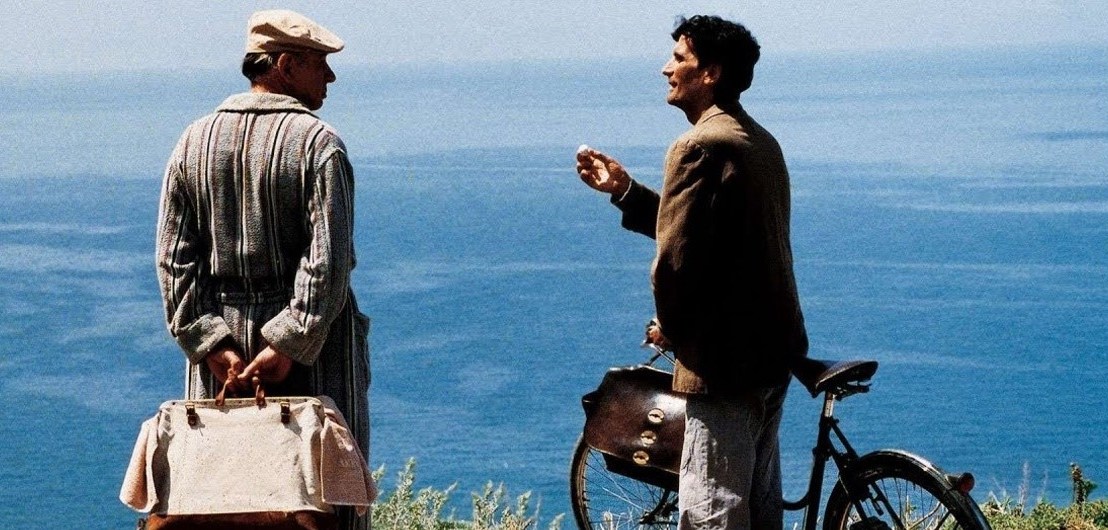
Pablo Neruda (Philippe Noiret) arrives on an Italian island in 1950, exiled from his home in Chile. He brings celebrity to the small community: but also transforms the life of local Mario Ruoppolo (Massimo Troisi). Mario, a quiet and slightly lost man who doesn’t want to follow in his father’s fishing footsteps, takes a job delivering Neruda’s mail. He becomes fascinated by poetry and idolises Neruda with whom he forms a friendship, after he enlists him to help woo Beatrice (Maria Grazia Cucinotta), daughter of the local café worker. Mario becomes more and more influenced by Neruda’s communism and love of language. How will he cope when Neruda’s exile ends?

A massive box office success – one of the biggest foreign language hits in the USA – Il Postino is a film born from tragedy. Troisi had long wanted to adapt the novel by Antonio Skarmeta. So much so, he delayed urgent heart surgery to make the film. With filming due to start, Troisi was so ill he could work little more than an hour a day. Many of his scenes were done in a single take. Radford re-worked scenes to allow Troisi to sit as much as possible, while a body double did all long shots, medium shots and any close-up where Troisi’s face didn’t need to be seen. Troisi recorded all his dialogue before filming – and tragically died the day after shooting completed.

It’s a moving story: and it’s hard to separate your reaction to it from your reaction to the film. Perhaps influenced by Troisi’s illness, Radford turns Il Postino into a quiet, gentle and mediative piece, crammed with restrained camerawork and thoughtful pacing. There is a gentle, easily digestible warmness to Il Postino, with relatable themes around love, friendship and the power of poetry. But you can’t help but feel subtitles made some feel they were watching something arty, rather than something that is essentially a bit of popular fiction turned into a film.

Don’t get me wrong, there are plenty of positives. Radford perfectly captures the warmth and eye-opening wonder of a man discovering intellectual horizons he never imagined. Mario at first seems not particularly bright – but we discover he is simply a man who has grown up without intellectual stimulation of any sort. No one ever leaves his island and the only ambition anyone has is to become a fisherman. Watching a newsreel of Neruda’s arrival in Italy, the villagers seem as stunned by seeing these magic moving pictures as they do the famous poet’s arrival.

Into this tiny world drops a magic figure: someone who makes Mario discover that the functional words that only ever dropped hesitantly from his mouth, can actually be crafted into gorgeously elaborate sentences, full of power and beauty. Poetry at first just seems like a great way to get girls – Mario is stunned by the amount of mail from ladies Neruda receives – but then becomes an end in itself. Slowly Mario appreciates things around him – the moon, the lapping of waves on the shore, the sound of the wind in the hills – in a way he never even thought about before. Similarly, he begins to question the quiet acquiescence the village shows to all-too-obviously corrupt local politician Di Cassimo.

This largely works due to a quiet, unforced and gentle performance from Troisi. Shyly muttering his lines and rarely raising his head up to look directly at the person he is talking to, Troisi’s performance has an unaffected naturalness to it. He’s quiet, abashed and shy, also childlike, worshipping Neruda with a puppy-dog intensity (that never wilts, even after Neruda leaves the island) and reacts to things around him with an awe-filled wonder.

Opposite him, Noiret soaks himself in artistic confidence as Neruda, a man very aware he’s a huge fish in a small pond. Perhaps because he’s lonely, perhaps because he finds Mario’s childlike openness endearing, he indulges and encourages Mario’s attempts to befriend him. But, despite appearances, I’m not sure Il Postino wants to commit to the fact that this is not a friendship of equals. Neruda is fond of Mario – but he never, truly, sees him as an equal. Mario is, at heart, a distraction Neruda is fond of. He indulges Neruda’s clumsy attempts to win his attention, and there is a slight quiet background air of fatherly condescension in his treatment of him.

It means people overlook the more interesting parts of Il Postino. Because, despite the way it’s presented, this isn’t a story of a friendship over a divide. The final act is in fact more interesting in showing, after Neruda leaves, that a relationship that changed Mario’s life forever was just a brief, fond distraction to Neruda. Neruda remains the most important person in Mario’s life – but he wouldn’t even make the top hundred in Neruda’s life. Neruda makes little effort to keep in touch, gets a secretary to write a functional letter to Mario and takes years to even consider a visit.

The real point of interest here is how Mario flew, Icarus like, close to the sun – but found he could only get so close. He will only ever be a footnote in Neruda’s life, while Neruda is his life. Even when faced with evidence of Neruda’s affectionate disregard, he will still insist on naming his child after him. Similarly, poetry is something he can love but never quite master himself. This is interesting stuff. Il Postino avoids it.

Instead, it’s a film that settles on sentiment. You can’t argue with the skill Radford directs the film, or the quiet power of a late sequence when Mario records the sounds of the island for Neruda. Radford’s unobtrusive direction – partly influenced by working around Troisi’s illness – works to wring the maximum emotion from it. But it’s still a sentimental package: a package skilfully presented to Academy voters by Miramax (Luis Bacalov’s Oscar win for score was surely connected to Weinstein mailing a recording to every member of the Academy) and presents a pleasant fantasy story for the masses, that veers away from its more complex parts to present something far more reassuring and gentle.

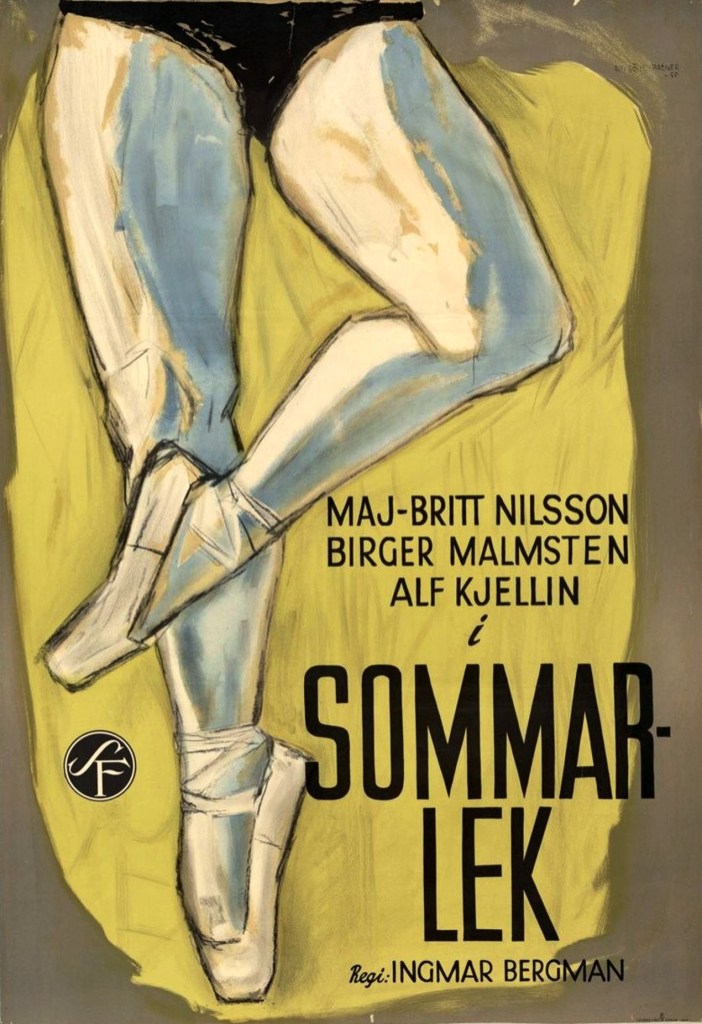
Summer Interlude (1951)

Summer Interlude (1951)

Memory, mortality, repression, grief and a little dash of hope: Bergman establishes his themes in one of his earliest film

Director: Ingmar Bergman

Cast: Maj-Britt Nilsson (Marie), Birger Malmsten (Henrik), Alf Kjellin (David Nyström), Annalisa Ericson (Kaj), Georg Funkquist (Uncle Erland), Stig Olin (Ballet Master), Mimi Pollak (Mrs. Calwagen)

On the night of the dress rehearsal for her next production, successful ballerina Marie (Maj-Britt Nilsson) receives a parcel containing an old diary. It’s thirteen years old and belonged to Henrik (Birger Malmsten), a young man she met and fell in love with while staying with family friends on a small island. The relationship was one of blissful joy – so why then does even the faintest memory of it bring out a cold panic in Marie?

The answer is of course rooted in past trauma in a film that touches on so many themes Bergman would explore in even greater detail later, it’s hard to see it as a film in its own right, like an early draft pencil sketch of a Renaissance master. Themes of memory, trauma, mortality, repression, romance and coming to terms with all of these would resurface time and again in the master’s later work. Wild Strawberries, The Seventh Seal, Face to Face, Persona, Fanny and Alexander… They all expand on Summer Interlude. For starters, Marie’s reverie on the island revolves around memories activated by eating strawberries and takes in an ageing priest exploring mortality through chess.

So, you can sort of watch Summer Interlude as a game of inspiration-spotting, keeping a tally of the Bergmanesque pre-homages. But that would do a disservice to a heartfelt, beautifully judged, hauntingly sad film which deals not only with loss but also acceptance. It’s effectively two films in one, straddling the emotionally cold present and Marie’s return to the windswept island, and the glorious summer of carefree romance she shared all that time ago, when everything was possible.

As Marie, Maj-Britt Nilsson is impressive. One of the first of Bergman’s muses – and the first major indicator of his skill and empathy for powerful female-led drama – Nilsson has the difficult job of distinguishing between two versions of her character. Her present day one is muted, restrained and hiding behind her ballet performance make-up, unable to really face the world and unhappy in her own skin. By comparison, the younger version feels like a different person: vibrant, hopeful, excited and youthful. And besotted with Birger Malmsten’s boyish and delightful Henrik, an impulsive but engaging kid.

The flashback to their romance is given the sun-dabbled beauty of memory. They run across beaches and up hills, flirt in beach huts and conduct a sweet engagement ceremony. The company of the other is more than enough for both of them. Gunnar Fischer’s photography captures this with an intense, naturalistic beauty – including a gorgeous shot of a cloud across the sun while we hear the voices of Marie and Henrik below. It also makes for a wonderfully alive contrast to the more static coolness of the present, where wide-open spaces are exchanged for backstage confines.

It’s not a huge surprise to reveal that Marie and Henrik’s relationship end tragically. That after all is the mood we associate with the Gloomy Swede. But what makes the film really work is the hope and joy not only of the memory of that glorious summer – but also in the ability, thirteen years later, of Marie to consider processing it and allowing new joy into her life. To come to terms with what has happened to her and learning to love the person she is today, (literally) wiping away the defensive make-up that has kept her distant from the world.

Much of her defensiveness comes courtesy of “Uncle” Erland (a deeply unsettling Georg Funkquist), the family friend she was staying with that summer. A doctor and psychiatrist, Erland clearly has a unsuitable interest (bordering on obsession) with Marie (something all too obvious to his wife). His desire to help her deal with her tragedy is based more on an unpleasant desire for control as it is friendship. He’s one of the darker figures in Bergman, even more so because he’s so mundane in his corruption.

Memory and past trauma linger over Summer Interlude – and the influence of both is central to the film’s impact. Bergman skilfully intercuts between past and present, without ever overplaying or showing his hand. Both timelines are interspersed with little character flourishes that would be worthy of whole films (and in some cases Bergman explored those himself later!). Henrik’s geriatric aunt, a fanatical chess player, who (correctly) states she will live for decades to come. A priest dwelling on mortality. A ballet master who understands how Marie’s obsession with dancing serves to blot out any other life. A fellow dancer who muses on how long before their time is up.

These ideas are assembled though with a warmth and emotional intelligence that would become Bergman’s hallmark. It’s also a film crammed with invention: a (brief) argument with Henrik over Marie’s obsessive practice, frames her feet in constant close-up as she practices her moves: the film will end with a similar shot, this time with practice married to romance. For a film about tragedy, trauma and torturous memories, it’s surprising how optimistic it is. As Marie smiles for what seems like the first time in decades, you feel there is hope for us all.

Time After Time (1979)

Time After Time (1979)

HG Wells zooms through time on the trail of Jack the Ripper in this surprisingly charming time travel romantic thriller

Director: Nicholas Meyer

Cast: Malcolm McDowell (HG Wells), David Warner (Dr John Leslie Stevenson), Mary Steenburgen (Amy Robbins), Charles Cioffi (Lt Mitchell), Kent Williams (Assistant), Patti d’Arbanville (Shirley), Joseph Maher (Adams)

1979 was clearly the Year of the Ripper. New conspiracy theories abounded on his mysterious identity. In Murder By Decree, Sherlock Holmes took on the investigation. And in Nicholas Meyer’s Time Travel fish-out-of-water drama, he pops up in 1970s San Francisco, still up to his wicked ways. How did he get there? Well, imagine instead of just writing The Time Machine, HG Wells had actually built it: and that, during a dinner with a doctor friend, he not only discovers his friend is the infamous killer, but watches him pinch his time machine to escape the long arm of the law.

HG Wells is played by Malcolm McDowell – who surely when he was sent the script assumed he was being asked to take a look at the role of the Ripper – who uses his machine to follow the Ripper to the 1970s to find him. The Ripper is played by David Warner (one of the few actors even more demonic than McDowell), and he’s rather more at home in the 1970s than Wells, who expected to find a utopia. Wells is helped by Amy Robbins (Mary Steenburgen), who is drawn to this charming Englishman, who she believes is a Scotland Yard detective on the hunt for a serial killer.

Meyer’s first film is a little raw – you can see he’s still learning his craft, a few shots are a little rough around the edges in their framing and some plot points and transitions are not easy to follow – but rather charming, for all it’s about the hunt for a serial killer. Meyer gets a lot of affectionate comic mileage from Wells – the quintessential gentle Englishman, timid but determined when riled – working out the social rules of the 1970s. From crossing the road, to hailing a taxi, from consuming a McDonalds (“Fries are pomme frites!” – some silver presumably crossed Meyer’s hands to show the novelist chomping down thrilled on the fast food chain’s merchandise) to working out the rate of exchange for his fifteen Victorian pounds doesn’t translate to many dollars, it’s got a fish-out-of-water delight and a shrewd comic energy.

It’s helped a great deal by McDowell’s gentle, playful and thoroughly engaging performance – Time After Time leaves you sad he doesn’t get to play more roles like this. Wells is optimistic, polite, gentlemanly and admirably brave: even more so, because he’s so hesitant about risk. He travels around the 1970s with a wide-eyed wonder and has a humanitarian streak a mile wide. He’s one of the nicest guys you could meet.

No wonder Amy falls for him so swiftly. There is an electric chemistry between Mary Steenburgen – full of Southern sweetness but with a very modern (but never grating) feminism – and McDowell (and clearly off screen as well, as they married almost immediately after). Meyer plays this romance like a classic rom-com, with meet-cutes at the bank and McDowell’s playing of this shy Victorian gentleman’s courtly manners (he touchingly stops a kiss to make absolutely sure he has full consent – which Amy makes clear he more than does!) works like a charm.

The jokes are genuinely well-thought out and keep the film brisk. I love the alias Well’s plucks out of the air when pretending to the police to be a Scotland Yard detective: he seizes upon what he guesses will be a long forgotten popular fiction character of his day and calls himself Sherlock Holmes. McDowell and Steenburgen have an affinity for physical comedy – watch McDowell hail a taxi with a jaunty wave or Steenburgen sitting frustratedly on a sofa waiting for Wells to make a move. The fish-out-of-water elements work a treat (you can see the clear groundwork for gags Meyer would take even further in his next time-travel hit Star Trek IV: The Voyage Home).

Time After Time sits this comedy next to a genuine Ripper-flick. The film opens with a long POV shot as the Ripper strikes in the streets of London. David Warner gives a very good performance as a world-weary psychopathic, who can hide his depravity but not control his urges. Unlike Wells, the Ripper adjusts very naturally to the modern world – probably because he’s more used to pretence than the honest Wells – dressing in progressively more relaxed 70s garb. His murders are shot with discretion – mostly off screen with the inevitable splash of scarlet on a surface or face from off camera. The actual historical elements of the Ripper are bunkum, but the handling is well done.

The time travel elements are rather laboriously explained, with much talk of keys, return-prevention locks and stabilisers. Wells points out the various features of the machine with a bluntness that all but has Meyer tapping you on the shoulder and saying “remember that it will be important later” – you can utterly (correctly) guess the eventual ending purely from this lecture. But the time travel effects use a mixture of 2001-ish camera tricks rather effectively and the film plays a little bit with paradox and timeline tweaking (although without any depth).

Meyer’s film is an enjoyable ride, even if some plot developments gear shift swiftly (the Ripper seems to have had a sudden emotional breakdown at some point between his penultimate and final scene and the reasons for the time machines physical shift to San Francisco are barely explained) and it at times loses its drive (the Ripper is all-too-obviously presumed dead at one point and his determination to grab a key that controls the time machine oscillates with urgency from act to act). But as a debut, it’s an enjoyable piece of pulp. And it’s got a hugely likeable performance from McDowell and very assured support from Steenburgen and Warner. It’s a very enjoyable romp.

The Curious Case of Benjamin Button (2008)

The Curious Case of Benjamin Button (2008)

Ageing, romance and sentiment in Fincher’s handsome shaggy dog story

Director: David Fincher

Cast: Brad Pitt (Benjamin Button), Cate Blanchett (Daisy Fuller), Taraji P Henson (Queenie), Julia Ormond (Caroline Button), Jason Flemyng (Thomas Button), Elias Koteas (Monsieur Gateau), Tilda Swinton (Elizabeth Abbott), Mahershala Ali (Tizzy Weathers), Jared Harris (Captain Mike Clark)

As the eleventh hour of the eleventh day of the eleventh month of 1918 strikes, a baby boy is born. A baby boy unlike any other, with the appearance and illnesses of a very old man. Discarded by his horrified father (Jason Flemyng), the boy is adopted by Queenie (Taraji P Henson), caretaker of a nursing home. There it becomes clear he is growing backwards: the older he gets, the younger he appears. Young Benjamin will eventually grow into Brad Pitt and spend his life watching those around him grow ever older as he grows ever younger. Most joyful, and painful, of all being his childhood friend Daisy (Cate Blanchett), the woman he will love his whole life.

Fincher’s film is a strange beast. A huge technical triumph, that uses cutting edge special effects and astonishing make-up to age – in both directions – Brad Pitt and Cate Blanchett throughout the course of the film (both taken from extreme old age to face-lifted youth), it’s also a whimsical shaggy dog story with elements of a fairy tale that does very little with its astonishing concept other than pepper the script with easily digestible homilies about the purity of the simple life, as if screenwriter Eric Roth was still gorging on the same box of chocolates from which he plucked Forrest Gump.

TCCoBB has a lot going for it: you can see why it was coated with technical Oscars. The ageing and deageing special effects are skilfully and even subtly done, the recreation of a host of periods – from the 1910s to the 1990s and beyond – flawlessly detailed. Claudio Miranda’s photography uses a host of film stocks – from sepia, to scratchy home movie footage style, to luscious technicolour beauty – to reflect time and era constantly. The assemblage of the film has been invested with huge care and attention and, despite its great length, Fincher cuts together (with Kirk Baxter and Angus Wall) an episodic film that manages to keep its momentum and drive going.

Also, it’s a far less vomit-inducing spectacle than the manipulative stylings that coat Forrest Gump. This is in part to Brad Pitt’s restrained and contemplative performance in the lead role: Pitt underplays with surprising effectiveness, capturing Benjamin’s “come what may” attitude and eagerness to go with the flow of the opportunities life offers him. He delivers the narration with an authority just the right side of portentous (for all his rather flat, uninteresting voice) and skilfully manages to invest his body with a physicality quite contrary to his physical appearance (his old body moves with a young man’s casualness, while his younger form carries a slightly world-weary hesitancy).

Benjamin’s mantra becomes one of living your life just as suits you best, not as others expect you to and never worrying about leaving it too late to take chances or make changes. Or at least something like that. To be honest, the weakest part by far of TCCoBB is the lightness and breeziness of its thematic impact. I’ve seen this film three times and, other than a slightly charming shaggy dog story, I’m not quite sure what point it is trying to make – other than straining for a star-cross’d romantic sadness.

This feels like a missed opportunity because there is so much that could be explored here. The film is a nearly unique opportunity to explore how much age – either physical or mental – defines us. A chance to see how our perceptions of a person are shaped as much by what they look like or how they sound, as by who they are. What sort of different perspective on humanity might Benjamin have? How might those around him evaluate, their own lives as they see this him getting younger?

Questions such as these are not touched, the film settling for Benjamin’s whimsical, first-do-no-harm philosophy crossed with a sort of saintly non-interference. The closest it gets to dealing with this is in Benjamin’s friendship and later relationship with Daisy. Old/young Benjamin is told off by Daisy’s grandmother for being a dirty old man, when they first met as children (or old man in his case). Later their lives will drift together and apart, until they form a relationship when both are “the same age” physically. But the film shirks really exploring the implications of this – and outright flees the idea of Benjamin as an increasingly younger man in a romantic relationship with an increasingly older Daisy.

Instead, it settles all too often for easy lessons, comforting parables and charming little vignettes. Benjamin grows up cared for by his adopted mother Queenie (an engaging, if straight forward, performance by Taraji P Henson) – but in the sort of 1920s New Orleans where a racial epithet is never even whispered. He travels the world with Jared Harris’ (rather good) salty sea-dog, falling in love briefly with Tilda Swinton’s lonely champion swimmer turned society wife. He reconnects happily with his father (after all it’s much easier to live a life of free choice if you are the heir to a massive button factory empire). Idyllic 1960s love hits Daisy and Benjamin – a brief shot of a cruise missile taking off is the only reference to those troubled times we see.

It’s all very easy, romantically toned, sweet and easily digestible. Even writing it down highlights how these are charming, eccentrically tinged, vignettes. All events and experiences come together with a vague “lessons learned” impact, as old Benjamin regresses into a teenager, a child and then an infant. But it could have been so much more. A real study of what makes us human, a real look at how events and perspectives define us. It isn’t. Heck, other than watching Pitt travel handsomely around the world on a motorbike in a late montage, we don’t really get much of a sense of how being young/old may impact him.

Which isn’t to say it’s not enjoyable. It all proceeds with a great deal of charm and love, much of which has clearly been invested in every inch of its making. The acting from (and chemistry between) Pitt and Blanchett is very effective. But it feels like a slightly missed opportunity, a film that settles for being a warm, reassuring cuddle when it could have sat you down and helped you understand your life. For all its slight air of importance, it’s a crowd-pleasing, if slightly sentimental, film.

The Men (1950)

The Men (1950)

Brando makes his film debut in this earnest but realistic drama about paraplegic war veterans

Director: Fred Zinnemann

Cast: Marlon Brando (Ken Wilocek), Teresa Wright (Ellen), Everett Sloane (Dr Brock), Jack Webb (Norm), Richard Erdman (Leo), Arthur Jurado (Angel), Virginia Farmer (Nurse Robbins)

The Men opens with a thoughtful dedication to the two wars many soldiers have fought: the first with weapons, the second “with abiding faith and raw courage” against the physical and emotional consequences of the first. Fred Zinnemann’s documentary-influenced The Men takes a careful look at how the impact of that second war at a paraplegic veterans hospital. Ken Wilocek (Marlon Brando, in his film debut) is a former college sports star now confined to a wheelchair and struggling to adjust. His fiancé Ellen (Teresa Wright) is still eager to marry – but are either of them ready for the difficulties Ken will have adjusting his life?

The biggest strength of The Men – aside from its realist lack of flash – is how it avoids easy answers to big questions. Sure, Carl Foreman’s script has a tendency to lean into a mix of relationship drama and information film. But in looking at Ellen and Ken’s wedding night (and, in a neat visual metaphor of a misfiring champagne bottle, their likely sex lives), The Men is coldly realistic. Ellen might be largely presented as a picture-perfect ideal woman – but even she is freaked out by Ken’s squeaky wheelchair, twitching leg, implied impotence and the thought of what she has let herself in for.

That’s as nothing to the self-loathing fury – directed into rage at Ellen – Ken feels. This man who defined himself by machismo and physicality, who labours for weeks to stand upright so he can get married at the alter (it’s a sign of the film’s avoidance of easy solutions that, despite this, Ken still falls over at the alter) suddenly realises that he will always be partially dependent on his wife for simple tasks. He’ll never be the provider he expected to be – and he’ll never be able to fulfil some of his wife’s sexual needs. A proud man, no wonder the realisation throws him into depression.

It’s moments like this when Zinnemann’s film is at its strongest. It’s a film surprisingly frank and (for the time) daring about the emotional and physical consequences of war injury. Everett Sloane’s impassioned doctor is introduced warning wives and mothers about the consequences of paraplegia and the difficulties emotionally, physically and (he all but says) sexually they will have – but he might as well be talking direct to the camera informing the audience.

ZInnemann’s film, in a dispassionate but respectful way shows the process of rehabilitation, its strengths and its weaknesses. From physical training to the difficult emotional adjustments. The film used several real-life veterans – including Arthur Jurado in a key role as a Latino paraplegic holding onto optimism – and worked closely with hospital medical staff (some of whom appear as themselves). There is a solid sense of respectful realism about the whole thing. (You can feel the hand of producer Stanley Kramer.)

He’s also helped hugely by a powerful, committed and complex performance from Brando in the lead role. Making his first film, Brando astounded Zinnemann and the crew with his commitment. Effectively Brando “learned” to be paraplegic, forming deep friendships with the veterans (far more allegedly than with his fellow actors). His performance is a searing collection of contradictions. Ken is boyish, eager and lets excitement flash across his face when playing sports or driving an adjusted car for the first time. But he’s just as apt to be surly, resentful and bitter, to snap at those trying to help him and furious at the failings his own body have forced on him.

It comes to a head at that disastrous wedding night. Brando struggles with a growing realisation of his dependence and helplessness and his face flares with the pained recognition that this is in no way the wedding night be imagined. Throughout much of the film he is desperate to cling to any chance of recovery – from imagining sensation in his legs to furious workouts to build his upper body strength to help him pretend he still has fully functioning limbs. It’s a fabulous performance, a slice of realism and humanity, underplayed with an everyday casualness.

It does mean Teresa Wright at times looks a little more actorly as Ellen. To be fair to Wright, her part is saddled with the most conventional plot arcs and scenes, of romantic devotion mixed with sudden doubts. (It’s not helped by Dimitri Tiomkin’s overly emphatic themes for her character, that do their best to do all the work for the audience). Her scenes tend to have the air of the infomercial about them, as Ellen debates disabilities with Dr Brock and her doubting parents. Foreman’s dialogue also tends to lean a little too much into “I’ll love you Ken, no matter what” territory.

The Men is at its weakest when it looks at societal integration. For all the quality of Brando and the low-key sensitivity of Zinnemann’s direction, this ends up being a lighter, less impactful version of Wyler’s astounding The Best Years of Our Lives. Brando plays a combination of Dana Andrews’ and Harold Russell’s characters from that film, but The Men never hits the same heights of universal experience and pain as that film does. (Teresa Wright basically plays the same role here as she did opposite Dana Andrews). It’s just a little too low-key, a bit too documentary.

When away from the medical, there is a lack of inspiration and poetry from The Men. It gains a lot from Brando’s performance, but without him it would feel more like a Government infomercial. When it hits drama, for all its daring, it never manages to fully turn itself into something more than a traditional romance-against-the-odds. It has its heart in the right place, but it feels like a companion piece to better films than a classic in its own right.

The Last Metro (1980)

The Last Metro (1980)

Passion, privacy, tension and terror all come to head in Truffaut’s stately theatrical occupation epic

Director: François Truffaut

Cast: Catherine Deneuve (Marion Steiner), Gérard Depardieu (Bernard Granger), Jean Poiret (Jean-Loup Cottins), Heinz Bennent (Lucas Steiner), Andréa Ferréol (Arlette Guillaume), Paulette Dubost (Germaine Fabre), Sabine Haudepin (Nadine Marsac), Jean-Louis Richard (Daxiat), Maurice Risch (Raymond Boursier)

The curtain parts and we are introduced to a magic world of imagination and drama play out before us on stage. But how can the actors immerse themselves in this, while such huge drama plays out in the real world? It’s the dilemma of the Montmatre theatrical troupe in Paris during the Occupation. With war raging with all its complex moral choices and dangers, how can you focus on the art within – or for the matter process the complex emotional entanglements in an already claustrophobic profession only made worse by the perils of Nazi occupied Paris and their pet collaborators.

Truffaut’s film is called The Last Metro as it recalls a period during the occupation when hundreds of thousands of people crowded into Parisian theatres to stay warm at night before rushing to catch the final train home before the curfew. The Montmatre Theatre is run by Marion Steiner (Catherine Deneuve), a film star turned stage actor struggling to keep the theatre going in the absence of her Jewish theatre-director husband Lucas (Heinz Bennett) – who, unknown to anyone else, is hiding in the theatre basement. Bernard Granger (Gérard Depardieu) is her new lead actor for their latest Ibsenesque production: but his presence will stir powerful feelings in the embattled Marion.

Truffaut’s film steers away from his other more famous work – the sort of vibrancy and romance of earlier films like Jules et Jim or The Four Hundred Blows or the inventive playfulness of Day for Night. Instead, The Last Metro is a more formal, classically shot, interior piece that revels in small moments and touches of emotional investment so subtle and glancing some viewers might not even notice them. It’s also – surprisingly for cinema’s leading cineaste – a film deeply in love with the mechanics and backstage drama of theatre, subtly contrasting the claustrophobia and intensity of such spaces with the oppressive world-shrinking and glance-over-your-shoulder anxiety of occupation.

It’s also a superb character study, with a quite brilliantly complex and compelling performance from Catherine Deneuve. A starlet with a double burden – not only keeping the theatre alive, but also her husband – Marion is a woman pulled so hard and so overwhelmingly in so many competing directions, it’s taking every ounce of her control to hold herself together. Facing financial pressures, censorship pressures and the constant fear that a single wrong word could see her theatre ripped away from her and her husband discovered and killed, she maintains a cold and professional veneer that rarely, if ever, slips.

So little does it, that Bernard – played with an effortlessly underplayed grace and charm by Gérard Depardieu that belies his Rugby-player bellicosity – is, for the most part, blissfully unaware of Marion’s growing, unspoken, attraction to him. A love she seems hardly able to acknowledge herself, not least because it feels like an even deeper betrayal now of her husband, hiding out in the basement and utterly dependent on her, than it would in peacetime.

Lucas – a wonderful Heinz Bennent – is himself teetering on the edge of falling apart from the sustained effects of acute cabin pressure. Never leaving the damp theatre basement – apart from surreptitious trips to the stage late at night – Lucas’ attitude to his enforced imprisonment moves from a larkish boys-own adventure into an increasingly bitter resentment. Directing the show from afar – a drain has been hooked up so he can listen in on rehearsals – he provides late night feedback to Marion to accompany the detailed handwritten notes he ‘left behind’. Mapping out future productions on his cell walls, Lucas avoids the suspicion that the constant pressure of concealing him has tipped their relationship from romance to one of anxiety-ridden responsibility.

It contrasts with the play the company is performing: where, in typical Ibsen style, the lead is a tragedy tinged woman, suffering memory loss, who falls into a deep but mutually painful love with her son’s tutor. Even from the rehearsals, Marion begins to feel some bleed of this dramatic relationship into her real world: she asks Bernard to not touch her during rehearsals, as if worried that this moment of physicality could lead to consequences she cannot control.

Touch is a key sensation in The Last Metro – as if moments of physical contact and intimacy carry even more weight in a world where no one can be trusted and every word must be carefully watched. Bernard uses a repeated routine of palm reading to try and seduce (with mixed results) a series of women (most notably lesbian production designer Arlette – strikingly played by Andréa Ferréol – who, in a lovely flourish, he describes as longing for “like a warm croissant”). Physical contact – the light caress of a face and hands – is crucial to the film. Truffaut’s camera zooms in on moments where hands take each other, either in longing, understanding or – in a sequence where Marion journeys to Gestapo headquarters – with the threat of imminent violence.

Closing distance is particularly important in a period where all contact must be carefully judged and measured. Collaborators, like powerful press chief Daxiat, will use the smallest slight or word out of place to justify pulling your world down. Played with a hissable vileness by Jean-Louis Richard, Daxiat is a pompous, self-important, two-faced and vindictive man parroting Nazi slogans and revelling in his power to destroy careers. But, small man though he is, the Occupation gives him power – when Bernard angrily confronts him for his rudeness about Marion in his review, its Bernard who Marion is furious at for his recklessness.

It’s because hanging over every moment – and constantly playing in Deneuve’s expressive eyes – is the dread of what will be found if her theatre is searched or how doomed her husband will be if it is closed. Finding a play that passes muster with the censors and pleases the masses is literally a matter of life and death.

Truffaut echoes the claustrophobia of occupied France in his shooting of the cramped backstage world – and he and Suzanne Schiffman in their screenplay add to this with their look at backstage politics and affections between actors, stagehands and crew. Even the outside is shot like an interior – and Truffaut never bothers to make the locations feel like anything other than sets, as if the whole world is a claustrophobic theatre – with extensive use of mid and close-up shots and subtle tracking shots that maintain the theatrical effect.

It does make for a film that can feel stately and a little too heritage – and its undeniable you miss some of the energy of Truffaut’s other films (you can’t imagine his idol Hitchcock ever shooting a frame of The Last Metro­ – or what he would have made of its luxurious pace). Its subtle energy is sometimes so easy-to-miss that it can be easy for parts of the film to pass you by. Plotlines – such as Bernard’s support of the resistance – sit awkwardly at times within the framework, and the film’s boiling down of Vichy France to (essentially) one bad apple told a story about Occupation that was very pleasing to the French self-image (no wonder if was a massive hit).

The Last Metro is at times a little too in-love with its cultural heritage and the quiet professional skill of its making. But, it counter-balances this with some involving and subtle work from all its principles and director: and in Denevue (especially) and Depardieu it had two of the greatest actors in French cinema at the top of their game. Multi-layered and demanding, it’s a film that makes you work from its newsreel opening to its fourth-wall, metatextual ending, riffing on romantic entanglements, art, burdens and the oppression of occupation. Perhaps too knowingly prestige to be great, but still an essential watch.

Top Gun (1986)

Top Gun (1986)

Cruise flies into movie super-stardom in this fun-but-much-worse-than-you-remember flying film

Director: Tony Scott

Cast: Tom Cruise (Lt Pete “Maverick” Mitchell), Kelly McGillis (Charlie Blackwood), Val Kilmer (Lt Tom “Iceman” Kazansky), Anthony Edwards (Lt Nick “Goose” Bradshaw), Tom Skerritt (CDR Mike “Viper” Mitchell), Michael Ironside (LCDR Rick “Jester” Heatherly), John Stockwell (Lt Bill “Cougar” Cortell), Barry Tubb (Lt Leonard ”Wolfman” Wolfe), Rick Rossovich (Lt Ron “Slider” Kerner), Tim Robbins (Lt Sam “Merlin” Wells), James Tolkan (Cdr Tom “Stinger” Jardian), Meg Ryan (Carole Bradshaw)

“I feel the need: the need for speed!” Those words lit up mid-80s cinema screens with one of the biggest hits of the decade. Top Gun is still one of Cruise’s most iconic films, its blasting rock-and-roll soundtrack, beautifully backlit romance and cocksure go-getting self-confidence making it one of the definitive Reaganite 80s films ever made. Its legacy is so all-consuming, it’s always a surprise when you sit down to watch it what a fundamentally average it is.

Its plot, such as it is, can be summarised thus: Tom Cruise cockily flies planes and romances Kelly McGillis until Goose dies. Then he flies planes with the same level of skill but slightly more humility and commits to Kelly McGillis. It all takes place in TOPGUN, the navy’s dog-fight training school for elite pilots. Cruise is Pete “Maverick” Mitchell, super-confident best-of-the-best. Kelly McGillis is the astrophysicist and civilian instructor on the course whose heart melts for Tom’s boyish charms. Anthony Edwards is the doomed Goose (he might as well have a skull and crossbones hanging over him – he’s even got a loving wife and son back home). Val Kilmer is Cruise’s rival pilot, super-professional “Iceman”. The training is fast-paced, macho and culminates in a clash with a (conveniently unnamed) country that definitely isn’t the USSR.

There are three things undeniably great about Top Gun. The songs from Kenny Loggins and Berlin are top notch, full of soft-rock sing-along bombast. Scott shoots the hell out of scenes and the sun-kissed beauty framing the various airplanes and aircraft carriers is superb. With its fetishistic worship of the manly glory of the navy and its equipment, the film had full military backing, a huge boon it exploited for wonderfully executed scenes of dogfights and faster-than-sound planes (Scott even paid $25k to get an aircraft carrier to change course – writing a cheque there and then – so a sunset shot would look better). And of course there is Tom Cruise.

Top Gun is the foundation stone in the Church of Tom Cruise, defining a persona Cruise would effectively riff on for huge chunks of his career. Pete Mitchell is so cocksure he’s even called Maverick. But, as well as being arrogant and over-confident, he’s preternaturally skilled, boyishly enthusiastic, strangely vulnerable, yearns for affection, wins people over with a grin and goes through a crisis of confidence that sands down his negative qualities while never touching his courage, skill and likeability. Cruise cemented his eye-catching charisma and relatability: audiences wanted to be him or be with him. A huge chunk of its massive success is down almost exclusively to what a star Cruise is and how easily he makes this hackneyed stuff work.

The rest is a bizarre mix of half-formed plot ideas, weakly sketched characters and a plot so shallow it almost doesn’t deserve the name. Top Gun is all about a cool guy flying planes accompanied by some excellent songs. There is no depth to its character exploration. There is a dim suggestion Maverick needs to mature (with Goose as the sacrificial lamb to prompt that development) but it’s barely explored. It has no shrewdness in its look at the risk-taking intensity of flying or the type of personalities it might attract. The training is awash with familiar tropes: hotshots, grizzled trainers (two of them in Skerritt and Ironside!) mixing growls with behind-his-back grins at Maverick’s pluck. His rival is the anthesis of Maverick, but (gosh darn it!) he eventually learns to respect him.

The central romance seems thrown in because a film like this needs it – it’s very much An Officer and a Gentlemen in the skies. Maverick’s true emotional love story is with Goose – this surrogate brother/uncle providing Maverick’s only friendship and the vicarious family this Cruise archetype character secretly longs for. But gosh darnit, it’s Hollywood so gotta have a beautiful woman for our hero to manfully seduce. Poor Kelly McGillis looks rather uncomfortable in her ill-shaped and poorly developed character, while her love scenes with Cruise are acted with a slobbering over-intensity that suggests both of them are trying too hard (he constantly kisses her tongue first, which is gross). Perhaps they wanted to really go for it in the hope viewers would overlook the obvious homoerotic tensions of most of the film.

Oh those tensions! Top Gun drips with gleaming, tanned half-naked men squaring up to each other in dressing rooms – and that’s not even mentioning the infamous volleyball sequence (where only Edwards, bless him, wears a t-shirt). Characters forever utter variations on “I’ll nail his ass” lines. Iceman and Maverick take part in a homoerotic-tension fuelled rivalry that culminates in an explosive dog-fight climax and a loving embrace on the deck of an aircraft carrier.

It’s hard to tell how much all this was a joke, and how much Scott, Bruckheimer and Simpson just didn’t notice in the middle of all their glistening, back-lit, fast-paced shooting of military muscle (in every sense) how gay it might look. Maybe they thought people wouldn’t notice either amongst all the military machinery (this must be Michael Bay’s favourite ever film). Top Gun’s aerial footage is super impressive (though it is funny noticing now that famous daredevil Cruise clearly does all his cockpit shots in front of a green screen) even if the whole film feels like an MTV video to promote its knock-out songs.

Top Gun is still fun, even if that’s mostly mocking the nonsense and emptiness it’s built upon. Nothing much really happens, its plot so flimsy it barely stands up against the Mach-9 force of its planes. But it’s got Cruise at his blockbuster best – and when you’ve got that you don’t really need anything else. It’s poorly written, junkfood trash all framed in a fetishistic beauty – but it’s sort of goofy, stupid, empty fun.

The Barefoot Contessa (1954)

The Barefoot Contessa (1954)

An enigmatic beauty finds fame but not happiness in Hollywood in Mankiewicz’ slightly muddled mix of satire, romance and tragedy

Director: Joseph L Mankiewicz

Cast: Humphrey Bogart (Harry Dawes), Ava Gardner (Maria Vargas), Edmond O’Brien (Oscar Muldoon), Marius Goring (Alberto Bravano), Valentina Cortese (Eleanora Torlato-Favrini), Rossano Brazzi (Count Vincenzo Torlato-Favrini), Elizabeth Sellers (Jerry Dawes), Warren Stevens (Kirk Edwards), Franco Interlenghi (Pedro Vargas)

Rain hammers down on a funeral in the Italian Rivera. A group of (mostly) men gather to pay their respects to deceased film star Maria Vargas (Ava Gardner). In flashback, two of the men who discovered her as an exotic dancer in a Madrid nightclub, remember her. Harry Dawes (Humphrey Bogart) is the world-weary writer-director and her friend and mentor, Oscar Muldoon (Edmond O’Brien) a publicist to power-mad producers and self-satisfied millionaires who wanted to use Maria for their own ends. Maria’s success goes with a growing loneliness and ennui: marriage to Count Vincenzo Torlato-Favrini (Rossano Brazzi) feels like a fresh start but leads only to further tragedy.

Mankiewicz’s The Barefoot Contessa was an attempt to do for Hollywood what he so superbly did for theatre in All About Eve. What’s fascinating is that it’s clear Mankiewicz loved the theatre – for all its bitchy acidness – but clearly didn’t like Hollywood that much. The Barefoot Contessa is a cold, cynical film where Hollywood is a shallow, selfish place with no loyalty and where people are only commodities.

The only exceptions are Dawes and Maria. Dawes – an obvious Mankiewicz stand-in (and who hasn’t wished they could be Humphrey Bogart?) – is an artist, with an abashed guilt about wasting his talents on shallow films. Played with a quiet, observational languor by Bogart (so ashen faced at times, he seems almost grey), Dawes narrates with a dry distance, seeing but avoiding involvement, an arched eyebrow for every event. He’s also got a level of principle and integrity largely missing from the other Hollywood figures.

What we see of them is often hard to like – could Mankiewicz already be so bitter about his profession, just a few years after dominating the Oscars? Maria’s first producer, Warren Stevens, is a spoilt millionaire (inspired by Howard Hughes), played with a stroppy greed by Kirk Edwards. Stevens humiliates underlings in restaurants, treats Dawes like a bellboy, demands total devotion from Maria (sulkily ordering her to stay away from a potential rival at a dinner party) and has not a shred of interest in art. Under his control, Dawes directs films which sound formulaic (Black Dawn!) and which he clearly despises. A screen-test for Maria is gate-crashed by a series of European producers who gossip about money, stars, finance and never art.

Maria rises above all this as a true romantic ideal, her tendency to go barefoot part of her defining characteristic as a natural free-spirit in touch with the Mother Nature (“I feel safe with my feet in the dirt”). Ava Gardner is perfectly cast as this romantic but enigmatic figure, an idealised figure we never quite understand. Introduced as curiously indifferent about auditioning for Hollywood (partly due to her instinctive dislike for Stevens), Maria almost drifts into stardom but finds little contentment. She lives the ultimate Cinderella story (as she comments on with Dawes) but never find a satisfying fairy tale ending after her rags-to-riches story.

The Barefoot Contessa starts as a Hollywood expose, but becomes an ill-focused study of this almost unknowable glamour figure. Gardner is, of course, nothing like what a Madrid dancer from the slums would look or act like, but she is perfectly cast as the idealised figure Mankiewicz wants for his Maugham-ish exploration of ennui and shallowness among the jet-set of Europe. They’re not that different from Hollywood producers: obsessed with status and class, and uninterested in truth and art. Marius Goring’s Italian millionaire turns out (for all his Euro-charm) to be as much a stroppy ass as Stevens (humiliatingly blaming Maria for his gambling losses). Her husband, the Count, seems to be her salvation, but turns out to be as much a deceptive empty-suit as anyone else.

I suppose it’s part of the point that we never get to hear Maria’s own voice, only the perceptions of the men around her. You could say the same about All About Eve’s Eve and Margo, but they were such rich characters our understanding of them was always clear. But Maria is never quite compelling enough and Mankiewicz never escapes from making her feel a variation on a fantasy figure (between sex bomb and earth mother). Mankiewicz was forced to compromise on his central conceit (rather than gay, her husband is cursed with ludicrous war-wound induced impotency) of Maria marrying the man least suited to giving her the family-life purpose she seeks.

The Barefoot Contessa – strangely for a film from a director whose best work was with women – eventually becomes a film about men, fascinated with a woman they can never really understand. Dawes gets the closest, the only man free of sexual desire for her, but to the others she is often seen as an unobtainable sexual figure (on a yacht, she defiantly confronts the lecherous stares of the men on board). When we finally see her dance, she has a freedom and naturalness you feel has been crushed by the circles she now moves in.

It feels like two films pushed together: one a Hollywood expose about a newly-grown star (that film is a broader, farcical one where Edmond O’Brien’s hammy Oscar-winning turn as a wild-eyed, famously sweaty publicist seems to fit); the other a novelistic musing on ennui in the moneyed jet-set classes, where an unobtainable woman is at last obtained by a man who can do nothing with her.

Mankiewicz’s weakness is not pulling these two narratives together into a coherent thematic whole. He himself was later critical of the films structure. It’s beautifully written of course – Mankiewicz is a master of theatrical pose – and Jack Cardiff’s technicolour beauty is outstanding. The Barefoot Contessa sits in the shadow, both of In a Lonely Place (Bogart’s vicious 1950 Hollywood expose) and films that loosely followed in its ennui-exploring footsteps, like La Dolce Vita. But it’s as if Mankiewicz got a bit lost (like Dawes) about what his intentions were in the first place.

Now, Voyager (1942)

Now, Voyager (1942)

Romance, make-overs and erotic cigarette lighting abounds in this classic luscious romance

Director: Irving Rapper

Cast: Bette Davis (Charlotte Vale), Paul Henreid (Jerry Duvaux Durrance), Claude Rains (Dr Jaquith), Gladys Cooper (Mrs Windle Vale), Bonita Granville (June Vale), John Loder (Elliot Livingston), Ilka Chase (Lisa Vale), Lee Patrick (Deb McIntyre), Janis Wilson (Tina Durrance)

The untold want by life and land ne’er granted, / Now, voyager, sail thou forth, to seek and find”. Walt Whitman’s words are the poetic urging of kindly psychiatrist Dr Jaquith (Claude Rains) to patient Charlotte Vale (Bette Davis) before she embarks on a cruise that will change her life. Crushed under her imperious mother’s (Gladys Cooper) thumb, Charlotte grew-up an unloved ugly-duckling and self-loathing spinster. How will a taste of freedom change her life – and, with that taste, a love affair with unhappily married would-be-architect Jerry Durrance (Paul Henreid)?

It’s easy to see Now, Voyager as a piece of soapy, romantic puff – and there are certainly suds in its DNA – but that’s to do an engaging, heartfelt character-study down. This is a sort of moral rags-to-riches story about a woman who has been mocked her whole life, finding the courage to build her own life. But that life is not the picture-perfect final image you might expect: instead, it’s about compromise and, more importantly, choosing your own compromises. Without knowing it, that is what Charlotte has been striving for. “Don’t let’s ask for the moon: we have the stars” are her famous closing lines, and it’s about the idea that choosing a compromised version of the life she actually wants is better than a life foisted upon her by others.

Now, Voyager works as well as it does, almost exclusively down to Bette Davis. She fought to get the role, hand-picked the director (an old friend) and stars (insisting on Henreid, despite a disastrous test) and reshaped most of the dialogue. It’s all justified by her superb performance. Charlotte Vale, with her ugly-duckling opening appearance, and operatic romance with Jerry, could have been a pantomimic performance. Davis though grounds her in sensitivity, reality and a deep emotional empathy. It’s a complex, heart-stirring performance.

Almost uniquely for stars at the time, Davis was not afraid to get ugly when the part demanded (she practically invented ugging-up). Charlotte Vale’s first appearance – Rapper teases the reveal by focusing first on her hands at her desk, legs as she descends a staircase before allowing her to fully enter frame – is a sight. With an eye-catching, hairy mono-brow, mousy glasses, a flattened haircut and dumpy clothing, she’s a million miles from our idea of 40s glamour. But Davis doesn’t make her a joke or play up to the appearance. She gives Charlotte a steel, born of self-defence – she snaps swiftly at Dr Jaquith when she thinks she is being condescended to – and a deep well of pain and ill-defined longing for a change she can hardly grasp.

Matters are beautifully inverted when she heads off on her cruise (you can criticise the film’s portrayal of therapy, which seems to be easy if you are stinking rich and can afford a cruise). Rapper repeats his intro trick again – this time revealing a physically confident and striking Charlotte, made-up and dressed to the nines. But, just as the self-loathing Charlotte had a defensive steel, so this ‘confident’ Charlotte has the same vulnerability and fear of ridicule and rejection just beneath the surface. Davis brilliantly gives the outwardly changed Charlotte, a different but equally moving vulnerability, a woman still working out who and what she is.

It’s a brilliant performance that gives the entire confection of the film a real emotional heft, as we experience every inch of this seminal voyage with her. And a lot of that life-change is filtered through the bond between her and fellow-passenger Jerry. Skilfully played by Henreid with a euro-charm that barely masks his own sadness, loneliness and guilt, Jerry may look the part but like Charlotte he’s close to succumbing to imposter syndrome. Unloved by his wife (this unseen harridan arguably deserves a film of her own – perfect role for Joan Crawford?) – but trapped into the marriage by his sense of duty and his love for his timid daughter Tina (Janis Wilson).

Jerry and Charlotte’s relationship blossoms from shyness into a genuine love affair. Reading between the lines of its 1940s code, it’s clear our two heroes get-it-on. Stranded in Brazil after a car crash (caused by an uncomfortably dated caricature portrayal of a Hispanic driver), the two of them ‘snuggle up’ for warmth while camping the night in an abandoned building. Any doubts about how far this went is removed when Henreid lights two cigarettes in his mouth in the next scene, passing one to Charlotte who sucks sensually on it. (This was the era when the language of cigarettes was crucial as a stand-in for bumping and grinding).

Of course, an affair could never be explicitly allowed, just as any idea of Henreid divorcing his awful wife was anathema. But its knowing that it-can-never-be which gives the film its romantic force. Charlotte will eventually find herself drawn to helping Jerry’s daughter Tina, their shared love for the child being the thing that will allow them to be married in spirit if not in actuality.

You could argue Charlotte’s decision to semi-adopt Tina as companion is not dissimilar from her own mother’s would-be exploiting of Charlotte as an unpaid nurse. But Charlotte has learned a lot from the cruel fierceness of her mother. Played with a witheringly cold grandeur by Gladys Cooper – at one point she taps her finger on a bed post in a way which captures oceans of barely repressed fury – this woman is selfish, self-obsessed and cruel. Standing up to her expectation that nothing has changed is the major challenge for Charlotte, with Bette Davis skilfully showing it takes all her strength to overcome.

Now, Voyager is an effective romantic film. It’s helped a great deal by Max Steiner’s beautifully romantic score, that perfectly complements and enhances every on-screen image. Superbly acted by its four leads – Claude Rains is also wonderful as the kindly and deeply professional Jaquith – it’s a detailed character study that manages to rise triumphantly above its soapy roots.