Category: Small town drama

Of Mice and Men (1939)

Of Mice and Men (1939)

Well-made version of a story that has since become almost excessively familiar

Director: Lewis Milestone

Cast: Burgess Meredith (George), Lon Chaney Jnr (Lennie), Betty Field (Mae), Charles Bickford (Slim), Roman Bohnen (Candy), Bob Steele (Curley), Noah Beery Jnr (Whit), Oscar O’Shea (Jackson), Granville Bates (Carlson), Leigh Whipper (Crooks), Helen Lynd (Susie)

I suspect John Steinbecks’s powerful parable has been rather defanged for many people, after extensive over-exposure in schools across the world. Who hasn’t spent hours in an English class pouring over the struggles and dreams of permanently unlucky Depression-era drifters, scrawny George and muscular-but-childlike Lenny? It’s hard to not feel Of Mice and Men is very familiar the second the credits roll on Milestone’s film – or fail to notice some of its on-the-nose musings (sometimes the kindest thing you can do is kill a frightened, vulnerable dog, rather than let it suffer – I wonder what development plot is being alluded too here…) and while familiarity has stripped Of Mice and Men of some of its power, this is an effective, well-made, version.

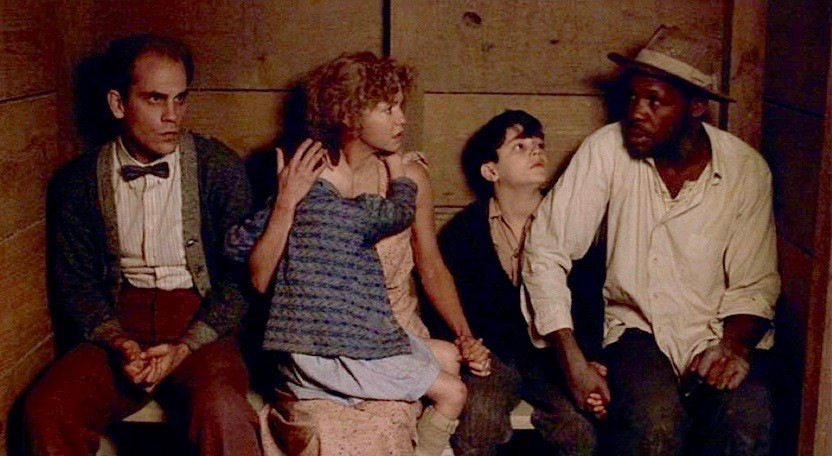
George (Burgess Meredith) is the brains of a partnership with childlike muscle man Lenny (Lon Chaney Jnr) as they drift from job-to-job out West, constantly hired on the back of Lenny’s muscle, then escaping from the troubles his lack of understanding of the world causes, through George’s survivalist cunning. They dream of having their own place – and they get a shot at it when aged, one-handed farmhand Candy (Roman Bohnen) offers to chuck his accident-payout dollars into their pot. But Lenny’s inability to cope with the world keeps leading to danger: from his accidental rousing of the ire of small-of-statue rancher’s son Curley (Bob Steele) to his fascination with Curley’s pretty wife Mae (Betty Field). Some dreams are doomed.

Of Mice and Men stays very faithful to Steinbeck, playing out this smalltown tragedy under the low-key, persuasive eye of Milestone who avoids either overplaying the tear-jerking or smothering the story with flashy film-making (there is one dramatic pull-back after disaster strikes, and George flees a barn, the camera heading into a sudden wide-angle, but other than that this is restrained film-making). Instead, the focus is very much placed on the relationship between two very different men who, without even quite understanding it, are mutually dependent halves of a whole.

At first it seems George and Lenny are effectively in a marriage of convenience. The wirey George would struggle to be hired without the loaded-cart lifting Lenny as a sweetener, while Lenny can barely tie his own shoelaces without George’s guidance. Meredith’s snipy, wheedling George feels at first like he can only just master his frustration with Chaney Jnr’s lumberingly sweet Lenny. But Meredith gives full life to a character who, we slowly realise, has a brotherly protective regard for Lenny – and needs the purpose Lenny gives his life, just as much as they both need the reassurance of George’s constantly spun story of their dream farm. This mantra – with Lenny echoing lines like a child’s bedtime story – of the buildings and animals they’ll care for is delivered by Meredith with a careful repetition that constantly flowers into earnest true-belief. We realise George is as much a lost soul as Lenny, adrift and barely able to cope with the world.

Because Depression-era America is a place where dreams go to die. Curley, clutching a few hundred dollars hush money after a farming accident cost him his hand, knows his life is just a countdown until he is kicked off the farm for being unable to work. He’s facing a future not too dissimilar from his euthanised dog, eyed up by the other men as a feeble old-timer who’d be better off snuffing it. No wonder both he and the simple Lenny, living on the bottom rung of life’s ladder, find a companionship with segregated Black farmhand Crooks (a very sensitive performance from Leigh Whipper, a character treated respectfully by Milestone’s film).

George’s natural alliance is with these little guys. Meredith’s George is naïve in his own way, slightly off-the-pace in social situations, tolerated by others, a deep vein of anxiety and worry just under his skin that he is all-too-happy to repress while he focuses on being father-figure and big-brother to Lenny. Meredith makes him chippy but not quite as worldly as he thinks, shrewd but vulnerable and, for all his carefully performance self-confidence, insecure and intimidated by events. He’s a passenger in life who likes to kid himself he’s a driver.

Authority lies elsewhere. Curley, played with a little-man anger and stunted swagger by Bob Steele, makes up for his own (many) insecurities – about everything from his height to what his flirtatious wife gets up to – by treating everyone below him in the farm’s pecking order with contempt. Curley needs to proof his masculinity by beating Lenny – who has all the physical gifts he longs for but none of the gumption to use them. He can only dream of having the relaxed, natural authority of Charles Bickford’s Slim, a man completely confident about himself and his standing in life – this easy assurance stands out in a film full of the jittery, frightened and insecure.

Of Mice and Men’s weakness, as with the book (as even Steinbeck later acknowledged) is Curley’s wife. Betty – played with a shrill energy by Betty Field in a performance she’s not quite strong enough to pull off – is only faintly crafted into a vaguely three-dimensional figure from the sexually charged, selfish flirt she is in the book. Here she has moments of self-reflection – and Milestone’s film briefly explores the isolation of this girl who dreamed of Hollywood but ended up married to an inadequate, angry man on a crappy farm – but remains, at heart, a brassy, selfish woman who precipitates disaster through her actions. It’s a singular lack of empathy in a film that prides itself on its humanitarianism.

Disaster is the inevitable outcome of a Steinbeck Depression-era drama. Milestone’s film finds quiet emotional power – aided a great deal by both Meredith and Chaney Jnr effectively under-playing – in the film’s final moments. You can imagine if this was your first exposure to a very familiar story, being impressed by the effectiveness of so much here. This is particularly so in the film’s powerful ending, directed with admirable restraint and played with a highly effective (and underplayed) emotion by Meredith. If other parts of the film are more well-assembled than really inspired, delivering Steinbeck pretty much as it is on the tin, that still makes for a fine version of a now familiar tale.

Norma Rae (1979)

Norma Rae (1979)

Heartfelt political drama, with a powerful lead performance, which works surprisingly well

Director: Martin Ritt

Cast: Sally Field (Norma Rae Webster), Ron Leibman (Reuben Warshowsky), Beau Bridges (Sonny Webster), Pat Hingle (Vernon), Barbara Baxley (Leona), Gail Strickland (Bonnie Mae), Morgan Paull (Wayne Billings), Robert Broyles (Sam Bolen)

At their best, Trade Unions remind us we are never stronger than when we work together. That’s never needed more than ever when confronted with the crushing, soul-destroying working conditions of an unfettered industry. Norma Rae was based on the true story of Crystal Lee Sutton, a North Carolina textiles worker who fought tooth-and-nail to gain Trade Union representation for her factory. Fictionalised here as Norma Rae Webster (Sally Field), Norma Rae covers her political awakening and her channelling her inbuilt sense of justice and fairness and her quickness to anger, towards the constructive goal of changing the lives of her and her community.

Martin Ritt’s conventional but heartfelt biopic may not reinvent the wheel when it comes to telling life stories, but throws itself into all-consuming righteous indignation at the staggering unfairness of the American economic model. The factory at the heart of Norma Rae wouldn’t look out of place in a Victorian-set movie. Deafeningly loud, machines whir non-stop, the air full of cotton spores clogging up lungs, breaks sharply controlled (making an emergency personal call is a disciplinary offence), dismissal possible at the slightest whim, pay kept at rock bottom, workers with medical conditions forced to work through under threat of dismissal… the ghastly, oppressive, miserable textiles factory is like nothing more than a workhouse.

And it is a captive workforce because the workers there have no other choice. The entire community lives in the factory’s orbit, with no other opportunities in the vicinity. The town feels only a few steps up from a shanty town in the factory grounds, people living and dying in its shadow. Even the shift supervisors are only a rung or two up from those they manage. No wonder that anyone who takes a job monitoring the other workers is treated like a snitch. There are no prospects, no hope of change and nothing to look forward to: only day-after-day constantly grinding out clothing for minimal wages (that have not kept track with inflation) while the bosses get richer.

Despite this though, everything is set up to keep the status quo going. Many of these Southern workers have swallowed the management kool-aid that anyone arriving from the North talking about unions are commie, anti-American agitators. Particularly when they are New York Jews like Reuben Warshowsky (Ron Leibman). The factory owners do the absolute minimum to meet the requirements of Warshowsky’s legally-entitled inspection, or to ensure the workers rights to vote for representation. Local authorities, such as the Church, collaborate in maintaining the status quo. And Norma Rae doesn’t look-away from how the racism is used. The local preacher can’t decide if he is more at aghast at the idea of a union meeting in his church hall, or that the meeting will be non-segregated. The factory bosses shamelessly peddle the lie that a union is a tool for Black people to take control of the factory and drive white workers out.

But Ritt’s film clings to the hope that good people can change things, with reasoned argument and passion. That’s embodied in Sally Field’s Norma Rae. Previously best known for sitcom The Flying Nun (her character did exactly what the title says), Field seemed left-field casting as a trailer-trash single mother to three children from three different fathers, turned firebrand political agitator. But Field’s performance was an (Oscar-winning) revelation. She makes Norma Rae both a firecracker of perseverance and determination, but also acutely aware of her vulnerability, Field never losing track of the anxiety that makes her resolute stand-taking all the more impressive.

Martin Ritt’s film skilfully and economically sketches out her character from the start, helped by Field’s skilled playing. We are introduced to her impulsively and furiously berating both her supervisor and the factory’s tame doctor after the never-ending noise of the machine leaving her mother deaf, with no thought of her tenuous position. Later she will berate her own shallowness in sleeping with a married men – then infuriate him with accusations of selfish, ill-treatment of his wife. In a few short scenes, Field establishes a character with principles, a sense of honour and a fierce sense of justice but also prone to rash and kneejerk decisions.

Field’s performance soaks in righteous indignation but also has an emotionality under the surface. When arrested, she struggles like a wild animal to avoid putting in the car before taking on a stoic defiance in jail – only to break down in tears after being bailed. Field creates a women fiercely resilient and unshakeably resolute once she has found a purpose, with a strong sense of justice.

These are qualities recognised by Leibman’s visiting union organiser. Norma Rae draws a fascinating and extremely restrained platonic romance between these two who, despite their surface differences, are soulmates in the relentless focus, all-consuming dedication to justice. But both are spoken for: Warshowsky to a fiancé in New York, Norma to the man she has only just married, the decent-but-utterly-ineffectual Sonny (Beau Bridges). Their unspoken, subtle dedication to each other over late-night union work (which never spills out, even during a playful lake swimming session) is a restrained, very effective beat in a movie that keeps its fireworks for politics.

The film highlights the slow grinding of changing minds and energising people to fight for their own freedoms. Ritt highlights, in a series of underplayed meeting scenes, a host of characters sharing their stories, their faces showing them come to the realisation almost in that moment of how shabbily they are treated. He balances this with real moments of showmanship, that carry even more impact due to the underplayed nature of the rest of the movie.

Most famous, of course, is Norma Rae’s impassioned (literal) stand on principle as the management find a dubious reason to dismiss her. (Ritt frequently uses Field’s shorter statue to powerful effect, surrounding her with larger, overbearing men.) Standing on a table, she refuses to budge, clutching a hastily hand-written sign that just states the word ‘union’. In many ways, it’s a bread-and-butter heart-soaring moment, but Field and Ritt expertly sell emotion, from Field’s quivering, emotional determination to the workers slowly one-by-one shutting down their machines in solidarity.

Solidarity is what it’s all about, in a film that is more sympathetic and admiring of organised labour than almost any other Hollywood effort (it would make a fascinating double bill with On the Waterfront). Directed with effective restraint by Ritt with a power-house performance from Field, it’s also interesting to watch at a time when many in America are calling for a return to American industrial life like this but without any call for guarantees for the rights of workers. Norma Rae could be even more relevant in the years to come.

Sergeant York (1941)

Sergeant York (1941)

Patriotic flag-waver with a great performance from Cooper and plenty of genuine heart

Director: Howard Hawks

Cast: Gary Cooper (Alvin C. York), Walter Brennan (Pastor Rosier Pile), Joan Leslie (Gracie Williams), George Tobias (“Pusher” Ross), Stanley Ridges (Major Buxton), Margaret Wycherly (Mother York), Ward Bond (Ike Botkin), Noah Beery Jr. (Buck Lipscomb), June Lockhart (Rosie York), Dickie Moore (George York), Clem Bevans (Zeke), Howard Da Silva (Lem), Charles Trowbridge (Cordell Hull)

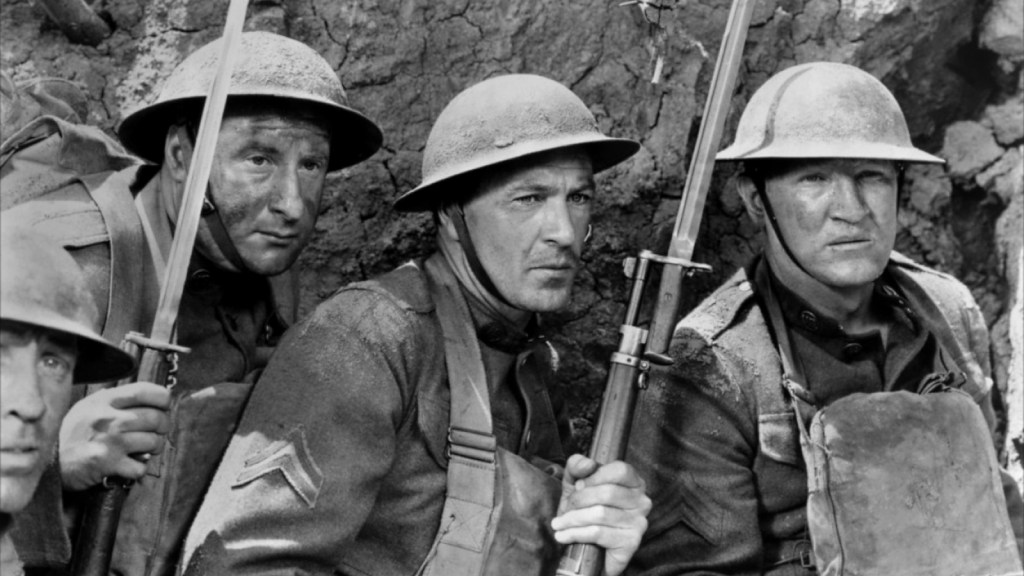
In 1941, after Japanese bombs landed on Pearl Harbor, America needed patriotic big-screen heroes. Few stood out more than Alvin York. A young man (over ten years younger than Gary Cooper) who had lived a youth of drunken rough-and-tumble before he found the light. When America joined the First World War, the 30-year-old York was called up. A gifted sharp-shooter, York was perfect for soldiering – but had to wrestle with his conviction to stick to the Commandments from the Good Book. Finding a solution to his moral quandary, York fought in France where his sharp-shooting instincts saw him almost single handedly capture a German machine gun embankment and 132 Germans (it’s an achievement that sounds pure Hollywood, but is in fact entirely true).

It’s an inspiring hero story that Warner Brothers bought to the screen at the perfect time, it’s release seeing tales of streams of young men walking from the cinema straight to the enlistment office. Producer Jesse L Lasky spent no less than twenty-two years attempting to persuade the notoriously publicity-shy and modest York (just as in the film, the real York couldn’t wait to leave the glitz and glamour of his triumphant homecoming behind and return to his fiancé, farm and work with the Church) to grant him the film rights to his life. York agreed only with the advance of Hitler, a hefty payment to his Church and a promise that no-less than Gary Cooper would play.

Cooper was reluctant – pointing out he was far too old to play this national hero – but really no other actor could have done it. Cooper won his first Oscar for the role, and it’s his understated sincerity and decency that really sells the film. He turns what could otherwise by a potentially cloyingly perfect man into someone utterly sympathetic and endearing. There is an aw shucks quality to Cooper, as he captures York’s modesty, his shrugging off his accomplishments as no more than his duty, his palpable discomfort with attention (be it from congressmen or his fellow Tennessee farmers commending his shooting) and a deep-rooted genuineness in his love for his beau Gracie (Joan Leslie giving a commendable performance of endearing brightness that helps you overlook she was 24 years younger than Cooper – thankfully she doesn’t look it).

Cooper’s performance powers a sprightly, very enjoyable film by Howard Hawks (who picked up his only Oscar nomination for this) that manages to transcend the danger of being an overbearing flag-waver. (Don’t get me wrong though – this film waves the flag so much, you can practically feel the strain in its arms). Hawks produces a film that in many ways owes as much to The Adventures of Robin Hood as an heroic All Quiet on the Western Front. Despite the patriotic focus being the final few Acts, as York carries out his act of astonishing heroism, the film’s real heart is in the opening half and the conversion of a man who is never-too-naughty into one who casts aside the demon drink, works hard to earn what he has, and puts his faith and the good of others before his own concerns.

Hawks shoots this part of the film with a palpable energy and a rough-and-tumble sense of humour. It’s there from the film’s opening as Walter Brennan (in a role he invests with all his wheezy, twinkly dignity) finds his sermon constantly interrupted by the gunplay of the drunken York and his buddies. There is a light humour when Margaret Wycherly – a little too ethereal for my taste as York’s saintly mum (although her casting does make York and White Heat’s Cody Jarrett siblings) – archly observes that, even when drunk, her son’s accuracy with a shooter is second to none. That’s the skill of Sergeant York there: in it’s end is it’s beginning, York is already deeply skilled and as his slightly embarrassed reaction shows when he sobers up, reformation is not a long journey.

A large part of the success is making York one of us. Striving to save the money he needs to buy the farmland of his dreams, Hawks provides a sweet montage of York undertaking no end of backbreaking, thankless work and returning home to tick off his slowly accumulating dollars under the smiling approval of Ma. When, after all his work, he finds the land has nevertheless been sold (because the owner never believed this previously idle lush could hold on to his hard-earned pennies), his outrage at the breaking of another man’s word is a clarion call to all of us who have played by the rules and been shafted. When his conversion comes, it’s not as out-of-the-blue as it could seem, but a logical conclusion for a journey we’ve watched him go on.

It’s undercut with scenes that drip with Hawksian skill. A marksmanship competition is crammed with a playful Robin Hoodesque skill. A bar-fight that the drunken York gets wrapped up in is so full of comedic tumbles and prat falls it’s hilarious. York’s constantly being fetched for various tasks by his kid brother is expertly played for subtle laughs. Alongside this, the romance between York and Gracie (and the off-screen slapping he hands out to a rival who treats her with disrespect) is beautifully handled.

The only real Hawksian touch missing is that little slice of cynicism, that ability to look under the skin of a legend (like with Wayne in Red River) and see a more flawed person. York basically is perfect, and in a film dripping with patriotism there can’t be any fault with either the army or the moral question of whether gunning down your fellow humans is alright in the service of your country. There is a version of Sergeant York where his commanding officer’s invitation that he take some time and read his way through the history of America (a replacement good book) was an act of naked manipulation of a guileless man. Or where we see the sort of guilt at his taking of life that the real York felt, play out across Cooper’s face. There’s none of that here.

In fact, after the vibrant, playful, heartfelt first few acts, you feel Hawks felt less interested in the war itself. There is a functionality about the final acts of Sergeant York as York aces his shooting tests on the range (although the flabbergasted reaction of his training officer and York’s apologetic manner at his failure to only manage five dead-on bulls-eyes on his first time using an army-issue rifle are funny). Hawks spices it up with York’s turkey-shoot metaphor, and a warm supporting turn from George Tobias (as a New Yorker soldier) and York’s gobble-gobbles to distract his German opponents. But, for all the realism of the trenches, there is an air of duty about this sequence.

But then Sergeant York works not because of the deed, but the man. And the film’s success in investing us in a man who could very easily have been all-too-perfect, in a playful and energetic first half works wonders. With a very fine, perfectly judged performance by Gary Cooper, this may not be Hawks most characterful work – but as the sort of film to showcase a man who inspires you to achieve acts of heroism, it hits the target perfectly.

Hold Back the Dawn (1941)

Hold Back the Dawn (1941)

A potentially cynical drama becomes a sweet romance, with three excellent lead performances

Director: Mitchell Leisen

Cast: Charles Boyer (Georges Iscovescu), Olivia de Havilland (Emmy Brown), Paulette Goddard (Antia Dixon), Victor Francen (Professor van der Luecken), Walter Abel (Inspector Hummock), Curt Bois (Bonbois), Rosemary DeCamp (Berta Kurz), Eric Feldary (Josef Kurz), Nestor Paiva (Fred Flores)

Refugees flock at the USA-Mexican border, desperate to squeeze into the Land of the Free, only to meet with a stringent border control and tight rules on immigration quotas. No, it’s not a story from today – it’s from the 1940s, with Mexico awash with refugees from Europe, fleeing Hitler. But the USA only has a certain quota of refugees it will accept from each country – and Romanian Georges Iscovescu (Charles Boyer) finds he’s got no less than a five to eight year wait before his quota number will come up. His ex-flame Anita (Paulette Goddard) suggests there might be a way around this: if Georges can get married to an American citizen, he will fly through the border on a green card. Georges sets his eye on spinsterish teacher Emmy Brown (Olivia de Havilland) marrying her in a whirlwind romance – only to find feelings of guilt and growing affection for Emmy making his plan more difficult.

Hold Back the Dawn is well-assembled, well-paced mix of romance and black-comedy which pulls its jet-black punches in favour of a more conventional happy ending. Perhaps that’s why it was the last Billy Wilder script (working with regular collaborator Charles Brackett) he didn’t direct himself. You can imagine a director as prone to the cynical as Wilder, may not have settled quite as happily for the more optimistic and reassuring film Hold Back the Dawn becomes. Wilder was also unhappy with how he felt the film pruned back the more cutting political criticism of America’s immigration policy. As a refugee from Hitler himself, Wilder knew of what he was talking about.

However, that’s not to say Hold Back the Dawn isn’t awash with Wilder and Brackett’s patented mix of waspish character comedy and sharp dialogue tinted with more than a touch of arch cynicism. Mitchell Leisen’s success here, is to smooth the wheels to allow enough of this mix of black and absurdist humour to carry through a film you feel the studio has attempted to shoe-horn into being a conventional ‘love conquers all’ narrative (not least with its ending, which has the look and feel of a mix of hurried re-shoots and re-purposed footage to create a late upbeat ending, filmed after de Havilland was no longer available from her loan from Warner Brothers).

Hold Back the Dawn doesn’t shirk on the vicious, oppressive cycle of being stuck in a holding pattern waiting to be allowed into the US. Georges only gains his room in the overstuffed hotel because the previous tenant hangs himself (the manager matter-of-factly says he’ll have the room ready shortly). There is quite a lot of both dark humour (from Georges and Anita’s nakedly opportunist cadism) to little touches of high farce (a pregnant woman gaming the system to give birth on US soil) and the faintly surreal (a would-be refugee who might just be a descendant of honorary US citizen Lafayette). Throughout most of Hold Back the Dawn this never feels out of keeping with the slow-burning romance between Georges and Emmy.

A lot of this is also due to Charles Boyer’s highly successful performance in the lead role. Few actors were as skilled at mixing suave European class and louche rotter-ness than Boyer, and Georges is a gift of a part. A playboy stuck in a boring, dead-end purgatory of a town (one he aimlessly walks around time and time again to kill the hours), Boyer makes Georges believable charm personified – certainly enough to back the film’s implication he keeps himself afloat as a gigolo for tourists. Boyer’s arch voiceover relays every-step of the nakedly self-centred plan he initiates to squirm his way over the border. His performance is full of charm, tender shyness and love-struck adoration to Emmy, punctured throughout by Boyer’s canny side-eye to check on the effect of his shameless lies (there is a glorious moment when Boyer checks himself and cocks an eye when walking down a street, to make sure Emmy is following him).

The character works though because Boyer is a master at balancing this ruthless, self-serving charm with a general decency just below the surface that, no matter how hard he tries, he can never quite dampen down. It excels in the film’s middle act as the couple’s ‘spontaneous’ (so Georges can escape the notice of Walter Abel’s excellently shrewd immigration inspector) honeymoon in Mexico. Boyer brilliantly demonstrates through the slightest of vocal inflections and subtle shifts in body language (there is a point during a village fiesta where his face lights up with a genuine smile the like of which we have never seen before) that make us totally believe this is a man who, much to his surprise, is actually falling in love.

It helps with this that he shares scenes with such a winning presence as Olivia de Havilland as Emmy. Oscar-nominated, de Havilland takes a role (a spinsterish frump, who has never been loved) that could be ridiculous and makes it utterly and completely real. Throughout Georges initially cynical courting, there is a little sense of doubt throughout in de Havilland’s manner (she knows instant love is too good to be true), but such is her loneliness we can see and feel her willing herself into belief. As she does so, de Havilland lets the shy Emmy flourish into a woman of greater confidence, wit and burgeoning sexual desire (hilariously, the increasingly shamed Georges begins to event injuries to put off the consummation of this marriage). De Havilland makes Emmy a living, breathing person, someone miles away from the joke she is set up as initially: instead she is a genuine, true-hearted, increasingly brave woman whose decency and sense of warmth we grow to love as much as Georges does.

She makes an excellent contrast with Paulette Goddard’s ruthlessly amoral Anita. In one of her finest performances outside of her work with Chaplin, Goddard makes Anita utterly ruthless in seeking out what she wants and full of a hilariously honesty about her willingness to use anyone and anything to get it. She’s Georges even darker reflection, Goddard’s dialogue awash with brutal firecracker one-liners. But even she is capable at points of depth, a late act of petty cruelty awakening in her underlying feelings of sympathy and empathy that seem to surprise even her. It’s a lovely performance of darkly comedic ruthlessness.

These three leads all elevate a film that at times compromises on its vision of the harshness of the system these people are all stuck in. Hold Back the Dawn doesn’t want to make a statement as such – it wants to offer a more reassuring vision of hope and decency. This it does well: the film is even built around Georges pitching it as a possible film project to the actual Mitchell Leisen (effectively playing himself, on set shooting a real film with the real Veronica Lake and Brian Donlevy). After a start that suggests something darker and more dangerous, it ends as a comforting and safe picture – but one that works extremely well.

Johnny Belinda (1948)

Johnny Belinda (1948)

Small-town drama is a beautifully done exploration of prejudice with excellent performances

Director: Jean Negulesco

Cast: Jane Wyman (Belinda MacDonald), Lew Ayres (Dr Robert Richardson), Charles Bickford (Blackie MacDonald), Agnes Moorehead (Aggie MacDonald), Stephen McNally (Locky McCormick), Jan Sterling (Stella), Rosalind Ivey (Mrs Poggerty), Dan Seymour (Pacquet), Mabel Paige (Mrs Lutz), Alan Napier (Defence Attorney)

Small towns. Sometimes they’re safe, cosy little havens of the familiar. And sometimes they’re bitchy places of resentment and suspicion where everyone judges everyone else’s business. In an environment like that, it doesn’t pay to be different. Belinda MacDonald (Jane Wyman) is as different as they come: a deaf and dumb young woman, who (despite her intelligence and warmth) everyone assumes is a mentally deficient. Just as different, in a way, is Dr Richardson (Lew Ayres), a compassionate, well-educated man who forms his own opinions and is oblivious to other’s prejudices. Life’s going to be tough for this pair.

Dr Richardson is the only person in this small Canadian fishing town who can see the bright, vivacious young woman Belinda is. With his support, her father Blackie (Charles Bickford) rediscovers his love for a daughter, who he always blamed for her mother’s death in childbirth, while her austere aunt Aggie (Agnes Moorehead) thaws and proves her loyalty. Belinda will need them when she is raped by the popular Lucky (Stephen McNally) and trauma leaves her unable to remember who is responsible for the resulting child. The town, of course, blames Dr Richardson.

Johnny Belinda has all the ingredients of a melodrama: but it surprises as a mature, sensitive and moving story about real people. It’s amazing to see a 40s film this frank about rape and an illegitimate child, that lays not a finger of reproach on the victim, instead turning its fire on the small-minded judgements of those around her. It’s also striking it doesn’t define Belinda solely as a victim, either of deafness or rape. She gives birth to a child she dearly loves, refuses to let what’s happened haunt her and sees her life as one with blessings rather than curses. But neither is she an angelic character, being at times as capable of mistakes and quick judgements as the rest of us.

It helps that Jane Wyman (in an Oscar-winning turn) gives a perfectly judged performance. She’s never winsome or cloying, but fills Belinda with an uncomplaining grit to make the best of things, matched with a growing joy as her opportunities expand, from her discovery of sign language to the birth of her child. In complete silence (Wyman intensively learned sign), Wyman employs her expressive eyes to communicate a range of emotions from wonder to joy to fear to pain and grief (including a wordless rendition of the Lord’s Prayer). Belinda is a character we deeply empathise with, but never we nor the film treat her as an object of charity.

That also springs from Ayres’ Dr Richardson, a genial, kindly man whose inability to see the worst in people makes him a target-in-waiting for gossip. His less than regular attendance at Church has already raised question. Add his academic earnestness – and Ayres wonderfully embodies a man quietly passionate about making a difference – and you’ve got someone who doesn’t fit in a town that respects manly ruggedness. Richardson doesn’t pick up on this at all – just as he doesn’t even notice the clearly besotted devotion of his housekeeper Stella (an excellent portrait of quiet desperation by Jan Sterling).

Gossip is soon flying that Richardson is too close to Belinda. A trio of judgemental old woman, like Irish banshees, frequently stand on street corners to share little tit-bits of meanness.  The town punches down on outsiders, fitting people into insultingly simple brackets. It’s partly why immigrant shop-owner Pacquet (Dan Seymour) becomes the ringleader of a morality lynch mob: he’s all too aware it otherwise won’t be long before he’s the target again. No one, of course, can imagine for a moment that the carefree, rugged Lucky (Stephen McNally, a wonderful portrait of utterly smackable shallow vileness) could be the sort of cruel, cowardly cad he is.

A cad who takes notice of a newly confident Belinda – and not in a good way. Part of Johnny Belinda’s power is you can sense the latent danger in those eyes on a newly radiant and confident Belinda at a town shindig, the shy wallflower turned smiling young woman enjoying the music through feeling the vibrations of a violin string (a lovely moment, played with a real burgeoning wonder by Wyman). It’s a mark of the cruelty of the world that this confidence just makes Belinda a target for the vile Lucky.

Again, it’s a mark of Johnny Belinda’s success that the cruelty of what happens hits so hard. Rarely have I despised a film villain as much as Lucky, perhaps because he’s so weak, snivelling and arrogant – the sort of guy so arrogant and stupid he crows over the good-looks of his illegitimate son. He’s a picture of the real villains out there: the weak, stupid and shallow who always get passes from those around them.

Johnny Belinda creates deep, engaging characters. Charles Bickford’s Blackie is presented as first as a gruff, careless father. But the film – and Bickford’s performance – slowly unpeels him as a tender, caring and decent man. The sort of man whose first instinct is to protect, who delights in his unexpected grandson and is thrilled with the excitement of sign language. Similarly, Agnes Moorehead gives a terrific performance as a woman who seems at first a bullying harridan, but becomes a pillar of familial strength. (Both of them and Ayres were Oscar nominated, Johnny Belinda one of the few films to get nominations in every acting category).

This affecting story of people who feel real and three-dimensional, is well directed with restraint and care by Jean Negulesco (easily his finest film) and shot with a real beauty in its rugged Canadian sea-town visuals by Ted McCord. Max Steiner’s excellent score mixes emotional melody with sea shanty influences. It’s a world where intense but very real emotions help ground a story of rape, murder, scarlet letters and court cases into something that feels real and relatable.

Johnny Belinda feels like an overlooked gem, a sort of perfect example of Hollywood issue film where the ‘issue’ isn’t pounded over our head but built organically into the plot. One where characters surprise us with developments that feel real, embodied by a series of excellent actors at the top of their game. It’s a small gem that deserves to be better known.

All That Money Can Buy (1941)

All That Money Can Buy (1941)

The Devil sure knows how to tempt a man in this beautifully filmed morality tale

Director: William Dieterle

Cast: Walter Huston (Mr Scratch), Edward Arnold (Daniel Webster), James Craig (Jabez Stone), Anne Shirley (Mary Stone), Jane Darwell (Ma Stone), Simone Simon (Belle), Gene Lockhart (Squire Slossum), John Qualen (Miser Stevens), HB Warner (Judge Hawthorne)

Sometimes life can be a real struggle. With debts, failed crops and animals getting sick, what’s a guy to do? That’s the problem New Hampshire farmer Jabez Stone (James Craig) has in 1840. What he wouldn’t give to find a bundle of buried gold that could solve all his problems. Fortunately, charming old rogue Mr Scratch (Walter Huston) knows exactly where to find one – all he wants in return is for Jabez to sign away his soul seven years from now (signed in blood of course). Jabez gets fortune, prestige, the son he always wanted – but when ‘Mr Scratch’ comes to collect, can Jabez’s friend, famed orator, lawyer and congressmen Daniel Webster (Edward Arnold) save his soul?

All That Money Can Buy is a richly atmospheric piece of film-making from William Dieterle, adapted from Stephen Vincent Benet’s short story and full of gorgeously filmed light-and-shadow with a haunting score by Bernard Herrmann. (The story was originally titled The Devil and Daniel Webster, also the film’s original title before RKO changed it to avoid confusion with their more successful Jean Arthur comedy The Devil and Miss Jones.) It’s a neat morality tale, full of dark delight at the devilish ingenuity of Mr Scratch, with lots of dark enjoyment at seeing a weak-but-decent man corrupted into being exactly the type of greedy, cheating cad to whom he was deeply in debt to from the beginning.

It’s nominally about James Craig’s Jabez Stone, but Jabez is a shallow, easily manipulated passenger in his own life, pushed and pulled towards and away from sin depending on who he’s talking to. Stone’s fall is swift: moments after meeting Scratch, he’s digging hungrily into a meal while his wife and mother say grace, hugging his newfound bag of gold. As his wealth goes, he drifts from his pure wife (Anne Shirley, effective in a dull part) becoming easy prey for demonic (literally) temptress Belle (a wonderfully seductive Simone Simon). By the time the seven years are up, he’s skipping church for illicit card games and crushing the farms of his neighbours to fund his dreamhouse-on-a-hill.

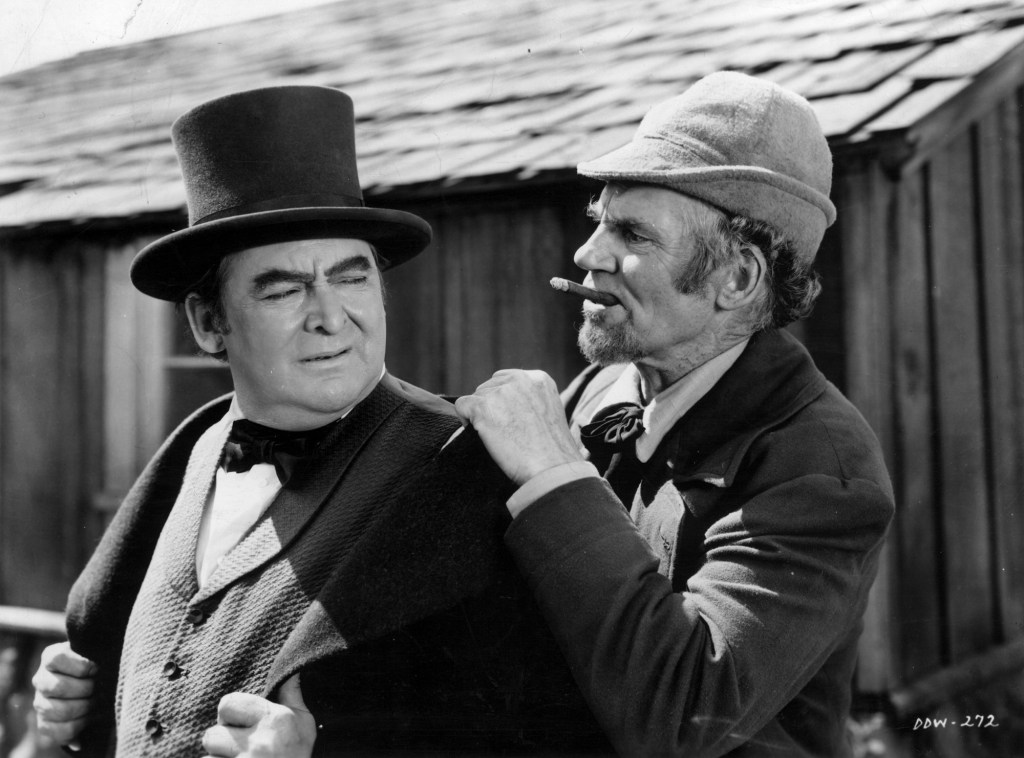
Stone is really the Macguffin here. The real focus is the big-name rivals: The Devil and Daniel Webster. It’s implied these two have fought a long-running battle for years: our introduction to Webster sees him scribbling literally in the shadow of Mr Scratch, who whispers to him tempting offers of high office. Later Webster is unflustered when Scratch suddenly appears to place a coat on his shoulders, treating him as familiar rival. You could argue Scratch is only prowling the streets of New Hampshire because he’s looking for a way to nail the soul of his real target, Daniel Webster.

As Mr Scratch, the film has a delightful (Oscar-nominated) performance from Walter Huston. With his scruffy clothes and twirling his cane, Scratch pops up everywhere with Huston’s devilish smile. It’s a masterclass in insinuating, playful malevolence, with Huston playing this larger-than-life character in a surprisingly low-key way that nevertheless sees him overflowing with delight at his own wickedness. Huston has the trick of making Scratch sound like someone trying to sound sincere, while never leaving us in doubt that everything he says is a trap or lie, only showing his arrogance and cruelty when victory is in his grasp. It’s a fabulous performance, charismatic and wicked.

Edward Arnold makes Daniel Webster both a grand man of principle and a consummate politician, proud of his reputation and all the more open to temptation for it. He also has the absolute assurance of a man used to getting his own way, and the arrogance of seeing himself as an equal to the Devil rather than a target. These two form the ends of a push-me-pull-me rivalry.

The rivalry culminates in its famous ‘courtroom’ scene, as Webster – a little the worse for drink –argues for Jabez’s soul in front of a ghostly court of American sinners from the bowels of hell (lead among them Benedict Arnold). Its shot in atmospheric smoke, with the double exposure creating a ghostly effect for jury and judge. It’s another excellent touch in a film full of inventive use of effects and camerawork, Dieterle at the height of his German influences. The artificial New Hampshire scenery is shot with a sun-kissed beauty that bears Murnau’s mark. Striking lighting and smoke-play abounds in Joseph H August’s camerawork, not least Belle’s introduction backlit with an extraordinarily bright fire. Early scenes of Stone’s misfortune interrupted by a brief frames of a photo-negative Scratch laughing, quite the chillingly surrealist effect.

Politically, All That Money Can Buy backs away from any overt criticism of Webster’s support for the Missouri Compromise (this key piece of slavery protection legislation is so key to Webster’s view of American strength he’s even named a horse after it). But it’s quite brave for 1941 in allowing the Devil legitimate criticism of America’s ‘original sins’ saying he was there driving on the seizing of the land from the Native Americans and up on deck on the first slave ship from the Congo. (Especially as Webster can’t defend these actions). It’s also interesting that the film praises collectivism for the farmers over rugged individualism, a conclusion it’s hard to imagine being praised a few years later.

All That Money Can Buy is also filled with impressive practical effects, not least Scatch’s impossible catching of an axe thrown towards him, bursting it into frame. Both Scratch and Bell reduce papers to flaming ashes with a flick of the wrist. Horribly woozy soft-focus camera work accompanies Jabez’s nightmare visions of the damned. It’s tightly and skilfully edited, superbly paced, with montages used effectively for transitions (a field of corn growing is particularly striking) and wildly unnerving sequences, like Scratch’s fast-paced barn-dance with its whirligig of movement and repeated shots. It’s all brilliantly scored by Herrmann, from the pastoral beats of New Hampshire to the discordant sounds (some created from telephone wires) that accompany Scratch.

All That Money Can Buy concludes with a stand-out speech from Webster that perhaps settles matters a little too easily – and brushes away any of the film’s mild criticism of America’s past with a relentlessly upbeat patriotic message. But the journey there – and the performances from a superb Huston and excellent Arnold – is masterfully assembled by a crack production team working under a director at the height of his powers. A flop at the time, few films deserve rediscovery more.

The Teacher’s Lounge (2023)

The Teacher’s Lounge (2023)

A series of minor thefts leads to a school spiralling out of control in this intense, small-scale drama

Director: Ilker Çatak

Cast: Leonie Benesch (Carla Nowak), Eva Löbau (Friederike Kuhn), Anne-Kathrin Gummich (Dr. Bettina Böhm), Rafael Stachowiak (Milosz Dudek), Michael Klammer (Thomas Liebenwerda), Kathrin Wehlisch (Lore Semnik), Leonard Stettnisch (Oskar Kuhn)

Schools can be like whole societies in microcosm, with attention grabbing events having earth-shattering consequences in these tiny worlds. New teacher Carla Nowak (Leonie Benesch) finds this out the hard way when she takes matters into her own hands to solve a spate of petty thefts in the staff room, before the blame is pinned on students. Setting a trap, to her surprise she captures on film evidence that the thief is the school’s popular administrator Mrs Kuhn (Eva Löbau), mother of Carla’s star-pupil Oskar (Leonard Stettnisch). Events quickly spiral out of control, as Mrs Kuhn denies the charges and Carla’s attempts to be even-handed and fair leave her isolated at the centre of a storm pitting teachers, students and parents against each other.

The Teachers Lounge is a gripping ‘everyday’ thriller, where events on a small scale capture wider conflicts that rock whole societies. The events themselves seem small – petty theft and arguments over invasions of privacy – but Çatak’s film demonstrates they have shattering impacts on those involved. Loss of reputation, of jobs, the damaging impact on a promising child’s education, the shattering of harmony in a small community – it all explodes due to a few spur-of-the-moment decisions, building on each other so delicately that you are suddenly surprised to find it’s a crisis.

What’s really painful about The Teacher’s Lounge is how scrupulously honest and moral everything Carla tries to do is. What she’s not prepared for, is other people not playing by the same rules. Privately confronting Mrs Kuhn (having caught her distinctive blouse going on camera) with an offer to stop stealing and she’ll say no more about it, she’s amazed and totally shaken by the complete unwillingness to admit any guilt. When the matter is raised with the headmaster, Carla is dumbfounded by Kuhn’s aggressive denial and furious counter-accusation of invasion of privacy. Her cause is passionately taken up by Oskar, accusing Carla of ruining his mother’s life for no reason.

At the film’s heart is a wonderful performance of repressed tension from Leonie Benesch. Carla is a good teacher, but also a slightly distant, perhaps little-too-professional person. She engages more comfortably with the children because the ‘rules’ are clearer. With her fellow teachers, she never seems relaxed. She isn’t willing, as they are, to support (or cover up) for colleagues regardless of the situation. She judges each situation on its own merits – and Benesch superbly shows through her tense frame and strained voice how stressful this is – and adjusts her views and opinions as the situation develops. To everyone else this isn’t a positive but a huge negative, her refusal to follow an agreed line a sign of her flaky lack of loyalty to the team. (Her controversial filming is entirely caused by her mistrust of her colleagues, after watching one of them shamelessly empty an honesty box).

Çatak’s film shows how fragile the rules holding society together can be under pressure. Carla’s compassionate, thoughtful teaching focuses on developing her young students’ empathy and morality. She respects their views and asks for honesty in return. When arguments arise in class, she encourages discussion and consensus building. A jolly welcoming clapping-and-singing routine she practices every morning is about bringing the class together as a group. All of this flies out of the window as events unfold, showing how fragile these precious democratic conventions are.

The control of the teachers in the school turns out to be unbelievably fragile. Carla’s students stop co-operating with her lessons, effectively forming a union. The school newspaper – older students full of idolism about being the next Woodward and Bernstein – trap Carla into a Gotcha interview and misrepresent her opinions, fuelling the crisis (and leading to a near mutiny over a ban of the school newspaper). Carla, naturally, is blamed by her colleagues for the interview.

These fragilities and small-scale repression is just one way Çatak uses the setting to illustrate larger issues. Just under the school’s surface, there is a strong ‘us-and-them’ atmosphere. Both teachers and students demand internal loyalty to their sides. The thefts have already motivated heavy-handed members of staff to pressure (in private meetings) students to inform on their classmates. Carla objects to this but lacks the strength to end it – just as she later objects but does not obstruct a forced search of the boy’s wallets for stolen cash. It becomes more and more clear that Carla’s more considerate, diplomatic way of proceeding simply hasn’t got a chance of getting heard.

There is an uncomfortable air of casual assumptions being swiftly made. The first student suspect is the son of Turkish immigrants (the father’s job as a taxi driver all but used as evidence that the boy is likely guilty). Some of the staff simply can’t believe a boy from his background could have ready cash on him. An unbearably uncomfortable meeting with his parents – who at one point are instructed to speak German – is rife with tension. No wonder Carla is so uncomfortable with her Polish roots being discussed, that she asks a colleague with a similar background to only speak to her in German. Of course that contributes even more to the untrusted sense of distance Carla accidentally gives off to her fellow teachers.

This makes it even more heartbreaking to see Carla’s world slowly collapse in on itself as her attempts to treat everyone’s view points and demands fairly and equally ends with her attacked by both her colleagues and students. With her ever tense, bewildered decency getting ever more crushed Leonie Benesch is excellent in Çatak’s wonderful small-scale morality tale about society today, where the loudest and most strident voices win out. If you were her, you’d be finding an excuse to scream in a classroom as well.

The Night of the Hunter (1955)

The Night of the Hunter (1955)

Laughton’s only masterpiece is a fairy-tale, stuffed with beautiful images and dreamlike logic

Director: Charles Laughton

Cast: Robert Mitchum (Harry Powell), Shelley Winters (Willa Harper), Lillian Gish (Miss Rachel Cooper), James Gleason (Uncle Birdie), Evelyn Varden (Icey Spoon), Don Beddoe (Walt Spoon), Billy Chapin (John Harper), Sally Jane Bruce (Pearl Harper), Gloria Castilo (Ruby), Peter Graves (Ben Harper)

Few films have had their critical reputation change quite as much as The Night of the Hunter. When released, its reception from film critics and audiences was so negative that the crushing disappointment saw director Charles Laughton decide his debut would also be his last film. Flash forward seventy years and it’s now hailed as one of the great American films, a pictorial masterpiece. The Night of the Hunter sits alongside Citizen Kane as the classic film unappreciated in its day.

Adapted from Davis Grubb’s best-selling novel, it follows the nightmareish experiences of young John Harper (Billy Chapin) and his sister Pearl (Sally Jane Bruce). These kids witness their father Ben (Peter Graves) dragged away by the cops to imprisonment and execution – but not before he’s hidden $10,000 in Pearl’s doll and sworn them both to secrecy. Word about the money gets out: it’s why sinister ‘Preacher’ Harry Powell (Robert Mitchum) arrives and starts a-courting their mother Willa (Shelley Winters). After swiftly disposing of Willa, Powell turns his attentions to the kids – who flee down river, eventually coming under the protective wing of kindly widower Rachel Cooper (Lilian Gish) and her brood of young waifs and strays. Is it far enough though to escape Powell’s clutches?

The Night of the Hunter plays out like a fairy tale. Its images are full of the magic of the countryside and mysticism of nature. It frequently, deliberately, uses artificial sets and locations to create a dream-like state. It’s got a classic monster its heart, with Powell a demonic force-of-nature. It follows a pair of children on a journey reminiscent of Hansel and Gretel. There is a kindly old woman and a moral message of the importance of love, family, faith and loyalty. Everything in it feels, to various degrees, heightened. This is Southern drama via Hans Christian Anderson.

I wonder if that’s what threw people off on release. I’d agree that the film’s opening – Lilian Gish’s face superimposed over a starry night sky (followed by a cut of five kids heads superimposed over the same sky raptly listening) – might tee us up for the film’s mood, but looks and feels kitsch. The moments where Laughton deliberately aims at heightened, almost cartoonish, reality push the envelope of what you can accept – why does Powell, at one point, chase the kids up a flight of stairs, hands stretched out before him like he’s in a live action Tom & Jerry cartoon? Stumble onto The Night of the Hunter unwarned about its fantastical grounding and melodrama and it must look and feel odd, bizarre and even a bit laughable.

But it’s these same qualities that have made the film last. Laughton created a film of magical force and power, crammed with striking, imaginative images and beautiful sequences that tip between dream and reality. Its real heart lies in the children’s escape down the river, a remarkable sequence as the camera follows the boat drifting down an obviously artificial river, the children asleep as it glides past spider’s webs, frogs and other wildlife. From a film that opens with the aggressive arrest of the Harper’s dad, this burst of Where the Wild Things Are mysticism intentionally feels like we are crossing into a completely different world, let alone movie. But it’s also part of the film’s striking originality and quirky memorability. Few things look conventionally ‘real’ – in fact, like the farmhouse the kids stop at overnight in their long drift down river it feels even intentionally artificial – but it also gives the film a timeless, poetic feeling.

It’s a beautiful sequence in a film stuffed with them. Laughton worked closely with cinematographer Stanley Cortez and several sequences are awash with poetic visual flourishes inspired by some of the great German silent cinema of the 1920s. Who can forget the visually stunning shot of Willa’s body in a car at the bottom of the river, her hair flowing in matching waves with the weeds around her (possibly the most beautiful image of death in the movies)?  From the countryside shots that bring back memories of Murnau’s Sunrise to striking sets that seem to have emerged from The Cabinet of Dr Caligari. Most striking is the high-ceiling, Church-like set that is Powell and Willa’s bedroom, a shadow-laden expressionist nightmare. The scene is played with the same carefully choreographed expressionist force, from Mitchum’s vivid gestures to Winter’s corpse-like resting.

Death comes from Mitchum’s Preacher, one of the great monsters in cinema. With those famous ‘Love’ and ‘Hate’ tattoos, Mitchum makes the role truly terrifying. Mitchum kept up a studied public contempt for acting, but he immerses himself in Preacher in a way he did with few other roles. He makes him horrifyingly charming (he wins adult confidences easily) and his smooth gravel-voice and masculine bearing are both imposing and intimidating. But Mitchum also embraced the weirdness, the psychopathy of a man who murders without a second thought while keeping up a private conversation with the Lord. Preacher is an animalistic demon wrapped up in human skin – he lets out the most bizarre, piercing screams when foiled or injured – twisting his body into unsettling shapes before his misdeeds or letting his eyes boil with anger and disgust (most particularly at sex, something he seems to find repulsive and fascinating).

It’s an extraordinary, terrifying, monstrous performance unlike almost everything else in Mitchum’s career in its willingness to go to such twisted, eccentric, unnatural extremes. Mitchum credited Laughton as his finest director – and Laughton’s skill with actors is clear from all the performances. Shelley Winters’ has rarely been better in a role she skilfully downplays, as an unhappy woman, desperate for redemption, forced to feel ashamed of her desires. The two children are very good, in particular Chapin’s frequently raw panic and trauma and determination. The rest of the cast is stuffed with striking, Dickensian pen portraits, performances of striking eccentricity.

These performances fit within the magical realism of the film in a film that is as stylised as this. Again, I can’t imagine that audiences at the time – used to blockbusters, shot on gloriously realistic locations – were ready for something that aped so strongly the artistic flourishes of silent cinema. But it works spectacularly for a film about a children’s semi-magical quest into the wilderness. It’s hard to think of another film that leans so completely into such an aesthetic unreality as this one – even the town the kids eventually escape to feels like it’s a movie set rather than a real place.

The film’s final act in the home of Miss Rose Cooper is not as strong as those before. There is something rather po-faced and self-satisfied about the slightly clumsy moral message of finding faith and goodness which feels rather twee and disappointing considering the gothic film we’ve just watched. The film’s final sequence, on a peaceful Christmas day, belongs in a more conventional film (even though you could argue it’s also a conventional fairy tale ending). Much as I enjoy several moments of Lillian Gish’s performance as a tough old woman – like a shot-gun wielding Whistler’s Mother – the shift of focus away from Preacher’s demonic schemes feels like a loss.

The Night of the Hunter, for me, isn’t the complete masterpiece it’s sometimes hailed as – there are clumsy moments (I would agree the Tom & Jerry Preacher chase feels tonally out of place, and neither the opening or closing is strong), but it’s also filled with moments of pure cinematic magic – and has a performance from Mitchum that is one for the ages. Its imagery is beautiful, it’s tone mostly perfect and its imagination limitless. The greatest sadness about watching it is that Laughton never directed again – based on this, imagine how good his next film might have been?

Small Things Like These (2024)

Small Things Like These (2024)

Profoundly sad film of the impact of small acts, with a soul-searching lead performance

Director: Tim Mielants

Cast: Cillian Murphy (Bill Furlong), Eileen Walsh (Eileen Furlong), Michelle Fairley (Mrs Wilson), Emily Watson (Sister Mary), Clare Dunne (Sister Carmel), Helen Behan (Mrs Kehoe), Zara Devlin (Sarah), Mark McKenna (Ned), Agnes O’Casey (Sarah Furlong)

Sometimes the only hope for change, is that the balance of small acts of kindness outweighs the mass of indifference and blind-eye-turning. Claire Keegan’s acclaimed novella is about exactly such a moment. In the small town of New Ross, Wexford, just before Christmas in 1985, coal merchant Bill Furlong (Cillian Murphy) works hard to provide for his family and look out for those around him. Bill is struggling with insomnia, haunted by memories of his mother’s (Agnes O’Casey) death when he was a boy. One day he witnesses something unsettling at the local convent: a young woman (Zara Devlin) begging not to be left there. A few days later he arrives at dawn to find her locked in the coal shed. The Mother Superior (Emily Watson) assures him it is nothing to worry about and sends him on his way with a giant tip. But Bill can feel in his bones something is not right.

Small Things Like These is a sombre investigation of how an appalling scandal like the Magdalene Laundries could continue for years. The convent’s influence touches every inch of the town. Social life revolves around the Church and even organise the town’s Christmas lights. They run the school – with the Mother Superior heavily implying Bill’s actions will have a profound impact on his children’s educational prospects – and they are treated with awed deference from everyone. You slowly realise many people know things are not right at the Convent – but no one wants to rock the boat (Bill’s wife even begs him not to and the pub landlady warns him to put his own family first).

In a world like this, bad things flourish because people don’t want to put themselves and their loved ones at risk. People must hear the wailing of babies from the convent and decide to keep walking. It’s not just the convent: New Ross is full of people looking the other way to poverty and misfortune. Bill quietly does his best to help people – a generous Christmas bonus for his workers, a handful of whatever change he has to a young boy walking home alone – but even he can only look on in slack-jawed sorrow when he sees a shoeless child in the middle of the night drinking from a cat’s bowl.

Mielant’s film brilliantly captures not only the drab, gloomy atmosphere of this poor Irish town – every shot is soaking in shades of grey, brown and coal dust black – but also the grim sense of things constantly being watched passively from a distance. The film is awash of shots that frame events through doorways or at a distance, be it from across the street or in mirrors or reflections. Small Things Like These is an oppressive, claustrophobic film, largely taking place in dusk or night-time darkness, where things go unspoken and unconfronted.

The burden of inaction has had a huge impact on Bill, in a mesmerising performance by Cillian Murphy. Quiet, awkward and shy, Murphy makes Bill weighed down by an impossible burden of sadness. Large chunks of the film simply allow us to study Murphy’s face, and few actors can convey inner turmoil as beautifully as Murphy can. You feel there is a poet’s soul buried in Bill, in Murphy’s eyes haunted with an impossible melancholia: Murphy brilliantly embodies a quiet, decent man who knows the world isn’t right but is deeply torn about what he can do about it, while haunted by his own lingering childhood pain at witnessing his mother’s death and never knowing his father.

It’s interesting that this past is one of the most brightly filmed parts of Small Things Like These. Bill’s natural empathy towards the young woman he encounters at the convent – and his desire to care and provide for his own family – is rooted in his own past. Growing up without a father, the child of the maid of a wealthy family, we realise it is only due to an act of decency that Bill’s life developed as it did. As a single, unmarried woman, his mother could easily have ended up in the Magdalene Laundries herself, with Bill taken at birth to be fostered by strangers. It’s only the kindness of her employer (a tender Michelle Fairley) that saved him – though Bill still grew up bullied and mocked for his illegitimacy.

Perhaps Bill realises more the lucky escape he had, when confronted by Emily Watson’s chillingly authoritarian (under a mask of genial indulgence) Mother Superior. What would his life have been like if his mother had been crushed by someone like this fierce woman, resolute in her self-righteousness? Bill’s shame and guilt is superbly conveyed by Murphy as he leaves with a previously disputed bill settled in full (and then some) and a promise of future favours to come. The message is clear: this is how the world works and Bill should get with the programme.

That’s how wicked deeds flourish among decent people. Small Things Like These may spin an old-fashioned Edmund-Burke-inspired line, but it’s hard not to argue with its honesty, conviction and the air of impossible sadness that drips from every frame of it. At points it’s decision to leave so much unspoken does create more ambiguity than I think it intends. In particular, the music choices for some flashbacks imply shocking revelations that never arrive. Which are in fact utterly counter to the film’s eventual, slightly open-ended, reveal of Bill’s past (contrary to the more explicit book) but this a refreshingly quiet, thoughtful and meditative film (with a brilliant, grief-stricken lead performance) – that in its gentle way carries real emotional force but leaves you feeling hopeful.

Evil Does Not Exist (2024)

Evil Does Not Exist (2024)

Haunting, enigmatic parable on nature and modern society that leaves a lingering impression

Director: Ryusuke Hamaguchi

Cast: Hitoshi Omika (Takumi Yasumura), Ryo Nishikawa (Hana Yasumura), Ryuji Kosaka (Takahashi Keisuke), Ayaka Shibutani (Mayuzumi Yuuko), Hazuki Kikuchi (Sachi Minemura), Hiroyuki Miura (Kazuo Minemura), Yûto Torii (Tatsuki Sakamoto), Takako Yamamura (Yoshiko Kizaki), Takuma Nagao (Tomonori Hasegawa), Yoshinori Miyata (Akira Horiguchi, Takahashi), Taijirô Tamura (Ippei Suruga)

Imagine a beautiful Japanese mountain village, where the water is so clean, jugs of are taken straight from the stream to the local restaurant where its unique taste adds to the food’s beauty. Everything here is in careful harmony. Until a corporation reckons it’s the perfect site – keen to exploit, while it can, lingering Covid subsidies – to build a glamping site with a 95% effective septic tank (because that’s fine with government regulations). The corporation hosts a charade of a consultation where the plans are rejected by the community, unconvinced by the ‘trickle down’ wealth promised and more concerned with that 5% sewage being tipped into their gloriously pure water supply.

Perhaps the point of Evil Does Not Exist is that there is no real malevolence here. The corporation that wants to effectively shatter the harmony of this community isn’t doing it because they are cruel, they’re just doing what they do to create profits. And they genuinely don’t really see the problem because with a classic lack of empathy they’re convinced what is good for them is good for everyone. And that deep-down everyone shares their outlook. The villagers are just angling for a bigger pay-outa and they don’t really need to fix the septic tank because it falls within the rules and the water will still be okay with a little bit of sewage in it.

Evil Does Not Exist it seems, because most of the bad stuff happening in the world is because of empathy-free systems, people not really caring about impact of their actions and a general lack of interest in long-term impacts over short-term gain. Hamaguchi’s beautifully filmed, Godard-inspired (from title fonts, to shooting-style to Hamaguchi’s use of non-professional actors) environmental parable carefully and subtly deconstructs a world where the beauty of nature can be rinsed away simply out of a sense of inevitability and quick-buck expediency.

Originally envisioned as a short film that would showpiece the beautiful orchestrations of its composer Eiko Ishibashi, Hamaguchi expanded it as he shot more and more material, eventually developing it into a fascinating and open-ended parable about our relationship with nature. Nature here is an elemental and unknowable force: the first five minutes of the film is a sustained tracking shot through the trees, the only sounds we hear being Ishibashi’s music. It’s almost ten minutes before we hear any dialogue. The village’s ‘odd-job man’ Takumi (Hitoshi Omika) is very much one with the natural world around him, taking only what he needs and living in gentle, stoic harmony with the environment.

Hamaguchi’s film – utilising his careful, Ozu-inspired camerawork and Godardian love of realist observation – creates a natural world which is both beautiful and hauntingly mysterious. In the film’s calm shots of nature, the forest becomes a haven but one strangely inhuman. There is a feeling of unknowable, unrelatable forces in this world, an organic Gaia understanding that the villagers are unconsciously plugged into, which governs the ‘rules’ of existence. It’s an understanding utterly inaccessible to those who arrive from the city and want to pave paradise and put up a parking lot.

Evil Does Not Exist pivots around its consultation meeting, which takes place in a town hall, chaired by initially bored consultants going through the motions with a slide deck they don’t understand and a ring-binder of notes they are unfamiliar with. As the villagers quickly discover (their adroit questioning taking the under-prepared consultants off guard), this consultation is a sham – anyone with any control over the fate of the project isn’t there and the glamping site is happening regardless of anyone’s feelings. All this meeting is about (as the head of the company later says, dialling in to chat to his consultants on a video call) is demonstrating the company has ‘listened’ and to tweak a few token issues (it’s telling that the head of the company describes the disastrous meeting as a complete success). None of this is evil of course: it’s just the bureaucratic acquisitiveness of the modern world, which values procedures and rules over impacts and end results.

Both consultants however find themselves taken with the village. But Hamaguchi demonstrates this is always rooted in a patronising sentimentality that’s as much about themselves as it is the actual village. Takahashi (Ryuji Kosaka) in particular, a disaffected company drone, spontaneously decides he can just jack it all in and become a skilled man of the wilderness like Takumi. Takahashi comes across as an embarrassing romantic, identical in many ways to the likely glamping customers (who want a sense of the nature without actually living there). He’s hideously clueless about the fauna of the forest and his practical skills (captured in a hilariously awkward attempt to chop wood) are woefully inadequate. None of this stops him from assuming he can fit right in on a whim with no preparation or training. Takumi’s just an odd-job man, how hard can that be to pick-up?

It doesn’t kid Takumi, who stares at him with an impassive face that hints at a range of emotions from contempt to humorous indulgence. Perhaps he’s aware that Takashi (again patronisingly) sees him less as an individual and more as his personal Yoda, placed on earth to mentor Takashi’s personal growth: to the outsiders the village and its inhabitants are always filtered through what they can do for them. Takashi’s patronising expectation that Takumi will welcome a ‘student’ isn’t wildly different from the company’s view that Takumi can be won over to supporting the project because they’ve offered him a job and a semi-decent salary.

This all culminates in a mysterious, open-ended conclusion which sees Hamaguchi lean into hints of folk-horror. Does the conclusion of Evil Does Not Exist show the dangerous consequences of mankind’s interference of nature on the most innocent? Does Takami represent a resentful natural world biting back? Questions hang over the film’s cryptic ending, which has been neatly foreshadowed throughout.

Evil Does Not Exist has a quietly hypnotic quality to it, but also a haunting chill behind its beautiful imagery. But it also asks subtle but intriguing questions about our link to nature and how a myopic focus on our own interests and needs inadvertently damages the world far more than actively ‘evil’ acts ever could.