Tag: David Niven

Dodsworth (1936)

Dodsworth (1936)

A marriage disintegrates in this richly mature, non-judgemental film one of the best of the decade

Director: William Wyler

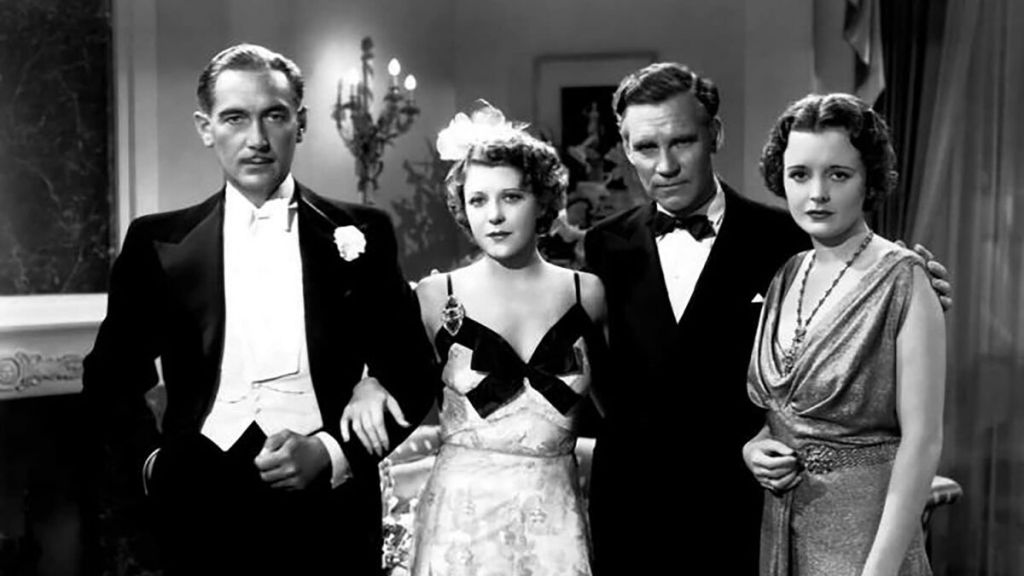
Cast: Walter Huston (Sam Dodsworth), Ruth Chatterton (Fran Dodsworth), Paul Lukas (Arnold Iselin), Mary Astor (Edith Cortright), David Niven (Captain Lockert), Gregory Gaye (Kurt von Obersdorf), Maria Ouspenskaya (Baroness von Oversdorf), Odette Myrtil (Renée de Penable), Spring Byrington (Matey Pearson), Harlan Briggs (Tubby Pearson), Kathryn Marlowe (Emily), John Payne (Harry)

Marriage is tricky. In the hustle and bustle of everyday life, bringing up a family, running a business and rushing between social events, what if you don’t notice you don’t have much left in common? That’s the theme of Dodsworth, one of the most strikingly modern of 1930s films, that tackles the breakdown of a marriage in a surprising subtle way, avoiding the sort of moral punishment and condemnation you’d expect from the production code. Combined with sharp writing, fine acting and some fluidly creative direction from William Wyler, and you have an overlooked classic.

Dodsworth kicks off with the retirement of car entrepreneur Sam Dodsworth (Walter Huston). Having sold his successful independent factory to a major business, Sam is now effectively retired and suggests that he and his wife Fran (Ruth Chatterton) take that trip to Europe they’d always discussed but never had time to do. The trip, however, starts to reveal fractures in their relationship. Fran isn’t ready to ‘rush towards old age’ like she feels Sam, with his touristy longings and interest in engineering mechanics is. She wants to be part of society and feel the excitement of flirtations (and more) with rakeish European types (from David Niven to Paul Lukas to Gregory Gaye), while Sam ticks off the sites and sits in cafés. Sam, it turns out, has far more in common with Naples-ex-pat Edith (Mary Astor) – but feels duty bound to do whatever he can to preserve his marriage with Fran.

It’s all adapted from Sinclair Lewis’ doorstop novel, skilfully boiled down into a clear dramatic journey by Sidney Howard, from his own theatre adaptation (which also starred Huston). It becomes both slightly sad, watching two people drift apart, while also offering rich vestiges of hope of what the future can hold if you dare to take a chance. It mixes this with dry wit, scenes of compelling narrative interest and an insightful look at two people effectively going through different types of life crisis during a ‘once in a lifetime’ journey. Because nothing can disrupt your thinking about your own life more than changing nearly everything about it in one swift barrage of events.

It’s assembled into a richly involving whole by William Wyler, who lands the film just the right side of melodrama. From the opening shot, tracking towards Sam’s back as he leans against a window looking out over the factory which gave his life meaning, there is a quiet air of its characters living in denial of their own melancholy. Part of Sam is already wondering what on earth he’s going to do without his factory – its why he immerses himself in the most banal details of the sights they will see in Europe, or the engineering of their cruise ship.

Sam feels his journey will give him new opportunities, but it often sees him uncertain and slightly adrift, from not knowing how to tip waiters to finding his mid-Western mindset unable to compute the sexually liberal rules of European high society. Fran claims the journey abroad will mean leaving behind the oppressive parade of the over familiar social scene in their small town. It quickly turns out, she’s only be bored of their small circle not the glamour of social events.

Sam is played with real skill and under-played grace by Walter Huston in one of his finest performances. He’s an overwhelmingly decent man, self-made, confident but hesitant and uncertain out of his element. There’s a fuddy-duddy quality to him you can understand Fran finding grating, but he’s also capable of genuine, unfiltered enthusiasm (watch his joyful spotting of a famous lighthouse during their journey – which hilariously he nearly misses while checking his watch – and the eagerness which he tries to share this with an irritated Fran and a politely bored Niven). What’s superb about Huston’s performance is the awkwardness, shyness and even timidity he brings to a successful man, the quiet air of confused anxiety behind Sam as his certainties melt away.

Both Sam and Fran are convinced everything between them is fine, constantly speaking (increasingly dutifully) about their love, as if trying to convince each other even as it starts to fall apart. Their home already feels invaded by their daughter and her husband, who absent-mindedly serves himself drinks from Sam’s cabinet. They’re in completely different mindsets. Fran is constantly embarrassed by her husband’s tendency to hickness. Sam feels Fran’s upper-class ‘friends’ wouldn’t look twice at her without the cash she can flash. Fran is horrified by Sam’s whimsical statement that they will soon ‘be a couple of old Grandparents’. She’s young at heart, being wooed and won’t give that up.

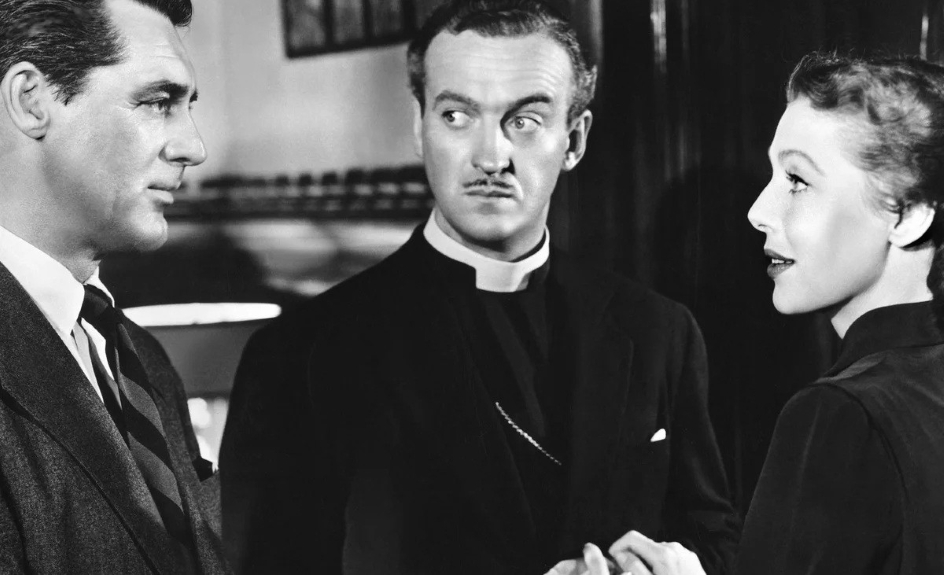
From a ship-bound flirtation with David Niven’s suave playboy where she seems shocked at his implication that they can take things further (Sam doesn’t help by telling her she only has herself to blame), she swiftly begins an all-but-open affair with Paul Lukas’ smooth gentleman (with Sam turning an embarrassed third-wheel blind eye) even sending Sam home to extend her holiday privately, while he fields awkward questions from their family and re-directs his inner fury at his public cuckolding into grumpy rants about other’s scrabble games covering his desk and fussily reaching for his Encyclopaedia to prove trivial discussion points.

By the time Ruth has convinced herself divorce will lead, inevitably, to a glorious new marriage with much younger aristocrat Gregory Gaye, she’s at the centre of an increasingly delusional mid-life crisis, full of false claims about her age and built on fantasies. Ruth Chatterton is very good, neatly bringing to life a woman who can’t face the idea of becoming old. The film (while siding with Sam) never fully condemns her for her behaviour – even if it maintains an American suspicion of her wealthy European upper classes. In fact, it’s very hard not to feel sorry for Fran when her lover’s mother (played by an imperiously shrewd Oscar-nominated Maria Ouspenskaya) punctures her delusions about the likely future of a relationship with her feckless son.

It’s all beautifully framed by Wyler. How can you not admire the lingering shot of Fran reading a telegram from Sam and letting Lukas’ Iselin set fire to it, the camera following the paper as the wind blows it across the balcony floor to disintegrate like the Dodsworth marriage? Dodsworth is full of such beautifully subtle moments, its imagery (and Oscar winning sets) wonderfully establishing a world in transit as much as the Dodsworths. Wyler also evens the score at points: Sam remains largely sympathetic, but its possible to be irritated by his naïve dullness, just while the frequently infuriating Fran is relatable in tragic fear that her life is behind her.

It’s this mature view of people drifting apart, making mistakes and not always being condemned that makes Dodsworth such a richly intelligent film. Sam would certainly by more happy with Edith (a very moving performance from Mary Astor), just as Fran would be better off without Sam. Dodsworth is largely refreshingly free of the sort of Puritan punishments other films dealing with similar themes would use under the Production Code. Instead Dodsworth is a superbly acted, directed and written melodrama with a serious tone that remains richly rewarding viewing.

Separate Tables (1958)

Separate Tables (1958)

Guilt and shame under the politeness in this stagy and almost-very-brave Rattigan adaptation

Director: Delbert Mann

Cast: Rita Hayworth (Anne Shankland), Deborah Kerr (Sibyl Railton-Bell), David Niven (Major David Angus Pollock), Burt Lancaster (John Malcolm), Wendy Hiller (Pat Cooper), Gladys Cooper (Mrs Maud Railton-Bell), Cathleen Nesbitt (Lady Gladys Matheson), Felix Aylmer (Mr Fowler), Rod Taylor (Charles), Audrey Dalton (Jean), May Hallett (Miss Meacham), Priscilla Morgan (Doreen)

Bournemouth’s Hotel Beauregard offers comfortable rooms and separate tables for dining. No wonder it’s popular with a host of regulars and out-of-town guests. But at each of those separate tables, drama lurks. Unflappable Pat Cooper (Wendy Hiller) manages the hotel and is secretly engaged to John Malcolm (Burt Lancaster), a down-on-his luck writer a little too fond of a pint in The Feathers. Their secret relationship is thrown into jeopardy when John’s ex-wife Anne (Rita Hayworth) arrives from New York, keen to get John back. Meanwhile, Major Pollock (David Niven) hides a secret behind his “hail-fellow-well-met” exterior, one which will threaten his place in the hotel and friendship with mousey Sibyl (Deborah Kerr) – a woman firmly under the thumb of her domineering mother (and resident bully) Mrs Railton-Bell (Gladys Cooper).

Delbert Mann’s film merges two Terence Rattigan one-act plays into a single, respectable piece of middle-brow Masterpiece Theatre viewing, which Mann subsequently effectively disowned (even after its seven Oscar nominations) after losing control of both editing and scoring to producer Lancaster. (Mann, quite rightly, loathed the hilariously out-of-place Vic Damone crooner number “Separate Tables” that opened the film.) Mann had already replaced Laurence Olivier, who dropped out after Lancaster’s company felt the film needed two American stars to make it box-office (handily they chose Lancaster himself and his business partner’s fiancée Rita Hayworth).

Lancaster and Hayworth are incidentally the weak points in the cast, their Americanness hopelessly out of step with Rattigan’s extremely English style and setting. Both actors are all too clearly straining to “stretch themselves” in unlikely roles, giving the film a slight air of self-indulgence. (Hillier later archly stated her best scene from the original was handed to Hayworth, while Lancaster recut the film to move up his first entrance.) The will-they-won’t-they tug-of-war between the two of them is Separate Tables’ least interesting beat and it’s to the film’s detriment that it, and these two awkwardly miscast actors, dominate so much of the film’s middle section.

They were already playing the dullest half of Rattigan’s double bill. Rattigan’s passion, and by far the film’s most electric moments – even if they only really constitute just under a half the runtime – revolve around the scandal of Major Pollock. Pollock, it is swiftly revealed, is not only prone to exaggerate his class, schooling and military career (his knowledge of alleged alma mata Sandhurst and the classics is revealed to be sketchy at best) but also carries a secret criminal conviction for harassing young women in a cinema.

While such harassment is of course recognised as beyond the pale today, it’s very clear in Separate Tables that Pollock’s misdeeds are standing in for a crime that literally “dare not speak its name”. Rattigan was one of Britain’s most prominent closeted homosexuals and his original intention had been for the Major’s crime to be fumbled cottaging. In the 50s it was unspeakable for the lead to be a sympathetic frightened homosexual so, in what looks bizarre today, it was far more acceptable to make him a timid sexual molester. However, the subtext is very clear, unspoken but obvious. One only has to hear the tragic Major sadly say “I’m made in a certain way and I can’t change it” and talk about his shame and loneliness to hear all too clearly what’s really being talked about here. Isn’t the Major’s pretence about being “the Major” just another expression of the double life a gay man had to lead in 1950s Britain?

This sensitive and daring plot is blessed with a wonderfully judged, Oscar-winning performance by David Niven (dominating the film, despite being on screen for a little over 20 minutes – the shortest Best Actor winning performance on record). Niven had made a career of playing the sort of suave, debonair military-types Pollock dreams of being – so there might not have been an actor alive more ready to puncture that persona. Recognising a role tailor-made for him, Niven peels away the Major’s layers to reveal a shy, sensitive, frightened man, desperate for friendship and acceptance. His heart-breaking confession scene (clearly a coded coming out) is beautifully played, while the closing scene with its hope of acceptance gains hugely from Niven’s stiff-upper-lip trembling with concealed emotion.

Niven’s performance – (Oscar-in-hand he rarely felt the need to stretch himself as an actor again) – centres the film’s most dramatic and engaging content. The campaign against the Major is led by Mrs Railton-Bell, superbly played by Gladys Cooper as the sort of moral-crusader who needs to cast out others to maintain her own ram-rod self-perception of virtue. Cooper uses icy contempt and overwhelming moral conviction to browbeat the rest of the guests in a sort of kangaroo court into blackballing the Major, a neat encapsulation not only of the power of the loudest voice but how readily decent people reluctantly acquiesce to it to avoid trouble.

Her control has also crushed her daughter’s spirit. Deborah Kerr’s performance is a little mannered: Kerr works very hard to embody a mousey, dumpy, frumpy spinster and make sure we can see she’s doing it. But she works beautifully with Niven and her meekness means there is real impact when the mouse finally (inevitably) roars. The rest of the guests are a fine parade of reliable British character actors: Felix Aylmer reassuringly fair and May Hallett particularly delightful as a no-nonsense woman who doesn’t give a damn what people think and trusts her own judgement.

Linking all plots together, Wendy Hiller won the film’s other Oscar as the hotel manager. Hiller was born to play decent matrons, bastions of respectable fair play who reluctantly but stoically bear personal sacrifices as their own crosses. She’s a natural with Rattigan’s dialogue and brings the best out of Lancaster, as well as providing all the drama (and sympathy) in the film’s other plotline as a surprisingly noble “other woman”.

Separate Tables is a middle-brow slice of theatre filmed with assurance. But when it focuses on Major Pollock it touches on something far more daring and much more moving than anything else it reaches for. Here is true low-key, English tragedy: under a clear subtext, we see the horror of a man who pretends all his life to be something he is not and the terrible judgements from others when he is exposed. It’s that which gives Separate Tables its true impact.

A Matter of Life and Death (1946)

A Matter of Life and Death (1946)

A pilot is stranded between Earth and…somewhere else in this brilliant romantic fantasy

Director: Michael Powell, Emeric Pressburger

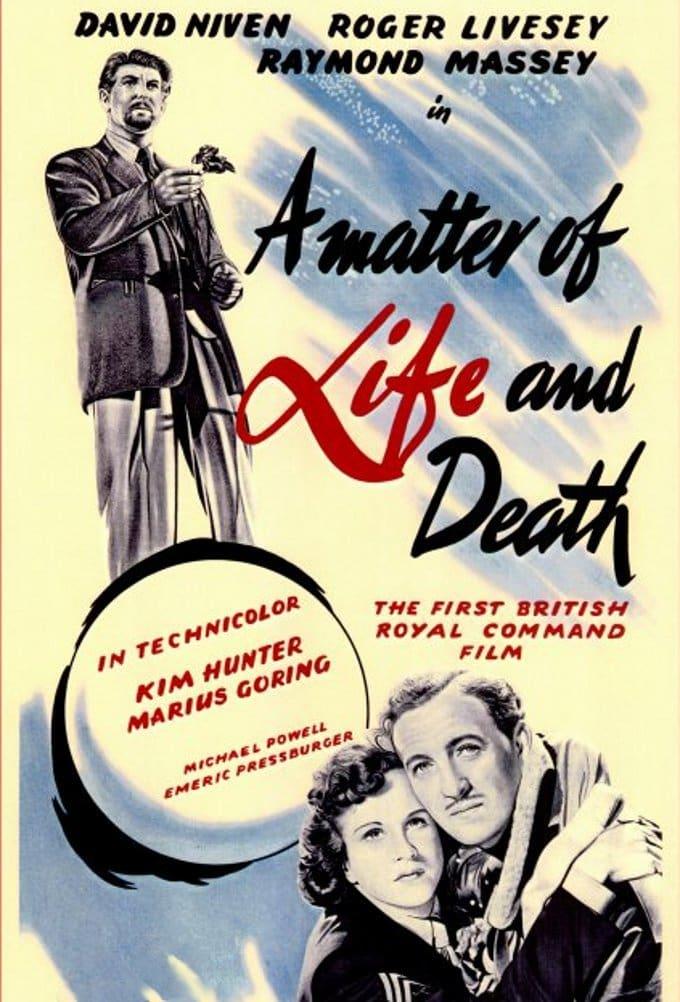
Cast: David Niven (Peter David Carter), Roger Livesey (Dr Frank Reeves), Raymond Massey (Abraham Farlan), Kim Hunter (June), Marius Goring (Conductor 71), Robert Coote (Bob Trubshaw), Kathleen Byron (Officer Angel), Joan Maude (Chief Recorder), Abraham Sofaer (Judge/Surgeon), Richard Attenborough (Pilot)

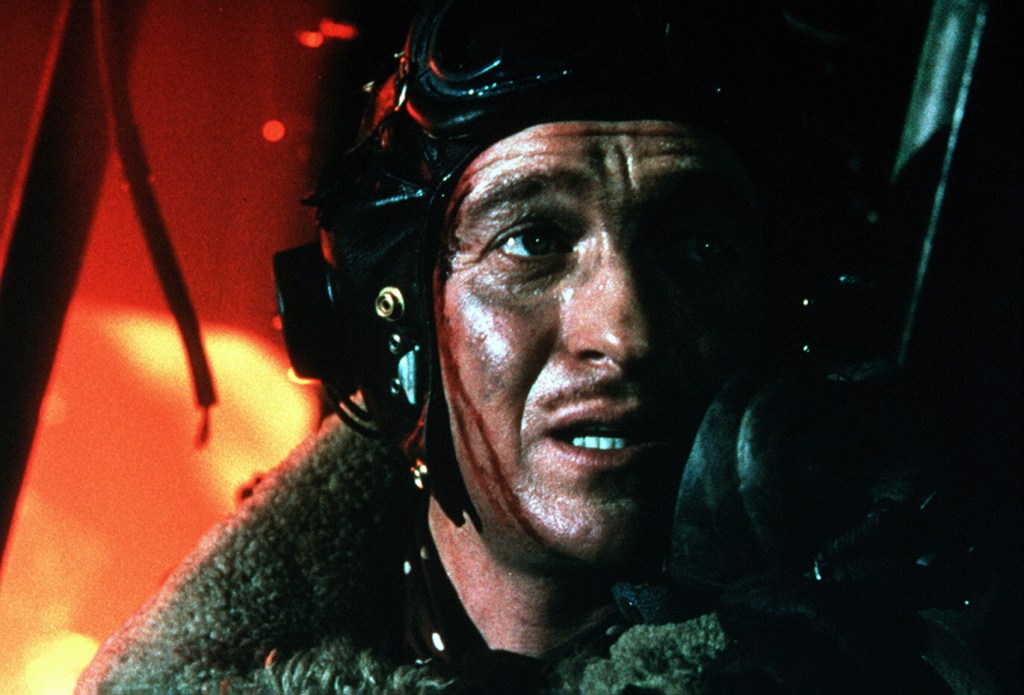
In the final days of World War II, a plane glides across the Channel in flames. The crew has bailed out, leaving only their skipper behind. Unknown to them, he’s not got a parachute – and is facing a choice between jumping or crashing to certain death. With only moments left to live, when is there a better time to fall in love? Quoting poetry and embracing what life he can in his final moments, Peter Carter (David Niven) falls in love with American radio operator June (Kim Hunter), the last person he expects to talk to. It’s stirring, sweeping, hugely romantic – and then Peter jumps at 50,000 feet.

So that’s it, right? Wrong. Peter washes up on the shores of Britain, not dead and practically on June’s doorstep. Happy ending? Perhaps not: at the end of a huge escalator linking our world to another (maybe the next?) Peter was expected. His “conductor” (Marius Goring), a French fop executed during the Revolution, whose job it was to take his soul “up” lost him in the fog. Now a man who isn’t supposed to be alive is walking around on Earth falling in love. Can it be allowed? Or will Peter need to head up that staircase? Or is all of this in fact in Peter’s head, a product of a head injury diagnosed by Dr Frank Reeves (Roger Livesey)? Either way, Peter faces two trials: life-saving surgery on Earth and a tribunal in that other place to decide whether he stays on Earth or not.

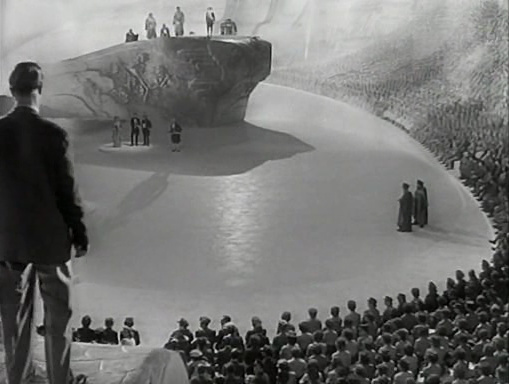
When released in America, AMOLAD was renamed Stairway to Heaven – a title rightly hated by Michael Powell. Part of the magic – and there is a lot of magic realism here in the most beloved of all British filmic fables – is the film’s carefully measured ambiguity. The film superbly doesn’t give any answers. The two worlds are clearly, visually distinguished and when Goring’s Conductor and others descend to Earth to freeze time and converse with Peter, their appearance is always foreshadowed with the same symptoms (smells and headaches) Frank diagnoses as part of Peter’s condition.

The beauty of AMOLAD is how wonderfully gently it explores the struggle of two nations – here represented by Peter and June – to emerge from the trauma of war and return to everyday life. From a world where death lies around every corner – where your plane can plummet to fiery doom in moments – they must readjust to one of romantic picnics, amateur theatricals and games of table tennis. Peter’s struggle to survive his surgery is a beautiful metaphor for returning to a life full of hope, possibility and looking forward rather than backward.

It’s why the visual impact of the film is so important. “Heaven” is shot in crisp black-and-white. As the Conductor says when travelling down to Earth, “one is starved of Technicolor up there”. This Heaven is a place of peace, but also of bureaucratic efficiency. Arrival lounges are staffed with decent but practical Angels (Kathleen Bryon is marvellous as the first of these we meet – and there is a fabulous shot from Powell that frames her in front of a clock, making the edges of its face appear like a halo around her head). There are rules and paperwork – in fact a whole city of clerks and arrival lounges. What it doesn’t have is the warmth and passion – the colour – of Earth. Down here, everything is in luscious, gorgeous Technicolor. Up there life is restful, but monochrome.

Jack Cardiff’s photography of AMOLAD – combined with Powell’s astute visual eye – crafts one of the most ravishing films you’ll ever see. Blues, oranges and reds practically pour off the screen into your eyes. Filters add a golden hue to much of what we see. The ramshackle details of locations – Frank’s cluttered library with its piles of books, June’s country-house-base – see every single detail captured in painterly beauty, colours popping out. Only Peter’s surgery room feels like a bridge between ”Heaven” and Earth, cooler filters stressing their blues and cool icey whites.

This is what Peter is fighting to stay in. A world of colour, of joy and poetry. Perhaps “Heaven” is just his imagination of what the afterlife could be like. It resembles the military operations he has spent the last few years emersed in. It’s filled with the historical generations he taught at university. Familiar faces up there fight his corner and represent him at the great trial to decide his fate. His surgeon on Earth shares the face of his judge in “Heaven”. Powell and Pressburger don’t lean too far either way – it’s all gloriously left open to our imagination.

And who, in 1946, wouldn’t want to believe in a heaven as reassuringly welcoming as this. (On a side note it’s refreshing to see a film from the 40s that depicts such a racially diverse after life). One where all are equal and questions of colour and creed are left aside. “Heaven” is packed with soldiers from all across the world – and the sheer volume of uniforms up there reminds us of the trauma down here.

AMOLAD is all about the world we might decide to live in after the trauma of war. It’s also about forging lasting bonds between two nations bought together to fight. No one feels more English than David Niven: and AMOLAD is, arguably, his finest performance. He makes Peter a man of casual wit and lightly worn intelligence, but with hints of the burdens he has carried across years of war. He’s the best of us Brits – and now he has fallen in love with the best of America. June, wonderfully played by Kim Hunter, is practical, brave and grounded. Their love (and the life they could spend together) becomes the battleground at the heavenly trial.

On the one side: a prejudiced revolutionary American (played with gusto by Raymond Massey) – on the other the perfect embodiment of English decency. There could have been no better choice of actor for this than the glorious Roger Livesey. Livesey’s Frank Reeves becomes a mix of English eccentric, master surgeon and Prospero-like magus. It’s no coincidence that among his hobbies is a large camera obscura with which he observes events on his village streets with a protective, grandfatherly care. His study is lined with books, his knowledge is infinite and he is always open to Peter’s tales of heavenly staircases and visitations from mysterious conductors. Then as his advocate in “Heaven” it is he who has the clear sight and judgement to focus the jury not on what divides us, but what unites us – what makes us all human, not what drives us apart.

AMOLAD is about what brings us together. It’s open about the flaws of Britain – the first trial jury is awash with Boers, Indians and other victims of Empire – but also a celebration of its virtues. It celebrates the melting pot of America – the second trial jury is made-up of an incredibly diverse selection of American citizens – and is a hymn to personal freedoms. Farlan picks up on what divides Britain and America – cricket vs American dynamism – but what unites us is our desire for life. So what does it matter if Brits can be austere or Americans so brash they raid a coke dispenser on arrival in “Heaven”. We’re still cousins.

All this helps capture the film as a universal fable, of love being discovered in the magical boundaries between worlds (its no coincidence we see Midsummer Night’s Dream being rehearsed by an American cast under a British vicar). This is a quiet, decent struggle about emerging from the horrors of war into the chance of a new world of love. It’s a struggle for Peter and June that is both very personal and hugely universal.  Powell and Pressburger’s film captures this perfectly in a film that’s sublimely directed and never-endingly rich in dialogue and visuals. It perfectly offers up a universal fable that speaks to the heart. It’s perhaps why this is their most beloved – and finest – hour.

Around the World in Eighty Days (1956)

Around the world header
David Niven and Cantinflas head Around the World in Eight Days in this Oscar-winning epic

Director: Michael Anderson

Cast: David Niven (Phileas Fogg), Cantinflas (Passepartout), Shirley MacLaine (Princess Aouda), Robert Newton (Inspector Fix), Charles Boyer (Monsieur Gasse), Joe E. Brown (Stationmaster), John Carradine (Colonel Proctor), Charles Coburn (Steamship clerk), Ronald Colman (Railway official), Melville Cooper (Mr Talley), Noel Coward (Roland Hesketh-Baggott), Finlay Currie (Andrew Stuart), Marlene Dietrich (Hostess), Fernandel (Paris coachman), Hermione Gingold (Sporting lady #1), Cedric Hardwicke (Sir Francis Cromarty), John Gielgud (Foster), Trevor Howard (Denis Fallentin), Glynis Johns (Sporting lady #2), Evelyn Keyes (Paris flirt), Buster Keaton (Train conductor), Beatrice Lille (Revivalist), Peter Lorre (Steward), Victor McLaglen (SS Henrietta helmsman), John Mills (London coachman), Robert Morley (Gauthier Ralph), Jack Oakie (SS Henrietta captain), George Raft (Bouncer), Frank Sinatra (Piano player), Red Skelton (Drunk), Harcourt Williams (Hinshaw)

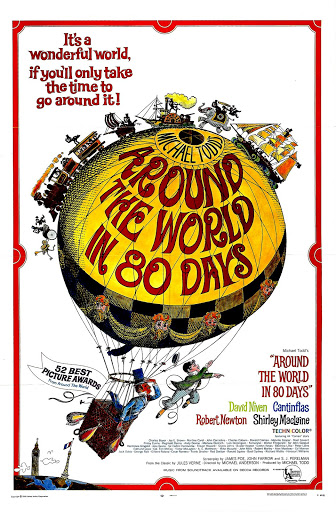
In the 1950s, cinema struggled to encourage people to come out of their homes and leave that picture box in the corner behind. Big technicolour panoramas and famous faces was what the movies could offer that TV couldn’t. This led to a trend in filmmaking that perhaps culminated in 1956 with Around the World in Eighty Days triumphing among one of the weakest Best Picture slates ever seen at the Oscars. Around the World had everything cinema knew it could do well: big, screen-filling shots of exotic locations filmed in gorgeous colour; and in almost every frame some sort of famous name the audience could have fun spotting. It’s perhaps more of a coffee table book mixed with a red carpet rather than a narrative film: entertaining, but overlong.

Faithfully following Jules Verne’s original novel (with added balloon trips), Phileas Fogg (David Niven) is a punctilious and precise Englishman of the old school, whose life is run like clockwork and whose only passion is whist. Nevertheless he accepts a challenge from his fellow members of the Reform Club (among them Trevor Howard, Robert Morley and Finlay Currie) to circumnavigate the globe in 80 days or less. Setting off with his manservant – the recently hired, accident prone Passeportout (Cantinflas) – Fogg races around the world, from Paris to Cairo to India to Hong Kong to Japan to San Francisco. Along the way he rescues Princess Aouda (Shirley Maclaine) from death by human sacrifice in India and has to confront the suspicions of Inspector Fix (Robert Newton) who is convinced that Fogg is responsible for a huge theft at the Bank of England. Can Fogg make it back to the Reform Club hall on time to win his bet?

Around the World was the brain-child of its producer Michael Todd. A noted Broadway producer, Todd had been looking to make a similar splash in the movies. Perhaps it’s no surprise that he decided the finest way to do this (after the mixed success of a movie version of Oklahoma) was to produce something that‘s pretty much akin to a massive Broadway variety show. Around the World – as you would expect – is an incredibly episodic film, seemingly designed to be broken down into a number of small sequences either to showcase the scene’s guest star or to provide comic opportunities for Cantinflas to display his Chaplinesque physical comedy.

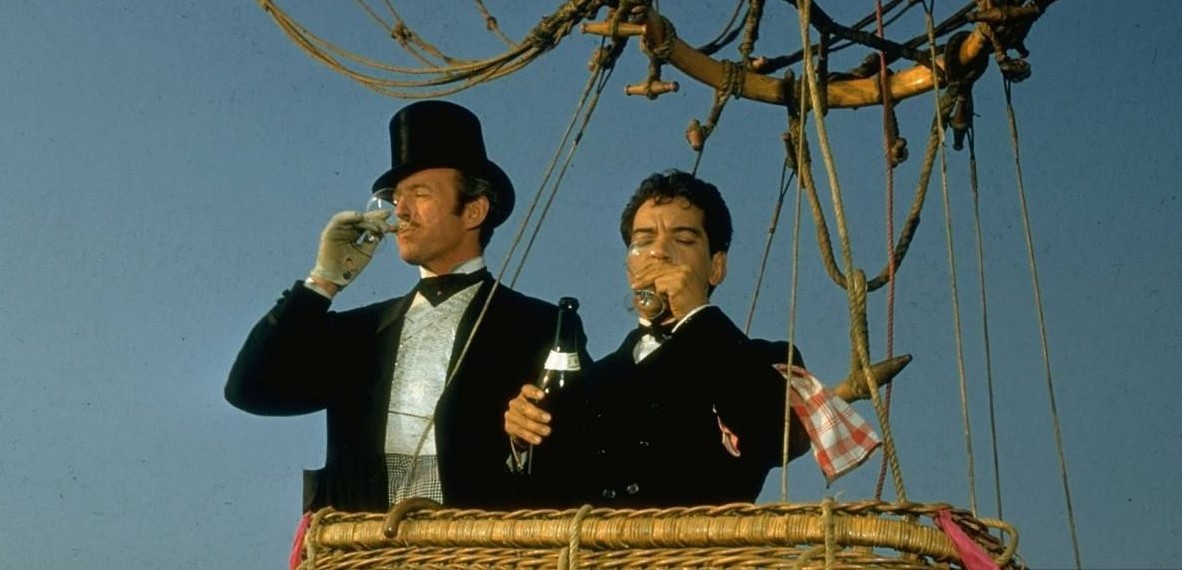
That and lots of opportunities for some lovely scenic photography. Nearly every major sequence is bridged with luscious photography capturing some exotic part of the world – from the coast of Asia to the Great American Plains. It’s pretty clear this is a major attraction of the film: come to the movies and see those parts of the world you’ve always dreamed of, just for the price of a movie ticket! Surely introduction of a hot air balloon to allow Fogg and Cantinflas to travel from Paris to Spain was purely to allow lovely aerial shots of the French countryside and chateaux. It’s the sort of film that proudly trumpeted in its publicity the number of locations (112 in 13 countries!), the vast number of extras (68,894!) and even the number of animals (15 elephants! 17 fighting bulls! 3,800 sheep!). It’s all about the scale.

That scale also carries across to the guest cameos. Between enjoying the scenic photography, viewers can have fun spotting cameos. Can that really be Noel Coward running that employment agency! The chap who owns the balloon, I’d swear that’s Charles Boyer! Wait that steward: that’s Peter Lorre! Good lord that’s Charles Coburn selling Fogg tickets for the steamer! Oh my, Buster Keaton is helping them to their seats on the train! Marlene Dietrich is running that saloon – and good grief that’s Frank Sinatra playing the piano! Most of the stars enter into the spirit of the thing, even if they frequently start their shots with backs to the camera, before turning to reveal their star-studded magnificence. Sadly time has faded some of the face recognition here, not helped by David Niven (perfectly cast as the urbane and profoundly English Fogg, so precise that his idea of romantic talk is to recount past games of whist) probably today being one of the most famous people in it.

Todd marshals all this with consummate showman skill. It’s handsome, very well mounted and generally entertaining – even if it is painfully long (it’s not quite told in real time, but can feel like it at points). The film is nominally directed by Michael Anderson. However, I think it’s pretty clear his job was effectively to point the camera at the things Michael Todd had lined up (be they location or stars) – Todd had already dismissed the original director, John Farrow, after a day’s shooting for not being sufficiently ”co-operative”. To be honest it’s fine as this is an entertainment bereft of personality, instead focused on being “more is more”.

Part of its extended runtime is due to the long comedic sequences given to Cantinflas. A charming performer – and possibly the most famous comedian in Latin-America at the time – Cantinflas can be seen doing everything from bicycle riding, to bull fighting (for a prolonged time), to gymnastics to horseback riding. (Far different from the unflappable and spotless English gentleman Niven is playing.) Your enjoyment of this may depend on how far your patience lasts. I’m not sure mine quite managed to last the course. Sadly one of Cantinflas’ greatest comedic weapons, his Spanish wordplay, was completely lost in translation.

There are some decent sections. The iconic balloon flight is well mounted and gives the most impressive images (the famously vertigo-suffering Niven was replaced by a double for much of this). Others, like the bullfight or an interminable parade in San Francisco go on forever. The casting of Shirley MacLaine as an Indian princess is an uncomfortable misstep (even at the time MacLaine felt she was painfully miscast), made worse by an offensive “human sacrifice” storyline – that got cut when the film was screened in India. Robert Newton though is very good value as the misguided but officious Inspector Fix.

Around the World in Eighty Days is grand, handsomely mounted entertainment. But to consider it as a Best Picture winner feels very strange. It’s not a lot more than an entertaining variety show, its plot impossibly slight (made to feel even more so by its vastly over-extended run time). While you can enjoy it in pieces, it finally goes on too long for its own good. Entertainingly slight as it is, it’s still one of the weakest Best Picture winners ever.

Death on the Nile (1978)

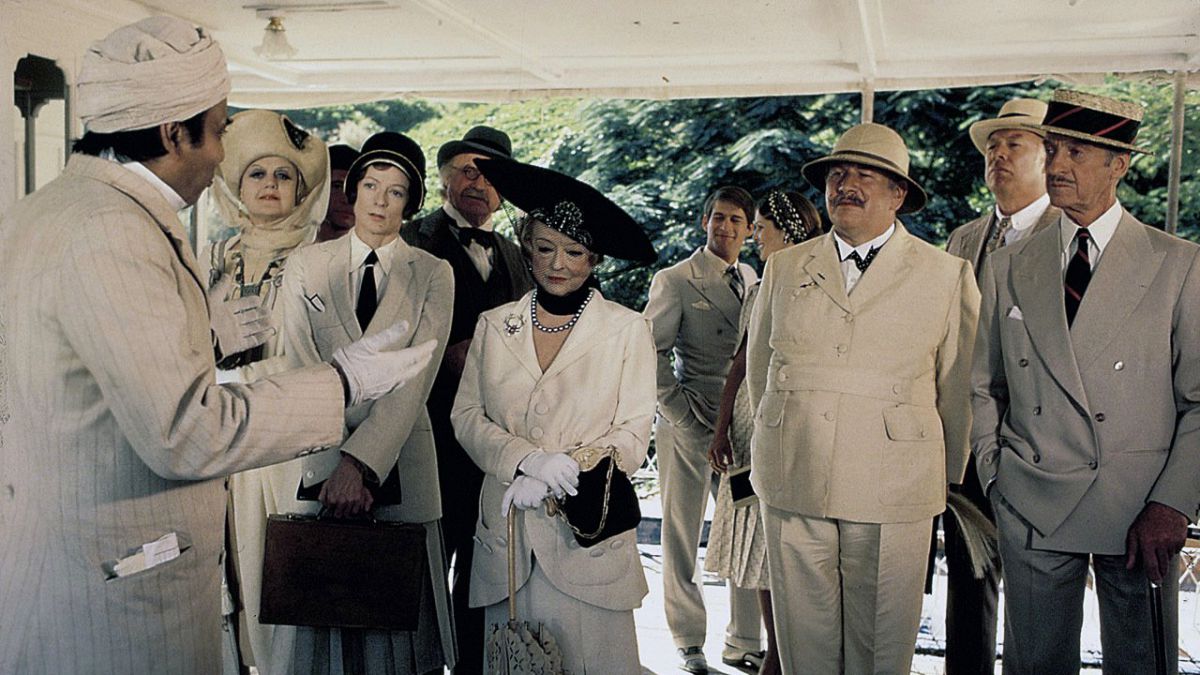
The all-star cast line-up for murder and mayhem in Death on the Nile

Director: John Guillermin

Cast: Peter Ustinov (Hercule Poirot), Jane Birkin (Louise Bourget), Lois Chiles (Linnet Ridgeway Doyle), Bette Davis (Marie van Schuyler), Mia Farrow (Jacqueline de Bellefort), Jon Finch (James Ferguson), Olivia Hussey (Rosalie Otterbourne), George Kennedy (Andrew Pennington), Angela Lansbury (Salome Otterbourne), Simon MacCorkindale (Simon Doyle), David Niven (Colonel Race), Maggie Smith (Miss Bowers), Jack Warden (Dr Bessner), IS Johar (Mr Choudhury), Harry Andrews (Barnstaple)

Is there anything more perfect for a Bank Holiday afternoon than an all-star Agatha Christie adaptation? Take a look at the TV schedules on those days and sure enough one of them will pop up. So on New Year’s Day, I took my place on the sofa for a welcome revisit to dastardly goings-on aboard a luxury cruise ship sailing down the Nile. 

Simon Doyle (Simon MacCorkindale) has jilted his lover Jacqueline de Bellefort (Mia Farrow) in order to marry the fabulously wealthy Linnet Ridgeway (Lois Chiles). It’s a tricky love triangle – so you can imagine the newly-married Doyles are far from pleased to find Jacqueline popping up on their Nile cruise holiday. Things eventually explode into a confrontation between Simon and Jacqueline that leaves him shot in the leg and her sedated. While they are both out of the picture, Linnet is murdered in her bed. With the two obvious suspects out of the picture, who among the (all-star) passenger line-up did the deed? Just as well Hercule Poirot (Peter Ustinov) is on the ship to solve the puzzle.

Following on the heels of the smash hit success of 1974’s Murder on the Orient Express, the producers of that film didn’t really shake up the formula too much. Hire a load of star actors, pick one of Agatha Christie’s most picturesque-set novels and then watch the money come pouring in. Albert Finney wasn’t available to come back (rumour had it he wasn’t keen in any case on the huge amount of make-up involved) so instead Peter Ustinov came on board and away we went.

Death on the Nile feels very much like a film following a formula. Perhaps it struggles to live up to the first film because it is a slightly less compelling mystery than the first film (although still a damn good puzzle with a real twist of a solution). Perhaps it was more difficult to recapture the magic? Or perhaps it’s because it lacks the quality of direction that Sidney Lumet brought to the first film. Lumet managed to create something that always felt more than a vehicle for star turns – the more plodding John Guillermin instead feels like the sort of guy brought in to manage the day-to-day realisation of a producer’s vision (essentially the same role he fulfilled on The Towering Inferno). Death on the Nile feels very comfortable on the television perhaps because it is filmed in a very straightforward, unobtrusive style with less visual panache than many of the David Suchet series Poirots (even the earlier ones).

But the film does a good job in hiring Peter Ustinov. Ustinov has the comedic chops – matched with the acting prowess – to walk a fine line between the drama and the slight air of comedy that underpins the film. The sort of performance that tells everyone that this is essentially a Christmas treat and shouldn’t be treated too seriously – but still conveys enough of the character’s humanistic shock and anger at violence and murder. Poirot can very easily become a slightly ridiculous character, and Ustinov is canny enough to realise that (relative) underplaying of the character actually works rather well to make him engaging and entertaining, but not too heavy.

Not that heavy is the film’s problem, as this is a pretty light soufflé. The all-star actors happily go through their paces, although you can pretty much tell most of them are in this for the free holiday and the pay cheque. Most of them have fun with their parts – none more so than Angela Lansbury who goes way way way over the top as a bohemian novelist – but they pretty much go through the motions. Shaffer’s decent screenplay doesn’t do much in any case to sketch these characters out – and you suspect much of the bitchy duelling between Bette Davis’ selfish rich widow and Maggie Smith’s put-upon companion was spun out post casting. 

Saying that, I was rather taken with Olivia Hussey’s performance as a fundamentally decent person in the middle of the madness, while Lois Chiles is good enough that you regret her career didn’t really go anywhere after this film. Simon MacCorkindale and Mia Farrow also do well with tricky parts. But it’s all pretty much paint-by-numbers stuff.

Visually the film looks lovely on the Nile. The costumes and designs are great – even if some of them look pretty much straight out of the 1970s rather than the 1930s – and you can tell that the money has been lavished on it to make a pure, old-fashioned entertainment. Shaffer’s script does a decent job of adapting one of Christie’s most twisty tales – even if it does give us what feels now a pretty racist portrait of the meek and crawling ship manager played by IS Johar.

But this is safe and comfortable entertainment – and it definitely is entertaining – rather than something that feels truly filmic. You could argue that this film more than any other set the tone for what we expect from an Agatha Christie adaptation – and its mixture of light comedy and grisly murder set in a lush 1930s location is pretty much de rigeur for everything else that follows. And you know what, I don’t think that’s a bad thing.

The Guns of Navarone (1961)


Gregory Peck leads one of the first men-on-a-mission films in The Guns of Nararone

Director: J. Lee Thompson

Cast: Gregory Peck (Captain Keith Mallory), David Niven (Corporal Miller), Anthony Quinn (Colonel Andrea Stavrou), Stanley Baker (Private “Butcher” Brown), Anthony Quayle (Major Roy Franklin), Irene Papas (Maria Pappadimos), Gia Scala (Anna), James Darren (Private Spyro Pappadimos), James Robertson Justice (Commodore Jensen), Richard Harris (Squadron Leader Barnsby), Bryan Forbes (Cohn), Allan Cuthbertson (Major Baker), Walter Gotell (Oberleutnant Meusel), George Mikell (Hauptstaumführer Sessler)

The Guns of Navarone is the archetypical “men on a mission” classic – it was the first major film to feature a team of specialists, all played by famous actors, going behind the lines to carry out some impossible task, leaving a trail of explosions and dead Nazis in their wake. Guns of Navarone was lavished with box-office success – and Oscar nominations, surprisingly – and although it’s a little too long, and a little weakly paced at times (as Thompson himself has admitted) it’s still got a cracking, bank holiday afternoon enjoyability about it. It’s not perfect, but honestly who could resist it?

In 1943, 2,000 British soldiers are stranded on the Greek island of Kheros. The Royal Navy plans to rescue them – but the way is blocked by two massive, radar controlled guns, in an impenetrable mountain base. The air force can’t take it out: so it’s up to Commando leader Major Roy Franklin (Anthony Quayle) to put together a team to do it. Recruiting mountaineer-turned-intelligence-agent Keith Mallory (Gregory Peck), explosives expert Miller (David Niven) and Greek-resistance leader Andrea Stavrou (who else but Anthony Quinn?), Franklin leads the team in. But when he is injured, the ruthless Mallory takes command – and leads the team in a perilous behind-the-lines raid.

I’d not seen Guns of the Navarone for a few years, and I’d forgotten what a brilliantly fun, boys-own-adventure thriller it is. I’d also forgotten what a lot of time is given early on into establishing what a team of bad-asses this group are. There seems to be no limit to their ruthless, knife wielding, gun running, cold-eyed killer bravery. And they hired a hell of a cast to play it as well – so damn good that you completely forget Peck, Niven, Quayle and Quinn are all just a little bit too over-the-hill for the derring-do they are called on to carry out.

Guns of Navarone brilliantly explains the mission aims, all the stakes and introduces each of the characters and their basic backstory, before the film basically gives us a series of action set-pieces – on a boat, at the coast, on a cliff, in a village, in a German cell, in Greek ruins, in a German base. It covers everything, and each scene is directed with real verve and increasing tension, with a simplicity to camera-work and editing that really lets the action breathe. The final sequence, waiting for the booby trap to explode among the guns, is a brilliantly done “rule of three” waiting game, with the tension building up each time.

The film is also rattling good fun, and gives each of its actors’ set-piece moments. Gregory Peck grounds the film perfectly as the increasingly ruthless Mallory, willing to sacrifice a number of pawns to achieve the target, but has a war weariness that still makes him sympathetic (as a side note, Peck’s German accent was so woeful all his German was dubbed). Niven plays Miller as a mixture of louche whiner, chippy middle-class man and natural-born troublemaker – and gets some knock-out speeches on the morality of war (Niven by the way nearly died after catching pneumonia during the boat wreck sequence).

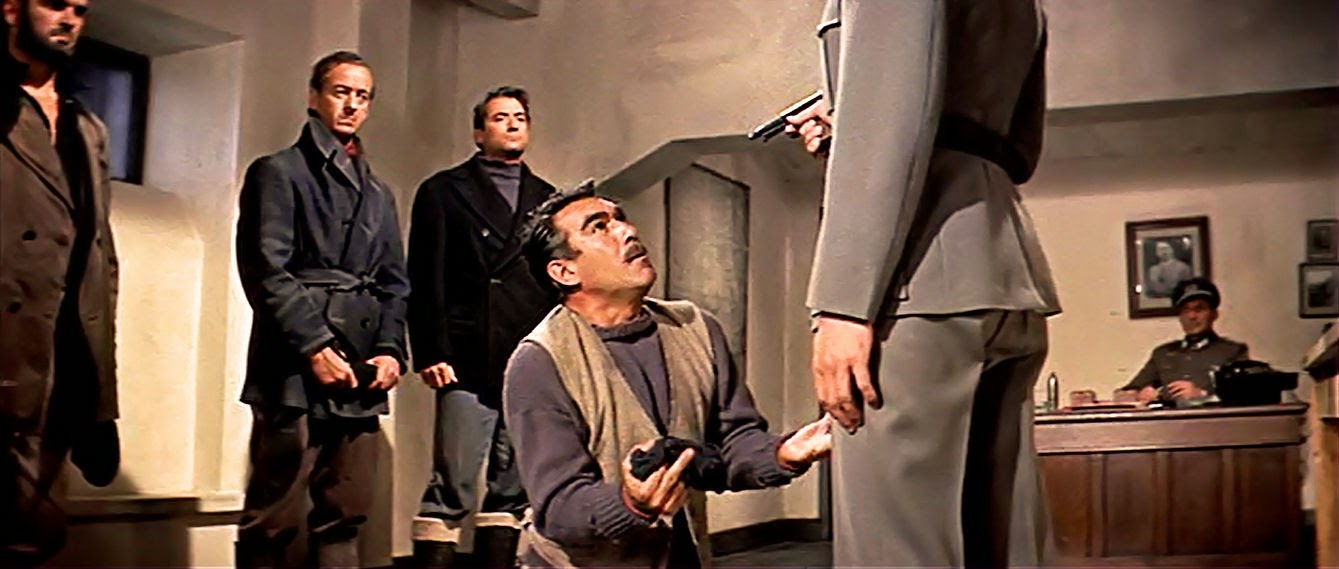
Anthony Quinn had a monopoly on playing exotic roles at the time – from Mexicans to Arabs, from Gaugain to Zorba the Greek – so no great surprise he plays the Greek colonel here. He’s terrific though, a cold-eyed ruthless killer – and the sequence where he pretends to be a cowardly awkward fisherman is wonderful (not least for Stavrou’s reaction to Miller’s praise for his performance – a half shrug and a “so-so” hand gesture, one of my favourite ever “character” touches in the movies). Irene Papas is perfect as his female equivalent, while Anthony Quayle puts together another of his “decent army officer chaps” as boys-own adventurer Franklin. Baker and Darren don’t get huge amounts to do, but Baker does well with a “lost my taste for this killing malarkey” sub-plot.

Many of the character beats were so well-done they basically became archetypes for every “group on a mission” film since (the austere leader, the difficult whiner, the old-school traditionalist, the ruthless warrior, the maverick, the one who’s lost his nerve – and, uh, I guess James Darren is the “sexy” one). The actors play off each other superbly. There are also some great cameos – Robertson Justice is great as “the man in charge”, Walter Gotell very good as an archetypical “worthy adversary” German – there is even a slightly bizarre cameo from Richard Harris as an Aussie pilot (yup you read that right). 

Navarone’s pace doesn’t always quite work – the gaps between the action sequences do lag. It takes nearly 45 minutes for our heroes to even get to Navarone. The film also can’t quite decide its stance on warfare. We get Miller’s passionate speeches on the pointlessness of missions when wars are always going to happen anyway. The unmasking of a traitor leads to a long debate on the morality of killing them or not. Several of the characters question the point and morality of war. But then, the film spends plenty of time on Alistair MacLean thriller beats: there is killing-a-plenty of German soldiers, gunned down with ruthless efficiency (not quite as many as Where Eagles Dare but pretty close!). There are small references to Greek villages paying a heavy price in retribution for the gang’s action – but these considerations never even slow them down, or make them stop to think.

Not that it really matters – this is a boy’s own action film, full of hard-as-nails actors grimly “doing what a man’s gotta do” throughout. And, despite being a little too long and aiming for a depth it doesn’t always follow through on, it’s brilliantly assembled, the action sequences are tightly directed, and the acting has a square-jawed confidence to it. Niven is pretty much perfect as the slightly dishevelled Miller, and the clashing relationship between him and Peck growing into respect, has fine bromance to it. Navarone is the first of its kind, and it’s still (and always will be) one of the best – really exciting, really thrilling, really damn good fun.