Tag: Denholm Elliott

Trading Places (1983)

Trading Places (1983)

Very 80s comedy, full of rude gags and the glories of money still funny in many places

Director: John Landis

Cast: Dan Aykroyd (Louis Winthorpe III), Eddie Murphy (Billy Ray Valentine), Ralph Bellamy (Randolph Duke), Don Ameche (Mortimer Duke), Denholm Elliott (Coleman), Jamie Lee Curtis (Ophelia), Paul Gleason (Clarence Beeks), Kristin Holby (Penelope Witherspoon), Jim Belushi (Harvey)
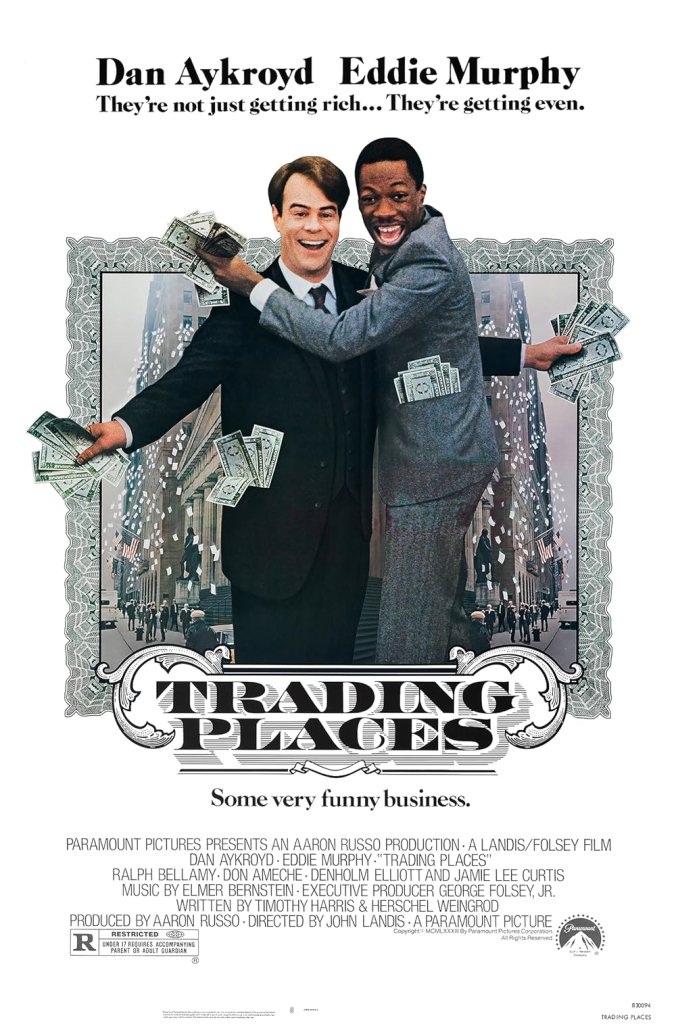
Louis Winthorpe III (Dan Aykroyd) has it all. A house in Philadelphia, glamourous fiancée and high-flying job as Managing Director at Duke & Duke, the leading blue-chip commodities brokers. Billy Ray Valentine (Eddie Murphy) has nothing: penniless, homeless, hustling on the Philly streets. But is their fate due to nature or nurture? Finding that out is the subject of a bet between heartless Duke brothers Randolph (Ralph Bellamy) and Mortimer (Don Ameche). They turn both men’s lives upside-down by swopping their positions – Louis will be disgraced and left with nothing and Billy Ray will get his house and job. Will they fall or rise? And what will they do when they find out their lives are the Duke’s playthings?

Trading Places was one of the big box-office smashes of 1983, a film that changed the lives of virtually the whole cast. It showed the world Aykroyd could carry a comedy without partner Jim Belushi, gave a second career to Bellamy and Ameche, led Curtis to say the role “changed her life” from just a scream queen and, perhaps most of all, turned Murphy into a mega-star. It’s still witty, fast-paced and funny today, even if in places it’s not always aged well.

Landis takes a screwball approach, unsettling the lives of two contrasting people and then throwing them into an unlikely revenge partnership. Trading Places is very strong on the contrasting world of rich and poor. The wood-lined, club-bound world of the Dukes is carefully staged, paintings of financial and political grandees staring down from walls as assured, masters-of-the-universe easily sachet around posh clubs and squash clubs, to the sound of Elmer Bernstein’s Mozart-inspired score. By contrast, the rough, litter-lined squalor of Philadelphia’s poorer neighbourhoods is unflinchingly shown with, under the comedy, the suggestion life is cheap and everyone is for sale.

Of course, a lot of the ensuing laughs come from seeing a rich person who has only known comfort thrown into this life of a tramp and vice versa. Ackroyd’s Winthorpe bristles with disbelief at his situation and the rich man’s blithe assurance that (any moment) someone will say there has been a terrible mistake carries a lot of comic force. Meanwhile, Murphy’s fast-talking Billy Ray assumes he is the subject of an elaborate prank (or perverted sex game) as stuffs the pockets of his first tailored suit with knick-knacks around the house the Duke’s assure him is now his. Hustler Billy Ray turns out, of course, to be well-suited to the blue-collar hustle of financial trading. He also finds himself, much to his surprise, increasingly interested in the culture and artworks around him.

Under all this, Trading Places has a surprisingly negative view of rich and poor. Louis posh friends and shallow fiancée are all status-obsessed snobs who turn on him in minutes when he is framed for theft, embezzlement and drug trafficking. The servants in their posh clubs – all, interestingly, Black men in a quiet statement on race that you still wish the film could take somewhere more interesting – are treated as little better than speaking items of furniture and there is a singular lack of interest or concern for anyone outside their social bubble. Playing fair, every working-class character we see (apart from Curtis and Murphy) is lazy, grasping and shallow, ignoring Billy Ray until they can get something from him, at which point they fall over each other to snatch freebies from his house.

Trading Places is, in many ways, a very 80s screwball. Money is the aim and reward here. Trading Places has respect only for aspirational characters who save and invest their money. (Curtis’ prostitute is marked out as savvy and decent because she has invested nearly $42k from her work in a nest-egg). The film culminates in a financial scam (playing out on the trading floor of the World Trading Centre) designed to reward our heroes with wealth and punish the villains with poverty. For all the film stares at the reality of poverty and riches, the implications and injustices of wealth are ignored, with money ultimately framed as a vindication.

But then, Trading Places is just a comedy so perhaps that’s reading a bit too much in it. There is a frat-house energy to Trading Places under its elaborate framing and a lot of its gags come from a rude, smutty cheek that sometimes goes too far (not least a punchline involving a villain being repeatedly raped by a randy gorilla). Murphy’s energy – every scene has the crackle of improvised wildness to it – is certainly dynamic (this is probably his funniest and – eventually – most likeable role) and while Aykroyd is a stiffer comic presence, he makes an effective contrast with Murphy.

The real stars here though are the four supporting actors. Bellamy and Ameche seize the opportunity to play the villains of the piece with an experienced gusto, brilliantly funny in scene-stealing turns. Outwardly debonair, the seemingly cudily Bellamy and prickly Ameche superbly reveal the greed and casual cruelty of these two heartless Scrooges. Elliot is also extremely funny, and the most likeable character, as a kind butler just about disguising his loathing of the Dukes. Curtis’ vivacity and charm makes a lot of an under-written “hooker with a heart of a Gold” trope – like her co-stars she seizes her chance with a fun role.

Some of Trading Places has of course not aged well. Jokes with gay slurs pop up a little too frequently. While the Duke’s use of racist language makes sense (after all they are vile people who see Billy Ray as nothing but a curious toy), it’s more of a shock to hear our nominal hero Louis do the same. Murphy’s improvised sexual harassing of a woman on the streets (ending with him screaming “bitch!” after her when she walks off) doesn’t look good. Curtis twice exposes her breasts for no reason. The film’s closing heist involves Aykroyd blacking up and affecting a Jamaican accent.

But, dubious as some of this is now (and while you can argue times have changed, surely even then some people would have been unsettled by this sort of stuff framed for good-old-belly laughs), Trading Places is still funny enough to be a pleasure. And, with the performances of Bellamy, Ameche, Elliot and Curtis we have four very good actors providing a humanity and professionalism to ground two wilder comedians. It’s easy to see why this was a hit.

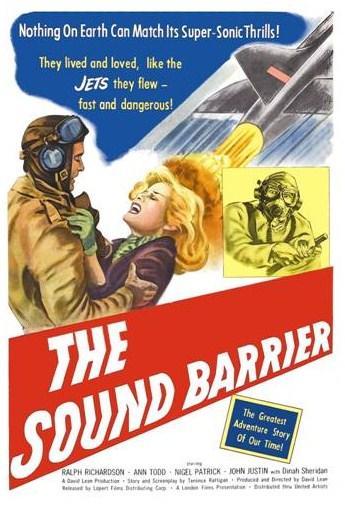
The Sound Barrier (1952)

Sound barrier header
Ann Todd and Nigel Patrick on a dangerous mission to break The Sound Barrier

Director: David Lean

Cast: Ralph Richardson (John Ridgefield), Ann Todd (Susan Garthwaite), Nigel Patrick (Tony Garthwaite), John Justin (Philip Peel), Dinah Sheridan (Jess Peel), Joseph Tomelty (Will Sparks), Denholm Elliott (Christopher Ridgefield), Jack Allen (‘Windy’ Williams), Ralph Michael (Fletcher)

David Lean’s film career can be divided into two eras: his early films are British-based literary adaptations and family dramas, many of them front-and-centring the experiences and tribulations of women. The later era are the jaw-dropping epics he became best known for. The Sound Barrier is towards the end of the first era – and it’s almost a bridge between the two, an impressively filmed story of man’s triumph over nature, that sneaks under the wire an emotional family-in-crisis storyline, with a daughter suffering the damaging impact of her father’s obsession.

That father is John Ridgefield (Ralph Richardson), a famous aeronautical engineer and airline entrepreneur who, with the end of the war, returns to his fixation: discovering a way to make a plane fly so fast it breaks the sound barrier. It’s a vision that has dominated his life, but which his daughter Susan (Ann Todd) finds hard to understand. John is a domineering, demanding father, whose son Christopher (Denholm Elliott) gets himself killed trying to qualify as a pilot to win his father’s respect. In his place, Susan’s husband Tony (Nigel Patrick), a test pilot, is claimed by John as a surrogate son and equally pushed to risk all to try and fly faster than sound.

Lean’s film is a wonderful mix of post-war military-based exploits and stiff-upper lip exploration of family dynamics, where resentments and passions go unspoken but shape everything. With a superb script by Terence Rattigan, whose work is filled with monomaniacs like Ridgefield and sympathetic and emotionally intelligent women like Susan, The Sound Barrier might seem like a celebration of British pluck (it hardly matters that we Brits didn’t actually break the sound barrier first – no mention of Chuck Yaeger here…), with some stunning aerial photography. But it’s a lot more than that.

What’s fascinating about The Sound Barrier – and what makes it such a rewarding watch – is how much it questions the value of these sort of quests. The film’s focus is less on the engineering struggles and the bravery of the pilots (compare and contrast this film with the more straightforwardly triumphant The Dam Busters), and more on the human cost of obsession and this sort of adrenalin-fuelled airborne machismo.

The Ridgefield family has been damaged almost beyond repair – under their wealth and comfort – by their father’s demanding perfectionism. Ralph Richardson is superb as this bluntly-spoken man who sees no reason to sugar coat anything or hide any disappointment. The character has more than a hint of a Gradgrind of engineering – and just like Hard Times patriarch, his well-intentioned but misguided parenting has distorted both his children.

His hero-worshipping son Christopher (a wonderfully fragile and charming Denholm Elliott) pushes himself through chronic air-sickness to lay down his life trying to follow in his father’s footsteps (John greets his death with a sad criticism of his flying skills and goes back to work with his jet-plane models straight after the funeral). Susan has a cold relationship with her father (strikingly she calls him Father while everyone else – even her husband Tony – calls him Dad), and can’t understand why all this goal is worth sacrificing lives and any chance of simple domestic happiness. Her father’s coldness and distance from his children – not to mention his obvious and continual disappointment that she was born a girl – has led her to treat him with respect but not love.

It’s a dynamic completely missed by her husband Tony, played here with a bluff simplicity by Nigel Patrick. But then it’s pretty clear that this risk-taking pilot is quite simply not that bright. His lack of independent thinking is even identified by engineer Will Sparks (a ‘sparkling’ performance of avuncular surrogate fatherdom by Joseph Tomelty) as his major weakness as a test pilot. Tony has no idea of his wife’s concerns or emotional problems with her father, and instead quickly gets sucked into filling the role of “son I never had” for John. But then Tony has everything John wants – the flying skills Christopher never had without the questioning independence of Susan. He’s exactly the sort of weak-willed would-be-hero who can be quickly sucked into taking huge risks.

The film’s sympathies though are with Susan, played with a real warmth tinged with a sad expectation for disaster by Ann Todd, whose presence slowly grows to dominate the film. She can’t understand why it is necessary to risk all for this nebulous goal: it’s a refrain she repeats throughout the film “I wish I knew, I really wish I knew”. We’ve just gone through a second calamitous war – why are we throwing our lives away for a concept? Why should her husband put himself at huge risk like this for a brief mention in the history books and nothing else? Why not be content with a happy family life and living to see his son? Not to mention that the film proves her right – the nice-but-dim Tony isn’t good test pilot material and Susan’s new family is destroyed just like her old one.

At first it might seem that Todd’s character is the stay-at-home “don’t go Darling” type, but the film increasingly shows the validity of her doubts. There is a slightly toxic “carry on” Englishness about Tony and her father. Obsession is shown to drive out all over considerations – and Richardson has a late scene that carefully but brilliantly demonstrates how it has left him isolated and alone. It’s telling the barrier is finally broken by devoted husband and father Philip (a very decent John Justin), who is aware of the danger and has the most settled family life of the lot (and who greets his triumph with tears of relief rather than cheers).

The Sound Barrier could have easily been a “Britain triumphs in the skies!” with soaring music and heroic filming. Instead, it demonstrates the danger of obsession and the damaging impact it can have on people and their families. It concentrates not on the men in the sky, but increasingly the potential widows on the ground, forced to acknowledge that life with the family is less important than the chance of glory. It’s a rich and emotionally intelligent film, very well directed by Lean with warmth and humanity and with three terrific actors leading from the front.

Raiders of the Lost Ark (1981)

Raiders of the lost ark header
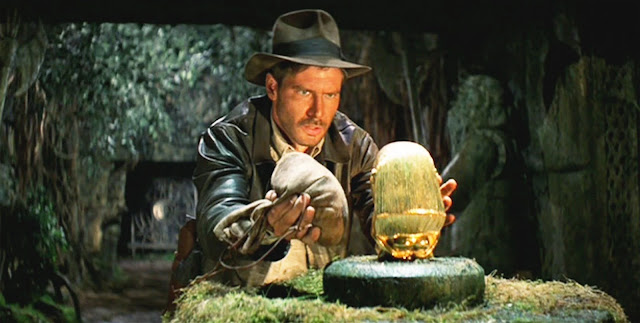
Harrison Ford goes in search for treasure in Raiders of the Lost Ark

Director: Steven Spielberg

Cast: Harrison Ford (Indiana Jones), Karen Allen (Marion Ravenwood), Paul Freeman (René Belloq), Ronald Lacey (Major Arnold Toht), John Rhys-Davies (Sallah), Denholm Elliott (Dr Marcus Brody), Wolf Kahler (Colonel Dietrich), Anthony Higgins (Major Gobler), Alfred Molina (Satipo)

Indiana Jones is now one of the most beloved – and instantly recognisable – film characters ever created. So, it’s strange to think that Raiders of the Lost Ark was released to such little fanfare. That soon changed when the film came out. In some cinemas it was so popular it played for the whole year. It became a box-office smash, turned Harrison Ford into Hollywood’s leading movie star for the next 20 years, and made Steven Spielberg Hollywood’s leading director. And it did all that because I’m not sure there is a more entertaining, tightly made, funny, thrilling and (at times) scary adventure film out there. Spielberg and producer George Lucas may have wanted to make a film that aped B-movie adventure serials – but they ended up reinventing an entire genre.

It’s 1936 and the Nazis are in search of occult relics. Their latest target is the Ark of the Covenant, which Hitler believes will make his armies invincible. What chance is there of stopping him finding it? Well obviously the US government must put its trust in Professor Indiana Jones (Harrison Ford), one of the world’s leading archaeologists who also (fortunately) is pretty handy in a fight. Not only that, but his ex-girlfriend Marian Ravenwood (Karen Allen), daughter of his former mentor, holds one of the keys to finding the Ark. Indy and Marian end up on an adventure that crosses continents, taking on the ruthless Nazis and mixing with profound mysteries that man is not meant to know.

Hollywood wasn’t happy about Spielberg making the film. His previous film – the war comedy 1941 – had bombed, losing millions. The studio was insistent with producer George Lucas: if he wanted to see his dream of making an old-fashioned B-movie with his friend Spielberg come true, then he would need to stick tightly to a budget. After all, Spielberg had a reputation for delivering films overtime and overbudget. Our heroes stuck to this deal – and Spielberg has said it was a blessing, as it forced him to keep the film lean, tight and, above all, free of indulgence. Spielberg’s direction is perfect, so good in fact that he set the template for nearly all big-budget directing (in terms of tone, pace, mood and tempo) to come. Every action film since owes something in its DNA to Raiders.

Raiders is far more entertaining – and brilliant – than it has any right to be. It’s effectively a series of set-pieces, threaded together by screenwriter Lawrence Kasdan into a plot. Kasdan’s dialogue though was spot-on – like the film, lean, tight and perfectly focused. With exceptional brevity and focus it brilliantly creates a small core of characters, and then gives them room to bounce off each other. Its dialogue is quotable, fun and punchy. He – with Lucas and Spielberg – also crafts a central character who is flawed but deeply likeable, and a heroine who is independent and dynamic. The script is a big part of the reason why the film is a success – it makes us care deeply for the characters as they get involved in the death-defying stunts and action set pieces that make up a lot of the film.

And we don’t follow any character more than Indy himself. Thank God Tom Selleck had to withdraw at the last minute. George Lucas had resisted casting Harrison Ford as he was worried about the overlap with Han Solo. But the part fits Ford like a glove. Sure, it comes from the same wheel-house as Solo – although Indy is more taciturn, intellectual and a degree less cocksure than Solo, more a man reluctantly forced into danger than a swaggering pirate – but Ford’s skill is faultless. Ford has an everyday quality to him, and he brings a world-weary tiredness to Indiana. He has the confident grin, but he’s just as likely to see that switch to concerned desperation (there is a perfect moment of this in the opening sequence, when the vine he is grasping on a cliff top suddenly works loose). He may be a bit of a rogue (not averse to shooting a swordsman) but he’s also a good man, with the street smarts of a ruffian, who is frequently exasperated by the errors of his sidekicks. This is the sort of man that men want to be and women want to be with – an impossibly difficult trick to pull off.

We relate to Indy because he’s vulnerable. He’s an underdog. The outstanding opening sequence – basically a little mini-movie in itself – showcases this. As Indy heads into a hidden temple for an idol (dodging spiders, bottomless pits, arrows from walls and most famously a huge boulder – a stunt Ford did for real) we get his entire character showcased. He’s astute, resourceful, trusting (sometimes too trusting) and ingenious. But he also takes a hell of a physical pounding, gets scared and above all goes through huge danger only to end up empty-handed. And of course, we find out he can cope with all this, but definitely not snakes (is there a better action set-piece punch line than “Grow a little backbone, will ya!”). It sets the tone for the rest of the film – in fact with the first five minutes alone, Raiders is already better than 99% of all other adventure films.

But then this is a director working at the top of his game. All the elements come together perfectly here: Spielberg always knows when to keep the tempo up, cuts the action superbly and also presents us with a brilliant mixture of tension, excitement and awe. He and Lucas brilliantly understand the power of images – there is a reason why a rolling boulder has become part of cinema’s language. The design of Raiders (one of its five Oscars) is absolutely perfect. Nothing like these temples could really have existed in real life – but as an evocation of 1930s adventure serials they are perfect. Mix that in with that brilliant sound design (those whip cracks for staters) and John Williams’ majestic score (from the classic Indy march to the haunting strains that tie in with the Ark) and this film is a masterclass for affecting the senses.

Then those set-pieces are told with just the right balance between thrills and wit. Again, Harrison Ford is a big part of this: he’s never smug, his trademark furrowed brow suggesting stress as much as his grin communicates relief at surviving. The truck chase – which sees Indy move from horse to truck, to under a speeding truck to back in the driving seat, half the time with a bullet in his arm – is a masterclass in thrills and superb editing. It’s such damn good fun that the film even gets away with a nonsensical beat where a car-load of Nazis is pushed off a huge cliff (the first and last indication that we are anywhere near a cliff in the whole scene!). Just like the opening sequence our hero’s combination of ingenuity, never-say-die determination and vulnerability is what makes it compelling (the Williams score also plays a huge part in building both the excitement and the triumph).

The whole film is a series of triumphant set-pieces. Spielberg also tinges the film with just enough darkness as well. The Nepal gun battle carries a real sense of danger, Indy’s fight with a tough Nazi air mechanic culminates in a quite gruesome death (although the fight beforehand has plenty of wit to it, as Indy is hopelessly outmatched physically by this giant). That’s all before the film’s famous closing sequence as the Ark finally opens up to reveal the power of God – bad news for the assembled Nazis crowded around it. The face-melting horror (and it’s hard to imagine any action adventure film doing something this horrific today) is impossible to forget, brilliantly executed and carries just the right amount of dread.

The darkness though is counter-balanced throughout by sly wit and a sense of fun. Wonderful jokes – from Major Toht’s nunchucks that become a coat hanger to an exhausted Indy responding to Marian’s kisses by falling asleep – pepper the script. The cast are fabulously chosen. Karen Allen is perfect as the independent Marian. Paul Freeman is chillingly austere and charmingly amoral as Indy’s rival Belloq. Denholm Elliott’s Marcus Brody is excellent as an older, wiser version of Indy very different from the comic buffoon he would become. The same can also be said for John Rhys-Davies Falstaffian but shrewd and loyal Sallah.

Raiders of the Lost Ark sees every element come together perfectly. Spielberg’s direction – the film did come in on time and on budget, going on to be the biggest success of its year – is completely perfect. Ford creates a character who from his first appearance is iconic (the zoom to introduce him is a wonderful tip of the hat to John Wayne’s classic entrance in Stagecoach – continuing the homages, the final shot is also a lovely nod to Citizen Kane). Every action set piece is a brilliant mix of thrills, danger, triumph and even a touch of horror (be it gruesome deaths or dreadful beasts). It’s a film that can not fail to entertain, raise a smile – and still have you hiding behind the sofa at points. Lucas and Spielberg wanted to make a film that would remind them of the adventures of our childhood. They were so successful that their film ended up defining the childhoods of millions of us.

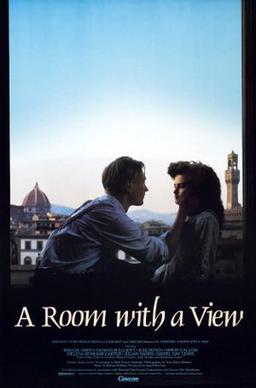
A Room with a View (1985)

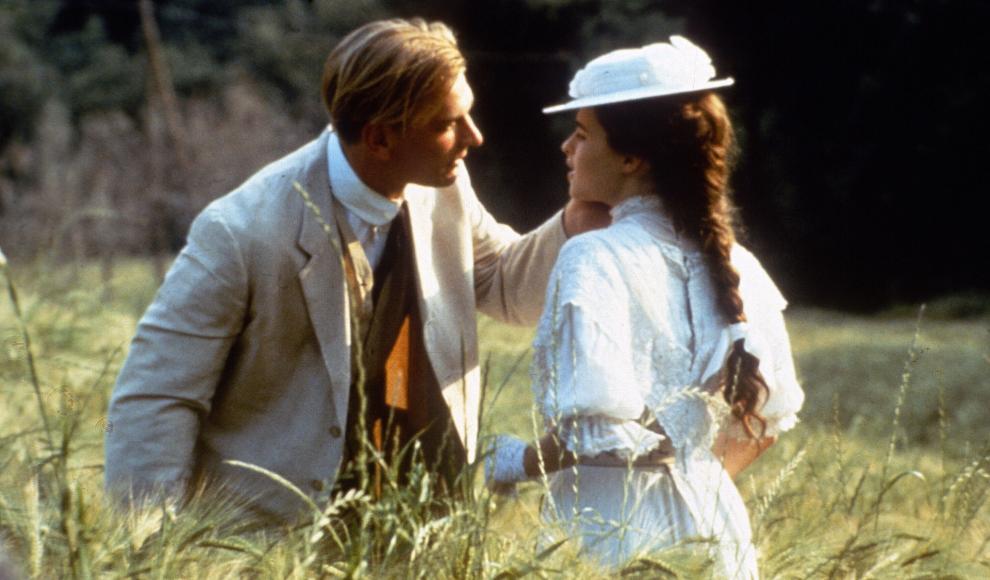
Julian Sands and Helena Bonham Carter find romance from A Room with a View

Director: James Ivory

Cast: Helena Bonham Carter (Lucy Honeychurch), Julian Sands (George Emerson), Maggie Smith (Charlotte Bartlett), Denholm Elliott (Mr Emerson), Daniel Day-Lewis (Cecil Vyse), Simon Callow (Reverend Beebe), Rosemary Leach (Mrs Honeychurch), Rupert Graves (Freddy Honeychurch), Patrick Godfrey (Reverend Eager), Judi Dench (Eleanor Lavish), Fabia Drake (Miss Catherine Alan), Joan Henley (Miss Teresa Allan), Amanda Walker (Cockey Signora)

Merchant-Ivory are the gold standard, practically synonymous with costume drama in the 80s and 90s. This really began with A Room with a View, their first true sensation, a box-office smash that won the BAFTA for Best Film and three Oscars. It practically defined what to expect from a Merchant-Ivory production: a classily made slice of English literature, with a wonderful cast of top British talent, tastefully directed with a sly observational wit for the foibles of the British class system. No one does such things better than Merchant-Ivory, and maybe only Howards End and The Remains of the Day did Merchant-Ivory better than A Room with a View.

Based on EM Forster’s novel (and that novel, largely thanks to this film, is probably now his best loved work), the film is set in Italy and England during the early 1910s. Holidaying in Florence, Miss Lucy Honeychurch (Helena Bonham Carter) and her chaperone cousin Charlotte Bartlett (Maggie Smith) are given poor rooms in their hotel – and accept an offer to swap (for the eponymous room!) with Mr Emerson (Denholm Elliott) and his romantic son George (Julian Sands). George, a free spirit, finds himself romantically drawn towards Lucy (and she to him), but something about the free Italian air frightens Lucy, and she withdraws and returns to England where she becomes engaged to the prig’s prig Cecil Vyse (Daniel Day-Lewis). However, when the Emersons rent a house near her home in Surrey she finds herself slowly drawn back once again towards George.

A Room with a View is the perfect expression of delicate, well-judged film-making, with James Ivory marshalling his precise judgement to create a luscious and involving reconstruction of the novel, which carefully layers its social and emotional observation with a dry wit. Ivory is a master of allowing the novel – and the film – to speak for itself, not intruding with flourishes but allowing the camera to hold moments. He captures wonderful moments of slightness: who can forget the camera holding on a rejected Cecil as he takes a moment to calm himself, then sits and begins to systematically retie his shoe laces? It’s a gentle, unforced moment of direction but it’s what makes the film work. 

And the careful grace and stateliness of much of A Room with a View is part of the film’s point. All this taste and manners, all this finery and wonderful design, is of course a trap. It’s precisely this pristineness and neatness that inhibits people from following their hearts, from actually having a bit of carpe diem. It’s telling that one of the film’s most striking moments involves George, Lucy’s brother Freddy and churchmen Mr Beebe going skinny-dipping (with long-shot full frontal nudity). There is something joyous for these men to literally cast off (for a few minutes) the shackles of society to just muck around in the all-together. And it’s a sort of exuberant liberal freedom you just don’t see in other parts of the film.

The film’s main theme is to see if Lucy will discover – and accept – enough about herself to follow the sort of romantic longings she feels within herself or if she is going to knuckle down and conform. Italy is a perfect sign of this – it’s hot, temperamental, the people wear their passionate hearts on their sleeves (whether that’s making-out in a carriage in front of uptight churchmen or stabbing each other in the piazza) – and it’s all that energy and lust for life that Lucy seems unsure about, but which George is chasing after. And it’s difficult to cast aside the rules you have grown up with – and scary – to find something a bit freer. Although I think you could criticise Ivory’s neat competence for failing to really visually get a contrast in look between Italy and England.

The film is blessed with a superb cast of British character actors. Helena Bonham Carter is excellent (in only her second film role) as a young woman who knows her mind but doesn’t want to follow it to its logical ends, part independent and free-thinking but also putting a constant block on her own instincts. Julian Sands as George does a decent job, although already the film (by far and away the best part he ever got) exposes his studied woodenness and flat, uninteresting voice and he often seems straining for a sort of depth and Byronic passion that is slightly beyond his range.

Maggie Smith and Denholm Elliott were both Oscar nominated, and both bring their A-game to the roles. Smith is perfect as a spinster who slowly reveals she has more sense of life’s lost opportunities than expected (even if the part is one she could play standing on her head), while Elliott gets lot of scene-stealing mileage from a sweetly eccentric Mr Emerson. Simon Callow, also in his second film role, probably gives his best (and most intriguing performance) as Mr Beebe the affable but subtly sleazy clergyman.

The film is however stolen by Daniel Day-Lewis as Cecil Vyse (originally offered his choice of parts between George and Cecil). A Room with a View opened the same day as My Beautiful Laundrette in the States and audiences were amazed that the same actor could play a self-important prig and a gay, punk fascist. Day-Lewis is the embodiment of fastidious preciseness, a man so studied in every second that each movement seems planned, with no touch of spontaneity. He even kisses Lucy with a carefully placed precision. He’s arrogantly certain of his place in the world and every moment of his life has been planned in advance with careful exactitude.

It’s the jewel in the crown of this perfect costume drama. Merchant and Ivory had longed to film the works of EM Forster for decades, and had to wait until King’s College, Cambridge (the rights holders) had someone in place who actually liked films until it was considered. They expected the main interest to be around Howards End (don’t worry its time would come!) and A Passage to India. But in A Room with a View, Merchant Ivory felt there was an unappreciated gem. They were right.

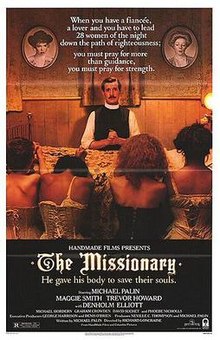
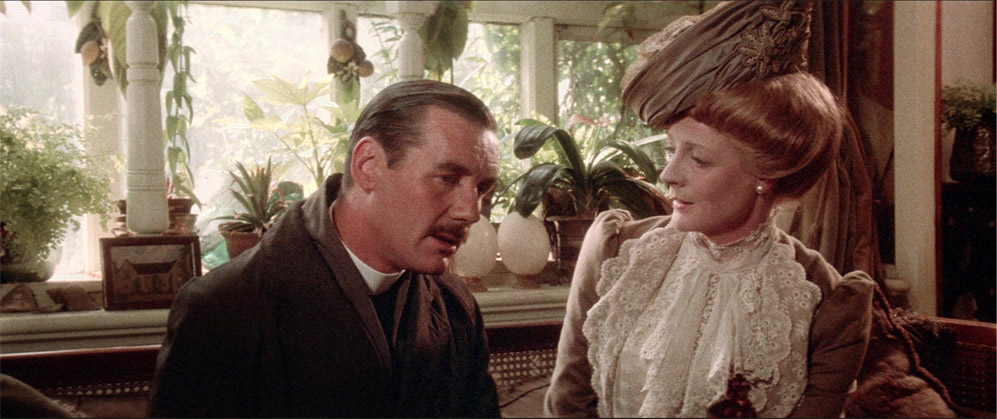
The Missionary (1982)

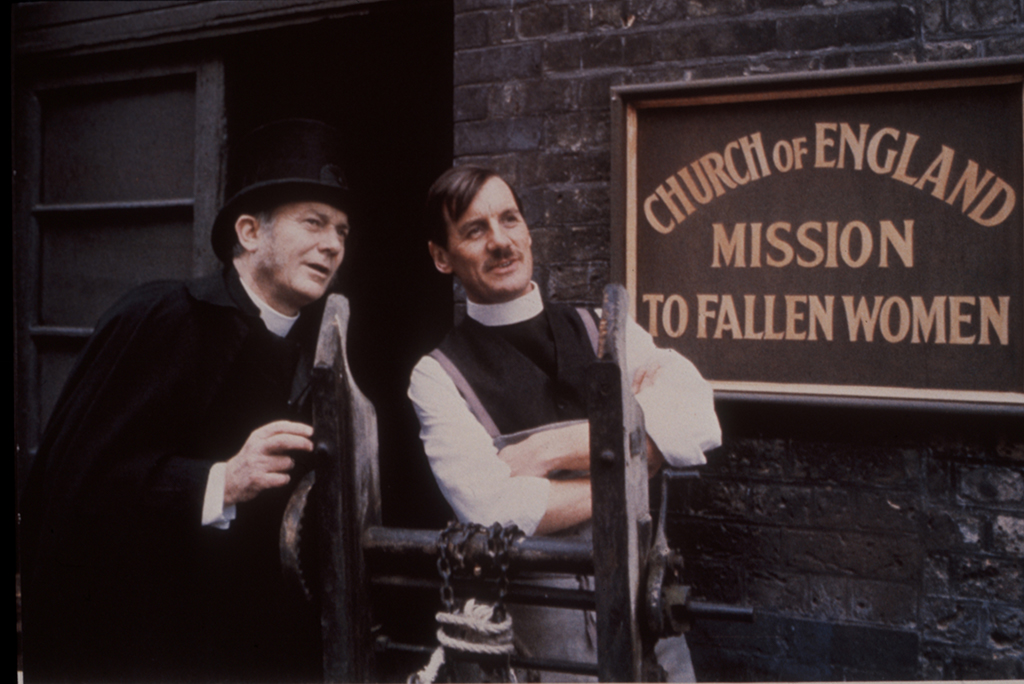
Michael Palin sets up a failed mission for change in The Missionary

Director: Richard Loncraine

Cast: Michael Palin (Reverend Charles Fortescue), Maggie Smith (Lady Isabel Ames), Trevor Howard (Lord Henry Ames), Denholm Elliott (Bishop of London), Michael Hordern (Slatterthwaite/Narrator), Graham Crowden (Reverend Fitzbanks), David Suchet (Corbett), Phoebe Nicholls (Deborah Fitzbanks), Roland Culver (Lord Fermleigh), Rosamund Greenwood (Lady Fermleigh), Timothy Spall (Parswell)

In the 1970s Michael Palin co-wrote (with Trevor Jones) a series called Ripping Yarns, affectionate half-hour spoofs of “Boys Own Adventures”, all starring Palin, told with a winning mix of affection, surreal gags and gentle humour. The Missionary is Palin expanding the concept into a full film, written by and starring the future Globe-Trotting Python. Palin plays the Reverend Charles Fortescue, who in 1902 returns from a mission in Africa (teaching the natives the date of composition of Magna Carta) to England and is asked by the Bishop of London to set up a mission in London to “save” prostitutes. Needless to say, things do not according to plan.

Palin’s script is full of some fabulous gags and a gentle, sometimes cheeky, sense of humour that gives you something truly entertaining every moment. If The Missionary does at times feel a collection of sketches and great comedic ideas and characters, rather than a fully formed filmic narrative, that matters slightly less when the jokes are as good as these. Sure, even Palin and Loncraine have said the final act of the film doesn’t completely work and largely fails to add actual narrative conclusion (it feels rather like the film required an ending, so this section was added to give it one), but it doesn’t really matter as much when the sense of fun is as strong as it is here.

Watching this on the recent re-mastered blu-ray from Indicator, this is also a beautifully made film, very well shot and framed by Loncraine with a cracking sense of pace. Visually the jokes work very well, and the push through from comic set-piece to comic set-piece that runs through the opening hour of the film is perfect. 

Palin also is perfect in the leading role, his sense of earnestness and decency, his slight air of a very-British innocence and bashfulness works in hilarious contrast to when (inexplicably to him) finds himself sexually irresistible to a host of ladies. Which sounds, when you write it, like a vanity project if ever I heard it, but never plays like it for a moment as there is a superb, slightly embarrassed, befuddled awkwardness about Palin (which I don’t think any other actor could have done as well) that makes the entire concept work an absolute treat.

It’s part of the extremely British atmosphere of the film, where sex is something deeply embarrassing and slightly shameful, something we are all far too polite to talk about or even acknowledge. Rather than the atmosphere of an end-of-the-pier show the film could have had, instead it has a very dry, rather touching attitude towards sex as something completely natural and everyday, that the repression of the English has elevated to something hugely awkward.

The only person who seems to be in touch with her true feelings and sexuality is Maggie Smith’s sexually liberal Lady Ames, a woman who knows what she wants and is determined to get it come what may. Smith is superbly funny in the role, a part she keeps just the right side of parody, making it very funny but also ring very true. This makes her a complete contrast to Fortescue’s intended (played expertly by Phoebe Nicholls) so repressed she cannot bear to be touched and obsessed with a complex filing system for storing and cross-referencing her fiancée’s letters.

All this happens within a series of sketches that are worth the price of admission themselves. Denholm Elliott has a few excellent scenes as a bullish Bishop, obsessed with sport who seems unable to speak in anything but sporting metaphors. Roland Culver plays a Lord who dies in the middle of an impassioned Fortescue’s pitch for funding, to the intense social embarrassment of his wife (Rosamund Greenwood, very funny). Best of all on the cameo front is Michael Hordern, who practically steals the entire movie as a butler utterly unable to successfully navigate around the gigantic house he works in.

Through this all rides Fortescue, a man with a barely acknowledged sexual drive, who bumbles from escapade to sexcapade with a bright-eyed innocence and determination to do the right thing, but constantly landing himself in trouble. It’s a charming, playful and very British movie and Loncraine and Palin get the tone just right. It’s perhaps a little too close to Ripping Yarns, a fabulous parody of a particular era (and type) of Britishness and British attitudes, and you feel it would be comfortable as a single 45 minute episode. But when the jokes are as cracking as they can be here – and Hordern apologetically leading Fortescue from room to room unable to work out where he is or how he can get to where they want to go, is a pleasure I could watch again and again – then you’ll cut it a lot of slack.

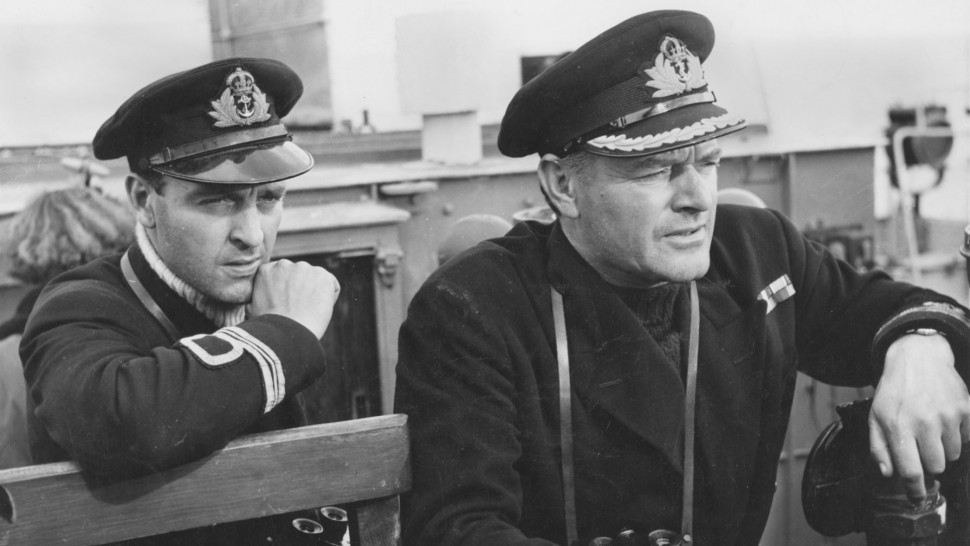
The Cruel Sea (1953)

The Cruel Sea (1953)

Command is a lonely, pressure-filled place in this complex and exceptional war film

Director: Charles Frend

Cast: Jack Hawkins (Lt Commander George Ericson), Donald Sinden (Lt Keith Lockhart), John Stratton (Lt Gordon Ferraby), Denholm Elliott (Lt John Morell), John Warner (Lt Baker), Stanley Baker (Lt James Bennett), Bruce Seaton (PO Bob Tallow), Liam Redmond (PO Jim Watts), Virginia McKenna (WRNS Julie Hallam), Moira Lister (Elaine Morell)

In 1953, The Cruel Sea was a colossal hit at the UK box office. With only a few years separating viewers from the sacrifices and struggles of war, it’s not hard to see why. The Cruel Sea is all about those struggles and sacrifices, about carrying on and doing your duty despite it all. But it’s also a film that understands the impact these have, and that that stiff upper lip is often covering a trembling bottom one. That stoic front is sometimes just that: a front. 

Jack Hawkins plays Lt Commander George Ericson, commanding a corvette on convoy duty in the Atlantic ocean. His mission? Make sure those ships make it through and destroy U-boats wherever possible – and everything else is secondary to that. But of course the real battle is against the cruel sea itself: and everyone sailing on her is at threat at any moment from losing their life. In the mid of this the men deal with losses at sea, losses at home, and the constant pressure of always being ready to do-one’s-duty.

On the surface, The Cruel Sea is pretty much the quintessential 50s British war movie. The upper lips are stiff, the accents are super clipped. Everyone is pulling together, regardless of class. Duty, king and country come before everything. But actually, this is a more complex film than all that. The Cruel Sea drills down into the psychological cost of war, and the impact of putting duty to the war above and beyond the needs of the regular sailor. Protecting the convoys and taking out these u-boats come first, and if that means sacrificing lives then it’s got to be done, regardless of the psychological impact that might have on the guy who makes the call.

Jack Hawkins is that guy, and this role pretty much cemented his niche in mainstream as the gruff, duty bound, slightly distant, quintessential officer type. But Hawkins performance here is that entire impression as a front, hiding his own doubt and guilt. During this film Ericson not only has to deal with his first ship sinking – with a huge loss of men – but also his decision to prioritise sinking a u-boat over saving men from a downed convoy ship trapped in the water. The depth charges he orders lead to the deaths of those men in the water: “bloody murderer!” screams an outraged crewman under his command.

And bloody murderer is exactly what Ericson thinks he is. Its’ the tough – and probably right – decision but the deaths of those sailors don’t sit easy with him. He’s the tough captain who can make the call – but his next shore leave sees him getting guiltily drunk and then tearfully expressing his doubts and guilt to his second-in-command. It’s clear that the pressure of making these calls, of sacrificing lives is something Ericson cannot wear lightly – and Hawkins performance in these moments breaks through the reserve of the 1940s to show a real depth of post-traumatic stress and guilt. Hawkins’ performance is raw, touching and above all real – and you feel he is expressing the survivor guilt of a generation who had all made tough calls during nearly a decade of war.

The Cruel Sea is all about those tough choices, and learning to deal with them. It’s also about that difficult balance between life at sea and life at home. Some families suffer terrible losses, some sailors come home to find loved ones have been killed in the blitz, others find that their wives have failed to stay loyal in the long months they have been away. At sea, there are more than enough pressures and threats, and that cruel sea takes a continuous toll, which is hard to forget. 

The scenes shot at sea have a professional tension and to them, and a really capture that sense that the most noble thing to do is to get on with doing your duty. The officers and men keep a reserve and a determination, as well as aiming to keep their spirits up as much as they can. There is very little patience for those who can’t or won’t put the good of the many first. Stanley Baker’s braggart second-in-command – an insecure stickler for rules, who is clearly both incompetent and cowardly – is treated with contempt and swiftly persuaded to jack it in for a spurious health reasons.

Meanwhile, the rest of the officers are decent, hard-working, determined and put duty and the lives of others in front of their own. Donald Sinden, underplaying (and a world away from the larger than life characters he would go on to play) is excellent as the young officer who grows in statue and authority, as well as having a very sweet romance with Virginia McKenna’s WRNS officer. John Warner and a young Denholm Elliott are equally good as young officers who have to deal with tragedy.

Because dealing with tragedy is what this film is about. The war at sea is long, often boring and punctuated with danger and loss. The opponent is hard to see, and the clashes with them never clean cut or open. For years of campaigning, you can count on one hand the number of direct clashes Ericson and his crew have with visible u-boats. Despite this, each of these attacks carries huge costs. The war at sea is unrelenting, tough and terrible: but also calls for men who are able to put themselves second, no matter the cost. It’s a great look at the mentality of a whole generation: no wonder it was such a hit.

Alfie (1966)


Michael Caine excels as amoral cockney moralist lothario Alfie

Director: Lewis Gilbert

Cast: Michael Caine (Alfie), Shelley Winters (Ruby), Millicent Martin (Siddie), Julia Foster (Gilda), Jane Asher (Annie), Shirley Anne Field (Carla), Vivien Merchant (Lily), Eleanor Bron (Doctor), Denholm Elliott (Abortionist), Alfie Bass (Harry), Murray Melvin (Nat)

Is there a more “swinging Sixties” film than Alfie – the story of a cockney wideboy interested only in “birds” and having a good time? On the surface it captures the attitude of the 1960s, with free love, thumbing your nose at authority, and having the sort of fun the wartime generation frowned on. But it’s a more interesting film than this, which criticises the emptiness of the 1960s by showing us Alfie’s selfishness and loneliness. Sure he has a good time now and again – but would anyone really want to live like this forever?

Alfie (Michael Caine) is a handsome chauffeur with a never-ending stream of affairs, commitment constantly avoided. The film follows these entanglements, starting with his needy girlfriend Gilda (Julia Foster), the mother of his child, whom he constantly cheats on. When Gilda finally leaves him – and Alfie loses touch with the son he has become fond of – a medical condition ends up with him in a convalescent home, where his affairs include the wife of a fellow patient, Lily (Vivien Merchant). Later relationships with a young hitchhiker (Jane Asher) and a rich American woman (Shelley Winters) similarly lead to disappointment.

The main thing that makes Alfie last (possibly the only thing) is Michael Caine’s sublime performance. Caine is on screen the whole time, and the film is spotted throughout with his casual direct-to-camera addresses. Caine’s charm and likeability work perfectly for this device, winning the audience over. But Caine never falls for Alfie – even if many audience members clearly did. Caine’s constantly demonstrates Alfie’s hypocrisy, shallowness, meanness and selfishness. Sure he recounts his actions with wit, but most of these actions are extremely shitty. But right from the start there is a charismatic, lothario swagger to him – and a cheeky charm – that makes you like him.

But his general shittiness is more obvious today than back in the 1960s. Then the amount of sex probably shocked viewers the most. Today it’s Alfie’s inability in to refer to women as anything but “it”, like some smooth Richard Keys. His attitude to women is appalling – he describes Jane Asher’s hitchhiker like some sort of floor-cleaning, bed-sharing car. Alfie avoids any sort of emotional connection at all with his conquests, and the film makes clear that this has left him empty and lonely, feelings he buries deep down.

In fact, the film is most telling at the moments when Alfie doesn’t turn to us with that confident grin and place a self-serving spin on what just happened. Seeing his son being warmly embraced by Gilda’s new husband (at the christening of their new child), Alfie can only skulk quietly at the back of the church – as scared to meet our eyes as he is those of this family he could have had. His love for his son is something Alfie refuses to accept himself – but his feelings are all too clear at his physical collapse on losing access to his child, and his later tear-stained reaction to Lily’s abortion.

Ah yes the abortion scene. Probably the highlight of the film – if only because its intense seriousness is so different from the rest of the film, and Alfie’s wheedling weakness and whiny self-justification become all the clearer. His complete lack of principle in sleeping with his only friend’s wife (“Well what harm can it do?”) of course results in her pregnancy. And Alfie is all at sea, firstly with Vivien Merchant’s expert portrayal of distress, pain, shame and guilt as Lily – and with Denholm Elliot’s perfect cameo of grimy, resentful disillusionment as a struck-off doctor turned back-street abortionist. Just to bang the nail on the head, Alfie leaves Lily alone after the operation (telling the audience that there’s nothing he can do anyway, right?). He may be horrified later at what he has done, and may feel moments of empathy – but has he really learned anything?

The film is full of these moments where we are invited to understand that Alfie is not leading a life for us to aspire to, but one we need to avoid. It’s left Alfie alone, miserable and abandoned. For all the jaunty 1960s vibe, and Alfie’s charming cheek, he’s not a happy man but a desperately shallow one. And he’s even got a shelf life for this way of life: “He’s younger than you are” one of his lovers tells him late in the film, as she leaves him. Because what has Alfie got in his life? When he runs through a checklist in the film’s closing monologue (“a bob or two, some decent clothes, a car. I’ve got my health back and I ain’t attached. But I ain’t got my peace of mind”) the emptiness of his life is all too clear.

Caine’s brilliance is to make this tragic, empty, selfish man seem attractive and exciting – while also never losing sight of what a complete shit he is. It’s a great performance and he dominates the entire film. He plugs perfectly into the hip, light touch that Lewis Gilbert directs the film with, and the entire film has a layer of cool on it that works rather well. What makes the film last today though is its shrewd analysis of the empty, soulless, coldness that underpins living your life like this – and how the sort of shallow, no consequences, no emotional investment bouncing around Alfie has just leaves you alone and growing old.

“What’s it all about?” You can argue the answers are buried in this film – but Alfie never spots them.