

Loud, self-important, pretentious, smug and crude satire that is also a satire on itself. Terrible.
Director: Alejandro González Iñárritu
Cast: Tom Cruise (Digger Rockwell/Curtis Markson), Riz Ahmed (Dr Nirav Ganesh), John Goodman (President Compson), Sandra Hüller (Emma Rockwell), Michael Stuhlbarg (Vice President Eddie), Jesse Plemons (Kenny), Robert John Burke (General Fitzgerald), Emma D’Arcy (Lina), Burn Gorman (General Amos), Sophie Wilde (Hannah), Pip Torrens (AG Schumer), Corey Johnson (Admiral Jacobs), Stephen Wight (Rev Moore)
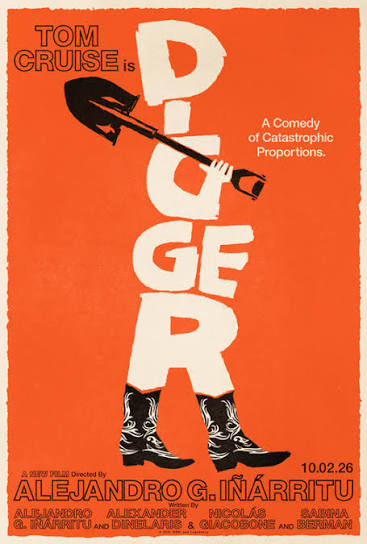
Somewhere along the line, Digger must have felt like an incredible idea. As the world almost literally boils over the summer, you can imagine Hollywood thinking: “people must be crying out for a satire on climate change!” Throw in the mega-wattage star power of Tom Cruise – with the added novelty of the svelte action-star in enough old-age make-up to make him look like a oligarch Oscar the Grouch – and lauded two-time Oscar winner Alejandro González Iñárritu calling the shots, no wonder $150 million was thrown at this. Perhaps it would have been better for the environment if that cash had just been sent to a charity.
Digger at first seem to be about unscrupulous, ruthlessly ambitious oil tycoon Digger Rockwell (Tom Cruise), whose Drill-Baby-Drill attitude to the Arctic leads to a cataclysmic natural disaster and massive ice shelves drifting towards Europe and North America like naval cruise missiles. Amazingly, Digger is the most competent person in the US administration (led by John Goodman’s Trump-esque President) trying to deal with the fall-out. But wait! There’s more. Because the Digger story is actually an elaborate theatrical production (Fossil Fools) being staged in the post-apocalyptic future Digger caused, with Cruise also playing the perfectionist lead actor, complaining about the lack of subtlety in the satire he’s performing.
Yup that’s right. Iñárritu’s film is both a loud, brash, shouty satire and a satire of loud, brash, shouty satires. Is this a good combination? Not really. The actual satire itself is neither particularly funny, insightful or entertaining. (Digger is like Dr Strangelove if every role was played like George C Scott’s Buck Turgidson). The framing device is ponderous, boring, adds very little and makes smug, intellectual points about how art can be hijacked by the wealthy to push an agenda but can still be an important cathartic outlet for emotion, but is still an inadequate response to world-shattering events. In other words, Digger spends most of its time shouting at you, then takes the odd breather to tell you off for watching the film itself. It’s so smug and full of itself, and been such a financial disaster, it’s not a surprise that a counter-wave of fans is now trying to claim it as a misunderstood masterpiece, rather than a complete dog’s dinner.
Digger feels rather like it brings together all the worst, most tiresome elements of Iñárritu’s back catalogue to the screen. We get the self-satisfied theatrical ‘satire’ from Birdman, the portentous self-importance of Babel, the ponderous pontificating and oblique mysticism of Bardo and the whizzy, show-off spectacle of both. All washed down with the feeling that the film is judging you the whole time, while patting itself on the back for its own audacity.
I can’t even begin to tell you how annoyingly ‘cake-ist’ it is to be a shrill, noisy, crude satire stuffed with stereotypes and also try to pre-empt any criticism of this by commenting about it in-universe itself. That in-universe commentary also tries to make on-the-nose big business points, as the play transpires to be funded by Digger’s nephew (played by Jesse Plemens). Plemens character claims it’s an apology, but seeing as he also runs an all-powerful tech company it’s actually clear the entire enterprise is an arts-washing exercise for his reputation. If Digger wasn’t trying to do a million things badly, this would be a good point. Instead its as pretentious as everything else.
The spectacle of Digger is well-done I’d give it that. (So it should be, considering the millions of dollars spent on it – I dread to think what environmental cost). Much like Birdman felt like it had been made so Iñárritu could show he could do a whole film in what looked like one take, so Digger looks like it’s been made to showcase how he can merge a theatrical and a cinematic world into one, with sets and locations branching into each other, and the strings (literally so on the scale models) skilfully shown.
That’s impressive. It’s impressive in Birdman, even though the rest of the film spends chunks of its time being pleased with itself and telling you off (very similar to this). But everything in Digger is preaching to the choir, with nothing fresh or interesting to say to build the congregation. The American powers-that-be are trigger-happy, Bible-bashing morons who don’t give a damn about anything outside their own needs. They’re all dialled up to elevem preening macho male egotists, with thinly veiled racist, sexist and homophobic views. John Goodman’s bombastic President is a moronic narcissist dying of “ass cancer” who believes his fate and the world’s are the same.
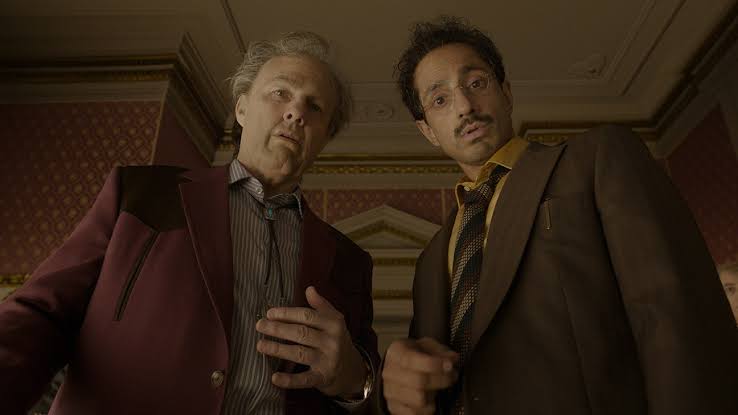
Saying this, Cruise throws himself into this world with the sort of commitment you’d expect from an actor you suspect is not a million miles from the back-seat driving perfectionist actor he also plays. He’s big, loud and giving it everything. If the film has any moments of merit, they are his. In particular, its set-piece scene where an unapologetic Digger bombastically informs the European parliament that they may claim they want eco-politics, but they are addicted to his black gold. Although its easy to think Digger is basically a self-important reprise of Tropic Thunder’s Les Grossman it’s all acting with a capital A, and the make-up, accent and inverted modesty of a buff athlete disguising himself as a paunchy geriatric in crappy cardigans is all part of that. But it’s all caricature of bangs and flashes – and that fact that, in his other role, Cruise tell us this repeatedly doesn’t change the truth.
What really stands out here is that neither Cruise nor Iñárritu are particularly funny. At least the equally tiresome Don’t Look Up was made by people who knew how a joke works. Digger resorts more often than you might think, to vomit, food splatting and bowel movements for humour. In its ‘real world’ framing device, there is bugger-all lightness of touch either, the film constantly whacking us in the face with points about everything from environmentalism to politics to business to art. What also feels a bit bizarre about Digger is that it still needs to position Cruise as something of a hero: Digger, for all his monstrous greed, is competent and you almost admire his self-belief; Markson is a principled artiste, tortured with worry about his missing daughter.
I’m not even sure what the main point Digger wants us to take out of all this. Is it saying we are drifting, indifferently, towards destruction? That even in the future, the people watching this show are being distracted from what’s really going on around them by something bright and shiny? Or is it focused on how our shallow and selfish world today isn’t willing to do anything to stop a calamity? Or is gunning for the greed of the super-rich smashing everything? I guess it’s some combination of all of these, but the sledgehammer wit is so on the nose, you can’t be bothered to work it out.
Digger is a mighty, stinking mess, full of smug self-satisfied flash but in reality pulling the threads of the few ideas it’s made from as tightly as possible around itself to hide its nakedness. It also makes me believe, more strongly than ever, that Iñárritu might just be the most tiresome, flashy, faux intellectual of all the modern great directors.