Tag: Franchot Tone

The Lives of a Bengal Lancer (1935)

The Lives of a Bengal Lancer (1935)

Old-school adventure mixes with some slightly dated Imperial attitudes in a film that’s still good fun

Director: Henry Hathaway

Cast: Gary Cooper (Lt McGregor), Franchot Tone (Lt Forsythe), Richard Cromwell (Lt Stone), Guy Standing (Colonel Stone), C. Aubrey Smith (Major Hamilton), Douglass Dumbrille (Mohammed Khan), Monte Blue (Hamzulla Khan), Kathleen Burke (Tania Volkanskaya), Colin Tapley (Lt Barrett), Akim Tamiroff (Emir), J Carroll Naish (Grand Vizier)
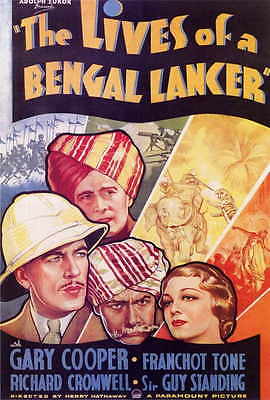
Tales of adventure and derring-do in the British Empire were meat and drink for generations of schoolboys. Few adventures were as well known as The Lives of a Bengal Lancer, a stirring tale of three lieutenants in the Bengal Lancers who become fast friends while defending Queen and country. We’ve got decent, impulsive but luckless McGregor (Gary Cooper), upper-class joker Forsythe (Franchot Tone) and eager-to-please Stone (Richard Cromwell), whose also the son of commanding officer Colonel Stone (Guy Standing). They go up against Oxford-educated Mohammed Khan (Douglass Drumbille), who schemes to seize an ammunition shipment. Can our heroes face down dastardly natives, exotic tortures and desperate escapes? All in a day’s work for a Bengal Lancer.

The Lives of a Bengal Lancer was a big hit on release, despite sharing nothing except the title, location and general theme with the semi-autobiographical novel from former-lancer Francis Yeats-Brown. It’s rollicking adventure and the boys-own mateyness of its leads, sparked a wave of spiritual follow-ups set everywhere from the Canadian mountains to the deserts of Africa. It scooped seven Oscar nominations and was celebrated as one of the greatest adventures on screen. Unfortunately, it’s not as fondly remembered now with its uncritical celebration of colonial India, spiritual links to Kipling’s White Man’s Burden and the fact Hitler of all people named it his one of his favourite film, loving its celebration of how a few white men could ‘protect’ (control) millions of natives.

It’s fair to say you have to close your eyes to some of this stuff when watching The Lives of a Bengal Lancer today. Otherwise you might flinch at our heroes threats to various squirming, cowardly Islamic rebels that if they don’t confess they’ll be sown inside a pig skin (even in 1935, outraged questions were raised about this in Parliament). You need to roll with Douglass Drumbille blacking-up as the well-spoken Mohammed Khan (not just him: nearly all the Indian characters are men-in-face-paint and for good measure our heroes also black-up to disguise themselves). There isn’t a second’s questioning about the morality of Empire and the implicit suggestion runs throughout that the Indian people should be grateful the British were there to run their country for them.

But put all that to one side, and The Lives of a Bengal Lancer is still rather fun. One of the factors making it easier to bench your misgivings is that, really, this film isn’t really interested in India or the themes of Empire anyway. For starters, all three of our heroes are played by Americans making no effort to hide their transatlantic accents (McGregor is suggested as being ‘Scotch Canadian’, but a few words of Cooper’s awful Scottish accent makes you relieved he didn’t bother to keep it up). Any insight into British-Indian relationships is extremely brief. The film is clearly shot in California, in locations identical to the sort of Westerns Hollywood was churning out. And a Western is what Bengal Lancer really is.

Our three heroes do feel more like cowboys shooting the breeze for large chunks of the film rather than army officers. Although there have been criticisms of the leads – Cooper in particular, probably because an actor so iconically American feels strange as an oddly accented Brit – all three of give entertaining, complementary, performances. Cooper is strongly charismatic, rather charming in his earnest attempts to do the right thing and his luckless incompetence at anything that isn’t soldiering (a running joke sees him building up increasing tab in a series of ill-considered bets with the good-at-everything Forsythe). But when action comes calling, McGregor is courageous, quick thinking and selfless. It’s immediately clear why Cooper essentially replayed versions of this relatable role several times. Franchot Tone is equally fine as the witty, smooth Forsythe who never takes anything seriously until things are really serious. Cromwell does sterling work as the naïve Stone.

Most of the film works because we end up liking these three characters – just as well since most of the first half is essentially watching them go about their daily tasks: riding, cleaning horses, heading out on patrol, shooting the breeze in the barracks. There is a small character-led crisis over whether the ram-rod Colonel Stone (a suitably dry Guy Standing) will accept his puppy of a son, but the biggest action drama in the first half is a wild boar hunt that nearly goes terribly wrong. If we didn’t enjoy Forsythe and McGregor deliberately rubbing each other up the wrong way, between teasing and taking a big-brother interest in Stone, we’d struggle to enjoy the rest of the film.

The second half is where the real action kicks in. During a dinner where our heroes dress up in native garb to make nice with a local Emir, Bengal Lancer throws in a bizarre Mata Hari figure, in the mysterious Russian Tania (Kathleen Burke). It’s not a remote surprise she ends up being no-good, or that the disillusioned Stone is swiftly honey-trapped into imprisonment by Dumbrille’s vaguely-motivated smooth-talking villain (it’s hilariously ironic that the villain is the most cut-glass Brit in the film). McGregor and Forsythe don Indian disguise – against orders naturally – to do what men do, which is stand by their friends.

A parade of exciting set-pieces follow thick-and fast, culminating in an impressively staged battle with towers toppling in explosives, machine gun fire spattering left-right-and-centre and our heroes literally coming to blows over who gets to make a heroic sacrifice. We get there via dastardly torture – Bengal Lancer coined the famous “We have ways of making men talk line” – as Mohammed Khan employs bamboo sticks under the fingernails (thankfully shown largely in shadow and Cooper’s stoic grimaces) to get information from our heroes. It’s all part of these men being forged by fire into exactly the sort of hardened men-of-combat we need to protect a frontier.

The Bengal Lancers ride in towards the end like the cavalry, and the air of a Western in Red Coats sticks with Lives of a Bengal Lancer throughout. Sure, it combines this with the stench of White Man’s Burden and an attitude of edgy distrust of foreigners, but The Lives of a Bengal Lancer is also riotous, old-fashioned fun, well shot and charismatically played. It might be a rather slight action-adventure fable, and sure its politics have not aged well, but it is still fun.

Five Graves to Cairo (1943)

Five Graves to Cairo (1943)

Exciting and witty war-time spy thriller, an overlooked work from a master director

Director: Billy Wilder

Cast: Franchot Tone (Corporal John Bramble), Anne Baxter (Mouche), Akim Tamiroff (Farid), Erich von Stroheim (Field Marshall Erwin Rommel), Peter van Eyck (Lieutenant Schwegler), Fortunio Bonanova (General Sebastiano), Miles Mander (Colonel Fitzhume)

It’s 1942 and the war is not going well for the British. The Germans are on the move in Africa under their ace commander Field Marshal Rommel. A tank drifts through the desert, bumping up and down sand dunes. Inside its crew slump, one dangling from his gun turret, another thrown on-and-off the gearsticks with each dune. It’s hauntingly Wilderish – a ghost tank charging through a never-ending desert – that Corporal John Bramble (Franchot Tone) wakes into, escaping across into the bombed-out Empress of Britain hotel run by panicked Farid (Akim Tamiroff), assisted by British-loathing Frenchwoman Mouche (Anne Baxter). Bramble’s hopes that he might lay low for a few days are thrown into danger when the hotel is requisitioned moments after his arrival by the German army with Rommel (Erich von Stroheim) himself setting up command there. Bramble passes himself off as recently deceased club-footed waiter Davos – only to discover Davos was a German spy and Rommel expects him to help delivery on his masterplan to crush the British.

Five Graves to Cairo is a magisterial juggling game of move and counter-move in which everyone holds tightly their own very specific parts of a greater mystery while trying to learn everyone else’s. Wilder does all this with wit and more than a little tension. Can Bramble keep up his pretence about being Davos while hiding his complete ignorance of Rommel’s masterplan? Will Rommel’s constantly alert, note-taking aide Lt Schwegler (Peter van Eyck) rumble him? The whole film is captured in one of its earliest sequences, as Farid carefully shepherds and blocks the view of Schwegler’s inspection of the foyer of his hotel, to prevent him seeing Bramble hiding behind the desk.

The whole film builds from there as Bramble constantly thinks on his feet, crafting obscure but convincing answers as he improvises wildly. All while limping around in a club-foot shoe and providing the sort of night-and-day waiting service the Germans expect. His improvisation is endless, from distracting a blowhard Italian general to steal his gun, to identifying himself quietly to a captured British officer being wined and dined by the smug Rommel by switching a whisky name chain on a bottle with his dog-tag (then smoothly passing off ‘Bramble’ as a rare spirit to the Italian general). His plans switch fast too, from a vague assassination attempt to being instructed by Miles Mander’s Montgomery-ish officer to uncover the Field Marshal’s schemes.

The Field Marshal himself is the epitome of Prussian arrogance. Played with a preening, puffed-up, Teutonic self-importance by an excellent Erich von Stroheim, Rommel never moves without his feathered swagger stick, pompously cavorting around the hotel, prissily demanding the finest sheets and best room. Far from the later ‘Good German’ image of the General, this Rommel is as snobbishly self-satisfied as a Bond villain, overwhelmingly pleased with his elaborate scheme (which he shrewdly set-up years earlier) and teasingly playing twenty questions with his British prisoners to see if they can work-out his intentions, while manipulating the game so his opponents can’t win. He’s an arrogant, hissable villain we are desperate to see taken down a peg or two.

Equally dislikeable is his whipper-smart aide, played with a thin-politeness by Peter van Eyck that hides his comfort with deception. With these villains as the face of the relentless German military machine, Wilder builds real tension around the importance of Bramble foiling Rommel’s scheme – and makes very clear to us that these ruthless sticklers for rules, certain of their own genius and superiority, will definitely not treat this accidental spy kindly if they catch him.

As Bramble, Franchot Tone does a decent job – although his Transatlantic vowels sound particularly odd when the similarly American Anne Baxter immerses herself in a French accent – even if Bramble himself is less interesting than his situation. A more charismatic actor might perhaps have helped lift Five Graves to Cairo to a higher level – after all it shares more than a few stands of DNA with Casablanca but Tone and Baxter aren’t quite Bogie and Bergman. What Tone does do well is morph swiftly from persona-to-persona, switching from heat-stroke confused soldier to would-be-assassin, to fast-thinking spy with a surprisingly natural ease.

He also builds a rapport with Mouche – Edith Head’s costumes for these two, with their contrasting blacks and stripes, quickly visually link them together – who discovers she hates the German more than she resents the British for abandoning her brother at Dunkirk. Baxter is very good as the real emotional heart of this film, a harsh woman hardened by loss, desperate to do what she can to save her POW brother but who finds a new cause to believe in. Baxter carefully lets her character build in statue from obstacle to reluctant aide to true believer, with real naturalness.

Her development reflects a whole film that uses its single claustrophobic location – nearly the whole film takes place over little more than a day or two in the hotel – to excellent effect, with potentially dangerous reveals lurking around every corner. Not least that the real Davos lies buried under rubble in the basement – not quite fully buried, Wilder’s focus early on Bramble’s orthopaedic show hinting at the vital ‘tell’ later on. Everyone – except perhaps the supremely self-satisfied Rommel – suspects there is more going on than they realise, and Wilder expertly ratchets up the tension through Hitchcockian time-bombs and carefully structured dialogue sequences to keep the audience firmly on the edge of their seats.

It’s makes for a fine caper, a careful riff on then current history that suggests Bramble might just have provided the vital clues to prevent the nefarious Rommel from claiming victory at El Alamein. While Five Graves to Cairo has a high entertainment factor, it’s not quite in the first league of war spy stories. But with entertaining performances – Tamiroff’s sweaty, stammering Farid and Fortunio Bonanova’s hyper-Italian Opera-singing general are also treats – and a real wit balanced with a well-developed tension, it’s a strong early film from a director who would go from strength-to-strength.

Mutiny on the Bounty (1935)

Laughton and Gable go head to head in Mutiny on the Bounty

Director: Frank Lloyd

Cast: Charles Laughton (Captain Bligh), Clark Gable (Lt Fletcher Christian), Franchot Tone (Roger Byam), Herbert Mundin (Smith), Eddie Quillan (Ellison), Dudley Digges (Bacchus), Donald Crisp (Burkitt), Henry Stephenson (Sir Joseph Banks), Francis Lister (Captain Nelson), Spring Byington (Mrs Byam), Movita Castaneda (Tehani), Mamo Clark (Maimiti), Byron Russell (Quintal), David Torrance (Lord Hood)

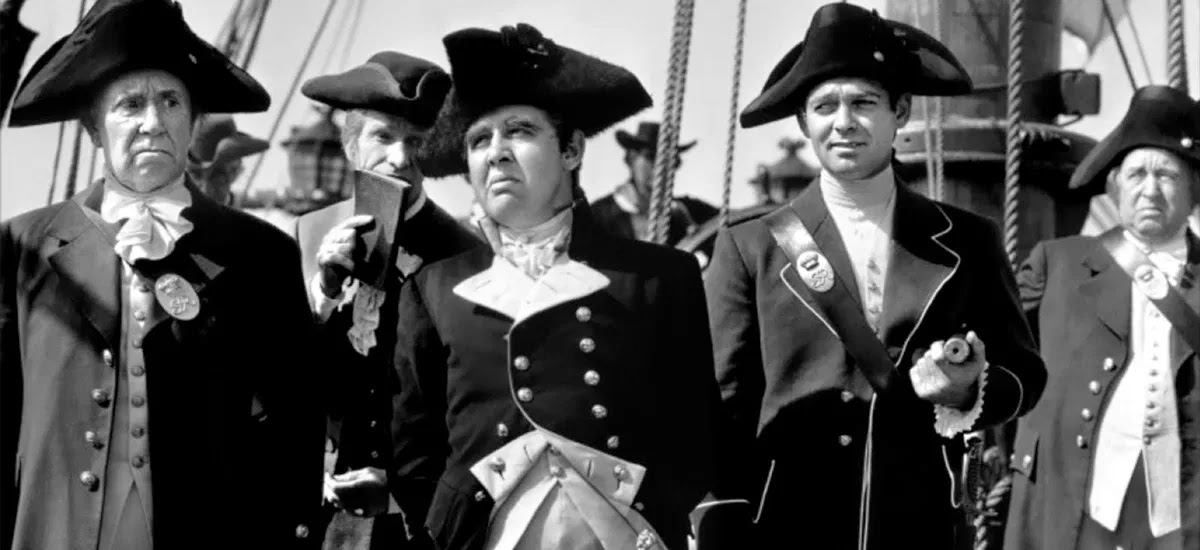
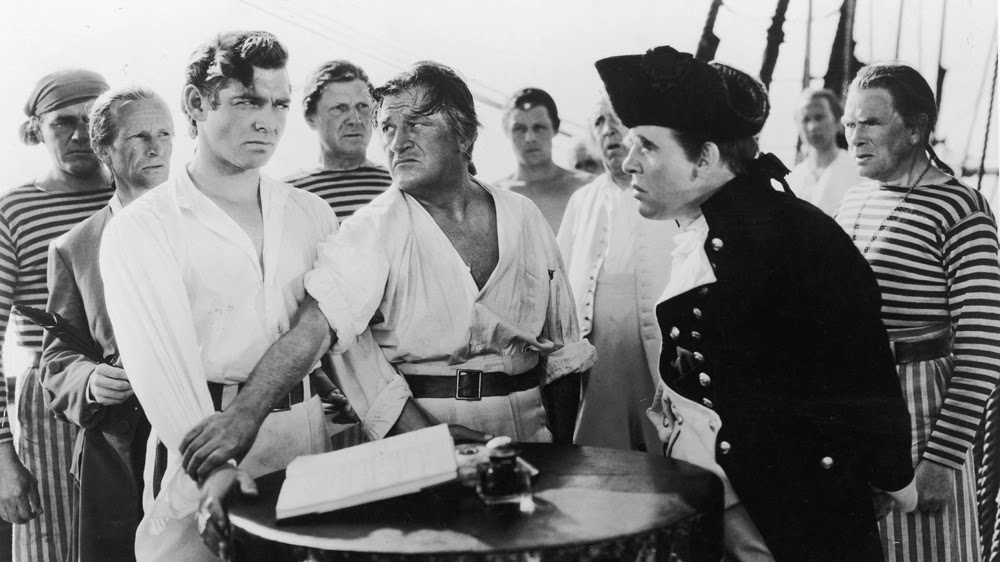
“They respect but one law – the law of fear…”. So hisses Charles Laughton as the definitively monsterish Captain Bligh in this Oscar-winning version of the most famous mutiny ever. It’s the quintessential adventure on the high-seas motion picture (never mind that the actual ship used could only get a few miles off the coast), but it’s also a feast of good acting and Hollywood class: the only picture to get three nominations for Best Actor, as well as the last Best Picture winner to only win one Oscar. It cemented the ideas around Bligh and Fletcher for generations.

Heading out on a two-year voyage in 1787 to transport breadfruit from Tahiti to the West Indies, the Bounty sets sail from Portsmouth with several members of the crew freshly press-ganged. In command is self-made man Captain William Bligh (Charles Laughton), while his second-in-command is gentleman Fletcher Christian (Clark Gable). A pair of fine sailors, the two of them are separated only by their methods. Fletcher is a man of the people, a motivator with a firm hand. Bligh is a man with just a firm hand, who never uses a dozen lashes of the crew when two dozen will do. Fletcher becomes more and more alienated by Bligh’s ruthless methods.

Frank Lloyd bought the rights to a novel that fictionalised the mutiny (introducing Roger Byam, a fictional version of Peter Heywood who later become a Post-Captain in the navy) with the intention of directing and playing Bligh himself. Fortunately he was persuaded to step aside on the acting front for Laughton, who is seized the part with relish.  Shoulders scrunched and neck jutting his head forward, with his lip curled, this is a Bligh constantly on the look-out for offence, a martinet whose anger stems from a self-loathing within. A chippy middle-class boy made good, he’s determined to enforce the letter of the law, and while a bully with no empathy he’s not exactly a bad man, just a bad captain. Laughton’s performance simmers with bitterness and a relish for being obeyed.

He makes a neat contrast with Clark Gable at his matinee idol finest. Worried about taking the role because it demanded the shaving of his lucky moustache (no facial hair in the navy), Gable gifts Laughton the flashier role to play the decent hero with only the best for his fellow man at heart. Gable’s Christian is decent, understanding, a natural leader who has a firm eye for justice. Not even bothering with the British accent, but settling for a mid-Atlantic ease, Gable is the Hollywood superstar to his core, his Christian the quintessential romantic ideal.

Between the two of them runs Franchot Tone’s Midshipman Roger Byam. Tone is the often forgotten third nominee for Best Actor, but he has in many ways the trickier part, which he handles with aplomb: the naïve young man who wants to serve his captain and his country, but also understands that his captain is not a man of justice. Tone gets the film’s highlight, a final speech to the court martial that helps make everything turn out alright, but his tortured pleading for justice and moral righteousness is delivered with a humble and effective forthrightness.

Lloyd has these fine performances (plus some great work from Mundin, Crisp, Digges, Quillan and others as assorted ship’s crew) and sets them all out perfectly on a film that captures the heart of the epic. The ship is brilliantly constructed and assembled, and Lloyd’s film reconstructs everything from day-to-day travails on sea to the impact of storms. The mutiny when it comes is shot with an Eisensteinesque immediacy, while he also manages to shoot Tahiti with a dreamlike paradise sheen. He paces perfectly the growing sense of tension and unresolvable fury between Bligh and Christian. 

And he certainly gets a brilliant sense of the cruelty and sustained violence of Bligh’s rule on the boat, as floggings come thundering down on the backs the sailors – often for the very meanest of reasons. A keelhauling (despite one moment of laughably bad model work) is brutal in its harshness. Bligh’s first act on boat is to flog a dead man (after all death doesn’t wipe out the need for punishment) and he goes from there. The film does give time to admire Bligh’s seamanship – and reconstructs surprisingly well his awe-inspiring open boat trip over 4,000 miles to take him and loyalists back to a safe port. Meanwhile Christian heads for the safety of Tahiti, a blissful series of images of our decent sailors enjoying homespun pleasures and hot Tahitian wives.

Of course it’s not actually what happened really. Bligh was a difficult, priggish and rather cold person with low personal skills but he wasn’t the monster he seems here. Christian had a certain aristocratic pull over the men, but he was also probably far more twitchy, young and stupid than the assured, experienced sailor he is here. Bligh’s ship wasn’t the bastion of cruelty it is here (punishments seemed in line with the rest of the navy, or even a little less according to the log), but Bligh’s lack of understanding of how men work and his endless drive, matched with his sailors’ seduction by the charms of an easy life on Tahiti perhaps led to the outbreak. Either way Bligh definitely didn’t command the HMS Pandorato hunt the sailors down, nor did the investigation into the matter end with him being snubbed as a wrong ‘un by Lord Hood.

But hey, if you know that this is legend printed as fact it’s fine. Because Lloyd’s film is still superbly entertaining, has three excellent performances among a fine ensemble cast and while its version of Bligh may be a monster made up, Laughton invests him with enough humanity and self-loathing you’ll despair at his poor choices as much as you’ll hate his cruelty. Prime Hollywood entertainment, perfect for any time.