Tag: Harrison Ford

Apocalypse Now (1979)

Martin Sheen heads into insanity in Coppola’s epic pretentious masterpiece Apocalypse Now

Director: Francis Ford Coppola

Cast: Martin Sheen (Captain Willard), Marlon Brando (Colonel Kurtz), Robert Duvall (Lt Col Kilgore), Frederic Forrest (Chef), Albert Hall (Chief), Sam Bottoms (Lance), Laurence Fishburne (Mr Clean), Dennis Hopper (Photojournalist), GD Spradlin (Lt General Corman), Harrison Ford (Colonel Lucas), Scott Glenn (Captain Colby), Christian Marquand (Hubert de Marais), Aurore Clément (Roxanna Sarrault), Jerry Ziesmer (Mysterious Man)

During the 1970s, the director was king in Hollywood. Get a reputation as a visionary director, and Tinseltown fell at your feet. You could spare no expense to put together ambitious, thought-provoking, epic films. If you wanted to shoot on location at huge cost, or reconstruct elaborate sets for single shots, for a huge runtime that catered as much to your ideas of being an artist as it did to crowd-pleasing narrative, then Hollywood would give you keys. It didn’t last: several massive bombs (combined with the huge box office take of Star Wars) shattered the mystique of the director as an ego-mad, flawless genius who had to be indulged, and persuaded Hollywood the future was in big-budget, mass-produced action films (welcome to the 1980s, Hollywood’s nadir).

Apocalypse Now wasn’t one of those flops, like (most infamously) Heaven’s Gate. But, by golly gosh, it really could have been. In fact, in many ways it should have been. It has all the hallmarks: a huge runtime, filmed over a colossal period of time in a difficult location, a plot that mixes action, war and thrills with impenetrably pretentious musings on mankind’s dark soul. A maverick director throwing his own very personal vision at the screen, and damn the consequences. It’s a miracle Apocalypse Now wasn’t a career apocalypse for everyone. It escaped because, despite everything, it more or less gets the balance right between plot and character and pretention and faux-philosophy.

The film is famously a transposing of Joseph Conrad’s Heart of Darkness into Vietnam. Captain Willard (Martin Sheen) is ordered to head down the river to “terminate with extreme prejudice” rogue Special Forces Colonel Kurtz (Marlon Brando), who is conducting his own vigilante war. On the boat trip down the river, Willard encounters a host of increasingly bizarre and surreal scenes, from war-mad Colonel Kilgore (Robert Duvall) to a seemingly leaderless battle over a bridge, a playboy bunny show and a compound of ex-French colonials. And that’s before he even arrives at Kurtz’s compound and things get really strange.

Apocalypse Now is almost impossible to separate from the bizarre, tortuous route it took to get to the screen. Originally scheduled for a few months, the film took over a year to complete. A typhoon destroyed all the sets in the first two months. Original star Harvey Keitel was dismissed after a week (as his performance wasn’t right): his replacement, Martin Sheen, had a near-fatal heart-attack partway through filming. Marlon Brando not only turned up the size of a buffalo but refused to learn (or even speak) his lines. A year into production, the film had no ending. Coppola put his entire fortune up as collateral to complete the film. It was a nightmare.

But yet somehow what emerged has a sort of force-of-nature quality to it. Even though parts are basically pretentious rubbish, despite the fact I have twice fallen asleep in this film, despite the fact it is far from being a film that trades in complex ideas and offers profound insights, it still has a hypnotic quality about it. It’s done with a real force of commitment, a genuine labour of love, a film that doesn’t leave anything in the locker room but throws it all at the screen. The quality of what lands may sometimes be questionable, but the commitment with which it is thrown is beyond doubt.

And in a world of cookie-cutter films, it’s hard to have anything but respect and regard for a film that is so defiantly its own animal, that tells its story in its unique way. It’s perhaps one of the first “experience” films: no film could of course communicate what it was like to serve in Vietnam, but this film perhaps gets close to the surreal, drug-fuelled madness in that conflict.

Because Apocalypse Now is a very surreal film. Its plot is extremely thin, and each section of its (mammoth) runtime is all about experiencing another element of the American experience. In the commentary, Coppola talks about the river trip being partly a journey from the present into the past, a journey back not only into the history of the conflict (and its different stages) but also the regressing of mankind itself into a more primitive, malleable, basic state. It’s a big lump for a film to bite off – and I’m not sure if the idea really comes across without you knowing it. The real impression you get is of rules of society being left further and further behind.

The arrival at Kurtz’s compound is the fufillment of this increasingly unnerving story. We’ve seen the madness on the journey, the pointlessness, and the bemused, carefree confusion of the crew. But at the camp we get the overblown, decadent lunacy of Kurtz. Brando dominates the final 30 minutes of the film, although his monologues are meaningless drivel, the sort of intellectual point-scoring you could hear in a sixth form debating society. To be honest, iconic as Brando’s appearance is, his performance of mumbling battiness is actually a little awful (like one big practical joke from the actor) and the film’s momentum grinds to a halt while he babbles on. 
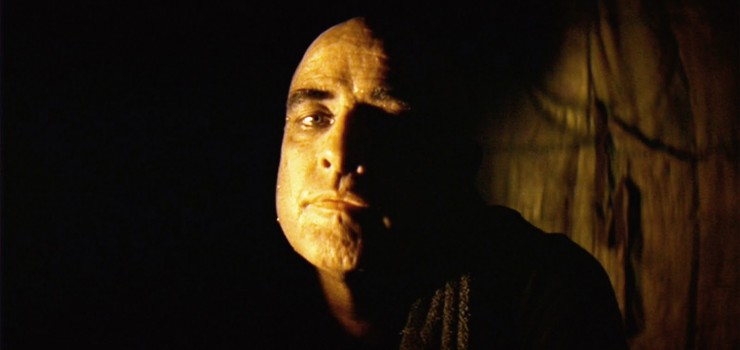
In fact, so self-indulgent is Brando that in a way it’s a sort of tribute to Coppola’s mastery of cinema that he makes this pompous character make any sense at all – or that he makes this sort of nonsense even remotely watchable. But again it’s the hypnotic pull of the film: Coppola builds towards a chilling, haunting final sequence of Willard and Kurtz’s final confrontation intercut with The Doors’ The End and the real-life slaughtering of an ox by a crowd of real-life villagers (they were going to kill the animal anyway but offered to do it for the camera). Coppola somehow turns all this into iconic cinema, even though, viewed objectively, it’s overblown, indulgent, pretentious rubbish.

The whole film is a testament to hewing compelling filmmaking out of breathtaking insanity. After the film departs in the boat, most of reason, sense and conventional story-telling depart with it. Information only gets conveyed through rambling monologues from Willard. The crew of the boat get into scraps that reflect heightened versions of the American experience in Vietnam – from a war crime as the crew shoot-up what turns out to be an innocent boat, to an attack from unseen tribesmen with spears from the mists of the shore. Sam Bottoms, as surfer-turned-GI Lance, is our guide of a sort here – as he gets more stoned, so narrative logic departs with his senses. 

What keeps the film going throughout is the masterful film-making. Coppola shoots the bizarreness with brilliant, visionary imagination. As a social theorist he’s pretty basic – man is, by the way, a savage animal and the Americans didn’t know what they were getting themselves into in ‘Nam – but as a film-maker he’s one of the best. Who else could have made three hours of episodic boat journeys so strangely compelling? The film is crammed full of great scenes and moments which rarely feel like they tie together – in fact, they could almost be watched in any order – and there is barely a character in there, but the film feels like its throwing you into the madness of Vietnam. 

Even the sequence with a bit more narrative is still laced with absurdity. Kilgore’s helicopter assault on a village – and its use of Wagner blaring from helicopters to scare the Vietcong – is justly famous. This is a bravura film-making – and as much a tribute to the astoundingly amazing editing and sound work of Walter Murch as it is the photography of Coppola. Like most of the rest of the film it is visually outstanding, but it also has the film’s best writing (in the quotable but also strangely subtle characterisation of Kilgore) and also the film’s most iconic performance in Robert Duvall. Duvall is terrific as the war-loving, but strangely childish Kilgore, obsessed with surfing and with an ability to live totally in the moment. 
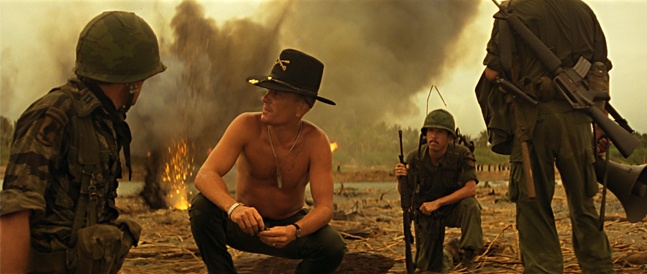
This sequence doesn’t hesitate in showing both the brutality of war – and also the insanity of our commanders. Kilgore is genuinely dreading the end of the war, and you can see why he would since he is clearly having a whale of a time bombing places. Kilgore is a lovable, quotable badass doing what needs to be done – but the film doesn’t forgot that he is also an insane soldier with no off-switch. And Apocalypse Now never really glamourises war, for all the excitement and beauty of watching those helicopters come over the horizon.

It’s the artistry in its film-making, and the genuine effort and work that helps make it a demented classic. Walter Murch’s sound design and editing is possibly flawless – this might be the best edited and sound designed movie ever – from the opening moment when the helicopter blade sounds transform into a hotel room fan you know you are seeing something special. Scenes such as Willard’s hotel-room breakdown hum with intensity as they feel genuinely real – that scene in particular feels like Martin Sheen exposing part of his tortured psyche at the time. Sheen is by the way perfect as Willard, a slightly unknowable killer with dead eyes and a dead soul, still aware of the vileness of his world.

Apocalypse Now is a sprawling batty film – and in many ways an intellectually empty one straining at a depth that ain’t there. But somehow, for all that, it still is a masterpiece. Which is in itself a bit of a miracle as it really should be a disaster. It’s pretentious. It’s overlong. It’s very full of its own importance as a work of art (the re-insertion of the long-winded political discussion at the French Plantation into the Redux version doesn’t help). Some of its performances are plain ridiculous, verging in Brando’s case on outright bad. But yet, it’s delivered with such force of conviction, it’s so wonderfully assembled, so hauntingly shot and edited, that it hammers itself into your brain. You literally can’t forget it, for all its many, many flaws. Despite yourself, you find yourself forgiving it an awful lot – a lot more than you might expect. A mess, but also a classic.

Blade Runner 2049 (2017)


Ryan Gosling does a man’s job filling some difficult shoes in Blade Runner 2049

Director:  Denis Villeneuve

Cast: Ryan Gosling (Officer K), Harrison Ford (Rick Deckard), Ana da Armas (Joi), Sylvia Hoeks (Luv), Robin Wright (Lt. Joshi), Mackenzie Davis (Mariette), Carla Juri (Dr Ana Stelline), Lennie James (Mr Cotton), Dave Bautista (Sapper Morton), Jared Leto (Niander Wallace), Barkhad Abdi (Doc Badger), Edward James Olmos (Gaff), Sean Young (Rachael)

SPOILERS: It’s pretty much impossible to discuss Blade Runner 2049 without revealing some of the workings of the plot. Since the film makers have gone out of the way to say “don’t reveal any of the plot” I thought it fair to say I’ll discuss some things fairly freely here. So you’ve been warned!

Making a sequel is a risky business at the best of times. Then imagine making a sequel to a film that is not just a cultural and artistic landmark film but one people genuinely love. The possibility of creating a massive disappointment? Pretty big. You need some guts to take that on – like announcing you are making Gone with the Wind: Blown Away or Casablanca: Everyone Back to Rick’s. That’s the sort of challenge for the makers of the long-awaited Blade Runner sequel. Could they make something that both complemented and expanded on the original?

The year is 2049 (of course!). K (Ryan Gosling) is a Blade Runner with the task of hunting down long-lived Nexus-8 replicants – the twist being (and its revealed in the opening minutes of the film!) that K himself is a replicant, a more obedient Nexus-9 model. After “retiring” aged replicant farmer Sapper Morton (a career best Dave Bautista), K locates the buried remains of a female replicant who died after an emergency caesarean section. Terrified that replicants may be developing the ability to reproduce, K’s superiors order him to “retire” the child and all who know of it. As K investigates, his loyalties become ever more divided – while sinister corporate genius Niander Wallace (Jared Leto) and his Nexus-9 hit-woman Luv (Sylvia Hoeks) have their own plans for the replicant child.

So the big question is, does Blade Runner 2049 succeed? The answer is a firm and reassuring yes. The big issue is, does the existence of this film affect (or even ruin) the previous film? Blade Runner 2049 not only complements the original, it builds on and expands its themes, and poses far more questions than answers. In some ways it’s even more profound and searching than the original – arguably it engages with ideas and concepts even more overtly (and richly). If your concern going into this film was it would end any discussion about whether Deckard is a replicant or not, then have no fears – the question remains as open as ever (and works either way for this story).

Even more than the original, this film tackles what it means to be human and how we define humanity by the ability to express emotions and empathy. It comes at this from a different stand-point from Blade Runner by removing any doubt about our hero’s nature. What is more, he is a replicant deliberately designed to be more obedient than earlier models. A cool, minimalist actor with a mastery of small expressions, Ryan Gosling is almost perfectly cast as the quiet K, developing deep yearnings to be more than what he is. The entire film revolves around this question of how capable K is not only of forming emotions, but of making his own choices.

The ability to live freely and choose is at the heart of the conundrums for all our characters. To what extent are they able to do this? K goes about his work of dispatching fellow replicants with a quiet reluctance, but does his duty nevertheless. But he is a character yearning to be “more” – and what, in many ways, is more human than that? The film taps into this expertly with K’s belief that maybe he himself is replicant child. The film’s mantra is about choosing what we live and what we die for and, regardless of who or what we are, being able to do this is what makes us “more”.

In a film stuffed to the gills with replicants and other artificial characters, we are constantly asked to address and question how far each of them goes towards achieving “humanity”. Just as with Blade Runner, the only two definitely human characters (Niander Wallace and Lt Joshi) are strangely distant, hard to read or even cruel authoritarian figures, making a damn bad case for real humans.

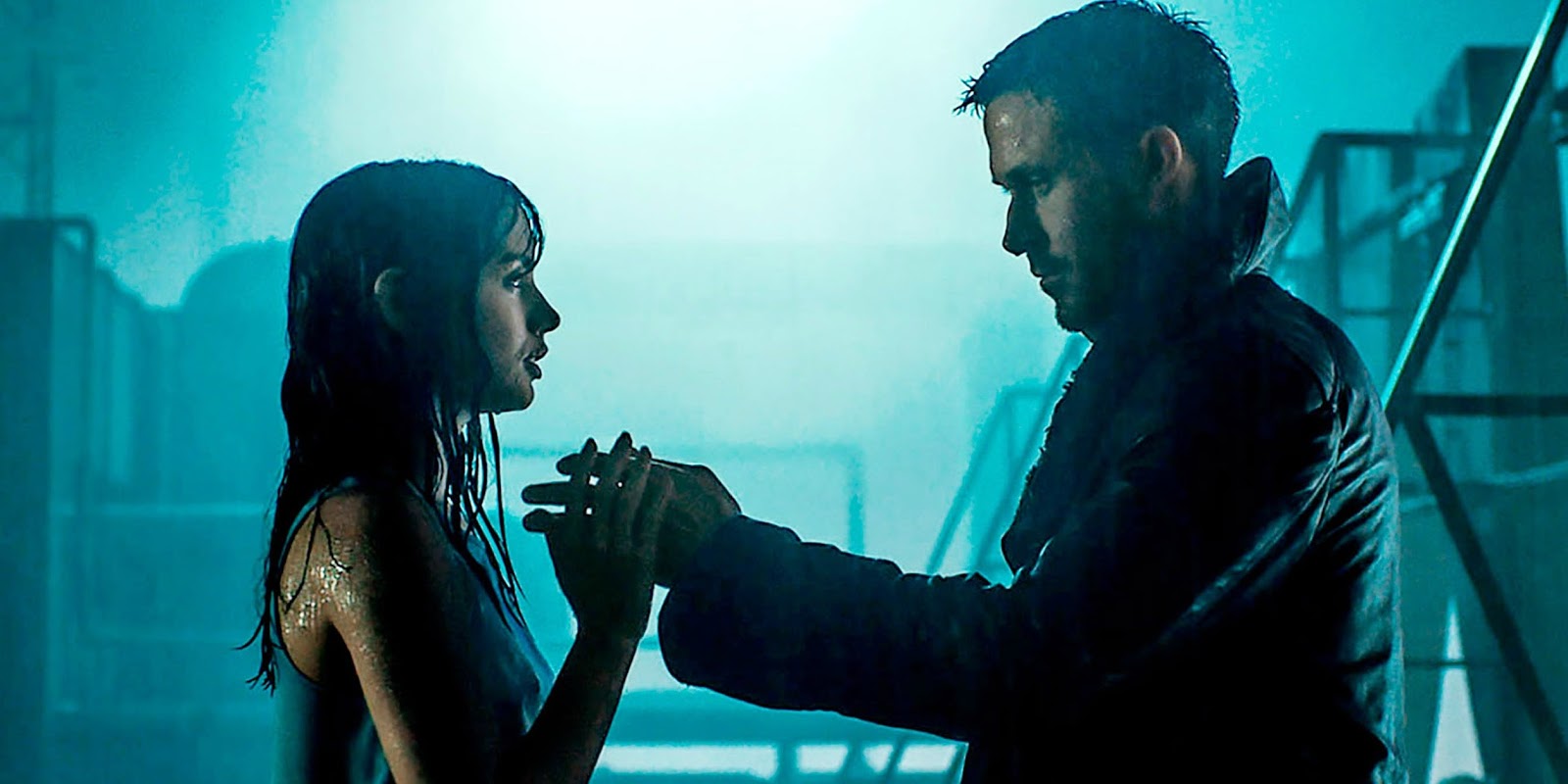
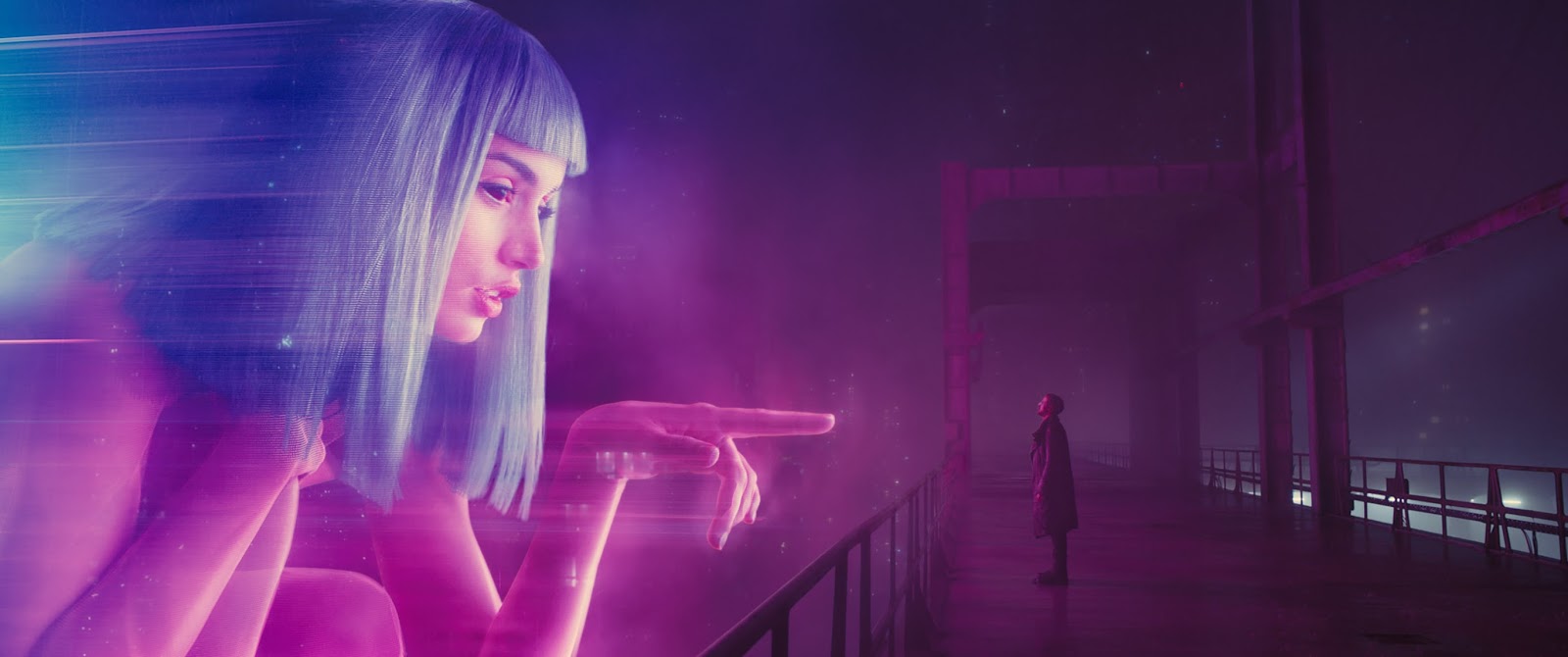
Joi (brilliantly played by Ana de Armas), K’s girlfriend, is a warm, caring, loving woman – but she’s also a hologram, designed to be the perfect companion. K and she go to great lengths to protect and care for each other over the film – and her final fate is a deeply moving moment. But Joi is a computer programme – and a late sequence in the film where K interacts sadly with a looming holographic advert of another Joi that repeats many of her phrases in a disconnected style casts a sad light on all their previous interactions. Every time Joi said anything with love or affection to K, was this just a computer reflecting back what her owner wanted to hear?

It’s not a great surprise to say K does eventually learn to make his own choices and to decide his own fate. In many ways this is a fable of growing up – K accepting his limitations while forging his own destiny – but it makes a contrast with other replicants. While the older models form their own resistance, K’s counterpart Luv (an imposing Sylvia Huks) can’t or won’t break free of following Wallace’s commands. There are more than a few hints Luv is not always happy with the duties she is asked to perform (at one point she weeps quietly as a replicant is dispatched). But at others, she’s clearly striving as much as K to be “special” – she triumphantly repeats a mantra to herself about being the best, like a daughter trying to impress her father.

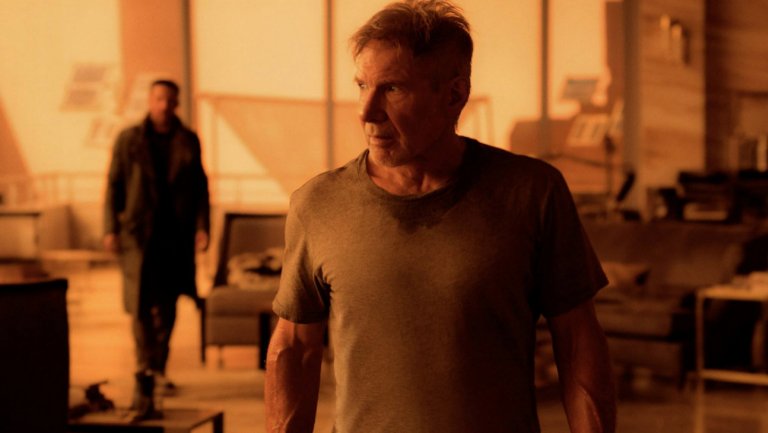
These new characters offer such diverse and exciting story-telling opportunities, you almost don’t notice that Deckard doesn’t appear in the film until nearly the third act. Harrison Ford may have been slightly uncomfortable in the original – but he fully understands the more assured, confident Deckard in this film, who has made his peace with leaving the world behind. Ford gives this new Deckard an almost Han Solo-ish shoot-first swagger, but mixes it with a world-weary sadness. I’d go so far as to say he’s actually better in this film than the first one.

Which is a further testament to the strength of this film. All the themes and ideas of the original are used as bouncing-off points for further exploration. This never feels like a retread, reboot or remake – it feels like a rich and rewarding piece of intelligent sci-fi by itself. I actually feel it could be watched independently of the first film, and still have plenty to offer. It’s not interesting in tying the first film up in a bow – instead it serves as a stimulus for future discussion. You could imagine a sequel to this film sustaining enough interest for 35 years.

Technically of course the film is an absolute marvel. Roger Deakins’ photography is gorgeous, capturing every element of this dystopian nightmare world in a series of brilliant images, in turns drained, bleached and sun kissed. Every frame is artfully composed for maximum impact. The production design is similarly magnificent, Dennis Gassner’s work melding the world of the original, with its steam-punk look, with a mix of technological developments. The score by Hans Zimmer and Benjamin Wallfisch is similarly perfect, giving the film a brooding intensity.

But most of this artistry comes back to the film-making mastery of Denis Villeneuve, a director so gifted I think he may be more interesting than Ridley Scott. His control of the pace of the film is brilliant – despite being very long, it never drags – and he shoots every scene with a careful, intellectually engaged brilliance. He is able – possibly even more than the original – to mix emotion and elliptical theorising, and to draw a raft of brilliant performances from an outstanding cast. More than anything else, he treats the audience with respect, giving them a measured and thoughtful film that trusts we have patience. Villeneuve tops Arrival here, and does so with confident aplomb.

Blade Runner 2049 is a film that demands to be seen more than once. It’s a patient and intensely thoughtful piece of science fiction, that asks profound questions about humanity and the characters in it. I don’t really feel from one viewing I’ve got a grip on it – in fact the more I think about it, the more its haunting, elegiac quality starts cramming into my head. You need to be patient and go with it – you need to be in the right mindset for this slowburn concept film. But, get in that mindset and this film is constantly rewarding. If you want to criticise something, I will acknowledge that many of the female characters are a little more clichéd (most are prostitutes or similar) – but this world where many women seem to be in subservient roles to men is in many ways an extension of the world created in the original film (and now an expression of the dystopian future).

However this is a great film. A really great piece of adult science-fiction. I’ll go out on a limb and suggest it is better than the original film.

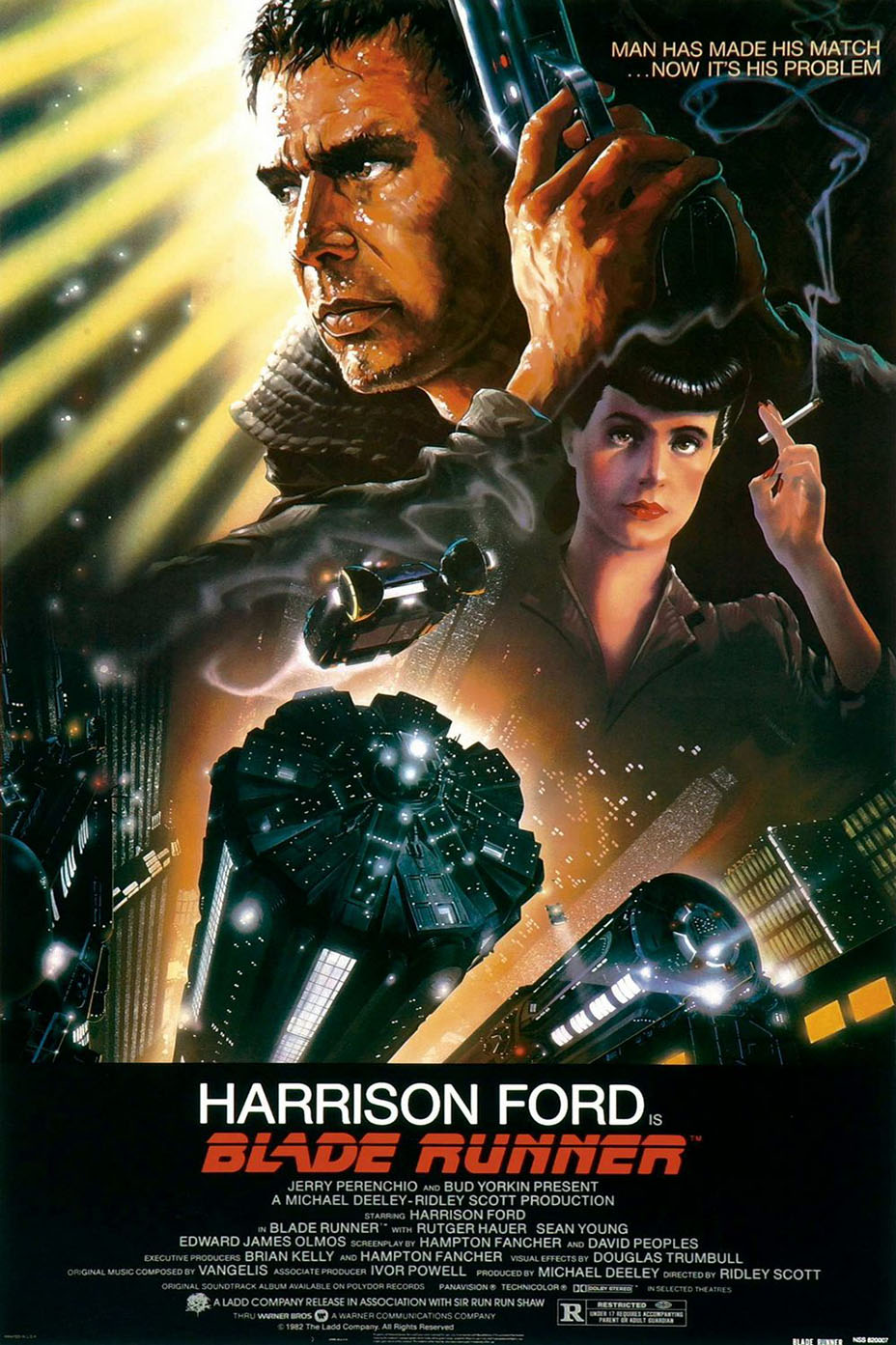
Blade Runner (1982)


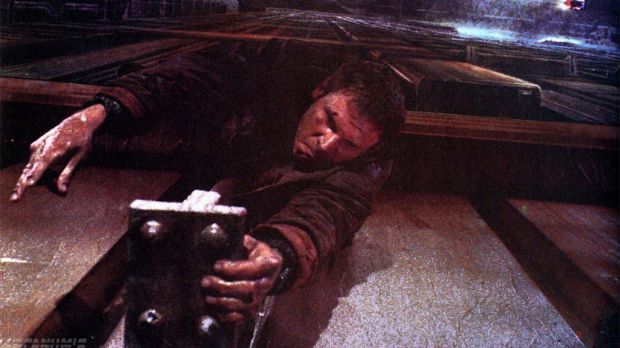
Harrison Ford hangs on for dear life in Blade Runner

Director: Ridley Scott

Cast: Harrison Ford (Rick Deckard), Rutger Hauer (Roy Batty), Sean Young (Rachael), Edward James Olmos (Gaff), M. Emmet Walsh (Harry Bryant), Daryl Hannah (Pris Stratton), William Sanderson (JF Sebastian), Brion James (Leon Kowalski), Joe Turkel (Dr Eldon Tyrell), Joanna Cassidy (Zhora Salome)

Everyone knows Blade Runner surely? And everyone has a viewpoint on its central mysteries. Why for a film largely ignored on release? Because as well as being tight and engaging, this is a rich thematic film, crammed with mystery and enigma. And there are few things more engaging than a film that succeeds in being as open to interpretation as possible.

In 2019 a dystopian, polluted Los Angeles is a launch pad for the wealthy to head out into the new colonies in the stars. Off-world, the unpleasant tasks are carried out by artificial humans known as replicants. Replicants are banned from returning to Earth – but a group of five led by soldier Roy Batty (Rutger Hauer) have come to Earth looking to extend their pre-programmed limited lifespans (no more than five years). On Earth, Rick Deckard (Harrison Ford) is reinstated as a Blade Runner, an agent whose job is to ‘retire’ (i.e. kill) replicants on Earth. Deckard is reluctant, having an increasing distaste for his work, but begins to hunt and eliminate the replicants.

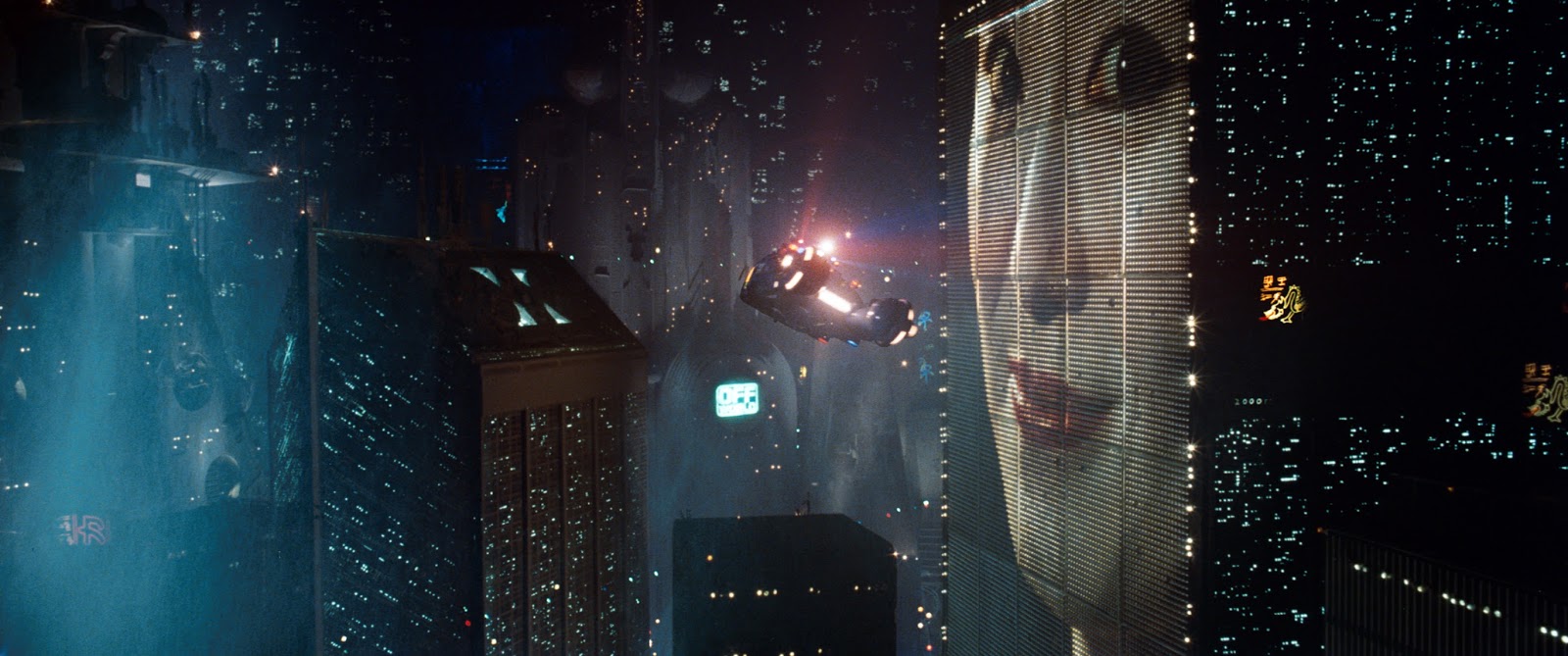
Blade Runner may be one of the most influential science fiction films ever made. Its look and style influenced virtually every other dystopian future you’ve seen in any other film since. Tall, run-down buildings. Overbearing corporate advertising. Flashing neon lights. Terrible weather. Everything dark all the time. Poverty and degeneracy on every corner. You’ve seen it in every dystopian future since. Visually, the film is a landmark, a testament to Ridley Scott’s graphic artistry.

But that wouldn’t be enough for Blade Runner to last the course. When released it was perhaps too elliptical and hard to categorise – equal parts dystopian thriller, noir detective story, sci-fi morality tale, dark romance – for audiences to really understand. Certainly the studio didn’t. After disastrous test screenings, it was re-cut. So began a fable of slice and dice that made Blade Runner perhaps second only to Brazil in the annals of re-versioned films.

The release included an overtly “happy ending” (bizarre images of our heroes driving into a blissful countryside, totally at odds with the rest of the film) and a disengaged voiceover from Harrison Ford that eradicated all the film’s subtlety. This was the only version for 10 years until a “Director’s cut” was released. This removed these elements, retooled scenes and introduced the famous “unicorn dream” sequence (of which more later). Fifteen years after that, Scott finally found the time to work on a “Final cut” which presented the film as Scott had intended it – with all its mysteries and questions intact. Has there been any other film with so many different “official” versions?

Anyway, was it worth the struggle? Certainly. While you could argue it is predominantly a triumph of style, Scott laces the film with a sense of mystery and profundity that makes it a rich and rewarding viewing experience. It’s a trim detective thriller that also questions the nature of humanity. It is a perfectly formed elliptical mystery, an archetypal cult film that engrosses the viewers to such an extent that 30 years later there is still a healthy debate about what the film means.

Humanity is =the key issue. The human characters are functional, cold, distant and unengaging. The hunt for the replicants (who are basically slaves) is brutally and unremorsefully executed. The replicants have been designed to learn and grow but cruelly had their lives capped to stop them taking advantage of this. Their world is polluted, tawdry, soulless and lost.

Meanwhile, the replicants exhibit far more (whisper it) humanity than the aloof human characters, ]despite the fact we are repeatedly reminded they cannot feel empathy. Clearly this is not completely true. And, the film argues, if an artificial human can display loyalty, fear, love, anger and pain, what actually is the difference between that and a “real” person. If a replicant can only be identified after dozens of questions in a test, can they really be that different from a human being?

Questions about this coalesce around Deckard. If the film has remained such a part of cultural discussions, it’s partly because of the fun of theorising about his true nature. Is he a replicant? Scott’s insertion of Deckard’s unicorn dream (implying the origami unicorn left by Gaff at the film’s end shows Gaff knows Deckard’s dream, meaning the dream is an implant in an artificial mind) very much suggests so. There is a case to be made either way, both of which work.

Deckard’s ruthless replicant hunt is deliberately juxtaposed with their own warm feelings. Deckard grows in humanity and reluctance as the film progresses – is this him becoming more human, or is it is humanity emerging? His coldness and reserved hostility contrast with the vibrancy of Batty, Pris and the replicants. In many ways, he fits in as the quintessential human in this world – a vague discomfort with what he is doing, but no real hesitation about continuing. Thematically, it makes more sense if Deckard is human – that he represents dehumanisation (and gradually realising it) while the replicants become more human.

However, clues are sprinkled throughout that Deckard is not what he appears. His distance from other characters. The treatment he receives from his co-workers. The photographs that fill his apartment (replicants enjoy photos as it gives them a sense of a past). His bond with Rachael. His relentlessness – and the fact that he is clearly considered expendable by the police. Then there is the rich irony: the best way of hunting down replicants is to create a hunter replicant. Either way, it’s a debate and conversation that sustains the film – and allows multiple interpretations of every scene.

It’s a debate that feeds into the main theme of the film: humanity, free will and our God complex. Batty, the dying replicant searching for new life, confronts his maker – a distant, arrogant man with no interest in his creation. And kills him. But Batty feels more human than any other character. He shows more affection, frustration, anger and grief than anyone else. His last words (the famous “tears in rain” speech) had such cultural impact because it has such poetic joy and depth to it. They are lines enthused with a desire to live, a romantic vitality. It’s the most poetic moment in the film and it comes from someone who isn’t “real”. What more sign do we need that the replicants are human? If we can create poetry in a machine, does it stop being a machine?

Empathy is the quality the replicants are judged on – but as we see replicants dispatched with little sense of regret, and then witness Batty and Leon’s grief for their fallen comrades, or Pris’ ease with man-child Sebastian, the lack of empathy from humans is all the more clear. Deckard is a fascinating character as he falls between two stools – either a human who has buried empathy, or a replicant discovering empathy. Strange and disjointed as the relationship between Deckard and Rachel is (and there is an uncomfortable moment where Deckard gets too physically forceful) it fits into this – are these two artificial people discovering the ability to bond? Or is it an emotionally stunted human finding himself drawn towards someone who feels more real than the other humans?

What makes the film work is that it doesn’t hammer home, these issues. It allows us to make our own minds up. It frames the action within a noirish detective thriller, laced with mood and awesome visuals. It’s sharply and sparingly written, with real intelligence. For all its discussions about humanity, it does feel at times a cold film – but it’s so rich in suggestion and implication that it doesn’t really matter. Yes you could argue the implication and playful suggestion imply more depth than actually exists, – but the film gets away with it, because it works so well.

Rutger Hauer gives easily the finest performance as Batty (he allegedly wrote the famous speech on the day). Batty is the most vibrant and dominant force in the film, who goes on the most engaging emotional arc. For me the dark secret of the film is Harrison Ford is slightly miscast– he’s aiming for moody, Bogartish disillusionment, but he comes across more disengaged (he’s strikingly better in Blade Runner 2049). I think Ford struggled with the character – it’s a role better suited to a John Hurt or James Caan, rather than Ford’s more conventional (if world-weary) magnetism – he’s not a natural fit for a bitter cynic. Olmos, Cassidy, Walsh, Sanderson and James give strong support.

Blade Runner is a visual triumph and a rich experience. Its story is compelling, but the real richness is the thematic layers under its skin. Scott created a film open to interpretation, and that’s what really grabbed the imagination. It marries mystery with curiosity and avoids pretension, becoming intriguing and engrossing. Scott has rarely made a film with such intense ideas and poignant confusion before. You could argue the final cut leans too far one way in the central mystery, but there is more than enough eerie richness under that – helped by Vangelis’ unsettlingly grand score – to keep people viewing and talking about it for another 30 years.