
Scorsese’s epic missed-opportunity, a film full of merits but overall unsatisfying
Director: Martin Scorsese
Cast: Leonardo DiCaprio (Amsterdam Vallon), Daniel Day-Lewis (Daniel Plainview), Cameron Diaz (Jenny Everdeane), Liam Neeson (“Preist” Vallon), Jim Broadbent (William “Boss” Tweed), John C Reilly (“Happy” Jack Mulraney), Henry Thomas (Johnny Sirocco), Brendan Gleeson (Walter “Monk” McGinn), Gary Lewis (McGloin), Stephen Graham (Shang), Eddie Marsan (Killoran), Alec McCowen (Reverend Raleigh), David Hemmings (John F Schermerhorn), Lawrence Gilliard Jnr (Jimmy Spoils)
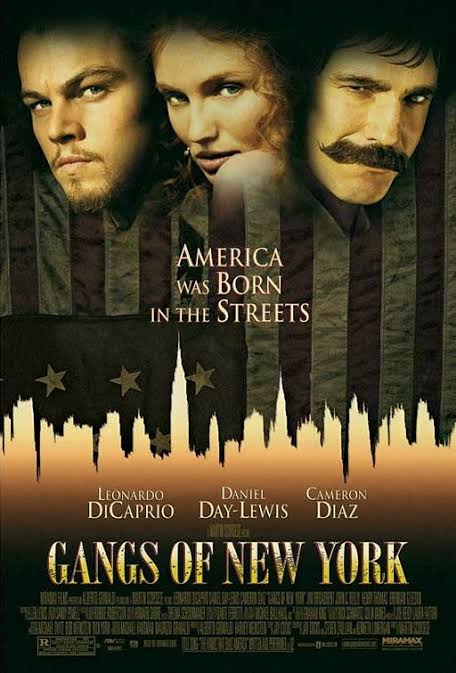
Gangs of New York: the film Scorsese always dreamed of making. I wonder if it’s now the film he dreams most about getting another go at? It needed serious money to make it, from the pockets of Harvey Weinstein (oh dear God). It’s well-known that Weinstein – then infamous as ‘Harvey Scissorhands’ before far more revolting revelations – and Scorsese fought throughout (so much so Scorsese considered quitting cinema). Scorsese has always claimed the unevenly paced final film is his ‘director’s cut’ – but considering his more recent films with even-more-bottomless-pocket backing (Netflix and Apple) were nearly four hours a piece, that’s increasingly hard to believe.
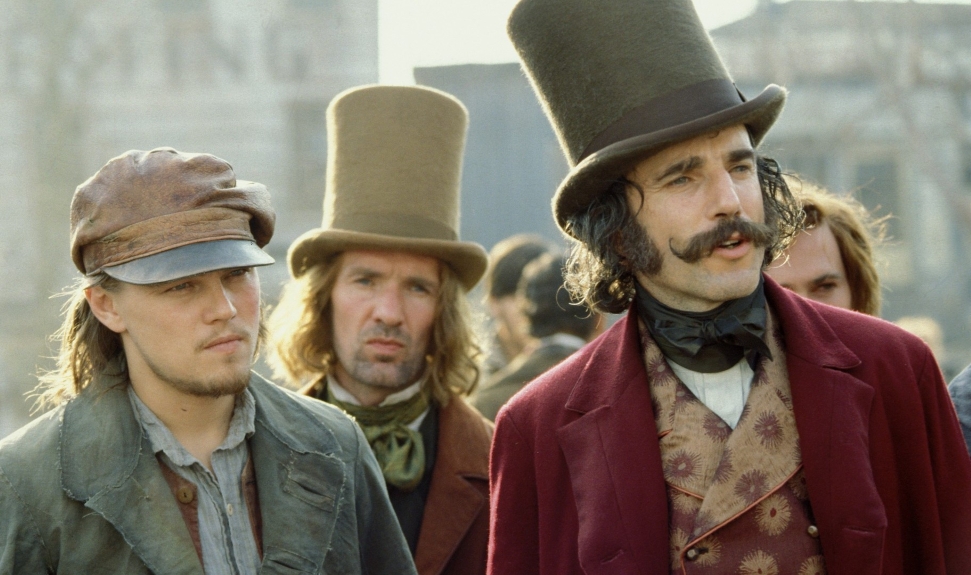
Set mostly during the horror of the American Civil War, Gangs of New York bites off an awful lot. A depiction of an entire era of American culture, exploration of migration and race in America, corruption in New York politics, gang warfare on the streets of Victorian New York, a son looking for revenge… Gangs of New York tries to cover it all and with very mixed success. Irish migrant Amsterdam Vallon (Leonardo Di Caprio) grows up an orphan after his gang boss father ‘Priest’ (Liam Neeson) is killed by nativist gang leader Bill the Butcher (Daniel Day-Lewis). He returns to New York, bent on revenge, working his way into Bill’s confidence, while Civil War tensions bubble and burn in New York.
There genuinely is a lot to enjoy in Gangs of New York. Not least the huge scale of it. Dante Ferretti went to town recreating the slums of nineteenth century New York, chucking in the sort of details which reflect what must have been hours scrutinising historical records. Unlike other Scorsese films, Gangs drips in colour, with the various street groups showing off their panache with colourful, distinctive clothing – just as the posh knobs of uptown New York flaunt their wealth in their threads. This all gives a huge amount of scope for Scorsese’s superb camerawork, very lusciously shot and with sequences cut to perfection by Thelma Schoonmaker (Howard Shore’s score is also good, although you can tell listening to it, he was still immersed in Middle Earth).
And of course, when the story is boiled down to it’s the principles it is most engaged in, it is a decent story of a son revenging a father by taking out a man he almost begins to see as a surrogate father. The casting of Liam Neeson as Amsterdam’s lost pop is a masterstroke. Neeson’s charismatic presence easily convinces an audience that of course characters would still be talking about him decades later and even his enemies would dream of becoming him. Gangs tries to wrap its fingers around a Homeric plot: new boss Bill is consumed with boredom at his mastery of the world and wants a challenge, so almost deliberately restarts the earlier cycle, casting DiCaprio’s Amsterdam as a younger version of himself (with himself as Neeson’s Priest). In turn, as is often the case with Scorsese, we’re left in tenterhooks to see if Amsterdam is savvy enough to get out of a life of crime or if he will double down.
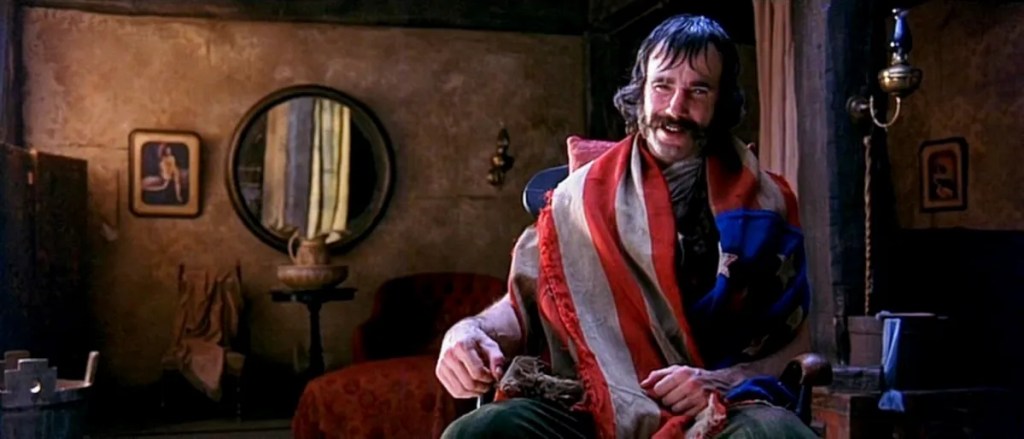
This plot is also the most engaging as it revolves around Daniel Day-Lewis’ larger-than-life Bill the Butcher. Plucked from a supposed retirement (in the years leading up to this, urban rumour had it Day-Lewis worked as cobbler somewhere in Italy), Day-Lewis rips into Gangs with the sort of towering commitment that saw him tapping a glass contact lens on his eye with a knife dozens of times a day so he could do it without flinching on camera. But Day-Lewis doesn’t just chew the scenery. He makes Bill as poetic and reflective as he is impulsively violent. His triumphs give him only passing pleasure and he feels like a relic clinging to a dying past. Day-Lewis has a knock-out, early-morning monologue (draped in an American flag) which he gives just the right spin of vulnerable regret and desire for an equal, even while talking about the unrelenting violence of his rise and the fear it’s based on. He’s the primary reason to continue watching the film.
Because aside from that, you are picking out only scenes and performances that survived the ruthless cutting down to the two-and-a-half hours we have. Day-Lewis gets more than his fair share, and there are fine performances from Brendan Gleeson as a principled club-for-hire, Jim Broadbent as a jovially corrupt politician and John C Reilly as a sleazily sadistic policeman. The film’s opening, a pitched street-battle, is shot and directed with real gusto, as are later scenes of New York Draft riots. Dynamic filming ideas abound, like a striking scene that tracks in one-shot Irish immigrants arriving, being pelted with stones, signing up for the army and boarding a ship out of New York to almost certain death on the front lines. But it’s only flashes of brilliance.
The overwhelming feeling otherwise is how fast everything is going and how half-formed plot ideas feel. Characters who were surely once more important in a longer cut, linger on the edges of scenes (or are billed prominently without even having names). The film relies so much on the vast background and research in its making that many of its scenes require DiCaprio to frequently limber up for an intermittent voiceover to force-feed us historical context on everything from the Five Points to pick-pocketing to the passing of the Draft Act. Several scenes – often involving Broadbent – feel like bullet points of longer, denser conversations rammed with historical details.
The vast amount of stuff the film tries to cover in its non-epic running time leaves so much feeling under explored or box-ticked. I can imagine a cut where more time given over to nativist fury at Lincoln’s slavery emancipation would have led to a more complex plot for Lawrence Gilliard Jnr’s Jimmy (the only Black character in the film), instead of him being treated as just one of a crowd until he’s unceremoniously lynched in a riot. Or the hypocritical church, which drives out the poor from their only refuge to build a church to tend to them, would have been seen as real antagonists. Or the wealthy, preening themselves during sight-seeing tours to the Five Points, may have been used to explore the class tensions in a country where the poor were being shipped to the Civil War front lines to die. All of these ideas, and more, get their five minutes in the sun but leave little real impact.
It also doesn’t help that both DiCaprio and Diaz feel out of the depth. Perhaps this role, and the chance to work with Scorsese, was something DiCaprio didn’t feel ready for. He finds little of interest or life in Amsterdam, who feels moody and sullen rather than a conflicted angel of revenge. He’s also struggling with the accent; but not as much as Diaz, fighting a losing battle with her Irish lilt. Diaz never really convinces as a working-class pickpocket (she feels far too modern and middle class). She also has the most cliched role as (essentially) a hooker-with-a-heart-of-gold, pushing her man to leave revenge behind. Both actors, you feel, were part of Weinsteins box-office plan (Weinstein also vetoed any physical consequences for the ferocious beating Amsterdam takes at the halfway point – within ten minutes of screentime he looks no worse than he would sleeping off a big night).
Gangs of New York feels like a sort of Spark Notes version of a much-longer, more-complex, multi-faceted film on race, class, gender and immigration in Civil War New York. All that stuff is in there but skirted over so fast with such little depth you can very easily watch the film a couple of times and not spot it at all. Which I suppose makes it a tragedy of sorts, a real could-have-been. Its noticeable that, twenty years later, no-one seems inclined to look back at Gangs of New York and re-evaluate it as some sort of misunderstood masterpiece. Instead, it feels like the film as forgotten now as it was at the Oscars with its eleven nominations and zero wins.

