
Tag: John Williams

Dial M for Murder (1954)

Dial M for Murder (1954)

Second-tier Hitchcock thriller, with some interesting flourishes and entertaining moments

Director: Alfred Hitchcock

Cast: Ray Milland (Tony Wendice), Grace Kelly (Margot Mary Wendice), Robert Cummings (Mark Halliday), John Williams (Chief Inspector Hubbard), Anthony Dawson (Charles Alexander Swann), Leo Britt (Party goer), Patrick Allen (Detective Pearson)
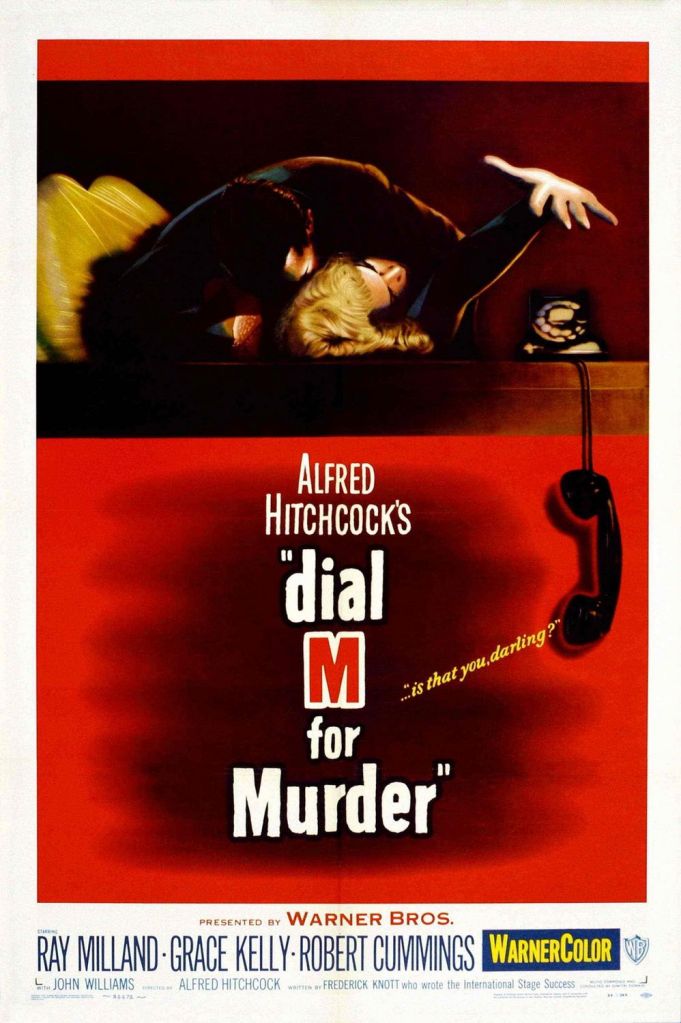
Tony Wendice (Ray Milland) is in a bind. A former tennis pro turned barely-successful sports goods seller, he loves the high life. Unfortunately, he’s running through cash like water – and, worst of all, most of it isn’t even really his but the property of his socialite wife Margot (Grace Kelly). And Margot is in the middle of an affair with trashy fiction writer, American Mark Halliday (Robert Cummings). An affair Tony knows all about, having stolen Margot’s love letters to anonymously blackmail her. But his new scheme is somewhat more permanent: blackmail disreputable Charles Swann (Anthony Dawson) into murdering Margot at a time when Tony has a perfect alibi. Sadly, things don’t go to plan – when do they ever? – and with Swann skewered in the back with a pair of scissors, Tony hurriedly improvises pining a pre-meditated murder charge on Margot all while avoiding the suspicions of Chief Inspector Hubbard (John Williams).

In his later extended interviews with Francois Truffaut, Hitchcock gave less than a few minutes to talking about Broadway-adaptation Dial M, describing it as, at best, a one-for-the-money assignment or sort of warm-up for Rear Window. He was similarly dismissive about the film being shot for 3D, which he described as a ‘nine-day wonder’ which he joined on the ninth day. Hitchcock had a tendency to play up to ideas of his genius, laying sniffy dismissal on what were viewed by critics as his lesser works (although Truffaut said Dial M grew on him every time he saw it). Actually, while Dial M does have the air of an assignment to it, there are some neat little Hitchcock touches it that, while not making it a classic, does make it an entertaining way to spend a Sunday afternoon.

After all, not many other directors would have so relished Swann’s body sliding down onto a small pair of scissors. Or found so many fascinating angles for shooting a (mostly) single-set, from lofted over-head shots that give Tony’s detailing to Swann of his elaborate plan a God-like force to crashingly tight close-ups on the phone Tony will use to dial in his alibi. Hitchcock also adds more than a little sexual energy to the play. There Margot’s affair is very much in the past, as opposed to here being very much keenly anticipated by Grace Kelly’s sensual stare over a newspaper to a clock counting down her assignation with Halliday. Hitchcock also avoided the sort of tedious ‘duck now!’ shots that has made 3D a joke in cinema-going circles, framing shots with a great deal of depth, placing key objects in different depths of field in the shot.

Dial M For Murder itself though, even with these little Hitchcock touches, tends to feel exactly like what it is: a well-heeled adaptation of a Broadway entertainment that is far more about plot, procedure and Christie-lite mystery than character or themes. (Actually, a mechanical operation like Dial M might well have appealed to Hollywood’s greatest ever proponent of the masterfully constructed tension piece more than her cared to admit). It’s a page-turner, Airport-novel transposed into glitzy, breezy entertainment where we get to flirt with someone completely naughty and wicked, but can be pretty sure the ‘howdunnit’ will become clear to everyone in the play, not just us (after all, the idea that Hitchcock – or anyone – will let Grace Kelly be executed for a crime she didn’t commit is of course preposterous).

Dial M plays very much into the Hitchcock playbook, where tension arises not from what we don’t know, but from the fact we know a little bit more than most of the characters. Just like Vertigo revealing its mystery surprisingly early, or watching a bomb tick down in Sabotage while its victims remain oblivious, we know from the start that this is all a scheme designed to entrap Margot. We know all the time exactly what Tony has done and the tension lies solely in working out whether Halliday or Inspector Hubbard will work it out and how they might manage to get Tony to pay for it. (There are also some echoes of Strangers in a Train, from Tony’s tennis-playing background to his sociopathic crime swop with Swann).

Tony is played with a suave, smugness by Ray Milland, which is just about likeable enough for a bit of you to want the selfish, shallow, self-obsessed Tony to get away with it. Milland won’t allow a slightly smug grin to disappear from his face – except in a burst of twitchy nerves when a stopped watch makes him concerned that he’s going to miss a vital phone call back home to establish his alibi during the attempted murder – and never once does he appear troubled by morality. In fact, he thinks rather sharply on his feet, pivoting in seconds from surprise at Margot’s survival to smoothly improvising a very convincing story, framed to (literally) hang Margot in. It’s an effective, enjoyable, pantomime-hissable performance which Milland has a lot of fun with.

He gets most of the film to himself, since Kelly is given a role that gives her little to do – although it does showcase her ability to communicate a great deal from looks alone, from her excitement at a future liaison, to growing fear as the police net draws around her. She’s certainly a far more magnetic performer than the bland Robert Cummings who has little about him to suggest he could set Grace Kelly all aflutter. The other key roles were filled out with actors from the original production: Anthony Dawson’s weasily opportunist Swann is perfectly convincing as the sort of cove who’d agree to murder to make his life easier while John Williams’ cements the image of the unflappable pipe-smoking detective who understands far more than it looks and lulls suspects into making fatal mistakes with an avuncular reassurance.

Dial M For Murder offers plenty of entertainment, even if it’s largely just a fairly routine plot-driven mechanical puzzle, spruced up by the odd inventive shot and engaging performance. But Hitchcock was probably right, that it sits very much in the second tier of his work.

Witness for the Prosecution (1957)

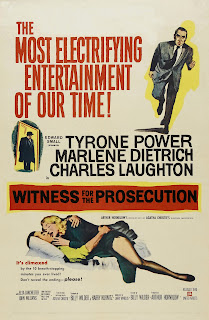
Witness for the Prosecution (1957)

A court case hinges on a heck of a twist or two in Wilder’s well-mounted Christie adaptation

Director: Billy Wilder

Cast: Tyrone Power (Leonard Vole), Marlene Dietrich (Christine Vole), Charles Laughton (Sir Wilfrid Robarts), Elsa Lanchester (Miss Plimsoll), John Williams (Mr Brogan-Moore), Henry Daniell (Mr Mayhew), Ian Wolfe (Carter), Torin Thatcher (Mr Myers QC), Norma Vaden (Emily Jane French), Una O’Connor (Janet McKenzie), Francis Compton (Justice Wainwright)

Agatha Christie is better known for detectives who unearth murderers, not lawyers defending those accused in court. But that doesn’t mean Witness for the Prosecution, a very effective courtroom drama, shirks on classic Christie flourishes. Witness has a single stonking twist that huge numbers of people never see coming (the end of the film comes with a sonorous warning entreating people not to spoil the surprises, the sort of anti-spoiler warning that would make Marvel proud).

Leonard Vole (an unlikely Tyrone Power) is the soldier and would be entrepreneur, who stands accused of the murder of a rich older woman (Norma Vaden) who conveniently left Vole her money. Defending Vole is richly-toned, highly-skilled barrister Sir Wilfrid Robarts (Charles Laughton), recovering from a heart attack and doing his very best to dodge the overly attentive concern of his private nurse Miss Plimsoll (Elsa Lanchester). Vole’s case looks difficult, with much circumstantial evidence stacked against him and worries about whether his German wife Christine (Marlene Dietrich) will stand by him or not?

Billy Wilder directs with a smooth professionalism – he later modestly claimed of his Oscar nomination, that it was like giving the crew that moved Michelangelo’s Pietá an award for best sculpture – but his real contribution (with fellow writer Harry Kurnitz) was sharpening the dialogue, expanding Christie’s characterisation (in particular adding much more shrewdness and eccentric pomposity to Robarts) and upping the zip of Christie’s original. It certainly met with the approval of the grandé dame of crime who listed this, and Lumet’s Murder on the Orient Express, as the only two adaptations of her work she liked.

The film is largely based around the courtroom dynamics, as witnesses are examined and cross examined and facts gently dragged into the light. There is plenty of quality theatrics, not least since Robarts and his opposition counsel Myers (a fearsome Torin Thatcher) are more than a little skilled at keeping things sparky for the jury. There is a hint of cynicism in Witness: Robarts needs to convinces himself of a client’s innocence, but there is a suggestion this is because it helps him work out how to effectively defend them, less because of any moral reasons. And certainly, the entire mechanics of the trial operates largely as a show, an entertainment with jokes and compelling stories offered by both sides.

There is of course no better showman than Robarts. Played by Charles Laughton in one of his last great – and possibly most enjoyable – performance, Robarts is an affectionate, witty performance of carefully studied eccentricity and barking bluffness. But there is also a vulnerability in him: Robarts needs to belief in his own legend and his ability to separate truth from lie (he even prides himself on his “monacle test”, using a reflection from it to shine in suspects eyes, believing a liar will get flustered and trip themselves up – needless to say it turns out to be faulty).

Wilder – with Laughton as a brilliant collaborator – transforms Robarts into a far more forceful and charismatic figure, making the late plot twists even more of a shock. If someone as professionally adept and plugged in as Robarts can be taken in, what chance do the rest of us have? Oscar-nominated, Laughton, a twinkle permanently in his eye, powers through moments of high court theatricality but also heartily enjoys the banter of real life, taking a real delight in his schoolboy mischief as he persists in having his own way.

A large part of that, is a running of dodging treatments and sticking to a diet of things that are bad with him. Wilder’s finest change from the original, in introducing Robart’s ill health and his love-hate relationship with his nurse Miss Plimsoll. Who is, of course, played by Elsa Lanchester, Laughton’s real-life wife. The chemistry between these two is spot-on, with Lanchester (also Oscar nominated – and unlucky to lose to Miyoski Umeshi in Sayonara) in particular playing the combination of world-weary exasperation and growing affection for Robarts perfectly.

Combined with those twists, it’s the interplay between these two that is the real highlight in the film – well that and the twists. Many of those twists are bound up with Marlene Dietrich’s character. Dietrich gives one of her most colourful and wide-ranging performances here. The secrecy of the film probably stopped her from landing an Oscar nomination (much to her regret – Wilder even apologised to her). Power is miscast – he lacks the required natural innocence and looks both too old and incongruously American – but fortunately spends most of the film in the dock.

The final twist is a doozy, perfectly delivered by the actors and Wilder. Wilder directs throughout with quiet authority – as well as fine sense of humour, in particular a stair lift scene that sees Robarts using the device as a tool to dodge being told what to do. Laughton and Lanchester in particular are wonderfully funny. It’s got some excellently handled courtroom tricks and you won’t forget how it turns out. It’s a solid example of Wilder’s skill behind the camera – but a very enjoyable film and a must for Christie fans.

To Catch a Thief (1955)

Cary Grant and Grace Kelly basically have a nice French holiday in To Catch a Thief

Director:  Alfred Hitchcock

Cast: Cary Grant (John Robie “The Cat”), Grace Kelly (Frances Stevens), Jessie Royce Landis (Jessie Stevens), John Williams (HH Hughson), Charles Vanel (Monsieur Bertani), Brigitte Auber (Danielle Foussard), Jean Martinelli (Foussard)

One of the nice things about being a powerful film director is, if you fancy a nice holiday in the sun, get a film greenlit in a nice location and settle in for a nice vacation. That’s perhaps the real story behind To Catch a Thief, a popular Hitchcock film that is, at best, a second tier entry in his CV – but has some truly lovely location shots of the French Riviera in it.

The film meanders through a plot that never really heads anywhere particularly interesting, other than crossing off some of Hitchcock’s familiar beats. Cary Grant coasts along as suave former French Resistance fighter and infamous jewel thief “The Cat”, now retired to a lovely vineyard on the French Riviera (presumably off the back of his ill-gotten gains). His French resistance past has basically made him immune from persecution, until a copy-cat thief starts to plunder the jewels of the rich. With Robie Suspect #1, who better to catch a thief than…another thief?

To Catch a Thief is so much about its style, its expensive Hollywood production standards and luxurious location shooting, that it almost forgets to have any substance at all. I suppose that doesn’t completely matter when this is very much one of Hitchcock’s entertainments – a luscious change of pace from his previous film Rear Window, which was all about confined spaces, voyeurism and seedy thrills. Here instead the focus is on beauty, charm and frothy comedy, with the plot unspooling so gently, that the final resolution is virtually thrown in as an afterthought.

Instead the focus is more on the extended game of flirting between Grant and Grace Kelly as daughter of wealthy American jewel owner Jessie Royce Landis. Grant was, of course, twice as old as Kelly (and only eight years younger of course than Landis, who played his mother four years later in North by Northwest), but the two make for a chemistry laden couple. (Hitchcock cheekily has one seductive late night conversation intercut – and end – with a fireworks explosion. No prizes for guessing what that symbolises). 

Much of this fire comes from Grace Kelly who, fresh from her Oscar win for Best Actress, is brimming with confidence. Clever, sexy and dangerous – she’s excited by Robie’s life of crime and loves the idea of joining him in a life of crime, don’t get many leading ladies of the time being as daring as that – Kelly oozes sex appeal and looks like she could eat Grant for breakfast. It takes all the experienced cool and charm of Grant – who adjusts the part so neatly into his wheelhouse, he feels like he could play the thing standing on his head – to keep up. Kelly is radiant and magnetic and walks off with the movie. So much so you wish it gave her slightly more to do. 

But then the plot of the film doesn’t give anyone much to do. Robert Burks (Oscar-winning) photography is lovely, really capturing the beauty and elegance of the French Riviera. But the events around it are nothing to write home about, an underpowered caper with little of the director’s energy and fire or his subversive creepiness. The identity of the copy-cat will be a mystery perhaps only to those who have never seen a movie, while the generally predictable beats in every scene make it feel like a hodge-podge pulled together from the offcuts of better films.

It’s got a lovely feeling of a holiday adventure for all and sundry. Plenty of French actors dutifully trudge through – although to a man their characters are either incompetent, bullies or crooks – with The Wages of Fear Charles Vanel clearly dubbed as a seedy ex-Resistance fighter turned restaurateur. It’s all very well mounted, entertaining enough and leaves almost nothing for you to digest after it’s finished.