
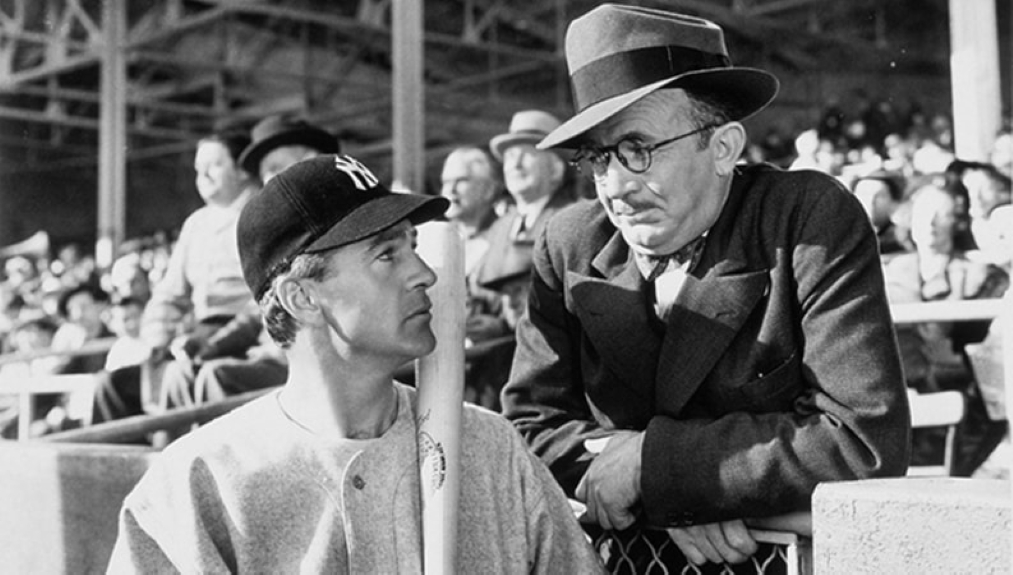
Cooper triumphs in this hagiographic but still endearing film, low on drama but high on sentiment
Director: Sam Wood
Cast: Gary Cooper (Lou Gehrig), Teresa Wright (Eleanor Twitchell Gehrig), Babe Ruth (Himself), Walter Brennan (Sam Blake), Dan Duryea (Hank Hanneman), Elsa Janssen (Mom Gehrig), Ludwig Stössel (Pop Gehrig), Virginia Gilmore (Myra), Bill Dickey (Himself), Ernie Adams (Miller Huggins), Pierre Watkin (Twitchell)
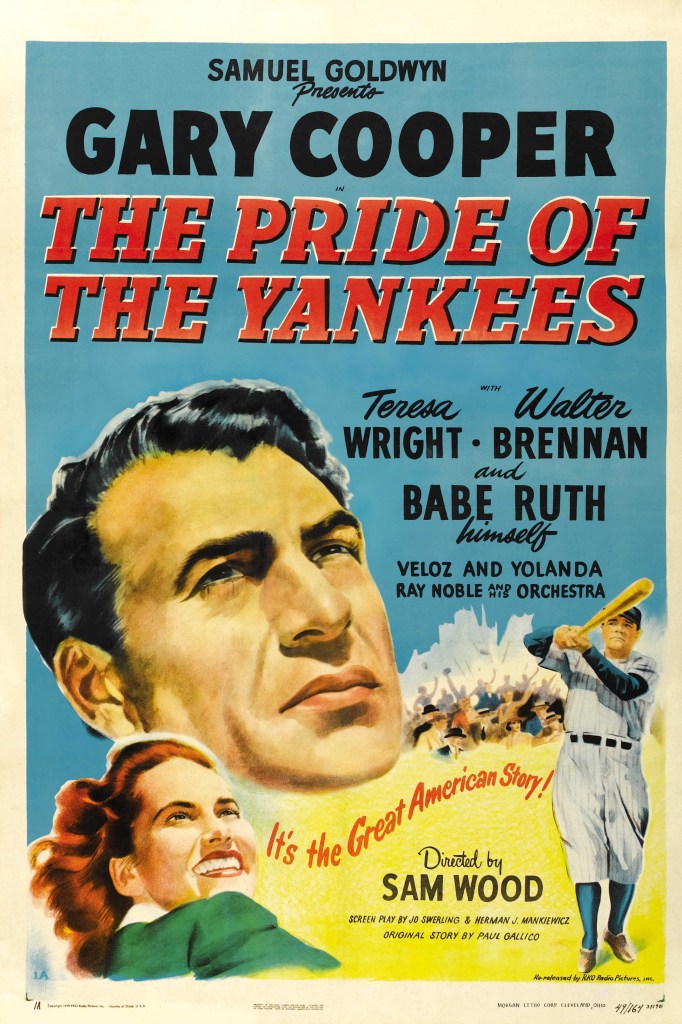
It was a story that touched an entire nation. Record breaking New York Yankees captain Lou Gehrig, hitter of home runs and holder of a consecutive games streak of over 2,000 games, suddenly retired and shortly after passed away after a shock diagnosis of amyotrophic lateral sclerosis, forever after known as “Lou Gehrig’s Disease”. The Pride of the Yankees is an unashamedly sentimental, feel-good and hagiographic staging of the life story of a man who was so decent, modest and honourable that not a single person seemed to have so much as a bad word to say about him.
As such, it’s not a surprise he is played by Gary Cooper, who was more or less the age Gehrig would have been when if he had survived (this does make it slightly harder to not frown a bit as the craggy looking Cooper plays Gehrig as a freshman student). There is no star in Hollywood who combined masculine strength and height, with such compelling vulnerability, tenderness and polite, gentle decency like Cooper. He’s perfect for the bashful, modest Gehrig, who struggles to talk to girls, treats his natural skills at baseball with an aw-shucks modesty, is devoted to his dotting (and slightly over-bearing) mom and head-over-heels with his witty, playful and endlessly supportive wife Eleanor (played with real charm by Teresa Wright).
So perfect is Cooper for the role – and so brilliant at nailing this film’s version of Gehrig’s lump-in-throat inducing goodbye speech to a packed-out Yankee’s stadium – that it barely mattered he had virtually no interest in baseball at all. For year’s stories abounded Cooper was utterly unable to master Gehrig’s distinctive left-handed swing, requiring him to be filmed the wrong way round in a mirror-flipped shirt, so the editor could flip the film. That’s not completely true, but it certainly is true Cooper was frequently replaced by doubles and his baseball skills frequently look rudimentary at best. (It’s interesting watching today, to see how pudgy and unathletic these star baseball players – such as Babe Ruth playing himself – look. They’d be eaten alive by the streamlined athletes of today).
But The Pride of the Yankees knows that truly successful sports films are rarely actually about sports. Most of Gehrig’s career achievements are glossed over in a late montage that ends with a shot of a dresser in the Gehrig home groaning under a collection of medals and trophies. The film has more interest – perhaps rightly – in relatable personal anecdotes rather than the intricacies of the ball game. Our longest sequence of sustained play revolves around an unspoken competition between Ruth and Gehrig to hit the most home runs in honour of a bed-bound kid in hospital (there is, apparently, also a championship at stake). Other than that, baseball is largely background colour in this most beloved of baseball films, Wood and Sam Goldwyn trusting die-hard fans would get their kicks from seeing so many real-life hitters and catchers playing themselves in Yankee kits.
Instead, the film is largely a tribute to the decency of Gehrig, presenting his life in charmingly related chunks, largely devoid of conflict or obstacles. You could in fact marvel about how undramatic Pride of the Yankees frequently is. Gehrig getting into some fisticuffs with a bunch of frat boys after one crack too many about his fumbled attempts to woo a girl is about as conflict heavy it gets. That and a brief power struggle between Eleanor and Momma Gehrig for control of the Gehrig matrimonial home – never has wallpaper caused such discord on film – which is resolved thanks to an off-screen conversation, leaving everyone thereafter bathed in happy smiles.
It sort of doesn’t really matter that conflict is a stranger, and obstacles always fall away from Gehrig, because the film itself is very sweet, well-meaning and charming. Sometimes, it seems to argue, good thanks happen to good people. And Gehrig, in one of the definitive Cooper roles, is a stand-up guy bar none. In his quiet, bashful way he’s dedicated to becoming the engineer his mother dreams of – only taking up the game professionally to pay for her medical care. He sits patiently on the Yankees bench (and is loaned out to every team under the sun) for his chance to shine, without a single complaint. His mantra America incarnate: if you work hard, you can do anything.
Pride of the Yankees coats itself in hard-warming personal stories, filled out by an impressive cast. Elsa Janssen finds keeps a nice pinch of possessiveness in Momma Gehrig’s devotion of her son – Gehrig is very adept at reassuring her of his devotion – while being endearing as a parent who supports her son come what may. Ludwig Stössel is equally sweet as his hen-picked, but quietly wise and observant dad. Walter Brennan, as a fictionalised representation of a host of journalists who supported Gehrig, is perfect casting as an endlessly loyal advocate of Gehrig. Best of all, Teresa Wright’s playfulness – from teasing Gehrig at his first game in Chicago, to a marvellous comic skit she performs to distract him from illness – is very good, warm-hearted, adorable and genuinely moving as she deals with Gehrig’s diagnosis.
It’s a well-constructed, admirably assembled film by Wood, with some photography from Rudolph Maté that mixes documentary reconstruction with real-world footage pretty seamlessly (an Oscar for editing was deserved). The general lack of conflict or struggle can slow the pace – as does Gehrig and Eleanor’s visit to a Chicago cabaret night, which feels like an excuse to reel out a few variety acts on Goldwyn’s books – but when the tone of the film is purely aimed at heart-warming reassurance and tribute to a fallen hero you can let that go.
The film though is Cooper’s. From his awkward youth – Cooper was always adept at using his height to feel more uncomfortable, and he frequently looks worried that he’s sticking out too much – to the modest decency of his glory years, the subtle hints of fear on his face as he feels a loss of the control in his hands, it’s a perfectly judged performance. Above all, Cooper’s final closing speech – capped by a perfect shot that follows Gehrig walking from the centre circle into the darkness of the dressing room – is perfectly judged. Gehrig couldn’t have asked for more.

