
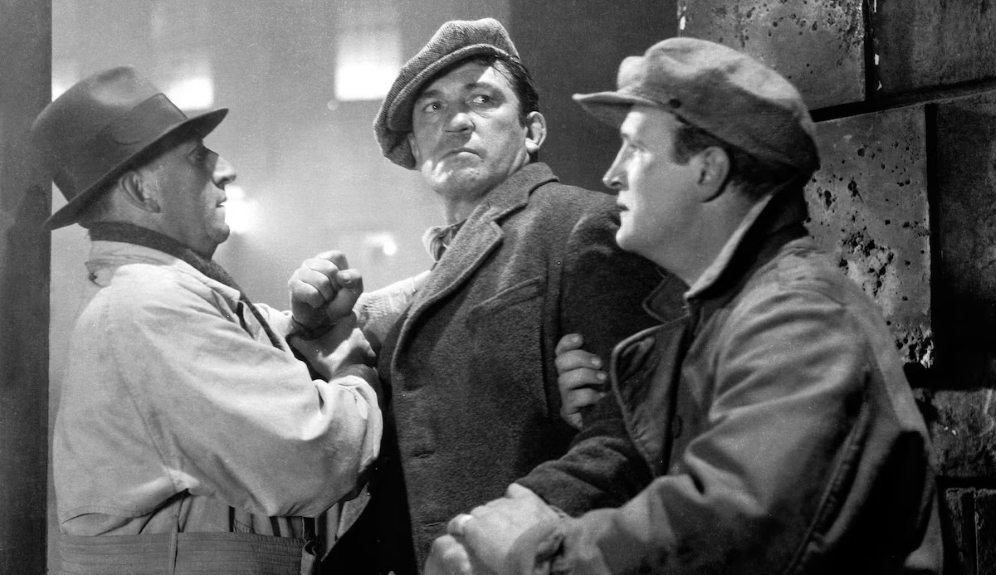
Ford’s atmospheric film is superbly directed and visually impressive, despite some clumsy moments
Director: John Ford
Cast: Victor McLaglen (“Gypo” Nolan), Heather Angel (Mary McPhillip), Preston Foster (Dan Gallagher), Margot Grahame (Katie Madden), Wallace Ford (Frankie McPhillip), Una O’Connor (Mrs McPhillip), JM Kerrigan (Terry), Joseph Sauers (Bartly Mulholland), Neil Fitzgerald (Tommy Connor), Donald Meek (Peter Mulligan, D’Arcy Corrigan (Blind man)
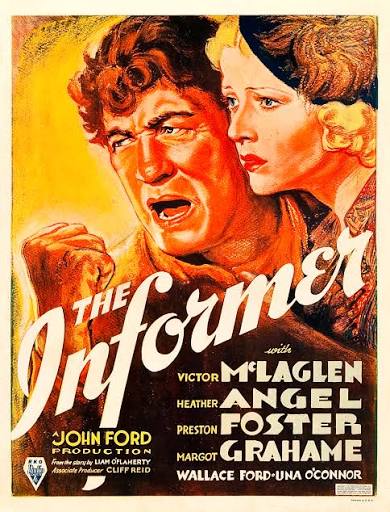
It’s hard to make ends meet in the fog-filled streets of 1920s Dublin. Especially if you are a non-too bright former boxer with an eager eye for the bottle. That describes “Gypo” Nolan (Victor McLaglen), a tough bruiser totally at sea after being expelled from “The Organisation” (that’s the IRA to you and me). Desperate for a bit of cash, Gypo instinctively rats out old friend Frankie McPhillip (Wallace Ford) to the British in return for £20, cash-in-hand. Guilt will slowly eat away at him over one long, self-destructive evening as his old colleagues from the Organisation ruthlessly hunt down the informer.
Ford’s richly filmed The Informer takes a limited RKO budget and makes it work to spectacular effect, disguising its largely unconvincing Dublin street sets with misty, Murnau-inspired photography from Joseph H August. The Informer is supremely atmospheric, fog coating around the edges of the frame and only interrupted by beaming streetlights or the odd shaft of light – almost all of which actually lead to danger (be it lighting the way to the British headquarters or the dreary basement where the Organisation measure out summary justice). The Informer still feels, in many ways, like a silent film – but in a good way, one where its story and the emotions would be perfectly easy to follow from the striking compositions that flood the frame.
This is Ford at possibly his most stylistic and impressionistic – influenced not just by Murnau but also clearly by Fritz Lang, the closing trial of Gypo feeling like a straight lift from Peter Lorre’s pathetic fate in M. As Gypo stumbles through the streets, he seems haunted by super-imposed images of the Wanted poster that instigated his betrayal – not to mention, his feet buffeted by wind-swept remains of the same poster. This fateful Wanted poster pops up repeatedly, even a version burnt by Gypo in a fire seems to sear through the frame as its edges disappear in flames. It’s a continual reminder to our hero of his weakness, foolishness and lack of character – his betrayal being so selfish that even the British toss the reward money to him with veiled contempt.
Our hero is played by regular Ford mucker Victor McLaglen, plucked from his regular pack to play the lead over the claims of several more prominent stars. Although it won McLaglen an Oscar, Ford selected him because he felt he was the sort of actor (a hard-bitten drinker, whose every fault was well-known to him) that could be manipulated into giving a virtuoso performance. McLaglen’s physicality is perfect for it – a former boxer himself, he’s got the perfect boisterousness and knuckle-ready force the part needs – but Ford also readily identified his vulnerability and nervousness. Deliberately keeping the actor on his toes, changing the shooting order on a day-by-day basis, Ford draws from McLaglen a performance of bubbling, hesitant, unaffected uncertainty. Gypo is forever stumbling over his words, glancing around waiting to be corrected, a sweaty nervous mess when the pressure piles on.
It’s a role that many actors could shine in, so rich is the material, and McLaglen doesn’t disappoint. The Informer follows his collapse in excruciating detail, as guilt leads to drink, leads to further guilt. Ford’s film surprisingly isn’t really awash with sympathy for this deeply flawed, child-like bruiser lost in the world of real men – despite the decency we discover in a man who was expelled from The Organisation because he wouldn’t kill an unarmed man. Chalk it up the director’s old-school ideas of loyalty and his notable Irish sympathies – not going to be easy to hold sympathy for a man who has betrayed both those elements.
Ford gives a striking martyrs death of McPhillip – played by his brother Wallace – who is caught in his home with his sister and mother (Una O’Connor, very good). He takes a few Black and Tans with him, before being machine gunned while climbing out of a rear window, our last view of him his hand disappearing over a ledge, nails scratching loudly on the surface. The members of the Organisation look like raincoat wearing hoods from Chicago, but fitting Ford’s sympathies they don’t leap to decisions (even if they execute anyone they find guilty), setting up a people’s court to trial those they suspect.
Their main suspect is an innocent tailor, excellently played with a mix of affronted innocence and weary defiance by Donald Meek, largely because they initially want to give the benefit of the doubt to Gypo and the string of half-formed, barely credible lies he has pulled together to shake the blame. Doesn’t stop them tailing Gypo during a night on the town, surrounded by ordinary people spending time with him for his new-found money, as he impulsively gives away the cash he has sacrificed his honour for.
The Informer does have a tendency to lay on its moral judgements a little too thickly. There are a few too many slightly sentimental shots of McPhillip’s grieving sister, a little too much of the moral judgement piled on Gypo, for all the passing sympathy for the boxer’s general lack of savviness. The Informer’s final ending, set inevitably in a church, is about as close as a great director like Ford can get to being flat-out bad: on-the-nose, clumsy, hectoring and simplistic and (particularly striking in a film as generally so beautiful as this) badly filmed. Max Steiner’s score similarly forces some of the emotional points a little too strongly, while his use of Irish Folk and Rule Britannia to hammer home points can wear a bit thin.
But there is still a lot to admire in The Informer, not least its extraordinary visual brilliance and the creeping paranoia and claustrophobia of its telescoped plot – you can feel the real influence it must have had on Carol Reed’s Odd Man Out with which it would make a fascinating double-bill. It might make its moral points with a little less subtlety than you would like, but it’s still an expertly executed, richly affecting film.

