Tag: Peter Vaughan

The Remains of the Day (1993)

The Remains of the Day (1993)

Hopkins and Thompson are marvellous in this masterful adaptation from Merchant-Ivory

Director: James Ivory

Cast: Anthony Hopkins (Mr Stevens), Emma Thompson (Miss Kenton), James Fox (Lord Darlington), Christopher Reeve (Congressman Jack Lewis), Peter Vaughan (Mr Stevens Snr), Hugh Grant (Reginald Cardinal), Michael Lonsdale (Dupont D’Ivry), Tim Pigott-Smith (Mr Benn), Ben Chaplin (Charlie), Patrick Godfrey (Spencer), Lena Headey (Lizzie), Pip Torrens (Dr Carlisle), Paul Copley (Harry Smith) Rupert Vansittart (Sir Geoffrey Wren), Peter Eyre (Lord Halifax), Wolf Kahler (Ribbentrop)
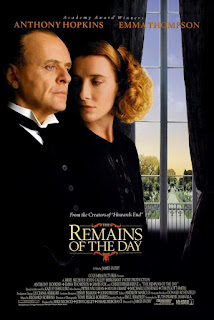
Kazou Ishiguro’s Booker-prize winning novel The Remains of the Day is one of my all-time favourites. So, it’s not a surprise I’m a huge fan of this masterful adaptation from the House of Merchant Ivory. I’m certain this is the apex of the team’s work. Mike Nichols had originally planned a film but, wisely, recognised when it came to making movies about repressed 1930s Brits, one team had a monopoly on how to do it best. Beautifully adapted by their regular screenwriter Ruth Prawer Jhabvala, The Remains of the Day is a wonderfully involving and deeply moving film.

Stevens (Anthony Hopkins) is a butler in a British country house purchased in 1956 by American Jack Lewis (Christopher Reeve). Keen to solve staffing problems (and for no other reason at all), Stevens journeys to the West Country to recruit the 1930s housekeeper, Mrs Benn nee Kenton (Emma Thompson). During the journey, he remembers his service for the previous owner, Lord Darlington (James Fox). An impeccable gentleman, Darlington dedicates himself to reconciliation between Nazi Germany and England, eventually tipping into an unwise dalliance with fascism and appeasement.

Stevens had no views on that though. In fact, he prides himself on his anonymity. The goal of his life is to maintain a dignified unobtrusiveness, ensuring the smooth operation of everything, leaving as little a mark as possible. Nothing can intrude on that: not his own feelings, the illness and death of his under-butler father (Peter Vaughan) and, above all, the unspoken romantic feelings between himself and Miss Kenton. The Remains of the Day is about duty and obsession and how a fixation on both can leave someone with little to show from a long life.

Stevens is living the lessons he learned from his father, an ageing powerhouse masterfully played by Peter Vaughan, who undergoes a physical collapse (from dripping nose to dropping trays) and bouts of forgetfulness, eventually dying on a night Stevens is too busy seeing to the sore feet of an illustrious French guest to spare a moment to visit him. It tells you everything about his character that this stiff-upper lipped commitment to duty is a source of pride to our hero.

There are few as curiously blank ‘heroes’ in literature than Stevens. The narrator of Ishiguro’s book is a dull, fussy, unbelievably cold man who has dedicated himself so fully to duty that he has let any emotional life wither and die on the vine – something he only realises far too late. It’s an immensely challenging role, bought to life masterfully by Hopkins. Hopkins astonishing skill here is to play all that repressed coldness on the surface, but also constantly let us see the emotion, longing and regret he is subconsciously crushing down play in his eyes and the corners of his mouth. Is Stevens even aware how much self-harm he is causing? It’s an astonishingly subtle performance.
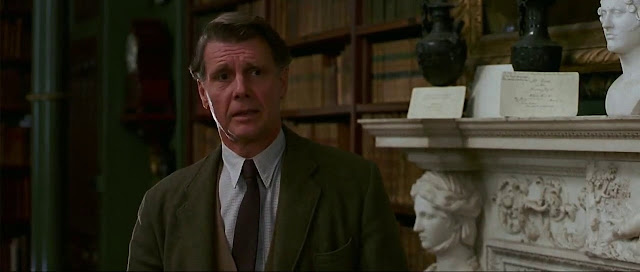
So subtle in fact that the books conclusion – Steven’s tear-filled confession to a stranger late at night of all the mistakes he has made – was filmed but cut for being superfluous. Hopkins had done the lot, all the way through the movie, through acting skill. You can’t miss the struggle within him, not least the desperate, powerless longing he feels for Miss Kenton that, for oh-so-English reasons he can never admit to himself. Hopkins has the vocal and physical precision, but every gesture tremors with unspoken, barely understood longings. In fact, it’s a shock when he exclaims an angry “Blast” after dropping a bottle of wine (the real cause of his outburst being, of course, Miss Kenton’s announcement that she is getting married)

He and Miss Kenton conduct a professional relationship that blossoms into something like a friendship – but he consistently rejects her polite efforts to take it further. In the film’s most powerful scene, Miss Kenton enters his parlour and playfully tries to see the title of the novel he’s reading (a sappy romance). The playfulness tips into agonisingly awkward tenseness as Hopkins’ Stevens seems paralysed, his hand lingering inches from her hair but unable to bring himself to break decorum and fold her in an embrace – all while Miss Kenton continues her increasingly desperate semi-flirtatious banter. It of course ends with Stevens dismissing her: just as later he will take a snap of frustration as a signal to irrevocably cancel their late-night cups of cocoa together.
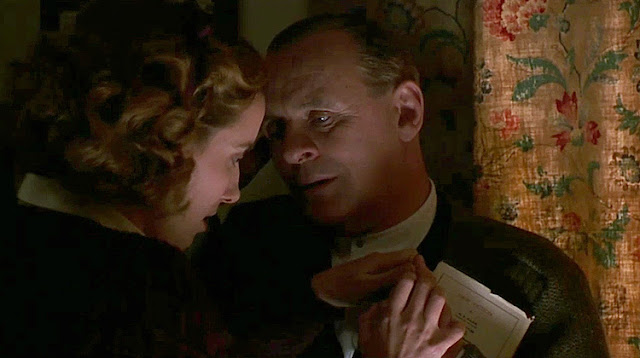
Emma Thompson is wonderful as a woman only marginally more in touch with her feelings and longings than Stevens is: aware that she, eventually, wants more from life, but unable to find the way of communicating the love she clearly feels for Stevens in a manner he can respond to. Instead, the two of them oscillate between a friendly, affectionate alliance and a discordant arguments (their only outlet for their passion), rooted in their inability to admit their feelings for each other. To further stress the point, both of them mentor young staffers (played by a very young Ben Chaplin and Lena Headey) who have the youthful “what the hell” to jack in all this for love.

Ivory’s wonderfully subtle film makes clear this is a turning point in history, the final hurrah for the this sort of deferential hierarchy. Stevens is the last of a generation of butlers, convinced that what their employers got up to had nothing to do with them – views not shared by Tim Piggot-Smith’s more grounded Benn, who chucks in his job working for a bullying blackshirt (who else but Rupert Vansittart?). Throughout the 1950s storyline, Stevens is constantly asked if he knew the infamous Lord Darlington (a sort of Lord Londonderry figure, hopelessly taken in by Hitler) – in fact, like Paul, he twice denies ever having known him.

And you can understand why, as the film has sympathy for Lord Darlington. As his decent, liberal god-son Reginald Cardinal (an excellent Hugh Grant) says, Darlington is a great asset for Germany precisely because he’s honest, well-meaning and motivated by a desire for peace. The fact that his leads him to consort with a host of Nazis, Blackshirts and the most appalling anti-democratic vestiges of the upper-classes (at one point, Stevens selflessly gives a performance of geopolitical ignorance so as to help demonstrate why men like him shouldn’t have the vote) is an unfortunate side-effect.

Played perfectly by James Fox, Darlington is misguided but genuine. As war approaches, he leads an increasingly hermit like life – camp-bed and paper-strewn, messy library – hosting conferences denounced by Jack Lewis (a fine Christopher Reeve) as a host of amateurs talking about a world they no longer understand. Beneath it all, Darlington is guided by fair play. So much so, it’s almost distressing to see him (under the influence of an attractive German countess) reading anti-Semitic pamphlets and sacking two refugee Jewish maids – an act he later regrets (far too late). This moment also reinforces Stevens’ compromised pig-headedness (not his place to judge!) and Miss Kenton’s fear to act (she’s horrified, but to scared of unemployment to hand in her notice).

All of this culminates in a series of scenes where emotions pour out of the actors, even while their words are banal and everyday memories and reflections. Ivory was never more confident and skilled behind the camera, and the film is a technical marvel, beautifully shot with a wonderful score from Richard Robbins. Hopkins is phenomenally good, simultaneously pitiable and smackable, Thompson is wonderful alongside him, Fox and Grant perfect – it’s a very well-acted piece. And a wonderfully perfect capturing of a classic modern British novel. No doubt: the best Merchant Ivory film.

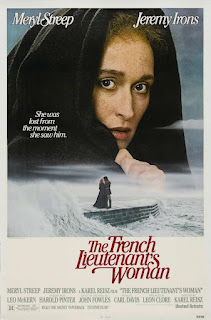
The French Lieutenant's Woman (1981)

The French Lieutenant's Woman header
Meryl Streep and Jeremy Irons play star-crossed lovers (twice!) in The French Lieutenant’s Woman

Director: Karel Reisz

Cast: Meryl Streep (Sarah/Anna), Jeremy Irons (Charles/Mike), Leo McKern (Dr Grogan), Hilton McRae (Sam), Emily Morgan (Mary), Lynsey Baxter (Ernestina), Patience Collier (Mrs Poulteney), Penelope Wilton (Sonia), Peter Vaughan (Mr Freeman), Michael Elwyn (Montague), Richard Griffiths (Sir Tom), David Warner (Murphy), Gerard Falconetti (Davide), Colin Jeavons (Vicar)

Many books have been considered unfilmable. John Fowles’ The French Lieutenant’s Woman is a key member of that list. Part pastiche, part commentary on Victorian novels, Fowles not only has a narrator who acts as an ironic commentator on events, but also offers up three possible endings to its central romance, each radically different from the one before. Not easy to bring that to film! Adapting it, Reisz and Harold Pinter came up with the concept of mirroring the novel’s central relationship with a relationship between two actors playing those characters in a film being made of the novel. Got that?

So, Meryl Streep and Jeremy Irons play both the novel’s romantically entwined couple Sarah and Charles AND also Anna and Mike, two actors playing those very roles in a film of The French Lieutenant’s Woman, also engaged in a love affair. Both affairs end in radically different ways, mirroring two of the alternative endings in Fowles’ novel. Most of the films runtime sticks with the novels’ plot, where Charles – an ambitious young scientist – is drawn away from his promising engagement to a potential business partners daughter (Lynsey Baxter), by his romantic fascination with Sarah, a woman of ill-repute in Lyme Regis, the former mistress of a French Lieutenant.

Pinter and Reisz’s adaptation is a smart idea. But I feel it misses a trick. If they really wanted to adapt the book – with its intrusive narrator and alternative endings – then the real character to focus on from a film set is not the actors but the director and producers. If our framing device had been watching the rushes in the screening room, seeing differently edited scenes play out in contrasting ways, with producers and director commenting on the action and making decisions about which ending (Happy? Sad? Open-ended?) they stick on the end of the film. Sure, that would have opened itself up to potentially on-the-nose dialogue, but it would be a better representation of the novel and its ideas, and truly translate some of the books real strength (its unique narrative style) to film.

But that’s talking about something the film doesn’t do. What it does do is offer something that is basically a 80% adaptation of the novel’s plot, mixed with 20% short interjections of the modern-day storyline. Deliberately, the film contrasts the intense romance and deeply-felt passions of the Victorian storyline – where acting on desire carries with it a huge, life-shattering cost in disgrace and social expulsion – with the shallow, off-hand flirtations of the modern era, where the stigma of a sexual affair has ceased to exist.

While this is effective in making the Victorian sections carry even more weight, it does mean the modern sections (by design) are slighter and less engaging. Their semi-regular appearance – it isn’t until the final half hour that we get anything approaching a proper sequence set in the present day, with a beautifully played garden party hosted by Mike and his wife (a magnificent putting-on-a-brave-face performance from Penelope Wilton), which is a feast of stolen glances, averted eyes and strained conversation.

But in some places the split narrative works a treat, particularly in allowing flashes of the real life, more unrestrained passion of the ‘real’ people drop into the Victorian characters. In particular, a meeting between Charles and Sarah in the woods (highly reserved), cuts to Anna and Mike rehearsing the same scene (playful and flirtatious). When the rehearsal reaches a key point – Anna/Sarah falling and being caught by Charles/Mike, the film cuts so that Anna falls but then Charles catches Sarah falling. And the scene continues. Suddenly, the Victorian couple has a burst of the same sexual freedom the modern couple has. It’s a beautiful cut. Later, Sarah falls to the ground (pushed by Charles), and suddenly bursts out laughing – and it feels like she falls as Sarah, reacts as Anna, then rises again as Sarah – either way it gives a wonderful, modern energy to the moment.

The film is wonderfully shot by Freddie Francis, with luscious forest vegetation and whipping winds and seas on the Cobb at Lyme Regis. Simmering sexual tensions are caught in lingering gazes, gestures that carry things words cannot, careful reaction shots captured by Reisz, the trapping of several characters within the ephemera of over-decorated rooms (at one point Ernestina literally can’t escape a room because of the all the knick-knacks within it).

A lot of the mood comes from the two lead actors, who give masterful performances. It’s very easy to see Streep’s performance here as overly mannered: her accent is oddly toned and highly studied, and much of her performance as Sarah is wilfully artificial and arch. But that’s deliberate: the genius here is that Streep is playing Anna playing Sarah who is in turn constructing her own fictional Sarah. With her pre-Raphaelite looks and artistic leanings, Sarah is a woman out-of-time, yearning for the sort of choices and freedom Anna takes for granted, constantly pushed into roles society can accept her in (Governess, eccentric, ‘whore’ etc.). Does she use Charles or not? Streep brilliantly captures her enigmatic, unreadable spirit, the sort of person who interjects a retelling of a possibly invented backstory, with a playful twirl around a tree. Who sometimes despises herself, at others everyone else. In contrast, Streep makes Anna assured, quiet and confident, with the power to choose risks.

Just as good is Jeremy Irons, in only his second film role and here cementing the start of a career that would see him play a parade of restrained and very British men struggling with passions they can hardly understand. Charles’ fascination with Sarah is rooted in feelings both sexual and romantic that both fascinate and terrify him. His final surrendering to being true to himself, rather than what is expected of him, carries with it both a power and strange desperate bitterness. By contrast, Mike is a far more flighty, shallow-figure – an actor who perhaps is more in love with the feelings he is playing (and the character that inspires them in his character) than he is with Anna.

Reisz pulls all this together highly effectively, and the film is at its strongest when exploring feminism and the opportunities for women in Victorian England. Those are few and far between. Women have defined roles and expectations and someone who deviates from these – like Sarah – have no place. In addition, women are held responsible for provoking dangerous erotic feelings in men (from women of poor reputation like Sarah, to the prostitutes in a London street). The ability of Sarah to make her own choices and lead the life she wants to lead is the underlying theme of her story – and her motivations. Does she want, however she might feel, a relationship that would define her again as “wife” rather than being truly herself?

These are fascinating ideas in a film full of beautiful images – their first meeting on the Cobb in particular is beautiful – scored expertly by Colin Davis (with just a tinge of suspense in the music). The framing device gives little moments of insight and reflection – even if it is only an approximation of the novel’s effect – but the Victorian set story, and it’s buried passions and social commentary is what really compels, in a way that the slighter modern story (almost deliberately) doesn’t. Either way, it has two brilliant performances, an intelligent script and handsome direction by Reisz.

An Ideal Husband (1999)

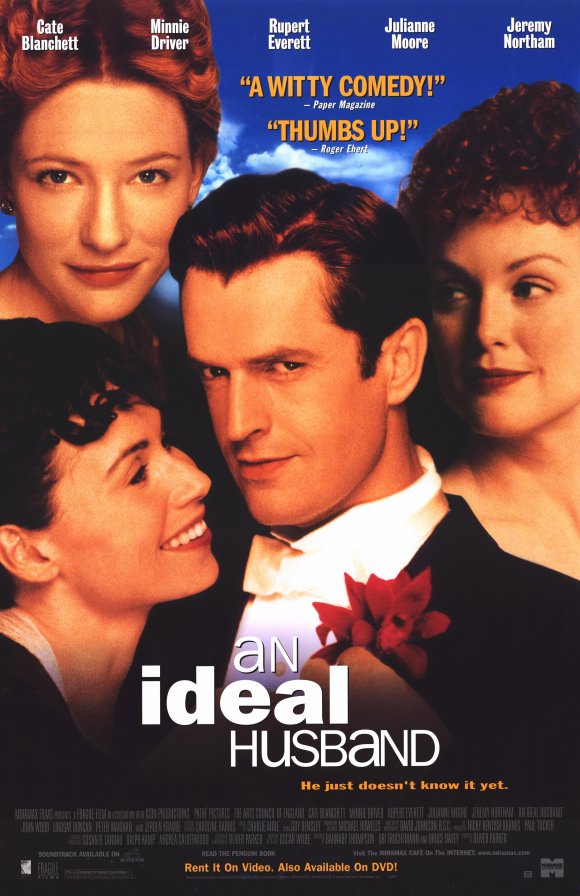
Cate Blanchett, Minnie Driver and Rupert Everett do the best in this Wilde mis-fire An Ideal Husband

Director: Oliver Parker

Cast: Rupert Everett (Lord Arthur Goring), Cate Blanchett (Lady Gertrude Chiltern), Minnie Driver (Miss Mabel Chiltern), Julianne Moore (Mrs Laura Cheveley), Jeremy Northam (Sir Robert Chiltern), John Wood (Lord Caversham), Peter Vaughan (Phipps), Lindsay Duncan (Lady Markby), Simon Russell Beale (Sir Edward), Nickolas Grace (Vicomte de Nanjac)

I have a theory that Shakespearean comedy rarely translates well to screen because what makes it work is its theatricality and how it encourages laughter by interacting directly with the audience. I think you could say the same for Oscar Wilde. Certainly, this film version of An Ideal Husband looks lovely and never misses a single Wildean bon-mot. But it’s overlong, drags rather in its final third and, above all, isn’t particularly funny.

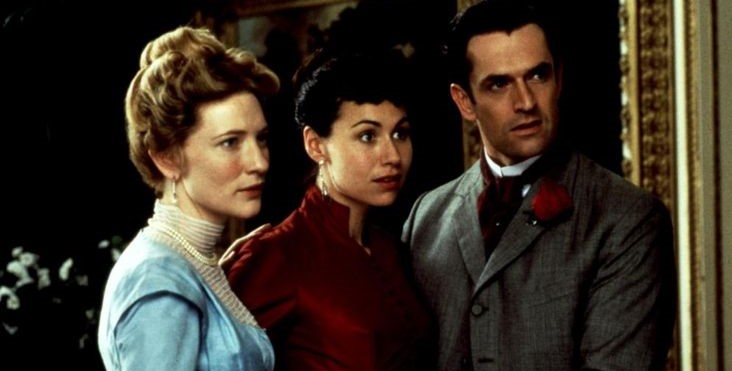
The plot has been freshened up and adjusted in places to make for a more filmic narrative, but the principles are the same from the play. Sir Robert Chiltern (Jeremy Northam) is a pillar of the establishment, famed for his unshakeable dedication to principle and adored by his wife Lady Gertrude (Cate Blanchett) who sees him as a paragon. But all that could be shaken up when Mrs Laura Cheveley (Julianne Moore) re-enters his life, bringing with her shocking revelations that could destroy Sir Robert. So he turns to help to his best friend, the witty and debonair Lord Arthur Goring (Rupert Everett), who is himself in love with Sir Robert’s sister Mabel (Minnie Driver). How will events play out as they start to spiral out of control?

Oliver Parker’s film is cautious, safe and – for all that it tries to open the play out with scenes in parks and Parliament – conservative and safe. You can imagine Wilde himself would probably have wanted something a little more daring had he been involved. As it is, things that work very well on stage (the farcical elements of mistaken identity and a house with a different character hiding behind every door) don’t really work on film. These ideas are inherently theatrical and depend on the heightened unreality of theatre – in the cold hard harshness of cinema, they feel out of place.

Put frankly, the big thing the play misses is the live audience. You can imagine this cast going down an absolute storm in the West End. The lines that demand a wink to the audience, bits of business that invite laughter, just fall flat here. They are rendered lifeless by the demands of being fit into a film, or having to take place in a world that seems real, when Wilde’s plays are all about a sort of bizarre ultra-Victorian world of form covering up a suggestive naughtiness. When the characters go and watch The Importance of Being Earnest at the theatre (a sign of the film’s clumsy opening out, and its lack of wit when left to its own devices) the dialogue style that doesn’t really work in the “real world” of film suddenly feels perfectly natural when we see people speak it on stage.

Parker’s film fails to bring any particular inspiration to events. Instead it seems determined to package Wilde as a heritage product, the sort of thing you can imagine people considering a safe thing for the whole family to sit down and watch. There is no sense of cheek, sex or danger in this like you can get in Wilde. Instead it’s all about attractive actors in period-drama drawing rooms, going about their work with skill. All made to look as pretty as possible with some lovely costumes. It’s Sunday tea-time viewing.

But despite this, some of those performances are spot on. I’m not sure there is an actor alive today better suited to Wilde than Rupert Everett. His imperious drawl, his sardonic wit, his louche manner (not to mention his ability to suggest an illicit wickedness under the surface) make him absolutely perfect. Everett has shown time and again – on film and in the theatre – he has an affinity for the dryness needed for Wilde, as well as being able to communicate the intelligence without smugness. All the successful scenes of the movie revolve around him, and he invariably brings out the best from his co-stars. He’s also far-and-away the funniest thing in the film.

The rest of the cast are more mixed. Cate Blanchett is the stand-out in (sadly) the least interesting main role, the rather stuffy Lady Gertrude (you wish you’d been able to see her let rip as the more wicked Mrs Cheveley) – like Everett she “gets it”. Jeremy Northam also does excellent work in the straight-man role of Sir Robert, but his characteristic dignity and intelligence do very well in the role. Julianne Moore though seems oddly constrained by the period setting as Mrs Cheveley (strange that she did this at the same time as her superior work as a restrained Englishwoman in The End of the Affair) while Minnie Driver lacks impact as Mabel. John Wood and Peter Vaughan – two old pros from the theatre – bring much of the energy and wit in supporting roles.

An Ideal Husband is fine. But watching it you’d wonder what all the fuss about Wilde is about. And that can’t be a good thing. If Wilde wrote a review of it, it would be funnier than anything in the film.

The Crucible (1996)

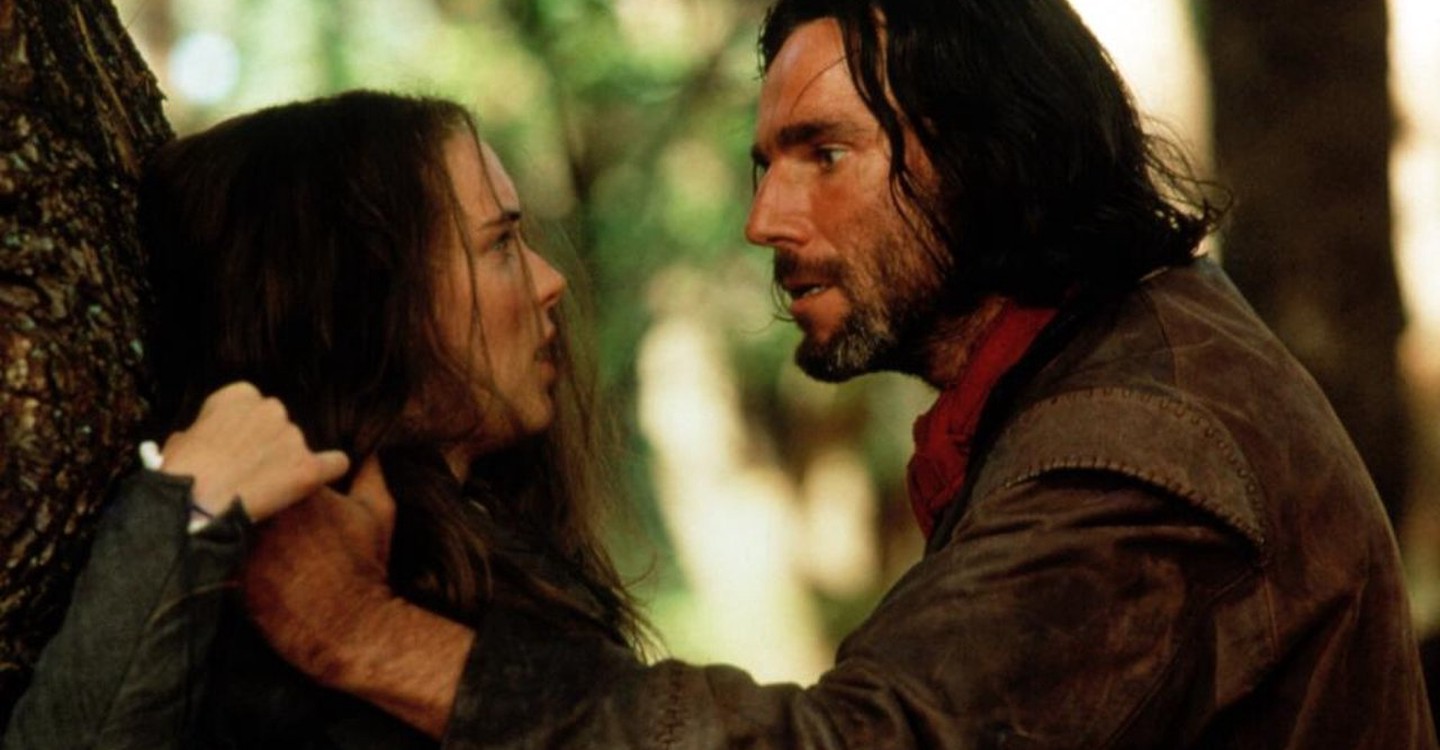
Winona Ryder and Daniel Day-Lewis are swept up in the heated emotions of small-town Salem in The Crucible

Director: Nicholas Hytner

Cast: Daniel Day-Lewis (John Proctor), Winona Ryder (Abigail Williams), Paul Scofield (Judge Thomas Danforth), Joan Allen (Elizabeth Proctor), Bruce Davison (Reverend Samuel Parris), Rob Campbell (Reverend John Hale), Jeffrey Jones (Thomas Putnam), Peter Vaughan (Giles Corey), Karron Graves (Mary Warren), Charlayne Woodard (Tituba), Frances Conroy (Ann Putnam), Elizabeth Lawrence (Rebecca Nurse), George Gaynes (Jude Samuel Sewell), Mary Pat Gleason (Martha Corey)

The Crucible is now so well-known, it’s virtually a shared cultural reference point. Surely we have all studied it at some point at school, or seen it on stage (or both). The play helped “witch trial” become a common short-hand for an increasingly vicious campaign conducted by society against a group within it. The Crucible works so effectively as a play because it is both simultaneously a brilliant recreation of the time it is staging, and a play of universal themes which is for all time.

In Salem, Massachusetts in 1692, the young girls of the village are caught dancing around a fire in the woods late at night by Reverend Paris (Bruce Davison). The next day, some of the girls will not awaken from fits, and rumours of witchcraft spread. Terrified of the blame being pinned on her, the girls’ ring-leader Abigail Willams (Winona Ryder) “confesses” to being tempted by the devil and swiftly accuses other people in the village (often at the prompting of senior villagers keen to remove rivals and resolve old feuds). However, Abigail’s real target is Elizabeth Proctor (Joan Allen), the wife of Abigail’s former lover John Proctor (Daniel Day-Lewis). The accusations quickly spiral into a series of trials based on the girl’s “evidence”, conducted by Judge Thomas Danforth (Paul Scofield).

The Crucible may be one of the finest adaptations of a play ever made. With the script adapted for the film by Arthur Miller itself, the play is effectively opened out and subtly restructured (the original is essentially four acts, each a single scene in a single location) to allow different character interactions, earlier introductions, and to show us things only implied in the original play. Many will complain about the film showing us rather than allowing our imaginations to work, but the film never loses the ideas and themes of the original play and gives it a real emotional force. What the film might sacrifice in the claustrophobia of small rooms, it more than makes up for in getting across a real sense of a community consumed by hysteria.

Nicholas Hytner – in only his second movie – directs with great skill, using a number of low-angle lenses to make ceilings loom over the scene. He mixes this with sweeping shots (beautifully filmed) of the Massachusetts countryside, which looks increasingly windswept and bleak. He really understands how to play the film “straight” – to let its universality speak by grounding it in the Salem countryside, without tipping the hat. His theatrical experience works wonders for the set-piece scenes, which sizzle with tension and brilliance, with Hytner allowing moments where you can almost convince yourself everything is going to be OK.

Miller’s expanded screenplay also allows an even greater sense of the hidden corruption of the trials, and how they are misappropriated by certain members of the village. Far more than even in the play, you get a real sense of old scores being settled, and of odd-balls and eccentrics being targeted. Frances Conroy (pre-Six Feet Under fame) is excellent as Ann Putnam, using accusations to alleviate her own bitterness at the loss of her children, while her husband is a spittle-mouthed bully, shamelessly using the trial as a landgrab (well played by Jeffrey Jones, awkward as it is to see him in a movie – google it).

In this nightmare village of suspicion and accusation, Abigail Williams is the only person who really understands the opportunities and dangers fully. Winona Ryder is often overlooked in this film, but her brilliant expressiveness is perfect for Abigail. She really adds depth and shade to the character – yes she is bitter and angry and ruthless and shameless, but she’s also scared and genuinely in love with John, and you get flashes of doubt and even regret over what she is doing.

The object of her obsession is John Proctor. Daniel Day-Lewis – Miller’s son-in-law – takes on the role and he is of course as excellent as you might expect. Day-Lewis’ key roles are such larger-than-life landmarks in cinema, it’s easy to overlook him playing a role taken on by so many other actors. At first, you almost feel it might be a waste – but he gives it a growing emotional commitment and force. He may be the one sane man in the storm of hysteria, but Day-Lewis doesn’t lose track of Proctor’s inner cowardliness, his corruption, his bitterness. Day-Lewis’ performance repositions the role as a man who has to learn to stand for something. It’s a superb performance.

He’s equally matched by Joan Allen, whose performance as Elizabeth Proctor throbs with dignity, but also a puritan strength of faith that makes it easy to imagine that Proctor would feel overwhelmed by a sense of being weighed in the balance and found wanting. She and Day-Lewis have a beautifully played, hugely emotional scene late on in a windswept field which (like so many other scenes in this production) briefly suggests a hope for the future.

Paul Scofield did so few films that each of his rare performances is to be treasured (this was his last film performance). His Danforth is simply superb, probably close to the definitive performance. It trades a lot on an inversion of Scofield’s most famous performance as Thomas More. Scofield plays Danforth as a man filled with certainty without a trace of doubt, who is married to the word of the law but has no understanding of the spirit of it. In Scofield’s masterful performance, flashes of arrogance and pride intermix with a genuine sense of faith and morality. His Danforth is convinced everything he does is right – a position that allows him to commit many wrongs.

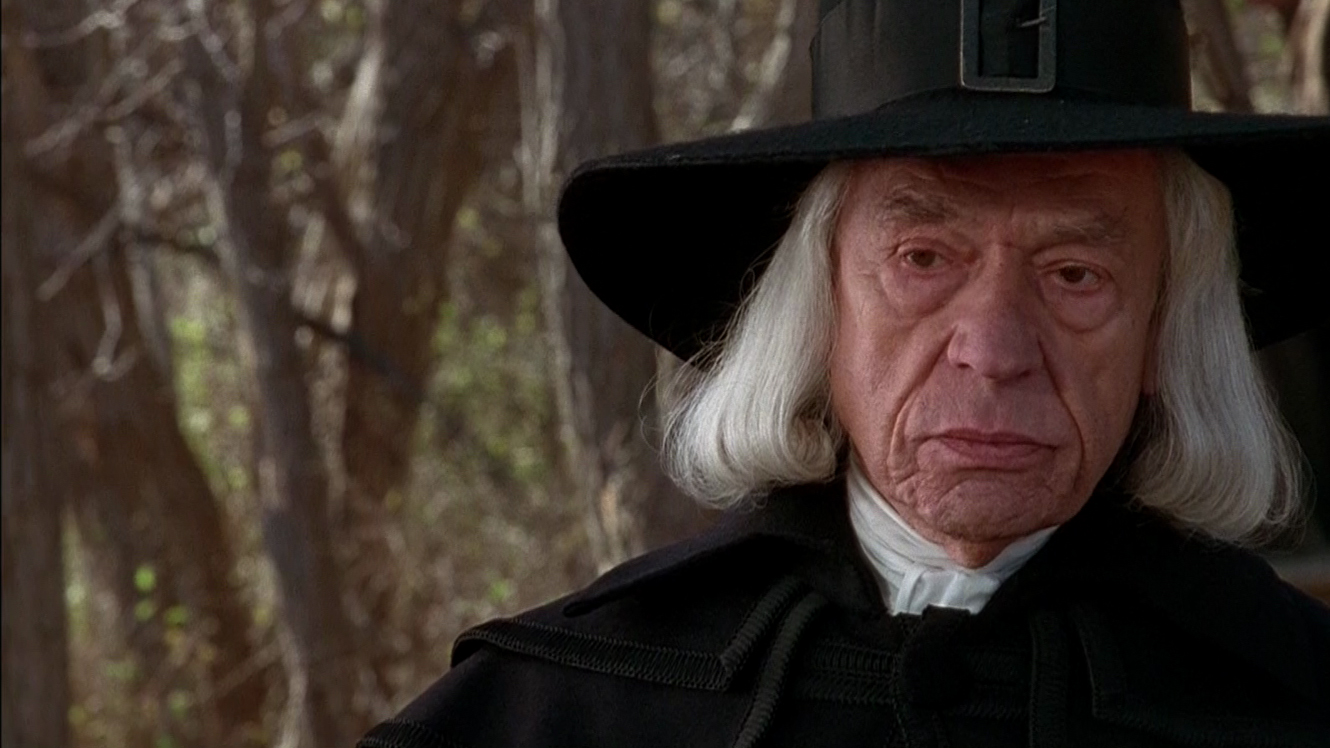
The film is rounded out by several other excellent roles: Bruce Davison is outstandingly weaselly as Samuel Paris, Peter Vaughan has a wily shrewdness as Giles Corey, Rob Campbell is increasingly filled with doubt and anger as Hale, Karron Graves is wonderful as a desperate and scared Mary Warren. Mary Pat Gleason is perfect as the proud Martha Corey, while George Gaynes subtly suggests a man consumed with doubt as Judge Sewell.

“Anybody seeing The Cruciblenow would never dream that it had been a play” said Arthur Miller on this adaptation. He’s right. This must be one of the best stage-to-screen adaptations there has ever been, with all involved totally understanding what made the play great while expanding and deepening the content for film. It’s a marvellous film.