Tag: Rami Malek

Nuremberg (2025)

Nuremberg (2025)

Terribly handled drama that accidentally deals a favourable hand to a leading Nazi

Director: James Vanderbilt

Cast: Rami Malek (Dr Douglas Kelley), Russell Crowe (Herman Göring), Leo Woodall (Sgt Howie Triest), Michael Shannon (Justice Robert Jackson), Richard E Grant (David Maxwell Fyfe), John Slattery (Colonel Burton C Andrus), Mark O’Brien (Colonel John Amen), Colin Hanks (Dr Gustave Gilbert), Wrenn Schmidt (Elsie Douglas), Lydia Peckham (Lila), Lotte Verbeek (Emmy Göring)

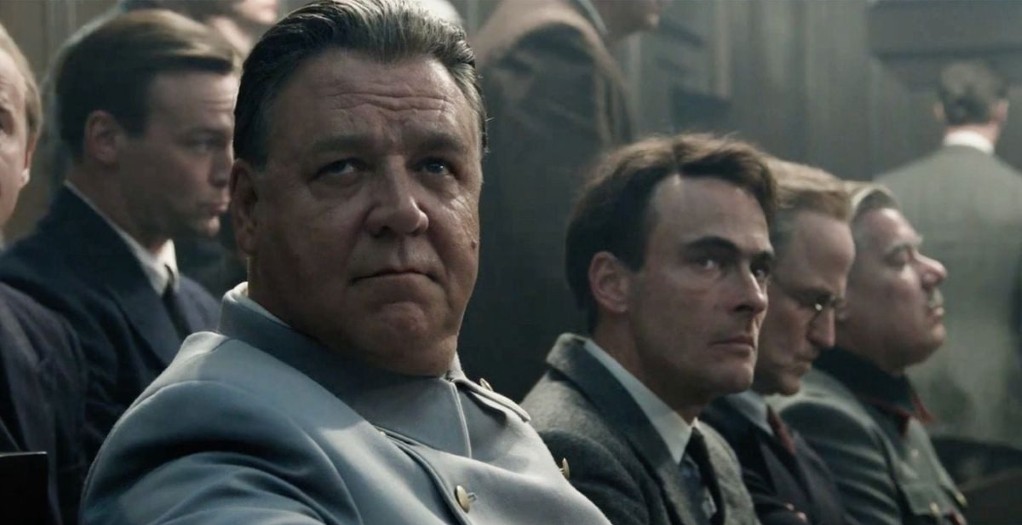
If one thing captures what a miserable failure James Vanderbilt’s Nuremberg is it’s this: if Herman Göring rose from the bowels of whatever Hell he currently resides in and saw it, he’d probably freaking love it. The misguided history lesson has a political and moral message that is obscured and fudged, its points either lost or delivered with thudding obviousness. But the one thing it’s consistent in doing is presenting the most infamous Nuremberg defendant as a fiendishly clever Hannibal Lecter, multiple steps ahead of everyone, whom the film allows to fudge (without sufficient correction) his responsibility for the Holocaust and who goes down due to his loyalty to his lost leader. Ye Gods.

Vanderbilt’s film is an old-fashioned film that simultaneously gives a spotlight to the relationship between Göring (Russell Crowe) and psychiatrist Douglas Kelley (Rami Malek) and attempts to tell the entire history of the set-up, planning, prosecution and judgement of one of the longest trials in history. It succeeds at neither of these things, and does so while cramming dry, exposition-heavy dialogue into its actors’ lips (the sort of speeches where people launch into lists of the Nuremberg Laws or the trial’s legal framework). Much of it is dramatically inert – at least those parts you’ll be able to see through the film’s impossibly murky camerawork (I expected the lights to shoot up in the courtroom in a standard ‘truth-bought-to-the-light’ cliché, but even here it’s hard to see).

The material around the trial set-up essentially takes a fascinating subject – the wrangling of four allies (three of whom didn’t really trust the fourth) to create a legal framework for an international tribunal never attempted before – and makes it dull as ditchwater. Michael Shannon does his best as Justice Jackson, architect of the trial, but the vast majority of his scenes are little more than exposition (his best is a meeting with Pius XII, whom he effectively blackmails into supporting the trial, in recompense for Pius’ lack of action against the Nazis). Richard E Grant adds a little flavour, even though this film’s whisky-from-a-teacup Maxwell Fyfe (in reality, a stern man in his 40s) feels more like Grant-101 than a real person.

While the trial is a drag, the rest is a farce. Rami Malek flails as Douglas Kelley, in a poorly written role. I suspect, based on the film’s final ham-fisted scene, the intention was to suggest Kelley got too close to Göring and bought a little of what he was selling until the scales fell from his eyes during the trial (and the Holocaust evidence). That Kelley would serve as a dark warning that even the brightest can get seduced by charismatic Nazis. This would have added real fire to the film’s closing vision of Kelley as a drunken Cassandra, desperately railing on US public radio that it could happen here. But clearly someone was worried positioning our hero as someone who admired Göring for a while was going to be hard for regular viewers to sympathise with.

Instead, we get a clumsy dance, where its repeatedly stressed Kelley is only getting close to Göring because he wants to exploit him for a best-selling book. That his sticking up for Göring (including giving credence to Göring’s argument that he couldn’t possibly know about the Holocaust, because that was Himmler’s department) and being nice to his wife and child was all part of this.

It then awkwardly tries to have this cake and eat it, by suggesting Kelley also realising the trial is about real people not just turning a buck. It spectacularly lacks the skill to pull this off. Even worse, it hilariously keeps providing evidence that Kelley is a terrible psychiatrist. Göring manipulates him with ease and, in the real low-point, we cut from Kelley blithely saying he spoke to previously-depressed prisoner Robert Ley and he seemed calm – straight to the aftermath of Ley’s grisly suicide.

This is as nothing to the film’s strange admiration for Göring. Not helped by Russell Crowe giving the film’s best performance, it feels like Vanderbilt never realises how quietly favourable the cards he gives Göring are. (It even actively absolves Göring of antisemitism, arguing he was just an opportunist supporting it for advancement.) He has all the best lines and dominates his scenes. The film draws attention to his fiendish cunning (allowing himself to be captured so he can manipulate the trial, hiding his ability to speak English etc.), shows him effortlessly running rings around everyone he talks to, weaning himself off a pills addiction through will alone… It wants the sort of Hans Gruber like villain who controls the whole trial from his cell.

It undersells small moments, such as Göring’s nervous reaction before, and complete denial after, the Holocaust film played in the trial. Even worse it gives Göring wiggle-room, unquestioned, to deny his responsibility for the Holocaust. Let’s not beat about the bush: Göring signed the order authorising it. In the real trial, his charisma butted up against the damning facts of his involvement from everything from petty art thefts, to murder of allied airmen, setting up the Gestapo and ordering the Holocaust. Nuremberg is brave enough to show Jackson’s real-life poor cross-examination of Göring – but allows Göring’s weasel words on a debatable mistranslation of his order on the Final Solution to go unexposed for the bollocks it was.

The film’s ‘gotcha’ moment in the trial is feeble, reduced down to Fyfe getting Göring to say he continued to support Hitler. This is played as the key moment that would turn Germany away from the Nazis, but surely was hardly off-putting to many in a country that had almost literally fought to the death for Hitler less than year earlier. Göring would call it loyalty – another thing he’d be thrilled the film showed him displaying.

It gets worse. A final shot of the executed Nazis’ bodies is in such staggeringly poor taste I almost can’t believe I saw it: laid out exactly like Holocaust victims, they are driven in the back of a van to be incinerated in a concentration camp. I can see Vanderbilt was going for “poetic justice” – but it’s awful. After that gut-punch, watching a drunken Kelley in a coda all-but-say ‘Watch out Trump’s-a-comin’ and he’s a Nazi!’ almost feels okay (except of course it’s awful in a different way, as subtle as every other point in the film).

Nuremberg is terrible. It’s at its best when it’s merely slow and boring. At its worst when it borderline admires Göring. If you want to watch this story, search out the 2000 mini-series Nuremberg with Alec Baldwin as Jackson and a (possibly) career-best Brian Cox as Göring (Cox, and the series, succeed in showing him with surface charm, smart, but full of vicious cruelty and staggering bombastic overconfidence). Don’t watch this.

Oppenheimer (2023)

Oppenheimer (2023)

Nolan’s masterful musing on the morality of science is both challenging and compelling

Director: Christopher Nolan

Cast: Cillian Murphy (J Robert Oppenheimer), Emily Blunt (Kitty Oppenheimer), Matt Damon (General Leslie Groves), Robert Downey Jnr (Lewis Strauss), Florence Pugh (Jean Tatlock), Josh Hartnett (Ernest Lawrence), Casey Affleck (Colonel Boris Pash), Rami Malek (David Hill), Kenneth Branagh (Niels Bohr), Benny Safdie (Edward Teller), Dane DeHaan (General Kenneth Nichols), Jason Clarke (Roger Robb), David Krumholtz (Isidor Issac Rabi), Tom Conti (Albert Einstein), Alden Ehrenreich (Strauss’ aide), Gary Oldman (President Truman), Jefferson Hall (Haakon Chevalier)

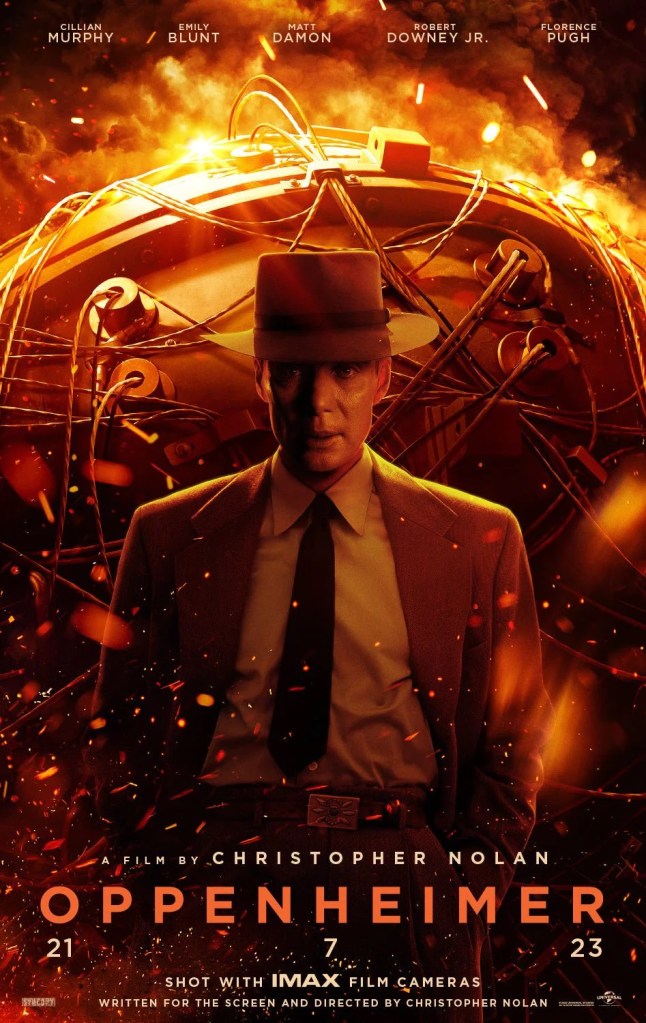
“I am become Death, the destroyer of worlds”. These words from The Baghavad Gita are synonymous with J Robert Oppenheimer, director of the Manhattan Project as he witnessed the destructive force of his creation, the atomic bomb. Fittingly, Nolan’s fascinating and ambitious film opens with a reference to Oppenheimer as Prometheus: the man punished for all time for stealing fire from the Gods. Oppenheimer uses everything from thriller to courtroom drama, to explore the moral responsibilities of science: if we can do a thing, does it follow that we must?

J Robert Oppenheimer (Cillian Murphy) is a Renaissance man and leading theoretical physicist who dabbled more than a little in left-wing politics. The woman he loves, Jean Tatlock (Florence Pugh), is a die-hard communist, the woman he marries Kitty (Emily Blunt) is a former party member, his closest friends are all members. Associations like these will later haunt him after he is approached by General Leslie Groves (Matt Damon) to use his organisational skills, political savvy and charisma to run the WW2 nuclear programme where maverick scientists work hand-in-hand with the army. Despite his position, Oppenheimer remains untrusted by many. In the aftermath of the war, these suspicions will be used by his opponents, among them Lewis Strauss (Robert Downey Jnr) ex-head of the Atomic Energy Committee, to bring about his downfall as Oppenheimer preaches disarmament.

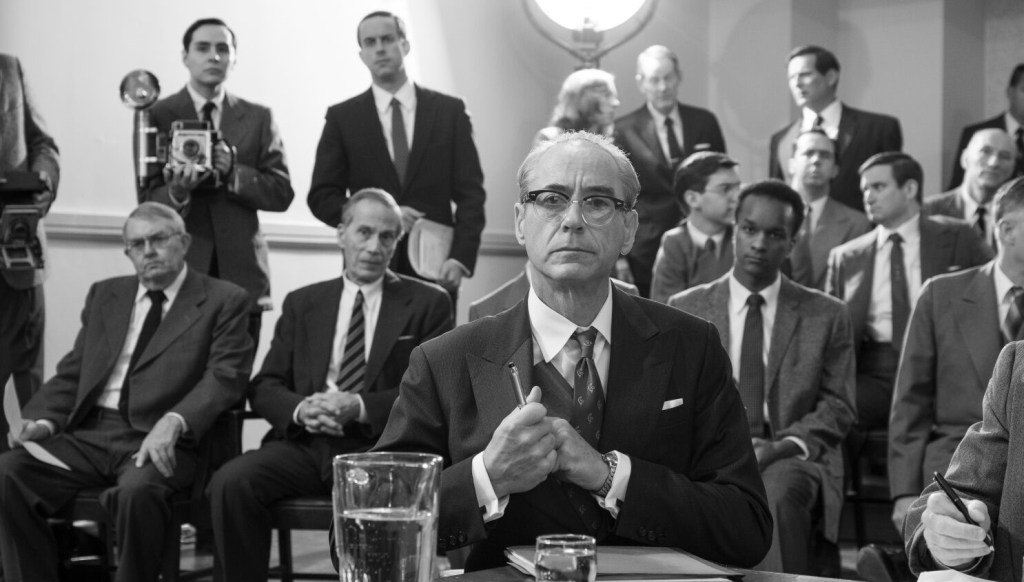
Much like Dunkirk, Oppenheimer is told in two timelines, intersecting with scenes replayed from different perspectives in subtly different ways. In “Fission” we see Oppenheimer, effectively on trial in 1954 for his security clearance, recount his life story, chronological flashbacks taking us through the development of the bomb. In “Fusion”, shot in gorgeous black and white, we follow the 1959 senate hearings to confirm Strauss in a cabinet post, and see his reminiscences of Oppenheimer’s post-war struggles to control the monster he has unleashed.

Oppenheimer is a brilliantly made, cinematically adventurous film: you would, of course, expect nothing less from a distinctive talent like Nolan. Brilliantly intercutting multiple timelines, it’s a film that is as much an experience as a story. This is a behemoth, filled with moments of flair and breath-taking use of sound and vision to affect mood. In particular, the film’s oppressive sound design bears down on the viewer like the pressure of the bomb itself. This means moments when we are released from its grip carry real impact. As Oppenheimer – already plagued with doubt – triumphantly announces the successful use of the bomb, the war-like celebratory pounding of scientists’ feet disappears from the soundtrack leaving Oppenheimer’s words echoing impotently around the room.

The pounding score and epic, sweeping camerawork (even more striking, since so much of the film takes place in small rooms filled with conversation) help Nolan to build up Oppenheimer’s mythic status and simultaneously strip him bare. Literally so at one point as, when questioned on his sex life in his hearing, Oppenheimer is seen naked in the room (as exposed as he must be feeling) answering questions with a naked Jean Tatlock astride him, staring into his wife’s eyes.

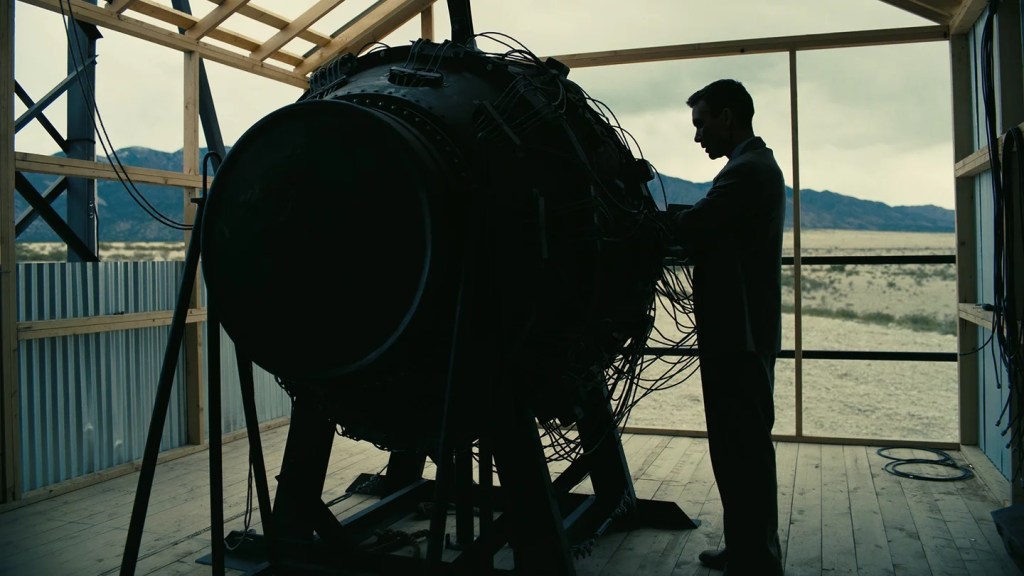
Oppenheimer labours, with the best intentions, to create a weapon before the Nazis. In its middle act, Nolan’s film focuses on the propulsive excitement of creation. The thrill of obstacles being overcome and solutions being found. The joy of a diverse team coming together for a single goal. We find ourselves longing for problems to be overcome, swept up in the desire for the endgame, as anxious as the scientists when it looks like rain will prevent the vital first Trinity test of the bomb.

Oppenheimer feels the same. Powerfully, intelligently and magnetically played by Cillian Murphy, this is a man who is a host of flaws crammed with impossible genius. A charismatic room leader, who is awkward in personal interactions. A charmer who rudely fails to remember his brother’s girlfriend’s name at a party. An inspiring leader who alienates people with ease. Murphy captures every inch of Oppenheimer’s staggering intellect and delight in intellectual problems, just as he also embodies the man’s arrogance and crushing self-belief.

So, it’s as crushing to him as it is terrifying to us, when the bomb explodes and the realisation hits us. Nolan’s sensory experience of a film fades down to silence as Nolan lets the camera float across the all-consuming fire of the silent explosion (the noise only comes when the shockwave hits) and suddenly the chilling implication of this terrible weapon becomes clear. This is a device that will kill millions. Oppenheimer knows it: he slowly shrivels into haunted guilt, Murphy seeming to shrink into himself as he finally understands what he has done.

Images of nuclear destruction both obvious (ashen bodies and nuclear flashes) and subtle (the out-of-focus vibration of background around Oppenheimer, as if sensing an approach shockwave) will haunt him and us for the rest of the movie. While many scientists – foremost among them Benny Safdie’s bull-headed Edward Teller and Josh Hartnett’s WASPish but decent Ernest Lawrence – feel little guilt. But Oppenheimer, and we, can no longer avoid questions of moral responsibility raised by those such as Niels Bohr (a quietly effective Kenneth Branagh).

Are there some discoveries better not made? Because once the genie is out of the bottle, it cannot be stuffed back in again. In this new world every world power must always have more. More bombs, bigger bombs, better bombs. And it explains why, like Prometheus, Oppenheimer must be punished. The tool of his punishment being his communist sympathies, embodied in his yearning attraction to Jean Tatlock (an under-used Florence Pugh). Nolan’s film is very strong on the terrifying paranoia of the secret state, where every word or association can be collected into a terrible portfolio of witnesses you cannot question, evidence you cannot see, testimony you cannot hear.

“Why don’t you fight” cries his wife Kitty, played with a dynamic, intelligent forcefulness by Emily Blunt. I could have done with a third act built more around Blunt’s starkly honest betrayal of a woman ill-suited to being a wife and mother, trapped in a world where that is all women can achieve (and which also trimmed a few witnesses from Oppenheimer’s trial). Why doesn’t Oppenheimer fight? Nolan has his theories, carefully seeded and confidently revealed.

Oppenheimer’s post-war clashes cover much of “Fusion”, anchored by a superbly under-playing Robert Downey Jnr (his finest work since Chaplin) as the outwardly avuncular, but inwardly insecure and bitter Strauss, who sees Oppenheimer as the embodiment of all the elitists who turned their noses up at him (no matter that Oppenheimer himself is an outsider, in a world of science run by WASPish types like Lawrence). Nolan’s film explores how morality is forgotten in an environment so rife with paranoia that the slightest expression of doubt is seen as treason.

Nolan’s film needs its vast runtime to keep as many balls in the air as it tries to. It’s probably a few too many balls. I would have loved more on Oppenheimer’s outsider status, as a Jew in American science (its not mentioned that the J stands for Julius, despite his claims it stands for nothing). Similarly, I would have welcomed more time to explore Oppenheimer’s complicated emotional life, in particular the fascinatingly complex relationship of some love, a fair amount of mutual respect and a large measure of mutual convenience with his wife Kitty.

But the film’s chilling musing on the horrors science can accidentally unleash while focused on progress is superbly explored and leaves a lasting impact. It’s a feeling that continues to be sharply relevant while we struggle with the implications of AI. Was there a need for the bomb? Perhaps there was. Were we ready for the bomb? No. And it is the failure of anyone, including Oppenheimer, to even consider this until it was too late that is the coldest warning in Nolan’s epic film.

Amsterdam (2022)

Amsterdam (2022)

Lots of quirk, whimsy and smugness, not a lot of interest or dynamism in this satirical mis-fire

Director: David O. Russell

Cast: Christian Bale (Burt Berendsen), Margot Robbie (Valerie Voze), John David Washington (Harold Woodsman), Robert De Niro (General Gil Dillenbeck), Chris Rock (Milton King), Rami Malek (Tom Voze), Anya Taylor-Joy (Libby Voze), Zoe Saldana (Irma St Clair), Mike Myers (Paul Canterbury), Michael Shannon (Henry Norcross), Timothy Olyphant (Tarim Milfax), Andrea Riseborough (Beatrice Vandenheuvel), Taylor Swift (Elizabeth Meekins), Matthias Schoenaerts (Detective Lem Getwiller), Alessandro Nivola (Detective Hiltz), Ed Begley Jnr (General Bill Meekins)

David O Russell’s has made a niche for himself with his ensemble awards-bait films, filled with touches of quirk and offering rich opportunities for eccentric, showy performances from actors. Some of these have walked a fine line between charm and smugness: Amsterdam tips too far over that line. Like American Hustle it’s a twist on a real-life event (opening with a pleased with itself “A lot of this really happened” caption) but, unlike that film, it fails to insert any compelling storyline, settling for a whimsical shaggy-dog story that frequently grinds to a halt for infodumps or lectures.

Set in 1933, just as Roosevelt has taken office, it follows three friends who formed a friendship for life in post-war Amsterdam. They are: wounded veterans doctor Burt Berendsen (Christian Bale) and lawyer Harold Woodsman (John David Washington) and socialite-artist-turned-nurse Valerie Voze (Margot Robbie). Berendsen and Woodsman lost touch with Valerie in the 1920s, but now they are all bought together after the murder of their respected former commander as part of a plot from various nefarious types to overthrow the government in a fascist-inspired coup.

Sounds gripping right? Well, Amsterdam fails to find any urgency in this. In fact, details of this plot and the political context it’s happening in are sprinkled around the film as if Russell kept forgetting what the film was supposed to be about. It’s almost as if he stumbled on an unknown piece of American history – a rumoured coup attempt, thwarted by being denounced by the ex-Marine General approached to lead it (here represented by De Niro’s ramrod straight General Dillenbeck) – but got more and more bored with it the longer he spent on it.

Instead, his real interest is in the faint overtones of Jules et Jim style thruple between Berendsen, Woodsman and Voze (though this is American not French, so any trace of homoeroticism is dispatched, despite the obvious bond between the two men). The most engaging part of the film is the Act two flashback to these three healing, dancing and bonding in post-war Amsterdam, in a “our troubles are behind us” bliss. Even if it’s self-satisfied in its bohemianism.

To be honest, even then, they have an air of smugness behind them. They pass the time singing improvised nonsense songs based on words pulled out of a hat and playfully posing in Valerie’s modernist artwork. Valerie is played with almost enough charm by Robbie for you to overlook she is a standard Manic Pixie Dreamgirl, the sort of babe who pulls shrapnel from bodies to turn it into artistic tea-sets as a commentary on the madness of war. She and Woodsman form a relationship (with the married Berendsen as a sort of – well I’m not sure what, but definitely not a sexual third wheel) and these blissful Amsterdam days are the times of their life. Russell is so keen for us to know it, that all three pop up in short cutaways at key moments to whisper “Amsterdam” direct to the camera, an affectation that fails to deliver the spiritual impact its straining for.

It’s better than the shaggy dog story around the conspiracy that fills the 1930s part of the storyline. This remains so poorly defined, that Bale has to narrate a concluding slideshow of clips and fake newsreel and newspaper coverage to explain what on earth has just happened. The lack of clarity about the stakes – and the general lack of seriousness or urgency anyone treats them with –fails to provide any narrative oomph. Instead, it drifts along from casual meeting to casual meeting, every scene populated with a big-name actor showboating.

There is a lot of showboating in this film. Bale, an actor with an increasingly worrying tendency for funny voices and tics, fully embraces the facially scarred, glass-eye wearing Berendsen, perpetually stooped with a war wound and prone to fainting from pain-killer overuse. It’s a showy, actorly performance with a licence to go OTT. Bale does manage to invest it with an emotional depth and vulnerability, but there’s more than an air of indulgence here.

Most of the rest follow his lead. Malek and Taylor-Joy sink their teeth into a snobby socialite married couple. Rock essentially turns his role as a veteran into a less sweary extension of his stand-up act. Myers and Shannon seize with relish roles as ornithologist spies (is this meant to be a joke about the origins of the James Bond name from the author of a bird-spotting guidebook?) Poor John David Washington ends up feeling flat with his decision to underplay (like he’s in a different movie) and only De Niro really manages to feel like anything other than an actor on holiday.

Russell wants to make a point about the continual corruption of the rich and how their hunger for more power will never be sated. There are some half-hearted attempts at attacking racism, with the ill treatment of black veterans, but it lacks bite or edge. His attempts to draw parallels with Trump are all too clear, but the film largely fails to integrate these ideas into the film. In fact, it ends up relying on voiceover lectures from Bale about dangers to democracy. It ends up like being hectored by an angry socialist after a student revue night.

The film is shot with a series of low angle shots and medium and close ups that eventually made me feel like I was watching it from the bottom of a well. A vague sepia-ish tone is given by Emmanuel Lubezki, but the film looks flat and visually uninteresting (so much so I was stunned to see $80million had somehow been blown on it, despite most of the cast working for scale). It drifts towards a conclusion, without giving us anything human to invest in (as Russell managed so well in Silver Linings Playbook or The Fighter) or providing the sort of caper enjoyment he delivered in American Hustle. Instead, it’s oscillates between smug and dull.

No Time to Die (2021)

One final mission for Daniel Craig in No Time to Die

Director: Cary Joji Fukunaga

Cast: Daniel Craig (James Bond), Lea Seydoux (Dr Madeleine Swann), Rami Malek (Lyutsifer Safin), Lashana Lynch (Nomi), Ben Whishaw (Q), Naomie Harris (Eve Moneypenny), Jeffrey Wright (Felix Leiter), Christoph Waltz (Ernst Stavro Blofield), Ralph Fiennes (M), Billy Magnussen (Logan Ash), Ana de Armas (Paloma), David Dencik (Dr Valdo Obruchev), Rory Kinnear (Bill Tanner)

Remember when Daniel Craig was cast as Bond? Remember that CraigNotBond campaign, based largely on Craig being blonde? For about five minutes there was doubt about the franchise… and then Casino Royale became one of the best Bond films ever made. Craig is, clearly, one of the greatest Bonds ever, so No Time to Die, his sign-off for the role was always going to be a big movie. It’s at times exciting and gripping, but also a strange beast, partly straining at the confines of the franchise at others desperately trying to service all expectations.

It’s five years after the events of Spectre (you’d assume the less said of that the better, but unfortunately that film is absolutely at the heart of No Time to Die so we can’t dodge it). And it’s five years since James Bond (Daniel Craig) abandoned Dr Madeleine Swann (Lea Seydoux), believing she had been responsible for luring him into a Spectre ambush. Today, Spectre agents steal a biological weapon from MI6. A retired Bond, living off the grid in Jamaica, is recruited by Felix Leiter (Jeffrey Wright) to hunt it down for the CIA but MI5, and their new 007 (Lashana Lynch), are also on the trail. Plots within plots are slowly revealed and it seems all roads lead back to Madeleine and her childhood escape from a scarred killer, the mysterious Safin (Rami Malek). Just when Bond thinks he’s out, they drag him back in…

I have very mixed feelings about No Time to Die. You have to admire the skill and expertise with which it has been made. It looks absolutely gorgeous. The action set-pieces are full of ingenuity and excitement – in particular a duel between Bond and Safin’s agents in a mist-filled Norwegian forest. The opening action set-piece, in a picturesque classic Italian town, with Bond leaping off bridges and bringing out the Aston Martin for one final spin, is a doozy.

But do you remember when Bond was, y’know, escapist fun? Or even really just fun? If there is one thing I’d argue that No Time to Die isn’t, it’s fun. Yes lots of exciting things happen, but it’s also a rather maudlin film. It’s got a weary end-of-days feeling and a slight air of self-importance. Its absurd length doesn’t help puncture this. Unlike almost any other Bond film, I have a hard time imagining watching this again: it’s probably a better film than, say, The Spy Who loved Me, but honestly which one would you rather watch on a Sunday afternoon?

But Daniel Craig is superb: the ultimate expression of his wryly amused but guarded and distant Bond, a man constantly worried about lowering his defences and letting anyone in, hiding pain under an insolent grin but secretly desperate for an emotional connection. It’s clear he is one of the great Bonds. He also feels rooted Fleming. Fleming’s Bond was never a super-hero, but a flawed, lonely man, often muddling through, far more vulnerable and emotional than people remember. No Time to Die has a lot of echoes of Fleming, which is no bad thing.

No Time to Die buries itself in the emotional world of Bond. This is as close as you going to get to a character study of our super-agent. So much so that the action (and even the presence of a Bond villain) feel like only a contractual obligation. I would love it if they had made a final, indie-tinged film on a small budget where we saw Craig’s Bond wrestling with complex feelings and trying to work out what it’s all about. More of Bond playing kids’ games with Leiter in a Jamaican bar, or preparing a child’s breakfast in the morning (scenes where the film literally has its heart). It makes No Time to Die an often poorly structured and ill-focused film (factors that contribute to its length) that’s trying to be about Bond but also be BOND. It’s a circle the film can’t really square.

The Bond franchise has always slavishly followed whatever the latest big trend in cinema was so No Time to Die doubles down in following the Marvel series, by retroactively converting all of Craig’s Bonds into one single Bondverse, with No Time to Die as its Avengers Endgame. Problem is, this was all thought of far too late, feels hideously thrown-together with no thought, and means both this film and Spectre had to bend over backwards to retroactively fill out now crucial back story.

As a result, we get the bloated runtime as the film needs to set up a personal back story, explore an emotional arc, establish a new threat and thread in huge set pieces. The writing and structuring aren’t deft enough to do this as well as Marvel does. The result is something three hours long but still feels hard to follow. Craig’s best film – Skyfall – worked because it was basically a stand-alone entry. The series (and the character) works best as a mission-focused individual.

Many elements of the story introduced here make little or no sense. Safin – in a truly awful performance by a whispering Rami Malek, straining to look intimidating – is possibly the worst, most incoherent Bond villain ever. His motivation makes no sense: at first he seems focused on eliminating only those who murdered his family; his rants about collateral damage in no way squares with his plan to unleash genocide via a bio-weapon. His “we are two sides of the same coin” confrontation with Craig feels like a feeble attempt to recapture the magic of the confrontation with Bardem in Skyfall.  An opening sequence suggests a plot-defining link between him and Swann which has promise but goes almost no-where (when they finally meet again mid-film, she doesn’t even know who he is).

A braver film would have dumped this bio-hazard nonsense and placed issues of family at its heart: a hero uncertain about settling down, the villain a person desperate to find a new family. This would have placed the link between Safin and Swann at its centre, and also allowed an even more intriguing exploration of Bond’s character by contrasting him directly with a villain explicitly focused on the same preoccupations. Instead, the comparison isn’t there and Swann remains an incoherent character – alternately weak and strong as required by the plot. Craig and Seydoux also have no real chemistry and look physically mismatched (Seudoux’s youthful looks make Craig look older than he is). Compare their chemistry with that between Craig and Ana de Armas (in a knock-out guest slot, the film’s most fun moment).

Instead it feels like a film where every single idea has been thrown at the frame and all of them made to stick. Lashana Lynch has some fine charisma, but basically nothing to do as the new female 007 (the part actually feels like a bone the franchise has tossed at diversity – Bond even gets the 007 title back part-way through). There are constantly plots within plots within plots, like a dementedly rushed series of 24. Bond goes AWOL, then AWOL from AWOL, then he’s in then out then in again from MI6. A more tightly structured story would have dared to cut some of the flab, but No Time to Die is only part way towards being the brave break from tradition it needs to be.

Sure, it takes daring decisions: it has a tragic ending and shock deaths punctuate the film. But while it needed to be a smaller, intimate story with a sombre mood, it still throws in ridiculous villains, bases on islands, armies of goons and a world-ending threat. These things honestly don’t really work together and contribute to making the film too long and too sombre to be any fun. It’s a film that’s only part way to being what it wants to be, but still obsessed with being what it thinks it should be. An awkward Frankenstein that I’m not sure will have as much shelf life as its maker’s hope.

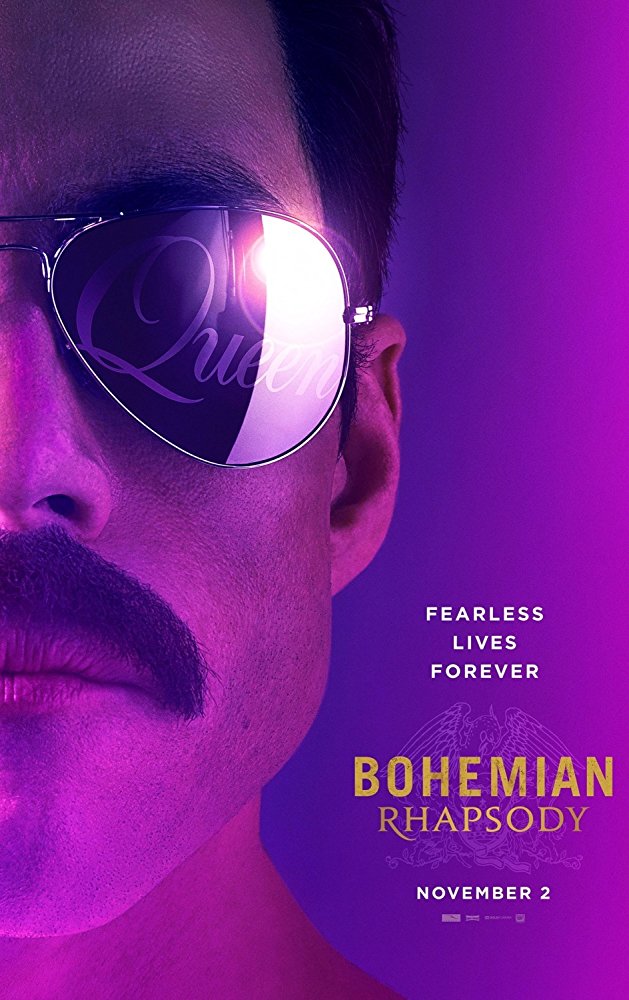
Bohemian Rhapsody (2018)

Rami Malek brings Freddie Mercury to life in crowd-pleaser Bohemian Rhapsody

Director: Bryan Singer (Dexter Fletcher)

Cast: Rami Malek (Freddie Mercury), Lucy Boynton (Mary Austin), Gwilym Lee (Brian May), Ben Hardy (Roger Taylor), Joe Marzello (John Deacon), Aidan Gillen (John Reid), Allen Leech (Paul Prenter), Tom Hollander (Jim Beach), Mike Myers (Ray Foster), Aaron McCusker (Jim Hutton), Ace Bhatti (Bomi Bulsara), Meneda Das (Jer Bulsara)

Biography can be a tricky territory on film. How can you hope to capture a whole life, with all its ups and downs, its shades of grey, in a single sitting of two hours? Well the truth is you can’t really – and Bohemian Rhapsody is an enjoyable but very safe and traditional attempt to tell something of Mercury’s life. It carefully organises his life into a clear five act structure (Beginnings, Early success, Triumph, Temptation and fall, Redemption) that wouldn’t have been unfamiliar to the writer of a medieval mystery play.

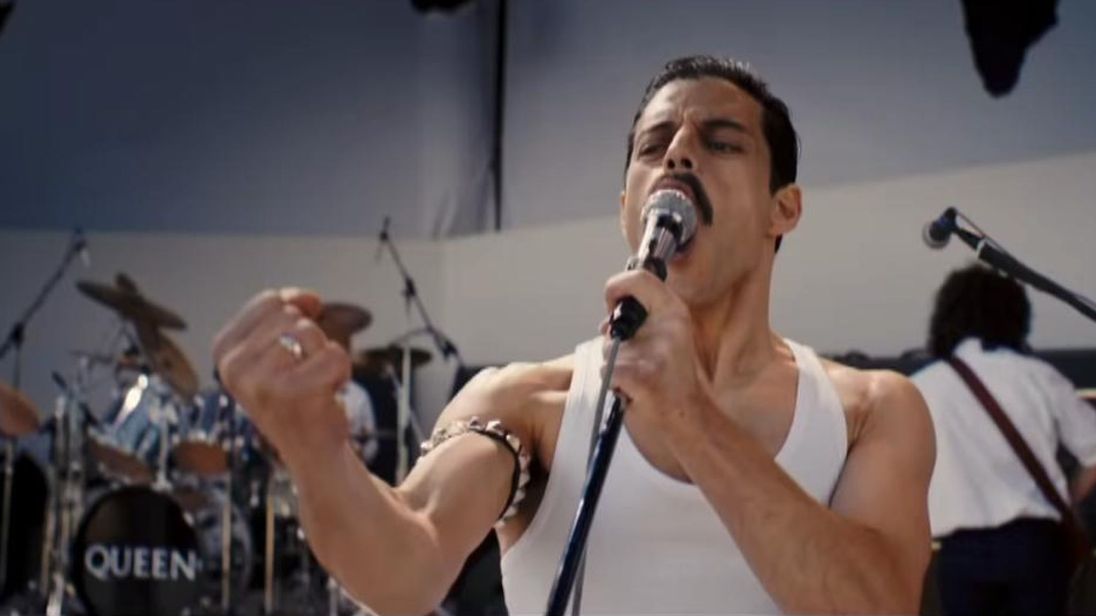
The film uses Queen’s legendary Live Aid performance as the book ends for a story that covers Freddie Mercury (Rami Malek) as he joins Queen, works closely with the band to compose the hit songs that would make them legends, then falls tragically under the influence of band manager Paul Prenter (Allen Leech) and leaves the band to build a solo career and succumbs to those dreaded demons of drink, drugs and sex. The film culminates in a brilliant recreation of Live Aid (by the way, only making the vaguest of passing references to the cause behind Live Aid, with the main motivation for performing seeming to be that everyone else is) which, despite some wonky CGI at points, brilliantly captures the atmosphere of being at an electric live gig. 

Bohemian Rhapsody is an affectionately made crowd-pleaser of a film which has convention running through its soul like sugar at the centre of stick of rock. With the heavy involvement of the surviving members of Queen and their manager, it’s a film that wants to very carefully avoid anything too controversial – which is fair enough when it’s people making a film about their friend – and does its best to shave off his rough edges, and apportion blame for faults anywhere other than Freddie.

As such, the film defines Freddie’s successes as those he achieved as part of “the family” of Queen – and his failures when he fell under the influence of others who were using him. The film draws Freddie as being desperate to find love and acceptance – from his struggles to be accepted by his traditional father (a very good performance by Ace Bhatti), to his deep love for his wife Mary Austin (while guiltily struggling with his homosexuality), to his sometimes prickly relationship with the rest of Queen, who are basically a band of brothers. Is it any wonder that someone as desperate for love as Freddie might fall under the influence of someone offering constant but not genuine affection?

Anyway, the film very carefully spreads the genius of Queen neatly around the band (we see them all chucking in songs and key ideas, even if Freddie is the driving force). Part of the reason the film works is that the band are right – these are songs for everyone. These are songs that make you want to be involved in their performance, that make you want to sing along and stamp your feet. It’s the magic alchemy of the band’s own genius that the film is so dependent on – even if the film does sometimes struggle to dramatise the act of creating art. Early on we see Freddie idly play the opening bars of Bohemian Rhapsody on the piano. “What’s that, it’s beautiful” asks his wife – “It has promise” Freddie shrugs. That’s about par for the course for how the songs come together in this film. What makes it work is the chemistry between the actors and the general lightness of the story telling.

That lightness is largely missing from the sections of the film that chart Freddie’s “dark days”. Keen to absolve Freddie as much as possible from fault, the film largely takes all his negative traits and actions and basically pours them into another man and identifies him as the reason for everything bad that happens in the film. I have no idea if the real Paul Prenter (a moustache twirling performance by Allen Leech) bore any resemblance to the chippy, bitter, scheming, selfish, greedy bad influence who appears in this film – but then Prenter has been dead for over 20 years so we’ll never know. The film blames everything – and I mean everything – on Prenter and paints Freddie as an innocent victim led astray.

The film also shies away as much as possible from showing us anything too gay. In fact, it’s hard not to get the awkward (if no doubt inadvertent) feeling that the film’s implying that the more Freddie got immersed in the gay underworld, the more he was consumed by his flaws and by bad things. In any case we get shots of Freddie at S&M parties, but shot with a dream like wistfulness that concentrates on Freddie walking towards the camera disconnected from his surroundings. The film juggles the timeline of Freddie’s life as much as possible to make for a clean narrative (in actual fact Prenter wasn’t dismissed until two years after Live Aid, Queen never split up and reformed and Freddie wasn’t diagnosed formally with AIDS until 1989), and it adds to a feeling that we are seeing a carefully formed drama that is telling a “better” version of Freddie’s life.

The biggest weapon in the film’s arsenal is Rami Malek’s performance in the lead role. His recreation of Freddie’s style and on-stage swagger is so faultless, you start to believe you are seeing the real thing. He also really adds a vulnerability, loneliness and sensitivity to Freddie’s private life. He can be prickly and arrogant, but it all stems from a deep insecurity that Malek brilliantly builds with a tender empathy. It’s a star-making performance, and he is very well supported by the rest of the cast, including Lucy Boynton as his loving wife, Gwilym Lee, Ben Hardy and Joe Mazzello very good as the other members of the band and Tom Hollander excellent as their eventual manager.

The main issue with the film is its strident conventionality. It obeys all the rules you would expect of a good biopic, and builds a picture of Freddie’s life that perfectly fits an ideal drama structure. Its basically safe, traditional and largely directed with a lack of imagination (although it’s troubled production, Bryan Singer’s dismissal due to “personal problems” and Dexter Fletcher’s late parachuting in to finish the film no doubt contributed to this) which offers very little that will surprise you and, in its quesiness on homosexuality, some that might offend you. But I think it provides enough pleasure from Queen’s wonderful discography that it almost rocks you.