
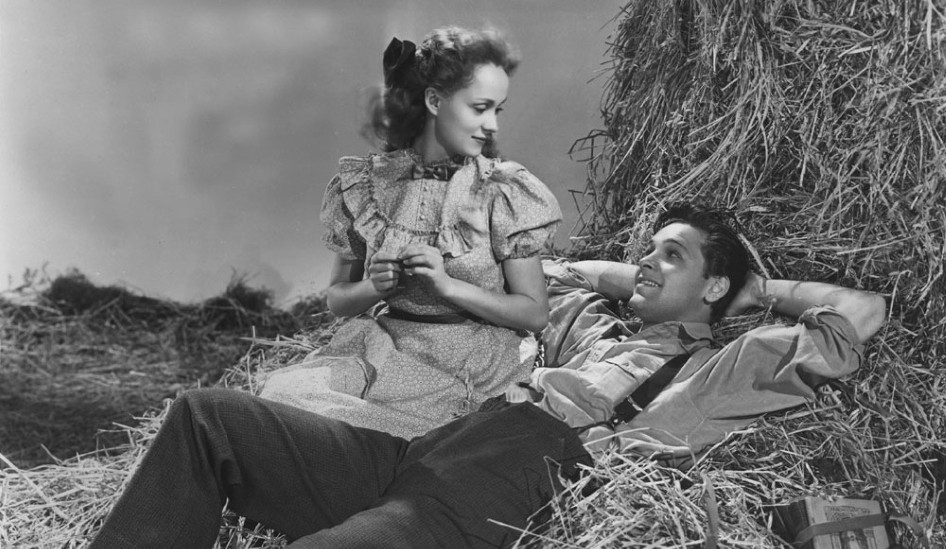
An attempt to take an unfilmable play to the screen doesn’t really work but has its moments
Director: Sam Wood
Cast: William Holden (George Gibbs), Martha Scott (Emily Webb), Fay Bainter (Julia Gibbs), Tim Davis (Joe Crowell Jr), Beulah Bondi (Myrtle Webb), Thomas Mitchell (Dr Frank Gibbs), Guy Kibbee (Charles Webb), Dix Davies (Si Crowell), Stuart Erwin (Howie Newsome), Frank Craven (Stage manager)
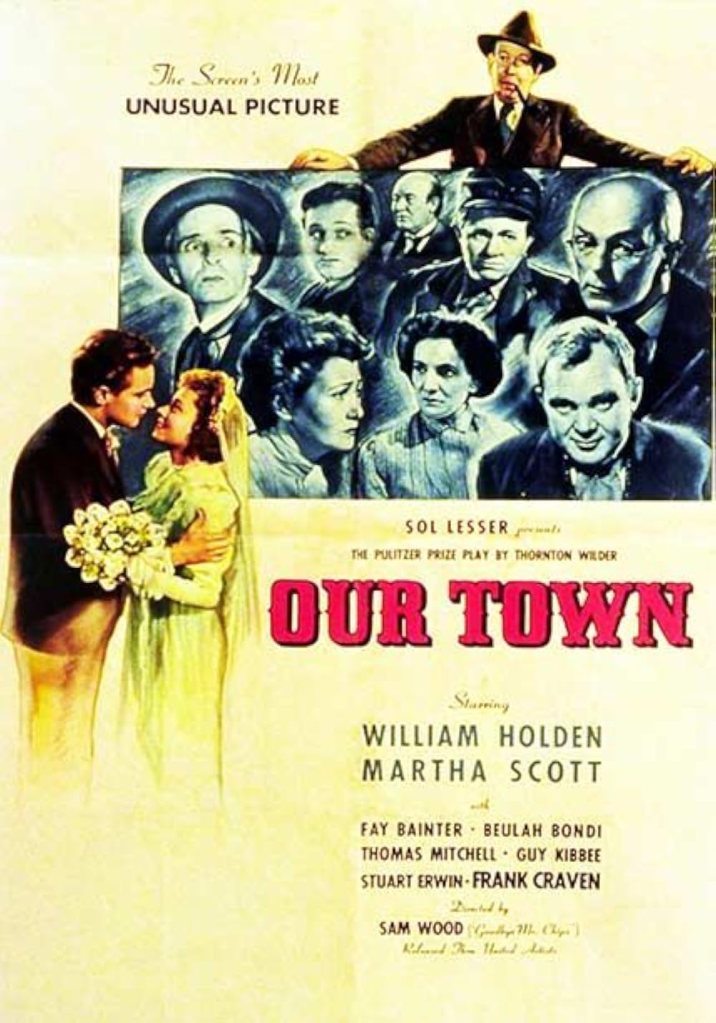
Thornton Wilder’s Our Town is a landmark in American theatre. A play diving into peopes lives in a small American town over thirteen years, told to us by an omnipotent stage manager, it’s a theatrical staple. An intensely theatrical piece, deliberately staged with few props and staging, with the world of the town created by the actors, playing multiple roles, it’s miles away from the realism of film. Despite this, its success made a screen transfer both inevitable and a seemingly impossible task.
Nearly all the elements of the stage triumph are there. The stage manager – here billed in solely in his more formal ‘role’ as drugstore owner Mr Morgan – is still there, introducing Grover’s Corner and moving us through the years, frequently interjecting to guide the characters into place or move them along. The lives we follow are the same: young schoolfriends and neighbours turned married couple George Gibbs (William Holden) and Emily Webb (Martha Scott). A first act introduces the town, a second focuses on George and Emily’s wedding day (with flashback to the realisation of their mutual love) and a final act focuses on Emily’s childbirth deathbed, her spirit moving among the fallen.
What it can’t quite capture is the mythical, theatrical magic of the more impressionistic original. Where the theatre draws on the viewer’s imagination, Our Town is full of intricately created sets, households crammed with period appropriate props and recreated streets of Grover’s Corner. While the stage manager remains present, his role as both an identifiable character and an omniscient narrator is deliberately blurred – and clumsy attempts to recreate a few moments of audience interaction (muffled voices off camera shouting questions at the experts the stage manager brings on to introduce the town) don’t really work at all.
Some of these were inevitable when the media switched. Thornton Wilder was heavily involved in adapting his play, including signing off (or, perhaps, even suggesting) the change to the play’s conclusion to shift Emily’s heartbreaking experience of the loneliness of the afterlife into being a dream during her recovery from terminal illness. It’s arguable no Hollywood film would have dared stage something as expressionistic as the original stage work (you’d have to wait almost seventy years before Dogville did – but that was a very different film, a dark commentary on Our Town). Despite this, the shift of media left designer William Cameron Menzies as a strong creative force – arguably more so than director Sam Wood – whose designs charted Grover’s Corner’s layout and also the camera positioning and framing for nearly every shot.
This framing frequently uses low-angles, with the camera positioned low to the floor, close to surfaces like tables, or in the corners of rooms staring up at the actors. This effect adds a mythic, almost Homeric, scale to the action. It’s complemented by Aaron Copland’s score, a series of beautifully poetic compositions which carry real emotional force. The final visions of the afterlife have a starkly lit, gloomy power: deceased characters stand on their graves in theatrical beams of light, speaking with coolness to the middle-distance, their graveyard mixing with the fields surrounding the town, which the Stage Manager will walk across like some sort of medieval prophet presenting Grover’s Corner like a celestial PowerPoint. It’s striking, like something out of Dreyer.
Lots of this works. But it’s a complex, well-planned attempt to utilise the realism of film to make something that relies on simplicity and theatrical minimalism to carry emotional impact. On stage this minimalism gives the simple, beautifully low-key stories of Grover Corner a universal power, generations have found moving. But on screen, the detail and design (however hard it tries) drains this power out of the dialogue. In fact, it makes most of the play feel like what (on the surface) it is: ordinary people, having small, everyday, frequently undramatic conversations during which very little happens or changes. Put simply, it makes Our Town feel like it’s about not very much at all, and it’s very easy to let your attention drift.
This is despite the fine efforts of the cast. While William Holden is a little raw and slightly too lightweight as the well-meaning but not too bright George, Martha Scott is first rate as Emily. Narrowly winning the right to recreate her stage role, Scott gives Emily a radiant intelligence and a lovestruck adoration of George while just about managing to suggest that (in the long run) she might have found the slightly plodding George rather trying. Frank Craven also recreates his stage role with assured, authoritative effect. A host of fine Hollywood supporting players give wonderfully heartfelt performances, especially Mitchell, Kibbee, Bainter and Bondi as the parents. Mitchell in particular has a fine speech of fatherly concern.
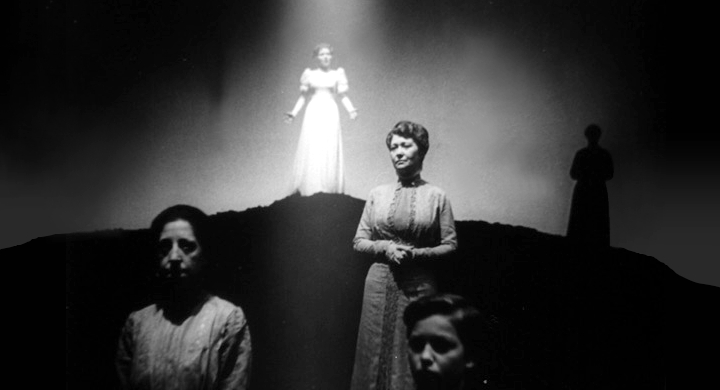
Where Our Town really stands out is that sad, insightful view the loneliness and isolation of death and the purgatory stage of the afterlife. Sure, the film may undermine this with its cop out idea that Emily lives (undermining much of the stage manager’s message about the inevitability of the universal human journey to death). But the imaginative transitions (especially a wall of pictures to a field of graves, or a bedsheet to a funeral march through the hills) are beautifully done. The composition of the vision of the dead on their tombs – with their disconnected, dwindling personalities – has a deeply moving Bergmanish beauty to it. Despite the slightly cheesy view of a ghoulish Emily watching a day in her life, the sequence is the closest the film gets to capturing something of the universal power of the original play.
But it’s a solitary moment in a film that otherwise struggles to find a middle ground between theatricalism and realism. Imagine if Hollywood had been brave enough to try and do something without the realism, to present something that really was (as the poster blared) “the season’s most unusual picture”. But that’s not Hollywood is it?

