Tag: Tim Pigott-Smith

Escape to Victory (1981)

Escape to Victory (1981)

The sort of odd movie pitch that could only have been made in the 80’s: it’s a POW film – but with footballers! And Stallone in goal! Cult nonsense, but fun.

Director: John Huston

Cast: Sylvester Stallone (Captain Robert Hatch), Michael Caine (Captain John Colby), Pelé (Cpl Luis Fernandez), Max von Sydow (Major Karl von Steiner), Bobby Moore (Terry Brady), Osvaldo Ardilles (Carlos Rey), Paul von Himst (Michel Fileu), Kazimier Deyna (Paul Wolchek), Hallvar Thoresen (Gunnar Hilsson), Mike Summerbee (Sid Harmor), Russell Osman (Doug Cluire), John Wark (Arthur Hayes), Daniel Massey (Colonel Waldron), Tim Pigott-Smith (Major Rose), Carole Laure (Renee)

It’s possibly the most bizarre idea in movies. An old-school, boy’s-own-adventure about POWs starring a Panini sticker album’s worth of footballers, led by Michael Caine and Sylvester Stallone playing the Germans (actually represented by a team of ringers from the New York Cosmos) in a ‘friendly’ football match in Paris. Oh, and it’s directed by John Huston. Who thought this one up?

Needless to say Escape to Victory is a cult hit. Caine plays professional footballer John Colby, his career interrupted by internment in a POW camp, challenged to an exhibition match by football-mad Major von Steiner (Max von Sydow). When von Steiner’s bosses turns the game into a propaganda vehicle, Colby is under intense pressure to pull out. When he refuses – not wanting to put his players lives at risk, some of whom (the Eastern European ones) have been rescued from labour camps – instead he is asked to accommodate a daring escape plan, led by American Robert Hatch (Sylvester Stallone) who joins as ‘trainer’ and back-up goalie. With the match scheduled, a plan is formed: the team will escape at half time. But will the players abandon the game, or will sporting pride kick in?

Well, what do you think? The whole film is a build up to the game. Are they really going to leave it at 4-1 to the Germans? The pedestrian opening two thirds of the film can pass you by. You certainly feel it passed John Huston by (if you ever want to see a great director do a pay cheque movie, watch this). The film settles into familiar rhythms of both genres (sports and POW movies) mashed together. For the latter; forgers, escape committees, roll-calls, daring escape attempts over and under wire, muttered attempts to board trains with fake papers are all dutifully ticked-off. Nothing unusual: the interest is all in the sports film.

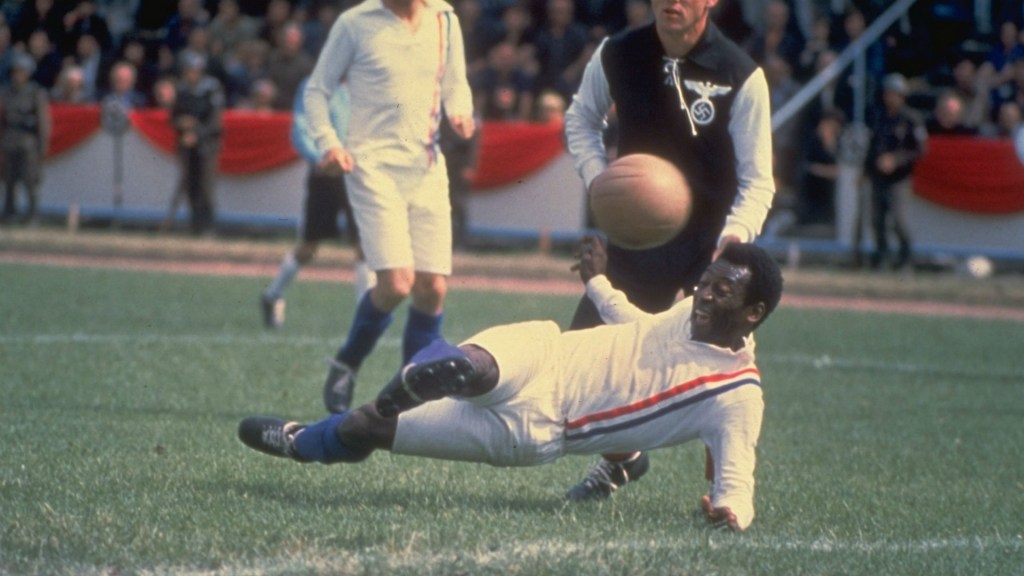
And if you are going to make a sports film – crammed with training montages – who else would you hire than a dream list of footballers to perform them. And no footballer was more of a God-like figure than Pelé. Welcome to the only film the Greatest Player Ever made (as soon as he opens his mouth, you’ll see why). Alongside him England’s legendary World Cup winner Bobby Moore, charming Argentinian Ossie Ardilles (not trusted with a line), several other internationals from across Europe and (filling out the numbers) half a dozen players from Ipswich Town (though, to be fair, John Wark might just be the best actor). Most of the best parts involve watching these stars go through their paces.
Michael Caine – who only took the film so he could say he had genuinely played with Pelé – anchors all this reasonably well (even though, at 47, he looks noticeably out-of-shape considering he’s playing an international footballer at the peak of his career). The role of Colby is no stetch for him, but Caine conveys carrying responsibility rather well, and there is some decent material as he butts heads against the unhappy upper-class officers who want him to tell the Germans to shove it.

The officers – decent performances from Daniel Massey and Tim Pigott-Smith among others – point out the Germans won’t give them a sporting chance. But, this is the sort of film where boy’s own pride kicks in, and we get a classic ‘let’s show em’ attitude. This culminates, of course, in the half-time planned escape attempt being aborted as the players protest “We can win this!” and the side head back out for the second half (and, of course, glory).

It’s a big shout as our heroes take a heck of a drubbing in the first half. (This despite Caine’s ahead-of-his-time coaching advice to make the ball do the running, which sounds like tika-taka seventy years early – was Escape to Victory required viewing in Spanish football academies?). To the disappointment of von Steiner – our token ‘Good German’ played with his customary professionalism of von Sydow – who gave his word it would be a fair game, his superiors hire “a very good referee” who will “make no mistakes”. German tackles fly in un-punished, a dubious penalty is awarded and Pelé’s ribs are broken in a filthy foul forcing the team to play with ten men. Those dirty, cheating Germans! Thank goodness Bobby Moore scores to give them a chance.

Every star player gets their moment in the spotlight, most of all Pelé who scores with a trademark bicycle kick. (I wonder if Pelé counted this one in his career goals record?) It’s a breath-taking piece of skill – von Steiner even proves his “Decent German” credentials by rising to applaud (to the fury of his fellow officers). Our heroes pull it back to 4-4 before having a goal disallowed for a false off-side (mind you it feels less inexplicable in an age where VAR chalks off goals for offside elbows). Then of course the Germans are awarded a penalty as the last kick of the game after a fair tackle by Ardiles.

And so, we come to Stallone. Perhaps the most inexplicable thing in this, the Italian Stallion at least convinces as a man who knows nothing about football. Looking trim, Stallone handles most of the POW and escape stuff (and a token romance subplot with a French resistance fighter) but of course space had to be made for him in the game. So, he plays as keeper (the team’s first choice keeper volunteers for Caine to break his arm so Stallone can be released from lock-up to play in the film’s most difficult to watch moment). Stallone wanted to score the winning goal, but was told that was unlikely for a keeper, so instead he saves the penalty to preserve the moral victory. Stallone mumbles his way through the film, feeling bizarrely out of place, but he was the big star.

Escape to Victory is a truly bizarre thing. But it’s got a fun football game in it and as sort of exhibition match it’s a bit of a treat. And watching it shortly after the passing of Pelé, it feels almost like a rather lovely tribute.

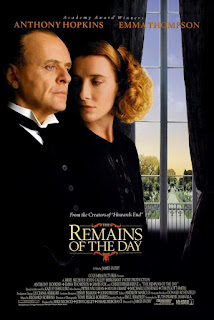
The Remains of the Day (1993)

The Remains of the Day (1993)

Hopkins and Thompson are marvellous in this masterful adaptation from Merchant-Ivory

Director: James Ivory

Cast: Anthony Hopkins (Mr Stevens), Emma Thompson (Miss Kenton), James Fox (Lord Darlington), Christopher Reeve (Congressman Jack Lewis), Peter Vaughan (Mr Stevens Snr), Hugh Grant (Reginald Cardinal), Michael Lonsdale (Dupont D’Ivry), Tim Pigott-Smith (Mr Benn), Ben Chaplin (Charlie), Patrick Godfrey (Spencer), Lena Headey (Lizzie), Pip Torrens (Dr Carlisle), Paul Copley (Harry Smith) Rupert Vansittart (Sir Geoffrey Wren), Peter Eyre (Lord Halifax), Wolf Kahler (Ribbentrop)

Kazou Ishiguro’s Booker-prize winning novel The Remains of the Day is one of my all-time favourites. So, it’s not a surprise I’m a huge fan of this masterful adaptation from the House of Merchant Ivory. I’m certain this is the apex of the team’s work. Mike Nichols had originally planned a film but, wisely, recognised when it came to making movies about repressed 1930s Brits, one team had a monopoly on how to do it best. Beautifully adapted by their regular screenwriter Ruth Prawer Jhabvala, The Remains of the Day is a wonderfully involving and deeply moving film.

Stevens (Anthony Hopkins) is a butler in a British country house purchased in 1956 by American Jack Lewis (Christopher Reeve). Keen to solve staffing problems (and for no other reason at all), Stevens journeys to the West Country to recruit the 1930s housekeeper, Mrs Benn nee Kenton (Emma Thompson). During the journey, he remembers his service for the previous owner, Lord Darlington (James Fox). An impeccable gentleman, Darlington dedicates himself to reconciliation between Nazi Germany and England, eventually tipping into an unwise dalliance with fascism and appeasement.

Stevens had no views on that though. In fact, he prides himself on his anonymity. The goal of his life is to maintain a dignified unobtrusiveness, ensuring the smooth operation of everything, leaving as little a mark as possible. Nothing can intrude on that: not his own feelings, the illness and death of his under-butler father (Peter Vaughan) and, above all, the unspoken romantic feelings between himself and Miss Kenton. The Remains of the Day is about duty and obsession and how a fixation on both can leave someone with little to show from a long life.

Stevens is living the lessons he learned from his father, an ageing powerhouse masterfully played by Peter Vaughan, who undergoes a physical collapse (from dripping nose to dropping trays) and bouts of forgetfulness, eventually dying on a night Stevens is too busy seeing to the sore feet of an illustrious French guest to spare a moment to visit him. It tells you everything about his character that this stiff-upper lipped commitment to duty is a source of pride to our hero.

There are few as curiously blank ‘heroes’ in literature than Stevens. The narrator of Ishiguro’s book is a dull, fussy, unbelievably cold man who has dedicated himself so fully to duty that he has let any emotional life wither and die on the vine – something he only realises far too late. It’s an immensely challenging role, bought to life masterfully by Hopkins. Hopkins astonishing skill here is to play all that repressed coldness on the surface, but also constantly let us see the emotion, longing and regret he is subconsciously crushing down play in his eyes and the corners of his mouth. Is Stevens even aware how much self-harm he is causing? It’s an astonishingly subtle performance.

So subtle in fact that the books conclusion – Steven’s tear-filled confession to a stranger late at night of all the mistakes he has made – was filmed but cut for being superfluous. Hopkins had done the lot, all the way through the movie, through acting skill. You can’t miss the struggle within him, not least the desperate, powerless longing he feels for Miss Kenton that, for oh-so-English reasons he can never admit to himself. Hopkins has the vocal and physical precision, but every gesture tremors with unspoken, barely understood longings. In fact, it’s a shock when he exclaims an angry “Blast” after dropping a bottle of wine (the real cause of his outburst being, of course, Miss Kenton’s announcement that she is getting married)

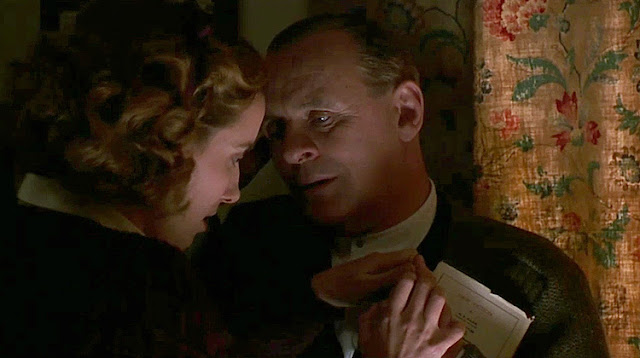
He and Miss Kenton conduct a professional relationship that blossoms into something like a friendship – but he consistently rejects her polite efforts to take it further. In the film’s most powerful scene, Miss Kenton enters his parlour and playfully tries to see the title of the novel he’s reading (a sappy romance). The playfulness tips into agonisingly awkward tenseness as Hopkins’ Stevens seems paralysed, his hand lingering inches from her hair but unable to bring himself to break decorum and fold her in an embrace – all while Miss Kenton continues her increasingly desperate semi-flirtatious banter. It of course ends with Stevens dismissing her: just as later he will take a snap of frustration as a signal to irrevocably cancel their late-night cups of cocoa together.

Emma Thompson is wonderful as a woman only marginally more in touch with her feelings and longings than Stevens is: aware that she, eventually, wants more from life, but unable to find the way of communicating the love she clearly feels for Stevens in a manner he can respond to. Instead, the two of them oscillate between a friendly, affectionate alliance and a discordant arguments (their only outlet for their passion), rooted in their inability to admit their feelings for each other. To further stress the point, both of them mentor young staffers (played by a very young Ben Chaplin and Lena Headey) who have the youthful “what the hell” to jack in all this for love.

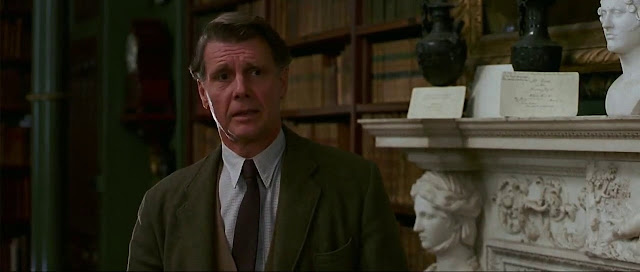
Ivory’s wonderfully subtle film makes clear this is a turning point in history, the final hurrah for the this sort of deferential hierarchy. Stevens is the last of a generation of butlers, convinced that what their employers got up to had nothing to do with them – views not shared by Tim Piggot-Smith’s more grounded Benn, who chucks in his job working for a bullying blackshirt (who else but Rupert Vansittart?). Throughout the 1950s storyline, Stevens is constantly asked if he knew the infamous Lord Darlington (a sort of Lord Londonderry figure, hopelessly taken in by Hitler) – in fact, like Paul, he twice denies ever having known him.

And you can understand why, as the film has sympathy for Lord Darlington. As his decent, liberal god-son Reginald Cardinal (an excellent Hugh Grant) says, Darlington is a great asset for Germany precisely because he’s honest, well-meaning and motivated by a desire for peace. The fact that his leads him to consort with a host of Nazis, Blackshirts and the most appalling anti-democratic vestiges of the upper-classes (at one point, Stevens selflessly gives a performance of geopolitical ignorance so as to help demonstrate why men like him shouldn’t have the vote) is an unfortunate side-effect.

Played perfectly by James Fox, Darlington is misguided but genuine. As war approaches, he leads an increasingly hermit like life – camp-bed and paper-strewn, messy library – hosting conferences denounced by Jack Lewis (a fine Christopher Reeve) as a host of amateurs talking about a world they no longer understand. Beneath it all, Darlington is guided by fair play. So much so, it’s almost distressing to see him (under the influence of an attractive German countess) reading anti-Semitic pamphlets and sacking two refugee Jewish maids – an act he later regrets (far too late). This moment also reinforces Stevens’ compromised pig-headedness (not his place to judge!) and Miss Kenton’s fear to act (she’s horrified, but to scared of unemployment to hand in her notice).

All of this culminates in a series of scenes where emotions pour out of the actors, even while their words are banal and everyday memories and reflections. Ivory was never more confident and skilled behind the camera, and the film is a technical marvel, beautifully shot with a wonderful score from Richard Robbins. Hopkins is phenomenally good, simultaneously pitiable and smackable, Thompson is wonderful alongside him, Fox and Grant perfect – it’s a very well-acted piece. And a wonderfully perfect capturing of a classic modern British novel. No doubt: the best Merchant Ivory film.

Victoria and Abdul (2017)

Victoria and Abdul
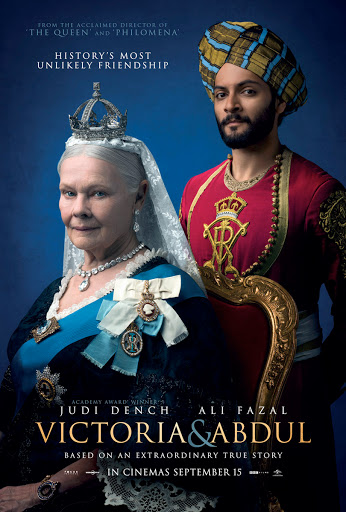
Judi Dench and Ali Fazal forge an unlikely friendship in the tame heritage flick Victoria and Abdul

Director: Stephen Frears

Cast: Judi Dench (Queen Victoria), Ali Fazal (Abdul Karim), Tim Pigott-Smith (Sir Henry Ponsonby), Eddie Izzard (Prince Albert), Adeel Akhtar (Mohammad Bakhsh), Michael Gambon (Lord Salisbury), Paul Higgins (Dr James Reid), Olivia Williams (Baroness Spencer), Fenella Woolgar (Harriet Phipps), Robin Soans (Lord Stamfordham), Simon Callow (Giacomo Puccini)

In the last decade of her life, Queen Victoria (Judi Dench – who else?) makes an Indian servant, Abdul Karim (Ali Fazal), one of her closest friends and advisors. As Victoria and Abdul become closer, the rest of the court are outraged – bad enough that the Queen is spending all this time with an over-promoted servant, but an Indian as well?!

The fundamental events of Victoria & Abdul are true. There was a man called Abdul Karim – and Victoria did raise him from servant to a confidant. He did cause conflict in the royal household and was finally sent back to India after her death, after surrendering most of his papers. But Victoria & Abdul repackages this friendship into a cosy, Sunday-afternoon entertainment, bereft of depth. And carefully works on the rough surfaces to make the story smooth and easy to digest.

The film is clearly trying to ape the success of Mrs Brown – a far more intelligent and emotionally complex (if similarly heritage) film that looked at Victoria’s previous all-consuming friendship with a male servant, John Brown. But that film didn’t close its eyes to the negatives of such relationships, as this one does. It made clear royal attention can be fickle – and being elevated above others can help make you your own worst enemy. In that film, after a honeymoon, the friendship declines into one of residual loyalty but reduced affection. It’s a realistic look at how we might lean on someone at times of grief, but separate ourselves from them later. Victoria & Abdul takes only one lesson from Mrs Brown: that a close bond between monarch and commoner is heart-warming.

The film in general is in love with the idea that if the Queen could only speak directly to her people, the world would be a better place. It presents a Victoria stifled by court procedure who knows very little about her empire and is constrained by the courtiers around her. It wants us to think that if the Queen took direct rule, she’d be kinder, wiser and more humane. That this figurehead symbol could craft a better British Empire if she was an absolute monarch.

Unfortunately, it doesn’t work. This romantic view of “Victoria the Good” is comforting stuff, but undermined even within the film by our introduction to the Queen at a royal dinner, where Victoria stuffs food down herself so quickly that mountains of untouched food goes uneaten on the plates of the other diners (as all plates are removed the moment she is finished). And despite being told that the Koh-i-noor diamond was stolen by the British (to her surprise), she still doesn’t think twice about wearing it later in the film while in the midst of her Indian passion. And while the real Victoria loathed the racist attitudes of some at her court, she still clearly sees herself as a paternalistic mother figure for India, which could of course never be able to make its own decisions about things.

Not that the film is interested in tackling more complex ideas of the position of India and its independence. It’s similarly confused by Abdul himself. In a more interesting film, Abdul would have been partly naïve servant and partly charming rogue. He very carefully spins an invented story of himself as a teacher and thinker (he’s actually a clerk from a fabric office) and it would have been interesting to see his building of a relationship with Victoria at least partly being based on self-gain. He certainly gains an awful lot from her – from his own carriage on her train to a home and his own servants. It would have been possible to have this side of him and still have his loyalty and friendship to the Queen being genuine. But it’s too much for the film to tackle.

An Abdul who was consciously playing a role of exotic thinker might have come across as a scam-artist – but would have given the film a lot more to play with, when the royal court is full of people positioning and presenting themselves for influence. Adeel Ahktar’s fellow-servant Mohammed even suggests in one scene that this is what Abdul is doing – and good luck to him. But the film is scared that this could be seen as endorsing the court’s fears about Abdul. So the character is neutered into nothing: he becomes exactly the sort of empty “exotic”, free of opinion and character, that filled out the extras list of a 1940s epic. He has no agency, never makes any decision or expresses any opinion. And his feelings for Victoria are presented as totally genuine which, combined with his foot kissing, turns him into someone who looks and feels really servile.

This is because the film wants to tell the story of a perfect friendship, with the British upper classes as the hissable baddies (never mind that no one is more upper class than Victoria). Never mind that Abdul’s action will indirectly condemn Mohammed to death in the British climate – or that while Abdul rises, Mohammed becomes his servant, still consigned to sleeping on the floor of his railway carriage. We learn nothing about Abdul. How did this clean-living saint become riddled with the clap? Why did he die so young? Did he really think nothing of the riches and honours Victoria showered him with? We don’t have a clue.

Instead the film keeps it simple with goodies (Victoria and Abdul) and baddies (almost everyone else). The most politically astute character, Mohammed, disappears and never allows things to get unpleasant. Jokes of the courtiers standing around aghast saying things like “Now he’s teaching her Urdu” are repeated multiple times. They’re fun, but it substitutes for dealing with the real issues.

It all has the air of ticking boxes. Frears’ direction is brisk, efficient and free of personality. Dench is great, but she could play this role standing on her head while asleep. Pigott-Smith (in his final role) is fine but Farzal has nothing to work with and Izzard provides a laughable pantomime role of lip-smacking villainy as the future Edward VII. The finest performance – handling the most interesting material – is from Ahktar. He’s the only character who seems to place what we see here in any form of context. Other than that, this film is just a string of very comforting heritage ideas, thrown together with professionalism but a total lack of inspiration.

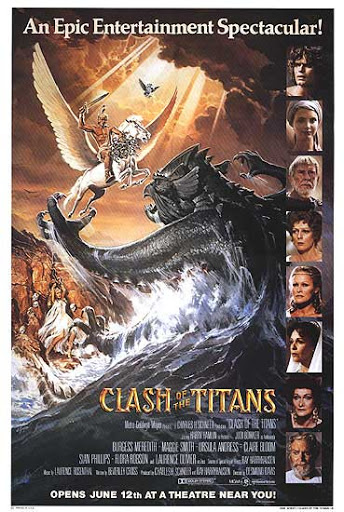
Clash of the Titans (1981)

Clash of the Titans header
Harry Hamlin takes on monsters in Clash of the Titans

Director: Desmond Davis

Cast: Harry Hamlin (Perseus), Judi Bowker (Andromeda), Burgess Meredith (Ammon), Maggie Smith (Thetis), Sian Phillips (Cassiopeia), Claire Bloom (Hera), Ursula Andress (Aphrodite), Laurence Olivier (Zeus), Susan Fleetwood (Athena), Tim Pigott-Smith (Thallo), Jack Gwillim (Poseidon), Neil McCarthy (Calibos), Donald Houston (Acrisius), Flora Robson, Freda Jackson, Anna Manahan (Stygian Witches)

It’s almost impossible not to have a soft spot in your heart for Ray Harryhausen’s stop-motion magic. The best of Harryhausen – and for me surely that’s his superb Jason and the Argonauts – has a magic that few other films can match. A magic born of awe at the technical skill and patience needed to bring it to the screen and the boundless imagination behind them. For all that they are no more real than the CGI of today, there is an emotional connection you can form with watching something where you know each frame was painstakingly hand-made, that you can’t quite feel for the scope of a computer-born Marvel world. Clash of the Titans was the last hurrah for Harryhausen. It’s far from perfect, and even in 1981 it looked dated and almost a relic from another era – but it still carries enough entertainment value.

We’re back in the mythology of ancient Greece. As a boy, Perseus (Harry Hamlin) and his mother are sent out to sea to drown by his Grandfather King Acrisius of Argos (Donald Houston), jealous of her love from Perseus’ father, the God Zeus (Laurence Olivier). Zeus orders Argos destroyed by the Titan sea monster the Kraken. Years later Princess Andromeda (Judi Bowker) of Joppa is due to marry Calibos (Neil McCarthy), son of the Goddess Thetis (Maggie Smith). But Calibos is cursed by Zeus, turned into a monster for his crimes. Andromeda is cursed by Thetis to only marry a man who can answer a riddle (set every night by Calibos). Perseus – using gifts from Zeus – discovers the answer to the riddle, confronts Calibos, cuts off his hand and is set to marry Andromeda.

But when Andromeda’s mother Cassiopeia (Sian Phillips) claims her daughter is more beautiful than any of the Gods, Thetis condemns the Andromeda to be consumed by the Kraken, or the city to be destroyed. To stop this, Perseus – with the quiet help of Zeus and his winged horse Pegasus – must travel across Greece to obtain the head of Medusa, who turns all who look upon her to stone.

Well, in case you were in any doubts (and I really struggled to write those last couple of paragraphs), one of Clash of the Titans main faults is that it’s plot is a mess (a combination of several Greek myths into one story) and lacks either a clear narrative thrust or a clear villain. It’s without focus, flabby and has so many sub-clauses in its structure, you either need to concentrate or just switch off and take it on a scene-by-scene basis. It’s summed up by the meaningless title which – for all Flora Robson’s Stygian witch shrieks “a titan against a titan!” mid-way through the film – barely relates to the plot.

The film also suffers from an over-abundance of characters (Gods, Kings, warriors, monsters) many of them only vaguely outlined. But with so much going on (and so much plot to cover in the slight running time) it all pulls focus from our two leads. Harry Hamlin’s Perseus is a dull, uncharismatic figure who it’s hard to get interested in. Judi Bowker fares a little better as Andromeda, but her brief moments of proactivity are only byways before she becomes a damsel in distress, chained to a rock. Neil McCarthy as nominal villain Calibos is undermined by only getting to play the character in close-up (in all other shots he’s all too obviously replaced by a tailed stop-motion monster), and in any case the character is barely given any decent motivation or background.

It doesn’t help these underpowered leads that there are a host of famous actors picking up pay cheques around them. Laurence Olivier made no secret of the fact that a large cheque (and only a week’s shooting time) was what bought him on board as Zeus (although the part is a good fit for his grandeur). Claire Bloom and Ursula Andress signed up for similar reasons. Maggie Smith (who was married to the screenwriter) seemingly did the film as a well-paid favour. Burgess Meredith repackages his role from Rocky as a poet turned advisor to Perseus. I will say Tim Pigott-Smith does a decent turn as the head of Joppa’s royal guard. But these are paper-thin characters, given what life they have by the actors rather than the script.

But Clash of the Titans is all about those Harryhausen set-pieces, with everything else just over-complicated filler to get us from place-to-place. Desmond Davis’ uninspired and flat direction doesn’t help, with the action too often presented in basic medium shot and frequently over-lit – a lighting set-up that doesn’t help to make the effects look particularly convincing. The film feels confusingly pitched, part a kids film, part an appeal to nostalgic adults. Neither seems to particularly work, and the film ends up looking rather uninspired.

This was the last hurrah for this sort of stop-motion. Star Wars had reset the table completely for adventure films like this. Clash of the Titans feels like a feeble attempt to address this challenge – right down to the irritating robotic owl Bubo, a clear rip-off of R2-D2 right down to his bouncing movement and dialogue of beeps. The film goes for making things as big as possible – the gigantic kraken, the huge scorpions – but everything in it looks a little tired.

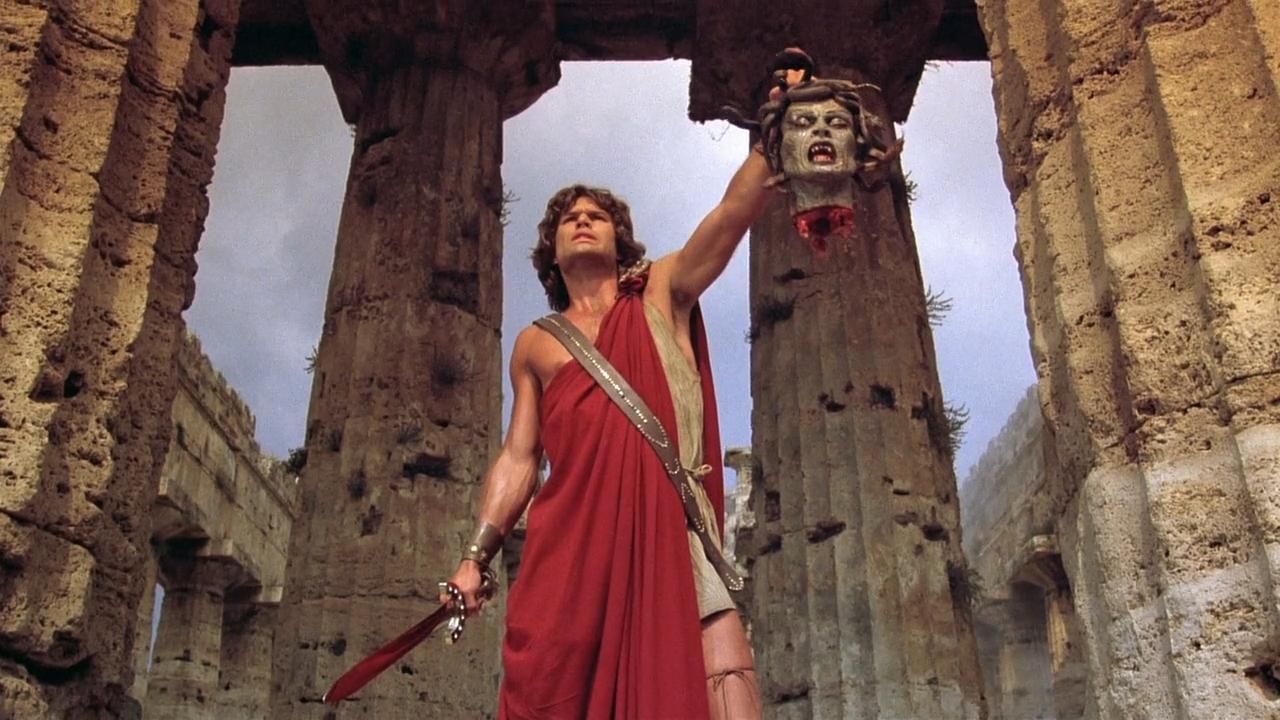
Davis’ uninspired direction and the film’s flatness doesn’t help – or its general air of fusty, dusty oldness. If Jason and the Argonauts has all the charge and energy of a young man’s film (from its sharp direction, pacey plot, neatly drawn characters and Herrmann’s score), this really feels like a middle-aged Dad trying to be hip. The Kraken’s destruction of Argos seems to consist of little more than a few toppling pillars. The beast is slow, cumbersome and takes forever to do anything. An extended sequence where our heroes fight a two-headed dog is both dull and laughable. The only classic piece of stop-motion here is Medusa. Surely no coincidence that this is the most atmospherically shot sequence, with lighting that helps to hide the joins between stop-motion and reality in a way the rest of the film ruthlessly exposes.

Clash of the Titans is a film you can feel a nostalgia for – but really it’s actually rather naff. It’s badly plotted – surely the story could have been told in a cleaner way than this confused mess. Too many actors either phone it in, or fail to deliver the charisma needed (Todd Armstrong in Jason is no Olivier, but at least he had a matinee idol robustness Hamlin lacks). It’s limply directed. Worst of all, too much of the stop-motion looks a little silly – the film failing to cover up the cracks and too frequently exposing the joins rather than disguising them. Show this one to someone first, and you’ll never get them back to watch the best of Harryhausen. While I always enjoy it – for nostalgia if nothing else – its a cult classic, but no classic.