
Szabó’s completes his trilogy with a film that’s covers familiar ground, offering little new
Director: István Szabó
Cast: Klaus Maria Brandauer (Klaus Schneider/Erik Jan Hanussen), Erland Josephson (Dr Bettelheim), Ildikó Bánsági (Sister Betty), Walter Schmidinger (Propaganda chief), Károly Eperjes (Captain Tibot Nowotny), Grażyna Szapołowska (Valery de la Meer), Colette Pilz-Warren (Dagma), Adrianna Biedrzyńska (Wally), György Cserhalmi (Count Trantow-Waldbach), Michał Bajor (Becker), Jiří Adamíra (Rattinger)

For their third collaboration, István Szabó and Klaus Maria Brandauer found a subject that lies somewhere between Mephisto and Colonel Redl. Hanussen is about the fall of a decrepit old regime, the rise of Fascism in Germany and has a tortured individual at its heart. Klaus Schneider (Klaus Maria Brandauer) is an Austrian veteran of World War One who discovers, while treated at a military hospital, that he has unusual powers of hypnotism and can predict the future. Under the stage name Hanussen, he becomes a sensation. But these powers prove dangerous in early 30s Germany as his predictions move from being a tool to being a threat of the Nazi regime.
It should work an absolute charm, but Hanussen never quite comes into focus as a truly compelling story. Even Szabó has claimed he considers the film a failure. Perhaps it’s because Hanussen misses the mark in its exploration of Hitler and the Nazi regime. There is a film crying out to be made from this material that explicitly compares and contrasts Hanussen and Hitler’s mesmeric power over crowds. Instead Hanussen plays lightly with their similarities – both wounded, Austrian war veterans who can control crowds and exert a mesmeric control over people in front of them – but ends up saying almost nothing about them. Worse, it jettisons almost all together the crucial difference between them: Hanussen’s historical Jewishness.
It’s a disappointing destination considering the film starts very strongly. It’s opening scene is truly striking, playing out over a birds-eye-view of an Austrian trench, leads into a symbolism-heavy attack on a church where soldiers are mown down in a graveyard. As is Schneider’s struggle with shell-shock and a head wound, under the fatherly care of Erland Josephson’s humane (but extremely selfish) Dr Bettelheim. This care sees an almost parental bond between the two, Bettelheim cuddling Schneider on a chaise longe (an image Szabó mirrors later in the film with their positions reversed).
Hanussen leaves carefully open the level of Schneider’s mesmeric and prophetic powers. When Scheider talks down a suicidal, grenade-clutching, ward patient with a wavering calm and improvisational instructions, he seems as surprised as everyone else when patient falls asleep as ordered. Both he and Bettelheim discuss the strange sensations they feel of feelings of foreboding about events. Hanussen’s prophetic powers seem to give him stress and uncertainty. He’s alarmed when he successfully predicts the exact price drop of cotton shares during the depression, and is clearly deeply uneasy about his insights into the later rise of Hitler to power.
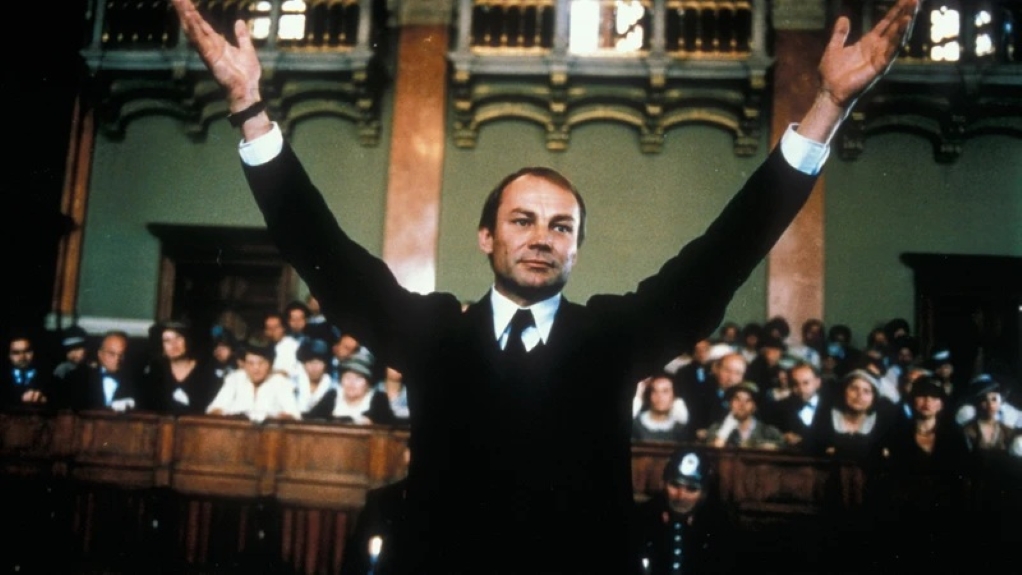
But much of this is real insight, and how much is his innate ability to understand people? Hanussen talks of Hitler as someone who is obviously intent on taking power no-matter what, and only a fool could miss this. Are his predictions clever empathy? He frequently makes revelations about people that could be educated guesses based on their character. His abilities to control and hypnotise people fluctuate. On stage he seems all powerful. In a courtroom – essentially another form of stage – he controls events and seemingly makes people stand in the room at his command. He can charm all women into his bed but makes a point that he cannot make them do things. For a skilled mesmerist he is frequently oppressed by events around him.
There are some rich themes here, but Hanussen ends up taking them to places that are neither particularly interesting or feel that different to Szabó’s previous films. The rise of Fascism seems rushed, as does Hanussen’s clumsy working with the party. Objections to his predictions of their rise from his disillusioned manager feel forced. Characters that are obvious stand-ins for Goebbels and Leni Reifenstahl feel absurdly lightly sketched – no comparison to the monstrous egoism of the Goering stand in of Mephisto – and their links to Hanussen barely make an impression. Hanussen agrees to a photo shoot where he inadvertently parrots/predicts Hitler’s own distinctive gestures in speeches, but it’s a point that feels tossed off rather than really defined.
There is a point in here that predicting the future is, in itself, a dangerous political act. That the Nazis themselves see the advantage when Hanussen speaks of their rise to power, but dispatch him once he starts to talk about things like the future Reichstag Fire. But to really make that clear, the film needs more of Hanussen’s outlining the horrors to come. And more of the danger this poses to the Nazis. Or it needed to bring out more clearly the fatalism Hanussen seems to feel as events take their path towards his inevitable death. We get neither of this. Instead events drift towards a dark conclusion that feels obligated rather than a thematic conclusion.
Which is not to say this film doesn’t feature another wonderful performance from Brandauer. He is, as always, effortlessly charismatic while giving Hanussen a quieter vulnerability behind his mesmeric control.He makes Hanussen a man relentlessly determined to be an individual, to walk his own life and who believes his independence will keep him free from getting wrapped up in the “sides” building around him. He’s wrong of course, but Brandauer is able to subtly suggest a fatalism and arrogance in him the film isn’t able to more fully bring out.
But it’s a shame that Hanussen becomes the last and least of a striking trilogy, that largely covers the same ground but less effectively or interestingly, with no new angles.

