
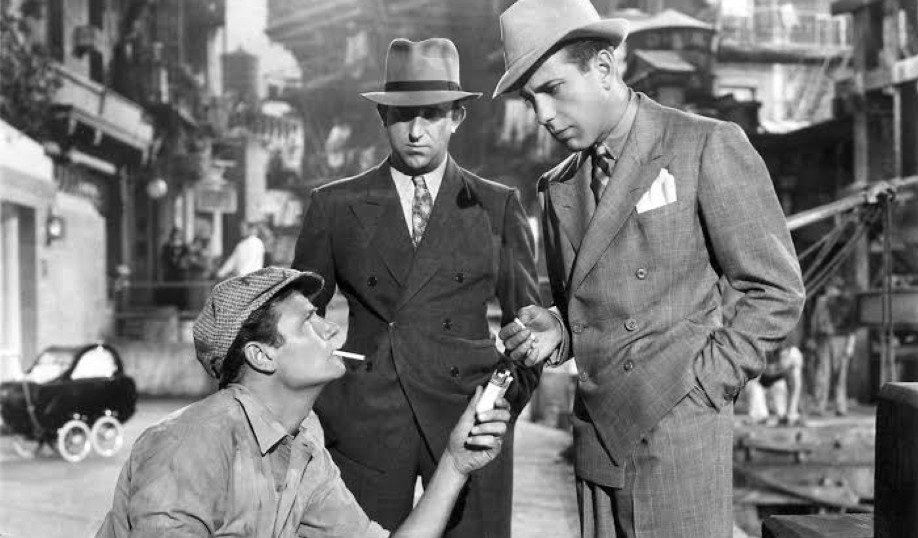
Tag: Wendy Barrie

Dead End (1937)

Dead End (1937)

Sometimes stagey mix of gangster thrills and downtown drama, with a great Bogart performance

Director: William Wyler

Cast: Sylvia Sidney (Drina Gordon), Joel McCrea (Dave Connell), Humphrey Bogart (Hugh “Baby Face” Martin), Wendy Barrie (Kay Burton), Claire Trevor (Francey), Allen Jenkins (Hunk), Marjorie Main (Mrs Martin), Minor Watson (Mr Griswald), James Burke (Officer Mulligan), Ward Bond (Doorman), The Dead End Kids
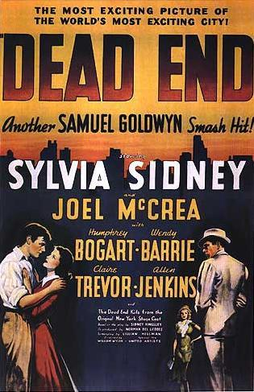
Adapted by Lilian Hellman from Sidney Kingsley’s Broadway hit, Dead End starts with a sharp little political point. The slum boroughs of New York on the East River (that dead end is where the city literally stops) sit side-by-side with towering luxury apartment blocks, after the rich worked out those riverside views are too nice to be left to the working classes. It’s led to an awkward world where mega-rich and working poor sit side-by-side, tensions bubbling. A neat political idea Dead End flirts with, but largely avoids delving into, as more dynamic sub plots dominate the film.

The clashes between the rich and poor focus on The Dead End Kids, a gang of tearaways led by Tommy (Billy Halop) whose sister Drina (Sylvia Sidney) despairingly struggles night and day to build a new life for this troublesome teen. Tommy and his gang beat and rob rich boy Philip and Tommy wounds Philip’s father Griswald (Minor Watson): justice and Griswald demands he be found and punished. It’s a plot line that gets squeezed out by the return of gangster “Baby Face” Martin (Humphrey Bogart), looking for some sort of redemption but rubbing up against the consequences of his life of crime and the suspicion of school friend and would-be-architect odd-job-man Dave (Joel McCrea).

It perhaps shouldn’t be a surprise that Bogart’s plot dominates the film; after all it’s by far the most dynamic and gripping storyline, powered by the film’s most naturally charismatic performer. Bogart’s meanness comes powering to the fore as Baby Face, a snarling bully with a self-righteous streak of self-pity. He’s living on the run – bizarrely he’s had plastic surgery to change his appearance, although nearly all the locals recognise him immediately – now full of sentimentality about his old life. Baby Face has come back for forgiveness and connection with old bonds, as a cheat to avoid actually making amends for his crimes or changing who he is.

This journey is thoroughly in vain, in a series of compelling scenes that remind you what a masterful director of actors Wyler was. As well as Bogart’s glowering resentment at people not responding as he expects – or disgust at their lives not meeting his romanticised ideals – there are masterful cameos from Marjorie Main and Claire Trevor (Oscar-nominated) as his mother and old girlfriend respectfully. Main can hardly bear to look at Baby Face such is her disgust and disappointment in him. Trevor is fabulous as a world-weary woman who – reading between the Hays Code – is essentially a syphilitic prostitute. As certain that Baby Face will reject her when he works that out – and Bogart’s appalled shock and barely concealed contempt are brilliantly done – as she is that any chance things might change for her is a fantasy, Trevor captures in one brief moment the horror of a life that has been a long drudge of disappointment and pain.

These masterfully done scenes – alongside Bogart’s furious resentment at the world, as he growls at sidekick Hunk played with loyal muscle by Allen Jenkin – build into the film’s dynamically filmed finale as Bogart comprehensively rejects turning his back on crime. Wyler – working to excellent effect with Gregg Toland’s Oscar-nominated cinematography – turns this Dead End borough into a world of noirish expressionist shadows. A chase through sewers and rooftops, is shot in shadows, light bursting through wooden slats or streaming through doorways. It’s fast-paced, punchy and exciting.

It also puts into sharp relief the far soapier and duller plot line revolving around the Dead End Kids. This follows a painfully standard plot of whether the soul of a young boy can be saved. Will Tommy, like Baby Face, hit that metaphorical dead end? The Dead End Kids themselves have a fair bit of energy (repeated off stage – the lads were sacked by the Studio after they spent most of their downtime trashing Studio property). And it’s interesting that the film doesn’t really try and sentimentalise them too much. They’re clearly a gang of bullies, quick to punch, who think nothing of beating anyone up.

It really comes down to how much you respond to this sort of plot and to be honest I found it rather hackneyed. Not helped by Sylvia Sidney, who as Tommy’s sister is given little to do other than continuously burst into tears and beg for mercy from the law after each of Tommy’s misdeeds. Since Dead End concentrates its opening and closing acts on these unpleasant little tykes, with the middle acts so overwhelming denominated by Bogart’s petty criminal, it’s hard not to feel your attention wander a bit.

Which isn’t to say there isn’t a fair bit to like about Dead End. It’s studio location recreation of New York’s rough streets is very impressive in its scale – despite rumours that producer Sam Goldwyn insisted the prop litter by tidied up because no film of his was going to look like a trash can. It does make the setting seem rather theatrical – its Broadway roots can be seen in all doorways for important locations opening up onto the same jetty where the Dead End Kids hang – but also throws open so many opportunities for Toland to cover the set in atmospheric shadows and light.

And the film pulls out several terrific performances – Joel McCrea also deserves note for his low-key turn as a disappointed man of decency, who has grown used to battening down his dreams and taking the brush off from girls like Wendy Barrie’s Kay who want men with better prospects. It’s hard to deny it isn’t at its strongest when its focused on gangsters pretending repentance rather than struggles to save kids souls, but it’s still a punchy film for all that.
The Private Life of Henry VIII (1933)

The Private Life of Henry VIII (1933)

Carry on Henry as Korda’s comedic historical epic cements the popular perception of the monarch

Director: Alexander Korda

Cast: Charles Laughton (Henry VIII), Elsa Lanchester (Anne of Cleves), Binnie Barnes (Katherine Howard), Merle Oberon (Anne Boleyn), Wendy Barrie (Jane Seymour), Everley Gregg (Catherine Parr), Robert Donat (Thomas Culpeper), Franklin Dyall (Thomas Cromwell), Miles Mander (Wriothesley), Laurence Hanray (Thomas Cranmer), John Loder (Thomas Peynell)

“A Great Guy With His Chopper” was the tag-line for Carry On Henry starring Sid James as a smirking, rogueish Henry. But it might as well have been the tag-line for this Oscar-winning film, that pretty much cemented the public’s perception of Henry VIII as a lusty, fun-loving king, chucking chicken legs over his shoulder when he wasn’t busy marrying wives. Korda’s handsomely filmed Tudor epic is more knock-about farce than history but was the then most successful British film ever (the first to be nominated for Best Picture) and scooped an Oscar for Laughton as the Merrie Monarch.

The Private Life of Henry VIII skips over the meat of most Henry flicks. Catherine of Aragon is dead (the films comment on her in the opening credits describes her story as being “of no particular interest”, news to scholars of the English Reformation) and with Anne Boleyn (Merle Oberon) prepping for her head to be lopped off with a sword. From there history is left firmly behind as Bluff Hal flirts with Catherine Howard (Binnie Barnes) – who has eyes for his pal Thomas Culpeper (Robert Donat) – marries Anne of Cleves (Elsa Lanchester) who uggs up to get out of it – and ends up as a hen-pecked old guy under a blanket, bossed around by Catherine Parr (Everley Gregg).

For those interested in history, don’t expect to find out anything here. Despite walk-on parts for the headline names of the Henrician reign (Cromwell, Cranmer and others dance around the margins) and some impressive sets and Holbein-influenced costumes, this is really a cheeky-comedy, popping gags at the monarch’s famed lothario. Just as well then that the gags are all pretty good, the pace kept up and the energy of all involved adds hugely to the sense of fun.

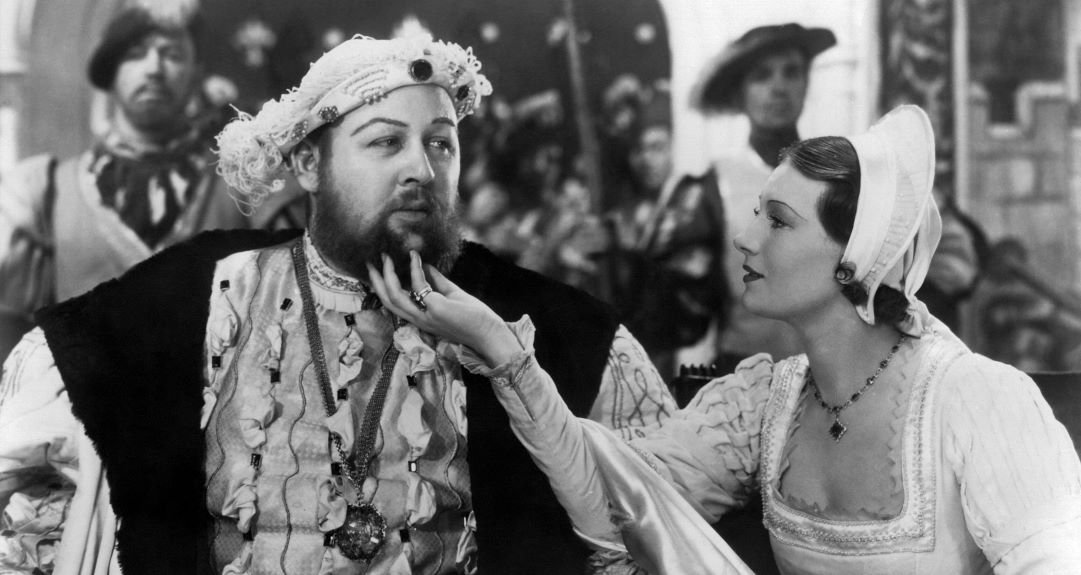
A lot of that is, of course, led by Laughton as Henry VIII. Laughton charges around, hand on hips, legs splayed and peppers every other line with outbursts of crude laughter and childish tantrums. Laughton, in short, has a whale of time, piling into every scene with lusty relish. There is a twinkle in his eye throughout even the film’s most laboured gags (the sequence of Henry spitting and throwing food over his shoulder while bemoaning “There’s no delicacy nowadays…Manners are dead!” would easily outstay its welcome without his delighted playing of it).

What’s also striking about Laughton’s performance is the depth he gives it under the humour. Korda’s film wants us to enjoy the outlandish, larger-than-life qualities of the king, but it’s not afraid to look at the darker soul below the surface of the man many call “England’s Stalin”. Laughton’s Henry is a man who greets news of Jane Seymour’s death with a few brief seconds of sadness, before a shrug of the shoulders and a cheerful enquiry about his son. His tantrums and egotism constantly dance on the edge of tyranny. He manhandles lords and servants, screams and stamps when he doesn’t get his own way and shows not a jot of remorse or guilt at the deaths he causes (he’s even seen impatiently tapping a window waiting for the sword to fall on Anne).

Despite this though, you still sort of end up feeling sorry for him. Perhaps because Laughton manages to also make him feel strangely naïve and trusting for all his school-boy bluster. Henry is torn apart with grief at the betrayal of Catherine and Culpeper (something he really should have spotted as it is almost literally going on under his nose). Korda presents a few fairly serious scenes, after a lot of comedic banter, with Henry first assaulting those bringing him the news and then collapsing into a shuddering mess of tears. A beautifully-framed shot in his chapel, shows Henry berating himself for the faults of Catherine, Laughton’s tear-stained face communicating his “mea culpas” with a soft, regret-filled quietness.

But what’s stuck in the public perception is the comedy. The film’s finest – and central – sequence covers the short marriage with Anne of Cleves, inevitably played by Elsa Lanchester. She delivers a superb performance of physical and verbal comedic charm. Henry famously was ‘unattracted’ to Anne (I’ve always believed this syphilitic, obese, gouty man just couldn’t blame himself for his inability to get it up so claimed it was the woman’s fault). Legend of Anne’s ugliness have cruelly stuck, but the film presents it as a rather amusing pantomime of fake stumbles and gurning faces used by Anne to save herself from one-day heading to the block under this tyrant.

Laughton and Lanchester’s natural chemistry (the first of their multiple collaborations on screen) sees the real-life husband-and-wife at complete ease and the wedding-night game of cards are the most relaxed and hilarious in the whole film. “The things I do for England…” Henry mutters, but there is a suspicion these two are much better suited than history assumes.

Korda pulls this altogether into a true crowd-pleaser. There is a farcical energy to the crowds providing a wry commentary on the executions. The film is crammed with some gorgeous sets – Laughton’s first entrance is a straight-restaging of Holbein. A sequence where Henry utterly fails to sneak into Catherine Howard’s bed-chamber (due to guards announcing “the King!” around every corner) is quite wonderfully staged. The cast are very fine: Merle Oberon makes a huge amount of Anne’s shrewdness (in the film’s most historically accurate sequence), Robert Donat is very charismatic as Culpeper, Binnie Barnes suitably flirty and empty-headed as a sex-pot Catherine Howard (even if she is considerably older then the real Catherine).

The Private Life of Henry VIII pulls all its material together into a luscious farce, with the odd serious moment, that might not make any sense at all when compared to history but makes a lot of sense when you compare it to stage farce. This was the first – and best – Carry On Henry.