
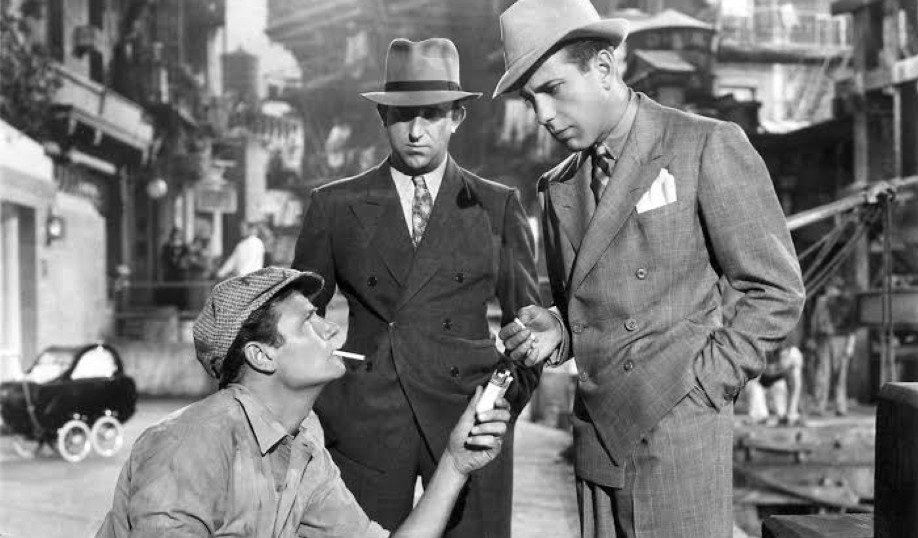
Sometimes stagey mix of gangster thrills and downtown drama, with a great Bogart performance
Director: William Wyler
Cast: Sylvia Sidney (Drina Gordon), Joel McCrea (Dave Connell), Humphrey Bogart (Hugh “Baby Face” Martin), Wendy Barrie (Kay Burton), Claire Trevor (Francey), Allen Jenkins (Hunk), Marjorie Main (Mrs Martin), Minor Watson (Mr Griswald), James Burke (Officer Mulligan), Ward Bond (Doorman), The Dead End Kids
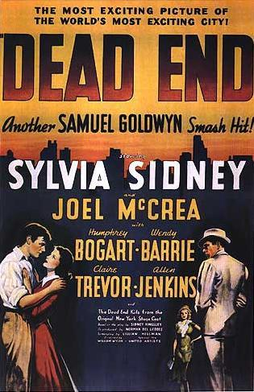
Adapted by Lilian Hellman from Sidney Kingsley’s Broadway hit, Dead End starts with a sharp little political point. The slum boroughs of New York on the East River (that dead end is where the city literally stops) sit side-by-side with towering luxury apartment blocks, after the rich worked out those riverside views are too nice to be left to the working classes. It’s led to an awkward world where mega-rich and working poor sit side-by-side, tensions bubbling. A neat political idea Dead End flirts with, but largely avoids delving into, as more dynamic sub plots dominate the film.
The clashes between the rich and poor focus on The Dead End Kids, a gang of tearaways led by Tommy (Billy Halop) whose sister Drina (Sylvia Sidney) despairingly struggles night and day to build a new life for this troublesome teen. Tommy and his gang beat and rob rich boy Philip and Tommy wounds Philip’s father Griswald (Minor Watson): justice and Griswald demands he be found and punished. It’s a plot line that gets squeezed out by the return of gangster “Baby Face” Martin (Humphrey Bogart), looking for some sort of redemption but rubbing up against the consequences of his life of crime and the suspicion of school friend and would-be-architect odd-job-man Dave (Joel McCrea).
It perhaps shouldn’t be a surprise that Bogart’s plot dominates the film; after all it’s by far the most dynamic and gripping storyline, powered by the film’s most naturally charismatic performer. Bogart’s meanness comes powering to the fore as Baby Face, a snarling bully with a self-righteous streak of self-pity. He’s living on the run – bizarrely he’s had plastic surgery to change his appearance, although nearly all the locals recognise him immediately – now full of sentimentality about his old life. Baby Face has come back for forgiveness and connection with old bonds, as a cheat to avoid actually making amends for his crimes or changing who he is.
This journey is thoroughly in vain, in a series of compelling scenes that remind you what a masterful director of actors Wyler was. As well as Bogart’s glowering resentment at people not responding as he expects – or disgust at their lives not meeting his romanticised ideals – there are masterful cameos from Marjorie Main and Claire Trevor (Oscar-nominated) as his mother and old girlfriend respectfully. Main can hardly bear to look at Baby Face such is her disgust and disappointment in him. Trevor is fabulous as a world-weary woman who – reading between the Hays Code – is essentially a syphilitic prostitute. As certain that Baby Face will reject her when he works that out – and Bogart’s appalled shock and barely concealed contempt are brilliantly done – as she is that any chance things might change for her is a fantasy, Trevor captures in one brief moment the horror of a life that has been a long drudge of disappointment and pain.
These masterfully done scenes – alongside Bogart’s furious resentment at the world, as he growls at sidekick Hunk played with loyal muscle by Allen Jenkin – build into the film’s dynamically filmed finale as Bogart comprehensively rejects turning his back on crime. Wyler – working to excellent effect with Gregg Toland’s Oscar-nominated cinematography – turns this Dead End borough into a world of noirish expressionist shadows. A chase through sewers and rooftops, is shot in shadows, light bursting through wooden slats or streaming through doorways. It’s fast-paced, punchy and exciting.
It also puts into sharp relief the far soapier and duller plot line revolving around the Dead End Kids. This follows a painfully standard plot of whether the soul of a young boy can be saved. Will Tommy, like Baby Face, hit that metaphorical dead end? The Dead End Kids themselves have a fair bit of energy (repeated off stage – the lads were sacked by the Studio after they spent most of their downtime trashing Studio property). And it’s interesting that the film doesn’t really try and sentimentalise them too much. They’re clearly a gang of bullies, quick to punch, who think nothing of beating anyone up.
It really comes down to how much you respond to this sort of plot and to be honest I found it rather hackneyed. Not helped by Sylvia Sidney, who as Tommy’s sister is given little to do other than continuously burst into tears and beg for mercy from the law after each of Tommy’s misdeeds. Since Dead End concentrates its opening and closing acts on these unpleasant little tykes, with the middle acts so overwhelming denominated by Bogart’s petty criminal, it’s hard not to feel your attention wander a bit.
Which isn’t to say there isn’t a fair bit to like about Dead End. It’s studio location recreation of New York’s rough streets is very impressive in its scale – despite rumours that producer Sam Goldwyn insisted the prop litter by tidied up because no film of his was going to look like a trash can. It does make the setting seem rather theatrical – its Broadway roots can be seen in all doorways for important locations opening up onto the same jetty where the Dead End Kids hang – but also throws open so many opportunities for Toland to cover the set in atmospheric shadows and light.
And the film pulls out several terrific performances – Joel McCrea also deserves note for his low-key turn as a disappointed man of decency, who has grown used to battening down his dreams and taking the brush off from girls like Wendy Barrie’s Kay who want men with better prospects. It’s hard to deny it isn’t at its strongest when its focused on gangsters pretending repentance rather than struggles to save kids souls, but it’s still a punchy film for all that.

