Category: Action film

Twister (1996)

Twister (1996)

Cardboard characters try not to get blown away in this extremely silly disaster movie

Director: Jan de Bont

Cast: Helen Hunt (Dr Jo Harding), Bill Paxton (Dr Bill Harding), Jami Gertz (Dr Melissa Reeves), Cary Elwes (Dr Jonas Miller), Lois Smith (Aung Meg Greene), Philip Seymour Hoffman (Dusty Davis), Alan Ruck (“Rabbit” Nurick), Sean Whalen (Allan Sanders), Todd Field (“Beltzer” Lewis), Wendle Josepher (Haynes), Jeremy Davies (Brian Laurence), Joey Slotnick (Joey), Zach Grenier (Eddie)

In 1996 Twister blew through cinema screens with a vengeance, becoming the second most biggest hit of the year. Yes, you read that right. Stop me if I am wrong, but has anyone thought about, even for a second, this bog-standard disaster film since? Staffed almost exclusively by characters so lightweight a puff of wind would blow them away, never mind a tornado, the whole thing is full of sound and fury and signifies absolutely nothing at all.

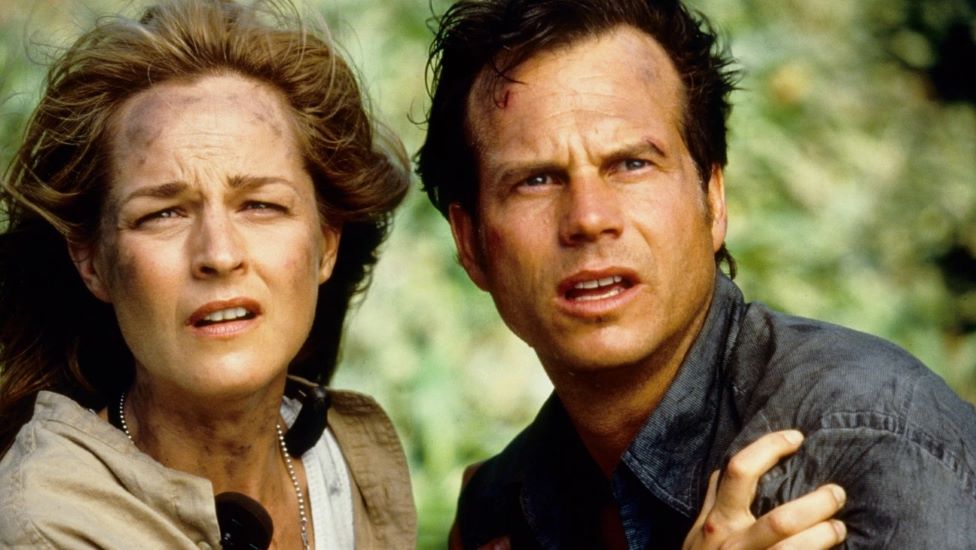
Drs Jo (Helen Hunt) and Bill Harding (Bill Paxton) are trying to get divorced. He’s finally had enough of risking his neck on their joint passion for storm-chasing, deciding to jack it in for a lucrative life on the media circuit and marriage to relationship therapist Dr Melissa Reeves (Jami Gertz). He arrives in Oklahoma to get Jo to sign the divorce papers – but doncha know it, he gets sucked in to “one more job”, to road-test the storm measurement doo-hickey device he and Jo dreamed of making but she’s actually built. And, handily, one of those pesky twisters is on the way.

The doo-hickey – I’m really not sure what it’s meant to do – is the sort of ludicrous scientific device that only exists in the movies. It’s basically a huge metal cauldron full of marbles that needs to be placed in the path of a twister. It’s also – in a terrible design flaw – hugely fragile and unstable, constantly falling over at the worst possible time. There are apparently three prototypes, of decreasing quality, each a back-up of the one before – you have one guess as to how many of these they burn through in the film.

In fact, you can pretty much one guess almost everything that might happen. Will Jo finally come-to-terms with the death of her father in a storm? (That’s right – she has a “I’m passionate and obsessed because a twister killed my dad” backstory!) Will Bill realise Jo is the one for him, not fish-out-of-water big-city-girl Mel? Will Cary Elwes’ lip-smacking, moustachio-curling copyright-stealing storm expert get his (fatal) comeuppance? Will sweet Aunt Meg (and her dog) survive her tussle with the storm? That “it’s almost never happened” super-storm they talk about at the start of the film – do you think it’s possible our heroes will find themselves in the middle of it before the end?

All of this is shuffled in a film with a hideously over-loaded deck. Jo’s team consists of around eight assistants, none of whom have so much as a character between them. They are a feeble collection of archetypes: the geek, the shy one, the techie, the religious one and the loud-mouthed one (a role of flamboyant indignity for Philip Seymour Hoffman, yet to be recognised as a great actor and instead relegated to feeble comic relief roles). But then it’s not like the leads are that interesting either: she’s committed, passionate but gosh-darn-it puts the storm before her personal life. He’s trying to move on but doncha-know-it he’s just lying to himself that he doesn’t love the storm.

In fact, as this rather smug ex-couple riffed on in-jokes, storm facts and their shared love for their doo-hickey made of marbles I felt rather sorry for Mel. Obviously, we are meant to scorn Mel, with her hand-wringing profession of counsellor (as opposed to the macho jobs of Bill and Jo) and her reluctance to run into a massive twister. Actually, I think she’s rather sensible. Bill and Jo are both clearly insane and take suicidal risks. She puts up with her fiancé flirting with his ex far longer than most of us would and she is hugely patient with the polite scorn she’s treated with by Jo’s rag-tag band of tedious risk-taking geeks playing at being alphas. She hangs around far longer than anyone else would do, before departing after maturely and sensibly telling Bill he should stick with his first two loves (Jo and storms – maybe not in that order).

People aren’t watching these films for the character or plot though – just as well as the film doesn’t really have either – but the special effects. These are impressive, I suppose, as the storm rips through sets, throws CGI buildings around and generally makes for loud and impressive noise. The film has a sort of goofy wit at times – at one point a CGI cow is blown through the sky in front of the Hardings, mooing rather sadly.

There are some decent set-pieces, even though they are basically all the same set-piece repeated over and over again at a different scale (first the storm blows over a car, then a building, then a village, then most of a town while our heroes duck and cover their heads). Lots of it was done with practical effects, shot with an alarming lack of regard for safety – Hunt got an infection from being flung into a drain and she and Paxton were temporarily blinded by a burst of artificial lightning.

De Bont directs all this with a personality-free competence. The film is at absolute best less than half as good as his first film, Speed – and de Bont’s subsequent film, The Haunting, would be half as good again in a career of ever-diminishing returns. Twister offers nothing new or even particularly interesting, other than some wind special effects that are of passing curiosity value but nothing else. It’s almost quaint that, in 1996, this was seen as something earth-shatteringly impressive. Now it’s as fearsome a burst of raw natural power as a fart.

Spider-Man: No Way Home (2021)

Spider-Man: No Way Home (2021)

Tom Holland’s Spider-Man encounters friends and enemies from another franchise or two

Director: Jon Watts

Cast: Tom Holland (Peter Parker/Spider-Man), Zendaya (MJ), Benedict Cumberbatch (Dr Stephen Strange), Jacob Batalon (Ned Leeds), Marisa Tomei (May Parker), Jon Favreau (“Happy” Hogan), Jamie Foxx (Max Dillon/Electro), Willem Dafoe (Norman Osborn/Green Goblin), Alfred Molina (Otto Octavius/Doctor Octopus), Benedict Wong (Wong), Tony Revolori (“Flash” Thompson), Andrew Garfield (Peter Parker/Spider-Man), Tobey Maguire (Peter Parker/Spider-Man), Rhys Ifans (Dr Curt Connors/Lizard), Thomas Haden Church (Flint Marko/Sandman), JK Simmons (J Jonah Jameson)

It’s been out long enough now – and Marvel are even advertising the Guest Stars – so I guess we can worry slightly less about spoiling this massive crossover event. Spider-Man: No Way Home became one of the biggest hits of all time. It’s not hard to see why, in our nostalgia-loving times. But its not just about nostalgia – lovely as it is to see all those old characters once again. It’s also a hugely entertaining, rather sweet film, crammed with slick lines and jokes, while also, like the best of Marvel’s films, having a heart. We’ve got a hero here so humanitarian he goes to huge risks to try and save the villains. That’s refreshingly human.

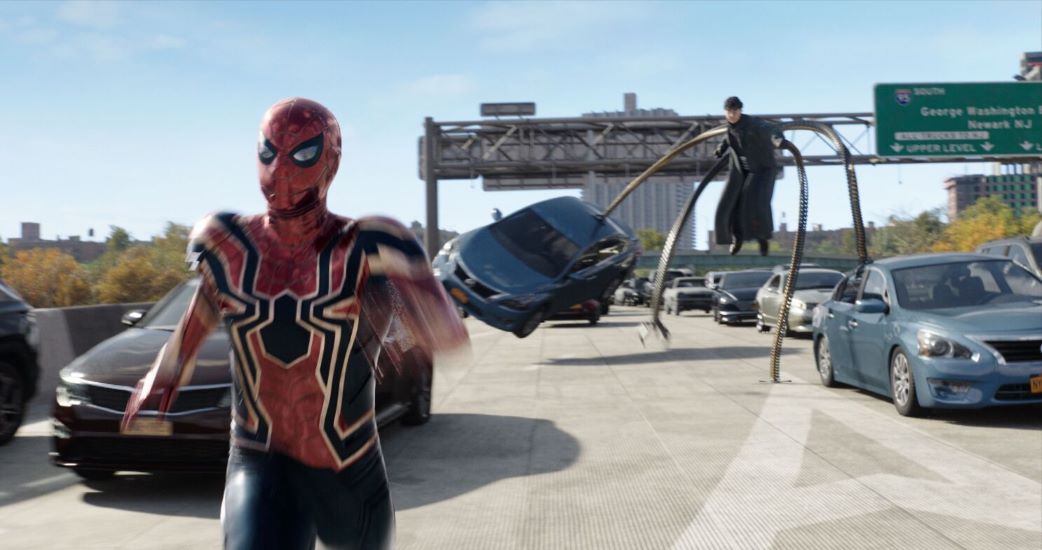
Picking up after the conclusion of Spider-Man: Far From Home, Peter Parker’s (Tom Holland) secret-identity is known. Parker finds himself at the centre of a massive, world-wide scandal, which ends the college chances of him and his friends MJ (Zendaya) and Ned (Jacob Batalon). Peter asks Dr Strange (Benedict Cumberbatch) for help: namely can the world forget who he is? When the spell goes wrong, people who know Parker’s identity from other realities start appearing. And these guys aren’t happy, with villains like Dr Otto Octavius (Alfred Molina), Electro (Jamie Foxx) and psychopath Green Goblin (Willem Dafoe) arriving. But, when Peter discovers sending them back will condemn them to die in the battle against their Spider-man, he decides to do everything he can to try and save them.

No Way Home’s success partly lies on the nostalgia factor, especially for those of us who loved the early Maguire films. And you can sign me up to that: I can’t believe it’s been 20 years since the first one came out! No Way Home throws in characters from all five pre-Holland films and zeros in on the best of the bunch. The films has a lot of fun shuffling and realigning these characters in interesting new combinations, often allowing them to moan about things like origin stories (there is a very funny exchange between Electro and Sandman on the danger of falling into experiments) or just to get on each other’s nerves (Molina’s Doc Ock is spectacularly grumpy).

You pretty much have to have a heart of stone not to enjoy seeing most of these characters again – particularly as they are played with such lip-smacking aplomb. Above all, Dafoe relishes the chance to cement his place as one of the great villains, switching perfectly between gentle and psychotic as the schizophrenic Norman Osborn/Green Goblin (and becoming the nemesis of no-less than two Spider-men). Molina is equally good: pomposity and rage turning into avuncular decency. These two landmark villains from the two best films take most of the limelight, with a smaller share for Jamie Foxx (far more comfortable here than he was in Amazing Spider-Man 2). But every villain is given moments of tragic depth and seeing them react to news of their deaths is strangely moving.

It sets the table rather nicely for a film about redemption. Peter believes he can save these villains from death if he can cure them and restore their humanity. While the pragmatic Strange sees this as pointless, Peter can’t turn his back on a chance to save people. On top of this, No Way Home also serves as a meta-redemption arc for the two previous franchises: Maguire gets a third film worthy of the first two and Garfield is given the sort of rich material he was denied in his failed series.

Which brings us nicely to the biggest returns. Denied by both actors for the best part of a year, this film throws not one, not two but three Spider-men at us, with Maguire and Garfield reprising their incarnations. All three delight in sparking off each other, riffing on everything from web-slingers to making normal life work (“Peter time”) alongside Spider-manning. Maguire settles nicely into the Big-Brother role, giving a worldly experience to the others without losing his gentle idealism. Garfield is sensational – lighter, funnier and warmer than he was in his own films, with a hidden grief that plays out with genuine impact.

Who couldn’t get excited about seeing these three together – or to see the film make these scenes work as well as it does? It shuffles and reassembles things we are familiar with, but presents them in new and intriguing combinations and above all feels true to the characterisations established in previous films. Maguire, Molina and Dafoe in particular feel like they’ve not been away since their own films, while Garfield and Foxx deepen and improve their characters. But it became a mega-hit because it has a truly strong story behind it.

A story staffed by strong, relatable characters. There is a genuine sense of alarm around how Peter and his friends in the film’s opening act are hounded and persecuted by a population scared of them. Even here redemption is key, with Peter going to dangerous lengths to try and get his friends a second chance at getting into MIT. These three characters have a sweet, warm friendship and the chemistry, in particular between Holland (who is sensational, endearing, funny but bringing the role great emotional depth) and Zendaya is stronger than it’s ever been.

And that’s before we hit the film’s genuinely endearing message. Holland’s still-optimistic hero (another excellent contrast with his more damaged alter-egos) is motivated by saving people. And that includes the villains. Maybe it’s the years of Covid, but there is something hugely lovable about a hero who wants to give people a second chance. It’s a living demonstration of “with great power comes great responsibility” (words this film introduces into the Marvel universe with powerful effect, in a mid-film climax). In fact the film is, in some ways, the origin-story Holland’s Spider-Man never had: it gives him a foundational tragedy, leaves him in an isolated position, strips him of his Iron Man style tech and leaves him in a set-up (alone in a cheap apartment, struggling to make ends meet and superheroing on the side) familiar from the comics.

Watts directs the film with real confidence and zest, especially outside the action set-pieces: there is frequent use of ingenious-but-not-flashy single takes and the film’s patient momentum for much of its first half, focusing on character and emotion, really pay off in the second half of fan-service and fights. The camera effects used for Peter’s web-slinging and his spider-sense have a delightful quirky invention. What he really does well though is zero in on the emotion and when events get tragic, he isn’t afraid to commit to that. It gives the film an emotional force that really connected with people.

That heart is what sustains it. It’s a joyful nostalgia trip – that redeems elements of the previous films – but this is a film that really cares about its characters – all of them – and wants you to as well. That gives difficult, emotional struggles to all its Spider-Men, that searches of the humanity in its villains, even the worst of them, making us sympathise with them even as they do dreadful things. Combined with the action and adventure – and the electric pace of the best of Marvel – No Way Home rightly stands as one of the best entries so far.

Eternals (2021)

Eternals (2021)

A cast of diverse actors are totally crushed in this pompous, dull Marvel film

Director: Chloé Zhao

Cast: Gemma Chan (Sersi), Richard Madden (Ikaris), Kumail Nanjiani (Kingo), Lia McHugh (Sprite), Brian Tyree Henry (Phastos), Lauren Ridloff (Makkari), Barry Keoghan (Druig), Don Lee (Gilgamesh), Harish Patel (Karun), Kit Harington (Dane Whitman), Salma Hayek (Ajak), Angelina Jolie (Thena)

It must have seemed like a good idea at the time… Marvel had already turned one little known gang of superheroes into a huge hit with The Guardians of the Galaxy. World defining stakes had been the core of most of The Avengers films. An ensemble cast of diverse actors were pulled together with an acclaimed (and now Oscar winning!) director at the helm. They only forgot one thing: to make the final film interesting, engaging or feel in any way original.

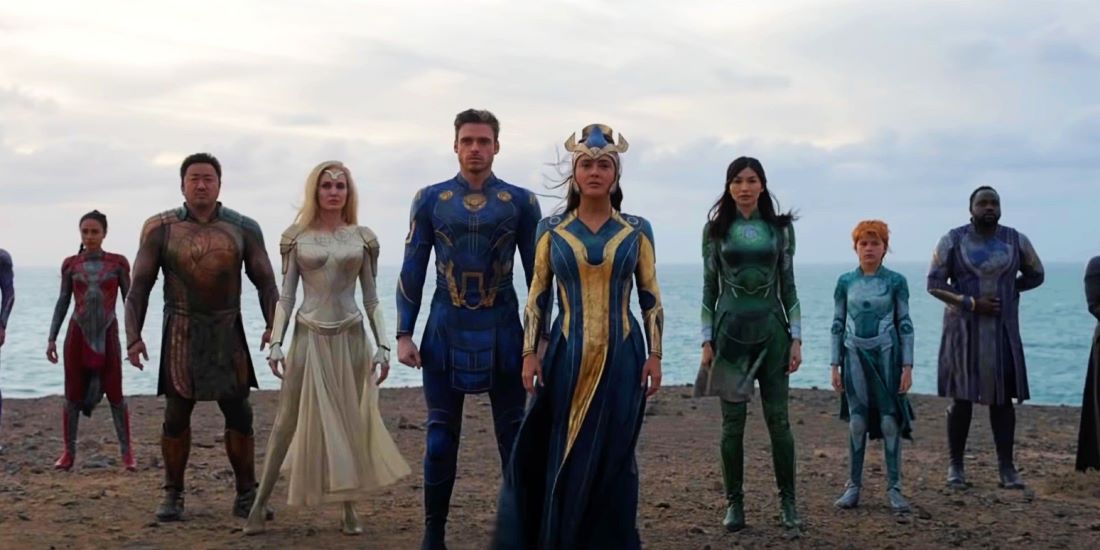
Our heroes are a group of very serious God-like Aliens called Eternals, who have been sent to Earth thousands of years ago by even more God-like Celestrial Aliens to protect humanity from savage monsters called Deviants. By 1521, the Deviants are defeated and our heroes are left unsure of what to do. Ordered to never interfere in the events of humanity, they go their separate ways and settle down into life on Earth. But in the present day the Deviants return – and the Eternals start to uncover dark facts about their mission.

All of this takes place over a runtime which feels pretty bloody eternal itself. Essentially the film opens with an info-dump, then spends a couple of hours getting the gang back together (interspersed with occasional additional info-dumps) before the inevitable final-act smackdown to save the world. The stakes have arguably never been higher: but with the film’s indolent pace and thinly sketched characters it sure-as-hell doesn’t feel like it. There is a lot of uninvolving world-building and its ends up feeling every bloody minute of its epic runtime.

With its group of characters, essentially a loving family that has fallen out, this should really be an intimate, character-driven film. But it never balances the huge cast, the epic action and building relatable characters swiftly. Instead the Eternals rarely seem like anything more than heavy-handed sketches defined by basic character traits: a caring empath, a warrior princess, a slightly austere would-be-leader, a mentor destined to die, an eternal child frustrated about never growing up, a natural showman, a cold mind-controller, a deaf athlete and a gay guilt-ridden inventor. The cast (as very proudly trumpeted in its marketing material) is on paper the most diverse ever in Marvel. But it’s like simply making it representative was enough and they didn’t need to bother creating rich, engaging and multi-faceted characters.

All of them are squashed into a film that really feels like it could have been made by anyone. For all Zhao’s occasional indie visual beauty, this is totally free of authorial voice, with completely routine action set-pieces. There is the odd joke, but Zhao’s attempt to put her own mediative personality on the film only really ends up making the bits between the fights dry and boring. Put quite simply, Marvel seems to have rather crushed any life out of her. We get endless solemn moments, as characters watch with horror the results of the development in mankind they have encouraged (from the genocide of the Incas to the bomb at Hiroshima). These nearly always feel on-the-nose and obvious. It all stems from Zhao failing to make us care about these characters.

So, when they find out they have been betrayed by their masters – that their purpose is to fatten the Earth for feasting, not raise it in good health – its rather hard to feel the impact of the betrayal. The film isn’t even smart, or daring, enough to acknowledge that the same manipulative Gods who have used the Eternals have done the same thing to the Deviants. The film continues to treat these as wicked killers, when in fact they are as much victims as everyone else. Would it have killed Eternals to acknowledge this for a moment, to explore the implications of this more?

Especially since it’s so bloody long. It takes almost two hours for the film to bring the gang back together. Each reunion with a new Eternal is basically played the same – a brief bit of banter and then a horrified reaction as they discover the truth. Which means we basically see versions of the same scene play out six times, with diminishing levels of interest. Can’t these guys conference call?

There is no momentum to this ever. Where is the pace? Where is the urgency? The Eternals have been told they’ve only a few days to save the Earth, but they seem to spend most of it ambling around chatting and catching-up. Even when the end-of-the-world starts, most of them still sit around starring at the middle distance sadly and bemoaning their lot. This – and soft spoken intensity and lackadaisical wandering – are constantly used by the film as a short hand for seriousness, a self-importance the film wears very, very heavily.

All of the actors get crushed under the weight of the film. Nanjiani stands out pretty much as the only one having anything approaching fun while only Lee gets to show some sort of warm, uncomplicated human connection. Keoghan, Ridloff and Henry do decent work, but the rest of the cast seem hampered by how very, very, very serious they need to be all the time. One of them, of course, is a wrong ‘un (you can make a pretty decent guess early on which in it will be), but they turn out to be the dullest most stick-up-the-butt character of the lot. Despite the huge amount of time we spend with them, lead characters like Chan’s Sersei and Madden’s Ikaris remain enigmas we can’t be bothered to find out more about.

Eternals is pretty much a failure. It’s long. It builds an expansive universe with a series of clumsy lectures and fails to make any of these interesting. It’s got long battle scenes which feel like several other films. It’s got no personality or vibe to it. It sets up the odd interesting idea then takes it nowhere. It makes the end of the world a massive yawn, while telling you it’s a hugely important and daring film (it’s neither of those things). You end up feeling this might be the most forgotten Marvel film since The Incredible Hulk.

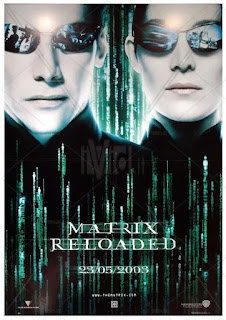
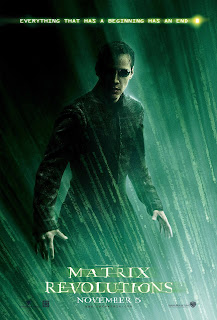
The Matrix Reloaded and The Matrix Revolutions (2003)

The Matrix Reloaded and The Matrix Revolutions (2003)

Tension, drama and thrills… all go missing in these increasingly ponderous self-important sequels

Director: The Wachowskis

Cast: Keanu Reeves (Neo), Laurence Fishburne (Morpheus), Carrie-Anne Moss (Trinity), Hugo Weaving (Agent Smith), Jada Pinkett Smith (Niobe), Monica Bellucci (Persephone), Lambert Wilson (The Merovingian), Gloria Foster/Mary Alice (The Oracle), Helmut Bakaitis (The Architect), Harold Perrineau (Link), Ian Bliss (Bane), Harry Lennix (Commander Lock), Collin Chou (Seraph), Nona Gaye (Zee), Gina Torres (Cas), Randul Duk Kim (The Keymaker), Daniel Bernhardt (Agent Johnson)

If you ever want to study a crash-course in how not to make sequels to a genre redefining film, these might be the perfect examples. I’m going to break a golden rule here and review them both together, which I’ve not done for anything else so far in this blog. The flaws in these films are so interlinked, I think you have to almost treat the whole misfire as one single, dreadfully disappointing film. And I just couldn’t bear the idea about writing two articles about each of them.

It’s six months after the events of The Matrix. Neo (Keanu Reeves) is an invulnerable phenomenon in the Matrix. He and Trinity (Carrie-Anne Moss) are in love. Morpheus (Laurence Fishburne) is being dragged over the coals by Starfleet Command (I know it isn’t called that, but it might as well be) for disobeying orders. And even worse news than that: the Machines have found the location of Zion, the secret last human city in the world. And they plan to destroy it – in 72 hours. Neo must undertake one final mission in the Matrix to find the secrets that will prevent this destruction of the human race – and he’ll have to do it with only the support of his friends, as the rest of mankind decides to batten down the hatches and wait for the uncoming storm. But is there more going on here than we think? Is there more to Neo’s existence than meets the eye? Why is he being plagued with dreams of Trinity’s death? And what is going on with Smith (Hugo Weaving) who know seems to be acting as rogue agent, working against man and machine?

The answers are all eventually revealed, with maximum pomposity and self-importance, over the nearly five hours these sequels drone on, seemingly determined to drain out everything that anyone found cool about the original movie and leave it with a stuffy, pretentious, dull shell that won’t win any new converts over. Before these films, The Matrix was a franchise that would have a life in films, video games, anime and fan fiction for decades to come. After them, it was dead in the water.

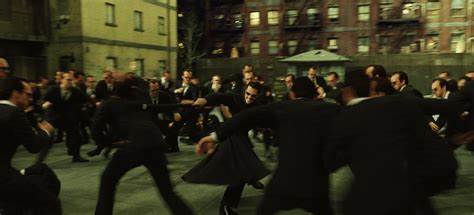
Why? What did people like about the first film? They liked the action sure, and they liked the cool action and visuals and the anti-authoritarian nose thumbing. But those all really worked because we related to the characters, we saw that they were vulnerable, outmatched and in peril. In the real world they were plucky, brave resistance fighters. In the Matrix they were desperate rebels who could do really cool things. This all gets blown away here. In the Matrix, Neo is now so invulnerable, that fights are pointless: they are little more than dull displays of choreography with inevitable outcomes. Reloaded hammers home time and again Neo can do anything he likes in the Matrix. Fighting hundreds of clones of Smith at once? No problem. Flying faster than the speed of sound? Sure thing. Reworking the reality to suit him? It’s just a shrug of the shoulders.

This is a disaster to drama in two ways. Firstly, it drains all the peril out of any moment in the Matrix world because we know that there is no way Neo can get hurt – or that he will allow any of his friends to get hurt. Secondly, it means to get any tension Neo has to be somehow depowered or separated from everyone else. This happens three times over the films: Neo gets dispatched to China, flung into an underground station purgatory and blinded in the real world. When the film becomes reliant on continuously finding a way to put its hero out of the way (a blight that also often hits Superman on film), you know you are in trouble.

Where Neo is still vulnerable, is the real world where the films spend more and more time. Sadly, the real world is a tedious, uninvolving place. Remember in the first film where Morpheus seemed like a super cool, sage-like leader of a rebellion? Well in fact he’s just a cog in a large, stuffy command structure that takes all the worst, most uncool elements of Star Trek’s Starfleet and doubles down on it. Zion is a stereotypical sci-fi city, with characters dressed in flowing robes, quasi-uniforms or urban rags (that’s when they are dressed at all – Reloaded’s early doors rave/orgy rightly draw oceans of sniggers). The real human world isn’t a gang of plucky, anti-authoritarian types but a typical sci-fi, rules-bound society. The flair of our characters is stripped from them.

All this is wrapped in a package that doubles down on the stuffy, Bluffer’s Guide to Philosophy that popped up in the first film. There it added a bit of self-regarding intellectual heft to a film about people kicking each other and dodging bullets, here it’s the be-all-and-end-all. But the films are nowhere near as clever as they think they are: various characters parrot crudely scripted stances on everything from free will to determinism to the greater good. None of it is new or intriguing, and nearly all of it feels like the directors straining to show off their reading list.

It hits its apotheosis in Reloaded as the Architect (Helmut Bakaitis), the bearded brain behind the Matrix, lays out in a long speech how Neo is in fact a part of the Matrix programme designed to help the system reboot and refresh in cycles, an interesting idea totally crushed under the weight of needlessly long, incomprehensible words, phrases and Latin quotes that don’t sound smart, only like the speech was written out in plain English and then run through a thesaurus.

And it was a neat idea that our Messiah might actually have been created by the machines to help their prison renew itself. But it gets lost in the clumsy, pleased with itself delivery, in conversations about choice and free will (will Neo choose his destiny or saving Trinity’s life? Guess!) and the generally turgid plotting. This gets worse in Revolutions which finally seeps the life out of the franchise, with a video-game shoot-out at Zion (which makes no tactical sense), a trek by Neo and Trinity to commune with the machines and Agent Smith converting every human being in the Matrix into a copy of himself, in a vague philosophical comment on the death of individuality.

The worst thing about these films is that they are self-important, hard to enjoy and often more than a little silly. Fights take place at great length with very little tension. Reloaded does have a fab freeway car chase – but again it depends on Neo being absent for any tension to exist (and as soon as he turns up it’s all solved in seconds). Almost everything in the real world is stuffy, earnest and bogged down in the sort of uncool sci-fi tropes the first film stayed away from. Nearly anything in the Matrix involves watching a God like figure hitting things (including a bizarre ten-pin bowling effect when Neo knocks over a host of Smiths).

The actors struggle to keep up the genre-redefining cool that made the first film so popular. Fishburne looks bored (and rightly so, since his dialogue is awful and he’s given almost nothing to do in Revolutions) and Weaving treats the whole thing as a joke. Reeves is earnest, but frequently restrained by the dullness of his role as an almighty God. Moss has most of the best material as Trinity makes drastic decisions for love and faith. The rest of the cast struggle with either paper-thin characters, painfully over-written dialogue or a mixture of both.

The Matrix sequels managed to drain out everything that was great about the original. Where that was nimble, these were stuffy. Where these were anti-authoritarian, these laid out a dull and stereotypical sci-fi society. Where the first was gripping, desperate and adrenalin fuelled, this sees invulnerable heroes, extended runtimes and a frequent lack of peril. Worst of all Revolutions in particular feels like hundreds of other “sci-fi war films” and about a million miles from the actual revolution of the first film. It doubles down on nearly everything that was less good in the original and strips out the things that most impacted people. How not to make a sequel.

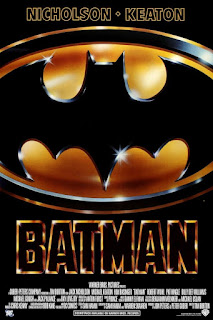
Batman (1989)

Batman (1989)

Comic book movies get a jump start in the very first attempt to take the genre really seriously on screen

Director: Tim Burton

Cast: Jack Nicholson (Jack Napier/The Joker), Michael Keaton (Bruce Wayne/Batman), Kim Basinger (Vicki Vale), Robert Wuhl (Alexander Knox), Pat Hingle (Commissioner Gordon), Billy Dee Williams (Harvey Dent), Michael Gough (Alfred Pennyworth), Jack Palance (Carl Grissom), Jerry Hall (Alicia Hunt), Tracey Walter (Bob), Lee Wallace (The Mayor), William Hootkins (Lt Max Eckhardt)

Strange to think, but there was a time when comic book movies were not Hollywood’s be-all and end-all. Instead, they were slightly embarrassing, campy messes, big-name actors were a little ashamed to appear in and studio executives were convinced no-one outside a comic-book shop would be remotely interested. So, you could say Batman is one of the most influential films of the last 30 years, a massive box-office smash that treated its source material fairly seriously. For the first time ever, it was suggested these films could be dark and adult, as well as fun. Sure, there is a lot more goofy humour in it than you might remember, but it changed how this genre was perceived.

It’s an origin story of sorts. Bruce Wayne (Michael Keaton) has just started his campaign as Batman, the masked vigilante terrifying criminals at night in crime-ridden Gotham city. A late-night scuffle at a factory stuffed with toxic waste (but of course) sees psychopathic gangster Jack Napier (Jack Nicholson) tumble into a vat of chemicals. Napier emerges, disfigured and insane, as The Joker and starts a campaign of terror across Gotham. A campaign only Batman can end.

Fans feared during its production that the film would follow in the footsteps of the campy 60s TV show. So many letters of complaint (at least 50,000 – imagine how many tweets that would translate into today) at the casting of ‘comic actor’ Keaton hit the officers of Warner Bros, the company’s share price even took a dip. Fans were only reassured when the film opened – and you know you’re in for something heavyweight, as soon as Elfman’s strikingly gothic yet bombastic score echoes out.

Gothic is the word here: Gotham is imagined as world where Art Deco meets Steampunk by way of German Expressionism – it’s like a Fritz Lang explosion in a graphic novel panel. The film was a brilliant twist on noir, with every street hosting a looming nightmare. This was a dark, sinister world where it was always night (fitting for the Dark Knight) and horrors lurked around every corner.

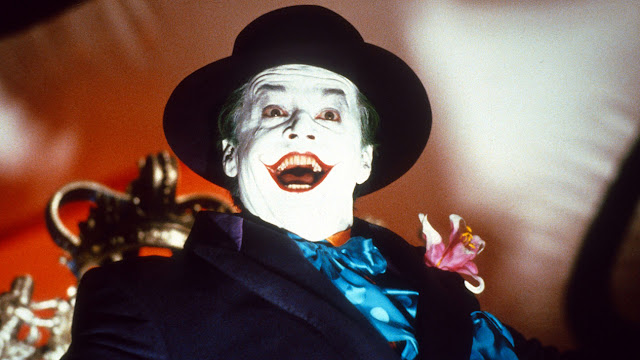
The nightmare at the heart of the film is of course the Joker. Nicholson was so uncertain about doing the film that he struck a deal giving him unprecedented control over the hours he worked, the length of the shoot, the billing and above all a huge back-end salary on box-office and merchandise (the deal was so good, he also made millions from Batman Returns, the sequel he didn’t even appear in). But it was worth it as the film benefits hugely from Nicholson’s cultural and artistic cache, but also his flamboyantly, unashamedly demonic performance, a grinning imp clearly having a whale of a time. Shrewdly, Burton recognised the Joker was such an outrageous character he could provide all the campy, OTT humour some viewers expected – and because it was in tune with the anarchy of the character, the fans wouldn’t mind. Which of course they didn’t, because it’s Jack.

Nicholson soaks up nearly all the energy of the film, leaving very little left for Keaton. Almost certainly very aware of the overwhelmingly negative reaction to his casting, Keaton plays the role absolutely dead-straight. So dead-straight in fact, that he all but forgets to bring any life to the character what-so-ever. Batman is a humourlessly sober hero (the rubber headset also meant Keaton couldn’t hear anything on set) while Wayne has a timid shyness that masks personal trauma. Keaton hits the notes very carefully and seemingly has decided to hide all the manic energy he had shown elsewhere. He effectively concedes the film to Nicholson – and it says a lot that he even looks overawed by Kim Basinger’s greater vibrancy as love-interest Viki Vale.

Watching Batman today, with our attitude to this sort of material changed completely (not least by Christopher Nolan), it’s striking how much more goofy this film seems. It actually says a lot that this was hailed as the darkest, most serious comic-book movie ever. It’s crammed with Burtonish pratfalls and visual humour, from tea trays blocking bullets to Basinger fainting when surprised by a jack-in-the-box. Classic Hollywood imagery is spoofed – at one point the batwing flies over the clouds, holds position dead-centre of the moon and then dives down while everyone in the film is dressed in a mix of pastiche 1930s style and 1980s clothing. In no way could you mistake anything here as happening in something approaching the real world (compare and contrast the few-degrees-to-the-left reality of Batman Begins).

Burton was in fact an odd-choice for director, with only two live-action films under his belt. He’s not been fond of Batman – he called it “mainly boring to me…more of a cultural phenomenon than a great movie” – and the film is an odd fusion of styles. Burtonish dark humour and surreal dashes, mixed with blockbuster action and Prince songs. The film itself has a drifting and unfocused plot (part of constant studio rewriting – shooting the climax Nicholson asked Burton “Why am I climbing up these stairs?” to which Burton responded “We’ll work it out when you get to the top”) which plays around with ideas of trauma motivating these characters but goes nowhere with it. The Joker has no scheme and the film gives him no real personality depth or manages to explore his anarchism in the way The Dark Knight did. Events sort of happen with a shady logic and an unconnected inconsistency, until the film decides to end with a parade climax and rooftop fight.

What’s also striking is how little the comic books are treated like Holy Text by the film-makers (a complete no-no today, where even the slightest deviation from the writ leads to an avalanche of on-line criticism). Batman offs criminals without a second thought, his backstory is radically altered, the continuity merrily distorted. He seems less like a highly-trained fighter and detective, and more a gamely-trying brawler dependent on gadgets. Every character outside Batman, Vale and, I guess, the Joker is a clueless old buffer. While the film is inspired by the look of some of the comic books, it basically has no interest at all in their mythology or deeper themes.

Batman is entertaining but manages to feel long – largely because its plot is vague and drifts, without a tightly controlling theme or plot arc. It’s at times rather inconsistently edited – watch the sequence in the art gallery that is rife with continuity errors – and the film is slightly in awe of Jack Nicholson’s exuberant performance that dominates the film and crushes the life out of any narrative. But it showed that comic books could take place in a world that was dark and imposing rather than primary coloured and that superheroes didn’t need to wear their underpants over their trousers to get the crowds in. For all its flaws, it’s the first stone in the road to the Marvel Cinematic Universe (and yes I know it’s a DC comic).

Rio Bravo (1959)

Rio Bravo header
John Wayne, Ricky Nelson and Walter Brennan are supremely unbothered by danger in Hawks’ High Noon riposte, Rio Bravo

Director: Howard Hawks

Cast: John Wayne (Sheriff John T Chance), Dean Martin (Dude), Ricky Nelson (Colorado), Angie Dickinson (Feathers), Walter Brennan (Stumpy), Ward Bond (Pat Wheeler), John Russell (Nathan Burdette), Pedro Gonzalez Gonzalez (Carlos Robante), Estelita Rodrigues (Consuelo Robante), Claude Akins (Joe Burdette)

When they saw High Noon Hawks and Wayne were unimpressed. Who was this sissy cry-baby, blubbing in his office, begging all and sundry to join him in an impending gunfight with an outraged gang? This wasn’t the West they knew. How un-American was that? So, heads went together and they came up with their counterpoint: Rio Bravo, where the Duke does the right thing, locks up the bad man, is supremely unruffled by threats of violence from his gang, turns down offers of help from across the town (he doesn’t need to worry, they all help anyway) and even finds time for an unfazed, late-night jail-room sing-along with his deputies. Take that Fred Zinnemann and Carl Foreman!

The Duke is John T Chance, a grizzled, experienced sheriff, still in-his-prime, who arrests the brother of Nathan Burdette (John Russell) after he shoots an unarmed man in a bar brawl. When Nathan demands his release – or there will be hell to pay – Chance relies on the men he can trust: old-timer Stumpy (Walter Brennan), recovering alcoholic former-deputy Dude (Dean Martin) and (eventually) plucky young gunslinger Colorado (Ricky Nelson). The three simply have to wait for the Marshalls to arrive and take Burdette away – but will the Burdette’s strike first? On top of which, Chance’s eye is caught by the widow of a cheating gambler, Feathers (Angie Dickinson) – does he also have time for a bit of love?

Rio Bravo is possibly one of the most “shooting-the-breeze” films ever made – even though the general air of manly cool is punctuated by the odd gun-fight. Wayne and his gang are far too cool, confident and quick on the draw to ever be that worried about the approaching threat of the Burdette family – not that you can blame them, since Hawks spends only the minimum amount of time fleshing them out. Instead, the film is a chronicle of a few days where they hole-up and basically shoot-the-breeze – their banter carrying over to exchanging bon-mots during the final gunfight (“You took two shots!” “I didn’t take the wind into account”). It’s the sort of unfazed cool against the odds that you can see has carried across to a whole host of modern action and superhero films, heroes who are so confident in their skills they crack wise even under fire.

Rio Bravo is directed at a gentle pace but complete assurance by Hawks. It occasionally has a feel of settling down and watching a relaxed after-show party, with a group of actors so comfortable in each other’s company, that they simply filmed themselves having a whale of a time. Wayne marshals the whole thing on screen with authority and confident precision: the part is far from a stretch, but he hits the beats with a naturalness that really works, from a fatherly mix of encouragement and disappointment in Dude’s slow turnaround from his drunken collapse, to a crusty flirtatiousness with Feathers (Angie Dickinson at her most radiant here).

The film is full of delightful little moments that pop-up with a perfectly judged regularity. Colorado and Feathers save Chance’s bacon with a perfectly timed flower-pot through the window, matched with Colorado’s pitch-perfect shooting skills. Dude judges exactly the location of sharp-shooter through the drops of blood on a full beer-glass (a lovely image from Hawks). Chance and Colorado confront a card cheat. Chance is so cool under fire, that pinned with two guns on his back in a small room, he never once feels like he thinks there is any real danger.

Either side of these events, the film is full of a sublime lackadaisical charm, as our heroes riff off each other, never once letting events get too heavy. You couldn’t cast Dean Martin and Ricky Nelson without having them break into song – so of course, they do just that in a late-night sing-along. It seems to be about blocking out the sound of Degüello, the cut-throat Mexican song that plays non-stop outside the town overnight, warning them of the perils to come. But really it’s just because we are watching three blokes chilling and simply too cool to be that flustered by scare-tactics. (The Degüello here, by-the-way, was composed by High Noon’s composer Dimitri Tiomkin – another one in the eye for that film).

Wayne’s charges all do a fine job on screen, with Dean Martin in particular fitting the role like a glove and bringing a wonderful sense of sixties brashness as well as a surprisingly affecting struggle with alcohol. Ricky Nelson does his duty when pushed. Walter Brennan wheezes and cackles as only he can. Angie Dickinson is wonderfully vibrant and sexy – surely, with those tights, she’s too much for even the Duke to handle?

Duty is what it is all about, and these are men’s-men who knuckle down and get on with it rather than complain. People may offer to help, but only those qualified will do so (two of them rock-up to help at the final gunfight anyway). That film’s concluding shoot-out is rousing, dramatic and literally explosive. Hawks shoots it all with assured skill – the film’s long silent opening, is a wordless delight of reaction, implication and careful character development (Chance and Dude are wordlessly, but perfectly, established).

Rio Bravo is one of those films people has have their “favourite” – and that might be because it’s laid-back, fun and invites you to join on it. It’s free of pretension and shows you the sort of men you’d like to be, going about effortlessly the sort of things you’d like to do. No wonder people love it so much.

Goldfinger (1964)

Goldfinger header
Sean Connery defines Bond forever in Goldfinger

Director: Guy Hamilton

Cast: Sean Connery (James Bond), Honor Blackman (Pussy Galore), Gert Fröbe (Auric Goldfinger), Shirley Eaton (Jill Masterson), Tani Mallet (Tilly Masterson), Harold Sakata (Oddjob), Bernard Lee (M), Martin Benson (Mr Solo), Cec Linder (Felix Leiter), Lois Maxwell (Miss Moneypenny), Desmond Llewelyn (Q), Burt Kwouk (Mr Ling), Richard Vernon (Colonel Smithers), Bill Nagy (Mr Midnight)

It took three films, but Goldfinger was when they got the James Bond formula spot-on. So spot-on, that all the James Bond films that followed would employ elements introduced here. This is where we got for the first-time: the pre-credits action sequence, Q, a gadget filled Aston Martin, a bizarre assassination tool, a villainous henchman with a bizarre skill, an outlandish scheme and Bond delaying being saved at the end for a few more moments of rumpy-pumpy. It’s Connery at the height of his powers, has a knock-out song, one brilliant sequence after another and marks the moment where Bond wisely severed any connection with the real world, like a laser slicing through gold towards our hero’s crotch.

On vacation in Miami, James Bond (Sean Connery) has a run in with Auric Goldfinger (Gert Fröbe), gold bullion millionaire and card cheat. During this his romance with Jill Masterson (Shirley Eaton) is cut short when she is killed by being covered completely in gold paint (a fatal case of the not-actually-real ailment “skin suffocation”) by Goldfinger’s silent steel-rimmed hatted manservant Oddjob (Harold Sakata). Bond is hungry for revenge when he is tasked by M (Bernard Lee) to find out how Goldfinger is smuggling Gold bullion. He finds out Goldfinger has an even more fiendish plan in the works, involving Chinese agents, a nasty gas, an all-female flying circus headed by Pussy Galore (Honor Blackman) and the US gold reserve at Fort Knox.

Goldfinger was a massive hit and pretty much lands somewhere near the top of any poll of the greatest ever Bond films. That’s because it’s just a massive explosion of cool fun. It’s exciting, funny, perfectly paced and has one scene after another that are so perfect, Bond films for the next fifty years would more-or-less repeat them again and again (taking it even further, A View to a Kill is virtually a remake of Goldfinger and even Quantum of Solace has a homage to death-by-gold-paint). Goldfinger takes place in a heightened reality of thrills and spills – unlike From Russia with Love or Dr No there is not even the slightest pretence espionage might work something like this – and barrels along with such pace and momentum it becomes a thrill ride you don’t want to get off.

The plot is actually rather close to Fleming’s original. Goldfinger’s plan has been tweaked, but the film still finds time for the classic “Bond takes on the cheating villain at a gentleman’s sport”, with Bond duelling with Goldfinger in a round of match-play golf (I like to think this is where Connery’s real-life obsession with the sport began, cunningly swopping the cheating Goldfinger’s ball on the final hole for default victory). But the film adds a playful, tongue-firmly-in-cheek quality. It manages to mix thrills with not taking itself too seriously, becoming a grandly entertaining thrill ride.

The re-working of the elements of the novel for the screen created an indelible template for Bond. Oddjob became a walking icon, his shadow instantly recognisable, invulnerable with a killing method – a steel rimmed hat he throws with Olympian accuracy – that’s a perfect mix of just-about plausible and utterly ridiculous. And also, of course, perfect to playfully imitate a home. What you can’t imitate is bombing around hill roads in a gadget-stuffed Aston Martin, but you can dream. The car chase is not only a show case for cool driving, it also lets you see each of the super-cool enhancements introduced by Q one-after-another (a pattern the series would follow time and again whenever a gadget-stuffed car appeared) and hammers home Bond’s super-cool confidence.

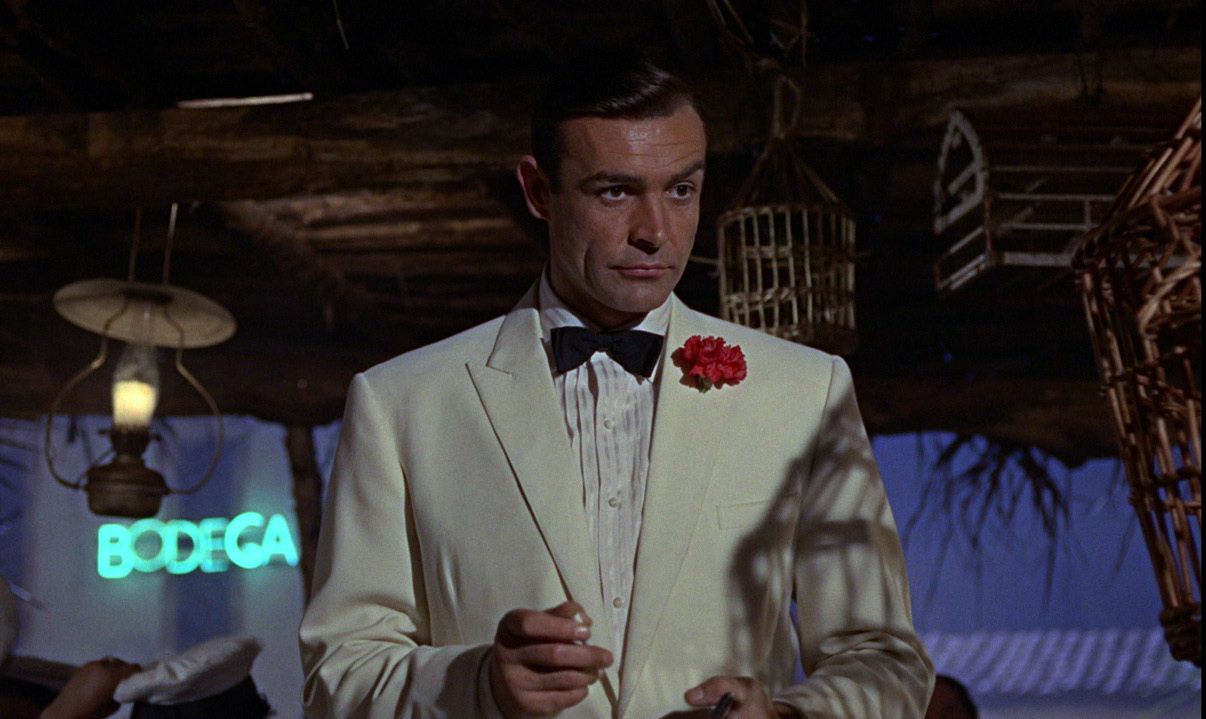
Connery was of course perfect for conveying that. In Goldfingerhe was still interested, clearly enjoying some of the best quips he got as well as just enough acting challenges – from Bond’s sad regret at anger at the death of no less than two Mastersons, to his terror at the prospect of being unmanned by a laser. That sequence has of course gone down in film history – from the striking image to the classic exchange “You expect me to talk?” “No Mr Bond I expect you to die!” – but a lot of it is sold from Connery’s desperate search for the right words to turn that machine off. Connery is cool but still just about vulnerable, cunning, smart and witty but also human. Who wouldn’t want to be so unshakeably cool that he can emerge from a wet suit (with a model seagull on his head!) unzip to reveal a tux, light a nonchalant cigarette while a factory explodes behind him, seduce a woman and then off a killer with a bathtub and a heater (“Shocking!”) – and that’s just the first five minutes!

Every scene in Goldfinger is a doozy. The playful cool of Bond outsmarting Goldfinger in Miami then getting his comeuppance (Connery is so cool in the film btw you forget that Bond is such a staunch conservative, he cheekily disparages the Beatles – that other icon of Swinging Sixties Brit Cool – to Jill as casually as he offs villains). That golf game in Kent (capped by a decapitated statue). Hillside driving with Tilly (with extra dodged bullets). Late night gadget-filled car chase. The first meeting with Pussy Galore (“I must be dreaming…”). Goldfinger’s briefing (his offing of all the attendants makes the whole thing even more funny, since its clearly just Goldfinger enjoying a bit of showing off). Bond dragging a nuclear bomb around an epic Fort Knox set. Oddjob surviving everything but a million volts. Goldfinger earning his wings in the film’s climax. It’s all terrific.

And it all works because it’s got the balance spot-on between cartoon and reality. You can see it come together in Ken Adam’s set for Fort Knox: the inside was all made up (no one would stack gold that high!) but people believed it was the real thing, because it felt like the Fort Knox we shouldhave. Goldfinger is a scowlingly wicked villain, with a little kid’s delight in his own naughtiness. Honor Blackman doesn’t appear until the film is halfway through, but is an assured, forceful, brilliant presence, more than a match for Bond (we’ll gloss over the slightly dated way Bond seems to ‘convert’ her from implied Lesbianism to – well perhaps bisexuality). The briefing sequence with a grumpy, unimpressed Q was so good Desmond Llewelyn would essentially repeat it another 13 times (only OMHSS and Live and Let Die would skip the “Now pay attention 007” sequence between this and TWINE). All of this has the bright, primary colour fun of a rollicking graphic novel.

You can watch Goldfinger about a million times – and anyone who has written a Bond film probably has, it was such a template for the next seventeen films that followed – and it would still thrill, excite and entertain you. Connery’s interest after this went downhill, and the magic wasn’t always recaptured – but this when Bond went from being a cool spy to a cultural phenomenon. Bond became the box-office franchise that would dominate cinemas for decades, the ultimate spy caper that others would be compared to. Goldfinger mixed silliness and seriousness perfectly, thrills and laughs, action and comedy. It’s a superb and hugely influential film. It’s one of the Best Bonds ever: it clearly has the Midas touch.

She Wore a Yellow Ribbon (1949)

She Wore a Yellow Ribbon header
John Wayne embodies the honour and duty of the American man in She Wore a Yellow Ribbon

Director: John Ford

Cast: John Wayne (Captain Nathan Brittles), Joanna Dru (Olivia Dandridge), John Agar (Lt Flint Cohill), Ben Johnson (Sgt Tyree), Harry Carey Jnr (Lt Ross Pennell), Victor McLaglen (Sgt Quincannon), Mildred Natwick (Mrs Abbey Allshard), George O’Brien (Major Mack Allshard), Arthur Shields (Dr O’Laughlin)

If there is a film that marks John Ford as the great American Artist of the West, it might just be She Wore a Yellow Ribbon. Shot in glorious Techicolour on location in (where else?) Monument valley by Oscar-winning cinematographer Winton C Hoch, it’s a gorgeously lit celebration of everything that made the American West a legend. Streaking red sunsets, rolling plains, lightening that slices through the sky, masculine military ruggedness beautifully bought to the screen. It’s Ford’s biggest push to become a Winslow Homer or Edward Hopper of the wide-open American space.

Nuzzling in the middle of Ford’s unofficial Cavalry trilogy (either side of Fort Apache and Rio Grande), John Wayne plays Captain Brittles (who might as well be Kirby York again, since he shares the same personality and most of the same backstory), is counting down the last few days until retirement. After Custer and his men are slaughtered at the Battle of Little Big Horn, he’s ordered to lead a cavalry patrol to fly the flag and help prevent a new war with the Indians. At the same time, he’s to escort his commander’s (George O’Brien) wife (Mildred Natwick) and niece Olivia (Joanna Dru) to an eastbound stagecoach (and safety). Olivia herself is in the middle of a love triangle with the two lieutenants eying taking on Brittle’s command, Cohill (John Agar) and Pennell (Harry Carey Jnr).

The film tells the story of that patrol and the subsequent follow-up mission to save those caught protecting the rear guard (needless to say Brittles continues the mission after his supposed retirement, bending the rules). There isn’t actually much in the way of plot in She Wore a Yellow Ribbon. Instead, Ford’s intention is to front-and-centre those particular American qualities of loyalty, honour, dedication to the cause and self-sacrifice. The men of the cavalry always put their country and fellow soldiers first, willing to sacrifice themselves to the greater good and show not one jot of hesitation in doing so. Ford shoots all this with real beauty and more than a touch of whimsical wit, coming particularly (where else?) from the Irish American contingent among the soldiers.

At the film’s heart is Wayne himself, now cemented in Ford’s films not as the traditional romantic action hero, but an elder statesman, wiser and less trigger-happy than his fellows, an unflappably experienced man who guides and inspires, shrugging off praise with an aw-shucks-just-doing-my-duty nobility. If Fort Apache and Red River were first steps towards Wayne – at this time only just past 40 – starting to act as if he was ten years older than he actually was (and in Red River’s case a little bit older than that!) – She Wore a Yellow Ribbon cemented him as the grizzled, inspiring man of action, a role he would play in variation for most of the rest of his career.

And he’s very good in She Wore a Yellow Ribbon. Ford had of course been impressed by the depth and shade of his performance in Red River. This is a simpler role – it would be a few more years before Ford used the darkness in Wayne as well as that film – but it shows Wayne slotting into place as part of What Made America Great. Wayne plays Brittles with a sadness – he’s a touching grieving husband, who takes a familiar chair out every night to talk to his wives tombstone – and a fatherly concern for his men, but tolerating no selfishness or greed. He mentors and pushes Cohill and Pennell like a second father, and has a brotherly banter with his loyal sergeant (inevitably Victor McLaglen as a hard-drinking, extremely Irish drill sergeant). He will do his duty, but he also respects Indian culture, will fight but prefers a peaceful option, will follow orders but never blindly. He’s all that’s good about the American fighting man, and this is one of his finest performances (and a personal favourite of his).

The yellow ribbon wearer is Joanna Dru as Olivia, the sort of spunky young woman Ford’s films frequently feature in key roles. Dru is just about the archetype: brave, determined, smart – much smarter than both of the rather dull men playing court to her. She’s also sensitive and understanding of Brittle’s grief and can hold her own with the men out in the field. Dru’s very good in the role, bringing it a great deal of depth and more than a touch of heart.

She Wore a Yellow Ribbon, plot wise, is more of a day-in-the-life movie. At heart not a lot actually really happens in it other than following the cavalry on two missions (one of which fails) and far from averting the war, it’s explicitly suggested they are just delaying it. The status quo is almost completely restored by the film’s end. The real focus of the film is the detail of what the men set out to do, the determination and humanity with which they go about it – not least the self-sacrificing bravery – and then the return to rest and prepare to go out again. All shot in some of the most striking and beautiful images of the West ever committed to the screen. As a visual tribute, the film is a rich feast.

It’s Ford’s celebration of America and the West and his case for the beauty and majesty of a generation and the values that they placed above all others. For this, She Wore a Yellow Ribbon may be one of the finest of its kind. It lacks the narrative thrust of Fort Apache – and like that film is, in the end, as unquestioning and uncritical of the actions and legacy of those pioneers out West, or the dangers of imperial expansionism or blind veneration of deeply flawed heroes like Custer – but it’s beautiful, very well acted (particularly by Wayne) and a fine film from a director at the top of his game.

The Last Duel (2021)

The Last Duel header1
Adam Driver and Matt Damon fight The Last Duel in medieval France

Director: Ridley Scott

Cast: Matt Damon (Sir Jean de Carrouges), Adam Driver (Jacques Le Gris), Jodie Comer (Marguerite de Carrouges), Ben Affleck (Count Pierre d’Alencon), Harriet Walter (Nicole de Buchard), Alex Lawther (King Charles VI), Marton Csorkas (Crespin), Željko Ivanek (Le Coq), Tallulah Haddon (Marie), Bryony Hannah (Alice), Nathaniel Parker (Sir Robert de Thibouville), Adam Nagaitis (Adam Louvel)

The medieval era had its own solution for “He said, She said”. Let God decide via a fight to the death. After all, He would never let the injured party lose, would he? Scott’s The Last Duel is a dramatisation of one of the last French judicial duels, in December 1386, between Sir Jean de Carrouges (Matt Damon) and his former friend Jacques le Gris (Adam Driver), after Le Gris is accused of raping Carrouge’s wife Marguerite (Jodie Comer). Scott’s Rashomon-inspired film shows the events leading up to the duel from all three characters’ perspectives.

The three different stories we see are not radically different. Unlike Rashomon – which presented totally different versions of the same events, according to the prejudices or agendas of the storytellers – The Last Duel’s versions stress subtly different reactions or presents different fragments of an overall story. So, for instance, Le Gris and Carrouges remember different elements of a battle. Carrouges recalls the noble charge to save the innocent, saving Le Gris’ life in the final stages of combat. To Le Gris it’s a suicidal charge, in which he saves an unhorsed Carrouge’s life. After the rape, Carrouge remembers offering his wife sympathy; she remembers his anger and demand they have sex at once to “cleanse her” of the stain.

These mixed recollections work best when we see each of them remember a fateful reconciliation meeting between Le Gris and Carrouges (where Le Gris and Marguerite first meet). A wedge has been driven between them ever since Carrouges believed Le Gris cheated him out of both land and his father’s former position. When the two agree to try and put the past behind them, Carrouge asks Marguerite to give Le Gris a kiss of peace. He remembers her surprise and timidity. Le Gris remembers her as being quietly excited with a kiss that lingers. Marguerite remembers a kiss from Le Gris that lingers too long. Small moments like this are where the film is at its strongest, making its concept feel very relevant today in our world of accusation and counter accusation.

But these moments are few and far between. Most of the time there isn’t this subtle variation. Where the film is weakest is when we (frequently) see the same events, presented the same way, three times. While our perception of Carrouges changes – from the ill-treated noble he sees himself to the sullen, self-entitled whiner everyone else sees – our idea of Le Gris is fundamentally the same (blissfully self-entitled). Fundamentally, when we see events the first time, later versions only really tweak our perception of them rather than challenge it.

You can see this in the rape itself, which we first see from Le Gris’ perspective. The film shows Le Gris’ understanding of consent has been twisted by most of his sexual experience being court orgies with playfully protesting prostitutes. His pursuit of a genuinely unwilling Margeurite around her room echoes exactly the pretend-chases and “chat up lines” he’s used in those earlier scenes, so we understand it’s possible he doesn’t actually understand he’s raped her. But no viewer can see Le Gris’ version as anything other than rape. In fact, the only tangible difference when we see the event from her perspective is that her screams of “No” and “Stop” are louder and the camera focuses more on her anguished face. If the film is presenting any tension about whether this is a consensual encounter or rape, it ends the second we see Le Gris’ story.

This negatively effects the drama – and actually makes Marguerite’s version seem strangely superfluous. You start to feel we might as well see all three perspectives at the same time, as the narrative trick ends up adding little to the film – especially since the film categorically states Marguerite’s version is the truth. Why not just tell the whole film from her perspective in that case? It also doesn’t help that Marguerite goes last – which means until an hour into the film, the character we should be most engaged with and sympathetic towards has stood on the side-lines.

This is particularly unfortunate as the film is striving for a feminist message. The men are callous and self-obsessed, treating women as sex toys or assets – and are praised for it. Marguerite though is intelligent and principled, marginalised by her husband and condemned as a whore when she protests her rape. She pushes her case with determination, despite discovering she will be condemned to burn if Carrouge loses (he of course is only in his own honour). Her word is only good if backed a man, and she is powerless to defend her innocence.

It’s the lot of medieval women. Harriet Walter (rocking a bizarre appearance, straight out of David Lynch’s Dune) as Carrouge’s mother tells Marguerite the same thing happened to her, but she considered it pointless (and dangerous) to press charges. What we see of the judicial system is ruthlessly unjust and misanthropic, with women harangued to confess their guild for tempting men.

But it doesn’t quite click together. It’s a shame, as many scenes are highly effective. The rape – both times we see it – is alarming. The final duel is brilliantly shot and hugely tense, not least because Marguerite stands literally on the top of an unlit bonfire watching every blow. Scott’s shoots the film with the same blue-filtered beauty he gave to the early scenes of Kingdom of Heaven.

There is of course an oddness in seeing such American actors as Damon, Affleck and Driver in period setting. The accents are an odd mix: Comer basically uses her regular (non-Scouse) performance voice, Damon does a gravelly version of his own, Walter an American twang to match Damon, Affleck is halfway to plummy Brit, Driver flattens his Californian tones. Damon is pretty good as the sulky, surly Carrouge who gets less sympathetic the more we see him, Driver is suitably charming on the surface but selfish. Comer plays wounded injustice extremely well and brings a lot of emotion to a difficult role. Affleck has the most fun, flouncing around in a blonde wig as a lordly, hedonistic pervert who likes nothing more than belittling Carrouge.

The Last Duel is part way to a decent film, but it just lacks that little bit extra to make it really come to life. Its alternative versions of the truth don’t illuminate as much as they need to – even if they are at points pleasingly subtle in their differences. It has an admirable feminist message, but defers most of it to the second half of the film (were they worried about sidelining the famous male actors?) and it’s concern that we should not doubt Marguerite at any point does undermine its drama. Handsomely filmed, it doesn’t make the impact it should. Perhaps that’s why it was one of the leading box office disasters of the Covid Pandemic?

Highlander (1986)

Highlander header
Sean Connery plays a Scottish Spaniard and Christopher Lambert a French sounding Scot in cult classic Highlander

Director: Russell Mulcahy

Cast: Christopher Lambert (Connor MacLeod), Sean Connery (Juan Sanchez-Villalobos Ramirez), Clancy Brown (The Kurgan), Roxanne Hart (Brenda Wyatt), Beatie Edney (Heather MacLeod), Alan North (Lt Frank Morgan), Jon Polito (Detective Walter Bedsoe), Shelia Gish (Rachel Ellenstein)

“There can be only one!”. It’s a neat, simple idea and lies at the heart of a cult science-fiction film crammed with them. There is a lot to chuckle at in Highlander. From the air of cheesy cheapness to the Accent Olympics (A Belgian plays a Scot. The world’s most famous Scotsman plays a Spaniard. Brits play Americans. An American plays an Ancient Eastern Barbarian.) But Highlander had huge impact – and was revived countless of times since – because there’s a kind of magic (see what I did there?) to this sci-fi fantasy about immortals struggling over centuries to emerge as the winner of a secret-but-deadly competition. There are so many intriguing ideas and possibilities here, you could make hundreds of adventures in this world (and they have) and still have new areas to explore. The film bombed on its first release in America (look at the poster – is it any wonder? How awful is that?) but it’s had a huge afterlife.

Our hero is Connor MacLeod (Christopher Lambert) who takes part in a lethal sword fight in the car park of Madison Square Gardens in 1985. Turns our Connor was born in the early 1500s, part of a Scottish tribe and was slain by immortal warrior The Kurgan (Clancy Brown). Discovering to his amazement – and his tribe’s horror – that he makes a full recovery from a mortal wound, MacLeod was exiled. He is found and mentored by Ramirez (Sean Connery) who informs him that they are both immortals, destined to join all other immortals in a competition from which there can be only one survivor. The competition will culminate in “The Gathering”, with the winner being given “The Prize”, a mystic power. Turns out 1985’s New York is the scene of the Gathering – and MacLeod and the Kurgan are destined to be the last men standing in the competition.

Perhaps the big thing that makes Highlander such a success is it becomes clear that everyone involved in it seemed to have a whale of a time. Queen were commissioned to write one song for the film: they wrote an album. Mulcahy, Lambert and other members of the cast and crew chipped in their own money to film extra scenes between MacLeod and his adopted daughter. Connery was at his jovial best on the five days he spent filming (Ramirez was to be the only character other than Bond he played twice, in the terrible sequel). All this investment off-camera pays-off in a film frequently rough and ready but also intriguing and enjoyable.

Sure, it’s no masterpiece. It’s very much of its time, with a distinctive 80s vibe and in many ways only scratches the surface of its potential: I’d have loved to see more of MacLeod during the ages, and other Immortals he had interacted with. (We get a confrontation in World War II and a comic duel in Georgian England, where MacLeod repeatedly survives deadly sword thrusts). Our nemesis, the Kurgan, is a frequently overblown and ridiculous character (for all the energy Clancy Brown plays him with) who isn’t quite interesting enough. Lambert is a slightly wooden performer (he learned English for the role – learning it with a Scottish accent was a tough task). Many of the sword fights (with the exception of the final duel) are high-school-play in their hack-and-slash simplicity.

But it doesn’t really matter too much, because Mulcahy shoots the hell out of the picture. Working with a tiny budget, he still manages to give every scene something distinctive to see and an edge in its delivery. The film frequently punches above its weight in its set pieces and with the surprisingly gritty action. Mulcahy has a great eye for the seedy underbelly of New York, just as he does for the Highlands of Scotland. He also handles the romance surprisingly well – both MacLeod’s wife in 16th century Scotland and his love interest in modern New York (including a surprisingly tender love scene) are engaging and complement each other (no mean trick).

Also, the idea is absolute solid gold, and for all that it’s sometimes buried in a cheesy 80s Euro-actioner, Mulcahy still gives the entire thing a sort of mystic force. The tragedy of someone living centuries – watching everyone they love grow old and die around them – is very affectingly done. The different personalities and backgrounds of the immortals are striking and the hints dropped about their involvement in past events intriguing. The concept of immortals growing stronger from beheading other immortals is intriguing and adds a fascinating subtext to every conversation between two of them. The Game itself has an ancient-legend sort of strength, the entire film’s concept having all the revisitable interest of a popular children’s story or a classic slice of mythology.

It looks handsome, and while the actual plot is often predictable and straight-forward, the richness of the backstories and the history carries real impact. Connery is great in a neat cameo – one of his first “mentor” roles (he’s only in it for about 15 minutes, but lifts the entire enterprise with his charisma). The Queen soundtrack is a knockout. Sure, some moments – such as Lambert all too obviously lifted on wires – look as cheap as they probably were, but the entire film is made with a burst of energy and a feeling of enjoyment and love that you have to have a hard heart not to care for it a little bit.