Category: Biography

The House of Rothschild (1934)

The House of Rothschild (1934)

Old-fashioned historical melodrama with a well-meaning, earnest political message

Director: Alfred L Werker

Cast: George Arliss (Nathan Rothschild/Mayer Rothschild), Boris Karloff (Count Ledrantz), Loretta Young (Julie Rothschild), Robert Young (Captain Fitztoy), C. Aubrey Smith (Duke of Wellington), Arthur Byron (Baring), Helen Westley (Gudula Rothschild), Reginald Owen (JC Herries), Florence Arliss (Hannah Rothschild), Alan Mowbray (Prince Metternich), Holmes Herbert (Roweth)

It’s 1814 and things are looking tight for the international banking house of Rothschild. With the Napoleonic Wars over, partly thanks to Rothshild financial support of Wellington’s armies, Nathan Rothschild (George Arliss) is pitching to underwrite the loans to help restore France. Problem is, now the merde is out of the European fan, many of the Powers-That-Be don’t want to continue working with a Jewish bank. Led by scowling antisemitic Prussian Count Ledrantz (Boris Karloff), the Rothschilds bid is unjustly rejected. Rothschild outmanoeuvres his enemies to win the contract back, but it leads to a series of revenge pogroms in Prussia. Things change though, when Napoleon escapes from Elba. As all roads lead to Waterloo, will Rothschild back the Allied powers or throw in his lot with Napoleon?

The House of Rothschild is a very well-meaning, old-fashioned historical melodrama, that takes a strong stance against antisemitism. It clearly has more than half-an-eye on events in Germany in the 1930s. As the film’s Prussia of 1814 sinks into mobs hurling stones through windows, smashing up shops and chanting for the expulsion of Jewish people, while families flee across the body leaving their possessions behind (all while the self-satisfied, archly cold Ledrantz pushes his agents to provoke the people to yet more outbursts), surely many people would have seen parallels with Hitler’s Germany.

Throughout the film, the accusations of antisemites are pointedly broken down and strongly rebutted or placed into context. Why do the Rothschilds work in money? Because they are literally banned from any other profession. And money is the only tool they have to defend themselves against 2000 years of persecution; persecution that has made the Rothschilds feel a true affinity for their fellow Jewish people. Indeed, Nathan Rothschild feels a duty to stand firm and do anything he can to help his people: and if that means a bit of financial chicanery or applying heavy pressure to the European powers, then so be it. There is a greater good here when lives are at stake.

The scourge of racism is strongly displayed throughout the film. It opens with a prologue as Nathan’s father Mayer (George Arliss pulling double duty, under a pile of make-up and a wig) struggles to hide his justly-earned fortune from being stolen by corrupt tax collectors who call him ‘Jew’ and smugly tell him the amount he owes to the government is whatever they say it is. It’s a ferocious piece of open antisemitism, but it has genteel echoes when Nathan is later snubbed for an invite to a ball to celebrate Wellington’s victory (a victory he largely paid for) since Jewish people aren’t welcome at such events.

The House of Rothschild places its laudable anti-persecution aim into a very traditional, old-fashioned, costume drama that wouldn’t look out of place on the Victorian stage. It was a passion project of George Arliss’ (who cared deeply about its message), but also fit wonderfully well inside his wheelhouse. You can see its deep similarities to Arliss’ Oscar-winning vehicle Disraeli. Just as there, he plays a twinkly elder statesman, with a touch of the rogue but overflowing with decency and honour. Despite being seen as a suspicious outsider, he out-plays his rivals in an international conspiracy while casting an avuncular eye over a love affair in the family: in this case between his daughter (Loretta Young) and gentile British cavalry officer Captain Fitzroy (a fairly wooden Robert Young). Both films end with our hero celebrated by royalty at a grand ball, while cementing a loving marriage with his wife (played again by Arliss’ wife Florence).

Arliss is, of course, very good in a role tailor made for his mix of playful charm and speechifying. Much of the film is essentially dominated by Arliss, who delivers with his customary skill (even if his performance as Mayer is more than a little ripe) and if his performance feels more than a little like Disraeli #2, his comfort in front of the camera and the naturalness he brings to the role help enormously. Under the playful exterior, Arliss also finds a strength and determination, powered by a real moral fury at the injustices, slights and (eventual) violence perpetuated upon his people.

Few other actors get much to play with here. House of Rothschild is heavily fictionalised, from its invented nemesis in Count Ledrantz (Karloff is good value as the scowling racist) to the build-up to the Waterloo campaign. However, for history buffs like me, there is a fair bit of delight in seeing a parade of great European statesmen pop up in cameos. From Tallyrand to Metternich to Lord Liverpool, these powerhouses of politics fill out the margins, even if they barely come to life as characters. If there is an exception, it’s the customary gruff no-nonsense military bearing C. Aubrey Smith gives Wellington (here a man firmly on the side of decency and honour).

The romantic sub-plot is very disposable, despite the best efforts of all involved. It briefly overlaps with the film’s main themes – Rothschild is less than happy with his daughter marrying a gentile, while he suffers a parade of humiliations from Fitzroy’s compatriots – but otherwise provides little real drama. The various conspiracies are largely resolved through some ingenious Rothschild speeches. The film’s main success is always the creeping dread of antisemitic violence, a candle it keeps alive throughout its old-school, costume-drama melodrama, with just small drops of directorial and cinematic invention. It’s the main reason for remembering a film that’s entertaining enough, in a gentle, classic Hollywood biopic way. It never reinvents the wheel, but it’s passionate about the people who find themselves ground beneath it.

Note: Considering all that, it’s particularly sickening to note that footage from The House of Rothschild of Arliss in full Mayer Rothschild make-up was pinched and repurposed for Joseph Goebbels’ vile antisemitic epic, The Eternal Jew.

The Smashing Machine (2025)

The Smashing Machine (2025)

Johnson goes for Oscar in a mediocre film that arguably shows his limits as an actor not his depth

Director: Ben Safdie

Cast: Dwayne Johnson (Mark Kerr), Emily Blunt (Dawn Staples), Ryan Bader (Mark Coleman), Bas Rutten (Himself), Oleksandr Usyk (Igor Vovchanchyn), Lyndsey Gavin (Elizabeth Coleman), Satoshi Ishii (Enson Inoue), James Moontasti (Akira Shoji)

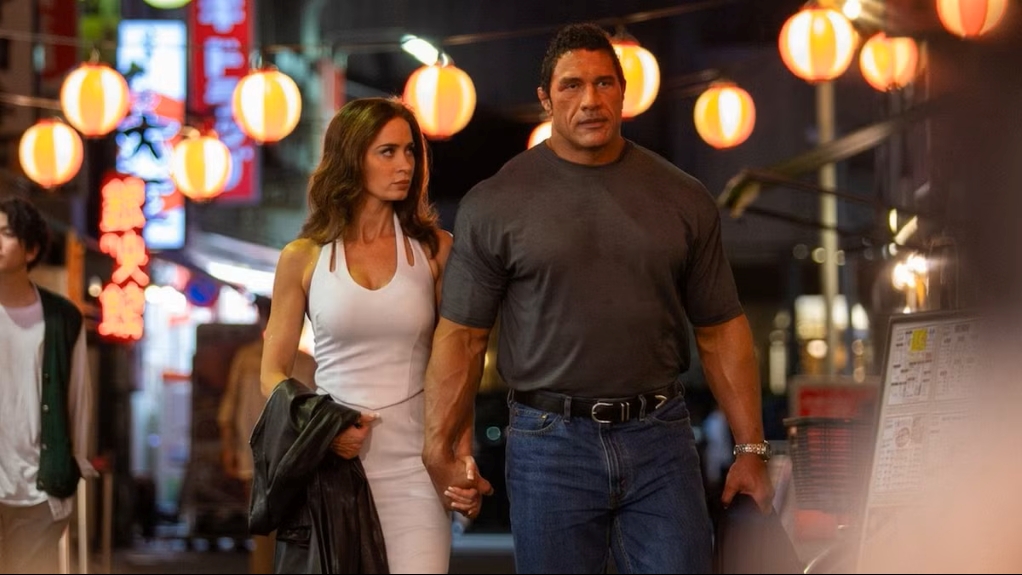
Mixed Martial Arts is big business today. The Smashing Machine makes a point of stating its stars are internationally known, earning millions of dollars. Making them not too dissimilar from The Smashing Machine’s star (and guiding light) Dwayne “The Rock” Johnson, who achieved both these in MMA’s ‘scripted’ sibling Professional Wrestling. It’s a knowledge the film is banking on, as Johnson plays Mark Kerr a leading MMA fighter from that period in the late 90s when men were willing to have several layers of shit kicked-and-punched out of them for a few thousand dollars and a dream.

Kerr is one of the big draws of MMA, an affable six-foot mountain of muscle who (when not brutally beating others in the ring) is a hulk of likeability. But he’s got problems – for starters a growing reliance on opioid painkillers and a relationship that’s two thirds self-destructive to one-third mutually dependent with girlfriend Dawn (Emily Blunt). The Smashing Machine covers Kerr’s getting clean, the break-up and return of his volatile relationship and his shot at 2000 MMA title in Japan in 2000 that could land him $200k.

The Smashing Machine covers all this in a deliberately distanced, low-key style. It nominally follows sports film structure (triumph, failure, re-build, some level of success), trudging along the Rocky template. But Safdie avoids exploiting the genre’s strengths (the highs and joys and it’s emotional release) in a way that is both admirable and makes The Smashing Machine a less engaging or interesting film than you keep expecting it to be. It’s almost a point-of-pride that the film avoids the obvious, but instead languidly leaves things unsaid, or skims lightly over key plot developments, as it spools out accompanied by an incessant jazz soundtrack. But it’s not always a strength.

What it fails to do is find something sufficiently interesting or compelling to take their place. It has all the surface appearance of raw, true-life drama: the jerky camera-work, jazzy score, muted colours, roughed-up actors – but is constantly too distanced and cautious to be truly raw. It (perhaps admirably) doesn’t want to be seen to exploit Kerr, but by playing down his struggles (or rather, boiling them down into neat little scenes ripe for “For your consideration” Oscar clips), it also makes them frequently feel like not that much of a deal. On top of this, the underlying desperation that could have been there in a film where people submit themselves (effectively) to ruleless cage fights like wage-slave gladiators never gets an airing.

It doesn’t even really explore the dark nature of the ‘romance’ at its heart, a relationship which seems categorically a ‘bad thing’ for both people (a coda reveals they married shortly after reuniting after the ballistic, emotion-packed row that is their final moments here – and separated within six years). This is a relationship where the two are never on an equinox. When Mark is in the depth of addiction, Dawn is both afraid of his drugged-out distance and enjoys his small-boy-like need for her affection. When he’s clean, Mark sermonises sanctimoniously while Dawn doubles down on drinking and pill-popping in front of him (“that’s not nice” Mark chides her, sounding like a disappointed child).

But, despite the disapproval hinted out from all the other characters in the film, The Smashing Machine shies away from really addressing this dangerous relationship, making it feel more like a formulaic awkward-love-story, rather than being braver with a harsh truth. In fact, that passionate heated romance, ends up feeling like somewhere between a rather forced series of contrived, manipulative moments (that have no real pay-off) and a firey acting exercise between two performers who trust each other.

Lack of bravery soaks through the whole film, a muted awkward affair where you feel different hands pulling in different directions (an on-the-nose commentator explains all the MMA action to us, as if a producer watching a late-cut was worried it would otherwise make no sense). It’s part a quiet, off-the-wall, yanging-when-it-could-ying serious character study (the Safdie side perhaps), part an Oscar bait slice of true-life heroism (the Johnson side).

Ah yes, the Oscar bait. Much play was made of how far Johnson was willing to move out of his comfort zone and cast aside the action that made him a star. However, for me, what The Smashing Machine reveals is the limits Johnson is willing to go too as an actor. The Rock doesn’t do vulnerability even when playing a beaten-up drug-addict in a borderline-mutually-abusive relationship (all the head-in-his-hands scenes weeping can’t change this, and Johnson delivers these moments like acting assignments rather than with true emotion). Johnson won’t sacrifice his strength of character to play a truly weak man: Johnson might punch a door apart, he never feels comfortable embodying a man who was at time selfish, self-destructive or foolish. Johnson prefers a Kerr who is always, in some degree, strong (even when whining at a loss, he does it with real commitment).

His partnership with Emily Blunt doesn’t help him: Blunt is far more skilled at creating a nuanced character, someone who weeps with pain at Kerr’s drug use and then later performatively rages at him for being boring when he’s clean. She’s not afraid to explore the darker, less flattering areas in the way Johnson doesn’t want to. Johnson makes the mistake of many in thinking real acting is starring soulfully and having a cry. What he doesn’t do is really commit to transforming his soul and persona: for all the wig, this always feel like a performance as in-control and carefully studied as Johnson himself is. The Smashing Machine shows that even a piece of against-type Oscar-bait is still fundamentally part of the same Johnson-branding exercise, another brick in the persona wall of a determined, charming high-achiever.

You can’t say as much for the film. An average film, lacking spark, energy or interest that can’t make up its mind about whether it wants to be low-key tragedy or a heroic tale of redemption. It says a lot that its most powerful and affecting moments are its closing ones, as we watch the real Kerr shopping in 2025, utterly anonymous, chatting pleasantly with staff who don’t know who he is before he breaks the fourth wall to wave us goodbye. In these minutes, the film clicks with a force nothing else in it manages. Shame you need to wait two hours for it.

Reversal of Fortune (1990)

Reversal of Fortune (1990)

Irons Oscar-winning turn is the stand-out of an otherwise dry picture lacking in energy

Director: Barbet Schroeder

Cast: Glenn Close (Sunny von Bülow), Jeremy Irons (Claus von Bülow), Ron Silver (Alan Dershowitz), Annabella Sciorra (Sarah), Fisher Stevens (David Marriott), Uta Hagen (Maria), Jack Gilpin (Peter MacIntosh), Christine Baranski (Andrea Reynolds), Stephen Mailer (Elon Dershowitz), Felicity Huffman (Minnie)

It was a trial that engrossed America in the early 80s. Did Claus von Bülow (Jeremy Irons), second husband of millionaire Sunny von Bülow (Glenn Close), pump her full of insulin and leave her on the floor of their ensuite to die? Sunny von Bülow, in a permanent vegetative state, narrates this tale Joe-Gillis-style from her coma as Claus is convicted of her attempted murder and hires law professor Alan Dershowitz (Ron Silver) to appeal. But did Claus do it, or is he the victim of public perception?

Of course, no one can know (Sunny even tells us in voiceover, if we want the answer, we’re going to have to wait until we see her wherever she happens to be now). Answers are not on the cards for Reversal of Fortune, which struggles to find something engaging enough to take their place. With some decent lines and striking moments, it focuses on a long breakdown of the might-have-beens, disputed facts and point-of-views of those involved, leaving it up to you to decide if Claus is just a European eccentric with an unfortunate manner and sense of humour or a cold-hearted killer who twice attempted to murder his wife for her money.

Your interest in this will be roughly proportional with how engaging you would find a true crime podcasts without any expert debate. As a rundown of the core facts, it often settles for a series of rather dry scenes of Dershowitz’s legal team reading to each other the various ins-and-outs of the prosecution case, poking holes where needed. There is a singular lack of energy about this, despite the film’s, in many ways admirable, decision to focus on the nitty gritty of cases being built instead of showpiece court confrontations. What Reversal of Fortune fails to do is make this collection of facts and arguments compelling. There are very few scenes of questioning witnesses, consulting experts or uncovering evidence – no investigative energy so crucial to making this sort of film work.

On top of this, it’s hard not to take the film with a pinch of salt, since it takes its entire perspective from Dershowitz, a lawyer who (for all his work for those on Death Row) has shown himself more-and-more as being at least as interested in self-promotion as he is in justice, taking on any case if it brings media prominence. After all, he rolled from von Bülow to representing OJ Simpson, Harvey Weinstein and Jeffrey Epstein. The biggest argument against Bülow’s innocence today might be to say “take a look at that client list”.

Reversal of Fortune walks a fine line between acknowledging Dershowitz’s ambition, while stressing his moral unease. Ron Silver is very good at Dershowitz’s showmanship, self-conscious scruffiness and room-controlling charisma. He has slightly less scope to explore Dershowitz’s moral flexibility: Reversal of Fortune argues it’s important to protect the civil rights of rich people, to prevent precedents hurting the rights of those who can’t afford a houseful of lawyers to pick holes in their cases. Reversal of Fortune further weights the deck to make us see Dershowitz heroically by fictionalising an actual a Death Row case he’s worked on alongside the investigation, representing two young men who broke their criminal father out of prison (who later went on to kill someone). In the film several facts about this case are changed from reality to make them more noble and sympathetic, most crucially changing the race of those involved from white to Black and radically reducing the number of murders involved (as well as not mentioning they also broke another convicted murderer out of prison).

The real strength of Reversal of Fortune is the Oscar-winning performance of Jeremy Irons as Bülow. This was a perfectly fitting, gift of a part for Irons – did they tell him to be as Jeremy Irons as possible? His performance is sly and darkly witty. Bülow is forever making poor taste puns about his possible crimes that Irons’ savours like mouthfuls of the richest caviar. It’s a performance of arch strangeness, Irons playing Bülow as a man so unreadable, taking such a naughty delight in the side benefits of being accused of a crime (he jubilantly states at one point he never before got such good tables in restaurants), so full of elegant European-gentility, he just looks naturally guilty to the parade of straight-shooting American citizens with the power of life and death over him.

Irons’ is also masterful at suggesting this unflappable, dark humour and quirk is actually a desperate front for a man deeply scared but used to hiding his real feelings. Irons suggests Bulow is genuinely using this facade to control his fears and keep him in fighting. The key to the character is nerve: it’s what he describes backgammon as being about, poo-poohing the idea that it’s down to luck, saying winners hold their guts in place. It’s the key to his whole character, the same gambling guts what he’s banking on to get him through this (someone actually guilty would never behave like this right?), and Irons simultaneously plays this front and keeps the frightened man underneath constantly present.

It’s a fascinating, funny, hugely enjoyable performance that lifts the entire film which struggles and slackens the second Irons leaves the screen. Aside from him – and Glenn Close’s arch narration (her agent did fine work nailing her top billing for this) – Reversal of Fortune is a surprisingly dry, rather slowly paced film which, while it is mercifully light on speculation, is also unfortunately light on drama.

A Complete Unknown (2024)

A Complete Unknown (2024)

Engaging but traditional biopic, very well-made and full of knock out performances

Director: James Mangold

Cast: Timothée Chalamet (Bob Dylan), Edward Norton (Pete Seeger), Elle Fanning (Sylvie Russo), Monica Barbaro (Joan Baez), Boyd Holbrook (Johnny Cash), Scoot McNairy (Woody Guthrie), Dan Fogler (Albert Grossman), Norbert Leo Butz (Alan Lomax), PJ Byrne (Harold Leventhal), Will Harrison (Bob Neuwirth), Eriko Hatsune (Toshi Seeger), Charlie Tahan (Al Kooper)

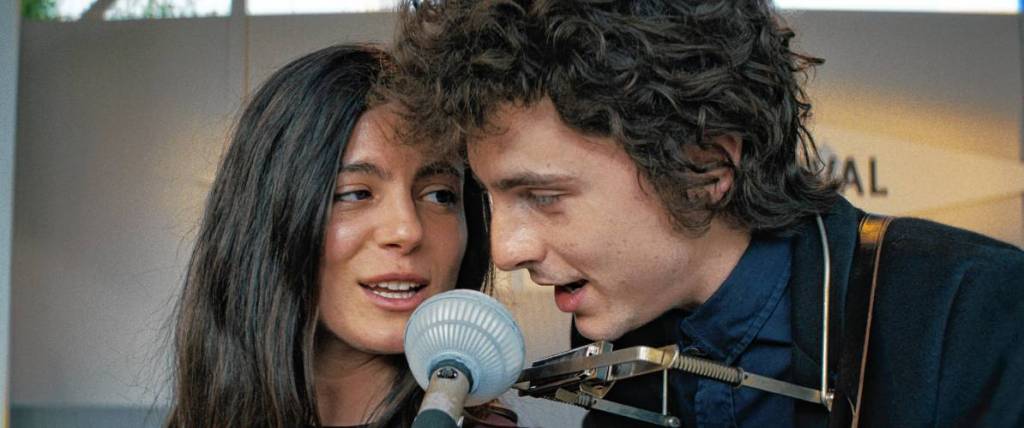
In 1961 Bob Dylan seemed to emerge from nowhere – or, if you like, from being A Complete Unknown – to become the big star of American music and the centre of a battle for the soul of American folk music. On one side, were the traditionalists – they loved Dylan’s thoughtful, lyrical ballads and use of guitar, harpsichord and other instruments. They believed Dylan could lead a whole new generation to traditional American music. On the other side were the modernists, inspired by rock and roll, and the new (electric) sound. A Complete Unknown is about Dylan’s – inevitable – journey towards exploring new music sounds, culminating in his strum-heard-around-the-world as he played an electric set at the Newport Folk Festival (to a mixed reaction to say the least).

That’s the meat of James Mangold’s traditional, but very well-made and enjoyable musical biography, a spiritual sequel to Walk the Line (with a decent, but drink-addled Cash here played by Boyd Holbrook). Much like that film, this tweaks and amends some historical facts, but manages to get close to the spirit of its subject all within a familiar biography set-up of early success, mid-way struggles and triumphant (of a sort) resolution. There is nothing in A Complete Unknown to surprise you but it’s still a highly enjoyable, very professionally assembled journey.

Its main success is the depth and insight with which it penetrates Dylan’s character. A Complete Unknown embraces Dylan’s enigmatic quality, not to mention his stubborn, relentless and obsessive focus on his music and the austere distance he can treat the world. This all comes across beautifully in Timothée Chalamet’s superb performance – not only a pin-point physical and vocal and impersonation, but also a soulful rendering of a poet who constantly pushed against being classified and categorised, bristling against ideas he should play certain songs certain ways.

The roots of the culture clash that will dominate the film are clear from the start when Dylan and Pete Seeger (Edward Norton) drive from visiting visited Dylan’s hospitalised idol Woody Guthrie (Scoot McNairy) and Dylan flicks through radio channels. Dylan finds interest in all the different music they encounter; Seeger smiles pleasantly and nods his head, but clearly can’t hide his patient disregard for the electric beats of rock and roll. It’s the platform for the surly discontent Chalamet so perfectly embodies as Dylan is expected to pigeon hole himself as a folk singer, who (as he puts it) stands with his acoustic guitar at a mic and sings Blowin’ In the Wind for the rest of his life. A Complete Unknown falls in love with Dylan’s passionate self-expression, his search for his own sound.

That search frequently makes Dylan a difficult person to spend time with. Awkward and hesitant with other people – Chalamet’s Dylan is constantly cautious about exposing too much of his inner thoughts and feelings – the poetic writer mumbles in monosyllables and responds to fame with a grudging disdain that seems him rarely remove his sunglass shield between him and the world. He has no interest in fame and is positively alarmed at adulation from strangers (there is a neat line when he is unrecognised by a street vendor and asked if he has kids to which he wearily replies ‘Yeah, thousands’). Match that with his ruthless determination to put his artistic calling above anything else, and you’ve got a man who verges on using other people.

It feeds into Dylan’s relationships. At his request, his girlfriend Suzie Rotolo is very-lightly disguised as Sylvie Russo, played with an emotional richness by Elle Fanning. The film skips the more difficult parts of their break-up – Dylan stated the only song he regrated was one he wrote about Rotolo’s abortion, calling himself a shmuck for doing so. But in doing so, the film steams off Rotolo’s contribution to Dylan’s writing and much of her own dynamic and interesting qualities. The original Rotolo, an artist, was an important sounding board: we don’t see a jot of that here, as she is repackaged into offering Dylan much-needed stability and security, dealing with movie-girlfriend insecurity about Dylan’s attraction to collaborator Joan Baez.

Dylan returns to Russo when he needs comfort at times of stress (from dropping in on her apartment – and waking her new boyfriend – late at night, to bringing her with him to the folk festival when he intends to turn electric) but Chalamet’s simmering self-focus makes clear Dylan at this stage can’t settle into a mutual relationship. It also comes between him and Joan Baez, played with dynamic charisma by Monica Barbaro, Despite their attraction and musical synchronicity, Dylan never sees her as a true artistic partner, even calling round one night for a booty call followed by private song writing using her guitar (she throws him out). On tour together, Dylan archly points out he writes the song and he leaves Baez hanging at a concert when he flat-out refuses to play the advertised favourites. The chemistry however is still there, within when it tips into aggression.

Dylan goes his own way, and if that means turning against surrogate fathers Peter Seeger and Woody Guthrie, then he will. A Complete Unknown features one of Edward Norton’s finest performances as a warm, tender and heartbreaking Pete Seeger (matched with a wonderful performance from Eriko Hatsune as Pete’s wife Toshi). Norton is brilliant at making Seeger – an environmentalist and gentle, accommodating advocate of folk music – a portrait of inevitable disappointment-in-waiting. There is a heart-rending moment where Norton beams as if all his dreams have come true as Dylan plays his first Newport festival: heart-breaking because we know Dylan’s next performance (where a guilty Dylan brusquely shrugs off Seeger’s gentle pleading to stay acoustic for just one more day) will see these dreams left in shattered pieces.

A Complete Unknown is a handsome, very well-mounted film from James Mangold, who has proved time-and-again that he can explore classic Americana with a freshness and energy few other directors can match. The film is perhaps overlong – probably due to the innumerable recreations of performances from Dylan, Seeger and Baez, all excellent but there are far too many – and it’s biopic approach is relentless traditional. But it’s filled with a parade of rich performances (with Chalamet outstanding), rolls along with energy, carries an emotional impact and will leave you engaged and entertained throughout.

Cry Freedom (1987)

Cry Freedom (1987)

Highly earnest, well-meaning, but tragically mis-focused biopic that doesn’t have the impact it wants

Director: Richard Attenborough

Cast: Kevin Kline (Donald Woods), Denzel Washington (Steve Biko), Penelope Wilton (Wendy Woods), Alec McCowen (High Commissioner David Aubrey Scott), Kevin McNally (Ken Robertson), Ian Richardson (State Prosecutor), John Thaw (Jimmy Kruger), Timothy West (Captain De Wet), Josette Simon (Dr Mamphela Ramphele), John Hargreaves (Bruce Haigh), Zakes Mokae (Father Kani), John Matsikiza (Mapetla), Julian Glover (Don Card)

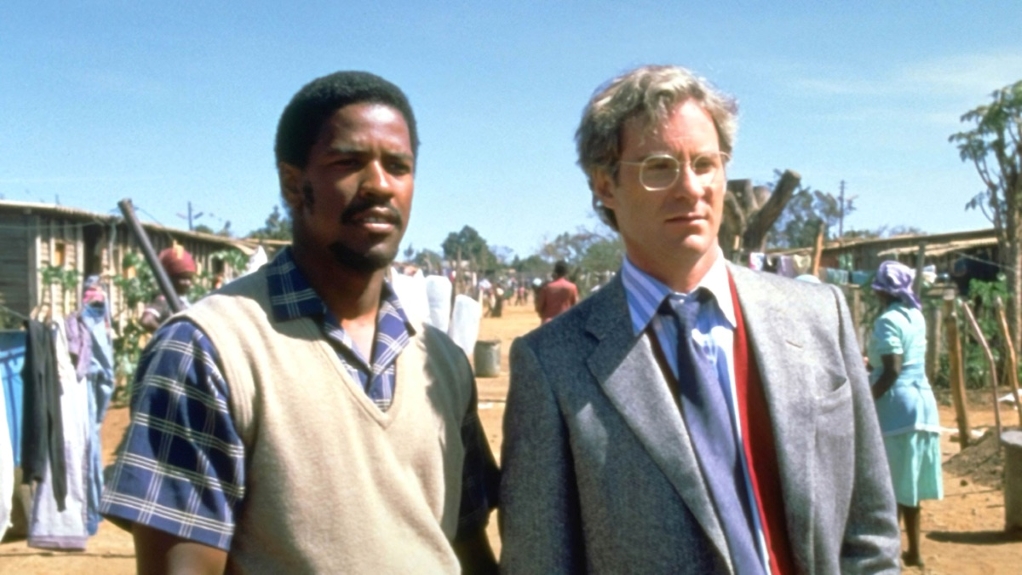
Steve Biko (Denzel Washington) was a leading anti-Apartheid campaigner, driving the Black Consciousness Movement in the repressive racist state of South Africa. Biko called for Black people to organise themselves and rejected the paternalistic concern of hand-wringing white liberals. Biko was ‘banned’ in 1970s by South Africa’s (in)justice department (meaning he could not be in physical proximity with more than one other person at a time) but didn’t let this stop him campaigning – until he was eventually arrested and murdered in custody in August 1977. His story came to international attention with the reporting Donald Woods (Kevin Kline), the white liberal newspaper editor who befriended Biko, later also banned and eventually fled in disguise from South Africa.

All of this makes very ripe ground for Richard Attenborough to make another socially conscious, unreservedly liberal film, very much in the style of Gandhi. Unfortunately, while Gandhi combined epic sweep and drama with its schoolboy history, Cry Freedom is a deathly serious film, straight-jacketed by recreating events as reverentially as possible and focuses itself in all the wrong places. Cry Freedom is the Biko biography in which Biko becomes a supporting character to exactly the sort of white liberal he rejected having African stories filtered through. Admirable as Donald Woods’ efforts to find justice for Biko was, does it feel like he deserved the focus of over half the film? It’s as if Attenborough had decided to frame Gandhi solely from the perspective of Martin Sheen’s journalist rather than the Father of India himself.

Following the trend of many films of the 80s and 90s, Cry Freedom believes that the only way the regular cinemagoer can relate to a minority group is through the filter of a complacent white person having their eyes opened to how unjust everything is. In carefully following this cliché, Cry Freedom does do a decent job. Woods is patronisingly certain of his liberal views, even while he sometimes fails to even acknowledge his live-in Black maid who unquestioningly calls him ‘master’.

Back-slapping himself on writing the odd sympathetic editorial and convinced one of the big problems of South Africa is the danger of anti-white racism, he’s exactly the sort of hero you get in this genre: the guy who assumes, because the system has always worked for him, it will work for everyone. When he resolves to support Biko, he immediately assumes a friendly pow-wow with Justice Minister Jimmy Kruger (a terrifyingly amorally, avuncular John Thaw) will sweep away all the problems (it, of course, makes things immeasurably worse for everyone).

Cry Freedom largely re-creates the oppressive policies of South Africa, through seeing a white character become a victim of the very persecution, bullying and terrorising the Black community has spent its whole life suffering. (With the big exception that Donald Woods never seems to be in danger of being dragged off the streets and beaten to death in a police cell). It feels like a tone-deaf way of exploring these issues. Particularly as Donald Woods’ eventual escape from South Africa is staged and filmed with a singular lack of energy over nearly an hour of screen time, with interest slowly drained out as Attenborough uninventively turns it into an identikit version of any number of bog-standard behind-the-lines Great Escape shenanigans you’ve seen done a million times better before.

Attenborough, to be fair, saves his energy for the re-staging of the brutal repression inflicted on the Black community. Cry Freedom’s opening and closing sequences – a brutal slum clearance in East London and a restaging of the shockingly violent crushing of the 16 June 1976 Soweto uprising (where indiscriminate police automatic weapons fire killed and injured hundreds of children) – are shot with exactly the sort of humanitarian outrage and cold-eyed recognition of the horrors of conflict that Attenborough bought to Gandhi and A Bridge too Far.

It’s not hard to wonder if this is more the sort of film Attenborough wanted to make, but that funding demanded a white lead so as not to panic mainstream cinema audiences. It makes large parts of the film feel like a missed opportunity. A real immersion in the actual day-to-day lives of Black South Africans – not just the beatings, but the unending, casual racism and oppression – would have created a film of even more power. (The fact the film suddenly ends with a flashback to Soweto – an event not central to the plot at all – makes you wonder if Attenborough suddenly realised that, without it, Cry Freedom would have barely shown a Black face for its last twenty minutes).

But too much of the rest of Cry Freedom feels too dry, reserved and lifeless. Even Biko himself falls into this trap. Denzel Washington delivers a very fine performance, full of the sort of effortless charisma and magnetic leadership that makes you believe that so many would follow him and using wit and moral certainty to stand up to the various bullying policeman he encounters. But too much of Biko’s dialogue with Woods is full of the sort of dialogue designed to inform and educate the audience, rather than create good story-telling. Too many scenes in Cry Freedom’s opening hour feel like a South African politics seminar, no matter how much energy Washington gives the dialogue.

It’s part of the feeling the whole film carries: a very serious political ethics class, mixed with an all-too familiar story of a white man learning first hand just how tough his Black friends have had it for years. Attenborough so clearly means well, it feels almost cruel to knock him and his film: but Cry Freedom feels like a film with a lot of blood, sweat and tears invested in it, which then fails to have the emotional heft it really needs and spends a lot of time telling the wrong person’s story.

The Apprentice (2024)

The Apprentice (2024)

Heavy-handed anti-Trump message is made to almost work by two excellent performances

Director: Ali Abbasi

Cast: Sebastian Stan (Donald Trump), Jeremy Strong (Roy Cohn), Maria Bakalova (Ivana Trump), Martin Donovan (Fred Trump Snr), Catherine McNally (Mary Anne Trump), Charlie Carrick (Fred Trump Jnr), Ben Sullivan (Russell Eldridge), Mark Rendall (Roger Stone), Bruce Beaton (Andy Warhol)

No one has dominated recent global discussion more than Donald Trump. The Apprentice aims to expose how he was formed – inevitably, you can’t move for reviews referring to it as a Supervillain Origin Story – but really, it’s being sung for the choir and I’m not sure it really adds anything to the international conversation. I can’t imagine this film shifting the dial at all (which indeed it didn’t): if you hate Trump (and I am not a fan), it’s gonna confirm everything you think already and then some. If you are a supporter you’ll probably think it’s a shrill hatchet job. Both sides might well agree Abbasi’s film is a little hectoring.

Picking up in the late 70s, and running through the all-consuming Greed-is-Good Reaganite America, The Apprentice charts the friendship between up-and-coming would-be-property-mogul Trump (Sebastian Stan) and ruthless McCarthyite legend lawyer Roy Cohn (Jeremy Strong). Cohn takes Trump under this wing, teaching him his three rules for success (always attack, never apologise, always claim victory no matter what). Under this guidance, Trump becomes the figure of bombastic, selfish egotism we see today – while Cohn, afflicted with AIDS, shrinks under his protégé’s shadow.  

Watching The Apprentice I was reminded of Oliver Stone’s Nixon – and not in a good way. Stone is no supporter of Nixon, but his film is a surprisingly generous Greek Tragedy which plays fair with the 37th President, acknowledging his strengths as well as his chronic character flaws. The Apprentice abandons any attempt to do the same by the halfway point. Part of that may well be that Trump is an infinitely more shallow, less complex, less accomplished figure than Nixon. But if The Apprentice had dared to find anything a little deeper in Trump (his complex relationship with his family would have been good for this) it might have had more impact.

Instead, it’s a Faust story where the power balance shifts from Mephistopheles to Faust. At first Cohn is all powerful, tempting Trump with the power and influence to transform him from two-bit rent collector to king of the world. But the more confidence Trump gains, the more he dwarves Cohn. And the more Cohn is slowly eaten away by weakening powers and the AIDS he refuses to acknowledge he has, the smaller and more desperate he seems. It’s almost a succubus tale, with Trump draining Cohn so much he ends the film passing off his mentor’s mantras as his own invention.

The film’s most interesting section by far is it’s opening hour. It’s the only part that presents us with a Trump we don’t know already. In an excellent, Oscar-nominated, performance Sebastian Stan not only captures Trump’s mannerisms he also searches under the man’s shallow surface. Stan makes the young Trump bashful, eager-to-please, over-awed by power and nervous in high society. Seeing a naïve, fragile, uncertain Trump whose father doesn’t love him is genuinely interesting – especially since we all know the cast-iron certainty he has today. It could have done with more of this, trusting us to lay our knowledge of the man today on top.

The main factor that really lifts The Apprentice our two leads. Both Stan and Strong find an emotional depth and insight in their characters (while never absolving them) that makes them more three-dimensional than Abassi’s film wants to make them. Jeremy Strong is particularly superb (and also Oscar-nominated) as Cohn. Whipper-thin, tanned, his head aggressively jutting forward he resembles a sort of angry ferret. Strong brilliantly captures the vicious contradictions in Cohn – the Jewish antisemite, the gay homophobe – and his demonic, but Strong brilliantly unpeels Cohn’s weakness. Trump absorbs all Cohn’s vices (and then some), but none of his few virtues – personal loyalty, patriotism. Strong never makes Cohn sympathetic, but also displays his pain, unhappiness and possibly even guilt, as he realises this uncaring monster will even consume his creator. (Strong’s final scene of the dying Cohn confronting Trump’s indifference one last time is superbly played).

Abbasi’s film is well-made – the photography frequently degraded to appear like grainy camcorder footage – and its filmed with a handheld, pacey immediacy. It captures the excess Trump lives in, with its golden surfaces and more-is-more bling. All of this is aimed at exposing the future President as overwhelmingly self-occupied, amoral and cruel, interested only in himself and seeing morals. None of that is a major surprise and Abbasi is a little too delighted with pricking Trump’s fragile ego, portraying him as impotent, sniggering at his hair loss and weight gain (although this allows a neat gag, with Trump telling a doctor the body has a limited amount of energy so exercise is actually bad for you – something he refuses to accept is not true).

Trump’s treatment of Cohn is the tip of the iceberg of the depths of Trump’s personal behaviour the film gleefully shows. Trump’s penchant for self-aggrandising speeches, his kneejerk homophobia about AIDS (his fear of catching it by touch leads to him fumigating items Cohn has touched), his indifference about relationships (swindling his father and dropping his alcoholic brother) all get ample coverage. He pursues Ivana (a very good Maria Bakalova) with a passion then, having got her, treats her only as something he can brag about (particularly her ‘improved’ breasts), becomes jealous of her growing fame. It overplays its hand by dramatising the disputed rape of Ivana by Trump – a crime so serious you feel it should be beyond question and not be treated as part of a parade of personal faults, never to be referenced again.

But that’s because The Apprentice never knows when to stop. If it had the courage to expand its opening hour, to explore the malign effect of Cohn on this ambitious young man, with a coda showing the fall of Cohn in the shadow of the Trump we recognise – it would have been a more interesting film. Instead, it seems designed to hammer home a political agenda rather than provide drama or insight making it more heavy-handed and obvious than it needed to be. Aside from the two marvellous performances from Stan and Strong, there is actually very little really here.

Lee (2024)

Lee (2024)

Kate Winslet plays with passion in an otherwise rather safe and traditional biopic

Director: Ellen Kuras

Cast: Kate Winslet (Lee Miller), Marion Cotillard (Solange d’Ayen), Andrea Riseborough (Audrey Withers), Andy Samberg (David Scherman), Noémie Merlant (Nusch Éluard), Josh O’Connor (Interviewer), Alexander Skarsgård (Roland Penrose), Arinzé Kene (Major Jonesy), Vincent Colombe (Paul Éluard), Patrick Mille (Jean D’Ayen), Samuel Barnett (Cecil Beaton), Zita Hanrot (Ady Fidelin)

“War? That’s no place for a woman!” That’s the message photographer Lee Miller (Kate Winslet) received when she applied to head to the Western Front for Vogue in World War Two. An experienced artist and photographer, with a strongly independent mindset, Miller wasn’t taking no for an answer: her stunning images of the horrors of war and the Holocaust would become a vital historical record.

That’s the key message of this well-meaning, rather earnest, slightly old-fashioned film, a callback to hagiographic biopics of yesteryear. It’s told through a framing device of an older Lee being interviewed in the 70s. The interviewer is played, in a thankless role, by Josh O’Connor (the character’s identity is a late act reveal that most viewers will probably guess early) and his dialogue is awash with either the sort of “and then you married and left France and moved back to London where you became the first woman photographer hired by Vogue” narration that links time-jumped scenes together, or blunt statements about Lee’s emotional state (“you must have been very frustrated”) that Winslet is definitely skilled enough to do with her face alone.

This was a passion project for Winslet, who spent a decade bringing it to the screen and which she bailed it out during a funding wobble, and she is the main reason to watch Lee. This strong-willed, take-no-nonsense bohemian turned hardened professional is a gift for Winslet, but she also gives Miller a strong streak of inner doubt and fear. Under her force-of-nature exterior, there is a strong streak of vulnerability in Miller, her life marked by past trauma. Winslet lets this rawness out at key moments, bringing great depth and shade to a character who could otherwise be blunt and difficult, and the film works best when it gives her free reign.

It’s unflinching but also tasteful in its depiction of war. Experienced cinematographer and first-time film director Ellen Kuras shoots its grimy, hand-held immediacy with an intensity that makes a lot of the film’s limited budget. Lee’s dirt and dust-sprayed combat scenes – with Miller dodging explosions and bullets to get into position to get the perfect shot – are tensely assembled and make a punchy impact. But Lee also knows when not to show us things, and its visual restraint when Miller and colleague David Scherman (Andy Samberg) photograph the horrific aftermath of Buchenwald and Dachau is admirable, the camera focusing on the characters’ stunned faces as they capture the terrible moments, with the horrific reality just out of focus.

There are some fine moments in Lee, which makes it more of a shame that so much of it feels safe, predictable and unchallenging. Lee focuses on Lee Miller as an artist and downplays her daring, unconventional life. Tellingly it’s adapted from a biographer by her son, titled The Lives of Lee Miller, which chronicles her life of constant reinvention. This is after all a woman who maintained a relationship with her Egyptian husband in the 30s, after meeting her second husband Roland who himself remained married for several years (they only married in 1947). She was a model, a surrealist artist, photographic pioneer, ahead of her time. That’s rinsed out to make her more conventional.

In the film, she and husband Penrose (a generously low-key performance from Alexander Skarsgård) have an uncomplicated meet-cute in a French villa owned by a friend (an extended cameo by Marion Cottillard) – admittedly it as at an outdoor picnic where Lee and others sunbathe topless – before settling into a life of middle-class suburbia (right down to Lee cooking meals for Roland when he returns from work). Hints that she has a consensual affair with Scherman linger, but the film seems prissily determined to reposition Lee as a far more conventional person than she really was. It’s a conservative attitude that comes from a good place – focusing on the work not the gossip – but it also makes her feel less unique or challenging than she was.

With the work as its focus, it’s surprising Lee doesn’t make more of the extensive collection of masterpiece photos Miller took. Although an inevitable credits montage shows how some of these were re-created for the film, actually including the images in the film itself might have carried more power and placed Miller’s work more prominently at its heart.

Lee also fumbles slightly with its final revelation of Miller’s past trauma. Shocking as this is, attempting to suggest what happened to Lee in her teens is on the same scale as the Holocaust or that she has a unique understanding of an act of ethnic genocide because she suffered in the past stinks. It’s especially notable since Lee does an excellent job of showing the quiet distress the Jewish Scherman feels as he realises only an accident of geography saved his life. Andy Samberg, in his first dramatic role, is extremely good in a role that clearly carries a very personal feeling for him.

Lee has things going for it, not least Winslet’s barn-stormingly committed and passionate performance. But in the end, it turns its lead character into someone who feels less provocative and revolutionary than she was. Its safely traditional structure and narrative approach turn her into a “role model” and make Lee the sort of middle-brow biopics Hollywood churned out in the 80s. It’s solid, interesting but essentially safe and forgettable.

Napoleon (1927)

Napoleon (1927)

Gance’s monumental film takes the breath away, packed with innovation, invention and drama

Director: Abel Gance

Cast: Albert Dieudonné (Napoléon Bonaparte), Edmond Van Daële (Maximilien Robespierre), Alexandre Koubitzky (Georges Danton), Antonin Artaud (Jean-Paul Marat), Abel Gance (Louis de Saint-Just), Gina Manès (Joséphine de Beauharnais), Vladimir Roudenko (Young Napoléon), Marguerite Gance (Charlotte Corday), Yvette Dieudonné (Élisa Bonaparte), Philippe Hériat (Antoine Saliceti), Max Maxudian (Barras), Annabella (Violine Fleuri), Nicolas Koline (Tristan Fleuri)

There is a marvellous quote from Victor Hugo when he wrote about the young life of the most famous Frenchmen who ever lived: Déjà Napoléon perçait sous Bonaparte. Which roughly translates as ‘already Napoleon was bursting through Bonaparte’ – or to put it another way, the man was already being consumed by the legend. That idea dominates Abel Gance’s extraordinary, epic, retelling of the Young Napoleon’s life, an origins story that sees a young man become increasingly distant and legendary before our eyes. Gance’s film may be resolutely old-fashioned in its historiographical approach, but is revelatory in its cinematic flair and invention, with almost every scene demonstrating Gance pushing the medium in new directions.

Napoleon was planned as only the first of no-less-than six films that would cover the cradle-to-grave story of the man who defined his whole era. Such was Gance’s ambition through, that even across five hours he felt he had only scratched the surface of the first 27 years of Napoleon’s (Albert Dieudonné) life from his childhood education (snowball fights and all) at Brienne – where he is seen as a Brutish Corsican outsider – via the French revolution, his failed attempt at revolution in Corsica, his successful siege of Toulon and promotion to General at 24, nearly losing his life in The Terror, Thermidor and his crushing of the Vendemaire uprising, marriage to Josephine (Gina Manès) and the beginning of his campaign in Italy.

Gance unfolds this in a film brimming with cinematic verve and invention. Much like its lead character, it is a seismic and larger-than-life (literally so in its most famous innovation, the three frame wide-screen effect achieved for its final twenty minutes). Napoleon practically defines the notion of historical epic, reproducing many at historical events at a 1:1 ratio. At its centre is a magnetically hypnotic (almost literally) performance from Albert Dieudonné (so enamoured with the role, he was buried in his costume) juggling the impossible by suggesting some of the many shades of this fascinating figure, part revolutionary, part tyrant, part romantic, part war-monger.

There is something truly striking and original in every frame of Napoleon. Gance presents a picture of the famous general more than touched with an old-fashioned Great Man theory of history, but still suggests he is almost two men in one. He is Bonaparte, the slightly-chippy, awkward young man who clumsily woos Josephine (barely sure where to do with hands, tugging shyly at his sash), struggles to get noticed in a map-making office and finds it challenging to make friends, either at school (where he is a painfully serious outsider) or as an adult. But he is also Napoleon, the totem of history who Gance frequently frames as almost communing with a historical version of himself.

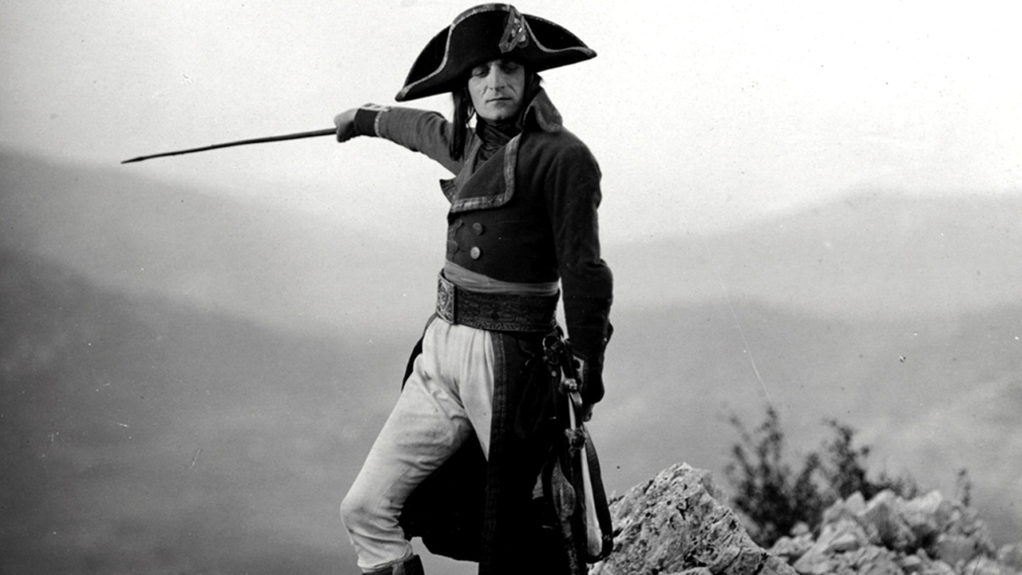
This Napoleon bursts from the awkward Corsican shell of Bonaparte. Gance frequently frames him almost confronting the camera, light shimmering around him to form halos, with a piercing stare that freezes people into place. He comes to identify himself with the flag and the revolution. So much so that, in his escape from Corsica, he will be borne across the seas by a tricolour jerry-rigged into a sail and visualise himself being hailed by the executed ghosts of the revolution as its natural heir. Indeed, the film ends with Napoleon atop a mountain starring into a montage of his future achievements, as if he was bending history around him.

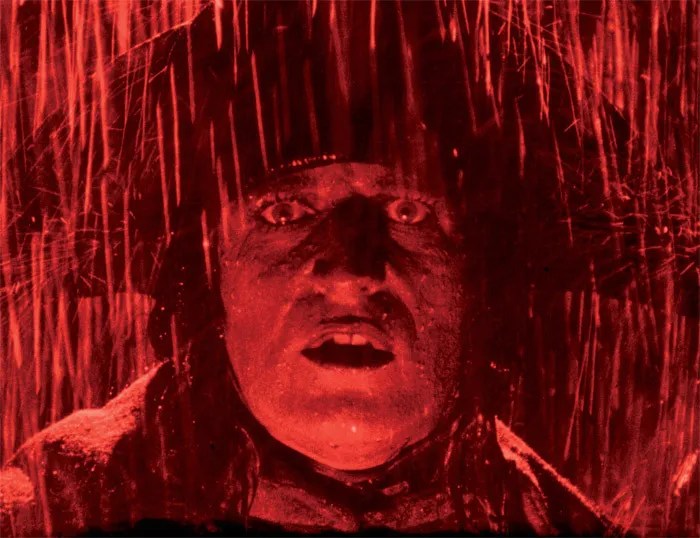
Which isn’t to say Gance sees him as a constantly sympathetic figure. While there is no question he is a force of nature – he controls the frame, frequently centred and when the camera moves (such as the careering gallop that takes him to Italy) he is always at the eye of its propulsive tracking shots – he is also an imposing, even scary figure, distant and cold. In dyed red frames, he looks positively demonic, such as when he looms forward out of the rain in Toulon, his face filling the frame to demand relentless attack. His self-identification with the revolution becomes monomaniacal.

Gance re-enforces his distance from normal human reaction by returning constantly to the Fleuri’s, a working-class family who shadow the Great Man (Violine loves him hopelessly and her father and brother worship him) but whom he never notices. It’s part of him being crafted into marble before us – with all the terrifying lack of human understanding that suggests. Throughout he’s shadowed by an eagle, a visual representation of his mystical, greater-than-human nature, a bird of destiny that drives him relentlessly on. He’s contrasted constantly with other would-be leaders: the itchy Marat, the empty windbag Danton and (most noticeably) the curiously ineffectual Robespierre, an uncharismatic man who can’t control a crowd, is lost behind darkened glasses, follows the orders of others and is comically dwarfed by an eagle statue not elevated by it.

Gance’s history has a slight school-book Victorianism to it. He’s very proud of “historical” facts – quotes and events are frequently branded with the on-screen phrase “(Historical)” so we can see his behind-the-scenes research – and has more than a little love for irony. Of course, the final island covered in school-boy Napoleon’s geography class is “St Helena”! Of course, the English sailor who spots him escaping from Corsica (and is refused a request to sink his ship) is Nelson! The film is littered with cameo appearances from later Napoleon rivals and allies. There is also a darker irony playing here: we know that when Napoleon is praised by the ghosts of the revolution that, far from protecting it, he will in fact become its final destroyer.

But what really singles out Napoleon is it’s intense, cinematic inventiveness. It’s an explosion of unique, fascinating images packaged into a single film. Gance reinvented the wheel multiple times on this one, not least on his of ghostly images and cross-fades. To achieve this – such as the ghostly appearance of the Great Revolutionaries in an otherwise empty Assembly Hall, he re-exposed the same film multiple times (sometimes as many as twenty) to achieve the effect. The same for Napoleon’s schoolyard fights, a single sequence with the screen split into nine squares each showing a different moment in time achieved by covering different parts of the frame for each exposure.

Gance’s camera is strikingly mobile, his editing frequently thrilling and thought-provoking. The famous sequence of Napoleon’s escape from Corsica is superbly intercut with the clash in the Assembly that will lead to the execution of the Gironists. The swaying of the ship is increasingly echoed by the swaying and eventually full-blown swinging of the camera in the Assembly room. Both events merge together through cross-fades. The camera whips through some scenes with real pace and aggression – witness the fast-paced tracking shots that follow Napoleon to Italy.

That’s matched as well with imaginative scenes of quiet beauty. The young Napoleon quietly communing with his pet eagle. The marvellous “shadow marriage” Violine conducts with a cardboard doll of Napoleon, positioned to cast a full-length shadow on the wall. There are moments of black humour – the coffin Robespierre and Saint-Just keep the death sentences they’ve passed in – and moments of soaring, lyrical inspiration such as the first singing of the Marseilles which takes on a mystical quality. To achieve this, Gance pushed the camera places it had never been before, patenting new techniques and devices to achieve frames, angles and cross-fades never seen before.

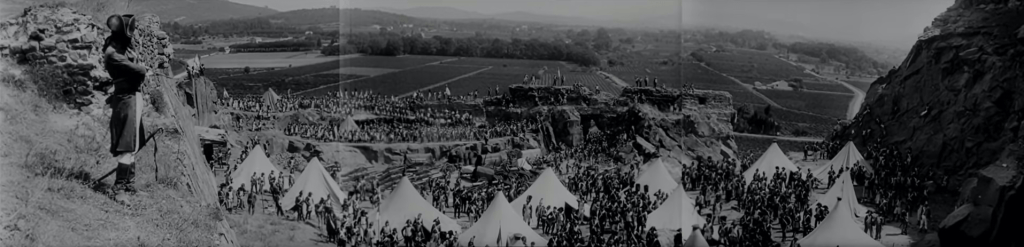
The most stand-out being the astonishing three-frame wide-screen effect. Perfectly mapped, with the small distortion in the joins almost adding to the power, this creates Panavision decades before Hollywood had even coined it. It creates awe-inspiring vistas of Napoleon’s Italian army – although the battle scenes Gance shoots are often cruel and dirty, with bodies twisted and crushed by the violence of war – but it also allows Gance to present three different images side-by-side, something he exploits to maximum effect in the closing moments that presents a giddyingly cut (it’s Eistensein-influence is clear) montage of past moments in the film that have led up to the Napoleon we see standing on a mountain before us starring into the future.

For Gance through, it is a future that wouldn’t come. Napoleon was not a success – perhaps people couldn’t quite process the scale of it, perhaps the money-men were terrified that Gance had spent the budget of six films on one and still hadn’t got round to Austerlitz, Borodino and Waterloo. The film was butchered and tinkered with for decades before it was reborn. And what a relief, because this is a stunning epic, which (for all its narrative simplicity) has something to wonder at in every frame. An extraordinary film, which everyone should see at least once.

The Story of Louis Pasteur (1936)

The Story of Louis Pasteur (1936)

A visionary struggles against the blind in this genre-defining slightly cosy biopic

Director: William Dieterle

Cast: Paul Muni (Louis Pasteur), Josephine Hutchinson (Marie Pasteur), Anita Louise (Annette Pasteur), Donald Woods (Dr. Jean Martel), Fritz Leiber (Dr. Charbonnet), Henry O’Neill (Dr. Emile Roux), Porter Hall (Dr. Rossignol), Raymond Brown (Dr. Radisse), Akim Tamiroff (Dr. Zaranoff), Halliwell Hobbes (Dr. Joseph Lister), Frank Reicher (Dr. Pfeiffer)

Jack Warner was convinced no one would want to watch the life story of some crusty old scientist. But Paul Muni insisted they would – and he was a star – so with a threadbare budget and host of re-used costumes (many not from the correct period) and sets The Story of Louis Pasteur came to the screen – and much to Warner’s surprise was a hit. It can look like an oddly cliché-ridden affair today: until you realise many biopic tropes we’re used to were virtually coined here.

The Story of Louis Pasteur remixes huge portions of Pasteur’s life to make it more dramatic: the man who was the leading scientist in France for almost thirty years is repackaged as an outsider and laughing stock, constantly scorned by the medical establishment until (but of course!) he is triumphantly hailed as a genius by the same doctors who mocked him for years. Sound familiar? The film charts Pasteur’s efforts to discover vaccines, first for anthrax in sheep (leading to a famous test where 25 sheep were vaccinated and 25 were not, then all of them exposed to the disease, killing all the unvaccinated sheep) then rabies in dogs and treating those bitten by rabid dogs. Pasteur uses his unparalleled knowledge of microbes which (but of course!) every other doctor says cannot possibly have anything to do with infection.

There is a lot to enjoy in The Story of Louis Pasteur, an undeniably old-fashioned “Great Men” view of history that manages to turn bacteriology into effective entertainment. It recasts history into an easily digestible tale of visionaries and scoffers – but, crucially, no real baddies – crafting a series of small steps towards scientific discoveries into flashes of inspiration and triumphant revelations. Science is made simple, plain and understandable with Pasteur to talk us through a few shots of microbes under microscopes. At its centre we have a stubborn maverick determined that it is his way or the high-way and who won’t listen for a second to anyone questioning his theories.

There is something rather touching about the film’s admiration for science and celebration of an altruistic quest to make the world a better place. It carefully outlines the dangers of surgery and poor hygiene in medical practice – it opens with a doctor murdered for failing to save his killer’s wife, the reason for his failure pretty clear from the haphazard way he chucks medical equipment into a bag (dropping some of it on the floor en route). This lack of hygiene affects rich and poor (even Duchesses are not safe), in particular women in childbirth. Its truly the enemy of mankind, as a caption explaining the 1870 war stresses (European squabbles being a distant second). This is a problem that is truly noble to take on.

And it motivates Pasteur. Paul Muni is on Oscar-winning form as Pasteur, brilliantly precise and superbly conveying great intelligence mixed with an arrogant self-assurance. But Pasteur’s egotism comes not from vanity but from simply knowing more of which he speaks than anyone else. He’s also a man consumed by a sense of duty to the world: when his work can literally save lives (be they either animal or human) he will not let scorn stand in his way. Muni captures all this wonderfully, creating a prickly man with a playful streak determined to do the right thing the right way (Pasteur may disagree with his critics, but woe-betide their assistants disrespectfully doing the same).

Dieterle’s film crafts a series of excellent set-pieces to present Pasteur as a visionary ahead of his time. To make this really land, he’s therefore completely altered into being seen as a crank and pariah by everyone around him, rather than the influential scientific leader he actually was. This might be poor history, but it’s much better drama. From a furious encounter with Napoleon III (who won’t wear the idea his hand-picked doctors might be wrong about sterilization) to the Medical Academy publicly poo-poohing Pasteur’s outlandish ideas that vaccines might prevent anthrax. To give a face to this mocking of Pasteur (from an establishment we are told is totally wrong on every count) the film invents Dr Charbonnet (well played by Fritz Leiber), an honest but pig-headed critic who exists to be wrong (for noble reasons) on almost every single issue.

Noble as important: this film want to stress everyone acts for decent reasons, so that its final celebration of Pasteur is unblemished by deeply personal rivalry. Charbonnet and Pasteur are both framed as decent men and their relationship allows for plenty of fun melodrama, such as Charbonnet injecting himself with Pasteur’s (fortunately for him) weak rabies sample to ‘expose’ his ideas. When Pasteur’s daughter falls ill in childbirth, but of course Charbonnet is the only doctor available: he humours Pasteur’s sterilisation rules in exchange for a signed letter from Pasteur rubbishing his own theories (Muni’s shuffling flash of conflict that flows across his face at this moment is very well done). But of course, Charbonnet and Pasteur eventually reconcile in honour and decency.

This forms a fun thread throughout the movie, that’s never less than well-staged by Dieterle, with pace and energy. The anthrax test is very dynamic – all celebrating crowds and circus side-shows – and the dramatic appearance of a host of Russian peasants (led by Akim Tamiroff’s bombastic doctor) desperate for a cure for rabies-induced sickness is well-executed. Some beats work less well than others. Donald Woods gets dealt a rotten hand as the dull son-in-law of Pasteur. The women in Pasteur’s family get even worse, with most of Josephine Hutchinson’s lines being of the “stop trying to cure anthrax and come to bed Louis” variety. The costumes are bizarrely all-over-the-place (the women look more like Southern Belles) and there is a reassuring cosiness about everything.

But that’s also one of its most successful features. The Story of Louis Pasteur is a little twee – but it’s also effective. It’s why it laid down a template that worked for countless films that follow (A Beautiful Mind pretty much follows its model and won an Oscar for it 65 years later). That’s because there is also a feel-good factor to see someone who is, without doubt, in the right triumphing over the stubborn. With a great performance by Muni, it’s a rewardingly entertaining biopic.

Nyad (2023)

Nyad (2023)

Swimming biopic relies on strong performances as it delivers expected strokes

Director: Elizabeth Chair Vasarhelyi, Jimmy Chin

Cast: Annette Bening (Diana Nyad), Jodie Foster (Bonnie Stoll), Rhys Ifans (John Bartlett), Karly Rothenberg (Dee Brady), Jeena Yi (Angel Yanagihara), Luke Cosgrove (Luke Tipple), Eric T Miller (Jack Nelson)

Diana Nyad was a champion endurance swimmer in the 1970s, but one major achievement eluded her: the 110-mile swim from Cuba to the tip of Florida at Key West. Estimated to take about 60 hours, it involves wild currents, difficult weather conditions and wild sea creatures with a support crew who can do nothing to help other than advise, keep her on course and provide food. The swim must be completed unassisted and without rest. A failed attempt in 1978 aged 28 was one of her last swimming feats for almost 30 years. Turning 60, Diana decides to dive back into the water and attempt it once again.

Nyad brings this story to the screen, refashioned into a comfortably feel-good sports biopic that presents Diana’s story within the expected framework of the cliches of the genre. There is almost nothing in Nyad that you haven’t seen before. Lessons are learned, people walk from the swimming campaign only to return for “one more adventure”, we discover there is no I in team and no solitary athlete ever truly works alone. Settle down for seeing the same sort of material you’ve seen in many other films before, and you won’t be disappointed.

The thing that makes Nyad different is the performances at its heart. Annette Bening (Oscar-nominated) trained for a year in preparation for this role, large chunks of which are spent watching Nyad charge forward through choppy open waters. On land, Bening skilfully balances Nyad’s prickly self-obsession with a vulnerability and fear of defeat. A demanding perfectionist who accepts no compromise, Nyad frequently rubs her team up the wrong way, but Bening never makes her unsympathetic. She’s a woman keen to prove something to the world and to herself, not least that age doesn’t define our horizons.

Our warmth to the tunnel-focused Nyad largely comes from the delightful chemistry between Nyad and her coach, ex-girlfriend and best friend Bonnie Stoll, delightfully played by the Oscar-nominated Jodie Foster. This is some of Foster’s finest work in years, an exuberant, playful, incredibly natural performance of a woman who is, in her way, as driven as Nyad, determined to protect her charge. It’s Bonnie who frequently needs to salve the wounds left by Nyad, hold the team together and make the difficult calls to continue or abort Nyad’s attempts. Foster’s performance is a burst of life in the film, providing its real heart.

The two dominate much of the film, although there is a room for a fine performance of curmudgeonly decency from Rhys Ifans as late navigator John Bartlett. But this is film that works best when focused on the two leads, be it Bonnie surprising Nyad with a birthday party, the two unashamedly celebrating watching a competitor’s attempt fail on television, Bonnie tending Nyad’s injuries, or the two arguing with the honesty that platonic life partners have. All of the film’s most memorable moments feature Foster and Bening bouncing off each other on land.

So, it’s a bit of a shame that a large part of the film takes place in the water. One of Nyad’s major failings is that it never really finds a way to make the act of swimming either truly dramatic of visually interesting. It is a tough challenge – after all, marathon solo swimming is (by its very nature) silent, monotonous, and in long stretches not exactly compelling to watch. But Nyad falls back too often into sequences that feel either artificial – look out there are sharks in the water! – or reliant on Life of Pi style visuals (no coincidence surely that film’s Claudio Miranda also shoots this one) to try and bring to life the hallucinations long-distance swimmers can suffer from after over 50 hours of non-stop physical effort. We get Bening swimming through magical light shows and an underwater Taj Mahal, but this feels like an attempt to give us something to look at rather than a flourish that gives insight into theme or character.

It’s a common theme of the film. Nyad often has watery-framed flashbacks to her younger self, pushed to achieve great things at an early age and suffering sexual abuse from her coach as a teenager. But, again, these revelations feel unconnected with the drama we are watching, making the repeated flashbacks to it feel unnecessary. The only time the subject comes up in the main plot line, Nyad brusquely closes the conversation down, insisting she has not been made into a victim and briskly moving on.  The film concurs in wanting to avoid defining Nyad in any way by this abuse. But it does leave you wondering why in that case the film so frequently returns to the issue.

At times it feels like Nyad has struggled to turn the act of someone swimming into drama. Instead, it relies on those standard sporting movie events. The initial success, the struggle, the break-up, the lessons, the heart-warming triumph. Nyad doesn’t find any time to explore the on-going debate around Nyad’s achievement (her poor record-keeping led to Guinness Book of Records refusing to recognise it) but that would get in the way of the triumphant ending. It’s a middlebrow film that relies pretty much exclusively on its actors for spark: fortunately, especially in Foster’s case, they provide it.