Category: Comedy

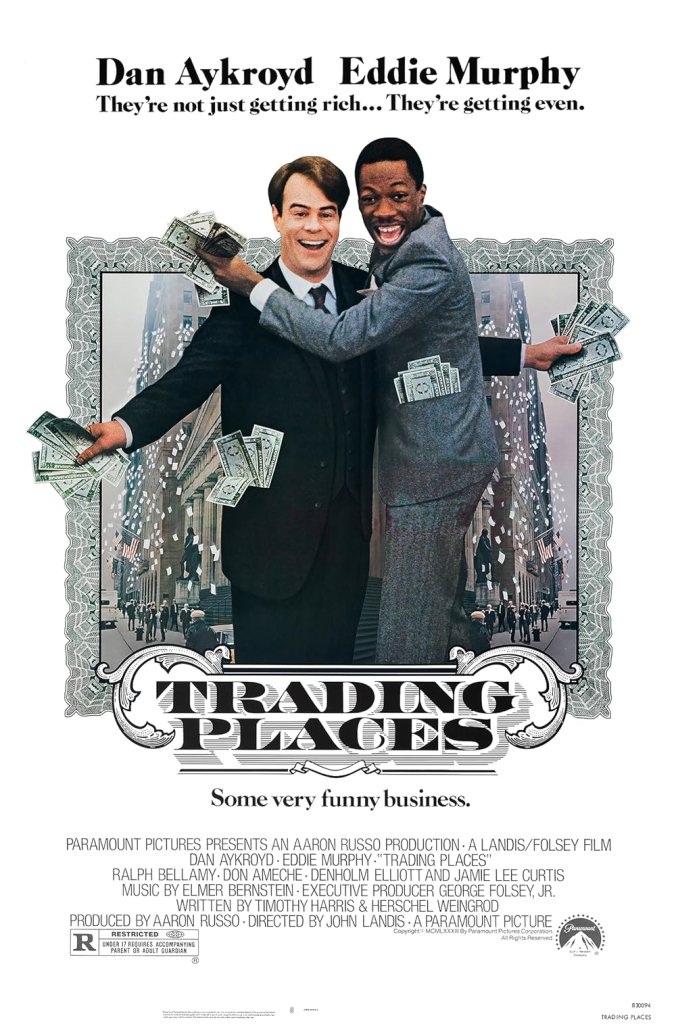
Trading Places (1983)

Trading Places (1983)

Very 80s comedy, full of rude gags and the glories of money still funny in many places

Director: John Landis

Cast: Dan Aykroyd (Louis Winthorpe III), Eddie Murphy (Billy Ray Valentine), Ralph Bellamy (Randolph Duke), Don Ameche (Mortimer Duke), Denholm Elliott (Coleman), Jamie Lee Curtis (Ophelia), Paul Gleason (Clarence Beeks), Kristin Holby (Penelope Witherspoon), Jim Belushi (Harvey)

Louis Winthorpe III (Dan Aykroyd) has it all. A house in Philadelphia, glamourous fiancée and high-flying job as Managing Director at Duke & Duke, the leading blue-chip commodities brokers. Billy Ray Valentine (Eddie Murphy) has nothing: penniless, homeless, hustling on the Philly streets. But is their fate due to nature or nurture? Finding that out is the subject of a bet between heartless Duke brothers Randolph (Ralph Bellamy) and Mortimer (Don Ameche). They turn both men’s lives upside-down by swopping their positions – Louis will be disgraced and left with nothing and Billy Ray will get his house and job. Will they fall or rise? And what will they do when they find out their lives are the Duke’s playthings?

Trading Places was one of the big box-office smashes of 1983, a film that changed the lives of virtually the whole cast. It showed the world Aykroyd could carry a comedy without partner Jim Belushi, gave a second career to Bellamy and Ameche, led Curtis to say the role “changed her life” from just a scream queen and, perhaps most of all, turned Murphy into a mega-star. It’s still witty, fast-paced and funny today, even if in places it’s not always aged well.

Landis takes a screwball approach, unsettling the lives of two contrasting people and then throwing them into an unlikely revenge partnership. Trading Places is very strong on the contrasting world of rich and poor. The wood-lined, club-bound world of the Dukes is carefully staged, paintings of financial and political grandees staring down from walls as assured, masters-of-the-universe easily sachet around posh clubs and squash clubs, to the sound of Elmer Bernstein’s Mozart-inspired score. By contrast, the rough, litter-lined squalor of Philadelphia’s poorer neighbourhoods is unflinchingly shown with, under the comedy, the suggestion life is cheap and everyone is for sale.

Of course, a lot of the ensuing laughs come from seeing a rich person who has only known comfort thrown into this life of a tramp and vice versa. Ackroyd’s Winthorpe bristles with disbelief at his situation and the rich man’s blithe assurance that (any moment) someone will say there has been a terrible mistake carries a lot of comic force. Meanwhile, Murphy’s fast-talking Billy Ray assumes he is the subject of an elaborate prank (or perverted sex game) as stuffs the pockets of his first tailored suit with knick-knacks around the house the Duke’s assure him is now his. Hustler Billy Ray turns out, of course, to be well-suited to the blue-collar hustle of financial trading. He also finds himself, much to his surprise, increasingly interested in the culture and artworks around him.

Under all this, Trading Places has a surprisingly negative view of rich and poor. Louis posh friends and shallow fiancée are all status-obsessed snobs who turn on him in minutes when he is framed for theft, embezzlement and drug trafficking. The servants in their posh clubs – all, interestingly, Black men in a quiet statement on race that you still wish the film could take somewhere more interesting – are treated as little better than speaking items of furniture and there is a singular lack of interest or concern for anyone outside their social bubble. Playing fair, every working-class character we see (apart from Curtis and Murphy) is lazy, grasping and shallow, ignoring Billy Ray until they can get something from him, at which point they fall over each other to snatch freebies from his house.

Trading Places is, in many ways, a very 80s screwball. Money is the aim and reward here. Trading Places has respect only for aspirational characters who save and invest their money. (Curtis’ prostitute is marked out as savvy and decent because she has invested nearly $42k from her work in a nest-egg). The film culminates in a financial scam (playing out on the trading floor of the World Trading Centre) designed to reward our heroes with wealth and punish the villains with poverty. For all the film stares at the reality of poverty and riches, the implications and injustices of wealth are ignored, with money ultimately framed as a vindication.

But then, Trading Places is just a comedy so perhaps that’s reading a bit too much in it. There is a frat-house energy to Trading Places under its elaborate framing and a lot of its gags come from a rude, smutty cheek that sometimes goes too far (not least a punchline involving a villain being repeatedly raped by a randy gorilla). Murphy’s energy – every scene has the crackle of improvised wildness to it – is certainly dynamic (this is probably his funniest and – eventually – most likeable role) and while Aykroyd is a stiffer comic presence, he makes an effective contrast with Murphy.

The real stars here though are the four supporting actors. Bellamy and Ameche seize the opportunity to play the villains of the piece with an experienced gusto, brilliantly funny in scene-stealing turns. Outwardly debonair, the seemingly cudily Bellamy and prickly Ameche superbly reveal the greed and casual cruelty of these two heartless Scrooges. Elliot is also extremely funny, and the most likeable character, as a kind butler just about disguising his loathing of the Dukes. Curtis’ vivacity and charm makes a lot of an under-written “hooker with a heart of a Gold” trope – like her co-stars she seizes her chance with a fun role.

Some of Trading Places has of course not aged well. Jokes with gay slurs pop up a little too frequently. While the Duke’s use of racist language makes sense (after all they are vile people who see Billy Ray as nothing but a curious toy), it’s more of a shock to hear our nominal hero Louis do the same. Murphy’s improvised sexual harassing of a woman on the streets (ending with him screaming “bitch!” after her when she walks off) doesn’t look good. Curtis twice exposes her breasts for no reason. The film’s closing heist involves Aykroyd blacking up and affecting a Jamaican accent.

But, dubious as some of this is now (and while you can argue times have changed, surely even then some people would have been unsettled by this sort of stuff framed for good-old-belly laughs), Trading Places is still funny enough to be a pleasure. And, with the performances of Bellamy, Ameche, Elliot and Curtis we have four very good actors providing a humanity and professionalism to ground two wilder comedians. It’s easy to see why this was a hit.

Blackberry (2023)

Blackberry (2023)

Comic-drama about business collapse wants to The Social Network but lacks its deft touch and humanity

Director: Matt Johnson

Cast: Jay Baruchel (Mike Lazaridis), Glenn Howerton (Jim Balsillie), Matt Johnson (Doug Fregin), Rich Sommer (Paul Stannos), Michael Ironside (Charles Purdy), Martin Donovan (Rick Brock), Michelle Giroux (Dara Frankel), Saul Rubinek (John Woodman), Cary Elwes (Carl Yankowski)

“We’ll be the phone people had before they had an iPhone!” I’ve always found successful products that collapsed overnight fascinating. The Blackberry tapped into something people didn’t even realise they wanted: a phone that combines a computer and pager, a status symbol that told everyone you were a Master of the Universe. It was the product everyone wanted – until Steve Jobs announced the iPhone that did everything the Blackberry did better. It should be material for an entertaining film – but Blackberry isn’t quite it.

The film is set up as a classic Faust story. Our Faust is Mike Lazaridis (Jay Baruchel), co-founder and CEO of Research in Motion, a tiny Canadian business with an idea for lovingly crafted cellular devices. Our Mephistopheles is Jim Balsille (Glenn Howerton), an aggressive blowhard businessman who sees the potential – and knows he can sell it the way the timid Lazaridis never could. The angel on Faust’s shoulder is co-founder Doug Fregin (Matt Johnson), who worries the quality-and-fun parts of the business will be sacrificed. Nevertheless, Mephistopheles tempts Faust into partnership and they turn Blackberry into a huge business destined to all fall apart.

Blackberry desperately wants to be The Social Network. What it lacks is both that film’s wit and sense of humanity. It’s a film trying too hard all the time, always straining to be edgy. You can see it in its hand-held, deliberately soft-focus filming style, the camera constantly shifting in and out of blur. (Watching after a while I genuinely started to feel uncomfortable, with a wave of motion sickness nausea.) It goes at everything at one hundred miles an hour, but never manages to make its depiction of a company bought low by arrogance and unwillingness to adapt either funny or moving. It’s aiming to capture the chaos, but instead feels slightly like a student film.

It’s Faustian theme of selling out your principles for glory is just too familiar a story – and the dialogue isn’t funny enough to make the film move with the zingy outrageousness it’s aiming for. It also lacks momentum, the woozy hand-held camerawork actually slowing things down, a very shot lurches into focus. It’s a film crying out for speedy montage and jump-cuts to turn it into a sort of cinematic farce, as the business makes ever more sudden, chancy calls which switch at the mid-point from paying off to unravelling. Instead, it stumbles around like a drunken sailor.

At the centre, Jay Baruchel delivers the most complex work as the awkward and timid Lazaridis who slowly absorbs more and more smart business styling and ruthlessness over the film. But the film fumbles his corruption. His opening mantras – that “good enough is the enemy of humanity”, that Chinese mass production equals low quality because the workers aren’t paid enough to care about the product, that companies should focus on human needs – are all-too obviously dominos set up to get knocked over as Lazaridis gets corrupted and cashes out his principles to turn out exactly the sort of bug-filled mass-produced crap he railed against at the start – but this makes the character himself feel more like a human domino himself rather than living, breathing person.

The other performances all verge on cartoonish. Glenn Howerton channels Gordon Gekko and The Thick of It’s Malcolm Tucker as abusive, sweary, would-be Master-of-the-Universe, only-interested-in-the-bottom-line Jim Balsille. Balsille will do everything Lazaridis won’t do: he’ll cut corners and browbeat his way into meetings. A smarter film would make clear Balsille is in many ways more effective than Lazaridis – that without him Research in Motion would have gone bust years ago. It could also have looked with more sympathy at a guy who so believed in his one shot at glory he re-mortgaged his house to pay for it. But the film leans into Howerton’s skill at explosive outburst and never really humanises him, constantly shoving him into the role of villain.

The film also fails with its more human element. Director Matt Johnnson plays Doug Fregin, Lazaridis’ best friend and business partner. Fregin is set-up as the angel in Lazaridis shoulder, the decent guy against selling out. But Johnson’s performance lacks charm or likeability. Fregin – like many of the other workers of the company – is a geek-bro, his veins pumping with fratboy passions, who thinks the best way to get people working is to throw a string of parties. He’s, in a way, as wrong as Balsille is on what makes long-term business success. Crucially as well, the friendship between him and Lazaridis never really rings true, not least because Fregin browbeats and bullies the timid Lazaridis as much as Balsille does.

With no-one to really care for, the tragedy of this business never hits home. It does capture the sense of desperation as the once-mighty company collapses in the face of Apple – Lazaridis ramming his head into the sand and refusing to believe anyone would want a phone sans keyboard – but it fails to successfully illustrate why an innovator lost his ‘magic’ touch. The script fails to land much of its humour, and tiptoes around positioning Lazaridis as increasingly corrupted, even as starts hiring brash businessmen (epitomised by Michael Ironside’s sergeant-major fixer) to say the thing to his underlings that he’s too scared to. The financial shenanigans that land Blackberry in trouble with the SEC aren’t properly explained, and the actual reasons the iPhone finally put Blackberry in the dust bin of history are hand-waved away (“minutes… data… look just accept it ok”)

Blackberry would, in the end, have been better as an hour-long documentary, with dramatic reconstructions supported by informative talking heads. The film we have fails to deliver on a concept that bursts with comic and dramatic potential.

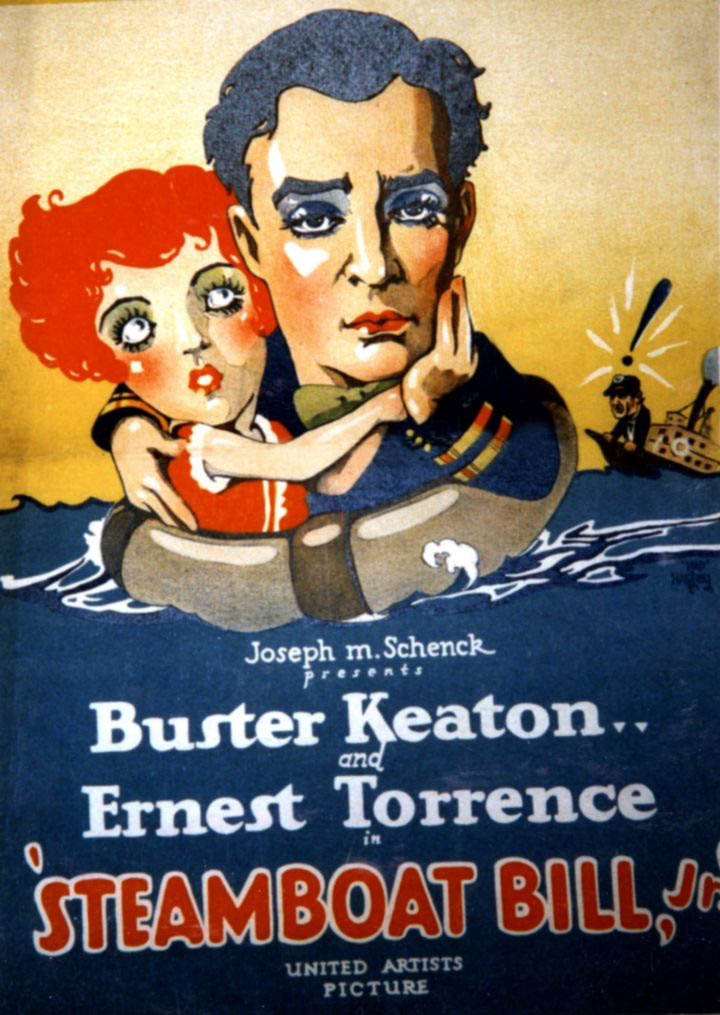
Steamboat Bill Jnr (1928)

Steamboat Bill Jnr (1928)

Keaton struggles to win his father’s approval in this brilliantly fast-paced farce

Director: Charles Reisner (& Buster Keaton)

Cast: Buster Keaton (William Canfield Jnr), Ernest Torrance (William Canfield Snr), Marion Byron (Kitty King), Tom McGuire (John James King), Tom Lewis (Tom Carter), Joe Keaton (Barber)

Steamboat Bill Jnr was meant to be a return to glory after the box-office disappointment of The General. Unfortunately for Keaton it shared all the traits of his previous film. An artistic triumph, today seen as one of the great silent comedies: but at the time an expensive misfire that hammered the final nail into Keaton’s filmmaking independence. Before he was swallowed by the MGM machine, Steamboat Bill Jnr was the last pure Keaton film, the last display of the master’s gravity defying stuntwork and all-in physical gag commitment.

Keaton is the forgotten son of paddle steamer operator William “Steamboat Bill” Canfield (Ernest Torrance) whose craft, the Stonewall Jackson, is being put out of business by the cutting-edge steamer The King named after its wealthy owner JJ King (Tom McGuire). William Jnr is a disappointment to his manly father: he’s clumsy, polite, decent has a pencil moustache (but not for long) and plays the ukelele. What kind of son is that? Worst of all, he falls in love with Kitty King (Marion Bryon), daughter of Steamboat Bill’s love rival. Can his son prove his worth when disaster piles on disaster and a cyclone hits the town?

Steamboat Bill Jnr is Keaton at his best. Although it has a romance plotline, this wisely plays second fiddle to the sort of role Keaton was born to play: slightly naïve and foolish sons, who are disappointments to their father. With his sad sack, impassive face and earnest, try-hard determination, Keaton was guaranteed to win the sympathies of the masses and Steamboat Bill Jnr is the fine-tuned ultimate expression of this classic Keaton role. He’s horrendously unlucky – he seems destined to trip over and activate vital levers or if he opens a door it will inevitable send someone tumbling off the boat – and at every turn well-meaning attempts to win his father’s favour backfire. It’s a superb exploration of a key theme in Keaton’s life and work – the struggle to win the regard of a domineering father in his own line of work, something Keaton had faced in his own life.

But despite that, like all the best Keaton heroes, he never, ever gives up. Adversity is milk-and-drink to him and, despite everything, his ingenuity and determination always wins out. He may look like a clueless, slightly ridiculous college kid adrift on a boat, walking around in his over-elaborate uniform: but the final reel, which shows him hooking up the boats systems via ropes and pulleys so he can control it singlehandedly proves it certainly wasn’t lack of attention that lay behind his mishaps.

And what’s really wrong with being a clearly middle-class kid who hasn’t spent much time on boats? It’s not like he’s a dandy or a layabout – he just doesn’t fit the mould his father expects – that of a flat-capped, oil-stained, tobacco chewer (and who knows not to swallow it!) never happier than when getting his hands dirty. Ernest Torrance is very good as this exasperated working-man, whose ideas of what counts as “manly” are very narrow (barely extending beyond the mirror) and sees any deviation in his son as highly suspicious metropolitan laxness.

Perhaps he feels his son looks too much like his puffed-up, slightly dandyish rival JJ King (an effective Tom McGuire). There is more than a touch of class warfare between these two, as well as a romantism that values the run-down-but-reliable Stonewall Jackson (right down to its Civil War era name) and the overly-polished-can’t-trust-it King. There are echoes (and not just in the names) in the generational family feud of Our Hospitality­ – not least in the fact that marriage seems destined to eventually bring the two families together in something approaching love and harmony.

Marion Byron gives a decent performance as Kitty – even if the film has little interest in her beyond love-interest device, including the inevitable moment where she becomes convinced Keaton’s character has let her down and decides to snub him. This snubbing takes place in a very funny scene of missed meetings and attempted evasions on the street; although this scene is itself a shadow of father and son meeting at the station, the son writing he will be recognisable by his white carnation, a flower everyone arriving at the train seems to be wearing (not helped by Keaton losing his).

Eventually matters proceed to blows and the arrest of Canfield Snr (and an attempted break-out foiled by the son’s inability to get his father to trust him) before the town is blown away in one of the great Keaton set-pieces. Rain and bad weather peppers the final thirty minutes of the film – including an exquisite sight gag when Keaton steps into a puddle and disappears up to his waist – and erupts into a cyclone that rips buildings apart, blows others across fields and raises the waters to wreck the paddleboats and wash other buildings out to sea.

And this storm is the centrepiece of another peerless display of Keaton’s physical determination and courage in the name of comedy. He gets trapped in a hospital bed blowing through the streets (after the building rips away to reveal him, a stunning in camera trick). He walks at almost 45 degrees against the wind. And, most famously, he stands in the perfect spot for the window of the façade of a house to save him when it falls on top of him. For this final stunt – insanely dangerous by any standards – even Keaton would later reflect on the suicidal risks he took. Either way, it’s a brilliantly elaborate set-piece (a riff on another set-piece from an earlier short) and a clear sign no-one did better than Keaton.

And no-one did. Watching Keaton bound like a squirrel up and down a paddle boat and dive into the flooded river, you know you are watching someone who really understand both the beauty of visual imagery and the peerless excitement of reality on film. Steamboat Bill Jnr combines this with a strong story, full of characters to root for and stuffed with sight gags (from a parade of hats stuffed on Keaton’s head, to a shaving from his father Joe) that make you laugh time and again. It’s a tragedy that this, one of his finest comedies, would also be his last where he had creative control.

Modern Times (1936)

Modern Times (1936)

Chaplin’s silent swansong, is a funny but quietly impassioned attack on corporate greed

Director: Charles Chaplin

Cast: Charles Chaplin (The factory worker aka The Tramp), Paulette Goddard (The Gamin), Henry Bergman (Café owner), Stanley “Tiny” Sandford (Big Bill), Chester Conklin (Mechanic), Al Ernest Garcia (President of Electro Steel), Stanley Blystone (Gamin’s father), Richard Alexander (Cell mate)

As cinema entered Modern Times of its own, Chaplin had a profound sense that he needed to move with those times. The legendary comedian, whose Tramp persona had made him (possibly) the most famous man in the world, was a silent comedian starting to be left behind by sound. There is a rich relish in the fact that Modern Times, a joke-packed criticism of the coldness of modern industry, is both Chaplin’s last silent and first sound movie, a dipping of the toe in modern times and a valedictory swansong for the past. It’s a film that bridges the ‘modern’ and classic of cinema.

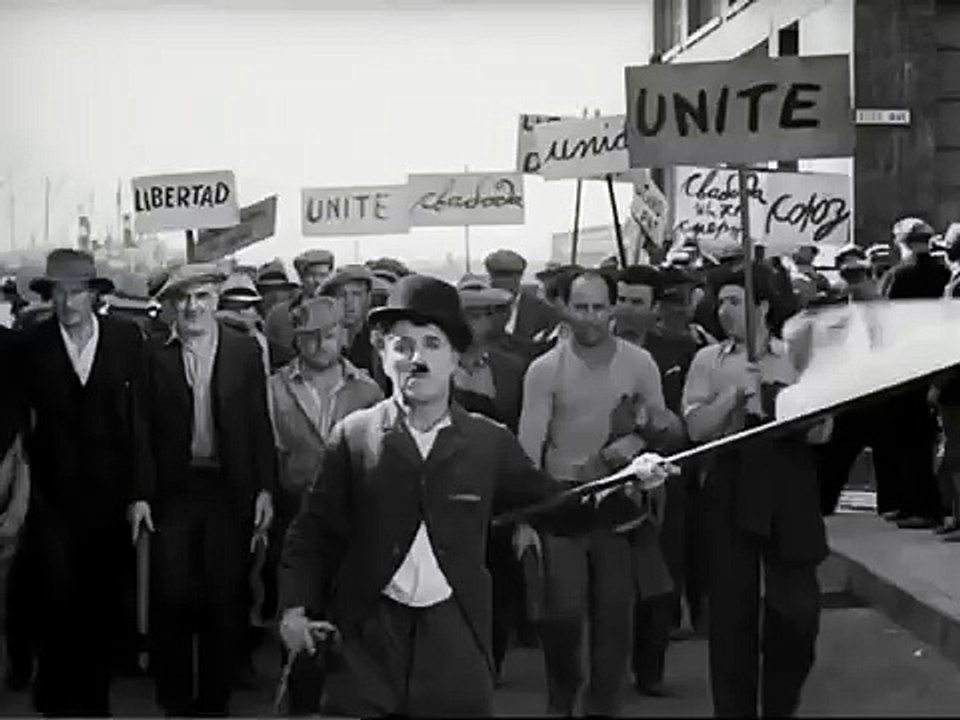
Chaplin is an assembly line-worker eventually driven to a nervous breakdown by the relentless, fast-paced monotony of his work (not to mention a death-defying encounter with the internal workings of the factory machines). Sent to recover in a hospital, he emerges into to find there is little in the world that a dreamer and romantic like him can understand. Again and again, things go wrong. He’s arrested for picking up a red flag in a union march, fired as a night watchman in a department store for helping starving thieves, hopeless as a factory repair man and struggles with tongue-tied silence as a singing waiter. But he and a young ‘Gamin’ (Paulette Goddard), both hope for a better life.

Modern Times has a deceptive structure. It’s easy, at first glance, to see is as four two-reelers thrown together: mini-films in the factory, prison, department store and café. But what Chaplin has created here is a picaresque fable, with the Tramp in the middle. (Only one sequence, with the Tramp as a repairman in a factory, feels superfluous repeating some jokes from the opening act). A morality tale of the modern era, where the big bosses and machines are indifferent to those on the bottom rungs, continually punctuated by the police riding up to bear away the innocent on the slightest pretext. It’s a masterclass of subtle repetition, with moments of contentment forever snatched away.

Chaplin’s most subtly political work became his most controversial. In a way few other films of the 1930s did, Modern Times engages with the conditions and politics of the Great Depression. Housing for the poor is ramshackle, with walls literally held up by mops. The factory alternates exploiting its workers at ever dizzying production speeds with ruthlessly laying them off the moment a slight economic downtown takes place. Union movements are ruthlessly stamped out: when the Tramp accidentally joins a march, he is arrested while the Gamin’s father is shot by police crushing another march. Poverty is ever-present – the Gamin ‘steals’ unwanted food to feed others, laid off factory-workers rob stores for food and when the factories are re-opened there is an almighty struggle from the desperate to get through the gates and claim a few hours of work.

Unsurprisingly Modern Times was condemned as possibly communist and suspiciously anti-American: Chaplin, turning a mirror on conditions in America started to be seen more-and-more by many as a suspicious alien (after all, he’d never taken on American citizenship). Nobody wanted to hear the funnyman turn prophet and many were suspicious of the comedian who used jokes to sweeten the bitter pill (even if, as per many of Chaplin’s messages, it was a rather naïve and simplistic one). It didn’t matter that Modern Times boils down to a plea for a universal love and understanding, it was somehow a creeping sign of the political dangers in ‘modern times’.

Today, distanced from the Red Scare, Modern Times looks far more like what it actually is: a pathos-filled, liberal eye on the working classes that champions the dreamers and the little guys over the corporations and the system. And who better as a hero for that than The Tramp? After all, this was a figure who had struggled against the odds for decades. Modern Times would see that struggle on multiple fronts: against the system, against the machines (literally so, as they swallow him up) and against a way of life that seems to be betting against him.

Even cinema was betting against the Tramp. Chaplin knew he couldn’t put off converting to sound forever. But he also knew the Tramp was a universal figure – and a large part of that was his silence. He never speaks in Modern Times – and when he sings, it’s in garbled, funny-voiced nonsense that effectively keeps him as a universal mute. It’s The Tramp’s final victory lap.

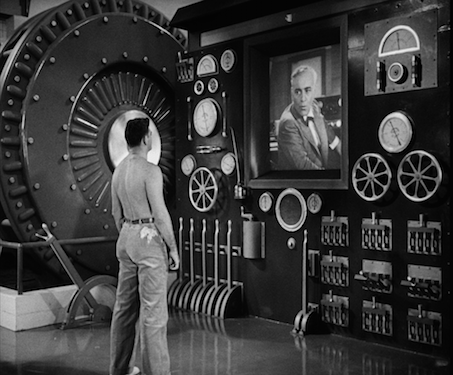
Chaplin’s comic timing remains masterful, and Modern Times is awash with marvellous, balletic set-pieces. Most famous is the opening factory sequence (which owes more than a debt to Fritz Lang’s Metropolis and feels remarkably prescient of Orwell’s 1984 with its Big Brotherish boss), a crazed ballet of repetitive, fast-paced movement on the production line – culminating in the legendary sequence of him being sucked into the very gears of the machine. The factory cares so little about the men there, that a machine designed to feed them as they work is dismissed as impractical rather than inhumane – though it gives us a great set piece of Chaplin assaulted by this machine with soup, custard pies and morsels rammed into his face by a mechanical arm.

The comic invention continues through the prison sequence. It’s a sign of the sting under the surface of Modern Times that the highlights of this sequence come about due to the Tramp (accidentally) being high on a mountain of cocaine. Foiling a jail break through coked-up bravado – another wonderfully done sequence, timed to perfection and filmed in one-shot – the Tramp’s reward is not being allowed to stay (and get the roof and food he needs) but early release. (Modern Times finds time, before he goes, for a final pop at ineffectual, superior middle-class do-gooders, lampooning a crusading priest’s wife as coldly distant and the subject of a cheeky gaseous gag).

Modern Times develops into a sweet fairy-tale romance with the introduction of the Gamin. Paulette Goddard gives a radiant performance, full of confidence and comic vibrancy – she becomes the first female lead given near-equal treatment by Chaplin. The department store sequence is grounded with their relationship, from the Gamin taking the opportunity to sleep in a beautifully prepared bed. Their time in the shop at night is full of wonder at the comfort and luxury – that they never see in their own homes – and culminates in a beautifully shot roller-skating sequence, with Chaplin circling balletically on the floors of the shop. (Tellingly though, he does so on the edge of precipice marked danger – Modern Times never forgets that danger lies just round the corner).

It’s the Gamin who lands them a job at a bustling café – awash with spoiled, rich customers – via her dancing ability (there is a fabulously simple transition that sees her pirouetting on the streets to ending the dance in glamourous clothes in the café). Even this moment of happiness is foiled by the law – illogically chasing the Gamin for past vagary offences rather than leaving her to work. But it’s made clear that they are a partnership: fitting the humane message of Modern Times that our best chance of being saved is sticking together.

Modern Times is shot by Chaplin with a striking, sprightly inventiveness. There are signs throughout of Chaplin’s overlooked visual and editorial skill, transitions that are hugely cinematic, storylines that are communicated with maximum efficiency and clarity. As well as the influences of Lang, Chaplin shows a debt to Eisenstein with a striking early visual cut that sees a crowd of sheep (with one black sheep in the middle) cut to a crowd of workers emerging from a subway into the factory. Modern Times pushes its humane message with a gentle persistency, but never lets it dominate the comic and emotional force of the film. Chaplin is an entertainer with a social conscience – but he is an entertainer first of all – and Modern Times is never anything less than charming and funny, even when it is spikey.

The General (1927)

The General (1927)

Keaton’s masterpiece, less of a comedy and more an inspiration for hundreds of action films

Director: Buster Keatson & Clyde Bruckman

Cast: Buster Keaton (Johnnie Gray), Marian Mack (Annabel Lee), Glen Cavander (Captain Anderson), Jim Farley (General Thatcher), Frederick Vroom (Southern General), Charles Smith (Mr Lee), Frank Barnes (Annabel’s brother), Joe Keaton (Union General)

The General frequently features in the lists of greatest comedies of all-time. It’s a bit of a misnomer: while The General has its fair share of jokes, it’s really a sort of action film. A Mad Max: Fury Road with gags, the greatest chase you’ll ever see and one of the most dynamic stunt spectaculars ever made. It’s Keaton’s apogee, one of the most influential and greatest films ever made. If you’ve ever seen a stunt-filled epic, you’ve seen something that takes inspiration from the tireless physical tricks Keaton pulled here and the stunning, cinematic grace he films it with. The General is a classic that is instantly, and constantly, rewarding.

Keaton plays Johnnie Gray, a respected engine driver of the South with two loves in his life: Annabel (Marian Mack) and his steam engine The General. He’s about to propose to Annabel when the Civil War breaks out. She wants him to enlist: he tries his best but is rejected, unbeknownst to him, because the army considers him more valuable as a train driver. Mistakenly seen as a coward by Annabel, she vows never to speak to him again. A year later The General is hi-jacked by Union soldiers as part of a surprise offensive. Johnnie gives chase in a second engine, The Texas, unaware Annabel is aboard the kidnapped General. The wild chase takes Johnnie North then South again to bring Annabel home and report to the Confederate army the approaching attack.

The General was the most expensive film Keaton’s company had ever made. No expense was spared in bringing two period-accurate engines to the screen, with everything shot in location (in Oregon, admittedly, due to the Tennessee not being keen on staging a Civil War Keaton comedy) and all executed in perfect period detail. The film contained the most expensive single shot ever mounted – costing a whopping $42,000, it would show a real bridge collapse and hurl a real engine into a real river (Keaton filmed in long shot, with real horses moving around near the bridge, to stress this was a real stunt not a model). Despite all this, the film was a box-office disappointment.

Why? Well frankly, I’m not sure the world was ready for something that promised itself as being a comedy set during what was still a raw scar in the American psyche. The marketing material also promised more laughs than you can shake a stick at – a misrepresentation of a film that is more a stunt-filled poem than a slapstick riot. For those expecting The Navigator, The General was a disappointment. For us today, it is one of the great American films, a piece of cinematic mastery.

The General is for a large chunk of its run-time (almost 40 of its just under 80 minutes) a glorious chase, in which every sequence show-pieces invention at high-speed. The majority of the stunt filled tricks were executed by Keaton himself, surely at some considerable risk to life and limb. As you watch him bound over railway carriages, dive through port holes, sprint alongside steaming trains or sit atop the hurling railway sleepers to remove obstructions, you can only marvel at his physical dexterity and commitment.

Keaton’s character is also subtly, and impressively, different from his other roles. These were often defined by their haplessness – would-be detectives and empty-headed heirs. But within his professional sphere, Johnnie is a master. He knows the capabilities of engines and dynamics of the railroad better than anyone. He is relentless and endlessly inventive in overcoming myriad problems just as he can use his knowledge to place near-insurmountable barriers in the way of his pursuers.

The opening of the film stresses the respect people hold him in – he’s hero-worshipped by children, greeted warmly by all and has no doubts about asking Annabel to marry him. Sure Johnnie can get pre-occupied and miss the bigger picture – a few times, he is almost left behind by the steaming train while resolving problems on the line – and away from the train, especially when he joins the soldiers in the film’s finale, he suffers from the same clumsy, cluelessness as Keaton did fighting to defend his ship in The Navigator. But he’s also brave, indefatigable, ingenious and relentless. He’s more of a model for every action hero maverick since than you could imagine.

And those stunts! Keaton was a master film-maker, framing the action to accentuate its speed, scale and reality. The camera runs alongside the train, demonstrating its speed by showing objects move by. The action is frequently framed in medium and long shot to demonstrate its scale and the grandness. This goes for Keaton bounding across carriages and for simple gags, such as the famous shot of a forlorn, jilted Johnnie sitting on a drive rod of the moving train, lifted up and down as it shunts forward. The complexities of this chase are always made clear and camera angles are key to the various attempt each train makes to stop the other. This is placed above the standard comedic reaction close-ups audiences expected – but make for a richer, more rewarding film.

In fact, watching the film, you can grow to admire Johnnie so much you start to wonder what he sees in Annabel. Perhaps Keaton, to an extent, wondered the same. Annabel is kidnapped, tied up, caught in a bear trap, tossed around in a sack and doused in engine water. Is this woman being partially punished by the film? After all, it’s her demand that Johnnie turn his life upside down to fight in (what we know) will be a brutal war – and her kneejerk condemnation of him – that sets events in motion. Does she need this humbling to learn her lesson? It perhaps helps her and Johnnie become an ever more effective partnership on their flight back South, setting traps and keeping the engine going (with the odd comic misunderstanding, one of which sees Johnnie running down then back up a hill to reboard the train) that leads to their eventual reconciliation.

Interestingly, what’s less comfortable with The General today is its avoidance of the core issues of the civil war. Slavery never rears its head, and the film takes a largely sympathetic view of the romantic Southern gentlemen vs the nefarious Northerner, with their under-hand schemes. Peter Kramer, in an excellent BFI book, lays out a compelling argument that The General exposes, especially through its final battle sequence which sees real people die and a hapless Johnnie charging into heroics like a lost child, the dangerously blind embrace of violence in the South and a subtle criticism of a horrific war that led to so many needless deaths. While there might be beats of that under the surface here (especially if you are familiar with the shocking death toll of the war), it’s not enough to overcome the generally sympathetic view of the Confederacy and its leaders.

But politics is not at the heart of Keaton’s film. The appeal for him, just as for Johnnie, was that engine and, by extension, the glory of the chase. Only someone who loved trains as much as Keaton could have made such a guilty pleasure of plunging one thirty feet to its doom on camera. And in Johnnie Flynn he created a genuinely little-guy hero, a character who shared his dynamism and pluck and, above all, his love for all things mechanical.

The General isn’t a comedy really – there are few real belly laughs in it, and the film is played straight by all and sundry, devoid of reaction shots. Its laughs come in shock at its audacity, its epic scale and from how much it causes you to invest in the trials and tribulations of its lead character. It’s an action film that you embrace with fervent love, because it’s pure, unadulterated, cinematic beauty. It’s a masterpiece.

Asteroid City (2023)

Asteroid City (2023)

Anderson’s quirk filled film is a triumph of his own style but lacks the depth of his best work

Director: Wes Anderson

Cast: Jason Schwartzman (Augie Steenbeck/Jones Hall), Scarlett Johansson (Midge Campbell/Mercedes Ford), Tom Hanks (Stanley Zak), Jeffrey Wright (General Gibson), Tilda Swinton (Dr. Hickenlooper), Bryan Cranston (Host), Edward Norton (Conrad Earp), Adrien Brody (Schubert Green), Liev Schreiber (J.J. Kellogg), Hope Davis (Sandy Borden), Stephen Park (Roger Cho), Rupert Friend (Montana), Maya Hawke (June Douglas), Steve Carell (Motel manager), Matt Dillon (Mechanic), Hong Chau (Polly), Willem Dafoe (Saltzburg Keitel), Jake Ryan (Woodrow), Grace Edwards (Dinah), Aristou Meehan (Clifford), Sophia Lillis (Shelly), Ethan Josh Lee (Ricky)

Every time I go and see a Wes Anderson film, I hope I might fall in love again. Eventually, I’ll find something in Anderson’s overly distinctive, quirky style that I love as much as The Grand Budapest Hotel. Maybe the romantic in me is dying, because I think its never going to happen. Certainly it doesn’t with Asteroid City a film I sat watching thinking “I know some people will love this more than life itself, but for me sitting here it feels like waiting for the rapture”.

Asteroid City is another of Anderson’s films that’s an intricate puzzle box where the pieces shift like the brightly coloured squares on a Rubrik’s cube. It’s filtered through several layers of remove: we watch a 50s TV announcer (Bryan Cranston) introduce a stage performance of a playwright’s (Edward Norton) long-running play that is itself an entrée to a wide-screen, technicolour production of a host of eccentrics, including a recently widowed photographer (Jason Schwartzman), his grouchy father-in-law (Tom Hanks), a glamourous Hollywood star (Scarlett Johansson) and several others accompanying their kids to a remote town in the desert for a young stargazing and science competition co-sponsored by an army general (Jeffrey Wright), when the whole town is thrown into quarantine after a stop-motion alien drops in, looks around and flies off.

Somewhere in Asteroid City there is an interesting, slightly sad, meditation on grief, loss and ennui struggling to get out. The alien arrival makes everyone question the nature of the universe and their place in it. It’s easy to see the influence of Covid on a town flung into quarantine, and the resulting state of uncertainty throwing everyone off kilter. We are following a man who has recently lost his wife, being played in this film-within-a-play-within-a-TV-show by an actor who was (we discover) recently lost his own partner. At one point this actor asks the director if he is ‘doing it right’, if he is getting the emotion or the author’s intention: “just tell the story” the director (Adrien Brody) responds. I think that’s part of a message about just live and let the big questions take care of themselves, of trusting that we can do our loved ones proud. That’s an interesting, rewarding point.

But it’s lost in Anderson’s pitiless device, his never-ending quirk and the deliberately distancing, artificial nature of his world and the monotonous, arch delivery his script, camera work and editing imposes on a series of actors. What this film desperately misses is a leading player with the strength and independence of a Ralph Fiennes or a Gene Hackman: someone who can bring depth and a sense of reality to the stylised Anderson world, while still delivering something perfectly in keeping with his tone. To put it bluntly, Schwartzman is, to put it bluntly, not a sufficiently engaging or interesting actor to communicate his character’s inner turmoil under the surface which the film’s inner meaning requires. He too naturally, and trustingly, settles into the Anderson rhythm.

In this crucial role, he’s a misfire. With our leading player too much of an artificial character, someone we never believe is anything other than a construct of the film’s author, inhabited by a collaborator who doesn’t bring the independence or new vision the director needs, the more the deeper emotional layers of the film are drowned. Instead, the film becomes a crushing onslaught of style and trickery, devoid of any sense of reality at any point.

It eventually makes the film feel overly smug, too pleased with-itself, too taken with its intricate, tricksy construction. It is of course a triumph of art design and the photography is gorgeous, from the black-and-white of the TV studio and theatre, to the 60s tinged, artificial world of Asteroid City, crammed with its obviously fake skylines and vistas and technicolour inspired feel. That at least its impossible not to admire. But it’s also a mighty artificial trap that enfolds the entire film – and eventually the audience – in a world of weightless, arch, eyebrow-cocked commentary that promises a lot but winds up saying almost nothing of any interest.

There are performances to admire. Scarlett Johansson is very droll and finds some depths as an star actress struggling with a concealed depression. Tom Hanks looks most like the actor who feels like he can break out of the Anderson mould and discover some genuine emotion. Jeffrey Wright demonstrates few actors can do Anderson dialogue better than him, Bryan Cranston very droll and perfectly observed as Ed Murrow style TV man and Adrien Brody is loose, fun and inventive as the play’s director. But yet its everything inside this framework that feels somehow empty.

What I want from Anderson is someone to come in and shake him up, to point out that he is not betraying his aesthetics or style by injecting a small dose of reality and humanity into it. When he has done that in the past – moments in Rushmore, The Royal Tenenbaums and, above all, The Grand Budapest Hotel – he has delivered movies that are inventive, fun and playful but also carry real, lasting emotional impact. When he delivers in-jokes like Asteroid City, it feels like a party you have been invited to where everyone speaks in some made-up language they’ve not told you about in advance. And after not very long, all you want to do is to get up and leave.

Go West (1925)

Go West (1925)

Keaton meets his finest leading lady – a cow – in this adorably charming comedy

Director: Buster Keaton

Cast: Buster Keaton (Friendless), Howard Truesdale (Ranch owner), Kathleen Myers (Ranch owner’s daughter), Ray Thompson (Ranch foreman)

Keaton had been unconvinced by Seven Chances, the theatrical farce he’d been asked to film that saw him chased left, right and centre by women. Perhaps his reaction to playing a somewhat cold man pursuing and pursued by ladies persuaded him to try something completely different. What if he could make a film where he removed the “romantic” girl from the equation altogether? Could Keaton make an affecting comedy where his character’s strongest bond is to a cow?

Go West is Keaton back to his best, a glorious Western spoof (a happy return to the grounds of Our Hospitality). Keaton is Friendless, a hard-working guy adrift in the cut-and-thrust of the world. So much so that, visiting New York, he is literally trampled by bustling crowds. He heads out West to try his luck, becoming a ranch hand on a farm. There he finally meets someone who sees him as a friend – ‘Blue Eyes’, a cow who like him is an outcast from the herd. For the first time both of them has a friend – but what will Friendless do when Blue Eyes is to be packed off to a Los Angeles slaughterhouse?

You would never think that a man and a cow could be as sweet as they are together in this film. Keaton spent almost a month with the cow who plays Blue Eyes, going everywhere with her, feeding her and spending weeks with her. By the time they came to filming, the cow followed him without the slightest hesitation and never once seemed anything less than completely comfortable in his presence. Keaton (half) joked he never had a better leading lady than Blue Eyes – and his earnest, gentle and sincere playing of this friendship between man and beast gives Go West its heart.

Taking a gentle pop at DW Griffith again – Friendless and Blue Eyes both share names with leading characters from the director’s Intolerance – Keaton creates a film that many have called his one excursion into pathos but, for me, is all about creating character and story and having it service comedy. The laughs come faster for me in Go West than a farce like The Navigator because Keaton invests real warmth into this unlikely screen partnership. You invest in their story – these two outsiders, lonely and illtreated on the ranch, who find themselves as unlikely soul mates – and once you have that investment, you laugh along with their exploits.

Keaton also creates a variation on his usual character. Friendless is stoic but unlike other Keaton characters, he’s not bumbling or naïve, instead he seems to have accepted that he has no place in the world of men. Unlike other Keaton characters, he’s got an impressive ability to teach himself new skills rather than relying heavily on imitating others and reading instruction manuals. Friendless, slowly, picks up the skills of a ranch hand himself. Sure, he bungles his first attempts – his hilariously poor saddling of a horse (the saddle almost on the horses’ rump) being a case in point – but give him time and he’ll get there.

He’ll even win odd moments of respect. He gets two bulls back into the pen through skilful, unfazed, use of a red handkerchief (two ranch hands look on in grudging respect). He improvises an elastic string for his tiny pistol which works surprisingly well. He spots a cheat in a card-game and then skilfully disarms him (by placing his finger in the way of the trigger). In the film’s closing act – where a herd of bulls walk wildly around Los Angeles – he’s able to herd them back together with a great deal of skill, cunning and improvisation. He’s he’s undeniably good at the things he does – and gets better.

Go West has several great jokes, many of them initially based around Friendless’ place as an outsider. Selling his remaining goods to a pawnbroker in the films opening, he forgets to remove his shaving kit and mother’s picture from a desk: of course, the pawnbroker immediately charges him for taking the goods (making his money back in moments). On the ranch, Friendless inevitably times his arrival at the daily meals with everyone else finishing up and leaving the table, forcing Friendless to leave as well (he doesn’t eat for days on this ranch). His clumsy attempts at ranch life leads to several pratfalls of inevitable high-standard.

But it all starts to change as he forms a friendship with Blue Eyes. He’ll bend over backwards to help her. He’ll stay up all night with a gun to protect her from wolves. He’ll strap antlers to her head to help her ward off bulls. He’ll shave a brand (thank goodness he grabbed that shaving kit) into her back to save her from the fire. And he’ll raise what money he can to try and buy her and, when that fails, he’ll jump on a train to travel with her to save her.

It leads into the film’s action packed third act. It starts with a classic Keaton piece of business. Trying to earn the money to buy Blue Eyes, he buys into a rigged poker game. Calling the dealer on cheating, the ranch hand pulls a gun and orders Keaton “When you say that – SMILE”. Will cinema’s most famous stony-faced comic finally crack a grin? It’s a lovely in-joke – and Keaton’s two fingered mouth push grin the perfect response, as his ingeniously shrewd solution to prevent violence. Jumping on a train from here (this is another classic train sequence from a Keaton film) he dodges bullets from an attack from outlaws and ends up the only man on board with an army of cows.

The final sequence – a series of sight gags as cows invade shops, Turkish baths and street stalls in Los Angeles before Keaton dons a red-devil suit to lead them back into a holding pens in a perverse twist on Seven Chances – is sometimes overlong, but offers plenty of delights. But none match the sweetness and innocence of that friendship between man and cow. Keaton’s chemistry with Blue Eyes – and his understanding that the beauty of silence makes animals as legitimate characters in many ways as humans – shines out. It gives the film a real heart and tenderness that grounds all the jokes in something real, as well as providing the film with real stakes (because, after all, Blue Eyes is in danger of being turned into one).

Go West is often overlooked in the Keaton CV but, despite being a fraction overlong, it’s a warm, tender and sweet story packed with excellent gags. This isn’t manipulative pathos – instead this is Keaton using humanity to deliver a unique sort of pure romance. This is possibly one of the finest films about friendship ever made – and Blue Eyes stands with Balthasar as one of the greatest animal actors on screen.

Cat Ballou (1965)

Cat Ballou (1965)

Zany western comedy, a little dated, but with almost enough good jokes

Director: Eliot Silverstein

Cast: Jane Fonda (Cat Ballou), Lee Marvin (Kid Shelleen/Tim Strawn), Michael Callan (Clay Boone), Dwayne Hickman (Uncle Jed), Nat King Cole (Sunrise Kid), Stubby Kate (Sam the Shade), Tom Nardini (Jackson Two-Bears), John Marley (Frankie Ballou), Reginald Denny (Sir Harry Percival)

In a town out West in Wyoming, Cat Ballou (Jane Fonda) is to be hanged as a notorious outlaw. How did she end up here? Let Nat King Cole and Stubby Kaye tell you as they recount ‘The Ballad of Cat Ballou’. This young, would-be school-teacher ended up on the gallows after a feud over her father’s (John Marley) land with Sir Harry Percival (Reginald Denny). Percival has a brutal hired gun, Tim Shrawn (Lee Marvin). So, Cat hired her own gunman, the legendary Kid Shelleen (Marvin again) who has become an equally legendary drunk. After the death of her father, Cat, Kid and her friends and love interests form a gang to bring Percival’s corporation down.

Cat Ballou stems from an era when audiences were not quite ready for the violent, nihilistic Western revisionism that would spawn the likes of McCabe and Mrs Miller and The Wild Bunch, but could no longer take the Ford/Wayne style Western seriously. Instead, it takes its inspiration from Swinging Sixties comedy, playing like Tom Jones or a Dick Lester Beatles movie. It’s zany, tongue-in-cheek, daubed in primary colours and nothing in it is meant to be taken particularly seriously, not even the bullets. It’s a fast-paced entertainment and if it looks rather dated today, at least it has its moments.

It’s most notable as the film that won Marvin the Oscar for his double performance as the drunk, shambling Kid Shelleen and the Marvinesque heavy Tim Strawn (with missing nose). Marvin revelled a chance to showcase his comic skills – and even have his stereotypical role as a bruising, violent killer as a contrast. Kid Shelleen doesn’t turn-up until almost a third of the way in, but all the film’s most memorable moments involve him. Slurring, scruffy, stumbling and only able to shoot straight when a little bit pissed (in an early shooting test he literally can’t hit a barn door), Marvin offers not only a red-eyed piece of comedy acting just this side of hammy, but also a neat jokey commentary on the truth behind an army of Western heavies (Cat is hugely disappointed to find the stories she’s read of Kid’s exploits, in no ways matches the mess she sees before her).

Marvin, rather graciously, always claimed of his Oscar “that half of this belongs to a horse somewhere out in San Fernando Valley”. It’s a touchingly modest reference to the film’s closing sequence – the inevitable rescue attempt on Cat – where Kid turns up pissed, riding a horse that seems as drunk as him (a neat shot, that took much careful animal wrangling, shows both Kid and his horse leaning lopsidedly against a wall, the horse with its legs drunkenly crossed). But Marvin’s performance works because it nails the tone of the film in a way no-one else really does.

That’s arguably true of Jane Fonda, who seems either slightly bemused or mildly contemptuous of the role she’s ended up in. When the film throws in moments close to tragedy, she reacts with more emotional realism than a zany comedy can support. She’s not willing to surrender herself to the moments of farce or flirtation, not helped by the dull or forgettable performances of her love interests. Callan lacks charisma or flair as outlaw Clay Boone, Dwayne Hickman overeggs as Boone’s comedic partner-in-crime Uncle Jed while Tom Nardini tries hard but lacks grace as Jackson Two-Bears. Fonda is also stuck in the only role where she can’t corpse at the drunken antics of Marvin.

The film bounces along, from its animated opening, via a series of comedic twists on Western tropes (a dance, a fight, a train robbery etc). Personally, I’ve never really been a fan of zany comedies, and my mind wasn’t changed here. Mixed with its very 60s view of the West, all colour splashed checked shirts, the try-hard craziness of Cat Ballou can start to wear cynical modern viewers like me down.

Which isn’t to say there isn’t a good joke here or there, or that Marvin isn’t worth the price of admission. Silverstein directs with a professional smoothness that leaves the actors to get on with it (perhaps a little too much). The darker moments of the film don’t always marry up successfully with the tone – Cat’s reaction to the death of her father is from a different movie altogether – but generally it glides along, helped with some catchy tunes well sung by Cole and Kaye as a ballad-touting Greek Chorus.

Cat Ballou might actually be best enjoyed by taking a leaf out of Kid Shelleen’s books: get a couple of whiskies inside you and you’ll find the accuracy of your laughter jumping up several notches.

Seven Chances (1925)

Seven Chances (1925)

Sub-par Keaton comedy, remembered only for its chase scene, but otherwise best forgotten

Director: Buster Keaton

Cast: Buster Keaton (James Shannon), T Roy Barnes (Billy Meekin), Snitz Edwards (Lawyer), Ruth Dwyer (Mary Jones), Frances Raymond (Mrs Jones), Erwin Connelly (Clergyman), Jules Cowles (Hired Hand), Jean Arthur (Receptionist)

It’s the film Keaton didn’t care for – so much so he told a film restorer working on his films to essentially not bother with it. It was a play purchased for him by producer Joseph Schenck, rather than chosen by the physical-comedy gag-meister, who called it a “sappy farce”. Still, he did his best with it – and then some, since it became one of his biggest hits – and, if it’s far from a stand-out on his CV, that’s not Keaton’s fault. In fact, the only parts of the film anyone remembers are all due to Keaton alone.

The plot follows businessman James Shannon (Buster Keaton). He finds out from a lawyer (Snitz Edwards) that he is to inherit $7million – but only if he is married by 7pm on his 27th birthday. And naturally, today is his 27th birthday! Bungling his proposal to the girl he loves (but was always too shy to ask) Mary (Ruth Dwyer), he and his business partner (T Roy Barnes) head to a country club and ask every girl he can see to marry him. They all say no (guess how many he asks) until an advert in the paper revealing the fortune awaiting a willing bride, produces an army of ladies who will chase Shannon to the ends of the earth for marriage. Can he get back to Mary, reconcile and marry by 7pm?

You can see why Seven Chances is an awkward fit for Keaton. He was more comfortable in a role where the world was awash with obstacles. From natural elements to modern machinery, Keaton was the impassive little guy struggling against the odds. He was much less suited to the faintly unsympathetic Shannon, where coincidence, shyness and poor explanations were his problem. Keaton reworked the character to make him more sympathetic – it’s shyness rather than unwillingness that delays his proposal (in an opening technicolour sequence showing the passing of the seasons around Shannon’s ever-delayed proposal), but its still a role he lacks affinity for.

The film’s opening is too dialogue driven – it throws up more title cards than almost any Keaton film you can think of – and Keaton looks restrained by the role. It’s telling that the “Keaton” part for the first ten minutes goes to Snitz Edwards (very funny with his eternally put-upon face) who struggles to get anyone to listen to his news about a possible inheritance. The film rushes through much of the plays plot in its opening 40 minutes, recognising that it’s essentially the same gag – Keaton asks a woman to marry him, she says no – repeated over and over again.

Those seven chances whizz by in the country club, as a progression of women (including an unbilled, pre-fame Jean Arthur) turn him down with a mix of laughter, anger and contempt. To be honest its diminishing returns, even with some Keaton directorial flair (one proposal takes place walking up the stairs, without breaking step after rejection Keaton walks down the stairs with a second unwilling woman). There is nothing for Keaton to get his teeth stuck into.

It’s only in the second half, the play forgotten, that Keaton finds sure ground – and the films memorable moments. The advert produces an army of women – in some shots, it looks like hundreds if not more. As Keaton sleeps in a church pew, it slowly fills up around him. Eventually a clever cross fade (similar to an early cross fade that moves a cars location without it moving in frame from one house to the other – Keaton understood editing like few others) sees the church filled with women. Keaton awakes, is ambushed under a scrum of would-be brides and makes his escape.

What follows is a madcap chase through the streets – including several inspired tracking and crane shots stressing the speed and the size of the pursuing crowd. The chase passes through a police march, a football game (where the players are all crushed by the mob), an industrial plant and then into the countryside, Keaton running for all he is worth.

At one point Keaton intended to end the film like this. It wasn’t until a test audience failed to laugh that he realised it needed to change – and he cottoned onto the unexpectedly loud laugh from when he had thrown himself down a hill (a suicidal looking jump on screen) and dislodged some rocks, causing a small avalanche. Back out to location they went, accompanied by dozens of papier-mâché rocks of various sizes, and scaled up the gag to huge levels, Keaton running, leaping and climbing up trees to escape this onslaught of boulders. It also created a reason for the women to be blocked off – and allow Keaton to escape to propose to his girl and create the just-in-time happy ending.

It’s that chase people remember – and gives Seven Chances a fonder public image than it deserves. But its ten minutes of great material in over an hour of sub-par Keaton. It doesn’t help that this film, more than any other Keaton, has a parade of black-face gags (Jules Cowles in a head-in-hands performance today) revolving around Mary’s servant, who is (of course) stupid, slow and lazy. It’s compounded by a gag where Keaton rejects (in horror) the idea of proposing to a Black woman.

Seven Chances is fondly remembered for its chase – but if you want to watch a Keaton chase, there are many better options than this, a film meaner and less good-natured than his best work.

The Navigator (1924)

The Navigator (1924)

Keaton is cast adrift in a film that is all gags and no story or stakes and not the better for it

Director: Buster Keaton (& Donald Crisp)

Cast: Buster Keaton (Rollo Treadaway), Kathryn McGuire (Betsy O’Brien), Frederick Vroom (John O’Brien), Noble Johnson (Chief), Clarence Burton (Spy)

Buster Keaton claimed The Navigator was his best film. With all due respect he’s wrong. The Navigator was born out of the ahead-of-its-time failure of Sherlock Jr. When that marvel of cinematic invention didn’t land with audiences, Keaton played safe. He put a lid on the tricks and focused on the gags. In fact, he cast himself away in a boat with only Kathryn McGuire for company and they told jokes for 45 minutes. That’s the basics of The Navigator and, for me, the lack of plot, stakes or character ends up in a much weaker film.

Buster is Rollo Treadaway, a rich sap, who one day decides to get married and books the honeymoon before he’s asked his planned intended Betsy (Kathryn McGuire). When she says no, Rollo goes on honeymoon anyway but in a confusion at the docks ends up on the wrong ship, The Navigator. It’s owned by Betsy’s father – but spies for a foreign power plan to set it adrift. In further confusion, Betsy also ends up on board and she and Rollo wake-up drifting at sea. How will two pampered rich people work out how to look after themselves on a deserted ship?

The Navigator keeps things simple, cranking up the jokes in a film much closer in spirit to his shorts, all designed to be easy to digest and just tickly the funny bone. You feel they genuinely did just cast the ship out to sea and waited for Keaton to work out as many gags as he could until the camera ran out of film. Donald Crisp was hired to direct the dramatic stuff, but Keaton quickly realised he didn’t need him and didn’t like Crisp’s vague prologue about wicked spies (he was right, it’s totally forgettable unlike the equivalent opening of Our Hospitality) so set off to sea without him. (Crisp makes a visual cameo as the painting of the ship’s captain that swings in front of a porthole).

There are, for me, three key gags that work in The Navigator. Rollo’s spontaneous decision to get married (based on seeing a happy couple outside of the window), after which he distractedly bathes fully clothed then gets his chauffeur to drive him to Betsy’s house – on the opposite side of the street (the car does a big circular loop across the street). After the rejected proposal he informs the chauffeur, he needs a walk home to clear his mind.

This is, in many ways, the funniest, most inventive moment in The Navigator. It’s a great little showpiece as well for the (passionately not-getting-married) Kathryn McGuire and the finest example of Keaton’s capacity for easily led saps, overwhelmingly influenced by things they see around them. It’s the part of the film I enjoyed the most and its over after ten minutes.

The Navigator starts to drift as soon as it heads to sea. There is some neat camera work that suggests the haunting emptiness of the ship (it’s so vast we get an amusing series of visual jokes as Keaton and McGuire consistently miss bumping into each other while walking around it), but where other Keaton films would have explored more the ghostly darkness of this technological marvel (or the oppressive nature of it emptiness) The Navigator largely shies away from this.

The best sequence on the ship follows McGuire and Keaton’s attempts to cook a meal in a massive galley, hampered by the fact that (a) everything on the ship is set-up to cook for hundreds not two and (b) the two pampered souls have no idea how to open a tin can or boil a kettle, let alone cook a meal. Three potatoes are thrown into an enormous vat. Keaton goes through a series of trial error involving drills and carving knives to get into tins. McGuire can’t work out that sea water isn’t drinkable or how much coffee is needed for a cup. They are both befuddled by fish (which they basically eat raw) and can’t find cutlery so make do with kitchen utensils. It’s a sharply observed, well-constructed scene.

But other than this, the film struggles with a series of gags that rather disappoint. There is a painfully overlong underwater sequence where Keaton wrestles with a fake swordfish. There is a lack of Keaton’s trademark physical stunts (aside from a bit of business with a deckchair). An encounter with an island tribe – a bit uncomfortable today to watch these Black-skinned savages – is overlong and heads into a siege that is never particularly funny (other than a gag of Keaton accidentally dragging around a miniature cannon that no matter where he turns is always aimed at him – a gag later lifted for Jar-Jar Binks in The Phantom Menace).

The main problem I have about The Navigator is that this bag of gags never engages me because the film isn’t about anything. Neither of these people feel like real people (and, lord knows, Keaton characters were often lightly-sketched comic roles, but this is ridiculous), the film has no stakes and has no plot momentum, drifting like the boat they are stuck on. I need more for a comedy, to feel invested. Without that investment, it’s just stuff happening. A Keaton’s I won’t revisit. It was, however, his biggest hit. What do I know?