Category: Comedy

The Grand Budapest Hotel (2014)

The Grand Budapest Hotel (2014)

Luscious visuals, hilarious gags mix with an air of sadness and regret in Wes Anderson’s masterpiece

Director: Wes Anderson

Cast: Ralph Fiennes (M. Gustav), Tony Revolori (Zero), F. Murray Abraham (Mr Moustafa), Mathieu Amalric (Serge X), Adrien Brody (Dmitri), Willem Dafoe (Jopling), Jeff Goldblum (Deputy Kovacs), Harvey Keitel (Ludwig), Jude Law (Young Writer), Bill Murray (M. Ivan), Edward Norton (Inspector Henckels), Saoirse Ronan (Agatha), Jason Schwartzman (M. Jean), Léa Seydoux (Clotilde), Tilda Swinton (Madame D), Tom Wilkinson (Author), Owen Wilson (M. Chuck)

I wrote recently I could forgive the flaws I’ve found in Kurosawa’s work, for the majesty of Seven Samurai. I can totally say the same again for Wes Anderson. He is a director I’ve sometimes found quirky, mannered and artificial – but God almighty he deserves a place in the pantheon for directing a film as near to perfection as The Grand Budapest Hotel, a delight from start to finish, as beautiful to look at as it is whipper-snap funny, as heart-warming to bathe in as it is coldly, sadly bittersweet. After three viewings I can say it is, without a doubt, a masterpiece.

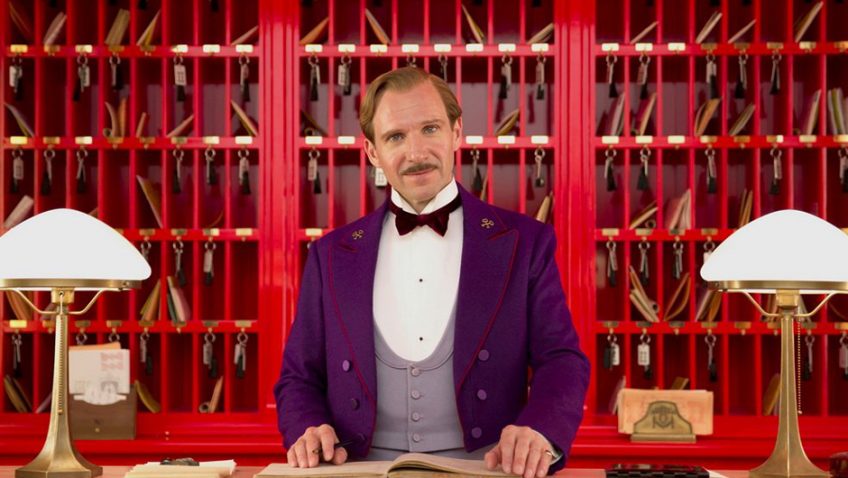
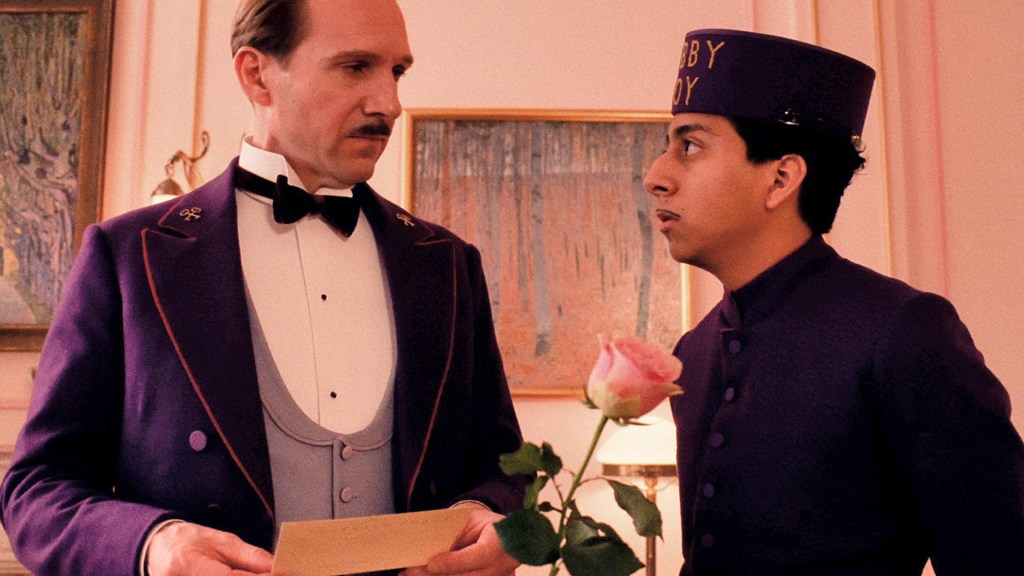
Like many Wes Anderson films, its storyline is eccentric, halfway between fantasy and absurdity. In 1932, in an opulent hotel, The Grand Budapest, concierge Monsieur Gustav (Ralph Fiennes) is the pinnacle of his trade: precise, fastidious, perfectionist, he can fix anything anywhere – opera tickets, the perfect table placement and a night of passion at any time for the elderly widows who visit his hotel. When one of them, Madame D (Tilda Swinton) dies leaving him a priceless painting, Boy with Apple he suddenly finds himself framed for her murder. Only his ingenuity, and the dedicated help of his protégé, best friend and surrogate brother/son, lobby boy Zero (Tony Revolori) will save him.

You can’t escape on the first viewing that The Grand Budapest Hotel is an extraordinarily funny film. Crammed with superb one-liners, it’s a showcase for a breathtakingly, blissfully funny performance from Ralph Fiennes whose comic timing is exquisite and whose mastery of the perfectly structured monologue of flowery language is as spot-on as his ability to deliver a crude punch-line. Anderson fills the film with clever sight-gags, bounce and a supreme sense of fun. You’ll laugh out loud (I frequently do, and I remember most of the gags) and wind back to watch them again.

But what lifts this is the wonderfully evocative, elegiac piece this beautiful film is. For all its comic zip, it unfolds in a romanticised past already a relic in 1932. We can’t escape the rise of Fascism that fills the film. Jack-booted soldiers accost and hunt Gustav and Zero. Adrien Brody’s furious heir to Madame D looks like a Gestapo officer, and his vicious heavy Jopling (Willem Dafoe so weathered, he looks like he’s been beaten by a carpet duster) has a stormtrooper menace. En route to Madame D’s funeral, Zero is nearly dragged off the train to be lynched by fascist thugs for being an immigrant and The Grand Budapest is taken over by this dreadful movement, filled with Mussolini-inspired ZZ insignia and blackshirts.

Under the jokes, the world Gustav represents has already died and been buried. We are never allowed to forget we are marching, inexorably, towards a very real-world war that will rip apart this fictional country and leave millions dead. Gustav’s gentile old-school charm ended with 1920s: and he sort of knows it. Fiennes, under the suaveness, conveys a man who falls back into potty language when he can no longer maintain his assured confidence that a straight-backed, polite assurance will solve any problem or a poetic reflection will allow them to put any unpleasantness behind them. Those days are gone and it makes for a deep, rich vein of sadness just under the surface.

It’s particularly acute because it’s made clear this is a memory piece. Anderson constructs the film like a memory box. It has no less than three framing devices. It opens and closes with a young woman in 2014 visiting a monument to a great writer, the author of the book The Grand Budapest Hotel. From there we flash back to the author (a droll Tom Wilkinson) in 1985 recounting how he met the man who inspired the novel, before heading again to a flashback to the 1960s where the young author (Jude Law) meets the man we discover is an older Zero (F Murray Abraham) who recounts the story we then watch. Each layer of the film descends deeper into Anderson’s artificial, carefully structured visual style, with its heightened sense of reality.

Old Zero – beautifully played by F. Murray Abraham – is introduced as a man of acute loneliness and sadness, who tells us early on the woman his young self loves, Agatha (a radiant Saoirse Ronan) will die and shuffles around the nearly abandoned The Grand Budapest (now a concrete nightmare of Communist architecture) with only his memories for comfort. No matter how jovial and bright the events of the 1930s are, we can’t forget that these are the reflections of a man full of regrets.

When old Zero’s narration turns to remembering Agatha, the lights around him dim: Agatha even enters the narrative almost by the side door: Gustav is arrested and imprisoned before she appears, along with a series of flashbacks-within-flashbacks to Zero and her meeting and her first meeting with Gustav, as if Zero had to steel himself to remember her (as reflected in Abraham’s tear-stained face). Later, when remembering the fates of Gustav (his best friend) and Agatha (the love of his life) he almost draws a veil over it (even their final scenes in flashback play out in monochrome). There is a deep, moving sense of humanity here, a powerful thread of grief that adds immense richness.

But don’t forget this is also a funny film! Anderson is an inventive visual and narrative director at the best of times, and here every single beat of his playful style pays off in spades. The entire 1930s section of the film (the overwhelming bulk of the narrative) plays out in 4:3 ratio, which to many other directors would be restrictive, but seems a perfect fit for a director who often composes his visuals with the skill of an expert cartoonist. The frame is frequently filled in every direction when within the grandeur of the hotel, but then feels marvellously restrictive for Gustav’s prison cell or the train compartments that seem to constantly carry Zero and him to disaster.

Anderson’s wonderfully precise camera movements also reach their zenith here. His camera is deceptively static, often placed in a series of perfectly staged compositions that places the characters at their heart, frequently looking at us. But then the camera will turn – frequently in a fluid single-plain ninety degrees to reveal a new image of character. There are Steadicam tracking shots that are a dream to watch. It’s combined with some truly astounding model shots (parts of the set are not-even-disguised animated models and miniatures, adding to the sense of fantasia) and the detail of every inch of the design (astounding work from Adam Stockhausen and Anna Pinnock) is perfection. The film is an opulent visual delight.

It’s a film of belly laughs and then moments of haunting sadness. But also, a wonderful celebration of friendship. The bond between Gustav and Zero is profound, natural and deeply moving – grounded, fittingly, in adversity from the agents of a hostile, oppressive state – and carries real emotional force. Newcomer Tony Revolori is hugely endearing as naïve but brave Zero, making his way in this new world (fitting the theme, he left his homeland after his family was destroyed by war) and sparks superbly with Fiennes and Ronan.

There is a wonderful beating heart in The Grand Budapest Hotel, amongst the farce, perfectly timed gags and cheekiness, that makes it a rich film you can luxuriate in. Anderson’s direction is faultless, Fiennes is a breathtaking revelation, both hilarious, affronted, decent and fighting the good fight. Gorgeous to look at, thought-provoking and laugh-out loud funny it’s a dream of a film.

The Banshees of Inisherin (2022)

The Banshees of Inisherin (2022)

Director: Martin McDonagh

Cast: Colin Farrell (Pádraic Súilleabháin), Brendan Gleeson (Colm Doherty), Kerry Condon (Siobhan Súilleabháin), Barry Keoghan (Dominic Kearney), Pat Shortt (Jonjo Devine), Jon Kenny (Gerry), Brid Ni Neachtain (Mrs O’Riordan), Gary Lydon (Paedar Kearney), Aaron Monaghan (Declan), Shelia Fitton (Mrs McCormick), David Pearse (Priest)

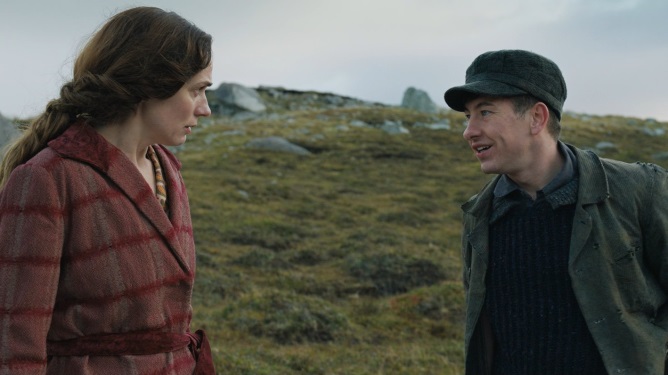
Pádraic (Colin Farrell) and Colm (Brendan Gleeson) are life-long friends on the small Irish island of Inisherin. Until one day, in 1923, Colm bluntly says he won’t speak to Pádraic again as “I just don’t like ya no more”. What on earth has led to this seemingly permanent severance? Did Pádraic do something wrong? The torment of not knowing will create a huge strain on Padraic, who prides himself on “being nice” and can’t understand why the older Colm doesn’t want to chat him. Just as Colm can’t understand why Pádraic can’t leave him alone, especially as he is almost universally agreed to be dull. Eventually this blunt stop to a friendship swiftly escalates out of all control.

McDonagh’s film is packed with the scintillating dialogue you would expect, and he combines it with an intriguing, tragedy-tinged character study where two sympathetic characters tip themselves into destruction through the unwillingness of either of them to compromise. It’s no coincidence that the film is set during the Irish Civil War. Cut off from the mainland on their tranquil island (where life feels like it hasn’t changed for the best part of 100 years), the characters are disturbed from their own civil war, every now and again, by the sound of gunfire and explosions from the mainland. The Banshees of Inisherin can be seen as a commentary on civil wars: don’t they all start, essentially, from someone deciding they have had enough and “just don’t like ya” anymore?

This marvellously rich film boils down a whole country tearing itself apart over what sort of future it wants, into one personal clash over two people’s future. The future increasingly obsesses Colm, a man preoccupied with mortality (who assumes his life can now be counted in years rather than decades), suffering from depression, worried he will disappear leaving no mark. A talented fiddle player, he wants to be like Mozart, remembered decades later – and he can’t do that wasting time every day for hours on end listening to Pádraic talking about his “wee donkey’s shite”.

It’s a perspective on the future, that Pádraic just can’t understand. For him, what does it matter what people you’ll never meet think about you? What matters to him is that the people around him like him and remember him as a “nice fella”. Not in a million years does legacy occur to him: the familiarity of everyday being the same is the most comforting thing, and change a horrific and terrifying thing to be avoided as much as possible.

You can see all this instantly in Colin Farrell’s heart-rending performance as this gentle, fragile but unimaginative soul, heart-broken at the inexplicable loss of his best friend. The film is a striking reminder that, contrary to his looks, Farrell’s best work is in embodying lost souls, the sort of people never ready for the life’s hurdles. Pádraic certainly isn’t, and his attempt to process what has happened defeats him. A man who considers his pet goat his next best friend and is as reliant as a child on his sister, doesn’t have the ability to understand what Colm is driving at about mortality, assuming instead he will stumble across the right words to be welcomed back into Colm’s company. He becomes the unstoppable object, trying to batter down Colm’s wall of silence.

He’s onto a losing battle, as Colm reveals himself to be – either due to his depression or his just not caring any more – the immovable force. Wonderfully played with a tinge of sadness and a depression-induced monomania, by Brendan Gleeson, Colm is a decent guy in many ways but fails to appreciate or consider the effect his actions will have on others. Instead he is focused on achieving at least something notable from his life. It leads to dramatic steps to drive Pádraic away, Colm threatening to cut off one of his fiddle playing fingers every time Pádraic bothers him, a threat he transpires to be more than willing to carry out.

And so civil war breaks out. As well as the parallels with Ireland’s war, I also felt strong echoes of our own poisoned social-media discourse. By his own lights, Colm believes his sudden severing of contact with Pádraic is perfectly reasonable. Many people who have “ghosted” others no doubt feel the same. Colm is reasonable when he explains it, and he still steps in with silent acts of comfort and support when Pádraic falls foul of the island’s brutish police office. But he never considers the traumatic impact this unexplained change will have on Pádraic – or how flashes of kindness can be as cruel as hours of non-acknowledgement.

Radicalism, in civil war and social media, quickly takes hold. What else can you call Colm’s threat to slice off his own fingers (the fingers he needs to live his dream of fiddle-playing legacy)? Just like people blowing hard on Twitter, he needs to deliver or lose face. Pádraic makes angry, passionate condemnations of Colm in the pub, like he’s posting rants online. Things escalate to a point where no-one feels they can step away or backdown.

That’s the tragedy McDonagh identifies here. This one decision of Colm’s – no matter the motives – ends up having disastrous effects on both men. Pádraic changes from a gentle soul to someone capable of wrathful fury and lifelong grudges. Colm literally disfigures himself, guaranteeing he will never achieve the very thing he started this for. Could there be a better parable for the destructive nature of civil combat? Neither Colm or Pádraic are willing to compromise: what if Colm said he would only see Pádraic once or twice a week, eh? Just like Ireland, they burn the world down.

This all takes place in a rich framework, with McDonagh skilfully working in clever, challenging sub-plots. The legend of the banshee, who foretold death and enjoyed watching destruction, is woven throughout, embodied by the sinister Mrs McCormick (a ghostly Shelia Fitton). The most forward-looking person on the island is Pádraic’s sister Siobhan – brilliantly played by Kerry Condon – who finds herself wondering why on earth she stays in such a self-destructive small-world. Barry Keoghan (also superb) plays the universally acknowledged village dunce, who (if you stop and listen to him) quotes French and poetry and (for all his crudeness and lack of social graces) is clearly a man stunted under the heel of his abusive father, the village policeman.

As events escalate and rush out of control – McDonagh’s pacing is very effective here – the film slows for carefully judged moments of emotional power, from the burial of a beloved pet to a character weeping in bed at the painful choices that must be made. McDonagh has created a powerful universal metaphor for the dangers of extreme, definitive choices and a total rejection of compromise by boiling it down to the smallest scale possible.

And your sympathies ebb and flow, due to the beautiful performances from its leads. Farrell is heartbreaking, a memory you carry as he becomes more vengeful. Gleeson is coldly reasonable, even as we grow to understand his crushing sense of mortality and character-altering depression. These two actors power an intelligent and thought-provoking film that achieves a huge amount with subtle and rewarding brushstrokes.

Triangle of Sadness (2022)

Triangle of Sadness (2022)

Östlund’s super-rich satire lines up straight-forward targets to easily knock down

Director: Ruben Östlund

Cast: Harris Dickinson (Carl), Charlbi Dean (Yaya), Dolly de Leon (Abigail), Zlatko Burić (Dimitry), Iris Berben (Therese), Vicki Berlin (Paula), Henrik Dorsin (Jarmo), Woody Harrelson (Captain Thomas Smith), Alicia Eriksson (Alicia), Jean-Christophe Folly (Nelson), Amanda Walker (Clementine), Oliver Ford Davies (Winston), Sunnyi Melles (Vera)

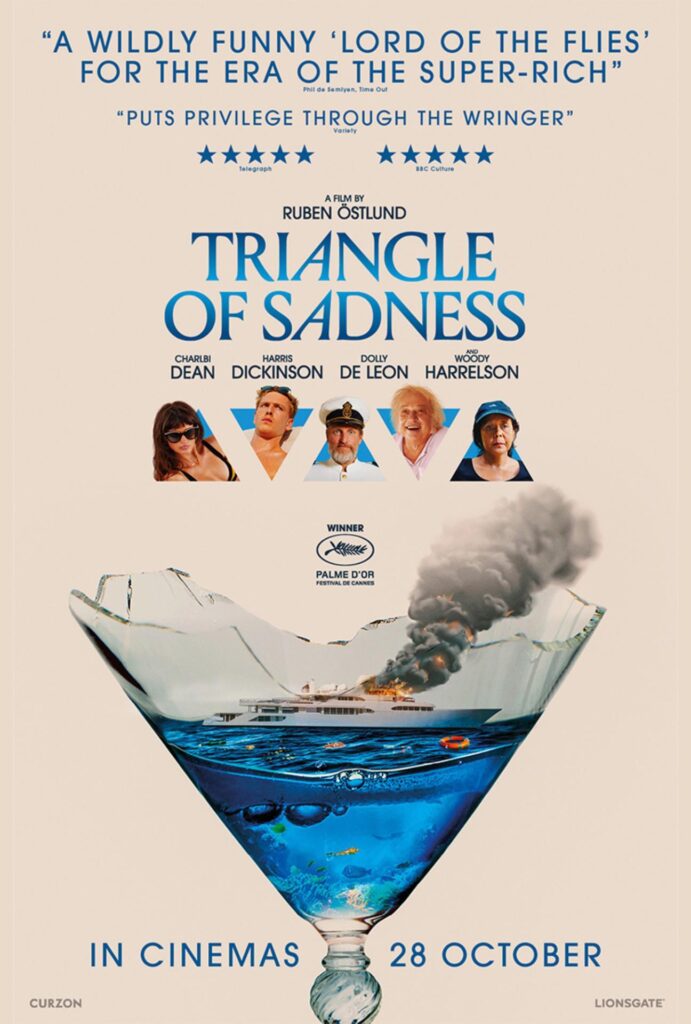
In my review of The Square, Östlund’s previous Palme d’Or winner, I described its targets as “so obvious, the entire film might as well be footage of fish being shot in barrels”. If only I’d known: Triangle of Sadness, his satire on the super-rich, takes this to the Nth degree: it’s an entire film of Östlund spraying machine gun bullets into an aquarium of drugged fish. That’s not to say there ain’t good jokes in here and several of its sequences are cheeky, engaging and funny. It’s well-made and high quality: but it’s also obvious and is in a such a rush to make its oh-so-clever satirical points that it frequently blunts its own impact.

The film revolves around a luxury cruise liner. On board: the self-obsessed, selfish, greedy representatives of the world’s oligarchs. A Russian who repeatedly amuses himself by bragging that he sells “shit” (fertiliser), a Danish app builder who splashes his cash, a married couple of British arms-traders who jovially bemoan how UN restriction on landmines made for tough financial years… you get the idea. Also on board: Instagram influencer supermodel Yaya (Charlbi Dean) and her insecure male model boyfriend Carl (Harris Dickinson). All of them treat the staff like slaves. But when the ship sinks after a storm and an attack by Somali pirates, the surviving passengers find they entirely lack the skills needed to survive on an island, unlike toilet-cleaner Abigail (Dolly de Leon) who rockets from the bottom to the top of the social hierarchy.

Östlund’s film lays into the emptiness, greed and selfishness of the super-rich with glee, even if it hardly tells us anything we don’t already know. The rich are only interested in their own needs and can only see others as tools for their own pleasure: who knew? Wanting to expand his satirical targets even further, Östlund also takes a pop at the social media generation. Apparently, they are shallow and interested only in commodifying their own lives. Who knew? It’s the sort of stuff that makes for a punchy student revue, but you want something a little bit more challenging that moves above cheap shots from a Palme d’Or winner.

In many ways the film’s most interesting section (and most subtle ideas) take place before we even reach the boat. The film’s first chapter exclusively follows Carl and Yaya. Carl auditions for a modelling job where he’s treated like a piece of meat (hilariously they mutter about him needing botox). At a fashion show, staff pleasantly demand three people move out of their seats to make way for VIPS – who immediately ask for one more seat. Everyone shuffles along one (the camera following this with a neat tracking shot), leaving Carl seatless. This is a more subtle commentary on the self-obsessive focus of the super-rich than anything that follows.

Carl and Yaya are in an interesting position: they are both part of the beautiful super-rich and not (they don’t have any money). That early act opener balloons from a disagreement over who pays for a meal into Carl inarticulately arguing for sexual-equality and mutual partnerships that defy gender roles. It’s more interesting than almost anything that follows, because it’s multi-layered and raises genuine issues we all face (to varying degrees).

But the film abandons multi-layered the second it steps foot on the boat. There are fun set pieces. Carl unwittingly gets a pool attendant fired because he’s jealous of Yaya’s admiration for his topless body. The staff on the boat gee themselves up for days of enthusiastic deference with a tip-expectant-group-chant. A Russian lady demands the staff all swim in the sea so they can have as much fun as she is having (and to show how ‘normal’ she is). The film’s most infamous set-piece occurs as a storm coincides with the captain’s dinner (with the fish courses under-cooked due to the aforementioned obligatory staff swim) leading to nearly all the passengers projectile vomiting across the state room, then sliding around the floors of the swaying ship in their own filth.

Amusing as that can be in its guignol excess, it tells you how subtle the film is. The film is awash with obvious, lazy jokes – of course the polite arms trading couple are called Winston and Clementine! To hammer home the social issues the film whacks us over the head with, the Captain (an awkward performance from Woody Harrelson) an alcoholic Marxist spends the storm pissed in his cabin, reading Noam Chomsky and his own anti-capitalist ravings over the ship’s tannoy. This takes up a huge amount of screen-time and manages to be both obvious and not very funny.

The film enjoys taking these pot-shots so much, it ends up feeling rushed when we arrive at the island. If we had seen more of Dolly de Leon’s Abigail earlier in the film (in actuality, the film sidelines her as much as the characters do, barely allowing her more than a minute of screentime in its first hour), the shift in social hierarchy would have carried more impact. If Östlund’s film had more patience to show the passengers expectation that shipwrecked life would be identical to that on the boat, then Abigail taking charge after a few days that would have carried more impact. Instead, Abigail takes command from arrival, and then essentially behaves (in a way I’m not sure the film quite understands) with exactly the same self-entitled greed as the passengers did. She takes the best cabin, establishes a hierarchy, keeps most of the food and turns Carl into a sex toy.

Because we’ve not really seen Abigail earlier in the film, we don’t get a sense of her earlier mistreatment (really, most of the film would have been better told from her point-of-view) or join her satisfaction at the tables being turned. The film also exhausts its commentary on the super-rich leaving it with little to say about in its third act Lord of the Flies set-up. Instead, the film dawdles its way to a conclusion and cliffhanger ending that feels unearned.

It makes you regret the loss of its earlier more subtle commentary on Instagrammers Carl and Yaya (good performances from Harris Dickinson and the tragically late Charlbi Dean) who are drowning-not-waving in a world where they must commodify their bodies but have no power over them, struggling to work-out where they fit in a world. It throws this overboard to go for some (admittedly at times funny) gags about greed and very obvious social commentary. If it had committed to its social underclass uprising earlier – or carried on with its more subtle themes from the opening prologue – it would have been a better film. Instead it’s as subtle and probing as the faceful of vomit it serves up halfway through.

Amsterdam (2022)

Amsterdam (2022)

Lots of quirk, whimsy and smugness, not a lot of interest or dynamism in this satirical mis-fire

Director: David O. Russell

Cast: Christian Bale (Burt Berendsen), Margot Robbie (Valerie Voze), John David Washington (Harold Woodsman), Robert De Niro (General Gil Dillenbeck), Chris Rock (Milton King), Rami Malek (Tom Voze), Anya Taylor-Joy (Libby Voze), Zoe Saldana (Irma St Clair), Mike Myers (Paul Canterbury), Michael Shannon (Henry Norcross), Timothy Olyphant (Tarim Milfax), Andrea Riseborough (Beatrice Vandenheuvel), Taylor Swift (Elizabeth Meekins), Matthias Schoenaerts (Detective Lem Getwiller), Alessandro Nivola (Detective Hiltz), Ed Begley Jnr (General Bill Meekins)

David O Russell’s has made a niche for himself with his ensemble awards-bait films, filled with touches of quirk and offering rich opportunities for eccentric, showy performances from actors. Some of these have walked a fine line between charm and smugness: Amsterdam tips too far over that line. Like American Hustle it’s a twist on a real-life event (opening with a pleased with itself “A lot of this really happened” caption) but, unlike that film, it fails to insert any compelling storyline, settling for a whimsical shaggy-dog story that frequently grinds to a halt for infodumps or lectures.

Set in 1933, just as Roosevelt has taken office, it follows three friends who formed a friendship for life in post-war Amsterdam. They are: wounded veterans doctor Burt Berendsen (Christian Bale) and lawyer Harold Woodsman (John David Washington) and socialite-artist-turned-nurse Valerie Voze (Margot Robbie). Berendsen and Woodsman lost touch with Valerie in the 1920s, but now they are all bought together after the murder of their respected former commander as part of a plot from various nefarious types to overthrow the government in a fascist-inspired coup.

Sounds gripping right? Well, Amsterdam fails to find any urgency in this. In fact, details of this plot and the political context it’s happening in are sprinkled around the film as if Russell kept forgetting what the film was supposed to be about. It’s almost as if he stumbled on an unknown piece of American history – a rumoured coup attempt, thwarted by being denounced by the ex-Marine General approached to lead it (here represented by De Niro’s ramrod straight General Dillenbeck) – but got more and more bored with it the longer he spent on it.

Instead, his real interest is in the faint overtones of Jules et Jim style thruple between Berendsen, Woodsman and Voze (though this is American not French, so any trace of homoeroticism is dispatched, despite the obvious bond between the two men). The most engaging part of the film is the Act two flashback to these three healing, dancing and bonding in post-war Amsterdam, in a “our troubles are behind us” bliss. Even if it’s self-satisfied in its bohemianism.

To be honest, even then, they have an air of smugness behind them. They pass the time singing improvised nonsense songs based on words pulled out of a hat and playfully posing in Valerie’s modernist artwork. Valerie is played with almost enough charm by Robbie for you to overlook she is a standard Manic Pixie Dreamgirl, the sort of babe who pulls shrapnel from bodies to turn it into artistic tea-sets as a commentary on the madness of war. She and Woodsman form a relationship (with the married Berendsen as a sort of – well I’m not sure what, but definitely not a sexual third wheel) and these blissful Amsterdam days are the times of their life. Russell is so keen for us to know it, that all three pop up in short cutaways at key moments to whisper “Amsterdam” direct to the camera, an affectation that fails to deliver the spiritual impact its straining for.

It’s better than the shaggy dog story around the conspiracy that fills the 1930s part of the storyline. This remains so poorly defined, that Bale has to narrate a concluding slideshow of clips and fake newsreel and newspaper coverage to explain what on earth has just happened. The lack of clarity about the stakes – and the general lack of seriousness or urgency anyone treats them with –fails to provide any narrative oomph. Instead, it drifts along from casual meeting to casual meeting, every scene populated with a big-name actor showboating.

There is a lot of showboating in this film. Bale, an actor with an increasingly worrying tendency for funny voices and tics, fully embraces the facially scarred, glass-eye wearing Berendsen, perpetually stooped with a war wound and prone to fainting from pain-killer overuse. It’s a showy, actorly performance with a licence to go OTT. Bale does manage to invest it with an emotional depth and vulnerability, but there’s more than an air of indulgence here.

Most of the rest follow his lead. Malek and Taylor-Joy sink their teeth into a snobby socialite married couple. Rock essentially turns his role as a veteran into a less sweary extension of his stand-up act. Myers and Shannon seize with relish roles as ornithologist spies (is this meant to be a joke about the origins of the James Bond name from the author of a bird-spotting guidebook?) Poor John David Washington ends up feeling flat with his decision to underplay (like he’s in a different movie) and only De Niro really manages to feel like anything other than an actor on holiday.

Russell wants to make a point about the continual corruption of the rich and how their hunger for more power will never be sated. There are some half-hearted attempts at attacking racism, with the ill treatment of black veterans, but it lacks bite or edge. His attempts to draw parallels with Trump are all too clear, but the film largely fails to integrate these ideas into the film. In fact, it ends up relying on voiceover lectures from Bale about dangers to democracy. It ends up like being hectored by an angry socialist after a student revue night.

The film is shot with a series of low angle shots and medium and close ups that eventually made me feel like I was watching it from the bottom of a well. A vague sepia-ish tone is given by Emmanuel Lubezki, but the film looks flat and visually uninteresting (so much so I was stunned to see $80million had somehow been blown on it, despite most of the cast working for scale). It drifts towards a conclusion, without giving us anything human to invest in (as Russell managed so well in Silver Linings Playbook or The Fighter) or providing the sort of caper enjoyment he delivered in American Hustle. Instead, it’s oscillates between smug and dull.

The Great Dictator (1940)

The Great Dictator (1940)

The Little Tramp takes down Hitler in this iconic satire on the dangers of over-mighty strong-men

Director: Charles Chaplin

Cast: Charles Chaplin (Jewish barber/Adenoid Hynkel), Paulette Goddard (Hannah), Jack Oakie (Benzino Napolini), Reginald Gardiner (Schultz), Henry Daniell (Garbitsch), Billy Gilbert (Herring), Maurice Moscovich (Mr Jaeckel), Emma Dunn (Mrs Jaeckel), Grace Hyle (Madame Napolini), Carter de Harven (Bacterian ambassador), Bernard Gracey (Mr Mann)

They were born four days apart and had the two most famous moustaches of the 20th century. There the similarities end. One became the world’s most beloved comic, the other its most reviled bogeyman. Chaplin and Hitler were bound together in people’s minds for a decade before Chaplin turned his revulsion at Hitler into satire: The Great Dictator sees him play both a version of his Little Tramp (here reimagined as a Jewish barber) and a version of the Fuhrer (as a temper-tantrum-throwing, hatred-spewing, lunatic). But it also sees Chaplin effectively playing himself, capping the film with a famous humanitarian appeal to the audience for a little peace and understanding.

The Great Dictator is, just about, a comedy. A Jewish barber (Chaplin) serving in the front lines for Tomania during World War One, saves the life of officer Schultz (Reginald Gardiner) but loses his memory. In a veterans’ hospital for 20 years, he emerges into a radically different Tomania, now an anti-Semitic, fascist dictatorship ruled by the barber’s doppelganger Adenoid Hynkel (Chaplin again). Hynkel rants and raves about racial purity and Tomanian expansion and his stormtroopers march through the Jewish ghetto. The barber is saved from death, first by Hannah (Paulette Goddard) and then by Schultz, now a senior leader in the new Tomania. But, as Hynkel eyes up an invasion of neighbouring Osterlich, what role can the barber play in stopping his plans?

Chaplin said later, if he had known the horrors Hitler’s regime would perpetrate, he would never have made the film. That would have robbed us of one of the sharpest, most astute satires of power-hungry radicalism ever made. But Chaplin made his stinging assault on Hitler – painting him as both ludicrous and insanely dangerous – at a time when Hollywood was still nervously appeasing Germany to keep access to its film market, before the true horrors were known.

Chaplin’s film is chilling enough with what it does know. Its depiction of bullying stormtroopers is deeply unsettling, for all they are also comic buffoons. These jackbooted bullies march into the ghetto, swiftly escalating from daubing “Jew” on shop windows to beating and shooting innocents. Hynkel casually orders the execution of thousands and day-dreams of a world where Jews are no more. We see Jews brutalised. Chaplin doesn’t pull punches in demonstrating fascism is a dangerous cancer in the world, or that the likes of Hynkel are appalling in their ruthless heartlessness.

That makes it a mark of genius that Hynkel is also the centre of a ridiculous farce painting him as inept, childish and laughable. Chaplin achieves this by masterfully channelling Hitler’s mannerisms – no less than you would expect from the most gifted physical comedian in history. We are introduced to Hynkel at a Nuremberg-style rally, delivering a speech in a hilarious mix of gobbledegook and random German words (“Werner Schnitzel!”) delivered with a perfect parody of Hitler’s physicality. (Marking the film’s careful balance between jokes and seriousness, this includes a spit-flecked rant against “Der Juden”). His grandiosity is further punctured with coughing fits and clumsiness.

That’s nothing to what we see of Hynkel off-stage. Prone to carpet-chewing rants, prat-fall prone with the manner of a bitter, insecure teenager, Hynkel is a bully elevated into a position of power, clinging to the trappings of office to give him a feeling of personal worth. Residing in a presidential palace that’s a perfect parody of Speer’s grandiose architecture, Hynkel is both laughable and deeply dangerous. Chaplin gets this mixture of the sublimely ridiculous and terrifying in every scene: most notably in Hynkel’s famous dance with an inflated globe. He bounces and cavorts with this like a romantic lover (appropriately themed to Wagner) – but it all grows out of his near sexual excitement at the idea of conquering and purifying the world of Jews (and brunettes).

The Great Dictator bursts that globe, but it also bursts the bubble of puffed-up strong men in a way that’s still highly relevant today. Hynkel and fellow dictator Napolini (a perfect capturing of Mussolini’s mannerisms, mixed with a “mamma-mia” accent from Jack Oakie) are both buffoons, who can’t even co-ordinate shaking hands in between their ludicrous salutes. These buffoons have the power and coldness to kill millions, but are both idiots. Napolini’s state visit is a hilarious game of one-up-manship, from Hynkel’s feeble attempts to intimidate Napolini in his office, to the two of them pathetically pumping their barber chairs higher and higher (to insane levels) to try and look the tallest. They even engage in a childish food fight while bickering over who will have the right to invade Osterich. Vanity, childishness and homicidal nation-destroying all hand-in-hand.

To counter his brilliant deconstruction of Hitler, Chaplin deployed his Little Tramp character in a new guise, here re-imagined as a Jewish barber, but with the same mix of good intentions and bumbling clumsiness. There is classic Chaplin business – his shaving of a client perfectly in time to Brahm’s Hungarian Dance No 5 is pretty much perfection – but also darker material. The Barber is saved from lynching, nearly gets roped into a suicide attack on Hynkel and winds up in a concentration camp. This is the Tramp’s war: his decency used to point-up the hideousness of Hynkel even more.

And, in case we miss the point, Chaplin plays a third character in the final five minutes. With Hynkel in prison (mistaken for the Barber), the Barber-as-Hynkel takes his place to speak to Tomania. He’s got the Barber’s soul, Hynkel’s appearance… but his words are Chaplin’s. Talking direct to camera – just as the Barber glances at the fourth wall throughout – Chaplin makes an impassioned plea for peace, like the curtain speech of a classical actor. He was begged not to do it (it later lead to him being denounced as a Commie) – but Chaplin was making the film to make this point. It was all very well to make Hynkel look stupid, but equally important to put forward an alternative vision, one of hope and faith in mankind’s decency. The speech may be on the nose (probably a little too much), but Chaplin delivers it with the intensity of someone who passionately believes every word he is saying – and at least it serves as a culmination of themes and ideals the entire film espouses among the jokes, rather than a blast from the blue.

The Great Dictator is over-long (at over two hours), and some of its comic moments are more successful than others. But the sequences that deconstruct Hitler are almost perfect (and feature superb support from Daniell and Gilbert as lupine Goebbels and cry-baby Goering parodies) and the film balances hilarious farce, biting political wit, and an earnest despair at the horrors of dictatorship with just the right touch of hope.

Chaplin’s genius combined with his passion created a landmark, brave film. Few others could have balanced its tonal shifts with such deft skill and perhaps no other performer could have been both so funny and so appallingly destructive. Hitler banned the film, but succumbed to curiosity and arranged a private screening. No one knew what he thought of it – but he watched it twice.

See How They Run (2022)

See How They Run (2022)

Smug, semi-spoof murder mystery which can’t decide whether it loves or scorns the genre

Director: Tom George

Cast: Sam Rockwell (Inspector Stoppard), Saoirse Ronan (Constable Stalker), Adrien Brody (Leo Köpernick), Ruth Wilson (Petula Spencer), Reece Shearsmith (John Woolf), Harris Dickinson (Richard Attenborough), David Oyelowo (Mervyn Crocker-Harris), Charlie Cooper (Dennis), Shirley Henderson (Agatha Christie), Pippa Bennett-Warner (Ann Saville), Pearl Chandra (Selia Sim), Paul Chahidi (Fellowes), Sian Clifford (Edana Romney), Lucian Msamati (Max Mallowan), Tim Key (Commissioner Harrold Scott), Jacob Fortune-Lloyd (Gio)

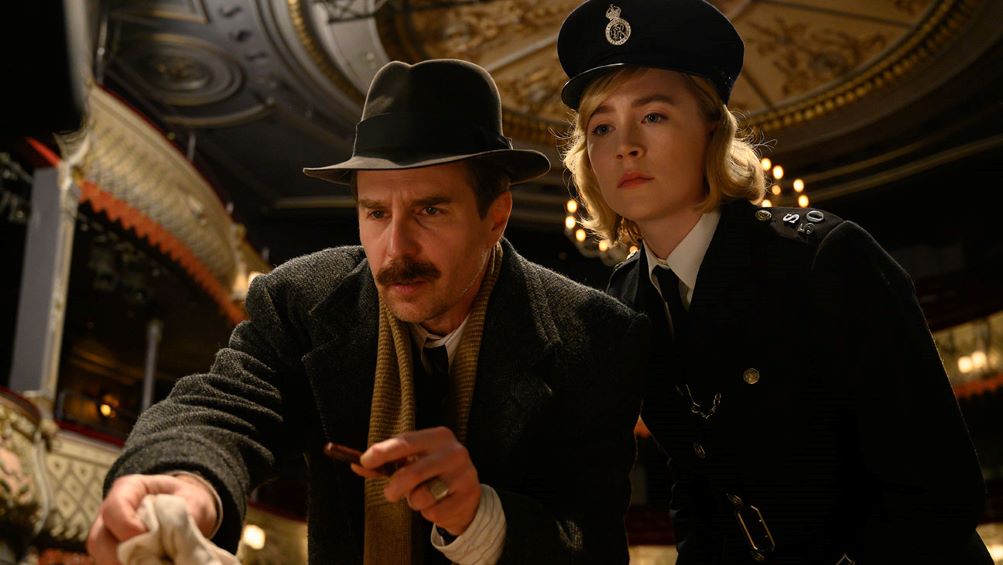
It’s the 100th performance of Agatha Christie’s The Mousetrap (“how much longer can it run”, the characters ask. If only they knew…) and producers are in talks for a big movie adaptation. At the party, boorish American film director Leo Köpernick (Adrien Brody) offends absolutely everyone – and promptly gets murdered. Not only are the cast (including Richard Attenborough – wittily impersonated by Harris Dickinson) suspect, but also the film producers which, contractually, can only go into production when the play closes. Investigating: dishevelled Inspector Stoppard (Sam Rockwell) and his super enthusiastic sidekick Constable Stalker (Saoirse Ronan).

See How They Run desperately wants to be a witty commentary on Agatha Christie style locked-room mysteries. It even opens with a voiceover from Brody’s Köpernick, full of scorn for the medium and its cliches before revealing, as per form, that as the least sympathetic character he himself is about to be knocked off. To be fair, there are one or two decent jokes. But the presence of Reece Shearsmith just made me think: Shearsmith and Steve Pemberton’s anthology dramady Inside No. 9 would have pulled off the same idea, but with far more wit and better understanding of Christie, in half an hour. And certainly with better jokes.

Instead See How They Run feels like it has only the most superficial understanding of Christie, based more on watching a few scenes of Poirot rather than reading the books. Rian Johnson’s Knives Out made a wittier, smarter and more enlightening commentary on Christie in its updating of the form, than this comedy ever manages. It’s never quite clear whether the makers want this to be a genuine Christie-style mystery or an inversion. Stoppard and Stalker go about their investigation in a traditional manner. The suspects all have motives of a sort. There is a definite mystery.

But it’s all lightweight and uninformed. Christie tropes are nudged and then ignored, as if the writers don’t understand them. What better opportunity could you have for Christie’s love for one mysterious character in the story turning out to be an actor in the group in disguise (invariably summarised by Poirot as “the performance of his/her life!”). There actually is a mysterious character here – but it turns out to be another person. Christie tropes around red herrings, secondary crimes, poison – all of them go unexplored.

The film ends with a deliberately counter-intuitive action sequence: but it’s not clear to me why. It’s neither particularly funny, nor does it feel like it has anything to say about the form other than offering an ending we might not expect. There is a nudge on the fourth wall (it’s the ending Köpernick wants) but what point is being made here? Is the action ending endorsing Köpernick’s belief that Christie-style mysteries are formulaic or boring, or is the shoot-out meant to look excessive and ridiculous? Is it implying everything we are watching is Köpernick’s dying fantasy? Is it a gag? I have no idea at all, and that sums up this tonal mess.

It’s a film that wants to have its cake and eat it. It tries to present a genuine murder mystery – and to be fair, when it does this, it does make for a good guessing game – but also wants to take potshots at the genre. It ends up doing neither particularly successfully. And there’s something a bit unlikeable about a film that wants to feed off the audience’s love of a Golden Age detective mystery, but also kinda wants to tell you how the thing you like is actually a bit stupid – and by extension so are you.

Its humour all too often feels a little studenty and obvious – the naming of Rockwell’s character as Stoppard being a case in point (although it does make for one good gag when Pearl Chandra’s charming Shelia Sim denounces another character as “a real hound, inspector”). It eventually feels like a rather smug film, which just goes to show how hard it is to make a Christie-style mystery.

If there is a decent joke in the thing, it’s that it manages to build a film where the plot of The Mousetrap is vital to the outcome, without ever revealing anything about what happens in The Mousetrap. (Presumably, the Christie estate would have had their guts for garters if they did.) Any moment where it looks like we might learn a major event in the play, a character interrupts or someone says “I already know”. These narrative gymnastics are the most inventive thing about it.

The other thing it’s got going for it is a performance of immense charm and comic likeability from Saoirse Ronan, who has rarely been as sweet, bubbly and adorkable as she is here. Ronan’s comic timing is excellent, and Stalker’s mixture of dogged determination and chronic over-enthusiasm provides virtually all the film’s highlights. Rockwell ambles through a (perhaps deliberately) under-written role, but most of the rest of the excellent cast feel under-utilised. Who casts Shearsmith and gives him not a single joke? Sian Clifford to deliver about three lines? David Oyelowo and Ruth Wilson do a lot with very little, but it’s telling that the final act appearance of Lucian Msamati and Paul Chahidi as a master-and-servant double act provides almost as much humour as the rest of the cast put together.

See How They Run passes the time – but that’s really about that. It doesn’t really have anything smart or funny to say about murder mysteries and it never offers anything truly unique or striking to justify itself (other than Ronan’s lovely performance). It’s straining as hard as it possibly can to ape the Coens or (most of all) the quirk of Wes Anderson, but totally lacks the skill and finesse of either. It feels like a film commissioned off the back of Knives Out success: but to be honest if you want to see something that brilliantly riffs off Christie while also being a bloody good mystery, just watch that instead.

Love Affair (1939)

Love Affair (1939)

Two people in love, separated by circumstance, in this film of two halves: one comedy, one sentimental

Director: Leo McCarey

Cast: Irene Dunne (Terry McKay), Charles Boyer (Michel Marnay), Maria Ouspenskaya (Michel’s Grandmother), Lee Bowman (Kenneth Bradley), Astrid Allwyn (Lois Clark), Maurice Moscovich (Maurice Cobert)

In many ways you could say Love Affair was the turning point in Leo McCarey’s career. For years in silent films and the early talkies he had been one of Hollywood’s leading comedy directors, the quick-witted master of the improvisational pun. But there was a second McCarey: the devout Catholic, concerned about social issues. The McCarey who light-heartedly complained when was given an Oscar for The Awful Truth rather than his heartfelt critique of elderly care, Make Way For Tomorrow. This McCarey increasingly leaned into well-meaning, sentimental dramas.

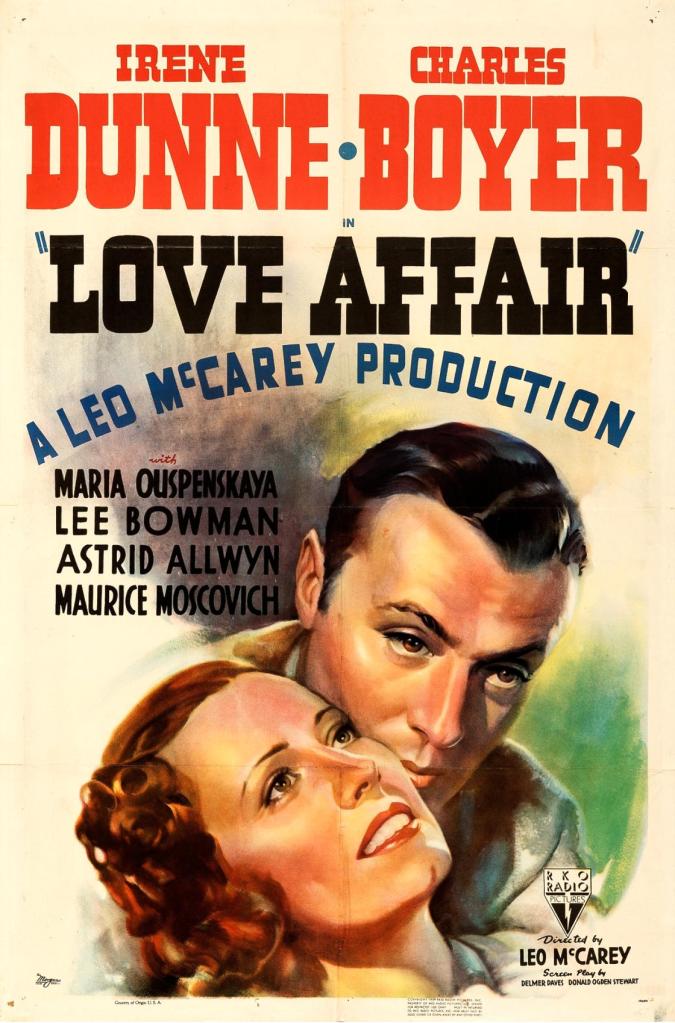
So why is Love Affair a turning point? Because the first half is a charming, funny, sexy meet-cute: and the second a well-meaning but sentimental love story that pulls two people apart. Those meet-cuters are famous Parisian playboy (he’s basically a gigolo) Michel Marney (Charles Boyer) and nightclub singer Terry McKay (Irene Dunne). They meet on a trans-Atlantic liner and fall in love. Problem is they are both engaged to others (both of them rich), waiting for them in New York. Should they decide to chuck it in and be together, they arrange to meet six months later at the top of the Empire State Building. Come the day, Michel waits – but on the way there, Terry is hit by a car and possibly left paralysed. She doesn’t want to tell him. He thinks she never planned to show up. Will they ever be together?

That car crash is the pivot in a film that feels like two genres surprisingly successfully wedded together. Love Affair is a great idea (so good in fact that McCarey remade it about 20 years later as An Affair to Remember), a romantic story with all the joy and vibrancy of a couple finding each other and falling in love, then the painful sting of tragic circumstances pulling them apart. It manages to be sweetly funny and then more or less manages to land just the right side of sentimental (though, lord, it skates near to the edge).

You go with that more overtly manipulative conclusion though, since the subtle comedic and romantic manipulation of the first half is so well done. McCarey encouraged his actors to improvise: filming started with McCarey sitting at a piano, plinking keys, waiting for inspiration to jazz up the script. It’s an approach many actors found challenging (Cary Grant nearly had a meltdown at first on The Awful Truth). But he found the perfect pairing with Boyer and Dunne.

Of course, Irene Dunne was a veteran. An actress far too overlooked today, Dunne flourished under McCarey’s style. Here she’s gloriously warm, sexy and charming. Terry McKay has a very dry (at times almost slightly smutty) wit; she’s absolutely no fool, but also kind, caring and considerate. Dunne sparkles every time she steps in front of the camera, displaying the sort of comic timing you can’t buy (her teasing glances at Michel during their first meeting, when she accidentally reads a telegram all about his sexual exploits at Lake Como, are to die for). But her face also lights up with a genuine radiance as she finds herself falling in love.

She also sparks wonderfully with Charles Boyer. Another overlooked star of 1930s Hollywood, Boyer was desperate to work with McCarey. He found the improvisational style awakened a relaxed, playful element in his acting that helped make Michel exactly the sort of dreamboat you could imagine falling in love with on a cruise. Boyer was also a superb reactor, his face able to communicate anything from growing interest, to delight and also piety, pain and disappointment. Boyer’s comic timing, like Dunne’s is faultless. Like her, he also effortlessly shifts to drama in the second half, expertly demonstrating the maturity of a playboy into someone generous and understanding.

With these two actors, McCarey couldn’t go too far wrong. Their natural ease with each other makes for wonderful chemistry. They are two people who progress naturally from teasing, to enjoying each other’s company, to realising they enjoy each other’s company way too much. Today, Love Affair can look a little tame – they don’t even kiss (although one shot of crashing waves, cutting to them opening a door on the boat to walk along the deck together, is rather suggestive). But the point is that this is love not an affair (or an affair about love). The feelings they develop for each are genuine and, bless them, they don’t want to corrupt it with behaviour that could compromise them.

Tellingly their love is cemented during a stop off in Madeira, where they visit Michel’s aunt (played by an archly eccentric Maria Ouspenskaya). She welcomes them into her home, bonds with Terry, and Michel shows Terry a far different side to himself than his playboy persona: a thoughtful artist. McCarey even shoots them together (in a beautifully lit scene by photographer Rudolph Maté) in a chapel, kneeling side-by-side at the altar. Could McCarey make the endorsement of their love more clear?

Perhaps he felt he needed to, since the screenplay was controversial. The Hays Code had no intention of allowing a film showing two engaged people walking out on their partners. Perhaps that’s why they needed to be “punished” with that sudden car crash. The second half is less successful: maybe because I find the “I can’t ruin his life by making him look after me in a wheelchair” a little too on the nose. Boyer and Dunne play the hell out of it: Dunne is quietly crushed under a surface of charm and what-will-be-will-be. Boyer tries his best to hide his pain, but still searches for some of what he’s lost in his new career as an artist.

Of course, the truth will out – and it will end happily. But there’s a little too much sentiment in the second half, after the heartfelt romancing of the first. A little too much put-a-brave-face-on-the-pain, a few too many contrivances to maintain the illusion (of course they go to the same play on Christmas Eve!). There are too many sickly sweet scenes of Dunne singing with the kids at the orphanage she’s recuperating at (a ghastly advance warning of McCarey’s tedious Going My Way). But it just about works, because we really care about Terry and Michel. We want them to be together, come what may.

Love Affair can be a mixed bag, but it’s got two wonderful performances for Boyer and Dunne (she was nominated, he was robbed) and McCarey manages to juggle comedy, romance, sweetness and a little touch of sadness. It’s a luscious romantic film, even while you see it manipulating you – and for that, it will always give you a great deal of pleasure.

Kinds Hearts and Coronets (1949)

Kinds Hearts and Coronets (1949)

Murder and amorality abound in the darkest (and perhaps Greatest) Ealing comedy ever

Director: Robert Hamer

Cast: Dennis Price (Louis Mazzini), Alec Guinness (The nine members of the d’Ascoyne family), Valerie Hobson (Edith), Joan Greenwood (Sibella), Audrey Fildes (Mama), Miles Malleson (Hangman), Clive Morton (Prison Governor), John Penrose (Lionel), Hugh Griffith (Lord High Steward)

Imagine you’re Louis Mazzini (Dennis Price). Your mother is the outcast daughter of the d’Ascoyne family (all of whom, male or female, bear a striking resemblance to Alec Guinness), Dukes of Chalfort. These vindictive snobs won’t even allow his mother to be buried in the family mausoleum. However, in the event of a series of unlikely deaths, Louis is the eventual heir to the dukedom. That couldn’t happen, could it? Even if they’re all such stuffy, tedious bores that the suave, sophisticated, urbane and witty Louis feels a lot more like what a duke should be.

What to do? Well, it’s obvious really: Louis will have to murder them. Because Louis wants nothing more than the thing he can’t have. It’s the same with the ladies in his life: his childhood sweetheart Sibella (Joan Greenwood), sensual and manipulative, seems all the more tempting when he’s with the refined and austere Edith (Valerie Hobson) and vice versa. We know that the charming Louis’ murderous career will eventually end at the gallows – the film opens with him writing his memoirs and eating his last meal in prison – but what crime will find him there?

Kind Hearts and Coronets is one of the first of the Ealing comedies. It’s also pretty much the one that sets the Gold Standard. I’ll confess I’ve been sceptical in the past, but rewatching it again, its black comic humour, shrewd psychology and delightful amorality delighted me as never before. Kind Hearts is a very, very funny movie: perfectly constructed, gorgeously scripted and supremely sharp, knowing and scintillating. It’s a miraculously marvellous film.

Is there a comedy sharper and more heartless than Kind Hearts? Our hero is, at best, a sociopath who kills without the slightest regret. Murders are frequent punchlines. One of its leading ladies is as selfish, conniving and ruthless as the hero. D’Ascoynes bite the dust regardless of their decency (and some of them are genuinely quite nice). But we don’t care – largely because Louis is such a smoothly charming and amusing person.

Brilliantly played by Dennis Price, even when poverty forces him into the role of draper’s assistant Louis is the genteel duke to his fingertips. His sociopathic focus on his own desires is delivered with such dry wit (“It is so difficult to make a neat job of killing people with whom one is not on friendly terms”) we can’t help but like him, even though he is a remorseless killer. Dispatching one d’Ascoyne and his mistress in a river “accident” he only sighs “I was sorry about the girl, but found some relief in the reflection that she had presumably during the weekend already undergone a fate worse than death.”

Some critics have attempted to position Louis as some sort of class warrior, pruning the nobility. Would that were so, eh? The biggest snob in the film is clearly Louis (compared to him the worst of the d’Ascoynes are more rude and boorish), a man so convinced of his own intellectual and hereditary superiority that even his lowly roots don’t concern him.

Louis really matches our expectations of a duke. He’s refined in voice and manner, dignified in physicality and has the sort of arch wit no one else can compete with (when Sibella tells him her husband wishes to go to Europe to expand his mind, Louis replies “He certainly has room to do so”). He is a million miles from a class warrior: he wants nothing more than to take his place on the velvet cushions of the House of Lords (so much so he insists on being tried there). He’s so convinced of his own superiority, the dispatch of legions of d’Ascoynes cause him to lose not a second of sleep.

He’s also charming, funny and ingenious: we like him. It’s the same reason we like Joan Greenwood’s scheming, sexy and selfish Sibella: what’s more fun than an unashamed baddy? It’s easier to like her more than Valerie Hobson’s staid Edith – though Hobson’s generous performance is spot on for creating the ideal upper-class wife, exactly the sort of refined status symbol Louis would long for.

Hamer’s perfectly paced comedy is largely a triumph of dialogue and characterisation. He shoots much of it in carefully positioned mid-shot. But there are wonderful moments of visual comedy. Who can forget Admiral d’Ascoyne slowly submerging, going down with his sinking ship? Or, best of all, Louis and Edith’s gentle garden conversation about her husband Henry d’Ascoyne’s future while, in the background, over a wall, the small explosion that has just killed him smokes away (“I could hardly point out that Henry now had no time left for any kind of activity, so I continued to discuss his future” Louis observes). But above all, Hamer doesn’t skim on the cold amorality of Louis. While we are never invited to judge him, there are no attempts to hide his sociopathic blankness.

Confronted with real emotion and situations outside his control, Louis is helpless. When his mother dies, he can only mourn her with a flourish straight out of the cheap melodrama he despises. When Sibella’s husband, the dull Lionel, insults his background, he’s reduced to punching him. Caught off guard in his trial, his articulate wit absolutely deserts him. Louis slips on  personae like the fine suits he wears, but his ambitious mind can only travel on his pre-planned route, no others.

But that makes him more than match for the d’Ascoynes. In a masterstroke, all members of this family are played by Alec Guinness, the sort of impish, playful trick Guinness loved. It’s a series of eight distinct comic sketches – to be honest none of them a challenge to Guinness, who is such a great actor that playing these pencil-sketch eccentrics was no-problem-at-all – but still a delightful running gag. His d’Ascoynes include a bumbling vicar, a windbag general forever banging on about his Boer (Bore?) war, a sneering playboy scion, bumbling amateur-photographer Henry (the most sympathetic by a mile), a stuffy banker, an austere suffragette and a bullying duke with a capacity for violence.

Seeing each of these Guinnesses is a neat running joke (not to mention, a little gag at the in-breeding of the upper classes). Price gets in on the act as well, doubling up as Louis’ Italian Tenor father (who dies of shock on Louis’ birth – our hero’s first murder?). But it’s also part of the film’s comedic commentary on construction, duality and falseness. Is it a surprise that the d’Ascoynes are all facets of the same actor, when Louis himself is an entirely self-constructed man, part bitter by-blow, part natural duke? Nothing is ever quite what it seems. Louis lies to everyone he meets, pretends affections he never feels and presents a front to the world totally different from his real self. Even the reason Louis is on death row turns out to be radically different from what we expect.

Kind Hearts and Coronets is a perfect display of arch Wildean front, redirected into sociopathic irritation (I can’t call Louis furious – he’s not got enough depth to him for real anger). It’s a jet-black comedy, crammed with superb lines and brilliantly acted, above all by Price whose tortured unknowability behind his Cowardian suaveness is perfect. Guinness went into film legend, Greenwood is fascinatingly vicious and Hobson the embodiment of polite class. Every scene has a great line and the humour is as dark as it comes. It’s one of the greatest of all Ealing’s comedies –certainly the darkest and most vicious – with a hero who looks, acts and talks like a villain.

Trouble in Paradise (1932)

Trouble in Paradise (1932)

Stealing, swindling and sex abound in Lubitsch’s masterful – and influential – early Hollywood comedy

Director: Ernst Lubitsch

Cast: Miriam Hopkins (Lily), Kay Francis (Madame Colet), Herbert Marshall (Gaston Monescu), Charles Ruggles (The Major), Edward Everett Horton (Francois Filiba), C. Aubrey Smith (Adolph J Giron), Robert Greig (Jacques, the butler)

“Ah, that Lubitsch touch!” It was a slogan invented by the studio (probably to help turn Lubitsch into a brand – see also “The Master of Suspense!”). No one has ever been quite sure what it is exactly – but you can’t argue it doesn’t exist after watching Trouble in Paradise. A smoother, more charming slice of Wildean wit mixed with saucy naughtiness you couldn’t hope to find. All put together with effortless, cosmopolitan wit by Lubitsch, where every shot and camera movement has been planned for maximum effect. No wonder it’s one of the great early Hollywood comedies.

It’s Vienna and a Baron and a Countess are sitting down to a wonderful dinner together. But both know all is not what it seems: they’re both professional conmen. The Baron is Gaston Monescu (Herbert Marshall), the Countess Lily (Miriam Hopkins) – and they can pick each other’s pockets as easy as breathing. Falling in love, they team up and head for Paris, there to relieve fabulously wealthy Marie Colet (Kay Francis) of some of her firm’s dividends. Gaston becomes Marie’s private secretary – but don’t you know it, he finds himself falling in love with her. Will he go through with the scam? And will Lily give him the choice? The answer is almost certainly not what you think.

Trouble in Paradise is so swift, smooth and gloriously comically inventive that its very existence is enough proof of that Lubitsch touch. The comic business here is so marvellously done, so hugely influential and inventive, that half the comedies existing owe it a debt. Take a look at that first sequence as the two of accuse each other of being thieves and liars, in between passing each other the salt, with consummate politeness then proceed to take part in a pickpocketing game of one-upmanship (purses, pins, watches, garters, you name it!). All shot and directed with a perfect mixture of one-take dryness, matched with perfectly chosen fluid camera movements that accentuate punchlines.

Then there’s that script (“Do you remember the man who walked into the Bank of Constantinople and walked out with the Bank of Constantinople?”). It’s crammed to the gills with sensational bon mots with more than a touch of Wilde or Coward but also a certain emotional truth (“I came here to rob you, but unfortunately I fell in love with you.”). Trouble in Paradise is an intensely suave and sophisticated film that delights in making its characters feel like the nimble-thinking smartie-pants who always know what to say, that you’d love to be, but never quite are.

It’s grist to the mill of Lubitsch, who coats the film in the three things that really makes it work: European sophistication and ruthlessly dry wit; playfully smooth direction; and more than a dollop of sex (and lots of people in this, let’s face it, are pretty impure to say the least). Sex is in fact what’s at the heart of this film: they may be criminals, but Gaston and Lily are at least as interested in getting some of that as anything else and Marie is more than a match for them.

Trouble in Paradise is pre-Code – and far racier than anything we normally expect from Old Hollywood. After all, this is a film that makes a series of perfectly timed punchlines out of a Butler constantly knocking on the wrong bedroom door to find Marie, unaware that Gaston and Marie are “spending time together” elsewhere. Gaston and Lily’s first meeting is capped with a “do not disturb” sign being hung on their bedroom door. The word sex gets bandied about. In case we missed the point, Lubitsch shoots a romantic clinch between Gaston and Marie by focusing the camera on the bed where their shadows are being cast, looking for all the world like they are lying down on it. Later Lubtisch will focus on a clock marching forward in time as we hear Gaston and Marie flirt (and clearly more than just flirt) as the time flows by.

No wonder when the Code was introduced, Trouble in Paradise was slammed on the shelf for years. It’s more than clear that Gaston has it away with Marie and Lily – and, even more scandalously, no one seems to mind that much. There is sexual liberalness to Trouble in Paradise. Marie is happily stringing along two boorishly foolish suitors (Charles Ruggles as a bluff retired major and Edward Everett Horton as a slightly pompous fop, fleeced in the past by Gaston – both very funny). Gaston feels many things, but never ashamed, while Marie seems sexually excited by the idea that he might be a crook. (Their first meeting is a simmering swamp of sexual tension.)

Lubitsch keeps the film flowing so effortlessly, it glides down barely touching the edges. The humour is spot on and perfectly delivered. At one point Lily (still disguised as the Countess at this point) phones her “mother” in front of Gaston. Her conversation is polite and giddy – then Lubitsch cuts to the other end of the call where her crude landlady is prattling bored on the end, and we realise it’s all part of a con. Gags like this have inspired filmmakers for years. You can see the root of half the screwballs that were to come in the love triangle flirtatiousness between Marshall, Francis and Hopkins.

All three of them are excellent. Marshall had few better opportunities to showcase his dry wit and sex appeal (he was so often cast as stuffy, dull husbands), and he’s the ideal arch gentleman here, with a twinkle in his eye at his daring smartness and very sexy in his confidence. (The constant shots of Gaston running up and down stairs is, in itself, a gag – Marshall had only one leg and all that running was a body double). Far from a rube, Kay Francis makes Marie a sexually curious, determined and out-going woman who knows what she wants and happily plays the game to get it. Miriam Hopkins has a punchier feistiness as a woman who can shift personae with effortless ease.

Trouble in Paradise – that Paradise being Gaston and Lily’s natural partnership – slides so smoothly from set-piece to set-piece, each of them shot with superbly smooth camera movements that perfectly accentuate their comic impact, that it continues to offer huge entertainment. Brilliantly acted, packed with superb set-pieces, it benefits above all from that glorious Lubitsch touch. Sophisticated, amoral, naughty but with a touch of heart among all the lying and cheating, it’s very funny and very cheeky and all about sex and stealing. It’s a landmark film.

Il Postino (1995)

Il Postino (1995)

A friendship (of a sort) across the divide in this sentimental, overtly charming romantic comedy drama

Director: Michael Radford

Cast: Massimo Troisi (Mario Ruoppolo), Philippe Noiret (Pablo Neruda), Maria Grazia Cucinotta (Beatrice Russo), Renata Scarpa (The Telegrapher), Linda Moretti (Donna Rosa), Mariano Rigillo (Di Cosimo), Anna Bonaiuto (Matilde Urrutia)

Pablo Neruda (Philippe Noiret) arrives on an Italian island in 1950, exiled from his home in Chile. He brings celebrity to the small community: but also transforms the life of local Mario Ruoppolo (Massimo Troisi). Mario, a quiet and slightly lost man who doesn’t want to follow in his father’s fishing footsteps, takes a job delivering Neruda’s mail. He becomes fascinated by poetry and idolises Neruda with whom he forms a friendship, after he enlists him to help woo Beatrice (Maria Grazia Cucinotta), daughter of the local café worker. Mario becomes more and more influenced by Neruda’s communism and love of language. How will he cope when Neruda’s exile ends?

A massive box office success – one of the biggest foreign language hits in the USA – Il Postino is a film born from tragedy. Troisi had long wanted to adapt the novel by Antonio Skarmeta. So much so, he delayed urgent heart surgery to make the film. With filming due to start, Troisi was so ill he could work little more than an hour a day. Many of his scenes were done in a single take. Radford re-worked scenes to allow Troisi to sit as much as possible, while a body double did all long shots, medium shots and any close-up where Troisi’s face didn’t need to be seen. Troisi recorded all his dialogue before filming – and tragically died the day after shooting completed.

It’s a moving story: and it’s hard to separate your reaction to it from your reaction to the film. Perhaps influenced by Troisi’s illness, Radford turns Il Postino into a quiet, gentle and mediative piece, crammed with restrained camerawork and thoughtful pacing. There is a gentle, easily digestible warmness to Il Postino, with relatable themes around love, friendship and the power of poetry. But you can’t help but feel subtitles made some feel they were watching something arty, rather than something that is essentially a bit of popular fiction turned into a film.

Don’t get me wrong, there are plenty of positives. Radford perfectly captures the warmth and eye-opening wonder of a man discovering intellectual horizons he never imagined. Mario at first seems not particularly bright – but we discover he is simply a man who has grown up without intellectual stimulation of any sort. No one ever leaves his island and the only ambition anyone has is to become a fisherman. Watching a newsreel of Neruda’s arrival in Italy, the villagers seem as stunned by seeing these magic moving pictures as they do the famous poet’s arrival.

Into this tiny world drops a magic figure: someone who makes Mario discover that the functional words that only ever dropped hesitantly from his mouth, can actually be crafted into gorgeously elaborate sentences, full of power and beauty. Poetry at first just seems like a great way to get girls – Mario is stunned by the amount of mail from ladies Neruda receives – but then becomes an end in itself. Slowly Mario appreciates things around him – the moon, the lapping of waves on the shore, the sound of the wind in the hills – in a way he never even thought about before. Similarly, he begins to question the quiet acquiescence the village shows to all-too-obviously corrupt local politician Di Cassimo.

This largely works due to a quiet, unforced and gentle performance from Troisi. Shyly muttering his lines and rarely raising his head up to look directly at the person he is talking to, Troisi’s performance has an unaffected naturalness to it. He’s quiet, abashed and shy, also childlike, worshipping Neruda with a puppy-dog intensity (that never wilts, even after Neruda leaves the island) and reacts to things around him with an awe-filled wonder.

Opposite him, Noiret soaks himself in artistic confidence as Neruda, a man very aware he’s a huge fish in a small pond. Perhaps because he’s lonely, perhaps because he finds Mario’s childlike openness endearing, he indulges and encourages Mario’s attempts to befriend him. But, despite appearances, I’m not sure Il Postino wants to commit to the fact that this is not a friendship of equals. Neruda is fond of Mario – but he never, truly, sees him as an equal. Mario is, at heart, a distraction Neruda is fond of. He indulges Neruda’s clumsy attempts to win his attention, and there is a slight quiet background air of fatherly condescension in his treatment of him.

It means people overlook the more interesting parts of Il Postino. Because, despite the way it’s presented, this isn’t a story of a friendship over a divide. The final act is in fact more interesting in showing, after Neruda leaves, that a relationship that changed Mario’s life forever was just a brief, fond distraction to Neruda. Neruda remains the most important person in Mario’s life – but he wouldn’t even make the top hundred in Neruda’s life. Neruda makes little effort to keep in touch, gets a secretary to write a functional letter to Mario and takes years to even consider a visit.

The real point of interest here is how Mario flew, Icarus like, close to the sun – but found he could only get so close. He will only ever be a footnote in Neruda’s life, while Neruda is his life. Even when faced with evidence of Neruda’s affectionate disregard, he will still insist on naming his child after him. Similarly, poetry is something he can love but never quite master himself. This is interesting stuff. Il Postino avoids it.

Instead, it’s a film that settles on sentiment. You can’t argue with the skill Radford directs the film, or the quiet power of a late sequence when Mario records the sounds of the island for Neruda. Radford’s unobtrusive direction – partly influenced by working around Troisi’s illness – works to wring the maximum emotion from it. But it’s still a sentimental package: a package skilfully presented to Academy voters by Miramax (Luis Bacalov’s Oscar win for score was surely connected to Weinstein mailing a recording to every member of the Academy) and presents a pleasant fantasy story for the masses, that veers away from its more complex parts to present something far more reassuring and gentle.