Category: Epic

The King and I (1956)

The King and I (1956)

Deliberately artificial adaptation, powered by star performers and sumptuous set-design

Director: Walter Lang

Cast: Deborah Kerr (Anna Leonowens), Yul Brynner (King Mongkut), Rita Moreno (Tuptim), Terry Saunders (Lady Thiang), Martin Benson (Kralahome), Rex Thompson (Louis Leonowens), Patrick Adiarte (Prince Chulalongkom), Carlos Rivas (Lun Tha), Alan Mowbray (Sir John Hay), Geoffrey Toone (Sir Edward Ramsey)

In its glistening, stagy exactness The King and I is the most traditional adaptation of Rodger and Hammerstein to hit the screen. A (questionably accurate) memoir by Anna Leonowens (Deborah Kerr) about her experiences as a tutor to the children of King Mongkut of Siam (Yul Brynner) in the 1860s, was repackaged by the musical hit-machine duo into a charming culture clash, with a garland of unspoken romance across the top. Anna wants to help the king improve and develop his kingdom – but also clashes with his ideas about his antiquated ideas and (above all) his treatment of concubine Tuptim (Rita Moreno), who is in love with servant Lun Tha (Carlos Rivas). Can the King and Anna reach an understanding?

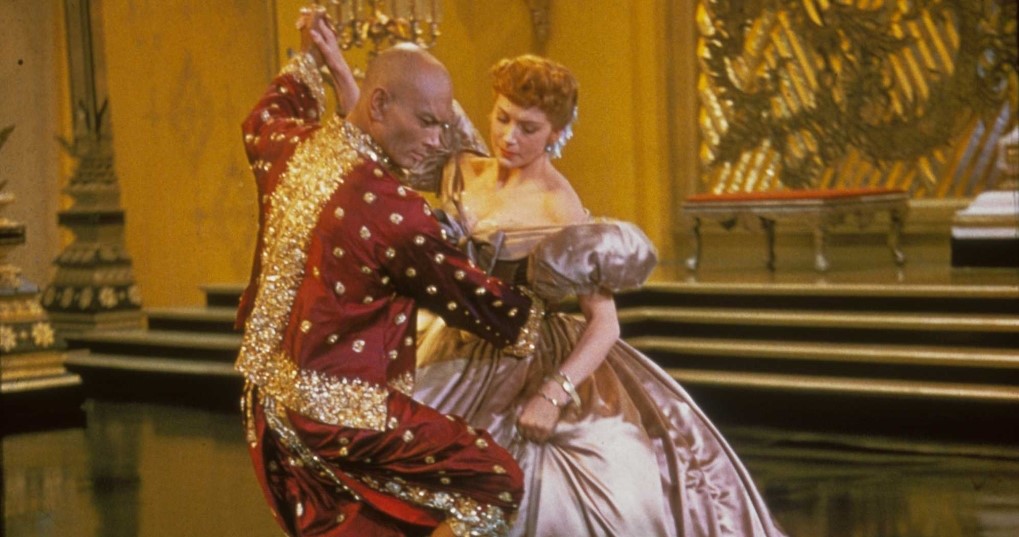
The King and I is one of the grandest, most artificial looking films you will see. No attempt has been made by anyone to even pretend we are not watching events play out on a series of massive, elaborately decorated soundstages. It all looks gorgeous of course, brightly coloured sets filling the frame. Even the scenes ‘outside’ – on Anna’s ship or the palace grounds – drip with ostentatious artificiality.

This impression is only increased by the mediocre direction of Walter Lang. A reliable studio B-movie hack, Lang sets the camera up in the equivalent of the front row of the stalls. While he can frame a scene efficiently (his centring in the final shot of the king’s hand is neatly done), Lang provides no originality, flair or real visual interest, all that supplied solely by the sets. He either misses beats or misunderstands jokes (the accidental flashing of the English ambassador is crying out for a beat of titillation from the old guy). It’s quintessential widescreen hackwork of the 50s, where the focus is on wowing the people with the money, bright colours and massive sets they couldn’t get from the little box in the corner. On that basis, a director who sets the camera up to get as much of that seen as possible all the time, fits the bill.

Besides, the film’s two most distinctive features didn’t really rely on Lang anyway. The King and I’s grand Thai-style ballet based on Uncle Tom’s Cabin was visualised and choreographed by Jerome Robbins (with Lang setting the camera stationary in mid-shot to capture it all). This ballet is, by the way, a masterclass of expressive visual originality (with its swirling use of masks, sheets and banners) that sticks out like a sore thumb in a film as visually flat as this one.

The other was of course Yul Brynner’s star-turn as the King. Brynner’s performance of the role on Broadway had transformed his career and years of honing it on stage meant he was the master of every beat of its eccentric energy. Brynner is magnificent, bombastic, proud, grand but also subtly playful, surprisingly timid and strangely shy. Brynner’s performance with its theatrical touches (the striking pose and the “et ceteras”) could be seen as overplaying, but actually fits perfectly with a man constantly, deliberately, putting on a show.

Brynner really shows the more thoughtful, quiet man under the surface, worried about his kingdom’s future. The earnest autodidact, who lies on the floor reading books. The eager-to-impress man who swots up on topics of conversation to impress the English ambassadors and hands a prompt sheet to Anna to work them into conversation. The careful flirt who only allows flashes of his romantic interest in Anna show. It’s a clever, grand but very human performance. Brynner had wanted to direct (and, rumour has it, partially did so) but settled for a Best Actor Oscar instead.

He also sparks extremely well off Deborah Kerr, buried under some truly might dresses (so heavy, that Kerr allegedly lost twelve pounds over the course of filming). Kerr turns a potentially stodgy part into a woman who is independent but not judgemental, forward-looking but diplomatic and very careful about allowing any expression for romantic feelings. Although her singing is dubbed by Marnie Nixon, it’s Kerr’s engaging sprightliness that carries a lot of the drama. She and Brynner’s chemistry also ensures the scenes between the two of them are by far the film’s highlights.

Most of the faults of The King and I can be traced to the musical itself. There isn’t much in the way of plot. The quiet will-they-won’t-they bond between Anna and the King is partly because that’s the nature of these things, but partly because the musical doesn’t really give them much material to work with. Virtually every character other than these two feels like either a sketch, a plot function or a stereotype, with the actors given almost nothing to work with. Impressive as the ballet is, it essentially takes up almost 15 minutes of screentime without advancing the plot or the themes of the film at all. Thematically the film explores very little, either on social progress in Siam or its place in the world. The film rushes towards a conclusion that feels like it comes out of the blue.

But then people aren’t watching The King and I for its social commentary or thematic depth. They are watching it for some hit songs, impressive production values and charismatic performers. You certainly get that and if the overall shape of the film feels rather loosely plotted and doesn’t go anywhere, that’s neither here or there. And of course, it’s a triumph for Brynner (who, late in life, dedicated his final years to performing the role, racking up over 4,600 performances), whose confidence and star-quality carries thing. Pretty, fun, not deep but pleasant – but then that’s Rodgers and Hammerstein for you and if that’s for you, this is the film for you.

Killers of the Flower Moon (2023)

Killers of the Flower Moon (2023)

Scorsese tries to tell an Indigenous story – but from the persecutor’s perspective

Director: Martin Scorsese

Cast: Leonardo DiCaprio (Ernest Burkhart), Robert De Niro (William King Hale), Lily Gladstone (Mollie Kyle), Jesse Plemons (Thomas Bruce White), Tantoo Cardinal (Lizzie Q), John Lithgow (Peter Leaward), Brendan Fraser (WS Hamilton), Cara Jade Myers (Anna Brown), JaNae Collins (Reta), Jillian Dion (Minnie), Jason Isbell (Bill Smith), Louis Cancelmi (Kelsie Morrison), William Belleau (Henry Roan)

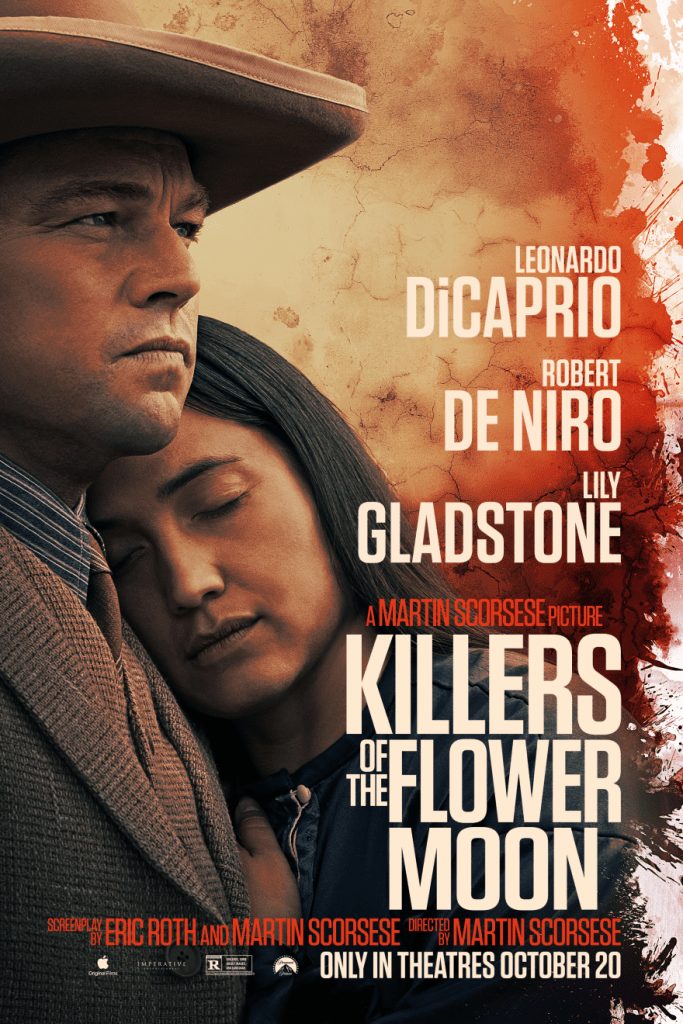
In the 19th century, the American government forcibly shifted Indigenous nations from their rich, fertile lands to unwanted backwater reservations. The Osage nation was moved from Missouri to Oklahoma, land no-one wanted… Until oil was discovered there in the early 20th century. Suddenly hugely rich, the Osage nation’s land once again became the focus of white Americans, as keen to dispossess these Indigenous people as they were in the last century. This ruthless grab of oil rights – and the brutal exploitation and murder of dozens of Osage people – is the theme of Scorsese’s epic Killers of the Flower Moon.

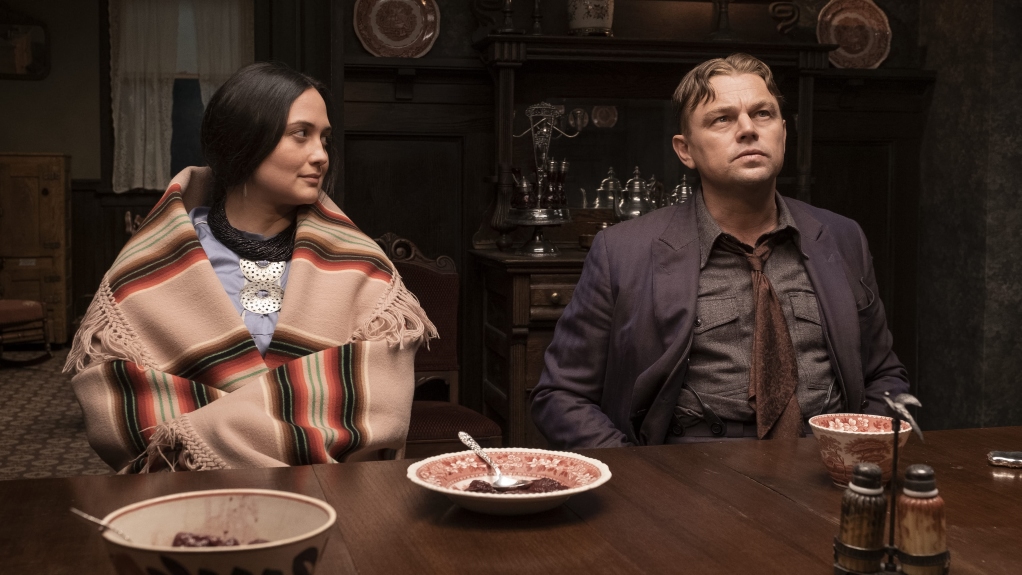
Ernest Buckhart (Leonardo DiCaprio) returns from war service (as a cook) to live with his uncle William King Hale (Robert De Niro) in Oklahoma. Hale lives on a ranch in the heart of reservation country and has built himself a powerful local presence by acting as benefactor of the Osage people. But Hale is, in fact, a ruthless sociopath who smiles cheerily at his neighbours, while plotting ceaselessly to steal their oil rights. Hale persuades Buckhart to marry Mollie Kyle (Lily Gladstone), whose family own headrights. While the gullible and easily-led Buckhart truly loves Mollie, he also willingly takes an active part for years in Hale’s schemes to murder the rest of Mollie’s family, so that their oil rights will collect with Mollie – and, in effect, with Hale.

Scorsese’s film is certainly a rich tapestry, but also a curiously mixed viewing experience. It feels at times like what it is – a film that dramatically changed its focus several times during its development, eventually reaching towards bringing the Indigenous experience to the screen, only to find that reach exceeding its grasp. The original book by David Grann focused on the FBI investigation into the crimes with DiCaprio originally set to play FBI investigator White (now played by Jesse Plemons). DiCaprio instead was drawn to the role of Buckhart, with the film repositioned to focus on the killers rather than the investigators or victims. During Scorsese’s extensive work with the Osage nation, the filmmaker became increasingly compelled by the exploitation of the Indigenous people.

Watching the film, it feels like a late swerve in focus Scorsese isn’t quite able to deliver on. However, some of the film’s most compelling content is its commentary on the Indigenous experience and the brutal exploitation and murders by a white community that sees the Osage people as second-class human beings. As a sort of twisted natural progression from encroaching on land a hundred years ago, people like Hale talk of marrying into Indigenous families, breeding out the blood and turning these communities into extensions of their own white families so they can control their wealth.

Over the course of the film, Scorsese carefully shows community gatherings becoming more and more dominated by white faces. Even tribal functions and ceremonies become awash with white faces, staring on with paternalistic, unfeeling smiles. From an early montage of Indigenous people enjoying their unexpected wealth (in a mix of historical and recreations photos and film stock), we progress ever more sharply into seeing whites take over. These fall into two firm categories: Masonic pinstripe types who stick together to cover-up crimes, and trailer trash and inept lesser-family members who are farmed out like cattle to soak up Osage wealth.

Scorsese’s film doesn’t shirk from depicting the casual racism of this community. A KKK march heads through the town. When Hale attends the cinema, he first sees newsreel footage of the Tulsa massacre then The Birth of the Nation. A montage of suspicious Osage deaths is marked by a Mollie voiceover stressing the lack of investigation. Osage oil owners are dispatched with increasing blatantness, as pretence of staged suicides and accidents degenerates into shootings, executions and finally bombs. Hale rants about the need to “take back control” and coldly states that they can escape any retribution because, fundamentally, no one cares or will remember.

But yet… this is still a film where we see a traumatic event happen to a group, but which focuses overwhelmingly on the perpetrators rather than the victims. I find myself agreeing with one reviewer that it feels at times like Get Out, told from the perspective of the white people. Scorsese’s film’s main beat feels like regret and guilt and perhaps what it needed was anger. For all its noble efforts, it’s hard to escape the fact that Mollie is the only Osage character in its epic runtime who is made to feel like a character, and she remains a person things happen to. The other Osage characters are, by and large, victims – Mollie’s sisters or William Belleau as Hale’s drunken, depressed neighbour – people who pop up in order to be dispatched.

I was reminded somewhat of The Searchers. In 1956, a film that criticised a John Wayne hero as an unpleasant racist was a big statement – but in a film where the Indigenous characters were still faceless nobodies, villains or comic relief. It’s similar here: Killers of the Flower Moon shows us the vileness of its white villains, but doesn’t really give us a full Indigenous perspective. And it feels, in 2023, we should do better. Even the impact and workings of reservations, land displacements and white-guardians isn’t explained in the film. Gladstone is marvellous – her eyes are full of suppressed pain, suspicion, fury and glimmers of the possibilities of forgiveness – but her character remains somewhat of a cipher, never quite receiving the exploration the killers of her family receive.

It feels like a realisation made during the filming, but without the time to deliver (after all the stars are playing the killers). Scorsese gives two beautiful Osage-themed bookends (and his carefulness around avoiding cultural appropriation is to be applauded), but the Osage themselves become passengers in their own story, allowed only a few brief moments to protest or express their anger. In a film that stretches over 200 leisurely minutes, more really should have been done.

Saying that, the film is blessed with two wonderful performances by Di Caprio and De Niro. DiCaprio, his mouth stuffed with rotten teeth, his body stumbling from scene-to-scene, expertly walks a tightrope between weakling and coward. Does he realise the moral morass he has climbed into? Or does he not care? How does he manage the mental gymnastics of plotting the deaths of his wife and her family and yet also convince himself that he is protecting her? It’s a fascinating performance. De Niro gives his greatest performance in 25 years as a polite, gentle man who warmly means every word of his friendliness but is also capable of acts of shocking murder and violence towards ‘his friends’ without even batting an eyelid. De Niro’s avuncular presence chills noticeably over the course of the film, brilliantly letting the egotistical dark heart leak out into the surface.

There is a lot to respect about Scorsese’s film, not least the way the late Robbie Robertson’s heartbeat-inspired score constantly creates an air of menace. It’s beautifully filmed – even if it is incredibly stately in its huge runtime – and it’s trying, very hard, to address an under-addressed issue in American culture. But it fumbles the ball because, for all its good intent, it still tells the story of an Indigenous group through the eyes of white people. Worse – their white persecutors. A braver, better (and shorter) film would have centred Gladstone’s Mollie rather than making her, at times, a passenger on a very long ride. Killers of the Flower Moon strains to make amends to Indigenous Americans – but instead it feels like a long guilt-trip for its white film-makers.

Cleopatra (1934)

Cleopatra (1934)

DeMille’s blockbuster is a fun, camp spectacle with plenty of his suggested sex and naughtiness

Director: Cecil B DeMille

Cast: Claudette Colbert (Cleopatra), Warren William (Julius Caesar), Henry Wilcoxon (Marc Anthony), Joseph Schildkraut (King Herod), Ian Keith (Octavian), Gertrude Michael (Calpurnia), C Aubrey Smith (Enobarbus), Irving Pichel (Apollodorus), Arthur Hohl (Brutus), Edwin Maxwell (Casca), Ian Maclaren (Cassius), Eleanor Phelps (Charmion), Leonard Mudie (Pothinos)

When a sand-and-sandals epic opens with a not-particularly-disguised naked woman cavorting erotically with incense, you know you are in Cecil B DeMille territory. Thirty years before the ill-fated Taylor-Burton epic, DeMille’s Cleopatra was the box-office hit of 1934. It was also a stompingly silly film, crammed with hammy performances and sexual imagery which it got-away-with in those pre-code days because it was an important historical subject taking place on humongous sets. But Cleopatra is also extremely good fun, a film so camply delighted in its naughtiness (and bowling along with such pantomimic energy) that it knocks spots off the turgid 1963 flop.

This Cleopatra follows pretty much the same structure (literally in half the time). Cleopatra (Claudette Colbert) is at war with her brother for the throne of Egypt. Smuggled into the presence of Julius Caesar (Warren William) wrapped in a carpet, she reveals the evil machinations of her rival Pothinus (Leonard Muddie) and seduces Caesar (possibly more with the prospect of controlling Egypt, since this Caesar is a power-mad cold-fish). When Caesar is dispatched by conspirators during the Ides of March, Cleopatra’s focuses on man’s-man Marc Anthony (Henry Wilcoxon) who is very open to her seduction. Before they know it though, the two are at war with envious technocrat Octavian (Ian Keith) who marches all of Rome to Cairo to crush the two. Bring on the asps!

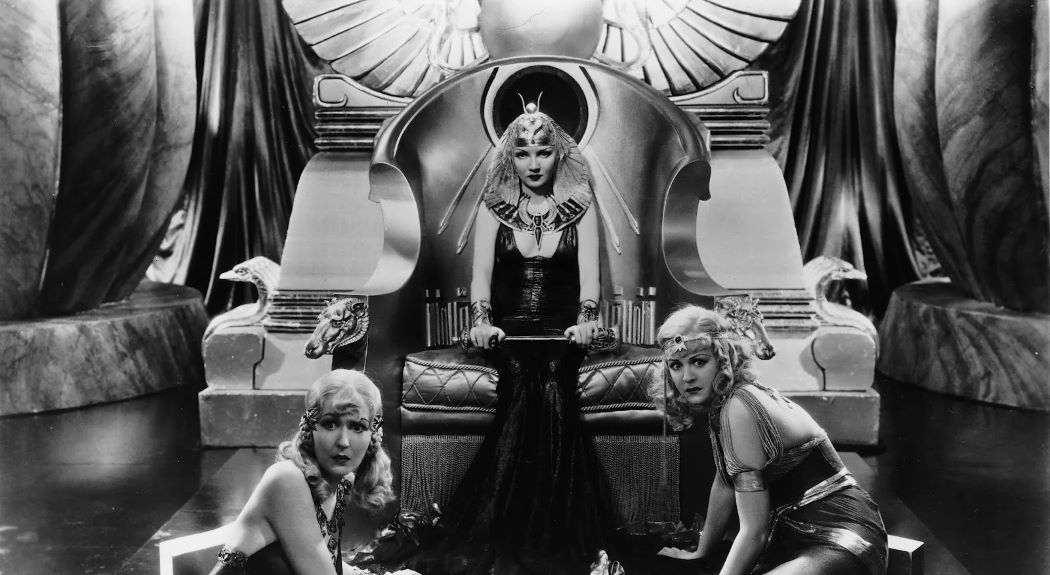
DeMille shoots all this with relentless energy and pace, though not quite enough that you don’t notice the dialogue clunking out of the actor’s mouths (“You and your Friends, Romans, Countrymen…” a bitter Octavius observes about Anthony’s funeral oration). Cleopatra, like many of the Great Showman’s finest films (of which this is unquestionably one) gives us all the sex and smut we could possibly want, disguised in its classic setting. Cleopatra absolutely drips in lust and is crammed with suggestive imagery from top to bottom.

From that cavorting incense-carrier, we cut to the rooms Cleopatra has been kidnapped from. These look like nothing less than the aftermath of a kinky orgy, including a hog-tied servant who looks like he’s passed out in an asphyxiation sex-game. Colbert models a series of deep-dive dresses that leave little to the imagination. Poor, randy Marc Anthony doesn’t stand a chance (we know he’s a hot-blooded man because he never goes anywhere without his two barking greyhounds). Cleopatra even dresses at time like some musicals starlet, trailing billowing fabric behind her as she descends stairs.

Meeting her on her pleasure barge (this ship is practically Tardis-like in its interior dimensions) he’s treated to the sort of show that wouldn’t be out of place in Amsterdam’s Red-Light district. Scantily-clad ladies cavort, dancers dressed in skin-tight leopard skin are marshalled by a whip-carrying ring-master, while they cavort and engage in (literal) cat-fights until broken up by a crack of the whip. All the time Cleopatra reclines on a silk-covered bed, Colbert’s eyes flashing unmistakable “come hither” glances. No wonder the randy sod quickly finds himself going all-in on Egypt.

Along with sex, the film mixes in plenty of action. Caesar’s assassin is rather imaginatively filmed through a POV shot (“You? You too Brutus?!” Warren William intones in despair), as daggers fly in. The forthcoming battles are teased in an early scene where Caesar, bored with an Egyptian delegation, fiddles with various models of siege engines. All of these come into play in the film’s later sequences, that sees a parade of fast-cut war scenes overlaid: siege engines fire, armies plough at each other over deserts, ships clash at sea, men drown in agony. Much like the epic scale of Cleopatra’s court and barge, the film doesn’t skip on the epic conflict.

Between these two tent poles, we basically get a soap dressed to-the-nines in sandals, short skirts and armour. Claudette Colbert in a banner year (this was one of three hits she had, and she won the Oscar for It Happened One Night) is sultry, playful and if she never feels for even-one-minute like a figure from antiquity, at least she has that in common with the rest of the cast. She gives Cleopatra a charismatic energy that makes her believable as a figure round whom all else revolves. Wilcoxon plays Anthony with a thigh-slapping, hail-fellow-well-met quality. Warren William underplays as Caesar – which can make him look dull in a film as overblown as this – but makes for an effectively cold and calculating man.

Egypt, in its voluptuous naughtiness makes all Rome look rather dull though. Our capital is introduced in a house-party where the conspirators pose and moan like hammy matinee performers, stroking their historically incorrect beards, while the ladies bitch like New York housewives gleefully spreading catty gossip. Octavian is re-imagined as whining middle-manager, a weasily Ian Keith constantly moaning about never getting enough attention and clearly far-too inhuman to ever be stirred by Cleopatra the way the lusty Anthony is. With the frame of the film being classic antiquity, we can even pretend this is somehow serious drama when really it’s just Dallas.

These actors march their way through a series of break-ups and get-togethers, punctuated by moments of silly drama. (Cleopatra, Hamlet-like, even stabs Porthinus through a curtain seconds before he can assassinate Caesar!) But it all kind of works because you suspect nothing is really taken that seriously. DeMille is making a big pageant here, a walloping epic of lusty suggestion, powered by larger-than-life performances. It’s meant to fill you with excitement and awe, to make you gasp in awe. It doesn’t really matter that we get a shit-stirring King Herod (a smirking Joseph Schildkraut) or an Enobarbus who puffs like a regimental sergeant-major (C Aubrey Smith, giant of beard). It’s all about the spectacle, the drama and showmanship. And no one really does that sort of stuff better than Cecil B DeMille.

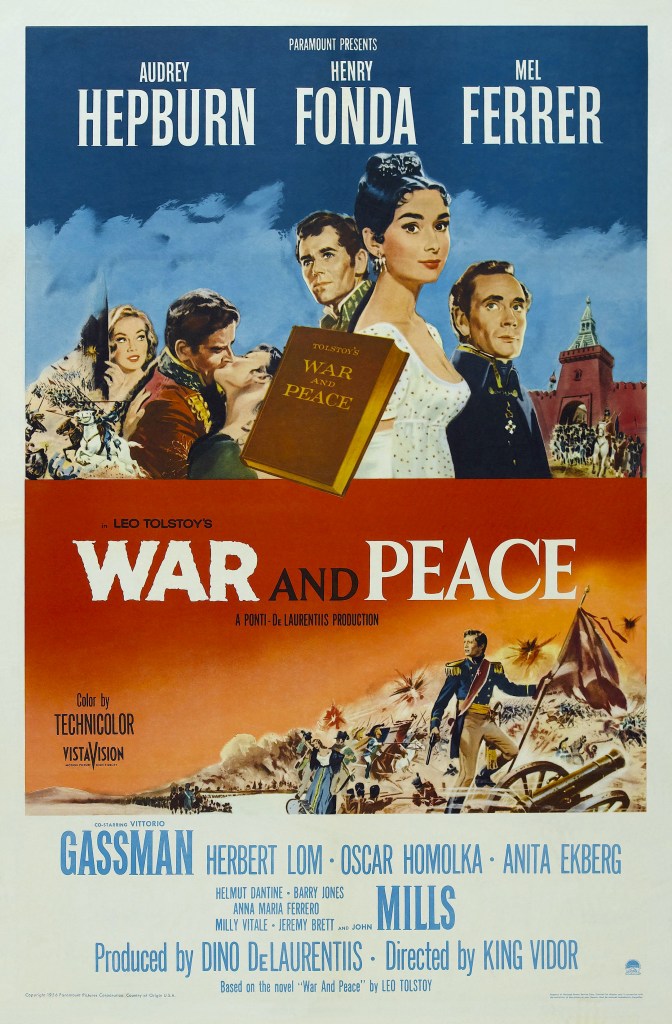
War and Peace (1956)

War and Peace (1956)

Tolstoy is boiled down in this epic and luscious but soapy adaptation of the greatest novel ever

Director: King Vidor

Cast: Audrey Hepburn (Natasha Rostova), Henry Fonda (Pierre Bezukhov), Mel Ferrer (Andrei Bolkonsky), Vittorio Gassman (Anatole Kuragin), Herbert Lom (Napoleon Bonaparte), Oskar Homolka (Field Marshal Mikhail Kutuzov), John Mills (Platanov), Anita Ekberg (Hélène Kuragina), Helmut Dantine (Fedor Dolokhov), Tulio Carminati (Vasily Kuragin), Barry Jones (Mikhail Rostov), Milly Vitale (Lisa Bolkonskaya), Lea Seidl (Natalya Rostova), Anna Maria Ferrero (Mary Bolkonskaya), Wilfrid Lawson (Nikolai Bolkonsky), May Britt (Sonya Rostova), Jeremy Brett (Nicholas Rostov)

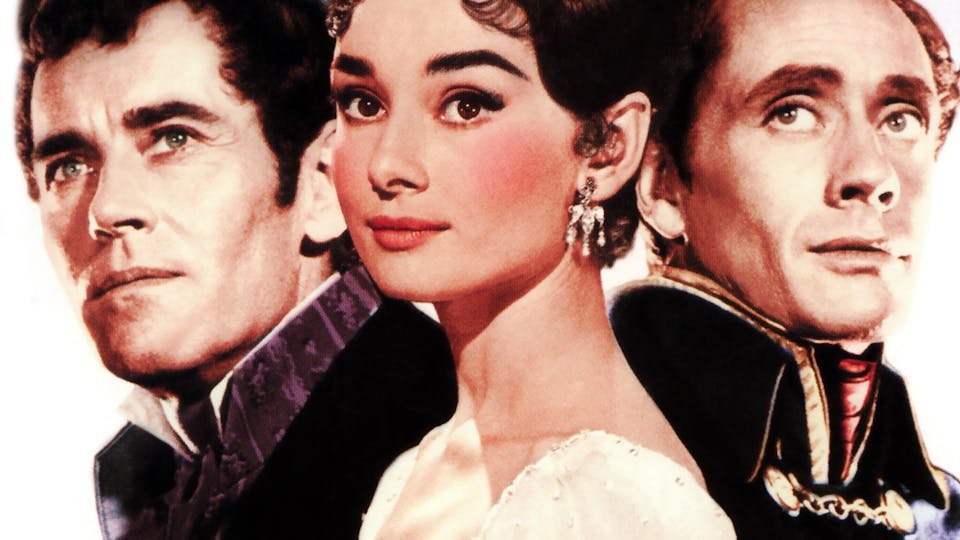
Let’s just say it right from the start: you can’t do Tolstoy’s War and Peace in three hours. All you can hope for is the little chunk of it you’ve bitten on is the most succulent part. King Vidor’s War and Peace zeroes in on the elements of the book Hollywood is most comfortably reproducing: a golden-tinged romance between Natasha and Pierre and the sweeping epic spectacle of Napoleon’s soldiers surging towards Moscow and limping home in the snow. While War and Peace, bravely, barely cuts a single major character or development, almost every other theme Tolstoy attempted gets shoved to the margins. This makes it both a SparkNotes version of the Greatest-Novel-Written, but also a very earnest attempt to do the impossible.

Tolstoy’s story stretched over seven years. The great Russian struggle against Napoleon is a backdrop to the lives of dilettante-turned-thinker Pierre Bezukhov (Henry Fonda), vivacious and impulsive Natasha Rostov (Audrey Hepburn) and stolid-but-thoughtful Andrei Bolkonsky (Mel Ferrer). Around them swirl other characters: Natasha’s warm-but-useless family, worthless womaniser Kuragin (Vittorio Gassman), his sister and Pierre’s faithless wife Hélène (Anita Ekberg), heartless roister Dolokhov (Helmut Dantine) and of course Napoleon (Herbert Lom) and his military antagonist, the pragmatic Kutuzov (Oscar Homoloka). Natasha falls in love with Andrei, betrays him then finds maturity caring for soldiers retreating from Napoleon, all while silently loved by Pierre.

This is compressed together into a film that certainly doesn’t feel like it is covering seven years despite its epic run-time. No one seems to age (just as well since everyone starts the film far too old) and the attempt to cover as much of the plot as possible means the film is moving forward so swiftly any sense of time is lost. It also means that the script frequently has to fill in the dots, communicating vital information that alters the lives of characters – major figures often die or are married off in short, easy-to-miss, sentences – and the ideas Tolstoy masterfully expounded about spirituality, destiny, fate, the quest for a life of meaning, are pretty much rinsed out in the plot focus.

War and Peace effectively reduces Tolstoy down into a sudsy romance against an epic backdrop. The romance is handled reasonably well, even if there is very little chemistry of any sort between any of the three protagnonists. Tolstoy’s rich leads, with the fascinating inner lives, are reduced to pen-portraits. There are odd moments where we have access to the inner thoughts and voices – sprinklings of voiceover dot around the picture – but they never feel real. Andrei has been robbed of the decency and warmth behind his thoughtfulness that attracts Natasha, while Pierre feels more like a second father or benevolent uncle than a soul mate.

This stripping down of Tolstoy’s complex characters to their bare principles fatally compromises all three lead performances. Hepburn comes off best, making a decent fist of Natasha Rostov. This is, after all, a character who embodies in her mix of passion, loyalty, fecklessness and self-sacrifice the very nature of Russia itself. No adaptation has ever managed to translate Tolstoy’s unplayable creation, but Hepburn has all the radiance and self-sacrificial guilt down pat. The film has to rush through her foiled elopement with Kuragin (Hepburn has more chemistry with Gassman than any of the others and their near elopement is artfully framed by Vidor with mirrors, reflections and a real illicit charge). Hepburn conveys the mesmeric impact this playboy has on Natasha and her selfish, tear-stained fury at the foiling of her disgraceful plans is laced with enough genuine guilt and pain by Hepburn to keep us caring. Hepburn skilfully translates this into a far wiser and more generous Natasha, placing others needs before her own.

By contrast, literally nobody reading the novel could picture Henry Fonda as Pierre (he’s the wrong age, shape, manner – there is nothing right about him at all), but Fonda does his best (as one reviewer at the time mentioned he’s one of the few actors who looks like he has read the book). He never convinces as the drunken playboy who gets into duels (he looks and sounds far too mature) and similarly doesn’t capture any of Pierre’s doubt and uncertainty (Fonda always looks like he knows exactly what he needs to do). It’s an intelligent reading for all that, but fundamentally miscast. Which is more than you can say about Mel Ferrer who turns Andrei into a stuff bore, ramrod straight and flatly monotone, an intellectual we never get interested in.

Honestly the film would have done better cutting more. Fonda is so unconvincing as the reckless young Pierre, they may as well have made him officially middle-aged to begin with. Similarly, Natasha’s brother Nicholas and his one-sided romance with cousin Sonya is given a mention so token its likely to confuse casual viewers. Andrei’s first marriage gets about five minutes and his sister Mary is reduced to a few dull scenes. Even John Mills’ thoughtful performance as Platanov strips out the characters worldview (and its profound impact on Pierre), turning it into one of simple, symbolic tragedy. It’s all the more noticeable when the film gets some stuff right, most notably Helmut Dantine’s bullying Dolokhov who war turns into someone with a sense of shame.

Faring much better are the historical characters. Like all War and Peace adaptations, this dials up the presence of Napoleon played with an excellent puffed-up grandeur by Herbert Lom, prowling with a swagger stick and collapsing into childish frustration, then silent tears as his plans for world domination collapse. Equally stand-out is Oscar Homoloka as scruffy realist Kutuzov.

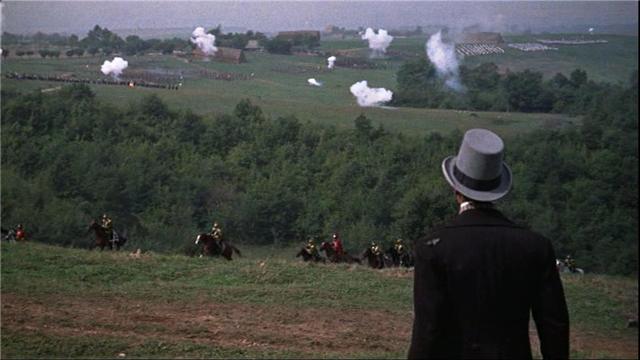
Vidor’s film may offer a simplified, romantic vision of the characters but he delivers on the scale. If you can bemoan the fact the peace leaves the characters neutered, the film completely nails the war.  War and Peace is a beautifully filmed by Jack Cardiff. From the sweeping vistas of the battlefield of Borodino, to the Dante-tinged flames at Moscow that cast orange light through the arches of a monastery where the Rostov’s take shelter, through the white-and-blue chill of the snow-covered retreat from Moscow, the film is an explosion of gorgeous colours. It’s also got the scale that old Hollywood loved. Borodino is restaged seemingly at 1:1 scale with a literal army of extras, soldiers and cavalry charging in their hundreds in long-shot and cannon fire peppering the land as far as the eye can see. Ballrooms are overflowing with extravagantly costumed extras and seemingly never-ending lines of Frenchmen march through the snow in the films closing moments.

It’s what this War and Peace is: a coffee-table accompaniment to the novel. You can look at the images it brings to life and the sweeping camera work Vidor uses to create nineteenth century Russia. But you’ll not understand anything that makes the novel great. In fact, to the uninitiated, you are likely to come away thinking the film must be a sort of high-brow Mills-and-Boon page-turner, a Gone with the Snow. What this tells us, more than anything, is that fifteen years on from the definitive Hollywood epic, Hollywood was still trying to remake it – and bringing Tolstoy to the screen was very much second to that.

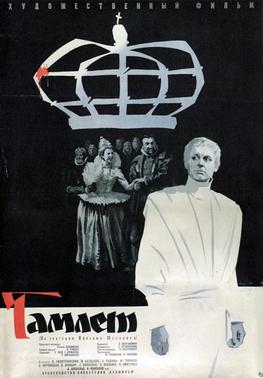
Hamlet (1964)

Hamlet (1964)

Kozintsev’s masterful version of Hamlet is one of the greatest Shakespeare films ever made

Director: Grigori Kozintsev

Cast: Innokenty Smoktunovsky (Hamlet), Mikhail Nazvanov (Claudius), Elza Radziņa (Gertrude), Yuri Tolubeyev (Polonius), Stepan Oleksenko (Laertes), Anastasiya Vertinskaya (Ophelia), Vladimir Erenberg (Horatio), Igor Dmitriev (Rosencrantz), Vadim Medvedev (Guildenstern), Aadu Krevald (Fortinbras)

One of the main reasons Shakespeare remains timeless is that he can be shifted and adjusted through any society or perception and new riches will be discovered in his work. That’s why the, perhaps, greatest film version of Hamlet doesn’t even have an actual word of Shakespeare in it: Grigori Kozintsev’s epic, paranoia-tinged Hamlet with the dialogue translated into robust, poetic Russian by Boris Pasternak, takes huge liberties with the text but creates a richer, commanding and, above all, cinematic version of Elsinore than almost any other version yet made.

Kozintsev was a leading Russian theatre director who had written extensively on Shakespeare. He bought to his film both a brilliantly cinematic eye but also a comprehensive understanding of the play. Kozintsev’s Hamlet is filtered through Stalinist Russia. Where other Hamlets of the era focused on Freudian themes and the poet Prince, his Hamlet would be starkly, strikingly political.

Here Elisinore is a place devoid of privacy, where every word is overheard and every action watched. It’s controlled by Claudius as an eminence grise turned king, a smooth and assured political player who understands the machinations of power and the importance of appearance. Koznitsev’s rearranges Claudius opening speech into three discrete chunks. The first sees a herald reading out Claudius’ announcement of his wedding and the new regime to a crowded courtyard of peasants. We then cut to crowded room of Ambassadors of various European powers roaming, where we hear snippets of conversation each delivering a separate line from Claudius’ oration. Finally, the conclusion of the speech, and his plans for Fortinbras, is delivered by the king himself to a room of nodding courtiers. That’s imaginative cinematic translation of Shakespeare right there.

This is a Hamlet that lives and breathes the fear of living in an oppressive regime, under the thumb of a smiling autocrat. Mikhail Nazvanov’s Claudius charms but has a resolute, ruthless coldness behind his eyes. The court is drenched in paintings of the great leader – including one grand armoured horseback painting that looks like a Claudius head has been swiftly painted over his brother’s. Claudius controls all privacy in the castle: Koznitsev fills the film with shots of closing doors, lowered portcullises and a constant stream of background observers for every conversation. Only Claudius can gain solitude – tellingly he is the only character who speaks his soliloquy out loud, because he is the only character who knows for sure his words are for his ears alone.

This Elsinore is a castle where knowing too much is dangerous and the threat of being wrapped up in the wrong side of a purge is a very real one. Laertes’ aborted rebellion may see him forgiven – but the citizens who follow him to charge into the castle are escorted way, hands bound, never to be seen again. Claudius’ soldiers are increasingly visible presence in every doorway and corridor. When Hamlet unsettles the King with the Player’s performance, the courtiers practically fly away from the would-be dissident, as if worried that even the faintest contact could infect them with the same danger of exile and death that Hamlet is flirting with.

In this authoritarian production, our Hamlet is not the poet prince that so many Western productions at the time presented him as. Instead, portrayed with a chilling intensity by Innokenty Smoktunovsky, Hamlet is a dangerous man, filled to the brim with suspicion and resentment, who trusts nothing and confides to no-one. Rarely alone in this crowded Elsinore, he strikes a lonely figure, who finds isolation only on the cliffs staring out to the sea. His soliloquies are all internal voiceover monologues – less due to their internalised nature, and more that you feel he cannot risk speaking his feelings out loud (an impression created by his voiceover of his “Too, too solid flesh” speech delivered while Smoktunovsky moves through a crowd of courtiers).

Hamlet’s destructive bitterness is sparked by the Ghost. Cutting the first scene, Koznitsev introduces Hamlet and us to the Ghost at the same time. Unlike the smooth, ornately collared Claudius, the Ghost is an armour-clad rigid behemoth, his face almost completely obscured by his helmet. (There is a brief shot of his eyes which I would have removed – better that it had been kept completely distant from us). The camerawork stresses both its deliberation and size while Dmitri Shostakovich masterful score helps to build its sense of power and might (so effectively, that only a reprise of its theme is enough to suggest its reappearance to Hamlet later). It is a terrifying, other-wordly figure.

Smoktunovsky’s Hamlet barely ever raises his voice but has the intense determination of a man of natural action. Koznitsev has removed virtually every line that dabbles in doubt, uncertainty or hints even vaguely at delay. Smoktunovsky is merely biding his time for his chance at taking a hit at Claudius – a chance that will rarely come, in a court crowded with military protection for the King. He never forgives and even the slightest delay rouses him to anger rather than self-analysis. Koznitsev has trimmed out most of his lines with Horatio, who becomes an almost silent, scholarly observer and makes Smoktunovsky even more of a distant figure, liable to break out into dangerous violence at any moment, with no regard for the consequences.

The most visible of those consequences is Ophelia, who Smoktunovsky’s Hamlet uses coldly as a tool for probing the weaknesses of his enemies. Portrayed with a touching vulnerability by Anastasiya Vertinskaya, Ophelia is likewise never alone, unable to escape a crowd of duennas, who train her in dancing like a clockwork toy. Polonius (here an arch and scruple free political fixer, played by Yuri Tolubeyev) shows almost no interest in her at all, bluntly dismissing her and her distress when his need for her is done. After his death, she is literally locked into a metallic corset by her maids and covered by a gauzy funeral dress – even her clothes are cages. Her madness scene inevitably takes place in a room full of soldiers: even at the end she cannot escape the eyes of strangers.

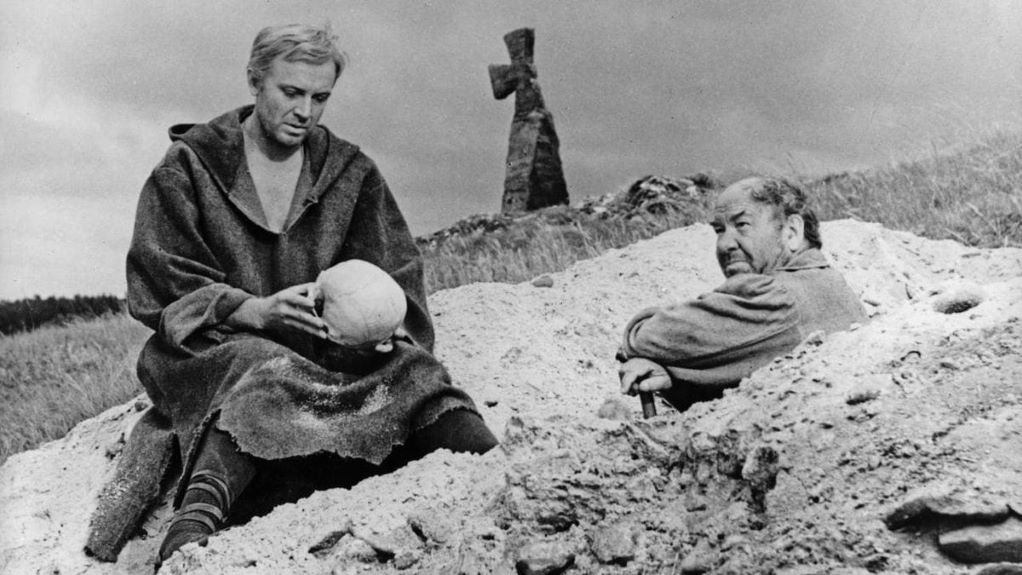
In the cold, Bergmanesque quality of Koznitsev’s film (the players, in particular, look like they have rolled in from The Virgin Spring), the stoney castle on the cliff (despite its renaissance, wood-lined interiors) is an imposing, terrible place. After the death of Polonius, Hamlet is dragged into (essentially) a show-trial (including a stenographer) before being dispatched to England. Rosencranzt and Guildernstern are empty-headed, ambitious minor officials who Hamlet displays not a moment’s hesitation in dispatching to their deaths. The only moment of reflection Smoktunovsky affords Hamlet is over Yorick’s skull – and even then, the cut suggests his focus is on the lost opportunities of great men. Certainly, Smoktunovsky’s grief over Ophelia is as much motivated by Laertes’ ostentatious show of public grief as sadness (and certainly not guilt, which he lacks entirely).

Koznitsev’s supremely visual film, beautifully designed and shot, reorders and reworks the text to maximum effect to continuously stress Hamlet’s highly political nature. It does mean characters like Gertrude fade into the background, but it repositions Elsinore highly effectively as a dangerous, ruthless place where life can be cheap. Like Stalinist Russia, the wrong word can condemn you and even our hero is as much a potential dictator as our villain. Hamlet is the most imaginative, revelatory and intelligently distinctive reading of the play on film, a production that interprets the play rather than just presenting it. It is a masterclass in adapting the Bard for the screen.

Watch the film here!

1900 (1976)

1900 (1976)

Bertolucci’s bloated, self-indulgent and simplistic film is a complete mess

Director: Bernardo Bertolucci

Cast: Robert De Niro (Alfredo Berlinghieri), Gerard Depardieu (Olmo Dalco), Dominique Sanda (Ada Fiastri Paulhan), Donald Sutherland (Attila Mellanchini), Laura Betti (Regina), Burt Lancaster (Alfredo Berlinghieri the Elder), Stefania Sandrelli (Anita Foschi), Werner Bruhns (Ottavio Berlinghieri), Stefania Casini (Neve), Sterling Hayden (Leo Dalco), Francesca Bertini (Sister Desolato), Anna Henkel (Anita the Younger), Ellen Schwiers (Amelia), Alida Valli (Signora Pappi)

After The Conformist and Last Tango in Paradise, Bertolucci could do anything he wanted. Unfortunately, he did. Perhaps the saddest thing about 1900 is that you could watch The Conformist twice with a decent break in-between during the time it would take you to watch it– and get a much richer handle on everything 1900 tries to do. Bertolucci went through a struggle to get his 315-minute cut released: perhaps the best thing that could have happened would have been if he had lost. Not only would the film be shorter, but it would be remembered as a lost masterpiece ruined by producers, rather than the interminable, self-indulgent mess we ended up with.

1900 – or Twentieth Century to literally translate its title Novecento – follows the lives of two very different men. Born minutes apart in 1901, Alfredo (Robert De Niro) is the grandson of the lord of the manor (Burt Lancaster), while Olmo (Gerard Depardieu) is the grandson of Leo (Sterling Hayden), scion of a sprawling dynasty of peasants. They grow up as friends, Olmo becomes a socialist and Alfredo an indolent landlord and absent-minded collaborator with the fascists, embodied by his psychopathic land agent Attila (Donald Sutherland). Their small community becomes a symbol of the wider battle between left and right in Italy.

In many ways 1900 is an epic only because it is extremely long and beautifully shot in the Bologna countryside by Vittorio Storaro. In almost every sense it fails. It offers nominal scale in its timeline, but its attempt to become a sweeping metaphor for Italy in the twentieth century falls flat and it focuses on a small community of simple characters, many of whom are ciphers rather than people. All of Bertolocci’s communist sympathies come rushing to the fore in a film striking for its political simplicity. It never convinces in its attempt to capture in microcosm the forces that divided Italy between the two world wars, nor invests any of its characters with an epic sense of universality.

Instead Bertolucci presents a world of obvious questions and easy answers. Every worker is an honest, noble salt-of-the-earth type, working together in perfect harmony to fight for rights. Every single upper-class character is an arrogant, selfish layabout, caring only about their back-pockets and the easy life. Bertolucci suggests fascism only arose in Italy as a means for the rich to control the poor, and never allows for one moment the possibility that any working-class person was ever tempted to take their side. It never rings true. (Bertolucci skips a huge chunk of the fascist 30s and 40s, possibly because this fantasy would be impossible to sustain if he actually focused on the history of that era.)

Bertolucci uses his two protagonists to make painfully on-the-nose comparisons between working class and rich with De Niro’s weak-willed Alfredo always found wanting compared to Depardieu’s Olmo. Even as children, Olmo is braver, stronger and smarter. Olmo has the guts to lie under the moving trains (Alfredo runs), Olmo stands up for what he believes in (Alfredo looks away), Olmo puts others first Alfredo whines about his own needs. Hell, Olmo even has a bigger cock than Alfredo (something they discover comparing penises as children and re-enforced when as young men they share an epileptic prostitute and she ‘tests’ them both).

The upper classes hold all the power but can do nothing without the working class. During the 1910s, a strike by the workers on the Berlinghieri leaves the clueless rich unable to even milk their moaning cows (they buy milk instead). Sterling Hayden’s peasant patriarch is a manly inspiration to all, while Lancaster’s increasingly shambling noble is literally and metaphorically impotent (Lancaster’s role is like a crude commentary on his subtle work in The Leopard). At one point he even pads around barefoot in horseshit to hammer home his corruption. (Incidentally this is the only film where you’ll ever see a horse’s anus being massaged on camera to produce fresh shit to be thrown at a fascist.)

For the rich, fascism is the answer. Continuing to shoot fish in a barrel, Bertolucci scores more easy hits by presenting our prominent fascist as an out-and-out psychopath. Played with a scary relish by Sutherland – in the film’s most compelling performance – no act of degradation is too far for Attila. Along with his demonic partner-in-crime Regina (a terrifyingly loathsome Laura Betti), he routinely carries out acts of violence, horrific murder and child-abuse, even literally headbutting a cat to death while ranting about the evils of socialism.

The poor meanwhile are all good socialists. Olmo, decently played by Depardieu, and his wife Anita (an affecting Stefania Sandrelli) rally the workers to stand against charging cavalry and protect their rights. Bertolucci even has Depardieu flat-out break the fourth wall for a closing speech, spouting simplistic platitudes direct to camera about the inherent wickedness of the landowner. Depardieu at least seems more comfortable than De Niro among this Euro-pudding (every actor comes from a different country and the soundtrack is a mismatch of accents and dubbing, not least Depardieu himself). Rarely has De Niro looked more uncomfortable than as the empty Alfredo, a role he fails to find any interest in, like the rest of the actors never making him feel like more than a device.

Bertolucci, stretching the run-time out, also embraces numerous tiresome excesses. Rarely does more than 20 minutes go by without a sex scene or a sight of someone’s breasts or sexual organs. From children comparing penises, to Depardieu performing oral sex on Sandrelli (just outside a socialist meeting), to De Niro and Depardieu getting hand-jobs from a prostitute, to Sanda dancing naked and high on cocaine or the revolting exploits of Attila and Regina, nothing is left to the imagination. As each goes on and on Bertolucci ends up feeling more like a naughty boy than an artist, so praised for his sexual licence in Last Tango that he feels more is always more. The excess doesn’t stop with sex either: at one point a worker silently cuts his ear off in front of a landowner to make a point about his stoic nobility.

1900 eventually feels like you’ve stumbled into a student debating club, where a privileged student drones on at great length about the evils of the rich, while quaffing another glass of champagne. It has moments of cinematic skill – some of its time jump transitions, in particular a train passing through a tunnel in one time and emerging at another, are masterful – but it’s all crushed under its self-indulgence. From its length to its sexual and violence excess, to its crude and simplistic politics delivered like a tedious lecture, everything is crushed by its never-ending self-importance.

Metropolis (1927)

Metropolis (1927)

Lang’s sometimes flawed science fiction epic is one of the most influential films ever made

Director: Fritz Lang

Cast: Brigitte Helm (Maria/The Machine), Alfred Abel (Joh Frederson), Gustav Frölich (Freder), Rudolf Klein-Rogge (Rotwang), Fritz Rasp (The Thin Man), Theodor Loos (Josaphat), Heinrich George (Grot), Erwin Biswanger (11811/Geogry)

It’s 1927 and for too long Hollywood had held sway over the movies. But there were plans in Germany to change that. The booming Weimar film community, arguably the artistic hub of World Cinema, felt they had a shot at claiming the sort of global success Hollywood had made its own. No expense would be spared to bring Fritz Lang’s science-fiction spectacular, Metropolis to the screen. It was met with such a muted reaction, that the original epic cut was sliced to ribbons, parts of the film lost for all time, and for decades it lived only in a mutilated form. But it was visionary and extraordinary enough to inspire virtually every single science fiction film that followed it.

Metropolis is a sprawling future city state, run by Joh Frederson (Alfred Abel). In it the rich live a gilded life in mighty skyscrapers, with private gardens, luxurious apartments and raucous parties. Beneath them – literally so – are the workers, living a Morlock-like life of drudgery in the factories and power stations that keep the lights burning. But all that could change: below ground Maria (Brigitte Helm) preaches hope for change, above ground Frederson’s son Freder (Gustav Frölich) falls in love with Maria and rejects his father’s way for the life of a prole. Frederson has a scheme of his own: to use a robot (Helm again) built by old friend (and one time rival for the affection of his late wife) the one-handed scientist Rotwang (Rudolf Klein-Rogge) to replace Maria and sow discord among a potential worker’s rebellion. But does Rotwang and his creation have a game of their own?

Lang had a brief to create a film that would be a box-office hit in America. No stone was left unturned in creating his epic. Metropolis took a staggering 17 months to film, running almost three times over its initial budget. It’s extended shooting schedule was a godsend for many of its extras, struggling to make ends meet while the Weimar Republic thrashed through the after-effects of hyperinflation. It’s a magnificent monument to Lang’s superb visual styling, marrying shadow filled expressionism with sweeping epic magnificence.

Metropolis’ strengths all lie in its stunning, inventive and breath-taking design work. That has been so inspiring, it has permeated vast swathes of our culture. Filmic visions of imposing, neon-lit, skyscraper packed modern Babels (Frederer’s headquarters is an art-deco reimagining of Brueghel’s Tower of Babel) all find their roots here: from Burton’s Batman to Scott’s Blade Runner. Any robot in the movies can chase its lineage back to Rotwang’s man-machine, as any mad scientist ancestor is  Rotwang (from Dr Strangelove to Back to the Future’s Doc Brown). It’s the film that invented steam-punk, with its piston-filled machines, staffed by boiler-suited workers (it’s inspiration for a zillion music videos is not surprising). Everywhere you look in Metropolis it might feel like you are seeing something familiar, when in fact you are witnessing its original generation.

Metropolis is a cat’s cradle of differing moods and designs, woven masterfully into a whole. Frederson controls the city from a penthouse suite, while his immediate staff and family live in swish, very 1920s apartments. This contrasts sharply with the industrial-punk of the factories, cathedrals of technological movement, full of gears, levers and men performing tasks with a robotic, convey-belt repetition under a series of clocks. There are real cathedrals, legacies of an old world, where God has been left behind by the new Gods of work and efficiency. Under the ground, the workers live in personality free tenement blocks and chiselled out caves, which echo churches. Rotwang works in a laboratory part Frankenstein’s layer, part bizarre lecture theatre, all seemingly housed in a ramshackle house that wouldn’t look out of place in a Hans Christian Anderson fairy tale.

A fairy tale is perhaps what Metropolis is, underneath all the astonishing technical sheen and directorial mastery. We follow a hero who exiles himself to live among the poor, eventually becoming their champion, with a damsel-in-distress he must rescue from a crazed wizard. The wizard even produces a magic imposter, who threatens to bring disaster. Metropolis’ plot often proceeds with the illogical progression of a fairy tale, with characters frequently making veering changes in allegiance or unveiling dastardly schemes that appear from nowhere or make little sense.

It’s similar in Metropolis biggest weakness: it’s simplistic plot, wrapped up in a casually naïve politically theory that attempts to find a balance between left and right, but essentially boils down to “why can’t we all just get along”. It’s loud proclamation that “The Mediator Between the Head and the Hands Must Be the Heart” is so vague that it allowed the film to be embraced by the left as a proto-socialist film supporting worker’s rights and the right as a film that revealed the workers as a mob and the fate of the world best left in the hands of elites who know what they are doing.

It’s part of the simplistic view the film largely takes of character and story, which frequently feels like an after-thought behind the film’s sumptuous production values and Lang’s expressive camera work. It’s also not helped by some of the acting which, particularly in the case of Gustav Frölich’s hand-claspingly camp performance, mines the depths of silent-movie ostentatiousness. Saying that Brigitte Helm is chillingly, wickedly artificial and physically disjointed as the fake Maria (a far cry from her more simpering ‘good’ self) and Abel underplays effectively as Frederson. Klein-Rogge’s insane glare and conflicting lusts also make a strong impression.

But none so strong as Lang’s mastery of visual symbolism. Freder’s terrified vision of the ‘heart machine’ that sits at the centre of the city’s power, transformed into a terrible Moloch with workers literally fed into its gaping, firey maw. Those same workers from the film’s opening with Lang’s brilliant visual conceit of shuffling, shoulder-drooping figures lurching into a gigantic elevator that lowers them into the ground. Rotwang’s birth of the fake Maria is a masterclass in light and cross-cutting, as is the simmering eroticism of the fake Maria’s dance at an orgiastic night-club, the screen filling with the slathering faces of the man she has enchanted.

It mixes with the Gothic power Lang brings the film in its closing sequence, seemingly inspired by mystery plays with their deep-rooted sins bubbling to the surface to condemn those alive today. There are echoes back to this in Freder’s dreams of Metropolis as a modern Babylon (hammered home, once, by the lost scene of a monk preaching in the cathedral) and in Maria’s Joan of Arc like status among the working classes – a mantle taken to its logical conclusion by her metallic replacement who leads a doomed insurrection. Again, all these concepts and influences are effortlessly held together into one magnificent whole by Lang’s fluidic, beautifully paced direction.

Metropolis lives today as a monument to creative science fiction film-making – it is the most ambitious and most influential science-fiction film ever, except perhaps 2001 and (in a very different way) Star Wars. It may be politically simple and its story may veer in unplanned directions and strange cul-de-sacs, but as a piece of visionary cinema it is nearly unparalleled. Even its existence today as a reconstructed, corrupted version of itself (after hours of footage were considered lost for decades) doesn’t not dim or diminish its mastery.

Indiana Jones and the Dial of Destiny (2023)

Indiana Jones and the Dial of Destiny (2023)

Is there a place for Indy in the 2020s? The nostalgia-tinged would-be epic doesn’t provide an easy answer

Director: James Mangold

Cast: Harrison Ford (Indiana Jones), Phoebe Waller-Bridge (Helena Shaw), Mads Mikkelsen (Jurgen Voller), Antonio Banderas (Renaldo), John Rhys-Davies (Sallah), Toby Jones (Basil Shaw), Boyd Holbrook (Klaber), Ethann Isidore (Teddy Kumar), Karen Allen (Marion Ravenwood), Shaunette Renée Wilson (Mason), Thomas Kretschmann (Oberst Weber), Olivier Richters (Hauke)

Okay let’s get the elephant out of the room: It’s better than The Kingdom of the Crystal Skull. Yes folks, we have a new fourth-best Indiana Jones film. Is that something to celebrate? Indiana Jones and the Dial of Destiny makes some of the same errors as the previous valedictory effort, but at least it learned a few things and it’s been made by people who clearly love Indy. But they loved it too much, creating an often overblown, hellishly overlong, everything-but-the-kitchen-sink film which never just jump when it can flip, spring, bounce then explode at the end of it.

It opens with a (younger) Indy (Harrison Ford) battling Nazis in the dying days of the Second World War, trying to save a train full of precious artefacts. After defeating them, we flash forward to 1969 with Indy now a retiring archaeology professor to disinterested students in New York’s Public University, out of a place in an era where man has stepped on the moon. Grouchy, separated and fed-up, Indy’s life gets disrupted one more time when his god-daughter Helena Shaw (Phoebe Waller-Bridge) turns up on the hunt for Archimedes’ Dial. Indy knows about this dial as it was also the obsession of Nazi physicist Jurgen Voller (Mads Mikkelsen), last seen on that train in 1945 and now the brains behind the NASA moon landings. Indy and the unscrupulous Helena end up in a duel with Voller to find the dial – the prize being what Voller believes is a chance to change history.

Back in the day, Raiders of the Lost Ark was largely made so Spielberg and Lucas could show they could make an action-packed, crowd-pleaser quick and cheap. Today The Dial of Destiny is one of the most expensive films ever made (lagging only behind assorted Avengers films, the recent Star Wars trilogy and various other franchise entries). So much mony to make something less than half as good.

What this has allowed is Mangold and co to act like kids given the keys to their parents’ car. The Dial of Destiny is an explosion of Indy ideas, all rammed into the film willy-nilly. It’s made by people who feel this is their only chance to make an Indy film and don’t want to miss the opportunity to include every idea they’ve ever had.

We end up with a film that feels both far too long and yet strangely rushed. The Dial of Destiny would be immeasurably improved if about twenty minutes (at least) had been cut from its run-time and its poorly sketched thematic ideas condensed down. Its narrative structure has one too many quests, with Indy and Helena forever searching for a thing that leads to a thing that leads to yet another thing. An entire sequence, involving a pointless cameo from Banderas as a one-legged diver, would have been better slashed to ribbons or cut altogether. Every single one of the mega-budget chase sequences go on at least 2-3 minutes too long, straining the interest.

At the same time, the film manages to feel rushed. Ideas are presented and then taken nowhere at all. We see Indy tipping most of a bottle of whisky into his coffee in the morning – this suggested alcoholism never rears its head again. Voller is working in partnership (it seems) with the CIA, but their motives for this are never explained and Voller calmly ditches them part way through the film. Indy is framed for murder, but this plot thread is judicially abandoned by the time we get to the end. John Rhys-Davies literally pops up to drive Indy to an airport and make a trailer-friendly speech.

Most strikingly, all the films blaring action and endless bangijg stuff buries the most interesting plot thread of a tired, depressed Indy who no longer knows his place is in the world. The film solves Shia LaBeouf’s toxic unpopularity by having Mutt die in Vietnam, giving Indy a burden of guilt and grief. This is an Indy who has fallen from his Princeton heights, as ancient to his students as the artefacts he lectures about. It’s a thread though that the film only intermittently remembers, so crowded out is it by overlong chases, so that when the film’s conclusion returns to it as a major motivator for Indy it feels forced.

In any case, the film’s action set-pieces peak with the 1945 opening section with a digitally de-aged Ford and Mikkelsen facing off on a speeding train. I think the de-aging effect is very well done (though Indy speaks with Ford’s current 80-year-old voice), and this sequence has a sort of nostalgic charm to it and at least it feels of a piece with the originals. Not that its perfect: it’s overlong and overblown of course – a castle explodes, Indy runs over the top of a speeding train – and looks like something created with blue-screens and digital effects rather than in reality. (It’s also clear a digitally de-aged Ford head has been placed on a stunt double at key points.)

But it’s a bright-spot. There are others: Harrison Ford, again, is perfect for the role – crusty, resigned but still with the glamour of excitement in his eyes. He and the film don’t back away from his advanced age – Indy looks more vulnerable than ever – and Ford sells the moments he’s allowed in the film’s breakneck speed to reveal Indy’s emotional turmoil. He also has a great chemistry with Phoebe Waller-Bridge, who effectively channels Han Solo as an immoral adventurer who learns about decency. Mikkelsen’s mastery makes him an impressive villain.

I’ve been really hard on this film. It is fun I promise. I laughed and at times I was thrilled. But it is too much. Even the settings of the chases offer a sensory and time overload: a chase around a ticker-tape parade in New York onto a subway (with Indy on a horse) has an overload of visual details. A chase through the streets of Marrakesh goes on forever – and is over-built with our heroes chasing Voller while also being chased by Helena’s gangster-former-fiancee. film culminates in a final sequence which is just about not as silly as aliens – but by any other score is incredibly silly.

Essentially The Dial of Destiny is undermined by fan love. Mangold is a good director but doesn’t know where to stop. The film leans into nostalgia too hard but, above all, it offers far too much bang for your buck. The film is frequently at its most effective in its quieter, character-driven moments. Like Crystal Skull, it mistakes bigger for better. It’s still a more entertaining and a better film than Crystal Skull – but, somehow, its excessive overindulgence makes you feel strangely disappointed.

Babel (2006)

Babel (2006)

Iñárritu’s grandiose film aims for a big statement about humanity, but settles for something simpler

Director: Alejandro González Iñárritu

Cast: Brad Pitt (Richard Jones), Cate Blanchett (Susan Jones), Gael Garcia Bernal (Santiago), Rinko Kikuchi (Chieko Wataya), Adriana Barraza (Amelia Hernandez), Kōji Yakusho (Yasujio Wataya), Boubker Ait El Caid (Yussef), Said Tarchani (Ahmed), Mustapha Rachidi (Abdullah), Elle Fanning (Debbie Jones), Nathan Gamble (Mike Jones), Clifton Collins Jnr (Border police officer), Peter Wight (Tom), Harriet Walter (Lily), Michael Maloney (James), Satoshi Nikaido (Detective Kenji Mamiya)

“Only connect” was the epigraph of Forster’s Howards End. It’s an idea Alejandro González Iñárritu attempts to bring to the screen in Babel. Across three countries, he shows how small events in one plotline have drastic impacts in others. It makes for an undeniably beautiful film-making experience – but also a film straining for import, that hectors and belabours obvious points and relies far more on random events occurring due to foolishness and stupidity than the vagaries of fate or humanity.

In Morocco, Abdullah (Mustapha Rachidi) buys a rifle from a neighbour to protect his goats. His young sons practice with it by taking pot-shots at a tourist bus. They hit Susan (Cate Blanchett), whose husband Richard (Brad Pitt) is left desperately trying to get her medical help in a remote Moroccan village. The incident means their nanny, Amelia (Adriana Barraza) with whom they have left with their children in the US, has to take them with her to Mexico for her son’s wedding, where events at the border spiral out of control. Meanwhile, in Tokyo, the original owner of the rifle Yasujio Wataya (Kōji Yakusho) struggles as a single father with his deaf teenage daughter Chieko (Rinko Kikuchi), who is dealing with grief and her burgeoning, frustrated sexuality.

I often find Iñárritu’s films a mixed bag. Babel is no different. There is a lot to admire here. There’s also just as much to be frustrated about. First the good. Iñárritu does an excellent job intercutting a film which moves from location to location and (it becomes clear) timeline to timeline, without ever confusing the audience or revealing plot details in one timeline until it becomes vital in another. We discover one entire storyline of the film takes place not in tandem but after the events of another plotline (which concludes where the other begins). The film is beautifully shot by Rodrigo Prieto, with Morocco unexpectantly filmed with a perfectly fitting dusty blue hue, Mexico in warmer tints that become oppressive and Tokyo with a sort of neon-noir.

The film’s first half does an excellent job of world and relationship building. Abdullah’s two young sons are head-strong, rash children entrusted with a weapon they lack the maturity to handle. The family’s desperation to hide their responsibility for the tragedy they have inflicted on Richard and Susan becomes terrifyingly engrossing – not least when we see the slap-and-trigger happy casual-brutality of the investigating forces. Similarly, Brad Pitt does a sterling job as a husband driven to ever-increasing desperation, impotent rage and grief as a husband powerless to help his dying wife in a remote village with poor communication and innumerable cultural barriers.

Iñárritu turns an intriguing eye on Mexico as a land met with looks of both wonder and terror by the Amelia two young charges. Young Mike is enthralled by the sights and sounds then sickened into tears when a game of ‘catch the chicken’ ends in a brutal decapitation. Amelia’s family is warm, friendly but also prone to thoughtless impulsiveness, made worse by a justifiable feeling of persecution from their wealthy neighbours across the border. The wedding though, for all the flashes of cultural confusion, is a vibrant and joyful event shot with a lyrical beauty.

The same poetic beauty extends to the Tokyo plotline, which is a sort of pilgrim’s progress for Chieko (excellently played in a superb mix of vulnerable and resentful by an Oscar-nominated Rinko Kikuchi) through a long few days in Tokyo. From feuding, aggressively, with referees at a volleyball, to clumsy attempts to seduce boys (alienated by her deafness) and, in one staggeringly awkward scene, a very much-older (and horrified) dentist, Iñárritu follow’s Chieko stumbling attempt to discover herself, leaving the revelation of the causes of her ennui for a final, near wordless sequence. Iñárritu experiments with sound, putting us into Chieko’s deaf isolation by draining sound in and out (noticeably in a late-night disco).

Communication and language are barriers for all the characters – hence the film’s grandiose title. Grandiose feels the word, as Babel makes a big swing making a relatively simplistic statement: the world would be a better place if we all listened to each other. Unfortunately, the script repeatedly falls back on tropes and narrative contrivances to make this message work. Two of the storylines – Mexico and the Moroccan family – hinge on aggressive, macho cops as disrupters. In a series of character developments I just don’t buy, Richard’s bleeding-out wife is treated as a tedious inconvenience by a busload of Brit tourists who essentially demand Richard leaves his wife to die so they can back to their hotel for dinner (I literally cannot imagine an entire busload of people behaving like this – god knows how the world responds to them when Susan’s bleeding out in a Moroccan village inexplicably becomes a major world news story).

There is also a half-hearted attempt to suggest guns are destructive forces. While it’s true a rifle purchase is the instigating factor – and Iñárritu makes a lot of one of the kids smashing up the rifle in a scene of heavy-handed import – it doesn’t really fly. Honestly, the main message I started to take out was that immature or stressed people make stupid, impulsive decisions in stressful situations. The kids shooting live ammunition at a tourist bus is an appalling act of immaturity. Santiago – a character set up as a time bomb from the start in an edgy performance by Gael Garcia Bernal – has a disastrous, impulsive meltdown bred out of booze and bravado at the Mexican border, that ruins the lives of everyone around him. Stranded in the desert, Amelia will make an equally disastrously poor decision with terrible consequences she can never turn back.

Eventually, Babel starts to feel like a film full of contrivances that mistakes ambitious range and variety of locations for actual depth. Essentially it has very little to say about the human condition other than looking for a little love or understanding. The four plot lines are fairly tenuously linked together, and impact each other only in the sense of each instigates the events of another. The film fails to create a tapestry of cause and effect and fails to weave its events back together for a conclusion. For all there are moments of effective tension and drama, and great deal of visual and visceral beauty, everything feels a little too forced, a little too on-the-nose.

That’s not to say there aren’t great performances or moments of great flair from Iñárritu. Adriana Barraza is fabulous as a proud mother and caring nanny, driven to her absolute limits. But it’s not as complex, revelatory or revealing as it thinks it is. It makes for a film that looks and feels like epic but carries only a simple and reassuring message.

The Leopard (1963)

The Leopard (1963)

Possibly the most luscious film ever-made, Visconti’s epic is a beautiful film of rage against the dying of the light

Director: Luchino Visconti

Cast: Burt Lancaster (Don Fabrizio Corbera), Alain Delon (Prince Tancredi Falconeri), Claudia Cardinale (Angelica Sedara), Paolo Stoppa (Don Calogero Sedara), Rina Morelli (Princess Maria Stella of Salina), Romolo Valli (Father Pirrone), Terence Hill (Count Cavriaghi), Serge Reggiani (Don “Ciccio” Tumeo), Leslie French (Cavalier Chevalley), Pierre Clémenti (Francesco Paolo Corbera), Lucilla Morlacchi (Concetta Corbera), Ida Galli (Carolina Corbera), Ottavia Piccolo Caterina Corbera)

There might not be a more visually ravishing film than Visconti’s The Leopard. Every detail of costume and set design is perfect in this gloriously stately, carefully crafted adaptation of Giuseppe Tomasi di Lampedusa’s only novel. It’s a perfect match for the autumnal melancholy of Visconti’s elaborate work, as an ageing prince in the Risorgimento rages quietly against the dying of the light. The Leopard is a delicate and carefully-paced film that carries a sweeping romanticism.

It’s 1860 and if the Sicilian aristocracy “want things to stay as they are, things will have to change”. Italy is forming itself into a nation and Sicily is in a state of civil war. On one side, the forces of the revolutionary republican Garibaldi – on the other, the old-guard of Francis II of the Two Sicilies, clinging to keep Sicily part of the Bourbon empire. Watching all this, Don Fabrizio Corbera, Prince of Salina (Burt Lancaster), scion of a noble family, watching the inevitability of change but clinging to tradition. His nephew Tancredi (Alain Delon) embraces first the fervour of Garibaldi, then Angelica (Claudia Cardinale) the radiant daughter of nouveau riche Don Sedara (Paolo Stoppa). But is there a place for the prince in this new world of democracy and the power of the middle classes?

The Leopard hails from the same wistful remembrance of things past that powers Brideshead Revisited in the English language. In Visconti, son of Milanese nobility, it found its perfect director. Visconti didn’t just know the world behind the declining place for the nobility: he’d lived it. He brings every inch of that to the luscious beauty of The Leopard, a mournful final hurrah of a generation and way of living that has no place in the present and is only an echo of the past.

The Leopard is crammed with simply stunning period detail. Visconti shoots this with a calm, controlled, observant camera, that moves and pans slowly through sets, carefully following its players. It’s set in a world of elaborate drawing rooms and stunning vistas. Costumes are intricate in their period detail. Dinners are grand celebrations of the opulence of this bygone era. Every detail in the set is perfect to the minutest detail – you feel a drawer could be pulled open and only period-appropriate props would be contained inside.

Visconti though never makes the film a slave to its period trappings. The careful details of the prince’s life serve to stress how bygone and dying these days are. It’s a film full of moments of small but telling undercutting that stress how this world is crumbling. In church, wind blows dust across the gathered Corbera family, coating them in dirt. They mock the newly empowered Don Sedara – and the pompous chap’s ineffectiveness is hammered home when a band keeps interrupting his attempt to declare the results of a rigged unification plebiscite – but Fabrizio is desperate to secure a marriage alliance with him and it’s clear Sedara is very much in the political ascendancy.

Could Fabrizio have done more to preserve his way of life if he wasn’t so clearly entering the twilight of his years? He’s virile enough, dashing from the family home (priest in tow) to spend a night in town with his mistress. He can climb the hills and hunt with the best of them. He half considers that it’s not outside the realm of possibility for him to have a crack at Angelica himself. But this is truly the Lion in Winter. He’s powerless to defend the traditional position that guarantees his influence and lacks the drive and youth Tancredi has to fashion himself a new one. For all his wry wit and handsome features, he becomes a sweaty, mournful figure at a celebration ball watching the young people dance all night and musing on where his own vitality went.

That long ballroom sequence – a near 45-minute extended scene that ends the film – is one of the triumphant tour-de-forces of cinema. A gorgeous culmination of the beauty of the entire piece, Visconti also manages to present it as a final hurrah of a whole way of life. This celebration is crammed with military figures who call the shots and filled as much with older people struggling to keep the pace as it is young ones with an eye on something far more modern than the pleasures that thrilled their parents. At the heart of this, Visconti’s camera carefully follows the prince as he moves from room to room, a quiet, lonely observer, tears in his eyes at moments, reflecting on his mortality and rousing his youthful fire only for a single dance with Angelica.

As this rusting monument to the old ways, Visconti was gifted with a Hollywood star. To be honest, at first he was far from happy when he received Burt Lancaster. But – once you get over the oddness of Lancaster being dubbed by a plummy Italian accent – it’s a near perfect marriage of actor and role. Always a graceful and elegant actor, Lancaster becomes Italian – there is more than a foreshadow of the Godfather to him – and his genteel, noble face is perfect for this bastion, just as his expressive eyes are perfect for the part’s delicacy and sadness. It should be a bizarre miscasting, but it lands perfectly and much of the success of the final ball sequence is his ability to communicate so much from such small moments.

Visconti places him at the heart of this languid, precise film and contrasts the prince’s gentle moving out-of-step with the future with the dynamism and openness to compromise of his nephew. Tancredi – a youthful and passionate Alain Delon – is energetic and with a casual ease switches passions personal and political. Starting the film as a red-shirted revolutionary, he ends it as a uniform-clad member of the elite. Professing his love for the prince’s daughter, he ditches her on a sixpence for Angelica. Not that anyone can blame him: Claudia Cardinale is gorgeous but also shows the elemental charisma that Leone was to use to such great effect in Once Upon a Time in the West. Cardinale also feels like someone between two eras: attracted to the casual and flexible Tancredi but perhaps more drawn to the elegant grandeur of the prince.

The Leopard works as extraordinarily well as it does because it is so well paced. This is a film that requires an inordinate length, lingering shots and scenes, and for action to be happening elsewhere. Our single burst of action is to see Garibaldi’s forces fight in the streets of Palermo: other than this, momentous events happen elsewhere off-screen. The camera moves instead to study the scenery or the passing of normal people on the streets. We are always given the sense of this family and its world being cut off and left behind by real events. Tancredi starts the film explaining his conversion to Garibaldi in detail: later he will barely mention why he’s changed uniforms or feel the need to say why he is accepting positions the revolutionaries reject.

It’s not a surprise that a cut-down version of The Leopard was a major bomb when released in America. The three-hour run time is needed to truly understand the drift and ennui Visconti’s film is exploring. It does it in a film dripping with gorgeous period detail and full of scenes awash with interest, but the point is this is a film of slow, deceptive but finally overwhelming impact. The quiet, controlled, predictable life that generations of the prince’s family has known, dies with the same polite, grand silence as it largely lived. The Leopard is a stunning tribute to the passing of an era.