Category: Family drama

Jean de Florette & Manon des Sources (1986)

Jean de Florette & Manon des Sources (1986)

Luscious scenery and combines with fine acting to produce a sort of French Merchant Ivory

Director: Claude Berri

Cast: Yves Montard (César Soubeyrnan), Daniel Auteuil (Ugolin), Gérard Depardieu (Jean Cadoret), Emmanuelle Béart (Manon Cadoret), Elizabeth Depardieu (Aimée Cadoret), Ernestine Mazurowana (Young Manon), Hippolyte Girardot (Bernard Olivier), Margarita Lozano (Baptistine), Yvonne Gamy (Delphine)

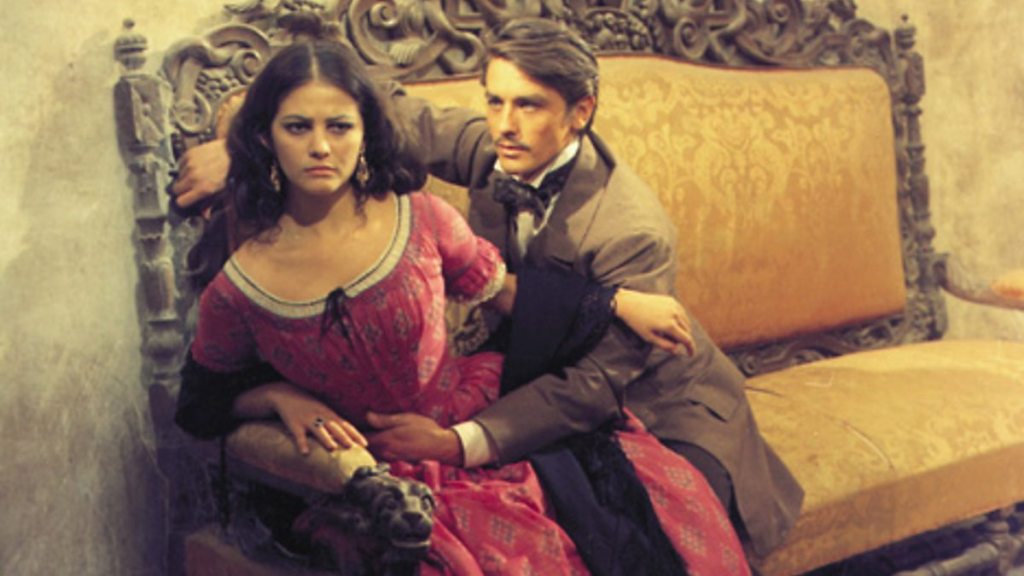
At the time this double bill (which I’ll refer to as Jean de Florette unless specifically referring to the sequel only) were the most successful foreign language films ever released. Shot over seven months, they were also the most expensive French films ever made and garlanded with awards, including a BAFTA for best film. Jean de Florette turned Verdi into the soundtrack for France, while its photography transformed the rural idyll of Provence into a major tourist destination and the dream location for holiday homeowners. The films themselves remain rich, rural tragedies, gorgeous French heritage films, a sort of French Gone with the Wind replayed as Greek tragedy.

Told in two parts – although designed as one complete movie – they tell a story of how greed destroys lives in 1920s rural Provence. César (Yves Montard) is the childless landowner whose only hope of a legacy is his hard-working but dense nephew Ugolin (Daniel Auteuil). Ugolin dreams of growing carnations but the perfect land is frustratingly not for sale. When an argument with the owner leads to his accidental death, the land falls to Jean Cadoret (Gérard Depardieu) hunch-backed former tax collector from the city and son of Florette, the girl who broke César’s heart decades ago when she left the village while he impulsively served in the foreign legion.

César and Ugolin resent Jean – Jean of Florette as they call him – and hatch a plan to see his dream of a rabbit farm fail. They secretly block up the spring on Jean’s land and keep his connection to Florette a secret from the rest of the village, encouraging them to see him as an outsider and hunchbacked bad-luck charm. Ugolin befriends the decent, optimistic and hard-working Jean and watches the farm disintegrate. A decade later, in Manon des Sources, Jean’s daughter Manon (Emmanuele Béart) plots revenge for her father on Ugolin and César.

Jean de Florette and Manon des Sources were adapted from Marcel Pagnol’s novel – written, ironically, after Pagnol’s film Manon des Sources was butchered down by the studio in 1952 from four hours into an abbreviated two. It’s a richly filmed, luscious picture crammed with gorgeous locations, sweeping camerawork and marvellous score that riffs on Verdi. It’s an entertaining story of injustice and comeuppances. It’s first half (Jean de Florette) is an, at-times painful, unfolding of Jean’s inevitable failure. The second (Manon des Sources) sees all those chickens come home to roost as Manon’s suspicions about César and Ugolin’s duplicitousness are confirmed.

But what perhaps made Jean de Florette as successful as it was, is its mix of Merchant Ivory and BBC costume-drama. Many outside of France essentially took it as art because the characters spoke French. But Jean de Florette is a tasteful, classy, very well-made prestige package designed to be easily digestible. Claude Berri marshals events with the skill of a natural producer – he’s effectively a sort of French Richard Attenborough with a great deal of natural talent with actors, but without the true inspiration of the greats. You couldn’t mistake Jean de Florette as something made by Carné let alone Godard or Truffaut. It’s decidedly too carefully, tastefully made for that.

Which is not to say it isn’t in many ways a very fine film. Its construction is well-executed across its two parts. Berri makes clear that – for all the film showed a picture post-card view of France, encouraged to promote tourism and ‘traditional values’ by the government – the village our film is centred around is rife with prejudice and underlying hostility. It’s all too easy to for them to take against Jean: not only he is an outsider, he’s a tax-collector and a hunchback to boot. Prejudice naturally sets them against him (the villagers gleefully watch this “city man” destroy himself vainly trying to turn his dry land fertile). Manon des Sources makes clear the whole village at the very least suspected the spring had been deliberately dammed but effectively couldn’t be bothered to help.

It’s not a surprise as Jean’s techniques are totally alien to the traditionalists. Played by Depardieu with a wide-eyed enthusiasm, guileless honesty and trust, Jean takes on farming as if its another mathematical problem. He has books full of calculations and productivity rates he expects to hit, covering everything from rabbit breeding to the daily amount of soil and water needed for crops. He is prepared for anything except the cruelty of humans and the weather (Berri makes clear that, even with one arm tied around his back by the spring being blocked, he nearly manages to pull it off).

Instead, his super-human efforts come to naught. Forced to walk miles a day to carry gallons of water back to his farm to irrigate his land, he starts to resemble the weighted down donkey he drags with him. Rubicons are crossed one by one: even his wife’s necklace is eventually called on to be pawned, for all his promises that it would never come to that (fitting the Zolaish tragedy here, the necklace turns out to be worth sod all). Ugolin does everything he can to befriend and support Jean without helping him, even ploughing the land for him when Jean comes close to finding the hidden water supply. The events beat down Depardieu, here in one of his finest “man of the soil” peasant roles, until he is literally left shouting at the heavens, imploring God to give him a break.

This makes is all the easier to despise César and Ugolin, especially as Berri cuts frequently to these hypocrites giggling at their own deviousness and Jean’s suffering. It makes Manon des Sources – arguably the even more rewarding part – all the more satisfying as we watch the two of them slowly destroyed, events replaying themselves from the other direction. Manon des Sources features a performance of Artemis-like grace from Emmanuelle Béart as the older version of Jean’s daughter (the younger noticeably never trusted Ugolin), whose beauty enraptures Ugolin and who in turn dams the source of the village’s water to expose the crimes against her father.

It leads to a series of shattering reveals that break César and Ugolin from their satisfaction and complacency. These two villains are portrayed in masterful performances by Yves Montard and Daniel Auteuil. Under buck teeth and a foolish grin, Auteuil is sublime as a man who has it in him to be decent but is all too easily led by his forceful uncle. He regrets his actions, while never making an effort to reform and reverts all too easily into a love-struck Gollum, spying on Manon and literally sewing her lost ribbon into his skin. He’s a pathetic figure.

Montard has the juiciest part, which flowers into one of true tragic force in Manon des Sources. César is a man whose life of regret and loneliness has turned him into a bitter old man, grasping, greedy and hungry for a legacy. He treasures the few possessions he has of Florette – faded letters and a single hair comb – like relics and subconsciously can’t bring himself to actually meet her son. Suppressed sadness makes him every more tyrannical and foreboding. But Manon explodes this exterior, as events and revelations strip away all he holds dear. It culminates in a breath-taking sequence of raw grief from Montard – which depends on the magnetic power of his eyes – as his last delusions are stripped away and the true horror of his actions exposed to him.

It’s this emotional power that gives the two parts of Jean de Florette its force and impact and lift it the higher plain of its costume drama roots. It may be a very self-consciously prestige picture, designed to appeal to the masses, but Berri’s conservative style is matched with a great skill of drawing powerful performances from the actors. He does this in spades with his four leads and events eventually gain, through their performances, some of the force of a Provence Greek Tragedy. Jean de Florette manages to avoid melodrama and provides real dramatic meat and, while it is not high art, it’s certainly very high drama.

Tender Mercies (1983)

Tender Mercies (1983)

Quiet, contemplative and almost wilfully undramatic, Duvall wins an Oscar in this gently moving soul-searching film

Director: Bruce Beresford

Cast: Robert Duvall (Mac Sledge), Tess Harper (Rosa Lee), Betty Buckley (Dixie), Wilford Brimley (Harry), Ellen Barkin (Sue Anne), Allan Hubbard (Sonny), Lenny Von Dohlen (Robert), Paul Gleason (Reporter)

The music industry can be cruel. It’s bought out the self-destructive traits in Mac Sledge (Robert Duvall), a Country and Western singer whose career collapsed into alcoholism. Estranged from his wife Dixie (Betty Buckley) and a stranger to his daughter Sue Anne (Ellen Barkin), Mac finds himself crashing, penniless, in a rundown motel in Texas. Paying for his bed and board with labour, Mac falls in love with and marries the motel owner, widow Rosa Lee (Tess Harper) and becomes stepfather to her young son Sonny (Allan Hubbard). Mac quits the bottle and turns his life around, living quietly and determined to become a new man.

Tender Mercies is a slice-of-life film. It aims to present an ordinary man, facing challenges and struggling with demons. But in many ways, it’s quite remarkable. There can be few dramas that so consciously avoid drama. In Tender Mercies the expected fireworks and dramatic tentpole moments never happen. Events that in other films would have been “for your consideration” scenes or so underplayed they almost pass you by, or don’t even feature in the film. Mac and Rosa Lee’s courtship is made up of small, quiet conversations on the sofa. The proposal is a polite, softy spoken request. The wedding isn’t even shown.

This is a film that lets events play out with the random disconnectedness of real life. Characters from Mac’s past life drift in and drift out of the story with the unpredictability of reality rather than the construct of scriptwriters. Horton Foote’s Oscar-winning script is written in soft, quiet moments of silence, tenderness and quiet decency. It’s a film that wants to embrace classic, Southern values. Where religion, modesty and keeping your word are pivotal. Kindness, reserve and a lack of exhibition are traits widely praised. It’s a celebration of letting the ‘tender mercies’ of faith into your life and letting them define how you respond to the world and events around you.

It can feel like very little happens. But this is largely the point. That’s what life is like. Mac decides to change his life and knuckles down and does it. Rosa Lee trusts him to keep his word. Temptations and moments of anger are rare, and events are usually met with a suppressed acceptance. You could argue that Mac is emotionally repressed – that perhaps he associates emotional expression with the wildness that clearly plagued his early life of drink and violence – but also perhaps it is intrinsic in his stoic character. In the broader scheme of life – and in this faith-tinged world – accepting the rough with the smooth is a duty.

Robert Duvall won an Oscar for this, and he is at the heart of the film’s quietness, gentleness and lack of demonstrance. Duvall is so quietly restrained he masters the technique of doing a lot while seeming to do very little. He is softly spoken and carries much of his emotion behind his eyes. Mac does little that is conventionally dramatic, but constantly Duvall lets his face, body and the careful soulfulness of those majestic eyes convey great regret, guilt and tragedy. Duvall’s Mac is gentle, but with the careful determination of a man determined to keep his second chance alive. There is a weary sadness at him, a longing for emotional connection that he struggles to express. And few actors would be willing to embrace a part so low on emotional fireworks. Even when tragedy strikes, Duvall remains quietly restrained.

He’s the perfect lead for this Chekovian conversation piece, well filmed by Bruce Beresford. Beresford brings a marvellous visual sense for the wide-open spaces of Texas and a perfect empathy for the observational, careful balance of the film’s narrative. It’s a film made up of events taking place in long and medium shot, filmed with natural lighting. Beresford encourages all the actors to gently underplay and lets his camera observe without flash and flair, letting the deceptively simple set-ups focus on the emotions.

It’s a film about a quiet quest for happiness – but also a wary suspicion of the pain and guilt life can bring. The fear that happiness can lead to loss and pain. Its why Mac has placed such a premium on stoicism. It’s an attempt by a fragile man to emotionally protect himself. He silently longs for a bond with his daughter, played with a wonderful little-girl-lost quality by Ellen Barkin, and struggles with the responsibility for the unhappiness he has caused his ex-wife Dixie (a more overtly fragile Betty Buckley). Happiness might not be what you expect – jubilant music and an explosion of joy – but quietly finding a contentment.

And contentment is embodied here by Rosa Lee, played with dignity and rectitude by Tess Harper. Rosa Lee is gentle, understanding and in many ways defined by her faith of forgiveness and second chances. She represents the rebirth that starts the film – which opens with a drunk Mac crashing to the floor – and is the lodestone around which the plot rotates, the fixed-point Mac needs in his life. Duvall and Harper have a fabulous chemistry and fully commit to the honesty at the film’s heart.

Tender Mercies is a honest short story expanded into a thoughtful and (in its way) brave film. It veers towards silence where other films would hit noise. It presents inaction and acceptance where other films would pick melodrama. It centres a still, calm continuation of events over fireworks. Duvall is central to this, an affecting performance of immense complexity under a stoic exterior, all framed around Beresford’s reflective shooting style.

It’s lazy to say this is “old fashioned” – no 40s film would be as uneventful and restrained as this – instead this feels like a final flourish of 70s filmmaking, a late burst of Malick-style American romanticism and poetry. Perhaps that’s why it was surprisingly nominated for multiple Oscars. And why it carries a quietly hypnotic power.

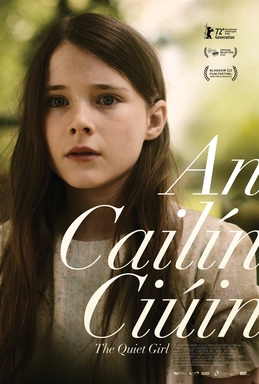
The Quiet Girl (2022)

The Quiet Girl (2022)

Stunning, low-key deeply-moving drama as a child flourishes with love in this Irish drama

Director: Colm Bairéad

Cast: Catherine Clinch (Cáit), Carrie Crowley (Eibhlín Kinsella), Andrew Bennett (Seán Kinsella), Michael Patric (Da), Kate Nic Chonaonaigh (Mam)

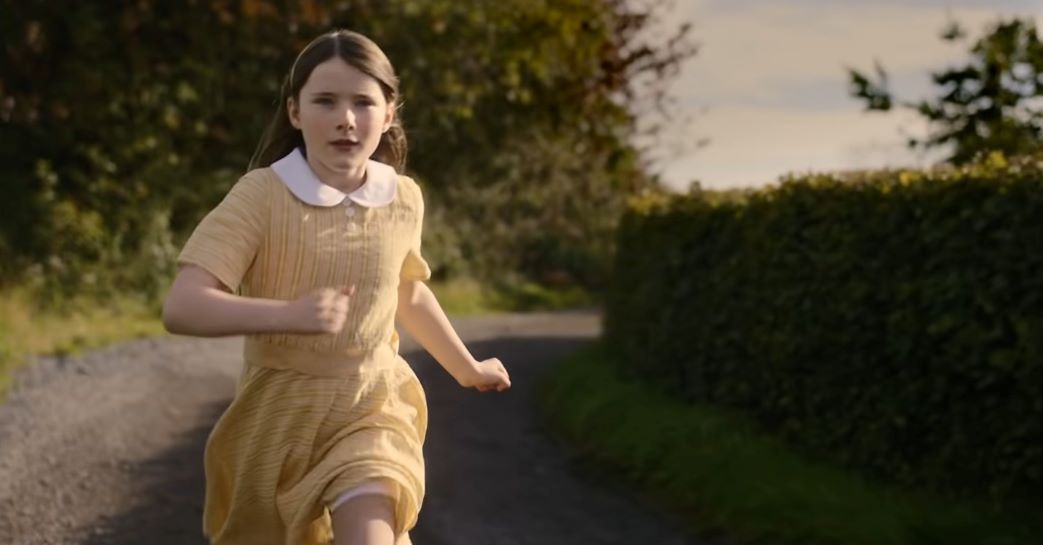
Childhood can be difficult. Even more so when the child knows they are an unwanted daughter, in an overlarge family overseen by an uncaring father (Michael Patric) more interested in the horses and the bottle than those his family. Cáit (Catherine Clinch) is a quiet child in early 1980s Ireland who has learned quietness because she knows no one cares what she has to say. When her Ma (Kate Nic Chonaonaigh) is expecting another child, Cáit is sent to stay with her Ma’s middle-aged cousin Eibhlín (Carrie Crowley) and husband Seán (Andrew Bennett) on their farm. There she finds a warmth, care and love she never knew at her home. But, though this is a house with warmth and “no secrets”, it is also a home where a painful loss is never spoken of.

Adapted from one of the finest short stories from Claire Keegan, one of Ireland’s leading novelists, The Quiet Girl became the most successful Irish film of all time and the first nominated for an Oscar. It’s no wonder: this is a beautifully made, carefully crafted and immensely moving film, overflowing with humanity and empathy that left me dapping my eyes.

Perfectly scripted and directed with a quiet controlled restraint by Bairéad, The Quiet Girl is a film that throbs with emotion, a collection of small events and everyday moments of kindness that bloom into moments of great resonance by the skilful empathy built up for this child. Throughout the film, shot in a Academy ratio 4:3, Cáit is frequently positioned in the centre of the frame. At first, in her home and school, this superbly stresses her isolation. Events bustle around her, family members casting shadows over her. She stares down and away from us and feels like the single fixed point in a world of motion. She sits unnoticed in the backseats of cars and watching her father drink in pubs. She is at the centre of our perception, but adrift in a sea of activity around her.

Bairéad superbly uses this device throughout to slowly bring characters and interactions to curve inwards and focus on Cáit much as we do. When she arrives at her aunt’s farm, for the first time the attention of others in the frame settles on her. Their eyes are on her, they speak to her, move to connect with her. The Quiet Girl is intensely moving as it shows the difference a change of scene can make, the warmth and love can make to a child who has known nothing like it.

This is in many ways a simple story, but the low-key tenderness which Bairéad tells it gives it immense power. Cáit – played with quiet gentleness by Catherine Clinch – is a sensitive, intelligent and caring girl who has never been allowed to flourish. It’s striking after the film’s first fifteen minutes showcasing the indifference she faces, how much your heart glows as Eibhlín talks to her, makes her feel comfortable, washes her and tucks her up in bed. It’s a world away from the neglect we’ve seen Cáit suffer.

This is a film where small acts of kindness bring tears to the viewers eyes. When Cáit wets the bed on her first night – too scared to use the toilet – Eibhlín immediately notes her fear (she expected punishment) and apologises for giving her “a mattress that weeps”. Eibhlín separates her from her uncomfortable clothes, teaches her basic household tasks, brushes her hair, encourages her to feel a part of their home. For the first time Cáit is treated not as a burden – or worse – but as a human being. This is brilliantly conveyed by Carrie Crowley as Eibhlín, who delivers a performance of immense emotional depth, both tender and kind but with a deeper layer of sadness underneath, the cause of which is slowly revealed.

Bairéad is sensitive about the home environment Cáit has emerged from. There are dark hints: her Da is, at best, a potentially violent drunk with a temper and Cáit is introduced first hiding in a field, then under her bed. Arriving at her foster home she has a fear of “secrets”. Eibhlín is quick to pick up on this, reassuing her there are no secrets here.

No secrets perhaps, but a pain never spoken of. Cáit’s room is decorated in train wallpaper and she sleeps in a child’s bed. She is dressed in boy’s clothes (“our old things”) only a few sizes too big for her. Seán finds her hard to look at, at first – but when, under her care, she wanders off he becomes panicked and distressed. The loss this sad couple suffered is clear to us and The Quiet Girl becomes a film of mutual healing. There is pain on both sides: a child with parents and parents without a child.

Seán’s growing bond with Cáit is wonderfully paced and deeply affecting. Gruff but kindly, Andrew Bennett’s performance melts the heart. From a biscuit placed without comment on a table to a run to the post-box that turns into a repeated game, their slowly flourishing love is simply beautiful. As he buttons her coat or the two of them race to sweep clean the cow shed, you’ll find it impossible not to be moved. Seán is slower to bond with the child than Eibhlín, but both of them find the pain in their heart slowly eased by allowing theirs to open to this quiet, caring child.

Of course, it is only a holiday that must end. Bairéad’s film ends with Keegan’s own, tinged with a slight ambiguity. But it’s a beautiful one for all that, a heart-rending tribute to emotional connection between people. Bairéad’s film has this empathy running through it like a pulse. Shot with an immense visual beauty that turns everyday objects into items of intense beauty – from tables to drains – The Quiet Girl is a deeply moving quiet masterpiece, which carries a low-key emotional impact that is hard to beat and impossible to forget.

The Wrong Box (1966)

The Wrong Box (1966)

Farce, murder, mayhem and comic energy abounds in this sometimes try-hard but fun enough knockabout comedy

Director: Bryan Forbes

Cast: John Mills (Masterman Finsbury), Ralph Richardson (Joseph Finsbury), Michael Caine (Michael Finsbury), Peter Cook (Morris Finsbury), Dudley Moore (John Finsbury), Nanette Newman (Julia Finsbury), Tony Hancock (Inspector), Peter Sellers (Dr Pratt), Cicely Courtneidge (Major Martha), Wilfrid Lawson (Peacock), Thorley Walters (Patience), Irene Handl (Mrs Hackett)

Do you know what a tontine is? For those who don’t (come on, own up!) it’s basically an investment named after the Florentine banker Lorenzo di Tonti in 1653. Investors pay into a scheme which gives a regular income while accumulating interest on the initial capital. As the investors die off, the individual payouts increase until the final surviving investor claims the full ‘pot’ of cash. It’s essentially a lottery for being the last surviving investor. That’s ripe for two things: murder and farce.

We got dollops of the latter in this slap-stick, old-school farce loosely (very loosely) based on a Robert Louis Stevenson and Lloyd Osbourne novel. A Victorian tontine sees its members fall at regular intervals until there are only two survivors: estranged brothers, cantankerous Masterman (John Mills) and almost supernaturally tedious Joseph (Ralph Richardson). With Masterman pretending to be on his own deathbed to lure his brother out (to murder him), the blithely dotty Joseph is kept in health by his greedy nephews Morris (Peter Cook) and John (Dudley Finsbury). En route to see Masterman, a train accident leads to a series of farcical misunderstandings involving mis-identity, confusion and a dead body packed into a box and delivered to the wrong house.

Directed with an, at times, slightly too overtly zany bent by Bryan Forbes, The Wrong Box oscillates between being rather funny and trying too hard. It’s all too obvious to see the influence of the Oscar-winning Tom Jones in the film’s jaunty musical score and use of flowery-lined caption cards to announce events and locations. It’s also clear in the fast-paced, at times overblown, delivery of performances and dialogue, with its mix of improvisational humour and cheeky lines. Despite this though, The Wrong Box manages to be just about be fun enough (and it’s funnier than Tom Jones).

That’s probably because it’s not aspiring to be much more than a jaunt, an end-of-term treat in which a host of famous actors and comedians put on a show. Forbes might not have the inspired flair at comedy or the sort of timing this needs. But he’s got a nifty touch with dialogue and does a decent job of translating classic British theatre farce to the screen. The Wrong Box – even the title leans into this – is all about those classic farcical tropes of things being delivered to the wrong people because they have similar names, mistaken or misheard messages being passed on and people obliviously talking at cross purposes.

We get set-ups like Mills’ fake-bed-ridden old man trying multiple times to off Richardson’s bore, each attempt obliviously foiled by coincidence and accident. A body misidentified because its wearing someone else’s coat, then packed into a crate and delivered (to the wrong house) to disguise a death that hasn’t actually happened. Undertakers mistakenly taking away a man who has fainted at the foot of the stairs rather than a body in another room. All classic farce.

It’s not a surprise that experienced theatre actors emerge best. Richardson, in particular, is a delight as a man who has made such a study of trivia that he compulsively bores anyone he encounters. Fellow passengers on a train, a farmer who gives him a lift in his cart, attendees at a funeral – all of them glaze over in despair while Richardson’s Uncle Joseph, with monotonous eloquence, expounds mind-numbing trivia (including, at one point, in Swahili). He makes a fine contrast with Mills’ angry short-man, constantly fuming at a string of slights, real and imagined.

These two leads set the standard for the rest of the cast, a mix of comedians, theatre pros and star names. Peter Cook occasionally tries a little too hard as a bossy-boots determined to inherit the tontine – it’s remarkably that, even this early, Dudley Moore looks more relaxed in front of the camera (Moore’s later stardom would be inexplicable to the jealous Cook). Tony Hancock looks rather sadly like a rabbit-in-the-headlights as an inspector. Peter Sellers, not surprisingly, shows how it’s done: his two-scene cameo as a drunken doctor of loose morals, surrounded by cats and permanently sozzled is a master-class in low-key, rambling hilarity.

Michael Caine and Nanette Newman also acquit themselves very well. Throwing themselves into the spirit of things as our romantic leads – fulfilling the requirements of the genre by being both charming and sweet but also naïve and a little dim – they strike up a romance that manages to be both rather touching and also a neat parody of costume drama flirtation. Forbes shoots a rather nice scene where they breathlessly eye each other up, the camera cutting rapidly from exposed arms to facial features one after the other. Both are very funny, with Caine striking up a lovely double-act with Wilfrid Lawson as an almost incoherently drunk butler (Lawson’s finest hour since Pygmalion).

The film keeps its comic energy flowing well, with Forbes using a good mix of interiors and some attractive Bath locations (doubling for London). It’s also a film which – surprisingly since its written by a pair of Americans – really captures a sense of British eccentricity. I really enjoyed, in particular, the opening sequence that charts the deaths of the other members of the tontine – a parade of inept empire builders (soldiers, explorers, big game hunters) meting a series of surreal (often self-inflicted) deaths.

It probably does slightly outstay its welcome – 90 minutes would have been perfect. It’s a little too pleased with its semi-surreal set-up and stylistic flourishes – the floral on-screen captions definitely are far less funny than the films thinks. There is, at times, a little too much of the “isn’t this zany!” air about the film that can grate, with set-ups groaning with their desire to amuse (a late hearse chase scene falls into this) like a pub bore telling you a story in his self-proclaimed “inimical style”.

But at least The Wrong Box does make you laugh. And when that is all it is aiming to do, its hard not to have a soft spot for it.

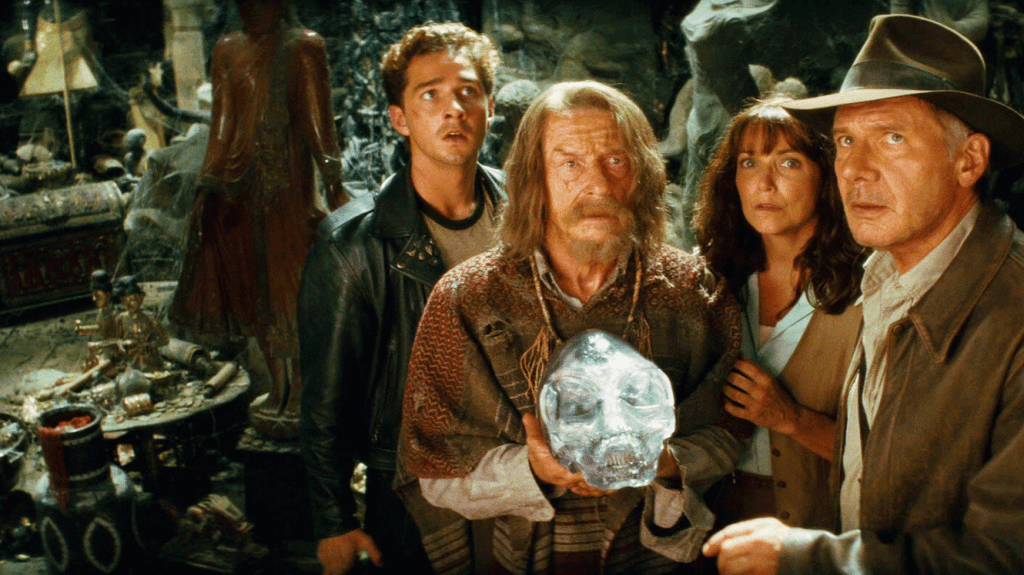
Indiana Jones and the Kingdom of the Crystal Skull (2008)

Indiana Jones and the Kingdom of the Crystal Skull (2008)

Indy is back. Hunting aliens. What could go wrong? Grab a fridge and let’s work it out.

Director: Steven Spielberg

Cast: Harrison Ford (Indiana Jones), Shia LeBeouf (Mutt Williams), Cate Blanchett (Colonel Irina Spalko), Karen Allen (Marion Ravenwood), Ray Winstone (George “Mac” McHale), John Hurt (Harold Oxley), Jim Broadbent (Dean Charles Stanforth)

Flying into ignominy faster than a tumbling fridge, you’d be hard-pressed to find anyone who lists Kingdom of the Crystal Skull as their favourite Indy film. I’ll confess I enjoyed it in an affectionate escapist way when I first saw it. But lord, doesn’t it just get worse after every viewing?

It’s the 1950s and Indiana Jones (Harrison Ford) is still hunting for archaeological gems. Just as he’s still getting into trouble. This time with the Russians. A secret group in America, led by Colonel Irina Spalko (Cate Blanchett) is on the hunt for a mysterious artefact – a secret mummified alien corpse. Spalko wants to trace the aliens to find the fountain of all knowledge. Indy is suspected of being a Commie agent – not least after his old ally Mac (Ray Winstone) is revealed as a double agent – but soon finds himself roped into searching for the secret aliens and their buried crystal skulls by Mutt Williams (Shia LaBeouf), a greaser and school drop-out and son of Marion Ravenwood (Karen Allen) (wonder who the father could be?). Soon they are racing to a secret alien tomb in the Amazon.

You can spend ages scooting around what doesn’t work here. But the heart of it might be this: this is a sequel trying to pass as a young man’s film, made by two older directors who had long since fallen out of touch with the passions that filled their lives 30 years earlier. Truth be told, I suspect both Spielberg and Lucas always saw Indiana Jones as a fun diversion from other passions and never really cared about it the way generations that grew up quoting it did. Perhaps that was the biggest disappointment of all about Indiana Jones and the Kingdom of the Crystal Skull, a film that has potential but always feels like it’s being put together by obligation (and to make money).

Still, the good stuff. Harrison Ford is, of course, still Indy and there is a great deal of pleasure in seeing him inhabit this gruff mix of brains, fists and reluctant, cynical decency. The film also does a good spin on the father-son relation of Last Crusade by casting Indy as the exasperated father who finds a bond with his wild-card son (well played by Shia LaBeouf). The two have a lovely run of banter, and some neat comedy – not least a great little moment in a bar where Mutt steals a drink from a waitress’ tray, only for Indy to smoothly put it back all the same motion.

There is an exciting chase through the streets of New Haven, with Indy and Mutt on a bike escaping the Russians, including a great sight gag of Indy being pulled into a chasing car passenger window, fighting through the car and emerging the other side back onto Mutt’s bike. The opening extended fight and chase sequence (before we hit that fridge) in an Area-51 storage site is equally well done, fast paced, witty and crammed with tonnes of Spielberg flourishes. Cate Blanchett is intriguingly off-the-wall as the villain. The film even leans into Ford’s age as Indy swings over a gap and misses (“Damn I thought that was closer”) and gives Indy much of his Dad’s grouchiness.

But too much doesn’t work. And all those beats that fall on their face eventually bury the moments that do work. For starters, the original films felt real. They are shot with a grainy realism and featured practical effects. Spielberg stressed in the build-up he wanted to keep that look. So naturally the first thing we see in the film is a CGI gopher. The film is shot with a glossy, lens-smeared shininess. After a while loads of stuff looks unreal. From the fake CGI sky in the opening scene to the hideously unreal looking jungle chase, culminating in the bizarre sight of Mutt swinging, Tarzan-like, leading an army of monkeys. Like the Star Wars prequels, it feels like Lucas and Spielberg mistook making things bigger, glitzy and more exotic for making them better. Truth is nothing in this film is as exciting as Indy climbing over a real van in Raiders or riding a real horse alongside a real tank in Last Crusade. These are real and gripping. Everything here looks like it’s been built in a computer, nothing feels real or possible, and everything is bigger and heartless.

That heartlessness carries into the plot. The earlier films had clear and emotionally engaging stakes. Indy had to save his soul (Raiders and Doom), a village of children (Doom) and his relationship with his father (Last Crusade) while chasing clearly defined artifacts. Here he’s sort of incidentally building a father-son relationship with a kid he doesn’t realise is his son until over halfway through and heading into the Amazon to return a glass skull because it told him to do it. These are not well-defined stakes. That’s before we even touch on the aliens.

I can’t quite put my finger on it, but where artefacts based on the Bible or Hindu religion make perfect sense, an alien skull chase that culminates in a parallel dimensions and flying saucers feels silly. It feels as awkwardly out-of-place as midichlorians in Phantom Menace. It makes the film jar as much as those special effects filled set pieces. I know it’s supposed to mirror the 50s setting by playing with the classic 50s B-movie set-up. But it doesn’t fit with the rest of the franchise.

And you are made even more aware of this by how cynically the film has been filled with fan-bait call-backs: the opening sequence in the Grail storage warehouse, the music cues, Karen Allen, a repeat of the father-son set-up (this time flipped), a car chase through a hostile environment, horrible small animals, Commies standing in for Nazis. Killer ants standing in for snakes, horrible insects and rats. Travel and map montages. All this does is remind you of better films.

It’s not helped by how many performances fall flat. Winstone and Hurt both insisted on reading the script before they signed up. Perhaps they also read their pay offers at the same time, because that’s surely the only reason they said yes to these roles. Winstone is painfully unfunny as the ever-betraying Mac whose geezerish cries of “Jonsey!” quickly gets on your nerves. Hurt is saddled with a sort of Ben Gunnish eccentric, babbling nonsense (you won’t believe by the way he and Ford are similar ages). Karen Allen, bar the sweetness of seeing her again, is not great.

The feeling you are watching the runt of the littler is impossible to escape. Indy was a hero people loved because you could see him bleed. When he was punched it hurt. When he fell, he struggled to get back up. The Indy from Raiders would never have been hurled miles in a fridge from a nuclear blast and been absolutely fine. Christ, he was too knackered to stand up after running from that rock. That’s why the fridge moment doesn’t work: no one watching it can believe for a moment that either (a) a fridge would be hurled away like that rather than melt (b) that anyone would be utterly unharmed by it or (c) that its lead lining would save anyone from being irradiated. A mystic box that melts people’s faces when open we can buy because its “power of God” is carefully established with just enough mysterious power. Something grounded in reality like a nuclear blast can’t work. We know what that does – the fridge stretches our willingness to disbelieve too far.

But then you feel Spielberg and Lucas didn’t mind. To them these were fun home movies, a chance to indulge some childish gags. They weren’t invested in it the way we were. They had moved on and I don’t think really either of them wanted to make it. When they did, they showed they didn’t really know what people really liked about the films in the first place. They assumed it was the action. Maybe they thought they needed that with the blockbusters they were going up against. But people loved the heart and the reality. When the fridge was nuked, they knew they won’t going to get that here. That Kingdom of the Crystal Skull would have none of what made us fall in love in the first place. It was an adventure we wouldn’t want to follow Indy on ever again.

The Whale (2022)

The Whale (2022)

Manipulative and sentimental, Aronofsky’s tear-jerker is dishonest and disingenuous

Director: Darren Aronofsky

Cast: Brendan Fraser (Charlie), Sadie Sink (Ellie Sarsfield), Hong Chau (Liz), Ty Simpkins (Thomas), Samantha Morton (Mary), Sathya Sridharan (Dan)

The Whale is the sort of film that is either going to bring you out in tears or hives. Me? Let’s just say I felt incredibly itchy as I sat through this naïve, sentimental and manipulative film. I hated its dishonesty and its disingenuousness. The only thing I felt move was my stomach.

Charlie (Brendan Fraser) is a morbidly obese, reclusive English professor who teaches online courses with the camera turned off. Nursed by Liz (Hong Chau), the sister of his deceased partner, Charlie has never processed his depression and guilt at his partner’s suicide. Now, facing death from congestive heart failure, his last wish is to finally bond with his daughter Ellie (Sadie Sink) whom he has not seen in the eight years since he left her and her mother (Samantha Morton). Ellie is now an angry, high-school drop-out teenager. But Charlie is sure he can see the good in her.

So much has been made about the morbid obesity of the film’s lead. The prosthetics coating Fraser in layers of fat are impressive. An opening montage shows Charlie struggling to move around the house. Picking something up off the floor is impossible and he has to lever himself out of the bed or into the shower. But the film is hugely pleased with itself that it dares to see a fat person as “one of us”. Aronofsky initially films him like a freak show monster – already patting himself on the back about how “humanising” it will be when we learn that obese people are just as capable of being at the heart of maudlin, self-pitying films as thin ones.

The Whale is adapted from a stage play. Not only does it really feel like it (it’s all set within Charlie’s apartment, with characters announcing their arrival in a neat four-act structure), it also sounds like it. The dialogue is forced, artificial and clumsy, making on-the-nose emotional points. Characters feel like narrative constructs. Sadie Sink’s Ellie is the sort of precocious-but-angry tear-away genius brat you never find in real life. Ty Simpkins’ hipster-turned-missionary is more a collection of quirks than a person. The script leans heavily on clumsy metaphors – a walk on the beach, bible quotes, Ellie’s childhood essay on Moby Dick – milked for all they are worth.

Worst of all, a film that prides itself on being about the power of honesty feels like a big, walloping lie. It lies about its characters and it lies about the real issues that drive them. Firstly, it never once touches on issues of mental health and addiction that have led Charlie to this state. Sure, we get a scene of him compulsively eating. But Liz, his “caring” nurse, brings him medicine and huge piles of food (a massive bucket of fried chicken, enormous sub sandwiches…). It’s like caring for an alcoholic by bringing him chicken soup and a huge bottle of whisky. How is this helping someone recognise and deal with an addiction? Which is what this level of over-eating is.

Worst of all the film treats this as a “charming friendship between two eccentrics”. It eventually touches on the fact they are both hurting from the suicide of Charlie’s partner Alan. But never once is the film brave enough to link their behaviour now to this act. Charlie failed to get Alan help, keeping him away from the world and others, believing that the isolated love of a single person would solve his depression. Liz repeats the same mistakes. She isolates Charlie, encourages him to eat, never challenges him to seek help or process his grief, and creates a safe environment for him to destroy himself. If he was a drug addict, what would we say about a carer who draws the curtains and encourages him to shoot up? We’d be calling her the villain of the piece.

That’s before we even dive into the film’s lack of honesty about Charlie. It’s sad to think of a character being so depressed he’s eaten himself to death. That’s awful – even if the film never wants to reflect on the emotional and psychological reasons for this (because that would be depressing in a film as desperate to be upbeat as this one). But by showing us Charlie at the end, full of regret and self-pity, the film white-washes his mistakes and selfishness. There are clear flaws in Charlie that contributed to this state – however much the film wants to present it as a terrible accident.

Charlie abandoned his family and made no contact with his daughter for years (he complains it was too difficult and tries to blame her mother), leaving her traumatised. The film loves its sentimental device of Charlie reading to himself Ellie’s childhood essay (which he knows by heart). But this is, basically, a selfish fantasy: an idea for Charlie to cling to that he was a good Dad and Ellie a kid with a future, radically different from the actual reality. Just like he never addresses why guilt and depression drove him to destroy himself, so he refuses to deal with the issues Ellie is facing now by simply not acknowledging that she has changed from his idealised version of her as the sweet, sensitive girl who knew Moby Dick was really about Melville’s unhappiness.

Instead, the film suggests her mother is the one who really failed. Charlie – who has spent about an hour in her company in eight years – would have donebetter. Just like Liz passing him chicken buckets, Charlie’s solution to solving his daughter’s problems is to smother her with love rather than get her to ask herself why she does and says the cruel things she does. How can the film not see he is repeating the same ghastly cycle again, encouraging a depressed, vulnerable person to stick her head in the sand and hope for the best? Well, he’s wrong. And the fact that the film doesn’t see this means it’s lying to itself as much as he is.

By the end you’ll be stuffed by sentiment, greased by the insistent score. Every single frame is like being walloped over the head while Aronofsky shouts “cry damn you”. The dreadful script is well acted, even if no-one ever makes these device-like characters feel like real people (except maybe Morton). Fraser is committed, a lovely chap and I’m very pleased he’s having “a moment”. But this is a simplistic character, that requires little of him other than to wear a fat suit and cry. He never once really delves into any complexity. It’s also true of Hong Chau, a collection of quirk and tears.

The Whale is a dreadful film, manipulative, artificial and full of naïve and dishonest emotions that avoids dealing with any complex or meaningful issues. Instead, it thinks it’s achieved something by making you see a fat person as a real person. There is almost nothing I can recommend about it.

The Fabelmans (2022)

The Fabelmans (2022)

Spielberg explores his childhood in this warm but honest look at the triumph and pain of movie-making and family

Director: Steven Spielberg

Cast: Gabriel LaBelle (Samuel Fabelman), Michelle Williams (Mitzi Schildkraut-Fabelman), Paul Dano (Burt Fabelman), Seth Rogan (Bennie Loewy), John Butters (Regina Fabelman), Keeley Karsten (Natalie Fabelman), Sophia Kopera (Lisa Fabelman), Mateo Zoryan Francis DeFord (Young Sammy), Judd Hirsch (Boris Schildkraut), Jeannie Berlin (Hadassah Fabelman), Robin Bartlett (Tina Schildkraut), David Lynch (John Ford)

Perhaps no director is more associated with cinema’s magic than Steven Spielberg. And watching The Fabelmans, a thinly fictionalised story about his childhood, clearly few directors have as much of that cinematic magic in their blood. The Fabelmans joins a long line of post-Covid films about auteur directors reflecting on their roots (clearly a lot of soul searching took place in 2020). Surprisingly from Spielberg, The Fabelmans emerges as a film that balances sentiment with moments of pain and a love of cinema’s tricks with the suggestion of its darker powers rewrite reality according to the eye of the director (or rather the editor).

The film follows thirteen years in the life of the young Spielberg, here reimagined as Samuel Fabelman (Gabriel LaBelle, by way of Mateo Zoryan Francis-DeFord). His father Burt (Paul Dano) is an electrical engineer with a startling insight into the way computers will shape the modern world. His mother Mitzi (Michelle Williams) is a former concert pianist turned full-time Mom. The family moves from New Jersey to Phoenix and finally California, as Burt’s career grows. From a young age Samuel is enchanted by cinema, filming startling narrative home movies, packed full of camera and editing tricks. But he and the family are torn between art and science, just as Mitzi’s friendship with “Uncle” Bennie (Seth Rogan), Burt’s best friend, is revealed to go far deeper.

The Fabelmans is both a love letter to cinema and to family. But it’s a more honest one than you expect. It’s got an open eye to the delights and the dangers of both, the pain and joy that they can bring you. The film’s theme – expertly expressed in (effectively) a sustained monologue brilliantly delivered by Judd Hirsch in a brief, Oscar-nominated, cameo as Samuel’s granduncle a former circus lion tamer turned Hollywood crew worker – is how these two things will tear you apart. The creation of art makes demands on you, both in terms of time and dedication, but also a willingness to make reality and (sometimes) morality bend to its needs. And family are both the people who give you the greatest joy, and the ones that can hurt you the most.

Spielberg’s film tackles these ideas with depth but also freshness, lightness and exuberant joy. Nowhere is this clearer than the film’s reflection of Spielberg’s deep, all-consuming love for the art of cinema. Its opening scene shows the young Samuel – an endearingly warm and gentle performance from Francis-DeFord – transfixed during his first cinema visit by the train crash the concludes DeMille’s The Greatest Show on Earth. So much so he feels compelled to recreate it – much to his father’s annoyance – with an expensive gift trainset, before his mother suggests filming it. Even this 10-year olds film, shows a natural understanding for perspective and composition.

The young Samuel – in an inspired moment of Truffautesque brilliance – is so enraptured with his resulting film, that he plays it repeatedly, projecting it onto his hands, as if holding the magic. No wonder he becomes a teenager obsessed with movie-making, who talks about film stocks and editing machines at a hundred miles an hour, locking himself away for hours carefully snipping and editing footage. The film this young auteur directs – very close recreations of Spielberg’s actual movies – are breath-taking in their invention and the joy. A western with real gun flashes – Burt is astounded at the effect, achieved by punching holes in the film – an epic war film crammed with tracking shots and stunningly filmed action.  This is a boy who loves the medium, excited to uncover what it can do, who finds it an expression for his imagination.

He’s clearly the son of both his parents. Burt, played with quiet, loving dignity by Paul Dano (torn between holding his family together and the knowledge he can’t do that), is a quintessential man of science. It’s from him, Samuel gets his love for the nitty-gritty mechanics of film-making, its machinery and precision. But to Burt it’s only a “hobby” – real work is the creation of something practical. So his artistic sensibility films comes from his mother Mitzi, gloriously played by Michelle Williams as a women in a constant struggle to keep her unhappiness at bay by telling everyone (and herself) its all fine. She needs a world filled with laughter and joy.

It’s what she gets from Uncle Bennie (Seth Rogan, cuddly and kind). It’s also where the darkness of both family and film-making touches on this bright, hopeful world. Creating a film of a camping trip the extended family have taken, its impossible for Samuel not to notice at the edge of the frames that Bennie and his mother are more than just friends. His solution? Snip this out of the film he shows the family, then assemble an “alternative cut” which he shows his mother, showcasing the tell-tale signs of her emotional (if not yet physical, she swears) infidelity. The Fabelmans skirts gently however, over how Spielberg’s teenage fear of sexuality in his mother and the association of sex with betrayal may have affected the bashful presentation of sex in many of his movies.

Samuel’s camping film works best as a reassuring lie. He’ll repeat the trick a few years later, turning his jock bully (who flings anti-Semitic insults and punches) into the super-star of his high-school graduation film, a track superstar who is made to look like a superman. Confronted about it, Samuel acknowledges it’s not real – but maybe it just worked better for the picture. It’s as close as Spielberg has ever come to acknowledging the dark underbelly of cinematic fantasy: it can mask the pain and torment of real life and it can turn villains into heroes. His unfaithful Mum becomes a paragon of virtue, his school bully a matinee idol.

Why does he do it? Is it to gain revenge by confronting those who have let him down with idealised versions the know they can’t live up to? Even he is not sure. Perhaps, The Fabelmans is about the young Spielberg reconciling that even if the movies are lies, they can also be joyful, exciting lies that we need: and that there is more than enough reason to continue making them. Just as, angry as we might get with our parents, we still love them.

The film is held together by a sensational performance by Gabriel LaBelle, who captures every light and shade in this journey as well as being uncannily reminiscent of Spielberg. It’s a beautifully made film, with a gorgeous score by John Williams that mixes classical music with little touches of the scores from Spielberg classics. And it has a final sequence dripping with cineaste joy, from a film deeply (and knowledgably) in love with cinema. Who else but David Lynch to play John Ford, handing out foul-mouthed composition tips? And how else to end, but Spielberg adjusting the final shot to match the advice, tipping the hat to the legend?

The Fabelmans creeps up on you – but its love for film and family, its honesty about the manipulations and flaws of both and its mix of stardust memories and tear-stained snapshots feels like a beautiful summation of Spielberg’s career.

Avatar: The Way of Water (2022)

Avatar: The Way of Water (2022)

Cameron’s film makes a huge splash despite its soggy plotted, flooded run-time

Director: James Cameron

Cast: Sam Worthington (Jake Sully), Zoe Saldaña (Neytiri), Sigourney Weaver (Kiri Sully), Stephen Lang (Colonel Miles Quaritch), Kate Winslet (Ronal), Cliff Curtis (Tonowari), Jamie Flatters (Neteyam Sully), Britain Dalton (Lo’ak Sully), Timothy Jo-Li Bliss (Tuk Sully), Jack Champion (Spider), Bailey Bass (Reya), Filip Geljo (Aonung), Duane Evans Jr (Rotxo), Edie Falco (General Frances Ardmore), Brendan Cowell (Captain Scoresby), Jermaine Clement (Dr Ian Garvin)

After thirteen years it finally arrived. The sequel to a film that seemed to leave no cultural impact, Avatar. People were convinced it would flop. But they say that about all Cameron films. And, if anyone should have learned anything from Terminator 2, Titanic and Avatar it was don’t bet against Cameron. If Avatar 2’s purpose was to make an awful lot of money, it has succeeded in every level. If its purpose was to make a strong and entertaining film… I’m not so sure.

About the same amount of time has passed on Pandora and Sully (Sam Worthington) and Neytiri (Zoe Saldaña) have raised a family of four children, including Kiri (Sigourney Weaver) born from the avatar of their friend Grace. They have also raised Quaritch’s son ‘Spider’ (Jack Champion) among them. Then the humans return… a bloody war begins, with Sully leading a guerrilla campaign. The company resurrects Colonel Quaritch (Stephen Lang) as a Na’vi super soldier to fight on their own terms. After Spider is captured, Sully and his family flee to live among the Metkayina, a sea-living tribe. But they can’t escape the war and its dangers.

As Avatar: The Way of Water is garlanded with praise and Oscars nominations, I feel like we are all part of a wide conspiracy of silence. So desperate are so many to keep viewers handing over their cash at the box office, that a film completely designed to be seen on the big screen (and this really is) is being praised to the skies by some as a masterpiece. It is not. It’s not even the best Avatar film. Instead, Avatar 2 is a visually impressive but hellishly long, predictable re-tread of the first film that stuffs the eyes with CGI wonders but leaves not a jot for the heart.

I was reminded part way through the overlong runtime that Cameron once made imaginative, thrilling sequels that completely reset the table. Aliens reinvented a haunted house horror movie as a pulsating action film. Terminator 2 turned a chase story into ramped up family story that mused on destiny. Avatar 2… basically tells exactly the same story, but with a familiar generational family conflict storyline and lots of water. It has the same environmental messages and anti-corporation vibe. When this lands, it works. A whale hunt is shot in terrifying detail, a giant mother whale creature brutally trapped and eviscerated for a small cannister of fluid extracted from its brain. This is also probably the most effective sequence and the one that moved me the most.

The effects do look impressive. There is no denying that, and the motion capture that turns the actors in blue giants is totally convincing. These Na’vi look and feel like flesh and blood beings. The visual imagination that creates this world, with its sweeping vistas and eclipse-kissed sky not to mention the myriad exotic creatures that populate it are stunning. If Avatar 2 deserves praise it’s for that. Pretty much every single frame looks like it cost a million dollars.

Unfortunately, it often also has a sheen of unreality. I became desperate for something real to appear on screen. But when only one character out of ten is not an effect, you don’t get much of that. On top of which the decision to film in slick, blur-free 48 frames per second means everything glides across the screen with the perfect-focused quality of a videogame. Don’t know what I mean? Try looking at things around you while moving your head at moderate speed. What do you see? Blur. Blur is real. The perfect focus of this world clues you up in every second that nothing in it is real.

The lack of reality eventually starts to remind you of The Phantom Menace. In fact, the only thing really separating this from that disaster is that James Cameron is a master director of epic, visual cinema. The film-making here, as a technical exercise , is beyond reproach. And few directors shoot action scenes with as much skill and raw excitement as Cameron. I can’t fault anything about that, even while I struggled to care as they dragged out over a huge chunk of time.

But Cameron’s weakness as always been the writing. He is a flat and unimaginative writer of dialogue – the Na’vi dialogue is awful flicking from ponderous (“We Sully’s stick together. That is our greatest weakness. And our greatest strength!”) to painfully bad (the number of “Bros” and “Dudes” from the Na’vi teenagers is fist-bitingly awkward, like your Dad trying to be down with the kids).

That’s not mentioning the fact that it’s so similar to the first film. The earth people return, war starts and eventually our heroes travel to a new part of Pandora where, just like Jake in the first film, they go through a training montage to learn the “way of the water”. This takes up most of the middle act. That’s not forgetting the huge number of themes and characters reshuffled and represented.  We build towards a clash very similar to the first film at the end. Nothing here feels fresh, everything feels like a retread. Our villain is resurrected as a Na’vi but, despite almost being defined by his racism in the first film, he doesn’t bat an eyelid at this.

There is a vague attempt to transfer Sully’s “torn between two cultures” storyline to Spider. But this character remains terminally under-developed and the film’s attempt to explore the father-son dynamic between him and Quaritch is so rushed, you wonder if Cameron was interested (odd since it’s crucial to the final act). Instead, we get a huge amount of generational clash in the Sully family, with Jake butting heads with his second son who struggles with being “the spare” (oddly appropriate right now), a hot head who gets everyone in trouble. These play out with a reassuring predictability, so much so that if I asked you to guess the fates of those involved you probably could.

There are bizarre logic gaps. Quaritch and his soldiers have been resurrected to destroy the Na’vi resistance – but instantly drop this for a personal vendetta against Sully (no one seems to care about the resistance after the first half an hour). When Spider is captured, Sully and gang don’t give a damn or even consider rescuing him. Sully doesn’t want to put the forest Na’vi in danger by staying – but doesn’t care about moving that danger to the water people.

Above all it’s frankly hellishly long, fully of trivial culture clash stuff and just the fact that the people in at are giant and blue or that it looks fabulous doesn’t make it good. Instead, Avatar 2 is a re-tread that feels like its treading water, spinning plates and repeating rather than reinventing. I’d rather watch the original again which, while it wasn’t inspiring, at least felt new.

The Heiress (1949)

The Heiress (1949)

Is it love or is it avarice? Wyler’s sumptuous costume drama is a brilliant translation of Henry James to the screen

Director: William Wyler

Cast: Olivia de Havilland (Catherine Sloper), Montgomery Clift (Morris Townsend), Ralph Richardson (Dr Austin Sloper), Miriam Hopkins (Lavinia Penniman), Vanessa Brown (Maria), Betty Linley (Mrs Montgomery), Ray Collins (Jefferson Almond), Mona Freeman (Marian Almond), Selena Royle (Elizabeth Almond), Paul Lees (Arthur Townsend)

Pity poor Catherine Sloper (Olivia de Havilland). She’s seems destined forever to be the spinster, the last person anyone glances at during a party. Her father Dr Sloper (Ralph Richardson) can’t so much as walk into a room without gently telling how infinitely inferior she is to her mother. And when a man finally seems keen to court her, her father tells her that of course handsome Morris Townsend (Montgomery Clift) will only be interested in her inheritance. After all, there is nothing a young man could love in a forgettable, dull, second-rate woman like Catherine. He’s cruel, but is he right – is Morris a mercenary?

The Heiress was adapted from a play itself a version of Henry James’ Washington Square. It’s bought magnificently to the screen in a lush, sensational costume drama that comes closer than anyone else at capturing those uniquely Jamesian qualities of ambiguity and contradictory motives among the New American elites. Magnificently directed by William Wyler, it brilliantly turns a theatrical character piece into something that feels intensely cinematic, without once resorting to clumsy ‘opening up the play’ techniques. And it marshals brilliant performances at its heart.

Sumptuously costumed by Edith Head, whose costumes subtly change and develop along with its central character’s emotional state throughout the story, it’s largely set in a magnificently detailed Upper New York household, shot in deep focus perfection by Leo Tover, which soaks up both the reaction of every character and the rich, detailed perfection of decoration which may just be motivating some of the characters. Not that we can be sure about that, since the motives of Morris Townsend and his pursuit of Catherine remain cunningly unreadable: just as you convince yourself he’s genuine, he’ll show a flash of avarice – then he’ll seem so genuinely warm and loving, you’ll be sure he must be telling the truth or be the world’s greatest liar.

Catherine certainly wants it to be true – and believes it with a passion. The project was also a passion piece for de Havilland, and this is an extraordinary, Oscar-winning performance that delves deeply into the psyche of someone who has been (inadvertently perhaps) humiliated and belittled all her life and eventually reacts in ways you could not predict. Catherine is clumsy, naïve and lacking in any finesse. With her light, breathless voice and inability to find the right words, she’s a doormat for anyone. She even offers to carry the fishmonger’s wares into the house for him. At social functions, her empty dance card is studiously checked and her only skill seems to be cross-stitch.

She is an eternal disappointment to her father, who meets her every action and utterance with a weary smile and a throwaway, unthinking comment that cuts her to the quick. Richardson, funnelling his eccentric energy into tight control and casual cruelty, is magnificent here. In some ways he might be one of the biggest monsters in the movies. This is a man who has grown so accustomed to weighing his daughter against his deceased wife (and finding her wanting) that the implications of the impact of this on his daughter never crosses his mind.

Catherine is never allowed to forget that she is a dumpy dullard and a complete inadequate compared to the perfection of her mother. Richardson’s eyes glaze over with undying devotion when remembering this perfection of a woman, and mementoes of her around the house or places she visited (even a Parisian café table later in the film) are treated as Holy Relics. In case we are in any doubts, his words when she tries on a dress for a cousin’s engagement party sum it up. It’s red, her mother’s colour, and looks rather good on her although he sighs “your mother was fair: she dominated the colour”. Like Rebecca this paragon can never be lived up to.

So, it’s a life-changing event when handsome Morris Townsend enters her life. There was criticism at the time that Clift may have been too nice and too handsome to play a (possible) scoundrel. Quite the opposite: Clift’s earnestness, handsomeness and charm are perfect for the role, while his relaxed modernism as an actor translates neatly in this period setting into what could-be arrogant self-entitlement. Nevertheless, his attention and flirtation with Catherine at a party is a blast from the blue for this woman, caught mumbling her words, dropping her bag and fiddling nervously with her dance card (pretending its fuller than of course it is).

Her father, who sees no value in her, assumes it is not his tedious child Morris has his eyes on, but the $30k a year she stands to inherit. And maybe he knows because these two men have tastes in common, Morris even commenting “we like the same things” while starring round a house he all too clearly can imagine himself living in – by implication, they also have dislikes in common. (And who does Sloper dislike more, in a way, than Catherine?) Morris protests his affections so vehemently (and Sloper lays out his case with such matter-of-fact bluntness) that we want to believe him, even while we think someone who makes himself so at home in Sloper’s absence (helping himself to brandy and cigars) can’t be as genuine as he wants us to think.

As does Catherine. Part of the brilliance of de Havilland’s performance is how her performance physically alters and her mentality changes as events buffet her. A woman who starts the film mousey and barely able to look at herself in the mirror, ends it firm-backed and cold-eyed, her voice changing from a light, embarrassed breathlessness into something hard, deep and sharp. De Havilland in fact swallows Richardson’s characteristics, Sloper’s precision and inflexibility becoming her core characteristics. The wide-eyed woman at the ball is a memory by the film’s conclusion, Catherine becoming tough but making her own choices. As she says to her father, she has lived all her life with a man who doesn’t love her. If she spends the rest of it with another, at least that will be her choice.

Wyler assembles this superbly, with careful camera placement helping to draw out some gorgeous performances from the three leads – not to forgetting Miriam Hopkins as a spinster aunt, who seems as infatuated with Morris as Catherine is. The film is shaped, at key moments, around the house’s dominant staircase. Catherine runs up it in glee at the film’s start with her new dress, later sits on it watching eagerly as Morris asks (disastrously) for her hand. Later again, she will trudge up it in defeated misery and will end the film ascending it with unreadable certainty.

The Heiress is a magnificent family drama, faultlessly acted by the cast under pitch-perfect direction, that captures something subtly unreadable. We can believe that motives change, grow and even alter over time – and maybe that someone can love somebody and their money at the same time (perhaps). But we also understand the trauma of constant emotional pain and the hardening a lifetime of disappointment can have. It’s the best James adaption you’ll ever see.

Waiting Women (1952)

Waiting Women (1952)

Bergman experiments with form and genre in this fascinating collection of female-led short stories

Director: Ingmar Bergman

Cast: Anita Björk (Rakel), Eva Dahlbeck (Karin), Maj-Britt Nilsson (Marta), Birger Malmsten (Martin Lobelius), Gunnar Björnstrand (Fredrik Lobelius), Karl-Arne Holmsten (Eugen Lobelius), Jarl Kulle (Kaj), Aino Taube (Annette), Håkan Westergren (Paul Lobelius), Gerd Andersson (Maj), Björn Bjelfvenstam (Henrik Lobelius)

Waiting Women is another early step in Bergman becoming one of the great directors in cinema. It’s easy to feel it’s a film worth seeing largely for completeness sake – I certainly felt that, seeing this unknown nesting at the bottom of a BFI box set containing Wild Strawberries, Smiles of a Summer Night and The Seventh Seal. But Waiting Women is a playful and inventive film that sees Bergman experimenting with form and genre and show-piecing his inventive use of the camera (it’s a key reminder this famed wordsmith also worked with two of the most gifted cinematographers in movie history, Gunnar Fischer and (later) Sven Nykvist).

Three women sit waiting at a country-side retreat (echoes of the holiday home in Wild Strawberries) waiting for their husbands (three brothers) to arrive. While they wait, they share stories. Rakel (Anita Björk) talks about her husband Eugene’s (Karl-Arne Holmsten) suicidal response to discovering her affair with childhood friend Kaj (Jarl Kulle). Marta (Maj-Britt Nilsson) remembers keeping her pregnancy from her now-husband Martin (Birger Malmsten), who she met thinking he was a penniless artist rather than the son of an industrial power-house family. And Karin (Eva Dahlbeck) remembers a night after a function which she and driven husband Fredrik (Gunnar Bjornstrand) spent trapped in a lift and almost rekindled the spark in their marriage.

Bergman’s takes these three stories and presents each in strikingly different ways. The first he packages as a full-blown romantic melodrama, with heightened passions, elaborate threats of death and dramatic proclamations of affection and desperation. The second shifts gear into a moody expressionistic drama, almost a silent-movie, with minimal dialogue and the scene shifting from striking shadow-play on hospital walls to silent comedy in a Parisian nightclub. The third caps the film with a single-location farce with witty wordplay and a dollop of sadness and regret.

It makes for a film that constantly surprises you – and a director looking to experiment and stretch his artistic legs, finding new ways of expressing himself in film. (He even pops up for a Hitchcock-like cameo!) It’s also three entertaining (in different ways) short stories and another, superb, Bergman female-centric film. Because, make no mistake, our sympathies are all with the women, whose stories leave you with more than a little impression – for all they have joyfully prepared the house for their husbands – that each of them are not leading the lives they might have wished.

The first story is the most conventional – perhaps because Rakel’s hormonal love-affair with a long-lost school friend feels like a twist on Bergman’s Summer Interlude. But all is carefully dialled up to eleven in a romance that would not feel out-of-place in Emily Brontë. The flirtatious lust between Rakel and Kaj – centred around a joint trip to a bathing house which drips with illicit sexual energy – simmers. There is an early Chekovian introduction of a gun, before Kaj’s essential coldness is revealed and Eugen’s shock swiftly turns to anger and suicidal resentment. It’s a marvellous Bergman scripting touch that Eugen always feels like the sort of man who will shoot himself to make his wife feel bad about herself rather than because of his own pain.

Bergman shoots it with brisk tracking shots interspersed with close-ups and allows the action to become increasingly bombastic as it builds towards its melodramatic conclusion of Eugen shuttered away in a boat house, threatening to end it all. It makes for a striking gear change as our second story begins, and the visual mastery of Bergman and Fischer’s partnership comes to the fore in a middle-chapter that homages the Silent Masters. Marta’s memories of her pregnancy and her meeting with her husband, begins with the nightmareish image of a face behind frosted glass, distorted out of all recognition (Bergman, as always, the lost great-horror director) before she finds herself in a hospital ward, breathing in anaesthetic gas, and seeing the shadows of the branches from the tree outside, twist and dance like possessive hands on the walls around her.

Played with a sympathetic sweetness, tinged with just the right touch of edgy defiance, by Maj-Britt Nilsson, Marta’s memories of meeting her husband in Paris plays out in her memory like an expressionistic film. In a Parisian nightclub, the camera ducks and swerves around exotic dancers, beautiful compositions of body and movement in every frame. She drops her GI boyfriend for a Martin after a series of surreptitious glances across the room and passed notes. Their courtship and early relationship in his blissful studio play out like a romance – until his family arrive with a chilling explosion of words about expectations and duties that shatter the illusion. The chapter closes with something that could be either memory or dream – Martin and Marta, with the warmth of their early days returned, on a beach together. Reality or regret? Bergman gives reasons to believe both.

The final story is the most enjoyable, lightest and also (in its own way) saddest. Beautifully shot largely in a single confined location – and this is a workshop for Bergman to build his confidence with composition – it gains hugely from the witty and controlled performances of Dahlbeck and Björnstrand as the austere married couple. Home truths and flashes of attraction seep out – and Bergman makes us feel for a moment that a corner has been turned when they return (at last) to their family home. It’s all an illusion though – its still Bergman after all – as the mood is shattered by Fredrik’s almost immediate resumption of his professional duties after a chance phone-call.

If its one thing you can pick up from these three stories, its that finding love, contentment and satisfaction is difficult for women. As three very different women, Björk, Nilsson and Dahlbeck are all superb, and the little hints of sadness Bergman gives all of them turns what could be a collection of shaggy dog stories into something suddenly, surprisingly, profound. Yes they are waiting – but is it for their husbands, or for the lives they (privately) might wish they had? As Marta’s sister Maj (Gerd Andersson) considers elopement with Marta’s nephew Henrik (Björn Bjelfvenstam), the normal expectations of discouraging such an action are challenged. After all, why shouldn’t Marta try for happiness? What’s the worst that could happen: that they could gain wisdom (as the other women have done?) from a summer of forbidden and confused love? Perhaps Bergman wanted to find out: his next film was the romantic first-love fable that turns sour Summer with Monika.