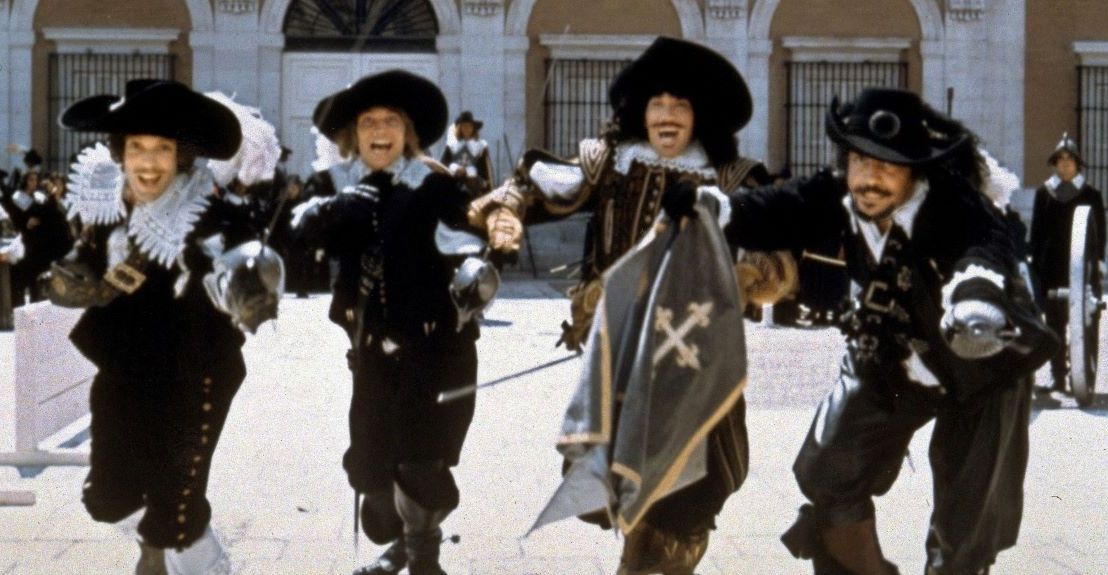
Category: Film about friendship

The Three Musketeers (1973) / The Four Musketeers (1974)

The Three Musketeers (1973) / The Four Musketeers (1974)

A film of two halves, in more ways than one: the swashbuckling original and its dark sequel

Director: Richard Lester

Cast: Michael York (d’Artagnan), Oliver Reed (Athos), Frank Finlay (Porthos/O’Reilly), Richard Chamberlain (Aramis), Raquel Welch (Constance Bonacieux), Jean-Pierre Cassel (Louis XIII), Geraldine Chaplin (Anne of Austria), Charlton Heston (Cardinal Richelieu), Faye Dunaway (Milady de Winter), Christopher Lee (Count de Rochefort), Simon Ward (Duke of Buckingham), Spike Milligan (Bonacieux), Roy Kinnear (Planchet), Georges Wilson (Captain de Treville)
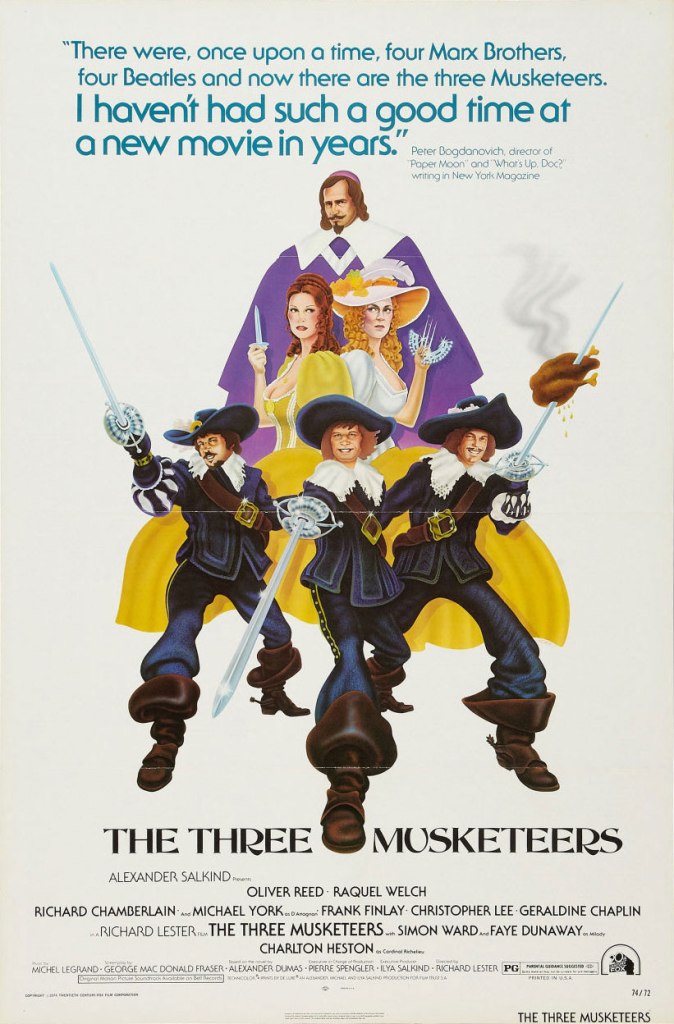
All for one and one for all! The Three Musketeers is probably the greatest adaptation of Dumas’ rollicking classic, a wonderful mix of swashbuckler, romance and Hellzapoppin comedy, that never takes itself particularly seriously and is crammed with actors having a whale of a time. It’s not quite a send-up, but it’s also not quite a straight re-telling either. Instead, it’s gunning all-out for entertainment – and it succeeds most of the time.

d’Artagnan (Michael York) arrives in Paris in 1625 desperate to join the musketeers. After various adventures along the way – including a rivalry with suavely villainious Rochefort (Christopher Lee) – the impulsive young man forms a friendship (after bumps in the road) with the famed musketeers Athos (Oliver Reed), Porthos (Frank Finlay) and Aramis (Richard Chamberlain). Falling in love with the unhappily married Constance (Raquel Welch), maid to Queen Anne (Geraldine Chaplin), d’Artagnan and his friends are dragged into foiling a plot by the ambitious Cardinal Richelieu (Charlton Heston) to use the ingenious Milady de Winter (Faye Dunaway) to expose the Queen’s infidelity with the Duke of Buckingham (Simon Ward). Will our heroes manage to foil the scheme in time?

The Three Musketeers adapts the first third or so – the most famous and by far the most enjoyable part – of Dumas’ novel. With an irreverent script by Flashman author George MacDonald Fraser, its framed as a rollicking romp with a tongue-in-cheek humour. Richard Lester, famed for his cheeky Beatles comedies (and the film was originally envisaged as a vehicle for the Fab Four), added his trademark scruffy, opportunistic comedy.

The film is awash with muttered asides – many of them well delivered by Roy Kinnear’s exasperated servant Planchet – that are only just picked up by the sound mix. My favourite? d’Artagnan bursting into a room full of guards, yanking a rug with a yell in an attempt to upend them, succeeding only in tearing the corner off it, then immediately jumping out of a window, leaving the bemused guards one of whom plaintively mutters “He’s torn our carpet” – I find this funny on multiple levels, from York’s all-in energy to the stillness of the shot, to the underplayed sadness of the punchline.
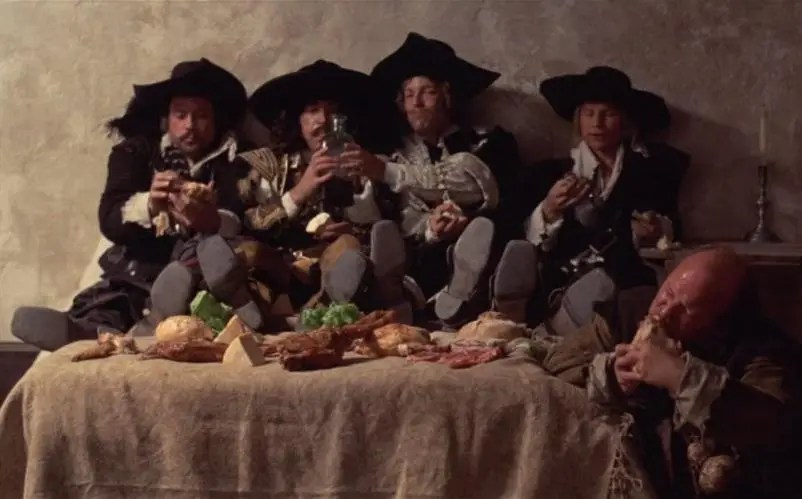
Lester’s film is full of long-shot gags – passengers in litters being dropped in a lake, d’Artagnan swinging on a rope to knock someone off a horse, missing and falling in the mud or his jump from a third storey window only to immediately reappear having landed on a (anachronistic) window cleaner cart. While the film does have its moments of drama, danger and intensity, it doesn’t ease up on visual humour, or gags (“This ticket is for one man” “I am one man. This is a servant”). It’s all part of Lester’s plan to make a fast-paced, pantomimic entertainment in which nothing is intended to ever be too serious.

It’s all played with maximum commitment by the cast, all of whom buy into the films’ tone. Michael York leaves very little in the locker-room with a performance full of youthful bravado, lusty hurrahs and naïve, winning eagerness. It’s a very hard balance to get right but he is never overbearing, but provides a relatable, likeable lead. He’s physical commitment to a series of Buster Keaton style gags is also commendable. He sparks a rather sweet romance with Raquel Welch, who is not the world’s strongest actress, but gamely delivers a series of pratfalls as the eternally clumsy Constance.

Around these two, a series of experienced actors delight in larger-than-life roles. Reed brings a surly intensity to Athos, a reminder of how great a career this charisma laden actor could have had. Finlay gives a Falstaffian joie de vivre to Porthos. Chamberlain (with little to do) strikes a gamely romantic figure as Aramis. As the baddies, Heston clearly enjoys subverting his grandiosity as the scheming Cardinal, Dunaway has a kittenish sensuality as Milady and Christopher Lee is so perfect as the debonair Rochefort that his eye patch (unmentioned in Dumas) has become de rigour for every Rochefort performance afterwards.

The Three Musketeers is crammed with swashes being buckled. The sword fights come thick and fast and are all shot in a series of impressive locations (the camera work of David Watkin, design of Brian Eatwell and costumes of Yvonne Blake do a wonderful job creating a sumptuous period setting). At times they do look a little ragged today – producers the Salkinds ran a tight budget, and there are multiple reports of the slightly-under-rehearsed fights leading to near-serious injury (this slapdash preparation would lead to tragic consequences when Roy Kinnear was killed on the belated second sequel 15 years later). But the actors enter into them with a firey commitment (a little too much so in Reed’s case according to the terrified stuntmen) and rumbunctious energy that really sells these as gripping action. They are also give a certain air of peril that gives just enough weight to the film.

The Three Musketeers has moments of dated clumsiness – the bizarely arty slow-mo opening with blurred motion feels totally out-of-keeping with the rest of the film – and not all the jokes land (Spike Milligan in particular is completely over-indulged in the film’s least successful comic moments). Not every performance works – Chaplain in particular is weak as Anne of Austria – and not all the jokes pay off. The musical score by Michael Legrand, catchy as it is, sometimes overeggs the “isn’t this all such fast-paced fun” angle. But the stuff that lands, really does well and there is more than enough fun, action, adventure and rollicking good humour to keep you entertained on a weekend afternoon.

And then there were two (or rather four)
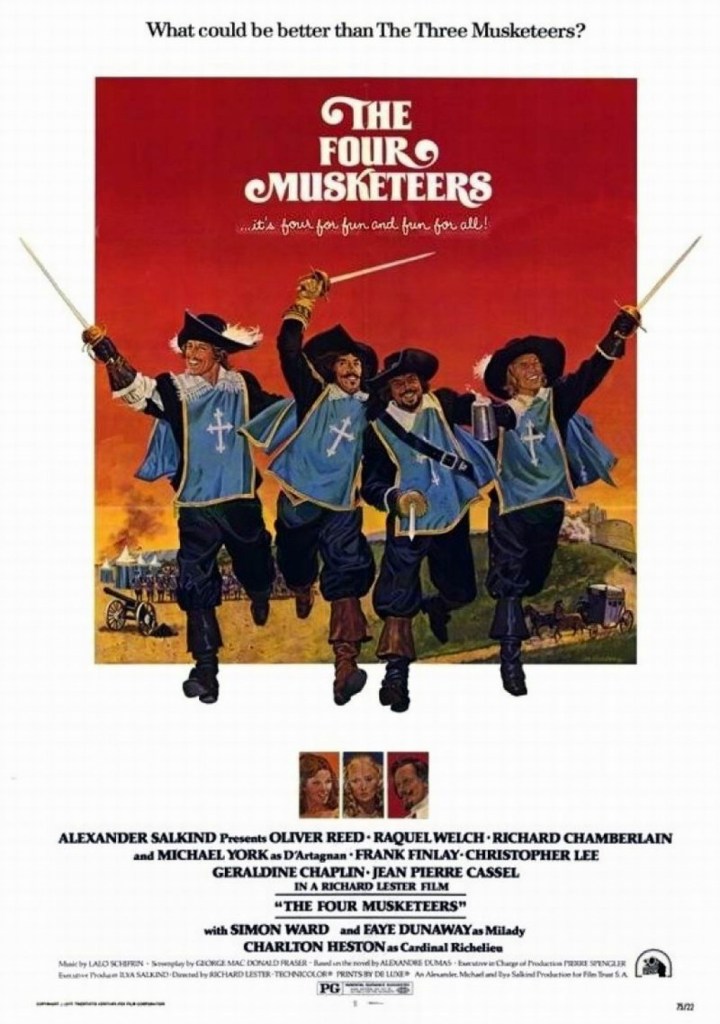
There is always a twist in the tale. At some point while making The Three Musketeers the Salkinds realised they would never get it ready for the Paris premiere. But they could get half the film ready. So, they released that and cheerily announced at the end a sequel was already in the can. Problem was no one had mentioned it to the cast, who discovered they had shot an entire movie for free. A court case exploded, which the Salkinds lost, settling with actors and leading to a new clause being inserted into all contracts for actors preventing such a dodge happening again.

The Four Musketeers covers the second, less famous, much less fun part of Dumas’ novel. Rather like novel, it’s a rambling affair that lacks the compelling narrative thrust (We’ve got to get those diamonds and save the Queen!) which made The Three Musketeers so entertaining. It doesn’t help that its also considerably darker, serious and bleaker as bodies pile up and things get serious.

This makes the sequel a very different beast to the first. Energetic heroism prevented villainy in the first film, but here it often fails . Milady (Faye Dunaway) has sworn revenge and is ordered by Cardinal Richelieu (Charlton Heston) to assassinate Buckingham (Simon Ward). Along the way she kidnaps Constance (Raquel Welch) and seduces d’Artagnan (Michael York) seduced. The Musketeers rescue Constance, fight at La Rochelle and do their best to defend Buckingham – but nothing goes to plan, especially after Athos (Oliver Reed) realises Milady and his criminal ex-wife (thought dead) are one-and-the-same.

The Four Musketeers keeps up the humour, but it is frequently at odds with the darker film it sits in. Gone is the high-paced musical score of Michel Legrand, replaced with a lyrical series of melodies by Lalo Schifrin. It’s telling that Welch – whose comic clumsiness was a large part of the first movie – appears only briefly here. Similarly, Cassell’s shallow monarch (dubbed by Richard Briers) pops up just once, Roy Kinnear’s Planchet isn’t in the first hour and Spike Milligan’s free-wheeling improvisation is missing completely (in that case, no bad thing).

The film feels tonally at odds with the first film and even, at times, with itself. The Three Musketeers was full of sword fights but no deaths – here sword strokes are lethal. As the Musketeers comically bounce around at La Rochelle sight gags abound – but it feels at odds with a film where the death is very real. The more realistic feel means some set pieces – such as Rochefort and d’Artagnan fighting on an inexplicably frozen lake in the height of Summer – become harder to swallow.

Some performers do flourish. Oliver Reed comes into his own as an increasingly dark and vengeful Athos, giving into temptations of shocking revenge. Faye Dunaway laces her role with cold, murderous fury. They have most of the film’s most compelling scenes – but the incredibly dark ending (which involves our heroes actively perpetrating judicial murder with a terrified victim) while loyal to the book, feels far too heavy for a pair of films that started with Buster Keatonish comedy.

The loyalty to the book and the commitment to follow it is partly to blame. There is a reason why most adaptations chuck away this section of the book. It lacks a clear narrative line for emotional connection and is highly episodic. d’Artagnan, in the book, does indeed sleep around after Constance disappears – but when the film requires their relationship to be the emotional heartbeat, is it a good idea to have him jump into bed with two women within days of her disappearance?

Lester announces the more sombre parts by filming them in a very framed, artful way inspired by the old masters, with a static camera and medium shot, reliant on Schifrin’s maudlin music. He’s far more at home with the comic business delivered by Finlay (very good) and Chamberlain (still with nothing to do). At other points he surrenders initiative to legends like Heston (suavely menacing), Lee (whose Rochefort steps up a level in lip-curling contempt) and Dunaway.

The finest thing on display are the sets and the sword fights, which are even more desperate, ragged and violently dramatic than last time (when Rochefort and d’Artagnan stop in one to take a breath, you are not remotely surprised given the total commitment we’ve seen). The action set pieces all look really impressive and staged with confidence and brio. It’s just a shame that much of the rest of the story feels like its being told by a natural comic trying hard to be King Lear, but not able to resist throwing a few gags in. It makes for an entertaining, but tonally messy film that feels it has come from a totally different place than its flawed but fun predecessor.

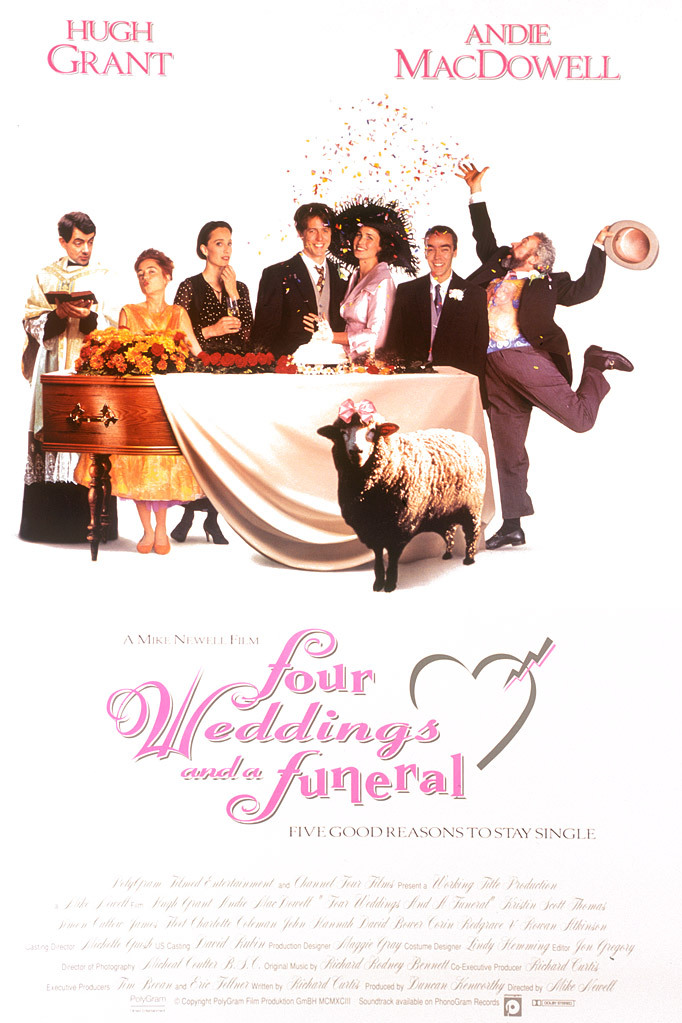
Four Weddings and a Funeral (1994)

Four Weddings and a Funeral (1994)

The phenomenon of the 90s, this charming comedy still (rightly) lies in many people’s soft spot

Director: Mike Newell

Cast: Hugh Grant (Charles), Andie MacDowell (Carrie), Simon Callow (Gareth), Anna Chancellor (Henrietta), Charlotte Coleman (Scarlett), James Fleet (Tom), John Hannah (Matthew), Kristin Scott-Thomas (Fiona), David Bower (David), Rowan Atkinson (Father Gerald), David Haig (Bernard), Sophie Thompson (Lydia), Corin Redgrave (Hamish Banks), Simon Kunz (John), Rupert Vansittart (George)

It’s 1994 and love really is all around. It certainly felt like it in the UK, as Four Weddings and a Funeral went from small Brit rom-com to national phenomenon. It was number one at the box office for ten weeks and Wet Wet Wet’s Love is All Around felt like it was number one for the whole year. The film was a huge international hit, the sort of once-in-a-lifetime movie for everyone involved, culminating in an Oscar nomination for Best Picture. For anyone who went to the movies in the 90s, it feels like an old, familiar friend. And, leaving aside the inevitable backlash, it’s still witty, charming and fun today.

Based on writer Richard Curtis’ experience of attending a never-ending parade of weddings one year (we’ve all been there), we follow Charles (Hugh Grant) through a series of disastrously different weddings (and, of course, one moving funeral) while he tries to deal with the fact he’s fallen in love with American Carrie (Andie MacDowell) – and one of the weddings he attends is hers. Around him float a phalanx of loyal friends: gregarious Gareth (Simon Callow) and his loyal, utterly reliable partner Matthew (John Hannah), dimly posh Tom (James Fleet) and his arch sister Fiona (Kristin Scott-Thomas) and zany Scarlett (Charlotte Coleman). But, when the time comes for Charles to head down the aisle, who will he find waiting for him at the end?

Four Weddings works because it’s blessed with a series of talents at the peak of their powers. Richard Curtis has never written a film script that balances so perfectly excellent one-liners, sharply sketched, engaging characters and a perfect mix of pathos and belly-laughs. Mike Newell balances the comedy with just the right touch of drama, never allowing events to tip into sitcom territory. The cast are all pretty much selected perfectly. And above all, it turned out Hugh Grant was placed on earth to play the lead roles in Curtis comedies.

Before Four Weddings, Hugh Grant was almost completely unknown: a Merchant Ivory supporting player at best. After it, he would be almost indistinguishable in the public’s eye from Charles (he’d effectively play the same role three times again for Curtis). What Grant does in this film is simply phenomenal. Curtis’ dialogue and rhythm fits his style like a glove: not since Rowan Atkinson (who delivers a Peter Sellars like performance as a nervous and shy vicar at the other end of the comic spectrum from Grant’s mix of comedy and pained earnestness) had an actor clicked so much with Curtis. There is, perhaps, no skill harder than light comedy, but Grant is a master at it.

He turns socially awkward comedy into a thing of beauty (trapped at a table with a series of ex-girlfriends, he lets the smallest inflections telegraph his desire for the earth to swallow him). He has the subtlety to not overplay pratfalls or physical gags (look at the minimalist simplicity which he plays being trapped, hiding, in a cupboard while a recently married couple have noisy sex in the same room, his face a mix of pained embarrassment and longing for escape). Grant captures better than almost any actor alive a peculiar, self-deprecating British sense of humour, the quiet rabbit-in-the-headlight horror of saying the wrong thing. He even makes you love Charles (who, in many ways, is a self-obsessed git) because Grant is so effortlessly likeable, emitting rays of little-boy lost charm.

It also works because the film crams into it a hinterland of friendship and warmth. The chemistry between the company is pretty much spot-on – you never for one moment doubt these people are lifelong friends, despite the fact we learn nearly nothing about any of them over the course of the film (even Charles – what other film would not even tell us his job?). Each of the actors seizes their role with relish. Simon Callow got to explode with red-faced bonhomie and shaggy-faced camp in a way you suspect he had been dying to do his whole career. Kristin Scott-Thomas’ arch dryness and icy posture was leavened with just the right touch of romantic yearning and wit.

In fact, the whole cast were so perfectly cast they almost became destined to spend their whole lives struggling to break out of the moulds Four Weddings placed them in. James Fleet was so skilled at nice-but-dim sweeties like Tom, he had to grow a huge beard to get serious roles. John Hannah (extremely good, with the films much touching WH Auden inspired moment) took on playing a posh twit in The Mummy. Anna Chancellor was so born to play the strangely needy ‘Duckface’, Charles’ ex-girlfriend she jokes the first line of her obituary will be “Duckface dies”. Callow and Scott-Thomas would play versions of these roles several times over – and even being arrested for picking up a sex worker wouldn’t break the public perception of Grant being Charles.

Which is all a round-about way of saying everything works here, the magic alchemy of everyone being in the right place at the right time, and every single risk paying off. You can be slightly churlish and say Andie MacDowell lacks some of the charisma and comic skill the role of Carrie needs (it’s a Meg Ryan role), but her innocent Southern exterior is needed to make the scene of her recounting her serial shagging to Charles over a restaurant table land with as much comic force as it does.

That’s one of many comic set-pieces that just plain work. From the “fuck!”-filled opening montage, which sees Charles hare, late, to a wedding where he is the best man, via the film’s many social faux pas (“She is now my wife” has never been funnier), Atkinson’s malapropism-stuffed wedding service to the film’s final comic denouement at Charles’ wedding, it’s packed with laugh-out-loud moments. But, because the characters are so well-drawn, with just the right amount of reality, we also care as well. The funeral carries real emotional impact – not least due to Hannah’s beautiful delivery of the eulogy (and let’s not forget, few other mainstream movies were as open to homosexuality at the time as this one). And every character has moments of depth: even dim Tom has flashes of real emotional insight.

You can mock it in retrospect for moments like “is it raining, I hadn’t noticed” – but films like this don’t stumble into becoming cultural phenomena. They get there because, for one glorious moment, everything comes together the way it was meant to be. A great script got just the right approach, from a series of actors perfectly cast and marshalled by a director towards warm, genuine comedy. That’s why people continue to watch – and quote it – thirty years later and it still feels like love is all around it.

Dark Victory (1939)

Dark Victory (1939)

Bette Davis almost single-handedly lifts another tear-jerker into something grander

Director: Edmund Goulding

Cast: Bette Davis (Judith Traherne), George Brent (Dr Frederick Steele), Humphrey Bogart (Michael O’Leary), Geraldine Fitzgerald (Ann King), Ronald Reagan (Alec Hamm), Henry Travers (Dr Parsons), Cora Witherspoon (Carrie Spottswood), Dorothy Peterson (Miss Wainwright)

Judith Traherne (Bette Davis) is vivacious and fun-loving. From her grand Long Island home, her days are taken up with racehorses and fast cars, her nights with parties and booze. No wonder she keeps having headaches and making those small falls, right? Pushed to check it out at the insistence of her best friend Ann (Geraldine Fitzgerald), it doesn’t take long for brain specialist Dr Frederick Steele (George Brent) to diagnose a brain tumour. An operation is a short-term success, but Judith’s condition is terminal. At best, she has a year to live. Steele and Ann decide to keep the news from Judith – but when she discovers the truth she decides to live life to the full with Frederick, the man she has grown to love.

Watching Dark Victory is a reminder of the sometimes-limited opportunities for women in Hollywood at the time. If an actor as radiantly talented as Bette Davis were a man, she would have been playing earth-shattering roles in stirring dramas. This was when Tracy, Muni and March were playing explorers, scientists, world leaders and campaigners. Davis, like other women, saw the vast majority of strong roles for women centred on screwball comedies or as loving wives and mothers. As such she made a career propping up effective, sentimental twaddle like Dark Victory.

Which is to be a little harsh, I will admit, on a fine if unambitious tear-jerker. Dark Victory had been a Broadway play – and a flop. The stage had exposed a little too clearly the blatant emotional manipulation of the story of a woman who falls in love in the final year of her life then facing death with self-sacrificing fortitude. On film though, it could be made to work, not least through the full-throated commitment and intelligence of Bette Davis’ acting.

Davis is too often button-holed into the “camp icon” bucket, but Dark Victory – much like Now Voyager – sees her real strong suit, turning ordinary women, tinged with sadness, into portraits of deep tragedy and emotional self-sacrifice. Davis evolves Judith from a shallow, fun-loving playgirl into someone thoughtful, caring and empathetic. Davis avoids almost completely the obvious histrionics you could resort to playing a woman dying of a terminal brain tumour.

Instead, she meets her diagnosis with a carefully studied casualness that hides her fear, confronts the realisation that she has been deceived with a betrayed disappointment rather than carpet-chewing fury, and faces death with an unselfish concern for others (a physical tour-de-force as Davis acts blind – the final stage of her condition – but hides this from her husband so as not to cause him to abandon a medical research conference he has postponed frequently for her sake).

It’s all, of course, very standard material for a tear-jerking “woman’s picture” of the 1930s. A flighty woman finds love, happiness and inevitable tragedy. Davis fizzes around much of the film’s first 30 minutes with a Hepburnesque energy and wit, jodhpurs and champagne glasses abounding. A great deal of sweet charm brilliantly adds to the poignancy as, in her first consultation with Steele, she fails to identify blindfolded the same object being placed in both hands (a dice, a pencil and a piece of silk, all instantly identified in her left are met with confused incomprehension in her right). This is highly skilled, emotionally committed acting that pays off in spades as the gentle, thoughtful, caring woman underneath is revealed.

It helps that Davis has a trusted director in Edmund Goulding. Never the finest visual stylist or most compelling technician, Goulding’s great strength was his finesse with actors. He worked especially well with Davis, his careful focus on performance over technical flair giving her an excellent showpiece for her skills. Davis paired again with George Brent, a solid but generous actor (with whom Davis started a long-running affair) never better than when breathing humanity and life into an on-paper stiff roll as a noble surgeon who falls in love with his patient.

Brent and Davis’ chemistry and comfort with each other squeeze out all other potential romantic sub-plots, despite the actors in the roles. Lord knows what the Irish Republican Brent made of Bogart’s bizarre Irish accent as Judith’s roguish horse trainer. Bogart looks hilariously uncomfortable, his accent coming and going and he lacks affinity for the role or the film. He still comes off better than the rather wet Ronald Reagan as Judith’s playboy friend. Instead, the film’s finest supporting performer is the wonderful Geraldine Fitzgerald, sparky, firm-jawed and endlessly loyal while torn up with grief for her friend.

Dark Victory, though, rises and falls on the success of Davis’ performance. It certainly makes no secret of the fact that we are heading towards a tragic ending. A parade of doctors emerge to confirm to Steele that, yes, the disease is terminal. When Judith uncovers her case notes, she flips through an army of letters from eminent surgeons repeating the phrase “Prognosis: negative” – she even then asks Steele’s secretary to explain the wording. We are building up constantly towards a show-stopping, three-hankie, climax of Judith’s inevitable decease.

And yet the film still manages to get you. Again, it’s the low-key but honest performance of Davis that makes this. The moment of tragic realisation that death is arriving, then the studied determination to carry on regardless and to spare her loved ones as much pain as possible. It’s the self-sacrificing decency and honour of the very best of the “women’s pictures”. Davis delivers on it so utterly successfully, it does make you wonder what triumphs she might have had if she could have played the sort of roles males stars played, as well as breathing such conviction-filled life into gentle weepies like this.

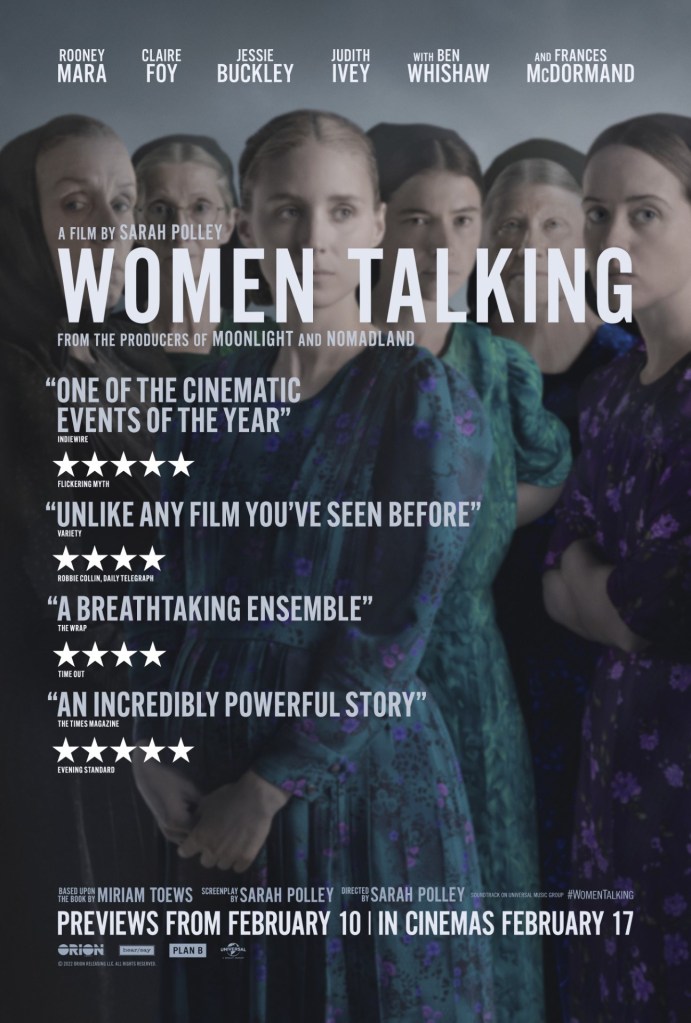
Women Talking (2022)

Women Talking (2022)

A worthy attempt but a misfire, that frustratingly fails to grapple with deeper feminist issues, settling for a safer, less challenging consensus

Director: Sarah Polley

Cast: Rooney Mara (Ona), Claire Foy (Salome), Jessie Buckley (Mariche), Judith Ivey (Agata), Ben Whishaw (August), Frances McDormand (Scarface Janz), Shelie McCarthy (Greta), Micelle McLeod Mejal), Kate Hallett (Autje), Liv McNeil (Nietje), Emily Mitchell (Miep), Kira Guloien (Anna)

In 2010, the women of an isolated Mennonite community discover they have been victims of a policy of systemic drugged rape by the men, every night for decades. All this remains unknown until a man is caught in the act and the attackers arrested. The other men go to the city to bail them out, informing the women they will be expected to forgive on their return. The women hold a vote about what to do: do nothing, stay and fight or leave. When the vote is tied between the latter two options, the women decide the final choice will be in the hands of a small group of their number, who will debate in the community’s hay loft.

All of this happens, in voiceover, in the film’s opening few minutes. It all sounds more engaging, challenging and dynamic than what actually happens in the film. I saw Women Talking with my wife, who is passionate about the issues this film wants to deal with. We were both united in our view of the film: Women Talking is full of talking, but no one really says anything. It’s a missed opportunity that fails to convert its undeniably powerful premise – or the committed and passionate performances of its cast – into something that really successfully grapples with, and comments on, the issues, with a cast of characters who feel more like devices than fully-rounded people discovering their voices and freedom.

It’s a film that should have the urgency of a time-bound debate and the passion of a group of women discovering that they have the power to make decisions themselves. But the film feels slow (much longer than its two hours), flat and theoretical where it should be filled with debate and different ideas. It has moments of power and speeches of tragedy, but it doesn’t manage to make this something truly revolutionary.

The film would have been more interesting if it had been about everything covered in that opening monologue. In this community the women are kept illiterate, have never been allowed to be part of any decision-making and are so oppressed they don’t even have language to understand what sexual assault is. There was a fascinating film waiting to be made about these women working out exactly what had happened to them – imagine the heart-rending conversations that must have involved – and discovering they were just as capable of reaching decisions in their own right as men. Of finding their voice and freedom.

Now that is a film about feminism I want to see! I wanted to see these women who have never even considered ideas about independence and self-determination discovering they could do that. Just having a vote in a community like this one is an astonishing revolutionary act – it shouldn’t be so blandly passed over as this film does. How did these women even realise that they could decide for themselves what they to do with their lives?

Instead, we get a film where actual debate is surprisingly neutered. Frances McDormand’s character is the voice of conservatism, but walks out of the debate after five minutes and never comes back. With her gone, no counter-arguments are raised, no voice given to help understand why people (and many of them have done so) would choose to stay in relationships even after they know the truth. McDormand’s character is almost certainly wrong – the women should get out of this awful place – but we should at least hear her say why she wants to stay and the film should trust us to understand that listening to her viewpoint isn’t the same as agreeing with it.

In fact, it would have been fascinating to hear why so many women in the community heard about the systemic rape and yet voted to stay. The hay-loft debates should hum with the exchange of ideas. We should hear different viewpoints. Many people voted to stay and do nothing: why? Let’s hear what makes these women accept what’s happened to them. Are they institutionalised, love their husbands despite their faults or can’t imagine leaving their homes no matter the cost? We don’t know. It’s like the film makers were worried that a debate which actually included all potential viewpoints would have been seen as reducing the horror. In reality, however, it’s essential.

There is also a fascinating discussion to engage with about justice and forgiveness – particularly given the film’s setting in a religious community that preaches forgiveness. The men have demanded the women forgive. Ona (Rooney Mara) declares early on that forced forgiveness cannot be real. But instead of engaging with this, that throwaway is all we get. It’s a deep question which we often grapple with in the wake of terrible crimes. Whole books have been devoted to people who can or cannot forgive those who’ve committed terrible crimes against them or their loved ones. There’s so much this film could have delved into with its cast of women who’ve been told all their lives they must forgive – but it had no interest.

Instead, the film wants to make things easy. It completely shirks any debate of religion. This is a community of women whose entire understanding of the world is founded on the Bible and religious instruction. But yet God, faith and Christian ideas barely come up. It’s briefly mentioned that leaving the community means exile from heaven – but that is benched and never raised again. It should be at the heart of their considerations. There isn’t even a debate about whether their community’s teachings are legitimate (since they are partly based on systemic rape, we can guess not).

In the end rather than really tackling themes, we get conversations which do little but make the same point over and over again. Some of these speeches are undeniably powerful, and the performances of Foy and Buckley in particular are strong, but they are weakened by the lack of depth to the characters.

Women Talking is full of words but never says as much as you are desperate for it to do. The actors do a fine job with the passionate speeches and bring a lot of power to this chamber piece. But it’s frustrating that we feel robbed of seeing these women realise they have the power to choose and instead circles a highly emotive but ultimately slightly unrevealing discussion intercut with on-the-nose shots of fields, playing children and empty kitchen tables. It manages to avoid focusing on anything potentially interesting or engaging and feels like a worthy missed opportunity.

Fight Club (1999)

Fight Club (1999)

Hugely popular, I find it widely misunderstood but also a little too in love with its own cleverness

Director: David Fincher

Cast: Edward Norton (The Narrator), Brad Pitt (Tyler Durden), Helena Bonham Carter (Marla Singer), Meat Loaf (Robert Paulson), Jared Leto (Angel Face), Holt McCallany (Mechanic), Zach Grenier (Richard Chessler), Eion Bailey (Ricky), Peter Lacangelo (Lou), Thom Gossom Jnr (Detective Stern)

When Fight Club was made, the studio didn’t get it. You can’t blame them. Studio suits sat down and just couldn’t understand what on earth this primal cry of anger, giving voice to the disillusioned and dispossessed, was going on about. Fight Club was categorically not for them. I’d managed to miss it for decades, so it’s an odd experience watching this angry millennial film for the first time when I’m now exactly the sort of punch-clock office drone its characters despised. I think I missed the boat.

Our narrator (Edward Norton) is cynical, bored and feels his life is going nowhere. Suffering from crippling insomnia, he takes to attending support groups for various terminal illness survivors, releasing his own ennui among the pain there. It’s where he meets fellow ‘suffering tourist’, Marla (Helena Bonham Carter), whom he’s attracted to while resenting her intrusion on his own private therapy. Shortly after he meets Tyler Durden (Brad Pitt), a charismatic rebel with whom he founds an underground bare-knuckle fight group for men who can’t express themselves in the modern world. But Durden’s charismatic, anti-corporatist rhetoric tips more and more into radicalism and he starts an affair with Marla. What will our Narrator do?

Sometimes I think Fight Club might be one of the most misunderstood films ever. So many people who have fallen in love with it talk about it being an attack on conformity in our cold modern world. Of its celebration of people leaving the oppressive, mindless 9-5 grind to find something true and real that makes them feel alive. To be fair, Fight Club is partly this. But how do our heroes do this? By starting a cult where the bitter, resentful and inadequate search for meaning through violence and becoming part of a monolithic organisation that bans independent thought. Essentially, it’s a cult movie, exploring what makes people who can’t relate to the monotony of the “real life”, embrace an oppressive set of rules simply because those rules make them feel important.

This misreading by many is a tribute to the brilliance of Fincher’s direction. Fincher’s film is radical, sexy, pulsating and exciting. It’s shot like a mix of music video and experimental feature and crammed with cutting, witty lines that skewer and puncture the ”grown up” ideas that so many find weary and tiresome. It’s a modern Catcher in the Rye and it pours all its functional, dynamically written anti-establishment rhetoric into the mouth of one of the world’s most charismatic stars in Brad Pitt and allows him to let rip.

Fincher’s Fight Club is really, to me, about the intoxicating excitement of anger, of how easy it is to pour your frustrations into actions that are destructive and selfish but which you can invest with a higher meaning. School shooters, incels – many of them see themselves as stars in their own Fight Clubs, as cool anti-establishment rebels who see some higher truth beyond the rest of us. Fight Club is a brilliantly staged exposure of how this mindset is created and how damn attractive it can be.

Because when Pitt lets rip with this mantra on finding truth and purpose, turning your back on Ikea and Starbucks and all the other soulless “stuff” people find important, you want to stand up and cheer with him. You can see that the attraction of forming a secret brotherhood with a series of other similarly frustrated men, who feel emasculated and purposeless in a world where they can’t do something meaningful like fight Nazis or hunt deer. How they could find satisfaction and a sense of masculine validation in punching seven shades of shit out of each other. Because, as the adrenalin and the blood flows, and the teeth go flying, you feel alive.

It’s certainly a lot more fun than trying to actually deal with your problems. Fight Club is really about this sort of toxic, masculine anger and bitterness leads us to fail to deal with our problems. The Narrator needs Durden, because he can’t manage to process his own feelings of insecurity and inadequacy. He can’t deal with ennui – except through a constant stream of cynical, privately spoken, bitter remarks – and when he meets a girl he likes, he can’t cope with that either.

Durden comes into his life straight after Marla does, and Durden does everything with Marla the Narrator can’t. He flirts with, impresses and fucks her. That’s the sort of thing the Narrator (literally) can only dream about doing. The film builds towards the Narrator realising that, by embracing Durden, he is denying himself the possibility of something real with an actual kindred spirit (screwed up as Marla is, she has decency and empathy). Fight Club – much as many of its fans who find the final act “disappointing” don’t want to admit it – is about putting away childish resentments and growing up. Even if the Narrator is culpable for the things Durden does – and only threats to Marla awaken his acknowledgement that he should do something – he recognises the aimless, irresponsible and dangerous anger of Durden is not healthy.

Because Fight Club centralises a group of terrorists who tell themselves they are plucky anarchists who don’t want to hurt anyone – but we know it never stops there. Especially when you have a mesmeric, Hitlerish figure like Durden driving people on. Pitt is superb as this raving id monster, a hypnotic natural leader who delivers rhetorical flourishes with such intense and utter belief he essentially brainwashes a legion of men into following his orders without question – acid burns, bombs and death don’t even make them blink, just even more willing to follow his orders.

Fincher works so hard to make us understand the attraction of all this that sometimes Fight Club – with its flash filtered look set in a nearly perpetual night – is more than a little pleased with its impish menace. It also takes a little too much delight in teasing its infamous twist – it’s a little too delighted with the “ah but when you watch it back” ingeniousness with which it presents a melange of scenes (the twist also makes you realise later just how brainwashed and dangerous the men in this cult must be, once we realise what they saw and how little they reacted to it). Fight Club also, for all its cool lines and winning gags, has an air of pop psychology to it. (I am very willing to overlook its cheap anarcho-socialism as we are very clearly invited to see this as empty nonsense – for all many people watching the film don’t.)

Edward Norton is extremely good in a challenging role, a stunted and bitter dweeb who dreams of being a player and barrels along with ever more dangerous events. He walks a fine line between a sheltered follower and true acolyte, in several moments showing more than a flash of Durden’s ballsy, take-no-chances, sadism-tinged determination when you least expect it. It’s the sort of performance designed to make sense in the whole, not in the moment – and on that score it’s exquisite. He also makes a wonderful pairing with Helena Bonham Carter, exploding her bonnet reputation with a part that’s rough-edged, unpredictable but surprisingly humane and vulnerable.

Is Fight Club a masterpiece? I’m not sure. It’s a very clever, sharp and dynamic piece of film-making designed to pull the wool over your eyes (in more ways than one). But it can also be overly pleased with itself and does such a superb job of getting you to empathise with the deluded and violent that when it gear changes in the final act it never quite lands as it should. It feels like an angry teenager’s idea of the greatest film ever made (and you can’t deny it digs into the same “loner who sees the deeper truth” vibe that helped make The Matrix a phenomenon later that year). It’s Fincher at his young, punk best – and maybe Fight Club got all this out of his system (you can’t believe the same man made this and Curious Case of Benjamin Button), but for me it lives in the shadow of Fincher’s dark and dangerous Seven, a film which explores similar themes but with more humanity and greater depth than Fight Club.

The Lavender Hill Mob (1951)

The Lavender Hill Mob (1951)

Delightful but surprisingly subversive Ealing comedy, one of my all-time personal favourites

Director: Charles Crichton

Cast: Alec Guinness (Henry “Dutch” Holland), Stanley Holloway (Alfred Pendlebury), Sid James (Lackery Wood), Alfie Bass (Shorty Fisher), Marjorie Fielding (Mrs Chalk), Edie Martin (Miss Evesham), John Salew (Parkin), Ronald Adam (Turner), Arthur Hambling (Wallis), John Gregson (Inspector Farrow), Clive Morton (Station Sergeant), Sydney Talfer (Clayton)

It’s my personal favourite of all the Ealing comedies. It’s always surprised me it has been so warmly endorsed by the Vatican. Sure, it ends with a cursory “crime doesn’t pay” message – and it’s got a great deal of lightness, affection and wit. You want our seemingly mousey underdog to successfully take on the big banks. But this is a surprisingly dark and subversive film under its cuddly exterior. Much like its lead character, appearances can be deceptive and The Lavender Hill Mob lulls you into a false sense of security to hide its surprisingly darker heart.

Set in post-War London, Henry Holland (Alec Guinness) is a timid bank clerk, paid pocket money to monitor the delivery of hundreds of thousands in gold bullion to his bank. And he’s had enough. Holland plans a heist – he’ll steal the money, escape unsuspected and live the life of Reilly he feels he deserves on the proceeds. The inspiration for how to smuggle the money out presents itself when he befriends artist turned tacky gift manufacturer Alfred Pendlebury (Stanley Holloway) – they’ll melt down the gold and smuggle it as Eiffel Tower models. What could go wrong?

The Lavender Hill Mob fits very neatly into the classic Ealing set-up. The plucky underdog takes on the establishment, in this case the heartless bank run by public-school poshos and the police with their new-fangled technologies. It plays these cards extremely well, poking fun at the set order and building a great deal of empathy with Holland and Pendelbury, the two most unlikely criminal masterminds you can imagine. Middle-aged, middle-class professionals who have led lives of quiet, dutiful anonymity, its huge fun to see them cut loose and embrace the chance to be bad-boys. Who hasn’t wanted to say “to hell with it” and grab the opportunities you want in life?

But TEB Clarke’s superb script, matched with Charles Crichton’s dynamic direction, has a darker heart under the surface charm. Set in a bombed-out post-war London, the film’s design never lets us forget this is an upturned Britain, reeling from years of unimaginable upheaval. A country going through social and political change leaving old, deferential ideas in the past and old principles of morality might not apply. After all, when death was a nightly visitor to the capital, why should you continue to play by the rules? Holland is actually a man who has simmered with quiet, unspoken resentment for decades, who crafts the perfect heist and sees it through with obsessive, almost cold-hearted fanaticism.

Sure, he seems sweet and, yes, he doesn’t half get swept-up in childish excitement in the glamour of crime – who can forget his bashful desire to take on the criminal nom de plume Dutch. But the genius of Guinness’ performance is that he never lets us overlook the ambition, greed and willingness to go to any lengths under Holland’s meek exterior. Watch how Guinness stares with unblinking acquisitiveness at the gold as it melts down. The authoritative command he takes over Pendlebury when a small batch of gold Eiffel towers are accidentally purchased by a group of school children. The demanding perfection he insists on in every step of the heist.

This is Guinness at his absolute best and perhaps only he could combine such a criminal heart with light-comedy. Holland is an immensely endearing character because his success remains so unlikely. His scheme is low-tech and clever so it’s impossible not to end up rooting for it – especially when the resources and technology of the police and the bank are so well sign-posted. Guinness is giddy with excitement at the scheme – but also look at how quickly and coldly he lies, how smug and satisfied he can be in success and how ruthless when the situation calls for it. But yet we love him. This is dramatic and light comic acting distilled in one. He’s superb.

If anyone is a corrupted innocent, it’s Alfred Pendelbury. Played wonderfully by Stanley Holloway as a poetry-quoting dreamer, Pendlebury is the real unlikely criminal here. Holloway and Guinness have a wonderful chemistry, both enjoying the naughtiness of theft, but with Holloway’s star-struck eyes, Pendlebury is the follower, in awe of Holland’s cleverness and determination. Poor Pendlebury almost blows the heist by absent-mindedly wandering away from a newspaper stand still clutching an (unpaid for) newspaper, blithely suggests they let lost Eiffel towers go and bundles around the crime with an optimistic amateurism.

Clarke’s script has a lot of fun with questions of class. The pompous bank managers are exactly the sort of arrogant posh-boys who look down on everyone else with paternal disregard. They are blank, unthinking automatons. Class works both ways. Holland is unsuspected of the crime as he’s the sort of middle-class person who wouldn’t do this sort of thing. Holland and Pendlebury are quietly resentful of those above them – but they assume the same authority over the criminal classes they recruit for the scheme. Sid James (cementing his persona as a cheeky spiv) and Alfie Bass are natural cap-doffers who quickly accept their place in the gang’s hierarchy and even (rather sweetly) trust Holland and Pendelbury to deliver their share from Paris (naturally, as working-class lads, they are suspicious of travelling to France anyway to collect the loot).

The Lavender Hill Mob exposes the assumptions and traps of the class system in this country, and does so with a gentle, sly, subversive wit. Holland is basically the forerunner of the sort of bitter middle and lower middle class ambitious types who would drive change in Britain in the next few decades.

The film also gets a lot of comic mileage out of the smug ineffectiveness of most of the official forces. The police have a raft of technologies – radios, cars, scientific techniques – all of which do very little to help. In a late car chase through London, the radios actively work against them – Holland easily uses the radio in their stolen police car to spread disinformation, the central radio director guides several cars into a collision and eventually scrambled signals lead to “Old MacDonald” being played on all receivers. Optimistic but hopelessly inaccurate bulletins are constantly posted on their progress and only personal inspiration of the lead detective (a colourless John Gregson) and chance leads to the crime being unmasked. As well as looking at the dark bitterness of its lead character, The Lavender Hill Mob is strikingly cynical about officialdom.

Crichton’s direction is visually inventive and at times almost Hitchcockian – Holland and Pendlebury’s dizzying stairway descent from the Eiffel Tower arguably inspired Vertigo. And the film is supremely funny. The heist is planned with perfect comic timing, chase scenes are brilliantly done and there is a superb farcical set-piece as Holland and Pendlebury hurriedly try to negotiate French customs in a rush to catch a boat. Every scene has a funny line or inspired piece of comic business and Clarke’s script perfectly balances this with gentle but intelligent social commentary.

The Lavender Hill Mob is a triumph. From start to finish a delight, insightful and funny, it has superb performances from a faultlessly brilliant Guinness and a bombastically huggable Holloway. It wraps up comedy, social commentary and a surprising cynicism into a complete package. It’s a tour-de-force of charm, shrewdness and grace. It remains my best loved Ealing comedy, and possibly one of my favourite comedies ever made.

Back to the Future Part III (1990)

Back to the Future Part III (1990)

The franchise closes on a high with a fun, romantic and exciting finale, tonnes better than Part II

Director: Robert Zemeckis

Cast: Michael J. Fox (Marty McFly/Seamus McFly), Christopher Lloyd (Emmett “Doc” Brown), Mary Steenburgen (Clara Clayton), Thomas F. Wilson (Biff Tannen/Buford “Mad Dog” Tannen), Lea Thompson (Lorraine McFly/Maggie McFly), James Tolkan (Marshal James Strickland), Elizabeth Shue (Jennifer), Matt Clark (Chester), Richard Dysart (Salesman), Flea (Needles)

And we’re back. After the frankly awful Back to the Future Part II – an onslaught of bad gags, terrible performances, clumsy call-backs and a lot of sound and fury – the trilogy ended on a high with Back to the Future Part III which, by going back to the past, managed to find more heart and originality than Part II ever had. Strangely, by looking backwards in time, the series managed to look forward to new ideas. Part III is, by many degrees, a huge improvement.

We left Part II with Doc Brown (Christopher Lloyd) stranded in 1885 and Marty McFly (Michael J Fox) equally stranded in1855. How are they going to get back to 1985? Well Doc is happy where he is, and has left the Delorean buried in 1885 for Marty to dig it up in 1955 and get back to the future with the help of the 1955 Doc. But, digging the Delorean up, Marty discovers Doc’s 1885 grave: turns out he will be murdered by gunslinger Buford “Mad Dog” Tannen (Thomas F Wilson). So, Marty travels back to 1885 to save him. But with the Delorean damaged on the way, how will they get back to 1985? Will Doc or Marty be killed in a fatal gunfight with Tannen? And what about the Doc and schoolteacher Clara Clayton (Mary Steenburgen) falling in love?

Back to the Future Part III juggles all these plot themes with real expertise, all based in a hugely affectionate portrait of the Old West that drips with Zemeckis and Gale’s childhood love for the genre. I’m going to guess that Part III is inexplicably not held in the same regard as Part II because my generation and onward simply has far less of a connection to the Western than they do crudely cheesy views of an 80s tinged future.

But the sense of fun here is on point. Galloping horses, street fights, open air dances, trains, cameos from old-school Western supporting actors, the majestic score… it’s all an on-point reconstruction of the tone and style of Ford. (In particular, the entire film feels like a fun recreation of many elements of My Darling Clementine). The film also has fun with later perceptions. Marty is dressed up for his journey back to 1885 in the sort of brightly coloured, skin-tight costumes 1950s TV and B-movie western stars wore. He adopts the alias “Clint Eastwood” (and doesn’t the film have fun with that). He even (eventually) dresses not dissimilarly from the Man with No Name himself.

It doesn’t stop with the Western re-build. Back to the Future Part III has the inevitable call-back gags to events we have seen throughout the last two movies. But here they are delivered with a far more freshness. Not least because Doc and Marty largely reverse roles here (leaning into this, they even swop their catchphrases at one point). While in the previous films Marty was the impulsive one, flying by the seat of his pants with instant decisions and being assisted by the eccentric Doc, here they settle into new roles.

Because Doc here is the one being rescued and the one tempted by an impulsive decision. Namely, staying in the past because he has fallen in love. Christopher Lloyd, a much better actor than he gets credit for, is allowed to broaden out and enrich his eccentric performance as Doc with a real emotional depth in a very sweetly drawn romance. Mary Steenburgen is equally good as the kindred spirit he falls in love with. Both actors play the romance dead straight and it allows Lloyd to show an emotional depth and shade his performance has lacked elsewhere. Steenburgen’s casting is also a nice tip-of-the-hat to Time After Time (where she also played a woman who inadvertently falls in love with a time traveller). Clara is also a neatly written character, integrated far more into the plot than poor Jennifer in Part II and another welcome shake-up the buddy formula.

As Doc takes on the romantic and paradox creating role, Marty becomes the driver, urging Doc to stop getting mixed up in influencing past events and focus instead on fixing the Delorean and getting back home. Fox embraces playing (largely) the secondary role in the film. He still gets moments of fun as an actor (not least playing Marty’s Irish great-grandfather – a performance immeasurably better than all his latex covered efforts in Part II) but he’s largely the voice of sense here.

Except of course concerning his fatal character flaw: don’t call him chicken. There is nowhere more dangerous to allow someone to pick a fight with you than the Wild West. And Marty swiftly inherits the clash with Tannen (played with gruff comic gusto and impenetrably density by Thomas F Wilson). This culminates – but of course – in a face-off in a dustbowl street, with a solution to the gunfight inspired by the real Eastwood and nicely signposted in Part II.

That leads into a genuinely edge-of-the-seat exciting race to hijack a train to push the Delorean up to the desired 88 miles an hour. Zemeckis shoots and cuts this sequence to perfection – and Alan Silvestri’s score does a lot of build and sustain the tension and excitement – and it seems appropriate that the only real opponent Marty, Doc and Clara have to deal with in this sequence is time itself. Crammed with sight gags, orchestrated to perfection and perfectly paced it’s a great way to cap the series.

Much as the film itself is a perfect ending to the franchise. Its imaginative and playful, riffing on the previous events without slavishly imitating them, approaching both its characters from new angles that helps us discover new things about them and crammed with great jokes, exciting set-pieces and genuine emotion. It’s easily the second-best film in the franchise. If you want to revisit a sequel for Back to the Future do yourself a favour and pick the one in the past.

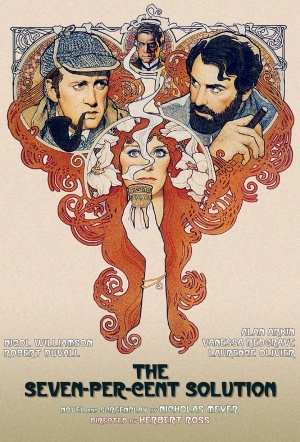
The Seven-Per-Cent Solution (1976)

The Seven-Per-Cent Solution (1976)

Affectionate and faithful Holmes pastiche that shines an interesting light on the Great Detective’s character

Director: Herbert Ross

Cast: Nicol Williamson (Sherlock Holmes), Robert Duvall (Dr John Watson), Alan Arkin (Dr Sigmund Freud), Laurence Olivier (Professor Moriarty), Vanessa Redgrave (Lola Devereaux), Joel Grey (Lowenstein), Jeremy Kemp (Baron Karl von Leinsdorf), Charles Gray (Mycroft Holmes), Samantha Egger (Mary Watson), Jill Townsend (Mrs Holmes), John Bird (Berger), Anna Quayle (Freda)

The magic of Sherlock Holmes is he is immortal. Doyle’s detective has been reshaped so many times since the publication of the canonical stories, that we’re now used to seeing him presented in myriad ways. It was more unsettling to critics – particularly British ones – in 1976, who didn’t know what to make of an original, inventive Holmes story that treats the characters seriously but is playful with the canon. Was this a parody or a new story? (Why can’t it be both!) Today though, The Seven-Per-Cent Solution stands out as a Holmesian treat, a faithful slice of gap-filling fan fiction.

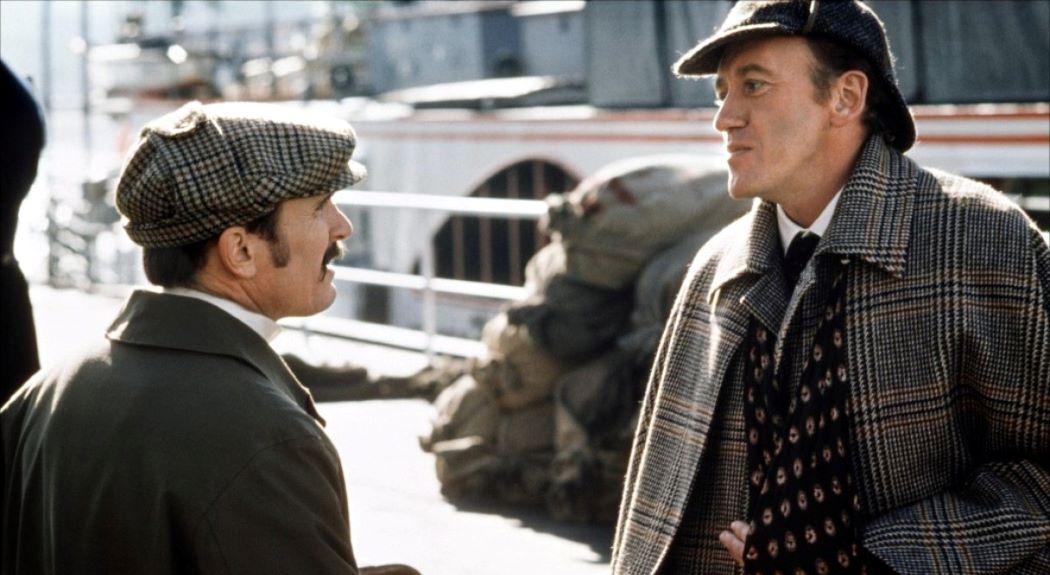
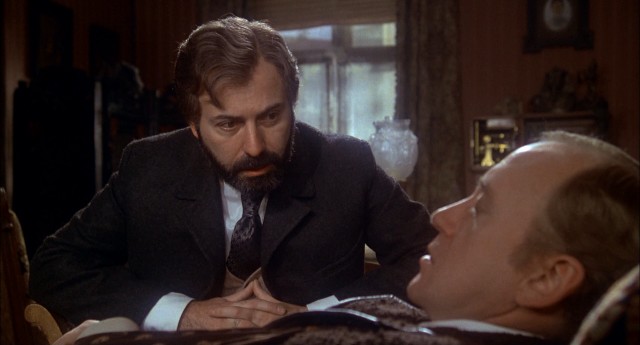
Based on a best-selling novel by Nicholas Meyer (who also adapted it), The Seven-Per-Cent Solution expertly reworks Doyle’s The Final Problem. Professor Moriarty (Laurence Olivier) is not the Napoleon of Crime, but a mousey maths tutor, the subject of Holmes’ (Nicol Williamson) cocaine-addled idée fixe. Worried about his friends dissent into addiction, Dr Watson (Robert Duvall) tricks Holmes into journeying to Vienna to receive treatment from an up-and-coming specialist in nervous disease and addiction, Dr Sigmund Freud (Alan Arkin). The treatment is a slow success – and the three men are drawn into investigating the mysterious threat to drug addicted glamourous stage performer Lola Devereaux (Vanessa Redgrave) that may or may not be linked to her fierce lover, the arrogant Baron Karl von Leinsdorf (Jeremy Kemp).

As all we Holmes buffs know, seven per-cent refers to Holmes’ preferred mix of cocaine, taken to stimulate his brain between cases and see off boredom. But what if that persistent cocaine use wasn’t a harmless foible – as Holmes tells the disapproving Watson – but something much worse? Kicking off what would become a decades long obsession with Holmes the addict – Brett and Cumberbatch would have their moments playing the detective high as a kite and a host of pastiches would explore the same ground – Meyer created a version of Holmes who was definitely the same man but losing control of himself to the power of the drug.

This short-circuited some critics who didn’t remember such things from school-boy readings of Doyle and hazier memories of Rathbone (those films, by the way, were basically pastiches in the style of Seven-Per-Cent Solution as well). But it’s a stroke of genius from Meyer, shifting and representing a familiar character in an intriguing way that expands our understanding and sympathy for him. Holmes may obsessively play with his hands and have a greater wild-eyed energy to him. He may sit like a coiled spring of tension and lose his footing. But he can still dissect Freud’s entire life-story from a few visual cues in a smooth and fluid monologue and his passion for logic, justice – as well as his bond with the faithful Watson (here bought closer to Doyle’s concept of a decent, if uninspired, man) – remain undimmed.

It helps that the film features a fantastic performance from Nicol Williamson. Few actors were as prickly and difficult – so could there have been a better choice to play the challenging genius? Williamson’s Holmes is fierce in all things. Introduced as a wild-eyed junkie, raving in his rooms and haring after leads, his behaviour oscillates between drug-fuelled exuberance to petulant paranoia. But there are plenty of beats of sadness and shame: Holmes is always smart enough to know when he no longer masters himself. When the mystery plot begins (almost an hour into the film), Williamson’s does a masterful job of slowly reassembling many of the elements of the investigative Holmes we are familiar with – the focus, the energy, the self-rebuke at mistakes and the excitement and wit of a man who loves to show he’s smarter than anyone else.

The film is strongest as a character study, in particular of Holmes. Its most engaging sections take Holmes from a perfectly reconstructed Victorian London (including a loving, details-packed recreation of 221B from production designer Ken Adam) to waking from a cold turkey slumber full of apologies for his cruel words to Watson. Seeing Watson’s quiet distress at Holmes state, and the great efforts he takes to help him, are a moving tribute to the friendship at the book’s heart. The clever way Meyer scripts Holmes’ ‘investigation’ into Moriarty (an amusing cameo from Laurence Oliver, his mouth like a drooping basset hound) sees him apply all his methods (disguise, methodical reasoning, unrelenting work) in a way completely consistent with Doyle but clearly utterly unhinged.

That first half serves as a superb deconstruction of the arrogance of literature’s most famous detective, who won’t admit the slightest flaw in himself. It’s still painful to see a frantic Holmes, desperate for a hit, causing a disturbance in Freud’s home and denounce Watson as “an insufferable cripple” (a remark met with a swift KO and later forgiven). Holmes’ cold turkey sequence is a fascinating sequence of nightmareish hallucinations, as he is plagued by visions of cases past (The Engineer’s Thumb, Speckled Band and Hound of the Baskervilles among them) and the eventual awakening of Holmes as a contrite, humbled figure very affecting.

Bouncing off Williamson we have the traditional “Watson” role split between that character and Freud. Robert Duvall is a very unconventional choice as Watson – and his almost unbelievably plummy accent takes some getting used to – but he gives the character authority without (generously) giving him inspiration. Limping from a war wound (another touch of the novels often missed until now), he’s dependable, loyal and goes to huge lengths to protect his friends.

But most of the traditional role is actually given to Freud, played with quiet charm and authority by Alan Arkin. Intriguingly the film places Freud as a combination of both men’s characters. He has the analytical mind of Holmes, investigating the subconscious. But he also chases after errands for Holmes, “sees but does not observe” during the case in the manner of Watson and eventually becomes an active partner in confronting the villains.

The actual mystery (taking up less than 40 minutes of the film’s runtime) can’t quite maintain the momentum, being a rather trivial affair (greatly simplified from the book) revolving around a cameo from Vanessa Redgrave as a fellow drug addict Holmes feels a touching sympathy for. Jeremy Kemp makes a fine swaggering bully, but his greatest moment is actually his pre-mystery anti-Semitic confrontation with Freud at a sports club, culminating in a Flemingesque game of real tennis between the two. If the film has any moment that tips into outright comedy, it’s a closing train chase that involves Holmes, Watson and Freud dismantling the train carriage to burn the wood as fuel.

But the real heart of the film is Holmes. Throughout the film we are treated to brief visions of the boyhood Holmes slowly climbing a staircase. What he saw at the top of that staircase is buried deep in his subconscious, with the final act of the film revealing all under hypnosis. It’s an intriguing motivator for all Holmes has become, just as it is surprisingly shocking. As Watson comments, the bravest act is sometimes confronting ourselves: The Seven-Per-Cent Solution treats the detective with huge respect, while pushing him into psychological waters Doyle would never have dreamed of. It’s why the film (and Meyer’s book) is a fascinating must-see for Holmes fans: it takes the material deeper, but never once forgets its loyalty to the source material.

The Whale (2022)

The Whale (2022)

Manipulative and sentimental, Aronofsky’s tear-jerker is dishonest and disingenuous

Director: Darren Aronofsky

Cast: Brendan Fraser (Charlie), Sadie Sink (Ellie Sarsfield), Hong Chau (Liz), Ty Simpkins (Thomas), Samantha Morton (Mary), Sathya Sridharan (Dan)

The Whale is the sort of film that is either going to bring you out in tears or hives. Me? Let’s just say I felt incredibly itchy as I sat through this naïve, sentimental and manipulative film. I hated its dishonesty and its disingenuousness. The only thing I felt move was my stomach.

Charlie (Brendan Fraser) is a morbidly obese, reclusive English professor who teaches online courses with the camera turned off. Nursed by Liz (Hong Chau), the sister of his deceased partner, Charlie has never processed his depression and guilt at his partner’s suicide. Now, facing death from congestive heart failure, his last wish is to finally bond with his daughter Ellie (Sadie Sink) whom he has not seen in the eight years since he left her and her mother (Samantha Morton). Ellie is now an angry, high-school drop-out teenager. But Charlie is sure he can see the good in her.

So much has been made about the morbid obesity of the film’s lead. The prosthetics coating Fraser in layers of fat are impressive. An opening montage shows Charlie struggling to move around the house. Picking something up off the floor is impossible and he has to lever himself out of the bed or into the shower. But the film is hugely pleased with itself that it dares to see a fat person as “one of us”. Aronofsky initially films him like a freak show monster – already patting himself on the back about how “humanising” it will be when we learn that obese people are just as capable of being at the heart of maudlin, self-pitying films as thin ones.

The Whale is adapted from a stage play. Not only does it really feel like it (it’s all set within Charlie’s apartment, with characters announcing their arrival in a neat four-act structure), it also sounds like it. The dialogue is forced, artificial and clumsy, making on-the-nose emotional points. Characters feel like narrative constructs. Sadie Sink’s Ellie is the sort of precocious-but-angry tear-away genius brat you never find in real life. Ty Simpkins’ hipster-turned-missionary is more a collection of quirks than a person. The script leans heavily on clumsy metaphors – a walk on the beach, bible quotes, Ellie’s childhood essay on Moby Dick – milked for all they are worth.

Worst of all, a film that prides itself on being about the power of honesty feels like a big, walloping lie. It lies about its characters and it lies about the real issues that drive them. Firstly, it never once touches on issues of mental health and addiction that have led Charlie to this state. Sure, we get a scene of him compulsively eating. But Liz, his “caring” nurse, brings him medicine and huge piles of food (a massive bucket of fried chicken, enormous sub sandwiches…). It’s like caring for an alcoholic by bringing him chicken soup and a huge bottle of whisky. How is this helping someone recognise and deal with an addiction? Which is what this level of over-eating is.

Worst of all the film treats this as a “charming friendship between two eccentrics”. It eventually touches on the fact they are both hurting from the suicide of Charlie’s partner Alan. But never once is the film brave enough to link their behaviour now to this act. Charlie failed to get Alan help, keeping him away from the world and others, believing that the isolated love of a single person would solve his depression. Liz repeats the same mistakes. She isolates Charlie, encourages him to eat, never challenges him to seek help or process his grief, and creates a safe environment for him to destroy himself. If he was a drug addict, what would we say about a carer who draws the curtains and encourages him to shoot up? We’d be calling her the villain of the piece.

That’s before we even dive into the film’s lack of honesty about Charlie. It’s sad to think of a character being so depressed he’s eaten himself to death. That’s awful – even if the film never wants to reflect on the emotional and psychological reasons for this (because that would be depressing in a film as desperate to be upbeat as this one). But by showing us Charlie at the end, full of regret and self-pity, the film white-washes his mistakes and selfishness. There are clear flaws in Charlie that contributed to this state – however much the film wants to present it as a terrible accident.

Charlie abandoned his family and made no contact with his daughter for years (he complains it was too difficult and tries to blame her mother), leaving her traumatised. The film loves its sentimental device of Charlie reading to himself Ellie’s childhood essay (which he knows by heart). But this is, basically, a selfish fantasy: an idea for Charlie to cling to that he was a good Dad and Ellie a kid with a future, radically different from the actual reality. Just like he never addresses why guilt and depression drove him to destroy himself, so he refuses to deal with the issues Ellie is facing now by simply not acknowledging that she has changed from his idealised version of her as the sweet, sensitive girl who knew Moby Dick was really about Melville’s unhappiness.

Instead, the film suggests her mother is the one who really failed. Charlie – who has spent about an hour in her company in eight years – would have donebetter. Just like Liz passing him chicken buckets, Charlie’s solution to solving his daughter’s problems is to smother her with love rather than get her to ask herself why she does and says the cruel things she does. How can the film not see he is repeating the same ghastly cycle again, encouraging a depressed, vulnerable person to stick her head in the sand and hope for the best? Well, he’s wrong. And the fact that the film doesn’t see this means it’s lying to itself as much as he is.

By the end you’ll be stuffed by sentiment, greased by the insistent score. Every single frame is like being walloped over the head while Aronofsky shouts “cry damn you”. The dreadful script is well acted, even if no-one ever makes these device-like characters feel like real people (except maybe Morton). Fraser is committed, a lovely chap and I’m very pleased he’s having “a moment”. But this is a simplistic character, that requires little of him other than to wear a fat suit and cry. He never once really delves into any complexity. It’s also true of Hong Chau, a collection of quirk and tears.

The Whale is a dreadful film, manipulative, artificial and full of naïve and dishonest emotions that avoids dealing with any complex or meaningful issues. Instead, it thinks it’s achieved something by making you see a fat person as a real person. There is almost nothing I can recommend about it.

Good Will Hunting (1997)

Good Will Hunting (1997)

Therapy saves the day in this well-written and acted, but rather earnest drama

Director: Gus van Sant

Cast: Matt Damon (Will Hunting), Robin Williams (Dr Sean Maguire), Ben Affleck (Chuckie Sullivan), Stellan Skarsgård (Professor Gerald Lambeau), Minnie Driver (Skylar), Casey Affleck (Morgan O’Mally), Cole Hauser (Billy McBride), John Mighton (Tom), Scott Williams Winters (Clark)

Two unknowns, Matt Damon and Ben Affleck, made a sensation in 1997 with their script for Good Will Hunting. It turned them into stars and the two youngest Oscar-winning screenwriters in history. Good Will Hunting is a heartfelt, very genuine film crammed with finely scripted scenes and speeches. It’s also an unashamed crowd-pleaser, a paean to friendship and opening your heart, all washed down with a bit of Hollywood-psychotherapy magic. It’s a basically familiar tale, told and performed with such energy that it made a huge impact on millions of viewers.

In Boston, orphan Will Hunting (Matt Damon) has a fiery temper and a rap sheet as long as your arm. He’s content shooting the breeze with best friend Chuckie (Ben Affleck), but he is also a preternatural genius, an autodidact with a photographic memory able to solve complex theoretical problems in hundreds of fields. It’s why he effortlessly solves the impossible proof Professor Gerald Lambeau (Stellan Skarsgård) pins up on a board at MIT, where Will works as a janitor. Lambeau is stunned, bailing out Will from his recent clash with the police – on condition he also sees a psychiatrist to resolve his anger management. Will reluctantly attends sessions with Lambeau’s old room-mate Dr Sean Maguire (Robin Williams), a recent widower – and the two of them slowly grow a father-son bond, while Lambeau pushes Will to not waste his talents.

Good Will Hunting is directed with a sensitive intimacy by Gus van Sant, with the camera frequently placed in careful two-shot, medium and close-up to bring these characters up-close with the audience. It’s an emotional story of grief, unspoken rage and trauma – but it manages to largely not present these in a sentimental or overly manipulative way. It’s gentle, patient and tender with its characters, not shying away from their rough edges, with an empathy for their wounded hearts.

Nowhere is this clearer than in Will himself. Matt Damon gives a charismatic, emotionally committed performance, as utterly convincing in genius as he is a surly, fragile young man hiding emotional trauma. He’s charming and easy to root for. He takes down smarmy Harvard types with a barrage of erudite opinions, is often self-deprecating, fiercely loyal to his friends and categorically on the side of the little guy. But he’s also aggressive, rude and capable of violence. He gets into fights for no reason, arrogantly assumes he can understand everyone better than they can themselves, and uses his intelligence as a weapon to pin-point and apply pressure to weak points.

It’s what he does throughout the film, from launching attacks at prospective therapists (accusing an illustrious MIT professor of suppressed homosexuality and mockingly supplying a string of psychobabble cliches to another) to cruelly exposing the limits of Lambeau’s intellect (which the professor is all too aware of, having to work night and day to even touch Will’s starting point). He analyses and strips down insecurities with dazzling displays of verbiage. It’s funny when he recounts doing this to an NSA recruiter: it’s less so when he reduces girlfriend Skylar to tears as she tries to get close to him, cruelly breaking down her life and personality into digestible, cliched clumps.

It’s all about pain of course. Good Will Hunting is rooted in the familiar Hollywood cliché of inner pain only being “fixed” by therapy. As always in Hollywood, sessions start with confrontation and end with a tear-filled hug as breakthroughs (that in real life take years) are hit after a dozen sessions. Will of course is using his intelligence to fuel his defensiveness – abandoned and poorly treated throughout his childhood, he pushes people away before they can get to close and holds the few people he trusts as tightly as he can. He can’t believe people want to help or care for him: Lambeau must be jealous, Skylar must be lying about loving him, Dr Maguire must be a fool.

It’s Dr Maguire who sees the lost little boy under the domineering, intellectually aggressive, angry exterior. Robin Williams won a well-deserved Oscar for a part tailor-made to his strengths. Maguire is witty, eccentric, cuddly – but also, like many of William’s best parts, fragile, tender and kind. It’s a part that allows Williams to combine his emotive acting and comic fire: he can mix grief-filled reflections on the weeping sore that is the loss of his wife, with hilarious flights of fancy on her late night farting (yup that’s Damon laughing for real in those scenes). Maguire is no push-over though: he throttles Will when he goes too far mocking the memory of his wife and gets into furious arguments with Lambeau over their differing opinions on what’s best for Will.

That’s the film’s other major thread: male friendship. Will’s friendship with Chuckie is the film’s key romance, and Benn Affleck gives a generous, open-hearted performance (although one scene of fast-talking cool when Chuckie stands in for Will at a job interview feels like a scene purely written to give Affleck “a moment”). Both these guys are fiercely loyal to each other – but it’s Chuckie who knows Will is wasting gifts and opportunities he would die to have, and who loves his friend so much he wants him to leave. Refreshingly, the slacker friends aren’t holding Will back here (he’s doing that himself) – they care so much they are trying to push him away.

If the film has a weakness, it’s the romance plotline, which feels like a forced narrative requirement to give Will something to “earn”. Minnie Driver does a decent job as a spunky, cool Harvard student – the sort of dream girl who quotes poetry but also tells smutty gags to Will’s mates – but she feels like an end-of-the-rainbow reward. Their relationship is underwritten and she bends over backwards to forgive and reassure Will at every opportunity: my wife probably isn’t the only woman watching the scene where Will punches the wall next to Skylar’s head during an argument and felt that she probably needs to get the heck out. For all the film wants a grand romance, honestly the film would probably have been better if it had focused more on the friendship between Will and Chuckie (the true love of his life).

Good Will Hunting truthfully does little that’s original. Our hero struggles with his past, guilt, anger – but learns to become a better man through the magic, sympathetic ear of therapy. What makes it work is the confident writing, which never shies away from its hero’s unsympathetic qualities and the sensitive, low-key direction of van Sant (the film never uses crashing violin-like moments to overegg emotion). It’s also superbly acted across the board – Damon, Williams, Skarsgård, Affleck and Driver are all excellent. It’s a warm tribute to the power of friendship. In short it gives you a pleasant, engaging and easy-to-relate to story. And who doesn’t want that?