Category: Films about science

2010: The Year We Make Contact (1984)

2010: The Year We Make Contact (1984)

Solid film stuck forever in the shadow of a landmark, all answers and no mystery

Director: Peter Hyams

Cast: Roy Scheider (Heywood Floyd), John Lithgow (Walter Curnow), Helen Mirren (Tanya Kirbuk), Bob Balaban (R. Chandra), Keir Dullea (Dave Bowman), Douglas Rain (HAL 9000), Madolyn Smith (Caroline Floyd), Elya Baskin (Maxim Brailovsky), Dana Elcar (Dimitri Moisevitch), James McEachin (Victor Milson), Natasha Shneider (Irina Yakunina), Vladimir Skomarovsky (Yuri Svetlanov), Mary Jo Deschanel (Betty Fernandez)

2010 is the film 2001 could have been. That’s not really a good thing. Where 2001 was invested with such Kubrickian mystique that is has engrossed and bewitched audiences for decades with its elliptical structure, haunting experience and complete lack of definitive answers or interpretations, 2010 is nothing but answers. Don’t get me wrong: 2001 is a tough act to follow, but 2010 is rather like rolling from looking at a Picasso to checking out a talented local artist. One produces art that you would happily hang on your wall – the other produces a priceless, timeless masterpiece that will define its medium for decades to come.

That’s the thankless position for Peter Hyam’s solid and basically perfectly fine science-fiction. In many ways, without the existence of 2001, it’s sensitive exploration of the deep-space thawing of Cold War relations, exploration of how more unites mankind than divides us, musing on questions of what makes us human would have felt quite hefty. 2010 however, forever in comparison to 2001, feels more like a well-made info dump, dedicated to answering any questions left over. As Heywood Floyd (Roy Schieder) takes part in a joint US-USSR mission to find the Discovery we are painstakingly told what the monoliths are, what they were for, what happened to Dave, why HAL went loco, where mankind goes next… all wrapped around a world teetering on nuclear war and the creation of a new star raced through in under two hours so swiftly that barely a scene goes by without breathless exposition.

It’s fine. Although anyone who sat through 2001 and wanted to know the exact science of the monoliths and the exact reasons for HAL’s psychosis may well have missed the point. Hyams film is a solid, decent, noble attempt to follow-up on a landmark that manages to pay a respect to the original (despite cringe worthy touches like a magazine cover in which Clarke and Kubrick cameo as the faces of the superpowers leaders – one of two wonky Kubrick references alongside Mirren’s character’s barely discussed anagram name) without wrecking its legacy. Dutifully the film replicates a few shots and throws in some already iconic sound cues. But it’s done in a way that manages to lift 2010 with some of the haunting poetry of the original, rather than dragging it down.

There is some decent stuff in 2010 a film swimming in Cold War tensions. The US and USSR crews start with an abrasive suspicion of each other, which refreshingly thaws out in a shared sense of team and there being no borders in space (despite the best efforts of their governments). A big part of this is the warmly-drawn relationship (with more than a touch of the romantic) between John Lithgow’s nervous engineer, on his first mission in space, and Elya Baskin’s deeply endearing experienced cosmonaut who takes him under his wing. More time is allowed to let this grow as a human relationship than any other pairing in the film, and it pays off in capturing on a personal level the film’s hopeful sense that tensions between two nations intent on MAD could thaw.

But the film mostly riffs on the original. The haunting presence of Kier Dullea’s Dave Bowman – now something beyond human – is effectively used at several points (a series of appearances to Roy Scheider’s Floyd inevitably sees Dullea rattle from shot-to-shot through every make-up stage he went through in Kubrick’s haunting conclusion to 2001, as 2010 continues to tug its forelock at its progenitor). The Discovery – now a dust covered relic in space – is fairly well re-created (even if the scale of the model is ludicrously off-beam in several shots featuring space-walking astronauts). Bob Balaban – bizarrely playing an Indian scientist, though thankfully without dubious make-up – has several scenes recreating Dullea’s floating in HAL’s innards, slightly undermined by the fact Balaban looks like he’s uncomfortably hanging upside down.

Tension is drawn from whether HAL himself – once again voiced with brilliantly subtle emotion just under his monotone earnestness by Douglas Rain – will once again flip out, but 2010’s generally hopeful alignment along with its ‘no answer left unturned’ attitude does rather undermine this tension. Just as we are never really left in doubt that Helen Mirren’s no-nonsense commander and Roy Scheider’s guilt-laden Floyd (who has had a character transplant from the coldly inhumane bureaucrat of 2001) will find a way to both respect each other and work together. You can however agree that 2010 does find more room for human feeling and interaction than 2001. Nowhere in that film could you imagine the hero sharing his anxiety about a risky space manoeuvre, huddled with an equally fearful Russian cosmonaut. Or 2001s version of Dave visiting his wife, or any of the characters entering into any sort of discussion on the morality or not of sacrificing HAL.

2010 also has some striking imagery among its cascade of answers and facts, But finally it’s only really a sort of epilogue or footnote to something truly ground-breaking. A curiosity of complete competence, which never really does anything wrong but also never really does anything astounding either. You’ve got to respect Hyams guts in even attempting it (I’m sure plenty of other directors flinched at the idea of recreating Kubrick) but you’ve also got to acknowledge that it falls into the traps of conventionality that 2001 avoided doing. 2010 is, at heart, really like a dozen other films rather than something particularly unique. Unfortunately for it, that was never going to be enough.

2001: A Space Odyssey (1968)

2001: A Space Odyssey (1968)

Kubrick’s enigmatic masterpiece will open your mind in the same way as its mysterious monoliths

Director: Stanley Kubrick

Cast: Keir Dullea (Dr. Dave Bowman), Gary Lockwood (Dr. Frank Poole), William Sylvester (Dr. Floyd Heywod), Douglas Rain (HAL 900), Daniel Richter (Moon-Watcher), Leonard Rossiter (Dr. Andrei Smyslov), Margaret Tyzack (Elena), Robert Beatty (Dr. Ralph Halvorsen), Sean Sullivan (Dr. Bill Michaels)

When I first sat down to watch 2001: A Space Odyssey I was a teenager. It quickly became clear I had no idea what I was getting into. Somewhere in my mind I pictured an experience a bit like Star Wars. What I wasn’t ready for was the enigma wrapped in a mystery Kubrick actually made. Watching it was rather like a teenager chugging back a fine red wine as their first drink: I spat it out and reached for a can of Fosters. Appreciation for that sort of stuff has to grow with age. Today, for all Kubrick can be self-important, this is visionary, individualistic, ground-breaking film-making. A truly unique piece of film artistry and a masterclass in sound and vision, presenting something unanswerably different. No wonder its impact has stretched through film, like the monolith’s on mankind.

2001 could arguably be about everything and nothing. It was developed by Kubrick and Arthur C Clarke, working in tandem to produce both script and Clarke’s novel. But Kubrick flew in a radically different direction. While he and Clarke populated the novel treatment with greater context, Kubrick felt (as the film reached its conclusion) that explanations weakened the film. Its power lay in maintain the mystery. Kubrick cut a voiceover, trimmed out characters, sliced out dialogue and removed all references to aliens behind events: he left the film itself as a mysterious artifact, the viewer could touch it and experience their own unique odyssey into the unknown.

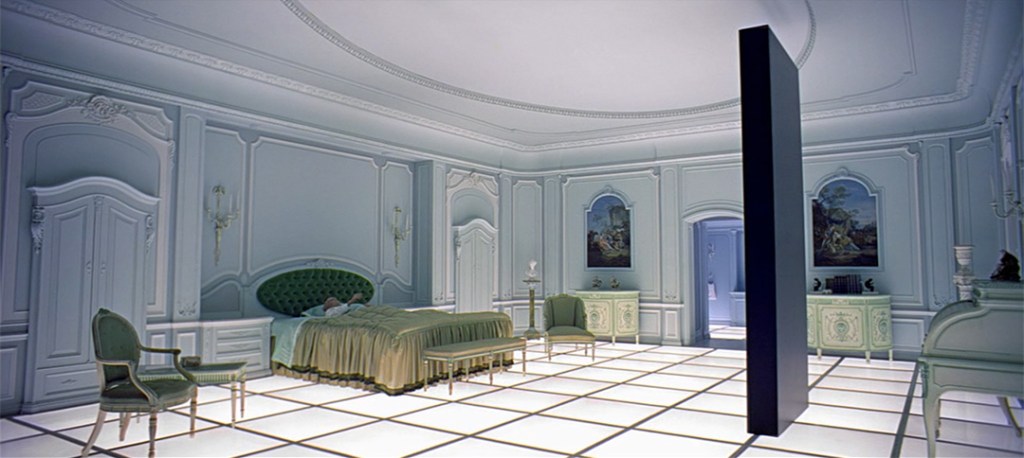
Split into four chapters, we are taken from the dawn of our civilisation to (perhaps) the dawn of our next civilisation. A prologue shows the arrival of a mysterious monolith on prehistoric Earth, where a group of ape-like humanoids encounter it and learn to use tools (namely to hunt and kill). Millions of years later, mankind’s early colonisation of space discovers another mysterious monolith, buried millions of years earlier. A mission is sent to Jupiter years to find out more about its origins. On that mission, all the crew bar Dr Dave Bowman (Kier Dullea) are killed when on-board computer HAL seems to malfunction. Bowman is left alone to encounter a monolith circling Jupiter which takes him into the infinite, a whole lifetime lived in minutes in a dream-like French drawing room, before his rebirth into a giant space baby.

What’s extraordinary about all this, is that Kubrick does nothing to place any of this into an understandable context. 2001 is a sort of Last Year at Marienbad in Space, a journey into a series of questions with no answers – but yet somehow never feels unsatisfying. It’s also fascinating as a work that feels profoundly philosophical, but with very little actual philosophy or insight in it. Instead, what the film supplies is a sort of raw, elemental power that makes you tremble to your very bones. You can feel it worming inside you, its unfathomable imagery, haunting audioscape and sometimes impenetrable logic making it even more engrossing.

It’s often been said the only character in 2001 Kubrick related to was HAL, the emotionless but sinister computer. In fact, I’d say the character Kubrick most relates to is the Monolith. For, essentially, what is it but a film director: a master manipulator holding all the cards, knowing all the answers and choosing what to share with us? We understand nothing in a film without the director’s guiding hand. Like the Monolith, 2001 has such overwhelming awe and majesty that people are drawn to it while barely understanding it. That’s a Godlike power I feel Kubrick relates to.

2001 is a master-class of the director’s art. The visionary beauty of its imagery is breath-taking. From its sweepingly empty vistas of the barren rocks of pre-historic Earth to the serene majesty of space, this is a film filled with indelible images. There is a true power in the geometrical perfect, bottomlessly black Monoliths that make them something you instantly can’t look away from. And don’t forget that 2001 has one of the two greatest jump cuts in history (the other, of course, being in Lawrence of Arabia), as an ape celebrates victory by flinging a bone into the air that cuts suddenly into a similarly shaped space craft as it falls.

Kubrick’s imagery of planets in mysterious line-ups, or the sun emerging over the top of the Moon have helped define how we think of space. His vision of mankind’s future, full of pristine surfaces, corridors that curve and rotate to create gravity has a power behind the simplicity of its design. So mind-bending is Kubrick’s vision of entering the Monolith – a kaleidoscope of colours hurtling towards the camera – that only the knowledge of his control freak self would let you believe that he (unlike many of the film’s viewers) never once dropped acid.

But the real genius Kubrick used was to match the stately, patient beauty of his images – and you can’t deny that 2001 is a film that frequently takes its time – with striking, perfectly selected classical music. You can argue what Kubrick does here is piggy-back emotional and spiritual effect from the work of others. But his choice of musical score is unfailingly, undeniably perfect: there is no chance Alex North’s rejected score could have had the same power. The deep rumblings of Richard Strauss’ Also sprach Zarathustra so perfectly captures the endlessly, unknowable power of space, time and the Monolith itself that it’s now become a landmark piece. The scenes of the ships in space are given a balletic beauty by being perfectly cut to Johan Strauss’ The Blue Danube. Could the Monolith have had both the power and unsettling sense of the unknowable without the sound of Ligeti’s Reqiuem? There is not a single decision to combine sound and visuals in 2001 that isn’t perfect.

And it only adds to the mysterious power of a film that can be deeply unsettling. If there is a transparent philosophical idea in 2001, it’s that mankind uses tools for conquest; the Monolith at first inspires a progression from the empty posturing of rival ape-tribes, into head-smashing violence. And, millions of years later, mankind is still two tribes (East and West), with weapons that could blow each other out of existence. But, whether that was the aim of the Monolith we never know. Just as we never really know what’s going on with Bowman’s fast track life through his neoclassical hotel (though I find something terrifying at Bowman encountering increasingly older versions of himself in silent trepidation).

Is 2001 optimistic or pessimistic about the future? I think Kubrick is aiming for letting us make up our in mind – after all this is our own private communion with his monolith. It matches his own natural inclination for distance. The humans in 2001 are almost impossibly stoic: space travel is no more exciting to them than a plane trip to a frequent flyer (the curved space station is basically an airport, which the character’s treat with the same time-killing blaseness as we do at a terminal). Messages from family members are twice watched by different figures with impassiveness. HAL’s control of the ship is so total, you wonder what the crew is for. Has the Monolith-inspired technology stunted mankind – now we are so dependent on machine that we just cogs in their workings, has progress stalled? 2001 could really be about mankind’s rebirth for a new life.

The HAL sequence – a precursor in many ways to The Shining in its unsettlingly invasive atmosphere – sticks in the mind as it has easily the most dialogue, plot and overt drama. HAL is a brilliant creation – Douglas Rain’s emotionless voice subtly shifting from strangely sweet to terrifyingly relentless to surprisingly sympathetic when he meets his end – and the sheer terror of these technological marvels turning against us (a space probe that shifts into a sort of monster, followed by a jump cut to HAL’s glowing red eye is just breathtakingly brilliant).

But if 2001 is short of narrative drive, surely that was Kubrick’s point? To keep 2001 as a mysterious encounter with no real answers. It opens and closes with two thirty-minute sequences devoid of any dialogue (the last word we here is “mystery”) and gives us such a blast of the senses that it feels more like being flung into a void of unanswerable questions. I was certainly not ready for that when I first watched it. But now, I just have to bow before Kubrick’s mastery. This inspired so many, its power is felt in thousands of works of art since. And it does this because it balances awe, wonder and mystery in a masterful way few other films can. You learn nothing in 2001. It has no real message, argument, or philosophical points, But yet it leaves you utterly satisfied, bursting at the seams with the power of your own imagination. That’s masterful film-making.

The Story of Louis Pasteur (1936)

The Story of Louis Pasteur (1936)

A visionary struggles against the blind in this genre-defining slightly cosy biopic

Director: William Dieterle

Cast: Paul Muni (Louis Pasteur), Josephine Hutchinson (Marie Pasteur), Anita Louise (Annette Pasteur), Donald Woods (Dr. Jean Martel), Fritz Leiber (Dr. Charbonnet), Henry O’Neill (Dr. Emile Roux), Porter Hall (Dr. Rossignol), Raymond Brown (Dr. Radisse), Akim Tamiroff (Dr. Zaranoff), Halliwell Hobbes (Dr. Joseph Lister), Frank Reicher (Dr. Pfeiffer)

Jack Warner was convinced no one would want to watch the life story of some crusty old scientist. But Paul Muni insisted they would – and he was a star – so with a threadbare budget and host of re-used costumes (many not from the correct period) and sets The Story of Louis Pasteur came to the screen – and much to Warner’s surprise was a hit. It can look like an oddly cliché-ridden affair today: until you realise many biopic tropes we’re used to were virtually coined here.

The Story of Louis Pasteur remixes huge portions of Pasteur’s life to make it more dramatic: the man who was the leading scientist in France for almost thirty years is repackaged as an outsider and laughing stock, constantly scorned by the medical establishment until (but of course!) he is triumphantly hailed as a genius by the same doctors who mocked him for years. Sound familiar? The film charts Pasteur’s efforts to discover vaccines, first for anthrax in sheep (leading to a famous test where 25 sheep were vaccinated and 25 were not, then all of them exposed to the disease, killing all the unvaccinated sheep) then rabies in dogs and treating those bitten by rabid dogs. Pasteur uses his unparalleled knowledge of microbes which (but of course!) every other doctor says cannot possibly have anything to do with infection.

There is a lot to enjoy in The Story of Louis Pasteur, an undeniably old-fashioned “Great Men” view of history that manages to turn bacteriology into effective entertainment. It recasts history into an easily digestible tale of visionaries and scoffers – but, crucially, no real baddies – crafting a series of small steps towards scientific discoveries into flashes of inspiration and triumphant revelations. Science is made simple, plain and understandable with Pasteur to talk us through a few shots of microbes under microscopes. At its centre we have a stubborn maverick determined that it is his way or the high-way and who won’t listen for a second to anyone questioning his theories.

There is something rather touching about the film’s admiration for science and celebration of an altruistic quest to make the world a better place. It carefully outlines the dangers of surgery and poor hygiene in medical practice – it opens with a doctor murdered for failing to save his killer’s wife, the reason for his failure pretty clear from the haphazard way he chucks medical equipment into a bag (dropping some of it on the floor en route). This lack of hygiene affects rich and poor (even Duchesses are not safe), in particular women in childbirth. Its truly the enemy of mankind, as a caption explaining the 1870 war stresses (European squabbles being a distant second). This is a problem that is truly noble to take on.

And it motivates Pasteur. Paul Muni is on Oscar-winning form as Pasteur, brilliantly precise and superbly conveying great intelligence mixed with an arrogant self-assurance. But Pasteur’s egotism comes not from vanity but from simply knowing more of which he speaks than anyone else. He’s also a man consumed by a sense of duty to the world: when his work can literally save lives (be they either animal or human) he will not let scorn stand in his way. Muni captures all this wonderfully, creating a prickly man with a playful streak determined to do the right thing the right way (Pasteur may disagree with his critics, but woe-betide their assistants disrespectfully doing the same).

Dieterle’s film crafts a series of excellent set-pieces to present Pasteur as a visionary ahead of his time. To make this really land, he’s therefore completely altered into being seen as a crank and pariah by everyone around him, rather than the influential scientific leader he actually was. This might be poor history, but it’s much better drama. From a furious encounter with Napoleon III (who won’t wear the idea his hand-picked doctors might be wrong about sterilization) to the Medical Academy publicly poo-poohing Pasteur’s outlandish ideas that vaccines might prevent anthrax. To give a face to this mocking of Pasteur (from an establishment we are told is totally wrong on every count) the film invents Dr Charbonnet (well played by Fritz Leiber), an honest but pig-headed critic who exists to be wrong (for noble reasons) on almost every single issue.

Noble as important: this film want to stress everyone acts for decent reasons, so that its final celebration of Pasteur is unblemished by deeply personal rivalry. Charbonnet and Pasteur are both framed as decent men and their relationship allows for plenty of fun melodrama, such as Charbonnet injecting himself with Pasteur’s (fortunately for him) weak rabies sample to ‘expose’ his ideas. When Pasteur’s daughter falls ill in childbirth, but of course Charbonnet is the only doctor available: he humours Pasteur’s sterilisation rules in exchange for a signed letter from Pasteur rubbishing his own theories (Muni’s shuffling flash of conflict that flows across his face at this moment is very well done). But of course, Charbonnet and Pasteur eventually reconcile in honour and decency.

This forms a fun thread throughout the movie, that’s never less than well-staged by Dieterle, with pace and energy. The anthrax test is very dynamic – all celebrating crowds and circus side-shows – and the dramatic appearance of a host of Russian peasants (led by Akim Tamiroff’s bombastic doctor) desperate for a cure for rabies-induced sickness is well-executed. Some beats work less well than others. Donald Woods gets dealt a rotten hand as the dull son-in-law of Pasteur. The women in Pasteur’s family get even worse, with most of Josephine Hutchinson’s lines being of the “stop trying to cure anthrax and come to bed Louis” variety. The costumes are bizarrely all-over-the-place (the women look more like Southern Belles) and there is a reassuring cosiness about everything.

But that’s also one of its most successful features. The Story of Louis Pasteur is a little twee – but it’s also effective. It’s why it laid down a template that worked for countless films that follow (A Beautiful Mind pretty much follows its model and won an Oscar for it 65 years later). That’s because there is also a feel-good factor to see someone who is, without doubt, in the right triumphing over the stubborn. With a great performance by Muni, it’s a rewardingly entertaining biopic.

Oppenheimer (2023)

Oppenheimer (2023)

Nolan’s masterful musing on the morality of science is both challenging and compelling

Director: Christopher Nolan

Cast: Cillian Murphy (J Robert Oppenheimer), Emily Blunt (Kitty Oppenheimer), Matt Damon (General Leslie Groves), Robert Downey Jnr (Lewis Strauss), Florence Pugh (Jean Tatlock), Josh Hartnett (Ernest Lawrence), Casey Affleck (Colonel Boris Pash), Rami Malek (David Hill), Kenneth Branagh (Niels Bohr), Benny Safdie (Edward Teller), Dane DeHaan (General Kenneth Nichols), Jason Clarke (Roger Robb), David Krumholtz (Isidor Issac Rabi), Tom Conti (Albert Einstein), Alden Ehrenreich (Strauss’ aide), Gary Oldman (President Truman), Jefferson Hall (Haakon Chevalier)

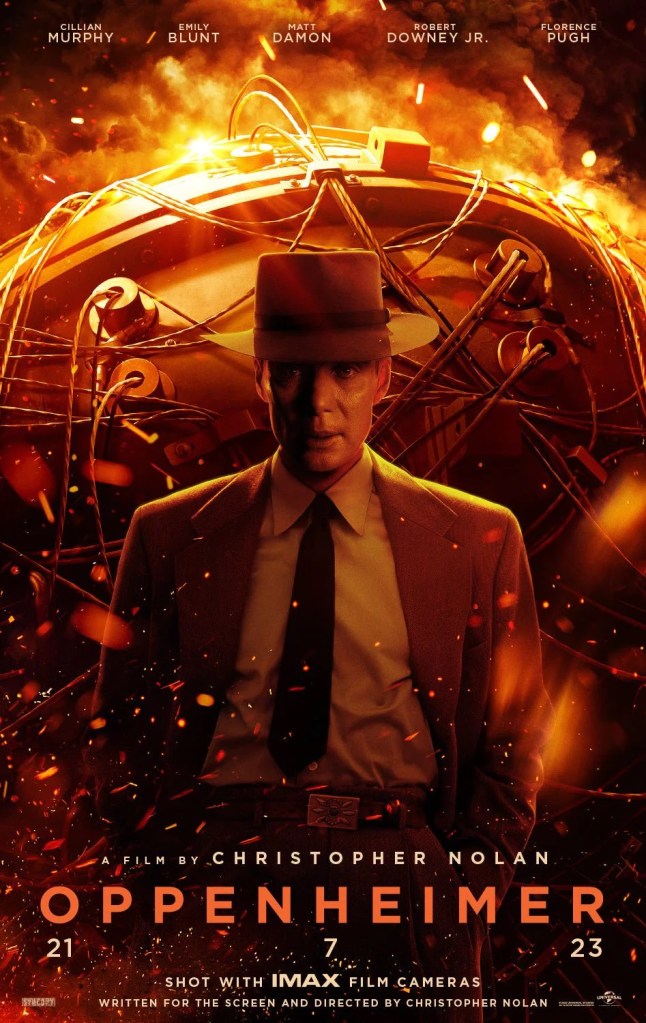
“I am become Death, the destroyer of worlds”. These words from The Baghavad Gita are synonymous with J Robert Oppenheimer, director of the Manhattan Project as he witnessed the destructive force of his creation, the atomic bomb. Fittingly, Nolan’s fascinating and ambitious film opens with a reference to Oppenheimer as Prometheus: the man punished for all time for stealing fire from the Gods. Oppenheimer uses everything from thriller to courtroom drama, to explore the moral responsibilities of science: if we can do a thing, does it follow that we must?

J Robert Oppenheimer (Cillian Murphy) is a Renaissance man and leading theoretical physicist who dabbled more than a little in left-wing politics. The woman he loves, Jean Tatlock (Florence Pugh), is a die-hard communist, the woman he marries Kitty (Emily Blunt) is a former party member, his closest friends are all members. Associations like these will later haunt him after he is approached by General Leslie Groves (Matt Damon) to use his organisational skills, political savvy and charisma to run the WW2 nuclear programme where maverick scientists work hand-in-hand with the army. Despite his position, Oppenheimer remains untrusted by many. In the aftermath of the war, these suspicions will be used by his opponents, among them Lewis Strauss (Robert Downey Jnr) ex-head of the Atomic Energy Committee, to bring about his downfall as Oppenheimer preaches disarmament.

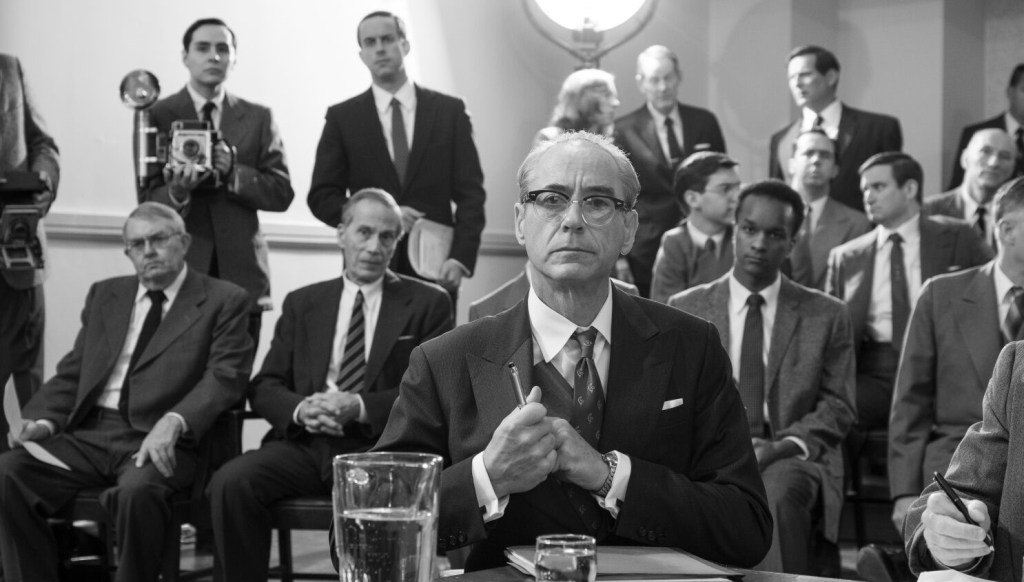
Much like Dunkirk, Oppenheimer is told in two timelines, intersecting with scenes replayed from different perspectives in subtly different ways. In “Fission” we see Oppenheimer, effectively on trial in 1954 for his security clearance, recount his life story, chronological flashbacks taking us through the development of the bomb. In “Fusion”, shot in gorgeous black and white, we follow the 1959 senate hearings to confirm Strauss in a cabinet post, and see his reminiscences of Oppenheimer’s post-war struggles to control the monster he has unleashed.

Oppenheimer is a brilliantly made, cinematically adventurous film: you would, of course, expect nothing less from a distinctive talent like Nolan. Brilliantly intercutting multiple timelines, it’s a film that is as much an experience as a story. This is a behemoth, filled with moments of flair and breath-taking use of sound and vision to affect mood. In particular, the film’s oppressive sound design bears down on the viewer like the pressure of the bomb itself. This means moments when we are released from its grip carry real impact. As Oppenheimer – already plagued with doubt – triumphantly announces the successful use of the bomb, the war-like celebratory pounding of scientists’ feet disappears from the soundtrack leaving Oppenheimer’s words echoing impotently around the room.

The pounding score and epic, sweeping camerawork (even more striking, since so much of the film takes place in small rooms filled with conversation) help Nolan to build up Oppenheimer’s mythic status and simultaneously strip him bare. Literally so at one point as, when questioned on his sex life in his hearing, Oppenheimer is seen naked in the room (as exposed as he must be feeling) answering questions with a naked Jean Tatlock astride him, staring into his wife’s eyes.

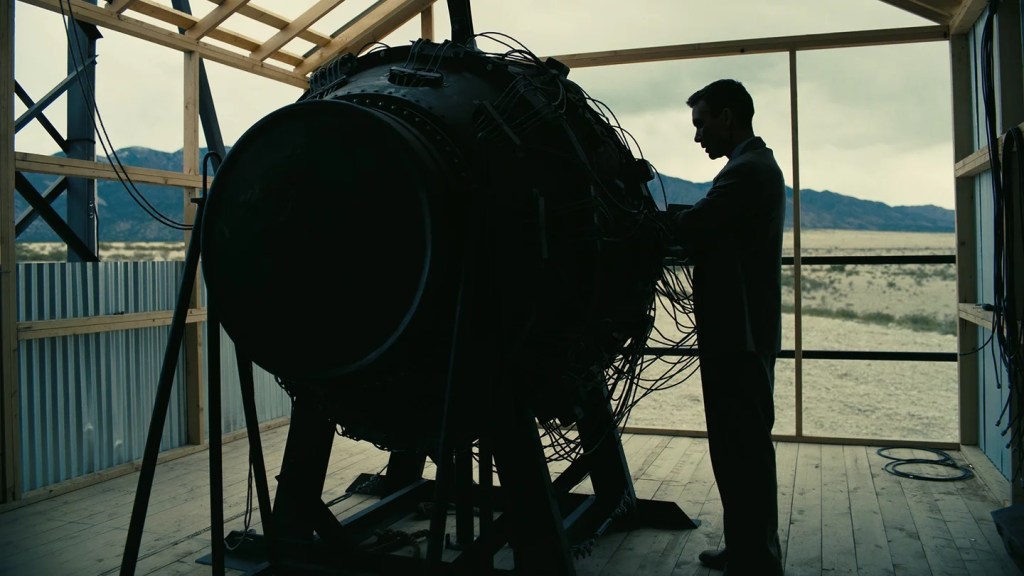
Oppenheimer labours, with the best intentions, to create a weapon before the Nazis. In its middle act, Nolan’s film focuses on the propulsive excitement of creation. The thrill of obstacles being overcome and solutions being found. The joy of a diverse team coming together for a single goal. We find ourselves longing for problems to be overcome, swept up in the desire for the endgame, as anxious as the scientists when it looks like rain will prevent the vital first Trinity test of the bomb.

Oppenheimer feels the same. Powerfully, intelligently and magnetically played by Cillian Murphy, this is a man who is a host of flaws crammed with impossible genius. A charismatic room leader, who is awkward in personal interactions. A charmer who rudely fails to remember his brother’s girlfriend’s name at a party. An inspiring leader who alienates people with ease. Murphy captures every inch of Oppenheimer’s staggering intellect and delight in intellectual problems, just as he also embodies the man’s arrogance and crushing self-belief.

So, it’s as crushing to him as it is terrifying to us, when the bomb explodes and the realisation hits us. Nolan’s sensory experience of a film fades down to silence as Nolan lets the camera float across the all-consuming fire of the silent explosion (the noise only comes when the shockwave hits) and suddenly the chilling implication of this terrible weapon becomes clear. This is a device that will kill millions. Oppenheimer knows it: he slowly shrivels into haunted guilt, Murphy seeming to shrink into himself as he finally understands what he has done.

Images of nuclear destruction both obvious (ashen bodies and nuclear flashes) and subtle (the out-of-focus vibration of background around Oppenheimer, as if sensing an approach shockwave) will haunt him and us for the rest of the movie. While many scientists – foremost among them Benny Safdie’s bull-headed Edward Teller and Josh Hartnett’s WASPish but decent Ernest Lawrence – feel little guilt. But Oppenheimer, and we, can no longer avoid questions of moral responsibility raised by those such as Niels Bohr (a quietly effective Kenneth Branagh).

Are there some discoveries better not made? Because once the genie is out of the bottle, it cannot be stuffed back in again. In this new world every world power must always have more. More bombs, bigger bombs, better bombs. And it explains why, like Prometheus, Oppenheimer must be punished. The tool of his punishment being his communist sympathies, embodied in his yearning attraction to Jean Tatlock (an under-used Florence Pugh). Nolan’s film is very strong on the terrifying paranoia of the secret state, where every word or association can be collected into a terrible portfolio of witnesses you cannot question, evidence you cannot see, testimony you cannot hear.

“Why don’t you fight” cries his wife Kitty, played with a dynamic, intelligent forcefulness by Emily Blunt. I could have done with a third act built more around Blunt’s starkly honest betrayal of a woman ill-suited to being a wife and mother, trapped in a world where that is all women can achieve (and which also trimmed a few witnesses from Oppenheimer’s trial). Why doesn’t Oppenheimer fight? Nolan has his theories, carefully seeded and confidently revealed.

Oppenheimer’s post-war clashes cover much of “Fusion”, anchored by a superbly under-playing Robert Downey Jnr (his finest work since Chaplin) as the outwardly avuncular, but inwardly insecure and bitter Strauss, who sees Oppenheimer as the embodiment of all the elitists who turned their noses up at him (no matter that Oppenheimer himself is an outsider, in a world of science run by WASPish types like Lawrence). Nolan’s film explores how morality is forgotten in an environment so rife with paranoia that the slightest expression of doubt is seen as treason.

Nolan’s film needs its vast runtime to keep as many balls in the air as it tries to. It’s probably a few too many balls. I would have loved more on Oppenheimer’s outsider status, as a Jew in American science (its not mentioned that the J stands for Julius, despite his claims it stands for nothing). Similarly, I would have welcomed more time to explore Oppenheimer’s complicated emotional life, in particular the fascinatingly complex relationship of some love, a fair amount of mutual respect and a large measure of mutual convenience with his wife Kitty.

But the film’s chilling musing on the horrors science can accidentally unleash while focused on progress is superbly explored and leaves a lasting impact. It’s a feeling that continues to be sharply relevant while we struggle with the implications of AI. Was there a need for the bomb? Perhaps there was. Were we ready for the bomb? No. And it is the failure of anyone, including Oppenheimer, to even consider this until it was too late that is the coldest warning in Nolan’s epic film.

Freud (1962)

Freud (1962)

This intriguing film makes an excellent attempt at exploring the nature of thought

Director: John Huston

Cast: Montgomery Clift (Sigmund Freud), Susannah York (Cecily Koertner), Larry Parks (Dr Joseph Breuer), Eric Portman (Dr Theodore Meynet), Susan Kohner (Martha Freud), Eileen Herlie (Ida Koetner), Fernand Ledoux (Dr Charcot), David McCallum (Carl von Schlosser), Rosalie Crutchley (Amalia Freud)

Few thinkers had as much impact on the 20th century as Sigmund Freud. For generations, Freud’s theories on psychology and sexuality were defining texts shaping perceptions of our inner world. John Huston was fascinated by his work, translating its spirit into this thought-provoking, if at times clinical, film that focuses on a few key years in Freud’s life and does its very best to communicate the thought behind the theory, while being careful to never delve too far into thornier matters. (Despite the poster’s blaring tagline “He dared to search beyond the flesh!”).

Freud is played by Montgomery Clift, whom we meet in 1885 Vienna as a young doctor. Freud’s theories that physical ailments might have a psychological cause are widely dismissed by the medical establishment, represented by smug Dr Meynet (Eric Portman). However, Freud is convinced the secret of treating neurosis lies within – not least since he recognises symptoms of neurosis in his own dreams, haunted by half-memories of his mother and complex feelings for his father. Working with his mentor Dr Joseph Breuer (Larry Parks), Freud explores hypnosis to access patients’ repressed feelings, working closely with Cecily Koertner (Susannah York), a young woman who has inexplicably lost the ability to walk. Slowly Freud begins to form a theory of sexuality in children, as well as discovering guided discussions and word association to be more effective than hypnosis.

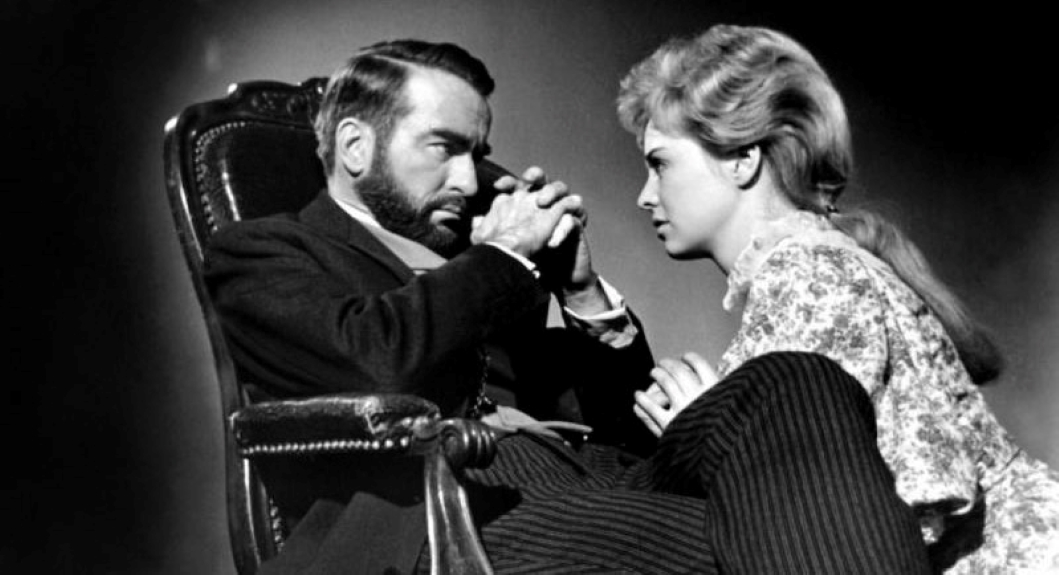
Huston’s film is shot in luscious black and white by Douglas Slocombe, composed of a mixture of images that balance painterly influences with surrealist nightmares. Freud and Koertner’s dream sequences are shot with a grainy intensity, a series of chilling images ranging from Freud being dragged towards his enthroned mother by a roped dwarf to Koertner’s mother domineering a beach from a grand tower. These surrealist touches tear through a film that otherwise presents a more earnest exploration of Freud’s theorising. It serves as a necessary contrast to the constraining formality of 19th-century Vienna, where inner passions and feelings are routinely stamped down.

Freud studiously explores the evolution of its subject’s thinking, in particular through his analysis of the fictional Cecily (standing in for several patients). Played with gusto by Susannah York, the film carefully structures her psychological make-up as a detective mystery to be slowly peeled away, with wrong-turns, false dawns and incorrect assumptions abounding. Initially treated with caring patience by Breuer’s hypnosis, slowly Freud replaces his mentor first as a doctor and then (to his subtle discomfort) as the subject of Cecily’s transposed attractions. These interior searches, eventually culminating in Freud’s first experiments of psychoanalysis and word association, are fascinating moments that pivot the film, with convincing false conclusions regularly introduced to constantly challenge the viewer’s assumptions.

It leads to the formulation of Freud’s Oedipal theories that cross a Rubicon his mentor cannot. In that, Breuer is joined by most of the medical profession. Huston’s film is strong on the stuffy self-confidence of the establishment, too hide-bound by its own ideas to recognise genius in their midst. Portman’s grandiose Dr Meynet gently, but firmly and devastatingly, rubbishes any nascent idea that neurosis patients are anything other than idlers and whingers. Meetings where Freud presents papers offer choruses of raucous boos and naked fury (at one point a dignified doctor literally stands up and spits at Freud’s feet in disgust). Hypnosis, with its vague medical support for its method is used as something close to a parlour trick by an otherwise supportive Dr Charcot (Fernand Ledoux) to pass physical symptoms from patient to patient, demonstrating the symptom is psychological even as he does nothing to understand the cause.

The path to decoding the human mind – as the film firmly believes Freud’s theories have done, hammered home by Huston’s narration which opens and closes the films and intermittently provides an internal monologue for Freud – is a bumpy one. Freud is frequently disturbed by the implications of his investigations. A young solider – a fragile David McCallum – alarms him when, under hypnosis, he reveals a deep, sexual longing for his mother via the fondling of a mannequin (naturally concealed under his father’s uniform). Freud’s closeness to his mother – a marvellous Rosalie Crutchley – becomes wrapped up in his theories, his dreams and memories haunted by half-remembered encounters and longings that cause him great unease.

Much of the clarity of this unease – and the tension as the unsettling implications of Freud’s nascent beliefs become more apparent – owes its success to Clift’s performance in the lead role. Clift was in extremely poor health at the time, still suffering from the effects of a near fatal car crash (including cataracts that affected his vision). An addiction to painkillers and alcohol had shot his memory to pieces. He struggled to remember lines (so much so the studio attempted to sue him for the film’s many delays), but his soulfulness appears to glorious effect. He makes Freud a profound and troubled but artistic thinker, a humanitarian full of empathy which also makes him a conduit for guilt and shame. His impassive face makes him the perfect listener but does not hide his own torment. It’s a marvellous performance, one that manages to convey the power of thinking.

Unfortunately, its genesis is also bound up in the story of the film’s making, that has often dwarfed the film itself in discussions about this intriguing movie. Huston – increasingly angry at Clift’s unreliability, compounded by his alpha-male disgust at Clift’s homosexuality – bullied the actor relentlessly during the film’s making, forcing him into take-after-take after every line flub to the increased anger of the other actors (York, in particular, was outspoken in her disgust at this). Huston had also originally written a script with Jean-Paul Sartre but, not surprisingly, the two were incompatible, Sartre eventually having his name removed from the credits.

It’s a shame these stories have dominated the discussion of the film, as it is a rich, intriguing work directed with a thoughtfulness by Huston that helps it become a thoughtful and patient film, rather than a triumphalist one (the film lacks either a eureka moment or a closing triumph, leaving Freud still rejected by the establishment and quietly visiting his father’s grave, having come to terms with his own feelings). With a marvellous performance by Clift – even if his treatment on set was shocking – it’s an intelligent, intriguing and well-handled exploration of a complex theme. It’s more than a curiosity, it’s a measured and serious film with flashes of surrealism that engages intelligently with important themes.

Solaris (1972)

Solaris (1972)

Tarkovsky’s search for inner meaning and depth in the framework of space

Director: Andrei Tarkovsky

Cast: Donatas Banionis (Kris Kelvin), Natalya Bondarchuk (Hari), Jüri Järvet (Dr. Snaut), Vladislav Dvorzhetsky (Henri Burton), Nikolai Grinko (Kelvin’s Father), Olga Barnet (Kelvin’s Mother), Anatoly Solonitsyn (Dr. Sartorius), Sos Sargsyan (Dr. Gibarian)

When Tarkovsky saw 2001 he was not impressed, calling it “a lifeless schema with only pretensions to truth”. Tarkovsky thought science fiction was in thrall to machinery and effects, rather than intellectual heft. (By the way, it shows how much Tarkovsky saw himself as a philosopher-poet, that he felt Kubrick a lightweight). Tarkovsky’s aim with Solaris was to present science fiction about people and ideas, rather than technology. Solaris is in equal parts fascinating and frustrating, wilfully slow (as Tarkovsky liked it) but also hypnotic, a film that never quite manages to marry up his stated aim to explore human feelings with his own intellectualist distance as a film-maker.

Adapted from Stanislas Lem’s novel, Solaris is set in an unspecified future and revolves around psychologist Kris Kelvin (Donatas Banionis). Kelvin is sent to a station orbiting the alien world of Solaris, an ocean world that quite possibly might be a gigantic living brain. It’s hard to tell if that’s the case, because contact with the planet has proved impossible over decades. Now the last three scientists on Solaris station are sending back strange reports and Kelvin’s job is to decide if the programme should continue. On the station he discovers the planet has somehow accessed the inhabitant’s dreams and made figures from their subconscious flesh – and he is horrified and then overwhelmed when his late wife Hari (Natalya Bondarchuk) appears on the station, a ghost made real by the strange powers of Solaris. How human is she? And does it matter?

Lem cordially disliked Tarkovsky’s Solaris. He couldn’t understand why the film didn’t exactly follow the book – where were the long chapters of scientific philosophical discussion? He felt it a shallow palimpsest of his work. I like to imagine that infuriated Tarkovsky, a director who prided himself on his intellectualism like few others. Huffily retorting films are different from novels, nevertheless he later claimed Solaris was the least favourite of his films, preferring the pretentious Stalker. But Solaris is ghostly and haunting in a way that the self-important Stalker (for me) never is.

Tarkovsky’s view of man’s exploration of the stars is that it blinds us to the more rewarding search for truth and meaning here on Earth. Not for nothing does the film start with a long, wordless, sequence following Kelvin walking through the grounds of his father’s dacha. Reeds dance in the river, long grass strokes Kelvin’s waist, rain spatters down from the sky.  Nature is a key part of what makes us human – on the station, the scientists affix paper streamers to air vents to replicate the sound of wind among the trees, to make Solaris feel a little more like home. To Tarkvosky space is a boring, featureless mass, and Solaris nothing but a pale shadow of Earth’s glories.

What’s the point of hitting the stars, if we are cold and lifeless ourselves? Kelvin is this at the start of the film, a distant, emotionless man, plagued with regret, barely engaged emotionally with his world. A mysterious child runs around his father’s house – we assume it must be Kelvins daughter (Tarkovsky never confirms) but our hero never takes an interest in her. This will change with the appearance of Hari, exactly as he remembers her – unaged (she died at least twenty years ago) and a strange mix of who she was and his half-remembered memories.

But Kelvin isn’t ready to explore this yet. He puts the ghost in a rocket and shoots her off into space. Pointlessly, as his fellow inhabitants of the station tell him. They’ve tried similar with their own ‘visitors’ – they always reappear when they wake from sleep. And Kelvin can’t do the same again with the second Hari. Especially as this Hari is so distressed at the slightest separation from him, she tears her way through a metal door after he closes it on her.

It turns Solaris into Tarkovsky’s real aim: an exploration of what lies within, rather than ethereal dreams among the stars. As Dr Snout says, real exploration would require mankind to find a mirror not a rocket. Solaris becomes about how far Kelvin will go to emotionally connect to a woman who may or not be real and both is and isn’t the person he remembers. How much will he put aside his doubts and reconnect with feelings he has long suppressed? And in Hari’s case, as her self-awareness grows with every minute of her ‘existence’, how much will she change? And, as she is born from Kelvin’s guilt at her suicide, is she always destined to embrace self-destruction?

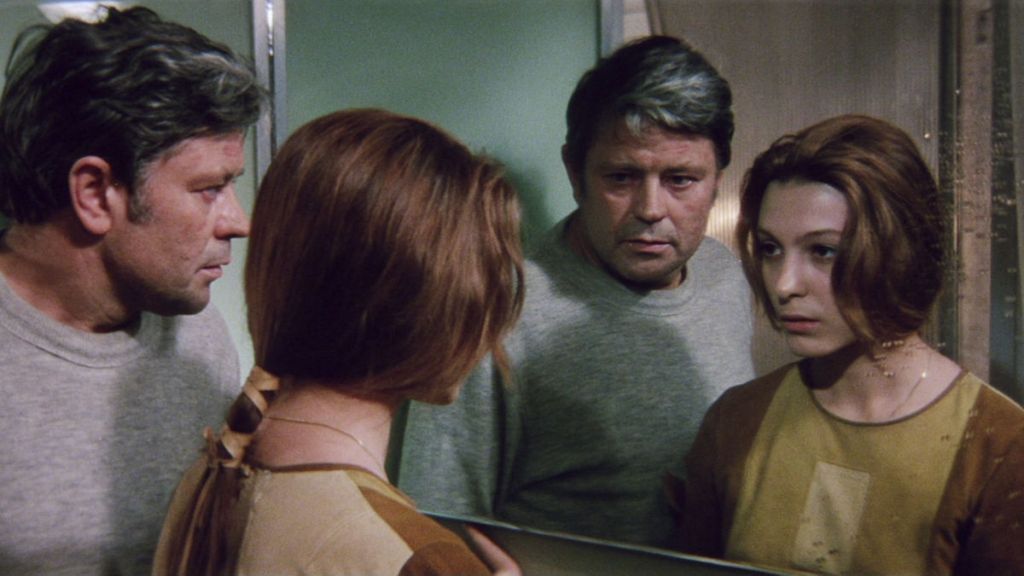
Solaris (1972 Andrei Tarkovsky) Donatas Banionis and Natalya Bondarchuk

These ideas become the heart of Solaris, unfolding in Tarkovksy’s trademark style. Solaris is awash with long unsettling takes and an eerie lack of music – and even, in places, ambient sound – in which the actors move with a coldness and lackadaisical precision. Solaris is, in many ways, an awkward fit for the director. Tarkovsky is not one to embrace raw emotion. Donatas Banionis remains, throughout, an austere and unknowable figure, whose exact feelings remain at times unconnectable behind his stoicness. Solaris is like a terrible ghost story that looks at the impact of loss with the same professional interest Kelvin as a psychologist has. At times Tarkovksy seems like a philosopher juggling the enigma of humanity, but getting a little bored with the question. Crude as he would find it, an emotional outburst or two would do wonders for Solaris.

But perhaps that would sacrifice part of what makes Solaris as compelling, haunting and lingering as it can be. Because there is a feeling the whole thing is taking place in a drained-out dream that could cross into a nightmare. Hari is beautifully played by Natalya Bondarchuk, carefully balancing the slow flourishing of a shadow into a human, scared and alarmed by the onslaught of emotions she cannot understand. Her slow of a distinct personality, rather than as an extension of Kelvin, contrasts with the cagey uncertainty of the rest of the characters. And makes us wonder how real they might be, since she feels at times the most vibrant.

Tarkovsky’s film uses his style to wonderful effect throughout. His lack of interest in the trappings of the modern world actually adds to its eerie disconnect. Clothing and technology basically look exactly like the 1970s, cars are unchanged, the space station is a grimy wreck. Kelvin’s journey to the space station takes about 45 seconds of screen time – compare to the long, dreamlike drive Burton takes through the city (actually – and clearly – Tokyo). Tarkovsky’s heart is in the poetry of a horse’s movement. It adds to the sense of space exploration as a chimera and the 45 minutes the film takes in its prologue on Kelvin’s father’s dacha reminds us that understanding the world around and inside us is where Tarkovsky feels our aims should be directed.

Solaris ends with a sequence that has stayed with me for decades. Kelvin repeats his long walk through his father’s land, all of it this time in a chilling stillness. Not a gust of air or ripple on the water. He approaches his father’s house to see rain falling inside. A long cut back shows the truth. It’s a close to the theme Lem felt was least engaged with by Tarkovsky: the impossibility of communication between two species so fundamentally different they can only offer a simulacrum of each other’s behaviour.

Tarkovsky is straining for a different type of psychological journey. Solaris offers little in the way of emotional investment – it’s far too restrained, cold and distant for that. Such emotions are placed at the heart of Soderbergh’s remake – but that sacrificed the austere, ghostly haunting of this. Solaris plays like a construct from the planet of our emotions, thoughts and fears, its characters moving in journeys of discover in our world much as Hari does in theirs. It’s unknowability and discordant stillness and jagged long-shots make it unique. It’s one of the Tarkovsky films I always want to revisit.

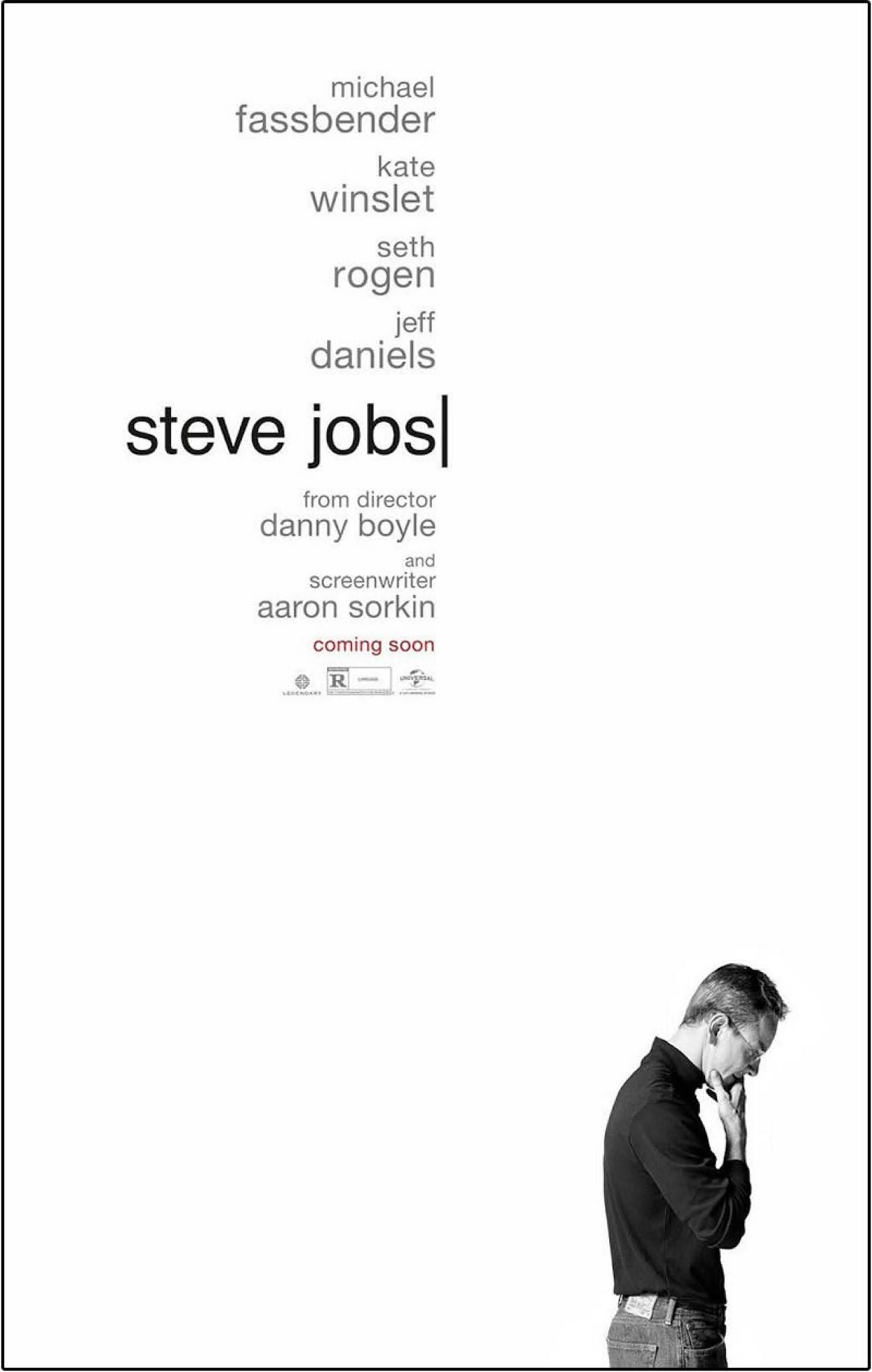
Steve Jobs (2015)

Michael Fassbender excels in Danny Boyle’s superb Sorkin scripted biopic Steve Jobs

Director: Danny Boyle

Cast: Michael Fassbender (Steve Jobs), Kate Winslet (Joanna Hoffman), Seth Rogan (Steve Wozniak), Jeff Daniels (John Sculley), Katherine Waterston (Chrisann Brennan), Michael Stuhlbarg (Andy Hertzfield), Perla Haney-Jardine (Lisa Brennan aged 19), Makenzie Moss (Lisa Brennan, aged 5), Ripley Sobo (Lisa Brennan, aged 9), Sarah Snook (Andy Cunningham)

The art of movie biography shouldn’t be slavishly covering every second of the subject’s life. It should be capturing their essence. Steve Jobs does exactly that, a superb distillation of its subject’s life and personality through focusing on the preparation for three vital project launches: the Apple Macintosh in 1984, the NeXT Computer in 1988 and the iMac in 1998, each playing out in real time. The contrasting (and continuing) clashes and tensions at each event – personal and professional – tells us more about the man and his impact than a cradle-to-grave biopic ever could.

It also helps that Steve Jobs has an electric script from Aaron Sorkin. Sorkin approached the project not like a film, but as a classic three-Act play. Steve Jobs is an explosion where all the special effects are the words, held together by pulsating ideas and a sense of rhythm musicians would envy. This is Sorkin at his absolute best, a script with zip and jokes but also a profound understanding of exactly the sort of tunnel-visioned visionary perfectionism Jobs encapsulated, all wrapped up with a beautifully judged emotional through-line. Only Sorkin can make just actors delivering dialogue as dynamic and edge-of-the-seat as a car chase.

And (like The Social Network) his intensely intellectual style, and sense for the frustration of the super-intelligent at the rest of us for not keeping up, is perfect for this tale of the creation of the future of computing. Sorkin uses product launches as a window into how fresh idea can be accepted (or not) by the world. The battles over them, with the focus on small details that communicate the big picture and the difficulties of making others understand the visionary core that makes something work is crucial – and brilliantly delivered here. That’s perfect for Sorkin, who is gifted at making big-picture passionate thinkers sound as brilliant as they are.

But what makes Steve Jobs perhaps his most compelling script, is that he adds an emotional undertone to it. Jobs was a visionary, who understood better than the customer what they really wanted. But he was also a flawed individual. Sorkin’s script makes clear that, like his computers, he was a closed system. Just as the Macs were designed to only work with their own software and not interface with others (Jobs’ gospel, the exclusivity of the product being what makes it special), so Jobs himself built his own conception of the world and refused to let anything outside that influence it, or allow any external factors to change his mind. Decide he was loyal to someone, and nothing they do will shakes that. Decide another has betrayed him, and the system locks them out.

Central to this is Jobs’ relationship with his unacknowledged daughter. From the 5-year-old he reluctantly spends time with, to the young girl he starts to form a carefully emotionally managed bond with to the 19-year old who finally tells him how much she resents his closed-system management of their relationship. Sorkin’s script brilliantly balances an insight into why Jobs might have acted like this (bound up in issues with his birth parents) and the emotional impact it has on the daughter (the hugs not returned, the words not said). Jobs isn’t a bad man – although the script doesn’t shy away from his selfishness, or the appalling things he said about Lisa’s mother in the press – or a straight-forward terrible dad. He’s just not quite capable (or willing) of giving the emotional commitment needs. It’s written tenderly with a great deal of empathy for both father and daughter.

This emotion is further bought out by Boyle’s dynamic humanism at the helm. It’s a reminder of what a great theatre director Boyle is: this film is basically one of the most dynamic plays you’ll ever see, fast cuts and graphics intermixed with extended one-shot dialogue scenes that allow his actors to flourish. Boyle employs on-screen graphics and montage to move us between the product launches, but isn’t afraid to let his camera serve the dialogue, with the exchanges brilliantly cut to the rhythm of the dialogue.

He also sets out a space for the actors to deliver uniformly superb performances. Front and centre is Michael Fassbender’s transformational performance. He communicates Jobs’ brilliance and his ruthless determination to never compromise. It’s a performance of messianic intensity, but also extremely grounded and real – and, like Sorkin, he understands the heart of the film is the father-daughter relationship. Fassbender carefully hides Jobs’ emotional need, just as he understands the dynamism that wouldn’t allow a hint of vulnerability and arrogance that judges everyone as second-best to himself. He’s a tough, difficult, uncompromising man – but also an egalitarian one, (eventually) willing to acknowledge his flaws, the biggest being his fear of emotion.

Equally brilliant is Kate Winslet as Joanna Hoffman, Jobs’ long-time confidante and ‘work-wife’, manager of each of the launches and a combination of mentor, conscience, counsellor and parent. Jeff Daniels is excellent as the businessman who goes from mentor to unforgiven rival. Seth Rogan gives his finest dramatic performance as Steve Wozniak, here a decent man and computing genius, who lacked Jobs’ ability to “play the orchestra” and shape events to his will.

It’s all wrapped up in a gripping film that feels like a fusion of theatre and film. If it has a problem, it’s that many will find its focus on the nuts-and-bolts of Apple hard to follow (and I confess, the script makes me understand the drama without understanding the product). But its strength is in understanding visionaries, their ability to shape ideas that wouldn’t occur to the rest of us – and the selfishness, and the damage that causes, that often goes hand-in-hand with that. With scintillating acting, skilful direction and, above all, a superb script, Steve Jobs is sharp and engrossing drama.

The Social Network (2010)

Andrew Garfield and Jesse Eisenberg bring the making of Facebook to life in Fincher’s modern American classic

Director: David Fincher

Cast: Jesse Eisenberg (Mark Zuckerberg), Andrew Garfield (Eduardo Saverin), Justin Timberlake (Sean Parker), Armie Hammer (Cameron Winklevoss/Tyler Winklevoss), Max Minghella (Divya Narendra), Brenda Song (Christy Lee), Rashida Jones (Marilyn Delpy), Joseph Mazzello (Dustin Moskovitz), Rooney Mara (Erica Albright), John Getz (Sy), David Selby (Gage)

Nothing has changed our interaction with the world faster than the internet. And nothing on the internet has changed how we interact as much as social media. As it drives changes in the way we relate to other people, it’s a brave film that tries to capture this zeitgeist and turn it into an effective movie. The Social Network is a brave movie – and also a brilliant one, a defiantly modern and far-sighted movie that avoids being the sanctimonious message movie it could have become, by concentrating on personal relationships, drama and, above all, a strong and compelling story.

Its October 2003 and a 19-year old Harvard student Mark Zuckerberg (Jesse Eisenberg) gets dumped by his girlfriend Erica (Rooney Mara). So, he responds like many people today would – but not in 2003 – by writing a series of rude and angry blogs about her. And at the same time, he does something you and I wouldn’t be able to do – he builds overnight a campus website called Facemash that allows users to rate the attractiveness of female students. It’s a sensation – and a scandal.

Off the back of it, Zuckerberg is approached by the Winklevoss brothers (in a skilled double performance by Armie Hammer) to see if he’d be interested in building an elite social network, Harvard Connection, for them. Zuckerberg agrees – but did he independently already have the idea for Thefacebook, an elite social network for Ivy League students? Either way, with funds from friend Eduardo Saverin (Andrew Garfield) he builds the platform which is to become Facebook. Does it all end well? Since the story is framed around Zuckerberg in 2009, sitting in depositions while being sued by both the Winkelvoss brothers (“the Winklevi”) and Saverin, you can guess not.

Fincher’s film reflects its central character in many ways – cool, efficient, tightly wound, juggling intellectualism with simmering tension. It’s vibrant, fresh, razor-sharp, perfectly paced and superbly dramatic. It turns what could have been a terrifically dull story of very clever people typing lines of code into a whipper-sharp story of jealousies, rivalries and suspicions. It also brilliantly veers away from being a polemic. It could easily have made points – as many films have – about the “evils and dangers of that creepy thing the internet” or constantly reminded us how morally superior film-makers are to social media kingpins. It does nothing of the sort. Instead it’s a brilliantly insightful look at the birth of a phenomenon that also makes subtle, intelligent points about some of the behaviours that phenomenon led to. All while keeping us gloriously entertained.

A big part of the film’s success is in Sorkin’s superb script. The material is perfect for him. The character’s intellectualism fits with his pithy turn of phrase, while their perceptions of themselves as victims or on a moral crusade fits with his ability to write morality with empathy. It also helps that he is the master of crackling dialogue. The idea to structure the film around the depositions is also a master-stroke. Not just a reminder of what’s to come, it adds an air of artificiality to everything we see (perfect as well for Sorkin’s smarter-than-life dialogue) – after all, each scene is based on the filtered remembrances of people in the depositions. And all of them remember a subtly different story.

Sorkin and Fincher also manage to avoid having villains in play. It would be easy to make Zuckerberg a villain: many films would have done. But Zuckerberg here isn’t bad – it’s more that he’s tunnel-visioned, selfish and socially inept. Erica (a marvellous turn by Rooney Mara as the first victim of social media bullying) has a point when she says she dumping him not because he’s a geek but because he’s not really a nice person. But Zuckerberg’s actions – his betrayals as some read them – come not from vindictiveness but a shark-like moving forward that leaves people behind him. And he’s also, as the film is keen to show repeatedly, lonely. He has one friend – whom he sacrifices on the altar of his creation – and is ruthless at cutting people out of his life when they fail to meet the standards he has set them.

The film channels the skills of Eisenberg – whose range is not huge – perfectly here, in a role he was surely born to play. Eisenberg crafts his physicality in something hunched, oppressed and sullen while his flat voice is perfect for a man who expresses himself through his creation not his personality. He gives Zuckerberg both a ruthlessness, but also a strange lack of knowledge – constantly surprised that his actions have consequences that leave him alone. He makes him a true lonely god of the internet – the man who invented the biggest social networking centre in the world, but who doesn’t have a friend himself.

But it also makes clear that Zuckerberg lacks the usual flaws of his kind: he’s not interested, it seems, in money, riches, fame or drugs. To him, the prize is to do not to be seen to do. He makes a rich contrast with Sean Parker (a brilliantly charismatic Justin Timberlake), the creator of Napster, who briefly influences him but is primarily interested in the flash and bang that the retiring Zuckerberg isn’t. What he does have is the drive and ruthlessness that his friend Eduardo Saverin (a wonderful performance from Andrew Garfield as a marvellously sweet, but clearly naïve and out-of-his-depth man completely lacking the vision a project like Facebook needs) doesn’t have – and which makes Saverin unsuitable for thinking in the global terms Zuckerberg is.

And the film has little time for the Winklevoss twins. Played with chutzpah in a double role by Armie Hammer (who skilfully distinguishes both of them), Zuckerberg is right when he describes them as rich kids who had everything they ever wanted in life – and seem outraged that they can’t be given the rights to Facebook as well. As he points out they intended to do nothing other than come up with a concept. These rowers – in a witty touch their boat is sponsored by that dinosaur Polaroid – also represent the old elite under siege from new media. The entitled rich, who can’t comprehend that the world is being handed to them on a plate.

The film also makes for an intriguing meta-commentary on the growth of social media. From the trolling of Erica, through the bitter feuds and arguments, the he-said-she-said fighting of the depositions, and the quick shifts between friendship and rivalry, it also manages to capture the world of social media in a nutshell. The atmosphere where actions can explode in people’s perception, where statements you made years ago come back to bite you, where judgement and criticism are constant and the ability to communicate more easily also makes fights easier to start, seem more and more prescient.

Fincher’s film does this marvellously, with a wit and sense of dramatic flair that reminds me of a more grounded Network. Sure the scene at Henley-on-Thames is hand-in-the-mouth agonising for any British person to watch (it is littered with major errors from turn-of-phrase to its understanding of life in Britain), but when every other scene in it is perfectly done it doesn’t matter. Like any victory, Facebook has many people claiming to be its father. You could say the film about this film: superbly directed, a brilliant script and perfectly cast, it’s a triumph.

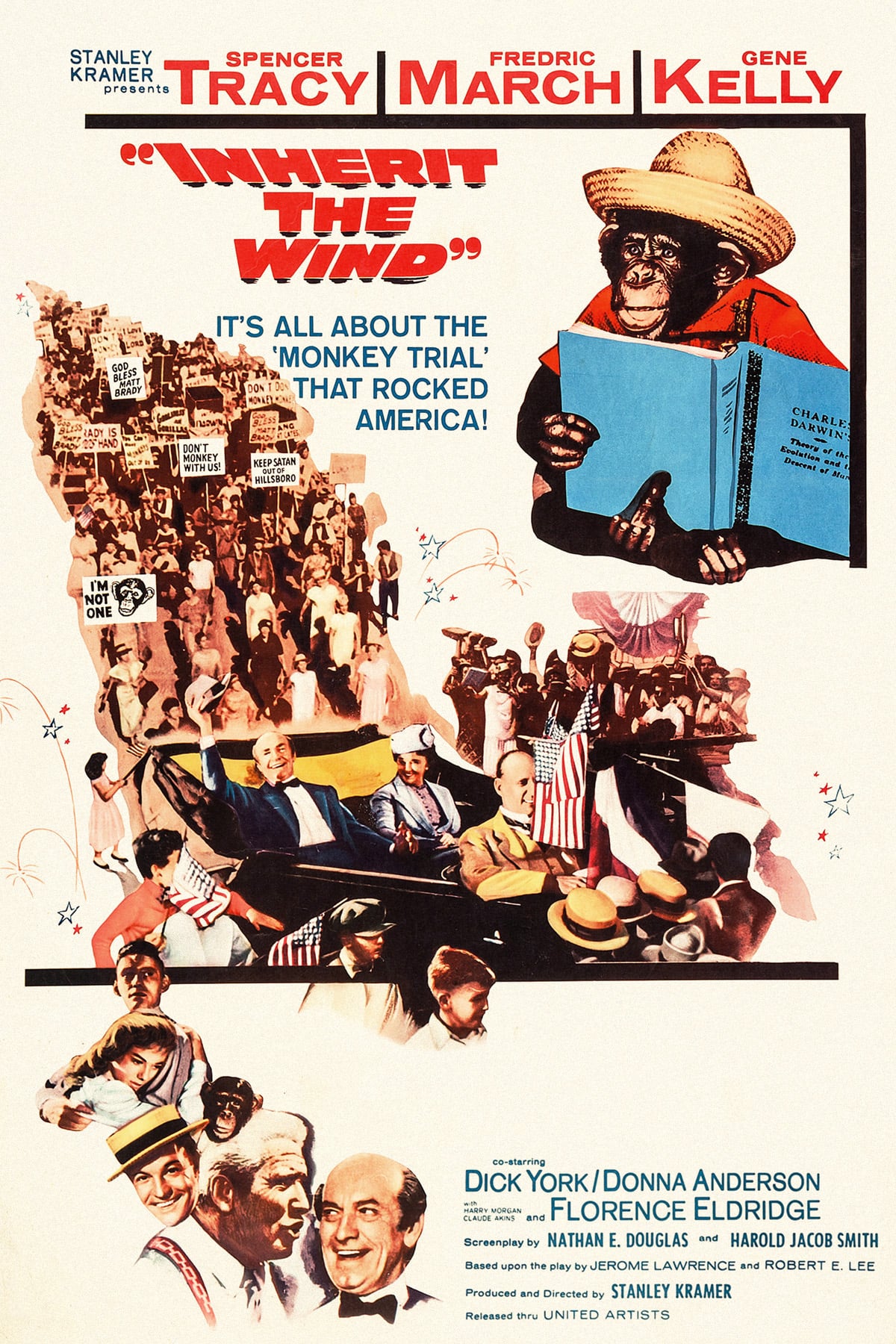
Inherit the Wind (1960)

Spencer Tracy and Fredric March go toe-to-toe in Stanley Kramer’s liberalism-on-trial movie Inherit the Wind

Director: Stanley Kramer

Cast: Spencer Tracy (Henry Drummond), Fredric March (Matthew Harrison Brady), Gene Kelly (EK Hornbeck), Florence Eldridge (Sara Brady), Dick York (Bertram T Cates), Donna Anderson (Rachel Brown), Harry Morgan (Judge Merle Coffey), Claude Atkins (Reverend Jeremiah Brown), Elliott Reid (Prosecutor Tom Davenport), Paul Hartman (Deputy Horace Meeker)

In 1960, Inherit the Wind was a parable. The teaching of Darwinism being illegal in a small town that defined itself by its faith couldn’t really happen today could it? So, the film used the concept as an angle to criticise the restrictions placed on free speech during the McCarthy years. The wheel has come full circle now: it’s no longer unlikely at all to imagine something like this happening. Indeed, versions of it have already taken place in America this century. This change does actually help the film look increasingly more prescient as time goes by.

A fictionalised version of the famous Scopes monkey trial (with most of the names changed, but many of the court room events fundamentally the same) a local schoolteacher, Bertram Cates (Dick Young), in a small Southern town is placed on trial for teaching Darwinism in his school. Staunch Christian and former Presidential candidate Matthew Harrison Brady (Fredric March) volunteers to put the case for the prosecution. Cates’ defence will be handled by the renowned liberal lawyer Henry Drummond (Spencer Tracy). Sparks fly in a courtroom and around the town, where many people are instinctively opposed to anything that can be seen to draw doubt on intelligent design.

Kramer’s films are often both praised and criticised for their rather heavy-handed liberalism. Inherit the Wind is no different. You’d be hard pressed to miss the message here about the dangers of intrusive laws designed to govern what we think and believe. Kramer’s film edges away from making criticism of fundamentalism too overt. Sure, the local preacher (a lip-smacking Claude Atkins) is a tongue-frothing “burn ‘em all!” maniac, only happy when stirring up an outraged mob. But on the other hand, Drummond is revealed to be a man of (liberal) faith – and, in an agonisingly heavy-handed final note, the film ends with him literally weighing The Bible and On the Origin of the Species in his hands then clasping them both together. You see – science and faith can work together!

While it’s easy to smile at Inherit the Wind’s striving for inoffensive liberalism, it means well and actually produces some effective court-room set-pieces. While its overlong – the sections outside of the court could do with trimming down and a rather shoe-horned plot with Cates dating the local preacher’s daughter (not helped by the blandness of both actors) promises much but delivers very little. What the film really works at is a chance for two seasoned performers to go at each other hammer and tongs in the court. Chances they both seize.

Spencer Tracy sets a template of sensible, liberal reasonableness mixed with a well-defined sense of right and wrong that would serve him well in a further three collaborations with Kramer. He brings Drummond a rumbled worldliness, a shrewd intelligence and a patient forbearance but never once lets us forget his righteous fury that this case is even happening in the first place. His courtroom performance hinge on a winning reasonableness that can turn on a sixpence into ingenious traps for witnesses. He’s a rock of decency in a shifting world and Tracy effectively underplays several scenes, making Drummond seem even more humane.

It also means that Tracy makes a lovely performing contrast with Fredric March’s firey passion as Brady. Sweating in the heat of the court, March’s Brady is overflowing with moral certainty and fury. March’s performance is big, but the character himself has a court-personae that depends on him appearing like an embodiment of God’s fury. It works because March gives Brady a quiet air of sadness. This is a man raging against the dying of the light – this case is his last hurrah. Brady is becoming yesterday’s news, but can’t seem to consciously accept this. In quieter moments, he is clearly a man of reflection and reasonableness – but (in a surprisingly modern touch) is all to aware that a raging public personae is what “sells”.

Kramer’s film is at its strongest when it lets these two actors go toe-to-toe. These moments aren’t just in the fireworks for court. Private scenes between the two show a great deal of mutual respect and even admiration. The two men are old friends. Drummond is very fond of Brady’s wife Sara (played excellently by Fredric March’s real life wife Florence Eldridge), who also regards him as a man of decency. They can sit on a bench at night and reflect on the good times. Brady may be a type of demagogue but he’s not a rabble rouser like the Reverend Brown (who he publicly denounces) even while he enjoys the attention of crowds. Drummond isn’t adverse to whipping up a bit of popular support – or enjoying the attention. It’s a fine contrast of two men who both similar and very different.

Aside from this, Kramer sometimes trips too often into rather obvious and heavy-handed social commentary. Gene Kelly is on good form in an over-written part as a cynical journalist – he sort of cares about justice, but only if its a good story and has only scorn for anyone else who believes anything. The film closes with a rather heavy-handed denunciation of his lack in belief in anything, compared to Brady’s faith. The script is at times a little too weak – Tracy and March sell the hell out of a vital confrontation near the end, playing “gotcha” moments that the script largely fails to deliver – but there is still lots of meat in there. Some of the staging and performances – including the extended pro-religion protests that pad out the run time – are a little too obvious.

But at heart, there is a very true and increasingly more-and-more relevant message in this film – and when its acted as well as this, it’s hard not to enjoy it.

A Beautiful Mind (2001)

Russell Crowe struggles with reality as Math’s genius John Nash in A Beautiful Mind

Director: Ron Howard

Cast: Russell Crowe (John Nash), Ed Harris (William Parcher), Jennifer Connelly (Alicia Nash), Christopher Plummer (Dr Rosen), Paul Bettany (Charles Herman), Adam Goldberg (Richard Sol), Josh Lucas (Martin Hansen), Anthony Rapp (Bender), Judd Hirsch (Professor Helinger)

There is nothing Hollywood likes more than a man overcoming adversity. Make him a troubled genius and that’s even better. Throw in a supportive wife who bends over backwards to help him and you’ve got the dream Hollywood scenario. You can bet Oscars will follow – and they certainly did for Ron Howard’s A Beautiful Mind, which hoovered up Best Picture, Best Director, Best Adapted Screenplay and Best Supporting Actress (it probably would have also nabbed Best Actor if Russell Crowe’s personal behaviour hadn’t turned him from idol to Hollywood’s most unpopular actor).

The film is a romantically repackaged biography of John Nash (Russell Crowe), a pioneering mathematician whose life was turned upside down by his diagnosis with schizophrenia in the 1960s. Even before then, Nash had become increasingly preoccupied by delusions and fantasies, many of them revolving around “secret government code-breaking work” for a bullying CIA Agent (Ed Harris). Slowly coming to terms with his diagnosis, with the help of his loving wife Alicia (Jennifer Connelly), Nash must learn to put aside the things he knows he are not real, while trying to rebuild his life.

Ron Howard’s film is assembled with his usual assured professionalism. It is never anything less than effective, what it never quite manages to be is inspired. Perhaps because it’s a very standard Hollywood biopic. It effectively presents the life of its troubled genius as something very easily digestible, hitting all the beats of suffering, determination and eventual triumph you could expect when the film starts.

This makes for exactly the sort of middle-brow filmmaking made with absolute professionalism that, if you turn your head and squint a bit, can be made to look like Oscar-winning art. That seems incredibly harsh on the film: but there is really nothing particularly “new” about anything here: in many ways, it could have been made almost exactly the same in the 1940s (and it would probably have won an Oscar then as well).

That’s not to say it’s a bad film. Howard’s direction is sharp and exact, and he stages the film very well, drawing very good performances out of the cast. The film is good at immersing us in Nash’s delusions, particularly in the first hour of the film (it’s not until the hour mark that anyone overtly states there is anything wrong with Nash beyond eccentricity and social awkwardness). Howard shoots the fantasies totally straight: in fact if you had managed to avoid knowing what the film is about, you can totally imagine being tricked into thinking it’s a genuine spy thriller.

With that though, the film gives you just enough hints. Take a beat and look at Nash’s CIA actions and they don’t make much sense. A secret code that involves him tearing pages out of thousands of magazines and pinning them up around his office connected with bits of string (standard filmic language for the obsessive nutter)? The CIA injecting a number implant into his arm? A dead drop at a posh house which requires letters to be sealed with wax? The film gives us the hints that Nash is more troubled than just awkward around people, but doesn’t lay it on too thick. And at least one plot reveal that something we have seen was in fact a Nash-delusion the whole time is so skilfully presented that it surprised me (and I know surprised several other people).

The film is also strong on schizophrenia and delusion. Reworking Nash’s real-life auditory hallucinations into visual fantasies (including imagined buildings and people) works really effectively for film. It also really opens up for us the horror of how difficult living with something like this might be. How would you feel if you could never trust the world you saw around you? What if you discovered things that were central to your life turned out to be fantasies? That people you had built relationships with were not real? That’s a traumatic emotional burden, and the film is very strong at building your empathy with Nash.

It’s also helped by Crowe’s very effective performance in the lead. Shy, buttoned-up, physically awkward, his eyes always cast down, body slouched and voice an embarrassed mumble, Crowe brilliantly embodies a nervous outsider whose problems fitting in only magnify his growing dependence on fantasies that place him at the centre of the world. There is a touching vulnerability about Crowe here that so rarely gets seen. A big part of the film’s success is due to his performance.

Jennifer Connelly also makes a great deal of her very traditional role as the supportive wife, bringing just the right level of assurance, spark and warmth to the role. Connelly carefully shifts the character from flirtatious confidence to heartbroken but supportive wife. But she doesn’t lose track of Alicia’s own frustrations at living with a medicated, unresponsive husband – even if, of course, any regrets she may have about the way her life turned out are overcome swiftly.

Which of course is completely different from real life where, for all her support, the couple divorced. Nash also had a baby (which he didn’t acknowledge) with a nurse he had an affair with. But these are real life complexities that have no place in a crowd-pleasing biopic like this. Similarly gone are Nash’s possible flirtations with bisexuality, his experiments with drugs or his flashes of violence. Added in are an entirely invented “pen gifting” Princeton ceremony and Nash’s Nobel prize acceptance speech where he gives thanks to his loving wife (in real life no such speech happened and the couple were separated). But that’s not the story this film wants to tell, so truth can go hang.

Perhaps these, post-diagnosis, difficulties are why the final third of the story – which sees Nash casting aside the invasive treatments to overcome the power his delusions have over him through willpower alone – is the least involving part. After all, they had to drop most of the actual real-life events that happened (see above). But there simply isn’t as much drama in watching someone quietly adjust to rebuilding a career in maths as there is in seeing them struggle.

Perhaps as well, because maths is a pretty difficult to bring to the screen. The film falls back into many accepted visual tropes – you’ll see a lot of writing on windows – and explains Nash’s theory of co-operative dynamics with a bar-and-booze based conversation around pulling girls in bars. That’s about as far as engagement with maths and understanding his theories goes – but we take it as read that Nash is a genius because he acts like one, people tells he is and he writes lots of big equations on boards.

A Beautiful Mind offers few real surprises (except for one) and presents a story that Hollywood has basically been making for decades. Things from real-life that don’t fit the story have been cut out, to make this as conventional a film as possible: the troubled genius and the loving wife behind him. It’s very well played (as well as Crowe and Connelly, Paul Bettany is brilliantly charismatic as Nash’s eccentric college roommate) and directed with a professional skill. But it’s also a very safe and even conservative film that has skill but not inspiration.