Category: Historical biography

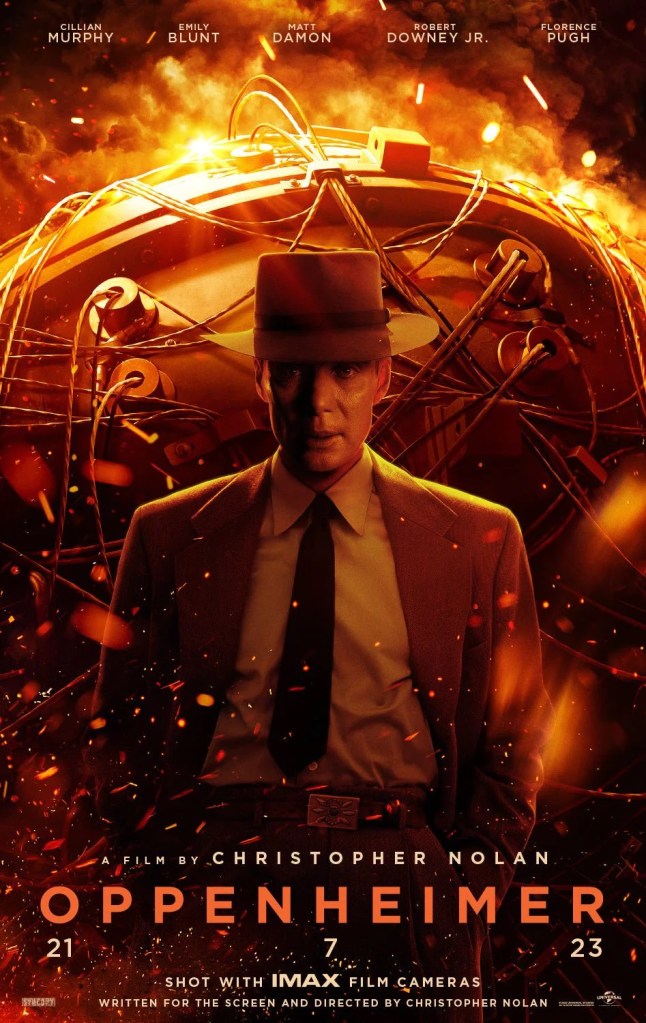
Oppenheimer (2023)

Oppenheimer (2023)

Nolan’s masterful musing on the morality of science is both challenging and compelling

Director: Christopher Nolan

Cast: Cillian Murphy (J Robert Oppenheimer), Emily Blunt (Kitty Oppenheimer), Matt Damon (General Leslie Groves), Robert Downey Jnr (Lewis Strauss), Florence Pugh (Jean Tatlock), Josh Hartnett (Ernest Lawrence), Casey Affleck (Colonel Boris Pash), Rami Malek (David Hill), Kenneth Branagh (Niels Bohr), Benny Safdie (Edward Teller), Dane DeHaan (General Kenneth Nichols), Jason Clarke (Roger Robb), David Krumholtz (Isidor Issac Rabi), Tom Conti (Albert Einstein), Alden Ehrenreich (Strauss’ aide), Gary Oldman (President Truman), Jefferson Hall (Haakon Chevalier)

“I am become Death, the destroyer of worlds”. These words from The Baghavad Gita are synonymous with J Robert Oppenheimer, director of the Manhattan Project as he witnessed the destructive force of his creation, the atomic bomb. Fittingly, Nolan’s fascinating and ambitious film opens with a reference to Oppenheimer as Prometheus: the man punished for all time for stealing fire from the Gods. Oppenheimer uses everything from thriller to courtroom drama, to explore the moral responsibilities of science: if we can do a thing, does it follow that we must?

J Robert Oppenheimer (Cillian Murphy) is a Renaissance man and leading theoretical physicist who dabbled more than a little in left-wing politics. The woman he loves, Jean Tatlock (Florence Pugh), is a die-hard communist, the woman he marries Kitty (Emily Blunt) is a former party member, his closest friends are all members. Associations like these will later haunt him after he is approached by General Leslie Groves (Matt Damon) to use his organisational skills, political savvy and charisma to run the WW2 nuclear programme where maverick scientists work hand-in-hand with the army. Despite his position, Oppenheimer remains untrusted by many. In the aftermath of the war, these suspicions will be used by his opponents, among them Lewis Strauss (Robert Downey Jnr) ex-head of the Atomic Energy Committee, to bring about his downfall as Oppenheimer preaches disarmament.

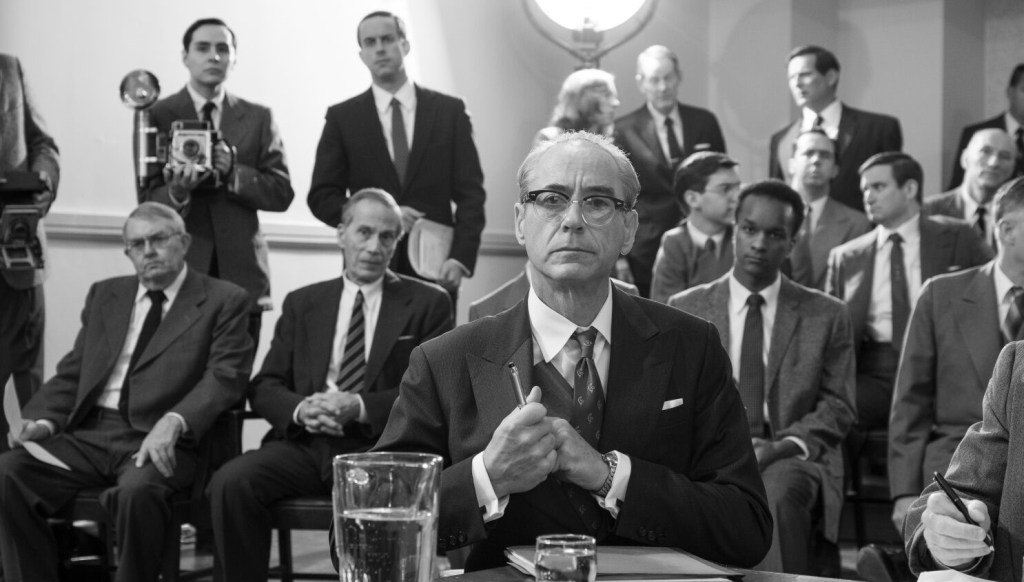
Much like Dunkirk, Oppenheimer is told in two timelines, intersecting with scenes replayed from different perspectives in subtly different ways. In “Fission” we see Oppenheimer, effectively on trial in 1954 for his security clearance, recount his life story, chronological flashbacks taking us through the development of the bomb. In “Fusion”, shot in gorgeous black and white, we follow the 1959 senate hearings to confirm Strauss in a cabinet post, and see his reminiscences of Oppenheimer’s post-war struggles to control the monster he has unleashed.

Oppenheimer is a brilliantly made, cinematically adventurous film: you would, of course, expect nothing less from a distinctive talent like Nolan. Brilliantly intercutting multiple timelines, it’s a film that is as much an experience as a story. This is a behemoth, filled with moments of flair and breath-taking use of sound and vision to affect mood. In particular, the film’s oppressive sound design bears down on the viewer like the pressure of the bomb itself. This means moments when we are released from its grip carry real impact. As Oppenheimer – already plagued with doubt – triumphantly announces the successful use of the bomb, the war-like celebratory pounding of scientists’ feet disappears from the soundtrack leaving Oppenheimer’s words echoing impotently around the room.

The pounding score and epic, sweeping camerawork (even more striking, since so much of the film takes place in small rooms filled with conversation) help Nolan to build up Oppenheimer’s mythic status and simultaneously strip him bare. Literally so at one point as, when questioned on his sex life in his hearing, Oppenheimer is seen naked in the room (as exposed as he must be feeling) answering questions with a naked Jean Tatlock astride him, staring into his wife’s eyes.

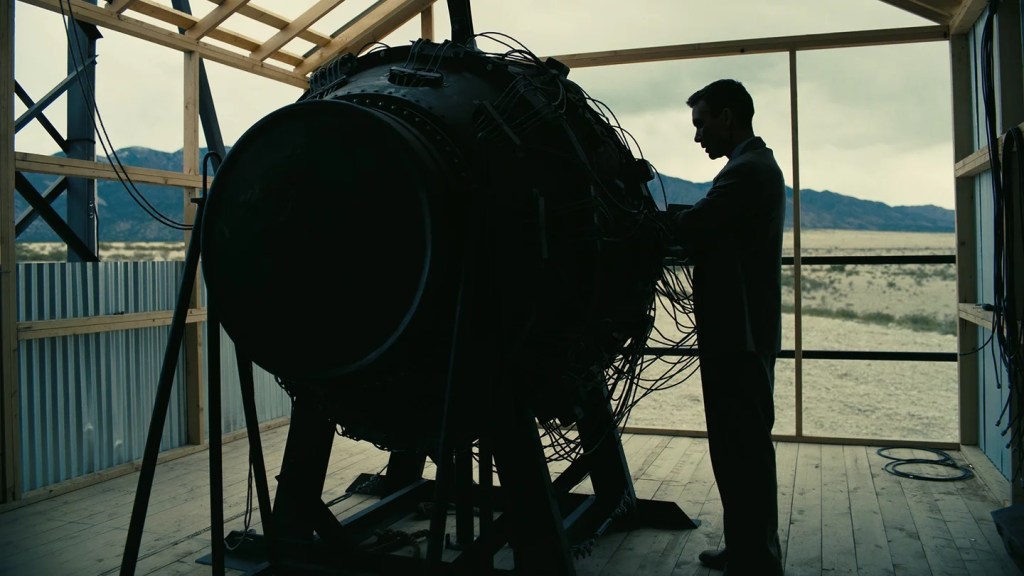
Oppenheimer labours, with the best intentions, to create a weapon before the Nazis. In its middle act, Nolan’s film focuses on the propulsive excitement of creation. The thrill of obstacles being overcome and solutions being found. The joy of a diverse team coming together for a single goal. We find ourselves longing for problems to be overcome, swept up in the desire for the endgame, as anxious as the scientists when it looks like rain will prevent the vital first Trinity test of the bomb.

Oppenheimer feels the same. Powerfully, intelligently and magnetically played by Cillian Murphy, this is a man who is a host of flaws crammed with impossible genius. A charismatic room leader, who is awkward in personal interactions. A charmer who rudely fails to remember his brother’s girlfriend’s name at a party. An inspiring leader who alienates people with ease. Murphy captures every inch of Oppenheimer’s staggering intellect and delight in intellectual problems, just as he also embodies the man’s arrogance and crushing self-belief.

So, it’s as crushing to him as it is terrifying to us, when the bomb explodes and the realisation hits us. Nolan’s sensory experience of a film fades down to silence as Nolan lets the camera float across the all-consuming fire of the silent explosion (the noise only comes when the shockwave hits) and suddenly the chilling implication of this terrible weapon becomes clear. This is a device that will kill millions. Oppenheimer knows it: he slowly shrivels into haunted guilt, Murphy seeming to shrink into himself as he finally understands what he has done.

Images of nuclear destruction both obvious (ashen bodies and nuclear flashes) and subtle (the out-of-focus vibration of background around Oppenheimer, as if sensing an approach shockwave) will haunt him and us for the rest of the movie. While many scientists – foremost among them Benny Safdie’s bull-headed Edward Teller and Josh Hartnett’s WASPish but decent Ernest Lawrence – feel little guilt. But Oppenheimer, and we, can no longer avoid questions of moral responsibility raised by those such as Niels Bohr (a quietly effective Kenneth Branagh).

Are there some discoveries better not made? Because once the genie is out of the bottle, it cannot be stuffed back in again. In this new world every world power must always have more. More bombs, bigger bombs, better bombs. And it explains why, like Prometheus, Oppenheimer must be punished. The tool of his punishment being his communist sympathies, embodied in his yearning attraction to Jean Tatlock (an under-used Florence Pugh). Nolan’s film is very strong on the terrifying paranoia of the secret state, where every word or association can be collected into a terrible portfolio of witnesses you cannot question, evidence you cannot see, testimony you cannot hear.

“Why don’t you fight” cries his wife Kitty, played with a dynamic, intelligent forcefulness by Emily Blunt. I could have done with a third act built more around Blunt’s starkly honest betrayal of a woman ill-suited to being a wife and mother, trapped in a world where that is all women can achieve (and which also trimmed a few witnesses from Oppenheimer’s trial). Why doesn’t Oppenheimer fight? Nolan has his theories, carefully seeded and confidently revealed.

Oppenheimer’s post-war clashes cover much of “Fusion”, anchored by a superbly under-playing Robert Downey Jnr (his finest work since Chaplin) as the outwardly avuncular, but inwardly insecure and bitter Strauss, who sees Oppenheimer as the embodiment of all the elitists who turned their noses up at him (no matter that Oppenheimer himself is an outsider, in a world of science run by WASPish types like Lawrence). Nolan’s film explores how morality is forgotten in an environment so rife with paranoia that the slightest expression of doubt is seen as treason.

Nolan’s film needs its vast runtime to keep as many balls in the air as it tries to. It’s probably a few too many balls. I would have loved more on Oppenheimer’s outsider status, as a Jew in American science (its not mentioned that the J stands for Julius, despite his claims it stands for nothing). Similarly, I would have welcomed more time to explore Oppenheimer’s complicated emotional life, in particular the fascinatingly complex relationship of some love, a fair amount of mutual respect and a large measure of mutual convenience with his wife Kitty.

But the film’s chilling musing on the horrors science can accidentally unleash while focused on progress is superbly explored and leaves a lasting impact. It’s a feeling that continues to be sharply relevant while we struggle with the implications of AI. Was there a need for the bomb? Perhaps there was. Were we ready for the bomb? No. And it is the failure of anyone, including Oppenheimer, to even consider this until it was too late that is the coldest warning in Nolan’s epic film.

Freud (1962)

Freud (1962)

This intriguing film makes an excellent attempt at exploring the nature of thought

Director: John Huston

Cast: Montgomery Clift (Sigmund Freud), Susannah York (Cecily Koertner), Larry Parks (Dr Joseph Breuer), Eric Portman (Dr Theodore Meynet), Susan Kohner (Martha Freud), Eileen Herlie (Ida Koetner), Fernand Ledoux (Dr Charcot), David McCallum (Carl von Schlosser), Rosalie Crutchley (Amalia Freud)

Few thinkers had as much impact on the 20th century as Sigmund Freud. For generations, Freud’s theories on psychology and sexuality were defining texts shaping perceptions of our inner world. John Huston was fascinated by his work, translating its spirit into this thought-provoking, if at times clinical, film that focuses on a few key years in Freud’s life and does its very best to communicate the thought behind the theory, while being careful to never delve too far into thornier matters. (Despite the poster’s blaring tagline “He dared to search beyond the flesh!”).

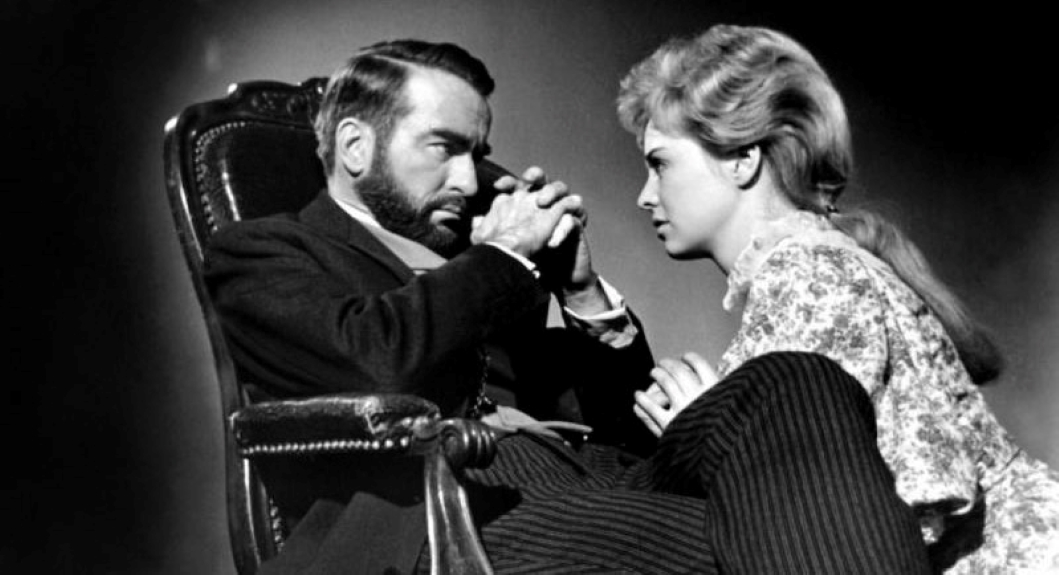
Freud is played by Montgomery Clift, whom we meet in 1885 Vienna as a young doctor. Freud’s theories that physical ailments might have a psychological cause are widely dismissed by the medical establishment, represented by smug Dr Meynet (Eric Portman). However, Freud is convinced the secret of treating neurosis lies within – not least since he recognises symptoms of neurosis in his own dreams, haunted by half-memories of his mother and complex feelings for his father. Working with his mentor Dr Joseph Breuer (Larry Parks), Freud explores hypnosis to access patients’ repressed feelings, working closely with Cecily Koertner (Susannah York), a young woman who has inexplicably lost the ability to walk. Slowly Freud begins to form a theory of sexuality in children, as well as discovering guided discussions and word association to be more effective than hypnosis.

Huston’s film is shot in luscious black and white by Douglas Slocombe, composed of a mixture of images that balance painterly influences with surrealist nightmares. Freud and Koertner’s dream sequences are shot with a grainy intensity, a series of chilling images ranging from Freud being dragged towards his enthroned mother by a roped dwarf to Koertner’s mother domineering a beach from a grand tower. These surrealist touches tear through a film that otherwise presents a more earnest exploration of Freud’s theorising. It serves as a necessary contrast to the constraining formality of 19th-century Vienna, where inner passions and feelings are routinely stamped down.

Freud studiously explores the evolution of its subject’s thinking, in particular through his analysis of the fictional Cecily (standing in for several patients). Played with gusto by Susannah York, the film carefully structures her psychological make-up as a detective mystery to be slowly peeled away, with wrong-turns, false dawns and incorrect assumptions abounding. Initially treated with caring patience by Breuer’s hypnosis, slowly Freud replaces his mentor first as a doctor and then (to his subtle discomfort) as the subject of Cecily’s transposed attractions. These interior searches, eventually culminating in Freud’s first experiments of psychoanalysis and word association, are fascinating moments that pivot the film, with convincing false conclusions regularly introduced to constantly challenge the viewer’s assumptions.

It leads to the formulation of Freud’s Oedipal theories that cross a Rubicon his mentor cannot. In that, Breuer is joined by most of the medical profession. Huston’s film is strong on the stuffy self-confidence of the establishment, too hide-bound by its own ideas to recognise genius in their midst. Portman’s grandiose Dr Meynet gently, but firmly and devastatingly, rubbishes any nascent idea that neurosis patients are anything other than idlers and whingers. Meetings where Freud presents papers offer choruses of raucous boos and naked fury (at one point a dignified doctor literally stands up and spits at Freud’s feet in disgust). Hypnosis, with its vague medical support for its method is used as something close to a parlour trick by an otherwise supportive Dr Charcot (Fernand Ledoux) to pass physical symptoms from patient to patient, demonstrating the symptom is psychological even as he does nothing to understand the cause.

The path to decoding the human mind – as the film firmly believes Freud’s theories have done, hammered home by Huston’s narration which opens and closes the films and intermittently provides an internal monologue for Freud – is a bumpy one. Freud is frequently disturbed by the implications of his investigations. A young solider – a fragile David McCallum – alarms him when, under hypnosis, he reveals a deep, sexual longing for his mother via the fondling of a mannequin (naturally concealed under his father’s uniform). Freud’s closeness to his mother – a marvellous Rosalie Crutchley – becomes wrapped up in his theories, his dreams and memories haunted by half-remembered encounters and longings that cause him great unease.

Much of the clarity of this unease – and the tension as the unsettling implications of Freud’s nascent beliefs become more apparent – owes its success to Clift’s performance in the lead role. Clift was in extremely poor health at the time, still suffering from the effects of a near fatal car crash (including cataracts that affected his vision). An addiction to painkillers and alcohol had shot his memory to pieces. He struggled to remember lines (so much so the studio attempted to sue him for the film’s many delays), but his soulfulness appears to glorious effect. He makes Freud a profound and troubled but artistic thinker, a humanitarian full of empathy which also makes him a conduit for guilt and shame. His impassive face makes him the perfect listener but does not hide his own torment. It’s a marvellous performance, one that manages to convey the power of thinking.

Unfortunately, its genesis is also bound up in the story of the film’s making, that has often dwarfed the film itself in discussions about this intriguing movie. Huston – increasingly angry at Clift’s unreliability, compounded by his alpha-male disgust at Clift’s homosexuality – bullied the actor relentlessly during the film’s making, forcing him into take-after-take after every line flub to the increased anger of the other actors (York, in particular, was outspoken in her disgust at this). Huston had also originally written a script with Jean-Paul Sartre but, not surprisingly, the two were incompatible, Sartre eventually having his name removed from the credits.

It’s a shame these stories have dominated the discussion of the film, as it is a rich, intriguing work directed with a thoughtfulness by Huston that helps it become a thoughtful and patient film, rather than a triumphalist one (the film lacks either a eureka moment or a closing triumph, leaving Freud still rejected by the establishment and quietly visiting his father’s grave, having come to terms with his own feelings). With a marvellous performance by Clift – even if his treatment on set was shocking – it’s an intelligent, intriguing and well-handled exploration of a complex theme. It’s more than a curiosity, it’s a measured and serious film with flashes of surrealism that engages intelligently with important themes.

Andrei Rublev (1966)

Andrei Rublev (1966)

Tarkovsky’s masterpiece is one of the greatest films ever made about art and creativity

Director: Andrei Tarkovsky

Cast: Anatoly Solonitsyn (Andrei Rublev), Ivan Lapikov (Kirill), Nikolai Grinko (Danlil Chyorny), Nikolai Sergeyev (Theopanes the Greek), Irma Raush (Durochka), Nikolai Burlyayev (Boriska), Yuriy Nazarov (Prince Yury/Grand Duke Vasily I), Rolan Bykov (Jester), Mikhail Kononov (Foma)

I’ve always been a Tarkovsky sceptic. But Andrei Rublev is a masterpiece. Perhaps only Tarkovsky could have made a film about an artist and never once show a paintbrush in action or design a film about creativity that drips with shocking violence. Andrei Rublev avoids the cliches of cradle-to-grave biography – helped by the fact we know almost nothing about this medieval icon painter – presenting instead a series of vignettes suggesting possible influences on the work of an artist. It makes for an intriguing, fascinating film, challenging but infinitely rewarding.

Tarkovsky’s film roughly chronicles 24 years (1400-1424) in the life of Andrei Rublev (Anatoly Solonitsyn). But this is far from a straight-forward narrative, and the episodes themselves often seem only loosely linked and the movement of time and location often feels hazy. In many of these scenes Rublev is often a quiet observer or a man searching for depth and meaning, uncertain of his own views, aspirations and how he wishes to express his faith.

Over the course of the film, he observes a travelling Jester (Rolan Bykov) punished for mocking the social order, debates theology with his mentor Theopanes the Greek (Nikolai Sergeyev), is tempted by a pagan orgy in the forest and witnesses shocking acts of violence (including taking a life himself) in a civil war between two feuding noble brothers. Eventually taking a vow of silence, it is his witnessing of the rapturous reception of the successful casting of a giant bell – and the relieved shock of the teenage bell-master (Nikolai Burlyayev) that confirms to him the spiritual importance of providing consolation and joy to others through religious art.

Shot in a luscious black-and-white, Tarkovsky’s film presents a series of beautifully composed images that constantly invites us to re-interpret and re-imagine what we are seeing. This is not history as picture-book or progressive story. This is Tarkovsky at his best, a sprawling dream that never tries to clumsily link events to artistic outcomes or obvious motivations, but to suggest how the atmosphere of the world can form an artist’s spirit.

This is a medieval world that feels immersive, grimy and real – but also hums with a gorgeous sense of possibility. Tarkovsky frequently shoots horses, his camera lingering on these free-spirited animals that represent the freedom nature can give us. A close connection with the natural world draws the characters in time and again: Theopanes sits contentedly and allows ants to swarm over his legs, the bell is born in a dug-out crater in the earth itself. Water recurs as a symbol of possibility and temptation: Rublev’s pupil Foma daydreams of flying while washing brushes in water and later meets his death in a river; Andrei spies the naked pagan celebration in the river, then averts his eyes when rowing past their inevitable arrest. In the film’s prologue an early balloonist flies across a river, while at its conclusion Rublev and Boriska crouch and comfort each other in a water-logged field. Nature is elemental, bringing characters closer to an understanding of themselves and others.

In contrast, Tarkovsky’s film is striking for presenting what a destructive, violent and brutal force the ambitions of man can be. A yearning for power and recognition time and again develops into of violence. The jester is consigned to beating and years of imprisonment due to the close-minded resentment of intelligent-but-uninspired monk Kirill (Ivan Lapikov). A group of stonemasons are brutally blinded in the forest (violence even corrupts nature) by the Grand Duke’s men for standing by their rights. Most strikingly, Andrei witnesses a brutal massacre (vividly shot with hellish detail by, the entire sequence echoing the Eastern Front in World War II) in the city of Vladimir, where the Grand Duke’s brother’s forces indiscriminately rape and slaughter the population (including a horde of survivors searching for sanctuary in the church Rublev has just decorated with icons) and brutally torture and murder a monk (culminating in feeding him a melted golden cross). Even the bell-makers labour under the threat of instant death should their work fail and the bell crack.

Tarkovsky perhaps suggests the possibility of beauty and violence goes hand-in-hand for all of us. I feel that is the message of his fascinating – but never clearly explained – prologue. Set in an unspecified time and place, a medieval balloonist takes to the skies while, on the ground, panicked villagers (seeing the flight as witchcraft) attack his assistants. The balloonist flies with joy over the river – then crashes to the ground (and probably his death). This Icarus fable is, perhaps, about the difficulties of reaching for the sublime when the world constantly wants to pull us down. There is little place for invention and creativity in an existence that places a premium on earthly concerns, where art is just another tool for maintaining the power of the elites and the masses fear change.

It’s what Rublev is straining to rebel against. He lives in a world – and it’s hard to resist the idea Tarkovsky was suggesting Soviet Russia was little different – where art is a tool of control, feathering the glory of the powerful. He struggles to paint a Last Judgement because, as he argues with fellow artist Danlil (Nikolai Grinko) he doesn’t want to create an image designed to terrify the masses into faith. The Duke’s motivation for painting his Church is to make it grander than his brother’s. The bell is cast as a show for foreign dignitaries. The jester’s performance is punished for its satire.

Andrei is contrasted with the more overtly intellectual – but uninspired and untalented – Kirill, played with surely resentment and self-loathing by Ivan Lapikov. Judgemental and arrogant, Kirill dreams of having his genius recognised (approached by Theopanes to work with him, he is more interested in having the offer repeated publicly than the work itself) and lashes out at both the jester and his own dog for having the sort of freedom he can never find in himself.

Temptation and vanity also stands in the way of achievement. Shot in a style reminiscent of Christ in the wilderness, Andrei is fascinated by  the pagan orgy he witnesses. He is similarly drawn, for reasons he seems not quite to understand, towards the beautiful holy fool Durochka (Irma Raush), who he will brutally defend from rape in Vladimir. A vow of silence – and a Sisyphean labour moving heated rocks around a snow-bound monastery – is his self-appointed punishment for both his dreams of glory and his yearnings for romantic couplings. Art can be challenging.

But its results can be beautiful and inspire higher feelings. In the aftermath of the massacre of Vladimir, Andrei imagines a discussion with the long-dead Theopanes (Tarkovsky skilfully shoots this sequence with Theopanes appearing at every turn Andrei makes) who scorns Andrei’s grief and guilt over his burned church icons (and the false clash their beauty makes with the brutal world around them) and proclaims their beauty is a purpose in themselves. It’s a feeling Andrei only understands when seeing the people react with joy to the casting of the bell.

The final bell sequence – which brings all characters together to witness – would in itself make a masterful short movie and is certainly the finest extended sequence Tarkovsky ever made and a wonder in its own right. Immersed in the detail – and offering a fine portrait of bullish determination and artistic dictatorialness from Nikolai Burlyayev’s laser-focused Boriska – shot with a striking series of long shots and edits (some of the birds-eye shots are extraordinary) Tarkovsky creates a sequence of inspiration and tension. The careful, omnious, build-up to see if the bell will ring creates the same joyful relief in the audience as it does the watching crowds. It’s also perhaps the finest example on screen of the strangely empty, nervous release the culmination of creativity can bring.

Andrei Rublev is a fascinating, challenging and deeply engrossing art-house picture that alone cements Tarkovsky’s position among the greats. Finding colour only at the end with a series of awe-inspiring studies of the details in Rublev’s paintings, it reaches a finer understanding of the struggles in the soul of the artist than hundreds of more traditional biopics. Solonitsyn is superb as the enigmatic Rublev, the film a brilliant pageant of events (much like the medieval passion play Rublev remembers witnessing) that uses incidents to give us a final picture of understanding. It becomes one of the most oblique but constantly thought-provoking explorations of artists ever made – and a film where hours of thinking only scratches the surface of its possibilities.

Wilson (1944)

Wilson (1944)

Well-meaning if slightly dry hagiography that struggles to turn history into drama

Director: Henry King

Cast: Alexander Knox (Woodrow Wilson), Charles Coburn (Professor Henry Holmes), Geraldine Fitzgerald (Edith Wilson), Thomas Mitchell (Joseph Tumulty), Ruth Nelson (Ellen Wilson), Cedric Hardwicke (Senator Henry Cabot Lodge), Vincent Price (William G McAdoo), William Eythe (George Felton), Mary Anderson (Eleanor Wilson), Ruth Ford (Margaret Wilson), Sidney Blackmer (Josephus Daniels), Madeline Forbes (Jessie Wilson), Katherine Locke (Helen Bones)

Darryl F Zanuck had a passion project: a biopic of the 28th President Woodrow Wilson. It would be both a tribute to a man, he felt, was overlooked and also a homage to current President Roosevelt – and a warning for the future. Like FDR, Wilson had introduced a raft of reforms and led the country in wars – and Zanuck was worried America would fudge the peace, just as Wilson had failed to get the Senate to endorse the League of Nations, leaving it a toothless lion.

Zanuck’s no-expense spared approach gives us a laudatory biopic that lavishes Wilson in euphoric praise, smooths off all his edges and presents him as a visionary and a near-flawless leader. The money was thrown into building elaborate sets and costumes – vast swathes of the White House and the Palace of Versailles were re-built on the sound stages of 20th Century Fox – and the script repackaged a series of major events interspersed with Wilsonian speeches. It was launched to a fanfare, was nominated (largely due to Zanuck’s influence) for ten Oscars (winning five) and was a box-office failure.

But is it a good movie? In truth, not quite. Despite the lavish production values, this is a dry, unimaginative and stately progression through its subject’s life. Henry King marshals events with the professionalism of an accomplished journeyman, but little inspiration. There is nothing striking, original or brave in a single minute of Wilson, but everything is perfectly framed and (considering its immense length) well-paced. King uses a series of low-angle shots to hammer home the magnificent detail of the sets and Alfred Newman’s score remixes a series of patriotic scores and heavenly-sounding choirs to build the impression of Wilson as secular saint.

But Wilson remains a largely undramatic movie, with an (Oscar-winning) script by Lamar Trotti that fails to inject drama or skilfully convey information. The warning signs are there in the film’s opening, with a group of New Jersey Democrats arrive to recruit Princeton head Wilson to run for Governor and clumsily give each other a potted precis of his CV and academic achievements while they wait for him to join them. Dialogue frequently info dumps historical research in our ears. Newspapers bluntly tell us in crude headlines what’s happening. Poor Thomas Mitchell’s entire role seems to be made up of running into rooms clutching telegrams announcing major events.

In amongst all this research though, we get very little idea of what Wilson actually stood for. There is virtually no time spent on his Governorship of New Jersey, other than a two-scene disagreement with the Democratic bosses whose power he breaks. On becoming President, his major legislative reforms are covered in a less-than-a-minute montage of signed bills. He consults his cabinet once or twice and, when war comes, walks a fine line between preserving American strength and not rushing into war. The final act of the film covers his failed battle for the League of Nations, the only policy the film invests any time into explaining.

For much of the rest of the time, this hagiography concerns itself with down-playing or skating over anything in Wilson that could be perceived as a flaw. Wilson here talks a good game of reform, equality and rights for all. In real life, he was a dyed-in-the-wool segregationist, sceptical about women’s suffrage as well as being an intellectually arrogant elitist who, later in his Presidency, began to see himself as a sort of vessel for God’s policies. While he was undoubtedly a highly effective moderniser and legislator, none of his faults make it to the screen.

Other areas are also carefully removed. Wilson was often accused of being heavily under the influence of advisors like “Colonel” House – House gets a one-scene cameo here. He ran for re-election in 1916 promising to keep America out of the war – this unfortunate broken promise is repackaged as Wilson sitting in the White House deeply regretting the campaign the party is running for him but stating there’s nothing he can do about it. His controversial re-marriage in 1915 to the much-younger Edith Galt (only two years after his wife died) is excused by his wife informing his daughters on her death bed that Wilson must marry again as he needs a wife. Wilson’s incapacity after a stroke in 1920 is down-played, while Edith (who effectively took over running the country for her husband in a constitutional scandal that would never stand today) states “I never made a decision without your knowledge and consent” while sitting with a sturdy Wilson.

All of this is played out in parallel with making Wilson’s rivals in the Senate mustachio-stroking schemers. None more so than Henry Cabot Lodge (well played by Cedric Hardwicke) who begins a career of animosity against the President after being made to wait for a meeting at the White House. In real life, Wilson refused any compromise offered by Lodge to get the League approved by the Senate, but here Wilson is a noble crusader foiled by political pygmies.

Saying that, the film benefits hugely from a very strong performance from Alexander Knox as Wilson, who not only looks and sounds exactly like the President, but perfectly captures his mannerisms. It makes you regret though the film is so little interested in Wilson’s personality or in building any picture of the humanity behind this leader. The rest of the cast have little to do other than state historical facts or stand to listen to Knox masterfully delivering Wilsonian speeches.

Wilson has a historical interest for Presidential buffs and, while it downplays the negatives around Wilson, it makes a very effective case for the President as a visionary leader (he was undoubtedly right about the League of Nations – even if his stance here is restructured into an FDRish self-determination for all nations). But this is a dry, stately film that never manages to turn the march of time into the thrust of drama. The Oscar-winning sets and photography look impressive, but its simplistic and hagiographic presentation of events eventually shakes your interest.

The Private Life of Henry VIII (1933)

The Private Life of Henry VIII (1933)

Carry on Henry as Korda’s comedic historical epic cements the popular perception of the monarch

Director: Alexander Korda

Cast: Charles Laughton (Henry VIII), Elsa Lanchester (Anne of Cleves), Binnie Barnes (Katherine Howard), Merle Oberon (Anne Boleyn), Wendy Barrie (Jane Seymour), Everley Gregg (Catherine Parr), Robert Donat (Thomas Culpeper), Franklin Dyall (Thomas Cromwell), Miles Mander (Wriothesley), Laurence Hanray (Thomas Cranmer), John Loder (Thomas Peynell)

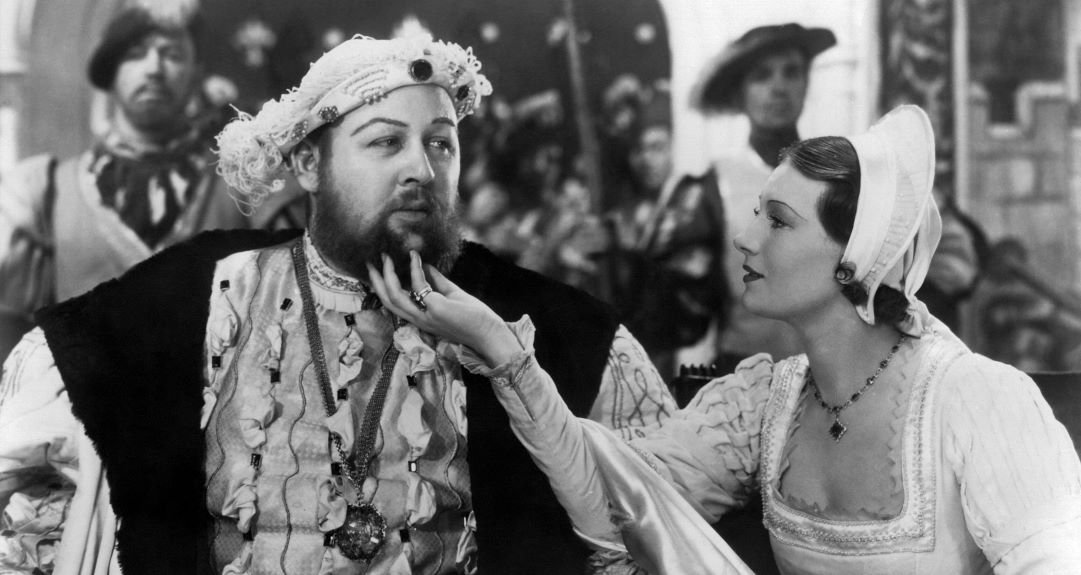
“A Great Guy With His Chopper” was the tag-line for Carry On Henry starring Sid James as a smirking, rogueish Henry. But it might as well have been the tag-line for this Oscar-winning film, that pretty much cemented the public’s perception of Henry VIII as a lusty, fun-loving king, chucking chicken legs over his shoulder when he wasn’t busy marrying wives. Korda’s handsomely filmed Tudor epic is more knock-about farce than history but was the then most successful British film ever (the first to be nominated for Best Picture) and scooped an Oscar for Laughton as the Merrie Monarch.

The Private Life of Henry VIII skips over the meat of most Henry flicks. Catherine of Aragon is dead (the films comment on her in the opening credits describes her story as being “of no particular interest”, news to scholars of the English Reformation) and with Anne Boleyn (Merle Oberon) prepping for her head to be lopped off with a sword. From there history is left firmly behind as Bluff Hal flirts with Catherine Howard (Binnie Barnes) – who has eyes for his pal Thomas Culpeper (Robert Donat) – marries Anne of Cleves (Elsa Lanchester) who uggs up to get out of it – and ends up as a hen-pecked old guy under a blanket, bossed around by Catherine Parr (Everley Gregg).

For those interested in history, don’t expect to find out anything here. Despite walk-on parts for the headline names of the Henrician reign (Cromwell, Cranmer and others dance around the margins) and some impressive sets and Holbein-influenced costumes, this is really a cheeky-comedy, popping gags at the monarch’s famed lothario. Just as well then that the gags are all pretty good, the pace kept up and the energy of all involved adds hugely to the sense of fun.

A lot of that is, of course, led by Laughton as Henry VIII. Laughton charges around, hand on hips, legs splayed and peppers every other line with outbursts of crude laughter and childish tantrums. Laughton, in short, has a whale of time, piling into every scene with lusty relish. There is a twinkle in his eye throughout even the film’s most laboured gags (the sequence of Henry spitting and throwing food over his shoulder while bemoaning “There’s no delicacy nowadays…Manners are dead!” would easily outstay its welcome without his delighted playing of it).

What’s also striking about Laughton’s performance is the depth he gives it under the humour. Korda’s film wants us to enjoy the outlandish, larger-than-life qualities of the king, but it’s not afraid to look at the darker soul below the surface of the man many call “England’s Stalin”. Laughton’s Henry is a man who greets news of Jane Seymour’s death with a few brief seconds of sadness, before a shrug of the shoulders and a cheerful enquiry about his son. His tantrums and egotism constantly dance on the edge of tyranny. He manhandles lords and servants, screams and stamps when he doesn’t get his own way and shows not a jot of remorse or guilt at the deaths he causes (he’s even seen impatiently tapping a window waiting for the sword to fall on Anne).

Despite this though, you still sort of end up feeling sorry for him. Perhaps because Laughton manages to also make him feel strangely naïve and trusting for all his school-boy bluster. Henry is torn apart with grief at the betrayal of Catherine and Culpeper (something he really should have spotted as it is almost literally going on under his nose). Korda presents a few fairly serious scenes, after a lot of comedic banter, with Henry first assaulting those bringing him the news and then collapsing into a shuddering mess of tears. A beautifully-framed shot in his chapel, shows Henry berating himself for the faults of Catherine, Laughton’s tear-stained face communicating his “mea culpas” with a soft, regret-filled quietness.

But what’s stuck in the public perception is the comedy. The film’s finest – and central – sequence covers the short marriage with Anne of Cleves, inevitably played by Elsa Lanchester. She delivers a superb performance of physical and verbal comedic charm. Henry famously was ‘unattracted’ to Anne (I’ve always believed this syphilitic, obese, gouty man just couldn’t blame himself for his inability to get it up so claimed it was the woman’s fault). Legend of Anne’s ugliness have cruelly stuck, but the film presents it as a rather amusing pantomime of fake stumbles and gurning faces used by Anne to save herself from one-day heading to the block under this tyrant.

Laughton and Lanchester’s natural chemistry (the first of their multiple collaborations on screen) sees the real-life husband-and-wife at complete ease and the wedding-night game of cards are the most relaxed and hilarious in the whole film. “The things I do for England…” Henry mutters, but there is a suspicion these two are much better suited than history assumes.

Korda pulls this altogether into a true crowd-pleaser. There is a farcical energy to the crowds providing a wry commentary on the executions. The film is crammed with some gorgeous sets – Laughton’s first entrance is a straight-restaging of Holbein. A sequence where Henry utterly fails to sneak into Catherine Howard’s bed-chamber (due to guards announcing “the King!” around every corner) is quite wonderfully staged. The cast are very fine: Merle Oberon makes a huge amount of Anne’s shrewdness (in the film’s most historically accurate sequence), Robert Donat is very charismatic as Culpeper, Binnie Barnes suitably flirty and empty-headed as a sex-pot Catherine Howard (even if she is considerably older then the real Catherine).

The Private Life of Henry VIII pulls all its material together into a luscious farce, with the odd serious moment, that might not make any sense at all when compared to history but makes a lot of sense when you compare it to stage farce. This was the first – and best – Carry On Henry.

Ivan the Terrible Parts 1 & 2 (1944/46)

Ivan the Terrible Parts 1 & 2 (1944/46)

Eisenstein’s final film sees him bravely turn Stalin’s dream project into a criticism of his whole regime

Director: Sergei Eisenstein

Cast: Nikolay Cherkasov (Ivan Vasilyevich ‘the terrible’), Serafima Birman (Efrosinia of Staritsa), Pavel Kadochnikov (Vladimir of Staritsa), Mikhail Zharov (Malyuta Skuratov), Amvrosy Buchma (Alexei Basmanov), Mikhail Kuznetsov (Fyodor Basmanov), Lyudmila Tselikovskaya (Tsarina Anastasia), Mikhail Nazvanov (Prince Andrew Kurbsky); Andrei Abrikosov (Philip, Metropolitan of Moscow)

The Soviet Union is at war, but Sergei Eisenstein is riding high. Fully restored to favour with the powers-that-be in the USSR with his flashy-but-traditional propaganda pic Alexander Nevsky, the master-of-the-montage was personally selected by Stalin to direct a three-part epic on the dictator’s hero, Ivan the Terrible. (You might wonder what attracted the paranoid, bloodthirsty dictator to a strong man Tsar best known for ruthless purges…) Stalin wanted an epic painting Ivan as a hero, who sometimes did bad things for the right reasons, all wrapped up in a neatly accessible package.

And he almost got it. Part 1 was met with acclaim and the Stalin Prize. Presenting Ivan as a successful politician and soldier, a true strong man binding the nation together and winning the admiration of his people, outfoxing his enemies at court (even though they successfully secretly murder his wife Anastasia), who retreats into Cincinnatus-like retirement only to be dragged back to save the country. It was the General Secretary’s wish-fulfilment wet-dream. Then came Part 2.

Part 2 was was immediately locked away in the vaults and all work on Part 3 ended instantly (every frame of footage shot was burned). If Part 1 was the dictator’s ideal Ivan-as-Stalin, then Part 2 was Ivan-as-Stalin that he definitely didn’t want to see. Now Ivan was ‘the Terrible’ doubling down on his nickname. Even worse, he did this while appearing unhinged, paranoid or (worst of all) manipulated by his poisonous advisors, none more so than jovial Beria-like Malyuta Skuratov (Mikhail Zharov). This Ivan rubbed out opponents, used terror as tool and focused all his anger and vengeance on those around him. Not something Stalin wanted to see, or was going to let anyone else see. Part 2 only emerged in 1958 ten years after Eisenstein’s death and 5 years after Stalin’s.

What the world ended up with, after they were allowed to see it, is a strange and hard-to-categorise film which has divided opinion for decades. To some it’s an artistic masterpiece, a triumph of symbolism and suggestion, with every shot crammed with intelligent and informed call-backs to artistic, psychological or sociological thinking. To others, it’s a somewhat turgid, hard-to-follow mess that serves as final expression of Eisenstein’s lack of interest in plot and character, not helped by his directions to the cast to echo Japanese theatre Kabuki style acting full of striking poses.

But you can’t deny the courage it must have taken Eisenstein to make this film. To have the guts to present something that deviated away from what history’s most ruthless dictator wanted and try and locate in it an unavoidable (if soft-pedalled) criticism of Stalinism. And can you blame Eisenstein if he tried to hide some of this behind art references and psychological games? Ivan the Terrible isn’t exactly easy – or fun – watching, but sometimes you just need to tip the hat to someone who has the guts to do things like this.

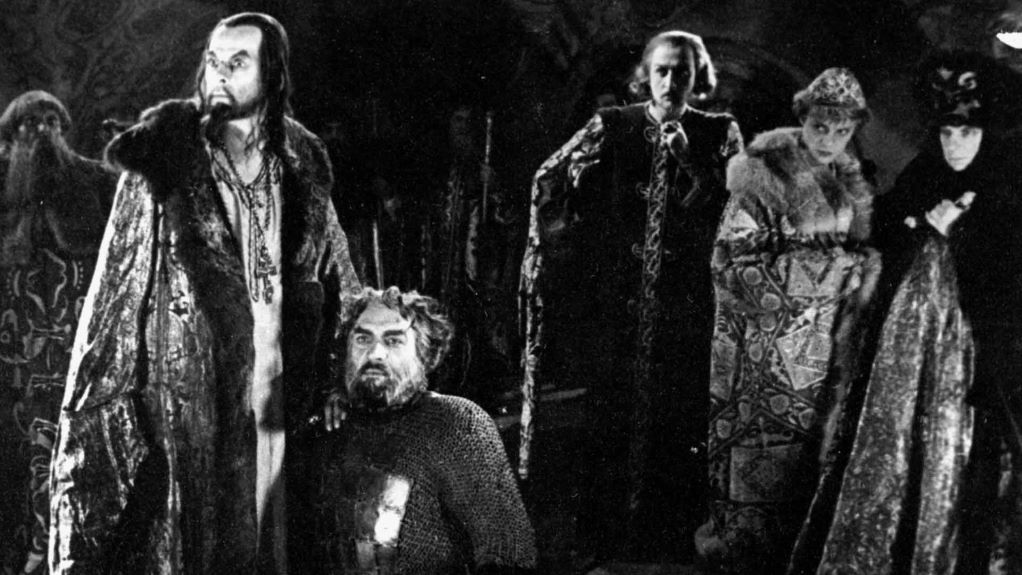
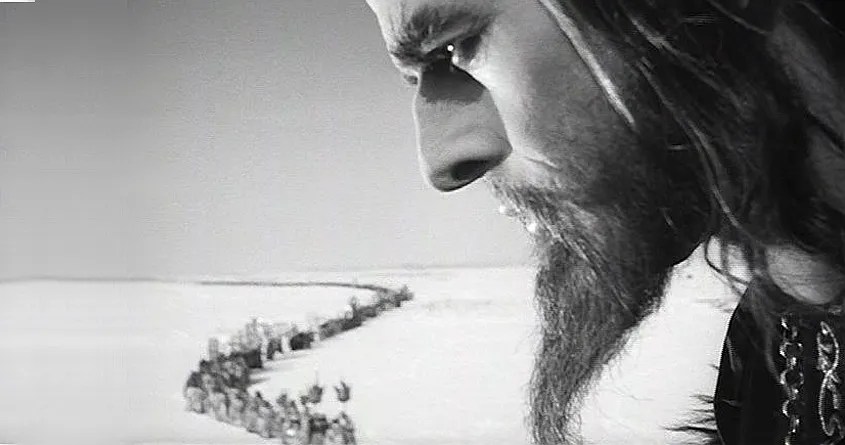
And there is plenty to admire in it. Eisenstein isn’t always recognised for his ability with the composition of shots – after all he’s the fast-cutting director’s dream – but Ivan the Terrible plays right back to his roots as a painter and designer. There are gorgeous shots here, my favourite being a looming close-up of Ivan’s face while behind him a never-ending procession of Russians slog through a white-out landscape to beg him to take back the throne. Ivan’s palace is a subterranean series of mole-like caverns, lavished with truly striking (and highly symbolic) devotional art. Firey angels are plastered across the walls above Ivan while plotting Boyars are shot huddled under mighty frescos of Death. The shadow work is extraordinary: light casts imposing, monstrous, giant black curtains. Astrolabe shadows dominate walls and advancing figures cast mighty shady pools in front of them.

Eisenstein takes his montage and arty suggestiveness of his editing work in Battleship Potemkin and October and translates it into images. The images do the work his banned formulist leanings had. Every image is rigidly thought-through and designed to make a specific implication or inference. It turns Ivan the Terrible into something ripe for analysis and exploration, the sort of film you could happily spend hours deconstructing.

It’s a film crammed with symbolism – some of it, if I’m honest, a little too clever-for-its-own-good. There are references to the work of Holbein, Botticelli, Rublev and a host of mythological figures. Sexual imagery is thrown in with blasting cannons at the siege of Kazan. It uses mirroring and contrasts throughout. Ivan’s coronation that opens in Part 1 will be echoed in a mock coronation of his would-be successor Vladimir (a fine performance of child-like simplicity and sweetness from Pavel Kadochnikov) in Part 2. As a child, Ivan will witness the death of his mother caught in the light of the doorway, very similar to the light in the doorway Vladimir will walk through to his death.

Characters are constantly positioned in framing that suggests (or hammers home) their personalities, motivations and desires. Vladimir will be cradled in his arms in a confessional Freudian clinch with first his mother and then (in an identical shot) with Ivan. The mock jovial Malyuta is given the physicality of the faithful dog he claims to be, while the villainous Efrosinia (a pantomimic, hissable Serafima Birman) rises from the ground like the serpent she feels like in almost every scene. Most of these characters are drawn in the broadest, most unsubtle strokes. It makes for some laughably unsubtle moments, but also a sort of primitive energy.

Unfortunately, it is also a film that dumps traditional narrative and characterisation for something highly stylised and impressionistic. Nowhere is this clearer than in Nikolay Cherkasov’s performance as Ivan. Constructed of a series of wild-eyed poses that would not look out of place in a silent movie, this is an over-the-top performance of hyperbolic mannerisms that probably has to be seen to be believed. There is nothing natural about this at all. It is all deployed to create a series of artistic poses and effects: what it is not designed to do is create a character we can relate to or understand.

Maybe this is how Eisenstein hoped to get away with implicit criticism of Stalinism? Ivan endorses the purges that happen, but we don’t seem him organising and initiating them. Was that, to Stalin, the worst crime of all – after all a strong man leads, even if his leadership is cruel. It’s also why, perhaps, he turned Malyuta into a jovial fixer (nevertheless Mikhail Zharov gives the film’s finest performance) rather than the ruthlessly ambitious killer he was. Part 2 shows an Ivan who allows executions not just out of ruthless paranoia but also a weakness of personality. Of all things, Stalin couldn’t take that.

Ivan the Terrible rockets along with very little sense of time, narrative or coherent, logical sense. Between the first and second scenes not only do years go by, but Cherkasov’s appearance changes so much it will take the viewer a few minutes to work out who he is. Characters sometimes go several scenes without being named. There is a Shakespearean pace to the narrative, even if it frequently flies over events, motivations, timescales and locations so quickly it’s hard to follow. It’s highly stylistic acting styles frequently make it hard for modern audiences not to raise a snigger.

Eisenstein was perhaps a little too keen to be seen as an artist, and Ivan the Terrible is at times – a bit like October – watching an overly enthusiastic art student showing you just how clever they can be. But, for all that, it’s intriguing and even if it’s not exactly entertaining, it offers many opportunities for intriguing analysis. And the very fact he dared to make a film that criticised Stalinism and then show it to Stalin is always going to be worth something.

Alexander Nevsky (1938)

Alexander Nevsky (1938)

Eisenstein offers one of the great battle scenes in an epic that abandons his earlier style

Director: Sergei Eisenstein

Cast: Nikolay Cherkasov (Alexander Nevsky), Nikolay Okhlopkov (Vasili), Andrei Abrikosov (Gavrilo), Dmitry Orlov (Ignat), Vasili Novikov (Pavsha), Nikolai Arsky (Domash), Valentina Ivashova (Olga), Aleksandra Danilova (Vasilisa), Vladimir Yershov (Hermann von Balk), Sergei Blinnikov (Tverdilo)

And we think directors are under pressure in modern Hollywood. Eisenstein hadn’t made a film in ten years after an ill-fated tour in America, that largely left him under suspicion back home in the USSR. He’s patented montage directing style had been denounced as ideologically unsound. His last film had ended in over-budget disaster, in the aftermath of which the head of Mosfilms had been arrested, tried and executed for treason. Eisenstein was in the last chance saloon and told he could make one film. Imagine having Stalin breathing down your neck.

He picked, from a bundle of possible projects, Alexander Nevsky. A medieval Russian hero, Alexander Nevsky led Russia to historic military victories over the Germans and the Swedes. (He also had the freedom of history knowing almost nothing about Alexander beyond that). Alexander Nevsky would zero in on his victory over the invading Teutonic knights in the “Battle of the Ice” and present Nevsky (Nikolay Cherkasov) as a Russian Henry V, a legend who knew only victory, leading a unified Russia against a barbaric and cruel (German) foe. What better subject when Hitler was on the door?

Eisenstein was given a team of Stalinists to work with (to ensure he never strayed into his “formalist” style) as well as trusted cinematographer Eduard Tisse and legendary Soviet composer Sergei Prokofiev. The film would essentially be the build-up to the central battle, a propagandist celebration of the strength and unity of the Russian spirit against wicked invaders. (It’s easy to forget that Eisenstein was one of the greatest propagandaists ever.) Nevsky – seven-foot, shot often from below so he towered over the frame and played by Stalin’s favourite actor, the charismatic Nikolay Cherkasov – would be a clear stand-in for the USSR’s leader.

Alexander Nevsky is strikingly different from Eisenstein’s earlier films. Obeying strict instructions, it is shot in a more formal, almost operatic, style with longer takes and a greater dependency on camera set-ups than Potemkin or October’s use of editing and montage. This translates into the battle that makes vivid use of speed, motion and immediacy in front of a camera, with carefully timed-cuts rather than fast-editing ala Potemkin. It doesn’t prevent this being one of the most influential battles ever placed on screen. It serves as a clear structural inspiration for Olivier’s Henry V (right down to Nevsky and the knight’s leader taking part in a mano-a-mano fight in the middle of the battle) and its DNA runs through countless films that followed, right up to Jackson’s Lord of the Rings.

This is an all-out brawl, a mass of bodies and weapons piling into each other with the camera (and the viewer) in the middle. The soundtrack is drowned out in a barrage of clashing swords, and we frequently see our Russian heroes framed centrally and slightly from below in mid-shot, hewing away on all sides with swords, axes and spears. At times Eisenstein employs faster film – particularly for the movement of troops – but it’s striking how clear and lack in impressionism the editing is. There are no cuts to suggestive details or the sort of flexing hands on straining horse’s reins you might expect from his other work. Instead, narrative clarity and masculine patriotism is to the fore.

None of this stops the battle from being compelling. A furious back and forth on the ice which culminates (inevitably) in the ice breaking and many German foes sinking to the bottom of the river in their heavy armour. Eisenstein, the master propagandist, makes no attempt to humanise the Germans. The Teutonic knights are nearly to a man, steel-bucket-headed stormtroopers, impersonal robots who cruelly follow any orders. At the sack of Pskov, they toss children and babies into bonfires without a backward glance and think nothing of slaughtering the helpless. Their leader is an arrogant sadist, who faces capture with a whimper. He serves alongside hypocritical churchmen who bless the slaughter of innocents and conspire with turncoat Russian monks to subvert Novograd.

On the flip side, the Russians are united in nobility and determination. They are led from the front by Nevsky who places weapons in the hands of the peasants and motivates all around him with his wisdom, humility and courage. Cherkasov is hugely charismatic as this idealised leader – even if little is called of him as an actor other than inspired speeches and standing hands-on-hips in manly determination. He forms a bond with a brave-but-Falstaffian blacksmith (Dmitry Orlov) standing in for the ordinary Russians, who jokes about but (unlike Falstaff) fights like a tiger.

As do all the Russians. All disagreements are put to one side. Two nobles feuding over their love for the same woman form a bond of brotherly mutual respect on the battlefield. The bereaved daughter of a Pskov noble, straps on chainmail and fights in the frontline. Peasant and noble hold the line together. The most despised character is Russian traitor Tverdilo (a snivelling Sergei Blinnikov) who betrays Pskov, wheedles for advantage and (literally) stabs people in the back.

The battle – and the rest of the action – plays out to a stunning score from Prokofiev. At turns martial, terrifying, tension-filled and triumphant, Eisenstein cut portions of the film to directly match Prokofiev’s rhythms. He’s equally well-served by Tisse, who shoots the film with a mix of epic stateliness and visceral immediacy. Interestingly it’s in the editing that the film looks most primitive today. At one point in the battle the Germans move from right-to-left charge to left-to-right (a strangely disconcerting switch) while the clash between Nevsky and the Teutonic leader is disjointedly cut with obvious, jarring, jumps.

But then Eisenstein didn’t want to be accused to succumbing to this formalist style. Stalin was showed the film and loved it. Allegedly apart from one reel which was promptly utterly destroyed (or it was destroyed before he saw it, his acolytes anticipating his dislike – the story varies). The film was a huge hit – until Stalin signed a pact with Germany in 1939, at which point it was banned. When the Germans broke the pact in 1941, it was back with a vengeance, a stirring example to all Russians of the glory of fighting back against the aggressor, with it’s “don’t tread on me” message (which Eisenstein throws up in text on the screen) a rallying cry in a new patriotic war.

There isn’t much to Alexander Nevsky outside of the battle – it’s all build-up, battle and then tiring up of loose ends. There isn’t much in the way of characters – never a major interest to Eisenstein. But he did creep some things under the wire, not least an effecting end-of-battle sequence that sees the dead and dying Russians on the field whisper or call out the names of their loved ones quietly before they expire. But in a film as triumphant as this one about the indomitable might of the Russian people, Stalin could let that slide. Alexander Nevsky might be a simpler, less striking film than Eisenstein’s earlier work – but it’s still an influential piece of cinema.

Watch Alexander Nevsky here (why this video has a full colour image fronting it I have no idea…)

Further reading

As a quick note… A new feature I’m trying out here. Probably more for classic films than recent releases.

Corsage (2022)

Corsage (2022)

The perils of a life married into royalty are as tricky for some 150 years ago as they are today

Director: Marie Kreutzer

Cast: Vicky Krieps (Empress Elizabeth), Florian Teichtmeister (Emperor Franz Joseph I), Katharine Lorenz (Countess Marie Festetics), Jeanne Werner (Ida Ferenczy), Manuel Rubey (King Ludwig II), Finnegan Oldfield (Louis de Prince), Aaron Friesz (Prince Rudolf), Rosa Hajjaj (Valerie), Lily Marie Tschörtner (Queen Maria Sophie), Colin Morgan (George “Bay” Middleton)

Known to the world as Sisi, there are few more troubled figures in the history of European royalty than Empress Elizabeth of Austria. Locked into a largely loveless marriage with Emperor Franz Joseph, she struggled with the expectations of her position. She suffered from an eating disorder in an obsession to reduce her waist size, exercising vigorously every day. She was an international icon, formed strong bonds with the Hungarian people, helping integrate them into the Austro-Hungarian empire and her later life was touched with tragedy (including her son killing himself in a murder-suicide pact with his lover) before her assassination.

Only touches of this dynamic story make it into this curious film, that focuses on one facet of her personality at the cost of exploring others. Focusing on the years 1877-78, Elizabeth (Vicky Krieps) is strapped into ever tighter corsets, struggles with “representing” Austria, attempts several love affairs that end in rejection, smothers her youngest child Valerie (Rosa Hajjaj) with affection and is prescribed a new “wonder drug” (heroin) to ease her nerves. While her family despair, she starts to groom her lady-in-waiting Marie (Katherine Lorenz) to stand-in for her at public events.

From a British perspective, pretty clear parallels are drawn between Elizabeth and that icon of 20th century monarchy Princess Diana. Like Diana, Elizabeth’s personal struggles are misunderstood and unsupported by her royal network. An intelligent, passionate woman, Elizabeth stifles under conditions that require her to do and say as little as possible. Her dull, formal husband (Florean Teichtmeister, refreshingly decent and befuddled as the Emperor) merely needs her to wave at events, nothing more. She finds this increasingly oppressive and constrictive.

Kreutzer’s film is a stylish presentation of Elizabeth as a sort of Royal rebel. Drenched in lavender – even the cigarettes she chainsmokes are lavender – Elizabeth takes every opportunity she can to leave the palace, avoids “smile and wave” events and behaves with unpredictability at social events (she’s as likely to laugh and flirt as storm out giving the room the finger). Her fainting could be due to her incredibly tight corsets – or it could just be a way of causing mischief. The system around her simply doesn’t know how to react to someone who doesn’t know herself what she really wants.

Corsage is most engaged with this analysis of undiagnosed depression, at a time when the condition was largely utterly unknown. We can see Elizabeth is mired in misery, but to others she’s merely a self-indulgent, difficult, un-co-operative woman. Shot with a candle-lit intimacy and drained out colours, the film presents the world much as Elizabeth (it suggests) may have seen it. Dark, oppressive and domineering.

Kreutser bravely avoids making her completely sympathetic. The film doesn’t shirk in showing how selfish and self-obsessed she can be. She can’t tell her maids apart (even Franz Joseph is more clued up on their names), bans loyal lady-in-waiting Marie from marrying as she needs her too much and drags her daughter through endless reluctant excursions (including a pre-sunrise horse ride) because she’s more interested in moulding her than listening to her.

Vicky Krieps embodies this prickly personality with huge skill. There are flashes of the sort of person Elizabeth could be. She frolics playfully for an early film camera in the countryside and comes flirtingly to life with two potential lovers, an English riding instructor “Bay” (played with bashful charm by Colin Morgan) and the man closest to being a kindred spirit King Ludwig II of Bavaria (an ebullient Manuel Rubey). Sadly, Bay is far too cautious to become the Empress’ lover (even when she turns up at his room dressed in little more than her corsage) and Ludwig far too gay (much as he values her friendship).

Krieps performance is full of empathy for her pain. She skilfully communicates her mixed feelings towards her genuinely decent-but-dull husband (Franz Joseph, the sort of man who peels off his fake sideburns and stores them carefully in a box). But also makes her demanding, sullen and frequently rude and overbearing. She lashes out at and banishes from her presence those who ‘betray’ her.

Elizabeth’s status is compared with those in the mental health hospitals she took such an interest in.  There women are bound to their beds or dunked in freezing baths to cure them of their lustful desires) and the war wounded. It’s a reminder that things could be a lot worse. But it’s also a reminder of the film’s singular focus, away from the other facets of this woman’s personality. There is no real reference to her efforts to support the Hungarian people, her most successful attempt to break out of the confines of her role. It’s part of the film’s sometimes myopic view of its subject.

Kreutzer’s film is full of style. But it’s sometimes hard to see to what purpose. Much of the music the characters listen to is anachronistic modern pop (performed by period instruments). Locations have been deliberately chosen for their ramshackle, faded appearance, no attempt made to return them to the grandeur they would had at the time. Elizabeth takes dips in a very modern pool and the film closes on a cruise liner that wouldn’t look out of place today. Semi-surreal moments pop-up, such as Elizabeth towering in a small-scale room that may-or-may-not be either a giant doll’s house or a visual representation of her state of mind. But they never quite coalesce into a whole or carry a clear purpose, beyond design flourish.

I think part of this is because the film delves into Elizabeth’s depression but offers little in way of acute analysis as to why she felt like this. With most of the interesting events of her life kept out of the film, we effectively drop into a few years of depression without a wider context of her interests or passions. Elizabeth becomes someone the film defines largely by her position, much as her depressing life did, leaving her remaining a somewhat puzzling enigma.

It culminates in a genuinely confusing, alternate history scenario that I was mystified what the film intended to me to feel about. Does it end on a note of tragedy or triumph? I’ve no idea – and the coda with Krieps dancing confuses me further. It’s a befuddling ending for a stylish film (with a great central performance) but which is often one-note. Eventually you feel you effectively learned everything it had to say after the first few minutes, and its happiness to settle for repetition and style over a more searching study eventually makes it disappointing.

The Passion of Joan of Arc (1928)

The Passion of Joan of Arc (1928)

Dreyer’s searing, close-up dominated, silent masterpiece is a truly unique piece of cinema – and still astounding

Director: Carl Theodor Dreyer

Cast: Renée Jeanne Falconetti (Joan of Arc), Eugène Silvain (Bishop Pierre Cauchon), André Berley (Jean d’Estivet, prosecutor), Maurice Schutz (Canon Nicholas Loyseleur), Antonin Artaud (Bishop Jean Massieu), Gilbert Dalleu (Jean Lamaitre, Vice-Inquisitor), Jean d’Yd (Nicholas de Houppeville), Louis Ravert (Jean Beaupère), Camile Bardou (Lord Warwick)

It falls to few films to have the grace to redefine what cinema could do. Dreyer’s The Passion of Joan of Arc is one of those films that simply demands to be seen – and once seen will haunt you forever. For a film in many ways so profoundly simple, it is also profoundly wise, deeply affecting, troubling, moving and finally almost unbearably painful. Shot in an iconic collection of interrogative close-ups, Dreyer’s masterpiece earns its place as one of the greatest films ever made.

Dreyer’s masterstroke here was not to create a conventional biopic. We see nothing at all of Joan’s finding of her faith, her campaign against the English or exploits on the battlefield. Instead, we witness only the final days of her life, pulled up as a heretic before a biased and arrogantly superior ecclesiastical court. We first see her not as a strong figure (or even defiant) but a frightened girl creeping into frame, dwarfed by spears and towered over by a priest. If the French producers were expecting a triumphant eulogy to their recently beautified national saint, they had a shock.

Mind you, they had plenty of shocks already. Dreyer’s film used one of the most expensive sets ever built. Seven million francs were shelled out on an intricate medieval castle and courtyard, full of interconnecting passage ways. Dreyer’s surviving model of the set is impressive. You have to assume the real thing looked impressive as well, because the film almost never shows it. The Passion of Joan of Arc takes place in tight, fixed, searching close-ups – most strikingly of Joan but also of her interrogators and the witnesses of her martyrdom. The epic is pulled down to the tightest and most intimate framing of all: the human face, with all its blemishes, imperfections and dizzying emotions.

Those emotions play most sharply across the face of Renée Jeanne Falconetti. Falconetti had performed briefly in one film eleven years previously, but this was effectively her only work on camera. And it is extraordinary, one of the most searing, memorable performances in the history of cinema. You will never forget the fixed glare of her eyes, the devotional joy in her face and the self-accusatory pain in those same eyes when she briefly recants. Dreyer and Falconetti worked closely together to chart every single moment of the complex array of emotions.

Hope, despair, defiance, fear, self-loathing, determination, shrewdness, timidity – all these expressions form both in micro and in carefully held shots that allow Falconetti to naturally move from one to another. This is one of the few films that really has the patience to record thinking. We see realisations dawn upon her, her face slowly changing to process them and then (frequently) her eyes filling with genuine, heart-rending emotion. It becomes an intense – painful – study in powerlessness and vulnerability, dappled with little moments of hope. Her joyful face when the shadow of a window forms a cross on the floor is almost unbearable.

Not least, because as she stares enraptured at this shadow, we cut back and forth to her interrogators forging a letter from the Dauphin to further break her spirit. Dreyer introduces the priestly interrogators with one of the few motion shots, a long tracking shot panning across the rows and rows of well-fed, comfortable men who are about to stand trial over this young woman. The close-ups reveal as much about the priests as it does Joan. A complacent, arrogant Bishop smirks while he picks his ear. Others snigger and stare in disgust at this abomination.

But Dreyer’s film is remarkable for how much scope he gives many of the priests. We see some of them begin to form serious doubts as Joan’s sincerity flies in the face of their expectations. Schutz’s Canon – writer of that fake letter – doubts grow, finally seen sadly turning away as she is prepared for burning. Even Silvain’s Pierre Cauchon isn’t a sadist, or really a bully – just someone who can’t imagine a world in which he is wrong. It’s what leads him to push and push, sometimes with a resigned unease, willing Joan to recant. Some burn her sadly: but burn her none-the-less.

Dreyer’s film though is a passion – and, like the medieval plays that inspire it, it wants to take us on a journey to understand the power of Joan’s faith and nobility of her martyrdom. The priests convey us and Joan to the torture chamber – one of the few wide shots Dreyer uses, to show us the extent of the ghastly devices. A giant breaking wheel is turned with increasing, horrifying speed, its many spikes blurring, as Cauchon demands Joan recant. It drives her into a fainting fit and she is bled. A real AD gave up his vein to produce shockingly, horrifyingly genuine spurts of blood.

Dreyer’s claustrophobic close-ups are not designed to throw us into Joan’s POV, but to make us feel as trapped as she does. It’s striking that many of the close-ups can’t be either Joan’s perspective or the priests. There isn’t always continuity between them – we’ll cut from a full-on view, to a side-on one, a camera angle above and then below, staring up or glaring down. The effect is less about putting us into the eyes of its characters, than to make us feel like a spirit in the room, powerless to intercede. There are no establishing shots for geography, only the onslaught of faces shouting at the camera or starring with confessional pain at the lens.

Which helps even more with the sense of devotional mystery play Dreyer is aiming to create, using the language of cinema in ways no theatre-maker ever could. As Joan is mocked, and garlanded with a false crown, by braying English soldiers, we feel as trapped as she does. When her hair is sliced away, the shears feel uncomfortably close, but just as traumatising is the agony of guilt on Falconetti’s face, at the realisation she has turned her back on her God.

It’s been said watching the film is like watching, as if by a miracle, actual documentary footage of the trial. This realism is one of Dreyer’s master-strokes. So many other directors would have allowed touches of medieval pageantry, of poetry among the stark images. The closest we get to this is a doubtful Joan starring at freshly dug up skull, from the eye socket of which wiggles a worm, while deciding whether to confess. Other than that, the lavishness (that perhaps the producers expected) is nowhere to be seen, helping make the film as punishing and (finally) moving to watch as it is.

The final burning offers no release. The camera maintains its focus on Joan, who quietly passes the rope to her executioner so he can bind her to the stake, then turns her eyes one final time to heaven before her face is obscured in smoke and flames. Dreyer’s camera doesn’t flinch, and its fair to say Joan’s death is as horrifying as anything caught on screen. An alarmingly life-like body blackens, burns and shrivels in uncomfortable mid-shot. In a stunning swinging camera shot, soldiers prepare weapons to disperse the crowd. Dreyer’s camera doesn’t shy away from this atrocity either: bodies are battered, a fallen woman stares sightlessly in the camera, screaming mothers run with children in their arms, a cannon pans across the camera and fires into the crowd. The smoke of the burning – to which we constantly cut back to – fills the screen. It’s bleak and hellish.

This is truly a passion, a sense of the ascension of the spirit through the dread of pain and suffering. And we feel every moment of it through the uncomfortable but profoundly moving immersiveness of Dreyer’s camera – and the breathtaking camerawork of Rudolph Maté – and the astonishing raw performance of Falconetti. The Passion of Joan of Arc sears itself onto your memory, a visceral, unique piece of film-making unparalleled in the history of the medium.

Milk (2008)

Milk (2008)

A political pioneer is lovingly paid tribute to in van Sant’s heartfelt biopic

Director: Gus van Sant

Cast: Sean Penn (Harvey Milk), Emile Hirsch (Cleve Jones), Josh Brolin (Dan White), Diego Luna (Jack Lira), James Franco (Scott Smith), Alison Pill (Anne Kronenberg), Victor Garber (Major George Mascone), Denis O’Hare (State Senator John Briggs), Joseph Cross (Dick Pabich), Stephen Spinella (Rick Stokes), Lucas Grabeel (Danny Nicoletta)

Harvey Milk was the first openly gay man elected to public office in the United States. Milk is a passionate, accessible and lovingly crafted biopic from Gus van Sant, which aims to restore this crucial figure back to the heart of public consciousness. van Sant covers a lot, but he crafts a film that hums with respect and a great deal of life. It also gains a huge amount from Sean Penn’s extraordinary and compassionate Oscar-winning performance, which embodies the spirit of this political pioneer.

Milk, in many ways, takes a traditional biopic approach, attempting to capture all the major events of Milk’s life in just over two hours. We follow Milk (Sean Penn) from closeted office worker, starting a relationship with Scott Smith (James Franco) to San Francisco and becoming part of a vibrant gay community – although one still facing an onslaught of discrimination and persecution from the authorities. Milk determines to change things, eventually elected as City Supervisor in 1977. From there he fights against the anti-gay Proposition 6 and pushes for change, until his murder by fellow City Supervisor Dan White (Josh Brolin) in November 1978.

Milk makes a strong statement about the dangers faced by the gay community in this period of American history. It opens with a montage of newsreel footage showing the impact of raids and the reaction to Milk’s murder. It explores in detail the vicious backlash against gay rights across America, with Florida among several states passing legislation to repeal rights. There is a creeping sense of danger throughout, from Milk walking down a dark street looking over his shoulder, to the everyday prejudice characters encounter on the streets. Above all perhaps, it strongly demonstrates the powerful sense of shame people were driven into about their sexuality, most powerfully in a young man who cold-calls Milk begging for help. Milk fascinatingly explores the tensions within the gay community and its representatives – split between radicals, like Milk and his friends, and the more traditional elite worried someone “too gay” will alienate people.

It’s a beautifully shot, loving recreation of 1970s San Francisco, fast-paced, insightful and informative. As Harvey Milk, Sean Penn gives an extraordinary, transformative performance. Penn’s careful study has beautifully reproduced Milk’s mannerisms and vocal tics, but above all he has captured a sense of the man’s soul. Penn presents Milk as fiery but caring, loving but sometimes selfish, passionate but reasoned, both an activist and a politician. He’s a man determined to make life better, so young men don’t feel the shame he felt growing up – not a hero or a superman, just someone who feels he can (and should) make a difference. Penn’s energetic performance mixes gentleness with a justified vein of anger at injustice.

And he has a lot to be angry about. The film’s finest sequence is Milk’s duel with Senator John Briggs (waspishly played by Denis O’Hare) over Proposition 6. van Sant skilfully re-constructs the debate, but also carefully elucidates the high stakes and the impact its passing would have had. van Sant’s film is frequently strong not only at reconstruction but also in using drama to inform and, above all, to bring to life the sense of hope people had that the struggle could lead to change.

The film grounds Milk firmly within his relationships and friendships, while exploring clearly the issues that motivated him so strongly. To do this, the film shies away from Milk’s polyamorous relationships, grounding him in a series of long-term relationships, some functional and some not. It presents Scott Smith (sensitively played by James Franco) as Milk’s lost “soul-mate” (the couple split over Milk’s all-consuming focus on campaigning) – perhaps van Sant’s attempt to keep the film as accessible as possible by introducing a more traditional element. Smith is contrasted with Jack Lira (Diego Luna), a sulky and immature man equally alienated by Milk’s focus.

Those personal relationships are extended to explore the tensions and fractured friendship between Milk and his eventual murderer Dan White. You’d expect the film to recraft White as a homophobic killer. Instead, it acknowledges White’s crime was largely motivated by factors other than gay rights, primarily his mental collapse and his sense of aggrievement over a workplace dispute. Sensitively played by Josh Brolin, White is presented as a man’s man suffering from a deep sense of inadequacy and insecurity (the film openly suggests he may have been closeted himself). Milk’s mistake is misunderstanding the depths of this man’s insecurities and never imagining the lengths they might drive him to. Brolin is very good as this troubled, if finally unsympathetic, man.

Milk of course fully anticipated being murdered – it was just he expected a homophobic slaying at a rally, rather than an office shooting by an aggrieved co-worker. One of the clumsier devices used in the film is its framing device of Milk recording his will a few days before his unexpected murder, a device that seems to exist solely to allow Penn to pop up and explain things more fully at points the film can’t find another way to expand. But again, it might be another deliberate attempt by van Sant and writer Dustin Lance Black to make a film as accessible as possible, by falling back on traditional biopic devices (including its semi-cradle-to-grave structure), just as he aims to shoot the film in a vibrant but linear and visually clear style, avoiding overt flash and snappy camera and editing tricks.

Perhaps that’s because the film generally knows it doesn’t need to overplay its hand to capture emotion (when it does, it’s less effective: you could argue its slow-mo murder of Milk to the sound of Tosca is far less affecting than the look of shock and horror that crosses Penn’s face a moment earlier when he realises what is about to happen – a cut to black might have worked more effectively here). Actual footage of the candlelit vigil after his murder, mixed with reconstruction, is simple but carries real impact. Throughout the film, real-life stories pop-up time and again of prejudice and pain, which move with their honesty. Above all, it becomes a beautiful tribute to a passionate, brave and extraordinary man who left the world a better place than he found it.