Category: Historical biography

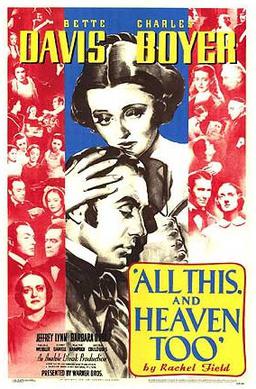
All This and Heaven Too (1940)

All This and Heaven Too (1940)

Illicit romance, murder, scandal… it should all be so much more exciting than this film makes it

Director: Anatole Litvak

Cast: Bette Davis (Henriette Deluzy-Desportes), Charles Boyer (Duke Charles de-Praslin), Barbara O’Neil (Fanny Sebastiani de-Praslin), June Lockhart (Isabelle de Choiseul-Praslin), Virginia Weidler (Louise de Choiseul-Praslin), Jeffrey Lynn (Reverend Henry Martin Field), George Coulouris (Charpentier, Harry Davenport (Pierre), Montagu Love (Army General Horace Sebastiani), Helen Westley (Mme LeMarie), Henry Daniell (Broussais)

In the 1840s, Henriette (Bette Davis) arrives as governess at the home of the Count de-Praslin (Charles Boyer). She’s calm, collected, patient and caring: in short she’s everything that the count’s wife Fanny (Barbara O’Neil) is not, and it doesn’t take the count long to work it out. With Henriette swiftly becoming a second mother to his four children, the count and Henriette find themselves falling, unspokenly, in love. But Fanny isn’t fooled – and neither is the gutter press – and as scandal brews, the count takes drastic action to stop his wife, leading to a legal case that will shock France.

All This, and Heaven Too was conceived as a sweeping romance to rival Gone with the Wind. Money was lavishly splashed on sets and costumes (Bette Davis has no fewer than 37 costumes in the film, averaging at one every five minutes). Based on a famous murder case – that some felt had contributed towards the anti-monarchy atmosphere that led to the revolution of 1848 – All This, and Heaven Too had everything on paper to challenge Gone with the Wind in romance stakes. So why doesn’t it?

There is something too restrained, too slow and controlled about the film. It’s overlong – the original cut was over three hours, reduced to 2 hours 20 minutes – and takes a very long time to get going. The two stars underplay very effectively – with Davis cast very successfully against type as a mousey, rather timid Jane Eyre-ish figure – but it also means that the sort of grand romance the film is aiming for never quite takes fire, for all the careful shots of burning flames between the two lovers as they discuss their romantic predicaments in roundabout terms.

Litvak’s film saddles itself with a framing device that, while accurate to the real-life story, adds very little. The film opens with Henriette teaching children in America – children who have no respect for her, having heard whispers of her scandalous past – which leads into her telling the story to them (and us) about her past. The film returns to this framing device at the end, but as a whole it provides very little insight or interest to the core thrust of the film’s action. The film also wastes time on Jeffrey Lynn’s Reverend (Heinrette’s future husband), a relationship that seems largely in there to absolve Henriette of any possible indirect responsibility for the murder (she can’t be a hussy, she marries a man of the cloth!).

A large chunk of the film is designed to minimise what was a major scandal that rocked French society. This was a (possible) sexual affair between an unhappily married aristocrat and the governess to his children. It culminated in the countess being stabbed and beaten to death and her blood-stained husband found on the scene, claiming he had fought and chased away an intruder (which, writing it down, is basically the plot of The Fugitive). He never confessed, but committed suicide via arsenic in prison a few months later. Henriette was arrested as an accessory (presumably for encouraging the count to kill his wife) but released.

This should have been racy, racy stuff – but the film shies away from it. It’s probably linked to the expectation that the Hays Code would never accept the idea of Henriette as an adulteress who never goes unpunished. The possible Therese Raquin style set-up is instead translated into a more Jane Eyre model, with the employer in love but the servant too noble to act on her feelings and expose herself to disgrace. The film does pull no punches in making clear that the count committed the crime (the camera zooming in on Boyer’s starring eyes as he advances on his pleading wife) but since he was always destined to meet a historical punishment (he helpfully absolves Henriette on his deathbed) there were no concerns there.

All This, and Heaven Too can’t have a passionate, lusty drama so it avoids any overt spark between Boyer and Davis. Both actors play this unspoken attraction extremely well, but the film has to work overtime to get drama out of their several scenes of standing carefully apart or side-by-side, talking about everything except their own feelings. Boyer, as ever, is first class: his expressive eyes and beautiful ability to listen and react is as perfect for an unspoken romance, as it is for a man who becomes convinced murder is his only escape. Davis’ meeker, Joan Fontainesque role suits her extremely well, even if it disappoints those expecting fireworks.

Those fireworks come from Barbara O’Neil instead, raving and unreasonable as a woman driven to the edge by this semi-imagined affair, in an energetic performance that gained one of the film’s three Oscar nominations. But the film’s strange momentum affects her too: she is left to repeatedly hit the same notes over again, as the film repeats its established set-up over and over for 90 minutes before she is murdered (then squashes everything connected to the historical scandal and the murder trial into the final 40 minutes).

It’s productions standards are high and it’s well shot by Gone with the Wind cameraman Ernest Haller. There is some beautiful use of shadows and several ball scenes are expanded with some gorgeous use of mirrors. It ticks many of the boxes you expect a period romance to have, but is fatally hampered by its caution and by its restrictive narrative choices. It ends up feeling long and drifts too often through its build-up, forcing it to rush its pay-off. All of this contributes to its lack of challenge to GWTW in the romance stakes.

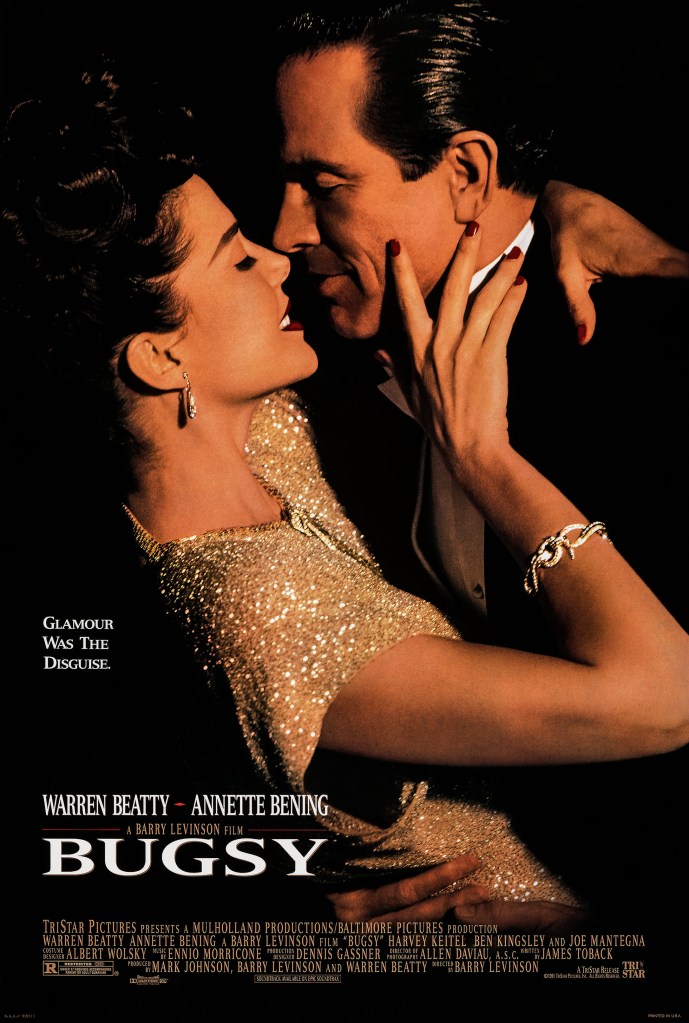
Bugsy (1991)

Bugsy (1991)

Old school glamour is the order-of-the-day in this luscious but slightly empty gangster film

Director: Barry Levinson

Cast: Warren Beatty (Ben “Bugsy” Siegel), Annette Bening (Virginia Hill), Harvey Keitel (Mickey Cohen), Ben Kingsley (Meyer Lansky), Elliot Gould (Harry Greenberg), Joe Mantegna (George Raft), Bebe Neuwirth (Countess Dorothy de Frasso), Bill Graham (Charlie Luciano), Lewis van Bergen (Joe Adonis), Wendy Phillip (Esta Siegel), Richard C Sarafian (Jack Dragna)

Las Vegas: the city of dreams for gangsters. As Ben (“Bugsy” – but don’t call him that) Siegel (Warren Beatty) tells a room full of gangsters when he’s pitching for their investment, like a hyper-violent Dragon’s Den: build the largest city in a state, you own the state, own the state and you own a slice of America. Imagine how the money can come rolling in then. It’s fair to say the mobsters aren’t so certain – and maybe Las Vegas would never have been a huge success if Bugsy had run it rather than being whacked – but God knows their investment paid out millions of times over.

The dream of building Las Vegas is at the centre of Beatty’s passion project (in this one he just played the lead and produced, dropping a couple of hyphens compared to Reds), a Golden-hued, romantic biopic of notorious gangster (and killer) “Bugsy” Siegel. Siegel sees what no-one else could see: how a city in a law-lax desert could become a mecca for gamblers, and crime could reap the profits. But the project goes millions over budget – not helped by girlfriend Virginia Hill (Annette Bening) creaming millions off the top. Trouble is Bugsy’s investors aren’t the sort of guys who shrug their shoulders at failed investments.

You can see what attracted Beatty to Bugsy. For all it’s about gangsters, I couldn’t escape the feeling Beatty sees Bugsy as something akin to a fast-talking movie producer. Bugsy spins elaborate stories for his backers of how their investment will pay-off, builds fantasies on a huge scale, won’t accept any compromise (a load-bearing wall should be knocked down if it’s blocking the view of the pool!), pouring his heart-and-soul into every detail of his vision. It doesn’t feel a world away from the same control-freak energy Beatty poured into Reds (Bugsy is basically financier, manager, backseat architect and marketing man for his dream).

Bugsy feeds a lot off the fascinating two-way admiration street between Hollywood and gangsters. Beatty’s Bugsy is enamoured with Hollywood, even shooting a (terrible) test reel to try and break into the movies. He’s thrilled to be hanging around with old pal George Raft (a muted Joe Mantegna), who seems equally jazzed to hook up with notorious criminals. Hollywood laps up the notoriety of criminals, both on-screen and off. For his Flamingo launch, Bugsy wants to stuff the place with stars (to his fury, bad weather prevents them arriving), and schmoozing celebrities is at least part of what is going to make the City of Sin such a fun place.

Levinson’s film is shot with a romantic lusciousness, a sepia-tinged nostalgia that wants you to soak up the glory of the costumes, sets and the cool of being a quick-witted gangster who gets all the best girls. It’s very different from the real Bugsy, a brutal killer with a huge capacity for violence. The film tries its best to match this, but can’t escape the fact that Beatty is way more suave and charming than Bugsy deserves. For all we’re introduced to him gunning down a cheating underling – and we see him brutally beat others for bad-mouthing Virginia or using his loathed nickname – he never feels like a brutal criminal, but more like a flawed, romantic dreamer with a temper.

It’s hard not to compare Bugsy with the best works of Scorsese from the same era. Goodfellas knew that, under the surface glamour, this was a dog-eat-dog world and that there was no romance at the end of a bullet. Casino (which followed a few years later, a sort of semi-sequel) sees the true vicious sadism and greed at the heart of this city-building operation, while Bugsy sees it more as a lavish dream and a tribute to a sort of visionary integrity. Even seeing Bugsy gunned down in his own home by a sniper, doesn’t carry  with it the sort of inevitability it needs. As Scorsese understands, this way of life is like playing Russian roulette forever – eventually the chamber is going to be full. For all Bugsy literally plays roulette, it never feels like he’s playing with fire, more that he’s reaching slightly beyond his grasp.

Perhaps Levinson doesn’t quite have the vision to make the film come to life or stamp a personality on it. It feels like a film that has been carefully produced and stage-managed to the screen – and Levinson deserves credit for marshalling such an array of commanding personalities together to create such a lavish picture. But it’s muddled in its message. Is Bugsy actually worth making a film about? What are we supposed to understand from this: was he a killer out of his depth, or an unlucky dreamer? Bugsy wants him to be both, but fails to make a compelling argument for either.

Beatty is impressive in his charisma though, for all he never quite seems to have the edgy capacity for instant violence the part needs. He does capture Bugsy’s desire for self-improvement, from the Hollywood dreams to the eternal elocution lessons he repeats over-and-over like a mantra. His desire for glory even manifests as a bizarre fantasy that he is destined to assassinate Mussolini. It also perhaps explains why he’s drawn to Virginia, a would-be starlet. Annette Bening gives arguably the most impressive performance (but, inexplicably, was practically the only major figure involved in the film not to pick up an Oscar nomination) as a woman who is an unreadable mix of devoted lover and selfish opportunist, leaving us guessing as to her real intentions and feelings.

There is good support from Keitel (hardly stretching himself as Bugsy’s number two Mickey Cohen), Kingsley (an ice-cool but loyal Meyer Lansky, unable to stop Bugsy destroying himself) and, above all, Elliott Gould as Bugsy’s hopeless, pathetic best friend. Bugsy though, for all it’s entertaining, feels like a mispackaged biopic that wants to turn its subject into a romantic figure, unlucky enough to be rubbed out before he could be proved spectacularly right. This soft-soap vision doesn’t ring true and misses the opportunity the film had to present a more complex and nuanced view of the era and its crimes.

Murder by Decree (1979)

Murder by Decree (1979)

Sherlock Holmes investigates Jack the Ripper in this overlong but enjoyable Doyle pastiche

Director: Bob Clark

Cast: Christopher Plummer (Sherlock Holmes), James Mason (Dr John Watson), David Hemmings (Inspector Foxborough), Susan Clark (Mark Kelly), Frank Finlay (Inspector Lestrade), Anthony Quayle (Sir Charles Warren), Donald Sutherland (Robert Lees), Geneviève Bujold (Annie Crook), John Gielgud (Lord Salisbury)

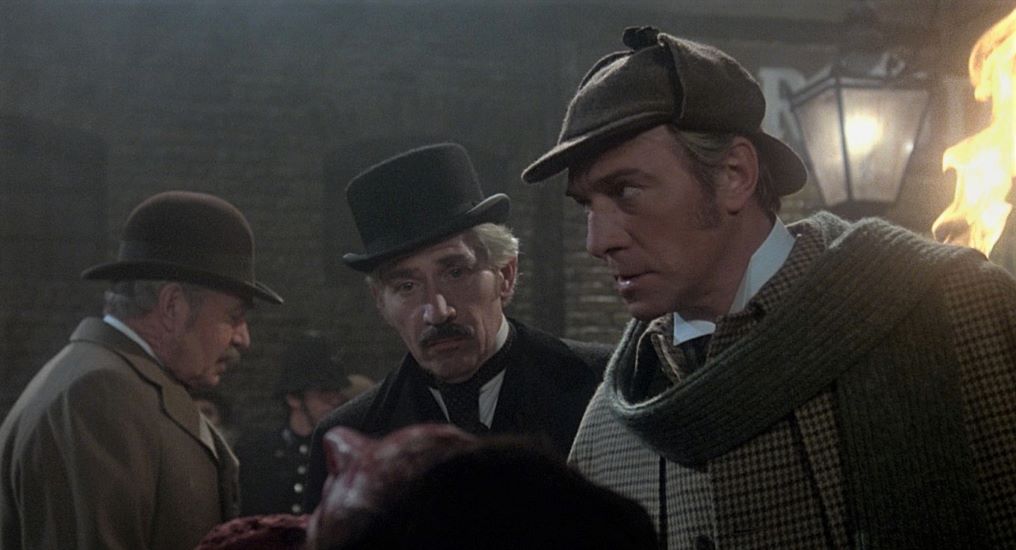
In the world of Sherlock Holmes pastiches, it’s a popular sub-genre: Sherlock Holmes vs Jack the Ripper. How would Holmes have taken on the murderer who has baffled generations since those brutal Whitechapel killings in 1889? Murder by Decree explores the idea, mixing Conan Doyle with a deep dive into (at the time) the most popular theory in Ripperology, the Royal Killings (Murder by Decree indeed!).

It’s all pulled together into a decent, if over-long, film, shot with sepia-toned stolid earnestness by Bob Clark. With its fog-ridden Whitechapel sets (carefully built but always strangely empty), heavy-duty actors sporting large sideburns, wavy-screen flashbacks and carefully unimaginative framing, there is something very old-fashioned about Murder by Decree. That also extends to its Ripper theory, steeped in a very 70s class-conscious conspiracy. The film pads out its two-hour run time with many a POV shot of the Ripper prowling the streets, which bring to mind Jaws and slasher horror films of the time.

Where Murder by Decree does stand out is in its imaginative characterisation of Holmes and Watson. They are presented as affectionate friends – Mason’s older Watson has a sweet indulgent elder-brother feeling to him, giving Plummer’s sparkly Holmes plenty to tease and bounce off. They split the casework between them – Watson is an equal partner, even if Holmes does the brainwork – and use their strengths to complement each other (notably, Watson frequently distracts people so Holmes can interrogate a witness more closely). They genuinely feel like long-term friends (there is a delightful sequence where Holmes is so distracted by Watson’s attempt to fork a pea, that he squashes it onto the fork – to be met with a forlorn “you’ve squashed my pea” from Watson, who likes the peas intact so they “pop in my mouth”).

They are dropped into the middle of a very much of-its-time Ripper theory. Murder by Decree centres on the theory that the murders were ordered (the film reluctantly suggests tacitly) by the establishment to cover up the secret marriage of Prince Edward, Duke of Clarence to a Whitechapel woman, Annie Crook. This alleged marriage produced a baby, and a royal doctor, sheltered by a Masonic conspiracy, sets about eliminating everyone who knows the truth. Of course, it’s almost certainly bollocks – but with its mix of secret societies, Royals, a lost heir and the rest, it’s an attractive story.

It gains a lot from the performances of the two actors. James Mason flew in the face of then popular perception by presenting a quick-witted, assured Watson, more than capable of looking after himself (he bests a blackmailing pimp in a street fight and is very comfortable with guns – far more than the reticent Holmes). He’s still the classic gentlemen, who loves King and Country, but also shrewd, brave, loyal, able to win people’s trust and look at a situation with clear eyes.

With Christopher Plummer, Murder by Decree has one of the all-time great Sherlock Holmes. Plummer’s Holmes is refreshingly un-sombre, twinkly with a ready wit, who loves teasing Watson (cleaning his pipe with Watson’s hypodermic needles) and delights in his own cleverness. But Plummer takes Holmes to places no other film Holmes goes. The case as a devastating effect on him: he weeps at the fate of Annie Crook (consigned by conspirators to a slow death in an asylum) and furiously attacks her doctor. When the conspiracy is unmasked, he emotionally confronts the Prime Minister and berates himself for his failures. There is a depth and humanity to Plummer’s Holmes unseen in other versions, a living, breathing and surprisingly well-adjusted man, unafraid of emotion.

Sadly, the film takes a little too long to spool its conspiracy out. Rather too much time is given to an extended cameo by Donald Sutherland as a pale-faced psychic who may or may not have stumbled upon the killer. There are a lot of unfocused shots of that killer, all swollen black eyes and panting perversion. It relies a little too much on a Poirot-like speech from Holmes at the end explaining everything we’ve seen. But there are strong moments, best of all Geneviève Bujold’s emotional cameo as the near-catatonic Annie Crook, cradling in her arms a memory of her stolen child.

There are many decent touches. The film is open in its depiction of the filth and squalor of life in Whitechapel – a pub is an absolute dive, and the women pretty much all look haggard and strung out. It has a refreshingly sympathetic eye to the victims, with Holmes denouncing the attitudes of both Government and radicals (looking to make political hay from the killings) who see them as lives without intrinsic worth. Holmes places no blame or judgment on them, or the choices life has forced on them, which in a way puts him (and the film) quite in line with modern scholarship (even if there is the odd slasher-style shot of mangled corpses).

The main issue is the film never quite manages to come to life. It’s a little too uninspired, a bit too careful and solid where it could have been daring and challenging. There are good supporting roles: Finlay is a fine low-key Lestrade (at one point persistently raising his hand to ask his superior permission to speak) while Gielgud sells the imperious Lord Salisbury. There is enough here for you to wish the film just had a bit more of spark to lift it above its B-movie roots. But in Plummer and Mason it has a Holmes and Watson to treasure – and for that alone it’s worth your time.

The Courier (2021)

The Courier (2021)

True-life Cold War thrills, as two spies battle to prevent the Cuban Missile crisis

Director: Dominic Cooke

Cast: Benedict Cumberbatch (Greville Wynne), Merab Ninidze (Oleg Penkovsky), Rachel Brosnahan (Helen Talbot), Jessie Buckley (Shelia Wynne), Angus Wright (Dickie Franks), Željko Ivanek (John McClone), Kirill Pirogov (Oleg Gribanov), Anton Lesser (Bertrand), Maria Mironova (Vera)

In October 1962 the world nearly ended, as the USA and the USSR clashed over Soviet missiles in Cuba. The history of this grim month is well known, as the fate of the world hung in the balance. What’s less known is the role Soviet double agent Oleg Penkovsky played in passing information on Soviet capabilities and strategy to the West – and how crucial this was to bringing the crisis to a (world-surviving) end.

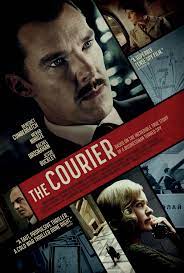
The Courier covers – in a pleasingly old-fashioned, Le Carré-ish way – Penkovsky’s (Merab Ninidze) dangerous espionage career, and the relationship he built with British businessman Greville Wynne (Benedict Cumberbatch). Wynne – totally unconnected to the Secret Services – was chosen by MI6 to make initial contact with Penkovsky. He then served as Penkovsky’s courier, carrying secret documents and microfilm back to the West under cover of business trips to the Soviet Union – and the two men became close friends. When the Cuban Missile Crisis increases the risks to Penkovsky, it’s Wynne who pushes for a risky mission to extract him before he is uncovered and killed.

Directed with confident, low-key aplomb by Dominic Cooke, The Courier mixes shady, spy-thriller tropes (secret meetings, scratched signals, one-time pads, secret cameras) with a genuine friendship between two very different people. All taking place in a grim, Soviet environment where the risk of discovery lurks around every corner. Ordinary receptionists and chauffeurs could all be active or potential informants of the KGB, and there is not a single room that cannot be bugged.

It’s a very unusual world fish-out-of-water Wynne finds himself in. Expertly played by Cumberbatch as a stiff-necked people-pleasing fixer (introduced deliberately losing a game of golf to close a business deal with the triumphant winners), Wynne uncovers depths he didn’t suspect in himself. He at first has no interest in spying – or the Soviet Union – and simply wants a quiet life rebuilding trust with his wife (Jessie Buckley making a great deal of a rather thankless part of a woman kept in the dark about her husband’s activities) after a past affair.

He needs brow-beating from MI6 to even carry out his first mission – which he executes with a nervy unease – and reacts with horror at the idea of repeating it. What draws him in is the same quality that will see him take huge risks: his sense of humanity and fair play and the bond of mutual friendship and understanding between him and Penkovsky. Wynne willingly accepts dangers and sacrifices others would blanche at, out of loyalty and a sharply defined sense of right and wrong.

Wonderfully played by Ninidze, The Courier makes clear the huge risks Penkovsky is taking even considering talking to the West. This is a country where a Western spy is executed in the middle of a special staff meeting at his ministry. Whose leader is hell-bent on asserting Russian dominance and devil-take the consequences (sound familiar?). A country taking part in an arms race that could destroy the world, and disregarding the risks that could lead to those weapons being used. A quiet, loving family man, Penkovsky is appalled at the aggressive posturing of his country and how it is endangering his family and millions like them around the world.

It’s the bond between these two men, their sense of duty and their desire to protect, their quiet wit and small acts of thoughtfulness – as well as their capacity for betrayal (Penkovsky of his country, Wynne of his wife) – that draws them together. For Wynne, the selfless risks of Penkovksy create a deep well of respect and admiration, as well as pushing this businessman to develop into a justified-risk-taking moralist with a greater emotional connection to the beauty of life (represented by two contrasting scenes showing the two of them attending a Russian ballet – the second performance moves them both to tears, as if reminding them why they fight).

Around them, shot in a beautifully drained out style that really adds to the sense of terror and danger, plays out a sharp, well-paced spy thriller. Rachel Brosnahan plays Penkovsky’s CIA handler – an invented female agent, allowing the film to take a few shots at the stuffed-shirt unimaginativeness of her superiors – while Angus Wright (all stiff realpolitik) is his MI6 one. The official agencies play a more pragmatic bat, pushing Penkovsky to greater-and-greater calculated risks to improve their access. They also coldly accept any double agent has only a limited shelf-life before discovery, and getting the maximum out of them while they can is essential.

The film’s final act explores the impact of this, as Penkovsky is exposed and Wynne goes to dangerous lengths to try and help him escape. Shifting at this point into something more claustrophobic and hand-held, the film’s final act layers on the grim suffering spies face when uncovered – and includes several moments of genuinely moving suffering.

The Courier is a low-key, efficient, well-made and well-paced true-life espionage story, that feels like the professional, smartly assembled, film-making that often gets squeezed out of cinemas today. Very well acted by a strong cast, every frame has a perfect mixture of 50s/60s style and Cold War paranoia and its final sequence carries a decent emotional punch. A fine retelling of an overlooked story.

In the Heart of the Sea (2015)

In the Heart of the Sea (2015)

Hunger, desperation, the sea and a very big whale in this Moby Dick origins story

Director: Ron Howard

Cast: Chris Hemsworth (Owen Chase), Benjamin Walker (Captain George Pollard), Cillian Murphy (Matthew Joy), Tom Holland (Thomas Nickerson), Brendan Gleeson (Old Thomas Nickerson), Ben Whishaw (Herman Melville), Michele Fairley (Mrs Nickerson), Gary Beadle (William Bond), Frank Dillane (Owen Coffin), Charlotte Riley (Peggy Chase), Donald Sumpter (Paul Mason), Paul Anderson (Caleb Chappel), Joseph Mawle (Benjamin Lawrence), Edward Ashley (Barzillai Roy)

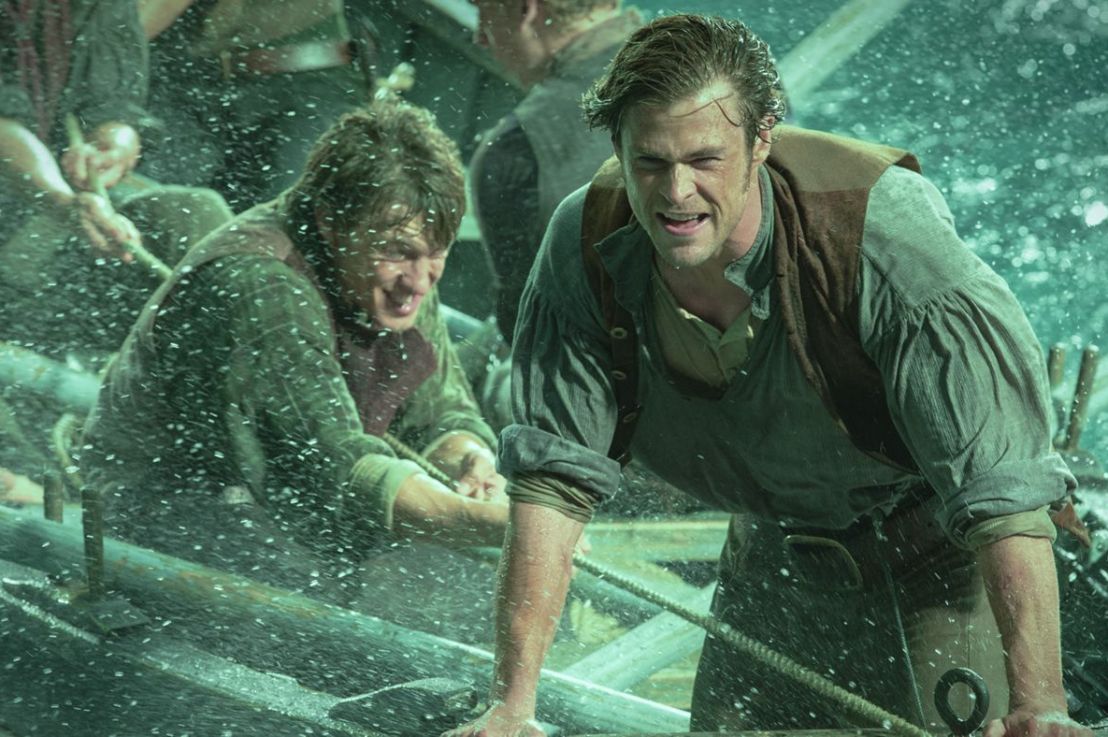
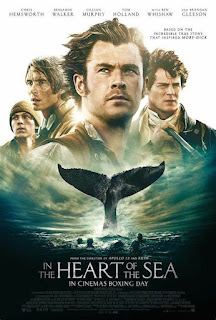
1820 and the world is run by oil. Not the sort you get out of the ground, but the sort you fish out of a whale’s corpse with a bucket. America is the leading exporter of whale oil and Nantucket is the centre of the industry. But it’s a dangerous business: as the crew of the Essex are about discover. Attacked by a whale, their ship sinks in the Pacific Ocean, thousands of miles from land. Passed-over first officer Owen Chase (Chris Hemsworth) and privileged captain George Pollard (Benjamin Walker) must set aside their differences to lead the survivors to safety. But starvation and desperation will lead those survivors to ever more desperate acts. All of this is told to Herman Melville (Ben Whishaw) by final living survivor Thomas Nickerson (Tom Holland and Brendan Gleeson), and it all sounds like a perfect inspiration for that Big Whaling Book Melville wants to write.

That Melville framing device is a good place to start when reviewing the many problems of In the Heart of the Sea, Ron Howard’s misfiring attempt at a survivalist epic. When we should be consumed by concern at whether these men survive, the film keeps trying to get us care as much about whether Melville will write a novel worthy of Hawthorne. The clunky prologue eats up a good sixth of the film, and we keep cutting back for Gleeson to tell us things the script isn’t deft enough to show us. Worse, it keeps ripping us way from the survivalist story that should be film’s heart.

Howard should know this: he directed one of the best survival-against-the-odds films ever in Apollo 13. Maybe the difference is that Apollo 13 is, at heart, a hopeful story. In the Heart of the Sea is about grimy sailors in a trade the film can’t find any sympathy for, eventually drawing lots in a long boat to see who is going to get killed and eaten by the others. It’s the sort of thing Werner Herzog would (pardon the metaphor) eat up for breakfast. For Howard, a fundamentally optimistic film-maker, its an ill fit. No wonder he wants to end the film with the triumph of Moby Dick.

In the Heart of the Sea is the rare instance of a film that is too short. The narration keeps skipping over time jumps in the first hour, that means we don’t get invested in the characters (most of whom are barely distinguished from each other, especially as beards and wasted bodies become the uniform). The sinking doesn’t take place until almost an hour in the film, meaning the time we spend with them lost in boats is a mere 40 minutes or so.

That is nowhere long enough for us to get a sense of either the monotonous time or the ravages hunger and desperation have made. Difficult as that stuff is to film – and I can appreciate its hard to make five men sitting, dying slowly, in a boat visually interesting – it means the film is asking us to make a big leap when it goes in five minutes from the men leaving a stop on an abandoned island to regretfully slicing one of their party up for dinner. We need to really understand how desperation has led to this point, but the film keeps jumping forward, as if its impatient to get to it.

Understanding is a general problem in the film. It can’t get past the fact that, today, we don’t see whaling (rightly so) as a sympathetic trade. But to these men, plunging a harpoon into a whale wasn’t an act of barbarous evil. It was more than even just making a living: it was a noble calling. Several times the film makes feeble attempts to push its characters towards moral epiphanies which seem jarringly out of chase (would Owen Chase, a hardy whaler with multiple kills, really hold his hand when confronted with a whale he thinks is trying to kill him?). Clumsy parallels are drawn between the heartless corporate oil industry of today, and the ‘suits’ back at Nantucket who only care about the bottom line.

Without accepting that, to these men, striving out into the ocean to bring back whale oil was as glorious a cause as landing on the moon, the film struggles to make most of the earlier part of the film interesting. Hard to sympathise with the characters, when the film is holding their profession at a sniffy distance. The film even radically changes the future career of its hero, Owen Chase, claiming he joined the merchant navy and never whaled again (not remotely true).

On top of this, Howard doesn’t manage to make the act of sailing feel as real or as compelling as, say, Peter Weir did in Master and Commander. Everything has a slightly unconvincing CGI sheen. Strange fish-eyed lenses keep popping up zooming in on specific features of pulleys and sails (is it meant to be like a whale’s eye view?). The film never manages to really communicate the tasks taking place or the risks they carry. There is a feeble personality clash between Pollard and Chase that fills much of the second act of the film, but is written and acted with a perfunctory predictability that never makes it interesting.

You can’t argue with the commitment of everyone involved. The cast noticeably wasted themselves down to portray these starving dying men. But it all adds up to not a lot. Chris Hemsworth gives a constrained performance as Chase – his chiselled Hollywood bulk looks hideously out of place – while Cillian Murphy makes the most impact among the rest as his luckless best friend. But the film’s main failure is Howard’s inability to make us really feel every moment of these men’s agonising suffering and to really understand the desperation that drove them to lengths no man should go to. Eventually that only makes it a surprisingly disengaging experience.

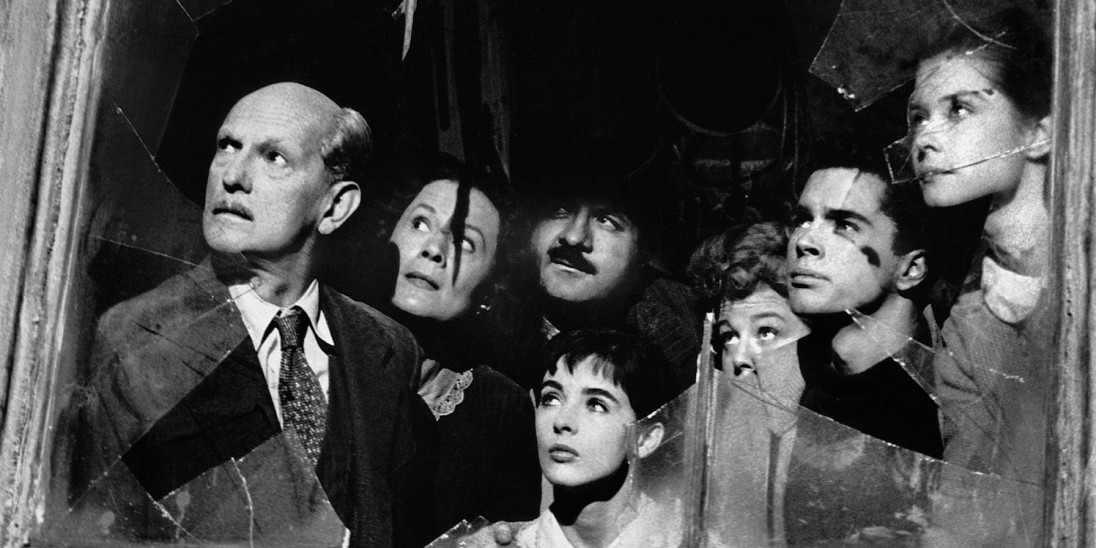
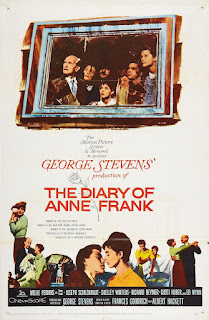
The Diary of Anne Frank (1959)

The Diary of Anne Frank (1959)

Reverent adaptation of the most famous diary ever written, that drains it of any sense of life or drama

Director: George Stevens

Cast: Millie Perkins (Anne Frank), Joseph Schildkaut (Otto Frank), Shelley Winters (Petronella Van Daan), Richard Beymer (Peter Van Daan), Gusti Huber (Edith Frank), Lou Jacobi (Hans Van Daan), Diane Baker (Margot Frank), Ed Wynn (Albert Dussell), Douglas Spencer (Kraler), Dodie Heath (Miep Gies)

Few personal stories have had such a huge impact on so many people’s lives than Anne Frank’s diary. This literary marvel, written by a teenager who mixed profound insight with teenage obsessions, was a world-wide sensation when it was published after the war. The diary covers the over two years Anne, her family and their friends spent in hiding in a secret annexe in her father’s warehouse in Amsterdam. For Jews hiding from the barbaric persecution of the Nazi occupying forces, every day was a struggle between trying to lead as normal a life as possible and the terror of discovery and deportation to a concentration camp. Of course, we know, tragically, they were discovered – and only Anne’s father Otto survived the war.

Otto discovered the diary when he returned to Amsterdam after the liberation of Auschwitz. Moved by the diary’s mix of maturity and youth, Otto had it published first for friends and then more widely. At various points, parts of the diary were edited to remove more “personal” content (Anne wrote freely at points on her growing sexuality and was sometimes less than kind to the other occupants of the annexe). More modern editions have embraced a less edited, fuller diary that really allows us to see what a brilliant, challenging, sometimes judgemental, fully rounded teenager Anne was. The Diary of Anne Frank hails from an era that framed a more sanitised diary. The worst you can say for it is that I think there is a good chance the real Anne Frank would have found it a bit dull.

Adapted from a Pulitzer Prize winning play by Frances Goodrich and Albert Hackett, George Steven’s film is reverent, noble and very worthy. It also frequently lacks any pace or life, and is so concerned with being life-affirming that it filters out nearly all sense of tension or conflict that these eight people felt (which they often did living, as they did, in a few small rooms for over two years, with very little food). The film also centres a romantic relationship between Anne and Peter – one that, according to Anne’s own diary, was already coming to an end at their discovery (in reality, she felt they had little in common other than living in the annexe together).

But Stevens’ film is so concerned with framing someone as fascinating as Anne as a secular saint that it removes much of the vibrancy that gives the diary such impact. It also doesn’t help that Stevens shoots the film in a luscious black-and-white, in detailed sets – but also in the widest possible cinemascope. This does allow for some lovely shots – an image of Anne and Peter kissing in a monochrome shadow, before a door opens to bathe them in light is striking – but it sacrifices the most essential fact of the setting: its cramped smallness.

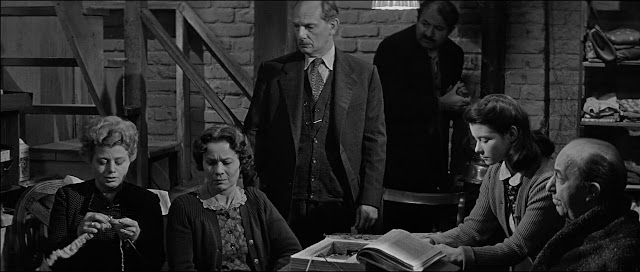
The widescreen frequently makes the annexe seem larger than it is

Who decided that a location defined by its claustrophobia and smallness was best captured in super-widescreen, I don’t know. But the wide angles make the annexe look a heck of a lot larger than it actually is (I’ve been there, I know it was more cramped than this!) and Stevens frequently frames the whole cast in shots which makes the annexe look positively cavernous.

The lack of claustrophobia has a serious impact on the story’s sense of drama. It also helps to filter out the tension. The script removes, or minimises, most of the key personal tensions in the annexe. We have moments of disagreement, but generally the inhabitants are shown to get on extremely well, with Anne herself practically perfect. This doesn’t really square with the diary, which is pretty open in Anne’s difficult relationship with her mother (with whom she felt no affinity), the clashes with the Van Daans and Mr Dussell (not their real names – Dussell basically translates as idiot, which gives a better impression of Anne’s difficult relationship with this unwanted roommate) or her later arguments with her father. Instead, things are smoothed out and nothing that could detract for a moment from the optimistic and hopeful message of the film is allowed.

The film also replicates several changes that the play made for dramatic effect. This most especially affects the character of Dussell (real name Fritz Pfeffer). In real life a respected dentist and pillar of the Jewish community, Dussell/Pfeffer here is a complacent, panicking imbecile, utterly ignorant of the Jewish faith and claims to have lived his whole life in Amsterdam with no idea he was a Jew. The real-life Pfeffer had in fact fled Germany to escape Nazi persecution. Played with a self-satisfied whininess by Ed Wynn (a famous TV comic, Oscar-nominated here for showing he could do drama), Dussell/Pfeffer is a joke. Pfeffer’s family cut ties with the Franks after the play was released.

Wynn’s nomination reflects how the broader performances in this film gained the most attention. Shelley Winters won an Oscar for her role as the blowsy Mrs van Daan – both van Daans are larger-than-life and obsessed with their status. More restrained and effective performances come from Gusti Huber as Anne’s shy and nervous mother and above all by Joseph Schildkraut as her wisely patient father. Richard Beymer gives an effective performance as a young Peter, straining against the leash of being stuck in a sort of suspended childhood.

As Anne, Millie Perkins looks the part in many ways – apart from the fact she is clearly too old. But there is something a little neutered and frankly a little too perfect about her performance. Her voice has a flat American twang to it that makes much of her voiceover a little wearing to listen to, especially as the tweeness is dialled up. I’m not sure she has the presence for the role – although she is not helped by the sanitised, earnest script.

Criticising The Diary of Anne Frank feels almost sacrilegious, like criticising the lives of the real people who went through something unimaginable to try and survive in a world of horror. But Stevens’ film is straining so hard to be reverent – and shaves the edges of its characters so much – that it turns them and their story into something much more easily digestible than it should be. It becomes a feelgood story, rather than something vibrant and alive. And that vibrancy is what has made Anne Frank live for so long after her murder. To create a film that captures so little of that, instead turning her into a conventional romantic heroine, just feels like it misses what made her unique.

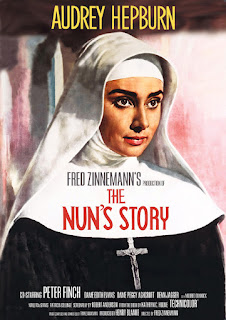
The Nun's Story (1959)

The Nun's Story (1959)

A nun struggles to balance faith and duty in this handsomely made, beautifully paced drama

Director: Fred Zinnemann

Cast: Audrey Hepburn (Sister Luke/Gabrielle van der Mal), Peter Finch (Dr Fortunati), Edith Evans (Reverend Mother Emmanuel), Peggy Ashcroft (Mother Mathilde), Dean Jagger (Dr van der Mal), Mildred Dunnock (Sister Margharita), Beatrice Straight (Mother Christophe), Patricia Collinge (Sister William), Rosalie Crutchley (Sister Eleanor), Ruth White (Mother Marcella), Barbara O’Neil (Mother Didyma), Colleen Dewhurst (“Archangel Gabriel”)

Gabrille van der Mal (Audrey Hepburn) has two passions in her life: her faith and a desire to heal the sick. Dreaming of combining these and working with native patients suffering from tropical diseases in the Belgian Congo, at 19 she joins an order of nuns who specialise in nursing. But the life of nun is far from an easy one, and Sister Luke (as she becomes) constantly struggles to square the circle of her faith, passion for medicine, ambitions and her natural antipathy towards authority. It’s a square she struggles with for almost twenty years, culminating in a crisis of faith during the German occupation of Belgium during World War II.

Zinnemann’s gracefully directed film, not surprisingly won the warm support of the Production Code Office, with its faithful depiction of the life and work of Nuns ticking all the boxes of a devout picture. However, The Nun’s Story is a more complex and intriguing film than this. While it finds much to praise in the self-sacrifice and devotion of the nun’s life, it isn’t afraid to look at how this institution (like many others) values obedience over innovation and praises submission over individualism. It stresses, in a way very few other films have done, how strikingly difficult it must be to lead your life in a religious devotion, and how much such orders (by their nature) demand we must put aside our natural inclinations.

Sister Luke is warned from the start by her doctor father (a genial Dean Jagger) that, with her stubbornness and independence, she is likely to find strictures on obedience hard to follow. He’s right. Superbly played by Audrey Hepburn (in her personal favourite performance), Sister Luke constantly finds it a near impossible struggle to submit herself to the authority of the order. Hepburn makes clear Sister Luke’s sincere faith, and her desire to belong, but also her unwillingness to accept that this might involve any compromise on her work as a nurse.

From the first she demonstrates she is unwilling to stop tending to a patient when the bell rings for her to attend prayer. She constantly reproofs herself for her inability to subjugate her personality to the requirements of her religious order. Training in tropical diseases at her medical college, she refuses a request from Mother Marcella to deliberately flunk an exam to prove her humility. As a ‘reward’, the best qualified nun in tropical diseases is dispatched to a sanatorium in Belgium to further learn obedience. Even when she is eventually allowed to work in the Congo it’s only in the “White’s Only” hospital (as they need the staff) and she is reproved for showing off when she makes much needed improvements to the hospitals working practices.

In many ways the film is a fascinating look at how hard it was for a woman to make a mark in the early 20th century. Clearly Sister Luke should have trained as a doctor – she graduates fourth in her class in tropical medicines – but that door was closed to her, and her only chance of working in Africa was as a member of a religious order. She ends up working in a system where she must constantly make difficult calls between her two passions (faith and medicine) – with her order placing devotion and obedience as the primary goal.

Not that the film is disparaging of religion. The devotion and goodness of the nuns is above question. Their ability to turn the other cheek and forgive is shown as an unparalleled virtue – even a shocking crime in the Congo is patiently forgiven. Many senior nuns are more than capable of balancing Sister Luke’s devotion to medicine with the orders demands. Mother Christophe (wonderfully and warmly played by Beatrice Straight) at the sanatorium, disagrees with the exam choice forced on Sister Luke and supports her to find a balance between her work and her order’s demand for obedience. Mother Mathilde (a matronly Peggy Ashcroft) in the Congo encourages her improvements – with the proviso she is told first. Others – such as Reverend Mother Emmanuel (a gently reserved Edith Evans) – consider it more important that Sister Luke dilutes her individualism in the order.

It makes for a fascinating film, that praises the devotion and self-sacrifice of religious orders, while not shying away from how rigid they often (by their very nature) are. Sister Luke in many ways is an ill-fit for being a nun. She can’t, or won’t, put her own beliefs about what is right second and she has an obstinance and pride (which she admits herself) that should really have ruled her out from the order in the first place. While the film doesn’t quite do enough to give as much space to her faith as it does her passion for medicine, it also makes it clear many characters – most astutely Peter Finch’s coolly professional Congo-based atheist doctor – recognise that she isn’t able to make the ultimate sacrifice that being a nun requires: the full submission of her own will.

Zinnemann directs this with a graceful, careful pace that finds many moments of quiet emotion amongst the imposing world of the order. The film is bookended by beautifully done sequences of departure and arrival, with possessions carefully left-behind and doors opening onto new and radically different worlds (the ending in particular plays out in a powerful silence). The film is beautifully shot by Franz Planer, with a wonderfully restrained score by Franz Waxman. It’s perfect material for this director, who was always strongest when showing the individual struggling within a system that demands they turn against their own nature.

The Nun’s Story is perhaps a little overlong and at times takes it stately pace a little too slowly. But it has a wonderful performance by Audrey Hepburn (who is in nearly every single frame), gorgeous location shooting and is directed with restraint and intelligence by Zinnemann. It also manages the difficult duty of finding things to both praise and criticise in the life of a religious order and both respects and questions the lifestyle and its rules. A middle brow film no doubt, but a fine example of highly skilled and professional Hollywood film-making.

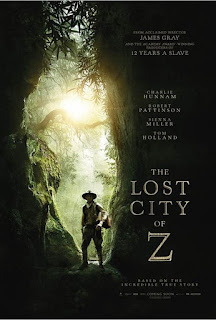
The Lost City of Z (2016)

The Lost City of Z (2016)

An obsessive explorer plunges into the Amazon in search of a lost city in this imaginative epic

Director: James Gray

Cast: Charlie Hunnam (Percy Fawcett), Robert Pattinson (Henry Costin), Tom Holland (Jack Fawcett), Sienna Miller (Nina Fawcett), Edward Ashley (Arthur Manley), Angus MacFadyen (James Murray), Clive Francis (Sir John Scott Keltie), Ian McDiarmid (Sir George Goldie), Franco Nero (Baron de Gondoriz), Harry Melling (William Barclay)

For as long as parts of a map so unknown, that all we write on them is “Here Be Dragons”, there have been explorers yearning to uncover their secrets. Exploring in the nineteenth and early twentieth century was a dangerous, sometimes fatal, call, as explored with a near-mystical thoughtfulness in James Gray’s ambitious film The Lost City of Z. Percy Fawcett (Charlie Hunnam) was the courageous soldier, whose whole life was a campaign to prove he had nothing in common with his disgraced father. Fawcett became obsessed with discovering the secrets of the Amazon, principally the existence of a lost civilisation built by the indigenous people of Brazil, which he called The Lost City of Z. It was to become a quest that would dominate his life.

Based on a true story, Gray’s film taps deeply into a Herzog-by-way-of-Lean view of the Jungles of South America, a place of great awe and danger which creeps inside the soul of Fawcett until, as one tribesperson says, he seems to be of both the West and the Jungle. Shot on location, the Jungle becomes a place of great beauty, but also unknowable mystery and menace. As Fawcett and his companions hack their way through it, on what could be a fool’s errand, their growing respect for it and the indigenous people, is matched only by their increased awareness of its dangers.

The Golden Age of Exploration is a difficult subject to tackle today, with many seeing (in some cases correctly) it as underpinned by a Westernised Imperialism, that earnestly believed the best thing that could happen to these lands (and the ‘savages’ who populated them) was that they should gratefully concede their land and culture to Western ‘civilisation’. Gray’s film is careful to show that Fawcett acknowledged he didn’t always understand the world he was in and learned some hard lessons. But the key difference is that acknowledgment and, as presented here, the humility and respect he recognised the rights and skills of the indigenous people. It marks him out from several of his contemporaries who see them only as contemptable savages and simpletons.

Indeed, Gray’s film positions Fawcett as an admirable egalitarian. His belief that the people of Brazil were not only capable of building in the Jungle, but that they could create an advanced society of pottery and irrigation ahead of those in the West is laughed out of court by many of his fellow members of the Royal Geographical Society (as we see in an involving debate sequence). While staying with a tribe in the Amazon, he marvels at their ability to cultivate and farm the land – something he had been assured was impossible. Encountering a tribe whose custom is to eat parts of their dead (so as to preserve their spirit in themselves), he reacts not with kneejerk disgust but understanding and respect.

The respect he shows for the environment and those he finds there is contrasted with the reaction of famed explorer James Murray, who joins him for his second expedition. Played with a puffed-up self-satisfaction and rigid believe in his own righteousness by Angus MacFadyen, Murray (a noted polar explorer) proves a serious handicap on the expedition. Unfit, unprepared for the tropical environment and treating all he encounters with hauteur, Murray slowly alienates the rest of the party by displaying the imperialist confidence Fawcett and his companions avoid. Stealing supplies, nearly overtipping a raft and ruining some of their stores, Gray uses Murray as the picture of the arrogant classic explorer and a great contrast with Fawcett, who swears thereafter to never again judge a man on his standing and reputation rather than on his character.

Gray’s film has rather a good ear for the pressures and hypocrisies of post-Edwardian Britain. The film opens with Fawcett successfully shooting a leading stag during a state visit by Archduke Franz Ferdinand. It’s a feat that wins him praise – but not any form of meeting with the Archduke since Fawcett is, as a Lord puts it, “unwise in his choice of ancestors”. It’s a stigma Fawcett has to deal with at almost every turn, from being pooh-poohed for his advocation of the Amazonian tribes to dealing with the criticism of the entitled establishment figures.

Gray marshals this all rather effectively, bringing the film into a neat balance of acknowledging modern issues with exploration while still giving an excellent idea of why motivated these men. It all plays out within a dream like aesthetic that leaves a haunting impression. During his first expedition, Fawcett emerges from the bushes into a make-shift opera house built in the jungle (how Fitzcarraldo is that?), on a plantation ruled by a Portuguese landowner dripping with the greed of his class (Franco Nero in a delicious cameo). During his time at home – and at the front during the First World War – elements of the jungle creep into frame, reflecting Fawcett’s longing to return to this mysterious exotic land which makes him feel alive in ways the stifling life at home never does.

Gray’s sense of atmosphere is so well done in the film – its mesmeric shots and sense of unreality will linger – that it’s a shame Charlie Hunnam isn’t quite the right actor to play the role (he took over from Benedict Cumberbatch, who would have been perfect for the obsession, decisiveness and desire to prove himself). Hunnam gives a solid performance, and he really understands the egalitarian humanity of Fawcett, who treats all men and women as equals. But there is a deeper unknowability and mystical longing in Fawcett that is beyond his grasp.

Interestingly, Robert Pattinson – here grimy, eccentric and almost unrecognisable as Fawcett’s best friend Henry Costin – would have been a better call. This is an intensity and soulfulness in Pattison that Hunnam can’t quite bring to Fawcett. Tom Holland gives a heartfelt performance as Fawcett’s hero-worshipping son and Sienna Miller a sensitive and intelligent one as his devoted wife. Clive Francis and Ian McDiarmid play with aplomb sympathetic senior RGS men.

There are many more virtues than faults in The Lost City of Z. The photography by Darius Khondji is wonderful – no one has filmed the jungle better since The Mission. Gray’s intelligent and thoughtful film addresses questions of colonialism and prejudice, while also not shying away from the danger and aggression of some of these tribes. The portrayal of Fawcett’s final expedition is wonderfully done, culminating literally in a dream like sequence where reality, hope and fate merge. It’s a fascinating film.

The Greatest Story Ever Told (1965)

Greatest Story Ever Told header
Max von Sydow carries a heavy burden in Steven’s far-from The Greatest Story Ever Told

Director: George Stevens

Cast: Max von Sydow (Jesus), Dorothy McGuire (The Virgin Mary), Charlton Heston (John the Baptist), Claude Rains (Herod the Great), José Ferrer (Herod Antipas), Telly Savalas (Pontius Pilate), Martin Landau (Caiaphas), David McCallum (Judas Iscariot), Donald Pleasance (“The Dark Hermit”), Michael Anderson Jnr (James the Less), Roddy McDowell (Matthew), Gary Raymond (Peter), Joanna Dunham (Mary Magdalene), Ed Wynn (Old Aram), Angela Lansbury (Claudia), Sal Mineo (Uriah), Sidney Poitier (Simon of Cyrene), John Wayne (Centurion)

You could make a case to prosecute The Greatest Story Ever Told under the Trade Descriptions Act. In a world where we are blessed (cursed?) with a plethora of Biblical epics, few are as long, worthy, turgid or dull as George Stevens’ misguided epic. Just like Jesus in the film is plagued by a Dark Hermit representing Satan, did Stevens have a wicked angel whispering in his ear “More wide shots George, and even more Handel’s Messiah. And yes, The Duke is natural casting for a Roman Centurion…”. The Greatest Story Ever Told has some of the worst reviews Christianity has ever had – and it’s had some bad ones.

The plot covers the whole life of the Saviour so should be familiar to anyone who has ever seen a Gideon’s Bible. It was a passion project for Stevens, who spent almost five years raising the cash to bring it to the screen. When he started, the fad for self-important Biblical epics was starting to teeter. When it hit the screen, it had flat-lined. It didn’t help that The Greatest Story Ever Told was first released as an over four-hour snooze fest, laboriously paced, that managed to drain any fire or passion from one of (no matter what you believe) the most tumultuous and significant lives anyone on the planet has ever led. The film was cut down to about two hours (making it incomprehensible) and today exists as a little over three-hour epic that genuinely still feels like it’s four hours long.

Stevens gets almost nothing right here whatsoever. Self-importance permeates the entire project. The film cost $20million, double the largest amount the studio had ever spent. Ordinary storyboards were not good enough: Stevens commissioned 350 oil paintings (that’s right, an entire art gallery’s worth) to plan the picture (which probably explains why the film feels at times like a slide show of second-rate devotional imagery). The Pope was consulted on the script (wisely he didn’t take a screen credit). Stevens decided the American West made a better Holy Land than the actual Holy Land, so shot it all in Arizona, Nevada and California. It took so long to film, Joseph Schildkraut and original cinematographer William C Mellor both died while making it, while Joanna Durham (playing Mary Magdalene!) became pregnant and gave birth. Stevens shot 1,136 miles of film, enough to wrap around the Moon.

There’s something a little sad about all that effort so completely wasted. But the film is a complete dud. It’s terminally slow, not helped by its stately shooting style where the influence of all those paintings can be seen. Everything is treated with crushing import – Jesus can’t draw breath without a heavenly choir kicking in to add spiritual import to whatever he is about to say. Stevens equates grandeur with long shots so a lot of stuff happens in the widest framing possible, most ridiculously the resurrection of Lazarus which takes place in a small part of a screen consumed with a vast cliff panorama. Bizarrely, most of the miracles take place off-screen, as if Stevens worried that seeing a man walk on water, feed the five thousand or turn water into wine would stretch credulity (which surely can’t be the case for a film as genuflecting as this one).

What we get instead is Ed Wynn, Sal Mineo and Van Heflin euphorically running up a hilltop and shouting out loud the various miracles the Lamb of God has bashfully performed off-screen. Everything takes a very long time to happen and a large portion of the film is given over to a lot of Christ walking, talking at people but not really doing anything. For all the vast length, no real idea is given at all about what people were drawn to or found magnetic about Him. It’s as if Stevens is so concerned to show He was better than this world, that the film forgets to show that He was actually part of this world. Instead, we have to kept being told what a charismatic guy He is and how profound His message is: we never get to see or hear these qualities from His own lips.

For a film designed to celebrate the Greatest, the film strips out much of the awe and wonder in Him. It’s not helped by the chronic miscasting of Max von Sydow. Selected because he was a great actor who would be unfamiliar to the mid-West masses (presumably considered to be unlikely to be au fait with the work of Ingmar Bergman), von Sydow is just plain wrong for the role. His sonorous seriousness and restrained internal firmness help make the Son of God a crushing, distant bore. He’s not helped by his dialogue being entirely made-up of Bible quotes or the fact that Stevens directs him to be so stationary and granite, with much middle-distance staring, he could have been replaced with an Orthodox Icon with very little noticeable difference.

Around von Sydow, Stevens followed the norm by hiring as many star actors as possible, some of whom pop up for a few seconds. The most famous of these is of course John Wayne as the Centurion who crucifies Jesus. This cameo has entered the realms of Filmic Myth (the legendary “More Awe!”exchange). Actually, Stevens shoots Wayne with embarrassment, as if knowing getting this Western legend in is ridiculous – you can hardly spot Wayne (if you didn’t know it was him, you wouldn’t) and his line is clearly a voiceover. In a way just as egregious is Sidney Poitier’s wordless super-star appearance as Simon, distracting you from feeling the pain of Jesus’ sacrifice by saying “Oh look that’s Sidney Poitier” as he dips into frame to help carry the cross.

Of the actors who are in it long enough to make an impression, they fall into three camps: the OTT, the “staring with reverence” and the genuinely good. Of the OTT crowd, Rains and Ferrer set the bar early as various Herods but Heston steals the film as a rug-chested, manly John the Baptist, ducking heads under water in a Nevada lake, bellowing scripture to the heavens. Of the reverent, McDowell does some hard thinking as Matthew, although I have a certain fondness for Gary Raymond’s decent but chronically unreliable Peter (the scene where he bitches endlessly about a stolen cloak is possibly the only chuckle in the movie).

It’s a sad state of affairs that the Genuinely Good actors all play the Genuinely Bad characters – poor old Jesus, even in the story of his life the Devil gets all the best scenes. That’s literally true here as Donald Pleasence is head-and-shoulders best-in-show as a softly spoken, insinuating but deeply sinister “Dark Hermit” who tempts Jesus in the wilderness and then follows Him throughout the Holy Land, turning others against Him. Also good are David McCallum as a conflicted Judas, Telly Savalas as weary Pilate (he shaved his head for the role, loved the look and never went back) and Martin Landau, good value as a corrupt Caiaphas (“This will all be forgotten in a week” he signs the film off with saying).

That’s about all there is to enjoy about a film that probably did more to reduce attendance at Sunday School than the introduction of Sunday opening hours and football being played all day. A passion project from Stevens where he forgot to put any of that passion on the screen, it really is as long and boring as you heard, a film made with such reverent skill that no one seemed to have thought about stopping and saying “well, yes, but is it good?”. I doubt anyone is watching it up in Heaven.