Category: Monster film

Frankenstein (2025)

Frankenstein (2025)

Del Toro’s dream project makes it to the screen in a lavish gothic spectacular

Director: Guillermo del Toro

Cast: Oscar Isaac (Baron Victor Frankenstein), Jacob Elordi (The Creature), Mia Goth (Elizabeth Harlander), Felix Kammerer (William Frankenstein), Lars Mikkelsen (Captain Anderson), Christoph Waltz (Henrich Harlander), David Bradley (Blind Man), Charles Dance (Baron Leopold Frankenstein), Ralph Ineson (Professor Krempe)

When he was a kid del Toro fell in love with James Whale’s Frankenstein. It was his dream project to create his own version of Mary Shelley’s classic. Year of dreaming pay off in this visually gorgeous, and emotionally engaging film – even if it’s also a little overlong and overindulgent. Del Toro throws everything into Frankenstein, creating a grand Gothic epic whose sympathies firmly lie with the abused Creature.

You must be familiar with the plot: in eighteenth century Germany, Frankenstein (Oscar Isaac), driven by never-really-resolved anger over his mother’s death, dreams of conquering death. With the funding of arms dealer Harlander (Christoph Waltz), who is also uncle to the woman he loves: Elizabeth (Mia Goth) who happens to be fiancée to his younger brother William (Felix Kammerer). On a stormy night, he gives life to the Creature (Jacob Elordi) but quickly rejects him. The Creature tries to find a place in the world, only to discover the world is full of prejudice and violence towards him and the Creature’s resentment against his thoughtless creator grows.

Del Toro’s film looks absolutely stunning, a sumptuously designed Gothic melodrama with extraordinary sets, grand costumes and beautiful cinematography (the Polar-set framing device is particularly striking, covered in lusciously contrasting blues and greens). There are striking echoes of the visual intensity of Pan’s Labyrinth, with Frankenstein’s lab turned into a mix of laboratory and classic temple, including a giant Medusa sculpture. The birthing sequence is a grandiose, operatically Gothic thing of beauty, a version of Whale’s film dialled gloriously up to eleven.

Del Toro’s film goes back to the novel in some ways (in themes and its Polar framing device), but in many ways it’s more of a complex, emotional reimagining of Whale’s film. Isaac’s Frankenstein, an egotist in need of an audience feels very similar to Colin Clive. Whale’s key motif, the Creature’s romantic yearning for the sun, becomes thematically central here. As there, Frankenstein conducts his experiments in a colossal Gothic tower, keeps the Creature chained and makes vague attempts to rear it and takes no responsibility for his actions or the deaths connected to it (in fact Isaacs’s Frankenstein lies and lies in a weasily attempt to protect his reputation). Waltz’s arms dealer funder of Frankenstein’s insanity feels like a version of Pretorious from Bride of Frankenstein, while del Toro goes even further than that film in deepening the bond between the Creature and the Blind Man.

Del Toro also doubles down on Whale’s implicit sympathy for the Creature. Here re-imagined as possessing near super-human strength and durability (his violent responses to being attacked being partially a result of his own strength being uncontrollably great), his child-like vulnerability is as dialled up as his actual physical invulnerability. The Creature feels, first and foremost, like a thought experiment by Frankenstein – and the fact this experiment has effectively rendered the Creature immortal and capable of a Wolverine-like cellular regeneration, condemned to walk the Earth forever alone only heightens the creator’s myopic selfishness.
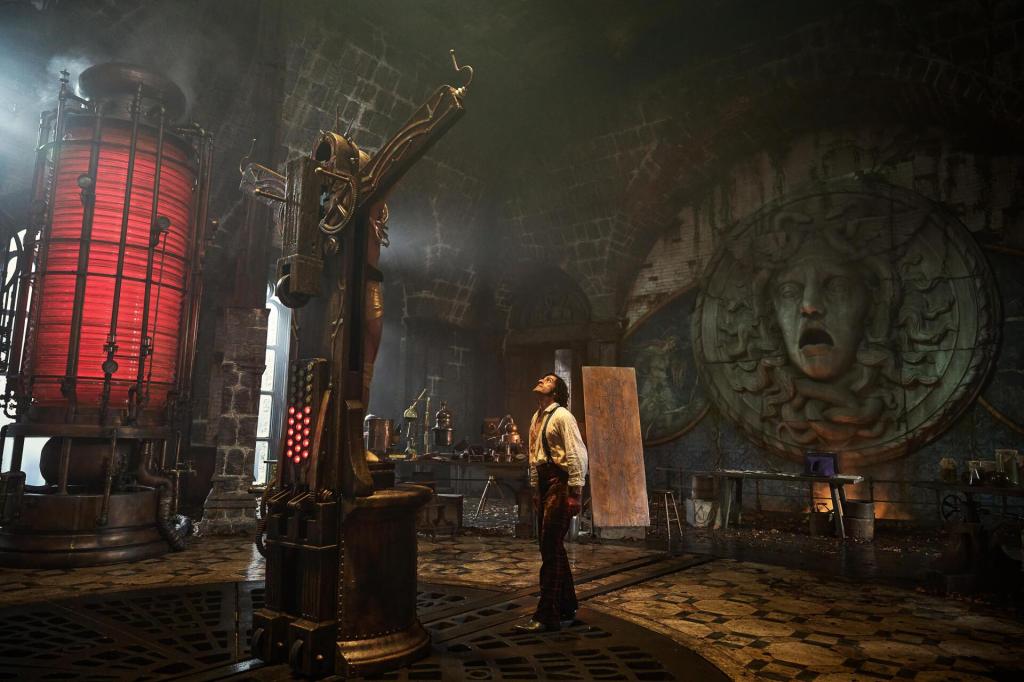
One of del Toro’s key themes is terrible parenting. Much as he loathed his domineering, brutal father (Charles Dance, in a role perfectly crafted for his austere distance) who caned his face (his hands are too precious) when he flunked remembering anatomy facts, Frankenstein ends up echoing his father’s approach. When the creature constantly fails to say anything other than ‘Victor’, he too reaches for a cane to beat learning into him. Like his father, he resents the creature for being a bad reflection on him. He is, effectively, a dead-beat Dad, casually fathering a child which he has no idea how to treat, who falls back on cruelty.

There can be few Frankenstein’s on film less sympathetic than the version played here by an impressively egotistical Oscar Isaac. He’s full of preening self-importance and self-justification, obsessed with his task but giving no thought to its consequences. Twice he reanimates corpses then callously switches them off without a second thought. Giving birth to Frankenstein – just like in Whale’s film – after an initial interest (that is really self-congratulatory pride) his reaction is to chain him up in the basement and lose patience at him. With his constant milk-drinking there is a sense he’s a little boy who never grew up, and to him love is founded on possession: first of his mother, then his brother, then Elizabeth, all of whom at various points he wants to keep to himself – while his anger at the Creature is rooted in his failing to meet Victor’s expectations.

Frankenstein is at heart an angry mother’s boy, resenting his father for ‘taking’ his mother away from him (del Toro even has him wrapped in his mother’s distinctive red when he wakes to discover the Creature lives). There is more than an echo in that in his love for Elizabeth, the fiancée of his younger brother (who he also subconsciously resents for both ‘killing’ his mother in childbirth and for having the sort of relationship with his father Victor never had). These Freudian feelings are subtly enforced by Mia Goth playing both roles (it’s so subtly done I missed it first time round). Victor’s love for Elizabeth is just as possessive and selfish as that for his mother – and in the same ways his contempt for the Creature is for ‘failing’ him.

By contrast with this monster, the Creature is presented overwhelmingly sympathetically. Played with an outstanding physical and emotional commitment by Jacobi Elordi, he’s framed as a child stumbling towards a painful adolescence. Freshly born, he waddles like a toddler, stares in fascination at leaves floating on a stream and painfully forms the word ‘Victor’. Of course, it never occurs to his creator that this is the equivalent of “mama”. Only Elizabeth, who feels an immediate affinity with the sensitive soul, understands this. Only she tries to speak to him – or asks what his name is.

The poor Creature escapes into a world he quickly full of senseless, prejudiced violence. He bonds with a stag – only for the creature to be shot in front of him by hunters (who instantly turn their guns onto him). In conversation, Elordi presents a man who is sensitive, kind and gentle but capable of anger and fury. Del Toro crafts a tender relationship between the Creature and David Bradley’s Blind Man (the only person, other than Elizabeth, to look past his appearance). The film’s second act, focusing on the Creature’s emotionally painful interaction with the world is its strongest – not least because you feel throughout del Toro’s deep bond with him.

After all this, it’s surprising that Frankenstein ends on a note of hope. Del Toro’s film isn’t always quite nimble enough for this: some of its more optimistic moments can feel as if they have emerged a little thin air (or from the optimistic wishes of the director). In particular, Elizabeth’s bond with the Creature feels so swiftly sketched out it failed to completely convince (more time on this and less time on Waltz’ creepy arms dealer would have been welcome). But this feels like a passionate, committed and perhaps above all beautiful to-look-at piece of work with a real emotional heart. This easily lifts it into the upper echelons of Frankenstein adaptations.

Jurassic World: Rebirth (2025)

Jurassic World: Rebirth (2025)

Back-to-basics monster mash that feels like a reheated remix of several elements from the previous films

Director: Gareth Edwards

Cast: Scarlett Johansson (Zora Bennett), Mahershala Ali (Duncan Kincaid), Jonathan Bailey (Dr. Henry Loomis), Rupert Friend (Martin Krebs), Manuel Garcia-Rulfo (Reuben Delgado), Luna Blaise (Teresa Delgado), David Iacono (Xavier Dobbs), Audrina Miranda (Isabella Delgado), Ed Skrein (Bobby Atwater), Bechir Sylvain (LeClerc), Philippine Velge (Nina)

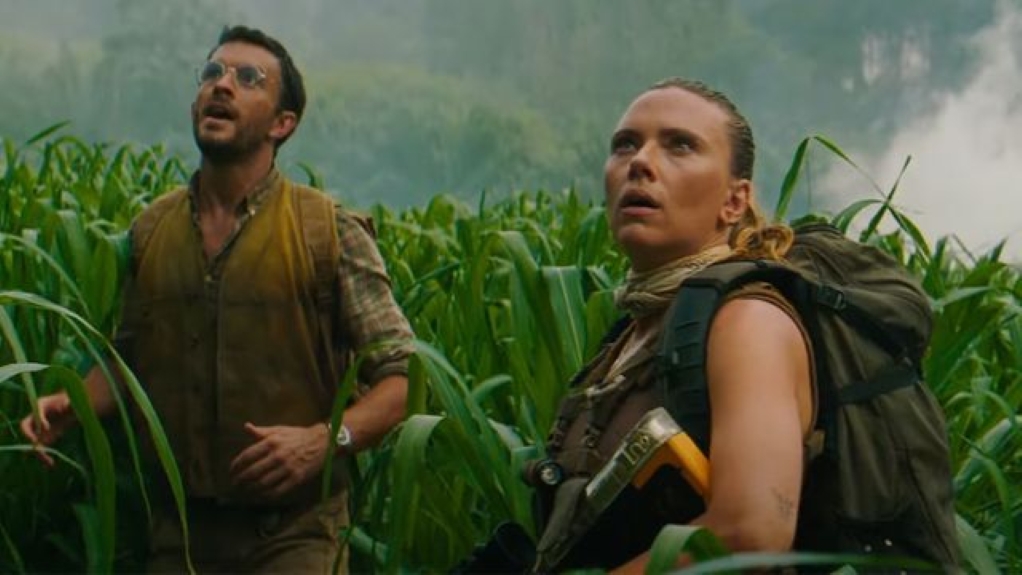
Those InGen scientists never know when to stop. The latest Jurassic film reveals yet another tropical island awash with prehistoric beasties. This one was also home to a Frankenstein-factory, where terrible genetic abominations were created, cross-bred dinosaurs with extra wow-factor (like flying velociraptors). But of course, almost twenty years later, they roam free, causing trouble for a team of mercenaries. Led by Zora (Scarlett Johansson) and Duncan (Mahershala Ali), they are working for Big Phama Baddie Martin (Rupert Friend) and friendly palaeontologist Dr Henry Loomis (Jonathan Bailey) to capture blood samples from the three largest dinosaurs ever to unlock a cure for heart disease (and millions of dollars). Things don’t go to plan when they end up stranded on an island, with a young shipwrecked family in tow.

It’s called Jurassic World: Rebirth but it could be Jurassic World: Reheated. Gareth Edwards film is shot with nerdy charm and crammed with lots of 90s-child fan-bait images of “Objects are closer than they appear” mirrors and “When Dinosaurs ruled the Earth” banners. But it’s also a blatant reheat of many elements of the first three films, often presented in a strikingly similar way. Like the little-loved, low-key and formulaic Jurassic Park 3, a team of mercs is stranded on an island with a family in tow. Perilous journeys take them into the nests of pterodactyls and down river against a gigantic dinosaur opponent. Throw in many other recognisable beats and scenes and you’ve got a film that will be feel more enjoyable and diverting, the less familiar you are with the preceding seven films.

In fact, much as I have a childish glee for dinosaurs still, Jurassic World: Rebirth makes me feel actually we might have gone as far as we can go. Even if the last two films were not complete successes, at least their vision of dinosaurs emerging to become everyday creatures we might encounter anywhere felt different. Rebirth shuts that down in the opening credit crawl, stating dinosaurs could only survive long-term in the tropics. Once again, they reside live on deserted islands miles from rescue. To hammer (multiple) points home, it opens with Friend’s phama boss whining because a dying brachiosaurus is blocking his four-by-four in the New York traffic.

It’s so we can get the familiar set-up, with a rag-tag mix of unlikely heroes thrown together to survive while shrieking and running in the jungle. There is precious little to surprise you in Rebirth, not least the fate of the characters. Every single Jurassic film has thrown children-in-peril into the mix and Rebirth literally can’t imagine setting itself up without the same, so introduces the Delgado’s, a divorced Dad with two daughters the oldest of whom brings with her waster boyfriend who has “redemption in waiting” written all over him. Just as we’ve seen now countless times before, no matter how terrified and dangerous things get, these kids have tooth-proof plot armour. Not a T-rex by the river or a flying velociraptor (in an almost neat restage of the kitchen scene from the first film) stand a change of laying a claw on them.

In fact, the rest of the cast feels the same. There is a weary paint-by-numbers inevitability about who will bite it and when. The second Ed Skrein’s arrogant merc turns up, you know he’s toast – just as Rupert Friends’ cowardly, profit-focussed exec might as well put himself in a dino lunch box and save us all time (though first he has to prove to the viewer, how shitty he is). The team is made up of three big name actors and a parade of red shirts who look and feel like red shirts from the second their under-developed mouths spew out their formulaic dialogue. A thick coating of plot armour is strapped onto the backs of nearly every other character, and not once in the film did I either (a) really fear for the lead characters or (b) think that any of them would turn out to be anything other than saints (I briefly thought Henry almost sharing a name with Halloween’s mad scientist might be a subtle reveal… it isn’t).

In fact, this lot are the nicest parade of mercs you’ll ever beat and both Johansson and Ali carry with them the sort of character-developing past trauma that is such basic scriptwriting 101 you almost feel sorry for the actors working with it. (To wit: Ali is a grieving father, Johansson is dealing with the loss of a boyfriend on a past op – if you can’t work out where those motivations might take you, you need to see more movies). These mercs are decent, hard-working, honourable guys about a million miles from what you think real merc, who shoot guns at people for money, might be like. They’re more like charming humanitarians.

The most interesting stuff in Rebirth are the moments that feel new. A prologue, set 17-years before, showing how all hell broke loose on the lab is well-done (even if its a lift from Edward’s past Godzilla film), both in its mounting dread and its almost satiric ‘no security system works in the movies’ resolution of a discarded snickers wrapper short-circuiting a billion-dollar system keeping the abominations secure. The abominations are also interesting: a flapping, vicious velociraptor feels new (it even proves its chops by devouring a normal velociraptor) while the D-Rex hybrid (a sort of grotesque mix of a T-Rex and the creature from Alien) is artfully shot by Edwards in a series of slow half-reveals before we see its real horror.

It’s a shame there isn’t more of that. Because otherwise, Rebirth passes the time but it’s a film for people who vaguely remembered the original films rather than someone who has watched them more than once. For anyone who has, there is nothing either new or surprising here, nothing that does anything remotely different, no character who doesn’t feel like they’ve been plucked and retooled from one of the earlier films. It’s a back-to-basics approach (staffed, to be fair, with some good actors) that gives you exactly what you expect all the time. That might be fine at times, but it’s hard not to wish for a little bit more. It is at least, though, twice as good as the woeful fanbait that was Dominion.

Sinners (2025)

Sinners (2025)

Coogler’s mix of political statement and horror flick is overlong but very effective

Director: Ryan Coogler

Cast: Michael B Jordan (Elijah “Smoke” Moore/Elias “Stack” Moore), Hailee Steinfeld (Mary), Miles Caton (Sammie “Preacher Boy” Moore), Jack O’Connell (Remmick), Wunmi Mosaku (Annie), Jayme Lawson (Pearline), Omar Miller (Cornbread), Delroy Lindo (Delta Slim), Li Jun Li (Grace Chow), Yao (Bo Chow), Buddy Guy (Old Samme)

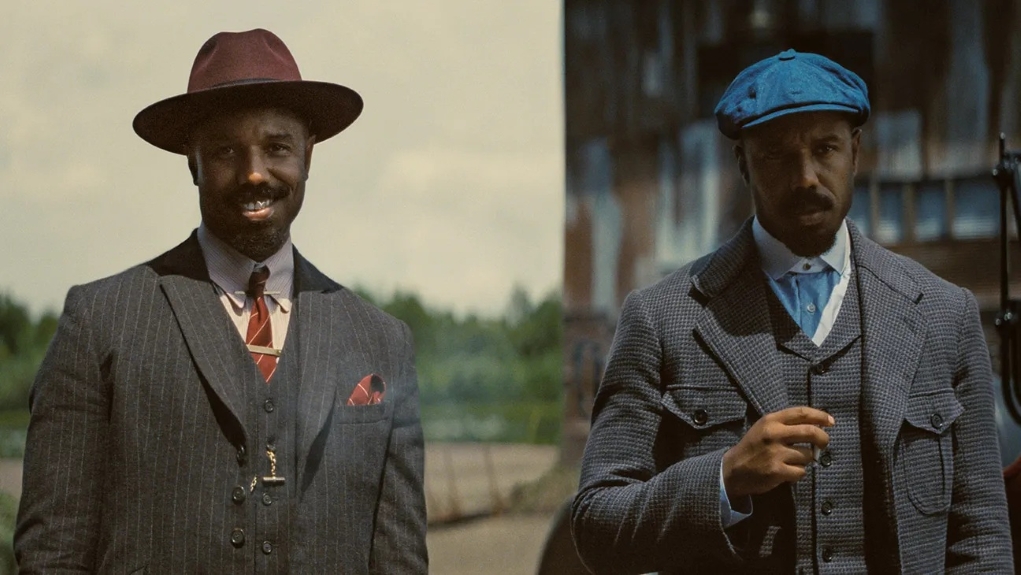
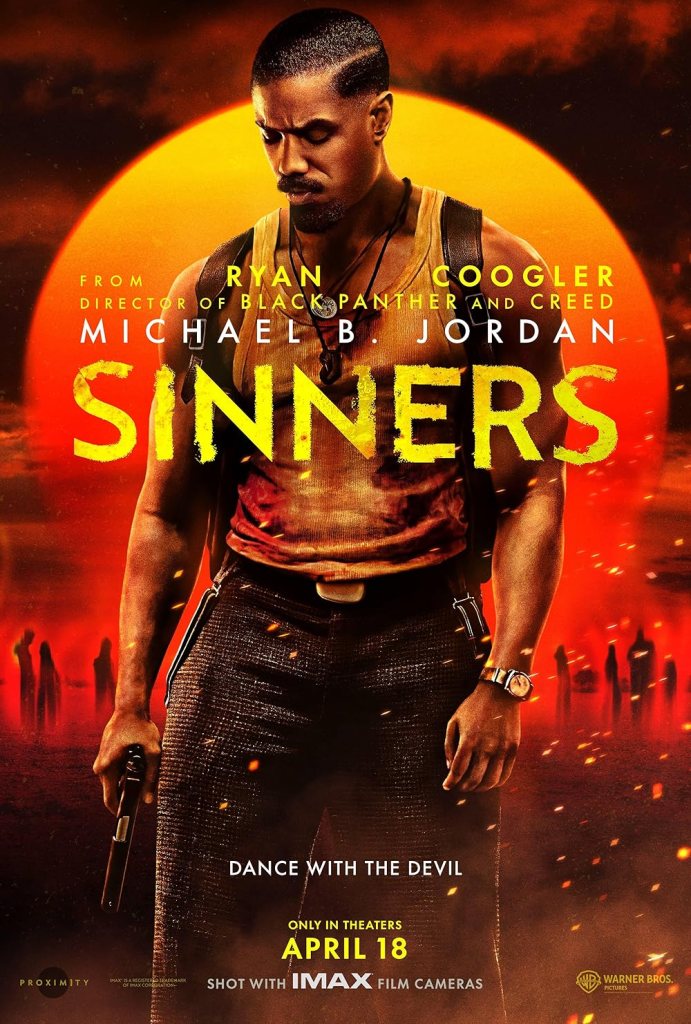
In 1932 twin brothers Smoke and Stack (Michael B Jordan, pulling double duty) return to the racist South of Mississippi after years of war service followed by time spent working for the gangs of Chicago. They dream of setting up a juke joint for the Black community, flying in the face the racism of local Mississippi. But the dangers of the KKK pale slightly, when their opening night coincides with the arrival of vampire Remmick (Jack O’Connell) who dreams of forming a new family of the dead – and wants to recruit Mississippi’s Black community, with promises of equality in his world they could never have in their own. Holed up in their juke joint, can the brothers and their families and friends survive a night long siege until dawn?

The basic set-up of Sinners is, to be honest, familiar. It delights in hueing close to Vampire mythology – garlic, wooden stakes, silver and sunlight are the key weapons here and the vampires are powerless to cross a threshold until they are invited – and the ‘base under siege’ that occupies the film’s final act is essentially taken direct from the sort of set-up John Carpenter excelled at in his heyday. What makes Sinners really stand-out is the richness of its character relationships and its social context.

That social context is, of course, the Jim Crow South. Sinners is a film steeped in the racial injustice of a particular time-and-place. In 1932, Black workers still pick cotton on plantations in exchange for wooden nickels. Families live in shanty towns and use different shops than the white folk (local goods dealers the Chow’s run two convenience stores, on opposite sides of the street, to serve their two clienteles). The danger of lynchings are everyday threats (Delroy Lindo has a haunting monologue, beautifully delivered, as Slim recounts the lynching of a former band partner, who unwisely produced his stuffed wallet at a train station). Virtually the only white people we see (other than Rennick) are KKK members.

In this world of radical injustice, it’s fascinating that Coogler suggests, in some ways, the afterlife of a Vampire is more just and fair than actual life. Rennick, himself the relic of a long-oppressed pagan Irish community, makes solid points about Smoke and Stack facing a losing battle trying to play by the white man’s game as entrepreneurs and would-be local businessmen. He even, genuinely, states he would be happy to kill the entire KKK just to wipe their hatred from the Earth. There is a certain truth in the fact that, in the legions of the undead, all are equal and race means nothing. That getting bit could be a doorway to a new world, free of racial oppression – even if it also seems to mean living in the sort of community Rennick alone crafts.

It becomes a fascinating idea, joined with the fact that Rennick also points out Christianity is a spirituality forced on the Black community. Unlike the blues music, that gifted young cousin to the brothers, Sammie (a lyrical performance in every sense from Miles Caton) plays so well it can cross the bounds of space and time joining Black souls together, the enslaved people didn’t bring Christianity with them across the water. It was forced on them, as much as the labour in the fields. Sinners isn’t quite brave enough to explicitly denounce the Church as just another wing of enslavement (even if Sammie’s preacher father uses trauma to hammer conversion on people, rather than offering comfort). But it does make clear that Sammie’s ‘coming-of-age’ is whether he will choose the culture of his ancestors or the culture of his oppressors.

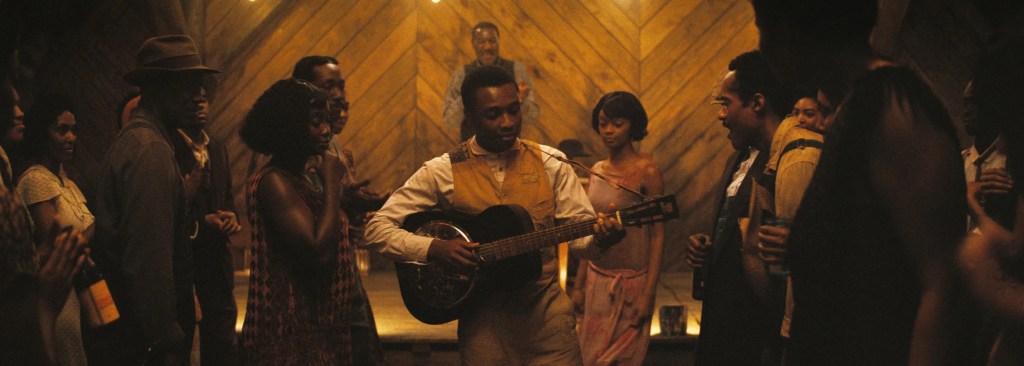
This is thought-provoking stuff – and Coogler does a superb job of threading it through the blood-spurting, neck-biting, stake-hammering action that fills up a large portion of the film’s conclusion. Sinners is dripping in Blues music, which artfully and beautifully wraps itself around the film to perfectly capture its tone and pitch. The sequence where Sammi’s music fills the juke joint, is transcendent in more ways than one, powerful and transporting in its musicality and passion (Ludwig Göransson’s score, created in partnership with several Blues artists and the actors is exceptional). Coogler matches it with one his trademark, virtuoso, one-take shots, the camera seamlessly weaving in and around the juke joint as our 1930s characters dance alongside modern club dancers and musicians as well as tribal African musicians of the distant past.

It also rewards more as Coogler takes his time throughout the film’s long opening act to really establish the characters and their relationships. You can argue that Sinners is over-indulgent in the sometimes overlong (well over an hour) long ‘recruitment’ sequence as Smoke and Stack assemble family and friends for their opening night. But this careful exploration of the closeness and warmth between these people – their loving sense of family, loyalty and sometimes painful shared history – pays off in spades when they begin one-by-one to turn to Rennick and then on each other. Coogler then makes these corruptions of the living into the hungry undead really sting, just as we feel the pain of those left among the living who must stake their nearest and dearest.

That carries further impact from the strength of the acting. Jordan, one of the most charismatic actors out there, gives a superb double-performance as the two twins, expertly sketching out their contrasting personalities and their deep love for each other. He makes Stack charismatic, gregarious and fun, and Smoke gruff, reserved but endlessly loyal and protective. They are too sharply humane turns, with Jordan so naturally playing off himself you forget both are played by the same actor.

Equally fine are the rest of the cast. Miles Caton is youthful idealism being shaken by traumatic events on the greatest night of his life. Wunmi Mosaku gives Smoke’s wife Annie a moral authority and deep sense of lingering grief. Hailee Steinfeld is vivacious but similarly burdened by disappointment and pain at chances lost as Stack’s one-time girlfriend that prejudice thwarted. Delroy Lindo’s soulful skill invests Slim with a real grace under the drunkenness. Even O’Connell, at times transformed into an Orlock-like nightmare, has a lonely humanity behind his ruthless, never-ending desire to build a new community (which he controls) around him.

There are powerful subtexts throughout here, even if parts of Sinners could at times benefit from a little tightening. Coogler effectively gives a rich hinterland to some familiar genre settings: and he surprises us with two codas, one rich in satisfying revenge violence the other with a rhapsodic melancholy which feel like natural ends for both their characters. Sinners mixes its Spike Lee influences with its John Carpenter ones with excellent effect, and is another firm reminder of the visual flair and piercing individualism of Coogler as director.

Nosferatu (2024)

Nosferatu (2024)

Eggers’ wonderfully atmospheric remake is creepy, haunting and quite extraordinary

Director: Robert Eggers

Cast: Bill Skarsgård (Count Orlock), Lily-Rose Depp (Ellen Hutter), Nicholas Hoult (Thomas Hutter), Aaron Taylor-Johnson (Friedrich Harding), Willem Dafoe (Professor Albin Eberhart von Franz), Emma Corrin (Anna Harding), Ralph Ineson (Dr Wilhelm Sievers), Simon McBurney (Herr Knock)

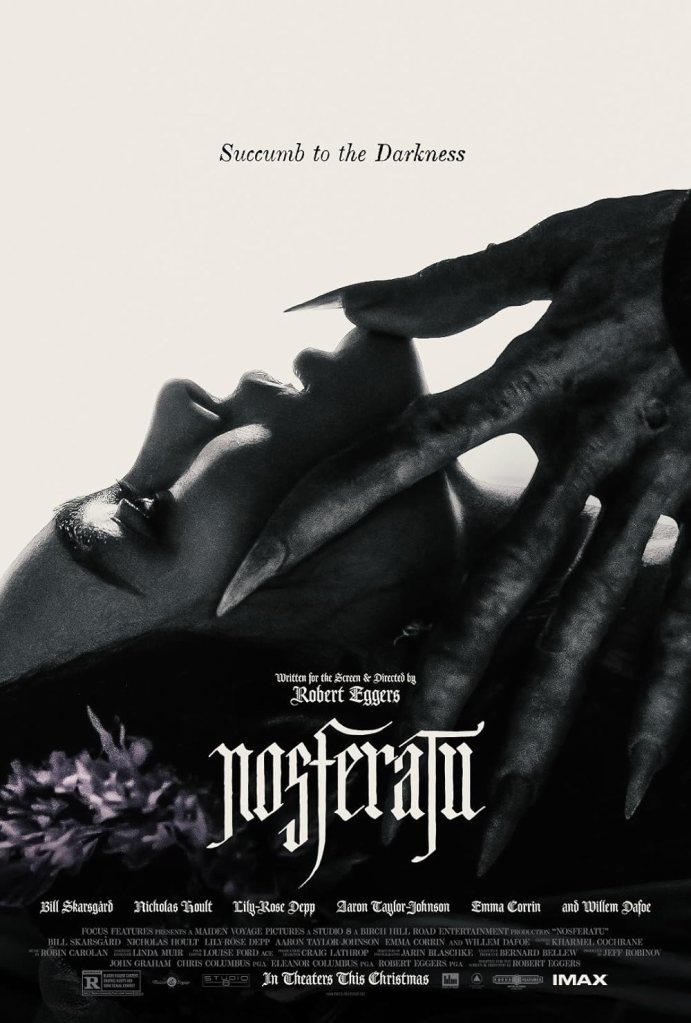
Robert Eggers dreamed so long of his own version of FW Murnau’s seminal vampire film (and Bram Stoker copyright infringement) Nosferatu, it was originally announced as his second film. We had to wait a bit longer, but it was well worth it. Eggers’ experience helped him create a film infinitely richer than I suspect he would have made ten years earlier. Nosferatu is an astonishing, darkly gothic, richly rewarding film, glorious to look at and a fiercely sharp exploration of the subtexts of both sources. It can never match the original’s seminal impact, but celebrates and elaborates it.

The story hasn’t changed dramatically from the one Murnau ripped off from Stoker. In Wisborg, junior solicitor Thomas Hutter (Nicholas Hoult) leaves his beloved wife Ellen (Lily-Rose Depp) for Transylvania and a lucrative land deal with the mysterious Orlock (Bill Skarsgård) that could lead to a comfortable life for him and his new wife. Unfortunately, there are three things he doesn’t know: firstly, the Orlock is a ravenously cruel vampire, with extraordinary supernatural powers; second his employer Knock (Simon McBurney) is an occultist worshiper of Orlock; thirdly, Orlock has used his mental powers for years to terrorise and groom Ellen from afar and Hutter’s presence is the final step in his scheme to control her. It won’t be long until a deadly curse plagues Wisborg.

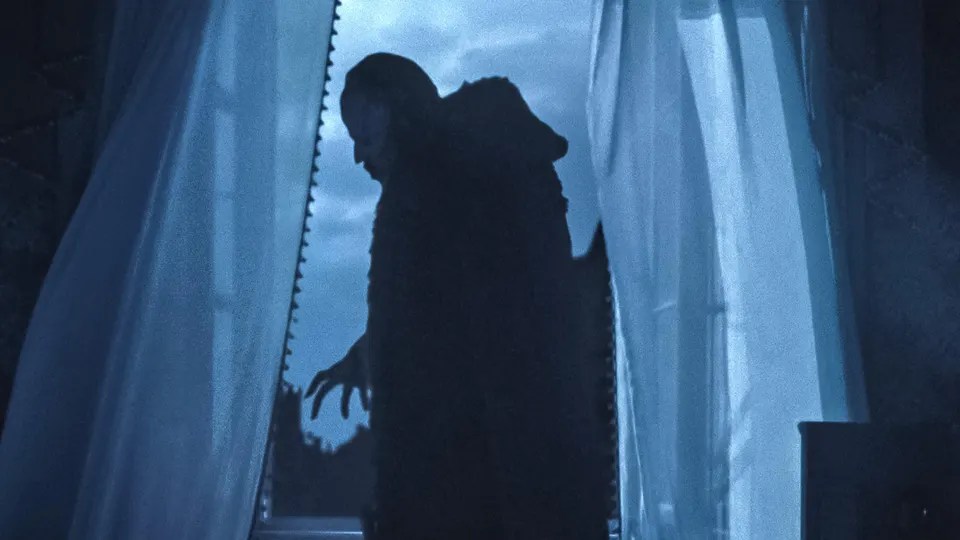
Egger’s dark (but extremely beautiful) gothic film drips with atmosphere, gloomy shadows rolling over its elaborate sets, the drained out night-time shots reminiscent of the tinted black-and-white beauty of the original. The entire film is soaked in love for silent-era horror, with homages to Murnau, Dreyer, Sjöström and so many others I couldn’t begin to spot them all – though I loved Orlock’s gigantic shadowy hand creeping Murnau’s Faustus-like over Wisborg. The film drowns in folk horror, from its snow-capped Transylvanian countryside dripping in unspeakable hidden evils to the unreadable motives of a mysterious Transylvanian village.

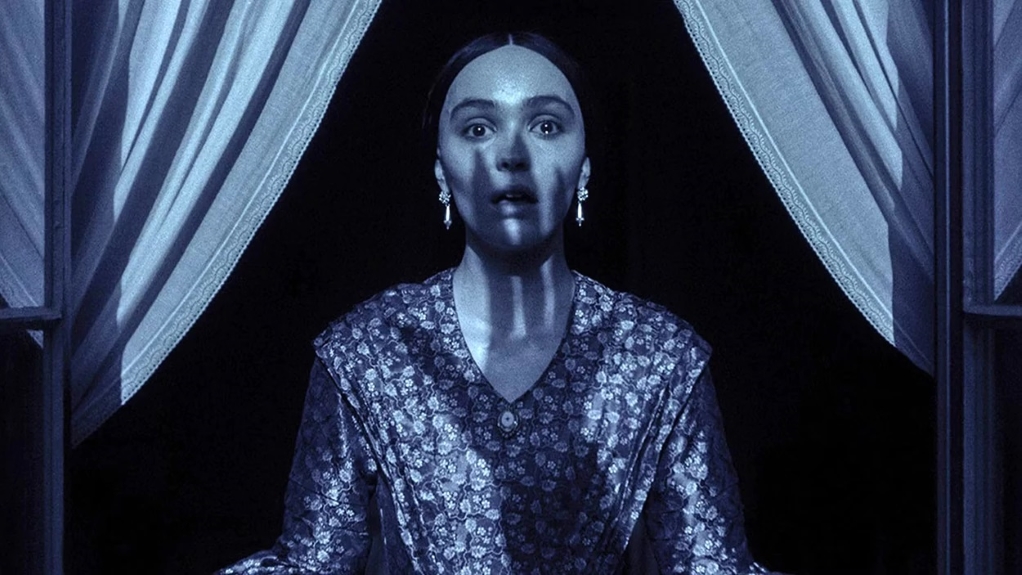
At its heart is an exploration of the sexual undertones of the vampire legend. Orlock’s assaults leave his victims are overwhelmingly sexual, with Orlock’s body thrusting forward while he drains the blood of his groaning victims. That’s not to mention Orlock’s revolting sexual manipulation of Ellen. Nosferatu leans heavily into Stoker’s dark sexual awakening subtext. Orlock’s psychological manipulation has left Ellen traumatised, torn between dark sexual desires and romance with Hutter. Nosferatu opens with a dark (dream?) sequence, as Ellen rises with sensual sighs from sleep, drawn towards Orlock’s seductive shadow in sheet curtains, before joining him outside for something that looks an awful lot like sex before Eggers cuts with a jump scare shot, our first glimpse of Orlock.

This is an Orlock radically different from Max Schreck’s original. While he shares his long nails and angular posture, here he is no-more-or-less than a decayed, rotting corpse. His body is covered in sores of decayed skin, with everything (including his penis) halfway to the compost heap, his bony legs and hips positively skeletal. There are homages to his Vlad the Impaler roots, from his fur-lined uniform coat (that like the rest of him has seen better days) to his surprisingly well-groomed moustache. But there isn’t a trace of the handsomeness of so many Draculas – this Orlock is possibly even more repulsive to look at than the rat-faced monstrosity of the original.

Skarsgård’s make Orlock a truly ruthless figure, delighting in his natural cruelty. With Hutter his looming, shadowy menace offers not a jot of home comforts, working to terrify a man who he sees as a perverse romantic rival. (His hallucinatory blood-sucking assault on Hutter is filmed in a manner reminiscent of rape). Throughout, he treats almost everyone he encounters with contempt and lofty disgust and takes a sadistic delight in torturing Ellen’s friend Emma Harding’s family, culminating in a truly shocking scene of grizzly horror. While the original Orlock was almost feral, like his rats, this one is a monstrous decayed sorcerer with a never-ending hunger and sadistic desire to play with his food.

He also has something the original never had: a voice. Skarsgård spent weeks in training to develop this (digitally unaltered) vocal range, a rolling bass-rumble which wraps itself around a raft of Dacian dialogue. Eggers’ gives him immense supernatural skills, in a film dripping with occult magic. Simon McBurney’s Knock (a remarkable performance) is a lunatic drowning in it: covered with dark markings, biting the heads of pigeons and communicating with Orlock by sitting naked in a Pentecostal star. His brain has been flushed out by Orlock’s mental power (who treats him like dirt) and the vampire’s hypnotic voice overwhelms the senses: just a few sentences drains Hutter of willpower (Nicholas Hoult’s fear is so palpable here you could almost touch it). Orlock’s malign influence can twist people or make them suddenly ‘wake’ with no idea of where they’ve been.

The power of his influence twists and distorts emotionally and physically. Lily-Rose Depp captures all this in a remarkable physical and vocal performance, as Ellen falls victim to Orlock’s mental manipulations. Depp throws herself into the most violent fits since Linda Blair: her body spasming, her voice distorted into an Orlock-mirroring gurgle, her eyes rolling back, her inhibitions falling away and blood weeping from deeply disgusting places, especially her eyes. Depp’s performance is extraordinarily committed, her fear and self-disgust at her manipulated sexuality (eekily from childhood) by the Count as tender as he hatred of him is sharp and all-consuming.

It’s never clear how far the vampire wants to screw Ellen, and how far he wants to consume her (Eggers even suggests, towards the end, that Orlock may even welcome his own destruction – perhaps the rapacious hunger is too much?). What is different from the original is Orlock and the plague he brings with him are different. While the original was a destructive force of dark nature, this Orlock is focused exclusively on punishing Ellen, with a literal plague striking down Wisborg.

In the face of this beast, the powers of science and reason are powerless (as Aaron Taylor-Johnson’s delicately performed Harding discovers, refusing to believe until its far too late). Like Murnau’s original, the powers of science and reason (such a key weapon against the vampire in Stoker) are useless. Even rationalist Dr Sievers (a fine performance by Ralph Ineson, channeling Peter Cushing and Michael Hordern) – a man so calm even the insanity of Knock can’t flap him – chucks in the towel and calls in Willem Dafoe’s barnstorming Professor von Franz (here considerably more effective than his counterpart), a scientist turned alchemist with deep occult knowledge.

But it can’t change the fact this is not a war between two sides, but a deeply personal struggle between Orlock and Ellen, with Hutter torn between them. Eggers’ focus on this personal story at the heart of a dark twisted legend adds a genuine freshness – and makes a superb counter-balance to the lashings of gothic horror the film soaks in. It makes for a superb remake that contrasts and comments on the original while telling its own story of dark, corrupted manipulation. Eggers’ direction is faultless in its atmospheric unease and there are superb performances from Skarsgård, Depp, Hoult and the rest. It’s a powerful work, overflowing with silent horror atmosphere while also feeling very modern that has the potential to haunt our nightmares as much as the original.

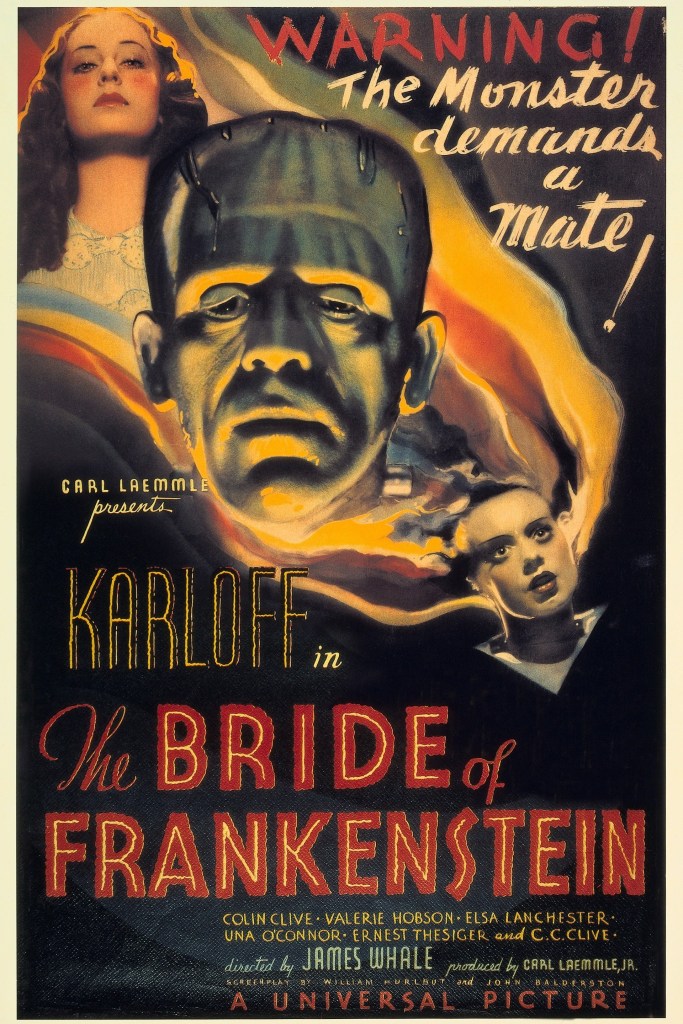
Bride of Frankenstein (1935)

Bride of Frankenstein (1935)

Whale’s sequel is a masterclass in how more can sometimes be more, a delightful black-comedy

Director: James Whale

Cast: Boris Karloff (Frankenstein’s monster), Colin Clive (Baron Henry Frankenstein), Valerie Hobson (Elizabeth Frankenstein), Ernest Thesiger (Dr Pretorius), Elsa Lanchester (Mary Shelley/The Bride), OP Heggie (Hermit), Gavin Gordon (Lord Bryon), Douglas Walton (Percy Shelley), Una O’Connor (Minnie), EE Clive (The Burgomaster), Dwight Frye (Karl), Ted Billings (Ludwig), Reginald Barlow (Hans)

What does every studio want after a mega hit? A sequel of course! Directors are never more powerful then when studios will let them do pretty much whatever they want so long as they get another shot at capturing body-sparking lightening in a bottle one more time. James Whale and gang came back for Bride of Frankenstein and produced a classic, more entertaining than the first film, a barmy, balls-to-the-wall piece of nonsense where logic is thrown out, sly jokes abound and the meter is dialled well up to camp. Bride of Frankenstein is exactly the “memorable hoot” Whale wanted to make, and proof that perhaps he had not “drained the well” after all.

Bride of Frankenstein kicks off pretty much where Frankenstein left off – requiring some fast thinking since the creature (Boris Karloff) ended that film incinerated in a burning windmill. Turns out he actually hid in the water-logged basement, emerging to stumble into violence from villagers terrified at this bolt-necked giant’s existence. Meanwhile, a chastened Henry Frankenstein (Colin Clive) swears he’s out of the reanimation game… only to be dragged back in by his old mentor (presumably a different one to the first film’s Waldmann) the creepy Dr Pretorius (Ernest Thesiger). Pretorius has been experimenting with creating life, and he wants a whole race of these people – so he’ll need a bride for the creature, to get that ball rolling. While the creature fights and flies, Pretorius and Frankenstein fire up the generator and get ready to stitch.

There is more than a little bit of black humour to Bride of Frankenstein, a film Whale clearly never intended to be taken seriously. It’s combined with more than a touch of camp and sprinklings of the absurd with general utter indifference to any rules of time, setting or location. Whale’s gothic world is whatever and whenever he needs it to be at any point. If that means the creature is chucked in a medieval cell one minute and Dr Pretorius is using a telephone to call his underlings the next, that’s fine. Logic is already all over the place, since it opens with Mary Shelley, her husband Percy and Bryon in full period costume recapping the first movie, despite that film being littered with no-end of what would be to them unimaginable technical possibilities.

Whale buttresses his fantasia on Frankenstein by pruning out, probably, the last couple of elements of the book he liked but hadn’t used: the creature’s ability to speak, it’s time out at the secluded hut of a blind man and (of course) the concept of a bride being resurrected. But then Whale also pours all his love into Ernest Thesiger’s sinister and delightfully eccentric Dr Pretorius, the sort of larger-than-life character who leaves all reality behind. Thesiger has a whale of the time, sucking on the sarcastic dialogue like a lemon and delighting in playing the sort of amoral mad man (he even makes Frankenstein look sane) who brings a picnic to a grave-robbing and uses a tomb as a table.

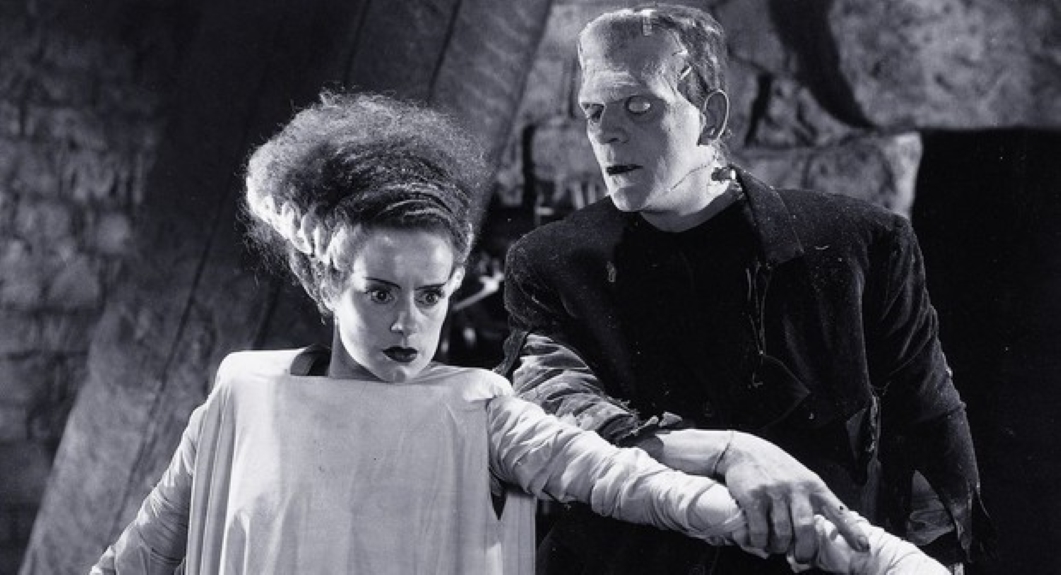
Pretorius’ swiftly brow-beats Frankenstein into saddling back up. Colin Clive – who broke his leg shortly before filming, requiring him to do nearly all his scenes sitting down – is surprisingly restrained, with the old madness only coming to the fore in the Bride’s birthing scene. That birthing scene is a brilliant expansion of the first film, Whale using the increased budget to expert effect to take us up onto the roof of the laboratory, expanding the detail shown of the mechanics of the experiment (Whale uses Dutch angles to dial up the general air of creepy weirdness and clearly was inspired by Metropolis) and launching a creation even odder than the original. As before the design work is exquisite: the Bride – wonderfully played with a ear-piercing screech (based on the swans near her London home) by Elsa Lanchester, her white high-lit hair a masterpiece of memorable, blackly-comic imagery. The Bride makes such a lasting impression, it’s a shock to realise she’s in it for less than five minutes.

Did Whale intend anything to be taken seriously? He tips the wink with Una O’Connor’s opinion-dividing performance of shrieking, Oirish panic as the villager who discovers the surviving creature. Pretorius is introduced showcasing his collection of miniature living people in jars (a bishop, a devil, a mermaid, a queen and a randy Charles Laughton-channelling Henry VIII) the sort of head-turningly bizarre scene that leaves you both delighted and shaking your head in amazement. There is something hilariously odd about the creature being introduced to those human vices, smoking and drinking. Whale was surely chortling to himself at the thought of the creature contentedly blowing smoke circles with the blind hermit or eagerly knocking back a glass with Pretorius.

It’s remarkable that despite this strong leaning into comedy, Bride of Frankenstein still manages to find the humanity in the persecution of the monster. Chased down (once again) by a wild, the creature is tied down to a pole and lifted up, his body unmistakenly in a crucifixion pose. The film’s emotional centrepiece is his sojourn with the blind hermit. It’s impossible not to see more than a touch of Whale’s experience of persecution for his homosexuality in the tender staging of these scenes, two men living contentedly together only to have their partnership condemned the moment the real world intrudes. The gentleness of these scenes becomes very affecting, not least since this is the first (and last) time the creature is treated like a person rather than a monster.

Karloff is, as before, excellent in the lead role – despite his worries about the creature’s mystery being sacrificed on the altar of his fumbling, toddler-like speech. He makes the creature, even more than before, someone reaching out for warmth and connection, disgusted at his own monstrous nature and whose delight at the idea of a bride is strangely touching. (Bride of Frankenstein – a title even name checked at one point by Pretorius – cemented the popular confusion about whether the creature or his creator is ‘Frankenstein’). It’s the monster who also emerges at the film’s conclusion as the closest thing we have to a moral force.

Really Bride of Frankenstein shouldn’t work as half as well as it does. It’s part horror, part black comedy, part farce with scenes that shift from tragedy to knock-about satire. But it’s superbly assembled by Whale – at the top of his game here – and barrels along at such speed (sustained by superb performances, in particular from Karloff, Lanchester and Thesiger creating a portrait of monstrously soft-spoken camp for the ages) and with such full-blooded commitment at every moment that the film never once sinks. It is such a gloriously entertaining, wildly committed piece of pulpy film-making that it’s hard to imagine it could have been done better. And it certainly was the last word in what to do with the monster on-screen, that saw him embrace fear, love, comedy and tragedy all in one go. He probably should have stayed with the dead.

Frankenstein (1931)

Frankenstein (1931)

Iconic monster film, dark expressionist nightmare that totally reinvented the novel’s public image

Director: James Whale

Cast: Colin Clive (Henry Frankenstein), Mae Clarke (Elizabeth Lavenza), John Boles (Victor Moritz), Boris Karloff (The Monster), Edward van Sloan (Dr Waldman), Frederick Kerr (Baron Frankenstein), Dwight Frye (Fritz), Lionel Belmore (The Burgomaster), Marilyn Harris (Maria)

Has any film shaped the popular idea of a book more than Frankenstein? Ask anyone to describe the monster or the book itself, and you’ll not have to wait too long until you start to hear about bolts in the neck, thunder-struck gothic castles, hunchbacked assistants and labs stuffed with bizarre electrical equipment. Of course, none of that is actually in Mary Shelley’s The Post Modern Prometheus. But it is a key part of James Whale’s creative vision in this Hollywood hit. In fact, so much of a hit that it and its army of sequels led to whole generations convinced Frankenstein was the name of the monster, not his creator.

Frankenstein in fact bears almost no similarity to the original novel at all, checking off a few plot points and duplicating some character names. Other than that, it’s very much its own thing, a big expressionistic nightmare, with everything dialled up as high as those lightening-catching electrical machines can cope with. Henry Frankenstein (Colin Clive) – you’ll note the film even changes his name to the more relatable Henry, with Victor given to his dull-as-dish-water pal Moritz (John Boles) – won’t settle down and marry fiancée Elizabeth (Mae Clarke). Instead, he dreams of creating life, to become like God! And to follow that dream, he’ll dig up bodies, steal laboratory brain specimens from his mentor Dr Waldmann (Edward van Sloan) and stitch them together into a creature (Boris Karloff). But then misunderstandings and ill treatment leads to a series of terrible events.

James Whale’s film is a triumph of atmosphere; its images and visual creativity so haunting it’s not a surprise it effectively overwhelmed the novel. Inspired by German expressionist cinema – you can see the fingerprints of Cabinet of Dr Caligari and Fritz Lang all over it – Whale sets this monster tale in a world of towering, angular buildings, looming shadows and vast steampunk (long before it came into fashion) labs in damp-lined medieval castles. There is a strange timeless quality to Frankenstein: it opens with a shadow-laden graveyard dug up by Henry and his assistant Fritz (Dwight Frye), but the village feels like it is set in almost any time from the late nineteenth to early twentieth century (the costumes in particular are a real hodgepodge). Perhaps this was part of Whale’s intention, to create a timeless metaphor for man’s reach exceeding what’s sensible, to disastrous consequences?

It’s also interesting that, for all the warning of the terrors to come the film opens with from Edward van Sloan (who also portrays Waldmann), we actually end up siding with the creature. A lot of this is due to Boris Karloff’s excellent performance. Without a word of dialogue, Karloff makes this lumbering result of stitched together bits and pieces, into something vulnerable, frightened and child-like, whose violent acts only emerge from tragic misunderstandings or gross provocations. Karloff’s physicality is frequently gentle and timid, the few strangled sounds he makes sound almost scared, and his awkward stumbling resembles a deadly, confused toddler. He needs parenting, not chasing down by a mob.

The film’s key moment is Frankenstein introducing the creature to the daylight – the camera following those towering vertical lines of the set up to into a skylight, with the enchanted creature reaching his arms up to try and touch this magic ball of light. Then Frankenstein smugly slaps it shut and Fritz shoves a torch into the poor creature’s face. The monster may be introduced with all the elements of dread – Whale’s classic introduction a series of striking cuts that pull us closer and closer to the reveal of his restitched head – but it doesn’t take long before you feel really sorry for it. Even if it does have a ‘criminal mind’ stitched into it (a development so out of tone with the treatment of the monster, it feels like a fig leaf to reassure the producers it must be the baddie).

Not least because Frankenstein himself is hardly that sympathetic. Colin Clive – a long-term collaborator with Whale – grabs this larger-than-life part and runs with it, oscillating from scenery-chewing self-aggrandizement (his celebratory screaming has rightly passed into cinematic legend) to self-pitying excuses. It’s telling he never takes a jot of responsibility for either creating the monster, or for his inattention and poor treatment of it directly causing the tragedy it unleashes. Unlike his book counterpart, his arrogance requires witnesses – Elizabeth, Victor and Waldmann – to his experiments, entirely due to his arrogant fury at Waldmann’s questioning his sanity. His first solution, as soon as the creature becomes challenging, is to euthanise it and he never confesses to the lynch mob that take on the creature in the film’s final act that he is its creator.

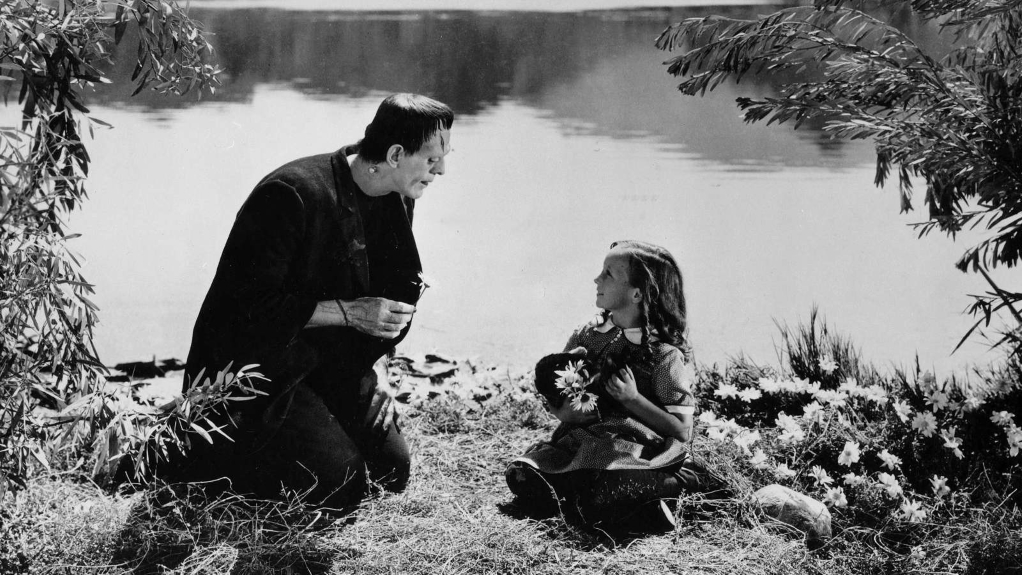
The lynch mob is responding to the creature’s accidental drowning of a small girl. Again, this killing stems from a misunderstanding. Young Marie – the only person in the film who doesn’t react with horror when she sees the creature, suggesting she instead sees a kindred spirit – invites the delighted creature to join her in a game, tossing flowers into the river. Clapping his hands in delight, the creature joins in for a scene directed with bucolic beauty by Whale – right up until the flowers run out and the creature tosses Marie in instead, only to find she doesn’t float artistically.

As the creature flees in confused panic, Whale cuts to the raucous wedding celebrations in the Frankenstein village, which comes to a crashing close as Marie’s father walks with her body through the crowd, that turns from joy to shock around him. It’s one of several striking moments of fluidic camera work in Frankenstein, Whale employing a tracking shot that follows and partially rotates around the father, while keeping him tightly central in the frame as he walks through the crowds. There are similar moments of dynamic camerawork throughout the film, Whale using every opportunity to make this gothic nightmare world as immersive as possible.

The hyper reality of Frankenstein means it doesn’t really matter that much of the skylines are all too clearly cloth (I like to think Whale deliberately kept the multiple points where the cloth has bunched up in shot to stress the artificiality), since everything about this is dialled up to eleven, from performances, to setting to the grandly staged windmill-finale, hugely impressive in its flame-licked excitement. In fact, it’s all so overblown and gothic, in its set design, shooting and performance that the most grounded, human thing in it is Karloff’s beautifully played creature himself. That feels like no accident and makes Frankenstein a surprisingly subversive film. And also perhaps, even though it strips the creature of much that makes him a character in the novel, made him a modern icon.

Jurassic Park (1993)

Jurassic Park header
Dinosaurs walk the Earth once more in Spielberg’s classic blockbuster Jurassic Park

Director: Steven Spielberg

Cast: Sam Neill (Dr Alan Grant), Laura Dern (Dr Ellie Satler), Jeff Goldblum (Dr Ian Malcolm), Richard Attenborough (John Hammond), Bob Peck (Robert Muldoon), Joseph Mazzello (Tim Murphy), Ariana Richards (Lex Murphy), Samuel L. Jackson (Ray Arnold), Wayne Knight (Dennis Nedry), Martin Ferrero (Donald Gernaro), BD Wong (Dr Henry Wu)

Can you imagine a more exciting film for a 12-year-old boy, than one with dinosaurs walking the Earth once more? And not the sort of rubbery dinosaurs, that we always knew were really models, in classic films. I was 12 when I first saw this film, and these animals really did look 65 million years in the making: they felt real, with roars that deafened the ears and footfalls that made the cinema shake. Dinosaurs are hugely exciting, awe-inspiring beasts. So much so you can forget many of them were also ruthless killers, with really sharp pointy teeth. It’s that mixture of awe and terror that Steven Spielberg understands so well in this exceptional blockbuster, like he mixed Close Encounters and Jaws together in a lab and then let it run loose.

Boffins have worked out a way to clone dinosaurs from frozen DNA, stuck inside prehistoric mosquitoes. Naturally, what else would you do with this discovery but use it to create the most exciting theme park ever seen. What could possibly go wrong? Avuncular billionaire John Hammond (Richard Attenborough) has built the park – and he wants scientists and archaeologists Alan Grant (Sam Neill), Ellie Satler (Laura Dern) and Ian Malcolm (Jeff Goldblum) to give it the thumbs up. Sadly however things are set for disaster during a long, low-staffed weekend when an act of industrial espionage by disgruntled employee Nedry (Wayne Knight) leads to all control over the par being lost and the dinosaurs turning on the guests.

The rights to Chrichton’s novel were sold before the book was published, and it’s classic Chrichton set-up of science trying to play God, and landing us all in a moral quagmire and massacre. But first though, let’s not forget how awe-inspiring dinosaurs actually. It’s a long wait until we see any more detail of one than a fearsome eye. But when we do, Jurassic Park knows that for that brief moment we are all children again. As John Williams’ triumphant theme thunders out, and the characters stagger with breathless, tearful excitement in its wake, a Brachiosaurus towers over the screen. Spielberg’s camera perfectly hammers home the sense of wonder at the size and beauty of this gentle giant. Sure science is arrogant, but then if it wasn’t we’d never reach the stars, right?

Spielberg’s film though isn’t just an awe-inspiring modern-day Planet Earth. Because the makers of this park also created plenty of fierce monsters, from the mighty T-Rex to the scarily smart and vicious velociraptors. And if the first half of the film is about the magic – that imperious brachiosaurus, a sleeping triceratops, a baby velociraptor emerging from its egg – the second half is about the horror of finding out what happens when man’s hubris comes back and (literally) bites him in the ass (and plenty of other places). Because when the Raptors get lose, suddenly this park isn’t magic, but a terrifying death-trap where the guests are the prey to out-of-control exhibits.

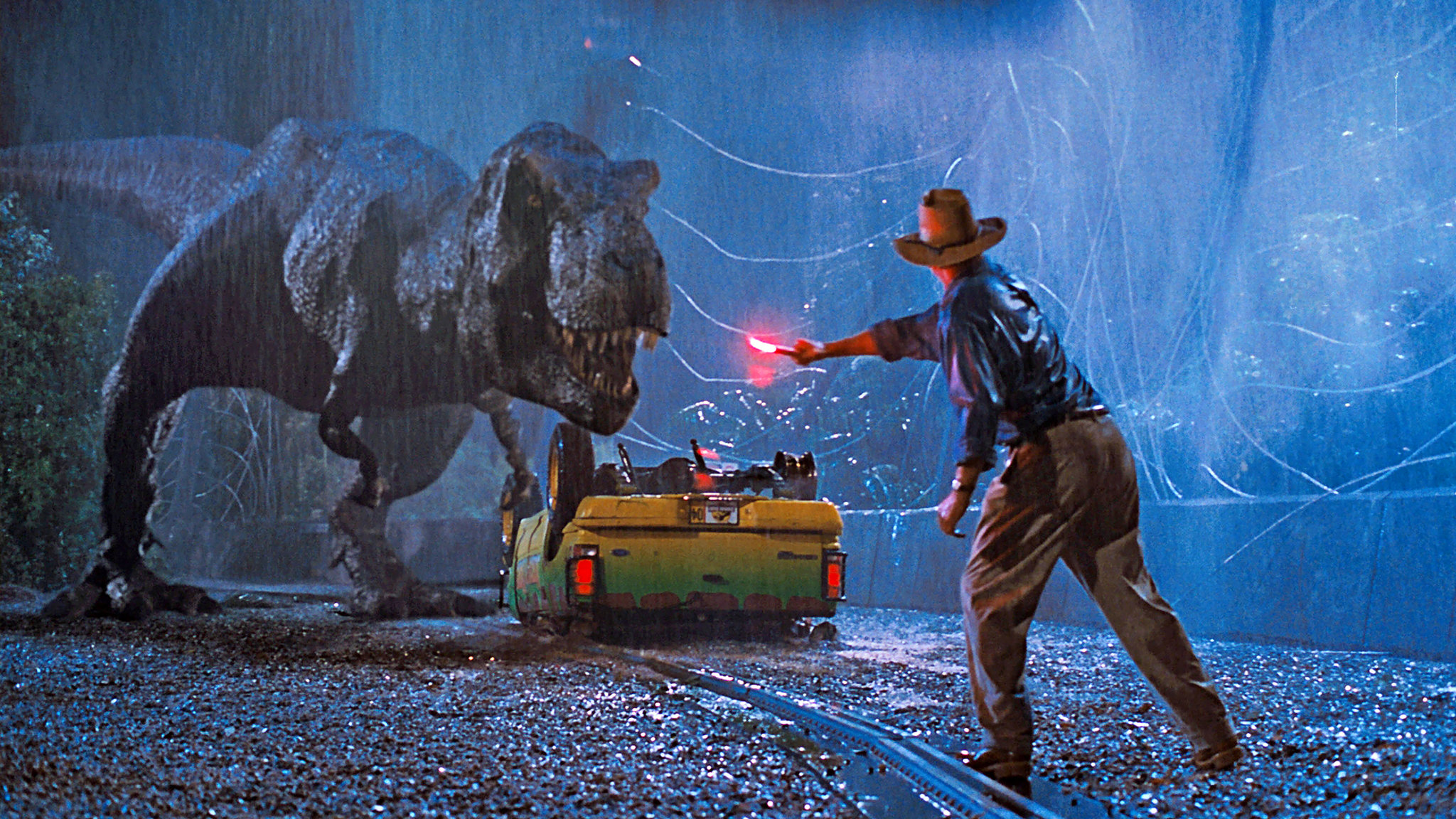
The second half of the film – from the moment the T-Rex bursts through its non-functioning electric fence to rip apart two jeeps (and of course eat a lawyer cringing on the toilet) – is a terrifying, giddy, exciting monster-chase, with a director who hasn’t delighted this much in the relentless horror of nature since Jaws. And Spielberg gets to play every game here. Huge dinosaurs stomping on cars. Velociraptors playing ruthless hide-and-seek in isolated power houses. Open spaces becoming terrifying hunting grounds and everyday ones like kitchens become terrible traps. What chance do human beings have when there are “clever girls” like the raptors running around?

Jurassic Park is singularly responsible for elevating the raptor, a previously largely unknown dinosaur, to the front rank of dinosaur fame. There is always a romantic appeal to the T-Rex. It’s the king after all, the biggest and the most famous – and its status in the public perhaps reflects the fact that the film sort of asks us to root for it. After all, it only eats the lawyer. And when the final act comes, it’s the T-Rex’s intervention that saves our heroes bacon. The real monsters are the raptors: supremely clever (they can open doors!), totally ruthless, they hunt in packs, they move super-fast and they look like a disturbing mix between bird, human and lizard. Spielberg makes them one of the most terrifying monsters in film, that more than live up to their extended build-up.

Spielberg directs the entire film with his usual devilish wit and fiendish mastery of the set-piece. The film draws some neat, if simple, story-lines for its human characters. Will Dr Grant overcome his aversion to children? Each of them gets a snippet like this. The actors are often (literally) in the shadow of the dinosaurs, but they are big part of communicating the sense of awe. Neill and Dern go through the motions with a certain charm. Goldblum steals most of his scenes as a rock ‘n’ roll physicist, riffing in the way only he can. Richard Attenborough reinvented himself from a career of creeps to cuddly grandad as a Hammond who shares nothing but his name with the book’s ruthless capitalist.

But the real stars are the dinosaurs. And even almost thirty years on, the special effects are really breath-taking here. These feel like real, living, breathing creatures, and Spielberg knows how to shoot them. Even today it still casts quite a spell. It’s telling that none of the sequels, except Jurassic World (which was made by the people who grew up on this film) gets near to matching the mix of magic and horror that this one hits. Sure, it’s a film so confident of success that it fills one scene with shots of the park merchandise (available in a shop near you now!), but then that’s because it’s got a master at the helm and the greatest attractions in 65 million years.

With its underlying plot of the dangers of mankind’s hubris – plus some rather witty criticism of how a park reliant on wild animals might have struggled to work anyway if the dinosaurs refused to emerge from the shadows of their huge paddocks for the tourists – Jurassic Park gives you something to think about, while still terrifying you with ruthless monsters. It’s a classic.]

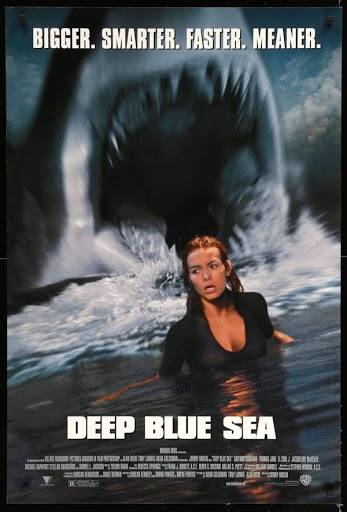
Deep Blue Sea (1999)

Deep Blue Sea header
Just when you thought is was safe to go back into the Deep Blue Sea

Director: Renny Harlin

Cast: Saffron Burrows (Dr Susan McCallister), Thomas Jane (Carter Blake), Samuel L. Jackson (Russell Franklin), LL Cool J (Sherman “Preacher” Dudley), Jacqueline McKenzie (Janice Higgins), Michael Rapaport (Tom Scoggins), Stellan Skarsgård (Dr Jim Whitlock), Aida Turturro (Brenda Kerns)

What would be your first idea for curing Alzheimers? Yup that’s right, you’d experiment on sharks brains: and to make those experiments even more effective you’d want the sharks to have really big brains. So, if you’re going to make them super-intelligent, you might as well make them super big, super ruthless with massive teeth. It’s just common sense. After all, they can never escape from your isolated sea laboratory could they? And even if they did, how much of a threat could they be?

Harlin’s film embraces its ludicrous set-up and B-movie nonsense from the start. Dedicated (and more than a little ruthless herself) scientist Dr Susan McCallister (Saffron Burrows) has bred these sharks to help with her obsessive dreams of curing Alzheimers. With millionaire funder Russell Franklin (Samuel L Jackson) flying into spend the weekend at the lab – with a skeleton crew on board – of course its time to run the final test. Can shark wrangler Carter Blake (Thomas Jane) help lead everyone to safety? Well no not everyone… it’s a monster flick after all.

There isn’t anything particularly surprising in Deep Blue Sea – other than one genuinely well-done shock death, which defies your expectations of which characters are the most important – but there are some decent jumps. Some nice little moments of action. A few good gags as sharks prowl through the base picking off the expected victims, while other characters use their wits and a bit of luck to take out the toothy opponents (even an oven gets employed as a weapon). But it’s quite predictable. And I predict that, if you are in the right mood, you might enjoy it.

The dialogue is unimaginative. Most of the acting is pretty wooden (Skarsgård in particular looks like a man yawning his way to a pay cheque) and the characters have clearly been scribbled on post-it notes. Harlin’s direction has a few playful moments, but there’s nothing special about it. You could pretty much predict where the film is going to go – and have a bit of fun spotting its various influences. But I think the film knows you are going to laugh at it. After all, mega sharks? Come on!

At the centre of this is the chemistry free line-up of Burrows and Jane. I feel a bit sorry for Burrows here. Her character is written as an all-consuming obsessive – she also is responsible for everything that happens – and, partly thanks to Burrows barely-concealed disdain for the whole thing, she never comes across as sufficiently guilty or apologetic. Test audiences watching the film reacted so negatively to the character – and you can’t blame them – that Harlin recut the film to make her more of the villain (not quite as much as the sharks, but up there).

A ‘romance’ with Jane hit the cutting room floor – although there are still several scenes where its DNA is readily apparent – just as well really as the actors are chemistry free. Jane in fact has more chemistry with LL Cool J (easily the films MVP as a charmingly offbeat, born-again cook) and the film works best when this bromance is at the fore.

Oh that, and when the sharks at the heart of it. The characters are so non-descript their fates will largely provoke laughter, but as a piece of popcorn rubbish Deep Blue Sea could be a lot worse. Sure it’s got no originality or real expertise about it all, with everyone chucking one in for the money, but its good fun. After all, who doesn’t love a vengeful super-smart shark eh?

King Kong (1933)

King Kong header
The end of an unsuccessful New York vacation in King Kong

Director: Melville C Cooper, Ernest B. Schoedsack

Cast: Fay Wray (Ann Darrow), Robert Armstrong (Carl Denham), Bruce Cabot (Jack Driscoll), Frank Reicher (Captain Englehorn), Sam Hardy (Charles Weston), Noble Johnson (Native Chief), Steve Clemente (Witch king), Victor Wong (Charlie)

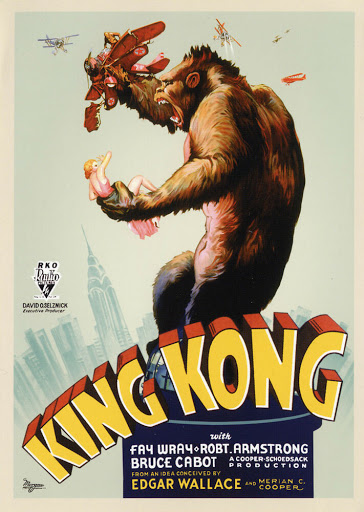
Of course, Citizen Kane is possibly the greatest and most influential film ever made. But, let’s be honest the paw prints of Kong is what we see most often in the latest Hollywood blockbuster. Kong may have met his end atop the Statue of Liberty (a death the poster spoiled), but his children are everywhere, from Alien to Jurassic Park to Avengers: Endgame. King Kong basically sets the template for special effects movies and Hollywood has almost been remaking it, in some way shape or form, for almost ninety years. But few films can match its momentum, action – or above all the heart it gives to its beast.

Carl Denham (Robert Armstrong) is a Hollywood director who has a plan to make his next film a huge success. He’s got a map to Skull Island (no need to worry with that name) where he’s heard rumour that a mighty creature is just waiting to star in his next film. Denham needs a female lead – so plucks Ann Darrow (Fay Wray) off the streets promising her the adventure of a lifetime. During the voyage to the island, she falls in love with first mate Jack Driscoll (Bruce Cabot). On arrival at the island they find a tribe of ferocious narratives, who kidnap Ann intending to sacrifice her to their god Kong – a massive gorilla. Instead Kong falls for Ann and carries her into the jungle. When Driscoll and Denham go to save her they find Skull Island is a dangerous place (who knew!), stuffed with brutal dinosaurs and scary beasts – and that Kong himself has no plans to give Ann back.

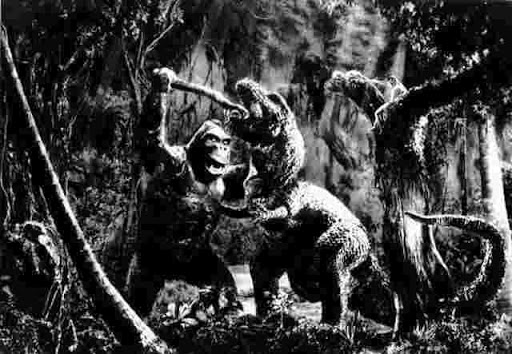
King Kong’s final hour is essentially little more than a stream of action scenes. However, few action films since have paced its action as well as this film does. With special effects by Willis O’Brien, one of the earliest masters of stop-motion, Kong in turn takes on a T-Rex, a pterodactyl, a village of natives and then most of New York in a series of escalating and dramatic sequences which use all the tricks Hollywood had, from animation to models and back projection. Each of these sequences are perfectly done and carry the sort of awe that stop-motion animation can project – all those hours of work! – helped by the successful (and brilliantly clever) use of back-projection to have these battling beasts seeming to tower over the human cast. You can imagine how thrilling it must have been – I’m not sure anything like this had been seen before.

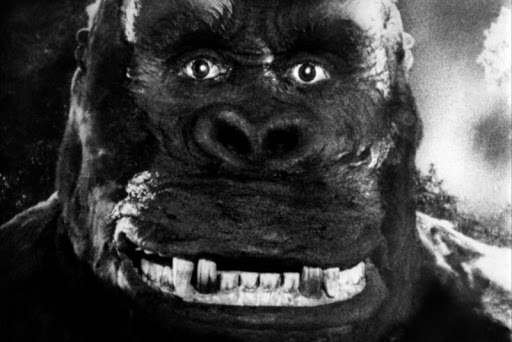
But the film has really lasted because Willis O’Brien’s skill is to add humanity and sensitivity to Kong himself. There is a reason why Peter Jackson (director of the sensitive but overextended remake) talked of weeping when he saw Kong meet his end. From almost the very first shot, Cooper and O’Brien cut to Kong’s eyes, which have a surprising soulfulness to them. And after all what does Kong really do wrong in this film? He is perfectly happy on Skull Island – he even only attacks other creatures when they make the move on him – he has no desire to go to New York and spends half the film trying to protect Ann from danger (not that she thanks him for it). The animation takes several moments to create the soul in Kong – from the ripples of his fur to his curious inclines of the head. After defeating creatures, he curiously picks up their crushed bodies, as if surprised to find them unresponsive. He gently moves Ann. There is a sort of innocence to him. After all what is he but a small-town guy who heads to the big city and falls for the wrong gal?

As such it’s rather hard not to root for him – or feel his pain (and shock) when attacked by planes at the top of the Empire State Building. You can see in Kong’s eyes the lack of understanding about what these metal objects are that are punching through his skin. The shooting gallery is tinged with tragedy – and it’s hard not to cheer when Kong manages to take one of these planes down. For all his fierceness, Kong seems like a real person, a vulnerable guy taken out of his depth against his will. The cruelty of exploiting Kong for Broadway ticket sales, as Denham plans to do, seems particularly un-just. It brilliantly allows us to get the best of both worlds: we can enjoy the spectacle of the wild animal Kong snapping the jaws of T-Rexs but we also feel for him as a confused and frightened animal put to death in a world he doesn’t understand.

Perhaps its easier to sympathise with Kong because so many of the human characters in it barely register. The first forty minutes is low-key – and often frankly rather flat – competently filmed but fairly-stiff build-up, carefully (and at times rather pointedly) establishing the situation and themes. None of the actors make much an impression (not helped that the second half of the film is so Kong focused that they hardly have a line to share). Robert Armstrong is effectively arrogant and ambitious as Denham. Bruce Cabot is pretty wooden as Driscoll (his first film after being recruited from the studio doorman staff, he has said he essentially stood where he was told and that was it). Fay Wray has a certain sweetness and charm as Ann, but barely opens her mouth other than to scream after the first forty minutes (in a neat bit of wit, her rehearsal on ship is standing still and practising screaming silently at an object she can’t see). With its blundering Hollywood director at the heart of all the chaos, King Kong could also be one of the first Hollywood satires.

Intentionally or not the film has an imperialism to it. Denham is an arrogant man out of his depth – although I am not sure how far the film is aware of this – and the crew come across as arrogant and clueless, blundering into a wild environment with an armed over-confidence (that quickly gets them all killed – most of them tumbling to their doom with an almost sickening rag doll snap after a meeting with Kong). You can sense that as well in the awkward lack of PC in framing the (black) residents of Skull Island as blood-thirsty savages with a lust for human sacrifice. However, with its eventual sympathy for Kong, there is enough here to allow the viewer to read into it a certain amount of post-colonial criticism of this sort of H Rider Haggard meets Arthur Conan Doyle world.

The film is very proud of its “Twas beauty that killed the beast” concept (it’s repeated numerous times in the film – not least most famously at the end) – but it’s an idea that is already framing Kong as the victim. So, for all the triumph of the design – the production design is stunning, rarely have Hollywood back lots looked as good – and the awe of Kong, the idea of him as a victim is there from the start.

A lot of that awe though comes from possibly the film’s MVP: Max Steiner. King Kong is one of the first films to use a full orchestral score and the music is vital to adding heft, drama and danger to this stop-motion beast. Steiner’s score superbly uses motifs to build Kong’s presence and operatic crescendos that brilliantly heighten the drama. It’s certainly one of the most influential scores ever written – and it’s impact on film history is so lasting, that watching the film today you take it’s revolutionary nature for granted, so often has the way of using music become part of our accepted cinematic language.

King Kong lasts because of the awe it builds for the monster, but also the way we start to feel for him. Complimented by the professional skill of Cooper and Schoedsack’s direction, King Kong still grips today, for all that you need to read into it more depth than is (perhaps) there. But depth isn’t what made Kong great. It was the excitement and drama of the spectacle – and its so exciting you barely notice that Kong dramatically increases in scale as the film continues. And while special effects have moved on, the power of what’s presented here hasn’t. Deserves to be listed as one of the most influential films ever made.

Alien (1979)

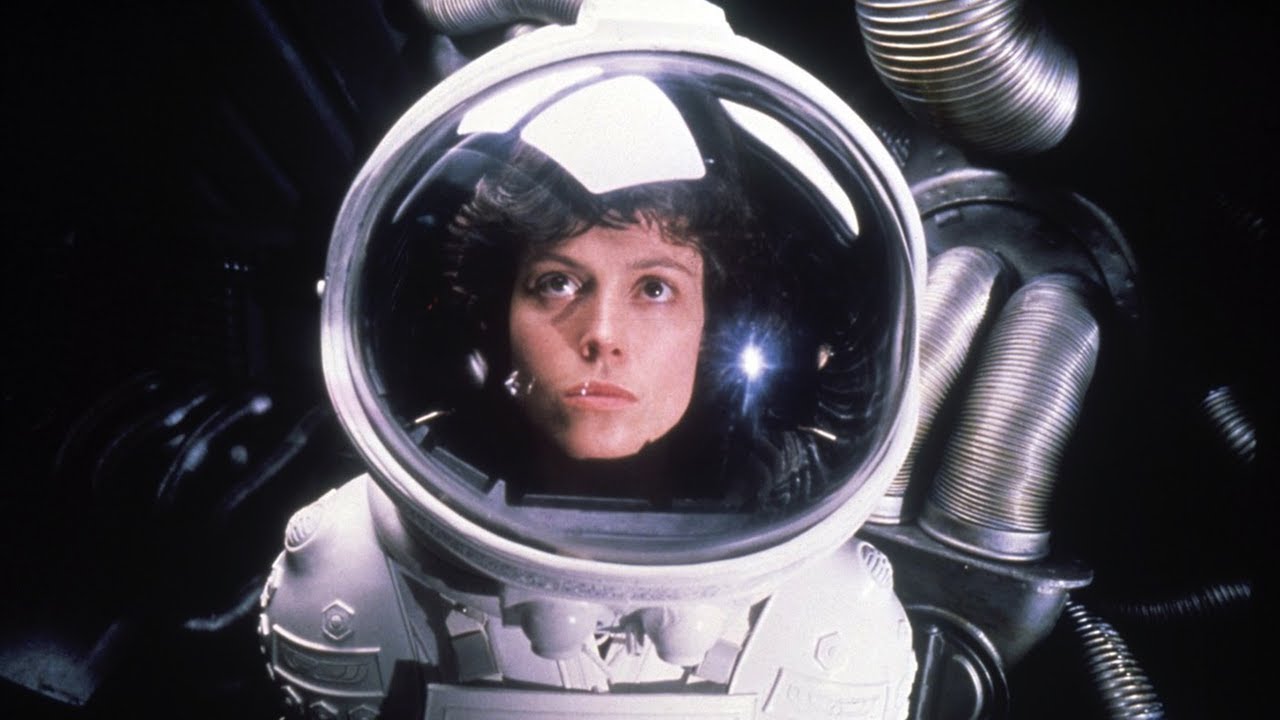
Sigourney Weaver is last woman standing in Alien

Director: Ridley Scott

Cast: Tom Skerritt (Dallas), Sigourney Weaver (Ripley), John Hurt (Kane), Ian Holm (Ash), Yaphet Kotto (Parker), Harry Dean Stanton (Brett), Veronica Cartwright (Lambert)

For decades, space was seen as a place of wonder. But Alien reminded us it was also a place where no one can hear you scream. We dream the vast void out there contains life: but what if the life we found was a relentless killing machine, a seemingly invulnerable monster literally having humanity for breakfast? Ridley Scott’s Alien took science fiction and ran it through the blender of horror, turning its space ship into a terrifying haunted house with an alien straight out of slasher films. It’s still a landmark today.

In deep space, the Nostromo’s crew is pulled out of hypersleep early – long before arriving back in our solar system. A strange distress call from an unidentified vessel needs to be investigated, on standing orders from “the company”. The seven-strong crew lands their ship and a party heads out – only to return with third officer Kane (John Hurt) with a strange alien creature attached to his face. The creature can’t be removed until it detaches itself of its own accord. All seems well until an unfortunate dinner party – at which point the crew finds itself being hunted one-by-one by a relentless alien monster.

Scott’s film is so famous today it’s very hard not to forget your foreknowledge of what’s going to happen and to experience it as its original viewers did. But it still works brilliantly – even if almost everyone watching knows only Ripley is getting out of this alive. The film is a masterpiece of slow-burn tension punctuated by moments of shocking horror. The final Alien itself doesn’t appear until almost an hour into the picture – but before then we’ve had our nerves more than jangled by the unsettling disquiet of the film’s mood. From the Nostromo, to the storm-laden planet they land on, and the vast alien ship – now a tomb of dismembered corpses with an unsettling organic look, like a giant carcass – everything in the film is designed to put us ill-at-ease. You can’t watch this film and expect anything to turn out for the best.

The camera prowls around the dank, grimy and run-down ship – space travel has rarely looked this unglamorous – like the predator that will hunt the crew. It’s slow, stately lingering on the crew, their faces, the eerily unsettling sounds and score, all serve to act like an advance funeral. Every single beat of the film stresses claustrophobia and dirt. It looks like a horrible trap already, and the film embraces a sense of grim inevitability. The observational style of the editing and shooting as we follow the characters, overhearing their bickering and functional work-based conversations, also helps add to this mounting sense of unease. It’s a surprisingly quiet film for much of its opening act, ambient noise and unsettingly lingering music dominating.

There is a poetical eeriness about the whole film. This is also partly from the sense of the ship being a society in microcosm. Much of the bickering is around bonus pay shares, the working-class engineers of the ship (one of whom is also black) bemoaning their smaller shares. The officers sit at the top, a mixture of entitled, distant, officious and daring. They have their own feuds over status, professional boundaries and personal rivalries. The captain is a laissez-faire professional, who offers only a general guidance and could really be just another member of the crew. The ship is like a giant oil-rig in space, with the crew basically a group of “truckers”. The film is as much about interpersonal tensions as it is about an alien monster who hunts people down.

But it is mainly about an alien monster that tears people apart. After almost an hour of deeply unsettling and unnerving build-up, when the monster (literally) rears its head, it’s a terrifying sight. We usually only see it briefly for small shots, but what we see is pure nightmare fuel. The creature is terrifying in its violence and power. It is partly human but also completely revolting. Covered in slime, it looks like a bizarre mix of a man, a giant penis and a vagina (its designer, HR Giger, reasoned nothing would be more unsettling and disturbing to us than seeing a beast that’s partly inspired by our own sexual organs). It creeps in corners, embraces the many shadows of Scott’s set and its capacity for violence seems unstoppable. Sharp editing and suggestion elaborates the visceral horror of its extending jaws punching through bone and flesh. It moves like an interpretative dancer and leaves a trail of blood. It’s unstoppable and infinitely cunning. It looks like your worst nightmare.

It’s all washed down with body horror. An alien that smothers its victims and shoves an egg down their throat which hatches through their chest becoming a slaughtering beast. There is an uneasy sexuality about this, right down to the “birth” of the creature being a grotesque parody of childbirth. The “birthing scene” is a masterpiece, the first moment in the film when the tension between the crew has eased – and the film itself seems to have relaxed for a moment from the knot of tension – that turns into one of the most memorable moments of body horror ever. The actors were allegedly told what would happen – but not how graphic it would be – and their horror-struck disgust (Veronica Cartwright was nearly knocked over by a powerful jetstream of mock blood and guts) and and shock gives the film a priceless realism.

Watching the film, it’s striking to me how much John Hurt’s Kane is shot as the hero early in the film. It’s he who wakes first from hypersleep. It’s Kane we follow the most for the early part of the film – he’s the one piloting the ship, volunteering to answer the distress call, urging his crew mates on as they investigate the alien vessel – it’s Kane who seems to be the hero. Making his brutal demise even more of a subconscious shock. On the other hand, Ripley is introduced as an officious, unpopular, by-the-book officer who it seems few other members of the crew like (Sigourney Weaver’s praetorian attitude helps a lot with this) – if you had to bet on someone to bite it early on, you’d pick her. The film continues to defy expectations. Characters who seem like they might be invulnerable are slaughtered early. Those who looked vulnerable survive until late on.

It’s a very strong cast. Weaver magnificently grows in authority as the film progresses, turning her abrasiveness into strength of character and moral determination. Hurt is very good as the unknowing victim-in-waiting. Kotto, chippy and defiant, is another stand-out. The finest performance through might well come from Ian Holm as science-officer Ash. Precise, cold, distant – but always hiding his own secret agenda – it’s an unsettlingly controlled performance that leads to a pay-off reveal that still works brilliantly today (and the character would have one of the most memorable death scenes in film, if he wasn’t in the same film as the most memorable death scene).

Scott’s filmmaking is brilliantly controlled, and the film is a horrifying masterpiece of tension and terror. The monster is skilfully shown at its worst (you’d never even guess in actuality it’s little more than a Doctor Who man-in-a-rubber-suit) and its design is faultless perfection. It’s not completely perfect – its build up might be ten minutes too long, and a late sequence that sees Weaver wearing little more than her undies looks hideously dated today – but it’s pretty close. Science fiction has never been scarier than it is here – hell the movies have rarely been scarer. In space no-one really can hear you scream.