Category: Murder mystery

Klute (1971)

Klute (1971)

Paranoia runs rampant in this fascinating – and chilling – murder thriller that taps into into conspiracy thrillers

Director: Alan J. Pakula

Cast: Jane Fonda (Bree Daniels), Donald Sutherland (John Klute), Charles Cioffi (Peter Cable), Roy Scheider (Frank Ligourin), Dorothy Tristan (Arlyn Page), Rita Gam (Trina), Nathan George (Trask), Vivian Nathan (Psychiatrist), Morris Strassberg (Mr Goldfarb)
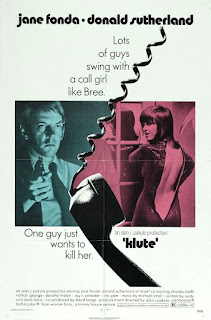
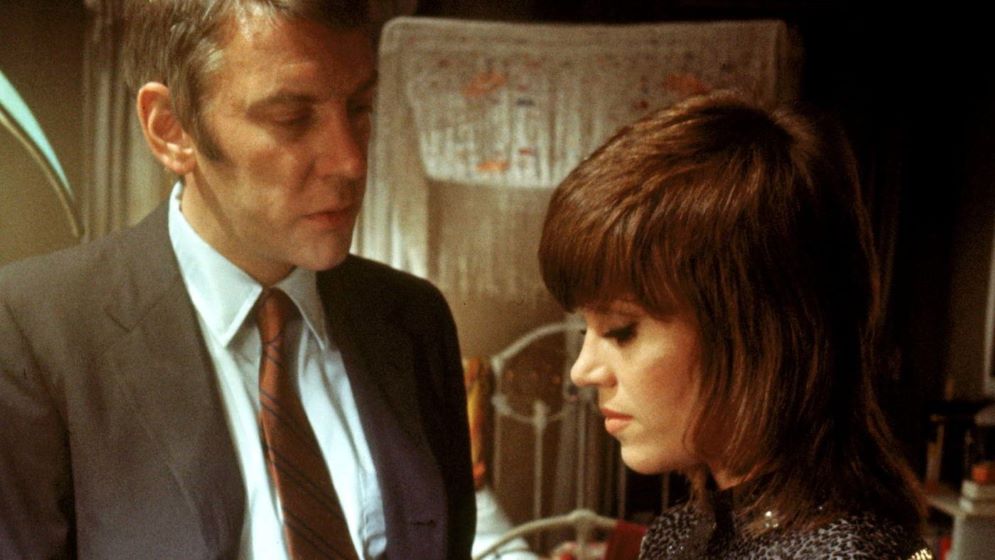
There is one question everyone asks when watching Klute: why the heck is it called Klute? Would calling the film Daniels have been too dull? Would Bree have made it sound like a history of cheese? Klute is dominated by its character study of Jane Fonda’s Bree Daniels, split between her desire to be an actress and the comforting sense of control and avoidance of intimacy her work as call-girl brings. Klute uses the conventions of the male detective movie to conduct a sympathetic, compassionate character examination of its female lead. Match that with Pakula discovering his affinity for creeping 70’s paranoia, and you’ve got one of the most interesting and rewarding films of the decade.

John Klute (Donald Sutherland) is a small-town cop called in as a private investigator after a six month New York police investigation fails to find his friend, businessman Tom Gruneman. The only lead they have is a series of obscene letters found in Gruneman’s office written to New York call girl Bree Daniels (Jane Fonda). Klute discovers Bree has no memory of Gruneman, but Klute believes she may be in serious danger. Together they investigate the crime further, which becomes more and more focused on a mysterious abusive client and even more complicated by the growing relationship between the quiet, reserved Klute and the strong-willed, independent Bree.

Klute uses the conventions of a gumshoe detective movie, spliced with a hard-hitting 70s fascination with grimy, sensationalist crimes (this was the same year as hard-bitten, shades-of-grey cops in Dirty Harry took on a serial killer and The French Connection explored the drugs trade), in this case the assault and murder of prostitutes. But this isn’t a whodunnit, or even really a detective story. The film is barely 45 minutes old before Pakula basically reveals who the killer is (the suspect list has only two people on it in any case). Most of the investigation takes place off screen. Some answers are kept vague. There is no cathartic moment of success.

Instead, the film feels far more like it’s using its Laura-ish set-up (the big difference here being the taciturn detective’s love interest is alive rather than just a painting) as a backdrop to deep dive in Bree’s personality. Bree is played with a stunning (and Oscar-winning) verisimilitude by Jane Fonda. Fonda immersed herself totally in the character, even living in the apartment set during shooting (Pakula had a working toilet installed) and developing a careful psychological background to Bree that is brilliantly introduced through our frequent cuts to her sessions with a coolly professional psychiatrist.

This is a portrait of a female sex worker on screen, where she’s neither a tragic or pathetic figure, or a hooker-with-a-heart-of-gold (the standard tropes). Instead, this is a woman struggling with a crippling fear of intimacy and a compulsion to control, who finds a freedom and release in acting out the fantasies of others. Bree speaks to her psychiatrist of being a call girl not as a curse or source of shame, but something she takes a sort of freedom from. It’s clear that really makes her sweat is not adjusting herself to whatever men want (faking an orgasm while checking her watch with one John, or acting out an elaborate, detailed fantasy for a lonely tailor) but the idea of having to be herself, to display something emotional and true.

And prostitution has the advantage over acting as she sets the terms. We are introduced to Bree as just one in a row of sitting actresses auditioning for an advert, each of them dismissively given a score from A to C. She later auditions for Shaw’s Saint Joan with a detailed, heartfelt reading (she’s clearly a good actress) which is stopped mid-speech by a bored director. With Fonda making clear that control is vital to Bree’s sense of well-being, no wonder she struggles with this dismissive world. Or that she finds a greater freedom in high-end prostitution, where we see she sets the terms with a business-like professionalism and is the centre of the focus and attention of her John’s for the whole of their session. This is a feeling she doesn’t get from anyone else.

What really scares her is the thought of a genuine emotional intimacy with Klute. In their first encounters she assumes she can seduce him with the professional ease she does most men, dropping naturally into her role of seductive dream-girl, offering him sex in return for recordings he has of her from his investigation. Later she will prove a point by coming to him in the night and seducing him with a pretence of vulnerability and fear, as if to prove to him (and herself) that she can work out exactly what mood she needs to control any man.
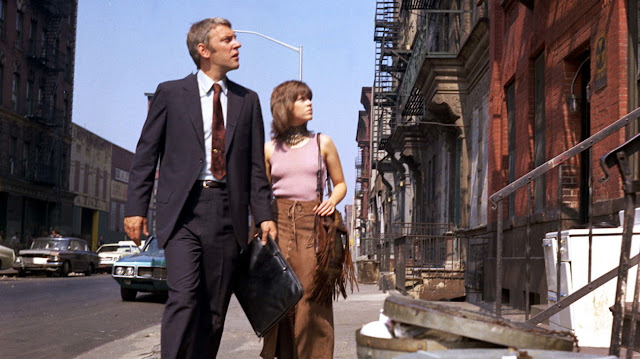
But it’s buried in genuine fear about emotional attachment. To her psychiatrist she talks about not understanding why Klute seems, with no ulterior motive, to be concerned for her safety and well-being despite the things he’s knows about her or that she’s done and said to him.

There is a marvellous scene where the two of them go shopping for fruit (Klute of course knows exactly how to choose the best fruit, he’s that sort of guy). First, she impulsively steals an apple like a naughty, impulsive child. When Klute responds with a bemused half-shock, she stands behind him, a grin spreading across her face, then she lightly rests her head (almost not touching) on his back – then follows him down the street, holding the end of his coat. It speaks worlds of how something in her emotional growth has been slightly stunted somewhere along the line. And the fact this intimacy is followed in the next scene by a drug-fuelled blow-out, speaks volumes of her fear of it.

It’s a brilliant performance by Fonda, throbbing with empathy and emotional complexity. She’s perfectly abetted by Donald Sutherland, who proves himself once again one of the most generous actors in the game. Klute is in many ways the typical rube in the big city, the one honest cop. But he also has a wet-eyed vulnerability, a tenderness and an urge to protect that as motherly as it masculine. He reveals very little emotionally, not from fear but from a shyness.

He’s also an observer. And Pakula’s film partly draws links between detective and voyeurism. Let’s not forget Klute also bugs Bree’s phone and follows her. The camera frequently shoots the action from distance, through windows and looking down on the action: the idea of being constantly observed lingers over the picture, giving it a rich vein of paranoia. The killer listens to disembodied audio recordings of Bree, and these frequently play over the action not only echoing this paranoia, but re-enforcing how her personality is a fractured one between the independent exterior and the less certain interior.

Pakula’s film pulls all this together into something creepy and unsettling but is also a fascinating character study. That is perhaps its best trick. You come into it expecting a film noir or a detective story. What you get is a compelling analysis of the psyche of one woman, who emerges into the picture and takes complete control of it. Perhaps that’s why it’s called Klute – it’s as much a part of the misdirection as everything else. With its psychological complexity and creeping sense of being watched, this would set the tone for many other films that followed in the 70s.

Witness for the Prosecution (1957)

Witness for the Prosecution (1957)

A court case hinges on a heck of a twist or two in Wilder’s well-mounted Christie adaptation

Director: Billy Wilder

Cast: Tyrone Power (Leonard Vole), Marlene Dietrich (Christine Vole), Charles Laughton (Sir Wilfrid Robarts), Elsa Lanchester (Miss Plimsoll), John Williams (Mr Brogan-Moore), Henry Daniell (Mr Mayhew), Ian Wolfe (Carter), Torin Thatcher (Mr Myers QC), Norma Vaden (Emily Jane French), Una O’Connor (Janet McKenzie), Francis Compton (Justice Wainwright)

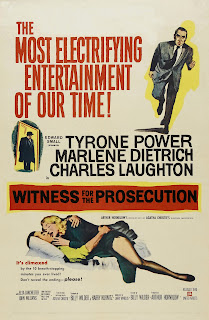
Agatha Christie is better known for detectives who unearth murderers, not lawyers defending those accused in court. But that doesn’t mean Witness for the Prosecution, a very effective courtroom drama, shirks on classic Christie flourishes. Witness has a single stonking twist that huge numbers of people never see coming (the end of the film comes with a sonorous warning entreating people not to spoil the surprises, the sort of anti-spoiler warning that would make Marvel proud).

Leonard Vole (an unlikely Tyrone Power) is the soldier and would be entrepreneur, who stands accused of the murder of a rich older woman (Norma Vaden) who conveniently left Vole her money. Defending Vole is richly-toned, highly-skilled barrister Sir Wilfrid Robarts (Charles Laughton), recovering from a heart attack and doing his very best to dodge the overly attentive concern of his private nurse Miss Plimsoll (Elsa Lanchester). Vole’s case looks difficult, with much circumstantial evidence stacked against him and worries about whether his German wife Christine (Marlene Dietrich) will stand by him or not?

Billy Wilder directs with a smooth professionalism – he later modestly claimed of his Oscar nomination, that it was like giving the crew that moved Michelangelo’s Pietá an award for best sculpture – but his real contribution (with fellow writer Harry Kurnitz) was sharpening the dialogue, expanding Christie’s characterisation (in particular adding much more shrewdness and eccentric pomposity to Robarts) and upping the zip of Christie’s original. It certainly met with the approval of the grandé dame of crime who listed this, and Lumet’s Murder on the Orient Express, as the only two adaptations of her work she liked.

The film is largely based around the courtroom dynamics, as witnesses are examined and cross examined and facts gently dragged into the light. There is plenty of quality theatrics, not least since Robarts and his opposition counsel Myers (a fearsome Torin Thatcher) are more than a little skilled at keeping things sparky for the jury. There is a hint of cynicism in Witness: Robarts needs to convinces himself of a client’s innocence, but there is a suggestion this is because it helps him work out how to effectively defend them, less because of any moral reasons. And certainly, the entire mechanics of the trial operates largely as a show, an entertainment with jokes and compelling stories offered by both sides.

There is of course no better showman than Robarts. Played by Charles Laughton in one of his last great – and possibly most enjoyable – performance, Robarts is an affectionate, witty performance of carefully studied eccentricity and barking bluffness. But there is also a vulnerability in him: Robarts needs to belief in his own legend and his ability to separate truth from lie (he even prides himself on his “monacle test”, using a reflection from it to shine in suspects eyes, believing a liar will get flustered and trip themselves up – needless to say it turns out to be faulty).

Wilder – with Laughton as a brilliant collaborator – transforms Robarts into a far more forceful and charismatic figure, making the late plot twists even more of a shock. If someone as professionally adept and plugged in as Robarts can be taken in, what chance do the rest of us have? Oscar-nominated, Laughton, a twinkle permanently in his eye, powers through moments of high court theatricality but also heartily enjoys the banter of real life, taking a real delight in his schoolboy mischief as he persists in having his own way.

A large part of that, is a running of dodging treatments and sticking to a diet of things that are bad with him. Wilder’s finest change from the original, in introducing Robart’s ill health and his love-hate relationship with his nurse Miss Plimsoll. Who is, of course, played by Elsa Lanchester, Laughton’s real-life wife. The chemistry between these two is spot-on, with Lanchester (also Oscar nominated – and unlucky to lose to Miyoski Umeshi in Sayonara) in particular playing the combination of world-weary exasperation and growing affection for Robarts perfectly.

Combined with those twists, it’s the interplay between these two that is the real highlight in the film – well that and the twists. Many of those twists are bound up with Marlene Dietrich’s character. Dietrich gives one of her most colourful and wide-ranging performances here. The secrecy of the film probably stopped her from landing an Oscar nomination (much to her regret – Wilder even apologised to her). Power is miscast – he lacks the required natural innocence and looks both too old and incongruously American – but fortunately spends most of the film in the dock.

The final twist is a doozy, perfectly delivered by the actors and Wilder. Wilder directs throughout with quiet authority – as well as fine sense of humour, in particular a stair lift scene that sees Robarts using the device as a tool to dodge being told what to do. Laughton and Lanchester in particular are wonderfully funny. It’s got some excellently handled courtroom tricks and you won’t forget how it turns out. It’s a solid example of Wilder’s skill behind the camera – but a very enjoyable film and a must for Christie fans.

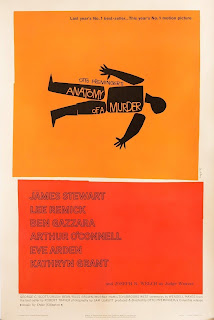
Anatomy of a Murder (1959)

Anatomy of a Murder (1959)

The mechanics of courtroom showmanship is ruthlessly exposed in this gripping drama

Director: Otto Preminger

Cast: James Stewart (Paul Biegler), Lee Remick (Laura Mannion), Ben Gazzara (Lt Frederick Manion), Arthur O’Connell (Parnell McCarthy), Eve Arden (Maida Rutledge), Kathryn Grant (Mary Pilant), George C. Scott (Claude Dancer), Orson Bean (Dr Matthew Smith), Russ Brown (George Lemon), Murray Hamilton (Alphonse Paquette), Brooks West (Mitch Lodwick), Joseph N Welch (Judge Weaver)

Winston Churchill once said Democracy was the worst form of government, except for all the others. You could say something similar about trial by jury: it ain’t perfect, but it’s better than any other justice system we’ve given a spin to in human history. Trials aren’t always forums for discovering truths: they are stages to present arguments (or stories), and they are won by whoever has the best one. Maybe cold, hard facts and evidence make up your story, maybe perceptions. Maybe it’s about how you tell the story. Elements of all three are found in Otto Preminger’s brilliant courtroom drama, Anatomy of a Murder.

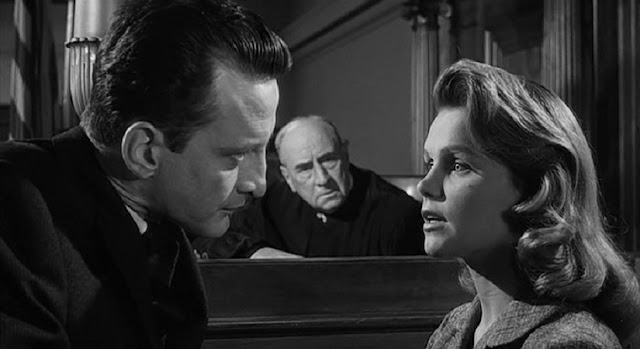
In a small town in Michigan, a US army lieutenant, Frederick Manion (Ben Gazzara) is arrested for the murder of innkeeper Barney Quill. Manion says he did the deed only because Quill raped Manion’s wife Laura (Lee Remick). Representing him is lawyer Paul Biegler (James Stewart), a former district attorney looking to start-up a new practise. On the opposite side is new DA Mitch Lodwick (Brooks West) and, far more of a worry, hot-shot lawyer Claude Dancer (George C. Scott) all the way from the Attorney General’s office. They say there was no rape – only a jealous murder after a consensual affair. It’s he-said-she-said, only “he” is dead. How will the trial clear that one up?

Otto Preminger was the son of a noted Austrian jurist, and Anatomy of a Murder can be seen as a tribute to his father, and to the process of the law itself. Not that it’s a hagiography. The film recognises the virtues as well as the faults of the system. Above all, that the system is not perfect, it can’t base every decision on firm facts and often requires people to take leaps of faith based on their gut instinct about who may, or may not, be telling the truth.

Preminger’s film does its very best to put us in the position the jury is in. We get no real evidence about what happened beyond what they get, and very few bits of additional information (except, perhaps, for seeing what many of the characters are like outside of the courtroom). Instead, the viewer is asked to make their mind-up on whether events fell-out as Manion claims (or not) based on our own judgement of the probabilities and of his (and Laura’s) character. The film opens with the crime committed and closes shortly after the verdict: there are no flashbacks or pre-murder scenes to help nudge us towards one view or another. The murder victim appears only as a photo. Like the jury we have to call it on what we see in front of us.

Anatomy of a Murder also makes clear there are plenty of shades of grey in the process of justice. During his first consultation with Manion, Biegler carefully suggests he consider whether he was in fact insane when he committed the deed – as that sort of defence will be much easier, since he doesn’t deny the killing. Sure enough, on their second meeting, Manion is now deeply unsure about his state of mind. Biegler then works backwards to establish precedent for the plea (a finds a single, over 75 years old one) to pull together a defence of irresistible impulse and to peddle hard a picture of the victim as an unrepentant rapist practically asking for a wronged husband to do the deed.

Biegler’s case is flimsy – but the key thing is to present it with pizzazz. And that’s what he’s got. Stewart’s performances in Hitchcock classics are highly regarded, but this might well be his finest dramatic performance. This is a brilliantly sly deconstruction of Stewart’s aw shucks charm: Biegler promotes an image of himself as a down-on-his-heels, bumpkin-like country lawyer, punching above his weight against the big city lawyers, Stewart dialling up the famous drawl. But it’s miles from the truth: Biegler is a former DA, an experienced trial lawyer and a formidable advocate. Stewart flicks the switch constantly, visibly putting on his persona like a skin, shedding it when no longer needed.

There is a constant suggestion that everything Biegler does is for effect. From fiddling with fishing tackle during the prosecution’s opening statements, to furious court-room theatricals as he thuds tables at slights and injustices. All of it is carefully prepared, rehearsed and delivered to make an impact on the jury. The constant parade of effect, manufactured outrage and appeals to an “us against them” mentality provokes exasperation from his opponents and a weary toleration from the Judge (played by real-life McCarthy confronting attorney Joseph N Welch). Stewart uses his Mr Smith Goes to Washington nobility, but punctures it at every point with Biegler’s cynicism and opportunism. Biegler, at best, persuades himself his client is innocent – but I would guess he doesn’t really care either way. He immediately perceives the personalities of his clients and then does his best to shield their less flattering qualities from the jury.

The one advantage we have over the jury is the additional insight we get into this strange couple, living a possibly unhappy, and certainly love-hate, marriage. Manion plays wronged fury in the court – but Gazzara gives him a lot of self-satisfied smarm and bland indifference to his crime in real life, meeting every event with a smirk that suggests he’s sure he can get away with anything. Equally good, Lee Remick’s Laura presents such a front of decency and pain in court, you’ll find it hard to balance that with the promiscuous, blousy woman we see outside of it, who provocatively flirts with intent with anything that moves. But it’s all about the show: present them right, and these unsympathetic people can be successfully shown as a conventional loving couple.

The prosecution is playing the same game. George C. Scott is superb as a coolly professional lawyer, who will use any number of tricks – from angry confrontation, to seductive reasonableness – to cajole a witness to say anything he wishes them to say. He will turn on a sixpence from being your friend, to berating you as a liar. And he’s not averse to his own morally questionable plays in court. Like Biegler, he knows presenting a good story is what is needed to win: the truth (or otherwise) isn’t enough.

Anatomy of a Murder still feels like a hugely insightful look at the legal process. Most of its runtime takes place in court, which Preminger shoots with a calmly controlled series of long-takes and two-shot set-ups, that help turn the film into something of a play (as well as a showpiece for fine acting). Along with its very daring (for the time) exploration of rape, it has a very cool soundtrack from Duke Ellington, that drips with allure and gives the film a lot of edge. The acting is all brilliant – along with those mentioned, Eve Arden is first-class as Biegler’s loyal secretary and Arthur O’Connell sweetly seedy as his heavy-drinking fellow lawyer. Anatomy of a Murder gives a first rate, at times cynical, look at the flaws and strengths of trial by jury – and is an outstanding courtroom drama.

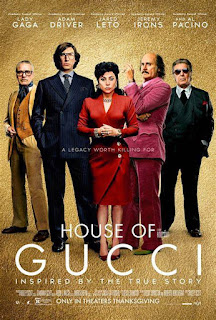
House of Gucci (2021)

House of Gucci (2021)

Ridley Scott’s bizarre film is half-pantomime, half true-crime drama

Director: Ridley Scott

Cast: Lady Gaga (Patrizia Reggiani), Adam Driver (Maurizio Gucci), Jared Leto (Paolo Gucci), Jeremy Irons (Rudolfo Gucci), Al Pacino (Aldo Gucci), Salma Hayek (Giuseppe Auriemma), Jack Huston (Domenico De Sole), Reeve Carney (Tom Ford), Camille Cottin (Paola Franchi), Youssef Kerkour (Nemi Kirdar)

There are few juicier combinations than glamour, money, fashion and true crime. Scott’s House of Gucci taps into this with a film that’s somewhere between pantomime and tragedy. Full of actors giving their very best “Mamma Mia!” Italian accents and shrugging shoulders, it oscillates wildly from scene-to-scene between black comedy and operatic high drama. It’s a strange mixture, with House of Gucci becoming some sort of bizarre treat, like an end-of-year treat for cinema viewers to unwrap.

The film follows the disastrous marriage between Maurizio Gucci (Adam Driver) and Patrizia Reggiani (Lady Gaga). Patrizia, a ruthlessly ambitious gold digger, zeroes in on the shy Maurizio, heir to 50% of the Gucci fashion fortune, and marries him. This is all to the horror of his father Rudulfo (Jeremy Irons), who (correctly) identifies Patrizia’s ambitions, and cuts them off. Taken under the wing of Rudolfo’s brother Aldo (Al Pacino), Patrizia pushes Maurizio into a management role in the company – and down a slippery slope that will lead to forgery, betrayal and eventually murder.

House of Gucci feels like it might have existed more comfortably as a ten-part TV drama. It’s essentially a big, brash version of the Emmy-award winning The People vs. OJ Simpson, but told in about a quarter of the time. What this basically means is that any subtle character work and detailed story telling is sacrificed, with the focus firmly on the salacious and entertaining drama. The overall effect is a swift rush through a story that becomes a series of sensational, almost comedic, clashes between larger-than-life personalities squabbling over a huge pot of money. Like Dallas on the big-screen, it’s all scored with a series of funky pop tunes, adding to the sense of pantomime.

It’s an odd outing from Scott, with (it felt to me) little of the individual stylistic touches that he has bought to other projects. In fact there’s very little of his stamp on it: it’s Scott as professional craftsman. He and the film feel very confused by the tone. Mostly the film doubles down on black humour and show-casing big, brash performances. Then it might acknowledge briefly that there were real victims here, which it wants to treat with a level of respect. By and large, the film is like a glossy magazine article, with Scott nudging you as you turn each page and saying “you will not believe what happened next!”

I suppose House of Gucci probably could have explored more the personal and emotional hinterlands of its characters. Relationships shift dramatically from scene-to-scene, with Maurizio and Patrizia’s marriage souring over-night, for no clear reason. Pre-existing family rivalries and politics could have been explored more: it’s heavily implied Aldo and Rudolfo are already engaged in a struggle of ideals (Aldo wants commercial expansion, Rudolfo to remain an elitist fashion house). Drama could have been made of the attempts by both brothers to use other members of the family as pawns in this feud. But then, a film that dived into the psychology of the players might well have ended up being more about business and less about the entertaining ruthlessness of the rich and famous.

The performances are wildly different in tone. Lady Gaga effectively holds the film together as an ambitious woman who is only partially aware (at first) of what a ruthless gold digger she is. Devoid of any interests other than being rich (“I’m a people pleaser” she tells Rudolfo when asked what her interests are), Patrizia is the sort of monster of ambition who would fit comfortably into an episode of Desperate Housewives. Setting her cap at Maurizio with a laser-like focus and shafting everyone left, right and centre (although Gaga does hint at her deeply repressed insecurity) it’s a performance that walks a fine line between OTT and human. The film has a lot of fun at her amoral certainty – she sees no problem with forging Rudolfo’s signature on some vital papers after his death (the film even sets forgery up as Chekhov’s skill in its opening scenes) and Gaga enjoyably plays the outrage that only someone convinced they never wrong can feel.

Opposite her, Driver plays Maurizio as a timid, easily seduced young man, pushed into taking a leading role in a business he has no real interest in (or aptitude for). Driver is softly spoken – and gives the most restrained and grounded performance in the film – and frequently meets another demand from his wife with a chuckle and a reluctant “Patrizia…”. House of Gucci steps carefully around Maurizio, sometimes playing him as an innocent abroad, at others as a man corrupted by his wife into a creature of ambition.

Most of the rest of the cast go for a broad style which, while fun to watch, only adds to the sense that we aren’t supposed to be taking anything too seriously. While many of the Gucci family probably were larger-than-life personalities, I’m not sure they could have been the cartoons they are here. Irons goes for a waspish Scar-like mastery of the cutting remark. Pacino doubles down on his shoulder-hunched energy, with added shouting. Hayek gives a performance that’s a near master-class in Vampish camp, plotting murder from a mud bath.

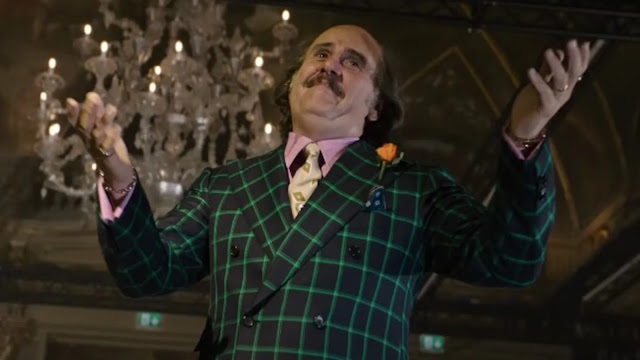
Towering above them all is Jared Leto, who seems to be in a film all of his own, with every scene another clip for his “for your consideration” show-reel. Buried under a mountain of latex that transforms him into a clone of Jeffrey Tambor, Leto goes all out as the passionate, ultra-stereotypical-Italian Paolo Gucci, in a performance that’s either a shameless parade of showing off or somewhere near a stroke of genius. It works because, beneath all the hammy exuberance, Leto make’s Paolo a desperately sweet guy, the only real innocent in the film. Leto and Pacino in particular feed off each other – a late scene between the two is hilarious (I’m not sure in the right way, but who can tell what these actors are aiming for sometimes) in its joyful overplaying.

Perhaps joy is the one thing House of Gucci needs a little bit more on. I wonder how more entertaining again it might have been if the film had really gone all out on being a camp classic. It shies away from this, wanting to leave some vestige of respect for the dead and not lose its true-crime-roots. But, I wonder if a director more suited to this material than Scott – who struggles to stamp his personality on it – might have done more to make this into a cult classic.

Gaslight (1944)

Charles Boyer and Ingrid Bergman excel in Cukor’s cinematic staging of Gaslight

Director: George Cukor

Cast: Charles Boyer (Gregory Anton), Ingrid Bergman (Paula Alquist Anton), Joseph Cotton (Brian Cameron), May Whitty (Miss Bessie Thwaites), Angela Lansbury (Nancy Oliver), Barbara Everest (Elizabeth Tompkins), Emil Rameau (Maestro Guardi), Edmund Breon (General Huddleston), Halliwell Hobbes (Mr Mufflin), Heather Thatcher (Lady Mildred Dalroy), Lawrence Grossmith (Lord Freddie Dalroy)

Spoilers: Spoilers here in for Gaslight both film and play

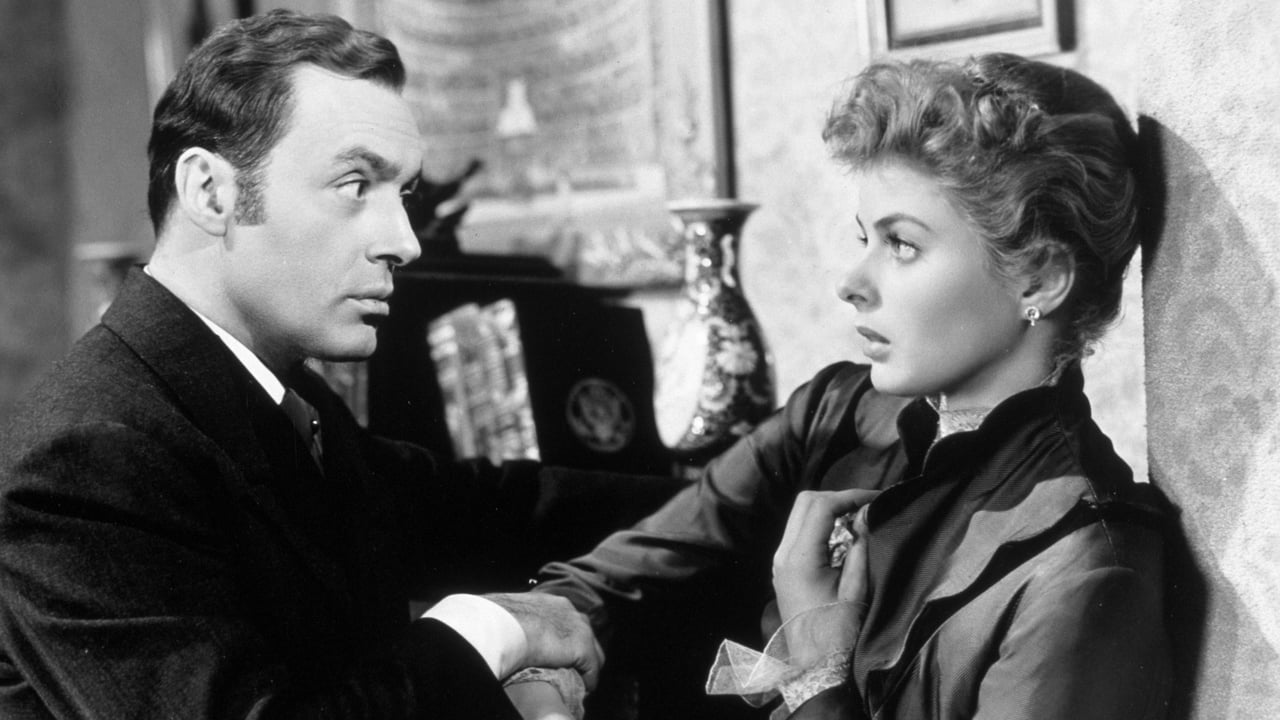
Paula Alquist (Ingrid Bergman) has terrible memories of finding her aunt, a world-famous opera singer, murdered in their home on Thornton Square when Paula was just fourteen. Years later she falls in love with, and marries, the charming Gregory Anton (Charles Boyer) who suggests she returns to London and her old home. To save his wife’s nerves, Gregory has all her aunt’s property moved into the attic. But then Alice starts to lose items, Gregory tells her she moves things and has no memory of it and at night she sees the gaslight dim and hears strange creaks in the attic. Is she slowly going mad as her husband insists? Or is she – and this is where the word comes from – being gaslit into thinking so by a husband who isn’t as nice as he seems?

Adapted from Patrick Hamilton’s play, George Cukor’s bring a sumptuous version of the iconic story of a decent wife manipulated by a bad husband to the screen (MGM allegedly tried to destroy all copies of a British version from 1940 so this could be the ‘only’ adaptation). While the original play is a claustrophobic one-set affair, using minimal characters and taking part in a narrow window of time, the film expands and deepens the stories timeframe and uses a host of locations to build-up Paula’s isolation and mounting insecurity. It’s a subtle and extremely well-handled costume-noir thriller, that holds it cards close to the chest and is powered by excellent performances.

It also makes several genuine improvements to the original play. There, the villainous husband is trying to drive the wife mad so he is no longer constrained by her presence while he searches the house he has purchased for missing jewels. It’s not clear why the villain has saddled himself with a wife (when his life would be much easier if he was a single man). The film improves this immeasurably by making marriage to the wife an essential prerequisite to the villain gaining entry to the house. This one change unknots many problems with the original play and also raises the stakes considerably, by increasing the personal connection to events from the wife.

Giving a traumatic backstory to the re-named Paula (all the names are changed from the play), also gives Ingrid Bergman far richer material in her Oscar-winning role. Bergman’s Paula is already nervous and vulnerable from the start, and her desperate need for love and security draws her inevitably towards a man who, even before we work out he’s a wrong ‘un, offers her a sort of fatherly reassurance. Bergman’s heartfelt performance also contains a streak of independence and determination: she struggles painfully with knowing she isn’t insane, even while being told she might be. The film also gives her a greater sense of agency, and Paula’s final act payback works as well as it does, because Bergman has made her gentleness so under-stated earlier, that her sudden iron and fury are even more striking.

Opposite her is an equally fine performance from Charles Boyer. Boyer inverts his charm and suaveness into a ruthless opportunist, devoid of morals, who takes a sociopathic delight in his own cleverness, even as he semi-regretfully mentally tortures and manipulates his wife. He’s never less than charming – making it all the more unsurprising that Paula places as much faith in him as he does – but the little marks of danger and control are there throughout. Cukor uses a wonderful shot early on of Paula disembarking from a train, at which point a hand enters frame and grasps her arm – it’s revealed as Anton, but a brilliant indicator of his threat and controlling nature. Truth is, Gregory is insane, and Boyer subtly suggests this throughout: there is another lovely shot from Cukor late on where studio lights are reflected in Boyer’s eyes giving him an insanely intense gaze.

It all revolves around finding those diamonds. If there is one area that film is slightly weaker is that it doesn’t actually dedicate much time to that dimming gaslight or those creaking floorboards at night. It feels like a beat that should be hit more regularly (a montage would have helped no end), a more constant presence would have helped make it a more convincing continual dread for Paula.

But its counter-balanced by the expansion of the film to multiple locations where Gregory manipulates Paula to disgrace herself in public. From a lost broach in the Tower of London to an evening soiree where she is made to appear as if she has stolen a watch, it all helps to tip Paula more and more into believing she is losing her mind. Again, Cukor keeps the focus within all this finery very much on our two leads, reproducing for us as much as possible the growing claustrophobic fear that is consuming Paula that was as at the heart of the stage production.

The moments away from this are slightly less strong. Joseph Cotton has a thankless role (with an awkward mid-Atlantic accent) as a police inspector, who smells a rat or two. The ‘investigation’ moments around this are often heavy handed, and labour under the sort of exposition that the scenes between Gregory and Paula skilfully avoid. Basically, Inspector Cameron barely has a personality, meaning he never really develops beyond being just a plot device.

Conversely, a character who takes on a great deal more presence is Angela Lansbury’s star-making turn as a sultry, defiantly sexual maid, parachuted into the house for goodness-only-knows what reason (!) by Gregory, who takes every opportunity to undermine her mistress. It’s a brilliantly pointed little performance from Lansbury, full of sass and smirk (it got her an Oscar nomination in her first movie) that adds even more to the feeling of Paula being a stranger in her home.

Gaslight is all smartly directed with Cukor, brilliant as always with actors, adding more visual flair than he often does with his fog-filled London and noir-tinged Edwardian home. With strong performances and many changes that materially improve the original material, it’s a fine adaptation.

The Player (1992)

Tim Robbins is the ultimate heartless Hollywood exec in Altman’s vicious satire The Player

Director: Robert Altman

Cast: Tim Robbins (Griffin Mill), Greta Scacchi (June Gudmundsdottir), Fred Ward (Walter Stuckel), Whoopi Goldberg (Detective Susan Avery), Peter Gallagher (Larry Levy), Brion James (Joel Levison), Cynthia Stevenson (Bonnie Sherow), Vincent D’Onofrio (David Kahane), Dean Stockwell (Andy Sivella), Richard E. Grant (Tom Oakley), Sydney Pollack (Dick Mellon), Lyle Lovett (Detective Paul DeLongpre), Gina Gershon (Whitney Gersh), Jeremy Piven (Steve Reeves)

Hollywood: it’s a hell of a place. Sharks ain’t got nothing on studio power-brokers, hunting product to sell. After all, not a single letter of “Art” appears in “Hollywood”. Griffin Mill (Tim Robbins) hears 50,000 pitches a year and gives the green light to ten or twelve. Mill is plagued with death threats. Confronting the writer (Vincent D’Onofrio) he believes responsible, he kills him in a fight. Can he get away with murder and successfully romance the writer’s artist girlfriend June (Greta Scacchi)? And, even more importantly, can he protect his job from hotshot executive Larry Levy (Peter Gallagher)?

Robert Altman had been working outside of the studios for well over two decades after negative experiences creating his critically acclaimed but hard-to-digest masterpieces (including McCabe and Mrs Miller and The Long Goodbye, the sort of films only Altman could make). His career had drifted during the 1980s, as his edgy, ‘disciplined ill-discipline’ approach (with overlapping sound and roving cameras) moved out of fashion. The Player was not only his payback expose on the studio system, with the exec a sociopath, but also his triumphant comeback to the frontline of film-making (he earned several awards, including a nomination for Best Director).

The Player is nominally a comedy, but in the way of Altman it also fits half a dozen other labels: from film noir to corporate satire. Above all it’s a maverick’s view of a system designed to produce product (Mill constantly speak of his films like this – he would love our modern age of “content”). The studio’s offices are lined with posters from classic Hollywood – but the studio produces the most crowd-pleasing cookie cutter movies you can imagine. It’s all about squeezing in all the ideal elements a film must have: “Suspense, laughter, violence. Hope, heart, nudity, sex. Happy endings. Mainly happy endings.” (In a neat subversive twist, these are of course all present in The Player – but then it’s to be expected when what we are seeing might actually be a film within a film).

Film pitches all have an air of desperation, every idea boiled down to simple, easily digestible slogans. It’s nearly always a combination of two other films – “Out of Africa meets Pretty Woman!” – or involves the biggest stars (“Julia” and “Bruce” were those two stars – and both actors hilariously spoof themselves in the film’s climactic sequence). Ahead of its time, the film even features a pitch (from a cameoing Buck Henry) for The Graduate 2, a nostalgia tinted exploitation of the IP with all the original cast, that basically sounds like the sort of thing they’d actually make today.

There is no place for film-making as an art – any idea that can’t be compressed into 30 seconds is worthless. Mill’s knowledge of film is patchy at best, his attempt to make small talk about Bicycle Thieves boiling down to “Perhaps we should remake it?”. The film (possibly the film within a film within a film), Habeas Corpus, pitched by Richard E Grant’s pretentious writer (“No stars! No pat Hollywood endings!”) is only attractive because it has the wisp of Oscar about it (and Oscars mean Big Bucks). Even then, Mill plans to rework the whole film into exactly the sort of pat-Hollywood romantic thriller Grant’s character claims to hate (no character will support this decision more than Grant’s sellout writer). The only person who seems to actually watch films is Fred Ward’s studio head-of-security – and at least half of his references are met with blank incomprehension. When Griffin makes a speech donating the studio’s old films to a cultural library, his words about art and culture are incredibly hollow.

This vicious satire of the shallow culture of Hollywood – Larry Levy’s up and coming executive attends AA solely to network, not because he has a drink problem – is wrapped up in a beautiful noir framework, that’s brilliantly a few degrees off reality (for reasons that later become clear). Deluged by death threats from (he surmises) a disgruntled writer, Griffin meets the man he suspects – a pretentious holier-than-thou wannabe, played with chippy fury by Vincent D’Onofrio – who he beats to death in a neon-lit carpark, after a dig too far about Mill’s job security (as nothing threatens these guys more than the prospect of being drummed out of town).

Altman’s film wonderfully echoes the neon lit shadows of classic noir, while building a homage filled trap around Mill, desperate to escape punishment. Mill of course has killed the wrong man – and his stalker knows it – and his own heartless-but-effortlessly-cool business dealings are contrasted with his efforts to avoid the dogged pursuit of a police department (led, in a curious but just-about-effective piece of casting, by Whoopi Goldberg) correctly convinced he is guilty. The film asks, how much does morality intrude on Mill, when he’s led his whole life trampling people: isn’t literally killing someone only the next step up from all that metaphorical killing he’s been doing?

His one weakness is falling in love with his victim’s girlfriend, an artist played with a breezy sexiness by Greta Scacchi. Scacchi’s June is intriguingly unknowable – how much does she suspect Mill, and how much does she even care? – and the dance of seduction and suspicion between them is highly effective, culminating in a tastefully, imaginatively but highly sensually shot sex scene (built from Scacchi’s refusal to do a nude scene – instead the nudity comes from a full frontal of Robbins emerging from a mud bath).

Scacchi’s June feels like halfway between a real person and a movie construct – and that’s a deliberate effect in a film which, the ending suggests, may well have been a movie within a movie. Mill takes a pitch in the final moments from his actual blackmailer, who outlines the very film we have been watching, a pitch Mill accepts on condition the film (he?) gets a happy ending: cue Mill arriving home to June and the two of them using the same pat Hollywood pay-off lines to greet each other, we just saw Bruce Willis and Julia Roberts mouth in Mill’s happy-ending for Habeas Corpus. Apply the logic of a film to all the action and it suddenly makes sense on a whole new level, as a beautifully judged exploration of the very crowd-pleasing elements Mills praises, repackaged in a sharp and bitter satire.

Tim Robbins performance of restrained amorality is vital to the film’s success. In his career, any weakness is deadly – a mantra he applies to his interactions with the police and with June. Mill is so eerily controlled – fear is the only emotion he categorically shows, guilt never crosses his mind – you start to wonder if he even has a real personality. But, in the movie’s structure, he’s both a real person and also a construct whose life echoes scenes from the movies whose posters fill his office.

Altman balances these ideas of truth and reality perfectly within the studio satire. The film is astonishingly well-made, all Altman’s trademarks of overlapping dialogue and roving camera present and correct. It opens with a hugely confident seven-minute tracking shot around the studio, which feels like a real “I’m back!” statement – and is beautifully and wittily done. The film is crammed with dozens of celebrities playing themselves (they were given no dialogue and encouraged to improvise scenes), all of them keen to show they were in on the joke.

The Player is dark, witty and very clever, one of Altman’s sharpest and most enjoyable films. Crammed with echoes of film noir and a brutal expose of Hollywood business practice, it’s very well performed and keeps just enough lightness and humanity (it encourages to empathise, but not sympathise, with Mill, for all his amorality) to also be entertaining. One of the great films about Hollywood.

American Beauty (1999)

Kevin Spacey and Annette Bening excel in the dated Best Picture winner American Beauty

Director: Sam Mendes

Cast: Kevin Spacey (Lester Burnham), Annette Bening (Carolyn Burnham), Chris Cooper (Colonel Frank Fitts), Thora Birch (Jane Burnham), Wes Bentley (Ricky Fitts), Mena Suvari (Angela Hayes), Peter Gallagher (Buddy Kane), Allison Janney (Barbara Fitts)

Time has not been kind to American Beauty – and I’m not just talking about Kevin Spacey. In 1999, what felt like a timely exploration of male-angst has, over time, looked less prescient and more like the last embers of a generation that thought they were The Graduate’s Benjamin but actually became his parents. Many of the sympathies of American Beauty now feel dated and slightly misguided, or obscure some genuine reflections on its characters. Its satire of consumerism feels trapped in the 90s. But it’s also very skilfully made, often funny, beautifully shot and you can see why it seemed like the next landmark masterpiece of American cinema, an Apartment for the modern age.

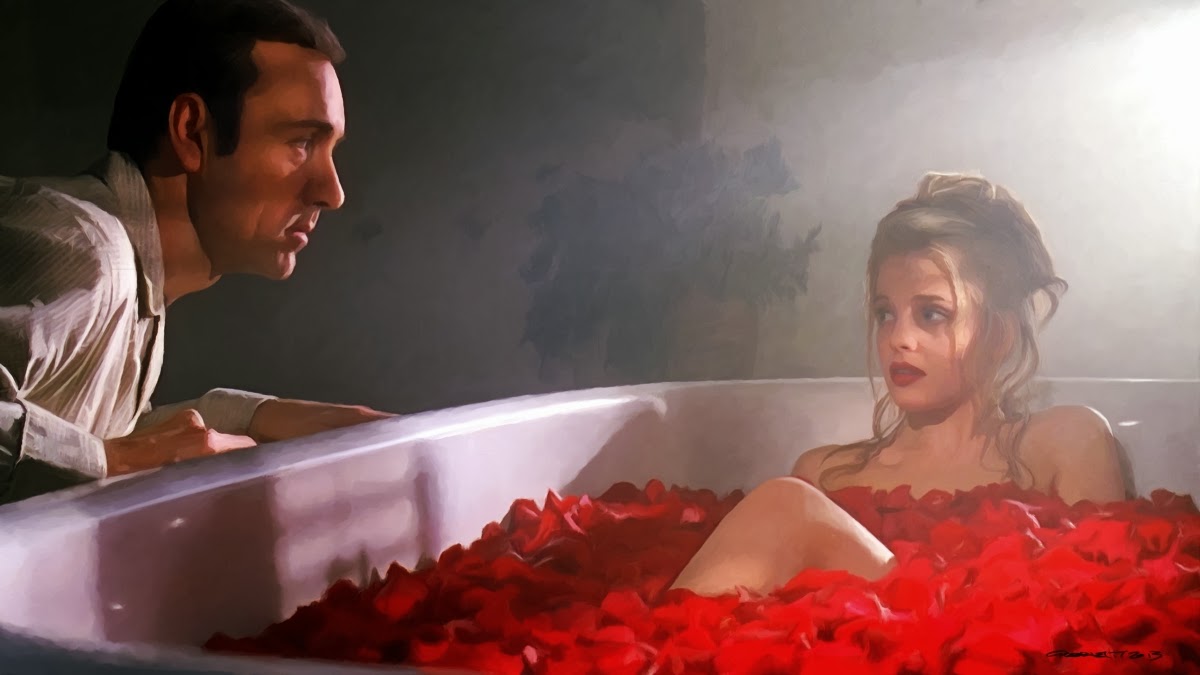
In suburbia, Lester Burnham (Kevin Spacey) is a middle-aged, middle-ranking magazine executive, tired of his life, unhappy in his marriage to Carolyn (Annette Bening), a fiercely ambitious real estate agent, and drifting away from daughter Jane (Thora Birch). He is snapped out of his ennui by his infatuation with Jane’s friend and fellow-cheerleader Angela (Mena Suvari). Next thing we know, Lester realises he hates his life, quits his job (blackmailing his boss on the way), buys the car of his dreams and takes a job flipping burgers – to the bewildered frustration of Carolyn, who starts an affair. Meanwhile Jane becomes intrigued by Ricky (Wes Bentley), the film-obsessed and drug-dealing son of their next-door neighbour, homophobic army colonel Frank (Chris Cooper). Oh, and it’s all narrated from beyond the grave by Lester – so we know it won’t end well.

“There is nothing worse than being ordinary” says Ricky at one point. It’s an attitude that underlies the film. American Beauty has that very showbiz attitude that the lives most ordinary people lead must be rather shallow and empty. That there can be no meaning in the life of suburbia, family and 9-to-5 that so many of us lead. A sharper film would have added depth and contrast to this – but American Beauty is a film that, for all its quality, is also very pleased with itself.

American Beauty’s debt to Billy Wilder is central to its DNA. It plays often as a mix of The Apartment and Sunset Boulevard, with Spacey skilfully channelling a twist of Lemmon as Burnham. Saying that, I can’t believe Wilder would have been as easy on Lester as Ball and Mendes are. Surely Wilder would have seen through the self-serving selfishness and sad delusion that underlie Burnham’s mid-life crisis, fuelled by his fears of emasculation.

It’s that fear running through American Beauty and – for all it looks at first like a satire on suburbia – what came out to me on rewatching is that parallel narrative of two men suffering familiar masculine crises. Burnham, the office drone, ignored at work, playing second fiddle to his wife at home. He doesn’t wear the pants anywhere – his wife chooses the music they listen to, the events they go to, she doesn’t even let him drive the car. Teenage dreams of rebelling disappeared. He’s forgotten what it feels like to be a man. Then there’s Colonel Fitts, the man’s man struggling with self-loathing due to his deeply repressed homosexuality. These are fairly conventional stories.

Lester’s story takes centre stage (even the name Lester Burnham is wimpy). Outstandingly played by Kevin Spacey, who was never better or more humane, Burnham is endearing, rather sweet, clutzy but still has that sharp-tongued Spacey sense of wit. The opening sequences perfectly capture Burnham’s Jack-Lemmonish awkwardness, repression, inadequacy and depression. But  if anything, Spacey is almost too sympathetic in the role, masking the selfishness and self-serving nature of Burnham’s mid-life crisis (which is what it is), urging us to celebrate his rules-bucking independence.  The film never gets to grips with the spark for all this being a sexual obsession with a teenage girl.

American Beauty never questions the sleazy corruption of Lester’s fantasy – and is perfectly happy with using his crush as a positive motivation for getting his mojo back, as well as frequently presenting Angela as a Lolita-esque fantasy. He holds back from sex with her when she confesses she is a virgin – but the film offers no “what am I doing” epiphany from Lester (or a realisation that he is about to sleep with someone literally young enough to be his daughter), instead turning this exploitative moment into an expression of some decency in Lester. Sure, it’s great that Lester realises his responsibilities eventually – but even in 1999, we all knew it was wrong for middle aged men to sleep with impressionable school-children.

The fact is that Election, released the year before, had more to say about exactly the sort of underperforming, thinks-of-himself-as-a-failure resentment of men of Burnham’s ilk – the difference being that Matthew Broderick’s Jim McAllister in that film is exposed as a bitter self-serving fantasist, which is what Burnham really is. Burnham’s dying moments may be full of reflections on his wife and daughter – but he ignores them or treats them with scorn throughout the film.

And there isn’t, I feel, a satirical note to this. Instead, the film roots for Burnham strongly, asking us to admire his late life rebellion. Maybe it’s the conservative in me – maybe it’s because I don’t much like The Graduate either – but I don’t feel it. Spacey is great – but Burnham is selfish and embodies a concern in certain men that career-minded women and suburbia were turning them from hunter-gatherers into hen-pecked losers. American Beauty is a direct development of the masculinity crisis films Michael Douglas specialised in throughout the 80s and 90s, of men lost in a world that isn’t 100% about them and what they want any more.

The film’s parallel plot of Fitt’s homosexuality crisis is even more familiar than Burnham’s and hits many expected bases – there are no real surprises here for anyone who has ever seen a film before. It largely works as it is so outstandingly sold by Chris Cooper, who gives a brilliantly rich and raw performance as Fitts.

But its faint whiff of predictability fits alongside a script that is often very rich on dialogue, but has a vein of pretention to it that makes the film feel it’s striving to be important. Ball’s dialogue too often undermines its own points with the stench of pretension. The teenagers in the film fall into broadly predictable cliché. The arty, dreamy ones are profound; the pretty one is shallow and flighty (although, to be fair, is shown to also be vulnerable and scared). Bentley’s character’s faux-artiste musings on the movements of a plastic bag are exactly the sort of pretentious ramblings Ball would later puncture so effectively with the college art classes in Six Feet Under. These scenes have dated terribly and ache with self-importance (and are ripe for parody).

But there is quality here, don’t get me wrong. Spacey is superb, Cooper brilliant. Annette Bening is pitch-perfect as a career-focused woman who lives her life through self-help mantras but is only just holding it together. It’s a shame that, just like Mrs Robinson, the film is so full of sympathy for its male protagonist that it has no time to empathise fully with its female lead.  Mendes directs with a stunning confidence for a first-timer, drawing brilliant performances from the actors as well as bringing a startling originality to the filming (in partnership with Conrad Hall as photographer).

But American Beauty never turns its “look closer” message on itself. It uncritically examines a particular masculine crisis and often makes points that are witty but simple. The final act becomes weighted down with a tiresome “whodunnit?” mystery. The acting, direction and much of the writing is frequently brilliant. But the film itself, as a whole, has not aged as well as we thought it might.

In a Lonely Place (1950)

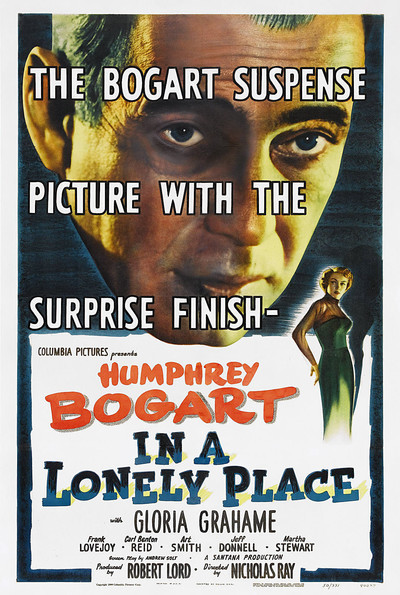
Humphrey Bogart struggles with a dark capacity for rage In a Lonely Place

Director: Nicholas Ray

Cast: Humphrey Bogart (Dixon Steele), Gloria Grahame (Laurel Gray), Frank Lovejoy (Sergeant Brub Nicolai), Carl Benton Reid (Captain Lochner), Art Smith (Mel Lippman), Martha Stewart (Mildred Atkinson), Jeff Donnell (Sylvia Nicholai), Robert Warwick (Charlie Waterman)

Hollywood: it’s a dark town. When movie makers turn their lens on themselves you’ve just as likely to see the dark underside of showbusiness, as you have a celebration. In a Lonely Place was made in the same year as Sunset Boulevard, and it’s even darker and less hopeful than that movie. It focuses on a person with a certain level of kudos, that has led others to overlook his deep personal flaws. In a Lonely Place reveals itself as a quite ahead of its time in its unflinching look at why people find themselves drawn into potentially abusive, controlling relationships with people who talk endlessly about how much they love you even while they try and control every aspect of your life. Overlooked at the time, it’s seen more and more as a classic.

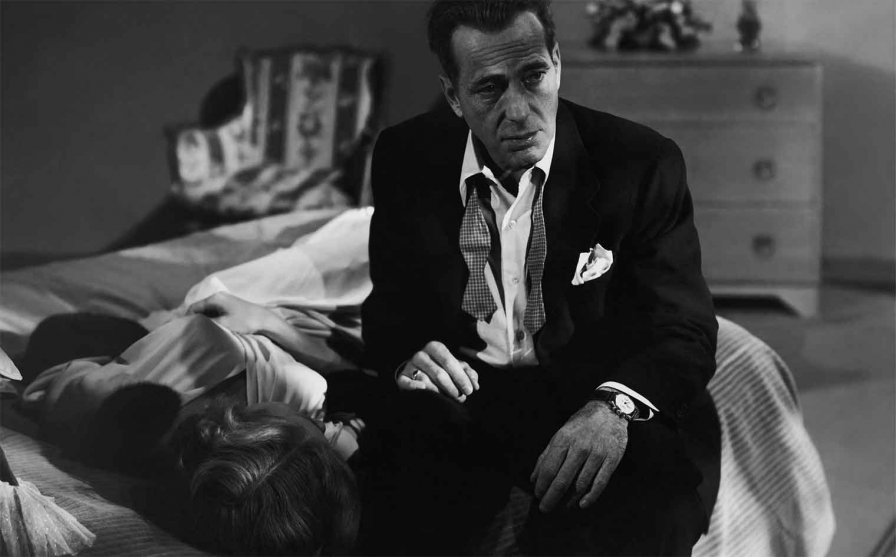
Dixon Steele (Humphrey Bogart) is a successful screenwriter but has gone a few years since his list hit. Hired to adapt a plot-boiler he’s so contemptuous of the synopsis he invites a waitress at his favourite restaurant, Mildred (Martha Atkinson), to his flat one night to describe the story to him. Becoming as bored with her as he is with the cliched plot, he sends her home. When she is murdered later that night, Dixon is number 1 suspect. He’s alibied by his neighbour, aspiring actress Laurel Gray (Gloria Grahame) and the two start a relationship. But the pressure from the investigation and his writing assignments bring Dixon’s barely controlled rage more and more to the surface – with Laurel slowly fearing that he could be capable of anything if pushed to it.

It would be expected for a movie of this period – say something like Suspicion where of course Cary Grant is just misunderstood not a would-be killer – for all this to simmer and then resolve itself as a terrible series of errors (mostly of course from the woman). In a Lonely Place doesn’t do this. Instead, from the start we are given no reason to doubt Dixon’s capacity for near-murderous rage. Practically the first thing we see him do is assault a producer – albeit avenging an insult to an alcoholic actor friend. His first resort is violence. It’s something he’ll resort to time and time again, his capacity for anger joined with a self-pity that makes preemptive violence more likely.

It bleeds into the relationship with Laurel, which at first is all goodness and light. The two of them are well-suited, and an excellent tonic for each other: she’s a combination of muse and amanuensis, helping Dixon turn out his script; he opens doors in Hollywood she has spent years pushing against. But Dixon’s possessiveness, resentment and suspicion become clearer, accentuated by Laurel’s reserve and caution to emotional commitment. The relationship becomes tortured as Dixon resents any trace of suspicion against him, alternating with desperately possessive pleading for love. Any deviation from his idea of their relationship is seen by him as an act of betrayal.

Then there’s that temper. It’s there all the time, a sadistic streak that suggests a damaging lack of empathy. Dixon – while vaguely sorry for Martha’s death – is also perfectly happy discussing her demise with a clinical academic interest. He’s unphased by crime scene photos. He feels no guilt about not driving her home. Later, at the house of his friend (one of the detectives) he theorises how the crime was committed with an animation that turns into unsettling excitement. After a row with Laurel he drives a car (with both of them in it) with reckless fury and then nearly beats to death someone whose car he clips. Dixon follows these moments with futile half-apologies – anonymous flowers for Martha’s family, anonymous cheques to pay for car damages. But he never addresses his deep psychological problems.

This relationship becomes one ripe with the unspoken capacity for violence. Gloria Grahame is excellent as a careful, guarded woman who opens herself romantically, only to become terrified that the man in her life could just as easily kill her as kiss her. It’s a tension we feel too. Making breakfast, Dixon may talk about how they will be together always– but his vulnerable voice underlines his own doubts, and his furious insistence that they marry ASAP carries the capacity for fury if denied.

As Dixon, Humphrey Bogart gives one of (if not the) greatest performances of his career. Playing a character who, with his dark rages, allegedly had similarities with himself, his Dixon is a bleak figure. Capable of wit and charm, Bogart also makes him a cruel, seedy and sinister in his excitement at murder, while never preventing us finding him vulnerable and weak in his fear at being abandoned. But not sympathetic enough for us to worry he may end things by murdering Laurel. He’s never sympathetic – his late, motiveless, slapping around of his decent agent ends our chance of finding him that for good – but he’s understandable.

And he lives in a dysfunctional town. Where Hollywood intrudes on the action, Ray makes clear it is dark, unsettling, alien and unfriendly town – a truly lonely place. There are no confidantes or friends: only colleagues and potential rivals. You are only as good as your last credit: when your last few credits are poor, you’re no-one. On the other hand, rage and misbehaviour will be tolerated if you can produce the goods. It’s not a place for humanity or goodness.

Ray’s overlooked classic is a beautiful fusion of film noir and Hollywood insider movie. With superb performances from the two leads, it also feels way ahead of its time in looking at abusive relationships. Abusive partners don’t arrive twirling moustaches. They seem decent, loving and passionate – its only when you start to disappoint them they start to turn angry, controlling and abusive. By the time the film’s end come – and it’s a bleak one – you’ll be hard pressed to find some hope in it. But you will certainly find some great film-making.

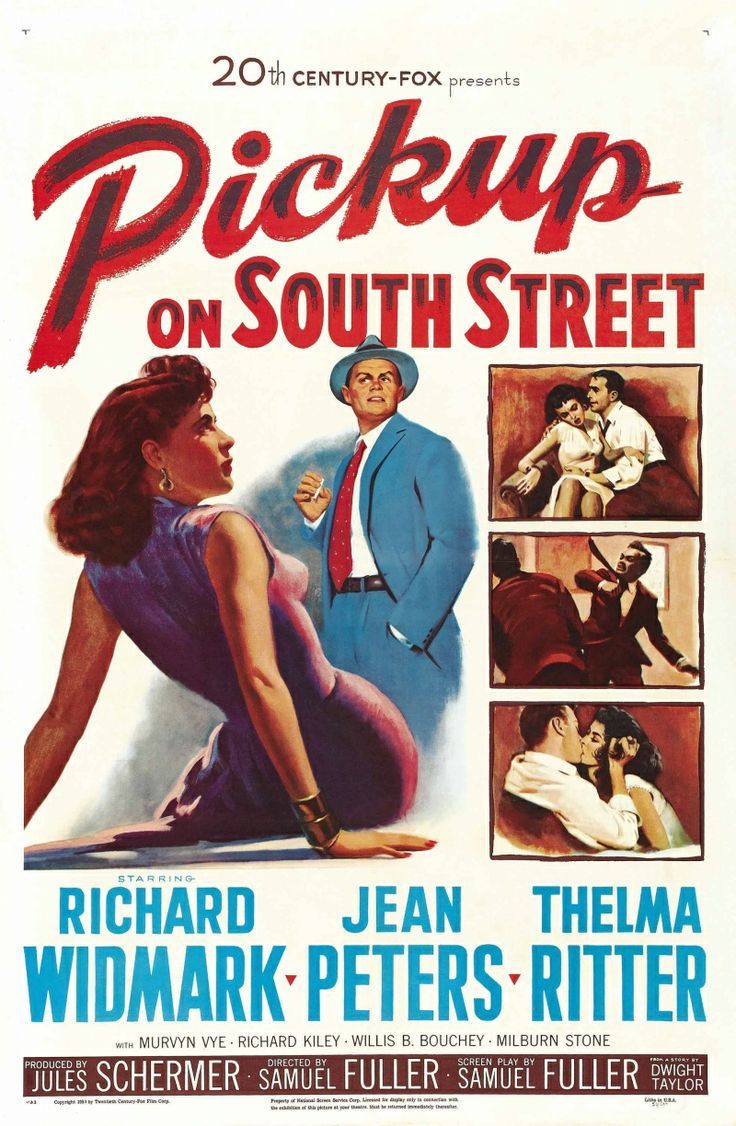
Pickup on South Street (1953)

Richard Widmark and Jean Peters feel the heat from the cops, the commies and their own passion in Pickup on South Street

Director: Samuel Fuller

Cast: Richard Widmark (Skip McCoy), Jean Peters (Candy), Thelma Ritter (Moe), Murvyn Vye (Captain Tiger), Richard Kiley (Joey), Willis B Bouchey (Zara), Milburn Stone (Winoki), Henry Slate (MacGregor)

It’s 1950s, and the biggest bogeyman in America is the Commies. Candy (Jean Peters) is one of their unwitting couriers, funnelling top secret microfilm for her ex-boyfriend Joey (Richard Kiley) to pass to his Moscow superiors (poor Candy just thinks she engaged in helping Joey with some good-old All-American industrial espionage). Trouble is, while the Feds are trailing her, they watch her being pickpocketed by career thief Skip McCoy (Richard Widmark). Skip now has on his hands on some serious state secrets. Should he return the film to the police who want to lock him up? Or make a big score by blackmailing the Commies who want to kill him?

What makes Pickup on South Street so intriguing is it’s not necessarily as straight forward as you might think. Fuller’s film is an anti-communist film – the sort of “reds under the bed” scare that terrified millions in a country still reeling from Klaus Fuchs and the Rosenbergs. But this isn’t your standard Red Scare film. Because our heroes have about as much stake in the USA as they do in the USSR. They are the down-trodden, the under-class, the grifters. At the end of the day, I’m not sure Skip McCoy really cares who ends up with the MacGuffin. He’s motivated firstly by financial gain and secondly by personal revenge. No appeal to flag and country cuts any ice with him.

Making the hero this sort of anti-social career criminal was a master-touch as it not only enriches the entire perspective of the film – what has their country ever done for these people – but also adds an air of uncertainty over the whole thing. There would never be any doubt if the microfilm had fallen into the hands of a clean-cut Henry Fonda type. The fact that it’s Richard Widmark – who always looks like he’s torn between laughing in your face or punching it – means you never quite know what he’s going to do. If it works out best for him to hand that film over the Russkies, you can be sure he will.

That’s despite the heavy-handed entreaties of the cops and feds. Skip faces a barrage of hostile interrogations, vague promises, handcuffs and searches from law agents who are damn sure he has the film, but can’t prove it. Like many Fuller films, there is more than a hint of roughness and violence in every frame – and the law and order figures aren’t averse to this. Captain Tiger (what a name!) has already served a suspension for beating Skip in custody. An illegal search or two isn’t beyond them. You can see why the FBI was unhappy with this film – not least because it shows them constantly out-thought by a pickpocket.

The Commies though are a thoroughly bad lot. After all, it’s still an anti-Communist film. Richard Kiley’s snivelling coward Joey is no true believer, but the kind of low-breed opportunist tempted by a quick buck. The other communists we meet are corrupt, shady types, sitting in backrooms puffing pipes and casually handing out death sentences. Kiley’s weak-willed and increasingly desperate Joey becomes more and more despicable as the film goes on, desperation to save himself from the fury of his paymasters leading to ever lower and despicable crimes.

So the only people who really come out as truly decent – and playing by a very fixed moral code of their own – are the criminal underclass. In this world, everyone knows where they stand. Skip isn’t angry at stool-pigeon Moe, who carefully trades information with the police – everyone has to make a living he observes. Skip will pick pockets to earn his keep, and punch back when he’s attacked, but there is no sense that he has any taste for the crimes of the Communist agents. He’ll sell on the microfilm to them – but that’s only because his own government offer him nothing but hot air and empty promises. And, as the unspoken message of the film goes, what difference would it really make to Skip and his like anyway where the film ends up?

Instead Skip becomes motivated by personal feelings – specifically his feelings for Candy and Moe. There is a genuine sexual frisson between Skip and Candy from the start: Skip’s pickpocketing of Candy is shot like a sex scene, all sweaty brows, heavy breathing and close-ups (with Skip’s hands ‘penetrating’ Candy’s handbag with all the metaphorical energy of a train speeding into a tunnel). As events draw them closer together, the two maintain this electric sexual energy – whether arguing or fighting or lying to each other they seem unable to take their hands off each other – and the intimacy of close-ups and low angles Fuller uses for this brings a real sexual charge to their scenes. Widmark – superb as a heavy with a (hidden) heart – and Peters are also great, with Peters bringing a real roughened hinterland of disappointment to her role.

The other motivator for Skip becomes the stool-pigeon Moe, brilliantly played with an eccentric bag-lady energy by an Oscar-nominated Thelma Ritter. Moe is a grifter, selling ties by day and trading information on the side. She embodies the underdog nature of the criminal world, wanting nothing more than to earn enough to buy a decent funeral when she goes. Ritter has a marvellous speech on just how tied she feels from this constant scramble of scrapping by on the edge of society. A surrogate mother figure of a sort to Skip, Ritter’s performance is a classic piece of character acting.

Fuller’s scene is lean, short and fast-paced. Like many of his films there is a lot of violence – beatings, fights, shootings – all shot superbly with the camera pulling back to soak up the action. Sex and violence go hand in hand – Skip accidentally punches out Candy thinking she has broken in to kill him, and the two of them are in a passionate embrace moments later. Mixed in with touches of reality, that bring the tough urban world the characters live in, Pickup on South Street is a lean and mean film that manages to be more than just a straight anti-Communist film. It doesn’t just give us something to fight against: it also asks how we might give people something to fight for.

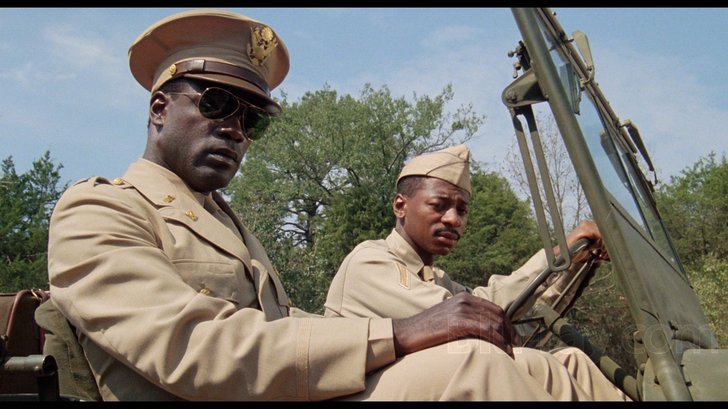
A Soldier's Story (1984)

Howard E Rollins Jnr investigates a racially motivated murder with a difference in A Soldier’s Story

Director: Norman Jewison

Cast: Howard E Rollins Jnr (Captain Davenport), Adolph Caesar (Sergeant Waters), Art Evans (Pvt Wilkie), David Alan Grier (Cpl Cobb), David Harris (Pvt Smalls), Dennis Lipscomb (Captain Taylor), Larry Riley (CJ Memphis), Robert Townsend (Cpl Ellis), Denzel Washington (Pfc Peterson), William Allen Young (Pvt Henson)

A Louisiana military base, 1944. A company of black soldiers prep for Europe to fight for Uncle Sam. All that is put on hold when hard taskmaster Vernon Waters (Adolph Caesar), their sergeant, is shot outside the base. Black JAG officer Captain Richard Davenport (Howard E Rollins Jnr) arrives to investigate the murder – to the hostility of his fellow officers, who are unused to saluting a black man as the common soldiers are. But is Waters murder the result of racism from the town? Or is it due to the tensions within the platoon?

Jewison’s adaptation of a notable stage success by Charles Fuller is a professionally mounted, sharp film – nominated for Best Picture in 1984, but largely forgotten since – that while never quite inspired, does provide plenty of insightful racial commentary on America. It never quite manages to come together as a film – and at times its pace is still better suited to the theatre than the movies –but it counterbalances this with its strength of good acting and an underplayed anger at divisions in America.

Racism is at the heart of the film. Many types of it. Jewison’s opening sequence – depicting Davenport’s arrival on the bus – provides us plenty of sightings of America’s apartheid, segregation being clearly visible in shops, benches and the bus itself. Davenport is addressed as “boy” and instinctive racial unease and disgust is in the eyes of every townsperson we meet. The officers range from paternalistic to patronisingly contemptuous of their men. Every element of the base is designed to remind the soldiers of their second-class status. Davenport is only with great reluctance allowed the trappings of his fellow officers. The film ends with a march of the soldiers towards war – a war they are volunteering to fight in, to protect a country that sees them as less-than-human.

But at its heart this is a film about the real insidious horror of racism. How it can turn someone against themselves. Because the real racial villain, it becomes clear, was actually Sergeant Walters himself. Played with a tightly-wound, self-loathing resentfulness by Adolph Caesar (repeating his stage role and Oscar nominated), Walters loathes the black men under his charge. He sees them as embodying the elements of black culture that (he believes) has led to them being treated so poorly by the whites. He hates their choices in music, in food, the way their talk. Most of all he hates the late Private CJ Memphis (Larry Riley), a good-natured, music-playing, sweet soldier who he believes embodies all the casualness and simplicity that he believes his people need to put them behind them to gain respect.

It’s Fuller’s brilliant insight that the most insidious thing about racism is that it is about creating barriers and hatreds – and it can lead to a black man loathing himself and his own people for not being white. Bad enough that the rest of society is against black people: worse that it is also secretly encouraging them to turn on each other. The tensions in the company all stem from Walters barely concealed unease at his colour, and his fury that his men don’t feel the same way.

Unwrapping in a series of flashbacks as Davenport investigates, the film reveals a fascinating series of tableau that demonstrates the confusion in Walters’ psyche and the impact it has on others. In a society where everything is all against them – as Jewison’s film is at pains to show – these are people who should be sticking together. Instead Walters crusade is to turn them against themselves and each other – to deny who they are in an attempt to become their oppressors. The quest for an acceptance that Walters eventually realises will never happen.

Because, as he bitterly states, no matter how much blood a black man sheds for America, no matter what sacrifices he makes – to many he will still be an “other”. Someone who the people of Louisiana are happy to have fight for them, but wouldn’t share a park bench with. These destructive attitudes are there as well in Davenport’s attempts to investigate, butting up against resentment from junior officers who can’t stomach being spoken to like this by a black man. Howard E Rollins Jnr plays the role with a terrific cool underneath which lies a tightly-controlled fury (he rather effectively channels Poitier in In the Heat of the Night).

A Soldier’s Story is crammed with some wonderful and challenging insights into race. It has a wonderful cast – Art Evans and a young Denzel Washington also stand-out – and a real sense of moral outrage at the evil of racism. What it sometimes lacks is the energy and dynamism the story needs to carry more immediate impact. Too often the film feels a little too safe, a little too conventional to really grip. It wraps up things with a rather conventional feel-good position (with Davenport and Dennis Lipscomb’s Captain Taylor coming to a soapy ‘mutual respect’ position). With the pace slightly off, it can drag at times. However, it’s insight can’t be doubted: it will certainly make you consider that the impact of racism can be even deeper and more damaging than the obvious, initial signs.