Category: Murder mystery

They Made Me a Fugitive (1947)

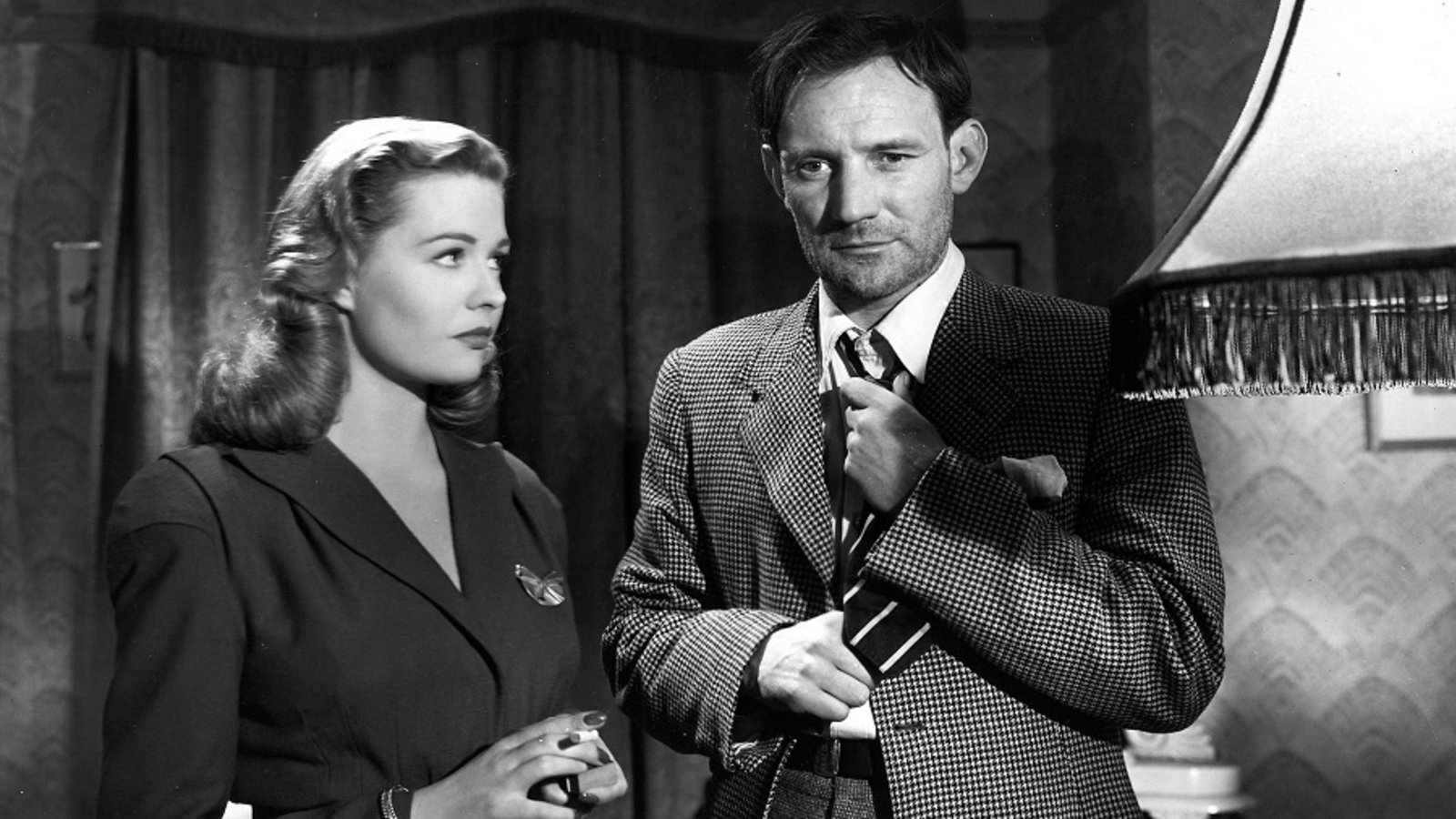
Trevor Howard is on the run in They Made Me a Fugitive

Director: Alberto Cavalcanti

Cast: Trevor Howard (Clem Morgan), Sally Gray (Sally), Griffith Jones (Narcy), René Ray (Cora), Mary Merrall (Aggie), Charles Farrell (Curley), Cyril Smith (Bert), Phyllis Robins (Olga), Vida Hope (Mrs Fanshaw), Eve Ashley (Ellen), Jack McNaughton (Soapy), Maurice Denham (Mr Fenshaw)

The Second World War is over – but the country is awash with ex-servicemen, not sure where they fit in, trained to kill. Clem Morgan (Trevor Howard) is one of them. A former RAF man, who escaped from a POW camp, he doesn’t know what to do with himself on civvie street. So he’s definitely open to an offer to work for black marketeer Narcy (Griffith Jones) – but not so keen once Narcy’s business dealings expand into drug smuggling and violence. Clem gets framed for the killing of a policeman and banged up in Dartmouth – where he receives a visit from Narcy’s mistreated girlfriend Sally (Sally Jones) who needs his help to prove Narcy is the real villain. Clem escapes, a fugitive, looking for, and on the run from, justice.

Cavalcanti’s film is a marvellous mix of noir, early kitchen-sink and faded post-war crime drama. The locations are run-down and dirty, the mood faded and worn out. The film is remarkably bitter, cynical and short on hope. Clem’s encounters take him past a gallery of those struggling in post-war Britain: black marketeers, shallow glamour-pusses, bored policemen, common criminals, vengeance minded housewives and brutal heavies. Everyone is corrupt, has violence or treachery in mind and don’t think twice about putting others through suffering. And to be honest, as a shambling, scruffy drunk, Clem makes a pretty good fit among them, a man whose best days happened somewhere in Germany in the 1940s and who hasn’t had a clue what to do with his life since.

The post-war Britain painted here isn’t nice. No wonder ruthless, thuggish black marketeers like Narcy (short for Narcissus of all things – which manages to be both a commentary on self-obsession, while being an abbreviation that sounds like Nasty or Nazi) are flourishing. Narcy – played with a callous, charismatic black-heartedness by Griffith Jones, in a performance bereft of any trace of morality – has no problem with any criminal act what-so-ever so long as it gets him what he wants. Smuggle drugs? Not a problem. Beat a woman? Line ‘em up. Murder a cold-footed subordinate? As many as needed. Narcy is a perfect emblem for this world, uncaring, brutal, sadistic and enjoying the fact that so many others are desperate.

His kingdom is a subterranean hell, in the basement of a undertakers. (It even has a huge sign reading RIP on the top of the building.) His haunts are foggy docksides, chilling streets and rough pubs. His followers are cowed former servicemen – although even they draw the line at using guns – and the police seem unable to touch him. But then Narcy’s world is pretty similar to the rest of England. The countryside Clem journeys through from Dartmouth to London to get his revenge is equally fog-ridden, cold, dirty and unattractive, full of farmers who shoot at him with buckshot and housewives who blackmail him to carry out their dirty deeds.

The film hinges at the half-way point on this surreal scene. Clem arrives at a home where the woman of the house – played with a sort of hypnotic monotone by  Vida Hope – allows him to wash, gives him new clothes, feeds him – and then hands over a gun and asks him to shoot her husband (a shambling drunk played by Maurice Denham). Clem refuses – he’s killed once in his life, while escaping a POW camp, and has no intentions of doing so again. He makes a run for it – at which point the woman does the deed herself, and places the blame on Clem. It’s a bizarre scene, but strangely magnetic – its a window into this topsy-turvy world. Killing means something different to everyone after years of the world tearing itself apart, and behind the chintz curtains of middle-class Britain, we can’t be certain there doesn’t lurk something dark and dangerous.

Trevor Howard makes a perfect lead for this sort of grimy world. He’s got the “hail well met” stance of Clem down perfectly: but he’s a character who also carries a natural integrity to him, someone who we can trust. No matter how drunken, shambling and untidy he gets when he’s in his cups, there is something decent in him we can trust. It also means we can root for him when the chips are down (which they are for most of the film), and while he finds himself in bizarre and dangerous situations, from being shot at by farmers to struggling to escape the curiosity of lorry drivers.

Howard powers the whole film, even if Griffith Jones perhaps carries it away in the more colourful part of Narcy. Sally Jones makes for a relatable woman of fixed morality (perhaps the only truly moral person in the whole film) who has somehow found herself in a dirty world. Cavalcanti’s world is filthy. He shoots it with a delicate but immersive intensity. It’s a surprisingly violent film. Knifes are used, shots are fired and Narcy beats two women with a viciousness (the first is shot with a whirling camera, which might go a little too far to get us to relate to the dizzying violence).

It’s also a film that seems low on hope. It ends on a downer. The forces of good – like the police – seem distant, uninvolved or, at best, useless in the face of all the crime. The forces of evil are left to effectively police themselves and corrupt but decent men like Clem get stuck in the middle. They Made Me a Fugitive makes for an involving and gripping thriller, a perfectly made little British B movie.
Amadeus (1984)

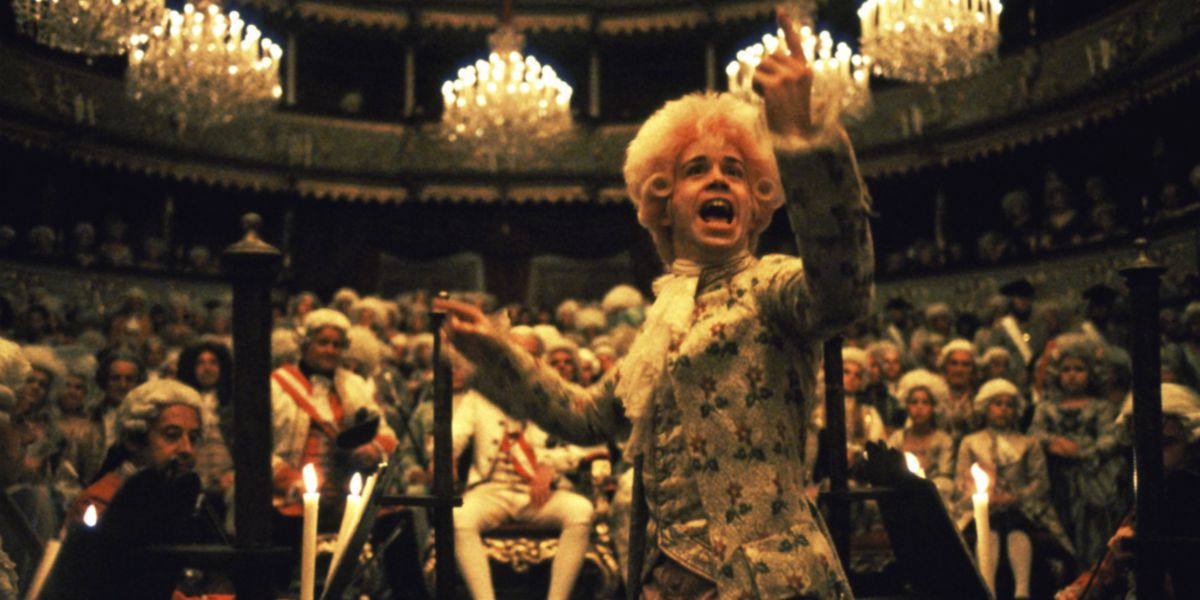
Tom Hulce is the childlike genius in Amadeus

Director: Milos Forman

Cast: F. Murray Abraham (Antonio Salieri), Tom Hulce (Wolfgang Amadeus Mozart), Elizabeth Berridge (Constanze Mozart), Roy Dotrice (Leopold Mozart), Simon Callow (Emanuel Schikaneder), Christine Ebersole (Caterina Cavalieri), Jeffrey Jones (Emperor Joseph II), Charles Kay (Count Orsini-Rosenberg), Kenneth McMillan (Michael Schlumberg), Richard Frank (Father Vogler), Cynthia Nixon (Lorl), Patrick Hines (Kapellmeister Giuseppe Bonno), Jonathan Moore (Baron von Swieten)

Peter Shaffer’s Amadeus was a smash hit play, both at the National Theatre and on Broadway. With such a delicious plot line – captured so beautifully in its tag line “The Man, the Music, the Madness, the Murder!” – is it any wonder that this fable about the life of Mozart, framed around the envy of his contemporary Antonio Salieri who, as an old man, claims to have murdered the great genius, was swiftly bought to the screen? Radically reworked and restructured by Peter Shaffer for the screen, Amadeus may stand as one of the few times where the script for the film is superior to the script for the stage. And the film itself is so carved out of radiance, that every single production of the play will forever live in its shadow.

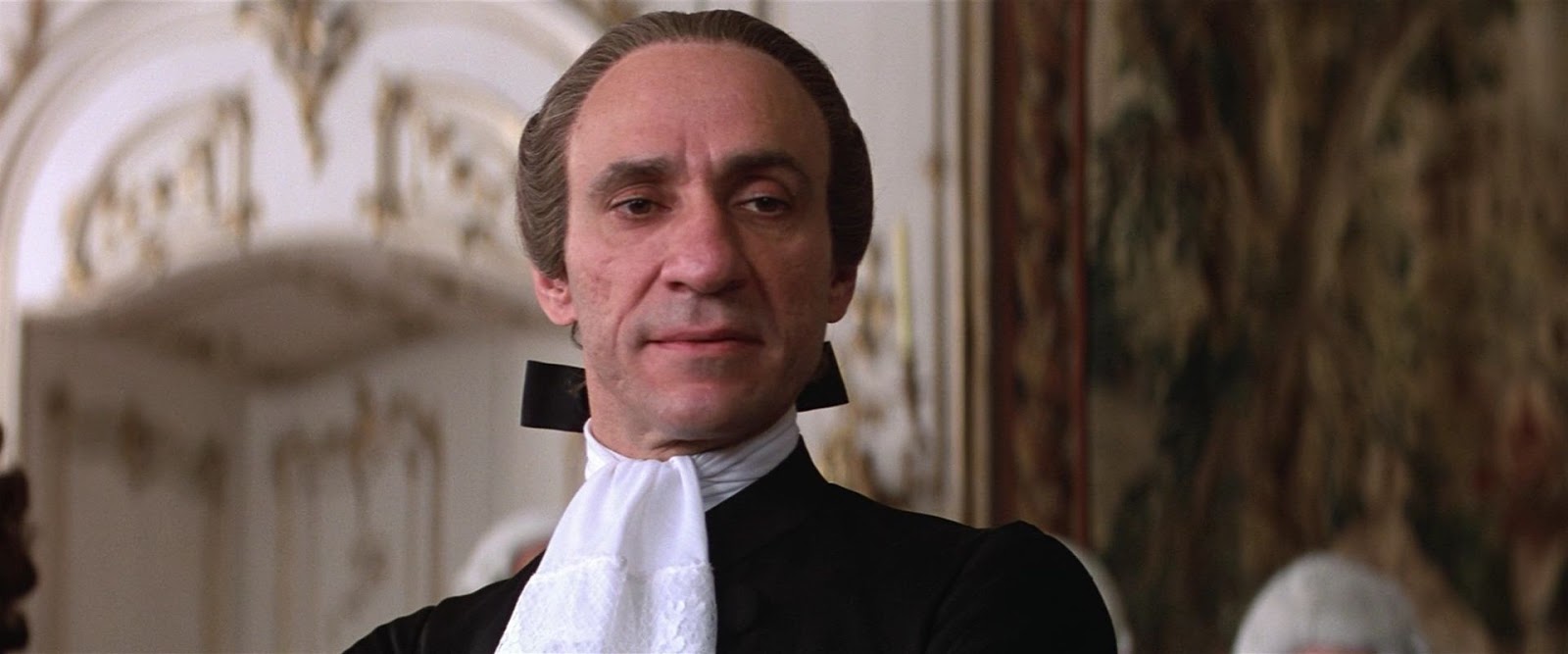
As an old man Antonio Salieri (F. Murray Abraham) confesses to the murder of Wolfgang Amadeus Mozart (Tom Hulce). After a suicide attempt, he tells his tale to a young priest (Richard Frank). As a younger man, Salieri was the court composer to Emperor Joseph II (Jeffrey Jones). He has everything he dreamed of as a young man – fame, riches and a life of music – all of which fortune he sees as a sign from God. His world view is shaken with the arrival in Vienna of the young genius Mozart. A brilliant artist and composer, with a God-given gift for composition, Mozart is also everything the reserved Salieri is not – brash, rude, impulsive and a man of once-in-a-generation talent. How, Salieri wonders, could a man like him be given all the gifts, while Salieri’s music is merely competent? Salieri believes this is a cruel joke played on him by God – made worse by the realisation that alone in Vienna society, Salieri seems able to recognise the genius. Salieri decides to destroy this chosen child of God once and for all.

Shot on location in Prague – and Czech defector Milos Forman was treated as a returning hero when he bought the film there – Amadeus is perhaps one of the most strikingly beautiful films ever made. The cinematography is luscious, the production design – utilising every inch of the almost untouched-since-the-18th-century Prague settings (Thank God for Communist inefficiency Forman joked) – sinks you into the era completely while the costume design is striking, imaginative and excellent. The film is an opulent feast. But it is a million miles from being a staid period piece – instead this is something fresh, bold and modern.

Amadeus is perhaps one of my favourite films of all time. I just think it gets everything more or less right. Not least, capturing the idea of the passions and struggle of creativity. It’s clear why this story spoke so clearly to Hollywood, because no film captures as well as this one, the horrible plight of the competent journeymen, working every hour, while watching an effortless genius create masterpieces as easy as breathing. That’s the real tension here – and what makes us all empathise with Salieri, at least on some level. All of us have looked at the things we create – be it putting up a shelf to writing a play – and frustratingly seen our grasp exceed our reach, while seeing others do what we have so failed to achieve with frustrating ease.

Matched in with this, it’s a film that understands perhaps better than any other the burdensome process of creation. It’s easy for viewers to just remember the childish excess of Mozart – but Forman and Shaffer also show a dedicated and passionate worker. Hulce’s Mozart crouches over a billiard table, oblivious to the world around him while he composes (the soundtrack, as it often does, is flooded with the score he is composing, while his wife tries to get his attention – snapping to silence as soon as she succeeds). His dedication to his music is absolute – in his first scene, only hearing the orchestra starting to play his music before his arrival snaps him out of his raucously rude flirtatious banter with Constanze. Scenes of him conducting and directing rehearsals pinpoint his exactitude and perfection. Salieri as well is seen frequently labouring carefully and precisely over his work, while lacking the inspiration of Mozart.

It’s pinpointed with a beautiful late scene, where a bed-ridden Mozart dictates his Requiem score to Salieri. Mozart is electric, precise, his thinking fast-paced, complete, his passion for the score all-consuming – with poor Salieri desperately trying to keep up (“You go to fast” he frequently whines). It’s a scene that captures completely the intensity of mining creation. (Hulce apparently deliberately skipped lines during the scene, to add to Abraham’s confusion in the scene – with Abraham’s later agreement!). Its part of what the film beautifully captures, how being able to bring your ideas, perfectly formed, into the world is the most enchanting drug of all.

So you can see why Salieri grows too loath this blessed talent. In a wonderful moment – again perfectly utilising Forman’s decision to use the music as almost a character in the piece – he flicks through a portfolio of Mozart compositions, all of them first drafts devoid of any correction, the music playing in his head (and on the soundtrack) as he reads. It’s the sort of skill his diligent and slavish composition could never achieve.

It’s pinpointed even more in their first scene together, where Mozart arrives at Joseph’s court. The emperor plays a small welcoming march, composed by Salieri, which is fine. Mozart not only memorises the tune on first hearing it (“The rest is just the same?”) but then beautifully starts to play with it before suddenly turning it into an aria from The Marriage of Figaro, composing this beautiful piece on the spot. Nothing could be more devastating but to see your hack work improved in front of others into something genius – and the genius in question to be so oblivious of the impact, that he behaves like he’s done you a favour. No scene in the movies, I believe, has ever captured so completely this world of difference between the journeyman and the artist.

The film is crammed full of moments like this, all perfectly delivered by a perfectly chosen cast. The film was controversial at the time for using American actors – with their natural accents – rather than Brits (the “American accents jar the ear” whined Brit critic Leslie Halliwell). In fact it’s an inspired idea, that adds an air of modernity to the piece, but also principally opens the door to making the whole genre less stuffy (as if 18th century Venetians would speak with received pronunciation). The only characters who speak with English accents are the most upper-class, Italian-fixated, Opera purists. Everyone else – with even Simon Callow (the original stage Mozart, here in his film debut) adopting an accent – speaks with a Yank twang.

F. Murray Abraham beat out seemingly the whole Western acting world to land the leading role of Salieri. (In a backhanded compliment if ever I heard it, Forman suggested on meeting Abraham that he simply was Salieri). Abraham’s precise, detailed and beautifully judged performance – which allows gallons of resentment and self-pity to bubble under the surface of a tight self-control. He also has a wonderful spry lightness as his elder self, who has come to terms with his failures. It’s a brilliant role – and one Abraham struggled to match for decades to come.

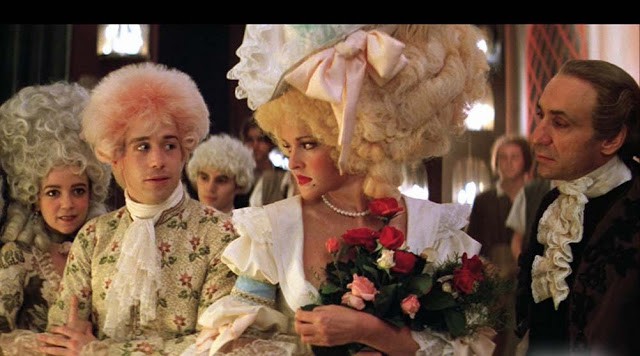
Tom Hulce is equally superb as Mozart. I’ve talked a lot about how wonderfully the film – and Hulce – captures inspiration. But Hulce perfectly mixes this with a childlike vulnerability, an impulsive foolishness and sense of absurdity. His Mozart is frequently rude, obnoxious and interested only in a good time – frequently losing nights to drink, sleeping around with a crude sense of humour. But he’s also sweetly childlike, who needs to be looked after – Elizabeth Berridge (very good, a late replacement for Meg Tilly during shooting) as Constanze frequently has to mother him and manage his life and career. The rest of the cast are equally strong, from Jeffrey Jones’ studied normality as the Emperor, to Roy Dotrice’s firmness as Mozart’s disapproving father.

Amadeus brings this all together superbly – Forman’s direction is faultless – and mixes it together with Mozart’s music. Not a single piece of music is used twice in the film, and each quote from the music has been perfectly chosen to reflect the scene, from the film’s opening with Symphony #25 to its close with the Requiem. Sections from opera performances are shown – with the actors conducting (both learnt). The music soaks through the whole film – Shaffer and Forman believed it was the “third lead”. And it perfectly captures the tone and emotion every time, deepening and enriching the film itself.

Winning eight Oscars (including Picture, Director, Actor for Abraham and Screenplay), Amadeus is not only the best film ever made about classical music, it’s also one of the most fascinating and profoundly engaging films ever made about creativity. Does it matter that historically it’s all bunk? Not really at all, as a fictionalised exploration of how the average can be tormented by the extraordinary it’s perfect.

Chinatown (1974)

Jack Nicholson struggles against the system – and loses – in Chinatown

Director: Roman Polanski

Cast: Jack Nicholson (JJ Gittes), Faye Dunaway (Evelyn Cross Mulwray), John Huston (Noah Cross), Perry Lopez (Lt Lou Escobar), John Hillerman (Russ Yelburton), Darrell Zwerling (Hollis Mulwray), Diane Ladd (Ida Sessions), Roy Jenson (Claude Mulvihill), Roman Polanski (Man with Knife), Joe Mantell (Lawrence Walsh), Burt Young (Curly), James Hong (Kahn)

“Of course I’m respectable. I’m old. Politicians, ugly buildings and whores all get respectable if they last long enough.” So says Noah Cross in the superlative Chinatown, the sort of the film you’ll want to start watching again the second it ends. Cross is of course a respectable businessman and an absolute monster. And his mantra applies just as much to Los Angeles as envisioned by Polanski and writer Robert Towne. It’s a corrupt, dirty place where terrible, appalling things are regularly allowed to happen but everyone pretends the place is fabulous. It’s such a sublime film, while also so bleakly, despairingly dark that you are surprised you fall in love with its excellence.

In 1937 private detective JJ “Jake” Gittes (Jack Nicholson) is hired – or so he thinks – by the wife of Water Board director Hollis Mulwray (Darrell Zwerling) to investigate his infidelity. When he does seem to uncover it, he founds not only was his client not Evelyn Mulwray (Faye Dunaway), but that shortly after his pictures appeared in the press (without his knowledge), Hollis himself winds up dead, having drowned in a dry river bed. What does this all mean? And how does Evelyn’s father (and Hollis’ business partner) Noah Cross (John Huston) play into this all? Gittes investigates further, to uncover shady schemes to manipulate the cities water supply for profit, under-handed business deals and unspeakable family crimes that leave lives shattered.

Polanski’s film has such a timeless wonder about it, perhaps because it was filmed with such careful and beautifully designed classicism that it has never dated. Seen at the time as a film told in the style of the classic film noirs (although it is of course full of blazing LA sunshine), but crammed with a darkness and corruption classic Hollywood shied away from it now seems to take its place as the most masterful of Hollywood mysteries. It’s recreation of 1930s detail is perfect, while its film making is restrained, controlled, unflashy but creates an atmosphere of simmering mystery and tension behind every frame. It’s a masterfully restrained piece of film-making that deals with matters of shocking horror.

And tension there should be as this explores the darkest underbelly of America. With Jerry Goldsmith’s sublime music score under every beat – riffing on classic Hollywood tunes, but with a haunting faded grandeur that suggests a whole melancholic world going to the wall – the film looks like classic, beautiful America but uses that to counter-frame terrible, heartless acts. LA is corrupt from top to bottom. Businessmen are asset stripping the city and its surroundings to line their own pockets. Wealth brings total immunity from all sorts of crimes, regardless of how foul they are. Even family ties are polluted by terrible lusts and greed. And for Gittes, Chinatown is representative of this – a one word reference to his career as a cop, where his ability to do any good at all was forever compromised by corruption.

Jack Nicholson’s performance as Gittes is central to the film’s success. He’s in every scene and the story is told entirely from his point-of-view – so much so that when he is knocked out, Polanski slowly fades out sound and picture. Nicholson is best known for his flamboyance, but here he brilliantly underplays too present a complex picture of an idealist disguised as a cynic. Gittes tries his best to coolly accept the world is what it is, and even that he is just trying to get what he can out of it. But he’s in fact a decent and honourable man with a deep-rooted sense of morality, who struggles in the world because it’s ill-suited for a guy who just wants to do the right thing. He has a sort of outdated charm and nobility about him, an almost courtly gentleness at times, and only lashes out in anger when he feels is either being lied to or his sense of honour impugned. He has a natural sympathy for the little guy and for all he may try to spin the sort of cynical Marlowesque dialogue, you don’t feel his heart is really in it. He is a dreamer who wants to believe.

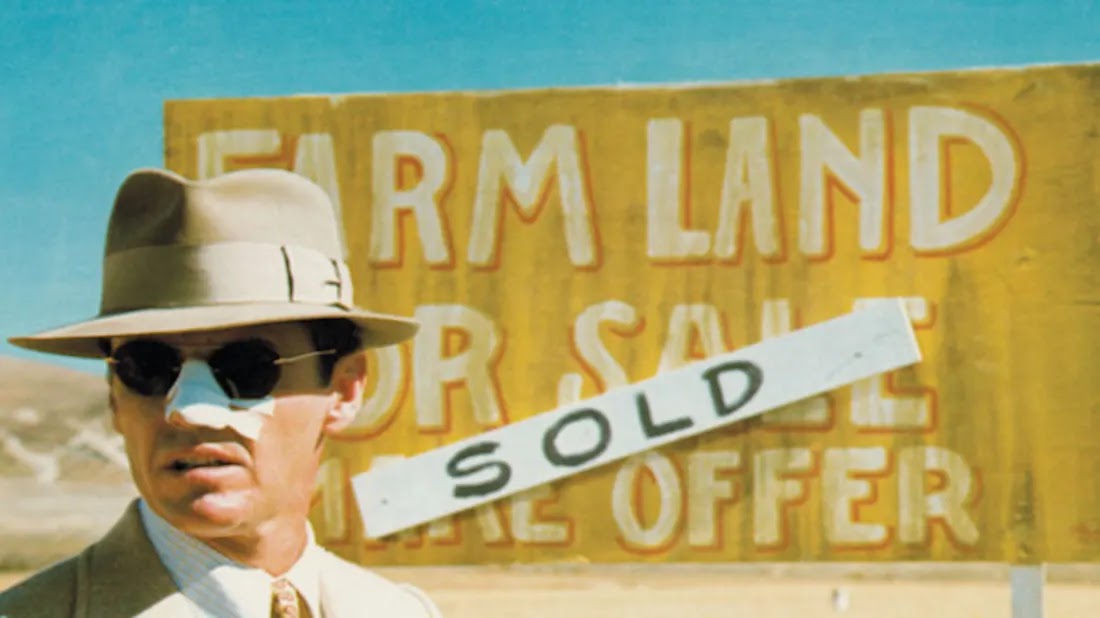
And he’s totally ill-suited to this world he ends up with. Gittes uncovers every inch of the mystery – but nothing he does has any positive impact. He completely fails to protect anyone, his attempts to ensure happy endings end in disaster, he’s regularly beaten to a pulp (most famously having his nose slit by a cameoing Polanski as a weasily little hoodlum) and he’s at sea when dealing with most of the characters of the film. Even his carefully built emotional armour breaks down, leaving him vulnerable to making even more mistakes. There are perhaps few characters so ineffective – and again it’s a credit to Jack Nicholson’s charisma that he makes this character feel like such a proactive figure.

Gittes senses at all times that there is some dark secret underpinning all these events he encounters. But he’s too innocent to begin to suspect the horrors that Evelyn has put up with at the hands of her abusive father. Faye Dunaway brings a marvellous fragility and vulnerability to a character who transcends the traditional femme fatale. (Dunaway famously hated both Polanski and working on the movie). At first seeming imperious and even suspicious, the film slowly breaks her character down into a wounded and vulnerable woman putting on a front, determined to try and protect herself but doomed to forever be the victim.

And Noah Cross is the dark heart of this. Played with a sensational sense of gentility masking supreme corruption and greed by John Huston, Cross is genteel and polite while being ruthless and grasping. He also reveals himself capable of huge, destructive acts, indifferent to the pain this causes and utterly implacable in his vileness. Huston’s performance – he’s only in three scenes – embodies the terrible dark heart of America, where money and power it seems can let you get away with anything you want, no matter who knows. (And I love the way he persistently mispronounces Gittes name, turning it into a growling Anglo-saxon “Gits”.)

Robert Towne’s superb screenplay is perfectly paced and pieces together an intricate and fascinating plot where every small detail mounts together into a devastating whole. It’s a film that demands careful watching, and that revels in small details and character beats that gain greater impact the more you see the film. Brilliantly, the macguffin here is water – the control of a substance that should be a right for every man, becoming a superb metaphor for the theft from ordinary Americans of justice and their country. 

The film culminates – as you feel it must when watching it – in a nihilistic ending where evil triumphs and good loses out. “Forget it Jake – it’s Chinatown”, goes the famous closing line. It works so superbly, because in Towne’s and Polanski’s vision of America here, there is no chance of the right thing winning out if the powers that be would have otherwise. With Jake’s Chinatown career in the police force becoming emblematic of everything that’s wrong in American justice, sure it makes sense that his return there as a private eye would see the same outcome. Towne pushed for a more upbeat ending, but Polanski knew – correctly – that only the shock of murder could end this tale, especially a murder that would have no repercussions.

Polanski’s direction is faultless, cool, calm, wonderfully observant with a superb sense of the 1930s – the film looks beautiful – and using the sunlight and brightness of LA to stress that just because we can see clearly, doesn’t mean we understand what we are looking at. With one of the greatest scripts ever – and a superb performance by Jack Nicholson in one of his finest roles – this is one of the best mysteries in Hollywood history, a timeless classic.

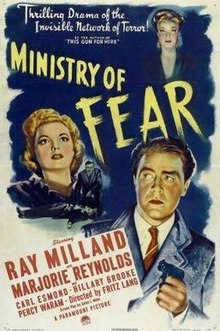
Ministry of Fear (1944)

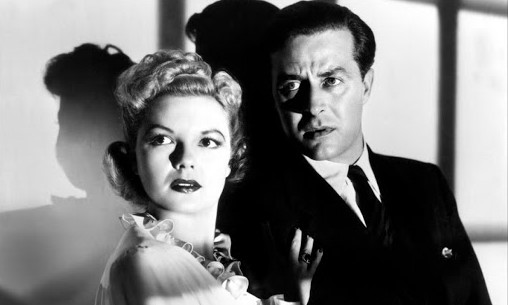
Ray Milland and Marjorie Reynolds take on Nazi agents in Ministry of Fear

Director: Fritz Lang

Cast: Ray Milland (Stephen Neale), Marjorie Reynolds (Carla Hilfe), Carl Esmond (Willi Hilfe), Hillary Brooke (Second Mrs Bellane), Percy Waram (Inspector Prentice), Dan Duryea (Cost/Travers), Alan Napier (Dr Forrester), Erskine Sanford (George Rennit)

Neither Fritz Lang nor Graham Greene (the author of the original book) cared much for Ministry of Fear. Both of them thought that the film they ended up with was only a shadow of the original novel, with both of them largely blaming the script by Seton I Miller and the producers for turning Greene’s novel into a more simplistic B-movie. And yes the film is at heart just a B-movie, that races through a conspiracy thriller – and you’d have no idea that it ever came from Greene-land unless you were told so – but it’s put together with such professionalism that you admire its skill, even while it’s no Third Man.

At the height of the Blitz Stephen Neale (Ray Milland) is released from an asylum only to find himself immediately embroiled in a load of shady goings-on with suspicious séances, hidden microfilm and Nazi sympathisers. Can the fragile Stephen get to the heart of it?

Ministry of Fear has a slightly dream like quality to it – probably because it’s a fragmented narrative that makes quick jumps from event to event, sometimes with very few links between them. Stephen emerges from an asylum straight into a charity fete, hence to a train, the centre of London and a séance, with all the speed of a logic-skipping dream. Everything is swift and somewhat low in logic. The plot of the film becomes sheer B-movie fluff, with the typical spy hijinks you might expect, lacking any of the complexity of the book. 

Greene was particularly disappointed by the deletion of the guilt Stephen feels around the death of his wife – and the film indeed skims over this very swiftly, leaving the reasons for Stephen’s being in an asylum in the first place largely unexplored and dispatched as swiftly from the film as possible. It’s not a film that has the time to explore the complexity of personalities of characters – instead it’s all about turning the content of the novel as much as possible into a high-flung spy thriller.

It’s why Lang was so disappointed with the script – and he became more and more dismissive of the film as he got older, claiming it to be bad film that he fell asleep in during a later showing – but he still bought to it a visual magic. The film is crammed with beautiful expressionistic images, present right at the start with Stephen watching a ticking pendulum through to some of its beautiful later images, in particular a shooting through a door that allows a beam of light to shine through a bullet hole in a door. Lang crams the film with striking images that help lift it above its B-movie roots.

Which is just as well because the general drift of the plot isn’t always that special, playing like the off-cuts from several Hitchcock films. Despite the artistry with which Lang presents it, he can’t hide the basically generic stuff that Greene’s book has been turned into. And its fast pace and logic jumps can perhaps find their root in the general contempt Lang had for the material he had to work with. Nothing in this feels particularly right – the England it presents is laughably wrong on several counts – while as always much of the mystery is reduced from the small cast list and tiny selection of possible suspects. 

There are some good sequences, don’t get me wrong. A séance is beautifully made and carries a fair degree of tension. The final confrontation with the architect of the misdeeds makes for a decent scene. It’s just a shame it’s counterbalanced with clumsy “this is what’s going on” scenes, such as Stephen’s briefing from British Intelligence. 

There are some good performances among the cast. Milland gives a well-judged performance of vulnerability, confusion and growing strength. He has just the right good-looking-but-not-drop-dead-handsome look to him to make him someone you can sympathise with but not completely trust (if the film hadn’t dropped some of the more interesting questions around Stephen’s guilt or innocence for past crimes this casting would have really worked to strengthen that). But he gives a fine performance. The array of suspicious characters around him are confidently performed, with Hillary Brooke a particular stand-out as a manipulative, seductive medium.

But Lang’s film is a covering of class and technique other soil that isn’t rich enough. The complexities of Greene has been lost and the film’s general plot and content doesn’t give much more than the sort of cheap thrills you could expect from a well-made B movie. With those involved this could have been more, but it never becomes a classic.

Once Upon a Time in America (1984)

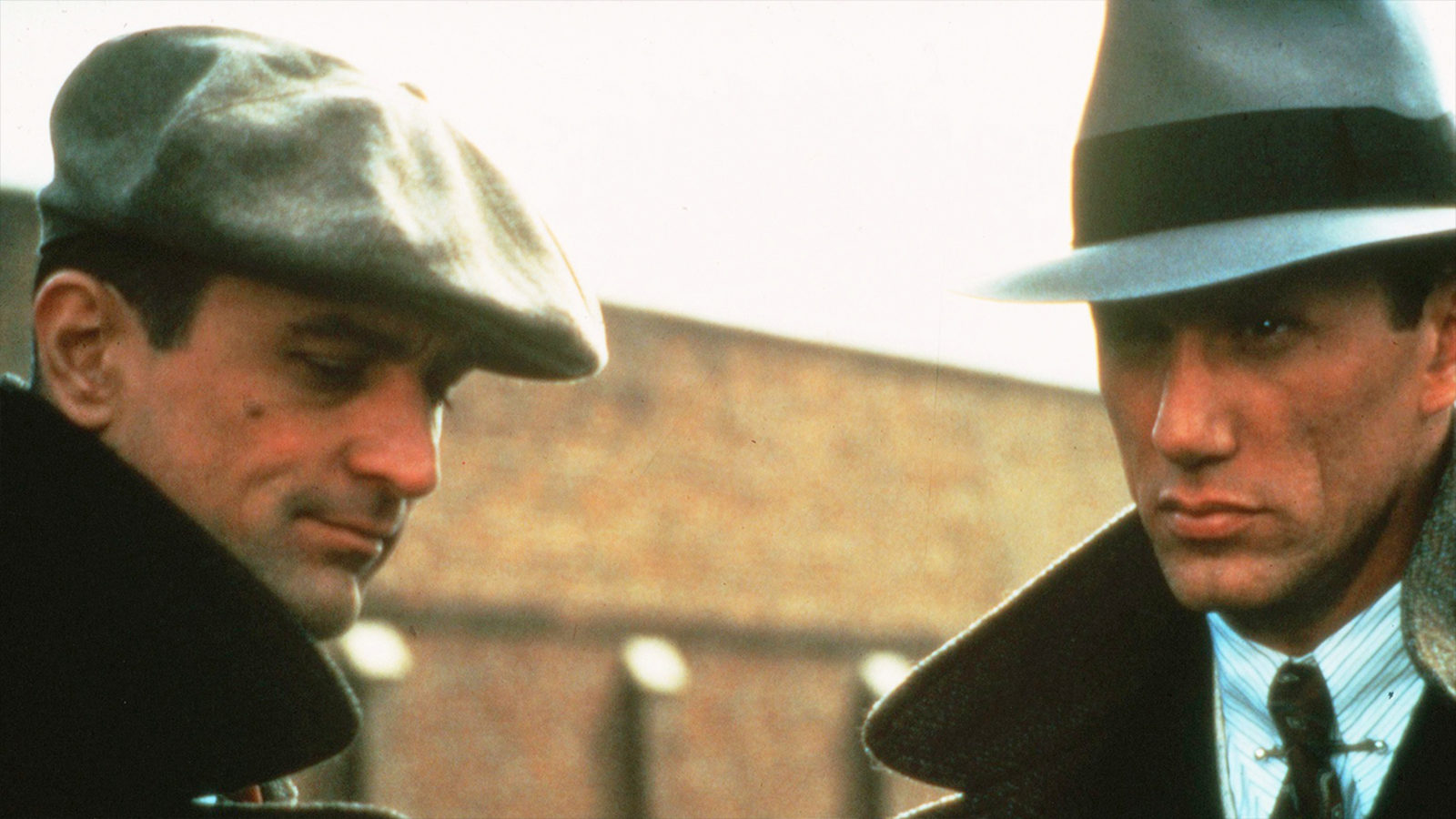
Robert De Niro and James Woods are gangsters in Sergio Leone’s sprawling indulgent masterpiece Once Upon a Time in America

Director: Sergio Leone

Cast: Robert De Niro (Noodles), James Woods (Max), Elizabeth McGovern (Deborah), Joe Pesci (Frankie), Burt Young (Joe), Tuesday Weld (Carol), Treat Williams (Jimmy O’Donnell), Danny Aiello (Police Chief Aiello), Richard Bright (Chicken Joe), James Hayden (Patsy), William Forsythe (Cockeye), Darlanne Fluegel (Eve), Scott Tiler (Young Noodles), Rusty Jacobs (Young Max), Jennifer Connelly (Young Deborah)

It had been thirteen years since Leone had made a film. During this time he turned down The Godfather in favour of his own dream of filming Harry Grey’s novel The Hoods. The final film, Once Upon a Time in America, seems destined to live in the shadow of The Godfather, from its settings and many of its themes through to its graphic design and cast. It’s a challenging, over-indulgent, sometimes difficult film that, never-the-less has its own sense of hypnotic power to it.

Told in a partly non-linear style, it opens with Noodles (Robert De Niro) a Jewish gangster on the run from thugs in 1930s New York days after the fall of prohibition. With his friends and his girl dead and his money stolen, Noodles flees the city – returning only in 1968 after a mysterious summons suggests his past is not as buried as he thought. Within this, the film weaves an intricate series of flashbacks that fill in the story of Noodles and his friend Max (James Woods) turning their teenage gang of hoodlums into an effective crew, muscling in on the money that can be made from prohibition. Carrying the story from 1918 all the way back to 1968, we discover why Noodles was on the run, what the money was, where it’s gone and who or what summoned him back to life.

Leone originally envisioned the film as a two-part epic: two films of three hours length. His original cut was almost ten hours long, cut down to six and then finally to just over four. This cut was released to critical acclaim at Cannes – but was still too long for the producers, concerned about making their money in America. To the fury of the cast (James Woods continues to be vocal about the butchering of the film), and the heartbreak of Leone, the film was cut again to just over 2 hours before its release in the States – a move that rendered it nearly incomprehensible and led to reviews that labelled it one of the worst of the year. Only with the much late release of the European cut (and work continues to restore something closer to Leone’s six hour cut) did the film find acclaim.

But you can see why the producers worried. Leone was never a director who felt the need to get where he was going quickly. As his films became ever more dominated by his love for artful compositions, meditative longeurs and drawing the tension out for as long as possible, so their running times ballooned. Leone matched this with a yearning to tell a story that was to be nothing less than about defining “America” – or at least, give a symbolic weight and depth to the Americana he loved. The film is overflowing with the feel of Old Hollywood gangster films and classic imagery of the immigrant experience in Manhattan. It’s like a brilliant coffee-table album bought to life and covered with blood.

So Once Upon a Time in America is a slow, lethargic even, film that takes its time to build up a picture of an immigrant community drawn together through bonds of culture and shared past that are nearly impossible to express – but fractured by the greed and capitalism of the American Dream, temptation to make an even bigger killing leading to old loyalties being sacrificed. Leone juggles some big ideas here, and if the film never quite comes to grips with any of them as it charts the fractured relationship of Max and Noodles, from brothers-in-arms to ambition, pride and private frustrations leading to betrayal it’s never less than strangely engrossing. 

In many ways this is a hugely indulgent film, but it is also remarkable (strangely) for how restrained and elegiac it is. The razzamatazz of some of Leone’s Westerns are mixed in with a golden age romantic view of the past – and its lost opportunities and loyalties – in a film particularly fascinated with the coming-of-age of young men. The film is nothing less than an old man taking a ruminative journey through the past (both Leone and Noodles in his memories), looking back at a life time of bad choices and lost chances. It all makes for one of cinema’s greatest mood pieces ever, with faultless period reconstruction, but also a piece that for all its focus on personal lives at cornerstones of histories, makes its characters seem strangely impersonal.

Part of that lies in Leone’s clear love for the film’s long second act (nearly a third of its runtime), which charts the young Jewish hoodlums teenage lives in 1918 New York – their meeting, first scores, rivalries with other gangs and inevitably the loss of virginity. For all its overextended backstory, the section of the film hums with love and elegiac romance. It’s the richest part of the film. There is a beauty in beats of the watching the boys encounter everything from first crime to first love – and easy as it is to mock a good 3-4 minutes watching one of them eat a cake intended as an offer in exchange for a first sexual experience with the local floozy, moments like that have an innocence and a beauty to them that Leone really captures.

It’s a shame that it’s the back-end of the film that suffers – and its plot and narrative drive. It feels like Leone fought to keep the beauty of this early section and sacrificed drive and narrative later. The fracturing of the relationship between Max and Noodles is less clear, and their adult characters never quite come into focus. Perhaps there isn’t quite room for actors in the long sequences of wordless silence and atmosphere, punctuated by bursts of shocking violence, in Leone’s world. Certainly the cut doesn’t help, with most of the supporting cast (Joe Pesci, Treat Williams, Burt Young, Danny Aiello) reduced to little more than one scene each, their storylines – particularly a crucial Teamsters plot – barely making any sense.

Max’s growing distance from Noodles is perhaps rooted in everything from his ambition being frustrated by Noodles small-time viewpoints, perhaps even in suggestions of a frustrated homosexual love for the defiantly straight Noodles. James Woods does very well to piece to together a suggestion of deep psychological unease and confusion in a character who remains unknowable, a man to whom loyalty is everything until it isn’t.

As Noodles Robert De Niro anchors the film with one of his quietest, most reflective performances. Noodles is a deeply flawed, low-key, humble character who carries in him a capacity for self-destructive and vicious violence. Leone’s film suggests Noodles is perhaps troubled by feelings and longings he can’t begin to understand or appreciate. He is a romantic character, deeply infatuated with both Max and his childhood sweetheart Deborah, but unable to express or communicate his feelings until it is far too late, a man traumatised by emotional connection.

Not that this excuses Noodles for his actions, particularly towards women. If there is one troubling aspect of the film it is its attitude towards women. There are two prominent women in the film, both of whom are raped. One of them, Carol, is a shrewish temptress, who deliberately provokes Noodles to rape her and is then shown enjoying it. The second rape, this time of Deborah, comes from Noodles after a romantic date where he has finally done everything right. While Leone shoots the scene with an almost unwatchable grimness – Elizabeth McGovern’s screams and distress make for very hard viewing – the film still asks us to feel not only for her pain, but also (perhaps more so) Noodles regret. Further when they encounter each other late in life, Deborah matches him in sadness at chances lost – an unlikely reaction you feel for someone who has suffered as traumatic experience as she has. 

But then to Leone perhaps this is part of the corruption of America – or rather the vileness of gangsters. The gangsters are a grotesque bunch in this film, killing without compunction, torturing, stealing, using violence as second nature. Loyalty is barely skin deep and arrogance abounds. There is no romantic sense of family behind it all – perhaps the thing Leone rejected most from The Godfather – just a series of people on the make and on the take. 

But for all its faults and over extended length the film is increasingly hypnotic and engrossing, Leone’s understanding of mood being near faultless. While the ideas are perhaps not quite pulled into sharp focus in the film – and leave the audience having to do a lot of supposition – it still works over time. And the film has so many astonishing merits – from its awe-inspiring shooting and production to the sublime score from Ennio Morricone that gives the film even more poetic depth – it more than merits its existence.

And of course there is the cheeky sense Leone throws in that some – or indeed all – of what we are seeing may not even have happened. The film opens and closes with Noodles in an opium den, stoned out of his mind, in the 1930s. In the opening he lies there, haunted by the sound of a ringing phone (the memory of the phone call he made betraying Max), and we see him arrive at the film’s end taking his first puff and lying back with a grin. Is the film’s off-kilter 1968 even real? Or just an opium den dream? Is the past – and the film’s disjointed narrative flying back and forth – just a stoned man lost in his own fantasies? Who knows? What we do know is that Leone’s indulgent epic is a flawed but genuine masterpiece – and the opium fantasy angle may just be the perfect cover for the fact more than half the film is on the cutting room floor of history.

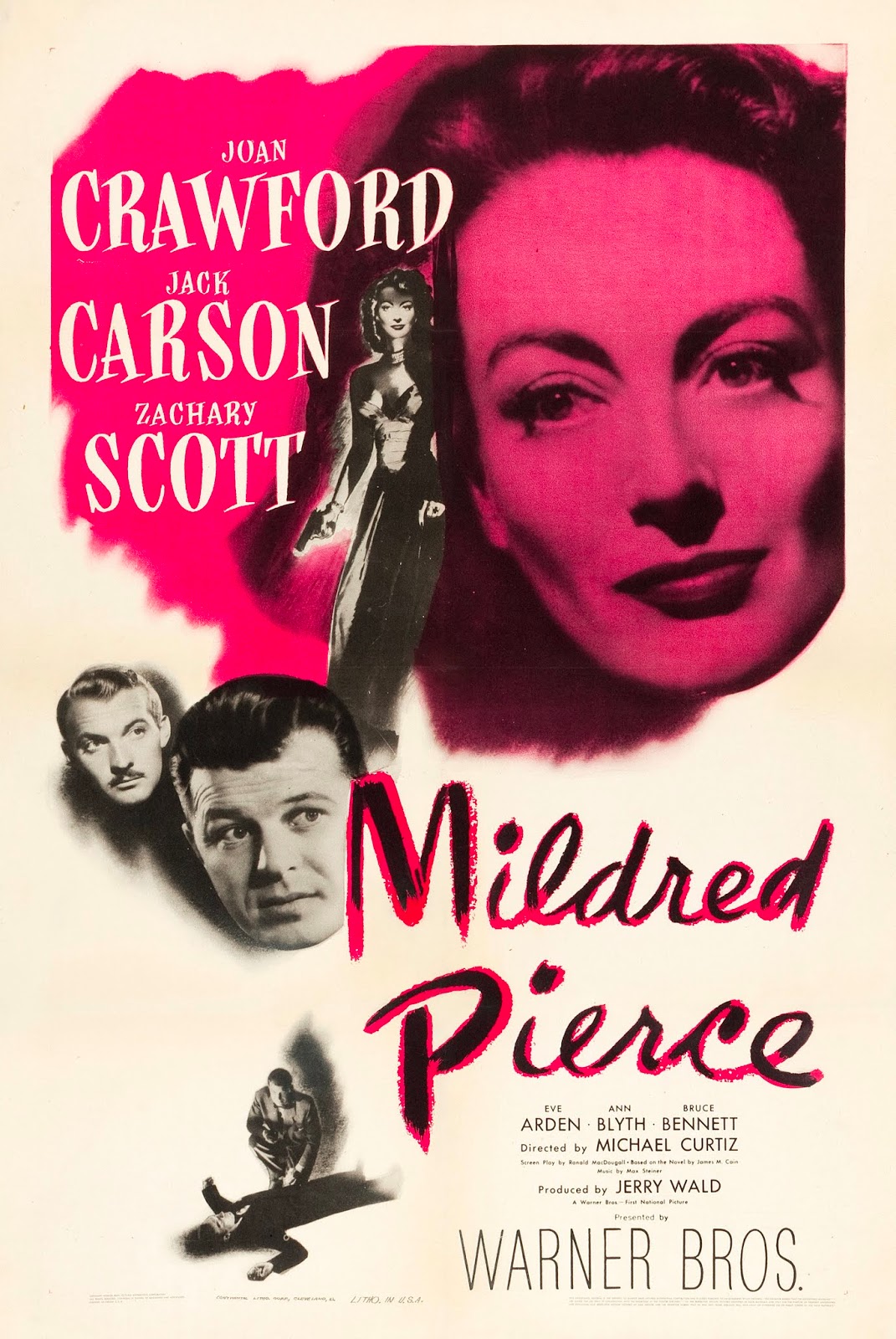
Mildred Pierce (1945)

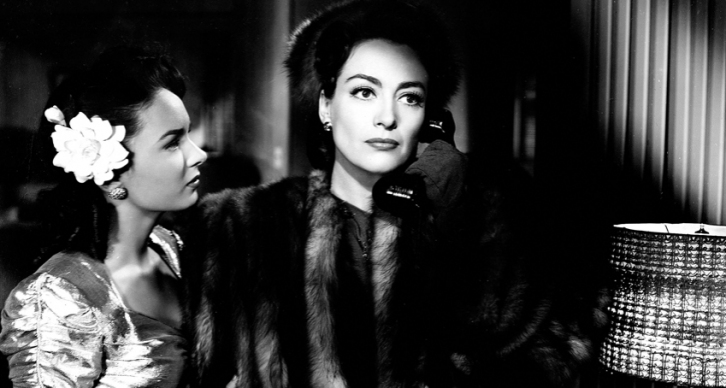
Joan Crawford sacrifices everything for a daughter who doesn’t deserve it in Mildred Pierce

Director: Michael Curtiz

Cast: Joan Crawford (Mildred Pierce), Jack Carson (Wally Fay), Zachary Scott (Monte Beragon), Eve Arden (Ida Corwin), Ann Blyth (Veda Pierce), Bruce Bennett (Bert Pierce), Butterfly McQueen (Lottie), Lee Patrick (Mrs Maggie Biederhoff), Moroni Olsen (Inspector Peterson)

There are few things that classic Hollywood did quite as well as a melodrama. Adapted loosely from a James M Cain novel – its murder plot line is a flourish solely for the screen – this is a triumphantly entertaining picture that mixes themes of sex and class with good old-fashioned family drama. It’s got psychology and it’s also got the high-concept family feuding around the building of a restaurant business that you could find in Dynasty. Put simply, Mildred Pierce is a prime slice of entertainment.

After her second husband Monte (Zachary Scott) is shot dead, Mildred Pierce (Joan Crawford) is brought in by the police for questioning. After the collapse of her first marriage to Bert (Bruce Bennett), Mildred has expanded her home-baking business into a full restaurant chain, with the support of Bert’s old business partner Wally Fay (Jack Carson). Mildred’s goal is to provide for all the needs of her eldest child Veda (Ann Blyth), a selfish snob who despises her mother for having to work for a living. The tensions between self-sacrificing mother and demanding, unloving daughter, lead Mildred to take a series of disastrous personal and business decisions, culminating in her wastrel, upper-class, Veda-approved, second husband Monte going down in a hail of bullets. But who pulled the trigger?

The murder mystery plotline adds effective spice to this very well directed (Michael Curtiz is at the top of his game) melodrama. Full of domestic thrills and spills, it races along like a combination page-turner and soap, perfectly matching a deeply sympathetic, self-sacrificing heroine with a host of deeply unsympathetic wasters, chancers and bullies. It’s capped by giving our heroine possibly the least sympathetic child in film history, the deliberately selfish and greedy Veda. 

Sure you could argue that its psychology is either pretty lightly developed, or thrown in only for effect. It’s never clear when or why exactly Veda and Mildred’s relationship went south so completely, or where Veda’s deep resentment and ideas above her station come from. It also avoids looking at how Mildred’s complete devotion has probably completely spoiled a child who clearly needed to be told “no” a lot more, a lot sooner. But it doesn’t really matter as the film follows the logic of an event-filled plot-boiler, throwing revelations and cliff-hangers at you left, right and centre.

In the lead, Joan Crawford took on a role that many had turned down before her – stars at the time were not keen to be seen playing roles that suggested they were old enough to have mothered children as old as Ann Blyth. The decision to push for the role paid off as she netted an Oscar and it’s the finest performance of her career. A somewhat haughty actress, Crawford here demonstrates depths of vulnerability and tenderness as a much-put upon woman who, despite everything, will stop at nothing to give her daughter what she wants. Crawford dominates the film, her air of self-sacrifice never once tipping over into self-pity, even as the character so desperately seeks for the sort of love and affection that is denied her from those around her. 

Around her most of the cast – with the exception of Eve Arden’s entertaining, wise-cracking best friend (Oscar nominated) – are basically a bunch of sharks. None sharper than Ann Blyth’s (also Oscar nominated) sweet-faced but dead-inside daughter. Rarely has a display of more naked grasping, snobbish disdain ever been captured on film, matched with unapologetic greed. Veda has no compunction about the moral consequences of her actions and, like Zachary Taylor’s archly lazy Monte, is as interested in spending Mildred’s money as she is contemptuous of its source. 

Curtiz’s film constantly however plays with our judgements and expectations of people. Veda has more than her share of moments of pain and vulnerability as she shares some of the more painful travails of her mother. Similarly, Wally Fay (very well played by a roguish Jack Carson) oscillates between being a trusted confidante of Mildred, and a lascivious greedy creep. First husband Bert (a somewhat dry Bruce Bennett) starts as a love rat but may have more decency about him than anyone else (except Mildred).

The film is wonderfully shot in luscious black-and-white by Ernest Haller, in a dynamic noirish style. Water reflections lap across ceilings. Smoke from fires and cigarettes rises up and seems to dance and swirl in the light. There are some beautiful shots of faces – the camera work in particular perfectly locates a vulnerability in Crawford’s superior features – and there is a beautiful shot late on when two people caught in an illicit kiss roll their heads back from the shadows to emerge into the light. The entire design of the film is spot-on, and it looks and sounds fabulous today.

Mildred’s struggles make this a brilliant example of the stereotypical “women’s picture”, a tale of a woman struggling against all the odds to make her way in the world, with the twist that the daughter she is straining to support is a monster and the men she chases are feckless wasters. Mildred makes chronically terrible decisions throughout but for the best of motives – and part of the film’s appeal is that you are so invested in her fundamental decency you are willing her not to make the same mistakes again and again.

Curtiz’s melodrama is brilliantly enjoyable and never lets up. It’s also a feminist icon of a sort – Mildred is never punished for having a career, indeed she’s celebrated for it (and is far more savvy about it than nearly all the men). She leaves her husband, runs her own household, pushes for her own divorce all while protecting and providing for her child (not her fault the child ain’t worth it). Mildred Pierce is ahead of its time, and still a fabulously entertaining film.

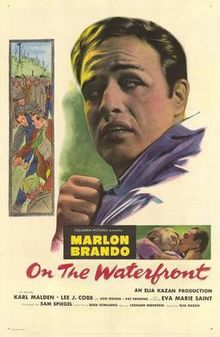
On the Waterfront (1954)

Marlon Brando reinvents film acting in On the Waterfront

Director: Elia Kazan

Cast: Marlon Brando (Terry Malloy), Karl Malden (Father Barry), Lee J. Cobb (Johnny Friendly), Rod Steiger (Charley “The Gent” Malloy), Eva Marie Saint (Edie Doyle), Pat Henning (Timothy Dugan), John F Hamilton (“Pop” Doyle), Ben Wagner (Joey Doyle), James Westerfield (Big Mac)

When’s the right time to speak out for what you know is right? It’s a question we’ve all faced at some point, and it’s the question that changes the life of Terry Malloy (Marlon Brando) after he is indirectly, and unwittingly, involved in the murder of a fellow dock worker. The killing was ordered by the corrupt, mob-connected union boss Johnny Friendly (Lee J. Cobb), who rules the workers of the shipyards of Hoboken, New Jersey with an iron fist. The victim was going to talk to the cops, and suddenly Terry finds himself in the middle of a major ethical bind: should he give evidence or play “D and D” (deaf and dumb) like the rest of the workers.

His bind grows ever tighter as the local priest Father Barry (Karl Malden) takes up breaking the power of the union as his own personal mission. Not to mention Terry’s growing closeness to the victim’s sister Edie (Eva Marie Saint), with whom he finds himself slowly falling in love. On the other side is his brother Charley (Rod Steiger), a lawyer and right-hand man of Johnny Friendly, who has been running his brother’s life forever, ruining Terry’s boxing career by ordering him to take a dive so Friendly could make a killing on the betting circuit. What will Terry do?

Elia Kazan’s multiple Oscar winner is a powerful, beautifully made, engrossing and uplifting modern morality drama that still packs a wallop today. Shot largely on location in New Jersey, with lashings of Kazan’s brilliant realism and ability to bring poetic beauty and emotional force to the most everyday of settings, On the Waterfront is sublime, a film to make you rail against the injustice of corruption and the unthinking cruelty of everyday folk when given a chance to stigmatise someone.

Kazan and screenwriter Budd Schulberg (whose script is a beautifully judged mixture of soulful dialogue and the rhythms of every day conversation) were both drawn towards the story after their engagement with McCarthyism in Hollywood. In this hunt for reds under the Hollywood bed, both Kazan and Schulberg named names. Both of them felt that they had been lied to and exploited by the communist movement in Hollywood – and also that Stalinist Russia was not a cause worth defending – but that didn’t stop many people rejecting them for breaking the rule of silence (the same rule that runs through this film). On the Waterfront is a heartfelt defence of the whistleblower (or the informer), and why that can sometimes be the only option open.

Based on a true story, Kazan’s film is a masterclass in carefully controlled, intelligent direction bringing out brilliant acting performances (always one of Kazan’s major strengths as director). Leading the way here is Marlon Brando, giving possibly the most famous, most influential acting performance in film history in the lead role. It’s not really an understatement to say it changed the face of movie acting. Brando here performs with a low-key, casual, almost tender naturalism that stands completely at odds with the more exhibitionist performers of the late 40s. And he funnels all this beautifully into Terry Malloy, a tough guy whom he inhabits with a vulnerability and gentleness that never once feels out of place with his temper and pride. There is instead an awe-inspiring transformation here, of the actor becoming the mumbling, uncertain character – not afraid for words to be lost, not worried about making eccentric or unexpected choices as a performer.

Two scenes stand out. In the first, Brando has his first long conversation with Edie Doyle, having rescued her from being set on by union men. In a single take – a carefully orchestrated willingness to let the actors explore the emotional truth of the scene from Kazan – Brando’s Terry shyly, gently, haltingly asks about her life and tries to explain his own. At one point, Edie drops her glove and Brando picks up the glove, fiddles with it and then puts it on – the sort of inspired naturalism that feels like nothing on paper, but on film carries a strange emotional force, a physical representation of the bond between them (and don’t underestimate the way Saint pulls the glove gently from his hand). The entire scene has the air of reality to it, Brando chewing gum, Saint wondering how much of herself to show to a man she isn’t sure she can trust. It’s masterful.

The other scene is of course possibly one of the most famous scenes in movies ever: I coulda been a contender. For films, this is like the To Be or Not To Be speech, a speech that has been quoted and riffed on ever since. But again, Brando resists the temptation throughout for histrionics – when Charley pulls a gun, Brando reacts not with shock or anger but sadness, almost tenderly pushing the gun aside and letting his voice fill with a world of regret for what has become of their relationship. Steiger is superb in this scene, but you can’t look at anyone except Brando here, awkward, sad, struggling to work out what to do with his life and finally confronting the broken past between the brothers with pointed regret and calm realisation rather than the anger and rage that other actors would have chosen. This is an actor who redefined his profession, at the top of his game.

The film is crammed with excellent performances. Eva Marie Saint (Oscar winning) has just the right measure of gutsy determination, fear and tender sweetness as the woman who opens Terry’s eyes to right and wrong. The film gained three Supporting Actor nominations (they all lost). Steiger is cocksure but self-loathing as Terry’s ambitious brother. Lee J. Cobb rages as only he can as the blowhard bully Friendly, demanding absolute loyalty. But on this rewatch, I loved Karl Malden’s moral certainty, courage and stubbornness as Father Barry. In any other film Barry’s speech railing against the dockers for being part of the system that oppresses them, all the time being pelted by food, would be the highlight of the film: here it’s just one of several stand-out moments.

Kazan was a superb visual stylist, this black-and-white masterpiece brilliantly shot by Boris Kaufman to create a world that feels the perfect mixture between the documentary realism and the theatrical. And working with a superb script that he felt such investment in helps to create a story that carries real emotional force, carefully investing you right from the start in Terry’s fundamental goodness and naivety, inviting you to feel rage on his behalf as he is sent to Coventry by his workmates. Topped off with a beautiful score by Leonard Bernstein – part jazzy, part wonderful orchestral stylings – this has barely aged a day in it’s over 60 years.

The Usual Suspects (1995)

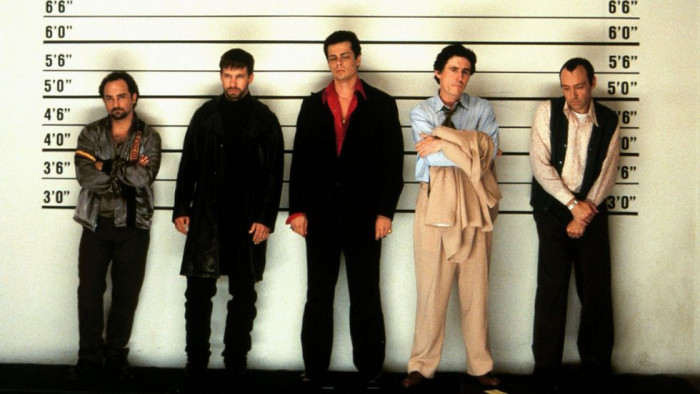
The immortal gang in legendary twist thriller The Usual Suspects

Director: Bryan Singer

Cast: Stephen Baldwin (Michael McManus), Gabriel Byrne (Dean Keaton), Benicio del Toro (Fred Fenster), Kevin Pollak (Todd Hockney), Kevin Spacey (Roger “Verbal” Kint), Chazz Palminteri (Agent Dave Kujan), Pete Postlethwaite (Kobayashi), Suzy Amis (Edey Finneran), Giancarlo Esposito (Jack Baer), Dan Hedaya (Sergeant Jeff Rabin)

SPOILERS: If you have been living in a cave since 1995, don’t read on as I discuss the twist at great length…

“Convince me”. That’s what Customs Agent Dave Kujan (Chazz Palminteri) says as he begins his interrogation of limping, low-time crook “Verbal” Kint (Kevin Spacey). That’s certainly what Kint does – and it’s what the whole film is aiming to do in this, the most famous confidence trick in movies. The Usual Suspects is one of those once-in-a-blue-moon films where everything comes together perfectly. It’s also a sleight-of-hand movie that remains hugely engaging and entertaining even when (as surely most people now do!) you know exactly what the magician has up his sleeve. Its solid gold entertainment factor even survives today, despite the slightly queasy presence of both Kevin Spacey and Bryan Singer in its credits.

Told in flashback, the film follows the coming together of a bunch of regular criminals, pulled in for a line-up and deciding to team up. Along with Verbal, the others include McManus (Stephen Baldwin), Fenster (Benecio del Toro), Hockney (Kevin Pollak) and ex-cop turned criminal Dean Keaton (Gabriel Byrne). After a successful series of heists, the gang are conscripted by suspicious lawyer Kobayashi (Pete Postlethwaite) to take on a dangerous hijacking job for shadowy – possibly legendary – master criminal Keyser Soze, the bogeyman of the criminal classes. We know the job will go wrong – after all Verbal is banged up telling the whole story, the only survivor of the job – but how? And who is the shadowy Soze – or is he even real at all?

The Usual Suspects takes what you know about movies and then works double time to use it against you. With a structure inspired by classic noir crime films from the 1940s – the whole operation has a touch of The Asphalt Jungle while the interrogation has more than a hint of Double Indemnity – mixed in with a lot of Rashomon, it’s a movie that has you primed so much for a reveal and a twist that it skilfully misdirects you into expecting the wrong thing. Because how could you guess that perhaps the whole movie is a spun-out-of-the-moment invention by Verbal, and that possibly almost nothing we see during the course of its run time even happened. 

But how can we guess? From the very first scenes with Kujan and Verbal, Kujan is shot dominating the frame, always taller, always filling the screen. Verbal is sitting, meek, trapped by the frame, the camera frequently looking down at him. Every shot subliminally tells us that he is weak. The story has to be dragged out of him, with the investigation outside of the room forcing Verbal to expand on issues he doesn’t want to touch on. Like Kujan we invest in what we are finding out, because it looks like Verbal doesn’t want to tell it to us. That’s how they get you.

Because Verbal, in his story, is sprinkling in just the twist that Dave (and the audience) is probably expecting – that Gabriel Byrne’s Dean Keaton, the guy who claimed to have gone good, who just wanted out, was bad the whole time and was the criminal mastermind this whole time. Christopher McQuarrie’s ingenious script primes us for this: Dave Kujan is casting doubt on Keaton’s “death” right from the start, and as the audience surrogate figure we want to be as smart as he is. So what does it matter that we ”see” Keaton shot in the opening sequence of the film? Surely that was an illusion, and we’re as clever as Kujan in seeing through it.

The film even gives us a brilliantly assembled “reveal” series of edited flashbacks, in which every small moment and hint that has existed in the film is replayed for us (John Ottman’s editing is flawless here – and he should also have credit for composing the film’s hauntingly classical score) to convince us, beyond a shadow of a doubt that, yup, poor simple Verbal was taken in all the time by dastardly Keaton, the guy who looks like a film star. Only of course it’s bollocks. That charred corpse that Singer jump cuts to at the start of the film as police investigate the boat massacre is indeed Keaton. And the clever twist we thought we were working out, turns out to be a mass distraction laid out for us by Verbal and the film.

So we get a second brilliantly edited reveal sequence as it hits Kujan while he studies that most famous notice board in film, that everything he thought he had worked out had been spun out of hints and clues off the board – from asides and anecdotes to entire locations and characters. And Kevin Spacey limps and then walks away, shrugging off the skin of timid, weak Verbal to transform into the chillingly amoral Soze. It’s a trick that worked especially well when Spacey was an almost unknown actor at the time (today it’s less of a surprise to find out that Spacey could be a creep). There is possibly no better reveal in Hollywood.

But the film continues to entertain even when you know it because Singer’s film is stuffed with richly layered characters, scintillating scenes and some rich and spicy dialogue from McQuarrie. It’s a brilliant combination and provides every scene with a clear and electric dynamism that makes it impossible to tear your eyes away. There are some truly striking scenes – not least the iconic line-up scene – and the film carries an improvisational energy (that line-up scene is a magic use of outtakes, as the actors couldn’t keep a straight face during the sequence).

Part of the magic of it comes from the brilliant clash of a group of vastly different actors bouncing off each other: the self-consciously method Baldwin, the edgy energy of Pollack, the chilly technique of Spacey and the classically trained professionalism of Byrne, who pulls off with aplomb a difficult job of playing a decoy protagonist and antagonist in one. And that’s not mentioning the wild card of Del Toro who, working out his character was a one-note plot device, throws in an eccentric chic and impenetrable mumbling accent that is part affectation (the sort of thing that made the actor more trying later in his career) and part jaw-dropping show of confidence. And backing them up is a collection of actors as eccentric as Palminteri channelling Law and Order with a smile and Postlethwaite as a sinister limey lawyer with an accent that sounds like it hails from the Raj.

Singer’s direction is flawlessly confident, creating a rich tapestry that you could lazily call Tarantinoesque, but actually reminds you of John Huston in its carefully framed mise-en-scene. It’s a very classical movie in its way, that loves clever wipes, slow build ups, brilliantly edited and surprisingly low key in much of its framing and shooting. Everything is perfectly placed to help build up the illusion. Singer never touched these heights of confidence and control again. It’s also superbly edited throughout by John Ottman, each beat landing perfectly, each transition perfectly judged. It wouldn’t seem out of pace to see Cagney playing Kint (with Bogart surely as Keaton). 

The devilish trickiness of the plot is kept largely under wraps until late on – Soze isn’t even mentioned until nearly halfway through the film – and the film’s confident misdirection suggests this might just be the gang aiming too high and getting burned rather than a shadowy mastermind manipulating it all. It’s a brilliantly judged change of pace, and all part of the impish delight of the film. It’s a clever game, but has more than enough force and invention in its story telling to keep you gripped time and time again. McQuarrie and Spacey won Oscars – and the film hinges so much on Spacey’s ability to both tell an anecdote and also not push his acting lame – and the film lives on forever in the memory as one of the finest twists. But it does so because the twist grows so organically from the film, and the film’s delight in tricking you is completely infectious.

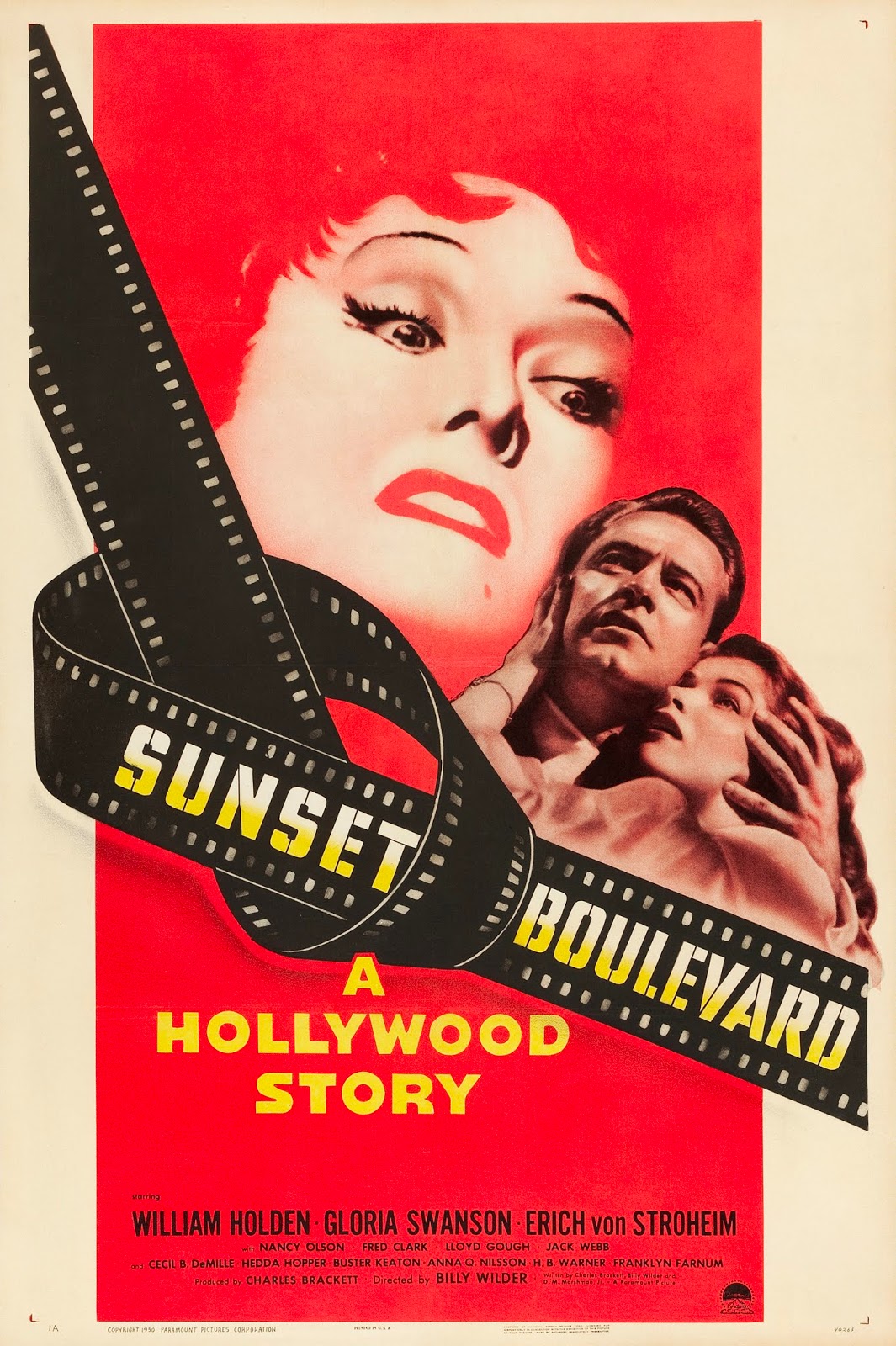
Sunset Boulevard (1950)

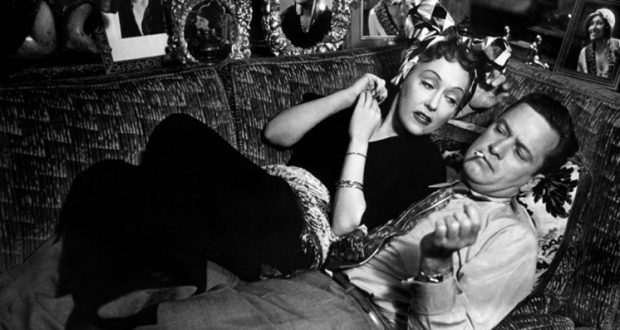
William Holden falls under Gloria Swanson’s spell in Billy Wilder’s superb Hollywood satire Sunset Boulevard

Director: Billy Wilder

Cast: William Holden (Joe Gillis), Gloria Swanson (Norma Desmond), Erich von Stroheim (Max von Mayerling), Nancy Olson (Betty Schaefer), Jack Webb (Artie Green), Fred Clark (Sheldrake), Robert Emmett O’Connor (Jonesy), Lloyd Gough (Morino); as themselves: Cecil B. DeMille, Hedda Hopper, Buster Keaton, Anna Q. Nilsson, HB Warner

Imagine if Charles Dickens had been born a hundred years later. He would surely have headed to Hollywood – and if he had, surely would have written something like Sunset Boulevard. Because who is Joe Gillis but another shallow Pip, dreaming of fortune and wasting his brains, who turns up at Satis House but stays on to become Miss Havisham’s live-in lover? Sure Wilder is more cynical and bitter than Dickens, but I guess even optimist Dickens killed off Little Nell so maybe he too would have had Joe Gillis end (and start) the film face-down in a swimming pool with three bullets in his back?

The cops arrive to find Joe (William Holden) exactly like that, while we hear Joe’s acidic commentary outlining exactly how this state of affairs came about. Joe is a screenwriter in Hollywood (he’s in the second tier of a second tier profession in the movies) who can’t get his latest script made for love nor money. Dodging the debt collectors set on reclaiming his car, he pulls into the drive of a mysterious house. It’s the home of Norma Desmond (Gloria Swanson), a forgotten silent film star who now lives out her days in her mansion, dreaming of her past glories and planning for a return to stardom that will never come, tended to by her loyal butler Max (Erich von Stroheim). Joe is roped in first to rewrite the (terrible) script she has been working on for her comeback, and then to become her live-in lover. But can such a situation survive Hollywood’s cold heart and Joe’s own self-loathing and desires to restart his screenwriting career in partnership with ambitious young studio script reader Betty Schaefer (Nancy Olson)?

Billy Wilder’s poison-pen love letter to Hollywood skewers the coldness at its heart. It does this with a triumphant mix of the grotesque and the heartfelt, the surreal and the coldly realistic, an insider’s guide to the world behind the magic of film-making and a story about those shut out of that very world. Hollywood is a shallow, bitter town where you’re either top of the bill or no-one at all. Would people from any other profession write such a bitter denunciation of their job that is also laced with affection and love? Maybe it has something to do with this being a unique profession which you have to love to enter, but once there you work with people who see it as a business.

The smell of desperation is there from the start, with Joe peddling his dreadful sounding baseball movie The Base Is Loaded to a polite but uninterested producer. Dropping a host of names and accepting any number of changes to the story (including changing it into an all-female sporting musical), Joe might once have had a talent but, as he says, “that was last year, this year I need money”.  William Holden was a late choice for Joe, but he is perfect in the part, capturing the air of the self-loathing cynic, a man bright enough to understand he’s shallow, a hack and desperate for any touch of the fame and fortune Hollywood can bring him.

Just like Pip, Joe is a young man who feels he is entitled to a life he scarcely seems to be qualified for. No wonder he settles into a life as Norma Desmond’s gigolo – it may well damage his sense of masculine pride to be an emasculated house-boy, but my God the suits are nice. And what talent does Joe even really have anyway? The script he is peddling barely seems to have any merit at all, and his extensive polish of Norma’s vehicle is still so alarmingly bad it never even gets the slightest consideration from Cecil B. DeMille. But Joe can’t let it go because he’s like a moth drawn towards those bright Hollywood lights.

And those bright Hollywood lights have consumed forever Norma Desmond. Wilder pulled Gloria Swanson out of an enforced semi-retirement to play the silent screen siren, whose career her own so closely parallels. It’s easy to remember Norma as a sort of Psycho-ish grotesque, a demented Miss Havisham living in her own crazy patchwork world of memory and delusion. Swanson certainly channels brilliantly the expression and body language of silent cinema into the part, and Desmond’s use of the sort of exaggerated gestures from that era in everyday life hammers home how her life hasn’t moved on from her glory days. 

But that would be to overlook the immense skill in Swanson’s performance. Norma may be sad, desperate, probably more than a little unhinged – a larger than life Miss Havisham to whom the “the pictures got small”, but she’s also a real person. Swanson makes it clear she genuinely loves Joe, she’s generous when she wants to be, devoted in her own way and immensely fragile. She takes a delighted pleasure in entertaining – a sequence of her reliving her glory days for Joe’s amusement (he couldn’t give a toss, making it all the more painful), capped with a charmingly delightful Chaplin impersonation shows a Norma who loves entertaining, loves putting a smile on people’s faces. Sure she’s obsessed with fame and desperate to reclaim it, but she’s also deep-down a real person.

But then that’s part also of Wilder’s romantic look at cinema. He can totally understand the bitter, destructive “business” part of it, but he still loves the show. His insiderish film is full of loving tributes to old Hollywood. Norma sits and watches real film footage of the real Gloria Swanson. The visit to Paramount Studios delights not only with its “backstage pass” feel, but also in the excitement with which the ageing extras and stage hands greet Norma. Norma’s weekly card games are staffed with genuine silent movie stars like Buster Keaton. Cecil B DeMille even pops up as himself (on the set of his film Samson and Delilah), kindly trying to guide Norma out of the studio even as he lacks the guts to tell her that her dream of a comeback is stillborn.

So how can you not feel sorry for Norma, who is clearly locked up in her haunted house on the outskirts of town, a million miles from reality, surrounded by endless reminders of her past glories. It’s so all-encompassing it traps Joe as well – at one point Wilder shows him trying to storm out, only for his pocket watch to literally get caught on the door. This place of dreams is staffed by the butler Max, a beautifully judged performance of Germanic chill mixed with doe-eyed devotion from Erich von Stroheim, also playing a dark version of himself as Norma’s pioneering former director (and husband) now reduced to protective butler. The entire house is a mausoleum without any escape.

The only character who seems truly positive is Nancy Olson’s wonderfully sweet Betty Schaefer, passionate about crafting a career for herself in the cinema. But even she is ruthlessly ambitious, a woman quite happy to consider jilting her fiancée for Joe’s attentions and has her eye on the price of success. She may have the talent, but she’s also got the sharpness.

Billy Wilder’s film brilliantly explores all these divides and contradictions in Hollywood and its history. Because what is Hollywood but a town that pays lip service to the past, but only has eyes for the future? Particularly with women. Female stars have a short shelf life and then they are dispatched. Poor Norma is still glamourous, still clearly has star quality – but as far as Hollywood is concerned she may as well be a million years old. No wonder Joe, used to these attitudes, is so ashamed to be kept by her – a woman he constantly refers to as a middle-aged friend. 

The dialogue, as you would expect from Brackett and Wilder, is superb from top to bottom with zingers and well-constructed dialogue exchanges so well placed they will survive for as long as there are movies. The film is beautifully shot by John F Seitz – part gothic horror, part dark romance, part neo-realist. Its pacing is perfect, its four act construction perfectly put together. All four of the principals (all Oscar nominated, none winning) are pitch perfect, sketching out characters that feel real and mixed with tragedy and loss as much as they are larger-than-life otherworldliness.

It’s the mixture of the freak show and the heart, in the massive Havishamesque estate, that marks this out as Hollywood does Dickens. The astute understanding of central characters, with enough depth to understand their shallowness, the grotesques that revolve around them but still have their humanity, it’s all there. Wilder mixes it with his own Hollywood emotions and his dry wit and cynicism to create a damn near perfect movie.

In the Heat of the Night (1967)

Sidney Poitier and Rod Steiger confront racism In the Heat of the Night

Director: Norman Jewison

Cast: Sidney Poitier (Virgil Tibbs), Rod Steiger (Chief Bill Gillespie), Warren Oates (Sam Wood), Lee Grant (Mrs Colbert), Larry Gates (Endicott), James Patterson (Purdy), William Schallert (Mayor Schubert), Beah Richards (Mama Caleba), Peter Whitney (Courtney)

A slim, tight thriller with a social message, In the Heat of the Night won Best Picture in 1967, beating out Bonnie and Cyde and The Graduate (both films with a revolutionary impact on films making) as well as another Sidney Poitier starrer, the even-more message heavy Guess Who’s Coming to Dinner. An unflashy, cleanly made, efficient film, In the Heat of the Night is in some ways a surprising winner – but the shocking depiction of racism in the Deep South at the time still hits home today.

In Sparta, Mississippi a wealthy industrialist from Chicago is found murdered in the street. Who committed the crime? Well surely it’s the well-dressed black man with a wallet full of money waiting to get out of town at the train station. The man is hauled in – only for him to reveal he is an expert homicide detective from Philadelphia named Virgil Tibbs (Sidney Poitier). Tibbs is sucked in to assist local police chief Gillespie (Rod Steiger) to investigate the crime, partly on the order of his boss, partly due to his disgust at the police department’s racism and incompetence, and partly at the pleading of the victim’s widow (Lee Grant) who recognises him as the best officer for the case. But will Tibbs’ expertise crack the case in a town where the idea of a black man in a suit, asking questions and taking no shit, is a still a surefire recipe for a lynching?

Nominally In the Heat of the Night is a murder mystery, but you’ll be hard pushed to remember much about the case after you finish the film. The eventual killer emerges from left field and the steps of the investigation are often unclear. While the film is trim, it does mean the tension around the killer’s identity never really builds up and we never get a real sense of the personality of the suspects (apart from the uniform racism).

Where its real strength is, is in the mis-matched “buddy” movie structure of two men forced to work together, the difference being that both casual and violent racism underpins every interaction Tibbs has in the town. Poitier was seen as a calm and graceful figure, but In the Heat of the Night finally gave him the chance to mix dignity with resentment and anger that had never been seen in a black character on screen before. The film works due to Poitier’s inherent toughness, his lack of compromise and anger at injustice. Poitier was never more hard-edged, defiant and determined to get what he deserves. Unlike Poitier’s other racial buddy movie The Defiant Ones, you can’t imagine Tibbs jumping off the train to freedom to try and save Tony Curtis.

Tibbs isn’t just the smartest, toughest policeman on the screen – he demands to be treated like it. The film’s most famous scene – and shocking at the time – is during Tibbs’ questioning of genteel racist Endicott in his orchid greenhouse. Endicott – whose home resembles nothing more than a plantation, loaded with black workers – is well spoken but inherently racist, and slaps Tibbs when his questions go on too long – only to immediately receive a backhand from Tibbs in return. Endicott is as shocked as audiences were – the idea of a black man striking back was on unheard of.

It’s terrifying and sickening to realise however that the American South at the time was genuinely like this. The slap is a proud moment – but it marks Tibbs for retribution. There is a genuine danger Tibbs will get lynched in this film (twice he narrowly escapes murder at the hands of a gang of furious rednecks). In real life, Poitier was very hesitant to film in the South, and for the brief location shooting in Tennessee slept with a gun under his pillow. The film is littered with casually dropped racial slurs, the politest of which is “boy”. It leads to the famous line from Tibbs that back home “they call me Mister Tibbs” – but you forget that it follows from Gillespie asking him what an n-word copper is called in Philadelphia. And even after that Gillespie only calls him Virgil, as if still not quite able to compute the idea of a black man who can be a “mister”.

The relationship between Tibbs and Gillespie is the heart of the film. And the film is brave to not have this turn into “they were opponents but then they became the best of friends”. Instead there is a sort of grudging respect that grows, even though Tibbs clearly thinks Gillespie is an impulsive racist and Gillespie thinks Tibbs is a stiff-backed but brilliant n-word. Rod Steiger won the Oscar for Best Actor, and he does some fine work as the complex Gillespie. Keeping his explosive energy in check (despite the inevitable outbursts), Steiger sketches out a character who is smart enough to know he isn’t smart enough, who can respect Tibbs’ professionalism and understand on some level that racism is beyond all sense but still drop racial words with an instinctive ease.

Steiger’s Gillespie is a tough-talking, stereotypical cop but he’s also got a sad little hinterland – a late dinner at his home with Tibbs has him confess that Tibbs is his only guest for years – and while he arrests no fewer than three innocent people for the crime, there is no doubting his dedication to justice. Steiger doesn’t apologise for Gillespie’s appalling attitudes, but also does enough to suggest that his racism is learned rather than innate. While never completely sympathetic, especially today, the film lays hints of hope that a racist cop from the South could work side-by-side with a black officer – and that was considerable progress at the time.

But it’s Poitier’s movie, and while in many ways he has the simpler part (and Poitier generously ceded his admiration for Steiger’s skill and craft pushing him to a level he felt he not reached before), Tibbs is the centre of the film. Jewison skilfully shoots Poitier as always the outsider, from his looks and Sherlock Holmes style skills, to the way the camera focuses on his hands touching things – from dead bodies to door knobs – to the visible discomfort of the white men watching him. Tibbs may be arrogant but he’s right and Poitier’s refusal to compromise or offer any concessions is a striking thing – Tibbs is who he is and he won’t change a thing to be accepted by the white man. At the end, he may respect the steps Gillespie has taken – but I doubt he’d consider the man a friend and certainly not a professional equal. 

In the Heat of the Night is still shocking for the openly displayed racism and menace of violence that black people faced in the Deep South in sixties America. Jewison’s film is efficiently assembled and tightly edited – not a single minute is wasted in one of the shortest Best Picture winners ever – and while its mystery is little to write home about, its portrait of racism in America is still shocking and stirring and its two lead performances are things to linger in the memory.