Category: Musicals

Wicked: For Good (2025)

Wicked: For Good (2025)

Part 2 doesn’t match Part 1 for entertainment or depth, but has enough moments to work

Director: Jon M. Chu

Cast: Cynthia Erivo (Elphaba Thropp), Ariana Grande-Butera (Glinda Upland), Jonathan Bailey (Fiyero Tigelaar), Michelle Yeoh (Madame Morrible), Jeff Goldblum (The Wizard of Oz), Ethan Slater (Boq Woodsman), Marissa Bode (Nessarose Thropp), Bowen Yang (Pfannee), Bronwyn James (ShenShen), Colman Domingo (Cowardly Lion)
Act Two comes to the screen in Wicked: For Good, putting the finishing touches to a five-hour journey through a single stage musical. While there are literally hundreds of millions of reasons for splitting the film in two, you can’t doubt the passion and love for the source material from everyone involved. However, Wicked: For Good, while shorter than the first film, feels longer: more padded but also more aimless, exposing more of the flaws of the musical less apparent when Act Two breezes past in about an hour. It’s still an entertaining watch, but it lacks the explosive, glorious impact of the first film.

Elphaba (Cynthia Erivo) has been firmly branded public enemy number one as the Wicked Witch of the West. Meanwhile, her old friend Glinda (Ariana Grande-Butera) is the universally beloved face of the regime, showmanship and trickery hiding her complete lack of magic. Elphaba is fighting a losing battle for hearts and minds, failint at her attempts to expose the Wizard’s (Jeff Goldblum) lies and to protect the animals of Oz from persecution. Attempts at good deeds constantly go wrong and the arrival of a young girl from Kansas brings chaos. Will Elphaba and Glinda heal their relationship and will Oz be saved?

Wicked: For Good suffers for covering the weaker second act. Most of the best songs were in the first film. The first act also has more interplay between the two leads (whose relationship is the heart of the story) and had a clearer coming-of-age arc with Elphaba’s eyes being opened to the nature of Oz. Wicked: For Good tries to tackle an awful lot (Good and Evil! Animal rights! The Wizard’s oppression and guilt! Propaganda and manipulation! Backstory for every character in The Wizard of Oz! Elphaba and Glinda’s relationships with Fiyero!) But it often ends up under-cooking, hand-waving and fudging many of them. It chops and changes its focus so often, that developments seem sudden or under-explained.

This is where the extended run-time doesn’t help. The logic leaps that can be done in a few minutes of dialogue between songs in an hour of stage-time, make less sense when stretched over two hours plus. One of Elphaba’s main motivations is protecting the animal’s rights, with these creatures literally losing their voice. Despite opening with her trying to free slave-worker animals from building the Yellow Brick Road, eventually this plot-line feels lost in the shuffle. The motivations and mechanisms of the persecution are unclear, and then confusingly bunched in with racist laws against Munchkins. Similarly, Jeff Goldblum’s Wizard switches from a sociopathic arch-manipulator, into a drink-dependent man coated in guilt, without this journey being amply explained.

Wicked: For Good also awkwardly shoe-horns in events from The Wizard of Oz (there is a lot of Dorothy and her companions on the margins) and comes up with not-always-well-developed reasons why Elphaba and Glinda do the things-they-do as required by Wizard of Oz, without contradicting the more complex, interesting characters they are here. Again, these are flaws revealed by the extended run-time which gives more depth to the leads, but little of its added hour to giving more depth and context to the plot and themes the film is trying to handle, making them feel under-powered.

That’s not to say there are not plenty of positives. Wicked: For Good really understands its core strength is the relationship between its leads, and the chemistry between Erivo and Grande is still dynamite. It’s made very clear they are taking opposite approaches in interpreting ‘what’s best for Oz’ (for Elphaba it’s ending the lies, for Glinda it’s keeping people happy – very on brand for both). Their scenes are the film’s emotional heart, whether laughing or crying together, or even (in one laugh-out-loud moment) literally fighting. Just as in the first film, Wicked: For Good demonstrates the different perception an outsider and an insider brings to a situation and how this informs their loyalties and actions.

Erivo’s wonderfully draws on deep loneliness and growing frustration at her inability to change things, capturing the sense of someone certain she’s in the wrong, but who utterly lacks the ability to persuade (be that animals to stay and fight, or Ozians to take another look at the Wizard). Her deep need for friendship (and romance with Jonathan Bailey’s effortlessly charismatic Fiyero – rather short-changed by screen time here) is clear, even if her transition to embracing elements of ‘the villain’ seems rather forced. Her singing remains breathtakingly good with ‘No Good Deed’ an extraordinary show-stopper.

However, the film might just belong to Ariana Grande. If Wicked was Elphaba’s coming-of-age, this is Glinda’s. Grande brilliantly shows how fragile the bubble of happiness Glinda has built is. Glinda’s realisation that from an early age (an excellent childhood flashback scene helps here) she hid her feelings with an immaculate smile is very well explored – as is her realisation that she is universally beloved, but has no real friends. Grande finds a desperation, fragility and sense of pain that only just peak out – feelings covered well in the best of the film’s two new songs ‘The Girl in the Bubble’, with Chu using reflections to stress Glinda’s realisation of the lies she has told herself.

Of the many themes the film tries to cover in a broad sweep, this one comes out best while others fall by the wayside. Propaganda and dictatorship in Oz sort of sits there as a presence without getting real focus. The oppression of the animals (and imagery of them working in whips and chains) makes a big emotional swing the film isn’t willing to commit to. The other new song, ‘No Place Like Home’, is an unforgettable ballad that awkwardly stages Elphaba begging animal users of an Underground Railroad to stay and hope for the best (imagine telling that to real-life Railroad users). There are darker elements I liked (Marissa Boda’s Nessarose and Ethan Slater’s Boq explore jealousy, possessiveness and rage in a surprisingly daring way, told with an effective economy I wish Chu could have found more often).

When Wicked: For Good works, it works. The impressive visual design from the first film is still in place. Chu directs with energy and vibrancy and gets real emotion from the moments between the leads. But I miss the large choreographed numbers here (perhaps expected from a darker Act Two) and its plot is often unfocused, forced and manages to use double the time to barely extend (or make more interesting) the level of thematic exploration the original musical does. I didn’t enjoy it as much as the first one and becomes a little too trapped by fitting into Wizard of Oz but it’s still an entertaining ride.
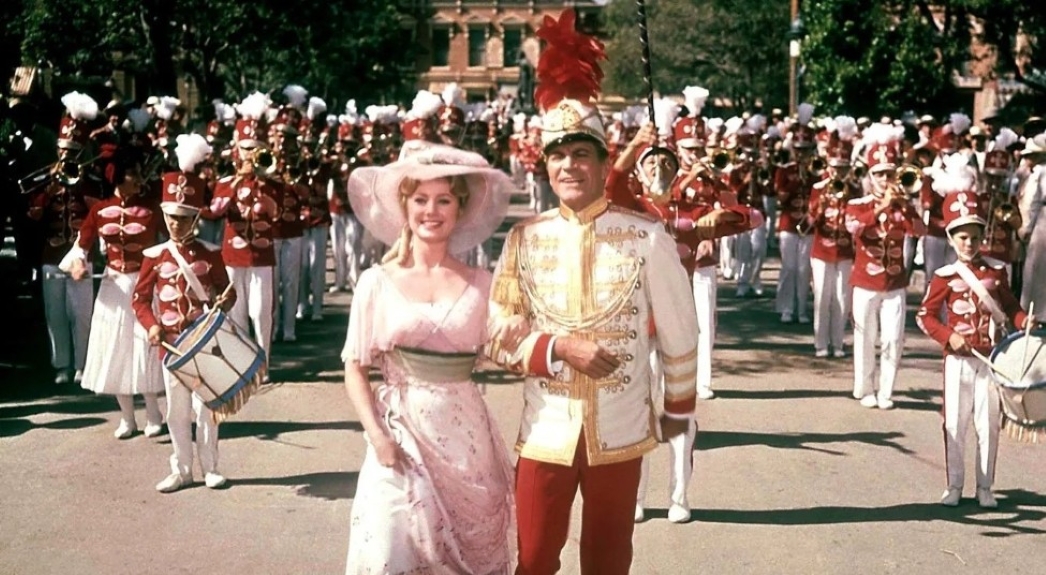
The Music Man (1962)

The Music Man (1962)

A star-turn and some good songs can’t quite make a shallow, over-long musical really work

Director: Morton DaCosta

Cast: Robert Preston (Harold Hill), Shirley Jones (Marian Paroo), Buddy Hackett (Marcellus Washburn), Hermione Gingold (Eulalie Mackechnie Shinn), Paul Ford (Mayor George Shinn), Pert Kelton (Mrs Paroo), The Buffalo Bills (The School Board), Timmy Everett (Tommy Djilas), Susan Luckey (Zaneeta Shinn), Ron Howard (Winthorp Paroo)

The Music Man is an ever-popular Broadway smash, the sort of charming, light, fun-filled musical with some good songs that makes it undemanding fun. It doesn’t, honestly, gain anything on screen – in fact, if anything, it’s fundamental lightness and lack of emotional or thematic substance gets rather exposed. The movie version may be ridiculously over-extended and frequently feel more like a slightly up-market filming of the Broadway production, but it’s still got some fine songs the best of them delivered with absolute aplomb by Robert Preston, masterfully recreating the Broadway role he had played nearly a thousand times already.

Preston plays Henry Hill, who arrives in the town of River City in Iowa in 1912 determined to sell instruments and uniforms to form a children’s band. Or at least that’s what he says he’s here to do: he’s actually a con man, whose plan is to sell the concept to the town, get them to invest, pass himself off as a music professor and then skip town with their money. Inciting a moral panic over a new Pool club opening in the town corrupting the kids (it will be ragtime next!), he wins them over. But it’s not all easy-sailing: librarian Marian Paroo (Shirley Jones) suspects Hill is not who he says he is. To try and protect his scheme, Hill aims to seduce her. But will this relationship actually help him find a conscience?

It’s a feel-good Hollywood musical so… I’ll leave you to guess. The Music Man is an odd musical. In many ways, you can see it as a slice of nostalgia, with its gentle 1910s setting and portrait of small-town America as a gentle, easy-going place where everybody knows everybody else, nobody locks their doors and the most dangerous thing is a pool table. But, at the same time, The Music Man frequently portrays its townspeople as staggeringly gullible (no one doubts Hill’s ‘imagination’ method of learning – don’t practice, just imagine you can play an instrument and you can!) and very hostile to outsiders (Hill receives the coldest, most suspicious of welcomes when he first gets off the train, even before he has announced any plan). Then, when he is exposed, their plan to tar-and-feather him sounds dangerously close to a lynching.

Put frankly, I have no idea what The Music Man is trying to say about small-town life or really anything else, seeming to want to have its cake and eat it by making the townspeople both a joke and an idealist past we can aspire to. Each of the characters is, in any case, a reassuring cliché. From Shirley Jones’ librarian (a mousy, but independently-minded intellectual who has never been kissed) to her mother (a blowsy, loud-mouthed Irish-woman who just wants a good man for her daughter), to the Mayor (a puffed-up, self-important idiot) and his wife (an attention-seeking moralist grande dame) to its sweetly love-struck teens, every character more or less feels like a stock figure carefully placed for comic or emotional impact.

It also rather fudges the semi-redemption arc it feels like its aiming for with Hill. He brings back memories of Elmer Gantry (the presence of Shirley Jones – here cast to type as the sweet, virginial mark rather than an infuriated floozy – also helps with this), and you can see a certain similarity between that shameless opportunist and this egotistical showman determined to make an immoral buck. The Music Man, I think, wants to show Hill’s conscious growing as he gets closer to the townspeople: it’s slightly under-mined by the fact it continually plays the townspeople as jokes and Hill’s character has no real depth (he remains, more or less throughout, a friendly, amoral opportunist).

As such, it needs a surprisingly sudden pivot to give some genuineness to Hill (a few minutes before changing his mind, he’s literally joking about not leaving town until he’s earned the fruits of his seduction campaign by bedding Marian). The fact that this even vaguely works is largely due to Preston. In fact, almost anything that works is due to Preston. He had a Broadway triumph with the role, and Da Costa (director of the stage production) and writer Meredith Wilson insisted he got the role over preferred choices Bing Crosby, James Cagney and (most inexplicably) Cary Grant. And it’s great they did, because Preston is triumphant: magnetic, charismatic, funny and delivering the film’s best numbers with an energetic, sublime aplomb. His comic timing is perfect and he successfully makes a persistently lying, opportunistic shit immensely likeable.

He also nails the best songs. The Music Man may be slightly fudged in its themes and its exploration of its central character, but it does have some very striking, catchy musical numbers. ‘Ya Got Trouble’ (essentially an energetically sung, word-heavy, fast-paced monologue) is funny and brilliantly performed by Preston. Similarly, ‘Seventy-Six Trombones’ is a show-stopper from Preston and he brings real lyrical charm to ‘Gary, Indiana’. There are further fine numbers, from the inventive ‘Rock Island’ that opens the film (sung in imitation of a steam train) and ‘Shipoopi’ a high-kicking dance number.

This is all filmed with a decent competence but very little flair. Da Costa essentially re-creates his stage production with very little of the sort of dynamism and flair someone like Stanley Donen had. Da Costa also doesn’t accelerate the pace – the light plot stretches over a very long, two and a half hours (almost nothing really happens in the middle hour. Remove Preston from it and I’m not sure there would be enough there to hold anyone’s interest. In fact, with its shallow plot, lifting and shifting of an existing musical to a (more expensive) real location with no re-thinking of the material for a different medium and its over extended, epic run-time, you can sort of see in it the DNA that would go on to become some of the mega-flop musicals that would weigh down the studios in a few years. The Music Man was a smash hit (probably because when it works, it is fun) but many of those that followed would not be.

And, as a side note, I was stunned to find out, that this beat West Side Story to the Tony Award for Best Musical.

Doctor Dolittle (1967)

Doctor Dolittle (1967)

The biggest crimes of this musical disaster is that is both hugely dull and thuddingly charmless.

Director: Richard Fleischer

Cast: Rex Harrison (Dr John Dolittle), Samantha Eggar (Emma Fairfax), Anthony Newley (Matthew Mugg), Richard Attenborough (Albert Blossom) Peter Bull (General Bellowes), Muriel Landers (Mrs Edie Blossom), William Dix (Tommy Stubbins), Geoffrey Holder (Willaim Shakespeare X)

Sometimes you think a film can’t possibly be as wretched as its reputation says. And then you watch Doctor Dolittle. This musical monstrosity, charmlessly adapted from a series of children’s novels, nearly sunk 20th Century Fox, losing millions (but still gaining nine Oscar nominations due to relentless lobbying by the studio). It’s not aged well: syrupy, over-long, lacking in any magic and, most damningly of all, crashingly dull over its bum-numbing runtime. Nearly everything either went wrong or is wrong with this.

Its plot is both tediously straightforward and frustratingly vague. In 1845, in the postcard-village setting of Puddleby-on-the-Marsh, eccentric Doctor John Dolittle (Rex Harrison) has become fluent in every animal tongue there is. Some think he’s a crazy misanthrope – after all his house is packed with every type of animal you can name and he spends the day chatting to them and being rude to humans – but others think he’s charming. (Sadly, you may find yourself siding with the former.) He dreams of finding the legendary Great Pink Sea Snail (for reasons that are never quite clear) and eventually heads on a whimsical journey with some new-made friends.

Doctor Dolittle’s principal crime, perhaps the reason why it has so few defenders, is that it’s at heart a very boring film. It takes nearly fifty minutes for even a trace of the plot to kick-in, then it meanders around a side quest of returning a seal to the sea before rushing the final act about the Great Pink Sea Snail. Really nothing much happens, and the stakes feel tiny: there is the vague danger that the unflappable Dolittle might get banged up in an asylum and (I suppose) the outside chance the native tribe of the floating island they encounter might sacrifice them, but that’s about it. Essentially, the film assumes that to entertain the family market, a bit of whimsy, a lot of Harrison nodding and “I see”-ing to animals and a few tunes (some of which are hummable) was enough to keep the kids happy. It’s not.

Any poor child strapped down to watch this light-weight confection, puffed up with an epic run-time and large-scale sets, will find themselves wading through as much animal shit as the film’s stars did on set. There is, at a push, one memorable sequence in Doctor Dolittle: Richard Attenborough’s circus master launching into a high-tempo musical number as he marvels at the pushmi-pullyu Dolittle is trying to flog him (the animal itself is so painfully obviously the front of two panto horses stitched together, I can only assume Attenborough was stunned by Dolittle’s cheek). Attenborough sells the heck out of this (to be honest) bland ditty, committing no end to its high-kicking energy (I like to think Fleischer immediately thought “that’s the guy I need to play John Christie”).

Attenborough can’t really sing or dance but at least he can give a good impression of someone who can. Harrison doesn’t bother. Of course, Harrison was arriving on this fresh from the glory of My Fair Lady where he had worked out it was possible to become a rich musicals star by talking with a bit of rhythm. Doctor Dolittle is set up for him to do the same, talking through his numbers – the problem being none of them are as good as anything by Alan Jay Lerner (who was supposed to write this, before he pulled out). Harrison murders a series of songs that might just have passed muster with an actual song-and-dance man. The low-point is early on as “Talk to the Animals” degenerates to Harrison literally bellowing at point blank range to a field of sheep and cows.

Dolittle has been further set up for Harrison to coast by essentially retrofitting his character into Henry Higgins #2. Dolittle shares all of Higgins’ misanthropic, obsessive tendencies only this time without someone like Audrey Hepburn to make us like him. His character is infuriatingly inconsistent, not least in his attitude to animals. The guy respects animals so much, he won’t eat meat but is perfectly happy to sell the pushmi-pullyu to a circus but then rescues a trapped female seal from the same circus? (I really hope this isn’t due to any feelings he has for said seal. Harrison whispers what sounds suspiciously like a love song to the seal while it’s dressed as a lady, even kissing the poor animal. This is probably the only kids film you’ll see to softly imply bestiality is a way to live your life).

There isn’t really a single interesting or particularly likeable character in Doctor Dolittle. Presumably thinking every kids’ film needs a kid, Dolittle (and we) are saddled with William Dix’s Tommy Stubbins, the sort of vomit-inducing stage-school brat most kids actually watching the film would love to pinch lunch money from. Anthony Newley can at least sing and dance, even if he is stuck with a bland Orisih accent (not helped by Harrison’s envy on-set leading to several of Newley’s scenes being cut). Samantha Eggar is utterly hamstrung by playing a character whom no one involved in the film can decide is Newley’s love interest (age-appropriate) or Harrison’s (because he’s the star) so sort of makes her the partner of both of them (so Dolittle can also claim to be the first kids’ film that promotes polyamory, making it quite advanced).

Oddly the animals themselves feel like rather minor characters. I assume this is because the production wanted to use real animals (since the times it uses puppets, they are breathtakingly unconvincing) but real animals have the unfortunate problem of not being actors. The most prominent animal, an irritating macaw called Polynesia, talks fluent English anyway so the others hardly need Dolittle’s skills. This even caused a slight kerfuffle on launch: the promotion had led with pictures of Dolittle riding a giraffe, a scene first cut then hurriedly shoved back in as part of a pointless montage on the island, after complaints.

Most of all, Doctor Dolittle feels like a charmless chore to watch. Nothing is sweet, nothing is charming, the hero is frequently a stand-offish jerk and you get no sense anyone really wants to be there. Which is, apparently, the case as during its hideously long production, the animals caused nightmares (everyone got shat on multiple times, which at least prepared them for the film’s critical reception), the Wiltshire village used for the location collectively lost its rag as over-running shooting meant no trace of the modern world was allowed in for months on end, and Harrison (allegedly) behaved like a total tit (at one point Christopher Plummer was signed up to replace him, then paid his full agreed salary after Harrison agreed to continue).

Doctor Dolittle trudges, inevitably, towards its chocolate-box finale – but anyone still watching will surely long-since ceased to care about anyone or anything involved in this mess. A later stage adaptation did salvage some of Leslie Briscusse’s songs, but nothing else was saved from this disaster that killed stone-dead nearly everyone’s careers. It really is as bad as they say.

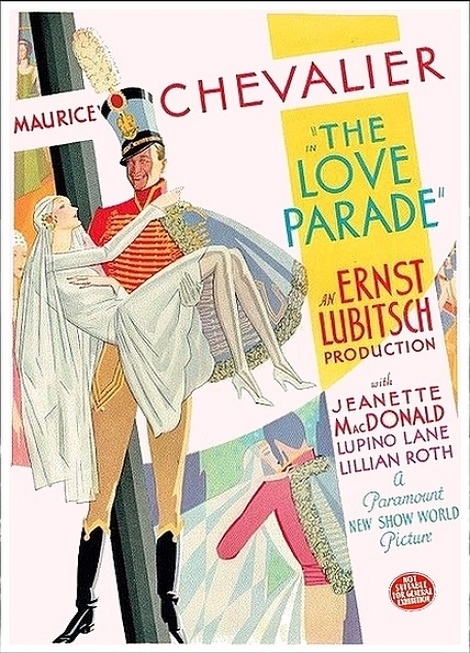
The Love Parade (1929)

The Love Parade (1929)

Lubitsch’s delightful early musical mixes European class with battle of the sexes wit

Director: Ernst Lubitsch

Cast: Maurice Chevalier (Count Alfred Renard), Jeanette MacDonald (Queen Louise), Lupino Lane (Jacques), Lillian Roth (Lulu), Eugene Pallette (Minister of War), E. H. Calvert (Sylvanian Ambassador), Edgar Norton (Master of Ceremonies), Lionel Belmore (Prime Minister)

Sylvania has a problem with its ambassador in France, Count Alfred Renard (Maurice Chevalier) – largely that he can’t stop seducing anything that moves. Renard is swiftly recalled to his homeland… where he catches the eye of young, unmarried Queen Louise (Jeannette MacDonald), who immediately thinks he might just be the man for her. Renard isn’t averse to marrying into royalty, but quickly finds himself chafing in the role of Prince Consort – this isn’t what marriage is supposed to be, the husband doesn’t defer to the wife!

It is of course a slightly dated version of marriage, and The Love Parade could be seen as a very light piece of Taming of the Shrew style-action where a strong woman learns true happiness is sometimes being the number two. The fact that, despite this, The Love Parade is still charming, funny and more than a little delightful is partly due to the immensely skilled lightness it’s directed with by Lubitsch (it feels the whole sweet confection could burst with a puff of strong air) and the huge charm of its leads. After all, Chevalier is no-one’s idea of a Petruchio while Jeanette MacDonald manages to marry up romantic longing with being tired of the restrictive burdens of royalty, that you believe she’d be happy to share some of it out.

The Love Parade was one of the first ‘talkie-musicals’ and it’s assembled with such pace and energy by Lubitsch (at his very best) that you almost don’t notice how often its forced into static framing for the talking and singing (where couples frequently sit or stand opposite each other to burst into song). That’s because the film is awash with swift intercutting between different locations, often to great comic effect (not least cut aways to groups of ministers, soldiers and servants excitedly commentating from afar on the lead’s first date) and intermixes this with smoothly seductive tracking shots through grand Habsburg-style sets.

Lubitsch’s film however uses sound effectively and remarkably imaginatively. Establishing his confidence with it, it opens with us overhearing dialogue from outside a room before the door swings open and we see Chevalier stride in and confide directly to us. Sound is used throughout for comic effect, either in its presence – the highly suggestive ‘400 cannon blasts’ on the night of the wedding or the frustrated drumming of fingers on the table our happy couple do in the midst of an early row to the awkwardly quiet march-past of a group of soldiers trying not to disturb the Queen’s lie-in. It’s creative stuff, considering the limitations at the time, and bounces effectively off the parade of songs and witty dialogue that powers the film.

Alongside that, the film works because it’s such an interesting exploration of social mores and etiquette, not to mention a cheeky love of the sort of content code-Hollywood would have frowned on. The opening sequence revolves around the aftermath of one of Renard’s seductions, with shots of garters, a furious husband and a gun loaded with blanks (Renard seems to have a drawer full of these for just such occasions). Queen Louise is all too clearly extremely aroused by reading about Renard’s string of sexual conquests, immediately running into her dressing room to apply more make-up before she can greet him with all the coquetteish excitement she can manage.

There is innuendo throughout (“My wife has told me everything” one of Renard’s embassy colleagues announces, something Chevalier’s face tells us is clearly far from true). Lubitsch uses visual humour expertly, cutting away from Renard’s delighted recounting of one of his adventures to a shot outside where we watch Renard and his audience talking silently from the other side a window, with only their reactions clueing us into how saucy the story is. All this is classic ‘Lubitsch touch’, which thrives among these gorgeously grand sets and costumes.

The Love Parade manages to keep us feel sympathy for the likeable Renard, not least once he discovers, as Prince Consort, his duties seem to be little more than shaving (because, as he tells Louisa, he looks terrible in a beard) and resting (so he’s nice and ready for the evening’s fun later). He literally can’t eat a meal until Louisa arrives to eat first (he’s reduced to plucking an apple from a tree to beat off hunger) and finds his advice is instantly handed back to him unread by one of Louisa’s many court flunkies. Sure, you’d prefer that The Love Parade works its way into a proper partnership at the end, rather than just reversing the power to it’s ‘natural order’ but at least you can see Renard has a point.

It’s interesting that a more natural partnership actually seems to develop between their two servants, Renard’s valet Jacques (Lupino Lane) and Louisa’s maid Lulu (Lilian Roth). Lane and Roth give energetically charming comedic performances – and also by far the most engaging and dynamic musical sequences. The highlight here is ‘Let’s be common’, that brilliantly uses Lupino’s double-jointed flexibility to stage the film’s most overtly entertaining number. There is a Mozartian quality to these super-smart servants – so much so, I’d willingly trade a few of Chevalier or MacDonald’s numbers for a couple more with them.

Which isn’t to disparage the stars. Chevalier’s comic skills are exploited to the max here – his reaction to ‘being shot’ in the opening sequence is a masterclass in timing – and it’s a part he invests with huge charm which sells Renard’s slight selfishness as genuine likeability. Lubitsch throws in a few neat gags about his accent, not least Renard’s penchant to voice his frustrations in perfect, rat-a-tat French to bewildered Sylvanians (he’s deeply disappointed when he asks one obstructive courtier if he speaks French only to get the answer ‘yes’). Jeannette MacDonald is also skilfully sharp and just frustrating enough, from her opening scene where she is poutishly pissed that he flunkies can’t find her a consort (despite the fact she doesn’t want one) to her mix of romanticism and imperiousness that runs through the film.

The Love Parade is an engaging and funny Lubitsch masterclass in his particular genre of sophisticated comedy, as well as a strikingly original use of sound and music. It remains engaging and entertaining today.

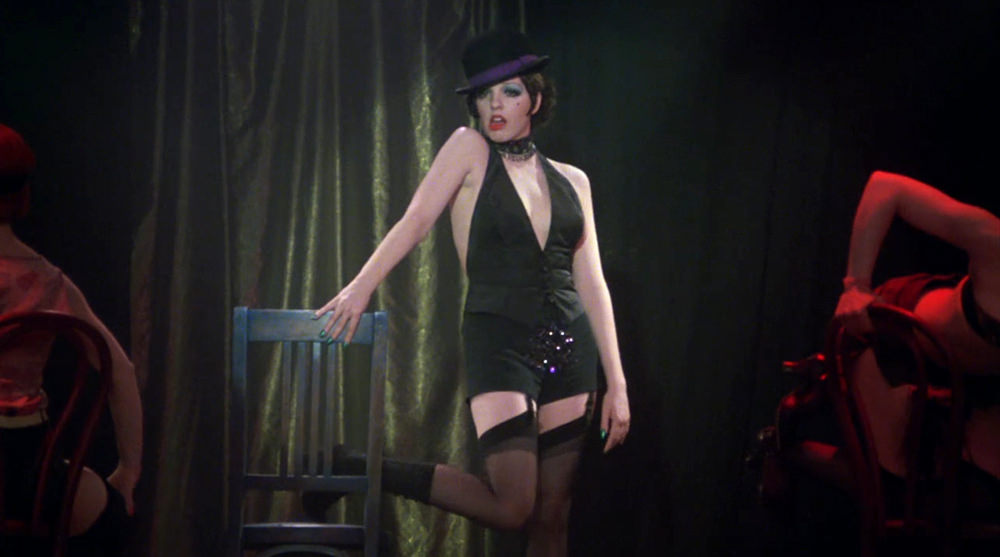
Cabaret (1972)

Cabaret (1972)

Fosse’s influential adaptation reinvents the musical into a superb exploration of sexuality and wilful blindness

Director: Bob Fosse

Cast: Liza Minnelli (Sally Bowles), Michael York (Brian Roberts), Helmut Griem (Baron Maximilian von Heune), Joel Grey (MC), Fritz Wepper (Fritz Wendel), Marisa Berenson (Natalia Landauer), Elisabeth Neumann-Viertel (Fräulein Schneider)

Some say Life is a Cabaret (old chum) – but they may well be closing their eyes to what’s really going on around them. Much harder to do that in Cabaret, a dark study of Weimar Germany, the quintessential time-period where everyone was so wrapped up in having a good time they failed to notice the world was beginning to burn down around them. Fosse’s version is a musical, but song and dance fills just over a quarter of the runtime. At its heart, it’s a character study of two young people in a particular time and place with very different perceptions of the dangers around them. It makes for a dark, inventive re-working of the Broadway original with Fosse stretching his wings into the sort of complex work culminating in the forensic self-examination of All That Jazz – and make Cabaret one of the most unique and exceptional of musicals.

Our Babes in 1931 Weimar Berlin are Sally Bowles (Liza Minnelli) and Brian Roberts (Michael York). Sally is a would-be superstar, plying her trade singing and dancing at the Kit Kat Klub. The host of erotic and blackly comic numbers there is the unsettling MC (Joel Grey). Brian is an academic, a reserved and very English young man with a preference for other men. Housemates in the same boarding house, the two become very close – and both very close indeed to happy-go-lucky Baron Maximilian von Heune (Helmet Griem). Sexual, romantic and emotional feelings ebb and flow while in the background the Nazis march relentlessly towards power along a path of violence.

Fosse was desperate to direct Cabaret, a film he felt certain would be a hit– and producer Cy Feuer was keen to bring his raunchy, dynamic choreography to the seamy world of the Kit Kat Klub. But Fosse also wanted to do something very different to the original musical. He wanted to return more to it literary roots, the semi-autobiographical works of Christopher Isherwood. He also felt, based on his experience directing Sweet Charity, that realism and bursting into song didn’t work. So the original script was jettisoned in favour of a new story junking most of the musicals plot (and several key characters), change its male lead from a straight American back to a queer Brit and cut all but one song not inside the Kit Kat Klub, making them a commentary on the action.

It’s a master-stroke, making Cabaret both a compellingly staged musical, but also a dark social issues piece and exploration of sexuality. In fact, you could watch Cabaret and wonder if Fosse didn’t really want to direct a musical at all. His heart, I feel, lies in the increasingly sexually charged and fluidic relationship between the three lovers at its heart: Sally’s vivacious enthusiasm, Brian’s careful guardedness and Maximilian’s shallow glee. It’scaptured beautifully in a late-night drinking scene in Maximilian’s palatial house, with the camera sensually close as the three dance together, their lips inches away from each other, the desire bubbling between them.

There’s a striking comfort with sexual freedom in Cabaret. Brian’s homosexuality – or bisexuality after he and Sally together discover his previous disastrous liaisons were clearly with “the wrong three girls” – is treated unremarkably by all: after all the Kit Kat Klub has its share of drag queens (one of them sharing a telling look with Brian after they surprise each other at the urinal). It’s all part of a wider bohemian lifestyle, exemplified by Sally who is always dreaming that a big break is just around the corner. This is the decent, brave and accepting side of Weimar Germany.

But Cabaret is also about the danger all around the characters, which too many of them ignore. Brian is the most conscious and politically aware, for all his English reserve. But Sally’s major flaw is that she chooses to pretend it’s not happening. Minnelli’s gorgeous rendition of ‘Cabaret’ at the end is so often seen as a triumphant embracing of life on her own terms, that its overlooked Sally performs it having decided to turn her back on broadening her own life outside her comfort zone and is singing to a room increasingly full of Nazis who will stamp out the very life she’s dreaming about.

Sally is bought to life in a superb, Oscar-winning performance by Liza Minnelli. Minnelli’s singing is of course extraordinary – her rendition of ‘Maybe This Time’ is one for the ages – but she’s also superb at bringing to life Sally’s bubbly naivety and kindness while also suggesting the fragility and desperation to be liked under the surface. There’s something very innocent about her, for all her hedonism: her attempted seduction of Brian has the clumsy brashness of an over-eager virgin, and while instinctively keen to help others she’s clueless at dealing with real emotional problems (there’s a wonderful moment when Minnelli looks sideways in panic as Maria Berenson pours her heart out to her, as if trying to find a way to escape). It’s a gorgeous, endearingly sweet performance – and perfectly counterpointed by Michael York’s career-best turn as the sharp, gentle, thoroughly decent Brian, with his own unique moral code.

Around them, Fosse uses the musical numbers to darkly comment on the action, helped by the demonic feel of Joel Grey’s sinister MC (the first real shot of the film is Grey’s face looming up from below to flash a Lucifer grin), whose manner becomes increasingly cruel, Fosse cutting to brief shots of him knowingly grinning as the dangers of Nazism become increasingly hard to avoid. Grey (who originated the part on stage) has a look of Joseph Goebbels about him, and it’s hard not to feel he’s some sort of manic sprite given even more life and energy as the world fills with horrors around him.

The musical numbers are extraordinary, brilliantly assembled by Fosse and full of seedy glamour – there is a gorgeous shot in ‘Willkommen’ when the camera whips around the high-kicking chorus line that’s like a shot of adrenaline. They mix between the darkly funny – the troubling romantic longing of ‘If You Could See Her’ – and the gorgeously inventive, with the tightly choreographed movements of ‘Money, Money’. Grey is a crucial part of this, his charismatic singing and dancing burning through the celluloid – who can forget his cruel glee under the comic interplay of ‘Two Ladies’ – and the use of him as a cryptic chorus who never speaks except on stage is a master stroke.

From its early scenes, we are left in no doubt of the violence many are choosing to ignore. From a street lined with ripped up election posters which Sally and Brian stroll down, to cut aways to stormtroopers brutally beating opponents, we can’t escape the inevitable death of this happy-go-lucky world. It’s also Fosse’s masterstroke to make the only musical ‘number’ outside the Klub not only goose-bumpingly powerful but also a skin-crawling piece of Riefenstahl-framed Nazi triumphalism.

Cabaret superbly captures in this one moment the seductive power of Nazism. As an Aryan boy sings ‘Tomorrow Belongs to Me’ (a slow camera pan reveals his SA uniform) at a beer garden, gradually the crowd joins in. The song builds into a resounding crescendo, people’s faces beaming with pride, full of fixed fanaticism, all of them sharing a special, powerful moment of belonging. Fosse’s unbelievable nerve is to present this utterly straight (someone with no knowledge of Nazism would be deeply moved watching it), making its seductive power even more chilling: because you can’t watch without also feeling a nausea inducing feeling of goose-bumps.

Hard not to agree with Brian when he wryly asks the smug Max whether he’s still sure the Nazis can be controlled. (Max parrots the upper class view that the Nazis are useful tools for getting rid of the socialists). It’s much easier for us to understand why Fritz Webber’s scruffy charmer Fritz (hiding his scuffed shirt cuffs) is scared of revealingly his Jewish heritage, even if it’s all he needs to do to win the love of Marisa Berenson’s shopping mall heiress. You don’t want to pop your head over the parapet in this world.

What’s clear in this superb film, is we can applaud the characters only so far: after all they decide to avoid the obvious that hedonism must be put aside to see the world for what it really is. There is a tragedy, in Sally in particular, that she can’t or won’t do this. As beautiful as her optimism is, it eventually becomes wilful blindness. This is part of what makes Fosse’s extraordinary film one that transcends its source material to become something truly unique. It’s a calling-card of a great director.

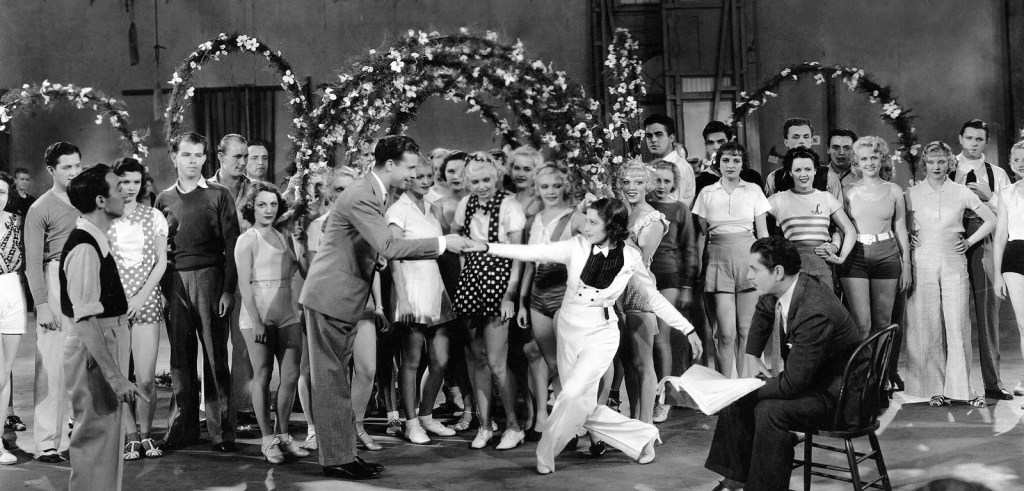
42nd Street (1933)

42nd Street (1933)

Less a musical, more about a musical – but a delightful love letter to the joy of theatre

Director: Lloyd Bacon

Cast: Warner Baxter (Julian Marsh), Bebe Daniels (Dorothy Brock), George Brent (Pat Denning), Ruby Keeler (Peggy Sawyer), Guy Kibbee (Abner Dillon), Dick Powell (Billy Lawler), Una Merkel (Lorraine Fleming), Ginger Rogers (Anytime Annie), George E Stone (Andy Lee), Ned Sparks (Barry), Robert McWade (Jones), Allen Jenkins (MacElroy)

Jones and Barry are putting on a show! The cry lights up Broadway (in an impressively staged series of quick-cuts, cross fades and super-impositions of the excited souls). And 42nd Street is all about the creation of that show, from the signing of the contracts to the opening night and the spontaneous making of a star. If it feels, watching 42nd Street that it’s made up of nothing but theatrical cliches… then it’s because most of them became cliches from excessive re-use after 42nd Street showed they worked so well – and made such a hugely entertaining film along the way.

The show is Pretty Lady, to be directed by Julian Marsh (Warner Baxter), the finest director (and friendliest tyrant) on Broadway who needs the money after losing a packet in the Crash. He’s not the only one struggling in Depression-era America: the competition to land a job as chorus girl is fierce. So, it’s a lucky chance that debutante Peggy Sawyer (Ruby Keeler) lands a gig. The star is Dorothy Brock (Bebe Daniels), a vaudeville veteran trying to make it as a serious Broadway actor and currently the squeeze of the shows’ wealthy financier Abner Dillon (Guy Kibbee) – although she is still seeing her old partner Pat Denning (George Brent). But will Dorothy make it through the drama to opening night – or will Peggy need to step up to save the day?

It’s not a surprise that of course she does, but then Julian’s final words to her (“You’re going out a youngster, but you’ve got to come back a star!”) is the film’s most famous moment. As well as launching a thousand backstage dramas, 42nd Street is remembered as a musical. But there is actually precious little music in it. We have to wait almost 45 minutes before the first song (Dorothy’s rendition of ‘You’re Getting to Be a Habit with Me’) and the final fifteen until we see the bulk of Busby Berkeley’s choreography. Other than that, this is very entertaining soapy, backstage drama with romantic entanglements. It’s a more film about the stressful theatrical alchemy involved in making a musical, rather than a musical itself – there is no ‘putting my feelings into song’ here.

And it’s taking place in Depression-era desperation. Everyone needs a job – that’s why they are so excited about hearing there is a show in town. That plays into the family atmosphere behind the scenes. After all everyone needs the show to be a success, and if that means roping in a few gangsters to get a wayward star back into line so be it. Much like, in fact, 42nd Street itself, coming to the screen after a glut of musical flops (perhaps that’s why there is so little actual musical content in it). The film zeroes in refreshingly and lovingly on the hard work, dedication and family atmosphere that can grow up in theatre, where everyone is working towards a common goal – and why I, a veteran of more than my share of putting a show on, felt a real soft spot for it growing.

And there is support, for all the bitchy moaning behind the scenes. Julian Marsh may tyrannically insist on absolute perfection – rehearsing through the night, waking the piano player when needed – but, it’s all to service a common goal. When emergency hits, the company flocks around and support each other. When one of their number triumphs there will be more congratulations than there are jealousies: even Dorothy will lay aside any personal feelings to support the new star. 42nd Street really captures the sense that behind the curtain in the theatre a little world of its own is created, one which can be very loving in its own unique way.

It’s also a world, with more than a few sexual escapades, something hard to overlook in a film as full of chorus girl’s legs as this (the chorus girls are largely hired on the basis of how good those legs look). Dorothy is effectively trading her favours for a career leg-up from the clueless Dillner, while sticking with true love Denning. Denning, jealous, conducts his own speculative flirtation with Peggy (in a fun sequence, her landlady throws her out for daring to bring Pat home for a coffee – while behind her another chorus girl smuggles out her lover with an illicit kiss). Anytime Annie didn’t get her nickname for her dancing, Lorraine is happy to leverage her relationship with dance director Andy Lee and Lee himself (it’s implied) is the willing subject of Julian’s attentions.

In the midst of this, poor Peggy feels rather naïve. Sure, she may be bouncing between unlooked for attentions from a young member of the company and leading young man Dick Powell, but a passing possibility of romance with George Brent’s cuckolded partner (in every sense) to Bebe Daniel’s star leaves her flustered. Brent’s intentions may well be noble, but left alone with him in his apartment, Peggy is sweetly nervous and locks her door after she is chivalrously conveyed to the spare bedroom by Brent, as if scared she may give into temptation. Hilariously they are only in his apartment, after his calling on her is mistaken for a dalliance by her landlady, who throws them both out while boasting she never misses a trick – all while, in the back of the shot, another tenant quietly ushes her beau out of the door.

All of this gives some lovely opportunity to its actors, and there are several delightful turns in 42nd Street. Not least in the chorus, where Una Merkel has a wonderfully playful flirtatiousness and Ginger Rogers gives her monocle-clad Anytime Annie a rogueish sexiness. Guy Kibbee’s moronically uncultivated sugar daddy gets several good laughs at his boorish cluelessness. If Ruby Keeler at times seem a bit unnuanced as the lead (there has long been some rather mixed feelings about her slightly heavy-footed dancing) and Dick Powell is eminently forgettable as her love interest, there is more than enough class from Baxter’s stressed out director, George Brent is very fine and Bebe Daniels invests Dorothy Brock with just enough vulnerability under the diva exterior to always leave you rooting for her (she is, after all, just as desperate for work as the meanest chorus girl).

It’s a film put together with flair – the early montage is pacily and flashily assembled – and a great deal of wit (producer Darryl F Zanuck and Berkely often gain the lion’s share of the credit for its pace, wit and zip although I feel some credit must go to experienced director-for-hire Lloyd Bacon). The final dance numbers are expertly done and very well filmed by Berkely, including a point where the camera glides under a parade of leg arches. But above all, it’s a heart-warming and witty tale that pulls back the romantic curtain of theatre to reveal – well an equally romantic view of the camaraderie and magic that brings a show to the stage. But it would be a hard heart that could not find something to smile at here.

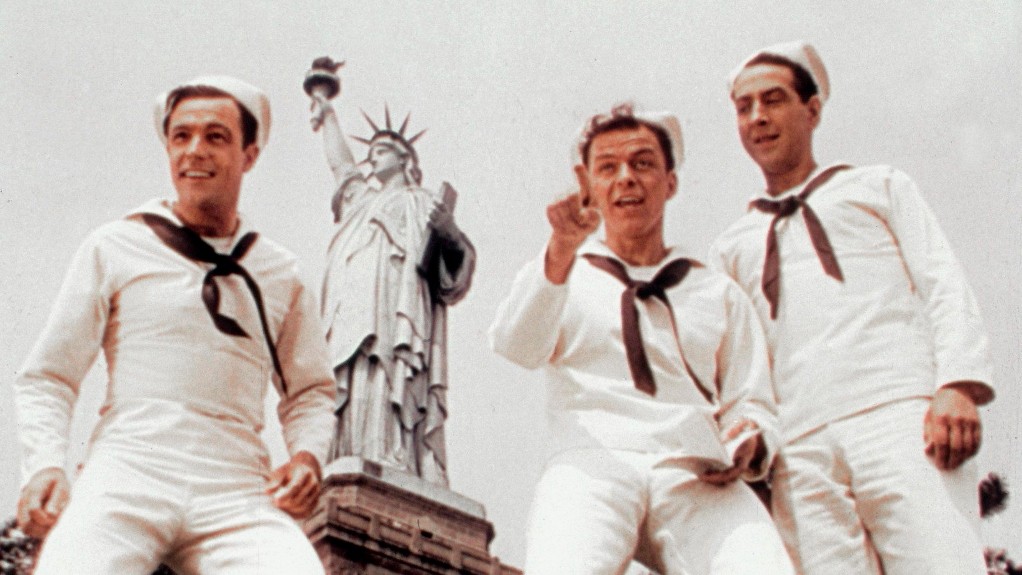
On the Town (1949)

On the Town (1949)

Hugely enjoyable musical, fast-paced, funny and crammed with excellent song-and-dance routines

Director: Stanley Donen, Gene Kelly

Cast: Gene Kelly (Gabey), Frank Sinatra (Chip), Betty Garrett (Hildy Esterhazy), Ann Miller (Claire Huddesen), Jules Munshin (Ozzie), Vera-Ellen (Ivy Smith), Florence Bates (Madame Dilyovska), Alice Pearce (Lucy Shmeeler)

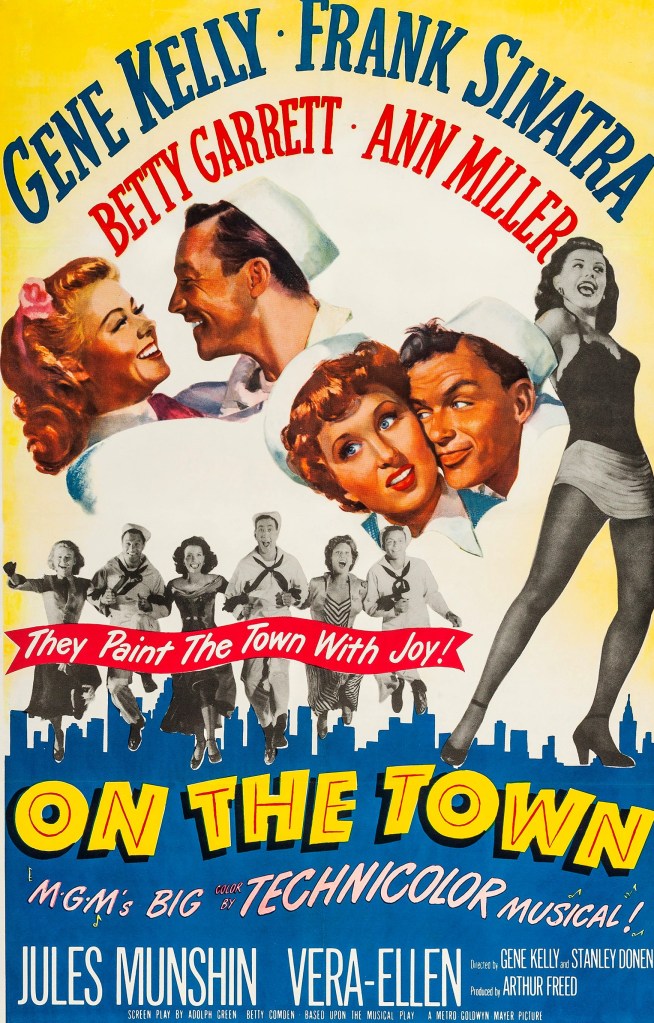
I assume Freed, Donen and Kelly re-watched Anchors Aweigh and said ‘There’s a good idea in here… but we can do better’. They certainly did with On the Town – and it surely helped that they seized on Leonard Bernstein’s hit Broadway musical with its book by Betty Comden and Adolph Green, for a pacier, funnier, more focused version of a very similar story. Once again, Gene Kelly and Frank Sinatra (now accompanied by third banana Jules Munshin) are sailors enjoying leave (this time in New York) and looking for romance. And they find it, with Gabey (Kelly) star-struck by Vera-Ellen’s Ivy Smith (who he mistakes for a celebrity), Chip (Sinatra) falling for flirtatiously voracious taxi-driver Hildy (Betty Garrett) and Ozzie (Menshin) inexplicably charming glamourous anthropologist Claire (Ann Miller). These three couples spend a fab 24 hours, getting in-and-out of scrapes and falling in love.

It’s all gloriously entertaining, zipping by in 90 pacey minutes with assured, dynamic and engaging direction by Stanley Donen that crams the film with zip and an enormous sense of fun. Donen’s first credit saw him handling much of the visuals and camerawork, while co-director Kelly took on the choreography. It made for a fantastic teaming, and it’s striking how much energy and visual panache Donen bought to the musical (again, compared to the more staid direction and visual compositions of Anchors Aweigh). Donen cuts the film tightly, never lets scenes out-stay their welcome, cuts tightly to the beat (the opening song New York, New York shifts excitingly from location to location during its performance) and crafting visual set-pieces that were exciting to watch (crane shots, tracking shots) while never compromising the view of the dancing.

On the Town also had the advantage of some fabulous source material. Interestingly, Freed and musical director Roger Edens were sceptical about whether Bernstein’s original score (with its artful repeated refrains) was accessible enough to appeal to audiences (not to mention many of the numbers in the musical were not a good fit for their cast). It was decided to junk a huge portion of Bernstein’s score (only four songs remain), a decision that led to him boycotting the film – but meant they could combine the best of his work with the sort of song-and-dance material that played to its star’s strengths.

And the film has several stand-out sequences, most notably of course that ‘New York, New York’ opening. Kelly and Donen pitched heavily to be allowed to shoot on location in New York and were granted ten days of location footage. It makes a huge impact to the number, allowing Donen to give it a grounded and vibrant mood. On the Town helped set the template for future films for fast-paced location shooting in bustling locations: driven by the fact Sinatra’s fame meant inconspicuous camera set-ups for quick shots was essential to avoid attracting crowds. (The only scene that shows the problems the film had with longer set-ups was the shot of the gang dancing in front of the Rockefeller centre, the balcony above the statue packed with rubber-necking fans).

There are also great song-and-dance scenes which utilise the strength of all the film’s performers. ‘Prehistoric man’ is suitably zany, ‘You’re awful’ a lovely song-showcase for Sinatra and Garrett, ‘On the Town’ and ‘You Can Count on Me’ fantastic toe-tapping showcases. It’s a parade of hugely engaging, dynamic musical numbers which are immensely fun to watch. It’s more than enough to make you forgive Kelly’s continued desire to prove himself a ballet dancer (On the Town shoves in a day-dream, silent ballet set-piece ‘A Day in New York’ which is an impressive showpiece for Kelly, even if it’s the only number that slows the film down rather than keeping the comic and narrative pace up).

On the Town also has a punchy series of funny lines, clever comic set-pieces and jokes from Comden and Green (it’s Dinosaur/Dinah Shaw mishearing gag is a real stand-out). Of course, narratively On the Town is completely barmy, much of the drama revolving around Ozzie’s accidental destruction of a Brontosaurus skeleton in the Natural History Museum and a resulting on-and-off again Keystone Kops style series of chases. The film zips along with such pace and wit that you happily swallow bizarre ideas (such as Ozzie, in a surprisingly vertigo inducing moment, hanging off the side of the top of the Empire State Building) and shameless coincidences.

But it’s knock-about fun and zany, nonsense plotting actually makes it all the more entertaining to watch. The film’s constant reminders of how far we into this strange 24-hour leave period works very well to give a sense of momentum to events and there is a more than a bit of Hays Code baiting naughtiness, not least in the clear implication that Chip and Hildy (in particular) and Ozzie and Claire spend most of the afternoon going at it great guns while claiming to Gabey that of course they spent the time searching the libraries and museums of New York for Ivy.

On the Town has its cast of musical stars nearly at their peak. Kelly’s dancing and choreography is energetically perfect as always and he fully embraces the charismatic romantic naivety of this would-be player Gabey. Sinatra is much more assured and comfortably witty than in many other musical roles. He also has excellent chemistry with Betty Garrett’s hilariously eager Betty. Ann Miller is wonderfully endearing and funny as Claire. Alice Pearce is surprisingly affecting in a role that initially suggests it might be a one-joke loser, as Ivy’s blousy single flatmate. Vera-Ellen may not have the charisma the role needs but is very sweet. Only Jules Munshin is trying too hard with some aggressively enthusiastic gurning.

Kelly later said On the Town might not have been the best musical they ever made, but it was the one when pretty much everyone involved was at the peak of their powers. He might well be right. On the Town is a slick, sleek and highly enjoyable confection that makes for perfectly entertaining Sunday afternoon viewing.

Anchors Aweigh (1945)

Anchors Aweigh (1945)

Classic musical frequently overlong and under-plotted with fun moments but dwarfed by later films

Director: George Sidney

Cast: Frank Sinatra (Clarence Doolittle), Kathryn Grayson (Susan Abbott), Gene Kelly (Joe Brady), José Iturbi (Himself), Dean Stockwell (Donald Martin), Pamela Britton (Brooklyn), “Rags” Ragland (Police sergeant), Bill Gilbert (Café manager), Henry O’Neill (Admiral Hammond)

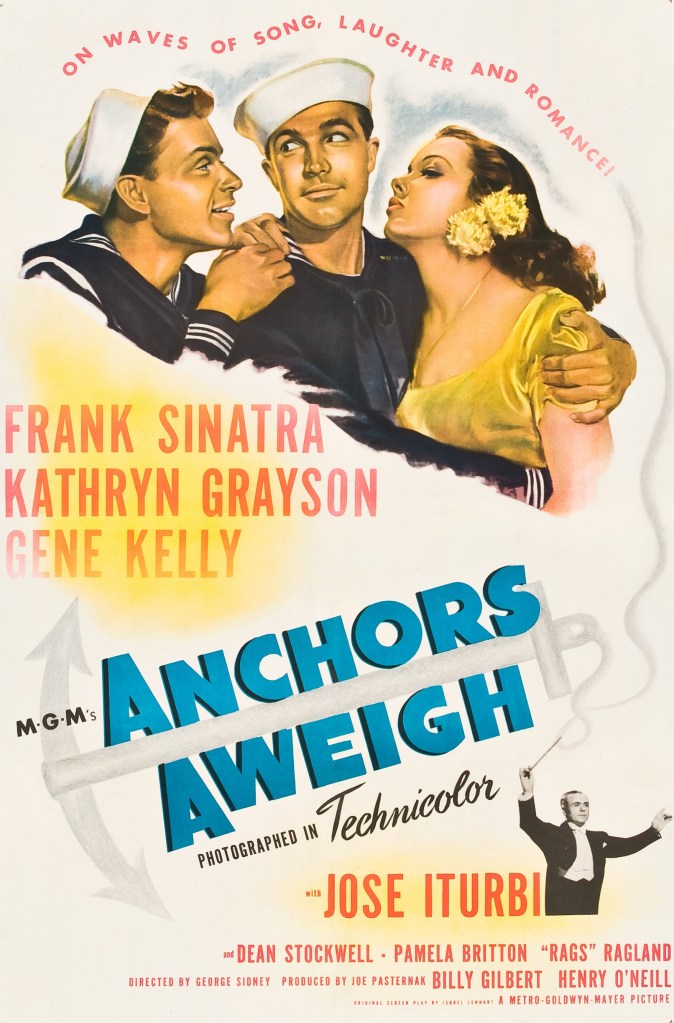
US Navy sailors Clarence (Frank Sinatra) and Joe (Gene Kelly) win medals and shore leave all on the same day, and head to the streets of Hollywood looking for a good time. But, Cyrano-like, Joe finds himself helping Clarence court would-be Hollywood actress Susan Abbott (Kathryn Grayson), whom he secretly wouldn’t mind whispering sweet nothings to himself. Just as well the naïve, never-been-kissed Clarence finds an instant spark with café waitress Brooklyn (Pamela Britton). But can the boys deliver to Susan the audition they’ve promised with esteemed MGM musical director José Iturbi (playing himself)? And can true love find a way through?

It certainly can, but it takes a very, very long time for it to do so. Anchors Aweigh was a big hit, scooping several Oscar nominations (including Kelly’s only acting nomination). But today it feels like a self-indulgent pilot for far more successful (and considerably shorter) Freed musicals that followed. The concept of Sinatra and Kelly as shore leave sailors was recycled in On the Town while a peak behind Hollywood’s curtain was obviously used far more effectively in Singin’ in the Rain. Compared to these two, Anchors Aweigh feels bloated, massively over-staying its welcome while its incredibly flimsy plot is stretched out over two hours and twenty minutes (in that time you could watch most of both of its superior successors).

Anchors Aweigh is really a collection of short skits where the stars showcase what they do best: Kelly dances and Sinatra sings. Every so often they sing-and-dance together. The plot’s romantic shenanigans are solved easily and everyone ends with a beaming smile on their face. Instead, the film is almost exclusively remembered for its skits, most famously a very impressive fantasy sequence where Kelly dances with an animated Jerry (of Tom and Jerry fame). This five minutes or so of ingenious animation matched with Kelly’s charm and energy would make for a heck of a short film: which is what of course it really is, since it bears almost no connection with almost anything else in the film (Kelly is spinning a yarn about how he won his medal, suggesting he did it by teaching a lonely mouse king how to trip the light fantastic).

The finest points of this film are these sequences: but there are far too many of them, and many don’t match the same quality. On the positive side, we get some fine singing from Ol’ Blue Eyes, and Kelly and Sinatra dance two hugely enjoyable numbers together: We Hate to Leave where they tease their fellow sailors about all the great fun ahead for them on shore leave and I Begged Her a high-tempo number (which Sinatra took eight weeks to master) as the boys brag about all the wild-antics we know they didn’t actually get up to the night before. Kelly gets a showpiece paso-tinged tap dance themed around Zorro which provides the film’s most impressive athletic stunts. On the negative side, Iturbi is given the scope for too many classical concerto excepts which dramatically slows the action (such as it is) down.

Problem is there is no cement to hold these moments together. The central plot is so flimsy, slight and utterly unsurprising, so completely devoid of conflict or drama, it seems designed to lull you to sleep between the set pieces. It’s not helped by the general acting weakness of much of the cast. Sinatra at this time was a stunning singer and surprisingly competent dancer but a very mediocre actor – amusing as it is to see him play a timid virgin who can’t get a girl. Kathryn Grayson gives a solid but uninspired performance, hardly charismatic enough to make you believe both men would fall for her so swiftly. José Iturbi is wooden as himself. Pamela Britton is so low on charisma, you hardly notice the film doesn’t bother to give her character a name. In his first major role, Dean Stockwell actually shows promise, even if his character is the sort of melt-your-heart child many audiences secretly find nauseating.

The real star here is the third billed Kelly, who nails the persona that would carry him through many films: the charismatic, sometimes glib charmer with the knack for comedic facial reactions who hides hidden romantic depths under a smooth exterior. Kelly is the motor of the whole film, with just the right light comic touch to keep things going, not to mention throwing himself into the film’s most memorable sequences. Every scene showcases his ability to pull a parade of witty facial expressions from bemused to long suffering to sheepishly guilty to exasperated. He’s the finest thing in a mediocre film.

A mediocre film is what Anchors Aweigh is, assembled with the sort of bland competence that was George Sidney’s calling card (compare his work here to the imagination and energy that Stanley Donen bought to pretty much the same material). It’s chief amusement now is chuckling at how certain set-ups now come across: the completely innocent homoerotic undertones between Kelly and Sinatra (although the film winks at this, when Kelly’s attempt to teach Sinatra to woo a girl sees him drawing glances as he minces down the street imitating the girl-next-door); the fact that Kelly’s unseen girlfriend Lola really sounds like she might be a sex worker; the tone-deaf decision of the boys to discourage Susan’s older (and, to be fair, predatory) suitor by singing a song about how she is the equivalent of the town’s bike; how completely chill everyone is about letting two random sailors take a small boy home alone. To be honest giggling at how these particular mores have changed over time is more amusing than most of this otherwise over-long, under-plotted, thuddingly average film.

Seven Brides for Seven Brothers (1954)

Seven Brides for Seven Brothers (1954)

Gentle fun from more innocent times, in an impressively high-kicking Western musical

Director: Stanley Donen

Cast: Jane Powell (Milly), Howard Keel (Adam), Jeff Richards (Benjamin), Julie Newmar Dorcas), Matt Mattox (Caleb), Ruta Lee (Ruth), Marc Platt (Daniel), Norma Doggett (Martha), Jacques d’Amboise (Ephraim), Virginia Gibson (Liza), Tommy Rall (Frank), Betty Carr (Sarah), Russ Tamblyn (Gideon), Nancy Kilgas (Alice)

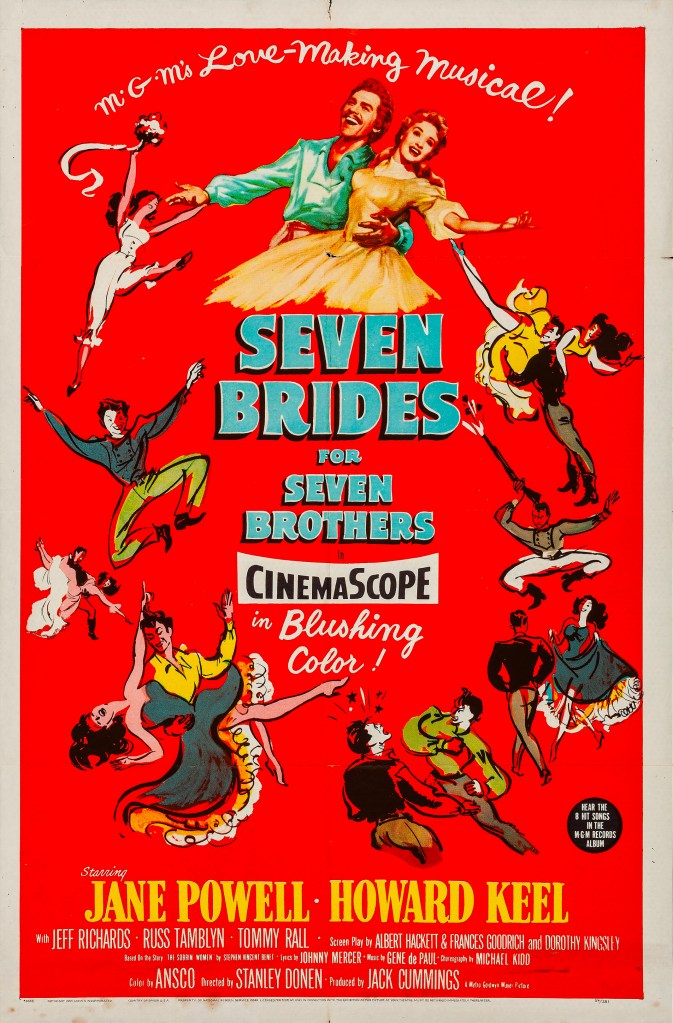
Glance at any list of odd things to adapt into a musical, and you might well find The Rape of the Sabine Women. You’ve got to admire the idea of shifting a Roman legend of horny menfolk grabbing armfuls of women from the Sabine tribe to carry them to Rome to make homes and babies, into… a primary-coloured, hi-kicking, cosy Western musical. Sure, parts of Seven Brides of Seven Brothers look rather awkward today but there is an innocent sense of good-fun (not to mention a sweet lack of sex in any frame) about the whole thing that still makes it rather charming today.

Out in Oregon in 1850, the Pontipee brothers are rough-living guys out in the sticks, who can’t imagine needing a woman in their lives, except maybe to cook and clean. That certainly seems to be what oldest brother, Adam (Howard Keel), has in mind when he marries Milly (Jane Powell). She is shocked to discover he sees her role solely in the kitchen and the laundry. Milly decides she’s not having this, pushing the brothers to clean up their home and acts. Much to their surprise, the brothers like clean living and fall in love with six more women in town (and they with them!). Shame they’re so inept at courtship they decide (much to Milly’s shock) the best way to get a wife is to grab a woman and bring them back home, just like those ‘sobbin’ women’ of yore.

You can see the trickier content there, but Stanley Donen’s film is so good-natured you can imagine its makers being baffled that anyone today could have an issue with it. We can address an elephant in the room: the kidnapping scenes – the Pontipee brothers throwing blankets over the women’s heads, chucking them over their shoulders and making for the hills – play uncomfortably today when framed for laughs. But these are men who, when they arrive home, are gosh-darn-it furious with themselves for not grabbing a priest so they could marry these women at once and immediately sleep in the cold barn to preserve the ladies’ dignities. Seven Brides for Seven Brothers is really a sort of fairy tale rather than a dance-filled Stockholm Syndrome drama, the beauties falling in love with the (not very beastly) beasts.

Take that mindset, and Seven Brides for Seven Brothers is gentle fun, more focused on its bright primary colours and superb dance sequences than any look at gender roles. Choreographed by Michael Kidd, the film is stuffed with imaginative showpieces showcasing the skills of its mostly professional-dancing cast. A pre-barn-raising dance turns into a competitive barn dance, with dancers throwing themselves into a myriad of possible positions, leaping over planks and swinging partners in wild circles (the film uses every inch of the Cinemascope framing – God alone knows what the 4:3 version Donen also had to shoot looks like). Every time the film kicks into dance mode, you are generally in for an impressively athletic treat.

The cast (except, noticeably Jeff Richards) are all strong dancers – or in the case of Russ Tamblyn so athletic it hardly matters – allowing Kidd to push the dance envelope. His choreography also conquers his initial concern: how believable would it be for rough-tough woodsmen like this to confidently trip the light fantastic at the drop of a hat? Its solved, in many cases, by using the sort of everyday jobs (like woodcutting in one single-take sequence) these boys would be doing as the framing device of the choreography. That and a wittily done sequence where Milly teaches her new brothers-in-law some basic dance steps only for them to find they actually enjoy kicking their heels.

Its one of several witty sequences, that serve to generally puncture for laughs the masculinity of this clan of brothers. Milly’s arrival, finding her new brothers-in-law are all strangers to the razor and the bath, then finds her tour of the house has to work around an on-going fight between these lads which her new husband all but ignores. By the time Milly is flipping over the dinner table after the brothers dive into her prepared meal with all the grace of a bunch of frat boys on a night out, you’re with her. In fact, Seven Brides could be a sort of Taming of the Shrew in reverse, where our heroine trains decency, politeness and basic interpersonal skills into the men. And, since Jane Powell’s firm-but-fair Milly is the most unfairly put-upon person in the film, we instantly side with her.

Instead, it’s Howard Keel’s (with his distinctive gloriously low voice) Adam who needs to be made to see sense: first to understand there is more to marriage than a servant-with-benefits, and secondly that other people’s feelings need consideration. Much of the drive for this change is Milly – the importance of her character being the main reason writer Dorothy Kingsley was recruited to bulk up her part from Albert Hackett and Frances Goodrich’s earlier drafts. Similarly, the seven brothers switch from punch-first braggarts to figures reminiscent of Snow White’s dwarfs in their eagerness to please Milly (even, during the barn-raising sequence, they politely back away from all provocations from the jealous townsmen until they are finally pushed too far by the townsmen’s rudeness to others).

In this framework, we are never in doubt that their brides-to-be are, in fact, not unhappy at being carried away by these men. There is no sense of danger in Seven Brides: no doubt that it’s not all going to turn out well. A large part of this gentle tone is due to Stanley Donen’s warm, witty direction. (Donen was heartbroken the budget wouldn’t stretch to Oregon location shooting, although the backdrops used throughout are hugely impressive). It generally looks like a film everyone had huge fun making – and that warmth, along with the brightly coloured shirt humble-pie-ness of it all, has meant it remains all jolly good fun today.

Emilia Perez (2024)

Emilia Perez (2024)

Controversial arthouse film which clumsily tries to do to many things, many of them not well

Director: Jacques Audiard

Cast: Zoe Saldaña (Rita Mora Castro), Karla Sofía Gascón (Emilia Pérez/Juan “Manitas” Del Monte), Selena Gomez (Jessi Del Monte), Adriana Paz (Epifanía Flores), Édgar Ramírez (Gustavo Brun), Mark Ivanir (Dr. Wasserman)

Sometimes a film comes along that manages to annoy everyone. Emilia Pérez seems to have achieved that unwanted goal. Jacques Audiard’s Cannes Jury Prize winner is a wild, audacious piece of film-making that misses as much as it hits. It’s also been bashed as a musical full of people who can’t really sing, denounced as transphobic, and savaged by Mexicans. Perhaps Emilia Pérez shows us the downside when an auteur French director works with Netflix who accidentally promote what would have otherwise been a little-seen arthouse film into the heart of a culture war. I don’t think Emilia Pérez intends to be racist or transphobic (but yeah most of the cast can’t sing), but it does deal with these issues at times very clumsily. It’s also a curious mish-mash that places a transitioning character in a traditional “hard-to-escape-your-past” plot.

That transitioning character is Emilia Pérez (Karla Sofía Gascón), formerly a notorious drug-lord. With the (initially coerced) aid of crusading lawyer Rita Mora Castro (Zoe Saldaña), Emilia succeeds in faking her death, moving her family to Switzerland to protect them, extricating a fortune from her criminal empire and flying to Israel for her operation. Four years later, Emilia finds she can’t live without her children and Rita is roped back into retrieve her wife Jessi (Selena Gomez) and kids and move them in with their “aunt” Emilia. Simultaneously Emilia, wanted to be cleansed of her criminal past, starts a foundation to “discover” the graves of those killed in Mexico’s drug wars. But returning to a world she left behind only makes it harder for Emilia to escape her criminal past.

Emilia Pérez: an Audiard crime story with songs! Audiard described it as an opera fantasia, and I feel it was his intention for nothing in it to be treated as traditionally “real”. The characters frequently burst into song or throw themselves into dream-like dance sequences to express complex feelings. Aside from the film’s explosive, guns-blaring conclusion, filmed on isolated, dusty, abandoned houses and roads, key scenes are tightly shot on sparse sets with very little back lighting, giving them a dreamy black-box effect. Emotions are as heightened as the (sometimes clumsy) lyrics and the film throws itself into every dialled-up event with a comic-book energy.

All of which means Emilia Pérez is an acquired taste and, like many ambitious films that zig when they should zag, fails as often as it hits the jackpot. Its finest scenes are the key song-and-dance numbers, all left in the hands of Zoe Saldaña (excellently torn between idealism, fear, cynicism and regret with complex feelings about her dubious employer). Saldaña is a dynamic and fearless dance performer, throwing herself into synchronised movements through a Mexican market in the film’s opening “El Alegato” and dominating the film’s central show-piece, an athletic, sensual dance around and over tables at a charity ball in “El Mal”.

But even Saldaña falls foul of the film’s largest musical failing: with the exception of Selena Gomez (who struggles with a Mexican accent so terrible, even non-Spanish speakers can tell it’s awful) no one in the cast can really sing. Criticism like that somehow feels shallow when you apply it to an arthouse film, but it’s legitimate. The cast largely go for fast-paced, Henry-Higgins-ish, rhythmic speaking, big on husky intensity but not exactly something you would sit and listen to. Gascón is a particularly poor singer, especially noticeable with the operatic high notes she is frequently given. Even the controversial AI-upgrade her voice was given in post-production can’t help her.

Throw into that the clumsiness of some of the lyrics. For a film dealing with as sensitive an issue as this, are lyrics like “Man to woman or woman to man? Man to woman. From penis to vagina” really a good idea? Is a song about Emilia’s son singing about how her smell reminds him of his Dad (body smell being a hot topic for this community) tasteful? Since this issue (the perception of bodily odours) is a key issue for the trans community, writing a whimsical song about it rather suggests Audiard and team didn’t really do enough to wrap their heads around controversial issues.

Perhaps that’s because Emilia Pérez is, at heart, a classic “just when I thought I was out…” movie that tries to spice up the formula by having its gangster character be a trans woman (the partial implication of a sex change being a type of disguise is another hot-topic issue the filmmakers should have got themselves familiar with). It does, I think, make for a fresh take to see even incredibly macho, hardened killers can have longings like Emilia – and Gascón’s performance is actually at its best showing the fear that lies below the aggression before Emilia’s transition, and when embracing her tearful joy at the success of her operation. But the point remains this is a film not looking to make a real statement on transgender issues, or even demonstrating any real interest in the experience of being trans. It is instead just using a trans identity as a new context for a familiar “starting a new life” storyline. With minimal changes, Emilia could have undergone extensive plastic surgery or gone into witness protection and it would have made few changes to plot or themes.

It is interesting to get a trans character who is not always completely sympathetic (although I get that the community find it a blow upon a bruise to finally get a film with a trans lead, and she’s as a morally questionable and unlikeable as this). Emilia’s desire to restart her life away from crime is fatally undermined by refusing to make the sacrifices needed. Slowly she drags her family back in (passing herself off, Mrs Doubtfire-like, as her own sister), reconnects with the criminal underworld (albeit for humanitarian reasons) and reverts to the threats and violence she used in her old life (when, let’s not forget, she had a plastic bag slammed over Rita’s head to motivate her).

Emilia Perez also never explores the outrageous moral stance of a murderer in a new life, using their knowledge to “help” their victims by “discovering” the graves of people she ordered put in the ground. In fact, the only person affected by Emilia’s past crimes whom the film shows her encountering is the widow of an abusive husband (who is actually grateful to the gangsters for saving her the trouble). It scrupulously avoids any contact with, say, a grieving relative of one of her past victims. Similarly, the film avoids engaging with Emilia’s appalling emotional manipulation of her family. Karla Sofía Gascón gives a committed performance, but she is not able to coalesce all these complicated feelings into a character that feels real and the film constantly veers awkwardly between giving her implied criticism and absolution.

Audiard offering not exactly the most flattering image of Mexico was the final nail in the film’s coffin, even if to be honest it’s his nationality as the face of a film about Mexico (Paz is the only Mexican involved) that has probably raised most hackles. Emilia Pérez has moments where Audiard’s impressive film-making stands out, a dance number captures your imagination or there is a flash of compelling acting. But then it will segue into the sort of scenes we’ve seen in hundreds of crime movies, or songs so out-there they raise the wrong sort of gasps. Emilia Pérez might not be intentionally trying to be racist or transphobic, but it certainly handles both themes with real clumsiness. Fundamentally, it’s a traditional plot told in an outlandish style, over-exposed into a world of criticism that Audiard (who has basically apologised if people don’t like the movie) and his collaborators just weren’t ready for. The film itself? Good moments, bad moments, but not worth all the fuss.