Category: Romantic comedy

Hello Dolly! (1969)

Hello Dolly! (1969)

Bloated, miscast and over-produced musical that nearly sank the genre and studio

Director: Gene Kelly

Cast: Barbra Streisand (Dolly Levi), Walter Matthau (Horace Vandergelder), Michael Crawford (Cornelius Hackl), Marianne McAndrew (Irene Molloy), EJ Peaker (Minnie Fay), Danny Lockin (Barnaby Tucker), Joyce Ames (Ermengarde Vandergelder), Tommy Tune (Ambrose Kemper), Judy Knaiz (Gussie Grander), David Hurst (Rudolph Reisenweber), Louis Armstrong (Band leader)

The old-fashioned musical had always been a winner for Hollywood. So, I guess it made perfect sense to pump $25 million (just over $200 million in today’s money) into Hello Dolly!. Reality didn’t agree though. Hello Dolly! was a massive box-office bomb which, despite its seven Oscar nominations (including Best Picture, due to intense studio lobbying) pretty much killed the traditional, Freed-style musical stone-dead. After this, musicals would have drama at their heart (like Fiddler on the Roof or Cabaret) and scale down the production numbers.

It also didn’t help that the mega-budget, colossal production values across its bum-numbing two-and-a-half hour run time ruthlessly exposed Hello Dolly! as a perilously slight story, in a way its years playing on Broadway hadn’t. Dolly Levi (Barbra Streisand) is a widowed matchmaker, hired by grumpy “half-a-millionaire” Horace Vandergelder (Walter Matthau) to find him a wife. However, Dolly rather fancies getting back into the game with Horace herself. Around them other parties flirt, such as Horace’s niece Ermengarde (Joyce Ames) with artist Ambrose Kemper (Tommy Tune) and his clerks Corenlius Hackl (Michael Crawford) and Barnaby Tucker (Danny Luckin) with fashion store owner Irene Molloy (Marianne McAndrew) and her assistant Minnie Fay (EJ Peaker).

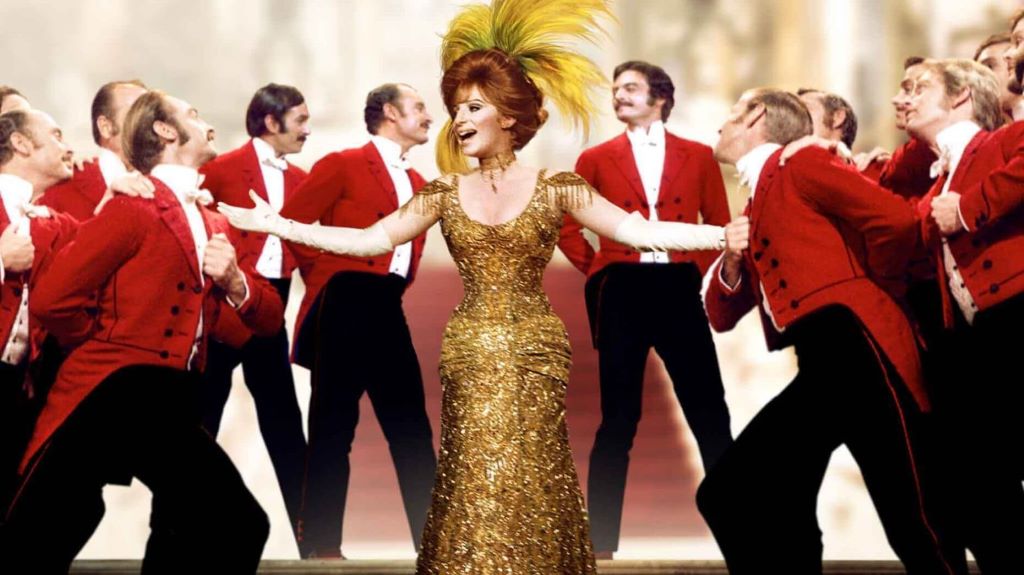
I’ll grant the scale and sets are impressive. Whole streets and parks were built. Grand, elaborate costumes (some of Streisand’s costumes cost thousands and thousands of dollars by themselves) add wow factor. If you believe “more is more” Hello Dolly! is for you, it’s Oscar for set design well deserved. But as you watch Streisand hit a high note in long shot while an entire parade of thousands takes place around her, you start to realise you’ve not formed a bond with the characters. When we finally get them all in one place (a crowded restaurant in New York) the best part of thirty minutes is taken up with three massive numbers (Dancing waiters! Streisand’s entrance number! Comedy foot-tapping from Crawford! Louis Armstrong cameo!) that piles so much stuff on, that you almost forget what the scene was meant to be about in the first place.

What this probably needed to be is a tighter, American in Paris style romantic comedy, the sort of stuff Arthur Freed would have run out in 100 minutes with a few set pieces. Instead, it’s a bloated mega-production with colossal sets, 12,000 extras, widescreen soaking up the action and vast, never-ending dance numbers that fail to progress either story or emotion. After being bludgeoned by balletic leaps, you suddenly realise not only has nothing much happened, but you are being asked to invest in the future happiness of characters you barely know and often hardly even like.

It’s not helped by the chronic miscasting of the leads. Barbra Streisand was the hottest star in town – the studio was (correctly) convinced mega-stardom was inevitable after watching the rushes of Funny Girl – but she is wrong on almost every level for Dolly Levi. A part intended for a slightly-over-the-hill widower in her late 40s, was barely retrofitted for a glamourous diva aged 26. Streisand, clearly painfully aware she was wrong for the part, struggles to work out how to play it. Sometimes she’s coquetteish, other times she goes for a mother-in-law largeness, most of the time she ends up channelling Mae West sauciness. While her singing is (of course) outstanding, she never looks comfortable. Equally out-of-place is Walter Matthau, whose grouchy comedy style never meshes with the tone of the film (although he has a great bit of business with a walking stick which he hammers down onto a table with such irritated force it almost rebounds and hits him in the face).

It also doesn’t help that Matthau and Streisand all-too-clearly can’t stand each other (their closing kiss is hilariously awkward – try replicating their physical positions to see how unnatural and unromantic it is). On set Matthau felt Streisand was too big for her newcomer boots while Streisand saw him as envious of her star quality. The two frequently fell into heated rows: this at least meant they fitted in naturally on a set where almost no-one got on. Streisand and Kelly’s working styles (both being demanding perfectionists) proved incompatible, Kelly stopped speaking to the official choreographer who also stopped speaking to the costume designer.

With the leads struggling, most of the film’s charm actually relies on its secondary leads. Hello Dolly! is, actually, an effective showcase for Michael Crawford’s physical dexterity (some would say recklessness) and his sweet romance with Marianne McAndrew’s charming Irene Molloy is the film’s emotional heart. It’s a shame both their film careers effectively ended here (though Crawford would go on to greater things on stage). Their dance number Elegance is one of the film’s most engaging while their duet It Only Takes a Moment is the simplest filmed and most moving moment in the film.

Bloat and bombast overwhelms the rest. Although Kelly knows how to shoot dancing – effective camera moves and having the dancers move towards the camera, increasing their dynamism is very well done – he’s far less suited to the character moments which Stanley Donen and Vincente Minnelli excelled at. The gags very rarely land, either because the timing is off or the camera is so focused on getting the mammoth sets in that the bits of business look like minor irrelevances.

Fundamentally, Hello Dolly! bet the house on throwing all the budget on the screen to wow audiences the way something like The Great Ziegfeld had over thirty years ago. But audiences needed an emotional connection with what they were watching. Hello Dolly spectacularly fails to deliver on this. What we were left with is a very slight story about matchmaking, basically a chamber piece with about six characters, transposed onto the sort of epic backdrop that makes Gone with the Wind look humble. The mismatch never works and the entire enterprise eventually collapses under its own gravitational pull. A box office dud that nearly sank the studio, the musical would never be the same again.

Steamboat Bill Jnr (1928)

Steamboat Bill Jnr (1928)

Keaton struggles to win his father’s approval in this brilliantly fast-paced farce

Director: Charles Reisner (& Buster Keaton)

Cast: Buster Keaton (William Canfield Jnr), Ernest Torrance (William Canfield Snr), Marion Byron (Kitty King), Tom McGuire (John James King), Tom Lewis (Tom Carter), Joe Keaton (Barber)

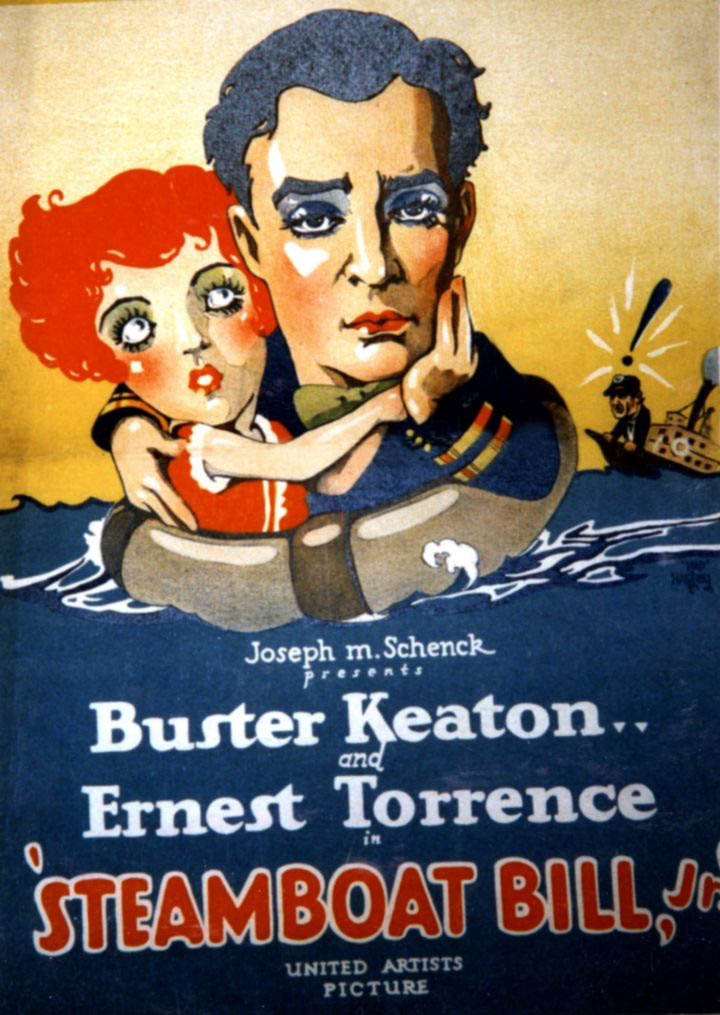
Steamboat Bill Jnr was meant to be a return to glory after the box-office disappointment of The General. Unfortunately for Keaton it shared all the traits of his previous film. An artistic triumph, today seen as one of the great silent comedies: but at the time an expensive misfire that hammered the final nail into Keaton’s filmmaking independence. Before he was swallowed by the MGM machine, Steamboat Bill Jnr was the last pure Keaton film, the last display of the master’s gravity defying stuntwork and all-in physical gag commitment.

Keaton is the forgotten son of paddle steamer operator William “Steamboat Bill” Canfield (Ernest Torrance) whose craft, the Stonewall Jackson, is being put out of business by the cutting-edge steamer The King named after its wealthy owner JJ King (Tom McGuire). William Jnr is a disappointment to his manly father: he’s clumsy, polite, decent has a pencil moustache (but not for long) and plays the ukelele. What kind of son is that? Worst of all, he falls in love with Kitty King (Marion Bryon), daughter of Steamboat Bill’s love rival. Can his son prove his worth when disaster piles on disaster and a cyclone hits the town?

Steamboat Bill Jnr is Keaton at his best. Although it has a romance plotline, this wisely plays second fiddle to the sort of role Keaton was born to play: slightly naïve and foolish sons, who are disappointments to their father. With his sad sack, impassive face and earnest, try-hard determination, Keaton was guaranteed to win the sympathies of the masses and Steamboat Bill Jnr is the fine-tuned ultimate expression of this classic Keaton role. He’s horrendously unlucky – he seems destined to trip over and activate vital levers or if he opens a door it will inevitable send someone tumbling off the boat – and at every turn well-meaning attempts to win his father’s favour backfire. It’s a superb exploration of a key theme in Keaton’s life and work – the struggle to win the regard of a domineering father in his own line of work, something Keaton had faced in his own life.

But despite that, like all the best Keaton heroes, he never, ever gives up. Adversity is milk-and-drink to him and, despite everything, his ingenuity and determination always wins out. He may look like a clueless, slightly ridiculous college kid adrift on a boat, walking around in his over-elaborate uniform: but the final reel, which shows him hooking up the boats systems via ropes and pulleys so he can control it singlehandedly proves it certainly wasn’t lack of attention that lay behind his mishaps.

And what’s really wrong with being a clearly middle-class kid who hasn’t spent much time on boats? It’s not like he’s a dandy or a layabout – he just doesn’t fit the mould his father expects – that of a flat-capped, oil-stained, tobacco chewer (and who knows not to swallow it!) never happier than when getting his hands dirty. Ernest Torrance is very good as this exasperated working-man, whose ideas of what counts as “manly” are very narrow (barely extending beyond the mirror) and sees any deviation in his son as highly suspicious metropolitan laxness.

Perhaps he feels his son looks too much like his puffed-up, slightly dandyish rival JJ King (an effective Tom McGuire). There is more than a touch of class warfare between these two, as well as a romantism that values the run-down-but-reliable Stonewall Jackson (right down to its Civil War era name) and the overly-polished-can’t-trust-it King. There are echoes (and not just in the names) in the generational family feud of Our Hospitality­ – not least in the fact that marriage seems destined to eventually bring the two families together in something approaching love and harmony.

Marion Byron gives a decent performance as Kitty – even if the film has little interest in her beyond love-interest device, including the inevitable moment where she becomes convinced Keaton’s character has let her down and decides to snub him. This snubbing takes place in a very funny scene of missed meetings and attempted evasions on the street; although this scene is itself a shadow of father and son meeting at the station, the son writing he will be recognisable by his white carnation, a flower everyone arriving at the train seems to be wearing (not helped by Keaton losing his).

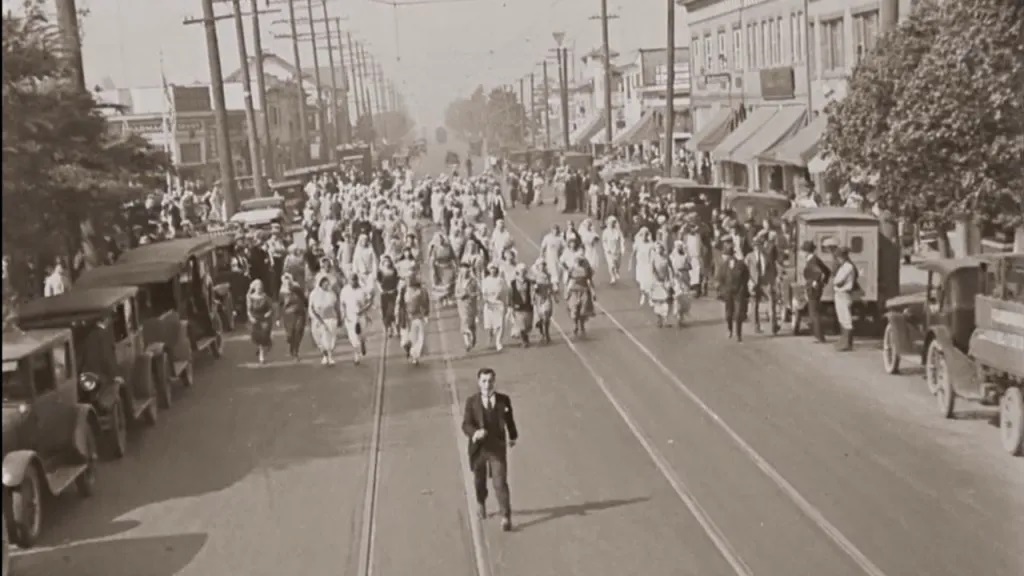
Eventually matters proceed to blows and the arrest of Canfield Snr (and an attempted break-out foiled by the son’s inability to get his father to trust him) before the town is blown away in one of the great Keaton set-pieces. Rain and bad weather peppers the final thirty minutes of the film – including an exquisite sight gag when Keaton steps into a puddle and disappears up to his waist – and erupts into a cyclone that rips buildings apart, blows others across fields and raises the waters to wreck the paddleboats and wash other buildings out to sea.

And this storm is the centrepiece of another peerless display of Keaton’s physical determination and courage in the name of comedy. He gets trapped in a hospital bed blowing through the streets (after the building rips away to reveal him, a stunning in camera trick). He walks at almost 45 degrees against the wind. And, most famously, he stands in the perfect spot for the window of the façade of a house to save him when it falls on top of him. For this final stunt – insanely dangerous by any standards – even Keaton would later reflect on the suicidal risks he took. Either way, it’s a brilliantly elaborate set-piece (a riff on another set-piece from an earlier short) and a clear sign no-one did better than Keaton.

And no-one did. Watching Keaton bound like a squirrel up and down a paddle boat and dive into the flooded river, you know you are watching someone who really understand both the beauty of visual imagery and the peerless excitement of reality on film. Steamboat Bill Jnr combines this with a strong story, full of characters to root for and stuffed with sight gags (from a parade of hats stuffed on Keaton’s head, to a shaving from his father Joe) that make you laugh time and again. It’s a tragedy that this, one of his finest comedies, would also be his last where he had creative control.

Seven Chances (1925)

Seven Chances (1925)

Sub-par Keaton comedy, remembered only for its chase scene, but otherwise best forgotten

Director: Buster Keaton

Cast: Buster Keaton (James Shannon), T Roy Barnes (Billy Meekin), Snitz Edwards (Lawyer), Ruth Dwyer (Mary Jones), Frances Raymond (Mrs Jones), Erwin Connelly (Clergyman), Jules Cowles (Hired Hand), Jean Arthur (Receptionist)

It’s the film Keaton didn’t care for – so much so he told a film restorer working on his films to essentially not bother with it. It was a play purchased for him by producer Joseph Schenck, rather than chosen by the physical-comedy gag-meister, who called it a “sappy farce”. Still, he did his best with it – and then some, since it became one of his biggest hits – and, if it’s far from a stand-out on his CV, that’s not Keaton’s fault. In fact, the only parts of the film anyone remembers are all due to Keaton alone.

The plot follows businessman James Shannon (Buster Keaton). He finds out from a lawyer (Snitz Edwards) that he is to inherit $7million – but only if he is married by 7pm on his 27th birthday. And naturally, today is his 27th birthday! Bungling his proposal to the girl he loves (but was always too shy to ask) Mary (Ruth Dwyer), he and his business partner (T Roy Barnes) head to a country club and ask every girl he can see to marry him. They all say no (guess how many he asks) until an advert in the paper revealing the fortune awaiting a willing bride, produces an army of ladies who will chase Shannon to the ends of the earth for marriage. Can he get back to Mary, reconcile and marry by 7pm?

You can see why Seven Chances is an awkward fit for Keaton. He was more comfortable in a role where the world was awash with obstacles. From natural elements to modern machinery, Keaton was the impassive little guy struggling against the odds. He was much less suited to the faintly unsympathetic Shannon, where coincidence, shyness and poor explanations were his problem. Keaton reworked the character to make him more sympathetic – it’s shyness rather than unwillingness that delays his proposal (in an opening technicolour sequence showing the passing of the seasons around Shannon’s ever-delayed proposal), but its still a role he lacks affinity for.

The film’s opening is too dialogue driven – it throws up more title cards than almost any Keaton film you can think of – and Keaton looks restrained by the role. It’s telling that the “Keaton” part for the first ten minutes goes to Snitz Edwards (very funny with his eternally put-upon face) who struggles to get anyone to listen to his news about a possible inheritance. The film rushes through much of the plays plot in its opening 40 minutes, recognising that it’s essentially the same gag – Keaton asks a woman to marry him, she says no – repeated over and over again.

Those seven chances whizz by in the country club, as a progression of women (including an unbilled, pre-fame Jean Arthur) turn him down with a mix of laughter, anger and contempt. To be honest its diminishing returns, even with some Keaton directorial flair (one proposal takes place walking up the stairs, without breaking step after rejection Keaton walks down the stairs with a second unwilling woman). There is nothing for Keaton to get his teeth stuck into.

It’s only in the second half, the play forgotten, that Keaton finds sure ground – and the films memorable moments. The advert produces an army of women – in some shots, it looks like hundreds if not more. As Keaton sleeps in a church pew, it slowly fills up around him. Eventually a clever cross fade (similar to an early cross fade that moves a cars location without it moving in frame from one house to the other – Keaton understood editing like few others) sees the church filled with women. Keaton awakes, is ambushed under a scrum of would-be brides and makes his escape.

What follows is a madcap chase through the streets – including several inspired tracking and crane shots stressing the speed and the size of the pursuing crowd. The chase passes through a police march, a football game (where the players are all crushed by the mob), an industrial plant and then into the countryside, Keaton running for all he is worth.

At one point Keaton intended to end the film like this. It wasn’t until a test audience failed to laugh that he realised it needed to change – and he cottoned onto the unexpectedly loud laugh from when he had thrown himself down a hill (a suicidal looking jump on screen) and dislodged some rocks, causing a small avalanche. Back out to location they went, accompanied by dozens of papier-mâché rocks of various sizes, and scaled up the gag to huge levels, Keaton running, leaping and climbing up trees to escape this onslaught of boulders. It also created a reason for the women to be blocked off – and allow Keaton to escape to propose to his girl and create the just-in-time happy ending.

It’s that chase people remember – and gives Seven Chances a fonder public image than it deserves. But its ten minutes of great material in over an hour of sub-par Keaton. It doesn’t help that this film, more than any other Keaton, has a parade of black-face gags (Jules Cowles in a head-in-hands performance today) revolving around Mary’s servant, who is (of course) stupid, slow and lazy. It’s compounded by a gag where Keaton rejects (in horror) the idea of proposing to a Black woman.

Seven Chances is fondly remembered for its chase – but if you want to watch a Keaton chase, there are many better options than this, a film meaner and less good-natured than his best work.

The Navigator (1924)

The Navigator (1924)

Keaton is cast adrift in a film that is all gags and no story or stakes and not the better for it

Director: Buster Keaton (& Donald Crisp)

Cast: Buster Keaton (Rollo Treadaway), Kathryn McGuire (Betsy O’Brien), Frederick Vroom (John O’Brien), Noble Johnson (Chief), Clarence Burton (Spy)

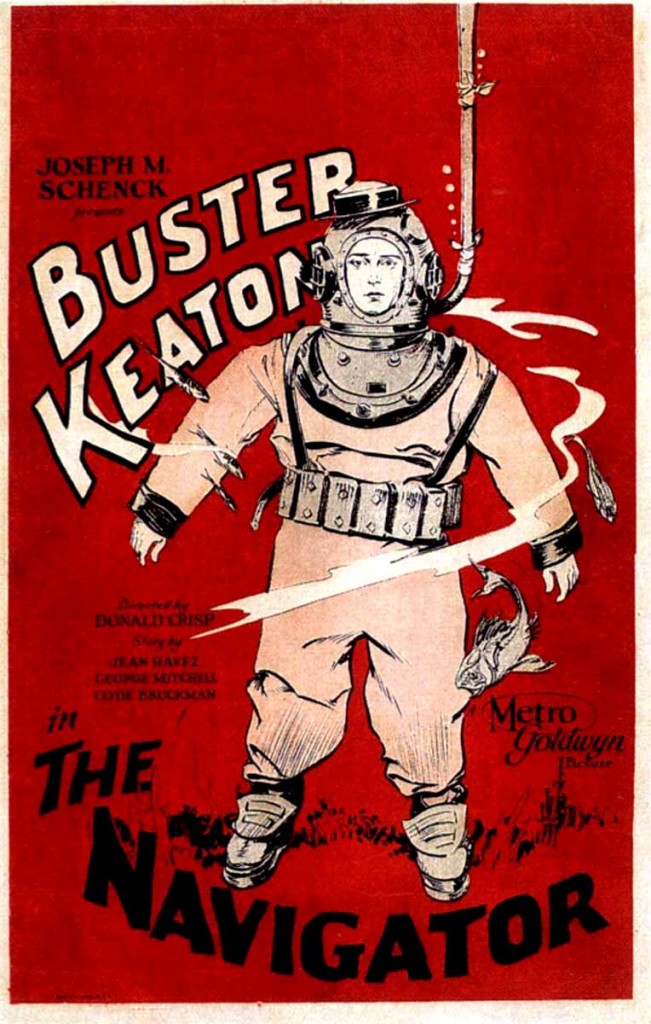
Buster Keaton claimed The Navigator was his best film. With all due respect he’s wrong. The Navigator was born out of the ahead-of-its-time failure of Sherlock Jr. When that marvel of cinematic invention didn’t land with audiences, Keaton played safe. He put a lid on the tricks and focused on the gags. In fact, he cast himself away in a boat with only Kathryn McGuire for company and they told jokes for 45 minutes. That’s the basics of The Navigator and, for me, the lack of plot, stakes or character ends up in a much weaker film.

Buster is Rollo Treadaway, a rich sap, who one day decides to get married and books the honeymoon before he’s asked his planned intended Betsy (Kathryn McGuire). When she says no, Rollo goes on honeymoon anyway but in a confusion at the docks ends up on the wrong ship, The Navigator. It’s owned by Betsy’s father – but spies for a foreign power plan to set it adrift. In further confusion, Betsy also ends up on board and she and Rollo wake-up drifting at sea. How will two pampered rich people work out how to look after themselves on a deserted ship?

The Navigator keeps things simple, cranking up the jokes in a film much closer in spirit to his shorts, all designed to be easy to digest and just tickly the funny bone. You feel they genuinely did just cast the ship out to sea and waited for Keaton to work out as many gags as he could until the camera ran out of film. Donald Crisp was hired to direct the dramatic stuff, but Keaton quickly realised he didn’t need him and didn’t like Crisp’s vague prologue about wicked spies (he was right, it’s totally forgettable unlike the equivalent opening of Our Hospitality) so set off to sea without him. (Crisp makes a visual cameo as the painting of the ship’s captain that swings in front of a porthole).

There are, for me, three key gags that work in The Navigator. Rollo’s spontaneous decision to get married (based on seeing a happy couple outside of the window), after which he distractedly bathes fully clothed then gets his chauffeur to drive him to Betsy’s house – on the opposite side of the street (the car does a big circular loop across the street). After the rejected proposal he informs the chauffeur, he needs a walk home to clear his mind.

This is, in many ways, the funniest, most inventive moment in The Navigator. It’s a great little showpiece as well for the (passionately not-getting-married) Kathryn McGuire and the finest example of Keaton’s capacity for easily led saps, overwhelmingly influenced by things they see around them. It’s the part of the film I enjoyed the most and its over after ten minutes.

The Navigator starts to drift as soon as it heads to sea. There is some neat camera work that suggests the haunting emptiness of the ship (it’s so vast we get an amusing series of visual jokes as Keaton and McGuire consistently miss bumping into each other while walking around it), but where other Keaton films would have explored more the ghostly darkness of this technological marvel (or the oppressive nature of it emptiness) The Navigator largely shies away from this.

The best sequence on the ship follows McGuire and Keaton’s attempts to cook a meal in a massive galley, hampered by the fact that (a) everything on the ship is set-up to cook for hundreds not two and (b) the two pampered souls have no idea how to open a tin can or boil a kettle, let alone cook a meal. Three potatoes are thrown into an enormous vat. Keaton goes through a series of trial error involving drills and carving knives to get into tins. McGuire can’t work out that sea water isn’t drinkable or how much coffee is needed for a cup. They are both befuddled by fish (which they basically eat raw) and can’t find cutlery so make do with kitchen utensils. It’s a sharply observed, well-constructed scene.

But other than this, the film struggles with a series of gags that rather disappoint. There is a painfully overlong underwater sequence where Keaton wrestles with a fake swordfish. There is a lack of Keaton’s trademark physical stunts (aside from a bit of business with a deckchair). An encounter with an island tribe – a bit uncomfortable today to watch these Black-skinned savages – is overlong and heads into a siege that is never particularly funny (other than a gag of Keaton accidentally dragging around a miniature cannon that no matter where he turns is always aimed at him – a gag later lifted for Jar-Jar Binks in The Phantom Menace).

The main problem I have about The Navigator is that this bag of gags never engages me because the film isn’t about anything. Neither of these people feel like real people (and, lord knows, Keaton characters were often lightly-sketched comic roles, but this is ridiculous), the film has no stakes and has no plot momentum, drifting like the boat they are stuck on. I need more for a comedy, to feel invested. Without that investment, it’s just stuff happening. A Keaton’s I won’t revisit. It was, however, his biggest hit. What do I know?

Sherlock Jr (1924)

Sherlock Jr (1924)

Keaton invents Looney Tunes in this master-class in both cinema and comedy

Director: Buster Keaton

Cast: Buster Keaton (Projectionist/Sherlock Jr), Kathryn McGuire (The Girl), Joe Keaton (The Girl’s Father), Erwin Connelly (The Hired Man/The Butler), Ward Crane (The Local Sheik/The Villain), Ford West (Theatre Manager/Gillette)

If there is one thing you learn from watching Keaton’s masterpiece, Sherlock Jr, it’s this: all Looney Tunes cartoons are Buster Keaton films. The level of astounding, frantic, comic genius in Sherlock Jr hits new heights and its mix of slapstick, improbable stunts, chases and poker-faced reactions basically makes it resemble nothing less than the world’s greatest cartoon made real. There is something either delightful or double-takingly how-did-they-do-that impressive in every scene and the entire film is assembled and designed with invention dripping from every pore.

Buster is an absent-minded, day-dreaming projectionist in a local theatre. But what he really wants to be is a detective. He gets his chance when he discovers that the father (Joe Keaton) of the girl (Kathyn McGuire) he’s in love with has had his watch stolen. We know it’s her villainous suitor (Ward Crane), but Buster’s clumsy investigation only ends up getting himself framed, with only the Girl to clear his name. Back in the theatre, Buster daydreams himself into the film he’s projecting, where he is the famed Sherlock Jr, master-detective besting scheming villains and winning the heart of the Girl, all of whom now look like the people he encountered in the real world.

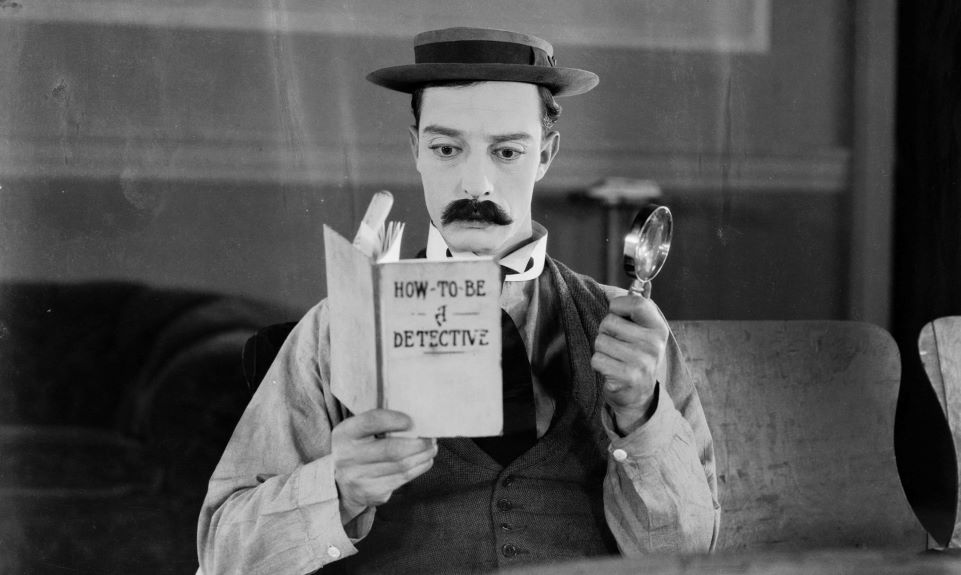
Sherlock Jnr resolves almost its entire plot in the opening fifteen minutes after Buster fails to prove his mettle as a detective. Bless, he goes about his investigation with a robotic lack of imagination, slavishly following the steps in his How to be a Detective book right down to following his suspect by almost literally dogging his footsteps (requiring a parade of sudden jerks, turns and dodges to avoid being seen). Fortunately, the Girl solves the crime for him, clears his name and heads to the theatre to tell him while he drifts off to sleep. What this means is that we can enjoy Buster’s day-dream of the movies without ever worrying about how he will solve the pickle he is in in real life.

Sherlock Jr can focus on its delightful fantasy sequence. In an oft-imitated stroke of double exposure shooting, the dream Buster emerges from the body of the sleeping Buster, picks up his (dream) hat and walks out of the projection room to the theatre where he is flabbergasted to see people he knows playing roles in the film. Why shouldn’t he be tempted to walk down the aisle and try to climb into the picture? Of course, the villain responds by tossing him out of the frame and back into the auditorium (just to reassure us again, Keaton cuts to the sleeping Buster in the projection room).

Keaton’s film has hugely inventive, creative fun with the medium as Buster re-enters the movie only to find – with the power of editing – his location changing with dizzying speed, without his position changing from shot-to-shot. He steps down a flight of stairs to find it turn immediately into a bench. He tries to sit on the bench but lands in a busy road. He walks down the road to find himself on a cliff edge. He peers off the edge to find himself among lions, then crawling through the desert, sitting on the shore, diving into a snow drift. This whole sequence is effortlessly, brilliantly assembled with Keaton’s position seemingly never changing but the location changing almost a dozen times. Think that cartoon when Daffy Duck goes to war with the cartoonist. No one before had understood the comic potential of editing, shifting locations and changed perspectives.

It’s perhaps the stroke of defining genius in a film crammed with moments from here to the end that leave you breathless with their chutzpah, daring and invention. From here, Sherlock Jr is full to the brim with hilarious comic stunts that Keaton makes look effortless but required such complex planning (and endless repetition on set to get right) that your admiration for their humour is matched only by the wonder at the dedication and sweat it took to deliver them.

In the dream-film, Sherlock Jr has just enough of Keaton’s comic clumsiness to be amusingly recognisable, but every detecting trick he plays turns up trumps. He tails suspects successfully, locates stolen jewels, unmasks criminals and he is never outwitted by the criminals (saying that he can also ride on the handlebars of a motorbike for miles not noticing that the driver has long since fallen off). Through it all, Keaton gives every set-piece the sort of physical commitment Hollywood wouldn’t see again until Tom Cruise started to embark on Impossible Missions.

All of this needed time. Imagine, if you will, the innumerable takes Keaton needed to execute a deluge of seemingly impossible trick shots in a game of pool, where every ball is pocketed except the number 13 (which has been replaced by a bomb). This is the sort of Newtonian logic of a Bugs Bunny cartoon but done for real. It’s doubly funny later when you realise Sherlock Jr wasn’t being phenomenally lucky but was in fact aware the ball was a bomb and was missing deliberately. Even without that knowledge, watching balls bend round the number 13 or divide perfectly so that two balls pass by without contact is breath-taking.

Equally so a stunt which sees Keaton fold up a disguise dress in a window, head into the room, then dive out of the window, straight into the dress, and walk away. The stunt is so incredible, Keaton even dissolves part of the wall of the building so we can see it done in one take. If that’s not enough, moments later he will seemingly dive into a wall through the chest of an accomplice who will then walk away – all in one take. Keaton wanted these magic tricks to seem impossible, to leave the audience helplessly trying to work out what they have seen. The answer, in every case, was endless attempts and vaudeville expertise. Just as Keaton worked out the comic potential of editing could transport him, in a single step, hundreds of miles – so he also worked out it could make impossible events look effortless by removing all the failed attempts.

The film culminates in a chase scene the Looney Tunes cartoons would riff on endlessly (the entire Wile-E-Coyote/Road Runner series is effectively a long version of the end of Sherlock Jr). Sherlock Jr races to rescue a girl, on the handles of a rider-less motorbike, racing over roads, blockages, train tracks and all sorts then switches with her to a car, that similarly does a series of improbably manoeuvres before it crashes into a lake and turns into a slowly sinking boat. All hilarious, all directed and played with a super abundant energy.

And then he wakes into a romantic reconciliation where our hero, slavishly, follows the romantic gestures of the man in the movie he is watching to win a kiss from the Girl. We knew the happy ending was coming – that’s why we enjoyed, pressure-free, the fantasy sequence where nothing was at stake. Sherlock Jr delivers a comic tour-de-force so packed with delightful tricks, committed stunts and joyous invention that it feels like it sails by even quicker than its 45 minutes. It’s a perfectly sustained and balanced series of gags all wrapped up in something that uses the medium perfectly. It’s the first and best Looney Tunes cartoon ever made.

Watch it now!

Our Hospitality (1923)

Our Hospitality (1923)

Keaton’s feature-length debut is a masterpiece of comic invention and slapstick stunt thrills

Director: Buster Keaton (& John G Blystone)

Cast: Buster Keaton (Willie McKay), Joe Roberts (Joseph Canfield), Natalie Talmadge (Virginia Canfield), Ralph Bushman (Clayton Canfield), Craig Ward (Lee Canfield), Monte Collins (Parson), Joe Keaton (Train engineer), Jack Duffy (Train conductor)

It starts with a dark and stormy night. If that sounds like cheap melodrama that’s kind of the point. Keaton’s first feature length comedy would be different from his joke-crammed shorts. This would be plot-led comedy, a drama full of jokes. As part of that, Keaton started the film with a storm-filled, joke-free, DW Griffith-inspired opening salvo that sees the lead character’s father dead in Intolerance inspired opening. With its gun flashes and bodies, we know in this film bullets kill.

The father is John McKay and he dies along with James Canfield in a deadly exchange. It’s part of a long-running feud betwixt McKays and Canfields (any similarity to the legendary Hatfield-McCoy feud is entirely deliberate), and the rest of the Canfields swear revenge on McKay’s baby son-and-heir. Twenty-one years later, Willie McKay (Buster Keaton) has grown up in New York, ignorant of the feud. When he returns to his father’s ranch, he finds himself in the awkward position of having fallen in love with Virginia Canfield (Natalie Talmadge), daughter of his newly discovered deadly enemy Joseph Canfield (Joe Roberts). How will matters be resolved?

With a great deal of laughs and a breath-taking series of stunts. Our Hospitality is early Keaton but already it cements his legend of comic invention and physical daring as well as his dynamism and imagination as a filmmaker. Our Hospitality is crammed with comic bits of pieces that Keaton would go on to explore and finetune in even greater detail in later films, but also culminates in a (admittedly slightly tongue-in-cheek) but still surprisingly gripping action sequence as our hero battles to survive a mountainous waterfall and save his love from toppling.

The film neatly divides into four acts, each subtly different in tone but all unified by Keaton’s creativity. Stone-faced and implacable, Keaton never mugs or goes overboard for the laugh but trusts that, with the intimacy of the camera, the smallest inflection or slightest turn of the head will raise a chuckle. He’s also charmingly innocent, refreshingly resourceful and rather brave – a perfect combination for a little guy (it helps, as always, that Keaton is literally a little guy) we root for.

That charm powers a lot of the film’s second act, a long incident-filled train journey McKay takes to the South. Keaton was fascinated by the comic potential of early technology – watching Willie, po-facedly, cycling with an early peddle-free bike, his feet alternately propelling the bike and lifted in the air is hilarious (the Smithsonian even asked if it could display this perfect replica) – and he deliberately set the film in 1831 to introduce a Stephenson-style rocket train, pulling its open carriages behind it. This vehicle not only looks hilariously ramshackle and strangely incongruous, it also opens an ocean of possibilities.

It is, for starters, hilariously slow – Willie’s dog has no problem keeping up with it. Its tracks have been laid with a rigid rule-following lack of imagination – at one point they ride up over a fallen tree log, the train and carriages bumping over it. The train is forced to stop by a donkey that refuses to leave the line (eventually the engineer simply drags the tracks around the donkey). There is an on-going feud between the Engineer (played by Keaton’s father Joe) and ticket-master about who is actually in charge of the train. At one point it veers off the tracks and down a road (everyone comments about how much more smoother this is) and later gets separated from the carriages at a junction, requiring Keaton gymnastics to bring it together. By the time it trundles into the station – and note how beautifully the train is filmed – you’ve had more comic invention than most other comedies.

During this journey Willie falls in love with fellow passenger Virginia (played, a little awkwardly, by Keaton’s wife Natalie Talmadge), little knowing she is a Canfield. The Canfields swiftly discover his identity: Willie asks one of her brother’s directions to his ranch, and the brother guides him there, all the while darting away at every opportunity to try and borrow a gun to take his revenge.

Most of the second act, which gives the film its title, revolves around Willie’s invite from Natalie to dinner at the Canfield house. Southern gentility declares the Canfields cannot take revenge on Willie while he is their guest – as soon as Willie realises this he does everything he can to remain in the house, as the (literal) instant he steps outside the door, guns come out. (Keaton also gets a lot of comic mileage from the cumbersome one-shot guns, which Willie frequently pinches to discharge to give himself a few precious moments to move outside while various Canfield’s reload).

When Willie eventually flees the house – disguised as a lady – it leads into a glorious, action-packed chase scene. Scaling mountains and cliffs, shot with a vertigo inducing brilliance (in reality Keaton placed the camera on its side and made it appear with his genius physicality that he was climbing rather than crawling). There are falls into rapids, Willie is dragged behind a racing train carriage and finally bobs and floats down a rapid (including one shot, kept in the film, where Keaton’s rope snapped and he was literally washed head first down a river). It culminates in an athletic, stunt-filled, precarious balance on a log suspended over a waterfall (a brilliant backdrop shot makes this feel impossibly high), swinging desperately on a rope to save Virginia from falling.

Our Hospitality is awash with comic energy and genius touches of business but it’s also an impressively ahead-of-its-time in the skill of its plotting and structure – you could pretty much remake it exactly today (but with words) without changing a detail, and it would still be a hit. But it wouldn’t be a legend because the only thing you wouldn’t have is Keaton. And he’s the lodestone that balances the whole thing.

The Russians are Coming, the Russians are Coming (1966)

The Russians are Coming, the Russians are Coming (1966)

Ealingesque farce meets Cold War moralising in this not-quite funny enough farce

Director: Norman Jewison

Cast: Carl Reiner (Walt Whittaker), Eva Marie Saint (Elspeth Whittaker), Alan Arkin (Rozanov), Brian Keith (Link Mattocks), Theodore Bikel (Captain), Jonathan Winters (Norman Jones), Tessie O’Shea (Alice Foss), John Philip Law (Alexei Kolchin), Ben Blue (Luther Grilk), Andrea Dromm (Alison Palmer), Paul Ford (Fendall Hawkins)

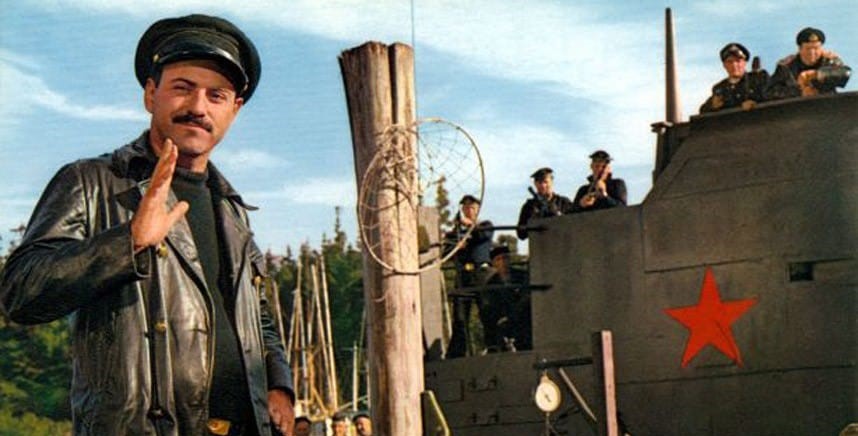
Off the coast of a New England island, a Russian captain (Theodore Bikel) wants to take a quick peek at the US of A. Bad idea. When his sub runs aground, they are forced to send a party ashore led by political officer Rozanov (Alan Arkin) to find a motor launch to get the sub back out to sea. They run into the Whittakers – playwright Walt (Carl Reiner), wife Elspeth (Eva Marie Saint) and their kids – take them hostage, steal their car, cut the telephone lines and try to save themselves. The town quickly hears news of the possible arrival of Russians, and the hysteria grows – just as Walt starts to feel his sympathies grow for the terrified Russian sailors. Can peace be reached across the divide?

The Russians are Coming, the Russians are Coming is basically an Ealing-esque comedy – written by Ealing veteran William Rose – translated not entirely successfully to America. Directed with an epic, widescreen sweep by Norman Jewison that sometimes crushes the life out of a comedy of confusion and coincidence, The Russians are Coming wants to be both a broad farce and carry an earnest message about the Cold War. It’s quite sweet that the film, made four years after Cuba nearly turned the world into an ash pile, wants to focus on what unites as humans rather than divides us, but the message is at times crow-barred in a little too forcibly.

It’s very hard not to see the Ealing influence on every single scene – and I suspect the film would have worked better as 4:3 black-and-white film full of harassed people in offices and homes, rather than the grand panoramas of the town and large crowd scenes. The Ealing influence can be seen in the townsfolk, who become a farcical panicked crowd of have-a-go heroes, making sweeping decisions based on no information at all, led by puffed up self-important, self-elected leaders determined to seize their moments of heroism. Misunderstandings abound, as tiny pieces of evidence balloon the “threat” into a full-blown invasion: the crowd are almost disappointed when they arrive at an airfield to find not a smouldering ruin but an operator blissfully unaware anything is going on.

Similarly, the Russians themselves fit nicely into the Ealing model of ordinary, decent, underdogs up against the system (in this case the townsfolk). In a brave touch, the Russian in the film is never translated – Theodore Bikel doesn’t have a line in English – meaning we only gradually learn what is going on and why, as Arkin’s character explains things to Whittaker in stumbling half-English. Arkin is, by the way, the film’s prize asset, demonstrating excellent comic timing and delivering his dialogue in a parade of Russian and fumbling English (there is a great sequence where he earnestly tutors his men on how to pass as officials clearing the street, teaching them phrases just a few degrees incorrect that will make them stick out like sore thumbs as soon as they open their mouths).

The film is never quite funny enough though and Jewison’s direction neither tight nor taut enough to keep the farcical pace up. There are one too many wrong turns taken by the Russians, one too many narrative cul-de-sacs as townsfolk barrel up and down the streets. The whole film plays out like this, many of its effective comic performers among the townsfolk lost among a sea of people and faces. Arkin and Reiner get the most impact, because their scenes tend to make place in individual rooms in set-ups that let us clearly see their faces and appreciate their comic skills.

The Russians are Coming largely struggles to keep the pace up – the best of the Ealing comedies told their farce-tinged struggles between the little-guy and the system, or confusion between two fundamentally sympathetic groups, in about 90 minutes, and this feels heavily over-stretched at a little over two hours. That’s partly because of the political statements which the film dresses up as a sub-plots. A romance between John Philip Law’s Russian sailor and the Whittakers’ babysitter Tessie O’Shea is all too obviously a plea for using love as bridge-building. The final alliance between the Russians and the townspeople, forged in their joint rescuing of an endangered child, bangs the “we are all the same” drum a little too persistently.

It makes the film today feel a little too much like it’s trying to have its cake and eat it: to be both a farce where Reiner’s playwright gets tied up to a librarian and the two struggle to free themselves in a series of pratfalls, and also a political statement about the bonds that can be built if we just let the Cold War melt a little bit. I won’t deny this must have had more impact in the 1960s, but today it makes for a film that is a little too grandiose where it should be nimble, and a little too lightweight when it should be important.

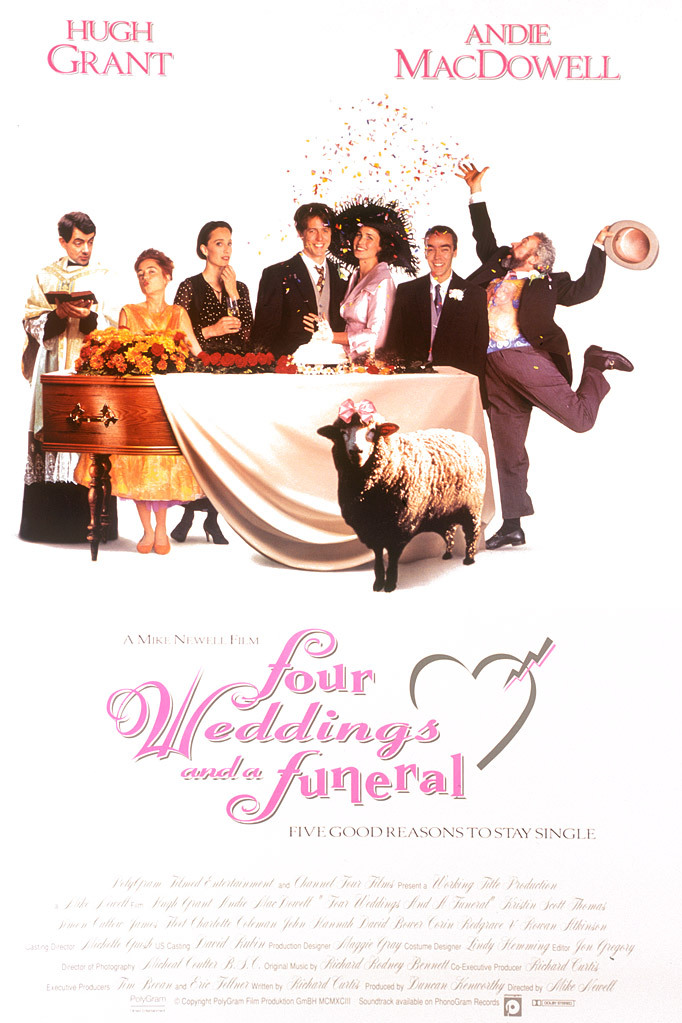
Four Weddings and a Funeral (1994)

Four Weddings and a Funeral (1994)

The phenomenon of the 90s, this charming comedy still (rightly) lies in many people’s soft spot

Director: Mike Newell

Cast: Hugh Grant (Charles), Andie MacDowell (Carrie), Simon Callow (Gareth), Anna Chancellor (Henrietta), Charlotte Coleman (Scarlett), James Fleet (Tom), John Hannah (Matthew), Kristin Scott-Thomas (Fiona), David Bower (David), Rowan Atkinson (Father Gerald), David Haig (Bernard), Sophie Thompson (Lydia), Corin Redgrave (Hamish Banks), Simon Kunz (John), Rupert Vansittart (George)

It’s 1994 and love really is all around. It certainly felt like it in the UK, as Four Weddings and a Funeral went from small Brit rom-com to national phenomenon. It was number one at the box office for ten weeks and Wet Wet Wet’s Love is All Around felt like it was number one for the whole year. The film was a huge international hit, the sort of once-in-a-lifetime movie for everyone involved, culminating in an Oscar nomination for Best Picture. For anyone who went to the movies in the 90s, it feels like an old, familiar friend. And, leaving aside the inevitable backlash, it’s still witty, charming and fun today.

Based on writer Richard Curtis’ experience of attending a never-ending parade of weddings one year (we’ve all been there), we follow Charles (Hugh Grant) through a series of disastrously different weddings (and, of course, one moving funeral) while he tries to deal with the fact he’s fallen in love with American Carrie (Andie MacDowell) – and one of the weddings he attends is hers. Around him float a phalanx of loyal friends: gregarious Gareth (Simon Callow) and his loyal, utterly reliable partner Matthew (John Hannah), dimly posh Tom (James Fleet) and his arch sister Fiona (Kristin Scott-Thomas) and zany Scarlett (Charlotte Coleman). But, when the time comes for Charles to head down the aisle, who will he find waiting for him at the end?

Four Weddings works because it’s blessed with a series of talents at the peak of their powers. Richard Curtis has never written a film script that balances so perfectly excellent one-liners, sharply sketched, engaging characters and a perfect mix of pathos and belly-laughs. Mike Newell balances the comedy with just the right touch of drama, never allowing events to tip into sitcom territory. The cast are all pretty much selected perfectly. And above all, it turned out Hugh Grant was placed on earth to play the lead roles in Curtis comedies.

Before Four Weddings, Hugh Grant was almost completely unknown: a Merchant Ivory supporting player at best. After it, he would be almost indistinguishable in the public’s eye from Charles (he’d effectively play the same role three times again for Curtis). What Grant does in this film is simply phenomenal. Curtis’ dialogue and rhythm fits his style like a glove: not since Rowan Atkinson (who delivers a Peter Sellars like performance as a nervous and shy vicar at the other end of the comic spectrum from Grant’s mix of comedy and pained earnestness) had an actor clicked so much with Curtis. There is, perhaps, no skill harder than light comedy, but Grant is a master at it.

He turns socially awkward comedy into a thing of beauty (trapped at a table with a series of ex-girlfriends, he lets the smallest inflections telegraph his desire for the earth to swallow him). He has the subtlety to not overplay pratfalls or physical gags (look at the minimalist simplicity which he plays being trapped, hiding, in a cupboard while a recently married couple have noisy sex in the same room, his face a mix of pained embarrassment and longing for escape). Grant captures better than almost any actor alive a peculiar, self-deprecating British sense of humour, the quiet rabbit-in-the-headlight horror of saying the wrong thing. He even makes you love Charles (who, in many ways, is a self-obsessed git) because Grant is so effortlessly likeable, emitting rays of little-boy lost charm.

It also works because the film crams into it a hinterland of friendship and warmth. The chemistry between the company is pretty much spot-on – you never for one moment doubt these people are lifelong friends, despite the fact we learn nearly nothing about any of them over the course of the film (even Charles – what other film would not even tell us his job?). Each of the actors seizes their role with relish. Simon Callow got to explode with red-faced bonhomie and shaggy-faced camp in a way you suspect he had been dying to do his whole career. Kristin Scott-Thomas’ arch dryness and icy posture was leavened with just the right touch of romantic yearning and wit.

In fact, the whole cast were so perfectly cast they almost became destined to spend their whole lives struggling to break out of the moulds Four Weddings placed them in. James Fleet was so skilled at nice-but-dim sweeties like Tom, he had to grow a huge beard to get serious roles. John Hannah (extremely good, with the films much touching WH Auden inspired moment) took on playing a posh twit in The Mummy. Anna Chancellor was so born to play the strangely needy ‘Duckface’, Charles’ ex-girlfriend she jokes the first line of her obituary will be “Duckface dies”. Callow and Scott-Thomas would play versions of these roles several times over – and even being arrested for picking up a sex worker wouldn’t break the public perception of Grant being Charles.

Which is all a round-about way of saying everything works here, the magic alchemy of everyone being in the right place at the right time, and every single risk paying off. You can be slightly churlish and say Andie MacDowell lacks some of the charisma and comic skill the role of Carrie needs (it’s a Meg Ryan role), but her innocent Southern exterior is needed to make the scene of her recounting her serial shagging to Charles over a restaurant table land with as much comic force as it does.

That’s one of many comic set-pieces that just plain work. From the “fuck!”-filled opening montage, which sees Charles hare, late, to a wedding where he is the best man, via the film’s many social faux pas (“She is now my wife” has never been funnier), Atkinson’s malapropism-stuffed wedding service to the film’s final comic denouement at Charles’ wedding, it’s packed with laugh-out-loud moments. But, because the characters are so well-drawn, with just the right amount of reality, we also care as well. The funeral carries real emotional impact – not least due to Hannah’s beautiful delivery of the eulogy (and let’s not forget, few other mainstream movies were as open to homosexuality at the time as this one). And every character has moments of depth: even dim Tom has flashes of real emotional insight.

You can mock it in retrospect for moments like “is it raining, I hadn’t noticed” – but films like this don’t stumble into becoming cultural phenomena. They get there because, for one glorious moment, everything comes together the way it was meant to be. A great script got just the right approach, from a series of actors perfectly cast and marshalled by a director towards warm, genuine comedy. That’s why people continue to watch – and quote it – thirty years later and it still feels like love is all around it.

The Quiet Man (1952)

The Quiet Man (1952)

Ford’s sweet and funny Irish fable is possibly his most purely enjoyable film

Director: John Ford

Cast: John Wayne (Sean Thornton), Maureen O’Hara (Mary Kate Danaher), Barry Fitzgerald (Michaleen Oge Flyyn), Ward Bond (Father Peter Lonergan), Victor McLaglen (Squire Will Danaher), Mildred Natwick (The Widow Sarah Tillane), Francis Ford (Dan Tobin), Eileen Crowe (Mrs Elizabeth Playfair), Arthur Shields (Reverend Cyril Playfair), Charles B Fitzsimmons (Hugh Forbes), James O’Hara (Father Paul), Jack MacGowran (Ignatius Feeney), Sean McClory (Owen Glynn)

John Ford wasn’t born in Ireland, but he loved the place in the way only the child of ex-pats could. The Quiet Man is a loving, romantic, almost fairy-tale view of Ireland, an affectionate feelgood fantasy that transcends any possibility of patronising its subject through its warmth and charm. It’s an unashamedly feel-good film, a delightful fable full of luscious scenery and tenderly sketched characters that plays out like a warm end-of-term treat where we are all invited to the party. It’s possibly Ford’s most purely enjoyable and heart-warming film.

Set in 1920s Ireland, Sean Thornton (John Wayne) returns to his childhood home of Inisfree after growing up and becoming a boxer in Pittsburgh. Sean loves his home country, but with his American upbringing is out-of-step with the customs and traditions of Ireland – something that becomes very clear when he falls in love with Mary Kate (Maureen O’Hara), sister of local squire Will Danaher (Victor McLaglen). Their rules-bound courtship – overseen by matchmaker Michaleen Oge Flynn (Barry Fitzgerald) – eventually leads to marriage, but via tricking Will, who withholds Mary Kate’s dowry, the sign of her independence. Mary Kate wants Sean to fight for it – but the former boxer is haunted by the accidental killing of an opponent in the ring and wants to live-and-let-live. Problem is everyone, from Mary Kate down, sees that as cowardice.

Ford was desperate to make The Quiet Man, the rights for which he had paid $10 for in 1933 when the short story was published by Maurice Walsh (Ford ensured Walsh received another $5k when the film was finally made). B-movie studio Republic Pictures was the only one willing to take a punt on it. But, alarmed by Ford’s insistence to shoot in colour and (even more expensively!) on location, they were convinced they had a box office bomb on their hands. They insisted Ford and his cast made a western first – the literally for-the-money Rio Grande – to cover the expected losses. They even demanded Ford couldn’t make it longer than 2 hours. Ford screened the final 2 hours and 9 minutes cut to them, stopping the film on exactly the two hour mark and asking them what they’d cut. They released the film unchanged. The film was an Oscar-nominated smash-hit.

It’s not a surprise why, because the film is a whimsical delight. Ford isn’t often remembered for his sense of fun, but The Quiet Man is unarguably funny. It’s crammed with sight gags – from sly double takes (there is a delightful one from the railway station workers, who watch first a determined Sean then a horse walk straight past them), to Sean and Will grimacing in pain but smiling as they exchange a brutal handshake, to Mary Kate jumping over obstacles as Sean drags her back to the village to have it out with her brother. It famously ends with an extended comic set-piece as Sean and Will launch a mano-a-mano “Queensbury Rules” fistfight that takes most of a day, moves across the whole village, and is interrupted only by a break for a pint.

All of this takes place in an Ireland that, while it never feels entirely real, is drawn with such loving affection and cast with such careful exactitude that it hardly matters. Ford’s insistence on shooting all the exteriors on location paid off in spades. The country has never looked more ravishing than through Winton C Hoch’s technicolour lens. Rolling vistas, gentle brooks, quaint villages, perfect beaches. You totally understand why Sean, on arrival, simply stands on a stone bridge and stares across the valley of Inisfree, lost in memories and his emotions.

Sure, it’s a romantic vision. And 1920s Ireland wasn’t the sort of haven depicted here, where Catholic and Protestant lived in perfect harmony, politics never reared its head and the local IRA man is a jolly joker in the pub. If The Quiet Man had not been so well-meaning, you can imagine people taking offence at a picture of the country full of roguish charm, horse-drawn carriages, drinking and fighting. (You could say The Quiet Man shaped many Americans’ perceptions of what the country is like.) But Ford never makes any of this a subject of humour. In fact, it’s a subject of love. The joke is never on the Irish. Inisfree is in fact a haven of community spirit, a supportive village where its people are wise, caring and decent, tradition is respected and what people say and do matters.

It’s why so many are shocked by Sean’s seeming cowardice at not raising his fists earlier. That’s not what “men” do. John Wayne is very effective as the easy-going Sean, a guy who just wants to settle down to marriage. It’s a decent playing-against-type by Wayne, that balances his quiet sense of dignity with the sort of manly determination we know will eventually come through. It’s easy to see why he and Mary Kate fall in love. Also, why she is both swept up in his masculinity and also enraged that he doesn’t behave enough like a man, by refusing to take a stand to defend her honour and secure that dowry that will make her a true wife.

O’Hara is marvellous in a challenging role as Mary Kate. This is a feisty and determined woman, who knows what she wants but denies to herself what that is. She and Wayne share a striking, windswept early kiss – her mood in it going form surprise, to fascination, to irritation, to surrendering to her own desires. While you could suggest the film’s comic set-piece of Sean dragging her (sometimes literally) back to the village so she can watch him fight her brother the way she’s demanded from the start feels uncomfortable today, but it’s also Sean not only delivering what she has wanted him to do from the start, but also strangely the thing that finally bonds them together.

A bond is what they have, both of them straining against the confines of the courtship rules of Ireland. Together they flee the chaperoned carriage ride Michaeleen (a delighful Barry Fitzgerald) takes them on to ride a tandem through the streets. Mary Kate constantly, bashfully, tries to go after what she wants – and a large part of that is the lurking “bad boy” tendency that she detects under the surface of the quiet Sean. Something her less-bright brother Will can’t see.

Victor McLaglen (Oscar-nominated) swaggers, slurs and puffs himself up as this rough-and-tough, punch-first-think-later bruiser, who constantly thinks he’s being cheated. He and Wayne throw themselves into the long dust-up that ends the film with the same comic energy and enthusiasm they did exchanging handshakes. Part of The Quiet Man’s success comes from the comfort and familiarity the cast felt for each other. The trip to Ireland was like a friends-and-family holiday: old mates like Ward Bond, Ford’s brother, O’Hara’s brother, Wayne’s children – they all round out the cast. It helps build even more the family and community feeling that makes the film a delight.

Above all, The Quiet Man leaves you with a smile on your face. With expertly filmed set-pieces – a horse race, Sean and Mary Kate’s long walk back to Inisfree and the epic punch-up – combined with luscious shooting (also done with wit – a sexually frustrated Sean pounds through the countryside, tossing heavily puffed cigarettes aside, after Mary Kate withdraws favours) – it’s also fast-paced, witty and warm. The cast even effectively take bows as Ward Bond’s (his finest hour) priest delivers a final voiceover. Full of affection and charm, it’s a delight and is perhaps the only foreign “Irish” film that has been embraced by the Irish.

Summertime (1955)

Summertime (1955)

An independent woman finds romance in Venice in this luscious travelogue, one of the best of its genre

Director: David Lean

Cast: Katharine Hepburn (Jane Hudson), Rossano Brazzi (Renato de Rossi), Darren McGavin (Eddie Yaeger), Jane Rose (Mrs McIlhenny), Mari Aldon (Phyl Yaeger), Macdonald Parker (Mr McIlhenny), Gaetano Autiero (Mauro), Jeremy Spender (Vito de Rossi), Isa Miranda (Signore Fiorini)

American spinster Jane Hudson (Katharine Hepburn) has dreamed of her holiday-of-a-lifetime in Venice for as long as she can remember. So long in fact, that she wants to capture every single minute on camera and not miss a single sight in the gloriously romantic city. But there is more in this canal city than she expected, something her life of proud, self-sufficient, isolation has had little of: romance – namely from antiques dealer Renato (Rossano Brazzi), the two of them thrown together by chance, in a meeting of hearts and minds.

Summertime was, surprisingly, referred to by David Lean as his personal favourite of his films. It feels like an odd choice: the final film shot in the period between his ever-green 1940s British classics (and Summertime has echoes of Brief Encounter, from love affairs to train stations) and the super-epics that would fill the rest of his career. But, in its patient, quiet and slightly sad look at the continuous presence of regret in our lives and our feelings of loneliness, it perhaps speaks of something in the soul of this surprisingly vulnerable great director.

It won’t have hurt either that Lean himself fell in love with Venice during the shooting of the film. Summertime is very much in the genre of “romantic holiday travelogue” so beloved of the 1950s, when it was practically de rigeur to send glamourous Hollywood stars to exotic locations to conduct star-cross’d love affairs. Summertime might just be the finest of these, combining one of Hollywood’s all-time greats with a director and cameraman who made the setting truly cinematic, rather than the holiday snaps the journeymen who shot similar films reduced the locations to.

I’ll admit it helps I love Venice as well (and it’s amazing, watching this, how little the city has changed in the past 70 years). But Lean and gifted photographer Jack Hildyard shoot it with an intimate wonder. We follow Hepburn down the city’s winding streets and across its many bridges with a close intimacy that doesn’t shy away from the bustle of the city. A beautiful moment sees the camera slowly reveal the appearance of the St Mark’s Square campanile through an arched streetway. Carefully cut imagery flicks over striking features of Venetian architecture. Lean and Hildyard make the city feel like both a dream of a destination, but also a real, organic place, full of delightful nooks and crannies. It’s a masterclass in how to shoot a city both for impact and truth.

It’s a backdrop for an affecting, low-key, character study that gains hugely from the intelligent, emotionally precise performance from Hepburn. No actress in Hollywood could convince more as a woman full of enough brio and confidence to be very comfortable in her own solitude. The brilliance of Hepburn though is to play this all as a carefully maintained front shielding a loneliness she is always aware of but doesn’t want to acknowledge. It’s there from her compulsive need to make conversation with a fellow passenger (a lovely uncredited cameo from André Morell) on the train into the city, or with the people she meets at her hotel. The desire for human contact fills the easy rapport she builds with street urchin Mauro (a lovely performance from Gaetano Autiero) or the awkwardness she feels sitting alone in the bustle of St Mark’s.

It’s why romance – or perhaps the lack of it in her life – creeps up on Jane. Her first chance encounter with Renato is at a café in St Mark’s when he signals down the waiter she’s struggled to catch the eye of, leaving her discombobulated and uncomfortable, as if surprised that a man has taken even a passing interest in her, and uncertain how to respond. She retreats and sit on the canal-side, her eyes caught by a lion-headed drain that water laps in and out of. Perhaps only Hepburn could turn such a small moment into one of such profound passing reflection – and Lean shoots it with a beautiful simplicity.

The relationship slowly builds as she happens to chance on Renato’s antiques shop and he sells her an 18th-century Venetian red glass goblet. Hepburn has a beautifully sensitive, almost girlish tentativeness to her as they walk idly together the next night through the streets. After they kiss under a bridge, she impulsively mumbles she loves him and then runs, as if she was startled by her own confession. The next night she prepares to meet him with a pampering session not out of place in a teen drama, sitting waiting for him with a giddy excitement.

As her beau, Rossano Brazzi has a wonderful unknowable quality to him. There are touches of his own sensitivity and isolation. There is also the worry, as he sits with cosmopolitan ease at a café table or (possibly) flogs Jane a worthless red glass goblet (she later discovers they are ten a penny, though he swears his is a genuine antique) that he could be a heartless roué. Jane worries it as well. But does she care? After all, this is a holiday-of-a-lifetime and perhaps a love affair is just part of that. It might well be the same for Renato: like Brief Encounter, two lonely people who recognise qualities in each other come together for a brief time, to find a little comfort. Let the fireworks explode (which Lean literally does in one more-than-suggestive cross-cut late in the film).

Summertime is very romantic, but it’s also very true. Both Jane and Renato know exactly what they are getting going into this: a blissful moment in time, but not a lasting commitment. There is something very true about this: and a pleasing acknowledgement that independence isn’t a condition to be fixed, but a state that allows bursts of companionship in between voyages of self-contentment. It’s mixes this with touches of humour (Hepburn sportingly performs a pratfall into the Venetian water – although it left her with an eye infection that troubled her for the rest of her life).

It’s possibly the finest travelogue romance ever made, very well paced and gently but handsomely filmed by Lean. Hepburn gives a stunningly intelligent, gentle and wise performance and its honest look at loneliness and passing regret at that loneliness – but still being contented at the choices you have made in life – also make it perhaps one of the most realistic and true-to-life.