Category: Tearjerker

The Whale (2022)

The Whale (2022)

Manipulative and sentimental, Aronofsky’s tear-jerker is dishonest and disingenuous

Director: Darren Aronofsky

Cast: Brendan Fraser (Charlie), Sadie Sink (Ellie Sarsfield), Hong Chau (Liz), Ty Simpkins (Thomas), Samantha Morton (Mary), Sathya Sridharan (Dan)

The Whale is the sort of film that is either going to bring you out in tears or hives. Me? Let’s just say I felt incredibly itchy as I sat through this naïve, sentimental and manipulative film. I hated its dishonesty and its disingenuousness. The only thing I felt move was my stomach.

Charlie (Brendan Fraser) is a morbidly obese, reclusive English professor who teaches online courses with the camera turned off. Nursed by Liz (Hong Chau), the sister of his deceased partner, Charlie has never processed his depression and guilt at his partner’s suicide. Now, facing death from congestive heart failure, his last wish is to finally bond with his daughter Ellie (Sadie Sink) whom he has not seen in the eight years since he left her and her mother (Samantha Morton). Ellie is now an angry, high-school drop-out teenager. But Charlie is sure he can see the good in her.

So much has been made about the morbid obesity of the film’s lead. The prosthetics coating Fraser in layers of fat are impressive. An opening montage shows Charlie struggling to move around the house. Picking something up off the floor is impossible and he has to lever himself out of the bed or into the shower. But the film is hugely pleased with itself that it dares to see a fat person as “one of us”. Aronofsky initially films him like a freak show monster – already patting himself on the back about how “humanising” it will be when we learn that obese people are just as capable of being at the heart of maudlin, self-pitying films as thin ones.

The Whale is adapted from a stage play. Not only does it really feel like it (it’s all set within Charlie’s apartment, with characters announcing their arrival in a neat four-act structure), it also sounds like it. The dialogue is forced, artificial and clumsy, making on-the-nose emotional points. Characters feel like narrative constructs. Sadie Sink’s Ellie is the sort of precocious-but-angry tear-away genius brat you never find in real life. Ty Simpkins’ hipster-turned-missionary is more a collection of quirks than a person. The script leans heavily on clumsy metaphors – a walk on the beach, bible quotes, Ellie’s childhood essay on Moby Dick – milked for all they are worth.

Worst of all, a film that prides itself on being about the power of honesty feels like a big, walloping lie. It lies about its characters and it lies about the real issues that drive them. Firstly, it never once touches on issues of mental health and addiction that have led Charlie to this state. Sure, we get a scene of him compulsively eating. But Liz, his “caring” nurse, brings him medicine and huge piles of food (a massive bucket of fried chicken, enormous sub sandwiches…). It’s like caring for an alcoholic by bringing him chicken soup and a huge bottle of whisky. How is this helping someone recognise and deal with an addiction? Which is what this level of over-eating is.

Worst of all the film treats this as a “charming friendship between two eccentrics”. It eventually touches on the fact they are both hurting from the suicide of Charlie’s partner Alan. But never once is the film brave enough to link their behaviour now to this act. Charlie failed to get Alan help, keeping him away from the world and others, believing that the isolated love of a single person would solve his depression. Liz repeats the same mistakes. She isolates Charlie, encourages him to eat, never challenges him to seek help or process his grief, and creates a safe environment for him to destroy himself. If he was a drug addict, what would we say about a carer who draws the curtains and encourages him to shoot up? We’d be calling her the villain of the piece.

That’s before we even dive into the film’s lack of honesty about Charlie. It’s sad to think of a character being so depressed he’s eaten himself to death. That’s awful – even if the film never wants to reflect on the emotional and psychological reasons for this (because that would be depressing in a film as desperate to be upbeat as this one). But by showing us Charlie at the end, full of regret and self-pity, the film white-washes his mistakes and selfishness. There are clear flaws in Charlie that contributed to this state – however much the film wants to present it as a terrible accident.

Charlie abandoned his family and made no contact with his daughter for years (he complains it was too difficult and tries to blame her mother), leaving her traumatised. The film loves its sentimental device of Charlie reading to himself Ellie’s childhood essay (which he knows by heart). But this is, basically, a selfish fantasy: an idea for Charlie to cling to that he was a good Dad and Ellie a kid with a future, radically different from the actual reality. Just like he never addresses why guilt and depression drove him to destroy himself, so he refuses to deal with the issues Ellie is facing now by simply not acknowledging that she has changed from his idealised version of her as the sweet, sensitive girl who knew Moby Dick was really about Melville’s unhappiness.

Instead, the film suggests her mother is the one who really failed. Charlie – who has spent about an hour in her company in eight years – would have donebetter. Just like Liz passing him chicken buckets, Charlie’s solution to solving his daughter’s problems is to smother her with love rather than get her to ask herself why she does and says the cruel things she does. How can the film not see he is repeating the same ghastly cycle again, encouraging a depressed, vulnerable person to stick her head in the sand and hope for the best? Well, he’s wrong. And the fact that the film doesn’t see this means it’s lying to itself as much as he is.

By the end you’ll be stuffed by sentiment, greased by the insistent score. Every single frame is like being walloped over the head while Aronofsky shouts “cry damn you”. The dreadful script is well acted, even if no-one ever makes these device-like characters feel like real people (except maybe Morton). Fraser is committed, a lovely chap and I’m very pleased he’s having “a moment”. But this is a simplistic character, that requires little of him other than to wear a fat suit and cry. He never once really delves into any complexity. It’s also true of Hong Chau, a collection of quirk and tears.

The Whale is a dreadful film, manipulative, artificial and full of naïve and dishonest emotions that avoids dealing with any complex or meaningful issues. Instead, it thinks it’s achieved something by making you see a fat person as a real person. There is almost nothing I can recommend about it.

Good Will Hunting (1997)

Good Will Hunting (1997)

Therapy saves the day in this well-written and acted, but rather earnest drama

Director: Gus van Sant

Cast: Matt Damon (Will Hunting), Robin Williams (Dr Sean Maguire), Ben Affleck (Chuckie Sullivan), Stellan Skarsgård (Professor Gerald Lambeau), Minnie Driver (Skylar), Casey Affleck (Morgan O’Mally), Cole Hauser (Billy McBride), John Mighton (Tom), Scott Williams Winters (Clark)

Two unknowns, Matt Damon and Ben Affleck, made a sensation in 1997 with their script for Good Will Hunting. It turned them into stars and the two youngest Oscar-winning screenwriters in history. Good Will Hunting is a heartfelt, very genuine film crammed with finely scripted scenes and speeches. It’s also an unashamed crowd-pleaser, a paean to friendship and opening your heart, all washed down with a bit of Hollywood-psychotherapy magic. It’s a basically familiar tale, told and performed with such energy that it made a huge impact on millions of viewers.

In Boston, orphan Will Hunting (Matt Damon) has a fiery temper and a rap sheet as long as your arm. He’s content shooting the breeze with best friend Chuckie (Ben Affleck), but he is also a preternatural genius, an autodidact with a photographic memory able to solve complex theoretical problems in hundreds of fields. It’s why he effortlessly solves the impossible proof Professor Gerald Lambeau (Stellan Skarsgård) pins up on a board at MIT, where Will works as a janitor. Lambeau is stunned, bailing out Will from his recent clash with the police – on condition he also sees a psychiatrist to resolve his anger management. Will reluctantly attends sessions with Lambeau’s old room-mate Dr Sean Maguire (Robin Williams), a recent widower – and the two of them slowly grow a father-son bond, while Lambeau pushes Will to not waste his talents.

Good Will Hunting is directed with a sensitive intimacy by Gus van Sant, with the camera frequently placed in careful two-shot, medium and close-up to bring these characters up-close with the audience. It’s an emotional story of grief, unspoken rage and trauma – but it manages to largely not present these in a sentimental or overly manipulative way. It’s gentle, patient and tender with its characters, not shying away from their rough edges, with an empathy for their wounded hearts.

Nowhere is this clearer than in Will himself. Matt Damon gives a charismatic, emotionally committed performance, as utterly convincing in genius as he is a surly, fragile young man hiding emotional trauma. He’s charming and easy to root for. He takes down smarmy Harvard types with a barrage of erudite opinions, is often self-deprecating, fiercely loyal to his friends and categorically on the side of the little guy. But he’s also aggressive, rude and capable of violence. He gets into fights for no reason, arrogantly assumes he can understand everyone better than they can themselves, and uses his intelligence as a weapon to pin-point and apply pressure to weak points.

It’s what he does throughout the film, from launching attacks at prospective therapists (accusing an illustrious MIT professor of suppressed homosexuality and mockingly supplying a string of psychobabble cliches to another) to cruelly exposing the limits of Lambeau’s intellect (which the professor is all too aware of, having to work night and day to even touch Will’s starting point). He analyses and strips down insecurities with dazzling displays of verbiage. It’s funny when he recounts doing this to an NSA recruiter: it’s less so when he reduces girlfriend Skylar to tears as she tries to get close to him, cruelly breaking down her life and personality into digestible, cliched clumps.

It’s all about pain of course. Good Will Hunting is rooted in the familiar Hollywood cliché of inner pain only being “fixed” by therapy. As always in Hollywood, sessions start with confrontation and end with a tear-filled hug as breakthroughs (that in real life take years) are hit after a dozen sessions. Will of course is using his intelligence to fuel his defensiveness – abandoned and poorly treated throughout his childhood, he pushes people away before they can get to close and holds the few people he trusts as tightly as he can. He can’t believe people want to help or care for him: Lambeau must be jealous, Skylar must be lying about loving him, Dr Maguire must be a fool.

It’s Dr Maguire who sees the lost little boy under the domineering, intellectually aggressive, angry exterior. Robin Williams won a well-deserved Oscar for a part tailor-made to his strengths. Maguire is witty, eccentric, cuddly – but also, like many of William’s best parts, fragile, tender and kind. It’s a part that allows Williams to combine his emotive acting and comic fire: he can mix grief-filled reflections on the weeping sore that is the loss of his wife, with hilarious flights of fancy on her late night farting (yup that’s Damon laughing for real in those scenes). Maguire is no push-over though: he throttles Will when he goes too far mocking the memory of his wife and gets into furious arguments with Lambeau over their differing opinions on what’s best for Will.

That’s the film’s other major thread: male friendship. Will’s friendship with Chuckie is the film’s key romance, and Benn Affleck gives a generous, open-hearted performance (although one scene of fast-talking cool when Chuckie stands in for Will at a job interview feels like a scene purely written to give Affleck “a moment”). Both these guys are fiercely loyal to each other – but it’s Chuckie who knows Will is wasting gifts and opportunities he would die to have, and who loves his friend so much he wants him to leave. Refreshingly, the slacker friends aren’t holding Will back here (he’s doing that himself) – they care so much they are trying to push him away.

If the film has a weakness, it’s the romance plotline, which feels like a forced narrative requirement to give Will something to “earn”. Minnie Driver does a decent job as a spunky, cool Harvard student – the sort of dream girl who quotes poetry but also tells smutty gags to Will’s mates – but she feels like an end-of-the-rainbow reward. Their relationship is underwritten and she bends over backwards to forgive and reassure Will at every opportunity: my wife probably isn’t the only woman watching the scene where Will punches the wall next to Skylar’s head during an argument and felt that she probably needs to get the heck out. For all the film wants a grand romance, honestly the film would probably have been better if it had focused more on the friendship between Will and Chuckie (the true love of his life).

Good Will Hunting truthfully does little that’s original. Our hero struggles with his past, guilt, anger – but learns to become a better man through the magic, sympathetic ear of therapy. What makes it work is the confident writing, which never shies away from its hero’s unsympathetic qualities and the sensitive, low-key direction of van Sant (the film never uses crashing violin-like moments to overegg emotion). It’s also superbly acted across the board – Damon, Williams, Skarsgård, Affleck and Driver are all excellent. It’s a warm tribute to the power of friendship. In short it gives you a pleasant, engaging and easy-to-relate to story. And who doesn’t want that?

Paddington (2014)

Paddington (2014)

Michael Bond’s lovable bear makes an almost perfect screen-transition in this heart-warming tale

Director: Paul King

Cast: Ben Whishaw (Paddington Bear), Hugh Bonneville (Henry Brown), Sally Hawkins (Mary Brown), Madeleine Harris (Judy Brown), Samuel Joslin (Jonathan Brown), Julie Walters (Mrs Bird), Nicole Kidman (Millicent Clyde), Peter Capaldi (Mr Curry), Jim Broadbent (Samuel Gruber), Imelda Staunton (Aunt Lucy), Michael Gambon (Uncle Pastuzo), Tim Downie (Montgomery Clyde)

If there is one thing we need in troubled times, it’s kindness. Few characters are as overflowing with warmth and decency as Michael Bond’s Paddington Bear. First introduced in 1958, the lovable marmalade-consuming little bear all the way from darkest Peru is never anything less than kind and decent – even as the well-meaning bear gets himself into a string of catastrophes.

Paddington is one of the most universally beloved figures from post-War British culture – surely no surprise he was the perfect tea-party guest for that other beloved icon of the same period, the Queen. The pressure was on for a Paddington film – could it match the tone of the books? The answer was an over-whelming yes. Paddington is an endlessly heart-warming triumph, which it is impossible to watch without a warm glow building inside you, and a goofy smile on your face.

Explorer (Tim Downie) discovers a species of intelligent, marmalade-loving bears in darkest Peru. Forty years later, after a terrible earthquake, a young bear travels to find a new home in London. He meets the Brown family – overly cautious father Henry (Hugh Bonneville), caring Mary (Sally Hawkins) and their children Judy (Madeline Harris) and Jonathan (Samuel Joslin) – who take him into their home and name him Paddington after the train station where they found him (his bear name being unpronounceable). Paddington (Ben Whishaw) works hard to settle in with his new hosts – but danger looms from an ambitious Natural History Museum taxidermist (Nicole Kidman) who longs to make Paddington the centrepiece of her collection.

Directed with a great deal of unobtrusive flair by Paul King, Paddington is a truly endearing film about the triumph of opening your heart to strangers. The Brown family don’t realise it, but they are in need of a burst of kindness in their lives to help bring them together. They get it in spades with Paddington. The film captures perfectly the little bear’s personality. This is Paddington exactly as you remember him: polite, decent, kind and hilariously accident-prone. King’s film also gets the tone exactly right – there are no pop-culture references or rude gags (although there are a few subtle double-entendres of a sort) and the film is set in a timeless mix of 1950s London and today.

The film’s CGI Paddington is gorgeously designed – a wonderful rendering of the bear’s appearance tailored with more realistic fur, but still the same as the book– and perfectly voiced by Ben Whishaw. Whishaw was a late replacement – Colin Firth voluntarily withdrew, as he felt his voice was ill-matched to this naïve, gentle young bear – but his light and gentle tones convey all the warmth you need. It’s a superb performance, humane, kind and deeply funny, and so well suited you suddenly realise in your head Paddington always sounded like this.

King creates a series of gorgeously handled set-pieces to showcase Paddington’s possibilities for well-intentioned mayhem. On his first night in the Brown household, he duels with toothbrushes, mouthwash, toilet flushes and showers, culminating in flooding their bathroom with a swimming pool’s worth of water. He gets mummified in sellotape, slips up in the kitchen and causes several marmalade-sandwich involved disasters (most hilariously a marmalade baguette-pneumatic tube mix-up). But he always means well: a caper-filled set-piece through the London streets sees Paddington finally collide with a man he’s trying to return a dropped wallet too – allowing someone we’ve known all along to be a pickpocket to be apprehended by the police.

The Brown family’s home – already a beautifully designed dolls-house made real, with a tree blossom mural that changes to reflect the mood of the scene – comes to life with Paddington in it. (Watch how the colours of their clothing change depending on how much Paddington is part of the family or not). Mary (a wonderfully warm Sally Hawkins) is already eager for him to stay. Judy and Jonathan (superbly sparky performances from Madeline Harris and Samuel Joslin) are quickly won over by him. It’s only Mr Brown – a performance of perfectly judged fussy, pinickity, rule-bound caution and stuffiness by Hugh Bonneville which flourishes into something warmer – who is unsure. But then this is a man so obsessed with his risk analysis job, he prevents his children from doing anything (34% of all childhood accidents happen on the stairs!) and has forgotten how to have fun.

Watching Mr Brown slowly warm to Paddington is a huge part of the film’s charm and warmth. Who could imagine the man who tries to leave him at the train station (and urge his family not to catch the bear’s eye, muttering “stranger danger”) would later be dressing up as a Scottish cleaning woman to help him infiltrate the Geographer’s Guild building? (This sequence is a little comic physical and verbal tour-de-force Bonneville.) It’s a larger part of the film’s wider – and most rewarding – message: the importance of treating migrants to this country with respect and care.

The pro-migration message is throughout the film – and the film is a fabulous reminder to many of what we have gained from those who have come to this land from across the seas, from NHS staff to political leaders to entertainers. Paddington’s journey to London – in a small boat, then sneaking past customs – is all-too-familiar.  Next door neighbour Mr Curry (a comically ingratiating Peter Capaldi) voices many of the “concerns” of anti-immigrant communities (let one bear in and who knows how many will follow?). Even Mr Brown voices worries about bears telling you sob stories to win your trust. The important message here is the value migrants bring us. A recurring calypso band reminds us of parallels with the Windrush generation. It’s not spoken but Jim Broadbent’s antique shop owner’s accent and memories of arriving on a train in London as a child clearly mark him as a Kindertransport child. Paddington has a subtle and truly important message for people: when we open our arms to people, we gain as much as they from the exchange.

Paddington throws in a few moments of darkness: the shock death of Uncle Patuszo is surprisingly affecting and Nicole Kidman’s taxidermist is possibly the scariest villain you’ll see in a kid’s film this side of the child catcher. But in some ways this enhances the warmth even further. By the film’s end you’ll feel your own life has been enriched by the small bear’s presence as much as the Brown’s has. We need him in times like this.

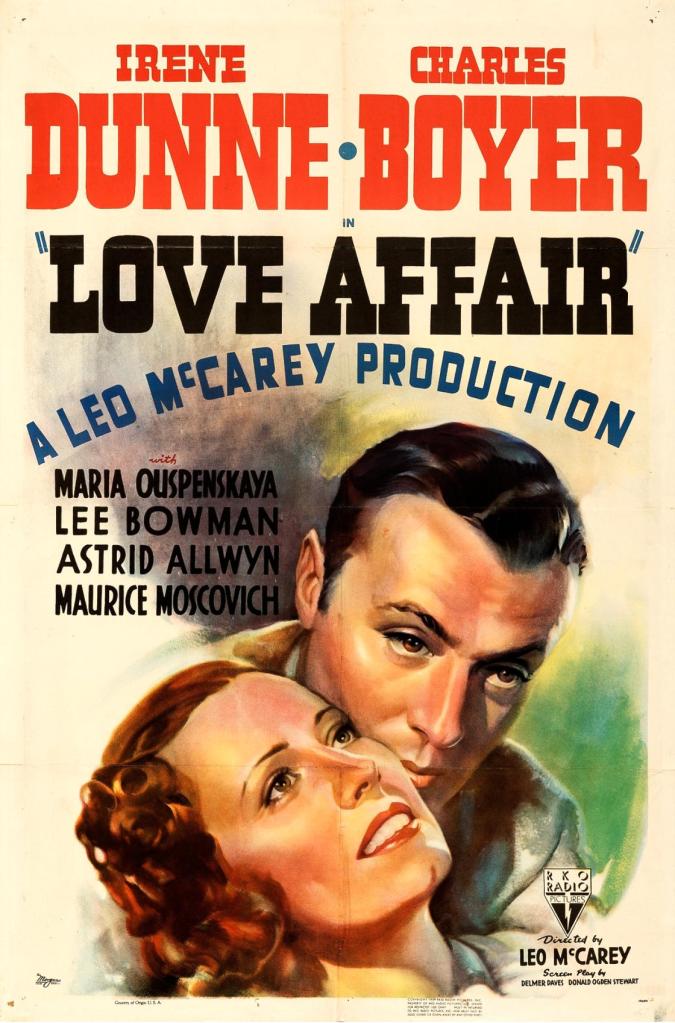
Love Affair (1939)

Love Affair (1939)

Two people in love, separated by circumstance, in this film of two halves: one comedy, one sentimental

Director: Leo McCarey

Cast: Irene Dunne (Terry McKay), Charles Boyer (Michel Marnay), Maria Ouspenskaya (Michel’s Grandmother), Lee Bowman (Kenneth Bradley), Astrid Allwyn (Lois Clark), Maurice Moscovich (Maurice Cobert)

In many ways you could say Love Affair was the turning point in Leo McCarey’s career. For years in silent films and the early talkies he had been one of Hollywood’s leading comedy directors, the quick-witted master of the improvisational pun. But there was a second McCarey: the devout Catholic, concerned about social issues. The McCarey who light-heartedly complained when was given an Oscar for The Awful Truth rather than his heartfelt critique of elderly care, Make Way For Tomorrow. This McCarey increasingly leaned into well-meaning, sentimental dramas.

So why is Love Affair a turning point? Because the first half is a charming, funny, sexy meet-cute: and the second a well-meaning but sentimental love story that pulls two people apart. Those meet-cuters are famous Parisian playboy (he’s basically a gigolo) Michel Marney (Charles Boyer) and nightclub singer Terry McKay (Irene Dunne). They meet on a trans-Atlantic liner and fall in love. Problem is they are both engaged to others (both of them rich), waiting for them in New York. Should they decide to chuck it in and be together, they arrange to meet six months later at the top of the Empire State Building. Come the day, Michel waits – but on the way there, Terry is hit by a car and possibly left paralysed. She doesn’t want to tell him. He thinks she never planned to show up. Will they ever be together?

That car crash is the pivot in a film that feels like two genres surprisingly successfully wedded together. Love Affair is a great idea (so good in fact that McCarey remade it about 20 years later as An Affair to Remember), a romantic story with all the joy and vibrancy of a couple finding each other and falling in love, then the painful sting of tragic circumstances pulling them apart. It manages to be sweetly funny and then more or less manages to land just the right side of sentimental (though, lord, it skates near to the edge).

You go with that more overtly manipulative conclusion though, since the subtle comedic and romantic manipulation of the first half is so well done. McCarey encouraged his actors to improvise: filming started with McCarey sitting at a piano, plinking keys, waiting for inspiration to jazz up the script. It’s an approach many actors found challenging (Cary Grant nearly had a meltdown at first on The Awful Truth). But he found the perfect pairing with Boyer and Dunne.

Of course, Irene Dunne was a veteran. An actress far too overlooked today, Dunne flourished under McCarey’s style. Here she’s gloriously warm, sexy and charming. Terry McKay has a very dry (at times almost slightly smutty) wit; she’s absolutely no fool, but also kind, caring and considerate. Dunne sparkles every time she steps in front of the camera, displaying the sort of comic timing you can’t buy (her teasing glances at Michel during their first meeting, when she accidentally reads a telegram all about his sexual exploits at Lake Como, are to die for). But her face also lights up with a genuine radiance as she finds herself falling in love.

She also sparks wonderfully with Charles Boyer. Another overlooked star of 1930s Hollywood, Boyer was desperate to work with McCarey. He found the improvisational style awakened a relaxed, playful element in his acting that helped make Michel exactly the sort of dreamboat you could imagine falling in love with on a cruise. Boyer was also a superb reactor, his face able to communicate anything from growing interest, to delight and also piety, pain and disappointment. Boyer’s comic timing, like Dunne’s is faultless. Like her, he also effortlessly shifts to drama in the second half, expertly demonstrating the maturity of a playboy into someone generous and understanding.

With these two actors, McCarey couldn’t go too far wrong. Their natural ease with each other makes for wonderful chemistry. They are two people who progress naturally from teasing, to enjoying each other’s company, to realising they enjoy each other’s company way too much. Today, Love Affair can look a little tame – they don’t even kiss (although one shot of crashing waves, cutting to them opening a door on the boat to walk along the deck together, is rather suggestive). But the point is that this is love not an affair (or an affair about love). The feelings they develop for each are genuine and, bless them, they don’t want to corrupt it with behaviour that could compromise them.

Tellingly their love is cemented during a stop off in Madeira, where they visit Michel’s aunt (played by an archly eccentric Maria Ouspenskaya). She welcomes them into her home, bonds with Terry, and Michel shows Terry a far different side to himself than his playboy persona: a thoughtful artist. McCarey even shoots them together (in a beautifully lit scene by photographer Rudolph Maté) in a chapel, kneeling side-by-side at the altar. Could McCarey make the endorsement of their love more clear?

Perhaps he felt he needed to, since the screenplay was controversial. The Hays Code had no intention of allowing a film showing two engaged people walking out on their partners. Perhaps that’s why they needed to be “punished” with that sudden car crash. The second half is less successful: maybe because I find the “I can’t ruin his life by making him look after me in a wheelchair” a little too on the nose. Boyer and Dunne play the hell out of it: Dunne is quietly crushed under a surface of charm and what-will-be-will-be. Boyer tries his best to hide his pain, but still searches for some of what he’s lost in his new career as an artist.

Of course, the truth will out – and it will end happily. But there’s a little too much sentiment in the second half, after the heartfelt romancing of the first. A little too much put-a-brave-face-on-the-pain, a few too many contrivances to maintain the illusion (of course they go to the same play on Christmas Eve!). There are too many sickly sweet scenes of Dunne singing with the kids at the orphanage she’s recuperating at (a ghastly advance warning of McCarey’s tedious Going My Way). But it just about works, because we really care about Terry and Michel. We want them to be together, come what may.

Love Affair can be a mixed bag, but it’s got two wonderful performances for Boyer and Dunne (she was nominated, he was robbed) and McCarey manages to juggle comedy, romance, sweetness and a little touch of sadness. It’s a luscious romantic film, even while you see it manipulating you – and for that, it will always give you a great deal of pleasure.

Thirteen Lives (2022)

Thirteen Lives (2022)

A real life rescue attempt that defied belief is bought to the screen with gripping power and skill

Director: Ron Howard

Cast: Viggo Mortensen (Richard Stanton), Colin Farrell (John Volanthen), Joel Edgerton (Dr Richard Harris), Tom Bateman (Chris Jewell), Pattarakorn Tangsupakul (Buahom), Sukollawat Kanarot (Saman Kunan), Teerapat Sajakul (Captain Anand), Sahajak Boonthanakit (Governor Narongsak Osatanakom), Vithaya Pansringarm (General Anupong Paochinda), Teeradon Supapunpinyo (Ekkaphon Chanthawong), Nophand Boonyai (Thanet Natisri), Paul Gleeson (Jason Mallinson)

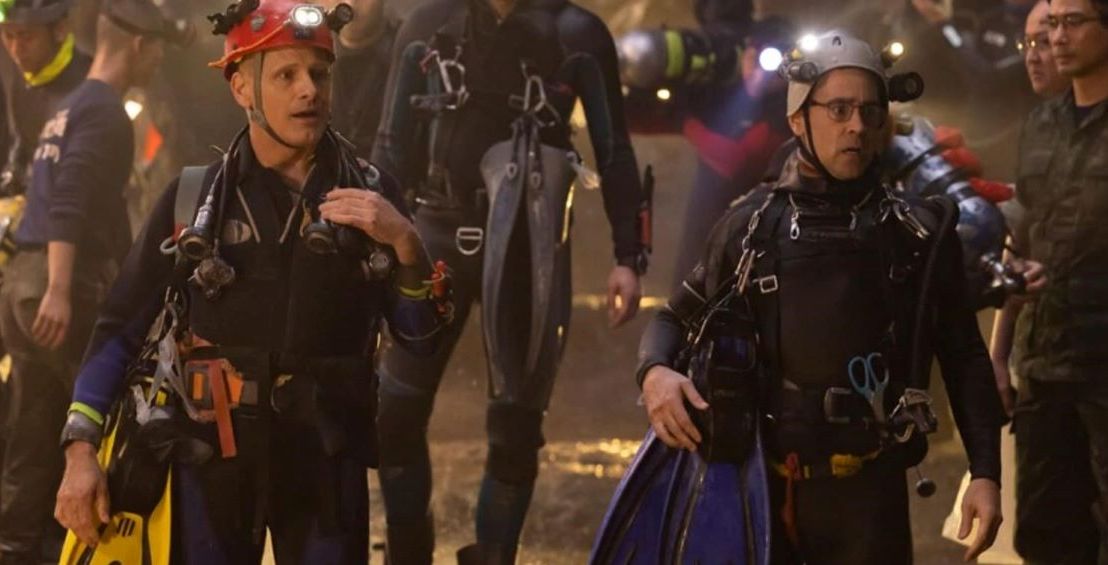
In Summer 2008 one story gripped the world. In Thailand on June 23rd, 12 members of a boys’ junior football team and their coach Ekkapon Chanthawong (Teeradon Supapunpinyo) were stranded underground in the Thum Luang caves by flooding. Rescue attempts would call for an international effort: Thai Navy Seals, American military, the local community and a team from the British Cave Rescue Council pooled talents and knowledge to help save the boys before they drowned, suffocated or starved to death.

It’s bought to the screen in Ron Howard’s gripping true-life disaster film, Thirteen Lives, a scrupulously respectful yet compelling dramatisation reminiscent of his Apollo 13: it wrings maximum tension from a story nearly all of us know the outcome of. Just like that film, it superbly explains the huge obstacles the rescuers faced – the near impossibility of navigating the flooded caves, the onslaught of water, the claustrophobic underwater conditions, the panic-inducing nightmare of swimming through kilometres of tight space for inexperienced divers…

Each of these is swiftly but carefully explained, before Howard focuses on the international effort resolving them. Onscreen graphics – in particular a map of the route through the cave complex, including distances and time spent travelling underwater (over four hours) – help us understand every inch of the journey and its implications. Carefully written scenes avoid the trap of exposition overload while making the dangers of an hours-long swim through dark, flooded tunnels clear.

Howard skilfully goes for show-not-tell where he can. The gallons and gallons of water running down the mountain and into the caves in the monsoon conditions are made abundantly clear. The first expedition of experienced cavers Richard Stanton (Viggo Mortensen) and John Volanthen (Colin Farrell) is staged in careful detail: the sharp currents, confined conditions (some parts of the cave are almost impassable – particularly when dragging two oxygen cylinders), the inability to see where you are going, the hours of oppressive time spent underwater.

In case we in are any doubt of how difficult any rescue will be, we see Stanton take a stranded rescue worker a short distance underwater: the man panics, nearly drowns them both and then nearly kills himself trying to surface. The eventual plan – to sedate each boy and have an experienced rescue diver carry him out – is as carefully explained as is its risk (if the dose is not exact, suffocation or panic induced drowning can and will occur). Howard’s careful, unflashy but captivating filming of the rescue attempt that follows is nail-biting and deeply moving.

Not least, because the film doesn’t shy away from the terrible risks. The accidental drowning of Navy Seal Saman Kunan – tragically volunteering from retirement – is sensitively, heartbreakingly handled. Every character is painfully aware of the dangers: Teeradon Supapunpinyo’s coach begs the families to forgive him for putting their children at risk (the children fall over themselves to praise him for saving their lives, in a heart-rending scene). Tom Bateman’s (fabulous) Chris Jewell breaks down in relief, guilt and a fear after he briefly panics during the rescue (no one blames him for a second – they all know each of them has been seconds away from the same countless times). This is a film that understands heroism is not square jawed machismo, but a grim awareness of the risks and a determination to not let that analysis stop you from helping those in need.

But Thirteen Lives is very pointedly not a white saviour story. It’s a story of teamwork and skills coming together: the British and Australian divers join a rescue effort being led by Thai Navy Seals, supported by local Thai officials. All of them are vitally assisted by a Thai water engineer who travels a huge distance to the site to help, and who brings vital knowledge, but can’t succeed without a local man who knows the terrain and a team of ordinary volunteers.

A triumphalist story would have opened and closed with one of our British heroes – the coolly professional ex-firefighter Stanton perhaps – and had them learning lessons and rising to the challenge. This film starts with the boys’ plans for a birthday party, and closes with the eventual much-delayed party. As soon as it’s revealed they are alive inside the cave complex, the film returns to them time and again and stresses their role was in many ways the hardest of all: trapped, lonely, terrified and slowly starving and suffocating, powerless to do anything. Howard’s film never forgets it is their story, or the courage they showed.

Equally, the film  doesn’t forget the role of ordinary people. Thirteen Lives is full of people unquestioningly making sacrifices, putting themselves in danger or working at the limits of endurance to help. It’s not just the divers who carried the boys out who saved them. It’s the Thai farmers, living in poverty, who willingly agree that their farmlands (and crops) be destroyed by redirected water flow from the mountain to buy the boys time. The Thai volunteers battling for days with sandbags, pipes and eventually bamboo funnels against a never ending waterflow.

In this the British team are another group of (admittedly more prominent and vital) experts, volunteering their skills. Their presence is at first resented by the Thai Navy Seals – do they fear a white saviour story as well? – who feel a personal duty to rescue the children. Such clashes are not glossed over – but Howard’s film demonstrates the growing respect between them. The Seals are superb divers: but less experienced in the caving conditions the British team practically live in. The British are experts, but strangers in this land.

As those divers – this is surely the first Hollywood blockbuster to feature a hero from Coventry – Mortensen and Farrell are superbly committed and human. (There is a British delight to be had from their discussion of the merits of custard creams.) Mortensen is the hardened realist: he is sceptical that the impossible can be achieved and is firm that he won’t allow himself or others to undertake suicidal efforts. Farrell is great as his counterpart, determined to leave no one behind. Both actors spark wonderfully off each other – and their commitment, and that of the rest of the cast,  to filming in these punishing conditions is stunning.

Thirteen Lives is a superb reconstruction of an incredible story, that wrings the maximum drama from an international sensation. It carefully celebrates internationalism and co-operation (its dialogue is largely not in English) and the struggles of the highly professional to find solutions to insurmountable problems. Channelling all Howard’s skills with biography, against-the-odds survival stories and ability to draw committed performances from actors, it’s his finest film in a decade and a worthy spiritual follow-up to Apollo 13.

Gone with the Wind (1939)

Gone with the Wind (1939)

For decades unchallenged as the best loved Hollywood film ever made, but showing some signs of its age, it’s still an undeniable marvel

Director: Victor Fleming

Cast: Vivien Leigh (Scarlett O’Hara), Clark Gable (Rhett Butler), Leslie Howard (Ashley Wilkes), Olivia de Havilland (Melanie Hamilton), Thomas Mitchell (Gerald O’Hara), Evelyn Keyes (Suellen O’Hara), Ann Rutherford (Careen O’Hara), Barbara O’Neil (Ellen O’Hara), Hattie McDaniel (Mammy), Butterfly McQueen (Prissy), Oscar Polk (Pork), Rand Brooks (Charles Hamilton), Carroll Nye (Frank Kennedy), Jane Darwell (Mrs Meriweather), Ona Munson (Belle Watling), Harry Davenport (Dr Meade)

For most of the twentieth century, if you asked people to draw up a list of the greatest Hollywood films of all time, you can be pretty sure this would be close to the top. A landmark in Hollywood history, everything about Gone with the Wind is huge: sets, run time, costs, legend. It’s crammed with moments that have developed lives of their own in popular culture. Its score from Max Steiner – luscious and romantic – is instantly recognisable, practically Hollywood’s soundtrack. It’s the most famous moment in the lives of virtually all involved and for decades whenever it was released, it raked in the cash. But as we head into the twenty-first century, does GWTW (as it called itself even at the time) still claim its place at the head of Hollywood’s table?

It’s the love child of David O. Selznick. Never mind your auteur theory: GWTW credits Victor Fleming as the director, but parts of it were shot by George Cukor (the original director, who continued to coach Leigh and de Havilland), William Cameron Menzies (the legendary art director, who shot the Atlanta sequences) and Sam Wood (who covered for an exhausted Fleming for several weeks). This is a Selznick joint from top to bottom. GWTW is possibly the ultimate producer’s film: a massive show piece, where not a single cent isn’t up on the screen. Huge sets, vast casts, colossal set pieces, thousands of costumes and extras. It’s an extravaganza and Selznick was determined that it would be an event like no other. And a hugely entertaining event it was.

It would also be scrupulously faithful to Margaret Mitchell’s novel, with a dozen screenwriters working on it (including Selznick). GWTW was the ultimate door-stop romance novel. Set in Atlanta, Georgia, the entire film is a no-holds barred “Lost cause” romance of the South during the Civil War and Reconstruction. Scarlett O’Hara (Vivien Leigh) is the passionate, wilful daughter of a plantation owner, desperately in love with Ashley Wilkes (Leslie Howard), who is attracted to her but all set to marry his cousin Melanie (Olivia de Havilland). Also interested in Scarlett is playboy Rhett Butler (Clark Gable). Romantic complications are set to one side when the Civil War breaks out, bringing disaster to the South. As the war comes to its end will Scarlett and Rhett find love, or will Scarlett’s fixation on Ashley continue to come between them?

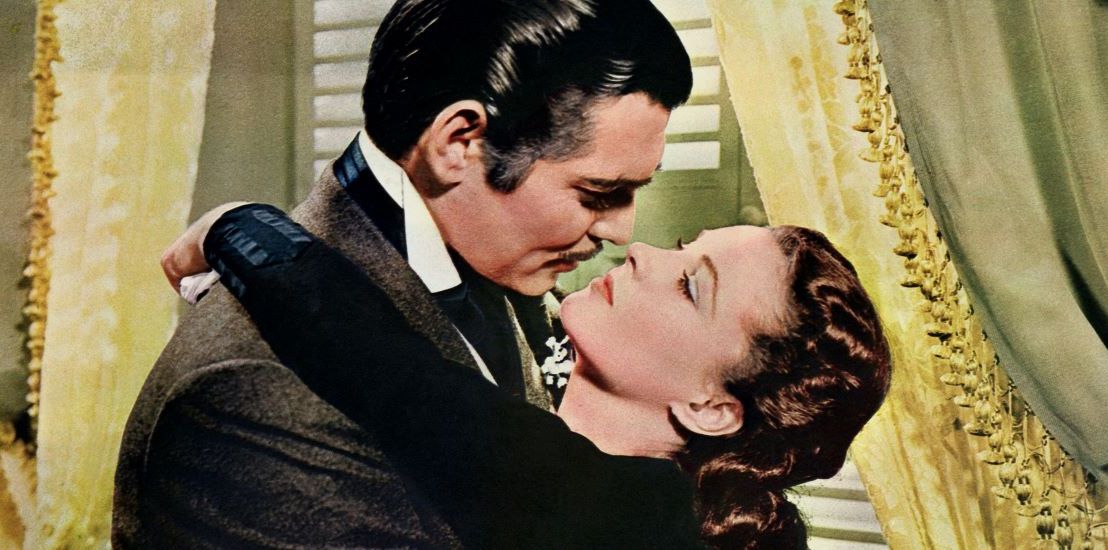
GWTW’s casting was the sort of national obsession not even the casting of a superhero gets today. Every actress in Hollywood seemed to screen test for Scarlett O’Hara, with Selznick playing the search for all the publicity it was worth. No one suggested Vivien Leigh. But, lord almighty, Leigh was placed on this Earth to play Scarlett O’Hara. GWTW is dominated by Leigh, dripping movie star charisma. She would be synonymous with the role for the rest of her life, and it’s no exaggeration to say this one of the greatest acting performances in movie history. Leigh balances a character stuffed with contradictions. Scarlett is wilful and vulnerable, impulsive and calculated, childish and dependable, selfish and generous, spoilt and sensible, romantic and realistic… But Leigh balances all this with complete ease. It’s an act of complete transformation, an astonishingly confident, charismatic and complicated performance.

There was no debate about who would play the romantic hero, Rhett Butler. He basically was Clark Gable. And Gable was perfect casting – so perfect, he was almost too scared to play it. But he did, and he is sublime: matinee idol charismatic, but also wise, witty and vulnerable (it’s easy to forget that Rhett is really in the traditional “woman’s role” – the ever-devoted lover who sticks by his woman, no matter how badly she treats him, spending chunks the latter half of the film halfway to depressed tears). For the rest, Leslie Howard was oddly miscast as Wilkes (he seems too English and too inhibited by the dull role) but Olivia de Havilland excels in a generous performance as Melanie, endearingly sweet and loyal.

These stars were placed in a film production that’s beyond stunning. Shot in glorious technicolour, with those distinctive luscious colours, astonishingly detailed sets were built (plantations, massive dance halls, whole towns). Everything about GWTW is designed to scream prestige quality. It lacks directorial personality – the best shots, including a crane shot of the Civil War wounded or a tracking shot on Leigh through a crowded staircase, seem designed to showpiece the sets and volume of extras. It’s a film designed to wow, crammed with soaring emotions and vintage melodrama. Nothing is ever low key in GWTW: disasters are epic, love is all-consuming passionate clinches. They built stretches of Atlanta so they could burn it down on camera. It’s extraordinary.

And much of GWTW is extremely entertaining. Especially the first half. It’s an often overlooked fact that if you ask people to name things that happen in GWTW, nearly everything (bar the film’s final scene obviously) they will come up with is in the first half. Rhett behind a sofa in the library? Atlanta on fire? Rhett and Scarlett at the ball? Scarlett surrounded by admirers at a garden party? “I’ll never be hungry again?” All before the interval. The first half is a rollicking, fast-paced rollercoaster that takes us from the height of the South to the devastation after the war. It grabs you by the collar and never lets go, supremely romantic, gripping and exciting.

The second half? Always duller. Bar the start and finish of the second half (nearly two hours in all), it’s a Less memorable film. Sure, it has the O’Hara’s in extreme poverty, Scarlett reduced to converting a curtain into a dress to glamour up some cash to keep Tara. It’s got Ashley and Melanie’s adorably sweet reunion. And it’s got possibly the most famous line ever in movies “Frankly my dear, I don’t give a damn” (not to mention “Tomorrow is another day”).

Other than that? It’s a bitty, plot-heavy series of forgettable, episodic moments which you feel really should have been cut. Who remembers Frank Kennedy? Or Scarlett’s lumber mill? Rhett pushing his daughter in a pram? The London sequence? There is a solid hour of this film which is flatly shot, dully paced and devoid of anything memorable at all. GWTW owes all its beloved reputation to the first half: and to be fair you’ll be so swept up in that you’ll give the film a pass for its middling second act. After all you get just about enough quality to keep you going.

But what about the elephant in the room? GWTW, like no other beloved film, has a deeply troubling legacy. They were partly aware of it at the time – after all, every racial epithet was cut, as is every reference to the KKK (it’s referred to as a “political meeting” and Rhett and Ashley’s membership is glossed over) and we never see the attack they carry out on a shanty town of former slaves. But GWTW remains, in many ways, a racist film peddling an unpleasant and dangerous mythology that the “Lost Cause” of the South was all about gentlemanly fair play, rather than coining it off plantations full of enslaved workers.

GWTW, in many ways, plays today a bit like a beloved elderly relative who comes round for dinner and then says something deeply inappropriate half-way through the main course. The dangerous mythology is there from the opening crawl which talks of the South as a land of “Cavaliers and cotton fields” where “Gallantry took its last bow…[full of] knights and their ladies fair, of Master and Slave”. The third shot of the film is a field of smiling slaves, working in a cotton field. Hattie McDaniel won an Oscar (at a segregated ceremony) and she is wonderfully warm as Mammy, but her character is another contented underling. At least she seems smarter than the other main black characters, Pork and Prissy: both are like children reliant on the guidance of their masters.

The Cause of the South is luscious and romantic, as are the people who fight it. Nearly every Yankee we see is corrupt, ugly and greedy, rubbing defeat in our heroes’ faces. It’s not quite Birth of a Nation, but the second half has a creeping suspicion of freed black people. A carpetbagger from the North is a smug, fat black man who mocks wounded Southern soldiers. Scarlett’s walk through the streets of a rebuilt Atlanta sees her startled and mildly hustled by black people who no longer know their place. Every prominent black character is sentimental about the good old days. GWTW would make an interesting double feature with 12 Years a Slave.

It’s this dangerous and false mythology that makes the film troubling today. It’s why you need to imagine the entire thing with a massive asterisk – and why you should be encouraged to find out more about the era than the fake and self-serving fantasy the film peddles as reality. But for all that, GWTW is so marvellous as a film that it will always be watched (and rightly so), even if it was always a film of two halves and only becomes more controversial in time. But watch it with a pinch of salt, and it is still one of the most gorgeous, sweeping and romantic films of all time: that’s why it still remains, for many, the definitive “Hollywood” film.

Mothering Sunday (2021)

Mothering Sunday (2021)

Arthouse flourishes and trickery drown this try-hard literary adaptation

Director: Eva Husson

Cast: Odessa Young (Jane Fairchild), Josh O’Connor (Paul Sheringham), Sope Dirisu (Donald), Olivia Colman (Mrs Niven), Colin Firth (Mr Niven), Glenda Jackson (Older Jane Fairchild), Patsy Ferran (Milly), Emma D’Arcy (Emma Hobday)

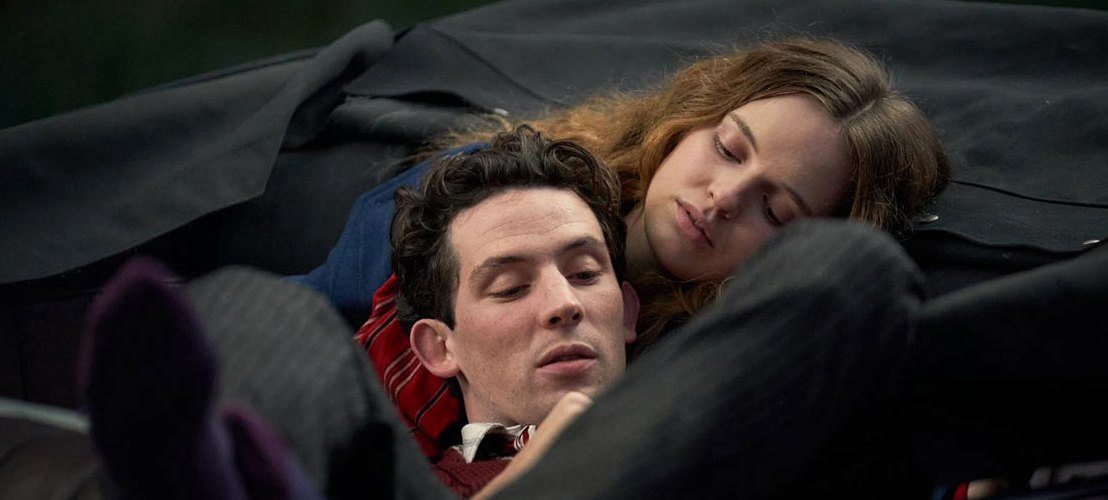
Based on an award-winning novel by Graham Swift, Mothering Sunday is mostly set on a single day: March 30th 1924. Jane Fairchild (Odessa Young) is the maid of the Nivens (Colin Firth and Olivia Colman), both of whose sons died in the Great War. The only surviving son of their close social circle is Paul Sheringham (Josh O’Connor), who has been conducting a secret sexual affair with Jane for several years. On this fateful day, Paul sneaks away from his fiancée (who was originally to marry the Nivens’ deceased son, James) for a tryst with Jane. The tragic after-effects will shape Jane’s future life. This is intercut throughout the film as she deals with the illness years later of her lover, philosopher Donald (Sope Dirisu).

Mothering Sunday is a proud, in fact a little too proud, art-house film. It takes an intricate, well structured and delicate novel by Swift and piles on the technique to try and wring as much meaning from the piece as possible. In doing so, Husson drowns a simple story in cinematic tools. Skilful cutting, intriguing shots, rich layered music, artful compositions, juddering intercutting between timelines, repeated shots and symbolic compositions eventually give an impression of a film trying too hard to impress.

It’s a story that would have carried a world more impact if it had been told with simple directness, where stylistic flourishes felt natural rather than exploited at every conceivable opportunity. Instead of moving though, the film eventually becomes tiring and the pointed dynamism of the film’s making gets in the way of the emotion. As we are cut away from moments of emotion, or the dialogue tries too hard to capture the complexity of Swift’s writing (as my wife put it, “there is a lot of talk about jizz”), we are constantly prevented from encountering the quiet emotion and unspoken devastation that should be at the heart of this simple-but-shattering story.

Even when Olivia Colman’s character – in her only real scene – is heart-rendingly confessing her pain at the loss of her children and her envy of Jane for her orphan status (she has no one to lose), Husson’s camera seems at least as interested in making you admire the fiddily mirror-based tracking shot she is using to shoot it. It is far more impactful and graceful when it sits still: for example moments like Colin Firth’s well judged performance of deeply repressed grief and pain, which expresses itself in very British banalities about the weather and doing-the-decent-thing.

Which isn’t to say that Mothering Sunday is a bad film, or that there aren’t moments of deeply impressive film-making. A dashboard-mounted camera that follows Jane’s disguised torment as she is driven to the scene of disaster is memorable, and there are beautiful shots like an aerial shot lingering over a fire in a forest that haunt the imagination. The film has a haunting quality to it, like a half-memory that flits from clear picture to clear picture via hazy recollection. But all this style swamps the impact. The film never has the patience to sit down and let us get involved in its story properly. Or really tackle how lasting the impact of loss – particularly the generational loss of the 1910s – had on families and, by extension, the whole country.

Mothering Sunday’s main successful feature is the hugely impressive performance from Australian actress Odessa Young. Not only is her accent faultless, but Young has a poetic romanticism in here that sits equally alongside an old soul within a young body. Much of the film is dependent on her micro-reactions to moments of life-changing sorrow and joy. She spends a large chunk of the film naked (as required by the source material – although this is also another tiresome sign of the film’s overly proud ‘arthouse’ badge) – but imbues this with a bohemian freeness that suggests it’s the only time, released from the shackles of her work clothes, that she feels truly free. She carries almost the whole film and does so with a consummate, compelling ease.

There are fine performances as well from Josh O’Connor – channelling Prince Charles somewhat – as a conflicted man, crushed by the burden of carrying the expectations for a whole generation, and Sope Dirisu (in a rather thankless role) as Jane’s later philosopher lover. Glenda Jackson contributes a neat cameo as a Doris Lessing-like older Jane, now a hugely successful novelist, reacting just like she did to the winning of the “major international prize” for literature.

But the overall film never quite manages to carry the impact it should. It should leave you consumed with the sadness and waste of early death and the destruction that comes from war. Instead, you will remember more the pyrotechnical invention of its making – and the wonderful score by Morgan Kibby – rather than any heart or sense of tragedy.

The Poseidon Adventure (1972)

The Poseidon Adventure (1972)

Our heroes climb up an overturned cruise liner in the film that launched a thousand enjoyable disaster movie clichés

Director: Ronald Neame (Irwin Allen)

Cast: Gene Hackman (Reverend Frank Scott), Ernest Borgnine (Mike Rogo), Red Buttons (James Martin), Shelley Winters (Belle Rosen), Jack Albertson (Manny Rosen), Carol Lynley (Nonnie Parry), Roddy McDowell (Acres), Stella Stevens (Linda Rogo), Pamela Sue Martin (Susan Shelby), Arthur O’Connell (Chaplain John), Eric Shea (Robin Shelby), Leslie Nielsen (Captain Harrison)

New Year’s Eve on the biggest cruise liner in the world and the money men have ordered “Full steam ahead!” into a storm – after all, it would be terrible publicity to arrive late at harbour. Needless to say, it’s a terrible idea, as the Poseidon is hit by a tsunami and flipped upside down. Everyone at the top of the ship is killed, leaving only the party goers in the promenade room alive. Who is going to make it out from the one of the most famous disaster films of all time?

Produced by the Master of Disaster himself Irwin Allen – he personally staked half the budget and made a fortune – the ship’s passenger log is a host of Oscar-winning stars, each balancing soapy plotlines. Gene Hackman is the maverick priest, body pumping with muscular Christianity, who believes God helps those who help themselves. Ernest Borgnine is a grumpy police chief, on a long-delayed holiday with his ex-call girl wife Stella Stevens. Shelley Winters and Jack Albertson are a retired couple heading to Israel to see their grandson for the first time. Red Buttons is an unlucky-in-love fitness freak, Roddy McDowell a plucky steward. Pamela Sue Martin and Eric Shea are two (unbearable) kids travelling to join their parents while Carol Lynley is the ship’s terrified singer.

The Poseidon Adventure cemented the tropes you’d come to know and love in disaster films. The maverick leader, the grouchy contrarian, a plucky pensioner with a vital skill, adorably brave kids, a self-sacrificing nice guy… They’re all in here, the actors playing these cardboard cut-out characters with gusto as they climb up the endurance obstacle course set of an upside-down cruise liner.

Allen’s film takes a while to get going: a quarter of the run time is dedicated to setting up the various character dilemmas. Is a member of the crew a former client of Stevens’ Linda? Will Gene Hackman find new purpose in his faith? Will Red Buttons find love? Neame shoots these opening exchanges with the uninspired professionalism the exposition-filled dialogue demands (there are several variations on “What am I doing on this ship? Let me tell you…” lines). But what makes the best of these films work is when the soapy shallowness manages to make the characters endearing. It’s what happens here: the cast could do these scenes standing on their head, but gosh darn it we end up hoping the Rosens will live to see their grandson at the foot of Mount Sinai.

The film of course “starts” proper with that wave hitting. At which point, Allen (and Neame) knows exactly what works. He makes the stakes clear, the target simple (climb up, get out) and taps into common fears of falling, drowning etc. He knows how to make us thrill at the stunts – that tipping ballroom, with various stuntmen plunging downwards – and throw in the odd moment to remind us how tragic it all is (like Red Buttons sadly laying his jacket across some poor soul).

It also understands that we need to feel smarter than the crowd of extras caught up in the drama. When Gene Hackman earnestly tells everyone their only chance of survival is up, we want to feel that we’d be smart enough to go with him, rather than join the sheeple listening to the literally-out-of-his-depth purser (“What you’re suggesting is suicide!”). Allen knows we need to feel smarter so much he later throws in another group led by a confident-but-wrong authority figure (the ship’s doctor) blithely walking downhill to the flooded aft, ignoring Hackman’s cries that they are striding to a watery grave.

No, we’d definitely be with the plucky stars. After all Hackman can’t be wrong! (Gene Hackman’s priest, for all his bluster, is remarkably unpersuasive – he even only just holds onto authority in the group). The stunt work and production design as the battered stars climb up the overturned ship to the hull are remarkable – not for nothing did this scoop nine Oscar nominations – and while the film is undeniably slightly cheesy, it’s played with an absolute earnest seriousness by the cast (Hackman, to his eternal credit, acts as if his life depended on it – which considering it’s clearly a pay cheque role other actors would have coasted through is admirable).

The set pieces are superb. As the cast is whittled down, the deaths carry a certain weight – again conveyed by the honesty of the grief from those left behind. Shelley Winters bagged the best role – and the most iconic scene – as an overweight old lady with a Chekhov’s skill, performing (at great cost) an act of heroism no one else could manage. (She landed an Oscar nomination, largely for this stand-up-and-cheer moment with a sting). Most get a moment to shine – although Carol Lynley’s pathetic, panicking singer (she can’t swim or climb or hold her breath or run…) who spends her time shrieking tries your patience no end.

The film is so much about the experience of seeing this group of people overcome death-defying climbs, swims and flames that when the survivors stagger into the sunlight, the film abruptly ends. It’s all about the ride, with most of the plot points established earlier settled by someone dying on the way up. But it’s entertaining and lands just the right side of involving. The characters may be artificial, but we still care about them.

The Poseidon Adventure was a massive hit and still the best maritime disaster film made (certainly much better than its belated, lame, remake). Allen cements a formula where swiftly sketched characters, played by recognisable actors, go through endurance tests in front of us via terrifying set-ups and death-defying stunts. It’s grand, old-fashioned entertainment, perhaps taking itself a little too seriously, but giving us lots to gasp and cheer at.

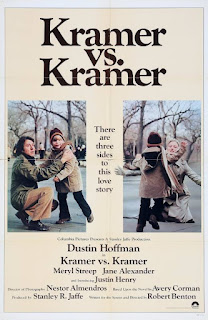
Kramer vs Kramer (1979)

Kramer vs Kramer (1979)

Father and son post divorce are explored in this Best Picture winning look at the state of marriage in the 1970s
Director: Robert BentonCast: Dustin Hoffman (Ted Kramer), Meryl Streep (Joanna Kramer), Justin Henry (Billy Kramer), Jane Alexander (Margaret Phelps), Howard Duff (John Shaunessy), George Coe (Jim O’Connor), JoBeth Williams (Phyllis Bernard), Howland Chamberlain (Judge Chamberlain)

Kramer vs Kramer is a near perfect example of how time changes the perception of a film. On its release, it was the smash-hit of the year, scooping five Oscars. It took a sympathetic look at divorce and explored the then unthinkable idea that a single father could find fulfilment in taking on the woman’s role of caring for a child. Today, it’s more likely to be seen as a thinly veiled attack on feminism and a promotional video for Fathers4Justice. But a film can be a warm celebration of a father building a relationship with his child and an implicit criticism of women who want it all.

The film opens with Joanna Kramer (Meryl Streep) tucking her 7-year-old son Billy (Justin Henry) into bed, telling him she loves him, and then walking out of her New York apartment for good. She tells husband Ted (Dustin Hoffman) – a workaholic advertising executive – she is deeply depressed and has to find what she wants from her life. Ted, a loving but distracted father, has no idea either how to raise his son or run a household. At first, he resents Billy for distracting him from his career, just as Billy resents him for being unable to care for him as Joanna could. Eventually though, Ted and Billy build a loving relationship, with Ted placing Billy’s needs first. At which point Joanna returns and demands custody, a clash that will lead to the courts.

Benton’s film, adapted from a successful novel, is shot with a chamber-piece richness by Nestor Almendros and signposts its art-house credentials with a Vivaldi string score. It’s superbly acted. Hoffman (winning for Best Actor) is hugely committed, running a gamut of emotions from anger and despair to a joyful devotion for his son. Streep won Best Supporting Actress as the deeply-torn and conflicted Joanna. Hoffman and Benton draw superbly natural work from Justin Henry as Billy, an unaffected, completely unmannered performance. Benton marshals these three actors through a series of simply shot but often surprisingly affecting scenes, alternating between raw hurt, anger and tender forgiveness.

But this is a film that needs a sister film. Specifically, one that shows events from Joanna’s perspective. Although the film – at Streep’s insistence – tries to avoid demonising her feminist desire for more in her life than cooking and cleaning, it still gives short shrift to her departure. With the film’s focus on the heart-warming relationship between father and son, it’s very hard not to implicitly see Joanna as first a selfish abandoner and then a hypocritical antagonist trying to steal Billy. There is little attempt to not stigmatise Joanna as, on some level, a bad parent.

For all the film opens with a long hard look at Joanna’s face, struggling with the conflict between her depression and leaving her beloved son, there is no real effort to explain or understand what motivates Joanna to do the things she does. There are some half-hearted justifications very late in the film, during its courtroom sequences – but these only dip lightly into any turmoil Joanna must have been feeling. Worst of all, it’s all presented as something Ted has to learn to “forgive” rather than understanding it was a crisis he played a role in causing.

The film’s main focus is on Ted learning to become a father. Ted is a classic workaholic dad of the 1970s. He stays late at the office boozing with his boss, has literally no idea about Billy’s everyday schedule and is so inept at home that cooking French toast is completely beyond him. He has no idea about how to enforce rules with Billy, alternating between showering him with ice cream to keep him quiet and then vainly trying to re-enforce rules. (In a great scene, Billy slowly and deliberately sees how far he can push these rules as he first refuses dinner, fetches ice cream from the freezer and then starts eating it, all while Ted lamely states “Don’t you dare do that” – it ends of course with mutual screams of “I hate you”.)

What Ted does is learn to become a parent. Or rather, learn how to become a 1970s mother – since it’s a joke made time again that he is the only man dropping his son off at school, taking him to the park or attending his school play. Benton’s film takes some decent pot shots at the poisonous masculine world of work, as Ted eventually loses his job for letting his single-minded focus shift towards his son – his boss offers no sympathy at all for a man whose mistakes are due to his distraction by “woman’s work”. And the Ted at the start of the film would have agreed.

The relationship between Hoffman and Henry is beautifully played, a gently paced but very naturally flourishing of love and acceptance between two people who have had their lives shattered in different ways. The Ted we met at the start could never have run several blocks to the emergency ward, carrying an injured Billy (shot with a one-take urgency by Benton) – and then point-blank refused the doctor’s suggestion he needn’t bother staying with his son while the wound is stitched up. That Ted wouldn’t have taught Billy to ride a bike or helped him learn his lines for the Halloween play. For all its dated attitudes at times, the film deserves praise for the way it stressed that men could – and should – be this involved in the lives of their children.

It should be noted that Hoffman, at the height of his method dickishness, smashed a glass in this scene without warning Streep he was going to do it – her shock was real. Hoffman also made Henry cry for camera at one point by telling him, when filming was done, he would never see any of his new ‘friends’ on the set again. You see now why he was perfect for Tootsie?

But it’s not perfect. The final act, with the return of Joanna, sees both parents gearing up for a paternity battle– and having watched Ted and Billy spend nearly an hour and 20 minutes build a heart-warming relationship, we know where our sympathies lie. Even at the time, lawyers denounced the viciousness and one-sided result of this court case, which seems inexplicable given these two parents live only a short-distance apart with similar salaries. Not that it matters as the film ends with a puff-piece Hollywood fiction moment, as Joanna bravely sacrifices her custody because she recognises she can’t take Billy from his home.

Of course, what the film doesn’t do is acknowledge that Joanna spent essentially seven years doing the sort of all-consuming parenting Ted has only just discovered in the last 18 months. Neither does it do much to avoid suggesting Ted taking these tasks on is an astonishing act of character, just as Joanna abandoning them is an act of calculated selfishness. That’s not to attack the obvious love Ted discovers for his son. He even – eventually – confesses to his son that Joanna’s leaving was his fault for taking her for granted. But the film is so taken-up with the (admittedly beautifully done) relationship between father and son, that it neglects any exploration of the wife and mother beyond her (twice) being a cataclysmic event in their lives.

But it’s a film of its time. And in trying to at least show a divorce where no one was too much at fault and stressing a father could be as much of a parent as a mother, it was trying to do a good thing – even if it sometimes looks like an elderly relative who clumsily says something offensive while trying hard to be open-minded. The three leads are superb and the film has some genuinely heart-warming moments. It looks more and more flawed at times today, but this was trying to do something very daring. And nothing dates worse than daring.

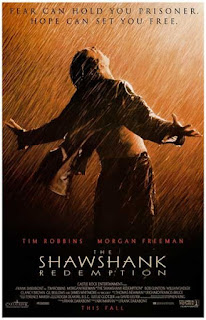
The Shawshank Redemption (1994)

The Shawshank Redemption (1994)

Hope and friendship are put to the test in one of the most beloved films ever made

Director: Frank Darabont

Cast: Tim Robbins (Andy Dufresne), Morgan Freeman (Ellis Boyd “Red” Redding), Bob Gunton (Warden Samuel Norton), William Sadler (Heywood), Clancy Brown (Guard Bryon Hadley), Gil Bellows (Tommy Williams), James Whitmore (Brooks Hatlen), Mark Rolston (Bogs Diamond)

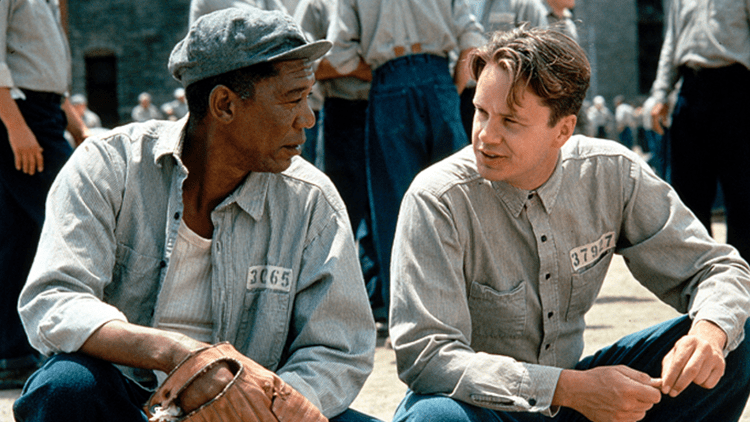
You’d hardly believe it… but the film now routinely listed as one of the most beloved films of all time was actually a box office bomb. The Shawshank Redemption tops many public polls of great films. It’s been the number one film on IMDB practically since the site was built. What is it about it that has had such a connection with people? Perhaps it’s because, under the multitude of genres the film touches on, it’s a film about the strengths of two things crucial to all of us: hope and friendship.

In 1947 Andy Dufresne (Tim Robbins), a mil-mannered bank manager, is imprisoned for life in Shawshank State Prison for the murder of his wife and her lover. For the next twenty years, Andy will get busy living rather than get busy dying, finding what moments of warmth, friendship and hope he can from rebuilding the prison library to helping his fellow prisoners. But he’ll also face daily danger, from sexual assault from brutal fellow prisoners to the machinations of corrupt warden Samuel Norton (Bob Gunton). During his time in prison, his confidant and closest friend is Red (Morgan Freeman), a smart fixer who has spent decades failing his parole hearings.

This is possibly the finest Stephen King adaptation ever made – the other major contender, Kubrick’s The Shining, has the disadvantage of being loathed by the author – perhaps because it captures both the Dickensian sprawl and sentiment of King’s best work, mixed with his edge and danger. There is a charming shaggy-dog story element to The Shawshank Redemption that helps make it delightful to watch. Not only that, it carefully builds up empathy for two people, both of whom are convicted murderers. It manages this as it turns its prison setting into a universal metaphor for the helpless victim trapped in a system.

Because, for all the pious spouting of the Warden (Bob Gunton at his most hypocritically vile), Shawshank is a place devoid of justice. On Andy’s first night in prison, a fellow new arrival is beaten to death for refusing to stop his terrified whining by head guard Hadley (a terrifyingly blank and amoral Clancy Brown). Abuse of power is pretty much endemic in Shawshank – as Andy discovers as he witnesses the guard’s casual brutality, and his accounting skills drags him into building the corrupt financial empire Norton runs with the slave labour of the prisoners.

Shawshank is all about squeezing hope out of people. It’s nothing less than a dystopian hell hole where there is no right and wrong. That’s Andy’s big impact on the place: for all its hellishness, he helps create some sort of freedom. Darabont wonderfully establishes the crushing dehumanising of the prison, so that moments where people can pretend for a moment they are free carry even more power. Whether that’s drinking cold beers on a freshly tarred roof (inveigled by Andy in return for sorting out Hadley’s inheritance tax problems) or listening to Mozart over the prison speakers. It’s there in the rebuilding of the library as a place prisoners can feel pride in or Andy coaching others to gain their school diplomas. And we feel every moment of it with them.

And that’s not even thinking about how brutish some of the other prisoners are. Much of Andy’s first few years in prison see him dodging gang rape from a group of particularly violent prisoners (led by a sneeringly vicious Mark Rolston). For that opening act, Andy is tossed as low as you can go, Darabont pulling no punches on vicious beatings or terror he has to endure. Hope becomes more powerful when it grows out of despair.

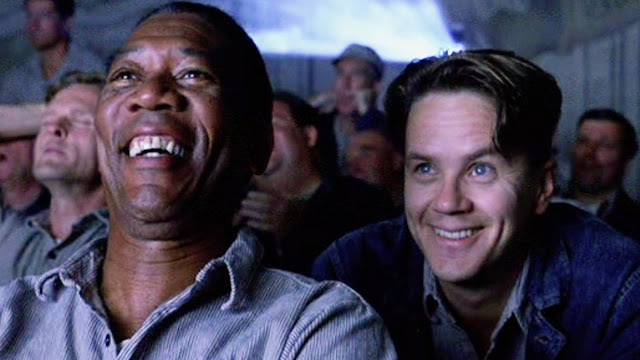
But that suffering is crucial because it gives even more warmth and power to the friendship between Andy and Red. Shawshank Redemption is a beautiful platonic love story, about a deep and lasting bond between friends. The warmth, regard and affection between these two characters, who discover how much they have in common is beautifully paced and supremely engaging.

It’s also helped a great deal by two fabulous performances from the leads. Tim Robbins’ baby-faced inscrutability is perfect for a man who may or may not be a murderer, and looks like he both needs protection and also has the internal strength to see him through anything. You can see why Red thinks, on first meeting him, he might be weak – but also never doubt for a moment that he’s strong enough to wade through the filth of Shawshank.

Opposite him is an iconic, beautiful performance from Morgan Freeman. Darabont’s film uses Freeman’s gorgeous tones to perfection through Red’s narration. Freeman of course gives Red a wonderful world-weary wisdom but also a sort of innocence. Red has worked out perfectly how to bend the rules of the prison – so confidently that he’s an awe of someone who finds out a way to break them completely. This is some of the actor’ finest work, making Red witty, shrewd, self-aware but also in some ways touchingly naïve and scared that he could never survive outside the prison.

Institutionalisation is a major danger in prison: it’s part of the danger of giving up hope, of accepting the status quo that your whole life is those four walls. But then, it’s also the terror of leaving a regimented world, where some decisions are made for you and you can always know your place. One of the film’s finest sequences covers the tragic end for Brooks, wonderfully played by James Whitmore, an educated and respected librarian inside but an irrelevant, old man outside, day-dreaming of one day being allowed to ‘go home’. It’s a danger Red knows could hit him too – after all he’s the best fixer inside, but a man with no such purpose outside.

Darabont’s film understands it. In fact, the film itself encourages the viewer to get a bit institutionalised themselves. The audience enjoys Andy’s triumphs, the commadre between the prisoners, the fun of the tables subtly turned. So much so the viewers can forget that this should be a film about getting out of this hell. (In fact you can argue, after a time, it makes prison look a little like an eternal boys camp). It shakes the viewer up as much as Andy when this status quo we’ve started to enjoy gets shaken up by the arrival of young thief Tommy (Gil Bellows). It’s a moment where the viewer realises that the film made a subtle shift from being a prison drama to a buddy movie where our heroes eek out little wins from the system: not least because this is the point when the system reminds Andy (and us) that it’s not to be messed with.

Darabont’s film reforms into a wonderful caper movie, a super-clever heist, covering Andy’s eventual escape. This is classic Ocean’s Eleven stuff and has the double delight for the audience of paying off Andy’s mistreatment and injustice and also allowing us to really enjoy how ingenious he is. Then the film switches gears effortlessly on a sixpence after this moment of delightful triumph with a low-key, tender, Red-focused coda which taps us straight back into the beautiful warmth of that friendship.

Perhaps this is why The Shawshank Redemption is so universally beloved. It’s a prison film and a buddy film, it’s a caper and it’s a film about a crushing system, it’s a film of hellish suffering and deep hope, all framed around a wonderfully judged, life-affirming friendship. Darabont’ script and direction is perfectly judged and immensely moving and the acting is perfect. It works so well because it constantly brings us back to feelings of hope and friendship. Those are universal feeling and they are beautifully presented in the film. We live with Andy being put through the wringer, and relate to him so much, that we feel as cleansed by the rainfall as he does. It’s that which lies at its success; and the brilliant way it gets you to invest in the fate of its characters.