Category: Western

Back to the Future Part III (1990)

Back to the Future Part III (1990)

The franchise closes on a high with a fun, romantic and exciting finale, tonnes better than Part II

Director: Robert Zemeckis

Cast: Michael J. Fox (Marty McFly/Seamus McFly), Christopher Lloyd (Emmett “Doc” Brown), Mary Steenburgen (Clara Clayton), Thomas F. Wilson (Biff Tannen/Buford “Mad Dog” Tannen), Lea Thompson (Lorraine McFly/Maggie McFly), James Tolkan (Marshal James Strickland), Elizabeth Shue (Jennifer), Matt Clark (Chester), Richard Dysart (Salesman), Flea (Needles)

And we’re back. After the frankly awful Back to the Future Part II – an onslaught of bad gags, terrible performances, clumsy call-backs and a lot of sound and fury – the trilogy ended on a high with Back to the Future Part III which, by going back to the past, managed to find more heart and originality than Part II ever had. Strangely, by looking backwards in time, the series managed to look forward to new ideas. Part III is, by many degrees, a huge improvement.

We left Part II with Doc Brown (Christopher Lloyd) stranded in 1885 and Marty McFly (Michael J Fox) equally stranded in1855. How are they going to get back to 1985? Well Doc is happy where he is, and has left the Delorean buried in 1885 for Marty to dig it up in 1955 and get back to the future with the help of the 1955 Doc. But, digging the Delorean up, Marty discovers Doc’s 1885 grave: turns out he will be murdered by gunslinger Buford “Mad Dog” Tannen (Thomas F Wilson). So, Marty travels back to 1885 to save him. But with the Delorean damaged on the way, how will they get back to 1985? Will Doc or Marty be killed in a fatal gunfight with Tannen? And what about the Doc and schoolteacher Clara Clayton (Mary Steenburgen) falling in love?

Back to the Future Part III juggles all these plot themes with real expertise, all based in a hugely affectionate portrait of the Old West that drips with Zemeckis and Gale’s childhood love for the genre. I’m going to guess that Part III is inexplicably not held in the same regard as Part II because my generation and onward simply has far less of a connection to the Western than they do crudely cheesy views of an 80s tinged future.

But the sense of fun here is on point. Galloping horses, street fights, open air dances, trains, cameos from old-school Western supporting actors, the majestic score… it’s all an on-point reconstruction of the tone and style of Ford. (In particular, the entire film feels like a fun recreation of many elements of My Darling Clementine). The film also has fun with later perceptions. Marty is dressed up for his journey back to 1885 in the sort of brightly coloured, skin-tight costumes 1950s TV and B-movie western stars wore. He adopts the alias “Clint Eastwood” (and doesn’t the film have fun with that). He even (eventually) dresses not dissimilarly from the Man with No Name himself.

It doesn’t stop with the Western re-build. Back to the Future Part III has the inevitable call-back gags to events we have seen throughout the last two movies. But here they are delivered with a far more freshness. Not least because Doc and Marty largely reverse roles here (leaning into this, they even swop their catchphrases at one point). While in the previous films Marty was the impulsive one, flying by the seat of his pants with instant decisions and being assisted by the eccentric Doc, here they settle into new roles.

Because Doc here is the one being rescued and the one tempted by an impulsive decision. Namely, staying in the past because he has fallen in love. Christopher Lloyd, a much better actor than he gets credit for, is allowed to broaden out and enrich his eccentric performance as Doc with a real emotional depth in a very sweetly drawn romance. Mary Steenburgen is equally good as the kindred spirit he falls in love with. Both actors play the romance dead straight and it allows Lloyd to show an emotional depth and shade his performance has lacked elsewhere. Steenburgen’s casting is also a nice tip-of-the-hat to Time After Time (where she also played a woman who inadvertently falls in love with a time traveller). Clara is also a neatly written character, integrated far more into the plot than poor Jennifer in Part II and another welcome shake-up the buddy formula.

As Doc takes on the romantic and paradox creating role, Marty becomes the driver, urging Doc to stop getting mixed up in influencing past events and focus instead on fixing the Delorean and getting back home. Fox embraces playing (largely) the secondary role in the film. He still gets moments of fun as an actor (not least playing Marty’s Irish great-grandfather – a performance immeasurably better than all his latex covered efforts in Part II) but he’s largely the voice of sense here.

Except of course concerning his fatal character flaw: don’t call him chicken. There is nowhere more dangerous to allow someone to pick a fight with you than the Wild West. And Marty swiftly inherits the clash with Tannen (played with gruff comic gusto and impenetrably density by Thomas F Wilson). This culminates – but of course – in a face-off in a dustbowl street, with a solution to the gunfight inspired by the real Eastwood and nicely signposted in Part II.

That leads into a genuinely edge-of-the-seat exciting race to hijack a train to push the Delorean up to the desired 88 miles an hour. Zemeckis shoots and cuts this sequence to perfection – and Alan Silvestri’s score does a lot of build and sustain the tension and excitement – and it seems appropriate that the only real opponent Marty, Doc and Clara have to deal with in this sequence is time itself. Crammed with sight gags, orchestrated to perfection and perfectly paced it’s a great way to cap the series.

Much as the film itself is a perfect ending to the franchise. Its imaginative and playful, riffing on the previous events without slavishly imitating them, approaching both its characters from new angles that helps us discover new things about them and crammed with great jokes, exciting set-pieces and genuine emotion. It’s easily the second-best film in the franchise. If you want to revisit a sequel for Back to the Future do yourself a favour and pick the one in the past.

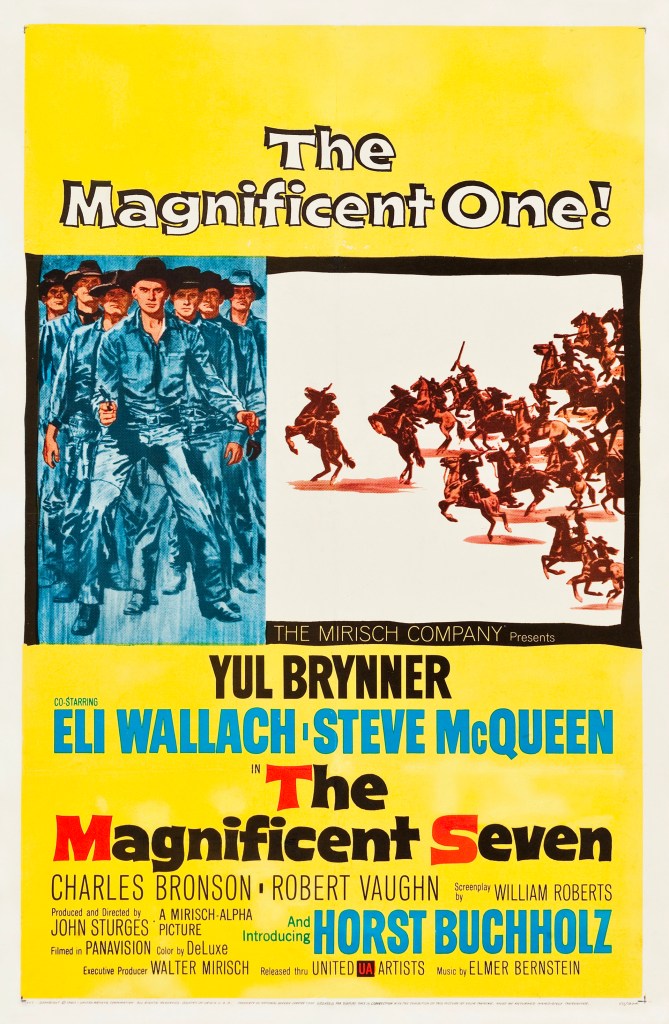
The Magnificent Seven (1960)

The Magnificent Seven (1960)

Man’s gotta do what man’s gotta do in this iconic rollercoaster of a Western

Director: John Sturges

Cast: Yul Brynner (Chris Adams), Steve McQueen (Vin Tanner), Horst Buchholz (Chico), Charles Bronson (Bernardo O’Reilly), Robert Vaughn (Lee), James Coburn (Britt), Brad Dexter (Harry Luck), Eli Wallach (Calvera), Vladimir Sokoloff (Old Man), Jorge Martinez de Hoyos (Hilario), Rosenda Monteros (Petra), Rico Alaniz (Sotero), Pepe Hern (Tomas)

“That’s the greatest shot I’ve ever seen!” – Chico after seeing Britt take down a bandit on a horse with a pistol from an unimaginable distance.

“The worst. I was aiming at the horse.” – Britt’s response.

To be honest I could probably just watch The Magnificent Seven for that moment alone. Akira Kurosawa enjoyed this remake of his greatest film so much, he presented Sturges with a samurai sword as congratulations. It’s a staple of any rainy Bank Holiday and the actors who played the seven is a classic pub quiz question (how many have scratched their heads trying to remember Brad Dexter’s name?). The Magnificent Seven has passed into cultural legend.

It’s a very faithful remake of the Japanese original (if an hour shorter). A farming village is plagued by bandits, led by scruffy, smug rogue Calvera (Eli Wallach). So, the farmers set out to find a gang of gunmen willing to work (almost literally) for peanuts to protect them. And they find themselves a heck of a posse: Chris (Yul Brynner), the unflappable tactician, Vin (Steve McQueen) the maverick sharp-shooter, tough-as-nails Bernardo (Charles Bronson), nervy veteran Lee (Robert Vaughn), samurai-like Britt (James Coburn), boisterous mercenary Harry (Brad Dexter) and plucky newbie Chico (Horst Buchholz). But will these few protect the village or will they cut and run when the going gets tough?

What do you think? The Magnificent Seven is one of those classic men-on-a-mission films, where men were stoic, noble and only stopped taking names to kick some ass. While The Magnificent Seven sheds much of the class and culture-based depth and tragedy of the original, it certainly doubles down on its fun and excitement. It barrels along with glorious energy from set-piece moment to set-piece moment, all marshalled with great skill by Sturges.

And those set-pieces are great. Chris and Vin riding a hearse shotgun (literally) through town when no-one else has the guts to do it. Britt’s dazzling knife-throwing skills calmly winning him victory in a one-on-one with a braggart. Chico proving his worth on the journey back to the village and berating the villagers running in fear from their rescuers (“Now we are seven”). The first battle with the bandits. That legendary bad shot from ice cool Britt. The final face-off in the village. What’s not to love about this explosion of well-paced, gripping, exciting action?

The casting was a smorgasbord of talents. Books have been written about Brynner and McQueen’s personality clash. The evidence of their on-going game of one upmanship is all over the picture. In nearly every shot Brynner is in, McQueen can be spotted in the background fiddling around with his hat to pull focus. Brynner took to elaborate cheroot lighting using his boot to keep eyes on him. Either way, the two of them bring their qualities perfectly to the screen. Brynner has more than a touch of the old master samurai to him, McQueen the cocksure cool (it wouldn’t be a surprise to see him turn up to the village on a motorbike). Sturges’ film builds a surprisingly warm friendship between these two that forms the emotional heart of the film.

The rest of the gang all get their moments in the sun. Robert Vaughn expertly makes Lee’s loss of nerve look like careful, deadly precision rather than a desire to duck whenever bullets go flying – in a few strokes he presents a lifetime of front to maintain presence. James Coburn – a huge fan of the original – brilliantly channels Seiji Miyaguchi as an unflappable professional. Brad Dexter bounces along as jovial chancer. Bronson gets the dullest role as the guy who befriend the village kids but manages to make his priggish material (the Western equivalent of “you kids should take care of your education and listen to your parents”) sound like tough-guy cool.

The film’s main change was to dramatically reduce the importance of Toshiro Mifune’s character, here represented by Horst Buchholz’s farmer turned gunman (also taking on Isao Kimura’s romantic subplot). Buchholz gets a version of the “the farmers are made who they are by the warriors” speech that the iconic Mifune nailed in Seven Samurai. But it’s a weaker, under-written part – it feels like what it is, a functional role for a pretty actor – with Buchholz awkwardly and dutifully going through the romantic motions with village girl Petra.

It’s part of the lack of depth to The Magnificent Seven. The original’s study of shattered world orders and the dangers of progress and change have no comparison here, although the film has a rather nice moment as the heroes bemoan the loneliness of their chosen lot (“Home, none. Wife, none. Kids… none. Prospects, zero. Suppose I left anything out?”). Brynner’s Adams has a lovely touch of regret at lost chances behind his manly eyes. The surviving gunmen know it’s the farmers who really win in the end. But, even with that, this is a film more interested in entertaining you.

That’s why we get a proper villain – Wallach’s great value as this ingratiating bully, who can’t even begin to understand what would motivate people to do something for so little gain – to give the final battle even more of a personal touch. Sturges also makes sure we get the full entertainment value of these grizzled fighters giving their all – perhaps for the first time – for a cause that goes beyond their immediate needs and that might just help give some meaning to their lives.

Above all though it’s rollicking good fun. Sharply written with tons of good lines, well-played by the cast and shot with pulsating excitement by John Sturges, every scene offers a little moment of delight. It’s a film you can kick-back and enjoy no matter what day it is, full of thrills and spills. One of those classics that never troubles the greatest films list, but always finds a place on the most popular lists.

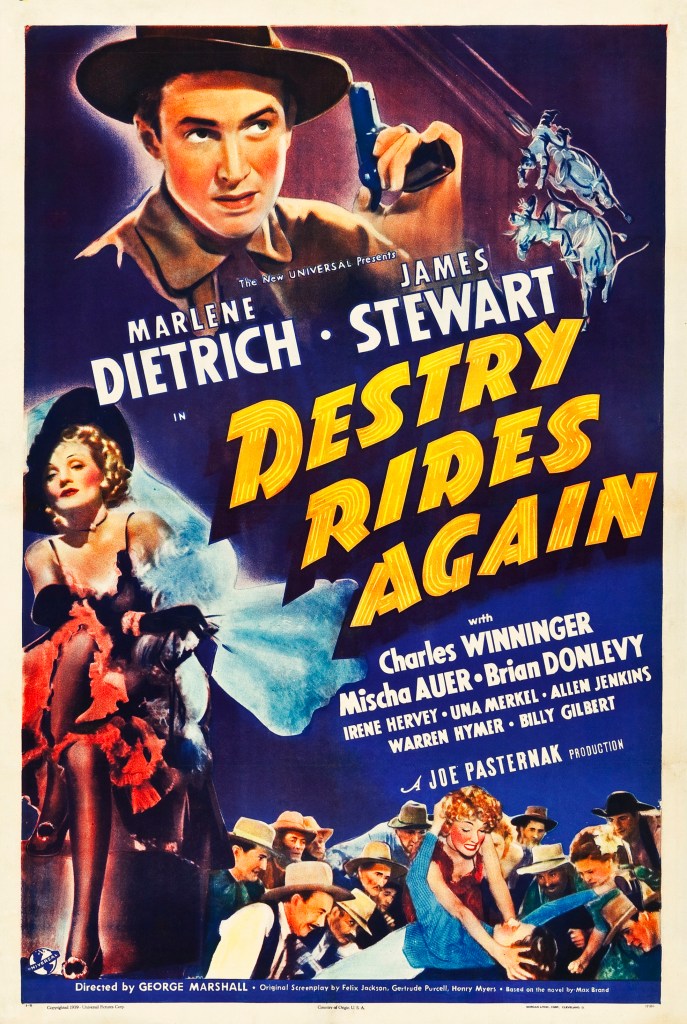
Destry Rides Again (1939)

Destry Rides Again (1939)

A gun-shy sheriff needs to clean up this town in this delightfully funny semi-comedy Western

Director: George Marshall

Cast: Marlene Dietrich (Frenchy), James Stewart (Tom Destry Jnr), Mischa Auer (Boris), Charles Winninger (Washington Dimsdale), Brian Donlevy (Kent), Allen Jenkins (Gyp Watson), Warren Hymer (Bugs Watson), Irene Hervey (Janice Tyndall), Una Merkel (Lily Belle), Billy Gilbert (Loupgerou), Samuel S Hinds (Mayor Hiram J Slade), Jack Carson (Jack Tyndall)

There’s a new deputy sheriff in town! Son of a wild-shooting, hard-as-nails lawman, Tom Destry Jnr (James Stewart) is surely the man to bring justice to Bottleneck. Or at least that’s what everyone thinks until his carriage arrives and out steps an aw shucks slouching drawler, carrying a parasol, who loves a homespun yarn and – worst of all! – doesn’t see the point of carrying guns. Surely, he’ll be a push-over for Kent (Brian Donlevy), the corrupt saloon owner who runs the town? Guess again. Tom will soon change all sorts of minds, not least Kent’s gal, glamourous singer (and card sharp) the improbably accented Frenchy (Marlene Dietrich).

George Marshall’s Destry Rides Again is pretty much a delight from start to finish. It combines rich comedy and Western satire, with genuine sharp-shooting thrills, and showcases a host of actors at the top of their game. It’s crammed with excellent jokes, shrewd observations and some moments of truly affecting tragedy. It’s the finest film Marshall, otherwise a journeyman, directed with confidently handled, crowd-filled set pieces and a wonderful sense of pace.

It’s hard not to fall in love with a man who doesn’t care what people think of him but, when push comes to shove, could beat them all in a game of quick draw. It helps abundantly when he’s played by James Stewart at his most boyish and lovable. Tom is determined to prove the law can be done another way: that escalating things by pulling a firearm only leads to trouble (“You see if I have had a gun there, why, one of us might have got hurt – and it might have been me”). Tom is quick-witted and confident enough to face down crises without a gun – putting him years ahead of the townsfolk who judge everyone by their ability to hit a target.

In fact, Destry Rides Again in its opening hour really commits to the idea of Tom as an ahead-of-his-time pacifist, who thinks through events with the grace of a chess-master. We’re constantly encouraged to delight not only in his smarts – the incriminating traps he lays for all around him, the skilful way he defuses situations – but also respect for his cool and guts (you need to be damn sure of yourself to order a glass of milk in Kent’s no-holds-barred saloon).

Tom eventually of course has to give them a show – his pin-point accuracy with a pistol leaves the town gasping, and a group of would-be trouble-makers lamely muttering how sorry they are to have disturbed the peace – but he’s far too brave to need to prove himself. Real courage is not caring what people think of you, and real smartness is being happy for others to call you a knabby-pabby yellow-belly. After all, they’ll only underestimate you – and make it even more likely Tom’s methodical, law-following approach will yield the right results.

Marshall mines gallons of fish-out-of-water comedy from Tom’s willingness to look the fool. From his arrival at the town clutching the parasol of a fellow passenger – his shoot-first-and-second-think-third fellow passenger Tyndall (Jack Carson) is mistaken for him because he matches the bill of what the town expects – to his passion for whittling napkin rings and his calm aw shucks good humour when handed a mop and told to use that to “clean up this town”. But we are never left with a doubt that Tom is the bravest, smartest, toughest guy in the town – and that he doesn’t need to constantly proof it to himself and others.

It eventually sinks in as well to glamour madam, Frenchy. Marlene Dietrich had not only never appeared in a Western before, she’d been declared “box office poison” just a few months earlier. In the public mind she was associated with glamour, distance and von Sternberg majesty. All that was to change with Destry Rides Again, where she was lusty, earthy but still with a touch of class. Who would have imagined Sternberg’s muse engaging in a no-holds barred cat fight with Una Merkel’s domineering housewife (a brawl that trashes most of the bar)?

Dietrich is quite superb in the role of this enigmatic madam. Her distinctive singing is used liberally throughout the film. Which fits nicely with Frenchy’s role in the town as the glamourous distracting agent for the crimes of Kent (a smugly grinning Brian Donlevy). Not that she’s an innocent: she swipes cards from punters in crooked card games and knows full well Kent sends “out of town” anyone who crosses him. But there is something in Tom she finds intriguing, perhaps because he’s smarter, more interesting and different from any other an in this benighted outlaw stop-off.

It helps as well that there is a clear magnetic attraction between the two. Not to mention between Stewart and Dietrich – it’s no surprise, watching the film, to hear they had a passionate affair during its making. Stewart has never really felt sexier than here with Dietrich, while Stewart helps Dietrich feel warmer and more approachable than she ever did with Sternberg. The dance (literally at one point) between these two, captures in microcosm the struggle for the town’s soul: will Tom win them over, or will the gun-totting baddies?

Marshall doesn’t quite cap the film off as well as you might hope. Eventually, Tom is left no choice but to pick up his guns. The film does present a final shoot out quite unlike anything you’ve ever seen before – ending in a battle-of-the-sexes brawl in the saloon, shot with an immersive comedy. But it doesn’t change the fact that Destry Rides Again can’t in the end square its circle: Tom may preach stern words over violence, but when push comes to shove only guns solve problems.

But you forgive it because this film is a hugely entertaining delight. There are a multitude of delightful supporting roles. Best of all are Mischa Auer is extremely funny as a Russian would-be-deputy who (literally) doesn’t wear the trousers in his marriage and Charles Winninger as the town drunk turned sheriff, who has a secret heart of gold even if he can’t tuck his shirt in (there is a lovely, late, call-back to this mannerism in the film from Tom that is genuinely moving). Destry Rides Again manages to be both a sort of spoof, but also a very real genuine Western, with a near perfect mix of jokes and action. It doesn’t quite manage to deliver on its concept, but it does more than enough.

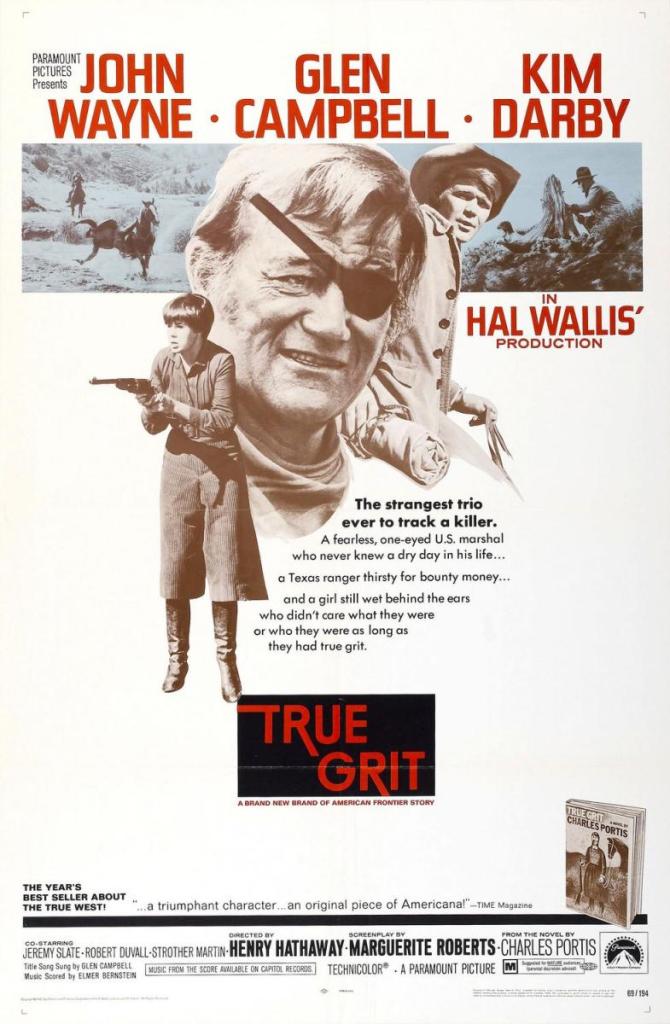
True Grit (1969)

True Grit (1969)

The Duke wins an Oscar in this solid Western (already old-fashioned in 1969) put together with a professional solidity

Director: Henry Hathaway

Cast: John Wayne (Reuben “Rooster” Cogburn), Glen Campbell (La Boeuf), Kim Darby (Mattie Ross), Jeremy Slate (Emmett Quincy), Robert Duvall (Lucky Ned Pepper), Dennis Hopper (Moon), Alfred Ryder (Goudy), Strother Martin (Colonel Stonehill), Jeff Corey (Tom Chaney), John Fiedler (Daggett)

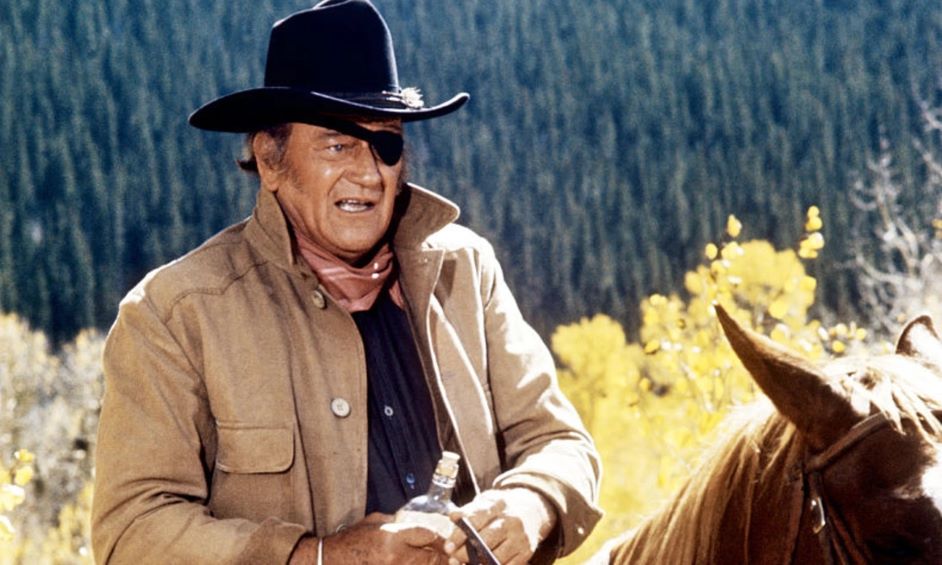
By 1969 John Wayne had been pulling his six shooters against rascals and rapscallions for thirty years, ever since making one of the all-time great entries in Stagecoach. He’d been an American icon, box-office gold and practically the Mount Rushmore of Hollywood. What he never really had was recognition that, underneath the drawl, he was a fine actor who knew his business. He’d only had the single Oscar nomination in 1949, so by 1969 there was a sentimental urge to correct that – especially since illness had already seen the Duke (one of the first major stars to be open and frank about his cancer and urge others to get checks) lose a lung a few years previously.

And correct that they did, as Wayne beat out two respected thespians (the perennially unlucky Burton and O’Toole) as well as the whipper-snapper stars of Midnight Cowboy (the sort of cowboy film the Duke would never even consider making!) to scoop the Best Actor prize for taking a character-role lead (all Wayne roles are lead roles) in True Grit. Wayne was “Rooster” Cogburn, a hard-drinking but hard-riding, always-gets-his-man US Marshal, hired by Mattie Ross (Kim Darby) the teenager daughter of a murdered father to track down his killer Tom Chaney (Jeff Corey). Rooster develops an avuncular relationship with Mattie, despite his penchant to get pissed and (of course!) eventually proves he has the ‘true grit’ that made Mattie hire him in the first place.

True Grit is a traditional yarn, directed with a smooth competence (but lack of inspiration) by Henry Hathaway. It must have felt quite a throwback in 1969: you could imagine it pretty much would have been shot-for-shot identical if it had been filmed in 1949 (especially since Wayne had been playing the veteran since at least Fort Apache). Compared to other major Westerns made that year – Butch Cassidy and the Sundance Kid and, especially, the grim nihilism of The Wild BunchTrue Grit looks like the cosiest film imaginable. It even shies away from the book’s ending where Mattie loses an arm after a snake bite (something the, frankly superior, Coen Brother’s remake would not do 40 years later).

It does feel odd to see Wayne, that bastion of old-school Hollywood, sharing the screen with New Hollywood icons like Dennis Hopper (playing a yellow-bellied squealer at the baddies hideout) and Robert Duvall (a belated villain, looking uncomfortable in this genre saddle-flick as a bad-to-the-bone gang leader). But Hathaway makes sure it’s The Duke’s show. Which it is from start-to-finish.

Rooster isn’t really a stretch for Wayne. Compared to his work in The Searchers and Red River, Cogburn is a cosy and straight-forward hero, a straight-shooter who always holds to his word. But it’s a perfect showpiece for his charisma. Wayne shows a decent comic-timing (he has a nice line in deadpan reactions, particularly when he meets Mattie’s famed lawyer Daggett for the first time, discovering far from the imposing figure he imagined he’s actually the mousy John Fiedler) and there’s just a little hint of lonely sadness in Rooster as he talks about the family who left him or the homes he’s never known.

Wayne also has a lovely chemistry with Kim Darby, the relationship flourishing in a rather sweet big-brother-“little sister” (as Rooster calls her) way. Although of course it takes time to form: Rooster spends most of the first half of the film trying his best to shrug her off so he can hunt down the gang Tom Chaney runs with (and collect the bounty for them) unencumbered. The two of them form a tenuous alliance with Texas Ranger La Bouef, who is far keener to deliver Chaney to another state for a higher bounty than that offered for the killing of Mattie’s father.

La Bouef is played with try-hard gameliness by singer Glen Campbell, largely hired to commit him to singing the film’s best-selling theme tune. To be honest, he makes for a weak third wheel – but it’s hard not to hold it against Campbell when he charmingly later said he’d “never acted in a movie…and every time I see True Grit I think my record’s still clean!”. Far better is Kim Darby, who gives a spunky tom-boyish charm to the shrewd and persistent Mattie who is far too-smart to either by cheated by short-changing landlords or to be ditched from the trail by Rooster and La Bouef.

It’s Wayne’s film though, and a final act face-off with the villains shows that there were few people better with a gun on screen (his one-handed shotgun twirling reload while riding a horse is surely the envy of Schwarzenegger’s similar move in Terminator 2). The whole enterprise is carefully framed to showcase Wayne and he rises to the occasion. Think of it like that, and it hardly matters that Hathaway offers uninspired work behind the camera and fails to provide either any moments of visual interest or dynamism (or work effectively with the weaker actors).

True Grit is an entertaining, second-tier Wayne film, lifted by his charisma and enjoyment for playing a larger-than-life gravelly cool-old-timer and cemented in history by his reward with that sparkling gold bald man. Compared to other Westerns – both before and at the time – it’s traditional, straight-forward and unchallenging. But it’s fun, has some good jokes and offers decent action. And it’s a reminder that no one did this sort of thing better than the Duke.

There Will Be Blood (2007)

There Will Be Blood (2007)

Daniel Day-Lewis triumphs in this incomparable masterpiece from Paul Thomas Anderson

Director: Paul Thomas Anderson

Cast: Daniel Day-Lewis (Daniel Plainview), Paul Dano (Eli Sunday/Paul Sunday), Kevin J. O’Connor (Henry), Ciarán Hinds (Fletcher Hamilton), Dillon Fraser (HW Plainview), Russell Harvard (Adult HW Plainview), David Willis (Able Sunday), Hans Howes (William Brandy), Paul F. Tompkins (Prescott)

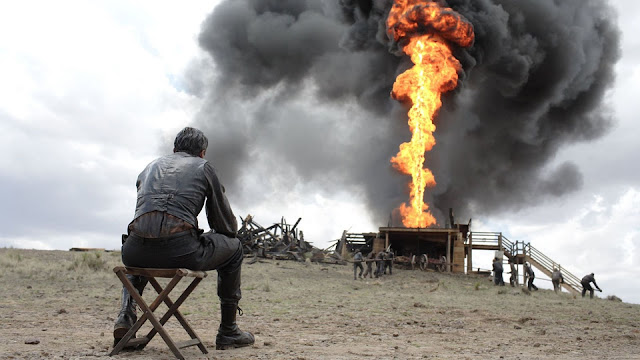
Citizen Kane’s original title was “American”. David Thomson observed perhaps there hasn’t been another film so deserving of that title until There Will Be Blood. This is one of those once-in-a-decade films, possibly the greatest American film of the twenty-first century and Anderson’s career-defining masterpiece. It’s a gripping exploration of what makes America tick, captured within the self-destructive greed and hunger for power of one man. It’s a stunning piece of work, a cast-iron masterpiece, that takes a stack of influences and reinvents them into something fresh, daring, bold and above all unrepeatably unique.

Adapted very loosely from Upton Sinclair’s novel Oil, the film follows thirty years in the life of Daniel Plainview (Daniel Day-Lewis), a misanthropic and fiercely ambitious empire-building oil man. Running a ‘family business’ with his adopted son HW (Dillon Fraser) – the boy’s father having been killed in a drilling accident – Plainview takes up a sea of leases across California. The film focuses on his exploitation of a rich seam under the community of Little Boston. A very religious community – dominated by the strong-willed Eli Sunday (Paul Dano), almost a mirror image of Plainview’s monomania – Little Boston becomes the setting for Plainview’s struggles with men and land, in a growing cacophony of drama that inevitably (as the title promises) builds towards an explosion.

Watching it you can see the inspirations. It reflects The Treasure of the Sierra Madre (which Anderson watched endlessly in preparation) in its chilling exploration of the impact of greed and Plainview is the grandfather of Charles Foster Kane. It’s set in a Fordian west, but filtered through the unique vision of Kubrick. But it’s not a slave to these: it’s a truly original work, an off-kilter epic, shot with a stunning beauty that’s half poetry, half gothic horror by Robert Elswit. It sounds like no film ever made, a deeply unsettling score that mixes discordant rhythm and baroque-inspired strings by Johnny Greenwood.

And it has two geniuses at its centre. Anderson, a director best known for large-scale ensemble pieces, inverts his style to focus on one single misanthropic force of nature, a man who sees people as only tools or rivals. His film hits every note from near silent-cinema expressionism, to Grand Guignol fever-dream intensity. It’s shot with an all-consuming urgency, long-takes of fluid camera movement, mixed with interrogative still shots. The film digs itself into your soul, takes hold and doesn’t let go. It’s at times as darkly funny, as it is horrifyingly bleak. No one else could have made it.

And no one else could have played Plainview. If There Will Be Blood cemented Anderson as one of the leading directors of the early 21st century, it confirmed Day-Lewis as the era’s greatest actor. Day-Lewis is beyond superb here: this is the sort of, epoch defining performance you see only a few times in your life. Hunched forward, like a man constantly on the move, dark eyes gleaming and his voice a malevolently rolling John-Huston inspired baritone, Day-Lewis makes Plainview a misanthropic monster. He’s articulate, instinctive and destructive. Achieving his dreams only makes him even more inhuman and bitter. And Day-Lewis makes clear the stunted, half-grown creature under the skin of the confident businessman.

It’s clear he’s desperately lonely, but seemingly only has enough humanity in him for one relationship at a time – even then, people still must serve a purpose. HW – and later Henry, the man who arrives on his land claiming to be his brother (a wonderful inscrutable performance from Kevin J O’Connor) – become props in the family business. Plainview reaches out to them for emotional connection, but it’s all one way. When an accident robs the young HW of his hearing, Plainview is incapable of caring for him – he treats the deafness like a betrayal. He banishes HW, just as he will banish and punish all those who he sees as betraying him, including Henry. There isn’t a scene that doesn’t have a piece of performative magic from Day-Lewis.

Alongside this genius, Anderson’s subject is America. It’s a stunning exploration of how capitalism, greed and an insatiable hunger for more – be it money, land, power or anything else worth a jot of value – has shaped the country. Plainview is the dark soul of pioneering American entrepreneurial spirit, obsessed to the elimination of anything else, with accumulation. Oil is the life blood of the country, God’s own gift of power wrapped in a dangerous black liquid. It’s pumping through the country’s soil, and to control it is to control the country’s circulation. It’s Plainview’s faith – and it’s the faith of all these men forging an empire out of the ground, motivated by the desire for more. It’s partly why the film is so focused on men – because it’s always grasping men like this, titans of industry, who shape the dark soul of our civilisation.

Nothing will please Plainview until he controls all around him, confessing in a quiet moment (there are no words for how brilliantly unrepentant, yet also strangely regretful Day-Lewis is in this underplayed scene) that he has “a competition within him. I want no one else to succeed. I hate most people.” Like the country itself, he has forged himself from nothing through naught but will-power and a determination to never know failure. There Will Be Blood argues that, much as we might want to think otherwise, America is built on the backs of men like Plainview – monsters with the vision and determination to turn a desert into a city.

God himself has no place in these calculations. Anderson contrasts the obsessive sweat of Plainview with the dogmatic and vainglorious Christianity of Eli Sunday (a brilliantly weasly Paul Dano). Eli’s church is a haven of evangelistic worship and showmanship, which Plainview immediately finds disgusting (does he recognise another expert peddler of bullshit?). Eli has a moral arrogance and as much as a desire to control as Plainview, and the battle that grows between these two for dominance not only shows the ruthlessness of both men, but also reflects the struggle between religious obligation and Mammon that has run through America’s history.

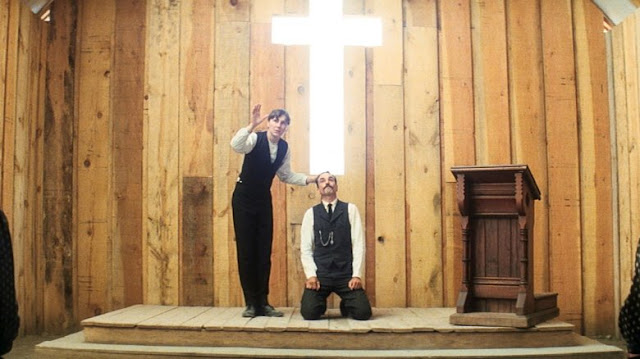
The rivalry between the two men revolves around three crucial confrontations. Having effectively robbed valuable land from Eli’s family for a pittance, Plainview then humiliates Eli, forcing him head first into the mud, refusing to allow him any influence over his dig. Eli’s revenge comes in spades: controlling a vital piece of land for Plainview’s pipeline, he demands Plainview comes to his church to be rebaptised. The resulting scene sees him goad, provoke and demean Plainview for his sins, forcing Plainview into a series of humiliating confessions (both actors are earth-shakingly brilliant).

Their final reckoning closes the film – and is both its most controversial and overblown sequence. Jumping forward fifteen years, to Plainview’s sprawling mansion (where Day-Lewis has become a dishevelled hermit, his misanthropy unchecked and his victories only confirming his loathing of humanity) it’s the famous ‘milkshake’ scene, played with the sort of OTT intensity only Day-Lewis could risk and which the film has carefully built us towards accepting. Blood-dripped in a Kubrickian setting of a bowling alley, it’s the final expression of two men’s mutual hatred and views of a world – Eli’s that it owes him something for his faith, Plainview’s that he controls it through will alone.

Only a film that has built on such firm grounding of escalating tension and excess could make such a scene a success. This is a film that starts with a near-silent 15 minutes, of Plainview hammering with a pickaxe obsessively in the belly of the country’s soil. It ends – after a long journey that has seen Plainview wheedle, steal, bully and grasp – with him entombed again, this time in his mausoleum of a home, no daylight allowed and the air filled with Plainview’s hate-filled rants. Along the way, we’ve seen the plains of California as a place of dreamy beauty, marshalled to the will of one man to control all around him, scenes of striking beauty and haunting intensity.

There Will Be Blood is a masterpiece, an inspired parable for American history, a showcase for one of the greatest actors of his generation to redefine his craft and a marvel of character study, epic vision and haunting lyricism from its director. There is not a false note in it and it stands towering as a landmark in American film history. The greatest American film of the 2000s? Possibly yes.

Rio Bravo (1959)

Rio Bravo header
John Wayne, Ricky Nelson and Walter Brennan are supremely unbothered by danger in Hawks’ High Noon riposte, Rio Bravo

Director: Howard Hawks

Cast: John Wayne (Sheriff John T Chance), Dean Martin (Dude), Ricky Nelson (Colorado), Angie Dickinson (Feathers), Walter Brennan (Stumpy), Ward Bond (Pat Wheeler), John Russell (Nathan Burdette), Pedro Gonzalez Gonzalez (Carlos Robante), Estelita Rodrigues (Consuelo Robante), Claude Akins (Joe Burdette)

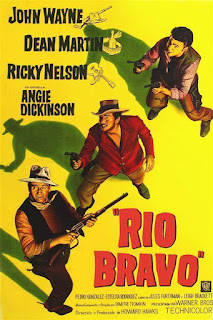
When they saw High Noon Hawks and Wayne were unimpressed. Who was this sissy cry-baby, blubbing in his office, begging all and sundry to join him in an impending gunfight with an outraged gang? This wasn’t the West they knew. How un-American was that? So, heads went together and they came up with their counterpoint: Rio Bravo, where the Duke does the right thing, locks up the bad man, is supremely unruffled by threats of violence from his gang, turns down offers of help from across the town (he doesn’t need to worry, they all help anyway) and even finds time for an unfazed, late-night jail-room sing-along with his deputies. Take that Fred Zinnemann and Carl Foreman!

The Duke is John T Chance, a grizzled, experienced sheriff, still in-his-prime, who arrests the brother of Nathan Burdette (John Russell) after he shoots an unarmed man in a bar brawl. When Nathan demands his release – or there will be hell to pay – Chance relies on the men he can trust: old-timer Stumpy (Walter Brennan), recovering alcoholic former-deputy Dude (Dean Martin) and (eventually) plucky young gunslinger Colorado (Ricky Nelson). The three simply have to wait for the Marshalls to arrive and take Burdette away – but will the Burdette’s strike first? On top of which, Chance’s eye is caught by the widow of a cheating gambler, Feathers (Angie Dickinson) – does he also have time for a bit of love?

Rio Bravo is possibly one of the most “shooting-the-breeze” films ever made – even though the general air of manly cool is punctuated by the odd gun-fight. Wayne and his gang are far too cool, confident and quick on the draw to ever be that worried about the approaching threat of the Burdette family – not that you can blame them, since Hawks spends only the minimum amount of time fleshing them out. Instead, the film is a chronicle of a few days where they hole-up and basically shoot-the-breeze – their banter carrying over to exchanging bon-mots during the final gunfight (“You took two shots!” “I didn’t take the wind into account”). It’s the sort of unfazed cool against the odds that you can see has carried across to a whole host of modern action and superhero films, heroes who are so confident in their skills they crack wise even under fire.

Rio Bravo is directed at a gentle pace but complete assurance by Hawks. It occasionally has a feel of settling down and watching a relaxed after-show party, with a group of actors so comfortable in each other’s company, that they simply filmed themselves having a whale of a time. Wayne marshals the whole thing on screen with authority and confident precision: the part is far from a stretch, but he hits the beats with a naturalness that really works, from a fatherly mix of encouragement and disappointment in Dude’s slow turnaround from his drunken collapse, to a crusty flirtatiousness with Feathers (Angie Dickinson at her most radiant here).

The film is full of delightful little moments that pop-up with a perfectly judged regularity. Colorado and Feathers save Chance’s bacon with a perfectly timed flower-pot through the window, matched with Colorado’s pitch-perfect shooting skills. Dude judges exactly the location of sharp-shooter through the drops of blood on a full beer-glass (a lovely image from Hawks). Chance and Colorado confront a card cheat. Chance is so cool under fire, that pinned with two guns on his back in a small room, he never once feels like he thinks there is any real danger.

Either side of these events, the film is full of a sublime lackadaisical charm, as our heroes riff off each other, never once letting events get too heavy. You couldn’t cast Dean Martin and Ricky Nelson without having them break into song – so of course, they do just that in a late-night sing-along. It seems to be about blocking out the sound of Degüello, the cut-throat Mexican song that plays non-stop outside the town overnight, warning them of the perils to come. But really it’s just because we are watching three blokes chilling and simply too cool to be that flustered by scare-tactics. (The Degüello here, by-the-way, was composed by High Noon’s composer Dimitri Tiomkin – another one in the eye for that film).

Wayne’s charges all do a fine job on screen, with Dean Martin in particular fitting the role like a glove and bringing a wonderful sense of sixties brashness as well as a surprisingly affecting struggle with alcohol. Ricky Nelson does his duty when pushed. Walter Brennan wheezes and cackles as only he can. Angie Dickinson is wonderfully vibrant and sexy – surely, with those tights, she’s too much for even the Duke to handle?

Duty is what it is all about, and these are men’s-men who knuckle down and get on with it rather than complain. People may offer to help, but only those qualified will do so (two of them rock-up to help at the final gunfight anyway). That film’s concluding shoot-out is rousing, dramatic and literally explosive. Hawks shoots it all with assured skill – the film’s long silent opening, is a wordless delight of reaction, implication and careful character development (Chance and Dude are wordlessly, but perfectly, established).

Rio Bravo is one of those films people has have their “favourite” – and that might be because it’s laid-back, fun and invites you to join on it. It’s free of pretension and shows you the sort of men you’d like to be, going about effortlessly the sort of things you’d like to do. No wonder people love it so much.

She Wore a Yellow Ribbon (1949)

She Wore a Yellow Ribbon header
John Wayne embodies the honour and duty of the American man in She Wore a Yellow Ribbon

Director: John Ford

Cast: John Wayne (Captain Nathan Brittles), Joanna Dru (Olivia Dandridge), John Agar (Lt Flint Cohill), Ben Johnson (Sgt Tyree), Harry Carey Jnr (Lt Ross Pennell), Victor McLaglen (Sgt Quincannon), Mildred Natwick (Mrs Abbey Allshard), George O’Brien (Major Mack Allshard), Arthur Shields (Dr O’Laughlin)

If there is a film that marks John Ford as the great American Artist of the West, it might just be She Wore a Yellow Ribbon. Shot in glorious Techicolour on location in (where else?) Monument valley by Oscar-winning cinematographer Winton C Hoch, it’s a gorgeously lit celebration of everything that made the American West a legend. Streaking red sunsets, rolling plains, lightening that slices through the sky, masculine military ruggedness beautifully bought to the screen. It’s Ford’s biggest push to become a Winslow Homer or Edward Hopper of the wide-open American space.

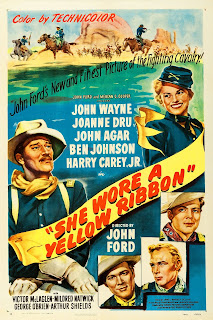
Nuzzling in the middle of Ford’s unofficial Cavalry trilogy (either side of Fort Apache and Rio Grande), John Wayne plays Captain Brittles (who might as well be Kirby York again, since he shares the same personality and most of the same backstory), is counting down the last few days until retirement. After Custer and his men are slaughtered at the Battle of Little Big Horn, he’s ordered to lead a cavalry patrol to fly the flag and help prevent a new war with the Indians. At the same time, he’s to escort his commander’s (George O’Brien) wife (Mildred Natwick) and niece Olivia (Joanna Dru) to an eastbound stagecoach (and safety). Olivia herself is in the middle of a love triangle with the two lieutenants eying taking on Brittle’s command, Cohill (John Agar) and Pennell (Harry Carey Jnr).

The film tells the story of that patrol and the subsequent follow-up mission to save those caught protecting the rear guard (needless to say Brittles continues the mission after his supposed retirement, bending the rules). There isn’t actually much in the way of plot in She Wore a Yellow Ribbon. Instead, Ford’s intention is to front-and-centre those particular American qualities of loyalty, honour, dedication to the cause and self-sacrifice. The men of the cavalry always put their country and fellow soldiers first, willing to sacrifice themselves to the greater good and show not one jot of hesitation in doing so. Ford shoots all this with real beauty and more than a touch of whimsical wit, coming particularly (where else?) from the Irish American contingent among the soldiers.

At the film’s heart is Wayne himself, now cemented in Ford’s films not as the traditional romantic action hero, but an elder statesman, wiser and less trigger-happy than his fellows, an unflappably experienced man who guides and inspires, shrugging off praise with an aw-shucks-just-doing-my-duty nobility. If Fort Apache and Red River were first steps towards Wayne – at this time only just past 40 – starting to act as if he was ten years older than he actually was (and in Red River’s case a little bit older than that!) – She Wore a Yellow Ribbon cemented him as the grizzled, inspiring man of action, a role he would play in variation for most of the rest of his career.

And he’s very good in She Wore a Yellow Ribbon. Ford had of course been impressed by the depth and shade of his performance in Red River. This is a simpler role – it would be a few more years before Ford used the darkness in Wayne as well as that film – but it shows Wayne slotting into place as part of What Made America Great. Wayne plays Brittles with a sadness – he’s a touching grieving husband, who takes a familiar chair out every night to talk to his wives tombstone – and a fatherly concern for his men, but tolerating no selfishness or greed. He mentors and pushes Cohill and Pennell like a second father, and has a brotherly banter with his loyal sergeant (inevitably Victor McLaglen as a hard-drinking, extremely Irish drill sergeant). He will do his duty, but he also respects Indian culture, will fight but prefers a peaceful option, will follow orders but never blindly. He’s all that’s good about the American fighting man, and this is one of his finest performances (and a personal favourite of his).

The yellow ribbon wearer is Joanna Dru as Olivia, the sort of spunky young woman Ford’s films frequently feature in key roles. Dru is just about the archetype: brave, determined, smart – much smarter than both of the rather dull men playing court to her. She’s also sensitive and understanding of Brittle’s grief and can hold her own with the men out in the field. Dru’s very good in the role, bringing it a great deal of depth and more than a touch of heart.

She Wore a Yellow Ribbon, plot wise, is more of a day-in-the-life movie. At heart not a lot actually really happens in it other than following the cavalry on two missions (one of which fails) and far from averting the war, it’s explicitly suggested they are just delaying it. The status quo is almost completely restored by the film’s end. The real focus of the film is the detail of what the men set out to do, the determination and humanity with which they go about it – not least the self-sacrificing bravery – and then the return to rest and prepare to go out again. All shot in some of the most striking and beautiful images of the West ever committed to the screen. As a visual tribute, the film is a rich feast.

It’s Ford’s celebration of America and the West and his case for the beauty and majesty of a generation and the values that they placed above all others. For this, She Wore a Yellow Ribbon may be one of the finest of its kind. It lacks the narrative thrust of Fort Apache – and like that film is, in the end, as unquestioning and uncritical of the actions and legacy of those pioneers out West, or the dangers of imperial expansionism or blind veneration of deeply flawed heroes like Custer – but it’s beautiful, very well acted (particularly by Wayne) and a fine film from a director at the top of his game.

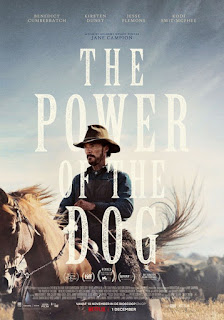
The Power of the Dog (2021)

Power of the Dog header
Benedict Cumberbatch rules his ranch with an iron fist in Jane Campion’s extraordinary The Power of the Dog

Director: Jane Campion

Cast: Benedict Cumberbatch (Phil Burbank), Kirsten Dunst (Rose Gordon), Jesse Plemons (George Burbank), Kodi Smit-McPhee (Peter Gordon), Thomasin McKenzie (Lola), Genevieve Lemon (Mrs Lewis), Keith Carradine (Governor Edward), Frances Conroy (Old Lady), Peter Carroll (Old Gent)

At one point in The Power of the Dog, Phil Burbank, monstrously domineering Montana Rancher, stares out at his beloved hills. Where others see only rocks and peaks, Phil sees how (like a cloud) they form themselves into looking like a howling dog. Seeing things others do not is something Phil prides himself on. It’s also something The Power of the Dog excels out: it’s a continually genre- and tone-shifting film that starts as a gothic, du Maurier-like dance among the plains and ends as something so radically different, with such unexpected character shifts and revelations, you’ll be desperate to go back and watch it again and see if you can see the image of a dog among its rocks.

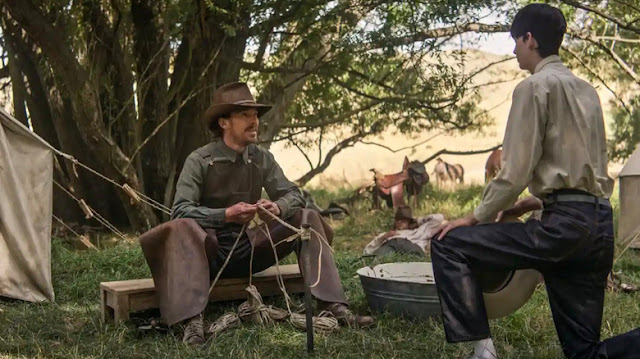
In Montana in 1925, two brothers run a ranch. George (Jesse Plemons) is polite, formal and quiet, seemingly under the thumb of his aggressively macho, bullying brother Phil (Benedict Cumberbatch). Phil is fully “hands-on” on the ranch, priding himself on being able to perform every task, from rope weaving to bull skinning, all of which he learned from his deceased mentor “Bronco” Henry. Things change though when George marries Rose (Kirsten Dunst). Phil takes an immediate dislike to Rose, engaging into a campaign of psychological bullying that drives Rose to drink. However, at the same time a strange bond develops between Phil and Rose’s student son Peter (Kodi Smit-McPhee) – is Phil’s interest in the boy part of a campaign to destroy Rose or are there other forces at work?

Campion’s film (her first in over ten years) is a fascinating series of narrative turns and genre shifts. It opens like a gothic Western. The ranch is a huge, isolated house surrounded by rolling fields and its own rules. Phil is an awe-inspiring, still-living Rebecca with Rose a Second Mrs de Winter having to share a bathroom with the perfect first wife. The psychological war Phil launches against Rose, like a hyper-masculine Mrs Danvers, seems at first to be heading towards a plot where we will see a vulnerable woman either crushed or fighting back. Then Campion shifts gears with incredible professional ease; the kaleidoscope shifts and suddenly our perceptions change along with the film’s genre, which becomes something strikingly different.

This all revolves around the character of Phil. Excellently played (way against type) by Benedict Cumberbatch, in a hugely complex performance, Phil at first seems an obvious character. A bully and alpha male who mocks George as “Fatso”, hurls homophobic slurs at Rose’s sensitive, artistic son and would-be doctor Pete, and treats his duties with such masculine reverence that the idea of wearing gloves to skin a cow or washing the dirt of his labour from him is anathema.

But look at Phil another way and you see his vulnerability. The opening scenes play as a torrent of abuse to George. But look again and you see this is a man desperately trying multiple angles to clumsily engage his brother in joint reminiscences. His emotional dependence on George is so great that they still share a single bedroom in their giant house (and even a bed in a guest house, like Morecambe and Wise) and he weeps on their first night apart. Despite his brutish appearance, his conversation is littered with classical and literary allusions (we discover later he is a Yale Classics graduate). His life is devoid of emotional and physical contact and he maintains a hidden retreat in the woods, a private den the only place we see him relax.

He’s a man clinging desperately to the past. At first it feels like he has never grown up, that he is still a boy at heart. But Campion slowly reveals his emotional bonds to his deceased mentor Bronco (whom he refers to almost constantly in conversation) to be far deeper and more complex than first anticipated. He treats Bronco’s remaining belongings with reverence, maintaining a shrine to him in the barn and cleaning his saddle with more tenderness and care than he feels able to show any human being. The depths of this relationship are crucial to understanding Phil’s character and the emotional barriers he has constructed. His gruff aggression hides a deep isolation and loneliness, feelings Campion explores with profound empathy in the film’s second half.

That doesn’t change the monstrousness of the bullying Phil enacts on Rose. Played with fragile timidity by Kirsten Dunst, Rose becomes so grimly aware of Phil’s loathing that is too paralysed by intimidation to even play Strauss on her newly purchased piano in front of George’s distinguished guests (Phil pointedly plays the music far better on his banjo and takes to whistling in in Rose’s presence) and later tips into alcoholic incoherence.

Despite Dunst’s strong performance, if the film has a flaw it is that we don’t quite invest in Rose enough to empathise fully with her emotional collapse. Both she and George (a fine performance of not-too-bright-decency from Plemons, in the least flashy role) disappear for stretches and play out parts of their relationship off camera, making it harder to bond with them (a bond the earlier part of the film needs). It perhaps might have been more effective to centre the film’s opening act on Rose rather than Phil, allowing us to relate to her better and feel her decline more.

Dunst however nails Rose’s growing fear, desperation and depression while her status as an unwelcome guest is constantly forced on her. Her panic only deepens with the return of her son Peter. This is where the film takes a series of unexpected shifts. To the surprise of all Phil offers to take the sensitive, quiet Pete under his wing: perhaps he’s impressed by Pete’s indifference to the homophobic abuse from the ranch-hands, perhaps he sees a chance to spiritually resurrect his mentor by playing the same role himself to Phil (pointedly, the film implies the younger Phil may not have been dissimilar from Pete). Either way, Campion’s film heads into its extraordinary and deeply impactful second half as an unsettling and uncertain personal drama between two men who seem totally different but may perhaps have more similarities than expected.

As Peter, Kodi Smit-McPhee gives a wonderfully judged performance of inscrutability and reserve. He’s an artistic boy who creates detailed paper flowers and keeps artistic scrapbooks, but can dissect animals without a flinch and snaps the neck of an injured rabbit with ease. He seems alternately devoted to his mother then queasily distant from her, calling her Rose and unsettled by her drunken inappropriateness. His motivations remain enigmatic, just as Phil’s motivations for befriending this isolated and very different boy could fall either way. Smit-McPhee and Cumberbatch are both extraordinarily good in the scenes between this unlikely partnership, and Campion’s artful film keeps us on our toes as to precisely what they want from this friendship. The result is haunting.

It leads into a stunning final act which demands we re-evaluate all we have seen and leaves such a lasting impression I was still re-living the film in my mind days later. Campion’s film is masterfully shot and carries a wonderful atmosphere of intimidation and unease, helped hugely by Johnny Greenwood’s brilliant score with its unsettling piano-inspired cadences. It reinvents itself constantly, Campion’s direction shifting tone and genre masterfully. It’s quite brilliantly acted and provides Cumberbatch in particular with an opportunity he seizes upon to slowly reveal depths of emotion and vulnerability an outwardly straight-forward monster. There won’t be many finer films released in 2021: and this will be a classic to sit alongside The Piano in Campion’s work.

The Big Country (1958)

Gregory Peck rides into town in The Big Country

Director: William Wyler

Cast: Gregory Peck (James McKay), Jean Simmons (Julie Maragon), Carroll Baker (Patricia Terrill), Charlton Heston (Steve Leech), Burl Ives (Rufus Hannassey), Charles Bickford (Major Henry Terrill), Alfonso Bedoya (Ramon Gutierrez), Chuck Connors (Buck Hannassey), Chuck Hayward (Rafe Hannassey)

From the very first frame when that score kicks in, you know you are in safe hands. The Big Country is a big film, and big entertainment. When I re-watched it I hadn’t seen it for years. I loved it. It’s a slab of prime Hollywood entertainment, not perfect, but it’s one of those films that always delivers.

It’s the American West, and James McKay (Gregory Peck) arrives in town to marry Patricia Terrill (Carroll Baker), daughter of local landowner Major Henry Terrill (Charles Bickford) who is in the middle of a turf feud with patriarch of a cowboy clan, Rufus Hannassey (Burl Ives). This is a town where men-are-men and a harsh word is met with a sock to the mouth. It’s a world where McKay is out of step: a seasoned naval captain, with more experience than anyone, he couldn’t care less what people think of him and won’t be goaded into doing something foolish. His self-assurance and strength of character are interpreted as wimpy yellow-belly-ness by nearly everyone, including Patricia and Terrill’s macho foreman Steve (Charlton Heston). Only local schoolteacher Julie Maragon (Jean Simmons) understands him. But as events come to a head, only McKay has the strength of character to step up and try resolve things without mass bloodshed.

The Big Country is the classic set-up: a stranger in town, who has the guts to stand up. The only difference here, is that McKay has the guts to stand up and not conform to the macho bullshit being driven by the two feuding patriarchs. Both of these men are, of course, far more similar than they would admit, being perfectly contrasting personalities. Charles Bickford plays a genteel man with the principles of a thug, while Burl Ives plays a thug with the principles of a genteel man. No wonder they can’t get on, both see in each other qualities they most likely despise in themselves.

Compared to them, McKay looks like the very model of twentieth century liberal coalition building. Or at least McKay is a liberal who packs a punch, since it’s pretty clear Peck is probably the toughest son-of-a-bitch in the town. What’s glorious in McKay – and Peck’s sensational performance of reserved warmth and wry amusement, mixed with world-weary sufferance – is that you get a definite sense he’s seen way worse than this before. A man who has sailed around the world for decades, in the hardiest conditions, who has been keelhauled and saved men from sharks, recognises this for the slightly pathetic parochial dust-up it really is, and has no interest – or need – to put his life or the lives of others at risk to make crude points about his manliness.

If only, the film argues, we could all be as confident in our own skin. McKay keeps his cool in a way no-one in film, except perhaps Tracy in Bad Day at Black Rock, has managed so successfully. He laughs off his irritation at a hazing from the Hannassey’s – and makes clear, as the Terrill’s saddle up to fight back, that in doing so they are not acting in his name. He won’t make a fool of himself by trying to ride a wild horse in front of a crowd. He won’t rise to Steve’s provocation for a punch-up in front of the entire Terrill gang. McKay is a man who only needs to prove things to himself: so he’ll tame that horse in front of no crowd and swear the only witness to secrecy. He’s not one to brag.

And if it’s a fight that Steve wants, he’ll give him one on his own time and his own terms – those being a dusky morning in private. Wyler shoots one of the greatest fights of all time, an exhausting slugging match between Peck and Heston, played out mostly in long shot that soaks up the dawn Western atmosphere, as the two men fight themselves to an exhausted score-draw, with each punch landing with a punishing wallop. There is something very compelling about this unflashy, in-the-dust, clash of two alpha males, and the strange sense of respect that grows between them (as well as the dry wit of the script – “You certainly take your time to say goodbye”, Heston deadpans after this exhausting ‘I’m leaving but first this’ fight).

It also showcases how well Wyler uses sound (or the lack of it), the fight taking place often in a longshot silence that somehow makes the dusty scuffle even more effective. Silence also comes into play brilliantly to stress McKay’s isolation when first the Terrill men ride away to extract vengeance and then the disgusted Patricia closes the front door on him, leaving him standing in magnificent isolation on the porch. Silence will also come effectively into play during the late act ride of various characters through a white chalk lined gorge and to stress the danger that the kidnapped Julie is under when being held by the Hannassey’s.

The final act brings all the threats of danger and threat together into a brilliantly tense final confrontation. This sequence showcases, not only Peck’s granite principles and nobility, but also gives excellent opportunities for Ives to explore hidden depths in Old Hannassey (it surely helped him win the Oscar for Supporting Actor) and his dumb son Buck (excellently played with a swaggering arrogance by Chuck Connors) who is all mouth and no trousers.

Sure, at times the film overplays the anti-violence card. It’s particularly noticeable as it sometimes wants to have its cake and eat it, favouring probably a sort of gun-toting liberalism, of the “I could kill you but I want to make it so I don’t have to” variety. But then the film would be a heck of a less effective if we weren’t so convinced that Peck was as tough as they come and that his unwillingness to throw himself into events thoughtlessly is a mark of his unparalleled strength. Again, Wyler uses silence as effectively as sweeping camera movements and that brilliant score, to suggest moral strength.

There is probably very little tension about where the romantic plotlines are going, but both Carroll Baker and Jean Simmons are very good as two very different, but equally strong, women (although both women allegedly found Wyler’s perfectionist Kubrickian retakes on set extremely trying). But it still works a treat because of the strength of the acting, and its strongly scripted characterisation.

That and I’ve hardly mentioned the score, by Jerome Moross, which is powerful and famous you’ll instantly know it even if you’ve never seen the film. The Big Country is a Western where the hero has the strength to stick to his principles while still getting the job done. It’s superbly acted by Peck, with Simmons, Baker, Heston, Ives, Bickford and Connors all excellent in support. Wyler combines visual and a compelling story into a film that, while at points a little long, is still a bona fide classic. Again I’ll say: I loved it.

Cimarron (1931)

Richard Dix strikes a pose as Irene Dunne looks on in the appalling Cimarron

Director: Wesley Ruggles

Cast: Richard Dix (Yancey Cravat), Irene Dunne (Sabra Cavat), Estelle Tayler (Dixie Lee), Nance O’Neil (Felica), William Collier Jnr (The Kid), Roscoe Ates (Jesse Rickey), Stanley Fields (Lon Yountis), Robert McWade (Louis Hafner), Edna May Oliver (Tracy Wyatt), Judith Barrett (Donna Cravat), Eugene Jackson (Isaiah)

The only reason Cimarron doesn’t regularly top polls of the worst Best Picture winners ever made, must surely be because so few people have seen it since 1931. Believe me you are not missing anything. A ponderous, pompous, puff of a movie, Cimarron might have tricked people into thinking it looked radical, daring and inventive at the time – but it’s fooling no-one today.

Over 40 years in Oklahoma, from the Land Rush of 1889, the town of Osage grows from tents and mud hats to a thriving modern 1920s city. Part of the story of the town are the lives of two of its founders, Yancey Cravat (Richard Dix) and his wife Sabra (Irene Dunne). Yancey is a noble, man’s man with wanderlust, who rides into Osage, guns down the bullies and campaigns for the rights of the poor and down-trodden via his newspaper. Sabra picks up the pieces when he wanders off (often years or decades at a time) raising the children, running the newspaper and eventually becoming a congresswoman.

It should be a sprawling epic, but Cimarron is a dull fart of a film that runs out of any narrative drive after its opening hour (which largely focuses on 1889-1893) and collapses into a series of disconnected, uninteresting scenes, very dully filmed, that sees our characters obtain increasing amounts of old age make-up while shedding what little personalities they had to begin with.

Ruggles shoots the film with such tepid flatness, you might as well be in the theatre. Most of the scenes sees the camera set in a static position (to capture the sound – the sound mix on the film, by the way, is appalling making most of the dialogue extremely hard to hear) with scenes taking place in medium shot allowing us to see the sets and follow the actors walking in and out. You might as well be sitting in the theatre – although, if you were, it would be harder to leave.

It’s not helped by the generally terrible acting, pretty much across the board. Irene Dunne just about emerges with some dignity by underplaying and even showcases a surprising amount of feminine independence – even if her character is an insufferable prig, demonstrating flashes of racism as and when the plot requires. But you can at least see why she continued to have a career – just as you can see why this was Richard Dix’s highest profile sound film. Dix doesn’t know whether to go for a declamatory theatrical style or to telegraph every emotion with poses, silent movie style. So, he does both. The result is a ludicrous collection of poses and grandstanding, that his wild eyes, dyed hair and middle-distance starring stance doesn’t help with. It’s a dreadful performance.

It’s fitting it sits in a film as bad as this one. The only moment of invention the film manages is its opening sequence, restaging the Oklahoma Land Rush. This set piece uses an army of carts and horses to restage the entire land grab from start to finish, the camera capturing these waves of prospectors charging into Oklahoma to grab the best bits. Nothing else in the film beats it, not even the gun fight that occurs part way through. Instead, the film degenerates into long, vague scenes, usually centring around a self-important speech of self-righteous bluster from Dix.

Nothing looks more dated in the film than its depiction of anyone not white and Christian. Now I will cut the film a little bit of slack here. It’s clearly trying to make a plea for greater toleration. Dix’s character passionately campaigns for the rights of Native Americans (or “the red men” as he puts it). He treats his black servant Isaiah with love and affection. He defends the Jewish prospectors. This film is trying to push an agenda more advanced than its time. It gets points for that.

It loses them all though for how these characters are presented. The Jewish characters are smiling, wizened Shylocks. The Native Americans are exotics, forever “How”-ing and happily accepting their status as second-class citizens. Worst of all, Yancey’s servant Isaiah is one of the most shockingly racist caricatures put on film. You think Gone with the Wind is bad? Watch this. Isaiah is stupid, muddle-headed, speaks in a clumsy patois, ridiculously fawning, delighted to be a servant and treats the white men like Gods. The film encourages us to chuckle at him, while patting his head with a smiling paternalism. All the tragic death scenes in the world can’t wash the bad taste out of the mouth. Back then it was fairly forward-thinking – today its jaw dropping.

The main problem is the film is a dull, drifting, dawdling mess that goes nowhere and asks us to root for two characters who are both, in their ways, self-important prigs, convinced they are right about everything. It builds to nothing at all, other than mirroring the sort of relentless march of time you’ll experience while watching it. It’s patronising, uninteresting and outstays its welcome. I can’t even work out why it’s called Cimarron (the name of Yancey and Sabra’s son). Is it because it’s a film asking us to think about the future? It can’t be because Cimarron is important – in ten minutes he ages from about 12 to 40. But then the fact the title refers to an empty non-character is somehow fitting for a film that really should be put down at the earliest opportunity.