The Pawnbroker (1965)

The Pawnbroker Header
Rod Steiger is superb in Lumet’s drama of grief, The Pawnbroker

Director: Sidney Lumet

Cast: Rod Steiger (Sol Nazerman), Geraldine Fitzgerald (Marilyn Birchfield), Brock Peters (Rodriguez), Jaime Sanchez (Jesus Ortiz), Thelma Oliver (Ortiz’s girl), Eusebia Cosme (Mrs Ortiz), Marketa Kimbrell (Tessie), Baruch Lumet (Mendel), Linda Geiser (Ruth Nazerman)
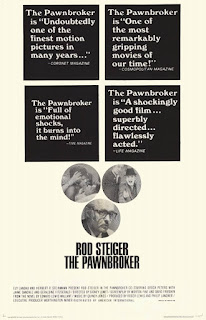
Sol Nazerman (Rod Steiger) lost his entire family – including his wife and two children – in the Holocaust. Previously a University professor, he has now cut himself off from engaging with life by burying himself in a dingy pawnbroker’s shop in Harlem, where he treats his desperate customers like “scum”, offering them nickels for their goods. On the anniversary of his wife’s death, Sol confronts his own grief, tensions from local crime boss Rodriguez (Brock Peters), the offer of a friendly ear from new neighbour Marilyn (Geraldine Fitzgerald) and the unwanted friendship of his assistant Ortiz (Jaime Sanchez).

It’s probably not a spoiler to say that all of this does not end well. The Pawnbroker is almost unrelentingly grim and bleak. Shot in a harsh black-and-white – superbly lensed by Boris Kaufman – it mixes French New Wave realism with a punishingly cold New York aesthetic that catches every grain of dirt on the streets. The past is virtually a character in the film, the events of over twenty years ago having far more importance than many of the trivial events Sol encounters in the present.

The constant presence of the Holocaust, and the scars it has left, are kept in our mind by the film’s constant use of quick – almost subliminal – cuts from current day events to snippets of Sol’s past. Hands pressed against windows turn briefly into hands against barbed wire. A young lady flicks back and forth into Sol’s wife. The sounds of a train inevitably transform into a transport train. Lumet makes it clear to us that everything Sol sees and encounters in the modern world, no matter how small, is just a continual reminder of the horrors of the Holocaust that defined his life.

This isn’t something as ‘simple’ as survivor’s guilt. It’s clear that, while his body survived, Sol effectively died in the camps and what we are seeing is his walking corpse. He’s deliberately alienated himself from the world and his concern, with no real desire to live but also no will for self-destruction. Perhaps he sees his continued existence as a punishment for failing to save his family. This has developed into a loathing for the melting pot of Harlem, a stubborn, conscious refusal to feel any empathy for anyone living there. Instead, he works hard to loath them as much as he loathes himself. Trapped by guilt and grief, Sol slaps away any offers of friendship, pity or warmth.

The film’s greatest strength is Rod Steiger’s towering performance. Normally Steiger was an actor who never shied away from the possibility of over-playing. Here, he’s so buttoned down and spiritually dead, every single movement like he’s walking around in a physical and spiritual straitjacket. Sol scuttles around the cages of his pawnshop, like a guy who has never left the camps. His performance is a masterclass in precision, of carefully restrained movement, gruff speech and eyes that stare into a dread a thousand miles away. Every step Steiger takes is weighted down by an impossible burden of grief, anger, despair and self-loathing.

It also avoids completely easy sentiment. For all that we see the suffering slowly revealed of Sol’s past, Steiger isn’t afraid to show Sol as a difficult, arrogant, even unpleasant character. The defence mechanism of hostility and non-engagement of the world has only increased his prickly aggressiveness. But yet, he remains sympathetic as Steiger also conveys the deep pain Sol spends every single minute of his life suppressing and controlling to stop it overwhelming him.

If there is a fault with the film, it’s that it goes about its carefully bleak and hopeless journey through a few days in Sol’s life with slightly too much precision. The Pawnbroker sometimes mistakes grim, hard-hitting and misery for emotional investment. For all that the film is a difficult, searing watch – and the terrors of the flashbacks are ghastly – it’s somehow not quite as moving as it should be. Perhaps this is because the present-day plot never quite takes off and the other characters – with the exception of Peter’s chillingly ebullient but dangerously violent Rodriguez – don’t quite connect. Fitzgerald’s social worker Marilyn is a character we don’t quite get to know. Not quite enough time is spent with Sol’s in-laws (despite good performances from Marketa Kimbrell and Lumet’s father Baruch Lumet) for their story arc to move us in its own right.

Similarly, the Holocaust sequences – brief and interspersed as they are – sometimes overplay their hand, particularly the rather heavy-handed opening sequences showing the Nazerman family playing in the field minutes before the Germans arrive (accompanied by a thudding musical score – and Quincy Jones’ score sometimes tries to do much work for the viewer). It would be hard not to make The Pawnbroker at least a little bit moving, but Lumet’s film bludgeons us with misery so heavily, that there is no sense of the lightness or warmth of life that has been lost. Scenes of the Holocaust of course are hard to watch, but The Pawnbroker bashes us with them to make us feel things. It’s a film that’s tough and leaves you in no doubt of the horror, but doesn’t always make you feel for individual. You need a touch of what was lost to be truly moved: with no real sense of that, we can’t grieve with the characters.

But, The Pawnbroker is still a daring film that leaves a lasting impression. Lumet’s direction has a New Wave freshness and an immersive sense of the New York Streets. Steiger is fantastic in the lead role – his most restrained (and greatest) performance ever. The film broke new ground for sexuality – including making Rodriguez a non-camp, intimidating homosexual – and while the final beats of inevitable tragedy aren’t quite earned by the events we see, it’s still a grim and powerful look at the lasting damage the past causes the present and the crushing legacy of grief.
Broadcast News (1987)

Broadcast News header
Albert Brooks, Holly Hunter and William Hurt struggle with the news and love in James L Brooks not very funny or insightful romantic media satire

Director: James L Brooks

Cast: William Hurt (Tom Grunick), Holly Hunter (Jane Craig), Albert Brooks (Aaron Altman), Robert Prosky (Ernie Merriman), Lois Chiles (Jennifer Mack), Joan Cusack (Blair Litton), Peter Hackes (Paul Moore), Christian Clemenson (Bobby), Jack Nicholson (Bill Rorish)

TV news – what is it for? To inform or entertain? It’s a debate James L Brooks tries to explore in his inconsistently toned hybrid rom-com and satire. At the end you very much intended to come out with the view that it should be about one, but is more about the other.

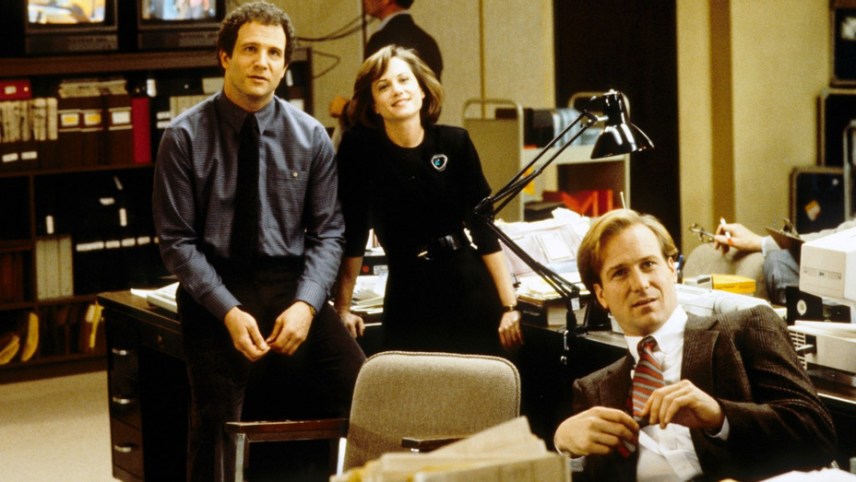
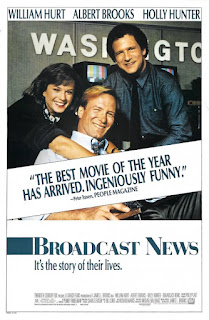
In the Washington branch of an unnamed network, Jane Craig (Holly Hunter) is a rising star producer, prone to daily emotional breakdowns. Her best friend is brilliant, committed reporter Aaron Altman (Albert Brooks), who longs to be the anchorman but lacks social skills. Arriving in their branch is Tom Grunick (William Hurt), handsome and full of TV savvy, set to become an anchor but lacking any real knowledge of either journalism or current affairs. Naturally a romantic triangle develops between these three, along with all sorts of debate about the purpose of TV news.

The film stacks the deck firmly in favour of the view that news should be a comment-free recitation of facts. Brooks’ film bemoans – often in heavy-handed ways – the intrusion of human interest, soft stories and puff pieces in place of hard-hitting questions and challenging coverage. Tom Grunick is the embodiment of this: charming, friendly, reassuring – and totally uninformed, interested in “selling” a story rather than telling it. Meanwhile, to the film’s disgust, the higher-ups at the network frequently value appearances and popularity over tough analysis, and looking good on TV counts for more than journalistic skills. Pity the film: if it feels this network is bad, imagine how it’d feel about Fox News today.

Of course what the film isn’t interested in is acknowledging a certain level of showmanship is an important tool in making the news accessible, engaging and interesting for the audience – making them more likely to pick up the important things in the content. It also overlooks that purists Aaron and Jane may avoid stage-manging their stories as overtly as others – but they’re more than happy to fill them with heart-string-tugging references and shots to get the audience reactions they want. In fact, you can see Tom’s point – what’s really wrong with him interjecting a shot of his own teary face while interviewing a rape victim (a moment he recreates)? Isn’t that basically the same?

Broadcast News tries to outline the difference, but I’m not sure it goes the full distance – or makes the debate accessible or interesting. That might be partly because the film can’t decide whether to give more attention to the satire or the romance – Jane is attracted to Tom (who returns her feelings), but is extremely close with Aaron, who carries a not-even-concealed passion for her. Both plots sit awkwardly side-by-side, getting in each other’s way and not adding insight to each other.

But then the film is fairly shrill. That partly stems from the two characters we are meant to relate to being tough to like. Holly Hunter is dynamic as the forceful, passionate Jane, but she’s also a rather tiresome character. Her purist demands are slightly holier-than-thou and while there are nice touches of humanity (on a date with Tom, she doesn’t want her handbag opened at a security check because she’s put a pack of condoms in it)  the film doesn’t manage to warm this control freak (so domineering she can’t get in a taxi without dictating the route). Jane also has a tendency to burst into tears – a suggestion of some underlying emotional problems the film instead treats as a joke.

That’s nothing compared to Albert Brooks’ Aaron Altman. This is exactly the sort of character beloved by film-makers, but who if you met in real life would come across an an unbearable creep. Like Jane, he’s an uncompromising idealist whose pious self-importance quickly grates. The film doesn’t appreciate the irony that its champion of professional reporting yearns to be the pretty-boy face of the network and resents that he’s neverbeen the popular kid.

His tantrums and rudeness are meant to be signs of his genuineness and the film leaves no doubt that his love for Jane should be requited because he knows what’s best for her. He’s the Nice Guy who doesn’t get the girls even though he really deserves them.  A scene where he furiously berates Jane when she confesses her feelings for Tom, then demands she leaves, then demands she stays so he can lecture her on his pain and why her feelings are wrong smacks of a thousand male script writers who didn’t get the girl they wanted and it was so unfair.

The film’s view of women is often questionable. Today, Aaron looks more like a Proto-Incel, one emotional snap away from strangling Jane because she won’t love him when she SHOULD. The film sees him as a relatable, principled hero. Jane may be smart and principled, but she’s hysterically over-emotional for no given reason (Women! They’re so crazy!), domineering and controlling. The film’s only other female character is Joan Cusack’s production assistant who spends her time either shrieking in shrill panic or talking with nervous incoherence.

So, it might be a fault of the film that the character I related to most was the one we were meant to condemn. William Hurt’s Tom is nice-but-dim, superficial but polite, supportive, hard-working and honest, self-aware enough to feel guilty that he’s not really qualified to do the job. He tolerates being mucked around by Jane far more than many others would and despite being constantly abused by Aaron, offers him no end of support. If Tom is the nightmare shape of TV news, you end up thinking “well heck, is it really that bad?”

Broadcast News overall is an underwhelming experience, not funny or romantic enough to be a comedy, or insightful enough about journalism to be thought-provoking. Brooks directs with his usual televisual lack of flair, but there are some decent comedic set pieces: Cusack has a mad-cap dash through a TV studio to deliver a taped report for a deadline that is a masterclass in physical comedy, while the film’s best set-piece is Aaron’s sweat-laden anchor appearance on a weekend news bulletin. But the film gives too many characters a pass and avoids asking itself the tough questions. It ends up a bit of a slog that probably has more appeal to insiders than audiences.

Julia (1977)

Julia header
Jane Fonda and Vanessa Redgrave play friends separated by time in Fred Zinnemann’s award-bait Julia

Director: Fred Zinnemann

Cast: Jane Fonda (Lilian Hellman), Vanessa Redgrave (Julia), Jason Robards (Dashiell Hammett), Maximilian Schell (Mr Johann), Hal Holbrook (Alan), Rosemary Murphy (Dorothy Parker), Dora Dull (Woman passenger), Elizabeth Mortensen (Girl passenger), Meryl Streep (Anne Marie), John Glover (Sammy)

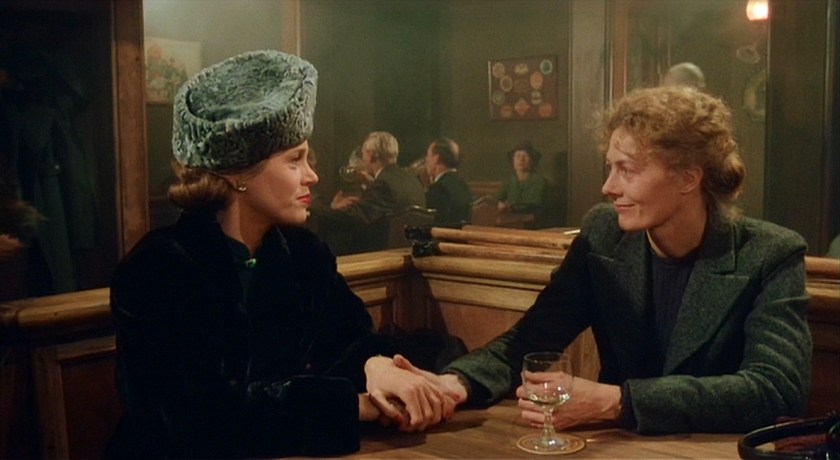
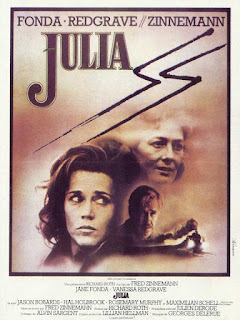
Playwright Lilian Hellman (Jane Fonda) remembers her close childhood friendship with Julia (Vanessa Redgrave), the daughter of wealthy Jewish parents being bought up by her grandparents. As young women, their lives take dramatically different routes: Lilian finds eventual success with The Children’s Hour, with the support of her mentor and lover Dashiell Hammett (Jason Robards); Julia travels to Vienna and then Germany where she becomes involved in anti-Nazi activity. Eventually, the need for money leads to Julia asking Lilian to smuggle funds over the German border.

That’s the meat of Fred Zinnemann’s old-fashioned, highly-genteel memory piece that also manages to make it sound far more exciting and interesting than the dry, worthy, middle-brow story that actually ends up on screen. What’s missing from the film almost completely is passion. This is a story that required fire: a sympathy for radicalism, or anger at the targeted cruelty and injustice of fascism. It gets none of this, instead offering a handsome reconstruction of period details, all filmed with a Golden Age glow, and a narrative focus that feels like it’s aimed at the wrong character.

It’s part of why this awards-bait drama hasn’t lasted in the public perception (it’s very hard to find a copy to watch – really striking for a film nominated for 11 Oscars and winning three, including two acting Oscars). There is very little really rewarding either emotionally or narratively here. The film lacks a real sense of danger or foreboding – even a scene showing fascist thugs throwing Jewish students off a balcony in Vienna is shot with a striking lack of edge or horror. And it unbalances itself by giving more time and priority to Hellman’s struggles to come up with a play “worthy of her” than it does to the title character and the real drama of her struggles. Redgrave is on screen for about 14 minutes. It’s effectively like watching The Pianist but entirely from the perspective of Emilia Fox’s character rather than Adrien Brody’s.

What we end up with is a film that feels old-fashioned, dry and respectable. It offers everything that will impress you, and reassure you that it is important film-making: a big subject, famous names, actors giving emotional performances, period detail, a tragic ending. But it lines these factors up in a way that never ever comes to life dramatically. There is a story buried in here about friendship – and Fonda and Redgrave are very good at selling a strong personal bond, especially considering their limited time on screen together – but what should be the heart of the story gets lost in a biography of Hellman, a digression into her relationship with Dashiell Hammett, and the lack of insight the film seems to have into the fate of Jews and outsiders in an increasingly fascist Europe.

The film’s only real sequence of interest is Hellman’s dash with money across the border and illicit meeting with Julia, a sequence involving coded messages, switching of hats and double-meaning conversation which fits with a spy novel. Zinnemann films this with a fine air of tension and intrigue – but it’s the only time the film stumbles to life.

I think Zinnemann struggled to find what really compelled him to tell this story. Which is a shame as a Julia-focused story – a woman struggling against a system – would have been meat and drink to the director of High Noon, From Here to Eternity and A Man For All Seasons. Instead, his skill from those films of empathising with characters trapped in a desperate situation and forced to take a stand on principle, is lost. In the end he and the film find little to interest them in Hellman, the successful novelist who feels a middle-class intellectual’s guilt at not doing more to help, who is fundamentally a footnote in a far larger story of rising Nazi terror in Europe.

The film has also perhaps faded from public attention because subsequent controversy revealed that a large part of this true story was almost certainly self-aggrandising bull-shit by Hellman. A New York psychiatrist, Muriel Gardiner, claimed in 1983 that Julia’s story was her story and that she had never met Hellman (but they did share a lawyer). No trace of a “Julia” has been found in Hellman’s life, and no evidence at all that she ever undertook this dangerous dash into Germany. Zinnemann also fell out with Hellman, privately coming to believe she was “an extremely talented, brilliant woman, but she was a phony character” and said his “relations with her were very guarded and ended in pure hatred”. Knowing that, it’s hard not to see the same distance on the screen.

Saying that, Jane Fonda is very good in the film, surprisingly fragile, uncertain and scared, and plagued with guilt that she cannot do enough to help her friend. Redgrave won an Oscar for her committed and passionate performance, which tapped into her radicalism and gives a slight character a great deal of depth (in her speech, the pro-Palestinian Redgrave made a famously controversial political speech denouncing “Zionist hoodlums”). Robards won the film’s other acting Oscar, for a professional turn as Hammett. In a very weak year for American film, Schell also landed an Oscar nomination for a brief cameo as a go-between Hellman meets in a Parisian park.

The performances are fine and the style and manner of the film is reassuringly middle-of-the-road. There is everything here to convince you this is an important film, apart from drama, purpose or conviction. Perhaps it’s so hard to find, because so few people have looked for it since 1977?

Highlander (1986)

Highlander header
Sean Connery plays a Scottish Spaniard and Christopher Lambert a French sounding Scot in cult classic Highlander

Director: Russell Mulcahy

Cast: Christopher Lambert (Connor MacLeod), Sean Connery (Juan Sanchez-Villalobos Ramirez), Clancy Brown (The Kurgan), Roxanne Hart (Brenda Wyatt), Beatie Edney (Heather MacLeod), Alan North (Lt Frank Morgan), Jon Polito (Detective Walter Bedsoe), Shelia Gish (Rachel Ellenstein)

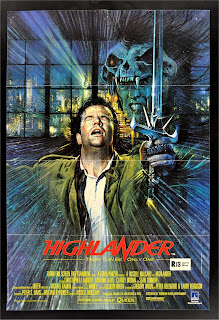
“There can be only one!”. It’s a neat, simple idea and lies at the heart of a cult science-fiction film crammed with them. There is a lot to chuckle at in Highlander. From the air of cheesy cheapness to the Accent Olympics (A Belgian plays a Scot. The world’s most famous Scotsman plays a Spaniard. Brits play Americans. An American plays an Ancient Eastern Barbarian.) But Highlander had huge impact – and was revived countless of times since – because there’s a kind of magic (see what I did there?) to this sci-fi fantasy about immortals struggling over centuries to emerge as the winner of a secret-but-deadly competition. There are so many intriguing ideas and possibilities here, you could make hundreds of adventures in this world (and they have) and still have new areas to explore. The film bombed on its first release in America (look at the poster – is it any wonder? How awful is that?) but it’s had a huge afterlife.

Our hero is Connor MacLeod (Christopher Lambert) who takes part in a lethal sword fight in the car park of Madison Square Gardens in 1985. Turns our Connor was born in the early 1500s, part of a Scottish tribe and was slain by immortal warrior The Kurgan (Clancy Brown). Discovering to his amazement – and his tribe’s horror – that he makes a full recovery from a mortal wound, MacLeod was exiled. He is found and mentored by Ramirez (Sean Connery) who informs him that they are both immortals, destined to join all other immortals in a competition from which there can be only one survivor. The competition will culminate in “The Gathering”, with the winner being given “The Prize”, a mystic power. Turns out 1985’s New York is the scene of the Gathering – and MacLeod and the Kurgan are destined to be the last men standing in the competition.

Perhaps the big thing that makes Highlander such a success is it becomes clear that everyone involved in it seemed to have a whale of a time. Queen were commissioned to write one song for the film: they wrote an album. Mulcahy, Lambert and other members of the cast and crew chipped in their own money to film extra scenes between MacLeod and his adopted daughter. Connery was at his jovial best on the five days he spent filming (Ramirez was to be the only character other than Bond he played twice, in the terrible sequel). All this investment off-camera pays-off in a film frequently rough and ready but also intriguing and enjoyable.

Sure, it’s no masterpiece. It’s very much of its time, with a distinctive 80s vibe and in many ways only scratches the surface of its potential: I’d have loved to see more of MacLeod during the ages, and other Immortals he had interacted with. (We get a confrontation in World War II and a comic duel in Georgian England, where MacLeod repeatedly survives deadly sword thrusts). Our nemesis, the Kurgan, is a frequently overblown and ridiculous character (for all the energy Clancy Brown plays him with) who isn’t quite interesting enough. Lambert is a slightly wooden performer (he learned English for the role – learning it with a Scottish accent was a tough task). Many of the sword fights (with the exception of the final duel) are high-school-play in their hack-and-slash simplicity.

But it doesn’t really matter too much, because Mulcahy shoots the hell out of the picture. Working with a tiny budget, he still manages to give every scene something distinctive to see and an edge in its delivery. The film frequently punches above its weight in its set pieces and with the surprisingly gritty action. Mulcahy has a great eye for the seedy underbelly of New York, just as he does for the Highlands of Scotland. He also handles the romance surprisingly well – both MacLeod’s wife in 16th century Scotland and his love interest in modern New York (including a surprisingly tender love scene) are engaging and complement each other (no mean trick).

Also, the idea is absolute solid gold, and for all that it’s sometimes buried in a cheesy 80s Euro-actioner, Mulcahy still gives the entire thing a sort of mystic force. The tragedy of someone living centuries – watching everyone they love grow old and die around them – is very affectingly done. The different personalities and backgrounds of the immortals are striking and the hints dropped about their involvement in past events intriguing. The concept of immortals growing stronger from beheading other immortals is intriguing and adds a fascinating subtext to every conversation between two of them. The Game itself has an ancient-legend sort of strength, the entire film’s concept having all the revisitable interest of a popular children’s story or a classic slice of mythology.

It looks handsome, and while the actual plot is often predictable and straight-forward, the richness of the backstories and the history carries real impact. Connery is great in a neat cameo – one of his first “mentor” roles (he’s only in it for about 15 minutes, but lifts the entire enterprise with his charisma). The Queen soundtrack is a knockout. Sure, some moments – such as Lambert all too obviously lifted on wires – look as cheap as they probably were, but the entire film is made with a burst of energy and a feeling of enjoyment and love that you have to have a hard heart not to care for it a little bit.

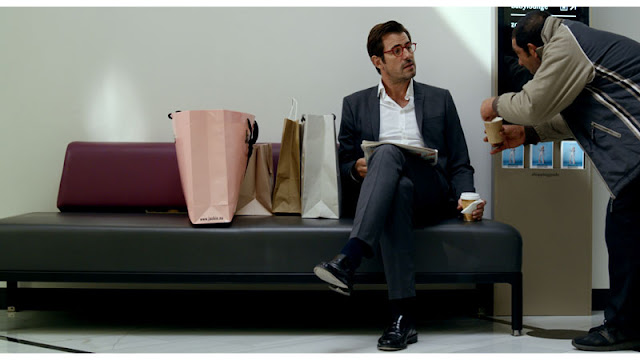
The Square (2017)

The Square header
Art goes wrong in Ruben Östlund’s scattergun satire The Square

Director: Ruben Östlund

Cast: Claes Bang (Christian), Elizabeth Moss (Anne), Dominic West (Julian), Terry Notary (Oleg Rogozjin), Christopher Læssø (Michael), Lise Stephenson Engström (Daughter), Lilianne Mardon (Daughter), Marina Schiptjenko (Elna), Annica Liljeblad (Sonja), Elijandro Edouard (Boy with Letter)

Christian (Claes Bang) has it all. The respected director of a celebrated Swedish Modern Art Gallery, he’s rich, handsome and highly thought of by all. That all fractures when his phone and wallet are stolen in a confidence trick. Using the phone’s tracker, Christian identifies the working-class apartment building its in. In a burst of late-night energy, he writes a threatening letter to the thieves and posts a copy through every single apartment door demanding it’s return. It is: but Christian’s letter has a negative impact on an innocent young boy (Elijandro Edouard) whose parents now believe he must be a thief. Christian is so preoccupied with this he fails to pay attention to a YouTube video created to promote his new exhibition: the video of a homeless child being blown up outside the museum leads to national condemnation.

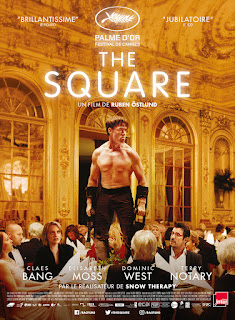
And that exhibit? It’s called The Square (you see!). Its main feature is a literal square on the floor, marking a safe space where everyone is equal. The exhibit is themed around trust, mutual respect and altruism. Traits which Östlund’s film reminds us time-and-time again his central characters are all sadly lacking in. It’s part of a broad-ranging satire on the self-importance of the Art World and the self-obsession of the upper classes that, while beautifully filmed, comes across as rather scattergun. Putting it bluntly, most of its targets are so obvious, the entire film might as well be footage of fish being shot in barrels.

A film like this, hinges on Christian’s self-perception being clearly shown to be very different from his reality. In effect, we need to see how Christian believes himself to be a decent, upstanding, noble fellow but also be shown he is in fact prejudiced, self-obsessed and vain. While the film does very well to show how shallow Christian’s “nice-guy” image is – he basks in the adulation of colleagues and museum patrons and carefully prepares his ‘spontaneous’ presentations for maximum effect – we never get quite enough of a sense of how he sees himself. His mystique is punctured so early, that the sense of events forcing an awkward confrontation with his true character is not developed.

This takes nothing away from the exceptional performance of Claes Bang, a charismatic and gifted actor who can pivot on a sixpence from huge charm to bullying menace. He’s completely believable as the red-spectacled, scarf wearing aesthete just as he is the sort of bully who’ll push a troublesome kid over. Matey and jovial with his employees, he’s also hesitant on their names and berates assistant Michael (Christopher Læssø) when he gets cold feet about executing his letter drop plan (on top of which, he naturally assumes as Michael is black, he’ll be better at carrying out the plan than Christian). His life is a careful performance, with every moment scripted by him, that fractures into something much messier the instant he loses control.

It’s just a shame that Östlund doesn’t delve into the opportunities this presents. He’s more interested in obvious characters like Elizabeth Moss’ Anne, a preening journalist (she inexplicably lives with a Chimp) with whom Christian enjoys a one-night stand, culminating in the two of them bickering over a used condom. (Christian seems worried she’ll pinch his sperm).

Too often Östlund contents himself with simply stating that the upper clases are vain and pre-occupied with their own needs instead of the lives of others. In case we miss this point, the film is littered with shots of beggars. It even opens with the camera focused on a beggar sleeping on the street in broad daylight while, off camera, a passionate student pushes leaflets urging people to do more to help the homeless while passers-by express irritation or disinterest to them. You see! Even the campaigner is more interested in virtue signalling than actually helping people! Interactions with beggars pepper the film: Christian is annoyed by one beggar not being grateful enough when he condescendingly offers to buy them dinner to get out of an awkward conversation with them and then later pays another to guard his shopping when he takes a phone call.

This social satire runs in parallel with a scathing-but-rather-obvious series of jokes at the expense of the preening self-importance of the Art World. The exhibition, The Square, is treated as if it’s the second coming but, other than parroting the Artist’s written vision, no one (not even Christian) seems interested in engaging in it or really has a clue what it is trying to do. The most important part of Christian’s role is in fact attracting money from rich patrons, who ooh and ahh over the art but have nothing whatsoever to say about it. The art itself is a parade of cliches – although there is a very funny recurring joke of an installation that is a series or piles of ash on the floor which the museum cleaners inadvertently slowly reduce each night.

The unwillingness of people to rock the boat in social situations is also parodied. Dominic West cameos as an American artist whose Q&A is constantly disrupted by a man with Tourettes – the discussion collapses but no one knows how to even to begin to manage the situation. This culminates in the film’s showpiece (and best scene). A Russian artist whose ‘art’ is to impersonate a monkey (played by motion-capture guru Terry Notary), performs an installation at a fund raiser dinner. The guests (and Christian) sit in increasingly awkward silence, no one willing to take the first step to intervene, as the artist progresses from humorous monkey noises to increasing acts of intimidation, violence and finally sexual assault.

It’s all interesting stuff, but it all feels a little too obvious. The advertising reps bought into design the video are such cliched social media obsessives they feel like sitcom characters. The juxtaposition of The Square’s idea that “everyone inside the square is equal” with the reality of no one being equal is made time and time and again with reduced impact.

Östlund finds a host of squares (stairways, windows etc) to frame Christian in visually to hammer this home. He makes frequent use of one-sided two shot set ups (meaning we only focus on one character during a conversation or exchange) which helps further drill down into that character’s psyche and stress their distance from whoever they are talking to. But it’s a lot of flash on an otherwise rather obvious and self-satisfied film, which never makes as many new and original points as it thinks.

If it’s a stunning realisation to you that people have a tendency to be self-obsessed, that the Art world is as much about posing and money as it is art and that social awkwardness will stop people intervening in the most disastrous circumstances, this is the film for you. Otherwise, you might find little real insight here.

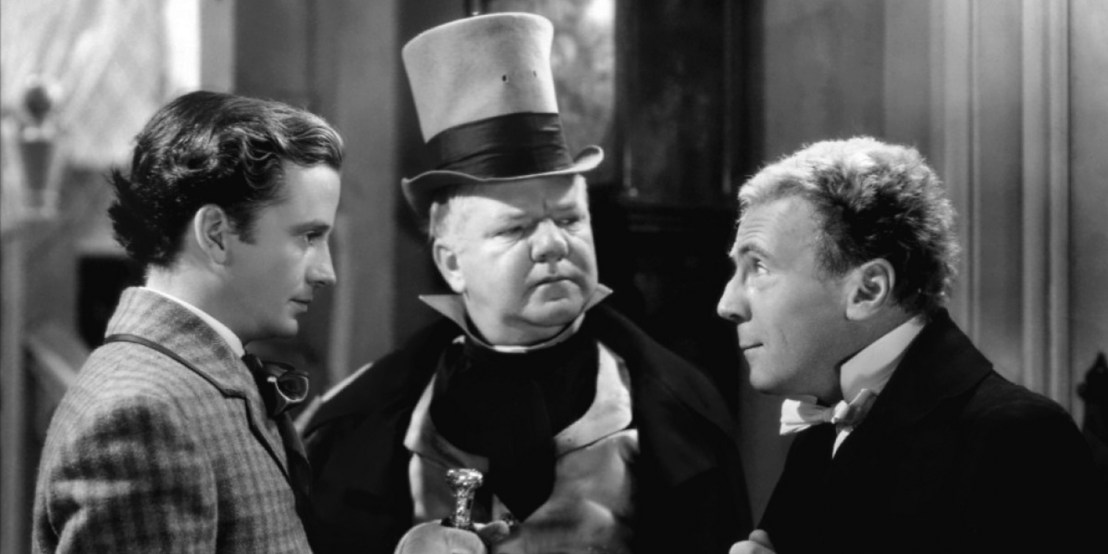
David Copperfield (1935)

David Copperfield header
Frank Lawton, WC Fields and Roland Young bring Dickens to life in David Copperfield

Director: George Cukor

Cast: Freddie Bartholomew (Young David Copperfield), Frank Lawston (Old David Copperfield), Edna May Oliver (Betsey Trotwood), Elizabeth Allan (Clara Copperfield), Jessie Ralph (Peggotty), Basil Rathbone (Mr Murdstone), Herbert Mundin (Barkis), Jack Buckler (Ham Peggotty), Una O’Connor (Mrs Gummidge), Lionel Barrymore (Daniel Peggotty), Violet Kmeple Cooper (Jane Murdstone), Elsa Lanchester (Clickett), Jean Cadell (Emma Micawber), WC Fields (Wilkins Micawber), Lennox Pawle (Mr Dick), Lewis Stone (Mr Wickfield), Roland Young (Uriah Heap), Madge Evans (Agnes Wickfield), Hugh Williams (James Steerforth), Maureen O’Sullivan (Dora Spenlow)

You could argue David Copperfield is one of the most influential films ever made. David O Selznick was desperate to bring Dickens’ favourite novel to the screen. But the MGM suits were convinced it couldn’t be done (800 pages in two hours?! Get out of town!) and anyway who would want to come to the cinema when they could read the book at home? They were wrong, wrong, wrong and Selznick proved that classic literature (even if it was a cut-down version of a great book) could be bought to the screen and capture at much of the spirit of the book, even if you couldn’t dramatise all the events. David Copperfield remains very entertaining, not least because it also showed you can’t go to far wrong when you assemble an all-star cast who fit their characters perfectly.

The story of the film pretty much follows the novel (with exceptions, deletions and abridgements). Young David Copperfield (Freddie Bartholomew, growing up into Frank Lawton at the half-way point) grows up loved by his mother (Elizabeth Allan) and nurse Peggotty (Jessie Ralph), but loathed by his step-father Mr Murdstone (Basil Rathbone) who barely waits five minutes after his mother passes away before dispatching David to a factory in London. There David forms a bond with the charming exuberant Mr Micawber (WC Fields) before deciding to walk to Canterbury to seek the protection of his aunt Betsey (Edna May Oliver). Growing into a young man, he faces romantic problems, the schemes of the vile Uriah Heap (Roland Young) and the betrayals of his schoolfriend Steerforth (Hugh Williams). Will all turn out well?

Stylistically, David Copperfield aims to be as true to the novel as impossible. It’s designed to look as much as possible like a series of Phiz sketches bought to life and the actors have clearly studied both novel and illustrations to craft themselves as much as possible into living, breathing representations of their characters. Well scripted by Hugh Walpole (who also cameos early on as a Vicar), the film manages to be faithful without being reverential and tells an engaging story with momentum – even if the pace accelerates a little too much towards the end.

Walpole’s adaptation splits the book into two acts: the childhood of our hero and his life as young man. Giving an idea of how the momentum accelerates towards the end, this basically means the first hour of the film covers the novel’s opening 200 pages, leaving the last hour to hurry through the remaining 600. This means several characters and events are deleted, simplified or removed. However, Walpole still manages to retain all the truly vital information and iconic material, and recognises most of the striking material is found in that first 200 pages.

This childhood story is very well told, partially because Freddie Bartholomew (while he has touches of school play about him) is an affecting and endearing actor, who makes the young David a kid we care about rather than either an insufferable goodie-two-shoes or a syrupy brat. He’s a smart, kind, slightly fragile boy who we end up caring about – and it gives a real emotional impact when his mother dies (a very tender Elizabeth Allan) or to see him misused by Mr Murdstone (a perfectly judged performance of austere coldness by Basil Rathbone). Little touches of joy in his life – like the time he spends at the Peggotty’s converted ship home (a perfect representation of its description in the book) are really heartwarming, because David himself is such an endearing fellow.

It does create an obstacle for Frank Lawton when he takes over, since the audience is asked to try and bond with this new actor having already committed their hearts for just over half the run time to another. Lawton also has to deal with scenes rushing towards the conclusion rather than getting character beats like Bartholomew. Cuts impact his key relations: his school friendship with Steerforth is relayed second hand, meaning Steerforth turns up only to almost instantly let everyone down; Dora Spenlow and Agnes Wickfield get only brief screen time to establish their characters. The schemes of Uriah Heap are barely explained (he’s just a hypocritical wrong ‘un, okay?). It says a lot that the last fifteen minutes rush through the deaths of three major characters, a shipwreck, a dramatic confrontation, David travelling the world and a resolution of romantic tensions. It’s the only point when the film feels like its ticking boxes.

But it doesn’t completely matter (even if a two-part film would have helped no end – particularly allowing Lawton more room to develop a character) since the performances are so good. Expertly marshalled by Cukor – who rarely introduces visual flair, but coaches pin-perfect turns from the entire cast – every role is cast to perfection. None more so than WC Fields, for whom Wilkins Micawber became a signature part. Replacing Charles Laughton mid-filming (he claimed he looked more like he was about to molest the boy), Fields keeps his own accent and some of his own persona, but still fits perfectly into the Dickensian larger-than-life optimism and good will of Micawber. His comic timing is spot-on – watch him climbing over a roof or bantering with David and his family – and he seems like he has just walked off the page. If there had been a Supporting Actor Oscar in 1935, he would almost certainly have won it.

He’s the stand-out of a host of excellent performances. Edna May Oliver is very funny and has a more than a touch of genuine emotion as Betsey Trotwood. Jessie Ralph is excellent as Peggotty. Lennox Pawle makes a very sweet Mr Dick. Roland Young is the very picture of unctuous hypocrisy as Uriah Heap. Only the young women get a little short-changed: despite her best efforts, Madge Evans can’t make Agnes Wickfield interesting and Maureen O’Sullivan is rather cloying as Dora.

But the film itself is pretty much spot-on for the tone of Dickens, even if events are rushed. The impact of the Peggotty/Steerforth story is lost since we are never given the time to get to know any of the parties involved, and certain plot complexities are only thinly sketched out. But Cukor marshals the actors perfectly and throws in at least one striking shot, of Murdstone appearing in the distance as the camera follows a cart bearing David away from his mother. It always looks just right and the characters that do get the time are perfectly played, so much so that a few performances (Fields, Oliver, Young) may even be definitive.

David Copperfield proved you could turn a doorstop novel into a film and, even if you sacrificed some of the complexities (and might need to rush to fit it all in) you could still produce something that felt recognisable and true to the original. So, for that – with the mountain of adaptations that followed – we have a lot to thank it for.

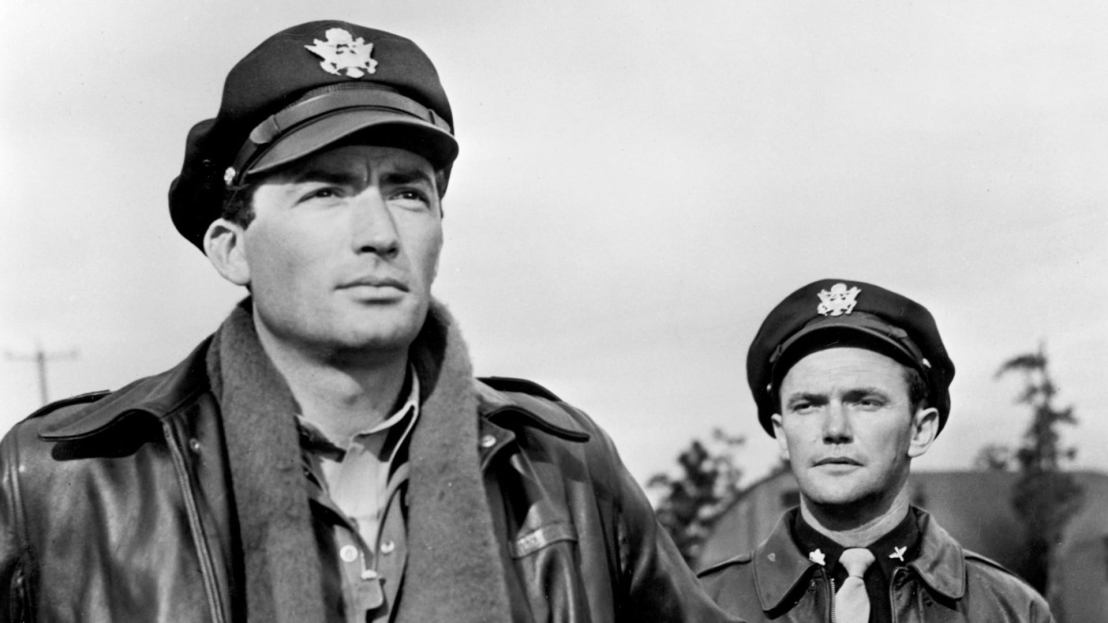
Twelve O'Clock High (1949)

Twelve OClock High header
Gregory Peck takes on the burden of command in Twelve O’Clock High

Director: Henry King

Cast: Gregory Peck (Brg General Frank Savage), Hugh Marlowe (Lt Colonel Ben Gately), Gary Merrill (Colonel Keith Davenport), Millard Mitchell (Mj General Pritchard), Dean Jagger (Major Harvey Stovall), Robert Arthur (Sgt McIllhenny), Paul Stewart (Major “Doc” Kaiser), John Kellogg (Major Cobb)

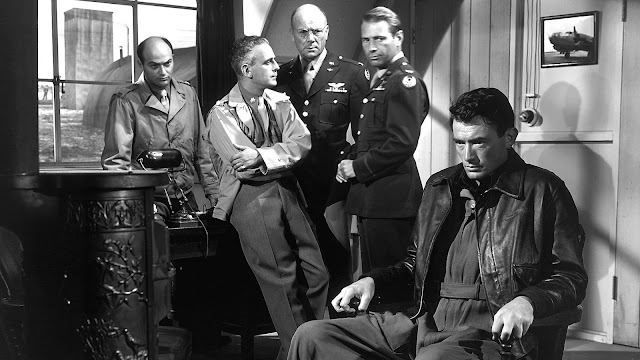
It’s tough at the top. Imagine how much tougher it would be if you job involved pushing people to their limits, and then a little bit further, in a job that puts their lives at daily risk? It’s the sort of burden commanders of American Bomber wings faced during the Second World War. It’s already got to Lt Colonel Keith Davenport (Gary Merrill), a decent guy and much-loved officer, who has grown so close to his men he can’t face sending them off to get killed over Europe any more. He’s replaced by Brigadier General Frank Savage (Gregory Peck), a by-the-book tough son-of-a-bitch who won’t tolerate men who can’t or won’t do their duty. But will the pressure of constant action, escalating casualties and a growing bond with his men also get to Savage?

With Peck at the top of his game, in one of his finest performances of stoical dependability and Lincolnonian authority concealing a carefully nurtured warmth and humanity, Twelve O’Clock High is a very different war film. Here the focus is much less on derring-do and heroism and more on the unbearable psychological pressure a life on the front lines brings. It’s all presented with a documentary style realism – so much so, that the film was used for decades in the USAAF as a training film on successful styles of command.

It’s about the impact that sustained trauma has – how it can make even the toughest man eventually paralysed by over-thinking, uncertainty and doubt. Davenport is a very popular CO – and good in the job in many ways – except the key one: he’s lost the ability to push the men and his willingness to sacrifice them. Essentially, in the nicest possible way, he’s damaging morale by letting the company reflect his own exhaustion, depression and amiable defeatism. He’s lost the ability to push men to want to achieve everything they can for the cause: meaning they are now doing the military equivalent of punching the clock, delivering the barest minimum an attack requires. Mistakes and errors are tolerated and, perversely, casualty rates are rising.

It’s what Savage is sent in to fix. Which he does by essentially blowing apart the cozy, boys-club feel of the Bomber Group. Air Exec, Lt Colonel Ben Gately (a great performance from Hugh Marlowe), is stripped of his command (for not leading from the front) and assigned to commanding the “The Leper Colony” a plane crewed by those Savage believes least likely to pull their weight. Drills are bought in and under-performance is no longer tolerated. Dropping out of formation for whatever reason – a move that puts the rest of the Bomber Group at risk – is punished harshly (a pilot is demoted to the “Leper Colony” for breaking formation to support another a plane, a decision that could have doomed the Group to death). Savage is the ultimate heartless drill sergeant.

Only of course he’s not: as Peck makes clear, the burdens of command weigh as heavy on him as they did on Davenport. But Savage is a professional who knows tough love is what’s going to keep most of the Group alive, accomplishing their missions and bringing the war to an end. And Savage’s policies work: the Bomber Group starts to achieve well above their previous performance. The pilots greet Savage by handing in a group transfer request, but by the time the request is heard by the army (Savage’s adjutant Stovall having delayed the requests with red tape) as a man they back the General. Savage gets then to take pride in themselves and their unit – so much so that, during their first strike on German soil, off duty men smuggle their way onto planes to be part of the mission. (Savage of course doesn’t let slip his pride, rebuking men for abandoning their posts on the base).

Underneath it all, Savage is starting to feel closer to his men. A young pilot, decorated but starting to get worried about flying, is mentored and encouraged by him. Gately responds to the tough love from Savage by aiming to prove to him he is indeed the best pilot in the squadron – winning Savage’s respect, not least when he flies several missions concealing a spinal injury. The pressure inevitably builds on Savage as he finds it harder and harder to maintain his professional demeanour while becoming closer and closer to his men (he even refuses a transfer back to his original job in HQ, as he feels the group isn’t ready for him to leave yet).

It all builds to one of the most famous breakdowns in film, as Savage goes from physically unable to climb into the cockpit to a confused state on the runaway and then catatonic until the Group returns home. This is beyond daring stuff for a 1940s Hollywood film, a true portrait of the effects of wartime pressure on a hero, which never once questions his competence and cowardice but in fact holds up the qualities that led to his breakdown as admirable ones. Peck plays all this with great power and control – and if Savage shrugs off his catatonic state later and the film doesn’t really explore the long-term impacts, the very fact that it showed someone as admirable, competent and professional as this suffering psychological damage from war was quite something.

It’s not a perfect film. King’s shooting style is often unimaginative and the film takes too long to get going – much of the first half an hour is a slow chug towards Davenport being relieved and Savage taking the post. More could be made of the impact of the war on the rest of the men on the group: it’s telling that only Jagger’s Stovell gets a scene where he also is allowed to let off steam against the pressure, getting drunk the night of a big raid, and he won an Oscar for it. But as something very different in Hollywood’s approach to the War, it really stands out as a companion piece to The Best Years of Our Lives.

House of Gucci (2021)

House of Gucci (2021)

Ridley Scott’s bizarre film is half-pantomime, half true-crime drama

Director: Ridley Scott

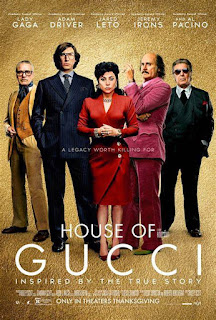
Cast: Lady Gaga (Patrizia Reggiani), Adam Driver (Maurizio Gucci), Jared Leto (Paolo Gucci), Jeremy Irons (Rudolfo Gucci), Al Pacino (Aldo Gucci), Salma Hayek (Giuseppe Auriemma), Jack Huston (Domenico De Sole), Reeve Carney (Tom Ford), Camille Cottin (Paola Franchi), Youssef Kerkour (Nemi Kirdar)

There are few juicier combinations than glamour, money, fashion and true crime. Scott’s House of Gucci taps into this with a film that’s somewhere between pantomime and tragedy. Full of actors giving their very best “Mamma Mia!” Italian accents and shrugging shoulders, it oscillates wildly from scene-to-scene between black comedy and operatic high drama. It’s a strange mixture, with House of Gucci becoming some sort of bizarre treat, like an end-of-year treat for cinema viewers to unwrap.

The film follows the disastrous marriage between Maurizio Gucci (Adam Driver) and Patrizia Reggiani (Lady Gaga). Patrizia, a ruthlessly ambitious gold digger, zeroes in on the shy Maurizio, heir to 50% of the Gucci fashion fortune, and marries him. This is all to the horror of his father Rudulfo (Jeremy Irons), who (correctly) identifies Patrizia’s ambitions, and cuts them off. Taken under the wing of Rudolfo’s brother Aldo (Al Pacino), Patrizia pushes Maurizio into a management role in the company – and down a slippery slope that will lead to forgery, betrayal and eventually murder.

House of Gucci feels like it might have existed more comfortably as a ten-part TV drama. It’s essentially a big, brash version of the Emmy-award winning The People vs. OJ Simpson, but told in about a quarter of the time. What this basically means is that any subtle character work and detailed story telling is sacrificed, with the focus firmly on the salacious and entertaining drama. The overall effect is a swift rush through a story that becomes a series of sensational, almost comedic, clashes between larger-than-life personalities squabbling over a huge pot of money. Like Dallas on the big-screen, it’s all scored with a series of funky pop tunes, adding to the sense of pantomime.

It’s an odd outing from Scott, with (it felt to me) little of the individual stylistic touches that he has bought to other projects. In fact there’s very little of his stamp on it: it’s Scott as professional craftsman. He and the film feel very confused by the tone. Mostly the film doubles down on black humour and show-casing big, brash performances. Then it might acknowledge briefly that there were real victims here, which it wants to treat with a level of respect. By and large, the film is like a glossy magazine article, with Scott nudging you as you turn each page and saying “you will not believe what happened next!”

I suppose House of Gucci probably could have explored more the personal and emotional hinterlands of its characters. Relationships shift dramatically from scene-to-scene, with Maurizio and Patrizia’s marriage souring over-night, for no clear reason. Pre-existing family rivalries and politics could have been explored more: it’s heavily implied Aldo and Rudolfo are already engaged in a struggle of ideals (Aldo wants commercial expansion, Rudolfo to remain an elitist fashion house). Drama could have been made of the attempts by both brothers to use other members of the family as pawns in this feud. But then, a film that dived into the psychology of the players might well have ended up being more about business and less about the entertaining ruthlessness of the rich and famous.

The performances are wildly different in tone. Lady Gaga effectively holds the film together as an ambitious woman who is only partially aware (at first) of what a ruthless gold digger she is. Devoid of any interests other than being rich (“I’m a people pleaser” she tells Rudolfo when asked what her interests are), Patrizia is the sort of monster of ambition who would fit comfortably into an episode of Desperate Housewives. Setting her cap at Maurizio with a laser-like focus and shafting everyone left, right and centre (although Gaga does hint at her deeply repressed insecurity) it’s a performance that walks a fine line between OTT and human. The film has a lot of fun at her amoral certainty – she sees no problem with forging Rudolfo’s signature on some vital papers after his death (the film even sets forgery up as Chekhov’s skill in its opening scenes) and Gaga enjoyably plays the outrage that only someone convinced they never wrong can feel.

Opposite her, Driver plays Maurizio as a timid, easily seduced young man, pushed into taking a leading role in a business he has no real interest in (or aptitude for). Driver is softly spoken – and gives the most restrained and grounded performance in the film – and frequently meets another demand from his wife with a chuckle and a reluctant “Patrizia…”. House of Gucci steps carefully around Maurizio, sometimes playing him as an innocent abroad, at others as a man corrupted by his wife into a creature of ambition.

Most of the rest of the cast go for a broad style which, while fun to watch, only adds to the sense that we aren’t supposed to be taking anything too seriously. While many of the Gucci family probably were larger-than-life personalities, I’m not sure they could have been the cartoons they are here. Irons goes for a waspish Scar-like mastery of the cutting remark. Pacino doubles down on his shoulder-hunched energy, with added shouting. Hayek gives a performance that’s a near master-class in Vampish camp, plotting murder from a mud bath.

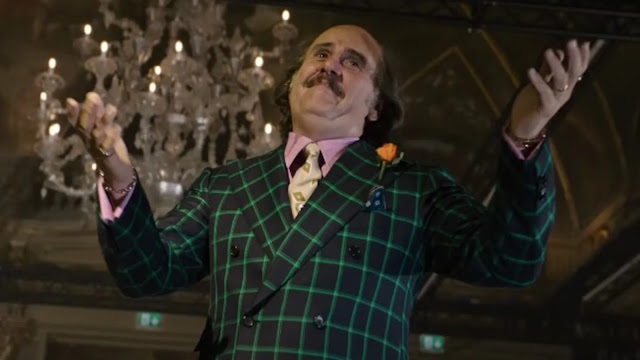
Towering above them all is Jared Leto, who seems to be in a film all of his own, with every scene another clip for his “for your consideration” show-reel. Buried under a mountain of latex that transforms him into a clone of Jeffrey Tambor, Leto goes all out as the passionate, ultra-stereotypical-Italian Paolo Gucci, in a performance that’s either a shameless parade of showing off or somewhere near a stroke of genius. It works because, beneath all the hammy exuberance, Leto make’s Paolo a desperately sweet guy, the only real innocent in the film. Leto and Pacino in particular feed off each other – a late scene between the two is hilarious (I’m not sure in the right way, but who can tell what these actors are aiming for sometimes) in its joyful overplaying.

Perhaps joy is the one thing House of Gucci needs a little bit more on. I wonder how more entertaining again it might have been if the film had really gone all out on being a camp classic. It shies away from this, wanting to leave some vestige of respect for the dead and not lose its true-crime-roots. But, I wonder if a director more suited to this material than Scott – who struggles to stamp his personality on it – might have done more to make this into a cult classic.

The Scarlet Empress (1934)

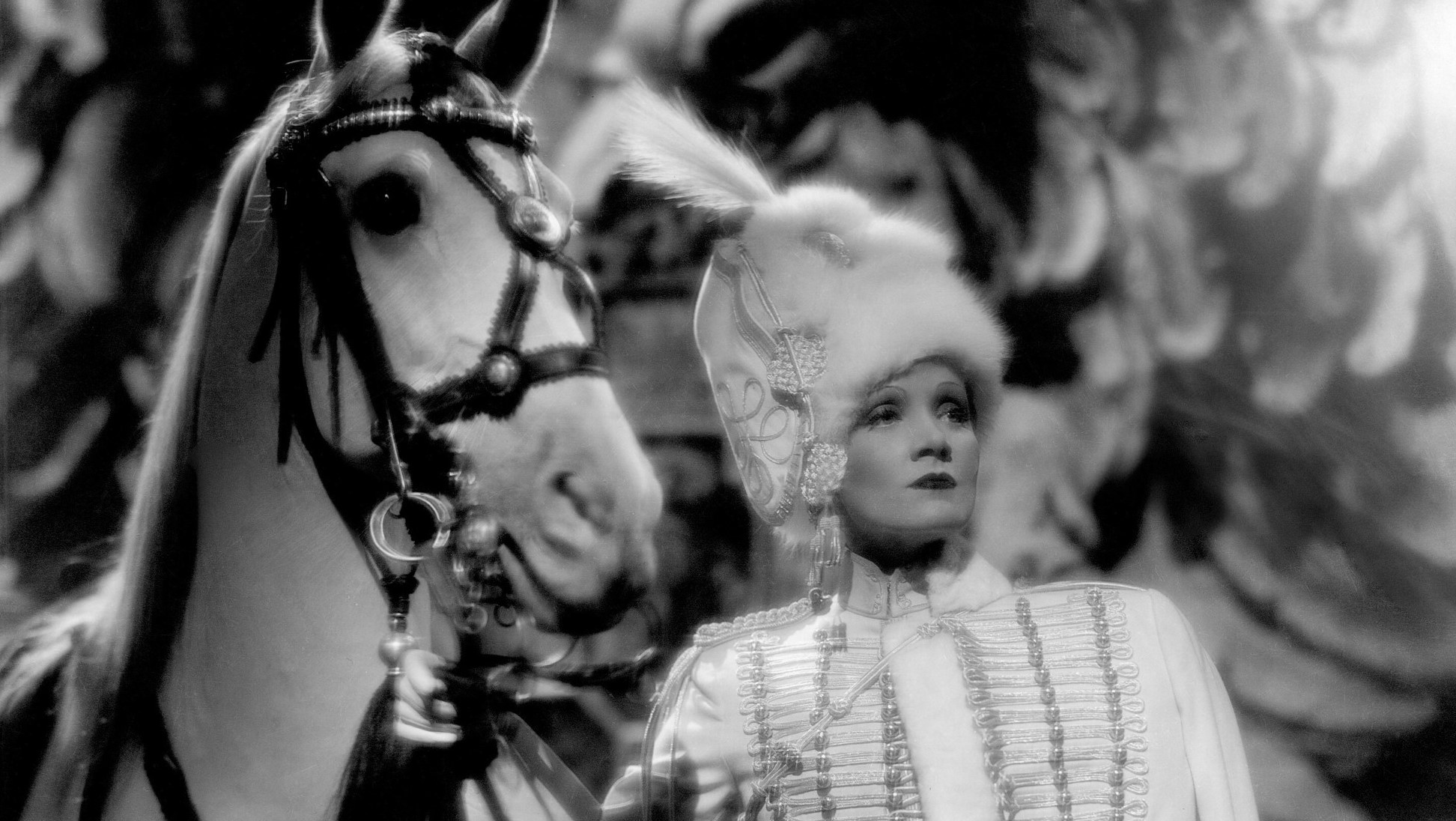
Marlene Dietrich with a beloved friend (and the film has fun with that rumour) in The Scarlet Empress

Director: Josef von Sternberg

Cast: Marlene Dietrich (Empress Catherine), John Lodge (Count Alexey Razumovsky), Sam Jaffe (Emperor Peter III), Louise Dresser (Empress Elizaveta Petrovna), C. Aubrey Smith (Prince Christian August), Gavin Gordon (Captain Orlov), Olive Tell (Joanna Elizabeth), Ruthelma Stevens (Countess Elizaveta), Davison Calrk (Arch Episcopope), Erville Anderson (Chancellor Bestuzhev-Ryumin)

Did von Sternberg have a bet on when he made this film? “Hey Josef, what’s the maddest film you think you could make and get away with?” Either that, or perhaps he didn’t care anymore and decided his own obsessions with visuals, sexuality and Dietrich were more important than anything else. Regardless, he made The Scarlet Empress, perhaps one of the most bizarre major releases from a 1930s Studio, a sort of camp masterpiece that contains things you just won’t see any in other film, but at the same time is a disjointed, barely plotted ramble through a fable-tinged version of Russian history. Either way, it’s a truly unique film – and how many films can you say that about?

The plot loosely follows the rise of Catherine the Great (Marlene Dietrich) to power, but any resemblance to real people (living or dead) seems to be purely coincidental. Catherine arrives in Russia to power the heir to the throne, Grand Duke Peter (Sam Jaffe), a gurning simpleton more interested in his soldiers (both toys and real ones) and his mistress Elizaveta (Ruthelma Stevens) than Catherine. Russia is ruled by his mother Empress Elizaveta (Louise Dresser), a domineering matriarch. The (initially) innocent Catherine is admired by the rakeish Count Alexey (John Lodge), but must learn to master the skills of the court – and the sensuality of her own body – to take power.

The Scarlet Empress is pretty crazy. If you are coming here for a history lesson on Catherine the Great, keep on walking. Josef von Sternberg called it “a relentless excursion into style” and that’s a pretty good description. It’s a parade of his fascinations (and obsessions), set in a Russia that never really existed but I suspect Sternberg would argue ‘shouldhave done’. This is Russia as a medieval backwater, built entirely from Cossacks, icons and gargoyles, with the Russian court a ramshackle wooden palace with a throne that wouldn’t look out of place in Game of Thrones. Much of the sense of time and place is buried under this and huge chunks of the film may as well be silent cinema, so little does dialogue matter and so skilfully are emotions and events communicated visually.

However, grab this in the right mood and this is a film it’s impossible not to admire and even fall in love with a little bit. There really is nothing like this, and like much of Sternberg’s work there is a visual sweep and drama here that few other filmmakers can match. There are some truly striking images, from Cossacks riding through the palace, to Sam Jaffe’s gargoyle like face as Grand Duke Peter, to a giant drill bit punching through the eye of a wooden icon. The jaw dropping production design – sets that dwarf the actors – is mixed with misty lighting for romantic assignations and deep shadows for (literally) backstairs court intrigue.

In all this, the story counts for very little, with the primary focus being Sternberg’s obsessions. Many of those seem to be sexual. The Scarlet Empress was released right on the cusp of the Production Code being enforced in Hollywood – and it’s hard to imagine it could ever have been passed once the code was fully enforced. The film lays it’s hand out early with an S&M tinged Russian torture montage (with naked women in iron maidens, whippings, beheadings and a giant bell with the clapper replaced by a human being) and hardly stops from there. Later montages feature explosions of Peter’s soldiers, looting, shooting and orgying across Russia.

The primary lesson Catherine needs to learn in Russia is to use the power of her own sexuality. The idea of politics is even openly rejected by Catherine in favour of mastering her seductive powers. Initially a blushing, mousy innocent, she becomes increasingly coquettish and seductive as the film unfolds. In an early scene she nervously fingers a riding crop – by later in the film she’s bending it in her hands with all the confidence of a Dominatrix. Lovers come and go, as she wins supporters over to her side (she “added the army to her list of conquests” a caption deadpans at one point). Trysts grow in confidence, as Dietrich’s performance progresses from innocence to dominant knowingness.

Dietrich is as close as she’s been to a prop here, striking a series of poses in a performance that’s largely campily two dimensional. For the first 70 minutes she’s given almost nothing to do other than strike a bemused face: for the remaining 40 minutes she’s like Sternberg’s wet dream of a sexually aggressive domineering woman. Basic notes are what most of the cast are kept to, fitting the impression that they are just props in a silent film. John Lodge scowls and poses as Count Alexey and is as wooden as most of the set. Sam Jaffe is one of the gargoyles made flesh. Louise Dresser is an older version of the sexual kingpin Catherine becomes.

But that’s because it’s all about the mood and the style. The Scarlet Empress has that in absolute spades. It’s as close as you can get in the 1930s to a director of a major Hollywood studio film, pouring money into something that maybe only he will like. It’s silent film roots can be seen not only in its vast impressionistic sets, but also in the steady parade of title cards that dance across the screen to communicate what passes for the story. Acting and story are very much secondary to the mood of sexual exuberance and craziness that dominates nearly every frame of the action. The film was a massive bomb on release – perhaps because no one else could quite work out what it was – and it’s taken decades for its overblown mad genius to be recognised. But it’s a film unlike any other and for that alone you should see it.

The Father (2020)

Olivia Colman and Anthony Hopkins excel in Florian Zeller’s sublime The Father

Director: Florian Zeller

Cast: Anthony Hopkins (Anthony), Olivia Colman (Anne), Rufus Sewell (Paul), Imogen Poots (Laura), Olivia Williams (The Woman), Mark Gatiss (The Man)

Is there any worse nightmare than the thought of losing your mind? Worse of all, to lose your mind in stages: to be aware, in every moment, that things are not as they should be, that people and places no longer seem to fit your memory of them. That you can walk into a room and completely forget why or meet someone close to you and have no a clue who they are. It’s an unimaginable condition to go through – and the subject of Florian Zeller’s exceptional adaptation of his award-winning play, The Father.

Anthony (Anthony Hopkins) is a retired engineer slowly succumbing to dementia. Events are increasingly confusing to him. Is he living in his own flat, or is he living with his daughter Anne (Olivia Colman)? Is Anne moving to France or not? Is she married to Paul (Rufus Sewell) or not? Where is his other daughter who looks so like a woman who may-or-may-not be his new carer, Laura (Imogen Poots)? From moment-to-moment Anthony struggles with confusion, rage and fear as the world constantly fails to coalesce into a meaningful picture, but instead remains a fragmented jumble.

That’s the brilliance behind Zeller’s adaptation of his own award-winning play. It captures the perspective of the world for those suffering from dementia in a way no film has done before. The play’s timeline is disjointed in an almost Nolan-esque way, and it’s not clear whether we are watching ‘real’ events’ or if all of these events are memories of Anthony’s which dementia has shuffled, reordered and recast. Either way, the film constantly refuses to allow you any grounding from scene-to-scene, and refuses to present clear answers (although you can infer much).

Even the sets betray us. From to scene to scene the apartment is redressed, sometimes in subtle ways, sometimes in jarringly different ways. The same fundamental layout sees every room constantly redesigned. Sometimes it could be Anthony’s apartment. Sometimes Anne’s apartment. Sometimes a mix of the two. Sometimes it’s a hospital, in others a retirement home. Often it might be a combination of one or more of these locations all at once. The style of decoration is inconsistent, the furniture changes, pictures move, even the colours of bedsheets change. Every single scene disorientates us: it’s only a movie for us, but for Anthony this is his life.

In fact, if The Father has a filmic influence, interestingly it’s a horror-film. Anthony is a man trapped in a situation where he knows everything is wrong, but can never fully understand why, or get people to listen to him. Often the camera catches discomfort and fear on Hopkins’ face, and it’s clear he neither knows where he is or, in many cases, who the people with him are. But for fear of not being believed or a sense of powerlessness, he’s too proud and scared to ask. It taps into the powerlessness of horror films, where you are relentlessly chased by a force outside your control: in The Father that force is life, which has become for Anthony a disturbing kaleidoscope where everything makes sense to everyone except him.

Of course, a large part of this is sold by Anthony Hopkins Oscar-winning lead performance. Hopkins delivers to an astonishing degree: this might just be the greatest performance of his career. Although we see flashes of ‘the true Anthony’ – his wit, playfulness and intelligence – Hopkins deftly and subtly demonstrates the wildly varying mood swings dementia brings. At times he’s paranoid, defensive and even aggressive. At others he’s stunningly vulnerable and scared – he has two breakdown scenes of such heart-breaking vulnerability and boyish fear, they are tough to watch.

The film opens with Anne telling Anthony she’ll be leaving for Paris, and Hopkins’ face collapses into a crumpled, puffy, scared-little-boy face while he plaintively asks what will happen to him. Anthony fixates on things that give him any sense of control: he is obsessed with his watch, hiding it and continuously searching for it. He will dredge up a fact from the distant past to ‘prove’ he has not lost his memory. He snaps angrily when he feels he is being talked down to. His resentment expresses itself in viciously cruel verbal assaults on Anne, labelling her a disappointment, failure and his least favourite child. Then a few scenes later he’ll squeeze her shoulder and quietly and lovingly thank her for everything she has done for him. All of this is delivered by Hopkins with no grand-standing, but with a hugely affecting truthfulness. It’s an astonishingly good performance.

Every scene carefully demonstrates time and again Anthony’s fear and vulnerability. Actors are even replaced by other actors in several scenes. In Anne’s second appearance she is played by Olivia Williams. In a beautiful piece of subtle acting by both Hopkins and Williams, it’s clear Anthony doesn’t recognise Anne and she realises this but decides not to say anything. Anne’s husband (or boyfriend – Anthony remains unclear, so at times so do we) Paul (as he’s called most of the time) is mostly played by Rufus Sewell, but sometimes by Mark Gatiss. Paul is the closest the film has to an antagonist, although much of that is filtered through Anthony’s confused perception and, in any case, Paul is right that Anthony’s condition is making it too difficult for him to remain at home.

And we can see his point. Although each scene more-or-less makes sense within itself, the complete film is like looking at a jigsaw puzzle with all the pieces upside down and no picture, and then being asked to assemble it. In one particularly brilliant dinner scene, the film starts with Anthony witnessing a conversation between Paul and Anne, then loops through the scene and ends with Anthony witnessing exactly the same conversation again. The film is a deliberately, brilliantly, opaque tableau that defies easy meaning.

In all, The Father is a quite unique and brilliant film, that translates a theatrical piece into something highly cinematic. Hopkins is breath-taking, but Colman is also superb as Anne, in a part tailor-made for her ready empathy and easy emotionalism. Zeller’s direction is astonishingly confident and dynamic for a first-timer and the film slots you into the world of a dementia sufferer with an alarming immediacy. A superb film.