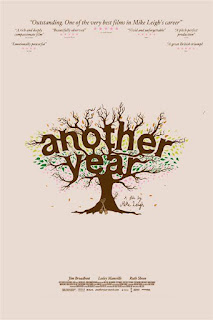
Another Year (2010)

Another Year header
Ruth Sheen and Jim Broadbent are either a blissfully happy and kind or rather smug couple in Another Year

Director: Mike Leigh

Cast: Jim Broadbent (Tom Hepple), Ruth Sheen (Gerri Hepple), Lesley Manville (Mary Smith), Peter Wight (Ken), Oliver Maltman (Joe Hepple), David Bradley (Ronnie Hepple), Karina Fernandez (Katie), Martin Savage (Carl Hepple), Michele Austin (Tanya), Phil Davis (Jack), Imelda Staunton (Janet)

Tom (Jim Broadbent) and Gerri (Ruth Sheen) are a blissfully content middle-class London couple. He’s a successful geologist, she’s an attentive NHS counsellor. They divide their time between work, their allotment and socialising with friends. But many of their friends are disaster zones. Gerri’s work colleague Mary (Lesley Manville) is a divorcee who falls over herself to tell people how happy she is, but is clearly depressed with a drink problem. Similarly, Tom’s old uni friend Ken (Peter Wight) is a lonely alcoholic, seriously overweight and equally depressed.

The fascinating question at the heart of Mike Leigh’s heart-felt and beautiful film is: are Tom and Gerri a sweetly loving couple who go out of their way to support friends – or are they a desperately smug pair, facilitating those around them in self-destructive patterns? It’s hard to say either way: and that’s the beauty of Leigh’s honest, subtle character study which presents a single year in the lives of these characters.

It’s also, of course, superbly acted by the cast – all of them regulars in the work of Leigh. Broadbent and Sheen are brilliant as a couple completely content and happy in themselves and confident that they essentially have life sussed. They are kind, considerate and supportive of everyone. But how much is this genuine and how much is it performative? They fuss and smile to each other around the depressed and fragile Mary – but do nothing to help her change and improve her life, and merrily continue to fill the glasses of both her and the even more alcohol ravaged Ken.

When Tom’s sister-in-law dies, they rush to support his quiet, reserved brother Ronnie (David Bradley). They arrange every detail of the funeral and do everything they can to remove any burden from him. Tom is furious at the selfish and uncaring attitude of Ronnie’s son Carl (a grimly chippy Martin Savage) who seems convinced he is somehow being cheated by them. They bring Ronnie back to stay with them for a few weeks – but frequently leave him alone or allow him to sit watching their own insular conversations. Sure, they give him a home and support, but do they really care or are they going through the motions of people who want to believe they really care?

Wouldn’t a real friend of Ken, tell the obviously over-weight, permanently drunk, desperately self-loathing man that he has serious problems and help him change his life, rather than refill his glass at every opportunity? Or is it a sign of Tom and Gerri’s decency that they don’t see it as their place to tell other people to live their lives? In addition, Tom sticks loyally by Ken in a way very few people would – its clear during a golf game with Ken, Tom, son Joe (Oliver Maltman) and pal Jack (Phil Davis) no-one else wants Ken there – and gives him more warmth and attention than you suspect anyone else ever has. Does it just not occur to him a real friend would help Ken change his life?

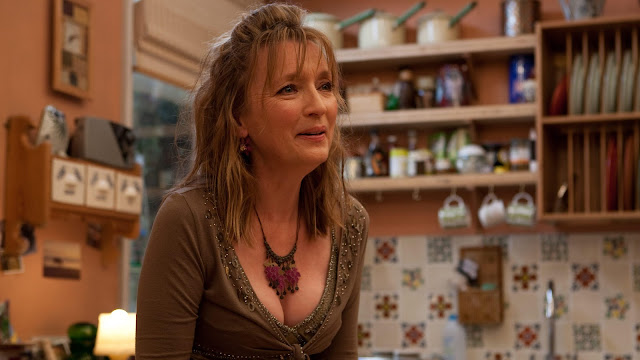
Above all, we see the frantic desperation and all-consuming anxiety, fear and neediness of Mary, played with a heartfelt and deeply moving frankness by a never-better Lesley Manville. Mary is a very sweet woman, who has lost her place in the world and clings to the idea – now long since departed from reality – that she is a young glamour puss, rather than a desperate, divorcee in her fifties. Tom and Gerri support Mary, making her a part of their lives. She is a frequent overnight guest in their house, has known Joe since he was little and relies on Gerri utterly for friendship.

But there is also a slight air of judgement with their treatment of Mary. Does having this all-too-obviously tragic case, this failure who is utterly emotionally dependent on them, make them feel better about themselves? What have they done over the years, for all those sympathetic ears and shoulders to cry on, to help Mary deal with the root cause of problems? While they are willing to listen at great length to her (often tedious and repetitive) conversation, they never once really step into help her effect real change.

Events bubble up as the lonely Mary begins to fixate on a fantasy of her forming a relationship with Joe. It’s implied everyone is aware of this, but politely do their best to hope the situation will go away. Manville is of course brilliant in playing the tragically self-deluded hope under this longing for a never-will-be relationship – particularly as she never once looks down on Mary, but plays with a real empathetic warmth, that helps us feel an immense sorrow for this woman, while still acknowledging she can be deeply frustrating.

And Mary perhaps has more warmth, and ability to connect naturally with people, than Tom and Gerri. This is suggested during a wonderful late scene with Ronnie (a brilliantly quiet David Bradley), where in a long conversation she forms more of a bond of him than we’ve seen Tom and Gerri, for all their patience, ever form. It’s impossible not to relate to Mary as she’s so clearly such a vulnerable person, desperate for love and human connection. Seeing her slow-motion collapse across the film is heart-rending. For all her flaws, she’s someone you are desperate to see happy.

Mike Leigh is able to capture all this in his beautifully observant film, perfectly placed, low-key but deeply affecting. There are never obvious beats and he is willing to show the positives as well as the flaws in every character. He never tips the deck either for or against Tom and Gerri, allowing us to judge them by their actions: they could be warm, friendly, open-house people who stick loyally to troubled friends most people would drop immediately; or they could be subconsciously using these tragic cases to feel even more blissfully happy with their own perfect lives. Leigh never tips it either way, and the breathtakingly emotional performances and beautifully played and written scenes mean that, even though the film is short on plot, it feels rich in character and emotion. It ends with a beautiful held long shot on Mary that, like the rest of this film, is deeply moving but also leaves you with more questions than answers. A triumph.

Rio Bravo (1959)

Rio Bravo header
John Wayne, Ricky Nelson and Walter Brennan are supremely unbothered by danger in Hawks’ High Noon riposte, Rio Bravo

Director: Howard Hawks

Cast: John Wayne (Sheriff John T Chance), Dean Martin (Dude), Ricky Nelson (Colorado), Angie Dickinson (Feathers), Walter Brennan (Stumpy), Ward Bond (Pat Wheeler), John Russell (Nathan Burdette), Pedro Gonzalez Gonzalez (Carlos Robante), Estelita Rodrigues (Consuelo Robante), Claude Akins (Joe Burdette)

When they saw High Noon Hawks and Wayne were unimpressed. Who was this sissy cry-baby, blubbing in his office, begging all and sundry to join him in an impending gunfight with an outraged gang? This wasn’t the West they knew. How un-American was that? So, heads went together and they came up with their counterpoint: Rio Bravo, where the Duke does the right thing, locks up the bad man, is supremely unruffled by threats of violence from his gang, turns down offers of help from across the town (he doesn’t need to worry, they all help anyway) and even finds time for an unfazed, late-night jail-room sing-along with his deputies. Take that Fred Zinnemann and Carl Foreman!

The Duke is John T Chance, a grizzled, experienced sheriff, still in-his-prime, who arrests the brother of Nathan Burdette (John Russell) after he shoots an unarmed man in a bar brawl. When Nathan demands his release – or there will be hell to pay – Chance relies on the men he can trust: old-timer Stumpy (Walter Brennan), recovering alcoholic former-deputy Dude (Dean Martin) and (eventually) plucky young gunslinger Colorado (Ricky Nelson). The three simply have to wait for the Marshalls to arrive and take Burdette away – but will the Burdette’s strike first? On top of which, Chance’s eye is caught by the widow of a cheating gambler, Feathers (Angie Dickinson) – does he also have time for a bit of love?

Rio Bravo is possibly one of the most “shooting-the-breeze” films ever made – even though the general air of manly cool is punctuated by the odd gun-fight. Wayne and his gang are far too cool, confident and quick on the draw to ever be that worried about the approaching threat of the Burdette family – not that you can blame them, since Hawks spends only the minimum amount of time fleshing them out. Instead, the film is a chronicle of a few days where they hole-up and basically shoot-the-breeze – their banter carrying over to exchanging bon-mots during the final gunfight (“You took two shots!” “I didn’t take the wind into account”). It’s the sort of unfazed cool against the odds that you can see has carried across to a whole host of modern action and superhero films, heroes who are so confident in their skills they crack wise even under fire.

Rio Bravo is directed at a gentle pace but complete assurance by Hawks. It occasionally has a feel of settling down and watching a relaxed after-show party, with a group of actors so comfortable in each other’s company, that they simply filmed themselves having a whale of a time. Wayne marshals the whole thing on screen with authority and confident precision: the part is far from a stretch, but he hits the beats with a naturalness that really works, from a fatherly mix of encouragement and disappointment in Dude’s slow turnaround from his drunken collapse, to a crusty flirtatiousness with Feathers (Angie Dickinson at her most radiant here).

The film is full of delightful little moments that pop-up with a perfectly judged regularity. Colorado and Feathers save Chance’s bacon with a perfectly timed flower-pot through the window, matched with Colorado’s pitch-perfect shooting skills. Dude judges exactly the location of sharp-shooter through the drops of blood on a full beer-glass (a lovely image from Hawks). Chance and Colorado confront a card cheat. Chance is so cool under fire, that pinned with two guns on his back in a small room, he never once feels like he thinks there is any real danger.

Either side of these events, the film is full of a sublime lackadaisical charm, as our heroes riff off each other, never once letting events get too heavy. You couldn’t cast Dean Martin and Ricky Nelson without having them break into song – so of course, they do just that in a late-night sing-along. It seems to be about blocking out the sound of Degüello, the cut-throat Mexican song that plays non-stop outside the town overnight, warning them of the perils to come. But really it’s just because we are watching three blokes chilling and simply too cool to be that flustered by scare-tactics. (The Degüello here, by-the-way, was composed by High Noon’s composer Dimitri Tiomkin – another one in the eye for that film).

Wayne’s charges all do a fine job on screen, with Dean Martin in particular fitting the role like a glove and bringing a wonderful sense of sixties brashness as well as a surprisingly affecting struggle with alcohol. Ricky Nelson does his duty when pushed. Walter Brennan wheezes and cackles as only he can. Angie Dickinson is wonderfully vibrant and sexy – surely, with those tights, she’s too much for even the Duke to handle?

Duty is what it is all about, and these are men’s-men who knuckle down and get on with it rather than complain. People may offer to help, but only those qualified will do so (two of them rock-up to help at the final gunfight anyway). That film’s concluding shoot-out is rousing, dramatic and literally explosive. Hawks shoots it all with assured skill – the film’s long silent opening, is a wordless delight of reaction, implication and careful character development (Chance and Dude are wordlessly, but perfectly, established).

Rio Bravo is one of those films people has have their “favourite” – and that might be because it’s laid-back, fun and invites you to join on it. It’s free of pretension and shows you the sort of men you’d like to be, going about effortlessly the sort of things you’d like to do. No wonder people love it so much.

Goldfinger (1964)

Goldfinger header
Sean Connery defines Bond forever in Goldfinger

Director: Guy Hamilton

Cast: Sean Connery (James Bond), Honor Blackman (Pussy Galore), Gert Fröbe (Auric Goldfinger), Shirley Eaton (Jill Masterson), Tani Mallet (Tilly Masterson), Harold Sakata (Oddjob), Bernard Lee (M), Martin Benson (Mr Solo), Cec Linder (Felix Leiter), Lois Maxwell (Miss Moneypenny), Desmond Llewelyn (Q), Burt Kwouk (Mr Ling), Richard Vernon (Colonel Smithers), Bill Nagy (Mr Midnight)

It took three films, but Goldfinger was when they got the James Bond formula spot-on. So spot-on, that all the James Bond films that followed would employ elements introduced here. This is where we got for the first-time: the pre-credits action sequence, Q, a gadget filled Aston Martin, a bizarre assassination tool, a villainous henchman with a bizarre skill, an outlandish scheme and Bond delaying being saved at the end for a few more moments of rumpy-pumpy. It’s Connery at the height of his powers, has a knock-out song, one brilliant sequence after another and marks the moment where Bond wisely severed any connection with the real world, like a laser slicing through gold towards our hero’s crotch.

On vacation in Miami, James Bond (Sean Connery) has a run in with Auric Goldfinger (Gert Fröbe), gold bullion millionaire and card cheat. During this his romance with Jill Masterson (Shirley Eaton) is cut short when she is killed by being covered completely in gold paint (a fatal case of the not-actually-real ailment “skin suffocation”) by Goldfinger’s silent steel-rimmed hatted manservant Oddjob (Harold Sakata). Bond is hungry for revenge when he is tasked by M (Bernard Lee) to find out how Goldfinger is smuggling Gold bullion. He finds out Goldfinger has an even more fiendish plan in the works, involving Chinese agents, a nasty gas, an all-female flying circus headed by Pussy Galore (Honor Blackman) and the US gold reserve at Fort Knox.

Goldfinger was a massive hit and pretty much lands somewhere near the top of any poll of the greatest ever Bond films. That’s because it’s just a massive explosion of cool fun. It’s exciting, funny, perfectly paced and has one scene after another that are so perfect, Bond films for the next fifty years would more-or-less repeat them again and again (taking it even further, A View to a Kill is virtually a remake of Goldfinger and even Quantum of Solace has a homage to death-by-gold-paint). Goldfinger takes place in a heightened reality of thrills and spills – unlike From Russia with Love or Dr No there is not even the slightest pretence espionage might work something like this – and barrels along with such pace and momentum it becomes a thrill ride you don’t want to get off.

The plot is actually rather close to Fleming’s original. Goldfinger’s plan has been tweaked, but the film still finds time for the classic “Bond takes on the cheating villain at a gentleman’s sport”, with Bond duelling with Goldfinger in a round of match-play golf (I like to think this is where Connery’s real-life obsession with the sport began, cunningly swopping the cheating Goldfinger’s ball on the final hole for default victory). But the film adds a playful, tongue-firmly-in-cheek quality. It manages to mix thrills with not taking itself too seriously, becoming a grandly entertaining thrill ride.

The re-working of the elements of the novel for the screen created an indelible template for Bond. Oddjob became a walking icon, his shadow instantly recognisable, invulnerable with a killing method – a steel rimmed hat he throws with Olympian accuracy – that’s a perfect mix of just-about plausible and utterly ridiculous. And also, of course, perfect to playfully imitate a home. What you can’t imitate is bombing around hill roads in a gadget-stuffed Aston Martin, but you can dream. The car chase is not only a show case for cool driving, it also lets you see each of the super-cool enhancements introduced by Q one-after-another (a pattern the series would follow time and again whenever a gadget-stuffed car appeared) and hammers home Bond’s super-cool confidence.

Connery was of course perfect for conveying that. In Goldfingerhe was still interested, clearly enjoying some of the best quips he got as well as just enough acting challenges – from Bond’s sad regret at anger at the death of no less than two Mastersons, to his terror at the prospect of being unmanned by a laser. That sequence has of course gone down in film history – from the striking image to the classic exchange “You expect me to talk?” “No Mr Bond I expect you to die!” – but a lot of it is sold from Connery’s desperate search for the right words to turn that machine off. Connery is cool but still just about vulnerable, cunning, smart and witty but also human. Who wouldn’t want to be so unshakeably cool that he can emerge from a wet suit (with a model seagull on his head!) unzip to reveal a tux, light a nonchalant cigarette while a factory explodes behind him, seduce a woman and then off a killer with a bathtub and a heater (“Shocking!”) – and that’s just the first five minutes!

Every scene in Goldfinger is a doozy. The playful cool of Bond outsmarting Goldfinger in Miami then getting his comeuppance (Connery is so cool in the film btw you forget that Bond is such a staunch conservative, he cheekily disparages the Beatles – that other icon of Swinging Sixties Brit Cool – to Jill as casually as he offs villains). That golf game in Kent (capped by a decapitated statue). Hillside driving with Tilly (with extra dodged bullets). Late night gadget-filled car chase. The first meeting with Pussy Galore (“I must be dreaming…”). Goldfinger’s briefing (his offing of all the attendants makes the whole thing even more funny, since its clearly just Goldfinger enjoying a bit of showing off). Bond dragging a nuclear bomb around an epic Fort Knox set. Oddjob surviving everything but a million volts. Goldfinger earning his wings in the film’s climax. It’s all terrific.

And it all works because it’s got the balance spot-on between cartoon and reality. You can see it come together in Ken Adam’s set for Fort Knox: the inside was all made up (no one would stack gold that high!) but people believed it was the real thing, because it felt like the Fort Knox we shouldhave. Goldfinger is a scowlingly wicked villain, with a little kid’s delight in his own naughtiness. Honor Blackman doesn’t appear until the film is halfway through, but is an assured, forceful, brilliant presence, more than a match for Bond (we’ll gloss over the slightly dated way Bond seems to ‘convert’ her from implied Lesbianism to – well perhaps bisexuality). The briefing sequence with a grumpy, unimpressed Q was so good Desmond Llewelyn would essentially repeat it another 13 times (only OMHSS and Live and Let Die would skip the “Now pay attention 007” sequence between this and TWINE). All of this has the bright, primary colour fun of a rollicking graphic novel.

You can watch Goldfinger about a million times – and anyone who has written a Bond film probably has, it was such a template for the next seventeen films that followed – and it would still thrill, excite and entertain you. Connery’s interest after this went downhill, and the magic wasn’t always recaptured – but this when Bond went from being a cool spy to a cultural phenomenon. Bond became the box-office franchise that would dominate cinemas for decades, the ultimate spy caper that others would be compared to. Goldfinger mixed silliness and seriousness perfectly, thrills and laughs, action and comedy. It’s a superb and hugely influential film. It’s one of the Best Bonds ever: it clearly has the Midas touch.

The Tragedy of Macbeth (2021)

The Tragedy of Macbeth header

Denzel Washington and Frances McDormand are the Macbeths in this brilliant, noirish, superb Shakespeare film

Cast: Joel Coen

Director: Denzel Washington (Lord Macbeth), Frances McDormand (Lady Macbeth), Corey Hawkins (Macduff), Brendan Gleeson (King Duncan), Harry Melling (Malcolm), Bertie Carvel (Banquo), Alex Hassell (Ross), Kathryn Hunter (The Witches), Moses Ingram (Lady Macduff), Ralph Ineson (Captain), Stephen Root (Porter), Miles Anderson (Lennox), Jefferson Mays (Doctor)

Shakespeare on screen is difficult to pull off. Focus too much on the language and you end up with something more theatrical than cinematic. Zero in on the visuals and you lose what makes Shakespeare great in the first place. That’s not even to mention that films – with their huge audiences – tend to focus on simple, more traditional interpretations of a play that add little to interpreting it afresh. These are all problems avoided by Joel Coen’s The Tragedy of Macbeth which is bloody, bold and resolute and jumps straight into the upper tier of great Shakespeare films. Inventive, dynamic, gripping and excellently acted it succeeds in being both a creative production of the play and something truly cinematic.

Shot in a crisply clean black-and-white, the 4:3 frame frequently filled with rolling mist and stark white light (it’s superbly shot by Bruno Delbonnel), this is a Macbeth set in a Jan Kott inspired Samuel-Beckett-tinged wasteland, with Scotland a bleak, blasted country, its characters leading lives full of sound and fury that signify nothing. The Macbeth’s castle is an Esher like construction of perfectly formed empty rooms, towering walls and arches casting grim shadows and open ceilinged rooms allowing onlookers to observe everything. There are brilliant images: not least the handle to Duncan’s door which is strikingly lit to resemble a knife. Characters frequently emerge from the mist or the darkness to walk towards us and confess their darkest thoughts.

No Shakespeare film has better used set and location since Orson Welles’ Othello – a film this is sharply reminiscent of, with its brilliant use of angles and shade that constantly disconcerts the viewer (even leaving us confused at points on whether we are looking down or up). Coen also seems to have been inspired by Peter Brook’s grimly nihilistic King Lear film, with this Scotland being trapped firmly in a circle of destruction powered by the witches. All three are played by Kathryn Hunter, whose contortionist twisting and ability to switch her vocals on a sixpence from sing-song to a Gollumesque growl make them truly feel of the earth and yet not. Hunter is inspired casting – sometimes representing all three witches in a single schizophrenic body, at others playing all three at once. A brilliant image at one point shows her double reflection in a watery pool, turning her body immediately into a trinity.

Hunter’s movement is birdlike and agile – fitting since it’s suggested the witches can transform themselves into carrion crows, flying over Scotland picking bones clean of fresh. The first image is the three birds circling the Captain as he walks slowly across a beach to report to Duncan. Later Hunter perches on a crossbeam in another opened-ceiling room, subtly poking Macbeth on to greater monstrosities. There is a cycle of destruction here – and the film’s ending implies all this chaos is bound to start again.

Crucial to this is Ross. Following Polanski’s Macbeth – and again heavily inspired by Jan Kott – Alex Hassell’s unctuous Ross, ingratiates himself with all while happily engaging in acts of brutality. He personally executes Cawdor (by beheading), joins Banquo’s murderers, shows the way to the sacking of Macduff house and hands Malcolm both the crown and Macbeth’s severed head. But Coen takes it further again: rather than a cruel opportunist, this Ross seems to be an agent of the witches – or maybe even a witch himself. Hassell’s costume, with its curiously feminine robe and wing-like arms, echoes the witches and Ross moves smoothly from side-to-side even in the final acts, planting seeds of further destruction (including further implied murders) and collaborating directly with the witches to restart the cycle at the end.

All this makes Macbeth and Lady Macbeth at times feel like rather tragic puppets at the heart of a terrible cycle of events they cannot control. It certainly fits with Denzel Washington’s balanced and intelligent performance in the lead. While Washington doesn’t mine as much weight and meaning from the text as the great stage Macbeths, he gives his line readings an unstudied naturalism and a dynamic and thoughtful rhythm (even if he is prone a little too much to the “soft-slow/fast” approach). His Macbeth is a weak, indecisive man, happy only when he is in action. Clearly ambitious from the start, he binds himself in knots thinking but, once a decision has been made, has no hesitation. Violence is an instinctive tool – he kills several people with no hesitation and a lightening aggression – but he’s lost without direction. He clings to the crown as if it will somehow give the things he has done meaning.

Washington’s performance shifts gears once Macbeth has decided to fully commit himself to those scorpions that fill his mind, becoming an unbalanced mixture of fatalistic and recklessly impulsive. No wonder he has less need for his wife. Frances McDormand is perhaps even better as a Lady Macbeth who sees the crown as her last chance for legacy in a world that has left her behind. McDormand really understands the way to mine nuance from the language. Frequently inpatient with her husband, she is decisive where he is not, but squeamish around violence in a way he isn’t. Both Washington and McDormand manage to suggest a great deal of unfulfilled sadness in the Macbeths, two people in the twilight of their years who pounce on a chance for a last hurrah but find themselves psychologically unsuited for the consequences.

The two leads are at the head of a uniformly strong cast. Hunter and Hassell are both superb. Bertie Carvel is a brooding but honest Banquo. Corey Hawkins a forceful but thoughtful Macduff, played with guilt and wise from the start on Macbeth’s villainy. Moses Ingram brings a lot of warmth to a striking scene as Lady MacDuff. Ralph Ineson’s delivery of the Captain’s speech is spot on. Harry Melling is an immature, stubborn Malcolm.

But the real star here might just be Coen’s direction. The brooding, overbearing beauty of the film is all part of its atmosphere of creeping intimidation and danger. There are some truly striking, haunting images: the flame lit murder of Banquo, a deranged Macbeth fighting a spectral hallucination of Banquo, water pouring down into the flagstones after Macbeth’s final visions of the future, the smoke and mist filled murder of Macduff’s children (a shot of Wellesian brilliance), Lady Macbeth standing before a sheer drop, the imaginative arrival of Birnam wood, Macduff and Macbeth’s final duel in a narrow battlements. This is a punchy, brilliant, beautiful, intelligent and unique reimagining of the play that mixes Shakespeare, visual and has something clear and unique to say about staging the play. Comfortably one of the greatest Shakespeare films ever made.

She Wore a Yellow Ribbon (1949)

She Wore a Yellow Ribbon header
John Wayne embodies the honour and duty of the American man in She Wore a Yellow Ribbon

Director: John Ford

Cast: John Wayne (Captain Nathan Brittles), Joanna Dru (Olivia Dandridge), John Agar (Lt Flint Cohill), Ben Johnson (Sgt Tyree), Harry Carey Jnr (Lt Ross Pennell), Victor McLaglen (Sgt Quincannon), Mildred Natwick (Mrs Abbey Allshard), George O’Brien (Major Mack Allshard), Arthur Shields (Dr O’Laughlin)

If there is a film that marks John Ford as the great American Artist of the West, it might just be She Wore a Yellow Ribbon. Shot in glorious Techicolour on location in (where else?) Monument valley by Oscar-winning cinematographer Winton C Hoch, it’s a gorgeously lit celebration of everything that made the American West a legend. Streaking red sunsets, rolling plains, lightening that slices through the sky, masculine military ruggedness beautifully bought to the screen. It’s Ford’s biggest push to become a Winslow Homer or Edward Hopper of the wide-open American space.

Nuzzling in the middle of Ford’s unofficial Cavalry trilogy (either side of Fort Apache and Rio Grande), John Wayne plays Captain Brittles (who might as well be Kirby York again, since he shares the same personality and most of the same backstory), is counting down the last few days until retirement. After Custer and his men are slaughtered at the Battle of Little Big Horn, he’s ordered to lead a cavalry patrol to fly the flag and help prevent a new war with the Indians. At the same time, he’s to escort his commander’s (George O’Brien) wife (Mildred Natwick) and niece Olivia (Joanna Dru) to an eastbound stagecoach (and safety). Olivia herself is in the middle of a love triangle with the two lieutenants eying taking on Brittle’s command, Cohill (John Agar) and Pennell (Harry Carey Jnr).

The film tells the story of that patrol and the subsequent follow-up mission to save those caught protecting the rear guard (needless to say Brittles continues the mission after his supposed retirement, bending the rules). There isn’t actually much in the way of plot in She Wore a Yellow Ribbon. Instead, Ford’s intention is to front-and-centre those particular American qualities of loyalty, honour, dedication to the cause and self-sacrifice. The men of the cavalry always put their country and fellow soldiers first, willing to sacrifice themselves to the greater good and show not one jot of hesitation in doing so. Ford shoots all this with real beauty and more than a touch of whimsical wit, coming particularly (where else?) from the Irish American contingent among the soldiers.

At the film’s heart is Wayne himself, now cemented in Ford’s films not as the traditional romantic action hero, but an elder statesman, wiser and less trigger-happy than his fellows, an unflappably experienced man who guides and inspires, shrugging off praise with an aw-shucks-just-doing-my-duty nobility. If Fort Apache and Red River were first steps towards Wayne – at this time only just past 40 – starting to act as if he was ten years older than he actually was (and in Red River’s case a little bit older than that!) – She Wore a Yellow Ribbon cemented him as the grizzled, inspiring man of action, a role he would play in variation for most of the rest of his career.

And he’s very good in She Wore a Yellow Ribbon. Ford had of course been impressed by the depth and shade of his performance in Red River. This is a simpler role – it would be a few more years before Ford used the darkness in Wayne as well as that film – but it shows Wayne slotting into place as part of What Made America Great. Wayne plays Brittles with a sadness – he’s a touching grieving husband, who takes a familiar chair out every night to talk to his wives tombstone – and a fatherly concern for his men, but tolerating no selfishness or greed. He mentors and pushes Cohill and Pennell like a second father, and has a brotherly banter with his loyal sergeant (inevitably Victor McLaglen as a hard-drinking, extremely Irish drill sergeant). He will do his duty, but he also respects Indian culture, will fight but prefers a peaceful option, will follow orders but never blindly. He’s all that’s good about the American fighting man, and this is one of his finest performances (and a personal favourite of his).

The yellow ribbon wearer is Joanna Dru as Olivia, the sort of spunky young woman Ford’s films frequently feature in key roles. Dru is just about the archetype: brave, determined, smart – much smarter than both of the rather dull men playing court to her. She’s also sensitive and understanding of Brittle’s grief and can hold her own with the men out in the field. Dru’s very good in the role, bringing it a great deal of depth and more than a touch of heart.

She Wore a Yellow Ribbon, plot wise, is more of a day-in-the-life movie. At heart not a lot actually really happens in it other than following the cavalry on two missions (one of which fails) and far from averting the war, it’s explicitly suggested they are just delaying it. The status quo is almost completely restored by the film’s end. The real focus of the film is the detail of what the men set out to do, the determination and humanity with which they go about it – not least the self-sacrificing bravery – and then the return to rest and prepare to go out again. All shot in some of the most striking and beautiful images of the West ever committed to the screen. As a visual tribute, the film is a rich feast.

It’s Ford’s celebration of America and the West and his case for the beauty and majesty of a generation and the values that they placed above all others. For this, She Wore a Yellow Ribbon may be one of the finest of its kind. It lacks the narrative thrust of Fort Apache – and like that film is, in the end, as unquestioning and uncritical of the actions and legacy of those pioneers out West, or the dangers of imperial expansionism or blind veneration of deeply flawed heroes like Custer – but it’s beautiful, very well acted (particularly by Wayne) and a fine film from a director at the top of his game.

The Happy Prince (2018)

The Happy Prince header
Rupert Everett excels as Oscar Wilde in his passion project The Happy Prince

Director: Rupert Everett

Cast: Rupert Everett (Oscar Wilde), Colin Firth (Reggie Turner), Colin Morgan (Lord Alfred “Bosie” Douglas), Emily Watson (Constance Lloyd), Tom Wilkinson (Father Dunne), Anna Chancellor (Mrs Arbuthnot), Edwin Thomas (Robbie Ross), Beatrice Dalle (Café manager), Julian Wadham (Mr Arbuthnot), John Standing (Dr Tucker)

Rupert Everett has long felt an affinity for Oscar Wilde. He saw Wilde as one of the first great martyrs of the gay community, sacrificed early to the hypocrisy of conventional society (who loved everything about this flamboyantly camp, witty man right up until they found out what he got up to in bed). He spent ten years trying to find the money to film his script about Wilde’s final days in exile in Europe. (Everett eventually recounted all this in a book, To the Ends of the Earth).

The final end result is a well-made, interesting, decent film that doesn’t reinvent the wheel or radically change our perceptions or knowledge of Wilde – but does plenty of credit to Everett. He directs with an assurance and a surprising amount of visual flair. The film is attractive and uses urgent, hand-held camerawork with a great deal of skill, giving even the most basic scenes a real spark of life. There are some intelligent and intriguing visual cuts and transitions and he gets good work from the cast (Firth, an old friend, loyally did the film for nothing to help it get made). There is enough here to make you keen to see Everett have a go at another film (although I suspect, from reading the book, that’s highly unlikely to happen).

Everett also plays the lead role, and that’s the film’s main interest. He honed his performance as Wilde after the best part of a year on stage (to huge acclaim) in David Hare’s The Judas Kiss. Not to mention Everett has a natural affinity for Wildean dialogue, having proven on several occasions that maybe no actor alive better captures Wilde’s wit and pathos. His Wilde is a shattered husk, slowly realising over the course of the film that his life is effectively over. This happens not so much as a raging against the light, but the slow deflation of a man who died at a very early age (barely mid 40s), collapsing into depression, alcoholism and repeating the same mistakes over and over again.

The most prominent of those mistakes being taking up again with his lover (and root cause of his disgrace the first time) Bosie, played here with preening, incandescent selfishness by Colin Morgan. During a long sojourn in Naples, these two flirt, fight and fuck until the money runs out – like an appalling unfunny screwball comedy couple who keep being dragged back together because fighting each other is better than talking to anyone else. Bosie then turns up in floods of tears at Wilde’s grave – having cut all ties with him or face disinheritance, fobbing him off with a few hundred quid of “thank but piss off” money.

Wilde’s loyal friends stick by him – but in that typical blinkered way we sometimes behave when we are in love, Wilde oscillates between being sickeningly dependent and dismissive of them. Everett isn’t afraid to make Wilde often preening, sponging, selfish and deluded or to stress how easily his wit and intelligence could be turned cruel. Edwin Thomas is heart-breakingly earnest as Wilde’s devoted friend Robbie Ross while Firth gives sterling support as the equally loyal Reggie Turner.

The film follows Wilde into some pretty dark places and plays some quite daring cards when exploring Wilde’s psyche. Everett plainly shows Wilde deeply regretted the end of his relationship with his children, and the damage he caused them. But he isn’t afraid to show him taking on potential substitutes for them in a teenage boy and his prepubescent brother – while still paying for sex with the older brother (eagerly pimped by his street-smart younger brother). Despite this there’s something very sad about Wilde settling down to tell these kids the same stories he told his own. Or his gentle longing for the family he left behind that we hear in his voice when he sees them.

Where the film is strongest is in showing the prejudice and rage Wilde met and the suffering he endured. Wilde is spat at, chased through the street by drunken poshboys on tour (finally physically confronting them in a church with a foul-mouthed fury), threatened and generally treated like dirt by nearly everyone of any social standing. Scenes of him at his pomp show the same traits now treated as disgusting signs of his sexual preference, were celebrated as evidence of his charm. The Happy Prince has an angry and rage to it that I almost wish Everett had committed to more.

Saying that, it’s shot and edited with such pace and urgency that the film still works. If at the end it never quite coalesces into a clear message, it’s still a fine tribute to Everett’s efforts to bring it to the screen. And his own performance is a marvel – beautifully judged, empathetic but not hagiographic, critical but sympathetic, funny and also moving, angry but gentle. Its best legacy is the opportunity Everett the actor is given by Everett the director (as he confesses in the book one of his principle reasons for writing the script in the first place) and if the film is a little too much of a one-man showcase, it still has plenty of interest to it.

The French Lieutenant's Woman (1981)

The French Lieutenant's Woman header
Meryl Streep and Jeremy Irons play star-crossed lovers (twice!) in The French Lieutenant’s Woman

Director: Karel Reisz

Cast: Meryl Streep (Sarah/Anna), Jeremy Irons (Charles/Mike), Leo McKern (Dr Grogan), Hilton McRae (Sam), Emily Morgan (Mary), Lynsey Baxter (Ernestina), Patience Collier (Mrs Poulteney), Penelope Wilton (Sonia), Peter Vaughan (Mr Freeman), Michael Elwyn (Montague), Richard Griffiths (Sir Tom), David Warner (Murphy), Gerard Falconetti (Davide), Colin Jeavons (Vicar)

Many books have been considered unfilmable. John Fowles’ The French Lieutenant’s Woman is a key member of that list. Part pastiche, part commentary on Victorian novels, Fowles not only has a narrator who acts as an ironic commentator on events, but also offers up three possible endings to its central romance, each radically different from the one before. Not easy to bring that to film! Adapting it, Reisz and Harold Pinter came up with the concept of mirroring the novel’s central relationship with a relationship between two actors playing those characters in a film being made of the novel. Got that?

So, Meryl Streep and Jeremy Irons play both the novel’s romantically entwined couple Sarah and Charles AND also Anna and Mike, two actors playing those very roles in a film of The French Lieutenant’s Woman, also engaged in a love affair. Both affairs end in radically different ways, mirroring two of the alternative endings in Fowles’ novel. Most of the films runtime sticks with the novels’ plot, where Charles – an ambitious young scientist – is drawn away from his promising engagement to a potential business partners daughter (Lynsey Baxter), by his romantic fascination with Sarah, a woman of ill-repute in Lyme Regis, the former mistress of a French Lieutenant.

Pinter and Reisz’s adaptation is a smart idea. But I feel it misses a trick. If they really wanted to adapt the book – with its intrusive narrator and alternative endings – then the real character to focus on from a film set is not the actors but the director and producers. If our framing device had been watching the rushes in the screening room, seeing differently edited scenes play out in contrasting ways, with producers and director commenting on the action and making decisions about which ending (Happy? Sad? Open-ended?) they stick on the end of the film. Sure, that would have opened itself up to potentially on-the-nose dialogue, but it would be a better representation of the novel and its ideas, and truly translate some of the books real strength (its unique narrative style) to film.

But that’s talking about something the film doesn’t do. What it does do is offer something that is basically a 80% adaptation of the novel’s plot, mixed with 20% short interjections of the modern-day storyline. Deliberately, the film contrasts the intense romance and deeply-felt passions of the Victorian storyline – where acting on desire carries with it a huge, life-shattering cost in disgrace and social expulsion – with the shallow, off-hand flirtations of the modern era, where the stigma of a sexual affair has ceased to exist.

While this is effective in making the Victorian sections carry even more weight, it does mean the modern sections (by design) are slighter and less engaging. Their semi-regular appearance – it isn’t until the final half hour that we get anything approaching a proper sequence set in the present day, with a beautifully played garden party hosted by Mike and his wife (a magnificent putting-on-a-brave-face performance from Penelope Wilton), which is a feast of stolen glances, averted eyes and strained conversation.

But in some places the split narrative works a treat, particularly in allowing flashes of the real life, more unrestrained passion of the ‘real’ people drop into the Victorian characters. In particular, a meeting between Charles and Sarah in the woods (highly reserved), cuts to Anna and Mike rehearsing the same scene (playful and flirtatious). When the rehearsal reaches a key point – Anna/Sarah falling and being caught by Charles/Mike, the film cuts so that Anna falls but then Charles catches Sarah falling. And the scene continues. Suddenly, the Victorian couple has a burst of the same sexual freedom the modern couple has. It’s a beautiful cut. Later, Sarah falls to the ground (pushed by Charles), and suddenly bursts out laughing – and it feels like she falls as Sarah, reacts as Anna, then rises again as Sarah – either way it gives a wonderful, modern energy to the moment.

The film is wonderfully shot by Freddie Francis, with luscious forest vegetation and whipping winds and seas on the Cobb at Lyme Regis. Simmering sexual tensions are caught in lingering gazes, gestures that carry things words cannot, careful reaction shots captured by Reisz, the trapping of several characters within the ephemera of over-decorated rooms (at one point Ernestina literally can’t escape a room because of the all the knick-knacks within it).

A lot of the mood comes from the two lead actors, who give masterful performances. It’s very easy to see Streep’s performance here as overly mannered: her accent is oddly toned and highly studied, and much of her performance as Sarah is wilfully artificial and arch. But that’s deliberate: the genius here is that Streep is playing Anna playing Sarah who is in turn constructing her own fictional Sarah. With her pre-Raphaelite looks and artistic leanings, Sarah is a woman out-of-time, yearning for the sort of choices and freedom Anna takes for granted, constantly pushed into roles society can accept her in (Governess, eccentric, ‘whore’ etc.). Does she use Charles or not? Streep brilliantly captures her enigmatic, unreadable spirit, the sort of person who interjects a retelling of a possibly invented backstory, with a playful twirl around a tree. Who sometimes despises herself, at others everyone else. In contrast, Streep makes Anna assured, quiet and confident, with the power to choose risks.

Just as good is Jeremy Irons, in only his second film role and here cementing the start of a career that would see him play a parade of restrained and very British men struggling with passions they can hardly understand. Charles’ fascination with Sarah is rooted in feelings both sexual and romantic that both fascinate and terrify him. His final surrendering to being true to himself, rather than what is expected of him, carries with it both a power and strange desperate bitterness. By contrast, Mike is a far more flighty, shallow-figure – an actor who perhaps is more in love with the feelings he is playing (and the character that inspires them in his character) than he is with Anna.

Reisz pulls all this together highly effectively, and the film is at its strongest when exploring feminism and the opportunities for women in Victorian England. Those are few and far between. Women have defined roles and expectations and someone who deviates from these – like Sarah – have no place. In addition, women are held responsible for provoking dangerous erotic feelings in men (from women of poor reputation like Sarah, to the prostitutes in a London street). The ability of Sarah to make her own choices and lead the life she wants to lead is the underlying theme of her story – and her motivations. Does she want, however she might feel, a relationship that would define her again as “wife” rather than being truly herself?

These are fascinating ideas in a film full of beautiful images – their first meeting on the Cobb in particular is beautiful – scored expertly by Colin Davis (with just a tinge of suspense in the music). The framing device gives little moments of insight and reflection – even if it is only an approximation of the novel’s effect – but the Victorian set story, and it’s buried passions and social commentary is what really compels, in a way that the slighter modern story (almost deliberately) doesn’t. Either way, it has two brilliant performances, an intelligent script and handsome direction by Reisz.

The Last Duel (2021)

The Last Duel header1
Adam Driver and Matt Damon fight The Last Duel in medieval France

Director: Ridley Scott

Cast: Matt Damon (Sir Jean de Carrouges), Adam Driver (Jacques Le Gris), Jodie Comer (Marguerite de Carrouges), Ben Affleck (Count Pierre d’Alencon), Harriet Walter (Nicole de Buchard), Alex Lawther (King Charles VI), Marton Csorkas (Crespin), Željko Ivanek (Le Coq), Tallulah Haddon (Marie), Bryony Hannah (Alice), Nathaniel Parker (Sir Robert de Thibouville), Adam Nagaitis (Adam Louvel)

The medieval era had its own solution for “He said, She said”. Let God decide via a fight to the death. After all, He would never let the injured party lose, would he? Scott’s The Last Duel is a dramatisation of one of the last French judicial duels, in December 1386, between Sir Jean de Carrouges (Matt Damon) and his former friend Jacques le Gris (Adam Driver), after Le Gris is accused of raping Carrouge’s wife Marguerite (Jodie Comer). Scott’s Rashomon-inspired film shows the events leading up to the duel from all three characters’ perspectives.

The three different stories we see are not radically different. Unlike Rashomon – which presented totally different versions of the same events, according to the prejudices or agendas of the storytellers – The Last Duel’s versions stress subtly different reactions or presents different fragments of an overall story. So, for instance, Le Gris and Carrouges remember different elements of a battle. Carrouges recalls the noble charge to save the innocent, saving Le Gris’ life in the final stages of combat. To Le Gris it’s a suicidal charge, in which he saves an unhorsed Carrouge’s life. After the rape, Carrouge remembers offering his wife sympathy; she remembers his anger and demand they have sex at once to “cleanse her” of the stain.

These mixed recollections work best when we see each of them remember a fateful reconciliation meeting between Le Gris and Carrouges (where Le Gris and Marguerite first meet). A wedge has been driven between them ever since Carrouges believed Le Gris cheated him out of both land and his father’s former position. When the two agree to try and put the past behind them, Carrouge asks Marguerite to give Le Gris a kiss of peace. He remembers her surprise and timidity. Le Gris remembers her as being quietly excited with a kiss that lingers. Marguerite remembers a kiss from Le Gris that lingers too long. Small moments like this are where the film is at its strongest, making its concept feel very relevant today in our world of accusation and counter accusation.

But these moments are few and far between. Most of the time there isn’t this subtle variation. Where the film is weakest is when we (frequently) see the same events, presented the same way, three times. While our perception of Carrouges changes – from the ill-treated noble he sees himself to the sullen, self-entitled whiner everyone else sees – our idea of Le Gris is fundamentally the same (blissfully self-entitled). Fundamentally, when we see events the first time, later versions only really tweak our perception of them rather than challenge it.

You can see this in the rape itself, which we first see from Le Gris’ perspective. The film shows Le Gris’ understanding of consent has been twisted by most of his sexual experience being court orgies with playfully protesting prostitutes. His pursuit of a genuinely unwilling Margeurite around her room echoes exactly the pretend-chases and “chat up lines” he’s used in those earlier scenes, so we understand it’s possible he doesn’t actually understand he’s raped her. But no viewer can see Le Gris’ version as anything other than rape. In fact, the only tangible difference when we see the event from her perspective is that her screams of “No” and “Stop” are louder and the camera focuses more on her anguished face. If the film is presenting any tension about whether this is a consensual encounter or rape, it ends the second we see Le Gris’ story.

This negatively effects the drama – and actually makes Marguerite’s version seem strangely superfluous. You start to feel we might as well see all three perspectives at the same time, as the narrative trick ends up adding little to the film – especially since the film categorically states Marguerite’s version is the truth. Why not just tell the whole film from her perspective in that case? It also doesn’t help that Marguerite goes last – which means until an hour into the film, the character we should be most engaged with and sympathetic towards has stood on the side-lines.

This is particularly unfortunate as the film is striving for a feminist message. The men are callous and self-obsessed, treating women as sex toys or assets – and are praised for it. Marguerite though is intelligent and principled, marginalised by her husband and condemned as a whore when she protests her rape. She pushes her case with determination, despite discovering she will be condemned to burn if Carrouge loses (he of course is only in his own honour). Her word is only good if backed a man, and she is powerless to defend her innocence.

It’s the lot of medieval women. Harriet Walter (rocking a bizarre appearance, straight out of David Lynch’s Dune) as Carrouge’s mother tells Marguerite the same thing happened to her, but she considered it pointless (and dangerous) to press charges. What we see of the judicial system is ruthlessly unjust and misanthropic, with women harangued to confess their guild for tempting men.

But it doesn’t quite click together. It’s a shame, as many scenes are highly effective. The rape – both times we see it – is alarming. The final duel is brilliantly shot and hugely tense, not least because Marguerite stands literally on the top of an unlit bonfire watching every blow. Scott’s shoots the film with the same blue-filtered beauty he gave to the early scenes of Kingdom of Heaven.

There is of course an oddness in seeing such American actors as Damon, Affleck and Driver in period setting. The accents are an odd mix: Comer basically uses her regular (non-Scouse) performance voice, Damon does a gravelly version of his own, Walter an American twang to match Damon, Affleck is halfway to plummy Brit, Driver flattens his Californian tones. Damon is pretty good as the sulky, surly Carrouge who gets less sympathetic the more we see him, Driver is suitably charming on the surface but selfish. Comer plays wounded injustice extremely well and brings a lot of emotion to a difficult role. Affleck has the most fun, flouncing around in a blonde wig as a lordly, hedonistic pervert who likes nothing more than belittling Carrouge.

The Last Duel is part way to a decent film, but it just lacks that little bit extra to make it really come to life. Its alternative versions of the truth don’t illuminate as much as they need to – even if they are at points pleasingly subtle in their differences. It has an admirable feminist message, but defers most of it to the second half of the film (were they worried about sidelining the famous male actors?) and it’s concern that we should not doubt Marguerite at any point does undermine its drama. Handsomely filmed, it doesn’t make the impact it should. Perhaps that’s why it was one of the leading box office disasters of the Covid Pandemic?

Oliver! (1968)

Oliver! header
Mark Lester asks for More. You may not share his sentiments in the Oscar winning Oliver!

Director: Carol Reed

Cast: Ron Moody (Fagin), Mark Lester (Oliver Twist), Jack Wild (The Artful Dodger), Oliver Reed (Bill Sikes), Shani Wallis (Nancy), Harry Secombe (Mr Bumble), Joseph O’Conor (Mr Brownlow), Hugh Griffith (Magistrate), Peggy Mount (Mrs Bumble), Leonard Rossiter (Mr Sowerberry), Hylda Baker (Mrs Sowerberry), Kenneth Cranham (Noah Claypool), Megs Jenkins (Mrs Bedwin)

1968. The Vietnam War gets worse. The My Lai Massacre is a low-point in America’s global reputation. MLK is assassinated. Student protests rip through campuses, culminating in Chicago riots at the Democratic convention. RFK is assassinated. In the UK, Enoch Powell talks about “Rivers of Blood”. A flu pandemic sweeps the world. The USSR ends the “Prague Spring” with tanks. It was a year of horrific global turmoil. Perhaps it’s not a surprise the Oscars chose as Best Picture something as blandly comfortable and utterly disconnected from all this mayhem as Oliver! A personality-free re-tread of a successful stage musical, with a few good tunes bolstering a lobotomised adaptation of Dickens’ novel, Oliver! is so coated with sugar it must have helped the medicine of 1968 go down.

Young Oliver (Mark Lester with his singing voice dubbed) is an angelic orphan, thrown out of the workhouse for asking for “more” (Never before has such an event occurred), eventually escaping to London (Where is Love eh?). There he finds the Big Smoke to be nothing less than a wretched hive of scum and villainy. Invited by pickpocket The Artful Dodger (Jack Wild) to consider himself part of the family, he’s soon learning how to pick a pocket or two from Fagin (Ron Moody). It’s not all fun and games though: violent criminal Bill Sikes (Oliver Reed) is a wildcard, although his devoted girlfriend Nancy (Shani Wallis), the sort of girl the boys will do anything for, remains loyal to Bill for as long as he needs her. But there’s a secret in Oliver’s past – who are his parents?

Carol Reed could once make a claim for being the greatest director in the world. You couldn’t make a case for that based on this cosily chocolate-box, unimaginative trudge through a musical that has little other than a couple of catchy tunes to really recommend it in the first place. The real MVP here is Onna White, whose choreography is very impressive. White takes everyday acts and, with a little bit of jazz and a dollop of musicality, turns them into dance movements. It gives the dance numbers a heightened reality that kind of works and provides nearly everything worth looking at it in the film. Reed certainly leaves her to it, carefully setting the camera up with simple wide and medium shots to capture as much of it as possible.

And you could argue that’s his job. But he brings nothing to the other parts of the production. Of course, Lionel Bart’s musical is a much lighter affair than Dickens’ original (although, in actual fact, this is much more of a musical remake of Lean’s Oliver Twist, making many identical cuts and sharing nearly all the same dialogue), but you’d think the director who gave us Odd Man Out and The Third Man could give some drama and character to London’s underbelly. Not a jot. They have the same muted technicolour cleanliness of everything else, and any hint of ruthlessness, criminality or moral conundrums are well and truly left at the door. What we get is a world where everyone – apart from Bill – is fundamentally nice and decent, and rapacious old men using children as criminals is basically not a lot different from running an after-school club.

It isn’t helped that Oliver!, like Bart’s stage original, has a weak book that offers little light or shade for its characters other than to typecast them into simplified “goodies and baddies”. Reed and the film either can’t or won’t stretch this much further – although the film does rearrange some events of the original production to give a bit more motivational heft to actions and introduce Bill earlier to at least add a bit more tension. The film is as quickly bored with the angelic Oliver as the original is – fair enough since he’s a tediously saintly chap – with Mark Lester alternating between looking winsome and shocked at the company he finds himself amongst.

Nothing can interrupt the overflowing “niceness” of what we are seeing. Ron Moody’s Fagin had been honed from performing it on stage so often (and he is very good). But his Fagin is a cuddly uncle, the sort of grown-up scamp you would invite over for a drink, only keeping an eye on the silverware when you did. This is, let’s not forget, a bloke who colludes in murder (though the film reduces his responsibility), kidnapping, grooms kids for a life of crime and willingly lets them die for him. Not a whiff of this is allowed onto the screen. The Artful Dodger (played with a cheeky but tellingly amoral charm by Jack Wild, who tragically never hit these heights again) is given more light and shade than Fagin.

Like the musical, the film downplays the abusive relationship at its heart. Nancy is little more than a walking embodiment of the cliched “tart with a heart” trope, and the film adaptation chooses to praise her for not just sticking with her abuser, but slavishly devoting herself to him. In fact, beyond being casually kind to a child once in a while, this devotion is pretty much Nancy’s entire personality – and the film approves of it. This isn’t a dark picture of a violent man victimising a young woman, folks, it’s love! See, there’s a ballad about it and everything!

It’s a family drama so her murder takes place off screen (just her death spasm legs are seen), but you’d like to think the film could have taken a few moments to put a bit of light and shade on just why this character feels the way she does and does the things she does. In fact, the film is quite dependent on Oliver Reed, the only actor in it who dares to touch some sort of psychological depth – it’s quite telling that, even though he was a famed drunk, he’s the only member of the cast to have had any success after the film was released.

Instead, this is a great big, colourful, empty pantomime of a musical, devoid of character and (outside of its choreography) inspiration. It’s a great big explosion of tasteful sets, mugging actors, pretty colours, prancing and the odd catchy tune. It’s got no idea what the original novel was about at all, and no interest in even touching some of the themes of poverty and criminality Dickens was aiming at. Reed directs the entire thing with the indifference of a gun-for-hire.

Its syrupy sweetness and hammering tweeness leaves you punch-drunk rather than sugar-rushed. Oliver is such an insipid fella you’ll be delighted when he shuts up and sits in the background for most of the second half. It clumsily unveils a mystery and then drifts towards a conclusion that lacks any real drama. It studiously avoids anything that could remotely stretch the viewer. It’s trying so hard to charm you and hug you, it comes across like a lecherous stranger offering you sweets. Oliver! wasn’t even the best musical of 1968, let alone the best film. But in a year when the world was going to hell in a handcart, perhaps a kid-friendly fable bending over backwards to charm and reassure you was what the world needed. Doesn’t mean I need to stomach it now.