Second-tier Spielberg sequel, one-for-the-money but still entertaining for fans of Dinosaur action
Director: Steven Spielberg
Cast: Jeff Goldblum (Dr Ian Malcolm), Julianne Moore (Dr Sarah Harding), Pete Postlethwaite (Roland Tembo), Arliss Howard (Peter Ludlow), Richard Attenborough (Dr John Hammond), Vince Vaughn (Nick Van Owen), Vanessa Lee Chester (Kelly Curtis), Peter Stormare (Dieter Stark), Harvey Jason (Ajay Sidhu), Richard Schiff (Eddie Carr)
Sometimes I wonder if Spielberg even remembers he directed The Lost World. I guess he wanted something to ease him back in after a few years off, which came with a nice big pile of cash to set up Dreamworks. There isn’t anything particularly wrong with The Lost World. It just feels from top-to-bottom like something rolled off a production line, largely devoid of any of the spark or magic you associate with the director. It’s like a Spielberg-pastiche and, while still better than several films in the franchise that followed, it’s unlikely to last 65 million years in the mind.
After the disaster of Jurassic Park, turns out there was a Site B. John Hammond (Richard Attenborough) plans to let the dinos there live freely, under observation. But InGen, now led by his greedy nephew Peter Ludlow (Arliss Howard), plans to exploit the dinos for cash. Hammond recruits Ian Malcolm (Jeff Goldblum) as part of an island team to build a case for protecting the dinosaurs – having already recruited his Malcolm’s girlfriend Sarah Harding (Julianne Moore). Malcolm high-tails it to the dangerous island to get her back (accidentally dragging his kid Kelly (Vanessa Lee Chester) along), only to find Ludlow also on the island, guided by big game-hunter Roland Tempo (Pete Postlethwaite) to capture dinosaurs. Soon “oohs” and “aahhs” turn to “arragghhs!”.
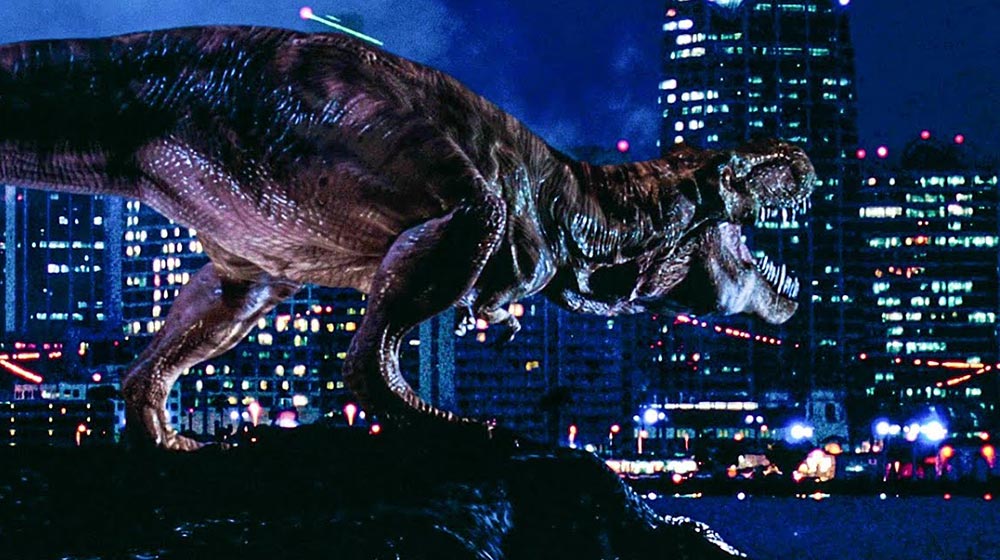
It was adapted pretty much in name only from Michael Chrichton’s Jurassic Park sequel – in fact, several of its most memorable scenes (such as Stormare’s character being munched by compeys, or its child-attacked-on-a-beach opening) are in fact unused material from Chrichton’s first book. The film feels like a wall where a collection of fun-sounding ideas have been chucked to see what it sticks, right down to the sudden gear-change final act with a T-Rex causing havoc in the streets of San Diego. To make this work, major characters consistently make sudden, contradictory or flat-out-stupid decisions, or abruptly disappear once their plot function has been served.
In fact, it’s basically a film of set-pieces with a very, very thinly plotted through-line. The main beats are either thuddingly obvious (can Malcolm bond with his kid?) or get completely lost (the very-lightly sketched non-intervention plans that kickstart the film quickly get dropped completely). What’s important instead is that this is a series of chases against dangerous dinos, with the T-Rex and the velociraptors playing narrative tag between them as flesh-eating antagonists with various (mostly unsympathetic) humans filling out their lunchboxes.
Spielberg is still Spielberg though, so when he gets into a set-piece it tends to be a good one. The T-Rex assault on our heroes caravan base (in a particularly great Spielberg touch, Moore finds herself on a slowly cracking glass windscreen with a deadly drop below) is genuinely exciting – and, in the fate of Richard Schiff’s luckless team mate, genuinely a bit sad. The rag-tag remains of both parties desperately trying to escape the island gives us exciting T-Rex attacks, Stormare (as slimily detestable as only he can be) eaten by a hundred compeys is well-executed and, finally, a brilliantly conceived sequence of raptors ploughing like torpedoes through a forest of long grass to pluck off stragglers is really striking, despite being very short.
These sit alongside (admittedly fun) set-pieces that also feel a little silly. The entire final sequence of the T-Rex fits neatly into this, full of cartoonish nonsense (a doghouse hanging by a lead from the T-Rex after a dog is consumed, or a giant pool ball sent rolling down a road in its carnage) as people scream, run about and generally panic as the T-Rex bombards down a busy high street. That’s without even thinking about the silliness that the T-Rex, like Dracula on the Demeter, kills everyone on the ship transporting it (including getting its massive body inside some really tiny rooms, to leave grisly remains like a hand hanging from a wheel) then calmly goes back inside its storage hold and (presumably) locks itself back in again.
But then this is also a film that throws in a chase between three of our leads and a group of velociraptors (which feels narratively its there to kill time while a miscast Vince Vaughan – as an all-action animal rights activist of all things – phones for help) which builds towards the totally absurd sight of a 12-year-old dispatching a velocitator to a spikey death via her gymnastic skills. It really hammers home how wildly the velociraptors’ skills vary: against Postlethwaite’s hunters they are ruthlessly effective; here Moore slows them down with well-aimed roof tiles, a limping Goldblum deters one with a car door and of course, Kelly uses them to show why she should never have been cut from the school sports team.
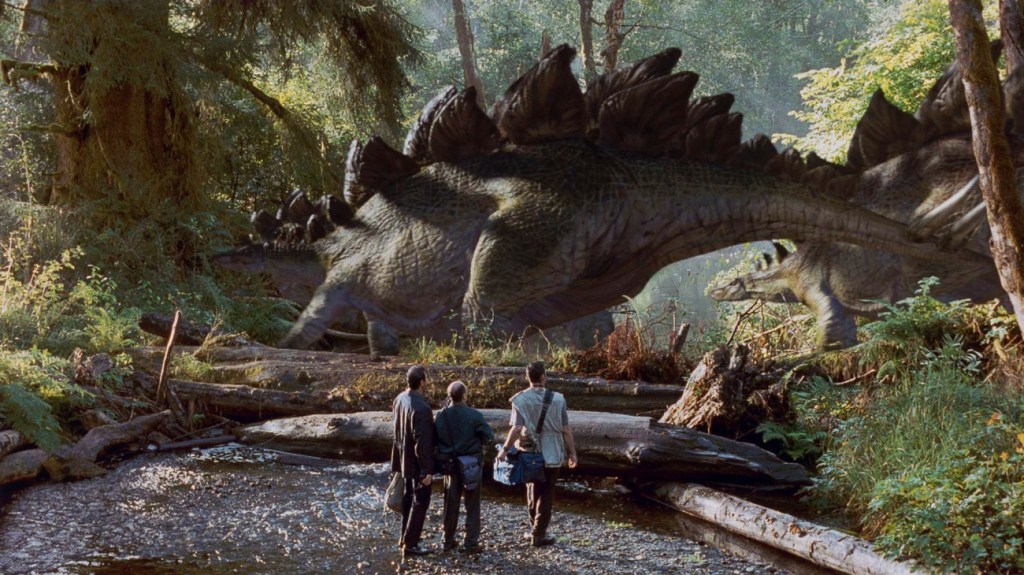
The Lost World barrels along leaving logic in its wake. Julianne Moore’s Sarah Harding is set-up as an expert on animal-survivalism, but in her first scene is nearly killed by that humble “children’s favourite dinosaur” the Stegosaurus, after startling their baby with her noisy camera (she learns nothing from this about the protectiveness dinosaurs have for their young). She presents a list of strict survival “rules”, all of which she promptly breaks, culminating in walking miles in a shirt soaked in T-Rex blood, after telling us their sense of smell is a superpower. Meanwhile Goldblum’s feelings towards Hammond veer between frustration and deep respect depending on the immediate requirements of the scene.
The film is in fact a parade of characters behaving stupidly and slightly miscast actors. –Moore’s chippy feistiness makes her seem reckless and out-of-her-depth rather than plucky and brave, Goldblum isn’t quite right as action hero (interestingly. I can’t really think of them playing as conventional action adventure roles as this again). As a result, its most compelling character is actually Pete Postlethwaite’s Allan Quartermain-throwback. Postlethwaite is by far the film’s most assured and authoritative performer, makes his character the film’s most professional and logical, and our heroes so frequently look frustratingly smug (and incompetent), that you end up seeing things more from his side. Postlethwaite is greatly missed when he departs the film abruptly before the final act.
That all sounds really harsh doesn’t it? The Lost World may well be very much second tier Spielberg, full of moments that don’t quite work, are very silly or feel half-baked. But despite that, it’s swift, pacey and generally entertaining even when it’s stupid. Because when Spielberg fills a bowl of popcorn, he generally knows just how much butter and salt to add in. It’s never going to be anyone favourite Jurassic Park film, but it’s still going to be good entertainment for a Saturday night.