Category: Literary adaptation

King Solomon’s Mines (1950)

King Solomon’s Mines (1950)

Travelogue journey through the jungle is the main appeal here, in an otherwise bog-standard adventure tale

Director: Compton Bennett, Andrew Marton

Cast: Deborah Kerr (Elizabeth Curtis), Stewart Granger (Allan Quatermain), Richard Carlson (John Goode), Hugo Haas (Van Brun), Lowell Gilmore (Eric Masters), Kimursi (Khiva), Siriaque (Umbopa), Sekaryongo (Gagool), Baziga (King Twala)

H Rider Haggard’s King Solomon’s Mines was one of the definitive ‘ripping yarns’, schoolboy tales of daring do in places far away from England’s cricket pavilions. This travelogue epic strips down Haggard’s story to a minimum, its main purpose being giving viewers over an hour of location footage from the African safari, all in glorious technicolour. It’s perhaps not a surprise that it was a massive box-office success, bit it is to think this very average adventure went up against All About Eve and Sunset Boulevard for Best Picture. Surely only its mega-bucks takings at the Box Office can explain that.

Allan Quatermain (Stewart Granger), the world’s most famous hunter, has made his life shepherding wealthy Europeans in front of exotic animals they can shoot. Tired of the life and sick of arrogant tourists, so he’s not interested in joining what he considers a damn-fool crusade – a trek through the jungle to find Henry Curtis, missing in search of the mythical treasure of King Solomon. Money talks however, if he can’t stand what he sees as the pampered arrogance of his new employer, Curtis’ wife Elizabeth (Deborah Kerr). She, in turn, is infuriated by his arrogance and rudeness. This odd couple trek off, accompanied by Elizabeth’s brother John Goode (Richard Carlson), Allan’s trusted bearer Khiva (Kimursi), picking up mysterious Umbopa (Siriaque) along the way.

King Solomon’s Mines already re-mixed the novel to introduce a (inevitable) female character: the novel has Henry Curtis searching for his brother. But you can’t have an adventure epic without a opposites-attract love story blooming, and it’s not the greatest surprise that’s what happens between Kerr and Granger’s. (Apparently, it also spilled over into real life as well). “You keep watching each other, what’s wrong” queries the clueless Goode halfway through as Kerr and Granger squabble, bicker and mentally undress each other for over an hour before a late-night clinch up a tree. That is, to be honest, kind of it in the film which otherwise is almost completely free of plot.

Instead it focuses overwhelmingly on the opening section of the novel, the actual journey to the mysterious mines. This swallows up over 70 of the film’s 108 minutes, showcasing the extensive location shooting across Uganda, Kenya and the Congo, with Richard Surtees’ (Oscar-winning) cinematography capturing a never-ending parade of animals, jungle foliage, crocodile-infested rivers, vast plains and a parade of indigenous tribes all happy to co-operate with the filming (as well as supplying much of the cast). So much footage was shot, that b-roll footage collected by Surtees found its way into dozens of MGM films for years-to-come.

And it was catnip for the punters, stunned by seeing the sights of the safari in glorious technicolour, soundtracked by brief bursts of tribal music (there is no orchestral score at all, rare for the time). King Solomon’s Mines feels like a National Geographic film with a plot very loosely attached. So gorgeous was the outside footage, the parts shot on studio sets do stick out (Hugo Haas, popping up as a rogue hunter with a villainous agenda, all too obviously never stepped foot out of California to shoot the film). The photography still looks impressive today, distressing as it is to find out an elephant gunned down in the opening (and mourned by his herd) was shot for real.

Did it matter that there is no real plot half the time? I guess not, when audiences are there for that photography. There is more than a whiff of colonialism about the whole thing, but Haggard’s attitudes were always more advanced than many give him credit for, carried across here. Like his novel version, Quartermain is respectful of (and genuinely likes) the indigenous people he encounters, learning their languages, forming friendships and mourning any deaths sincerely. Sure, he’s also an Edwardian paternalist, but it’s strikingly compared to the dripping contempt we see him treat most Westerners with. Granger plays him with a matinee-idol gruffness (Errol Flynn was the first choice).

Opposite him, Kerr has the typical ‘woman’s’ role in such stories. Although much is made of her toughening up on the journey – casting off her corsets, going by foot and taking a gun – she’s still required to regularly shriek and faint when danger calls. There’s a hilarious moment (even the original audiences laughed but it had to be kept in) when we cut from Kerr chopping off her flowing locks with a pair of scissors, to shampooing, to luxuriating in the sun with a hairstyle that looks like she’s spent hours in the make-up chair. Kerr could, of course, play these prim-and-proper types who really love the bad boy standing on her head, and the role is hardly a stretch.

The focus on the wildlife footage leaves almost no time for the actual plot of King Solomon’s Mines which is crammed into the film’s final half-an-hour, as mysterious bearer Umbopa (one of the novel’s main characters, here reduced to an almost wordless plot device) reveals himself as rightful king of the mountains and our heroes discover, enter, get trapped in and escape the mine (this takes about 6 minutes of screen time). Whether the actual plot was so heavily cut-back because the producers didn’t trust the Indigenous actors they cast to carry it or it was felt the 50s audience wouldn’t be interested in seeing an African story led by actual African characters is entirely up to speculation. Not a single African character in the film is really given an individual personality let alone a plot arc, a major disappointment considering the strikingly memorable, rich African characters (both heroic and villainous) in Haggard’s original story.

The film suddenly into a mad, often tough to follow for newbies, rush after an elongated trek through the jungles (Hugo Haas’ sudden Act Two appearance as a mid-trek baddie was introduced, solely to give us an antagonist of sorts on the journey). It proves that the main appeal was that safari trek photography (with an opposites-attract romance as a bonus). King Solomon’s Mines, truthfully, isn’t nothing special – everything it attempts to do would be done infinitely better a year later in The African Queen – and it remains a truly odd entry in the list of Best Picture nominees.

Captains Courageous (1937)

Captains Courageous (1937)

Well-made, coming-of-age story with two very fine leads and a heart-tugging ending

Director: Victor Fleming

Cast: Freddie Bartholomew (Harvey Cheyne), Spencer Tracy (Manuel Fidello), Lionel Barrymore (Captain Disko Troop), Melvyn Douglas (Frank Burton Cheyne), Charley Grapewin (Uncle Salters), Mickey Rooney (Dan Troop), John Carradine (‘Uncle Jack’), Oscar O’Shea (Captain Walt Cushman)

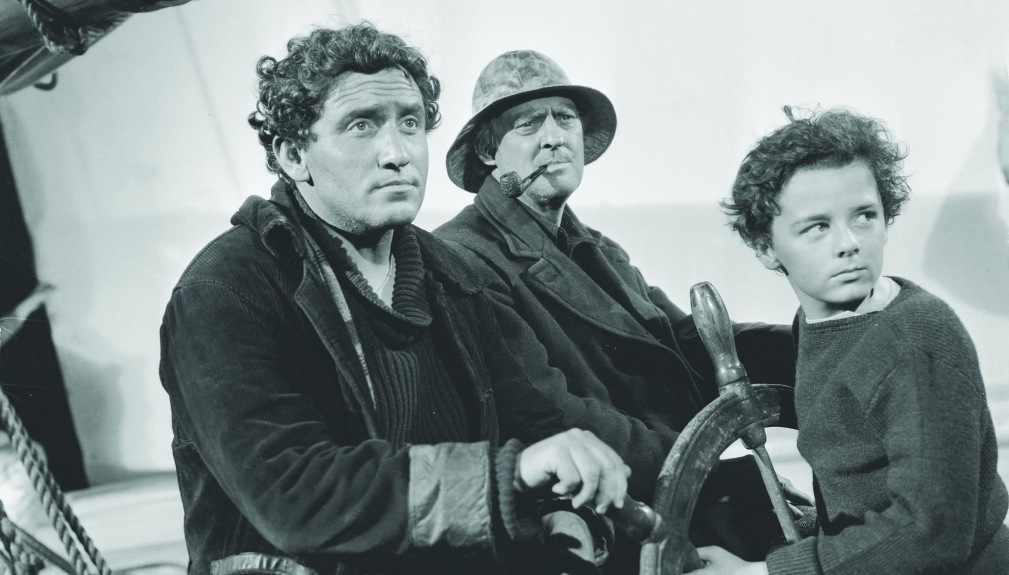
Harvey Cheyne (Freddie Bartholomew) is a hard kid to like. Scion of Henry Ford-like American tycoon Frank Burton Cheyne (Melvyn Douglas) he’s an arrogant, entitled snob who believes he is deserves anything he wants because Daddy has never-empty pockets. The servants in his father’s estate can’t stand him, his prep school classmates only pretend to like him and even his teachers think he needs to be taken down a peg or two. Suspended from school, his father (upset at what his son has become) hopes a trip to Europe will help Harvey grow-up. But, en route, Harvey is lost at sea and picked up by the fishing boat We’re Here. Despite his objections, they have no interest in cutting short fishing season by three months to take him straight back and slowly Harvey finds himself rather enjoying fishing life, helped by his growing bond with salt-of-the-Earth Portuguese fisherman Manuel (Spencer Tracy).

Adapted from a Rudyard Kipling novel – despite what you might think, Harvey and his father are also American in the original – Captains Courageous is a surprisingly sweet coming-of-age tale, mixed with a surrogate-father-son relationship, well-directed by Victor Fleming and strongly played by the cast. The cast spent months bobbing up-and-down in a giant water tank to bring the film to the screen, and it’s a tribute to Fleming’s direction and Harold Rossen’s sharp camerawork that it often genuinely feels like a film pulled in from the seas like Manuel’s fishes.

It also has some wonderful chemistry between its two leads. Freddie Bartholomew, one of the biggest (and most skilled) child stars of the 30s, had a hard task here: appearing in virtually every scene, he has to turn a character who most viewers would love to give a cuff around the ear too, into a kid we end up admiring. Captains Courageous doesn’t shirk at stressing Harvey’s arrogant, self-absorbed unpleasantness: he treats the servants like talking furniture, brags about his editorship of the school magazine (a position bought for him by his father’s purchasing of their printing press) which he feels with dull articles (essentially ‘what I did on my holidays’) and shamelessly uses his father’s money to bribe people (including his schoolmaster, who he loans $50 to then casually mentions it would be great if the history test could be made easier).

He is, in short, a total brat and that only starts to change on We’re Here. Bartholomew’s trick is to do just enough to suggest a decent kid buried under the surface here, even when he’s demanding the ship turn round to take him home or assuming his ship-mates will settle into playing servants for him. He and the film slowly reveal his childish enthusiasm waiting for an outlet. With a distant father, you get the feeling Harvey felt acting like the pampered, entitled wealthy man was the only way to impress him. Captains Courageous is rather endearing in showing how he flourishes when faced with pushback by someone (Manuel) who gives him genuine attention, teaches him things and won’t take his nonsense (in the way nearly every other employee in his life does).

Bartholomew’s thoughtfulness, vulnerability and eager-to-impress energy makes for a great combination with Spencer Tracy’s jovial warmth as Manuel. Tracy – who won an Oscar – was later rather self-critical of his curly-haired ‘liddle feesh’ accented-fisherman, generously claiming his success was partly due to Bartholomew. But Tracy’s work here is endearing, funny and unforced, making Manuel a mix of big brother and father, full of energy and joi d’vivre, with exactly the sort of easy-going happiness in small things (catching a big fish, playing music, even swabbing a deck) that Harvey never has. Tracy also brings out Manuel’s strong morals and his respect for others – it’s no surprise that he has no truck with Harvey’s cheating in a fishing competition.

In fact, Manuel’s response to this (deep disappointment, throwing the competition and firmly telling Harvey he’s no fisherman) is exactly the sort of firm-but-fair parenting, with a moral education, that Harvey needs. But Manuel is also a fierce defender of him when he admits his mistakes and also offers the sort of direct, in-person support and regard for Harvey that his own father failed to do. (There is a lovely reaction shot from Tracy – one of the best reactors in movies – of warm pride when Harvey admits blame). The two actors have a natural, easy bond which is genuinely endearing. Manuel even becomes as keen for the boy’s good opinion (bashfully clamming up when Harvey reacts with shock to his talk of ladies). Captains Courageous allows Tracy to be as playful, loose and fun as he ever has.

The staging and design of the fishing boat is marvellously done, the actors having clearly (and impressively) done their homework around the tying of knots, casting of lines and rowing of oars. Lionel Barrymore gives a fine salty sea-dog (with a hidden heart of gold) as the captain, with Mickey Rooney echoing him as his eager son and John Carradine scowling as Manuel’s rival fisherman. There is a genuine sense of energy and vibrancy in all the fishing and sailing scenes (despite some, at times, less than convincing back projection), with Captains Courageous more than holding its own with epics of the sea.

Of course, you are not perhaps surprised that the film is also heading towards a tragic end, as so many coming-of-age tales do. But it’s extremely well-done and, thanks to the playing of the cast carries real emotional impact, not least through Bartholomew’s and Tracy’s poignant performances. There is also a mature and tender coda to Captains Courageous about the nature (and difficulties) of fatherhood, adding further depth to a character study of a young boy that genuinely sees him grow and develop in a way that feels neither sickly sweet nor forced – and has a real warmth and joy to it. Full of impressive staging and with a wonderfully played relationship between Bartholomew and Tracy, it’s a fine, heart-warmer turned tear-jerker.

The Color Purple (1985)

The Color Purple (1985)

Spielberg’s film has many strengths but is a little too sentimental and can’t always grasp everyday horror

Director: Steven Spielberg

Cast: Whoopi Goldberg (Celie Harris-Johnson), Danny Glover (Albert Johnson), Adolph Caesar (Ol’ Mister Johnson), Margaret Avery (Shug Avery), Rae Dawn Chong (Mary ‘Squeak’ Agnes), Oprah Winfrey (Sofia), Akosua Busia (Nettie Harris), Willard Pugh (Harpo Johnson), Dana Ivey (Miss Millie), Desreta Jackson (Young Celie)

The Color Purple was Spielberg’s first foray into making ‘grown-up’ movies. He still seems like an odd choice for it today: author Alicia Walker was very hesitant, until ET proved to her Spielberg could make a film with empathy for a minority outsider. Producer and composer Quincy Jones actively courted Spielberg for the role – after all, this was a period where a mainstream film about the lives of Black people was rarely made without a white POV character (effectively, Spielberg filled that role instead). The Color Purple has several things about it that are hugely effective: but I found it much less moving than many others have. It feels like a film trying too hard, pushing its beats too firmly, sometimes timid and (interestingly) struggling to grasp the horror of relentless, everyday cruelty with the same understanding it gives explosive, violence.

Adapted from Walker’s Pulitzer-prize winning novel, it follows the life of Celie (Whoopi Goldberg) in the opening decades of the twentieth century. The victim of sexual abuse from her father (with whom she has two children, taken from her at birth) she is effectively sold to Mister Johnson (Danny Glover), a terminally inadequate man who violently takes out his frustrations on her. Forcibly separated from her beloved sister Nettie (Akosua Busia), Celie waits for years until she finds closeness with her husband’s lover, singer Shug Avery (Margaret Avery). Meanwhile, her adopted wider family encounter tragedy of their own, not least Sofia (Oprah Winfrey) the strong-willed wife of Johnson’s son Harpo (Willard Pugh) who unjustly finds herself persecuted by the law.

You can’t doubt the passion that’s gone into making The Color Purple. There is much to admire in it, not least the richness of its photography. Several sequences are profoundly affecting. The film constantly places Celie in a vulnerable position – the film’s opening constantly frames Celie and her husband together to stress his height and strength and to accentuate her vulnerability. This slowly inverts in the film as Celie starts to find a strength of character and independence. But the heightened trauma of her forced separation from her sister and the violence her husband is capable of is hard-to-watch.

It also works thanks to a subtle, low-key and tender performance from Whoopi Goldberg as Celie. With impressive restraint, Goldberg creates a woman beaten down by relentless misery who, for years, not only accepts domestic violence as something she deserves but as a regular part of the world (she even advises Harpo that he should exert control over Sofie with his fists). It’s genuinely affecting when, after over an hour, Goldberg finally smiles and begins to flourish as someone takes notice of her for who she is in her friendship with Shug. When years of pent-up fear and anger finally burst out of Celie, Goldberg really sells this cathartic moment that hits home all the more because of her quiet reserve of her performance.

In fact, the film is awash with fine performances. Danny Glover is very good as the weak-willed Mister Johnson, exerting the only power he has (domestic) with brutal force but treating others around him either with love-struck awe (Shug) or deferential fear (his father). Oprah Winfrey is excellent as a strong-willed, independent woman whose force-of-nature personality protects her at home but condemns her in a wider world that still revolves around racism. Margaret Avery carefully develops a woman who at first feels arrogant and self-absorbed into one revealed to be full of humanity (indeed it’s hard to understand what she ever saw in the pathetic Johnson). Adolph Caesar suggests sadism behind every sneer and muttered line as Mister Johnson’s appalling father.

These performances elevate a film that gets a lot right. The Color Purple understands how ashamed the abused can feel: from the guilt Celie feels at her father’s sexual abuse to the cowed, hollow person who feels she is ugly and worthless after years of oppression. It successfully displays a world where women are commodities, bought and sold by fathers and husbands with no say in their own lives. In this male-dominated world, Mr Johnson effectively rules his household like a plantation, treating his wife and children as he pleases. The camera doesn’t flinch when punches lash out.

But The Color Purple is also a sentimental film. Quincy Jones’ overly-empathetic score rings out over every scene, constantly telegraphic what we are meant to be feeling, choking the action. Some moments of humour land: a running-joke about the hapless Harpo falling through the roofs he tries to repair or Mr Johnson’s failed attempt to cook breakfast for Shug (and her furious rejection of this burnt slop) is refreshing. But the faint comic air given to Sofie’s post-jail employer Miss Milley, most crucially at her panic at the prospect of driving herself home alone leading her to insist Sofie breaks off re-uniting with her children after years of separation to take her home, works less well.

What’s fascinating about The Color Purple is that Spielberg, too me, can’t quite fully grasp casual everyday cruelty. Those petty acts of selfish cruelty, and the constant, demeaning talking-down and psychological cruelty of belittling people everyday. There is something about this relentless, unseen, low-key, damaging abuse that’s a little outside his world view. He understands the drama of slaps, punches and rapes but the everyday grind of an abusive partner effectively telling you every day you’re stupid and worthless is something the film can’t grasp (interestingly, the closest it can get to it is in trauma Johnson’s father has given his son). Tiny, reflexive, almost casual acts of cruelty and power play don’t quite land (in many ways, Johnson sleeping through his son’s wedding, is an act of cruel dominance not a gag) in the ways the violence does.

There has been criticism that a Black director should have taken on the project (and that’s fair) but really, I feel what this needs is a female director. Someone who could appreciate, in a way I don’t feel Spielberg quite can, the powerlessness of being a real outsider in a male-controlled world, constantly in danger. Because, in many ways, that constant disparagement is what has crushed Celine, even more than her husband’s fists. Instead the film is more comfortable with highlight moments of oppression, rather than continual misery. It can ‘t deliver on the grim grind of many years, it prefers the key moments that have immediate impact but lack the mortar binding them together.

It’s not the only part of the film where Spielberg blinks. The novel’s sexuality is stripped out, the romantic relationship between Shug and Celine almost completely ejected (you can feel the film’s discomfort whenever sex rears its head – Spielberg has never filmed sex with anything other than awkward embarrassment). It’s a loss of nerve Spielberg has acknowledged, in a film which leans hard into a sentimental and ‘all problems solved’ ending (that even gives a level of redemption to Mr Johnson that the novel avoided).

That’s the flaw with The Color Purple. There is something too well-planned and careful about it, a film building towards key points but which does that at the cost of a lot of the truth that underpins its characters. In the end it offers easier, more digestible versions of every theme it covers. It’s acting and filming is frequently first-class, but as a result I found it far less moving than I feel it should be.

Frankenstein (2025)

Frankenstein (2025)

Del Toro’s dream project makes it to the screen in a lavish gothic spectacular

Director: Guillermo del Toro

Cast: Oscar Isaac (Baron Victor Frankenstein), Jacob Elordi (The Creature), Mia Goth (Elizabeth Harlander), Felix Kammerer (William Frankenstein), Lars Mikkelsen (Captain Anderson), Christoph Waltz (Henrich Harlander), David Bradley (Blind Man), Charles Dance (Baron Leopold Frankenstein), Ralph Ineson (Professor Krempe)

When he was a kid del Toro fell in love with James Whale’s Frankenstein. It was his dream project to create his own version of Mary Shelley’s classic. Year of dreaming pay off in this visually gorgeous, and emotionally engaging film – even if it’s also a little overlong and overindulgent. Del Toro throws everything into Frankenstein, creating a grand Gothic epic whose sympathies firmly lie with the abused Creature.

You must be familiar with the plot: in eighteenth century Germany, Frankenstein (Oscar Isaac), driven by never-really-resolved anger over his mother’s death, dreams of conquering death. With the funding of arms dealer Harlander (Christoph Waltz), who is also uncle to the woman he loves: Elizabeth (Mia Goth) who happens to be fiancée to his younger brother William (Felix Kammerer). On a stormy night, he gives life to the Creature (Jacob Elordi) but quickly rejects him. The Creature tries to find a place in the world, only to discover the world is full of prejudice and violence towards him and the Creature’s resentment against his thoughtless creator grows.

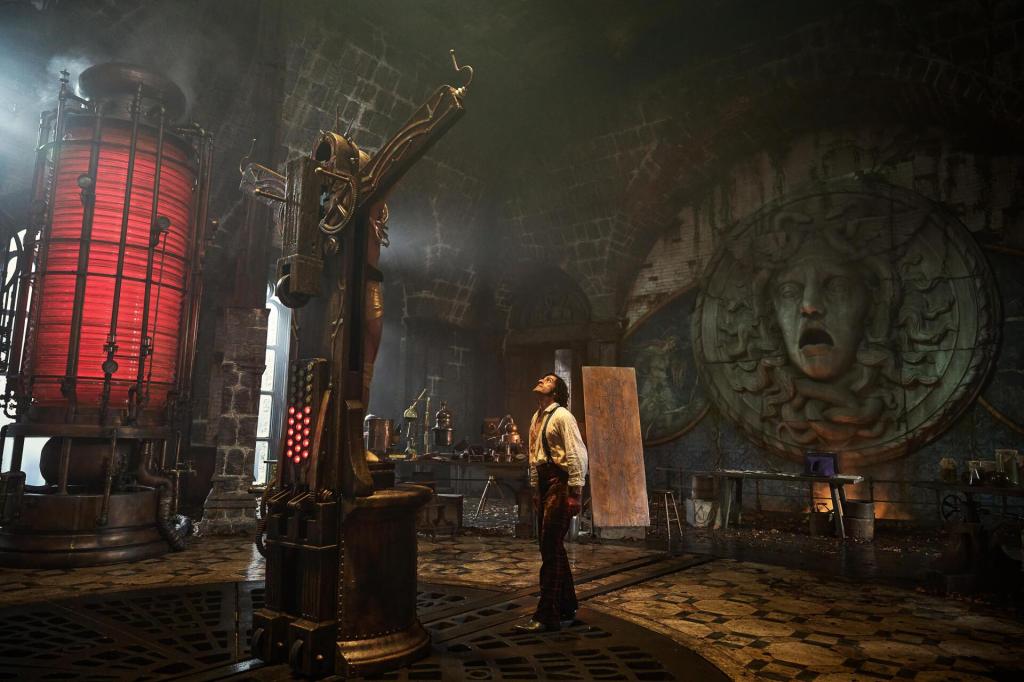
Del Toro’s film looks absolutely stunning, a sumptuously designed Gothic melodrama with extraordinary sets, grand costumes and beautiful cinematography (the Polar-set framing device is particularly striking, covered in lusciously contrasting blues and greens). There are striking echoes of the visual intensity of Pan’s Labyrinth, with Frankenstein’s lab turned into a mix of laboratory and classic temple, including a giant Medusa sculpture. The birthing sequence is a grandiose, operatically Gothic thing of beauty, a version of Whale’s film dialled gloriously up to eleven.

Del Toro’s film goes back to the novel in some ways (in themes and its Polar framing device), but in many ways it’s more of a complex, emotional reimagining of Whale’s film. Isaac’s Frankenstein, an egotist in need of an audience feels very similar to Colin Clive. Whale’s key motif, the Creature’s romantic yearning for the sun, becomes thematically central here. As there, Frankenstein conducts his experiments in a colossal Gothic tower, keeps the Creature chained and makes vague attempts to rear it and takes no responsibility for his actions or the deaths connected to it (in fact Isaacs’s Frankenstein lies and lies in a weasily attempt to protect his reputation). Waltz’s arms dealer funder of Frankenstein’s insanity feels like a version of Pretorious from Bride of Frankenstein, while del Toro goes even further than that film in deepening the bond between the Creature and the Blind Man.

Del Toro also doubles down on Whale’s implicit sympathy for the Creature. Here re-imagined as possessing near super-human strength and durability (his violent responses to being attacked being partially a result of his own strength being uncontrollably great), his child-like vulnerability is as dialled up as his actual physical invulnerability. The Creature feels, first and foremost, like a thought experiment by Frankenstein – and the fact this experiment has effectively rendered the Creature immortal and capable of a Wolverine-like cellular regeneration, condemned to walk the Earth forever alone only heightens the creator’s myopic selfishness.

One of del Toro’s key themes is terrible parenting. Much as he loathed his domineering, brutal father (Charles Dance, in a role perfectly crafted for his austere distance) who caned his face (his hands are too precious) when he flunked remembering anatomy facts, Frankenstein ends up echoing his father’s approach. When the creature constantly fails to say anything other than ‘Victor’, he too reaches for a cane to beat learning into him. Like his father, he resents the creature for being a bad reflection on him. He is, effectively, a dead-beat Dad, casually fathering a child which he has no idea how to treat, who falls back on cruelty.

There can be few Frankenstein’s on film less sympathetic than the version played here by an impressively egotistical Oscar Isaac. He’s full of preening self-importance and self-justification, obsessed with his task but giving no thought to its consequences. Twice he reanimates corpses then callously switches them off without a second thought. Giving birth to Frankenstein – just like in Whale’s film – after an initial interest (that is really self-congratulatory pride) his reaction is to chain him up in the basement and lose patience at him. With his constant milk-drinking there is a sense he’s a little boy who never grew up, and to him love is founded on possession: first of his mother, then his brother, then Elizabeth, all of whom at various points he wants to keep to himself – while his anger at the Creature is rooted in his failing to meet Victor’s expectations.

Frankenstein is at heart an angry mother’s boy, resenting his father for ‘taking’ his mother away from him (del Toro even has him wrapped in his mother’s distinctive red when he wakes to discover the Creature lives). There is more than an echo in that in his love for Elizabeth, the fiancée of his younger brother (who he also subconsciously resents for both ‘killing’ his mother in childbirth and for having the sort of relationship with his father Victor never had). These Freudian feelings are subtly enforced by Mia Goth playing both roles (it’s so subtly done I missed it first time round). Victor’s love for Elizabeth is just as possessive and selfish as that for his mother – and in the same ways his contempt for the Creature is for ‘failing’ him.

By contrast with this monster, the Creature is presented overwhelmingly sympathetically. Played with an outstanding physical and emotional commitment by Jacobi Elordi, he’s framed as a child stumbling towards a painful adolescence. Freshly born, he waddles like a toddler, stares in fascination at leaves floating on a stream and painfully forms the word ‘Victor’. Of course, it never occurs to his creator that this is the equivalent of “mama”. Only Elizabeth, who feels an immediate affinity with the sensitive soul, understands this. Only she tries to speak to him – or asks what his name is.

The poor Creature escapes into a world he quickly full of senseless, prejudiced violence. He bonds with a stag – only for the creature to be shot in front of him by hunters (who instantly turn their guns onto him). In conversation, Elordi presents a man who is sensitive, kind and gentle but capable of anger and fury. Del Toro crafts a tender relationship between the Creature and David Bradley’s Blind Man (the only person, other than Elizabeth, to look past his appearance). The film’s second act, focusing on the Creature’s emotionally painful interaction with the world is its strongest – not least because you feel throughout del Toro’s deep bond with him.

After all this, it’s surprising that Frankenstein ends on a note of hope. Del Toro’s film isn’t always quite nimble enough for this: some of its more optimistic moments can feel as if they have emerged a little thin air (or from the optimistic wishes of the director). In particular, Elizabeth’s bond with the Creature feels so swiftly sketched out it failed to completely convince (more time on this and less time on Waltz’ creepy arms dealer would have been welcome). But this feels like a passionate, committed and perhaps above all beautiful to-look-at piece of work with a real emotional heart. This easily lifts it into the upper echelons of Frankenstein adaptations.

Arrowsmith (1931)

Arrowsmith (1931)

An uninspired prestige drama suddenly turns at the end into an intriguingly subversive drama

Director: John Ford

Cast: Ronald Colman (Dr Martin Arrowsmith), Helen Hayes (Leora Arrowsmith), Richard Bennett (Gustav Sondelius), A.E. Anson (Professor Max Gottlieb), Clarence Brooks (Dr Oliver Marchand), Alec B Francis (Twyford), Claude King (Dr Tubbs), Bert Roach (Bert Tozer), Myrna Loy (Mrs Joyce Lanyon), Russell Hopton (Terry Wickett), Lumsden Hare (Sir Robert Fairland)

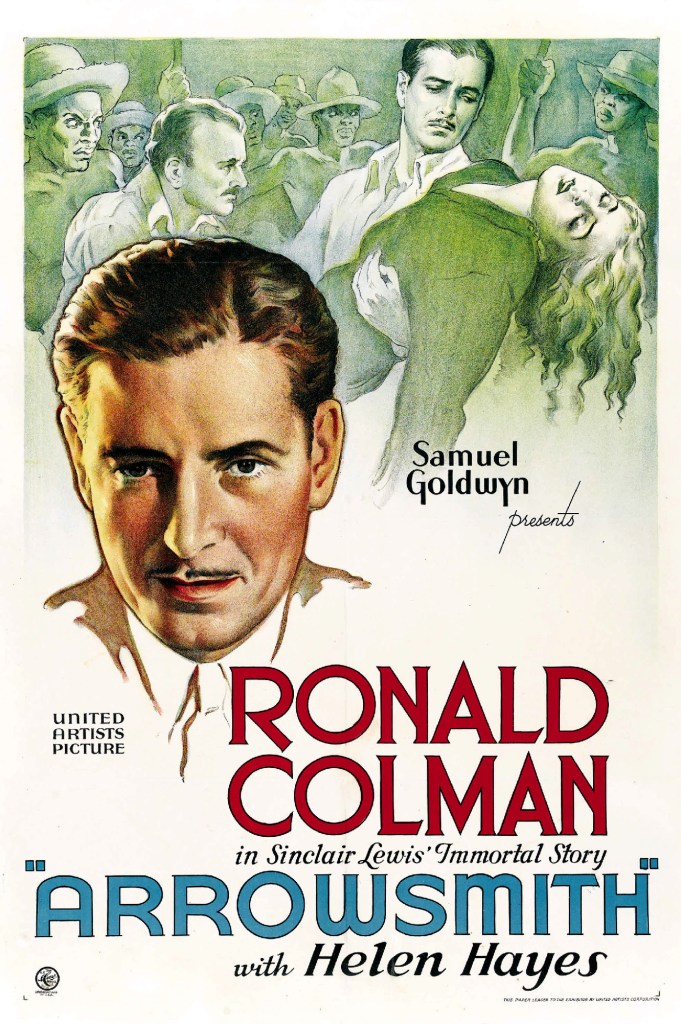
A neat trivia question: what was the first John Ford film nominated for Best Picture? Not many people remember Arrowsmith today – although, since Ford was ordered by producer Samuel Goldwyn to not touch a drop of the sauce while making it, we can be pretty sure he did. Adapted from a hulking Pulitzer-prize winning novel by Sinclair Lewis, it was the epitome of prestige Hollywood filmmaking. It’s a far from a perfect film, but it contains flashes of real beauty and genius – and presents one of the most surprising, subversive visions of infidelity you’ll see in 30’s Hollywood.

Martin Arrowsmith (Ronald Colman) is desperate to be a high-flyer. A scientist and doctor, he’s wants to make his mark – and his mentors such as noted bacteriologist Professor Gottlieb (A.E. Anson) and Swedish scientist Gustav Sondelius (Richard Bennett) think he can. But Arrowsmith postpones his dreams for a spontaneous marriage to Leora (Helen Hayes), before re-embracing science. When plague breaks out in the West Indies, the Arrowsmiths travel there, ordered to test a possible cure on the natives: half will receive the cure, the other a placebo. But temptation and tragedy will be Arrowsmith’s constant companion there.

Arrowsmith is very much a film of two halves (or, in terms of its run-time, two-thirds, one-third). To be honest, much of its first hour is frequently rushed, ponderous and dull, flatly filmed with the air of uninspiring prestige production. Watching it play, it’s hard to connect a film as flat, perfunctory and serviceable as this with Ford’s energy and flair. It’s not helped by the accelerated storytelling. Stuffing in as much of Lewis’s door-stop best-seller as it can (the first fifteen minutes cover as many events as whole movies often content themselves with), the plot barrels along so fast it can leave your head spinning. Scenes either feel like sketches from a larger whole or like narrative cul-de-sacs included to tick a box from the novel.

Arrowsmith feels like a compromised film. I suspect Goldwyn’s aim was to cover the book. But I feel Ford’s interest – if he had one in the film’s opening hour – was the Arrowsmith marriage. On the surface this is your standard loving-husband-supportive-wife pairing. But, underneath, there is a lot more going on here. Everything about their courtship and registry office marriage feels perfunctory. Arrowsmith treats his wife with a fondness that never tips into passion. When she suffers a miscarriage (which prevents her having children), he is sad but moves on remarkably quickly. At one point, Leona discusses the idea of leaving her preoccupied, distant husband who disappears for days on end (you feel she’s only half joking). Arrowsmith calls her ‘old girl’, which feels rather complacent and smug.

You suspect Ford might be hinting that, frankly, Arrowsmith is a self-important shit with grandiose ideas. It’s an idea the film can’t quite push – Ronald Colman’s undoubted charm smooths off Arrowsmith’s rough edges, even while he makes him self-righteous and pompous. But as Leona (Hayes is excellent in subtly suggesting this woman is much more lonely than she admits) watches her house jerry-rigged into a Frankenstein-laboratory (his atrociously poor safety measures will come back to haunt him later) or is left for days alone at home, it’s hard not to feel this is a more complex, strained relationship than the film can openly say.

These half-stated implications lead us into the film’s final act in the West Indies, which almost redeems the slightly confused mish-mash it proceeds. From the opening shot of this sequence – focused on Clarence Brooks’ doctor (notable for treating a Black character as an assured professional) with his patients sitting on a balcony, excluded from the conversation about their health going on down below – it’s impossible not to see Ford’s sympathy more openly lying with the West Indian villagers, whose health is of little interest to the white population and who even our nominal hero (reluctantly) uses as guinea pigs for his cure. This powers us through a half-hour sequence that is by far-and-away the most focused and interesting of the entire film.

This tragedy-laden sequence not only buzzes with an indignation of the unfairness of this system – in which our hero is a semi-reluctant participant – but unleashes the most beautiful, shadow-filled, expressionistic lighting in the film. Ford signposts moments of high emotion by casting people’s bodies in shadow. This mesmerising effect is used brilliantly, combined with shots deliberately echoing each other (most strikingly two contrasting shots of the Arrowsmith home, both framed at low angles with foreground chairs – the second laced with tragedy). Visual imagery reflects, not least the cutting between two cigarettes smoked by the Arrowsmith’s. There is a host of heart-rendering, inventive ideas in visual storytelling: at one point, Arrowsmith’s phone call with a sweating colleague goes dead – we cut to see a shot of the empty phone on the other end bathed in shadow, enough to tell us his interlocutor has literally died mid-call.

This shadow-filled sequence also powers the film’s most subtle moment: possibly the most under-the-wire depiction of infidelity seen in the movies. The original novel made clear Arrowsmith was serially unfaithful. Here, he meets Myrna Loy’s wealthy heiress, to whom he admits an immediate kinship. At night, wordlessly, Ford cuts back and forth between Loy preparing for bed and Colman sitting (bathed in shadow) smoking and possibly waiting. Wordlessly the cuts go back and forth – and then fades to black as we see a shadow approach the door of Colman’s bedroom. You can miss it entirely: but its clear they sleep together. (A late scene with Colman and Loy, with a lingering handhold, feels like proof positive). A late scene of Colman filled with manic energy, in this context feels powered more by guilt and shame.

It’s subtle because we know that in scenes of open emotion and dramatic import we’ve seen faces thrown into shadow. When its repeated here, in an otherwise inconsequential scene, we’re having visually communicated to us something the film can’t openly tell us: Arrowsmith is cheating on his wife. It’s the highlight of a compelling final act, full of drama, tragedy and beautiful filmmaking. When the film leaves the West Indies for its lab-set coda, it returns to flat film-making and sudden, jarring plot developments. But for this half-hour section, it’s a fascinating, oblique, challenging and rewarding film: one of the best short films buried in a large one you’ll see. Arrowsmith may not be a classic, but’s it’s a fascinating film.

Of Mice and Men (1939)

Of Mice and Men (1939)

Well-made version of a story that has since become almost excessively familiar

Director: Lewis Milestone

Cast: Burgess Meredith (George), Lon Chaney Jnr (Lennie), Betty Field (Mae), Charles Bickford (Slim), Roman Bohnen (Candy), Bob Steele (Curley), Noah Beery Jnr (Whit), Oscar O’Shea (Jackson), Granville Bates (Carlson), Leigh Whipper (Crooks), Helen Lynd (Susie)

I suspect John Steinbecks’s powerful parable has been rather defanged for many people, after extensive over-exposure in schools across the world. Who hasn’t spent hours in an English class pouring over the struggles and dreams of permanently unlucky Depression-era drifters, scrawny George and muscular-but-childlike Lenny? It’s hard to not feel Of Mice and Men is very familiar the second the credits roll on Milestone’s film – or fail to notice some of its on-the-nose musings (sometimes the kindest thing you can do is kill a frightened, vulnerable dog, rather than let it suffer – I wonder what development plot is being alluded too here…) and while familiarity has stripped Of Mice and Men of some of its power, this is an effective, well-made, version.

George (Burgess Meredith) is the brains of a partnership with childlike muscle man Lenny (Lon Chaney Jnr) as they drift from job-to-job out West, constantly hired on the back of Lenny’s muscle, then escaping from the troubles his lack of understanding of the world causes, through George’s survivalist cunning. They dream of having their own place – and they get a shot at it when aged, one-handed farmhand Candy (Roman Bohnen) offers to chuck his accident-payout dollars into their pot. But Lenny’s inability to cope with the world keeps leading to danger: from his accidental rousing of the ire of small-of-statue rancher’s son Curley (Bob Steele) to his fascination with Curley’s pretty wife Mae (Betty Field). Some dreams are doomed.

Of Mice and Men stays very faithful to Steinbeck, playing out this smalltown tragedy under the low-key, persuasive eye of Milestone who avoids either overplaying the tear-jerking or smothering the story with flashy film-making (there is one dramatic pull-back after disaster strikes, and George flees a barn, the camera heading into a sudden wide-angle, but other than that this is restrained film-making). Instead, the focus is very much placed on the relationship between two very different men who, without even quite understanding it, are mutually dependent halves of a whole.

At first it seems George and Lenny are effectively in a marriage of convenience. The wirey George would struggle to be hired without the loaded-cart lifting Lenny as a sweetener, while Lenny can barely tie his own shoelaces without George’s guidance. Meredith’s snipy, wheedling George feels at first like he can only just master his frustration with Chaney Jnr’s lumberingly sweet Lenny. But Meredith gives full life to a character who, we slowly realise, has a brotherly protective regard for Lenny – and needs the purpose Lenny gives his life, just as much as they both need the reassurance of George’s constantly spun story of their dream farm. This mantra – with Lenny echoing lines like a child’s bedtime story – of the buildings and animals they’ll care for is delivered by Meredith with a careful repetition that constantly flowers into earnest true-belief. We realise George is as much a lost soul as Lenny, adrift and barely able to cope with the world.

Because Depression-era America is a place where dreams go to die. Curley, clutching a few hundred dollars hush money after a farming accident cost him his hand, knows his life is just a countdown until he is kicked off the farm for being unable to work. He’s facing a future not too dissimilar from his euthanised dog, eyed up by the other men as a feeble old-timer who’d be better off snuffing it. No wonder both he and the simple Lenny, living on the bottom rung of life’s ladder, find a companionship with segregated Black farmhand Crooks (a very sensitive performance from Leigh Whipper, a character treated respectfully by Milestone’s film).

George’s natural alliance is with these little guys. Meredith’s George is naïve in his own way, slightly off-the-pace in social situations, tolerated by others, a deep vein of anxiety and worry just under his skin that he is all-too-happy to repress while he focuses on being father-figure and big-brother to Lenny. Meredith makes him chippy but not quite as worldly as he thinks, shrewd but vulnerable and, for all his carefully performance self-confidence, insecure and intimidated by events. He’s a passenger in life who likes to kid himself he’s a driver.

Authority lies elsewhere. Curley, played with a little-man anger and stunted swagger by Bob Steele, makes up for his own (many) insecurities – about everything from his height to what his flirtatious wife gets up to – by treating everyone below him in the farm’s pecking order with contempt. Curley needs to proof his masculinity by beating Lenny – who has all the physical gifts he longs for but none of the gumption to use them. He can only dream of having the relaxed, natural authority of Charles Bickford’s Slim, a man completely confident about himself and his standing in life – this easy assurance stands out in a film full of the jittery, frightened and insecure.

Of Mice and Men’s weakness, as with the book (as even Steinbeck later acknowledged) is Curley’s wife. Betty – played with a shrill energy by Betty Field in a performance she’s not quite strong enough to pull off – is only faintly crafted into a vaguely three-dimensional figure from the sexually charged, selfish flirt she is in the book. Here she has moments of self-reflection – and Milestone’s film briefly explores the isolation of this girl who dreamed of Hollywood but ended up married to an inadequate, angry man on a crappy farm – but remains, at heart, a brassy, selfish woman who precipitates disaster through her actions. It’s a singular lack of empathy in a film that prides itself on its humanitarianism.

Disaster is the inevitable outcome of a Steinbeck Depression-era drama. Milestone’s film finds quiet emotional power – aided a great deal by both Meredith and Chaney Jnr effectively under-playing – in the film’s final moments. You can imagine if this was your first exposure to a very familiar story, being impressed by the effectiveness of so much here. This is particularly so in the film’s powerful ending, directed with admirable restraint and played with a highly effective (and underplayed) emotion by Meredith. If other parts of the film are more well-assembled than really inspired, delivering Steinbeck pretty much as it is on the tin, that still makes for a fine version of a now familiar tale.

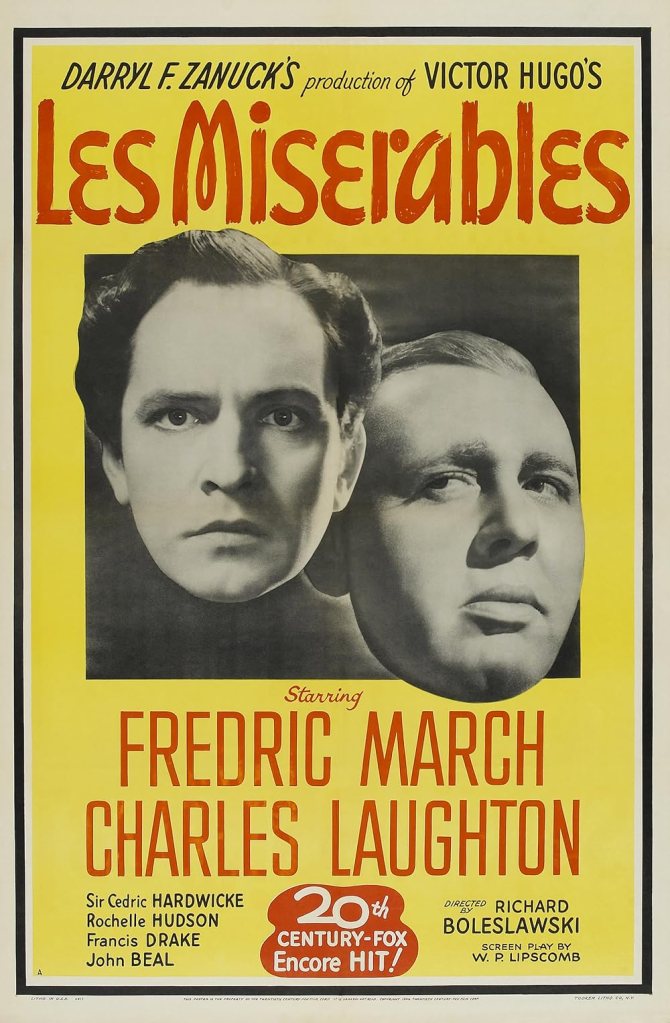
Les Misérables (1935)

Les Misérables (1935)

Odd choices are made in this Hugo adaptation, despite good photography and performances

Director: Richard Boleslawski

Cast: Fredric March (Jean Valjean), Charles Laughton (Inspector Javert), Cedric Hardwicke (Bishop Myriel), Rochelle Hudson (Cosette), Marilyn Knowlden (Young Cosette), Florence Eldridge (Fantine), John Beal (Marius), Frances Drake (Éponine), John Carradine (Enjolras)

There isn’t a more famous loaf of bread in literature, than that stolen by Jean Valjean to feed his starving family. There’s something quite sweet about the fact that Richard Boleslawski’s film of Hugo’s doorstop gives that loaf its moment in the sun, as its half-eaten remains are produced as evidence in Valjean’s trial. It’s an unintentionally funny moment, but feels right in a sometimes blunt film, that at times makes odd decisions for those of us so familiar now with the plot’s ins-and-outs and the moral up-righteousness of its lead character after forty years of the musical. Boleslawski’s version is an odd mix, part psychological drama, part atmospheric thriller, part thuddingly obvious soap where a loaf of bread needs to be literally seen. Parts of it work extremely well, other parts weigh the film down like the chains on its galley slaves.

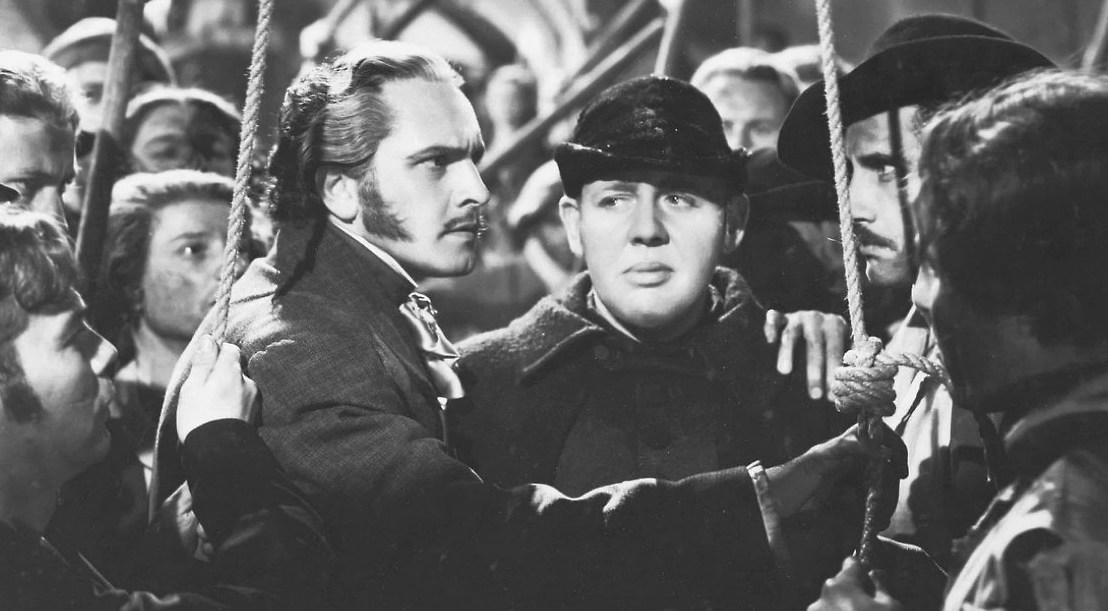
The film is overwhelmingly focused on the clash between Valjean (Fredric March) and Javert (Charles Laughton). One a good man who wrestles with temptation, but follows the sprit of justice. The other a rigid fanatic, who sees the letter of the law as gospel and the rights and wrongs of a situation an irrelevance. First meeting when Valjean serves a decade as a slave at the oars in the galleys, their paths recross after a released Valjean has a road-to-Damascus moment after the intervention of a noble priest (Cedric Hardwicke). Reinventing himself as ‘Monsieur Madeleine”, he becomes mayor of a small town and protector of Fantine (Florence Eldredge) and her daughter Cosette (Rochelle Hudson). But he cannot escape the pursuit of Javert which carries him into hiding for years in Paris, where a now grown-up Cosette falls in love with reforming student Marius (John Beal), leaving Valjean with one last dangerous choice.

Les Misérables restructures the novel into three acts, each presenting Valjean with a moral quandary. As such, Fredric March’s impressive performance must be unique among Valjean’s: this version is forever tempted with greed, anger and his own desires, constantly struggling to overcome his baser feelings. March is very good at bringing to life this conflict, just as he sells the sense of awakening purpose Valjean feels washing over him after the Bishop’s intervention prevents him from being returned to prison. It’s a muscular, agonised performance of a man constantly striving, even in the face of his resentment, to live up to his adopted moral principles. So, much as Valjean would like to let another man be accidentally condemned for his crimes, or to keep Cosette to himself or pull a trigger on Javert (March’s skilfully communicating the deep internal conflict each time) he’ll still (however reluctantly) find himself doing the right thing.

He contrasts excellently, with Laughton’s rigid, well-spoken, self-loathing Javert who has absorbed his moral code so completely, its left no room for any other form of principle or emotional judgement. Introduced, lips quivering, as he explains being denied promotion due to his convict father, Laughton’s Javert has channelled that resentment to worshipping the penal code as God. As he repeats, several times, good or bad is irrelevant, it’s just about the law. Of course, Laughton’s performance bubbles with repressed frustration, his pursuit of Valjean clearly motivated by far more personal feelings of anger and envy than he is willing to admit. Valjean is a spoke in his wheel of justice, a factor that makes no sense to him.

Boleslawski’s film is at its best when these two face off. It’s also at its most stylistic for these sequences. Les Misérables is awash with Gregg Toland’s atmospheric, mist-filled photography and expertly uses his expressionistic shadows. It’s depiction of a Parisian uprising, just like it’s introduction of a fast-paced horse chase between Valjean and Javert, are snappily edited and throw in a parade of dynamic Dutch and high angles. At the end of each act, Christian imagery is well used (in two cases, shrines to Mary and Jesus) to add emotional heft. A pursuit through grime and mist-filled sewers near the film’s close has a Fritz Lang atmospheric strength (did Carol Reed watch this before The Third Man?) as well as the film’s most effective use of music to build atmosphere as Valjean desperately submerges himself and Marius to hide.

There is effective stuff in Les Misérables. So, you try your best to forgive the fact it’s full of extremely on-the-nose, obvious touches. The introduction of the bread at the trial is not an end of its obviousness: for starters, the galley’s were prison hulks, not actual ships rowed around by convicts (where do they imagine these enormous hulks are going?). Truncating so much of the book down – and focusing overwhelmingly on its two leads – means many other parts of the story are short-changed or make little impact or sense (the hilariously watered down Parisian revolutionaries don’t turn up until the final 40 minutes). Florence Eldridge’s Fantine (all references to her prostitution are of course cut) does almost nothing but die – although not before the film gives her a (unique) ludicrously sentimental reunion scene with her daughter (played by a highly irritating precocious film-school brat before she grows up into Rochelle Hudson). Clearly the actual tragedy here (a mother never sees her daughter again) was considered too much.

Then there are the strange mis-readings and mis-interpretations. I can understand why Marius and his law students are re-imagined, by conservative Hollywood, into legal reformers rather than idealisitic revolutionaries (Marius even denounces the very idea of overthrowing the government as terrible). Here they want only penal reform – although of course, while ensuring the guilty are harshly punished – and chat like champagne socialists. It’s a bit of a mystery why this call for slow-paced, moderate social reform erupts into throwing up barricades, but clearly audiences at the time couldn’t be expected to get on board with anti-Monarchist cells. They’d probably agree with Eponine (interpreted here as a sort of femme fatale and Marius’ secretary) that it’s all a silly, slightly disreputable, waste of time.

However, even more strange, is the inexplicable interpretation of Valjean’s desire to keep Cosette to himself not due to being a protective father-figure investing everything in his life into his daughter, but instead an unpleasant sexual desire to make Cosette his wife. Even leaving aside this utter perversion of the novel, since we’ve seen Valjean raise her from the age of about 6 it’s hard not to feel a bit of bile forming in your throat at the stench of grooming this gives the relationship. It’s almost as if Hollywood could only imagine a man going to great lengths to protect a woman if he wanted to eventually get in her pants.

It’s odd reinventions like this that don’t quite work even within the world presented by the adaptation, let alone compared to the original source, that weighs the film down too much. They are blotches in the streamlining of a huge novel. But when the film focuses on an increasingly personal clash between two men, both well played by March and Fredric, and its atmospheric visuals, it works much better.

Dodsworth (1936)

Dodsworth (1936)

A marriage disintegrates in this richly mature, non-judgemental film one of the best of the decade

Director: William Wyler

Cast: Walter Huston (Sam Dodsworth), Ruth Chatterton (Fran Dodsworth), Paul Lukas (Arnold Iselin), Mary Astor (Edith Cortright), David Niven (Captain Lockert), Gregory Gaye (Kurt von Obersdorf), Maria Ouspenskaya (Baroness von Oversdorf), Odette Myrtil (Renée de Penable), Spring Byrington (Matey Pearson), Harlan Briggs (Tubby Pearson), Kathryn Marlowe (Emily), John Payne (Harry)

Marriage is tricky. In the hustle and bustle of everyday life, bringing up a family, running a business and rushing between social events, what if you don’t notice you don’t have much left in common? That’s the theme of Dodsworth, one of the most strikingly modern of 1930s films, that tackles the breakdown of a marriage in a surprising subtle way, avoiding the sort of moral punishment and condemnation you’d expect from the production code. Combined with sharp writing, fine acting and some fluidly creative direction from William Wyler, and you have an overlooked classic.

Dodsworth kicks off with the retirement of car entrepreneur Sam Dodsworth (Walter Huston). Having sold his successful independent factory to a major business, Sam is now effectively retired and suggests that he and his wife Fran (Ruth Chatterton) take that trip to Europe they’d always discussed but never had time to do. The trip, however, starts to reveal fractures in their relationship. Fran isn’t ready to ‘rush towards old age’ like she feels Sam, with his touristy longings and interest in engineering mechanics is. She wants to be part of society and feel the excitement of flirtations (and more) with rakeish European types (from David Niven to Paul Lukas to Gregory Gaye), while Sam ticks off the sites and sits in cafés. Sam, it turns out, has far more in common with Naples-ex-pat Edith (Mary Astor) – but feels duty bound to do whatever he can to preserve his marriage with Fran.

It’s all adapted from Sinclair Lewis’ doorstop novel, skilfully boiled down into a clear dramatic journey by Sidney Howard, from his own theatre adaptation (which also starred Huston). It becomes both slightly sad, watching two people drift apart, while also offering rich vestiges of hope of what the future can hold if you dare to take a chance. It mixes this with dry wit, scenes of compelling narrative interest and an insightful look at two people effectively going through different types of life crisis during a ‘once in a lifetime’ journey. Because nothing can disrupt your thinking about your own life more than changing nearly everything about it in one swift barrage of events.

It’s assembled into a richly involving whole by William Wyler, who lands the film just the right side of melodrama. From the opening shot, tracking towards Sam’s back as he leans against a window looking out over the factory which gave his life meaning, there is a quiet air of its characters living in denial of their own melancholy. Part of Sam is already wondering what on earth he’s going to do without his factory – its why he immerses himself in the most banal details of the sights they will see in Europe, or the engineering of their cruise ship.

Sam feels his journey will give him new opportunities, but it often sees him uncertain and slightly adrift, from not knowing how to tip waiters to finding his mid-Western mindset unable to compute the sexually liberal rules of European high society. Fran claims the journey abroad will mean leaving behind the oppressive parade of the over familiar social scene in their small town. It quickly turns out, she’s only be bored of their small circle not the glamour of social events.

Sam is played with real skill and under-played grace by Walter Huston in one of his finest performances. He’s an overwhelmingly decent man, self-made, confident but hesitant and uncertain out of his element. There’s a fuddy-duddy quality to him you can understand Fran finding grating, but he’s also capable of genuine, unfiltered enthusiasm (watch his joyful spotting of a famous lighthouse during their journey – which hilariously he nearly misses while checking his watch – and the eagerness which he tries to share this with an irritated Fran and a politely bored Niven). What’s superb about Huston’s performance is the awkwardness, shyness and even timidity he brings to a successful man, the quiet air of confused anxiety behind Sam as his certainties melt away.

Both Sam and Fran are convinced everything between them is fine, constantly speaking (increasingly dutifully) about their love, as if trying to convince each other even as it starts to fall apart. Their home already feels invaded by their daughter and her husband, who absent-mindedly serves himself drinks from Sam’s cabinet. They’re in completely different mindsets. Fran is constantly embarrassed by her husband’s tendency to hickness. Sam feels Fran’s upper-class ‘friends’ wouldn’t look twice at her without the cash she can flash. Fran is horrified by Sam’s whimsical statement that they will soon ‘be a couple of old Grandparents’. She’s young at heart, being wooed and won’t give that up.

From a ship-bound flirtation with David Niven’s suave playboy where she seems shocked at his implication that they can take things further (Sam doesn’t help by telling her she only has herself to blame), she swiftly begins an all-but-open affair with Paul Lukas’ smooth gentleman (with Sam turning an embarrassed third-wheel blind eye) even sending Sam home to extend her holiday privately, while he fields awkward questions from their family and re-directs his inner fury at his public cuckolding into grumpy rants about other’s scrabble games covering his desk and fussily reaching for his Encyclopaedia to prove trivial discussion points.

By the time Ruth has convinced herself divorce will lead, inevitably, to a glorious new marriage with much younger aristocrat Gregory Gaye, she’s at the centre of an increasingly delusional mid-life crisis, full of false claims about her age and built on fantasies. Ruth Chatterton is very good, neatly bringing to life a woman who can’t face the idea of becoming old. The film (while siding with Sam) never fully condemns her for her behaviour – even if it maintains an American suspicion of her wealthy European upper classes. In fact, it’s very hard not to feel sorry for Fran when her lover’s mother (played by an imperiously shrewd Oscar-nominated Maria Ouspenskaya) punctures her delusions about the likely future of a relationship with her feckless son.

It’s all beautifully framed by Wyler. How can you not admire the lingering shot of Fran reading a telegram from Sam and letting Lukas’ Iselin set fire to it, the camera following the paper as the wind blows it across the balcony floor to disintegrate like the Dodsworth marriage? Dodsworth is full of such beautifully subtle moments, its imagery (and Oscar winning sets) wonderfully establishing a world in transit as much as the Dodsworths. Wyler also evens the score at points: Sam remains largely sympathetic, but its possible to be irritated by his naïve dullness, just while the frequently infuriating Fran is relatable in tragic fear that her life is behind her.

It’s this mature view of people drifting apart, making mistakes and not always being condemned that makes Dodsworth such a richly intelligent film. Sam would certainly by more happy with Edith (a very moving performance from Mary Astor), just as Fran would be better off without Sam. Dodsworth is largely refreshingly free of the sort of Puritan punishments other films dealing with similar themes would use under the Production Code. Instead Dodsworth is a superbly acted, directed and written melodrama with a serious tone that remains richly rewarding viewing.

Empire of the Sun (1987)

Empire of the Sun (1987)

Beautifully shot version of Ballard’s semi-biographical novel with a superb lead performance

Director: Steven Spielberg

Cast: Christian Bale (Jim Graham), John Malkovich (Basie), Miranda Richardson (Mrs Victor), Nigel Havers (Dr Rawlins), Joe Pantoliano (Frank Demarest), Leslie Phillips (Mr Maxton), Masatō Ibu (Sergeant Nagata), Robert Stephens (Mr Lockwood), Takatarō Kataoka (Young pilot), Emily Richard (Mary Graham), Rupert Friend (John Graham), Ben Stiller (Dainty), Paul McGann (Lt Price)

JG Ballard was 12 when he was sent from Shanghai to a Japanese internment camp in 1943 for the remainder of the Second World War. His experiences formed the basis for his novel, Empire of the Sun. The key difference being that, unlike him, young Jim Graham (an incredible Christian Bale) is separated from his parents, falling under the duelling influences of charmingly callous grifter Basie (John Malkovich) and compassionate Dr Rawlins (a very good Nigel Havers), switching between starving trauma and boyish excitement at the explosions of war around him.

Empire of the Sun was originally due to be a David Lean project, before he handed the reins to producer Steven Spielberg. Keen to echo one of his idol’s works – keen to make a film that could sit alongside The Bridge on the River Kwai – and clutching an excellent Tom Stoppard adaptation, Empire of the Sun becomes a grand epic, gorgeously filmed by Allen Daviau. But it also a strangely under-energised affair. It has flashes of powerful emotion, moments where it is profoundly sad and moving. But it’s also an overlong film that struggles to fully commit to a young boy’s emotionally confused reaction to war.

On its release, Empire of the Sun suffered in comparison to Hope and Glory. Unlike Spielberg, John Boorman’s presented a deeply personal, autobiographical view of war through his own memories. Boorman, remembering his own experiences, was not afraid to present war as a child might see it: the grandest game in the world. It’s something Empire of the Sun struggles to process, awkwardly struggling to fuse Jim’s romantic view of the camp as a home full of adventure and its neighbouring airstrip being lined with fighter planes he worships, with his understanding that the guards are dangerous temperamental bullies prone to violence. There is something in this difficult to manage balance between childish wide-eyed excitement and terror at war that Spielberg can’t quite master.

Which isn’t to say there’s not a lot to admire in Empire of the Sun. Visually it’s a wonder, from its early green fields and blue-sky framed shots of the Shanghai British community to the increasingly yellow-filtered bleakness of the punishing, drought packed prison camp and death march that is the eventual fate of the internees. If anything, the film is a little too strong on the desolate beauty of the POW camp, the grand visuals sometimes making an awkward fit with its tale of childhood trauma. John William’s overly grand score – too reminiscent of the adventures of previous Spielberg films – also doesn’t quite work, overpowering moments of the film that should feel more subtle.

This visual and aural grandness would work, if Spielberg could commit to Jim’s frequent view of war as a grand game. After all, separated from his parents in Shanghai he cycles anywhere he wants. In the camp, he cosplays as an American pilot and charges around with the breathless energy of a kid at summer camp. To him, an attack on the airfield becomes a glorious fireworks show. Spielberg is more comfortable with the scenes showcasing Jim unquestionable distress (in particular, a teary breakdown over his inability to remember his parent’s faces). It’s a film that wants to be a survivor’s story amongst suffering, but in which the lead spends a great deal of time enjoying his situation.

Empire of the Sun can’t quite wrap its head around Jim’s psychology, never quite willing to commit to the perspective of a naïve child who can’t quite understand the real horror of the situation he’s in, even while death piles up around him. It’s more comfortable with familiar coming-of-age tropes, such as the early stirring of Jim’s sexuality with Miranda Richardson’s alluringly distant Mrs Victor. (Richardson is very good as this society grand dame, fonder of Jim than she admits).

None of this though is to bring into any question the breathtakingly mature performance by future Oscar-winner Christian Bale (Spielberg’s greatest directorial feat is the unstudied naturalness he helps draw out of Bale). Bale’s performance does a lot to square the circle of Jim’s excitement with the fragile trauma under the surface, almost more than the film does. If there is one thing Spielberg’s film does get, thanks to Bale, it’s a child’s inexhaustible reboundability. Jim is never quite spoiled by his experiences: shaken yes, but still a kind, imaginative child with a relentless optimism. Bale’s performance is highly nuanced, the flashes of pain and panic very effective, the subtle hardening of his survival instinct very well judged.

Bale’s stunningly mature performance powers one of Empire of the Sun’s strongest themes: Jim’s subconscious quest for substitute parents. Barely able to remember his real parents, Jim looks to other adults to fill the gap, while lacking the maturity to judge who is appropriate and who not (he even allows himself to be ‘renamed’ from Jamie to Jim). This brings out a strong Oliver Twist subplot, with Jim fixing himself onto an amoral American Fagin. John Malkovich gives a serpentine menace to the amoral Basie, the grifter who always comes out on top, demonstrating just enough affection for Jim while never leaving you in doubt he’d eat the boy alive if circumstances called for it.

With so many strengths, it makes it more of a shame Empire of the Sun doesn’t quite click. It’s at least twenty minutes too long, dedicating too much time to larger scale moments which, while impressively staged, distance us from the heart of the movie. It works best with smaller personal moments, even within its epic sequences. The Japanese army marching into Shanghai is masterfully staged, but it’s the terror of Jim as he loses his parents in a surging crowd that carries the real impact. Similarly, Jim watching the A-bomb explode, light flowing across the screen, has a silent power. Some moments capture the changing world in microcosm brilliantly: Jim’s discovery that his parent’s staff are looting his home, has the maid respond to his anger by calmly walking across the room and slapping him. This moment captures the fall of everything Jim has known perfectly.

You wish there was more of these smaller, more intimate moments in Empire of the Sun – just as you wish that the film was more slimmed down, more focused and better able to engage with the complex child’s perspective that could simultaneously love and hate the way. Spielberg’s film despite its many strengths and virtues, isn’t quite willing to do that.

Don’t Look Now (1973)

Don’t Look Now (1973)

Atmospheric, heart-rendering and beautifully constructed supernatural film, an emotional look at grief

Director: Nicolas Roeg

Cast: Julie Christie (Laura Baxter), Donald Sutherland (John Baxter), Hilary Mason (Heather), Clelia Matania (Wendy), Massimo Serato (Bishop Barbarrigo), Renato Scarpa (Inspector Longhi), Leopoldo Trestini (Hotel manager), Giorgio Trestini (Woekman)

We tend to trust our senses, don’t we? We like to see the world as something solid and factual, that we can process and understand with rational thought. What we don’t have time for is the idea of a sixth sense about the world beyond us. We can’t measure that, so we prefer to ignore those feelings. Don’t Look Now is partially about the terrible consequences of ignoring gut-instincts about the unexplainable, as well as the terrible, all-consuming horror of grief. On top of that it’s a horrifying quasi-ghost story, a moving portrait of marriage and a terrifyingly beautiful image of Venice that’s quite unlike anything else on film.

John (Donald Sutherland) and Laura Baxter (Julie Christie) are in Venice, a few months after the death of their daughter in a tragic drowning accident. John is busying himself at work restoring a church, Laura is looking for distraction from grief. Chance leads to a meeting between Laura and two mysterious sisters (Hilary Mason and Clelia Matania), one of whom claims to have second sight and to be able to ‘hear’ messages from the Baxter’s late daughter. Laura is desperate to believe, but John is resolutely unconvinced. But it’s John who starts seeing visions of a child in a red coat – a red coat just like the one their daughter was wearing when she drowned – and becomes increasingly troubled by strange coincidences and feelings.

Roeg’s stunning film is a masterpiece of atmosphere. Shot in vivid colours in a coldly intimidating Venice – which Roeg manages to make feel both beautiful and deeply, disturbingly unknowable and dreadfully intimidating. Don’t Look Now constantly unsettles and disorientates you, a gorgeous city hosting an insidious gothic mystery. It’s a masterfully edited film, that uses our ‘knowledge’ of the language of cinema to disorientate us, forcing us to form associations between images by juxtaposing them together (for instance, Roeg cuts from John casting doubts on the motives of the sisters to them laughing joyfully something that context makes us see as sinister).

The clue in Don’t Look Now is in the title – once we are told to look at something, we’ve got an overwhelming desire to stare straight at it. John’s mind is mind sending a plethora of subconscious warnings: but the more his mind says ‘don’t look’, the longer he stares. He should be picking up on the visual signals from Roeg’s extraordinary design: Don’t Look Now is awash in red. In almost every scene, splashes of striking crimson abound – from coats, to bags, to signs, to everyday objects, to blood – as if the film itself is trying to warn him (at one crucial moment, he even turns away from a street of green fronted shops and cafes, to charge down a street lined with red ones). Don’t Look Now is the tragedy of a man with great powers of intuition who comprehensively ignores them because it’s the rational, sensible thing.

Already he has been warned of the dangers of ignoring his instincts. Roeg opens the film with the drowning of the Baxter’s daughter, while her parents rest indoors after a large Sunday meal. It’s a sequence of ominous, intense anxiety and terrifying, gut-wrenching impact as we cut back and forth between the daughter playing outside (with broken glass and lost balls floating on ponds), to John and Laura continuing casually talking while a slide frame of the Venetian church John is working on soaks in spilled water and the red of a girl’s coat in the image bleeds across the it (as much a prescient warning of John’s danger, as it is of his daughter’s). A distracted John is finally unable to resist the of danger he is feeling – racing instinctively to the pond, but too late to prevent tragedy.

The heart-rendering, raw pain as John fishes his daughter from the pond – the elemental roar from Donald Sutherland being almost unwatchable – caps a deeply affecting sequence in Don’t Look Now’s profound and tender study of grief and the strain it places on a loving relationship. Sutherland and Christie give beautifully judged, profoundly humane and sympathetic performances as shell-shocked people, barely able to process tragedy and looking for anything to distract them from the crushing grief that is hollowing them out. Grief in this wintery city is practically a third wheel in the relationship, an unspoken mix of regrets (and recriminations, Laura at one point blaming John’s lax rules for their daughter’s death) and barely expressed pain.

This doesn’t detract from the deep love they still feel from each other. Don’t Look Now’s (in)famous sex scene carries the erotic charge it does, because it genuinely feels like a long-married couple reconnecting physically, intimately familiar with each other’s bodies. Brilliantly, this sense is actually increased by Roeg intercutting from their love-making to their post-coital dressing, somehow the act of them half-watching each other put their clothes on being as loving as what they did before. Both have a deep desire to protect the other: John is distracting himself from his grief by ‘looking after’ Laura, while she re-focuses on an intense desire to protect her remaining family.

Laura at first feels the more vulnerable of the two: her emotions rawer (she collapses in distress after her first encounter with the sisters), her need for spiritual connection – either lighting candles in the Church, or desperately trying to believe she can communicate with their late daughter – much greater. It’s only when they are separated (after she rushes home to see their son after an injury at school) that the depths of John’s vulnerability and fragility become clear. Without her to distract him, he quickly seems to fall apart: becoming paranoid, increasingly fixated on possible disasters, ever-more obsessed with his glancing images of that girl in the red coat.

Roeg presents much of the world exactly as John sees it, and his masterful framing and editing of key moments and sequences both leave us in as much doubt about what is real as John is, suckering us into making the same mistakes he does. Again, our trust of how visual images are presented works against us, just as John misinterprets and misunderstands premonitions as events literally happening at that moment. It’s what lies behind his obsessive hunt for his ‘kidnapped’ wife, after seeing her on a boat on the canal hours after she flew back to England. Later events will demonstrate how disastrously he has misinterpreted these warnings.

John is drawn into an ever-more Kafkaesque nightmare (there is a lovely touch that, the more distressed John becomes, the more his Italian evaporates – in his element at the church, rebuilding frescoes, he’s fluent – at other times he can barely string a sentence together). A sinister police inspector – Roeg deliberately not correcting Renato Scarpa’s phonetic delivery of his English dialogue, making it unsettingly ‘wrong’ – seems sympathetic, but has John watched. The off-season city empties out (even the Baxter’s hotel closes), becoming a ghost town of echoey, identical streets which John hurtles down. The dark mystery of a serial killer haunting Venice becomes more prominent, concluding in the film’s horrifying reveal of what lies under that red coat, John realising all too late the skills of intuitive understanding that make him a skilled restorer of fragmented mosaics, was the same ignored intuition warning him of the dangers first to his daughter then himself.

Don’t Look Now is not only a masterpiece of atmosphere and superb editing and structure, it’s also Roeg’s most humane and tender work. It’s a deeply affecting portrait of a loving marriage struggling with grief – with extraordinary performances from Christie and Sutherland – and the way our longings combat with our rational mind to confound us. Set in a Venice that is eerily, ghostly and unsettling, it’s a haunting, powerful and superb piece of film-making.