Category: Road trip movie

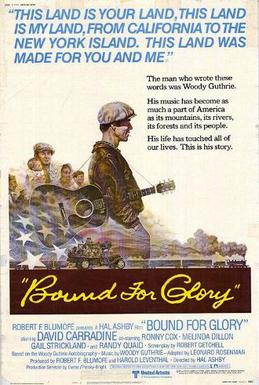
Bound for Glory (1976)

Bound for Glory (1976)

Beautifully filmed but psychologically and politically un-insightful film, easier to admire than enjoy

Director: Hal Ashby

Cast: David Carradine (Woody Guthrie), Ronny Cox (Ozark Bule), Melinda Dillon (Mary Jennings Guthrie), Gail Strickland (Pauline), Randy Quaid (Luther Johnson), John Lehine (Locke), Ji-Tu Cumbuka (Slim Snedeger), Elizabeth Macey (Liz Johnson), Mary Kay Place (Sue Ann), M. Emmet Walsh (Trailer Driver)

Woody Guthrie was a sort of poet of American folk music, his music influencing a generation of artists, from Bob Dylan onwards. His music spun a vision of the enduring strength of the working man and their rights to a share of the American Dream. It’s mythic stuff, so feels perfectly positioned to be spun into a modern fable in Ashby’s Bound for Glory. Coated in period detail, a sort of Grapes of Wrath by way of Barry Lyndon, it’s a lyrical piece of historical memory making with a nominal grounding in social and political issues. Is it a complete success? Perhaps it’s a film easier to admire than love.

It takes the title from Guthrie’s (David Carradine) biography, and follows his journey from Dust Bowl Texas in the 1930s to the hopes of employment in California, where he joins a mass of not-particularly-welcomed economic migrants. He discovers there an audience for his politically tinged folk music, but steadfastly refuses to compromise his principles. Actually, aside from these broad sketches and Guthrie himself, almost everything in this is essentially fictional. It’s a myth being spun, building a legend of a sort of John the Baptist of American folk music, a nostalgic vision of 30s America which makes little room for Guthrie’s actual politics.

Actually, that’s one of the most fascinating things in Bound for Glory. So keen is this to create a nostalgic view of an America from yesteryear, celebrating the perseverance of blue-collar America, it avoids talking in detail about anything Guthrie actually believed in. Although possibly not a card-carrying member of the Communist party, Guthrie was certainly at least a fellow-traveller. He had sharply left-wing, pro-worker, anti-capitalist views. His music echoed this – ‘This land is your land’ is actually about land ownership. But most traces of this have been carefully rinsed out of Bound for Glory.

That isn’t to say that it doesn’t take a deepe dive into Depression era America than any film since The Grapes of Wrath. Guthrie’s pilgrimage – and there is something distinctly Saintly about how he is presented here, making him more comfortable a figure than a left-wing radical – features plenty of dwelling on injustice and poverty. It opens in the ramshackle poverty of Dust Bowl Texas, where winning a dollar in a bet is potentially life changing. Migrants to California are at hurled from goods trains, then risk being shot (as one of Guthrie’s friends is) when attempting to jump on them as they puff past. They are barred entry on the road to California (in cars weighted down with their few possessions) if they can’t produce $50. The migrant camps are run-down, overcrowded and run by baton-wielding work-bosses who have complete power to decide who works and who doesn’t and don’t hesitate to wield their weapons to enforce their will.

Bound for Glory however avoids saying anything too firm against all this. It can carry sympathy for the plight faced by the working man but, much like The Grapes of Wrath, it’s terrified about saying or doing anything that could possibly be seen as promoting left-wing politics. Guthrie sometimes mumbles vague statements about the working man finding his slice of the American dream, but never anything too pointed about the fact that unfairness and having-and-have-noting is built into the system, like a spine in a body. The bravest shot the film takes is at a complacent priest, who smugly turns a hungry Guthrie away from his large church because he only hands out soup to people who have worked that day. Otherwise, the furthest it allows Guthrie to go is asking his wealthy lover (Gail Strickland in a thankless part) if she feels guilty having so much when others have so little. It’s the washed down, simplistic politics of the playschool.

And, to be honest, it robs Bound for Glory of much of its life and blood. It fails to replace this with a fierce personal story (like The Grapes of Wrath) and it never even attempts to make anything like a political statement as Ashby’s old collaborator Warren Beatty would do five years later with the similarly luminously beautiful Reds. Quite frankly, as Bound for Glory unrolls slowly and deliberately it does so with precious little fire and guts to it and (at times) very little interest. In other words, it’s very possible to sit and watch it and (while admiring it very much) kind of wish you were watching Rocky instead (as the voters for Best Picture at the Oscars that year clearly did).

It becomes instead a triumph of style, photography and design, rather than an enlightening biopic or making a statement about the Great Depression (other than it was tough). David Carradine hasn’t quite got the charisma to bring the vague threads Ashby gives him together. (Almost every single big name actor in Hollywood turned it down, which tells you something). Guthrie remains a vague, drifting blank, whose views and beliefs are undefined and to whom events frequently seem to just happen. Of the supporting roles (several women in particular get dull, thankless parts) only Ronny Cox gets something to get his teeth into as a musician turned union activist.

The real merits of Bound for Glory is it’s Barry Lyndon like recreation of a time and period. A lot of that is due to the breathtaking photography of Haskell Wexler – not for no reason was he the first person billed on the film. Wexler’s work is extraordinary, creating a sepia-toned view of Great Depression America that feels like its been taken straight from a photo library and placed on screen. Bound for Glory also astounded viewers at the time with the first Steadicam shot captured on screen, which starts with an aerial view, glides down to Guthrie and then follows him through a crowd of hundreds of extras to fail to be picked for a work party. It was the cherry on top of the Oscar-winning cake for Wexler.

It’s just a shame that these surface delights are all that really come to life. Other than that, this is distant, reserved and (in truth) slightly empty work from Ashby that presents the basic facts in a mythologised way that you feel removes much of the core truth. It turns a fascinating man of real conviction, into an unknown enigma, an Orpheus of the Dust Bowl who goes on a Pilgrim’s Progress that leads to (if we’re honest) nowhere in particular. It’s a film that strains a bit too hard for high art at the cost of passion or entertainment.

One Battle After Another (2025)

One Battle After Another (2025)

Fabulously made film, a brilliant merging of half-a-dozen genres is one Andersons’s finest

Director: Paul Thomas Anderson

Cast: Leonardo DiCaprio (Pat Calhoun/Bob Ferguson), Sean Penn (Colonel Steven J Lockjaw), Benicio del Toro (Sergio St Carlos), Regina Hall (Deandra), Teyana Taylor (Perfidia Beverly Hills), Chase Infiniti (Willa Ferguson), Wood Harris (Laredo), Alan Haima (Mae West), Paul Grimstad (Howard Sommerville), Shayna McHayle (Junglepussy), Tony Goldwyn (Virgil Throckmorton), John Hoogenakker (Tim Smith)

What is revolution – changing the world or just the relentless grind of One Battle After Another? It’s as hard to define as it is to define Paul Thomas Anderson’s incredibly striking Thomas Pynchon adaptation. Look at it one angle, and it’s a sharp political commentary on America; from another it’s a satire on the insular, self-defeating rules of secret societies; from a third it’s a pulpy chase-thriller; from a fourth a touching coming-of-age story of a daughter growing closer to her dad. Anderson’s skill here is that it’s basically all these and more at the same time, an electric, frequently laugh-out loud funny, hugely eccentric film that defies all categorisation.

Pynchon’s novel Vineland saw the radicals of the 1960s pulled, clumsily, back to life in the 90s. Anderson keeps the time skip, but moves the start to the late 00s and the destination to today. Pat (Leonardo DiCaprio) is a dishevelled, but true-believing, junior member of The French 75, a radical Atifa-style organisation on a wave of armed anti-government action. He’s in love with Perfidia (Teyana Taylor), an adrenalin-fuelled militant whose radicalism is often secondary to the rush she gets from guns and bombs. She’s the source of perverted sexual obsession for bottled-up, socially-striving US army officer Stephen Lockjaw (Sean Penn). After Perfidia makes a terrible choice, 16-years later the disillusioned, frequently doped-out, Pat (now living under the alias of Bob Ferguson) is raising their teenage daughter Willa (Chase Infiniti) when Lockjaw explodes back into their life, desperate to clean up his past indiscretions in case they imperil his acceptance into a secretive Neo-Nazi organisation of wealthy American, ‘the Christmas Adventures Club’. Cue a wild and crazy chase.

Anderson’s film bowls along with a whipper-cracker pace, over-flowing with confidence that it doesn’t need to spoon-feed us timelines, details or locations but trusts us to go with narrative flow. Which I for one really did. It’s a film that throws you straight into the mix – a French 75 raid on an immigration detainment facility – and barely lets up from there. Within the first half an hour we’ve seen a wave of direct action events from blowing up campaign offices (after warning phone calls) to sabotaging a city’s electricity supply – alongside Pat and Perfidia overcome with giddy, sexual thrills at thumbing their nose at the system. It’s a great way of grasping what an addictive rush fighting the man can be, something that’s all too-clear in the excited whooping, cheering and bombastic speechifying of many of its members.

These good times can’t last, but Perfidia wants to enjoy them as long as she can. In a blistering, force-of-nature performance from Teyana Taylor, Perfidia acts completely on impulse, thrilled with her life of action, pulling the naïve Bob in her slipstream. Danger of all sorts is addictive, from bombs to risky liaisons. She’ll spontaneously attempt to sexually humiliate Lockjaw on their first encounter (essentially ordering him to ‘stand to attention’ for her), then throw herself into an off-the-books sexual relationship with him (after he obsessively tracks her down for more humiliation) seemingly for kicks. She embodies the risky, thrilling excitement of the revolutionary world.

She’s also what leads to its destruction (her fellow revolutionaries are reduced to frightened shadows of themselves when, during a bank raid. Perfidia actually uses the lethal force everyone else has just talked about). Anderson’s film, after its propulsive start (assembled like an extended montage across an entire act), jumps to a very different future, where the thrills and spills of the underworld are subtly undermined, firstly by the hilarious dark comedy of all communication being managed through obsessive codeword rules and then by comparison with a far more quiet, but far more effective, underground railroad for migrants run by Benecio del Toro’s (underplaying brilliantly, his natural charisma flowing off the screen) Latin community leader and Taekwondo-sensei.

It’s also clear how hard it is to keep the revolutionary fire-burning. One Battle After Another superbly exploits the vulnerability and anxiety that underpins many of DiCaprio’s best performances. For all his involvement with radical violence, Pat/Bob is a sensitive, true believer starry-eyed, but with an appreciation for every-day duties that his fellow revolutionaries lack. It’s him who believes family and their daughter should come first (Perfidia, in the midst of post-natal depression, even admits she’s jealous of her daughter for absorbing so much of Pat’s love and attention).

DiCaprio brilliantly finds in Bob a good heart, whose desire to do the right thing is undermined by his own incompetence. In disappointment, he’s become a paranoid grouch, grumbling about pronouns, like any other middle-aged man adrift in the modern world. DiCaprio burns through the desperate energy of the part, but mixes it with a rich vein of black comedy at Bob’s frequent inability to cope with his situation. It’s a perfectly judged performance of loyalty and love, mixed with exasperation, panic and frequent well-meaning poor judgement.

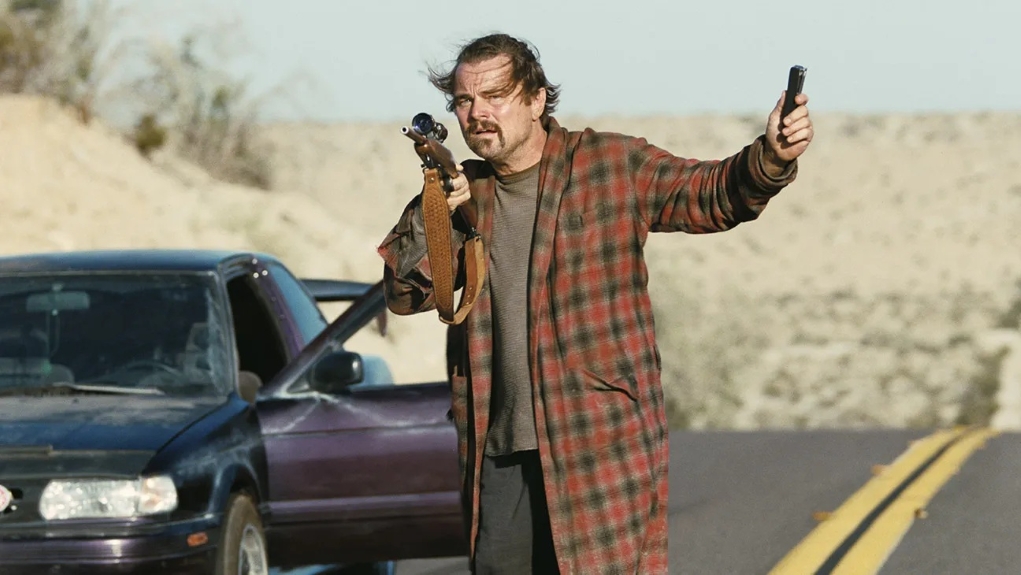
The second-act leans into the satirical comedy of these middle-aged revolutionaries, bought crashingly to life. In a neat comic touch, Bob spends most of the film on the run, desperately trying to find Willa, while dressed, Arthur Dent-style, in the same scuzzy dressing-gown he was wearing before Lockjaw’s raid. Time-and-time again, he’s reduced to swearing impotently down a phone-line like any other middle-aged consumer fed-up with unhelpful customer service, as he repeatedly fails to dredge vital codewords up from his stoned memory. During his escape, he’ll fall off a roof while evading the law, blanch at jumping from a moving car and spectacularly bungle a shoot-out. But what never waivers is his determination to help his daughter. One Battle After Another plays at times like a version of Taken where Neeson’s character had let himself get out of shape but still threw himself into the chase.

Anderson has fun with the bombastic self-importance of revolutionaries and the intricate insularity of their world. But he also has respect for their underlying desire to change the world for the better, even if the film suggests that the carefully, unflashy work being carried out by del Toro’s railroad is a better approach. Among the revolutionaries, there is a genuine warmth and feeling, embodied by Regina Hall’s loyal and humane Deandra (another superb performance in a film packed with them). There is a loyalty and protectiveness among the revolutionaries that bonds them together. And Sergio – del Toro outstanding as a never-fazed Sensei, a performance bubbling with dry wit – has built a community founded on mutual respect and looking out for each other.

And One Battle After Another has no respect at all for the alternative. The Christmas Adventures Club, the bizarre neo-Nazi group Lockjaw dreams of joining, shares the ridiculous language of secret knocks, handshakes and codewords. But it’s repellent in its instinctive racism and treats its members not as allies to be protected, but assets to be exploited and disposed of as needed. And their insidious extremism of its powerful white guys, with their hands on the gears of power, poses a far more dangerous threat.

Lockjaw is superbly played by Sean Penn as a ball of righteous, inadequate anger – from his ludicrous hair (which he frequently combs into an aggressive thrust), his tight t-shirts to accentuate his muscles to the lifts in his shoes to make him taller. Lockjaw is desperate to be a somebody, after a lifetime of social insecurity. Lacking any sense of imagination, with the emotional maturity of a disgruntled teen, Penn makes Lockjaw the embodiment of angry male entitlement trying to grab what power they can.

Anderson fuses all these elements into a film that takes us through several propulsive acts, from it’s French 75 prologue, to Bob’s desperate attempt to evade Lockjaw’s troops to a dusty road-chase that superbly carries an air of Mad Max. But Anderson does this, while never letting the film’s focus slip from the twisted family relationships at its centre: from Bob’s genuine, protective fatherly love, to Lockjaw’s incel jealousy and their twisted struggle for Willa (beautifully played by Chase Infiniti, in a star-making turn, as young woman finding a strength and idealism within herself that surprises her). It finds space for a genuinely moving series of personal relationships, just as it also skilfully shows Willa’s self-belief and social imagination flourishing under insane circumstances.

It’s part of a compelling, exciting, blackly comic and compelling film, which is not afraid to go to extreme, satirical lengths one moment and then pull you up with a scene that is gentle, earnest and heartfelt the next. It also avoids the trap of too directly preaching about America today, while asking several searching (and uncomfortable questions) about where we are now. Superbly acted across the board, it again shows Anderson is one of the finest directors working.

Five Easy Pieces (1970)

Five Easy Pieces (1970)

Nicholson gives a scintillating performance as a self-loathing soul in this searing drama

Director: Bob Rafelson

Cast: Jack Nicholson (Robert Eroica Dupea), Karen Black (Rayette Dipesto), Susan Anspach (Catherine Van Oost), Lois Smith (Partita Dupea), Ralph Waite (Carl Fidelio Dupea), Billy “Green” Bush (Elton), Irene Dailey (Samia Glavia), Toni Basil (Terry Grouse), Helena Kallianiotes (Palm Apodaca), William Challee (Nicholas Dupea), John Ryan (Spicer)

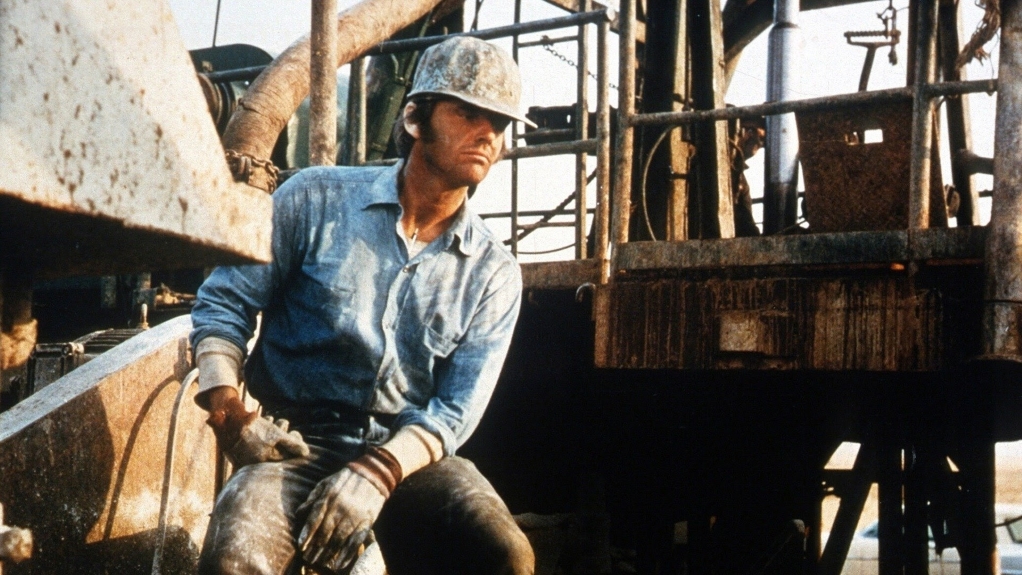
Robert Dupea (Jack Nicholson) is a man out of place. From a family of musical prodigies, groomed from childhood to become a leading concert pianist, he now works as an oil rigger out West. Turns out Robert isn’t content anywhere: he’s too rebellious for the upper-classes, too contemptuous to be part of the working classes. His life is one of running away, moving from place-to-place, avoiding emotional responsibilities, commitment and honesty, constantly seething with feelings he lacks the ability to process, unable to know what he wants with a self-destructive chasm a mile wide that swallows anyone that gets near it.

Five Easy Pieces is an intelligent, quiet, thoughtful character-study of a man who defies all possible labels and doesn’t fit comfortably into any pigeon-holes. Heavily influenced by the European artistes of the 60s, it’s a film that engages with class alienation in America more than almost any other, placing at its heart a man who refuses to compromise with anyone (to his own detriment) and whose selfishness and willingness to hurt other people constantly challenges the level of sympathy we are willing to give him. Despite this though, Rafelson has created a quiet domestic tragedy, with a man at its heart who is both unbearably selfish and unendingly vulnerable and scared at the world, who only knows how to react with bursts of resentful anger and whose instinct is to run away when things get either too tough or too involved.

Five Easy Pieces splits into three acts: the first sees Robert quietly snobbily bucking up against the working-class environment he’s chosen to live in; the second the long car journey to his family home while he struggles to find outlets for his tension; the third his return to the upper-class environs of his family where he can’t hide his contempt for their closeted privilege. What’s consistent is Robert is as constantly ashamed of himself as he is of his environs: a man of class and culture who longs to be working joe, a manual worker who yearns for sophistication around him. Robert’s tragedy is he can never square this circle.

It’s a role that calls for an actor at the top of his game, which it gets with Jack Nicholson. There is a moment near the start, where Nicholson does a little half-pivot skip while going round a corner into this home. It’s a small moment, but it’s a flash of something playfully real and endearingly childish that explains why we bear with him, even while he’s blowing things up around him. Nicholson’s performance is extraordinary. Robert has a constant simmering tension to him, but it’s a born of deep personal discontent. Nicholson perfectly brings to life a man constantly trying to seem assured, carefree and cool – but always with a nervous fear of what people think of him. Do the workers, and his friend Elton, realise he’s as posh as he is? Will his family look down on his waitress girlfriend?

One of the things Nicholson brings so brilliantly to Robert is his unease with talking: sure, he can barnstorm a self-righteous speech, but when it comes to actual conversation or talk about personal emotions he’s as timid and lost as a child. The idea of having roots is anathema to him (he’s perfectly willing to abandon Rayette when he thinks she’s pregnant) but it’s clear he also wants to belong somewhere. His tragedy is, as soon as he finds himself part a community all he feels is contempt for them – as if, like Groucho Marx, he can’t imagine joining a club that would have him as a member.

In fact, it becomes clear, Robert probably hates himself. He dismisses his accomplishments: inveigled into playing piano by his brother’s fiancée Catherine (a lovely performance of misguided sensitivity by Susan Anspach) he responds to her emotional reaction with dismissive rage, belittling his playing and questioning her feelings. It’s a mark, again, of the vulnerability and sensitivity Nicholson balances in this tempestuous, angry man that after this takedown we still believe she goes to bed with him. The tension of Robert’s loathing of himself never needs much to be released in anger against strangers: be it ranting at cars pointlessly blaring horns in traffic jams or an argument with a waitress who refuses to bring him toast that ends with glasses thrown petulantly across the floor. Nicholson never lets the pain of dealing with the world escape from Robert’s eyes, even when he’s at his most abrasive.

Robert’s inability to place himself in either world is perfectly captured in his relationship with waitress and would-be country singer Rayette, played with an endearing honesty and affection by Karen Black. If Robert could compromise, they would be well-suited: they both love music and share a sense of rootlessness. But he makes no real room for her. He can’t hide her contempt for her liking the wrong sort of music (country is no Chopin), he fills their house with little touches of art and scoffs at her inability to appreciate them; then he defends her working-class-honesty against his family’s snobbish friends while also being mortified by her artless, uneducated conversation among his family.

Fundamentally, Robert only cares for Rayette in relation to how she makes him feel about himself in the moment. She is a safe, undemanding comfort blanket – someone who will accept anything from him. His first instinct before returning to his family is to ditch her. Nicholson (in a superb sequence) shamefacedly mutters apologies between angry self-justifications while packing his bags – before a burst of self-loathing in his car sees him return. He then drags her across country only to park her at a motel while he sees ‘how things are’, clearly hoping she may decide to head home without him. When she instead turns up, he’s as ashamed of her as he as of his family’s wealth.

Like his siblings, Robert has never really grown up. His kindly sister Tita (a beautiful performance by Lois Smith) bounces around with enthusiasm, twiddles with a ping-pong bat with teenage glee while she flirts with her father’s nurse and seems utterly cossetted from the outside world. His brother Carl (Ralph Waite, very funny) has the distracted air of a natural eccentric, who has never had to engage with reality. But are they that different from Robert, who has a childish tantrum when he loses a bowling match? Five Easy Pieces suggests a difficult, distant relationship with his domineering father (now confined to silence in a wheelchair) in an astonishingly raw scene from Nicholson – but goes far from giving Robert a pass, his self-destructive self-loathing being far more of an inbuilt character flaw.

In fact, Robert suffers from an ennui that suggests he will never be happy wherever he lands – and he lacks either the self-knowledge or willingness to change. Above all, and it’s clear in every frame of Nicholson’s searing performance, Robert is a man who despises some part of himself so much, that all he can feel for those who show him warmth is contempt. After all, if he doesn’t care for him, why would anyone do so? It’s a pattern that is destined to leave him forever unhappy, forever hurting people, for ever lashing out. It’s a brutal honesty that makes Five Easy Pieces in some ways one of the bleakest, least hopeful of American films.

Dodsworth (1936)

Dodsworth (1936)

A marriage disintegrates in this richly mature, non-judgemental film one of the best of the decade

Director: William Wyler

Cast: Walter Huston (Sam Dodsworth), Ruth Chatterton (Fran Dodsworth), Paul Lukas (Arnold Iselin), Mary Astor (Edith Cortright), David Niven (Captain Lockert), Gregory Gaye (Kurt von Obersdorf), Maria Ouspenskaya (Baroness von Oversdorf), Odette Myrtil (Renée de Penable), Spring Byrington (Matey Pearson), Harlan Briggs (Tubby Pearson), Kathryn Marlowe (Emily), John Payne (Harry)

Marriage is tricky. In the hustle and bustle of everyday life, bringing up a family, running a business and rushing between social events, what if you don’t notice you don’t have much left in common? That’s the theme of Dodsworth, one of the most strikingly modern of 1930s films, that tackles the breakdown of a marriage in a surprising subtle way, avoiding the sort of moral punishment and condemnation you’d expect from the production code. Combined with sharp writing, fine acting and some fluidly creative direction from William Wyler, and you have an overlooked classic.

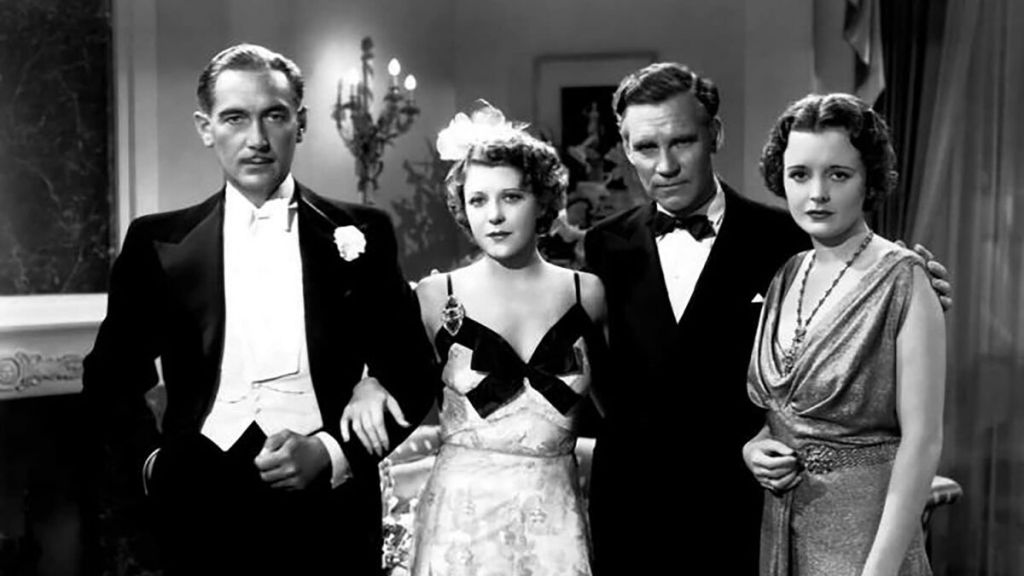
Dodsworth kicks off with the retirement of car entrepreneur Sam Dodsworth (Walter Huston). Having sold his successful independent factory to a major business, Sam is now effectively retired and suggests that he and his wife Fran (Ruth Chatterton) take that trip to Europe they’d always discussed but never had time to do. The trip, however, starts to reveal fractures in their relationship. Fran isn’t ready to ‘rush towards old age’ like she feels Sam, with his touristy longings and interest in engineering mechanics is. She wants to be part of society and feel the excitement of flirtations (and more) with rakeish European types (from David Niven to Paul Lukas to Gregory Gaye), while Sam ticks off the sites and sits in cafés. Sam, it turns out, has far more in common with Naples-ex-pat Edith (Mary Astor) – but feels duty bound to do whatever he can to preserve his marriage with Fran.

It’s all adapted from Sinclair Lewis’ doorstop novel, skilfully boiled down into a clear dramatic journey by Sidney Howard, from his own theatre adaptation (which also starred Huston). It becomes both slightly sad, watching two people drift apart, while also offering rich vestiges of hope of what the future can hold if you dare to take a chance. It mixes this with dry wit, scenes of compelling narrative interest and an insightful look at two people effectively going through different types of life crisis during a ‘once in a lifetime’ journey. Because nothing can disrupt your thinking about your own life more than changing nearly everything about it in one swift barrage of events.

It’s assembled into a richly involving whole by William Wyler, who lands the film just the right side of melodrama. From the opening shot, tracking towards Sam’s back as he leans against a window looking out over the factory which gave his life meaning, there is a quiet air of its characters living in denial of their own melancholy. Part of Sam is already wondering what on earth he’s going to do without his factory – its why he immerses himself in the most banal details of the sights they will see in Europe, or the engineering of their cruise ship.

Sam feels his journey will give him new opportunities, but it often sees him uncertain and slightly adrift, from not knowing how to tip waiters to finding his mid-Western mindset unable to compute the sexually liberal rules of European high society. Fran claims the journey abroad will mean leaving behind the oppressive parade of the over familiar social scene in their small town. It quickly turns out, she’s only be bored of their small circle not the glamour of social events.

Sam is played with real skill and under-played grace by Walter Huston in one of his finest performances. He’s an overwhelmingly decent man, self-made, confident but hesitant and uncertain out of his element. There’s a fuddy-duddy quality to him you can understand Fran finding grating, but he’s also capable of genuine, unfiltered enthusiasm (watch his joyful spotting of a famous lighthouse during their journey – which hilariously he nearly misses while checking his watch – and the eagerness which he tries to share this with an irritated Fran and a politely bored Niven). What’s superb about Huston’s performance is the awkwardness, shyness and even timidity he brings to a successful man, the quiet air of confused anxiety behind Sam as his certainties melt away.

Both Sam and Fran are convinced everything between them is fine, constantly speaking (increasingly dutifully) about their love, as if trying to convince each other even as it starts to fall apart. Their home already feels invaded by their daughter and her husband, who absent-mindedly serves himself drinks from Sam’s cabinet. They’re in completely different mindsets. Fran is constantly embarrassed by her husband’s tendency to hickness. Sam feels Fran’s upper-class ‘friends’ wouldn’t look twice at her without the cash she can flash. Fran is horrified by Sam’s whimsical statement that they will soon ‘be a couple of old Grandparents’. She’s young at heart, being wooed and won’t give that up.

From a ship-bound flirtation with David Niven’s suave playboy where she seems shocked at his implication that they can take things further (Sam doesn’t help by telling her she only has herself to blame), she swiftly begins an all-but-open affair with Paul Lukas’ smooth gentleman (with Sam turning an embarrassed third-wheel blind eye) even sending Sam home to extend her holiday privately, while he fields awkward questions from their family and re-directs his inner fury at his public cuckolding into grumpy rants about other’s scrabble games covering his desk and fussily reaching for his Encyclopaedia to prove trivial discussion points.

By the time Ruth has convinced herself divorce will lead, inevitably, to a glorious new marriage with much younger aristocrat Gregory Gaye, she’s at the centre of an increasingly delusional mid-life crisis, full of false claims about her age and built on fantasies. Ruth Chatterton is very good, neatly bringing to life a woman who can’t face the idea of becoming old. The film (while siding with Sam) never fully condemns her for her behaviour – even if it maintains an American suspicion of her wealthy European upper classes. In fact, it’s very hard not to feel sorry for Fran when her lover’s mother (played by an imperiously shrewd Oscar-nominated Maria Ouspenskaya) punctures her delusions about the likely future of a relationship with her feckless son.

It’s all beautifully framed by Wyler. How can you not admire the lingering shot of Fran reading a telegram from Sam and letting Lukas’ Iselin set fire to it, the camera following the paper as the wind blows it across the balcony floor to disintegrate like the Dodsworth marriage? Dodsworth is full of such beautifully subtle moments, its imagery (and Oscar winning sets) wonderfully establishing a world in transit as much as the Dodsworths. Wyler also evens the score at points: Sam remains largely sympathetic, but its possible to be irritated by his naïve dullness, just while the frequently infuriating Fran is relatable in tragic fear that her life is behind her.

It’s this mature view of people drifting apart, making mistakes and not always being condemned that makes Dodsworth such a richly intelligent film. Sam would certainly by more happy with Edith (a very moving performance from Mary Astor), just as Fran would be better off without Sam. Dodsworth is largely refreshingly free of the sort of Puritan punishments other films dealing with similar themes would use under the Production Code. Instead Dodsworth is a superbly acted, directed and written melodrama with a serious tone that remains richly rewarding viewing.

A Real Pain (2024)

A Real Pain (2024)

Delightful and enjoyable character study, slight but very well acted by well-cast leads

Director: Jesse Eisenberg

Cast: Jesse Eisenberg (David Kaplan), Kieran Culkin (Benji Kaplan), Will Sharpe (James), Jennifer Grey (Marcia), Kurt Egyiawan (Eloge), Liza Sadovy (Diane), Daniel Oreskes (Mark)

Life is tough. David (Jesse Eisenberg), a new father and successful seller of internet advertising space, finds social situations incredibly challenging. They aren’t a problem for his cousin Benji (Kieran Culkin), an impulsive, charming but troubled man who sits somewhere on an undiagnosed spectrum. The two were once as close as brothers, but growing up (as far as you can say Benji has) led to them drifting apart. After their death of their Holocaust-surviving grandmother – who Benji felt was closer to him than anyone – they travel to Poland, as part of a Holocaust-themed tour group, to commemorate her.

Eisenberg’s film is a witty, heartfelt, sharply scripted character study that’s slight on plot, but works very effectively as slice-of-life film-making. A Real Pain isn’t about solving problems, but acknowledging them (or not). It looks at how challenging and complex life, with its different ages and the changes those inflict on us and those around us, can be overwhelming. Above all, it’s an involving and engaging exploration of the relationship between two people who could not be more different, but are (or were once) held together by deep, unbreakable bonds.

This is despite sometimes finding the other person both loveable and deeply frustrating. That best sums up Benji, a charismatic man who feels things very, very deeply – and doesn’t see any reason to filter those feelings. In a fabulous, magnetic performance, Kieran Culkin makes him a guy who is fun personified until he isn’t. Benji connects with the tour group in a way David can’t: at their first meeting he absorbs details about them with a passionate interest, he ropes them into confidences and larking around for photos, he makes them laugh. He’s memorable, fun and lights up a room.

But he’s also deeply troubled. There is clearly some form of mental health issue with Benji – anything from Tourettes to autism via ADHD. Benji is scrupulously, passionately honest all the time. Which is fine when he is joking around: much more of a problem when he explodes in a furious tirade about the dark-irony of a Jewish Holocaust tour-group travelling first class on a Polish train. His explosions of passionate, vigorous outrage often showcase his failure to understand basic social norms (those rules that govern how far we go when we are annoyed), meaning he often ends up pushing things like a five-year-old who doesn’t realise the impact of his words.

He’s a man who always displays what he feels: after visiting a concentration camp he literally shakes with uncontrollable sobbing; when he wants a moment’s reflection in a graveyard from tour guide James (an excellently restrained, very funny Will Sharpe) he’ll launch into a massively critical tirade about James losing the ‘real people’ behind a blizzard of historical facts. But, strangely, during this passionately felt but excessive tirade (which is excruciatingly embarrassing), he’ll be as equally genuine when he praises James’ tour as he was when lambasting the picture-postcard view of the Holocaust he feels the tour can get lost in. And you can’t help but feel that he has a point, that the link between tourism box-ticking and real historical life-and-death is a bit uncomfortable. But you probably wouldn’t express it at such awkward, skin-crawling length as Benji does.

Culkin’s performance has echoes of his role in Succession – Benji shares Roman Roy’s impulse control, bouncy lack of focus and disregard for what people think about him (although, unlike Roman, that’s more because he genuinely can’t seem to understand people might respond to stuff differently to how he would). But Culkin also mines Benji’s vulnerability and desperation for affection. He’s a loud, bouncy man because he’s terribly, deeply lonely. He frequently wraps David in affectionate laddish embraces as if he’s scared he’ll run away. He clings to the memory of his bond with his grandmother and is distressed at a casual statement from David that suggests it might not have been as close as he believes. He constantly keeps on the go, seeking out new people and experiences, because he’s clearly deeply distressed at the idea of being alone with his own thoughts.

It makes him a fascinating contrast with David, who seems at first more nervous and anxious than Benji but turns out to be far better adjusted – just forgettable opposite the electric Benji. It’s a great performance by Eisenberg, nervous, twitchy and flummoxed by the world. David behaves like most of us would: nervous about Benji’s exhibitionism, worried about what people think about him and anxious about the people he loves. Sure, there’s a bit of Woody Allen-ish comedy to David (the sort of guy who leaves innumerable voicemails whenever there is the slightest change to his travel plans), but he feels like a real guy trying to make the general pressure of life work.

And a lot of that pressure comes from what a joy and a burden Benji can be. Benji can make him laugh but no-one else, but who (as he confesses in a stand out, single-take emotional speech by Eisenberg) he switches between wanting to be him (who wouldn’t want to make friends that easily?) and hating him (who wouldn’t be frustrated by a guy as unpredictable as that?). But, above all, he’s anxious and worried about a cousin who can’t look after himself and secretly struggles the daily turmoil of real life. It’s a whole extra burden he’s carrying, worrying about what this unpredictable, troubled man might do to himself.

Eisenberg’s leans into a thematic idea that the responsibility to life a happy, pain-free life is even more pressure-inducing for Jewish people living in the shadow of these unspeakable horror. There are teasing moments where this processing a traumatic legacy among the mundane burdens of life, looks like it might drop into place – from the second generation American immigrant couple who feels it’s their duty to live a good life, to the Rwandan convert Eloge (very well played by Kurt Egyiawan) who finds a peace in Judaism he’s never found elsewhere – but somehow it never quite clicks into focus. 

A Real Pain is a film stronger on the small details than thematic big pictures.  It wonderfully stages this very male relationship, where both men focus on shared memories and banter so they don’t need to talk about real feelings. And it gives plenty to celebrate in this delightful character study of two complex characters excellently played by Eisenberg and Culkin (Eisenberg has written two perfect roles for actors with very specific ranges). It’s a very intimate character study that makes you think about how each of us try to cope with everyday burdens, packed with moments that will make you both laugh and think. Eisenberg but just be an even better writer-director than he is actor.

Stagecoach (1939)

Stagecoach (1939)

Iconic action adventure, a very exciting chase film with a strong script and characters

Director: John Ford

Cast: Claire Trevor (Dallas), John Wayne (The Ringo Kid), Andy Devine (Buck Rickabaugh), John Carradine (Hatfield), Thomas Mitchell (Dr Josiah Boone), Louise Platt (Lucy Mallory), George Bancroft (Sheriff Curly Wilcox), Donald Meek (Samuel Peacock), Berton Churchill (Gatewood), Tim Holt (Lt Blanchard), Tom Tyler (Luke Plummer), Chris-Pin Martin (Chris), Francis Ford (Billy Pickett)

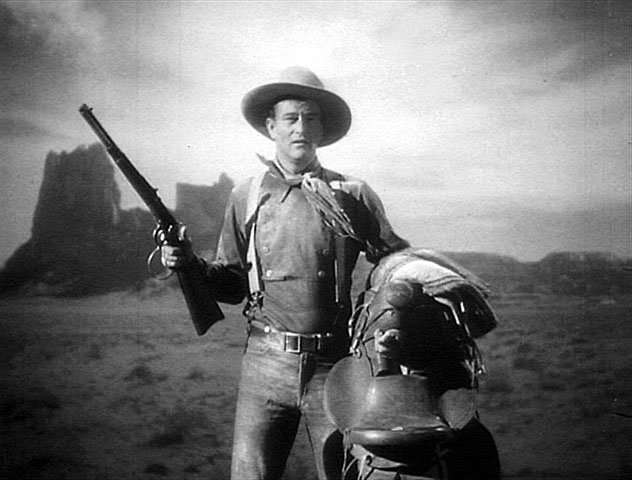
It might be the greatest star entrance of all time. Before Stagecoach, John Wayne was a minor leading man from a never-ending stream of oats-and-saddles B-movies. But, after one shot – a superb fast-paced zoom (so fast, the focus slips at one point) into the stoic face of Wayne, Winchester rifle twirling – that wasn’t going to be the case anymore. Stagecoach was Ford’s return to the Western – and he was bringing a friend along for the ride. After it, both director and star would become synonymous with the genre and Wayne would remain Hollywood’s Mayor-in-all-but-name.

Of course, that shot alone didn’t make Wayne a star (but, as you can imagine Andy Devine’s Buck wheezing “it sure helped, didn’t it”). What cemented the deal was what the hugely entertaining thrill ride Stagecoach is, a rollicking journey through Monument valley, crammed with just about anything you could want, from gun-battles and stunts to class commentary and arch dialogue. Like some sort of JB Priestley play, a regular smorgasbord of folks climb into a stagecoach to travel from Tonto to Lordsburg, facing a parade of dangers from Geronimo’s Apaches along the way – not to mention their own personality clashes and business to take care off in Lordsburg. All aboard!

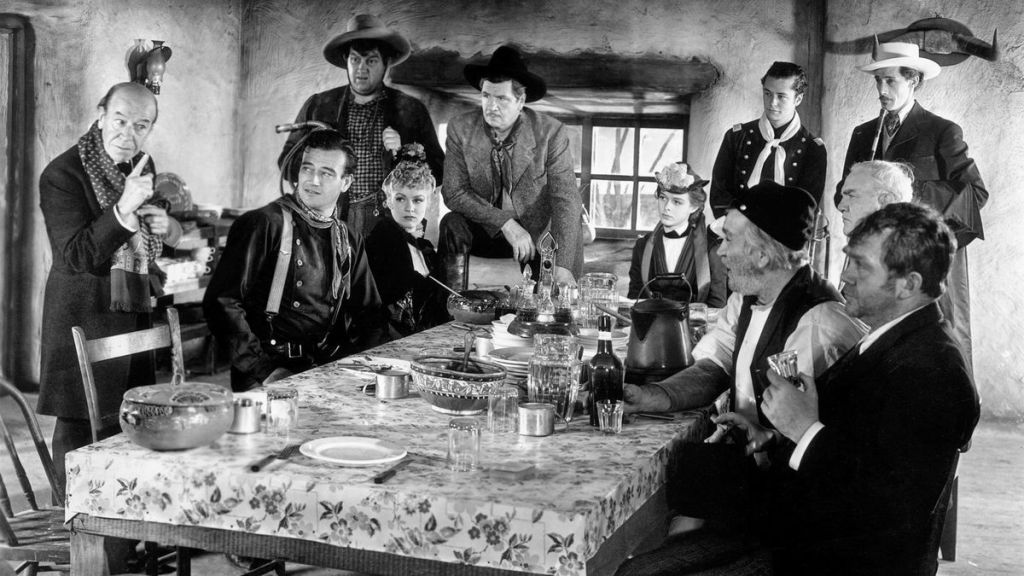
We’ve got prostitute Dallas (Claire Trevor), run out of town by ‘blessed civilisation’ – much like drunken surgeon Dr Boone (Thomas Mitchell) – hoping for a new life. Army wife Lucy Mallory (Lucy Platt) trying to find her missing husband, escorted by Southern gent turned gambler Hatfield (John Carradine); both are more than a little uncomfortable sharing a carriage with a lady of the night. They probably wish the carriage had more people like bank manager Gatewood (Benton Churchill), although they might change their mind if they knew he was an embezzler. Sheriff Curly Wilcox (George Bancroft) is trying to catch escaped prisoner The Ringo Kid (John Wayne), who is himself keen to get to Lordsburg to take down the Plummer gang who killed his father and brother.

All of these well-drawn characters – including the timid whisky salesman (whose name no-one can remember) Peacock (well played by the suitably named Donald Meek) – are bought vividly to life by a strong bunch of actors working with a well-constructed script by Dandy Nichols, crammed with sharp lines and wit. It’s packaged together by Ford into a film that’s lean, plays out at a whipper-cracker pace and juggles several plots, threats and character motivations all at once.

You can see Ford’s mastery of story-telling throughout Stagecoach. The opening fifteen minutes is a superbly efficient piece of lean scene-setting which, in a series of tightly-focused, engaging scenes, brilliantly introduces the principle characters, their motivations and the twin dangers of the Indians on the road and the Plummers in Lordsburg all in perfectly digestible chunks. In addition, Ford carefully introduces the class commentary that greases Stagecoach’s wheels: from the unconcealed loathing and disdain Dallas is treated with by the town’s worthies (including the appalled revulsion of Hatfield and the marginally less strident disdain shown by Lucy) to the unquestioned bluster of blowhard fat-cat Gatewood, whose blatantly transparent lies and increasing nervousness draws no where near the level of suspicion it should do.

But then most people are too worried about catching sin-by-touch from Dallas. Stagecoach never outright states her profession, but only the naïve Ringo Kid seems unaware she’s on-the-game. At the first stop on the journey, Ford orchestrates a perfectly constructed scene of micro-aggressions and class structure, where Ringo guiltily utterly misreads as snobbery about his own jailbird past. (Hatfield is so committed to keeping the distance between himself and Dallas, he won’t even let her borrow his water glass as he does Lucy, tossing Dallas the canteen to drink straight from instead). Similar disdain also meets Dr Boone, whose utter refusal to even slightly moderate his drinking (he spends the first day getting sozzled) disgusts the elite passengers, right up until his skills are needed during a medical emergency. (At this point Hatfield starts treating him as the fount of wisdom).

Ford’s sympathies are, like so often, with the tough little-guys out in the West, who judge people by who they are and what they do rather than where they come from. Claire Trevor is perfectly cast as Dallas, never a victim but always full of patient defiance, all-to-used to the snubs from others. But we respect Dallas because it’s clear – from the start – she’s kind, considerate and decent. When the chips are down for Laura, it’s Dallas and Boone (not self-appointed guardian Hatfield) who step-up to save her, and never once does it cross their mind to hold Lucy to account first.

Just the same is, of course, The Ringo Kid. Stagecoach was possibly the last time Wayne could plausibly be called ‘the Kid’ – he looks older than his 32 years already – and he fills the part with a sincere honesty, courtesy and straight-forwardness that would become integral to Ford’s films, while still making the Kid the rough-and-tumble hero you want to be. The Ringo Kid may be a jailbird, but treats people according to their personal merits, sticks to his word, unhesitatingly protects people (that iconic introduction is him warning the coach of danger ahead) and won’t do anything he isn’t unwilling to do himself. It’s people like that – and Thomas Mitchell’s Oscar winning (Mitchell had key roles in half the best picture nominees that year, so had to win for something!) Doc Boone who turns himself into a master surgeon by force-of-will alone – who form the backbone of Ford’s West.

This all sits alongside some truly sensational action-adventure. Most of Stagecoach is a long build-up to its two action sequences that end the film: the running attack across the wide-open desert sands from the Apache and Ringo’s fateful duel with the Plummers. The eight-and-a-half minute chase would be the highlight of any film, a dynamic, pulsating masterclass of tight editing and tracking shots that fills the screen with electric pace and energy. It also has some of the most iconic stunts of all time, executed by Yakima Canutt Wayne’s long-term stunt consultant. From Canutt-as-Ringo jumping from pair-of-horses to pair-of-horses in front of the coach galloping at full-speed, to Canutt-as-Apache leaping from horse, to coach horses to falling and bring dragged under the coach (a stunt homage by Raiders of the Lost Ark’s truck chase) their visceral thrill is made even more exciting by Ford’s camera speeds making them look like they took place at even faster pace than the 45-miles-an-hour the horses were galloping at.

Ringo’s final duel with the Plummers gets a different approach, a long, steadily paced build-up that culminates in a very low camera watching a ready-for-action Wayne move towards us like a striding mountain. Stagecoach is also a masterclass in visual imagery and camera-use – so much so Orson Welles literally used it as such in prep for Citizen Kane, screening it over 40 times. Not just in action and editing, but also the brilliance of placement. Stagecoach’s low-ceilinged sets and striking shadows are a clear influence on Kane. A superb shot of Dallas from down a corridor, framed in light strewn from an open doorway, is a wonderful piece of visual poetry and there are gorgeous visual flourishes throughout, from the black cat that crosses the Plummer’s path to the wonderful vistas from Ford’s first trip to Monument valley.

All of this comes together into a film that is a wonderfully entertaining character study, wrapped up with a series of knock-out set-pieces, with romance, comedy and social commentary thrown in on top. It’s perhaps one of the most purely ‘entertaining’ Westerns ever made and one of Ford’s finest fusions of artistic brilliance and popcorn chewing thrill-rides.

Scent of a Woman (1992)

Scent of a Woman (1992)

Pacino roars to Oscar-glory with an impressive turn in an enjoyable but predictable coming-of-age drama

Director: Martin Brest

Cast: Al Pacino (Lt Col Frank Slade), Chris O’Donnell (Charlie Simms), James Rebhorn (Mr Trask), Gabrielle Anwar (Donna), Philip Seymour Hoffman (George Willis Jnr), Ron Eldard (Officer Gore), Richard Venture (Willie Slade), Bradley Whitford (Randy), Nicholas Sadler (Harry Havemeyer)

Hoo-ha! It took eight nominations, but Pacino finally lifted the Oscar for his abrasive, damaged, charismatic turn as blind retired army Lt Colonel Frank Slade in Scent of a Woman. It’s not really a surprise: it’s a gift of a part, tailor-made for an actor as in love with bombast as Pacino to rip into, and rip he does. But he also manages to find the moments of gentleness, pathos, fear and self-loathing while expertly calibrating his internal acting dial to pings with explosive entertainment when the big show-stopping speeches come. It’s a million miles away from Michael Corleone’s bolted down, internalised rage – but it’s also a hell of a lot of fun to watch.

Pacino picks Scent of a Woman up and carries it single- handedly through enemy lines. Almost nothing will surprise you in this cosily familiar mix of coming-of-age posh-school drama and well-worn “odd couple” friendship, where an abrasive older guy toughens up a reluctant mild protégé. But, whaddya know, the kid also softens the old guy up. Charlie Sims (Chris O’Donnell), decent and polite scholarship kid at super-posh Baird school, faces expulsion because his principles won’t let him snitch on the spoilt, trust-fund, tosspot kids who played a prank on the school’s sanctimonious headmaster (James Rebhorn). Taking Thanksgiving to think about what to do, he accepts a job looking after Slade who promptly ropes him into a trip to New York, where the blind Slade plans on one final glorious weekend before blowing his brains out in a five-star hotel.

Of course, the film doesn’t end with Pacino’s little grey cells dripping down the side of the Waldorf’s no-expense-spared wallpaper. It will not surprise you at all that Martin Brest’s film heading where all feel-good films like this head: learned lessons, love of life re-embraced and a big speech from the big star solving all the problems. Scent of a Woman’s biggest flaw is it takes a very long time to hit all these familiar beats on the way towards its cookie-cutter capping of its coming-of-age/road trip set-up. Martin Brest was never a director to tell a story in a few sentences when a whole chapter would do, and Scent of a Woman is the last time he got the balance right between the length of the journey and the pleasure of being on it.

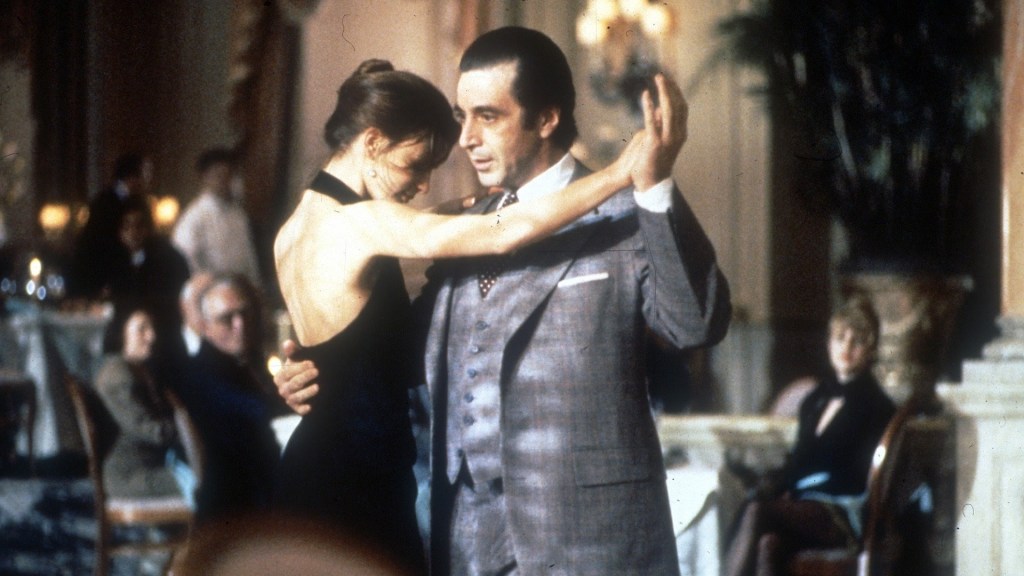
But then, as mentioned, a lion’s share of the credit belongs to Pacino. Surly but with just enough cheek. charm and biting wit, it’s a hugely entertaining role with big meaty speeches to chew on. Pacino makes it very funny, from his don’t-give-a-crap rudeness to his don’t-take-no-for-an-answer insistence on getting his own way. The film gives him a memorable set-piece moment pretty much every 15 minutes: his surly introduction, via a speech on the beautiful scents of women, the film’s iconic tango-dancing with Gabrielle Anwar, driving a Ferrari around the empty streets of the Bronx (and convincing a cop who pulls him over that he’s not blind), a thwarted suicide with the sort of barked refrain Pacino loves (“I’m in the DARK here!”) to a leave-no-prisoners final “courtroom” speech that’s one of the best of its kind. This is all meat and drink for Pacino.

But this is a more nuanced performance than just a star’s turn. Pacino makes Slade a deeply unhappy man, slowly realising he has been so most of his life. A man who uses anger, wit and cruelty as shields to drive people away and make himself look and feel tough. Blindness has become a constant reminder of his vulnerability and dependence, but also made the shell of isolation he has built around himself all consuming. He’s realising pretty much everyone he knows hates him, whose family (from youngest to oldest) want as little to do with him as possible, who has never had a meaningful relationship and clings to a war record he frequently garnishes to appear more important. Pacino manages to convey all this deep-down regret and self-loathing extremely well, matched with a physically dedicated performance of approximating blindness that is one of the best there is on film.

There’s a striking scene midway through where Slade crashes his brother’s Thanksgiving dinner. The family are less than happy to see him, but tolerate him at a table he dominates, first with garrulous (uninvited) army stories and then increasingly rude, sexual comments about his nephew’s wife. The nephew (Bradley Whitford) eventually tears him off a strip: in 1992 some felt sorry for this merciless puncturing of Slade’s self-mythologising, but today I can’t help but agree with Whitford’s takedown of Slade’s bullying. Slade’s eventual assault on his nephew is allegedly for calling Charlie “Chuck” once too often, but really feels like a desperate attempt to take revenge without feeling in the wrong. It’s a scene that actually cements what an awful negative force Slade has been, something he’s just starting to realise no end of whimsy can fix. This is a complex stuff among the Hoo-Ha.

Pacino’s helped by a very fine, generous performance from Chris O’Donnell as a young man who may be naïve and innocent but, in his own way, has more guts and integrity than the mercurial Slade ever did. While Slade is fundamentally selfish (and always has been), Charlie will make sacrifices for people he knows will never do the same for him and won’t flex his principles for any personal gain. O’Donnell also does some magnificent reacting throughout, frequently generously providing the dramatic context and crucial reaction points to make Pacino’s character work effectively.

Scent of a Woman’s posh-school drama provides a few more straight-forward figures of loathing: from James Rebhorn’s headmaster, via Philip Seymour Hoffman’s smug, gutless, entitled fellow student (a prototype of his role in The Talented Mr Ripley) who hangs Charlie out to dry, culminating in the three unbearably arrogant rich kids who carry out the prank. In some ways the plot here is far more engaging than Slade’s suicide run, even though nothing surprising really happens at all throughout it’s runtime. It also allows Brest to caps it off with such a dynamite speech from Pacino that it made the Oscar probably a foregone decision (even though Denzel Washington’s Malcolm X could feel rightly aggrieved at missing out on the little bald man).

That kind of sums the whole film up. Despite moments of complexity in its character study – forcefully delivered with depth and feeling by Pacino – Scent of a Woman is a film that offers virtually no surprises at all while expertly hitting every single beat you would expect to see while giving maximum entertainment factor along the way. It’s the sort of thing that Oscars are grown from.

A Hard Day’s Night (1964)

A Hard Day’s Night (1964)

The Fab Four conquer the movies in this fast-paced and funny road movie

Director: Richard Lester

Cast: The Beatles, Wilfrid Brambell (John McCartney), Norman Rossington (Norm), John Junkin (Shake), Victor Spinetti (TV Director), Anna Quayle (Millie), Richard Vernon (Man on Train), Kenneth Haigh (Simon Marshall)

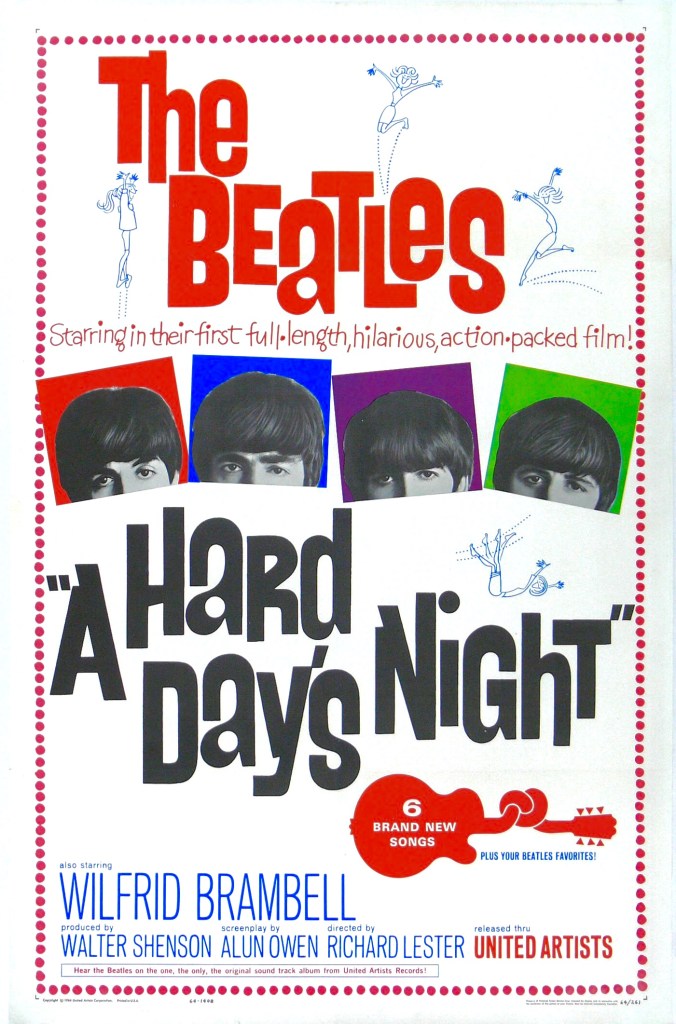
In 1964 they weren’t just the most popular music act: they basically were music. Everywhere they went they were met by crowds of screaming fans. They’d conquered America. They were no longer four lads from Liverpool: they were The Beatles. They were numbers 1-5 in the States, their last 11 songs had gone to number one, they were the most popular people on the planet. Of course, it was time for them to conquer the movies.

What’s striking is that A Hard Day’s Night could have been like any number of god-awful Elvis Presley films, with the King awkwardly playing a series of characters shoe-horned into plots based on songs. Richard Lester would do something different – and along the way he’d arguably invent the music video (when told he was the father of MTV, Lester famously asked for “a paternity test”) and the mockumentary all in one go. Lester placed the fab four into a day-in-the-life road movie, mixed with silent-comedy inspired capers and Marx Brothers style word play, in which they would play versions of their various personas in what basically amounted to a series of fly-on-the-wall sketches.

The film follows the gang in Paul’s (fictional) grandfather John (“Dirty old man” Steptoe’s Wilfrid Brimbell) complains move from “a train and a room and a car and a room and a room and a room”. (In a running gag lost on those not au fait with 60s British sitcoms, he is repeatedly called “clean”). In other words, we see the Fab Four shuttle to London, answer questions at a press conference, skive-off to prat about in a park then go through a series of rehearsals (with interruptions) before performing on TV and choppering off to their next appointment. It’s non-stop (even their night-off is filled with answering fan-mail – and pulling Grandad out of casino) work, work, work and any time outside is spent running from a mob of screaming fans. A Hard Day’s Night indeed.

Lester shoots this with an improvisational energy that feels like its run novelle vague through a kitchen-sink drama. He’s not averse to Keystone Kops style chases, sight gags and letting the camera bounce and jerk around with the actors. If things go wrong – ten seconds into the film George and Ringo fall over during a chase scene, get up and start running again while John laughs his head off – Lester just ran with it and kept it in. Everything feels like it has the casual, cool energy of just sticking the camera down and watching four relaxed, cool guys shoot the breeze.

It helps that he moulds four decent performances from a band that, let’s be honest, was never going to trouble the Oscars for their acting. Screenwriter Alun Owen – whose Oscar-nominated script is awash with pithy one-liners and gags – spent a couple of weeks with the boys and from that essentially scripted them four personas best matching their real-life attitudes. John becomes a cocksure smart-arse, with a quip for every corner. Paul an earnest, decent guy with a taste for wacky gags. George a shier, poetic type. Ringo the closest the band gets to a sad-sack loser, but also the most down-to-earth. Essentially, with these scripted “selves” the band were encouraged to relax and go where the mood takes them.

It works. Of course, it helps that the Beatles are (a) really cool and (b) totally relaxed with themselves, with Lester encouraging an atmosphere where the four feel less like they are acting and more like they are just being. There is an impressive naturalness about this film – really striking since it’s full of silly stuff, from the four hiding in a work tent to a car thief being roped in by the police to drive them through a chase – that means it catches you off guard. After a while you kick back and relax along with the people in it. That’s the sort of casual cool that’s impossibly hard work to pull off.

The musical sequences also feel spontaneous. When the Beatles bust out their kit and do a number on the train among the baggage it makes as much sense as them performing their stuff in the studio. It all stems from confidence – the sort of confidence that makes the group seem cheeky rather than cocky. There is a vein in A Hard Day’s Night of thumbing your noise at the posh, privileged world that was being gate-crashed by four working-class Scousers. It’s hard not to side with the Beatles when they tease Richard Vernon’s snobby city gent on the train (“I fought a war for you lot” he sniffs “Bet you wish you’d lost now” John snarks) or smirk at the deferential police eye these working class lads with suspicion.

What A Hard Day’s Night does best of all is make the Fab Four look like Four Normal Guys. They always look slightly dumbfounded by the pace of their life and the riotous reception from fans. They always seem like they’d be happier joking around or, as Ringo does when he bunks off for some time alone, wandering along chatting with people and dreamily watching the world go. They treat the media attention (and stupid questions) with straight-faced but ridiculous answers (“What do you call this haircut?” “Arthur”) and never feel or look like fame has corrupted them. Their manager Norm (a fine Norman Rossington) essentially treats them like four naughty schoolboys.

A Hard Day’s Night flies by in less than 90 minutes. It’s charm, wit and Lester’s sparkling imagery (the boys pratting around in the park did indeed inspire about a million MTV videos) and ability to shoot musical gigs in imaginative exciting ways makes it almost certainly the finest music-star film ever made – and inspired generations of comedies to comes. No wonder it made the Beatles number one at the Box Office and the Charts.

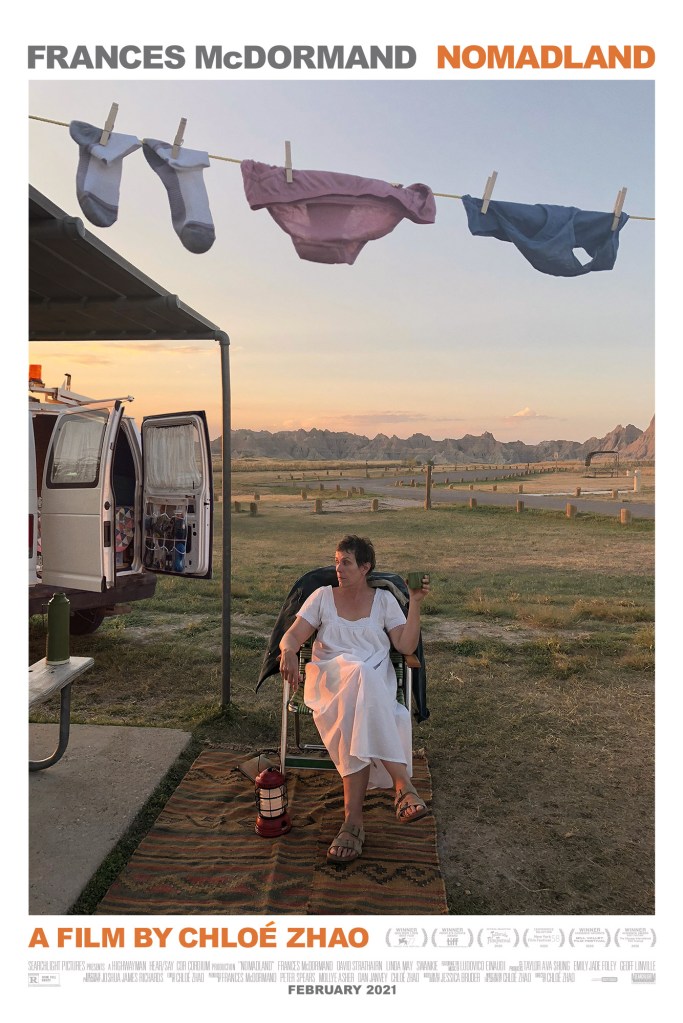
Nomadland (2020)

Nomadland (2020)

Poetic and surprisingly moving, this Best Picture winner is light on plot but deep on meaning

Director: Chloé Zhao

Cast: Frances McDormand (Fern), David Strathairn (Dave), Linda May, Charlene Swankie, Bob Wells, Peter Spears, Derek Endres

We all have ideas about what life should look like in the 21st century. Settled job, dream home, the rooted life. It’s what we are expected to be working towards – but it’s not for everyone. Nomadland, Chloé Zhao’s Malick-influenced road movie explores the lives of those who decide to live off that beaten track. The modern nomad, who chooses flexibility to move their home from place to place and don’t want to be tied down by bricks-and-mortar. It makes for a meditative, soulfully poetic film with a quietly mesmeric power.

Fern (Frances McDormand) is recently widowed, childless and has lost her job after the gypsum plant in Empire, Nevada closes. But, far from down-hearted, Fern is determined to lead a new life without the fixed commitments of her old one. She sells most of her possessions, kits out a van as a travel home and begins to drive across the country, taking seasonal jobs as and where she stops. She finds herself part of a warm and supportive community of nomads, who help to learn how to flourish in this unconventional home life.          

Nomadland winning Best Picture is as close as the Oscars have come to giving an award to Terence Malick. It’s hard not to feel his influence over the camera’s languid worship of the beauty of the Badlands, or its characters quiet searching for higher in life, via a communing with nature. Zhao’s film is a very effective and surprisingly moving character study, with only the smallest smidgen of a plot, but full of feeling. Radiantly shot by Joshua James Richards, it finds an orange-tinged beauty in a dawn and dusk and tiny moments of joy in rain falling in your face. All contrasted with the dull oppressiveness of buildings, those four walls shutting out nature.

Zhao’s film goes a long way in challenging neat assumptions we might have about this lifestyle. “I’m not homeless I’m houseless” Fern states and she politely – but firmly – turns down well-meaning offers of charity. The decision to move from place-to-place is not one enforced by poverty or failure. Instead, this is a rich, vibrant, supportive community that looks out for each other and share a legitimate (and refreshing) view of the world. Who says you need to spend your life chasing the dollar and building up a debt to have a fixed slice of real-estate you can sort of call your own?

This is particularly true in our post-recession world. Nomadland starts with the final collapse of an industrial community, now a ghost town. Many of the nomads find seasonal work that is often manual and low-skilled. Fern’s first job (of many) is working at an Amazon dispatch location, where jolly team leaders burst with enthusiasm met with smiling indifference by the (often older) staff. Fern’s travel is shaped around moving to key locations for seasonal work – Amazon, a campsite, a short-order chef job, beet processing… The economic situation is poor, but this is a way of playing the system to get a higher level of freedom, without debt or financial pressures.

It’s a key subject of a talk given to fellow nomads by Bob Wells, an influential advocate of the nomad life-style (one of any people playing versions of themselves). It’s part of a series of events at a nomad event – a sort of convention – where people gather to share experiences, advise and life-hacks. Ever needed to know how to change a tyre or what size bucket you should use for your built-in toilet? Wonder no more! On the road people come together in a way they never would in more regular life. With everything transient and nothing fixed, friendships and connections are more intense, constantly in that first glow of excitement.

That’s the pay-off of choosing this lifestyle. Everything is transient. Close friendships form, but you might not see the other person for months at a time. While phones help you to keep in touch, day-to-day you see completely different people from place-to-place. It will never be completely clear where you might be to your family. However, the short-lived intensity of connections can lead to a closeness and intimacy that might otherwise take months – a friend of Fern’s confides she has terminal cancer but regrets nothing, with a warmth and trust that would normally takes years to form not weeks.

It’s implied as well that the more short-lived intensity of friendships fits more with what the slightly taciturn and guarded Fern wants from life. Frances McDormand makes her friendly, ready with a smile, good company – but she is always slightly reserved and guarded. She will give sympathetic ears and invite confidences. But she is also a woman determined to live by her own rule. Having lived most of her life in one place in a happy marriage, a conversation with her sister (who bails her out with a loan to repair her van) reveals she was always prone to not look back when a decision was made. It’s the same with deciding to live on the road as moving to Empire – Fern knows her own heart and mind, and will fully commit to that.

This is despite temptations, the main one she faces being David Strathairn’s (the only other professional actor in the film) Dave, a fellow nomad who makes no secret of his romantic interest in her. Sweetly played by Strathairn, Dave pursues Fern and dangles the possibility of a more fixed and traditional life. They are close, but Fern has lived that life of marriage and rejected already the idea of a family. And, as McDormand makes clear in her soulful eyes, if that life was ever on the cards, it would have been with her husband not this new man, nice as he is.

Nomadland, like Fern, can see the dangers and problems. A van breaking down in the middle of nowhere is a major danger, a broken plate a potential disaster – Fern painstakingly reassembles it, not wishing to spend the money to replace it. Low temperatures and bad weather can make it uncomfortable – although she (smilingly) rejects an offer from a garage owner to sleep inside. But it also understands living this lifestyle is a legitimate choice, filled with rich possibilities. You only need to see Fern joyfully travel to the coast or get wrapped up in the embrace of the vibrant community she finds on the road to see that you could do immeasurably worse with your life.

Zhao’s film has a documentary realism to it, that comes from its deep immersion in real nomad communities. It makes copious use of real nomads playing versions of themselves, giving a rich feeling of authenticity to every moment. It also means we gain a real understanding of the idea that goodbyes are never final in this world, that there is always the prospect of seeing someone again “down the road”. The film’s poetic empathy, its warmth and the vibrant humanity of its characters makes it film that creeps up on you and has a surprising, but profound, power.

Wild (2014)

Wild (2014)

Reese Witherspoon finds herself in a film that is more than just Eat, Pray, Hike

Director: Jean-Marc Vallée

Cast: Reese Witherspoon (Cheryl Strayed), Laura Dern (“Bobbie” Grey), Thomas Sadoski (Paul), Michel Huisman (Jonathan), Gaby Hoffmann (Aimee), Kevin Rankin (Greg), W. Earl Brown (Frank), Mo McRae (Jimmy Carter), Keene McRae (Leif)

Ever thought tackling a 1,100 mile hike would be a fun adventure? The opening of Wild might change your mind. Gasp as Reese Witherspoon rips out a bleeding toe nail and then throws her ill-fitting hiking boots down a mountain, screaming abuse at them all the way! Want to grab that back-pack now?

In this adaptation of a memoir about loss and self-discovery, Witherspoon plays Cheryl Strayed who (fairly impulsively) decided to hike the Pacific Crest Trail in 1995 to try to find in herself the woman her late mother “Bobbie” (Laura Dern) believed she could be. After Bobbie’s early death from cancer at 45, Cheryl had collapsed – ruining her marriage to Paul (Thomas Sadoski) in an orgy of anonymous sex and heroin addiction. Now she wants to make a new start.

Adapted by Nick Hornby with a good deal of skill and emotional intelligence, Jean-Marc Vallée’s film is an interesting character study via the survivalist genre, mixed with a touching exploration of grief, loss and self-loathing. After throwing us into Day 26 with that bloodied toe-nail, the film rolls back to follow Cheryl’s walk: intercut with powerful memories of her relationship with her mother, each memory activated by different encounters along the way and bubbling into her mind along with a distinctive soundtrack (most especially Simon and Garfunkal’s El Condor Pasa) that reflects the music that reminds Cheryl of her mother.

It could have been a sentimental finding-yourself movie – Eat, Pray, Hike anyone? (I also rather like Reese Witherspoon Finds Herself in a Backpack) – and I won’t lie, there are elements of that. But maybe it caught me in the right mood, maybe because I’ve always fancied testing myself with an epic hike, but I actually found it intelligent, sensitive and just the right side of sentimental.

Wild carefully avoids simple points. It’s a film not about a long journey leading to revelation, but a journey that helps you accept all your past decisions, right or wrong. There is a pointed lack of emotional breakdowns, tearful confessions or flare ups of self-anger and revelation. Instead, it’s about the long grind of starting an internal journey towards contentment. Because trekking 1,100 miles is the long haul: there ain’t any easy ways out or short cuts on this trek.

The film’s principal asset is Reese Witherspoon. Also serving as producer, Witherspoon is in almost every single frame and delivers an under-played but very emotionally satisfying performance. She plays Cheryl as quietly determined, having already hit rock bottom and knowing every step she takes from now is upwards. She meets adversity – aside from the odd flash of frustration – with a stoic will and finds an increasing spiritual freedom in the wild that serves as an escape from the horrific wilderness of her self-destructive years. But she never lets us forget the pain that underpins this journey for Cheryl. It’s a very impressive performance.

The reminders of that pain are distributed through the film, which unflinchingly chronicles Cheryl’s escape from grief in the arms of a parade of sleazy men, anonymous hotel sex and (finally) shooting up heroin on the streets of San Francisco. It ends her marriage to Paul – but not their friendship, in the sort of adult emotional reaction you hardly ever see in a movie. Paul – played with warmth by Thomas Sadoski – may not be able to continue his marriage after discovering his wife’s parade of trust-breaking, but it doesn’t stop him from helping a person he loves who is in need.

All of this is nicely counterpointed by the hike itself. Naturally it’s all slightly episodic, as Cheryl moves from location to location, but Hornby’s script makes these vignettes really work. Vallée’s direction also does a fantastic job of intercutting between the long walk of 1995, and Cheryl’s memories of both her mother (played with a vibrancy that makes a huge impression from limited screen time by an Oscar-nominated Laura Dern) and her own emotional collapse after her death.

I also appreciated that Wild doesn’t shirk from showing the vulnerability of an attractive young woman hiking alone. Some potential predators are revealed to be the opposite: others are exactly what they appear to be. But not every encounter is one of potential danger: far from it.

Cheryl is met time and again by people who only appear to support, share their expertise and help her in her quest. At an early station, a man talks her through the huge amount of equipment she’s bought and advises what she can leave behind (Vallée opens the film with the strenuous effort, including rolling around on the floor, Cheryl has to go through just to put this backpack on). She finds a touch of romance with a handsome musician (a charming Michel Huisman). There’s also comedy, most of all with Cheryl’s encounter with a self-important journalist (Mo McRae), who won’t be convinced that she isn’t a female hobo.

This is all packaged together in a quiet, un-pretentious way that culminates in a thought-provoking monologue about the value of self-acceptance and putting aside regrets. Others would have layered on the sentiment, but here the balance is just right. With Witherspoon at the top of her game, Wild is a well-made and involving road trip that also makes you think.