
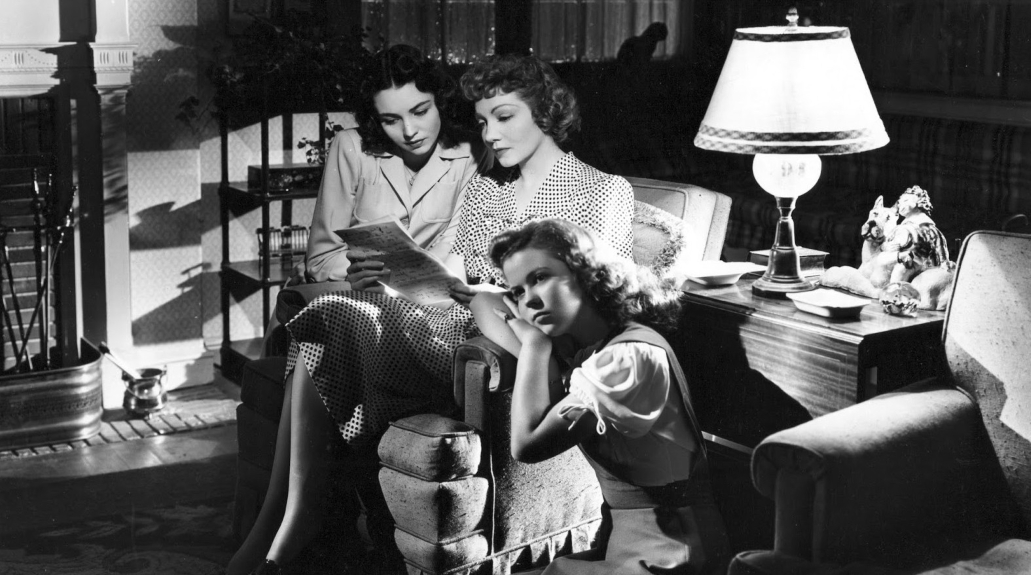
Overlong attempt to make an American Mrs Miniver which can’t sustain its focus over three hours
Director: James Cromwell
Cast: Claudette Colbert (Anne Hilton), Jennifer Jones (Jane Hilton), Joseph Cotton (Lt Tony Willett), Shirley Temple (Bridget Hilton), Monty Woolley (Colonel William G Smollett), Lionel Barrymore (Clergyman), Robert Walker (Corporal William G Smollett II), Hattie McDaniel (Fidelia), Agnes Moorehead (Emily Hawkins), Nazimova (Zofia Koslowska), Albert Basserman (Dr Golden), Keenan Wynn (Lt Solomon)
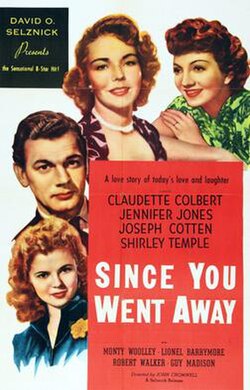
With America embroiled in the Second World War, David O. Selznick felt it was his duty to do his bit. And what better way than making a movie. So was born Since You Went Away, adapted by Selznick himself from Margaret Buell Wilder’s epistolary novel, about a woman writing letters to her husband while he fights the good fight abroad. It was nothing more or less than Selznick’s attempt to create a Mrs Miniver for America, to bring the tribulations of those left behind to the screen.
Our family is the Hiltons. Over the course of 1943, they wait for news of husband and father Tim as serves abroad. With Tim’s income gone, wife Anne (Claudette Colbert) needs to make economies and bring in a lodger, avuncular retired Colonel Smollett (Monty Woolley). This brings into their lives Smollett’s nephew Bill (Robert Walker), who begins a romance with Anne’s oldest daughter Jane (Jennifer Jones), while her younger daughter Bridget (Shirley Temple) builds a friendship with their lodger. The family is aided by friends, not least Tim’s best friend Tony Willett (Joseph Cotton), the subject of a long-standing crush of Jane’s and is himself in love with Anne. Over the year, the family does everything they can to support the war effort.
There is probably a fine couple of hours in Since You Went Away. Unfortunately, it’s buried in a film so long it sometimes feels like you are living a year in the life in real-time. It’s not helped by the film’s sentimental scope often repeating the same beats over and over again, a soapy message of the overwhelming importance of hearth and home and the unbreakable bonds of love that keep families faithfully together forever (it’s ironic that this paean to duty and fidelity was made while Selznick was breaking up his marriage for an affair with Jones, while she ended her marriage to Robert Walker).
Essentially, the film has made most of its points and observations by the half-way mark, and is reduced to repeating them again in the second half, all accompanied by Max Steiner’s overly insistent score (which won the film’s only Oscar) which hammers home every single emotional point with laboured riffs on songs like No Place Like Home or Come Let Us Adore Him. Much of the drama is undermined by having almost no sense of threat: unlike Mrs Miniver there is zero chance of any of the characters actually being bombed at home but, just like that film, there is also absolutely no chance at all that Anne will be tempted by the heavily suggestive flirtation of Tony.
Instead, there is a slightly cosy air of gentleness under Since You Went Away. We are told the war, and loss of Tim’s salary, has caused hardship for the family – but it’s the sort of hardship that sees a hugely wealthy family adjusting to merely being comfortably well-off. The main concessions seem to be setting up a vegetable patch and taking in a well-paying lodger (who, of course, becomes an honorary family member). Even their Black maid (Hattie McDaniel, in a truly thankless part) is so devoted that she continues to serve them during her time-off from her new job (for no pay). There is never even a suggestion they may need to move from their massive five-bedroomed house or stop moving in their affluent circle.
This circle is represented by Agnes Moorehead, sneering like a suburban witch wrapped in ostentatious furs, who scorns any idea of pulling her weight during the war and crows about how cleverly she’s exploiting rationing loopholes. This is contrasted with the families growing civic duty, embodied by Jennifer Jones’ Jane casting aside her giddy teenage years to devotedly work as a volunteer nurse with war wounded (much to the disgust of Moorehead) and Anne’s shift to training as a welder in a munitions factory. Since You Went Away heavily pushes the angle that everyone must do their bit, hammered home by refugee welder Nazimova who gives a misty eyed reading of the famous Statue of Liberty message.
What Since You Went Away starts to feel like at times is an over-inflated, Little Women-ish drama, with war as a backdrop. There are moments of loss: Tim is reported missing, cause for much stoic resilience and heartbreak and the son of the local store is killed early on. The film has a tragic romance in the form of Jones and Walker’s Smollett Jnr, which goes through a gentle flirtation, playful hay-rolling into an overly empathetic departing train goodbye (expertly parodied in Airplane!), that holds together due to the charm of the actors. But the main message is one of cosy reassurance: it’s a million miles away from the more doubtful The Best Years of Our Lives – there’s no doubt Tim will settle straight back into a world unchanged from that he left behind.
The characters are pretty uniformly predictable and conventional, but are delivered effectively. Colbert, in many ways with a rather dull part, effectively underplays as the endlessly patient, dutiful and calm Anne, bottling up her doubts and fears into her diary. She makes a generous still centre of the film, even if the film doesn’t call for one minute of playfulness for her as an actor. She cedes much of the best ground to Jones (Selznick’s complete control of the film surely played a role in this), who is full of radiant sparkiness, even if her teenage giddiness gets a little wearing. Jones, looking in her twenties, plays the role as if she was in her teens while Shirley Temple, looking in her early teens, plays her like she was still at elementary school. Needless to say, there is no chance of either of these girls causing serious trouble or going off the rails.
Opposite them, Monty Woolley delivers exactly what is required as the outwardly gruff Colonel whose frosty exterior inevitably melts over time. Woolley does bring a lot of depth to Smollett’s quiet grief and playfulness from Smollett’s love-hate relationship with the families pet bulldog. Joseph Cotton just about manages to make Tony charming – charming enough that his hanging around and constantly flirtation with both mother and daughter isn’t too reminiscent of his psychopathic uncle in Shadow of Doubt. (In many ways, Tony is an overly insistent creep).
But the successes of the film are drowned by its absurd length and overly insistent sentimental hammering home of every single point. It does look fabulous – the shadow-laden photography of Lee Garmes and Stanley Cortez adds a great deal of noirish emotional depth – but it’s flatly directed (Cromwell was one of many directors on the project, including Selznick himself) and lacks pace. In trying to present a reassuring celebration of all-American family values, it frequently lets character and drama drift and never presents a plot development that surprises or challenges. It’s no Mrs Miniver.










 Movie Musings