Category: Small town drama

The Russians are Coming, the Russians are Coming (1966)

The Russians are Coming, the Russians are Coming (1966)

Ealingesque farce meets Cold War moralising in this not-quite funny enough farce

Director: Norman Jewison

Cast: Carl Reiner (Walt Whittaker), Eva Marie Saint (Elspeth Whittaker), Alan Arkin (Rozanov), Brian Keith (Link Mattocks), Theodore Bikel (Captain), Jonathan Winters (Norman Jones), Tessie O’Shea (Alice Foss), John Philip Law (Alexei Kolchin), Ben Blue (Luther Grilk), Andrea Dromm (Alison Palmer), Paul Ford (Fendall Hawkins)

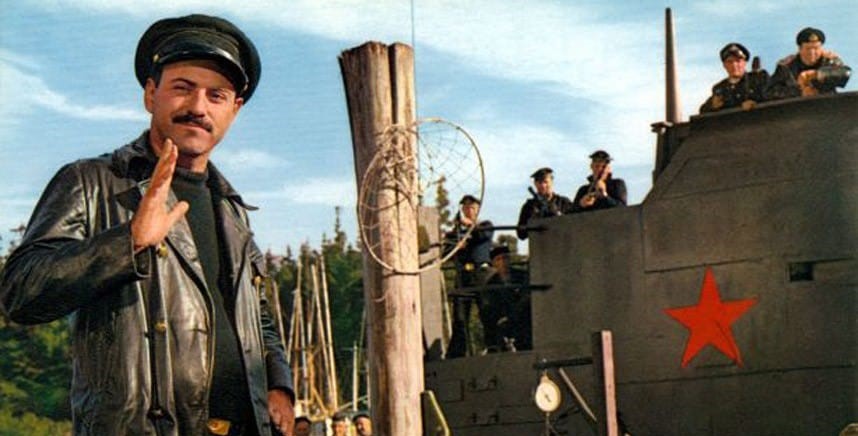
Off the coast of a New England island, a Russian captain (Theodore Bikel) wants to take a quick peek at the US of A. Bad idea. When his sub runs aground, they are forced to send a party ashore led by political officer Rozanov (Alan Arkin) to find a motor launch to get the sub back out to sea. They run into the Whittakers – playwright Walt (Carl Reiner), wife Elspeth (Eva Marie Saint) and their kids – take them hostage, steal their car, cut the telephone lines and try to save themselves. The town quickly hears news of the possible arrival of Russians, and the hysteria grows – just as Walt starts to feel his sympathies grow for the terrified Russian sailors. Can peace be reached across the divide?

The Russians are Coming, the Russians are Coming is basically an Ealing-esque comedy – written by Ealing veteran William Rose – translated not entirely successfully to America. Directed with an epic, widescreen sweep by Norman Jewison that sometimes crushes the life out of a comedy of confusion and coincidence, The Russians are Coming wants to be both a broad farce and carry an earnest message about the Cold War. It’s quite sweet that the film, made four years after Cuba nearly turned the world into an ash pile, wants to focus on what unites as humans rather than divides us, but the message is at times crow-barred in a little too forcibly.

It’s very hard not to see the Ealing influence on every single scene – and I suspect the film would have worked better as 4:3 black-and-white film full of harassed people in offices and homes, rather than the grand panoramas of the town and large crowd scenes. The Ealing influence can be seen in the townsfolk, who become a farcical panicked crowd of have-a-go heroes, making sweeping decisions based on no information at all, led by puffed up self-important, self-elected leaders determined to seize their moments of heroism. Misunderstandings abound, as tiny pieces of evidence balloon the “threat” into a full-blown invasion: the crowd are almost disappointed when they arrive at an airfield to find not a smouldering ruin but an operator blissfully unaware anything is going on.

Similarly, the Russians themselves fit nicely into the Ealing model of ordinary, decent, underdogs up against the system (in this case the townsfolk). In a brave touch, the Russian in the film is never translated – Theodore Bikel doesn’t have a line in English – meaning we only gradually learn what is going on and why, as Arkin’s character explains things to Whittaker in stumbling half-English. Arkin is, by the way, the film’s prize asset, demonstrating excellent comic timing and delivering his dialogue in a parade of Russian and fumbling English (there is a great sequence where he earnestly tutors his men on how to pass as officials clearing the street, teaching them phrases just a few degrees incorrect that will make them stick out like sore thumbs as soon as they open their mouths).

The film is never quite funny enough though and Jewison’s direction neither tight nor taut enough to keep the farcical pace up. There are one too many wrong turns taken by the Russians, one too many narrative cul-de-sacs as townsfolk barrel up and down the streets. The whole film plays out like this, many of its effective comic performers among the townsfolk lost among a sea of people and faces. Arkin and Reiner get the most impact, because their scenes tend to make place in individual rooms in set-ups that let us clearly see their faces and appreciate their comic skills.

The Russians are Coming largely struggles to keep the pace up – the best of the Ealing comedies told their farce-tinged struggles between the little-guy and the system, or confusion between two fundamentally sympathetic groups, in about 90 minutes, and this feels heavily over-stretched at a little over two hours. That’s partly because of the political statements which the film dresses up as a sub-plots. A romance between John Philip Law’s Russian sailor and the Whittakers’ babysitter Tessie O’Shea is all too obviously a plea for using love as bridge-building. The final alliance between the Russians and the townspeople, forged in their joint rescuing of an endangered child, bangs the “we are all the same” drum a little too persistently.

It makes the film today feel a little too much like it’s trying to have its cake and eat it: to be both a farce where Reiner’s playwright gets tied up to a librarian and the two struggle to free themselves in a series of pratfalls, and also a political statement about the bonds that can be built if we just let the Cold War melt a little bit. I won’t deny this must have had more impact in the 1960s, but today it makes for a film that is a little too grandiose where it should be nimble, and a little too lightweight when it should be important.

Jean de Florette & Manon des Sources (1986)

Jean de Florette & Manon des Sources (1986)

Luscious scenery and combines with fine acting to produce a sort of French Merchant Ivory

Director: Claude Berri

Cast: Yves Montard (César Soubeyrnan), Daniel Auteuil (Ugolin), Gérard Depardieu (Jean Cadoret), Emmanuelle Béart (Manon Cadoret), Elizabeth Depardieu (Aimée Cadoret), Ernestine Mazurowana (Young Manon), Hippolyte Girardot (Bernard Olivier), Margarita Lozano (Baptistine), Yvonne Gamy (Delphine)

At the time this double bill (which I’ll refer to as Jean de Florette unless specifically referring to the sequel only) were the most successful foreign language films ever released. Shot over seven months, they were also the most expensive French films ever made and garlanded with awards, including a BAFTA for best film. Jean de Florette turned Verdi into the soundtrack for France, while its photography transformed the rural idyll of Provence into a major tourist destination and the dream location for holiday homeowners. The films themselves remain rich, rural tragedies, gorgeous French heritage films, a sort of French Gone with the Wind replayed as Greek tragedy.

Told in two parts – although designed as one complete movie – they tell a story of how greed destroys lives in 1920s rural Provence. César (Yves Montard) is the childless landowner whose only hope of a legacy is his hard-working but dense nephew Ugolin (Daniel Auteuil). Ugolin dreams of growing carnations but the perfect land is frustratingly not for sale. When an argument with the owner leads to his accidental death, the land falls to Jean Cadoret (Gérard Depardieu) hunch-backed former tax collector from the city and son of Florette, the girl who broke César’s heart decades ago when she left the village while he impulsively served in the foreign legion.

César and Ugolin resent Jean – Jean of Florette as they call him – and hatch a plan to see his dream of a rabbit farm fail. They secretly block up the spring on Jean’s land and keep his connection to Florette a secret from the rest of the village, encouraging them to see him as an outsider and hunchbacked bad-luck charm. Ugolin befriends the decent, optimistic and hard-working Jean and watches the farm disintegrate. A decade later, in Manon des Sources, Jean’s daughter Manon (Emmanuele Béart) plots revenge for her father on Ugolin and César.

Jean de Florette and Manon des Sources were adapted from Marcel Pagnol’s novel – written, ironically, after Pagnol’s film Manon des Sources was butchered down by the studio in 1952 from four hours into an abbreviated two. It’s a richly filmed, luscious picture crammed with gorgeous locations, sweeping camerawork and marvellous score that riffs on Verdi. It’s an entertaining story of injustice and comeuppances. It’s first half (Jean de Florette) is an, at-times painful, unfolding of Jean’s inevitable failure. The second (Manon des Sources) sees all those chickens come home to roost as Manon’s suspicions about César and Ugolin’s duplicitousness are confirmed.

But what perhaps made Jean de Florette as successful as it was, is its mix of Merchant Ivory and BBC costume-drama. Many outside of France essentially took it as art because the characters spoke French. But Jean de Florette is a tasteful, classy, very well-made prestige package designed to be easily digestible. Claude Berri marshals events with the skill of a natural producer – he’s effectively a sort of French Richard Attenborough with a great deal of natural talent with actors, but without the true inspiration of the greats. You couldn’t mistake Jean de Florette as something made by Carné let alone Godard or Truffaut. It’s decidedly too carefully, tastefully made for that.

Which is not to say it isn’t in many ways a very fine film. Its construction is well-executed across its two parts. Berri makes clear that – for all the film showed a picture post-card view of France, encouraged to promote tourism and ‘traditional values’ by the government – the village our film is centred around is rife with prejudice and underlying hostility. It’s all too easy to for them to take against Jean: not only he is an outsider, he’s a tax-collector and a hunchback to boot. Prejudice naturally sets them against him (the villagers gleefully watch this “city man” destroy himself vainly trying to turn his dry land fertile). Manon des Sources makes clear the whole village at the very least suspected the spring had been deliberately dammed but effectively couldn’t be bothered to help.

It’s not a surprise as Jean’s techniques are totally alien to the traditionalists. Played by Depardieu with a wide-eyed enthusiasm, guileless honesty and trust, Jean takes on farming as if its another mathematical problem. He has books full of calculations and productivity rates he expects to hit, covering everything from rabbit breeding to the daily amount of soil and water needed for crops. He is prepared for anything except the cruelty of humans and the weather (Berri makes clear that, even with one arm tied around his back by the spring being blocked, he nearly manages to pull it off).

Instead, his super-human efforts come to naught. Forced to walk miles a day to carry gallons of water back to his farm to irrigate his land, he starts to resemble the weighted down donkey he drags with him. Rubicons are crossed one by one: even his wife’s necklace is eventually called on to be pawned, for all his promises that it would never come to that (fitting the Zolaish tragedy here, the necklace turns out to be worth sod all). Ugolin does everything he can to befriend and support Jean without helping him, even ploughing the land for him when Jean comes close to finding the hidden water supply. The events beat down Depardieu, here in one of his finest “man of the soil” peasant roles, until he is literally left shouting at the heavens, imploring God to give him a break.

This makes is all the easier to despise César and Ugolin, especially as Berri cuts frequently to these hypocrites giggling at their own deviousness and Jean’s suffering. It makes Manon des Sources – arguably the even more rewarding part – all the more satisfying as we watch the two of them slowly destroyed, events replaying themselves from the other direction. Manon des Sources features a performance of Artemis-like grace from Emmanuelle Béart as the older version of Jean’s daughter (the younger noticeably never trusted Ugolin), whose beauty enraptures Ugolin and who in turn dams the source of the village’s water to expose the crimes against her father.

It leads to a series of shattering reveals that break César and Ugolin from their satisfaction and complacency. These two villains are portrayed in masterful performances by Yves Montard and Daniel Auteuil. Under buck teeth and a foolish grin, Auteuil is sublime as a man who has it in him to be decent but is all too easily led by his forceful uncle. He regrets his actions, while never making an effort to reform and reverts all too easily into a love-struck Gollum, spying on Manon and literally sewing her lost ribbon into his skin. He’s a pathetic figure.

Montard has the juiciest part, which flowers into one of true tragic force in Manon des Sources. César is a man whose life of regret and loneliness has turned him into a bitter old man, grasping, greedy and hungry for a legacy. He treasures the few possessions he has of Florette – faded letters and a single hair comb – like relics and subconsciously can’t bring himself to actually meet her son. Suppressed sadness makes him every more tyrannical and foreboding. But Manon explodes this exterior, as events and revelations strip away all he holds dear. It culminates in a breath-taking sequence of raw grief from Montard – which depends on the magnetic power of his eyes – as his last delusions are stripped away and the true horror of his actions exposed to him.

It’s this emotional power that gives the two parts of Jean de Florette its force and impact and lift it the higher plain of its costume drama roots. It may be a very self-consciously prestige picture, designed to appeal to the masses, but Berri’s conservative style is matched with a great skill of drawing powerful performances from the actors. He does this in spades with his four leads and events eventually gain, through their performances, some of the force of a Provence Greek Tragedy. Jean de Florette manages to avoid melodrama and provides real dramatic meat and, while it is not high art, it’s certainly very high drama.

The Quiet Man (1952)

The Quiet Man (1952)

Ford’s sweet and funny Irish fable is possibly his most purely enjoyable film

Director: John Ford

Cast: John Wayne (Sean Thornton), Maureen O’Hara (Mary Kate Danaher), Barry Fitzgerald (Michaleen Oge Flyyn), Ward Bond (Father Peter Lonergan), Victor McLaglen (Squire Will Danaher), Mildred Natwick (The Widow Sarah Tillane), Francis Ford (Dan Tobin), Eileen Crowe (Mrs Elizabeth Playfair), Arthur Shields (Reverend Cyril Playfair), Charles B Fitzsimmons (Hugh Forbes), James O’Hara (Father Paul), Jack MacGowran (Ignatius Feeney), Sean McClory (Owen Glynn)

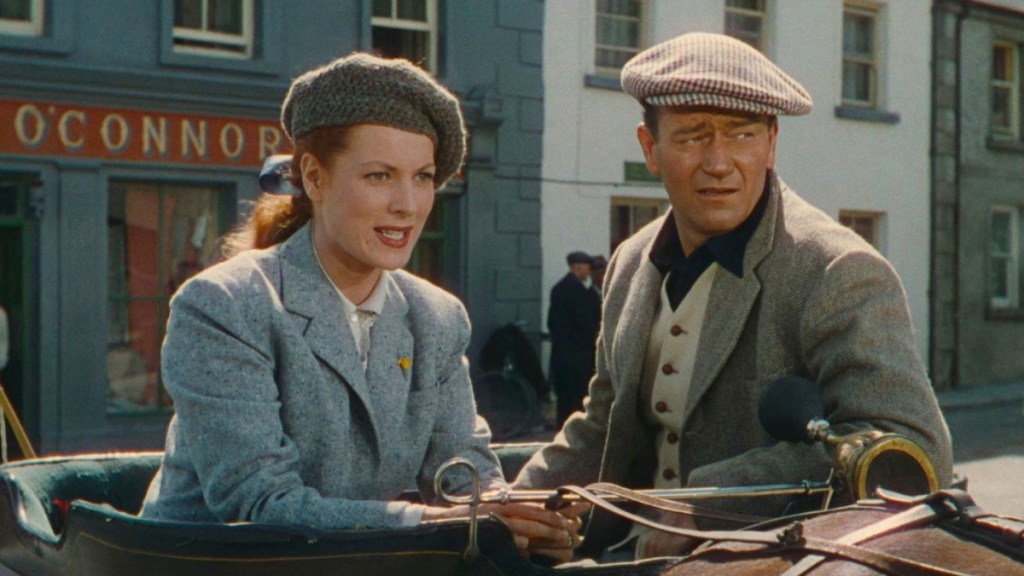
John Ford wasn’t born in Ireland, but he loved the place in the way only the child of ex-pats could. The Quiet Man is a loving, romantic, almost fairy-tale view of Ireland, an affectionate feelgood fantasy that transcends any possibility of patronising its subject through its warmth and charm. It’s an unashamedly feel-good film, a delightful fable full of luscious scenery and tenderly sketched characters that plays out like a warm end-of-term treat where we are all invited to the party. It’s possibly Ford’s most purely enjoyable and heart-warming film.

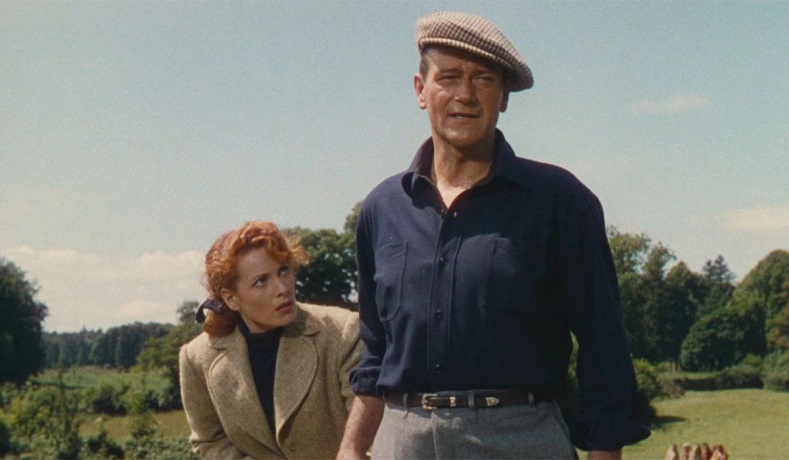
Set in 1920s Ireland, Sean Thornton (John Wayne) returns to his childhood home of Inisfree after growing up and becoming a boxer in Pittsburgh. Sean loves his home country, but with his American upbringing is out-of-step with the customs and traditions of Ireland – something that becomes very clear when he falls in love with Mary Kate (Maureen O’Hara), sister of local squire Will Danaher (Victor McLaglen). Their rules-bound courtship – overseen by matchmaker Michaleen Oge Flynn (Barry Fitzgerald) – eventually leads to marriage, but via tricking Will, who withholds Mary Kate’s dowry, the sign of her independence. Mary Kate wants Sean to fight for it – but the former boxer is haunted by the accidental killing of an opponent in the ring and wants to live-and-let-live. Problem is everyone, from Mary Kate down, sees that as cowardice.

Ford was desperate to make The Quiet Man, the rights for which he had paid $10 for in 1933 when the short story was published by Maurice Walsh (Ford ensured Walsh received another $5k when the film was finally made). B-movie studio Republic Pictures was the only one willing to take a punt on it. But, alarmed by Ford’s insistence to shoot in colour and (even more expensively!) on location, they were convinced they had a box office bomb on their hands. They insisted Ford and his cast made a western first – the literally for-the-money Rio Grande – to cover the expected losses. They even demanded Ford couldn’t make it longer than 2 hours. Ford screened the final 2 hours and 9 minutes cut to them, stopping the film on exactly the two hour mark and asking them what they’d cut. They released the film unchanged. The film was an Oscar-nominated smash-hit.

It’s not a surprise why, because the film is a whimsical delight. Ford isn’t often remembered for his sense of fun, but The Quiet Man is unarguably funny. It’s crammed with sight gags – from sly double takes (there is a delightful one from the railway station workers, who watch first a determined Sean then a horse walk straight past them), to Sean and Will grimacing in pain but smiling as they exchange a brutal handshake, to Mary Kate jumping over obstacles as Sean drags her back to the village to have it out with her brother. It famously ends with an extended comic set-piece as Sean and Will launch a mano-a-mano “Queensbury Rules” fistfight that takes most of a day, moves across the whole village, and is interrupted only by a break for a pint.

All of this takes place in an Ireland that, while it never feels entirely real, is drawn with such loving affection and cast with such careful exactitude that it hardly matters. Ford’s insistence on shooting all the exteriors on location paid off in spades. The country has never looked more ravishing than through Winton C Hoch’s technicolour lens. Rolling vistas, gentle brooks, quaint villages, perfect beaches. You totally understand why Sean, on arrival, simply stands on a stone bridge and stares across the valley of Inisfree, lost in memories and his emotions.

Sure, it’s a romantic vision. And 1920s Ireland wasn’t the sort of haven depicted here, where Catholic and Protestant lived in perfect harmony, politics never reared its head and the local IRA man is a jolly joker in the pub. If The Quiet Man had not been so well-meaning, you can imagine people taking offence at a picture of the country full of roguish charm, horse-drawn carriages, drinking and fighting. (You could say The Quiet Man shaped many Americans’ perceptions of what the country is like.) But Ford never makes any of this a subject of humour. In fact, it’s a subject of love. The joke is never on the Irish. Inisfree is in fact a haven of community spirit, a supportive village where its people are wise, caring and decent, tradition is respected and what people say and do matters.

It’s why so many are shocked by Sean’s seeming cowardice at not raising his fists earlier. That’s not what “men” do. John Wayne is very effective as the easy-going Sean, a guy who just wants to settle down to marriage. It’s a decent playing-against-type by Wayne, that balances his quiet sense of dignity with the sort of manly determination we know will eventually come through. It’s easy to see why he and Mary Kate fall in love. Also, why she is both swept up in his masculinity and also enraged that he doesn’t behave enough like a man, by refusing to take a stand to defend her honour and secure that dowry that will make her a true wife.

O’Hara is marvellous in a challenging role as Mary Kate. This is a feisty and determined woman, who knows what she wants but denies to herself what that is. She and Wayne share a striking, windswept early kiss – her mood in it going form surprise, to fascination, to irritation, to surrendering to her own desires. While you could suggest the film’s comic set-piece of Sean dragging her (sometimes literally) back to the village so she can watch him fight her brother the way she’s demanded from the start feels uncomfortable today, but it’s also Sean not only delivering what she has wanted him to do from the start, but also strangely the thing that finally bonds them together.

A bond is what they have, both of them straining against the confines of the courtship rules of Ireland. Together they flee the chaperoned carriage ride Michaeleen (a delighful Barry Fitzgerald) takes them on to ride a tandem through the streets. Mary Kate constantly, bashfully, tries to go after what she wants – and a large part of that is the lurking “bad boy” tendency that she detects under the surface of the quiet Sean. Something her less-bright brother Will can’t see.

Victor McLaglen (Oscar-nominated) swaggers, slurs and puffs himself up as this rough-and-tough, punch-first-think-later bruiser, who constantly thinks he’s being cheated. He and Wayne throw themselves into the long dust-up that ends the film with the same comic energy and enthusiasm they did exchanging handshakes. Part of The Quiet Man’s success comes from the comfort and familiarity the cast felt for each other. The trip to Ireland was like a friends-and-family holiday: old mates like Ward Bond, Ford’s brother, O’Hara’s brother, Wayne’s children – they all round out the cast. It helps build even more the family and community feeling that makes the film a delight.

Above all, The Quiet Man leaves you with a smile on your face. With expertly filmed set-pieces – a horse race, Sean and Mary Kate’s long walk back to Inisfree and the epic punch-up – combined with luscious shooting (also done with wit – a sexually frustrated Sean pounds through the countryside, tossing heavily puffed cigarettes aside, after Mary Kate withdraws favours) – it’s also fast-paced, witty and warm. The cast even effectively take bows as Ward Bond’s (his finest hour) priest delivers a final voiceover. Full of affection and charm, it’s a delight and is perhaps the only foreign “Irish” film that has been embraced by the Irish.

The Banshees of Inisherin (2022)

The Banshees of Inisherin (2022)

Director: Martin McDonagh

Cast: Colin Farrell (Pádraic Súilleabháin), Brendan Gleeson (Colm Doherty), Kerry Condon (Siobhan Súilleabháin), Barry Keoghan (Dominic Kearney), Pat Shortt (Jonjo Devine), Jon Kenny (Gerry), Brid Ni Neachtain (Mrs O’Riordan), Gary Lydon (Paedar Kearney), Aaron Monaghan (Declan), Shelia Fitton (Mrs McCormick), David Pearse (Priest)

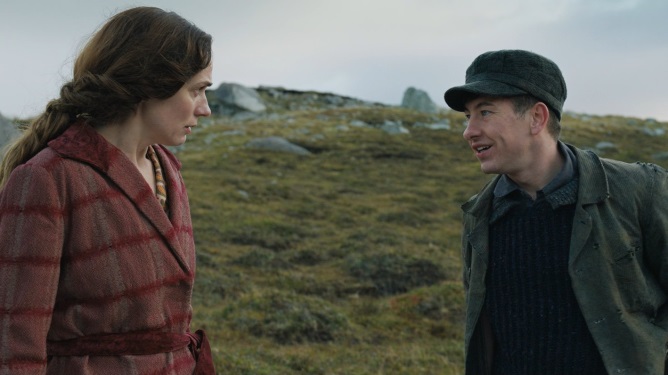
Pádraic (Colin Farrell) and Colm (Brendan Gleeson) are life-long friends on the small Irish island of Inisherin. Until one day, in 1923, Colm bluntly says he won’t speak to Pádraic again as “I just don’t like ya no more”. What on earth has led to this seemingly permanent severance? Did Pádraic do something wrong? The torment of not knowing will create a huge strain on Padraic, who prides himself on “being nice” and can’t understand why the older Colm doesn’t want to chat him. Just as Colm can’t understand why Pádraic can’t leave him alone, especially as he is almost universally agreed to be dull. Eventually this blunt stop to a friendship swiftly escalates out of all control.

McDonagh’s film is packed with the scintillating dialogue you would expect, and he combines it with an intriguing, tragedy-tinged character study where two sympathetic characters tip themselves into destruction through the unwillingness of either of them to compromise. It’s no coincidence that the film is set during the Irish Civil War. Cut off from the mainland on their tranquil island (where life feels like it hasn’t changed for the best part of 100 years), the characters are disturbed from their own civil war, every now and again, by the sound of gunfire and explosions from the mainland. The Banshees of Inisherin can be seen as a commentary on civil wars: don’t they all start, essentially, from someone deciding they have had enough and “just don’t like ya” anymore?

This marvellously rich film boils down a whole country tearing itself apart over what sort of future it wants, into one personal clash over two people’s future. The future increasingly obsesses Colm, a man preoccupied with mortality (who assumes his life can now be counted in years rather than decades), suffering from depression, worried he will disappear leaving no mark. A talented fiddle player, he wants to be like Mozart, remembered decades later – and he can’t do that wasting time every day for hours on end listening to Pádraic talking about his “wee donkey’s shite”.

It’s a perspective on the future, that Pádraic just can’t understand. For him, what does it matter what people you’ll never meet think about you? What matters to him is that the people around him like him and remember him as a “nice fella”. Not in a million years does legacy occur to him: the familiarity of everyday being the same is the most comforting thing, and change a horrific and terrifying thing to be avoided as much as possible.

You can see all this instantly in Colin Farrell’s heart-rending performance as this gentle, fragile but unimaginative soul, heart-broken at the inexplicable loss of his best friend. The film is a striking reminder that, contrary to his looks, Farrell’s best work is in embodying lost souls, the sort of people never ready for the life’s hurdles. Pádraic certainly isn’t, and his attempt to process what has happened defeats him. A man who considers his pet goat his next best friend and is as reliant as a child on his sister, doesn’t have the ability to understand what Colm is driving at about mortality, assuming instead he will stumble across the right words to be welcomed back into Colm’s company. He becomes the unstoppable object, trying to batter down Colm’s wall of silence.

He’s onto a losing battle, as Colm reveals himself to be – either due to his depression or his just not caring any more – the immovable force. Wonderfully played with a tinge of sadness and a depression-induced monomania, by Brendan Gleeson, Colm is a decent guy in many ways but fails to appreciate or consider the effect his actions will have on others. Instead he is focused on achieving at least something notable from his life. It leads to dramatic steps to drive Pádraic away, Colm threatening to cut off one of his fiddle playing fingers every time Pádraic bothers him, a threat he transpires to be more than willing to carry out.

And so civil war breaks out. As well as the parallels with Ireland’s war, I also felt strong echoes of our own poisoned social-media discourse. By his own lights, Colm believes his sudden severing of contact with Pádraic is perfectly reasonable. Many people who have “ghosted” others no doubt feel the same. Colm is reasonable when he explains it, and he still steps in with silent acts of comfort and support when Pádraic falls foul of the island’s brutish police office. But he never considers the traumatic impact this unexplained change will have on Pádraic – or how flashes of kindness can be as cruel as hours of non-acknowledgement.

Radicalism, in civil war and social media, quickly takes hold. What else can you call Colm’s threat to slice off his own fingers (the fingers he needs to live his dream of fiddle-playing legacy)? Just like people blowing hard on Twitter, he needs to deliver or lose face. Pádraic makes angry, passionate condemnations of Colm in the pub, like he’s posting rants online. Things escalate to a point where no-one feels they can step away or backdown.

That’s the tragedy McDonagh identifies here. This one decision of Colm’s – no matter the motives – ends up having disastrous effects on both men. Pádraic changes from a gentle soul to someone capable of wrathful fury and lifelong grudges. Colm literally disfigures himself, guaranteeing he will never achieve the very thing he started this for. Could there be a better parable for the destructive nature of civil combat? Neither Colm or Pádraic are willing to compromise: what if Colm said he would only see Pádraic once or twice a week, eh? Just like Ireland, they burn the world down.

This all takes place in a rich framework, with McDonagh skilfully working in clever, challenging sub-plots. The legend of the banshee, who foretold death and enjoyed watching destruction, is woven throughout, embodied by the sinister Mrs McCormick (a ghostly Shelia Fitton). The most forward-looking person on the island is Pádraic’s sister Siobhan – brilliantly played by Kerry Condon – who finds herself wondering why on earth she stays in such a self-destructive small-world. Barry Keoghan (also superb) plays the universally acknowledged village dunce, who (if you stop and listen to him) quotes French and poetry and (for all his crudeness and lack of social graces) is clearly a man stunted under the heel of his abusive father, the village policeman.

As events escalate and rush out of control – McDonagh’s pacing is very effective here – the film slows for carefully judged moments of emotional power, from the burial of a beloved pet to a character weeping in bed at the painful choices that must be made. McDonagh has created a powerful universal metaphor for the dangers of extreme, definitive choices and a total rejection of compromise by boiling it down to the smallest scale possible.

And your sympathies ebb and flow, due to the beautiful performances from its leads. Farrell is heartbreaking, a memory you carry as he becomes more vengeful. Gleeson is coldly reasonable, even as we grow to understand his crushing sense of mortality and character-altering depression. These two actors power an intelligent and thought-provoking film that achieves a huge amount with subtle and rewarding brushstrokes.

Shadow of a Doubt (1943)

Shadow of a Doubt (1943)

A small town family is corrupted by a malign force in Hitchcock’s favourite of his films

Director: Alfred Hitchcock

Cast: Teresa Wright (Charlie Newton), Joseph Cotton (Uncle Charlie Oakley), Macdonald Carey (Detective Jack Graham), Henry Travers (Joseph Newton), Patricia Collinge (Emma Newton), Wallace Ford (Detective Fred Saunders), Hume Cronyn (Herbie Hawkins), Edna May Wonacott (Ann Newton), Charles Bates (Roger Newton)

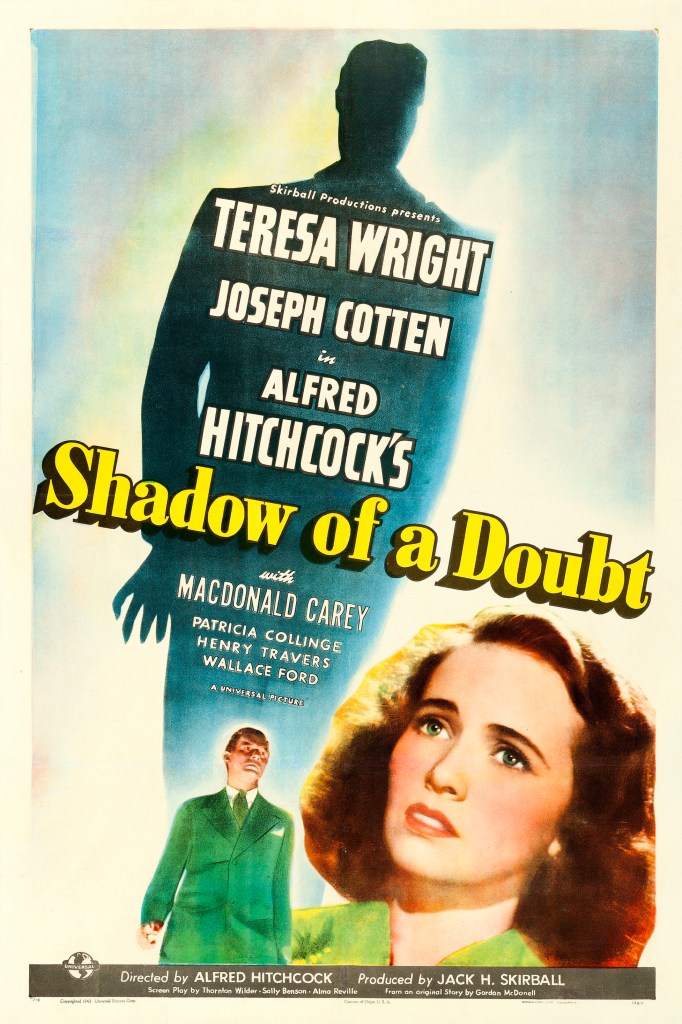
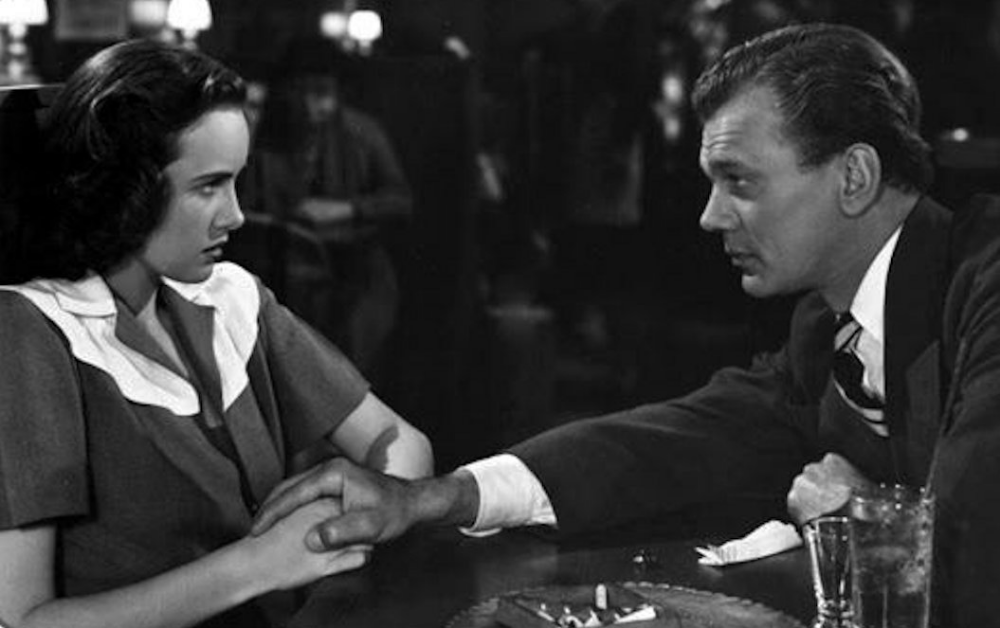
It’s a surprise to discover Shadow of a Doubt was Hitchcock’s favourite of his films (although the Master of Suspense was a notorious kidder). It rarely makes even the top ten of Great Hitchcock’s and for years was semi-forgotten in his CV. But delve into this small-town chiller and it becomes less of a surprise the master was so fond of it. Hitchcock’s first American-set film (his previous American films being British-set), this takes an idyllic, everyone-knows-your-name, no-doors-locked small town in California and injects into the middle of it a ruthless sociopath, as charming as he is shockingly ruthless. Doesn’t that sound like Hitchcock all over?

That small-town is Santa Rosa in California. There the Newton family is thrilled at the imminent arrival of Uncle Charlie (Joseph Cotton) from New York. None more so than his niece Charlie (Teresa Wright), a precocious teenager who shares her uncle’s wit and worldly wisdom. He arrives laden with gifts – but also dragging two police detectives and swirling rumours of terrible crimes. Surely Uncle Charlie – hero to all and idol of his niece – can’t also be the ruthless “Merry Widow” killer, dispatching aged widows for their riches? And, if he is, what on earth will Charlie do about it?

A lot of what would become Hitchcock’s central concerns in his later, darker, mature works make their inaugural appearance in this dark, creeping mystery. Everything in the Newton home is perfect, until they welcome Charlie, whose amiable greed and self-interest tarnishes everything he touches. Despite this, he’s the most likeable, charismatic, charming character in the film. So much so, a big part of us wills him not to be the murderer we can all be pretty confident he is. He’s far too exciting and dynamic for us to want him torn away from us!

The two Charlies are close – so much so Hitchcock would surely have dialled up the incestuous spark between them even further if he had made the film fifteen years later. They have a near supernatural mental bond, seemingly able to predict where and when the other might be. They laugh and flirt. In arguments Uncle Charlie grasps his niece like a frustrated lover, clutching her too him. As well as sharing many character traits (implying it would be easy for Charlie to become like Uncle Charlie) they’re closeness feels as much like a courtship as it does familial closeness. When Uncle Charlie takes Charlie to a gin bar to gain her confidence and support to hide from the cops, the entire scene feels like the appeal of a would-be lover.

It overlaps another theme future Hitchcock have taken further: the thin line between innocence and killer. Uncle Charlie and his namesake have a special bond. They share the same world-view and many of the same ideas. They’re both charismatic and natural leaders. They both feel stifled by this small-town world. They are both ruthlessly determined when roused. One of them might be innocent and one might be good – but how much of a push would it be to turn one into the other?

Hitchcock probes this possibility throughout in a film stuffed with doubles and duality. Both Charlies are introduced with similar shots of them lying in bed, being questioned by others. Later Uncle Charlie will inherit Charlie’s room in the house. Greeting each other at the station, they move towards each with mirroring shots. They share the same name. Twins, doubles, mirrors and the number two abound in the film – a marvellous blog here captures this all in far more detail and insight than I could here.

Uncle Charlie slithers into Santa Rosa like the serpent into the garden of Eden. He offers temptation left, right and centre. The Newton family receive lavish (stolen) gifts. His brother-in-law’s bank gets a investment from the cash Uncle Charlie carries around (he’s old fashioned you see). He laughs and jokes, reminds Charlie’s mother of the joys of her past and inveigles himself into the heart of the family (he even sits at the head of the table). But he’s also a dark, sinister figure, frequently framed at the top of staircases, marching inexorably towards camera and (in one stand out moment) breaking the fourth wall to address us directly while coldly, contemptuously outlining his theory about the pointless burden useless lives have on the rest of us.

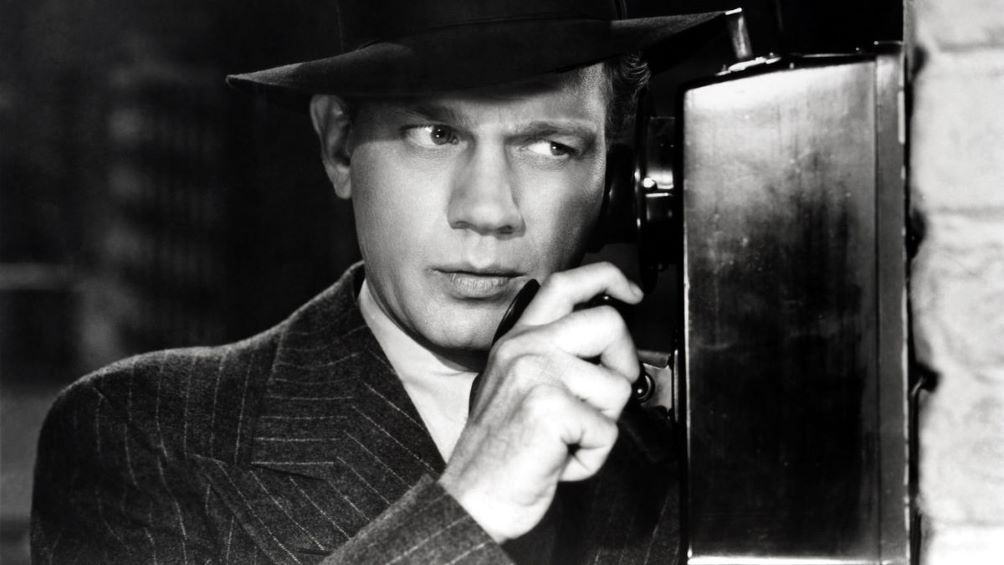
He’s played with a charismatic, cold-hearted, jovial wickedness by Joseph Cotton. Cotton is so good as this on-the-surface amiable man, with a soul devoid of any love, it you’ll wish he’d got parts like this more often. Liberated from playing decent best-friends, Cotton dominates the film with a malignant charisma, married with a growing only-just-concealed desperation at the fragility of his fate. Opposite him, Teresa Wright is marvellous as a young woman who finds her sense of morality fully awakened into outrage by this dark presence corrupting everything in her life.

Corruption is central to Shadow of a Doubt – no wonder Hitchcock loved it – with Uncle Charlie turning everything in the simple, honest town into something darker and tainted by his very presence. There is an almost cliched home-spun decency about the town (almost as if co-writer Thornton Wilder was parodying his Our Town), serving to make Uncle Charlie’s modern sociopathy even more of a destructive force.

Shadow of a Doubt is directed with immense care, but a great deal with subtle flourish. Staircase shots abound, to stress sinister motivations, positions of weakness and unease. Characters lurch towards the camera frequently, as if the whole film was hunting us down. An air of menace, lies and danger builds inexorably as Uncle Charlie’s true-nature leaks out. There is also wit: not least from Charlie’s father (a jovial Henry Travers) and eccentric neighbour (a scene-stealing Hume Cronyn) gleefully discussing true crime throughout. There is also Hitchcock’s love of irony, not least in the fact Charlies problems are largely caused by his attempts to conceal a newspaper article that otherwise would have gone unnoticed.

Hitchcock makes his cameo early on as a card player on a train journey. He’s revealed to be holding all the trumps. That’s how he likes it: and perhaps explains his fondness for Shadow of a Doubt. Low key but perfectly constructed, it’s a film that latches onto themes of corruption, dark temptation and ruthless violence. Film logic abounds – who cares that the detective’s investigation is so inept they’d never be employed again – and the second half is crammed with murder attempts as unsubtle as they are ingeniously dark. Shadow of a Doubt feels like a prototype for darker themes of obsession and temptation Hitchcock would explore in the future. Perhaps that’s why he was so fond of it: it’s where he started to spread his wings.

Zorba the Greek (1964)

Zorba the Greek (1964)

The popular image of Greece gets largely defined, for better and worse, in this flawed, over-long, tonally confused film

Director: Michael Cacoyannis

Cast: Anthony Quinn (Alexis Zorba), Alan Bates (Basil), Irene Papas (The Widow), Lila Kedrova (Madame Hortense), Sotiris Moustakas (Mimithos), Anna Kyriakou (Soul), Eleni Anousaki (Lola), George Voyagjis (Pavlo), Takis Emmanuel (Manolakas), George Foundas (Mavrandoni)

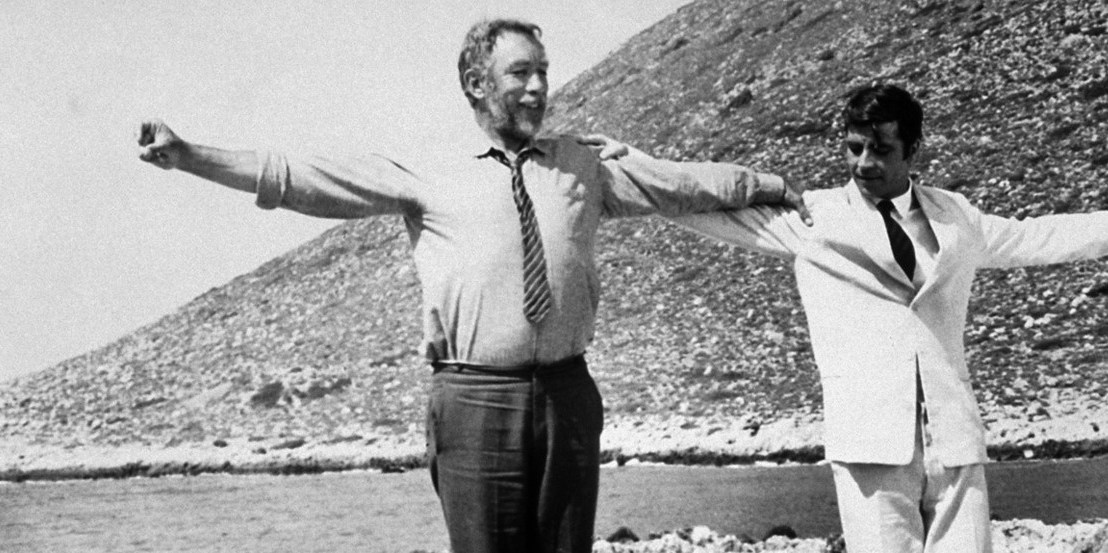
Basil (Alan Bates) a Greek-British writer, returns to Crete to try and make a success of his late father’s lignite mine and rediscover his roots. Joining him is Zorba (Anthony Quinn), a gregarious peasant, who believes in confronting the world’s pain with a defiant joie de vivre. In the Cretan village, their friendship grows and they become involved (with unhappy results) with two women: Basil with the Widow (Irene Papas), lusted after by half the village, and Zorba with ageing French former-courtesan Madame Hortense (Lila Kedrova).

Zorba the Greek was based on a best-seller by Nikos Kazantzakis, directed by Greece’s leading film director Michael Cacoyannis. Matched with Anthony Quinn’s exuberant performance, it pretty much cemented in people’s mind what “being Greek” means. So much so the actual film has been slightly air-brushed in the cultural memory. Think about it and you picture Quinn dancing on luscious Greek beaches. There is a lot of that: but it’s married up with a darker, more critical view of Greek culture that sits awkwardly with the picture-postcard tourist-attracting lens used for Crete.

Nominally it’s a familiar structure: the stuffed-shirt, emotionally reserved, timid and sheltered, is encouraged into a bit of carpe diem by a larger-than-life maverick. As is often the case, he needs t build the courage for romance and work on an impossible dream. Zorba the Greek however inverts this structure: the main lessons Zorba teaches is that you have to meet disaster just as you would meet triumph: with a shrug, a smile and a dance. It’s decently explored – and it lands largely due to Quinn’s barnstorming iconic performance – but also slight message. And Cacoyannis never quite marries it up successfully with the tragic consequences in the film.

Shocking and cruel events happen to the two female characters. The Widow – never named in the film – is loathed and loved by the men of the village, because (how dare she!) she’s not interested in sleeping with them. Played with an imperial distance by Irene Papas, she is condemned as a slut the second she does make a choice about who she welcomes into her bed (Basil, once). Madame Hortense (played with a grandstanding vulnerability by Oscar-winner Lila Kedrova) enters into a one-sided relationship with Zorba. Led to believe (by Basil) Zorba intends marriage, she becomes a joke in the village. Both women’s plot end with shocking, even savage, results.

A braver and more challenging film than Zorba the Greek would have used these events to counter-balance the light comedy and romance of the Greek vistas and Mikis Theodorakis’ brilliantly evocative score, by more clearly commenting on the darkness and prejudice at the heart of the village. In this Cretan backwater, lynching is perfectly legit, women are public property and even our heroes powerlessly accept what happens as the way of things. A smarter film would have pointed out that, in a savage land, Zorba’s ideology is essential or had Basil question his romantic view of Greece once confronted with the barbarism it’s capable of. Neither happens. Instead, the fate of these women is just another of life’s curveballs – the very thing that Zorba has been trying to train Basil to look past. They become learning points on our heroes journey.

Cacoyannis’ rambling script makes a decent fist at trying to capture the mix of Greek life and philosophical reflection that filled Kazantzakis novel. But he fails to bring events into focus or make any real point other than a series of picaresque anecdotes. Tonally the film shifts widely: a boat journey to Crete is played as slapstick, the eventual fate of the Widow chilling horror, the relationship between Zorba and Basil a buddy-movie tinged with the homoerotic. It’s a film that tries to cover everything and ends up not quite exploring any of its successfully.

It’s most interesting note today is homoeroticism. Helped by the casting of Bates, an actor whose screen presence was always sexually fluid (and who is excellent here), it’s hard not to think that Basil and Zorba are most interested in each other. Basil gets jealous, moody and lonely when Zorba leaves for weeks to fetch “supplies” from a local town. Zorba is equally fascinated by the twitchy and shy Basil, coming alive with him in a way completely different to the gruffness he shows to the other characters. Most happy in each other’s companies, there’s a fascinating homoerotic pull here that the film skirts around (not least by making sure both men have female love interests).

Basil is a curious character, strangely undefined and ineffective who listens a lot to Zorba’s messages but seems to learn very little. When the village turns on the Widow he watches like a lost boy. Zorba effectively takes over his home. The one time he tries to live life to the full, it leads to disaster. He remains strangely unchanged by events, which I am sure is not the films intention.

This misbalance is because the film really should be about him and the changes made to his life. It isn’t, because Quinn dominates the screen. A Latin American who most people thought was Italian or Arabic, here becomes the definitive screen Greek. Quinn’s performance here is his signature, grand, performative but also sensitive and strangely noble under the surface, a bon vivant just the right side of ham. He makes Zorba magnetic and hugely engaging and it says a lot that the Greeks effectively claimed him as one of their own. But he does seize control of the film and tips its balance away from its central figure.

Zorba the Greek is a crowd-pleaser, show-casing Greece, that skims on making a more profound impact on how beauty and savagery can live so close together. It doesn’t want to sacrifice the romance too much by staring too hard at the brutality. Tonally, Cacoyannis doesn’t successfully balance the film and its overextended runtime stretches its slight message. But, with its marvellous iconic score and wonderful performances, it’s got its moments.

Peyton Place (1957)

Peyton Place (1957)

Small-town America is the home of hypocrisy in this ridiculously silly soap opera that spawned…a long-running TV soap opera

Director: Mark Robson

Cast: Lana Turner (Constance MacKenzie), Diane Varsi (Allison MacKenzie), Hope Lange (Selana Cross), Lee Philips (Michael Rossi), Arthur Kennedy (Lucas Cross), Lloyd Nolan (Dr Matthew Swain), Russ Tamblyn (Norman Page), Terry Moore (Betty Anderson), David Nelson (Ted Carter), Betty Field (Nellie Cross), Mildred Dunnock (Elsie Thornton), Leon Ames (Leslie Harrington)

Small-town America: what mysteries lie behind those white picket fences? If the small New England town of Peyton Place is a guide, all sorts of terrible things. Why is Constance MacKenzie (Lana Turner) so afraid of sex and romance? Could her fear that the slightest kiss could turn her would-be-writer teenage daughter Allison (Diane Varsi) into a slut, be rooted in her own mysterious past? Why does Allison’s friend Selena (Hope Lange) fear her drunken and lecherous step-father Lucas (Arthur Kennedy) so much? Why is Mommas-boy Norman (Russ Tamblyn) so shy?

If that all sounds like the set-up for a great-big TV soap… well that’s because it essentially is. Peyton Place was a huge box-office success in 1957, but you can argue it found its natural home when it later mutated into a long-running TV soap. It’s one long onslaught of high-flung, ridiculously OTT events, all filtered through the sort of dialogue punctured by swelling music to hammer home the feelings. Peyton Place is completely disposable – but also strangely enjoyable, rollicking along like all the best soaps do, so full of events that you don’t have time to stop and realise how silly it is.

Adapted from a doorstop popular novel, screenwriter John Michael Hayes faced quite a task. The original was crammed with sex, foul language and everything from murder to teenage pregnancy, illegal abortions, rape and incest. That’s not exactly the sort of stuff the Hays Code dreamed of. Peyton Place: The Movie is almost a triumph in how much of this stuff it manages to cover, all in a very cunning, under-the-radar way. Sure, the rough edges are shaved off (and, of course, not the hint of a cuss word makes it to the screen) but it still manages to tick a lot of those boxes.

It’s all to hammer home the hypocrisy of small-town America. Curtain-twitching busybodies watch every moment, leaping for their phones at the merest hint of scandal: from kisses out of school to teenage kids skinny dipping (bet they can’t believe their luck when an actual murder happens). Peyton Place follows in Picnic’s footsteps (to which it is vastly superior, equally shallow but much less pleased with itself and far more entertaining) in exposing the hypocrisy of 50s America, where everybody goes to church and no-one practices the good-will and love it preaches (and yes, I know the film is set in the 1940s, but no one told the costume or production designers).

Peyton Place was littered with acting nominations (in a year where 12 Angry Men got none, for Chrissakes!). It’s a little hard to understand why, considering every part fits neatly into a trope. Lana Turner is the nominal lead as the frigid clothes-store owner who hides a secret shame (all about that long-lost husband) that gets in the way of her flirtation with the newly arrived schoolmaster (played with smug dullness by Lee Philips). But that’s only because she’s the most famous actor in it. Her performance sets a sort of template for mothers that would be repeated countless times.

The real leads (both Oscar nominated for Supporting Actress) are Diane Varsi and Hope Lange as the two teenagers at the heart of Peyton Place’s ocean of hormones (although, it being a 50s film, a smooch at a booze-free party is the furthest anyone goes). Varsi narrates most of the film as a precocious would-be writer, with several grandstanding scenes wailing at her mother for being so unfair. It’s a broad but engaging performance and she manages to make Allison not quite as wet as she could be. She also gets a shy romance with nervous Norman Page (a gentle Russ Tamblyn, also nominated): Norman is clearly closeted, struggling with his sexuality in a small town (“I don’t know how to kiss a girl” he says) but the film does its best to overlook this.

More engaging is Hope Lange, who gets the juiciest material to play. The film is surprisingly daring in staging her rape by her boorish step-father (a slightly too ripe Oscar nominated Arthur Kennedy, although still the most memorable male performance). Robson’s camera pans up from her being pinned down, to her raised hands and then finally cuts outside. Lange plays the trauma of this – including an unwanted pregnancy, removed by the Doctor in an abortion the film bends over backwards to make an accident-induced miscarriage – with a great deal of vulnerability and empathy, her shame and desperation rather moving.

It makes her the target for gossip. Peyton Place smugly ticks off small-town America for its gossipy meanness – while still peddling a message that, if we just followed the warmth of the best of small-town values, the world would be a better place – ending with Lloyd Nolan’s doctor delivering a pompous ticking-off to the town (from the witness box during a murder case no-less). Peyton Place at heart is a fairly conservative film, that ends with most people discovering their inner-goodness (apart from a few irredeemable harridans), and all wickedness resolved.

It’s directed with workmanlike professionalism by Mark Robson, but it didn’t need inspiration. It’s odd to consider this had nine Oscar nominations, since it feels like the sort of disposable mini-series Netflix throws together every week. Its main claim to fame might be that its quaint small-town smugness, masking a bucketload of scandal, served as the main inspiration for Twin Peaks (though dialled up to a whole other level of weird). It’s overlong, overblown and very silly, but because it doesn’t take itself seriously (unlike heavy-duty message film that year Sayonara, a silly soap that thought it was Pulitzer material) it’s actually ridiculously entertaining, in a totally trashy way.

Picnic (1955)

William Holden stirs up a small-town – and Kim Novak – in Picnic

Director: Joshua Logan

Cast: William Holden (Hal Carter), Kim Novak (Madge Owens), Rosalind Russell (Rosemary Sydney), Betty Field (Flo Owens), Susan Strasberg (Millie Owens), Cliff Robertson (Alan Benson), Arthur O’Connell (Howard Bevans), Verna Felton (Helen Potts), Reta Shaw (Irma Kronkite)

In a small Kansas town in the early 1950s, everything is sweet as apple pie. But under the surface, tensions bubble – and it only takes a stranger changing the status quo to make them explode. In William Inge’s Pulitzer-Prize-winning play – bought to the screen by original Broadway director Joshua Logan – that stranger is Hal Carter (William Holden), failed sportsman, actor and college drop-out, drifting into town looking for a new start from old friend Alan (Cliff Robertson). But Hal, an amiable screw-up, quickly puts himself in the middle of a love triangle between Alan and his girlfriend Madge (Kim Novak), the local beauty tired of being judged only by her looks.

All this eventually explodes into a series of furious confrontations where the true colours of various participants are revealed. In the 1950s Picnic looked like a criticism of the cosy conservatism of small-town America. But today, it actually feels more than a little nostalgic for the lost innocence of those times. Sure, some people in the town are less than sympathetic, or their lives have been crushed by the expectations of others. But generally, with its pastel colour palette and its generally fundamentally well meaning characters, it now feels a rather reassuring watch.

Like many films that pushed the envelope at the time, it also looks rather tame today. The film is strong on demonstrating the impact of the sexuality of a topless Holden on the women of the town – nearly all of whom go weak at the knees. But generally, the film’s sexual content now looks remarkably safe and gentle. A sense of powerful longing for something missing from their own lives does comes across strongly – Russell’s Mrs Sidney, worse for wear from drink, ends up feebly trying to pull up Holden’s trousers to look at his legs while dancing. But the sexual outbursts largely restrict themselves to that and a few passionate clinches.

Logan’s film throws in a few big visuals (such as the closing helicopter shot as a bus drives out of town) and clearly enjoys its location shooting, but remains stage-bound. Several scenes translate across exactly to backyard locations, the same sets in all but name that appeared on stage. It also struggles to fill the cinemascope screen, for all that James Wong Howe’s photography has a certain Autumnal beauty to it (you won’t see any vibrant greens, reds or yellows). In addition, many of the actors go for somewhere between naturalism and a mannered Broadway show-boating.

Perhaps the main issue is that film dwarves this slight and intimate story. Moments of intimacy that on stage you feel carry impact – heartfelt declarations and tortured confessions – don’t carry nearly so much on screen. In fact, the story ends up feeling rather slight and even predictable: the drifter has depths, but the town unfairly turns against him, the old-maid schoolteacher is deeply frustrated, the local beauty juggles depression, the good natured son of the local bigwig is a self-entitled bully. None of this really feels revelatory and, on screen, easily drifts by with little impact.

Logan’s stagy style also has a mixed impact on the acting with some going for a cinematic underplaying, and others inspired by a theatrical grandness to embrace the big moments. Leading the way in that camp is Rosalind Russell who gives a strong performance as the frustrated schoolteacher, but frequently allows herself to go a little too far in moments of emotional outburst. It’s particularly noticeable as she’s paired with Arthur O’Connell (reprising his Broadway role, and getting an Oscar nomination) who underplays with a quiet wit and honesty.

One of the film’s principle problems are with the two leads. William Holden gives a fine performance – fun-loving and kind but also cutting a rather sad and tragic figure behind the bonhomie – but is blatantly too old for the role. Hal is probably meant to be in his 20s – Holden was 37 and, with his craggy face, actually looks older. While it does add a level of Hal being increasingly irresponsible for his age, the part really means a charismatic youngster dripping sex appeal (think James Dean – Paul Newman was turned down for the part). Opposite him the inexperienced Kim Novak does, at times, give her line readings a striking genuineness but at others comes across as slightly wooden.

A stagy and slightly old-fashioned watch today, Picnic was nominated for several Oscars, but increasingly looks rather like a celebration rather than a gentle criticism of the small-town values it depicts.

The Last Picture Show (1971)

last picture show header
Timothy Bottoms, Jeff Bridges and Cybil Shepherd are making the best of small-time life in The Last Picture Show

Director: Peter Bogdanovich

Cast: Timothy Bottoms (Sonny Crawford), Jeff Bridges (Duane Jackson), Cybill Shepherd (Jacy Farrow), Ben Johnson (Sam the Lion), Cloris Leachman (Ruth Popper), Ellen Burstyn (Lois Farrow), Eileen Brennan (Genevieve), Clu Gulager (Abilene), Sam Bottoms (Billy), Randy Quaid (Lester Marlow), Gary Brockette (Bobby Sheen)

“Anarene, Texas, 1951. Nothing much has changed…” So went the tagline for Peter Bogdanovich’s The Last Picture Show. Change, or rather the lack of it, is the heartbeat of this film. It’s small time (fictional) Texas town isn’t a million miles from the Wild West dustbowls. You feel nothing has really changed for decades, the same faces in the town have just got older. But the tagline suggests that, in many ways, the 1950s were not that different from the progressive 1970s. Sex and scandal lie under the surface of the town, with the inhabitants having little to distract them from boredom other than seducing each other. Unlike the sort of traditional films shown in the picture show – Father of the Bride or Red River – this town is just drifting, a change in America both round the corner but also feeling like something that would slide off the town like water from a duck’s back.

The film largely follows three high schoolers are preparing for graduation. Sonny (Timothy Bottoms) and Duane (Jeff Bridges) are on the town’s useless high school football team (a uselessness no-one will let them forget). Duane is dating Jacy (Cybil Shepherd), a woman just discovering the power of her looks – and Sonny longs for her himself. Instead, Sonny starts an affair with Ruth Popper (Cloris Leachman), the overlooked, lonely housewife of his football coach. Romantic entanglements abound, but life drifts on with the younger generation thinking sometimes of the future, but really repeating the mistakes of the older generation – people like Jacy’s cynical mother Lois (Ellen Burstyn) and the owner of the town’s pool-hall, cinema and diner, the fading conscience of the town Sam the Lion (Ben Johnson).

Bogdanovich’s film was a sensation when it was released, a key part of the New Wave films in Hollywood. It has lasted, in the way other films from the period haven’t, because it has a subtly simple but compelling story, shot as a perfect fusion of French New Wave styles with John Ford and Orson Welles inspired classicism. Bogdanovich’s film buffery is obvious from every frame – not just from the film posters announcing what is being shown at the picture palace, but also from its loving use of French-style realism and lack of glamour, set and framed in the Fordian style, often stressing isolation, intercut with homages to Kane, The Magnificent Ambersons and Touch of Evil.

And in it we have a series of young people who seem to have no idea either where they, or the world is heading. Timothy Bottoms acts with such effortless naturalism, it’s easy to forget he is even acting at all. It’s a perfectly judged performance of a very normal young man, low on aspiration and inspiration, selfish in the way the young are but full of passion and regret. Jeff Bridges is similarly brilliant, playing a not-particularly smart (or particularly successful) school sports star in a performance completely free of any condescension or camera winking, but played with a charming honesty. These are supremely normal young men. Generally decent, well-meaning and naïve, not knowing what it is they want or need from life. They would fit as neatly into 1971, with their dreams, as they do in 1951. Especially as Duane packs off to head to Korea (no real difference from Vietnam).

And a lot of these dreams revolve around sex – and often sex with Jacy. Cybil Shepherd was a sensation on the film’s release, seen as the ultimate late-teen temptress and sexpot. But in fact, Jacy is (in her way) as much of an innocent as the others. She’s a woman only just discovering her own passions and longings. Who doesn’t want to become the jaded figure her mother has become – but working out the easiest way to get what she wants (be that a better boyfriend, better chances or even just some attention) is through using her physical attributes. Her sexual experimentation is, in a way, liberating – and just another attempt to find an answer to her own aimlessness. Sure – encouraged by her mother – she doesn’t invest anything emotionally in these entanglements. But is it really all that different from Sonny’s own using of Ruth Popper?

Ruth Popper is emblematic of the sadder older generation in the town. You can imagine they must have had hopes and dreams – or were once as breezily uncaring – as the younger generation. But they’ve found out, just as they will, that things don’t change. That you can blink and find yourself twenty years down the line, unhappy and lonely in a place you can’t seem to escape.

Cloris Leachman is outstanding as Ruth (she won an Oscar), the only person in the all the film’s couplings that we see expressing tenderness and vulnerability (in a film full of sexual encounters, the most intimate thing we see is her combing Sonny’s hair). She dares to slowly open herself up emotionally to believing in Sonny – to seeing their affair as more than just the booty call it starts as, but as something with a future. From the tearful fragility of her first scenes – her buttoned up matronly appearance, making her look far older than she is – she blossoms into a warmer, excited, person. It makes her inevitable betrayal by Sonny all the more heart-wrenching – along with her self-loathing fury that closes the film.

All the adults are drifting through the same disappointing life. Ellen Burstyn (also nominated) is wonderful as Jacy’s mother, who continually defies expectations. This mother is unfazed by her daughter sleeping with her lover, suggests that she might as well experiment sexually so she can find out it’s not all that and carries a revelation of deep loss and personal tragedy that only comes to light late in the film but is there in the character from the start. Other adults seem equally aware of their pointlessness: the coach is a repressed homosexual, the English teacher seems resigned to teaching Keats to bored students, Jacy’ father is a blow-hard nobody, Sonny’s father is a stranger to him. Only Eileen Brennan (excellent) motherly waitress still seems to have some hope.

Sonny’s surrogate father – and the heart of the film – is local businessman Sam the Lion. Johnson is superb, gifted a surprisingly small number of scenes but which establish both his moral force and his position as a link to a halcyon days past in America that might not really exist. Bogdanovich gives Johnson a knock-out speech (surely what won him the Oscar) – an Everett-Sloane-in-Kane inspired remembrance of a relationship from long ago, where the world seemed full of hope and opportunity, that perhaps get closest to defining the film’s sad reflection on how little those two things actually seem to exist in the present.

But it’s also about the temptation of memory. Bogdanovich’s masterpiece (it was all downhill in his career from here), The Last Picture Show knows only too well how quickly we realise life is a confusing, compromised mess. And the film, for all its old-school Hollywood style, is all about the past being just as a confusing, empty, sex-filled place of loss as the present is. Things have always been like this – and they probably always will. Welcome to Anarene. Nothing has changed.

Thelma and Louise (1991)

Susan Sarandon and Geena Davis hit the road in Thelma and Louise

Director: Ridley Scott

Cast: Susan Sarandon (Louise Sawyer), Geena Davis (Thelma Dickinson), Harvey Keitel (Detective Hal Slocumb), Michael Madsen (Jimmy Lennox), Christopher McDonald (Darryl Dickinson), Stephen Tobolowsky (Max), Brad Pitt (JD), Timothy Carhart (Harlan Puckett)

Two people on the run, dodging the police and doing what they can to survive. It’s a well Hollywood has gone back to time and time again. But in most cases the people were either two men, or maybe a man and a woman (romantically involved naturally). It was unheard of to make that most masculine of genres, the outlaw road movie, into one led by women. But that’s what we get here, in a movie that has become iconic in more ways than one, Thelma and Louise.

Louise Sawyer (Susan Sarandon) is a tough, independent-minded waitress. Thelma Dickinson (Geena Davis) is a shy housewife, whose husband Darryl (Christopher McDonald) is a jerk. With Darryl away for the weekend, Thelma and Louise head off for a weekend away together, to let their hair down and feel a bit of freedom. Unfortunately, disaster happens when Thelma flirts with a sleazy guy in a Texas bar (Harlan Puckett), who tries to rape her in the car park. Louise saves her – but guns the guy down. The two women now find themselves on the run from the law, terrified that no one will believe their side of the story. But as the women find themselves on the road, the experience changes them, with Thelma flourishing in an environment where she can make her own choices and Louise becoming more able to open herself up emotionally. But can they stay ahead of the law?

With a terrific (Oscar-winning) script from first-time writer Callie Khouri, Thelma and Louise offers a dynamic and daring twist on the Hollywood road movie. By placing women at the centre of a story like this, a fascinating new light is shed not only on the law, but also on the culture of the American South. It also gives what would otherwise be familiar situations, a fascinating new light as two underestimated people are forced to prove time-and-time again how ahead of the game they are.

Ridley Scott directs the film with a beautiful, confident flourish. The John Fordian iconography of the West is a gift for a painterly director like Scott, and this film hums with the sort of eye for American iconography that only the outsider can really bring. The film brilliantly captures the dusty wildness of the West as well as the neon-lit grubbiness of working class American bars. It looks beautiful, but also vividly, sometimes terrifyingly real. Scott then, with a great deal of empathy, builds a very humane story around this, with two characters it’s nearly impossible not to root for.

He’s helped immensely by two stunning performances from the women in the lead roles. Susan Sarandon’s is perfect for the brash and gutsy Louise, not least because she’s an actor brilliantly able to suggest a great emotional depth and rawness below the surface. Louise is a women juggling deeper traumas – past experiences (its implied a historic rape) that leave her in no doubt that the justice system will not be interested in hearing about a woman’s suffering. It’s the hard to puncture toughness that softens over the course of the film, as Louise becomes more willing to explore her emotions and allow her vulnerability to show.

Particularly so as the lead between the two is slowly taken over by Geena Davis’ Thelma. This is certainly Davis’ finest work, her Thelma starting as a beaten down housewife, just trying to let her hair down in a bar, into a scared victim, a horny teenager lusting over Brad Pitt’s hunky JD then finally into a road warrior who discovers unimagined determination and resources inside herself, toting guns and robbing stores. It’s the sort of once-in-a-lifetime part Davis seizes upon. She’s sensational and totally believable at every turn.

Placing these two women at the centre of a story like this puts the feminine perspective front-of-centre – and it’s alarming to think how little some things have changed. Can we imagine today that there wouldn’t be policemen and lawyers willing to blame Thelma – or claim she asked for it – for her near rape in a bar? Or that there wouldn’t be a fair crack of the whip in the system for Louise for gunning down an unarmed rapist? On top of that, the majority of the police tracking the two women (with the exception of Harvey Keitel’s decent cop – Keitel is very good in this) find it hard to take “these girls” seriously, finding it hard to imagine them being anything other than a joke.

Mind you the attitudes of men are laid bare at every turn. Thelma’s husband Darryl (a very good performance of selfish patheticness by Christopher McDonald) is a waste of skin, a man who can’t imagine a world where Thelma could be his equal. Timothy Carhart is all charm until Thelma denies him the sex he believes he was due for in exchange for a night if flirting and drunks, and promptly turns extremely nasty. The cops – gun totting with itchy trigger-finger – just seem to be waiting for an excuse to throw the ladies down. Even JD (a star marking early performance by a deeply attractive and charismatic Brad Pitt), who seems so charming – and proves the sort of generous and skilled lover Thelma has never experienced in her life – has no qualms about robbing the ladies of their life savings, leaving them hung out-to-dry.

Many men at the time complained (pathetically) about the presentation of men in this film (as if men haven’t had any films where they were sympathetically placed front and centre), but I think it’s a pretty clear judgement that women are not held to the same standards. Khouri’s script shows time and time again the casual sexism (and sexualisation) the women encounter – to the extent that when they finally confront (and pull guns) on the sexist, aggressive truck driver who has been following them for most of the film, you cheer along with them when they shoot out first his tyres, then his oil tanker. We’ve even had a warm-up with Thelma turning a tough intimidating cop into quivering jelly by taking control of the situation.

But that’s what this film is about – the unexpected taking control. Because this isn’t just a feminist statement because it puts women into a male genre. It does so by showing how few choices these women have in their lives before they take into the road and how liberating it is to be able to make their own choices. Because these characters have had all their choices made by men, from Thelma’s smothering marriage to Louise’s undefined past as a victim. And their futures are as much out of the control, likely to find themselves on death row for shooting a rapist. On top of all that, men continue to see them both as sex objects.

How could you not be moved by this? It’s why the films iconic ending carries such impact. These are women discovering they have the power to make their own choices and their own mistakes. It has an undeniable power to it. It’s a power that runs through the entire film, perfectly shepherded by Scott’s astute and sharp direction, with Davis and Sarandon superb. It will still give you shocking insights today into what life is like for women in a world still dominated by men.

More recently its writer and stars pointed out that the film actually ended up changing very little for women in Hollywood. There was no new wave of daringly different female-led movies, with “women’s drama” still mostly restricted afterwards to family drama and romances. There are still few exciting opportunities for female filmmakers. (And it’s a sign of the times back then that the very idea of a woman directing this feminist film was never even raised as a possibility.) Perhaps that’s why Thelma and Louise remains such an icon, because it’s still such a one-off. Either way, it’s a film that hasn’t aged a day since it was released.