
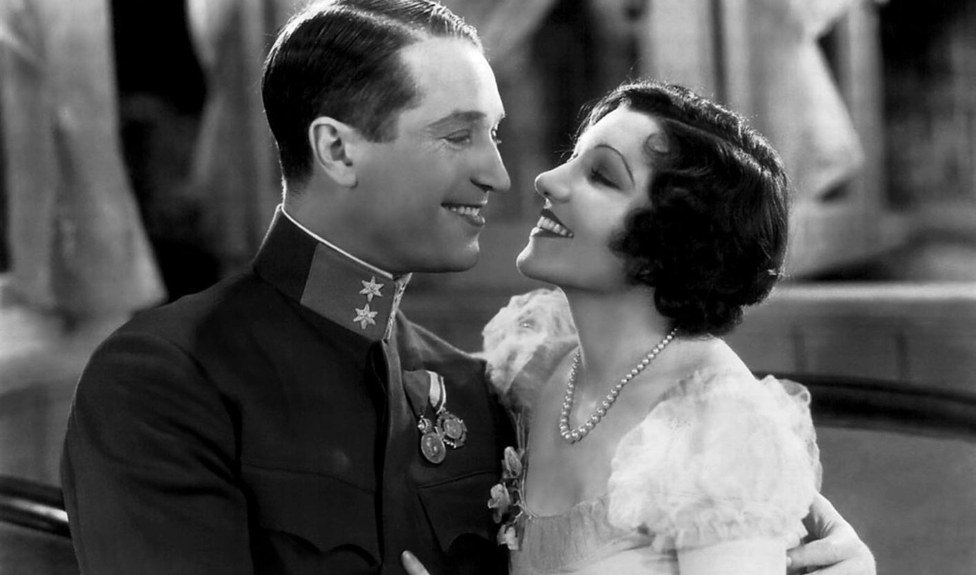
Lubitsch’s touch doesn’t fail him in this light and frothy but charming comedy
Director: Ernst Lubitsch
Cast: Maurice Chevalier (Lt Niki von Preyn), Claudette Colbert (Franzi), Miriam Hopkins (Princess Anna), Charles Ruggles (Max), George Barbier (King Adolf XV), Hugh O’Connell (Niki’s Orderly)
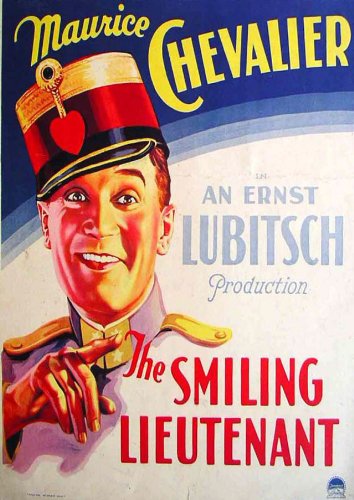
Lt Niki von Preyn (Maurice Chevalier) has it made. An officer in the Royal Guard, he’s the toast of Vienna. When he joins married friend Max (Charles Ruggles) as a wingman for a café trip to check out glamourous violinist Franzi (Claudette Colbert), he snaffles her from under Max’s arms and falls head-over-heels in love. So much so, he can’t help but smile at her while he’s on duty. Problem is, he does it while the visiting King (George Barbier) and Princess Anna (Miriam Hopkins) of Flausenthurm are driving past, and they are convinced he was laughing at her. Niki defuses the potential diplomatic disaster – but Anna falls in love with him and Niki finds himself married to her, while still in love with Franzi. How will this be solved?
Ernst Lubitsch brings his touch once again to the grand courts of Europe – Austria and the fictional land of Flausenthurm – in a light, witty and quietly rather naughty La Belle Époque drama, that’s crammed full of fabulous lines and cheeky gags. It’s almost a retread of The Love Parade and the set-up remains as light and frothy as before, with Chevalier pretty much playing the same role: a suave, likeable playboy roped into a dutiful marriage which (spoilers) eventually works out. Lubitsch lets both comedy and drama glide by incredibly smoothly, with a Wildean wit – and you could argue the greatest Lubitsch touch of all is presenting a comic romance where the man ends up with the “wrong” girl.
He does so because our Niki is a regular horn-dog under his Chevalier-esque charm: all that’s needed for him to look at Princess Anna as something other than a checkers-partner is for her to ‘jazz up her lingerie’ (an actual song title – welcome to pre-code Hollywood), puff a cigarette, smarten up her blonde locks and burn her dull nightwear. What’s a neat reversal is that this make-over comes courtesy of Franzi, who may look like a nightclub charmer but has the heart-and-soul of a true believer in marriage. More than enough – with a warm farewell letter – for Niki to refocus on his loving wife. Would any other director have managed to have his cake and eat it like this? (People have also enjoyed, for decades, the lesbian subtext in the scenes between these two – hilarious as well since they allegedly didn’t get on).
The Smiling Lieutenant has prepared the ground with a parade of cheeky gags along the way, dripping with innuendo and suggestive flirtation. Niki only meets Franzi as he’s been asked to assess her as a possible new mistress for Charles Ruggles (who never looked more like a bank manager as he does here) and promptly steals her away. He’s got several advantages of course: he ‘plays the piano’ so they can do some ‘chamber music’, and these men in uniform are catnip to the girls. Lubitsch making the point with a wonderful sequence as Niki walks Franzi home past a parade of cannoodling officers who ‘jump to attention’ as he passes – culminating in an officer who suddenly emerges from behind the bushes to do the same. Niki and Franzi’s late night discussion culminates in a long discussion about having dinner together – or even better breakfast. Pretty clear what they have in mind. The Smiling Lieutenant manages to make this relationship heartfelt and sweet: so much so, we’re not surprised Niki is giddy on duty.
Possibly only Lubitsch could present the royal family of a small nation as practically rubes in the big city. For all King Adolf complains that the Habsburgs, with a mere 700 years of power, are new kids on the block, the guys from Flausenthurm don’t have the refinement of Viennese. The Austrian Emperor prioritises greeting a train of cows over them (adding insult to injury, said cow train even passes them on their way into the city), they can’t even import a decent Schnitzel. George Barbier’s King Adolf feels more like a bluff country squire than the fifteenth of his name. Poor Anna, played with a wide-eyed naivety by Miriam Hopkins, is a dowdy princess, whose only education comes from Encyclopaedias with ‘all the interesting things left out’.
It makes quite a contrast with Claudette Colbert’s sensual but surprisingly sweet Franzi who is a knock-out on the violin (and other things). Colbert is, naturally, very good bouncing brilliantly off Chevalier who could play these likeable, honourable rogues standing on his head. Princess Anna can look quite dull and dowdy next to her, but Miriam Hopkins manages to suggest decades of repressed sexuality in her, desperate to burst out. She just can’t get it right. Meaning, even with royalty as part of the deal, Niki is like a horse who can be bought to water but can’t be made to drink. Niki’s desperation to get out of a marriage he doesn’t want his hilarious, not least a Catch 22 conversation with Adolf where it’s explained that whether his intentions were honourable or dishonourable both means he has to get married.
The Smiling Lieutenant has the sort of professional lightness and ‘winking’ cheeky comedy that Lubitsch made his own. With wonderfully light comedic performances from its leads – Chevalier was happier breaking the fourth wall with a cheeky grin than any other actor working – and a parade of excellent jokes and one-liners in every scene, combined with Lubitsch’s ability to find a suggestive risqué or hilarious sight gag at the right time, The Smiling Lieutenant is a light sophisticated comedy. Sure, you can argue that Niki’s swerve from loving Franzi to embracing Anna is driven by showing a bit of leg, but when the entire confection is as frothy as this you can’t mind.

