Tag: J. Carrol Naish

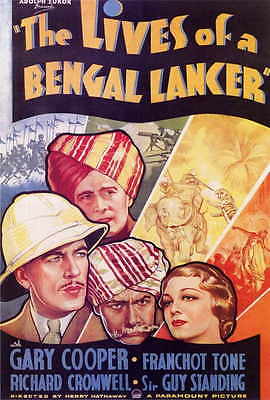
The Lives of a Bengal Lancer (1935)

The Lives of a Bengal Lancer (1935)

Old-school adventure mixes with some slightly dated Imperial attitudes in a film that’s still good fun

Director: Henry Hathaway

Cast: Gary Cooper (Lt McGregor), Franchot Tone (Lt Forsythe), Richard Cromwell (Lt Stone), Guy Standing (Colonel Stone), C. Aubrey Smith (Major Hamilton), Douglass Dumbrille (Mohammed Khan), Monte Blue (Hamzulla Khan), Kathleen Burke (Tania Volkanskaya), Colin Tapley (Lt Barrett), Akim Tamiroff (Emir), J Carroll Naish (Grand Vizier)

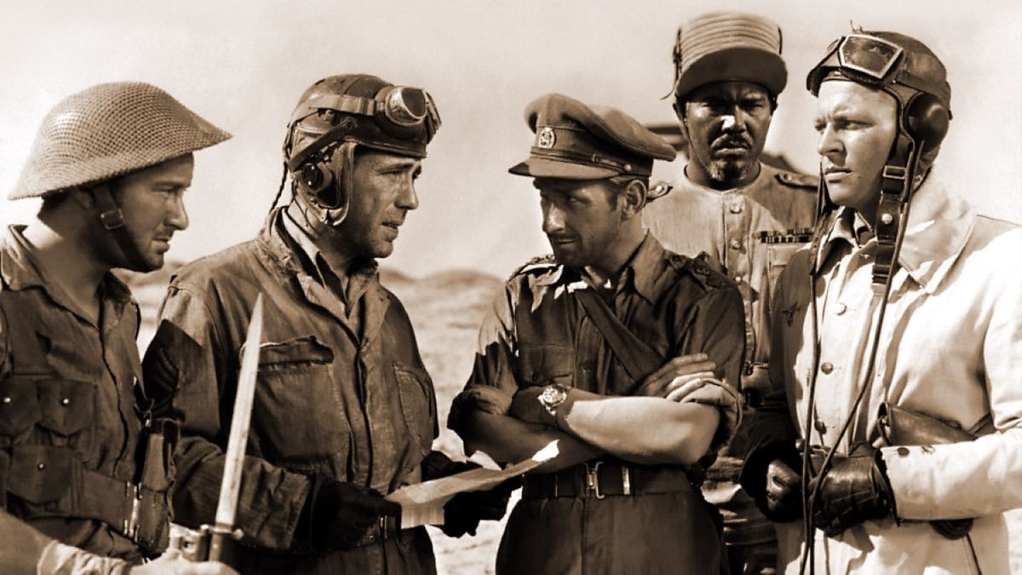
Tales of adventure and derring-do in the British Empire were meat and drink for generations of schoolboys. Few adventures were as well known as The Lives of a Bengal Lancer, a stirring tale of three lieutenants in the Bengal Lancers who become fast friends while defending Queen and country. We’ve got decent, impulsive but luckless McGregor (Gary Cooper), upper-class joker Forsythe (Franchot Tone) and eager-to-please Stone (Richard Cromwell), whose also the son of commanding officer Colonel Stone (Guy Standing). They go up against Oxford-educated Mohammed Khan (Douglass Drumbille), who schemes to seize an ammunition shipment. Can our heroes face down dastardly natives, exotic tortures and desperate escapes? All in a day’s work for a Bengal Lancer.

The Lives of a Bengal Lancer was a big hit on release, despite sharing nothing except the title, location and general theme with the semi-autobiographical novel from former-lancer Francis Yeats-Brown. It’s rollicking adventure and the boys-own mateyness of its leads, sparked a wave of spiritual follow-ups set everywhere from the Canadian mountains to the deserts of Africa. It scooped seven Oscar nominations and was celebrated as one of the greatest adventures on screen. Unfortunately, it’s not as fondly remembered now with its uncritical celebration of colonial India, spiritual links to Kipling’s White Man’s Burden and the fact Hitler of all people named it his one of his favourite film, loving its celebration of how a few white men could ‘protect’ (control) millions of natives.

It’s fair to say you have to close your eyes to some of this stuff when watching The Lives of a Bengal Lancer today. Otherwise you might flinch at our heroes threats to various squirming, cowardly Islamic rebels that if they don’t confess they’ll be sown inside a pig skin (even in 1935, outraged questions were raised about this in Parliament). You need to roll with Douglass Drumbille blacking-up as the well-spoken Mohammed Khan (not just him: nearly all the Indian characters are men-in-face-paint and for good measure our heroes also black-up to disguise themselves). There isn’t a second’s questioning about the morality of Empire and the implicit suggestion runs throughout that the Indian people should be grateful the British were there to run their country for them.

But put all that to one side, and The Lives of a Bengal Lancer is still rather fun. One of the factors making it easier to bench your misgivings is that, really, this film isn’t really interested in India or the themes of Empire anyway. For starters, all three of our heroes are played by Americans making no effort to hide their transatlantic accents (McGregor is suggested as being ‘Scotch Canadian’, but a few words of Cooper’s awful Scottish accent makes you relieved he didn’t bother to keep it up). Any insight into British-Indian relationships is extremely brief. The film is clearly shot in California, in locations identical to the sort of Westerns Hollywood was churning out. And a Western is what Bengal Lancer really is.

Our three heroes do feel more like cowboys shooting the breeze for large chunks of the film rather than army officers. Although there have been criticisms of the leads – Cooper in particular, probably because an actor so iconically American feels strange as an oddly accented Brit – all three of give entertaining, complementary, performances. Cooper is strongly charismatic, rather charming in his earnest attempts to do the right thing and his luckless incompetence at anything that isn’t soldiering (a running joke sees him building up increasing tab in a series of ill-considered bets with the good-at-everything Forsythe). But when action comes calling, McGregor is courageous, quick thinking and selfless. It’s immediately clear why Cooper essentially replayed versions of this relatable role several times. Franchot Tone is equally fine as the witty, smooth Forsythe who never takes anything seriously until things are really serious. Cromwell does sterling work as the naïve Stone.

Most of the film works because we end up liking these three characters – just as well since most of the first half is essentially watching them go about their daily tasks: riding, cleaning horses, heading out on patrol, shooting the breeze in the barracks. There is a small character-led crisis over whether the ram-rod Colonel Stone (a suitably dry Guy Standing) will accept his puppy of a son, but the biggest action drama in the first half is a wild boar hunt that nearly goes terribly wrong. If we didn’t enjoy Forsythe and McGregor deliberately rubbing each other up the wrong way, between teasing and taking a big-brother interest in Stone, we’d struggle to enjoy the rest of the film.

The second half is where the real action kicks in. During a dinner where our heroes dress up in native garb to make nice with a local Emir, Bengal Lancer throws in a bizarre Mata Hari figure, in the mysterious Russian Tania (Kathleen Burke). It’s not a remote surprise she ends up being no-good, or that the disillusioned Stone is swiftly honey-trapped into imprisonment by Dumbrille’s vaguely-motivated smooth-talking villain (it’s hilariously ironic that the villain is the most cut-glass Brit in the film). McGregor and Forsythe don Indian disguise – against orders naturally – to do what men do, which is stand by their friends.

A parade of exciting set-pieces follow thick-and fast, culminating in an impressively staged battle with towers toppling in explosives, machine gun fire spattering left-right-and-centre and our heroes literally coming to blows over who gets to make a heroic sacrifice. We get there via dastardly torture – Bengal Lancer coined the famous “We have ways of making men talk line” – as Mohammed Khan employs bamboo sticks under the fingernails (thankfully shown largely in shadow and Cooper’s stoic grimaces) to get information from our heroes. It’s all part of these men being forged by fire into exactly the sort of hardened men-of-combat we need to protect a frontier.

The Bengal Lancers ride in towards the end like the cavalry, and the air of a Western in Red Coats sticks with Lives of a Bengal Lancer throughout. Sure, it combines this with the stench of White Man’s Burden and an attitude of edgy distrust of foreigners, but The Lives of a Bengal Lancer is also riotous, old-fashioned fun, well shot and charismatically played. It might be a rather slight action-adventure fable, and sure its politics have not aged well, but it is still fun.

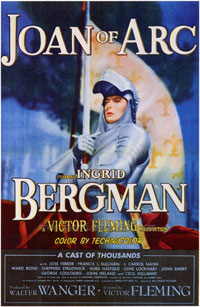
Joan of Arc (1948)

Joan of Arc header
Ingrid Bergman shows France the way in po-faced epic Joan of Arc

Director: Victor Fleming

Cast: Ingrid Bergman (Joan of Arc), José Ferrer (Dauphin Charles), Francis L Sullivan (Bishop Cauchon), Roman Bohnen (Durand Laxart), Geoge Coulouris (Sir Robert de Baudricourt), George Zucco (Constable of Clervaux), Gene Lockhart (Georges de la Trémoille), John Emery (Duke d’Alençon), Richard Ney (Charles de Bourbon), Lief Erickson (Dunois of Orleans), John Ireland (Jan de la Boussac), Hurd Hatfield (Father Pasquerel), Ward Bond (La Hire), J. Carrol Naish (Count of Luxembourg), Frederick Worlock (Duke of Bedford), Shepperd Strudwick (Father Jean Massieu), Alan Napier (Earl of Warwick), Cecil Kellaway (Jean Le Maistre)

A light descends from heaven, and a young girl is seized with a sense of purpose. Joan of Arc (Ingrid Bergman) believes – as do her countrymen – that she received a message from heaven to help deliver fifteenth-century France back to the French, and out from under English occupation. For three years, this young woman strikes fear into the hearts of the English, inspiring the French into a series of victories (most of all at Orleans) and improving the French position such that the ambitious Dauphin (José Ferrer) is crowned Charles VII. But Joan is a target for the English, and she’s eventually  captured and burned for heresy after a trial notably free of justice at Rouen.

A huge investment at the time, with its colossal cast and loving recreation of medieval France, Joan of Arc is historically a luckless film. Despite its box-office winnings, it failed to cover its immense cost. It gained seven Oscar nominations (and four wins!) with no nomination for Best Picture. Its director, its cinematographer and actor Roman Bohnen (playing Joan’s uncle) all died prematurely after its release. Ingrid Bergman was caught up in scandal – and effectively exiled from Hollywood – shortly after when her affair with director Roberto Rossellini became public knowledge. Producer Walter Wagner was imprisoned three years later for shooting his wife’s lover. The film itself had 20 minutes sliced from it and, for decades, was only available in its truncated version.

Aside from these historic curiosities, Joan of Arc is a well-made, handsomely mounted but fundamentally rather dry and at points rather dull historical drama, mixed with more than enough touches of Biblical worthiness. Victor Fleming himself felt the film was a disappointment, that a trick had been missed – perhaps  aware that his own old-fashioned, rather flat direction fails to bring any inspiration out of the drama.

If drama is quite the right word for what, all too often, are too many scenes made up almost solely of a group of men sitting around a table in medieval garb talking at length of current affairs. Too many of these scenes lack in pace or urgency and many end up feeling forced, with too much of the dialogue reduced to recounting events rather than driving the story.

The structure of the story feels off as well: it can be split into three rough acts: Joan’s search for her purpose, Joan’s time as the inspiration of the French, and Joan’s imprisonment and trial. The trial, in particular, takes up almost the final 45 minutes of the film. The play the film is based on used a troupe of actors performing the life of Joan as a framing device for further insight into the life and impact of the saint. Without this framing device, the actual film becomes a rather dry history lesson.

It’s not helped by Bergman’s performance, which serves to capture in capsule the film’s po-faced piousness. It was a dream of Bergman’s to bring her Broadway performance of Joan to film. Sadly, the script’s lack of wit (or insight into the personality of Joan), means the majority of her scenes fall into a stock pattern: her lines are delivered with a breathless intensity with her hands are clasped across her chest. Aside from a few brief scenes where Joan questions why her voices have fallen silent, there are very few moments where either Bergman or the film seek to delve down into the motivations and inspirations of Joan. Like the film, her performance is bereft of any wit or warmth – instead it is almost devotional in its careful respect.

It’s part of the film’s seriousness. It makes some excellent points on the lasting impact of Joan, the horrific unfairness of her trial and the fact that, by burning her, the English merely cemented her hold on the French people rather than ending it. But too many other issues are pushed to the wayside, along with Joan’s character and motivations. No questions are raised around Joan’s interpretation of her visions. The conflict between faith and war is unexplored. The film sets its store out clearly: this is a devotional work and we should take it as that, and any questions around faith, legitimacy or what drove a fanatical teenager to embrace a life of military campaigning goes unexplored. In truth, we know as little about Joan at the end as we did at the beginning.

Which isn’t to say the film doesn’t have its plusses. As a piece of devotional film-making, it has a lovely score from Hugo Friedhofer, with just the right uses of heavenly choirs singing through the most devout sections. The design of the film is beautifully done, heavily inspired by medieval manuscripts, with the same striking primary colours and framing. It has in fact a beautifully old-fashioned look to it, a wonderfully designed artificiality. The siege of Orleans is a dramatically staged sequence, with a particularly striking orange-drenched sky. Visually you can imagine this as an incredibly stuffed-shirt Adventures of Robin Hood, but still glorious to look at.

Bergman is also wisely surrounded by a strong cast of character actors, all providing the sort of colour and corruption that Bergman’s stiffly written Joan can’t provide. José Ferrer landed an Oscar nomination for his film debut as the ambitious, weak-willed and envious Dauphin, more interested in realpolitik than doing the right thing. Francis L Sullivan connives and blusters wonderfully as corrupt Bishop Cauchon, fixing the trial. George Coulouris gives his usual hurried authority to de Baudricourt, while Cecil Kellaway inverts his Irish kindness as Joan’s Inquisitor. Off-the-wall casting choices like Ward Bond as a French captain surprisingly tend to pay-off. Shepperd Strudwick makes the biggest impression though as Joan’s sympathetic bailiff (he also speaks the prologue).

The overall film though is one more for history buffs than for movie goers. With its seriousness, odd pace (some events take forever, while others – such as Joan’s capture – either rush past in seconds of happen off-screen) and general lack of any humour or warmth, it’s not always an engrossing watch. Well-made as it is, it’s also directed with a certain flat professionalism rather than inspiration and Bergman seems constricted by the script and the part. A curiosity, but not a complete success.

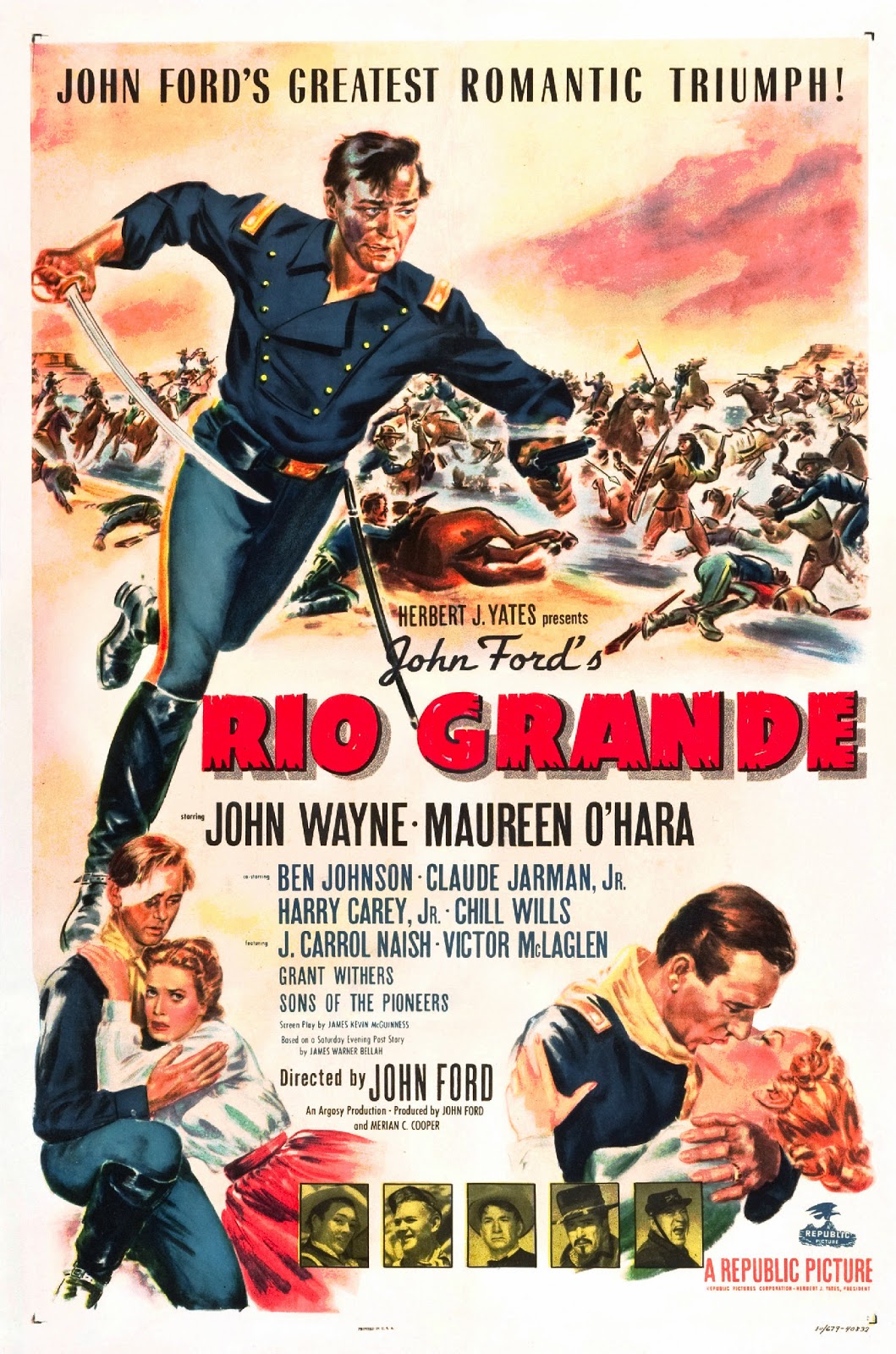
Rio Grande (1950)

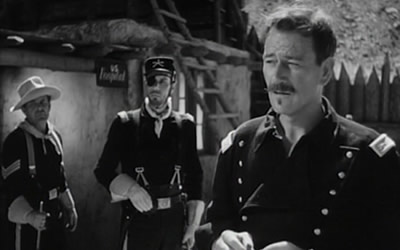
John Wayne is the Colonel regretting past mistakes in Rio Grande

Director: John Ford

Cast: John Wayne (Lt Colonel Kirby Yorke), Maureen O’Hara (Kathleen Yorke), Victor McLaglen (Sergeant Major Quincannon), Ben Johnson (Trooper Travis Tyree), Claude Jarmon Jnr (Trooper Jefferson Yorke), Harry Carey Jnr (Trooper “Sandy” Boone), Chill Wills (Dr Wilkins), J. Carrol Naish (General Philip Sheridan)

John Ford’s next project was meant to be The Quiet Man, his Ireland-set passion project. However the studio, Republic Pictures, were not convinced the expensive picture could ever be a hit (it later became one of their biggest hits and only Best Picture nominee). So they told Ford he could make it on condition that he, and his proposed stars Wayne and O’Hara, first made a good old-fashioned Western. Because they sure as hell knew they could sell that. So Ford turned out the third and final picture in his “Cavalry” trilogy, three interconnected films (the others being Fort Apache and She Wore a Yellow Ribbon) with loosely connected themes and overlapping character names.

Lt Colonel Kirby Yorke (John Wayne) is posted on the Texan frontier, defending the settlers against Apache attacks. When Yorke’s son Jefferson (Claude Jarmon Jnr) – who Yorke wasn’t seen in almost eighteen years – washes out of West Point, he volunteers to join Yorke’s regiment as an ordinary Trooper.  This leads to the arrival of his mother – and Yorke’s estranged wife – Kathleen (Maureen O’Hara arriving at the Fort, eager to get her son out of an enlisted life she feels isn’t right for him. But Yorke is determined there will be no special treatment for his son, never mind how dangerous are starting to get with the Apaches. 

Rio Grande is a professionally assembled, classic Ford western that hits all the marks you could expect in terms of action, excitement and that romantic version of the West that you might expect from Ford. But it’s perhaps so professionally assembled it still feels like one for the money at times – it’s a collection of all you might expect from a Ford classic, so much so it doesn’t feel like it offers much new among the director’s other works.

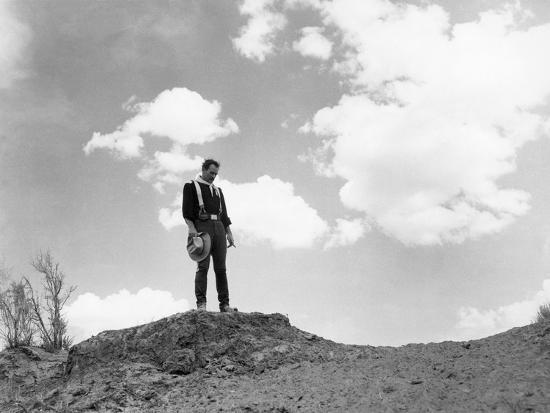
It’s most interesting parts revolve around John Wayne’s complex performance as a man who has buried his emotions beneath a cover of professionalism. Yorke is now martinet, but he’s a man who has put duty above his personal relations. It’s easy to forget that in many of his iconic roles Wayne was often the veteran, and here is man nearing retirement, loaded down with regrets and secretly crying out for a chance at reconciliation. Wayne’s performance is heartfelt and tinged with sadness, the sort of man who looks at his son from a distance as he performs dangerous horse riding stunts, but then backs away into the shadows, anxious that his fatherly concern remains unseen. It’s a quiet, lonely and sad performance from Wayne, a reminder of what a soulful actor he could be.

It also helps that he has wonderful chemistry with Maureen O’Hara, equally wonderful as his wife. A caring and loving woman, O’Hara’s Kathleen is also determined and independent, sure of her own mind and with no compunction about standing her ground against her husband. The two of them make a wonderful pair, two people who fear they have turned their backs on happiness for duty but secretly desperate for reconciliation. That desire certainly drips from Wayne, whose sad eyes beneath his drooping moustache seem to be constantly searching for grasping something from his life – and Ford certainly knew how to shoot this American icon with angles that made him appear like a mournful monument.

The actual plot of the film outside of this isn’t really that strong. Any shade or depth is removed from the Apaches who are faceless, ruthless killers who move like a swarm and spend the nights dancing and drinking after a victory. Even at the time there were feelings that the film was uncomfortably slanted in its view of the Native Americans. The actual story of the battle against the Apache meanders across the screen, with discussions of crossing the Rio Grande to do battle with them largely forgotten in a final act kidnap plotline that serves as the film’s action set piece.

Honestly, most of the plot outside of whether Wayne, O’Hara and son (played with an earnest honesty by Claude Jarmon Jnr) pretty much is by the numbers stuff. There are a host of songs and musical interjections from contemporary Western group Sons of the Pioneers. Ford made a virtue of the studio’s decision to include the band – apparently they loved being in the film and led a number of impromptu sing-alongs during the late night cast sessions, which basically led to Ford putting more of them in the film. The songs do add a wistful, whimsical air to the film which actually works rather well and mirrors nicely the personal drama of a family unit which duty is keeping apart.

The action when it kicks in is enjoyable, even if Ford relies a little too heavily on over cranked cameras to adjust the speed of various falls and horse riding stunts – the sped up effect actually often makes the whole thing look a little too reminiscent at times of keystone kops silent film. The best stunt sequence is done instead in real time, as Johnson, Carey Jnr and Jarmon Jnr take it in turns to “Roman Ride” two horses at a time around a course. Johnson and Carey – skilled horsemen – spent weeks training, the effect was so good that Ford suggested Jarmon have a go.

The cast is rounded out by some solid work from Ford regulars. McLaglen is good value as a decent Sergeant, one of those comic Irish types that Ford had such fondness for. Johnson is very good as a trooper on the run from the law who can’t resist coming back to the do the right thing. But the film belongs to Wayne and O’Hara, a couple looking to seize a last chance at happiness. Rio Grande may be one for the money, but it’s still got a touch of that Ford magic.