Category: Action film

The Hobbit: The Desolation of Smaug (2013)


Martin Freeman does some good work in one of the rare moments where the film actually does a scene from the original book

Director: Peter Jackson

Cast: Martin Freeman (Bilbo Baggins), Ian McKellen (Gandalf), Richard Armitage (Thorin Oakenshield), Benedict Cumberbatch (Smaug/Necromancer), Evangeline Lilly (Tauriel), Luke Evans (Bard), Lee Pace (Thranduil), Stephen Fry (Master of Lake Town), Orlando Bloom (Legolas), Graham McTavish (Dwalin), Ken Stott (Balin), Aidan Turner (Kili), James Nesbitt (Bofur)

The Hobbit films are an interesting opportunity to watch a team try to recapture lightening in a bottle. The Lord of the Rings films were not just a hit – they were a cultural phenomenon and changed the lives of nearly everyone involved in their production. For many of the actors it will be the first line of their obituary. The Hobbit followed the same shooting plan (two years in New Zealand, three films shot back to back) but somehow it didn’t manage to recapture the same magic. It still made squillions of dollars of course, but it’s not as loved as the first trilogy.

Of course the main problem with this is that the three films were (let’s be honest) a rather bloated inflation of a pretty short kids’ book into almost 8 hours of film making. The Desolation of Smaug is one of the biggest victims of this aggressive padding, as action sequences are crammed into to fill up the running time, at the cost of those moments of character development that made the first trilogy such a rewarding investment (and even made the first film an enjoyable experience for all its faults).

This film is all too aware that it is a “big film” and a guaranteed box-office smash, so gives us the action it thinks the punters want. Strangely it all feels more like a contractual obligation (“Peter we need more Tolkien. Three more to be exact. Do what you have to do!”) – what it probably needed (as did the whole trilogy) is a new pair of eyes on it, a fresh take, rather than Jackson having to go back to the well. To be fair Jackson acknowledged this, and tried to hire Guillarmo Del Toro to direct the trilogy (still credited as creative consultant).

The action sequences in this film bizarrely expand moments from the book with overblown padding – they are invariably the duller parts of the film. In that I’ll include the ludicrous semi-comic barrel escape of the dwarves (turned from floating down the river to a chase orgy of Dwarves-Elves-Orc conflict) and the overextended attempt to dispose of Smaug in the Lonely Mountain (again marked by unbelievable acts of athleticism and derring-do which seem so out of step I wonder if we are meant to take them seriously). Add in the huge amount of action given to Jackson-favourite Legolas and we have an awful lot of dull, over-choreographed action padding out a very slim story (no more than 6 chapters of the original book). What the makers seem to feel are the film’s tentpole highlights are in fact the sags in the fabric.

It’s a shame because the moments where the film does hew more closely to the story of the book are easily the best bits. The confrontation between Bilbo and Smaug is the film’s real highlight (helped by Benedict Cumberbatch’s superb vocal work as the self-satisfied fire breather), and (with some tweaks) it’s pretty much straight out of the book. The material in Laketown is faithful enough to the tone of the book, while adding depth to its story and the life of the town so that you invest in its fate (Luke Evans does a good job with surprisingly little as Bard). The inclusion of Beorn the shapeshifter I could have done without (one for the fans) and stupid as the spider attack is, at least it was in the original book. But the more the film starts to focus away from the dwarf plotline and onto elf politics or the terribly vague rise of Sauron story, the less it holds your attention.

Bless him, by 2013 Jackson was probably the only person on the planet excited by seeing Orlando Bloom in a film. The acrobatic elf has all the depth and interest of a cartoon character, while his now heavily over choreographed fight scenes seem to be taking place in a different universe from the first trilogy. In fact, all the scenes involving the elves are deathly dull and add very little to the plot, little more than limp attempts to tie in the LOTR story more fully into The Hobbit. This focus on Legolas also steals screen time from the dwarves, making many of them little more than extras in their own story.

The problem with ramming so much action and extra plot in to link the films into LOTR is that we don’t get the time with the characters we need in order to feel the necessary concern for them. The main problem here is that there are too many characters. There are three people who can claim to be the lead in this film (Bilbo, Gandalf and Thorin). Behind them there are at least 10 prominent supporting characters and behind them at least another 12 small but important characters. That’s 25 characters the film needs to be juggle – in other words about 6.5 minutes each if you divide it equally. Jackson does a decent job with juggling these it has to be said – but it’s still way too many. I challenge any non-Tolkien fan to successfully identify pictures of all 13 dwarves without prompts.

It’s a shame as there are some very good performances in this. Martin Freeman continues to be perfect for the lead role, decent, brave and resourceful (but with small flashes of “ring addiction”); Ian McKellen of course just is Gandalf; controversial as her extended storyline is, I rather liked Evangeline Lilly’s performance; Ken Stott does a lot with limited screen time as Balin. Richard Armitage demonstrates his star charisma again as Thorin, a complex part he invests with a Shakespearean gravitas: in this film Thorin is at times kindly, stubborn, generous, selfish, patient, temperamental, a warm friend, a deeply suspicious comrade – Armitage holds all these threads together brilliantly. Honestly the guy is an absolute star.

Overall, I enjoyed Desolation much more than I remember doing in the cinema. Perhaps it helps that I’ve seen all three films, and understand more where this film is going. It’s still an overblown, overstuffed piece of work that doesn’t have the sense of soul that LOTR has. It mistakes high octane action for human interest and struggles to make all the characters in the film make an impression. A braver adaptation would have reduced the number of dwarves – but I can just imagine the riot from the book fans… What this film really is, of course, is 4-5 really good scenes, surrounded by padding to boost the running time – but those scenes (Smaug and Bilbo, Thorin confronting the people of Laketown, the few quiet talking bits) are very well done, and they just about make the film work. On repeated viewings you’ll find yourself drifting out to make a cuppa during the barrel chase. But you’ll certainly be in your seat when Bilbo first enters the Lonely Mountain’s treasure store. And its miles better than what was to come.

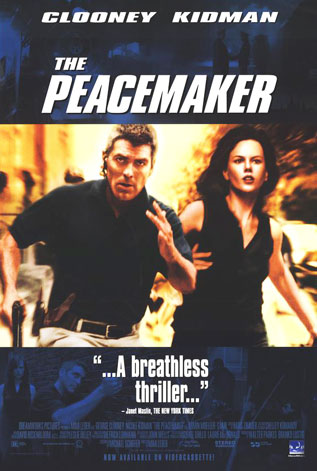
The Peacemaker (1997)


Clooney and Kidman flee an exploding cliché

Director: Mimi Leder

Cast: George Clooney (Lt. Col. Thomas Devoe), Nicole Kidman (Dr. Julia Kelly), Marcel Iureş (Dušan Gavrić), Aleksandr Baluev (Gen. Aleksandr Kodoroff), Rene Medvešek (Vlado Mirić), Armin Mueller-Stahl (Col. Dimitri Vertikoff) 

In the late 1990s, Steven Spielberg, music tycoon David Geffen and the former chairman of Disney Jeffrey Katzenberg banded together to pool their knowledge and resources to found their very own film studio, DreamWorks. Excitement abounded – what would be the first film released from DreamWorks? How would all that genius and experience express itself? The answer was The Peacemaker.It’s a film cobbled together, Frankenstein-like, from bits and pieces of other movies. Russian separatist soldiers steal nine nuclear warheads. The USA immediately leads efforts to locate these bombs, their efforts spearheaded by a maverick Army colonel (George Clooney) uneasily paired up with a by-the-book White House Nuclear Weapons expert scientist (Nicole Kidman). The trail leads them to dodgy Eastern-European officials playing both  sides  shoot outs in picturesque locations such as Vienna and non-descript ex-Soviet republics, and  a cat and mouse chase in New York for a man on a very personal mission of revenge.

It’s quite something, an achievement almost, to sit down and watch a film and see nothing original in it at all. That’s the case with The Peacemaker: there is literally nothing in this film that you won’t have seen in any action film made between 1980 and 2000. It’s such a perfect capturing of clichés and tropes it could almost work as a time capsule piece. A reasonably film literate person could probably take a decent stab at writing down the plot of the film in advance with nothing more than a cast list and brief one-line synopsis.

It’s also fun now to see Clooney and Kidman play such dumb, by-the-numbers roles like this, having seen how far both of them have come since the 1990s. Back then, Kidman was best known for being Mrs Tom Cruise and Clooney as the star of ER struggling to break Hollywood. Both of them go through the motions with assurance, though Clooney is basically Doug Ross in an army uniform while Kidman plays a sort of Hepburnish scientist, overtly unimpressed (but secretly very impressed) by her macho comrade. There is a retrospective interest seeing them in something you can’t imagine either of them touching with a barge-pole today.

The film is routinely directed by Leder, then a staple on ER’s director payroll, with a habit of expressing the same clichés over and over again. Most of the action sequences lack any real flair, though a truck chase is reasonably well done and the final half hour chase around New York works well enough.

The plot is straight forward, although like many of these things it doesn’t really make any sense at all when you sit down and think about it (twice I think I’ve watched this in my life, and I still don’t understand how the baddies fund their operation). But everything has a back-of-a-fag-packet briefness to it, not least the yawningly familiar tale of our heroes slowly growing to respect each other. In fact the most original beat of the film is probably that they don’t end the film locking lips.

I guess you could say The Peacemaker is exactly the sort of safely dull, totally forgettable, paint by numbers bland piece you could expect a fledgling studio to dip its toes into the water with. It goes with the sort of formulaic familiarity that’s worked for countless films in the past. It’s inoffensive enough and (good judgement by them) they snagged two actors whose fame has increased exponentially since the making of the film, meaning it will always have a lifespan on TV repeats. DreamWorks went on to much better things than this TV-Movie of the week, but at least this one-for-the-money job is okay, you won’t mind wandering in and out of the room while it’s on, and you might even enjoy some of its spirited retreads of worn clichés.

I Am Legend (2007)


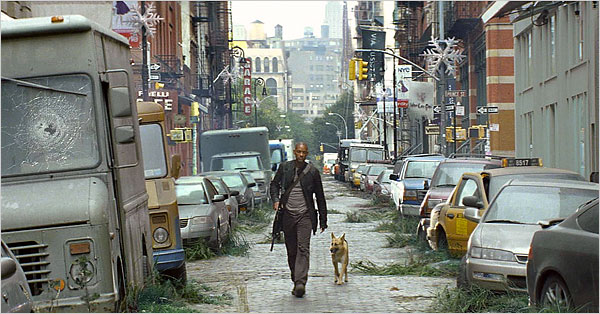
Rush hour is a lot easier to beat when its just you and your dog.

Director: Francis Lawrence

Cast: Will Smith (Robert Neville), Alice Braga (Anna Montez), Charlie Tahan (Ethan), Salli Richardson (Zoe Neville), Willow Smith (Marley Neville), Emma Thompson (Dr. Alice Krippin)

If you’re going to make a movie that involves the viewer watching one person, alone with just a dog, for well over an hour, you’d better be sure that the person you recruit to play that role can actually hold the viewer’s interest for that time. Factor in, for Hollywood, that the person you pick needs to be capable of getting big box-office, and you ain’t got a lot of choices. But casting Will Smith in this was a choice the studio largely got right.

The year is 2012 and the world has ended. Robert Neville (Will Smith) is a military virologist, the last surviving human in New York. A miracle cure for cancer went disastrously wrong three years before and killed 94% of the world’s population, mutated 5% into feral “darkseekers” who attack anything living at night, leaving just 1% of the world’s population immune. Neville lives alone in New York, with only his deceased daughter’s dog for company, and works to find a cure for the disease by capturing and experimenting on the darkseekers.

In a remarkably brave and unusual move for a blockbuster, Will Smith is essentially alone on screen for a solid hour. The film takes a measured, well-paced delight in following his daily routines, covering everything from his work in immunology to scavenging for supplies, hunting deer (escaped from the zoo), hitting golf balls off aircraft carriers, and having free run of a video store he has filled with mannequins. His Washington Square house is heavily fortified, but also remarkably homely and certainly not that bad a place to watch the end of the world from.

Following this daily routine is, by far and away, the most interesting part of the film, as it is one of the few parts that actually feels unique and original. In fact, you wish it could go on longer and that the film didn’t need to revert back its more predictable “one man against the monsters” theme. The ingenuity of survival in extreme circumstances, and the eerie freedom of the busiest city in the world completely empty, makes you wonder not only “could I do that” but also, secretly “would it be fun for a while to drive a fast car around Times Square or whack golf balls off the wing of a stealth bomber?”.

“For a while” is the key thing here, as the film also explores the deeply damaging effect extreme isolation has had on Neville’s psychology. It’s here that Smith earns his chops. He’s an extremely engaging actor, so you’re happy to spend time with him, but he’s also skilled enough to play a cracked psyche without going overboard. Neville chats (and flirts) with mannequins, knows Shrek so well he can speak in perfect unison (inflections and all) with the film, and keeps up a regular stream of conversation with his dog Sam, including asking her what she is planning to do for his birthday. Much of this is played lightly, but at key moments Smith allows Neville to snap. He also plays the tragedy gently – his reactions to Sam’s death are genuinely quite moving because they are quiet and restrained.

This is all interesting stuff. Less interesting are the “darkseekers” and the film’s final resolution. Firstly, the darkseekers themselves are bog-standard zombie monsters – screaming, running, deadly creatures with their one quirk being their fear of UV light. Other than that, it’s nothing you haven’t seen in half a dozen movies before (better). Turning them into zombie creatures does make Neville even more isolated but makes encounters with them fairly predictable, mostly inspired by films past. Most of the film’s big confrontation set pieces have a slightly tired familiar feeling to them. I’m already struggling to remember them, and I only saw the film two days ago.

The major problem with this film is its ending. I Am Legend had its ending re-shot after test audiences saw it. Originally, a reveal would have been that the darkseekers were far more intelligent than appeared, and their motivation was to prevent Neville’s experimentation on them. Two scenes still make a point of discussing Neville’s Mengele-like wall of photos of dead darkseekers, killed by his cure experiments, and other hints remain through the film: the traps they set , the presence of an “Alpha” leader among the monsters, repeated shots of the tattoo on Neville’s last captured darkseeker, which was intended to be a crucial clue that she was the mate of the Alpha.

But test audiences weren’t having that. So in the final version, all this build-up and suggestion is shoved aside as Neville grabs a grenade and blows himself and them to hell to allow a cure to be taken to the rest of mankind. As the cure is taken to an idyllic community in the country (church and all) mankind’s future is his “legend” or some such guff. It’s a major loss of nerve that makes the film just another run-of-the-mill monster flick. It doesn’t match with hints that remain in the whole film and it doesn’t tie in with the more successful first hour of the film. It doesn’t question the possible rights and wrongs of Neville’s actions (at best comprehensive animal experimentation), but fully endorses them.

It’s a shame as this has ideas, its vistas of New York being reclaimed by nature are interesting and memorable, and Will Smith is pretty good in a straight acting role. But instead it settles for being a schlocky monster pic, where we can unquestioningly cheer as everything is neatly tied up with a bow and everything we thought about all of its characters is confirmed. As such, this film isn’t a classic and it hasn’t had the sort of life it might have been able to have. Despite good moments, it’s definitely not a Legend.

The Equalizer (2014)

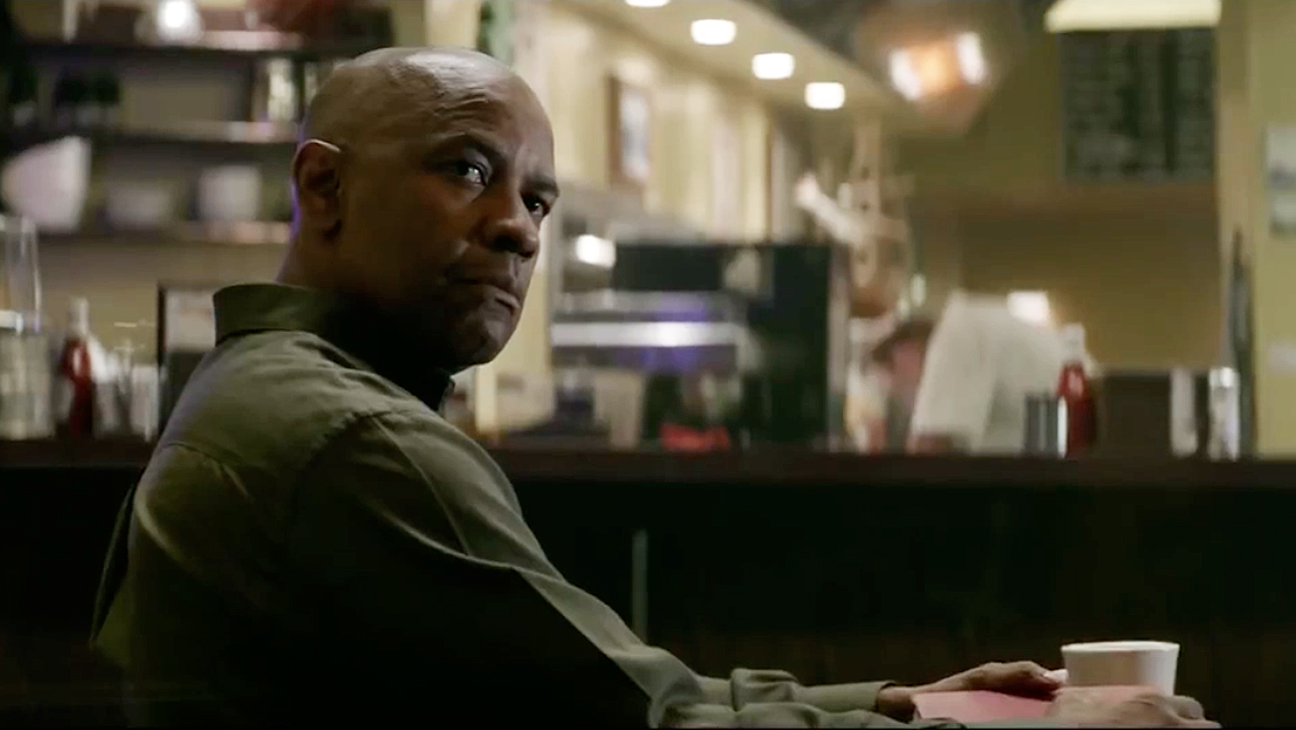
Denzel rests up. In about five seconds of screen time that scolding hot coffee will probably be in someone’s face.

Director: Antoine Fuqua
Cast: Denzel Washington (Robert McCall), Marton Csokas (Nicolai Itchenko) , Chloe Grace Moretz (Alina/Teri), Melissa Leo (Susan Plummer), Bill Pullman (Brian Plummer), David Harbour (Frank Masters), Johnny Skourtis (Ralph)

In the 1980s Edward Woodward had a sudden massive success in the States starring as Robert McCall, akaThe Equalizer, a former agent of a Government Agency, making atonement for past misdeeds by offering his skills free-of-charge to help the innocent and falsely accused. It ran for four seasons and then largely faded from memory. As such, it seems a strange choice for Denzel Washington to bring back to life – until you remember that Washington has a fondness for appearing in trashy action films. Kinda like I have a fondness for watching them.

Because I’ll be honest, this film is more or less exactly what you would expect from a film whose poster is the star male actor holding a gun (and, after watching this on Netflix and seeing my recommendations I am now aware how many films out there have posters of late middle age actors holding guns. Liam Neeson has a lot to answer for. Half of Hollywood’s middle aged men should be paying him some sort of commission.)

Here McCall is reimagined as a quietly retired man, works at a hardware store, is beloved by his colleagues and in mourning for his wife, who of course he promised he would leave his old life behind. There are hints that he has a certain level of OCD, and meticulously times every action he carries out. Concerned at the poor treatment handed out to a teenage prostitute by her Russian Mafia pimp, he attempts to intervene politely but firmly – but of course a blood bath of slaughtered goons ensues, and before we know it the whole Russian mafia is trying to work out who our hero is and what he wants.

It’s a pretty familiar set-up and the film wastes no time in letting us understand it before hurling us into events that will shatter any peace its lead character has. After all we all know that this zen peace isn’t going to last and that Washington will soon be dishing out pain and taking names like nobody’s business. What the film does do quite well though is sketch out the everyday folk in the film so well (with only brief moments on screen of things like baseball games) that you actually do care for them, and you actually do understand why McCall finds this life so enjoyably unstressful.

The violence when it comes is very effectively filmed. It has a great “Bourne-ish” quality to it, as McCall uses a series of everyday items with lethal effect. The final sequence takes place in the very hardware store McCall works at, and there is some imaginative use of the various products contained therein. Similarly, throughout the film McCall uses various hardware items for purposes other than those intended by the manufacturer, and niftily cleans the items to return them for sale (a great way of junking the evidence).

My one issue with the violence in this film is that I felt, at times, it was a little too graphic, a little too delighting in its mayhem. It largely gets away with this as it establishes that the victims of the violence throughout the film are mobsters and killers. The film is also slightly too long – the momentum dries up in places – and the script or direction fails to deliver a single key ‘moment’ to make this stand out from the crowd of films in this genre. It’s entertaining and good fun for fans of the genre, but it never really seems completely original, instead an effective remix of things from other movies.

Denzel Washington is of course the film’s MVP, and he tackles the part extremely well, adding a great deal of depth to McCall’s shame at his past, his discomfort with violence and his need to carefully organise his life into time managed compartments. He has the quiet, cool confidence that the part needs and suitably manages to look normal enough that you can believe he would fade into the background. Of course he could do the part standing on his head, but he still gives it a lot of interest. Marton Csorkas also does a good job as his nemesis, though the part is paper thin.

The ending feels rather tacked on and designed as sequel bait – but there are far worse films out there that will get sequels. Decent fun, nothing special, an effective remix of other films.

Pride and Prejudice and Zombies (2016)

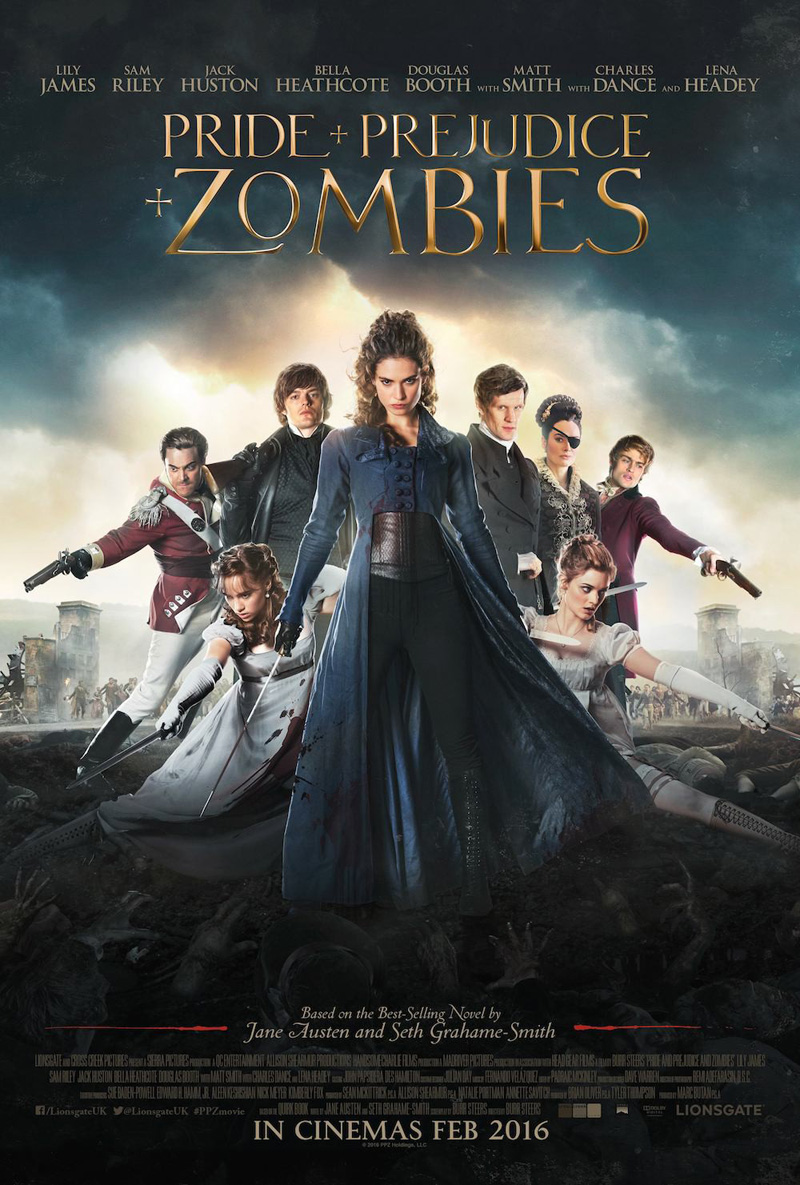
Sisters doing it for themselves. As I’m sure the film would have said in the dialogue if it had the guts.

Director: Burr Steers
Cast: Lily James (Elizabeth Bennet), Sam Riley (Fitzwilliam Darcy), Jack Huston (Wickham), Bella Heathcote (Jane Bennet), Douglas Booth (Mr. Bingley), Matt Smith (Mr. Collins), Charles Dance (Mr. Bennet), Lena Headey (Lady Catherine de Bourgh), Sally Phillips (Mrs. Bennet), Aisling Loftus (Charlotte Lucas)

Back in the 1990s, Harry Enfield and Chums did a sketch in which The Terminator (played by Martin Clunes) arrives in early 20th-century England, and spends a weekend at a country house searching for his victim. His violent antics are met with po-faced, stiff upper lip responses from the Upper Crust members of the household and uncomplaining reserve from the servants. It’s very funny. It sticks in the mind. It brilliantly mashes up costume drama with sci-fi drama. It’s five minutes long.

This film is effectively the same gag but stretched far beyond any possible welcome to an agonising 104 minutes, in which the same comic beat is repeated over and over again. “Oh look! Those posh girls/blokes in frocks are discussing tea and table arrangements! And now they are slaughtering a herd of zombies! While continuing the conversation! What larks!”

Pride and Prejudice and Zombies was the poster child of a mercifully short-lived literary novelty: classic novels rewritten with genre elements. This trend also saw sea monsters inserted into Sense and Sensibility and hard-core sex scenes inserted into Jane Eyre (the worst of all, as the author had the cheek to suggest that Bronte would of course have got those scenes in if she could). It was a best-seller, but only in the sense that it was the ultimate ‘I-don’t-know-what-to-get-you-for-Christmas’ gag gift. But years after the moment had passed, the movie adaptation lumbered towards the big screen.

Morbid curiosity made me watch it (over several nights on Netflix, I hasten to add) and it’s exactly what it appears to be: a student sketch that is worthy of maybe a slight smile for the first few minutes, but then totally collapses the longer it goes on. Now I like Jane Austen films and I like zombie films but still I didn’t like this. Firstly it’s a terrible zombie film – the action moments are poorly shot and hard to follow, the action dull and the “laws” around the zombies in the movie are inconsistent (some zombies are super killers, others are lumbering brainless beasts). Secondly, all that Zombie stuff makes it a pretty bad Austen film. Worst of both worlds.

The Austen bits are (unsurprisingly) by far the best bits. There is a good cast here: Lily James and Matt Smith in particular would be very well cast in a proper adaptation. Anything interesting comes largely from Austen (the characters, the emotions, the bulk of the watchable stuff in the first half) anything dull from the source material (the zombies, the action, the final 30 minutes). The idea of society being fundamentally unchanged by a zombie invasion makes no sense at all (would money still be the driving factor in a world destroyed by the undead?). Much of the fighting involving the female characters has a slightly uncomfortable leering sexuality about it (“Look at those hot chicks pull knives from their undergarments! Phrroooaaahhh!!!!”) as well as being far too over choreographed.

Zombies is a pointless film of a forgotten fad. It’s one of the worst zombie films ever made. It wastes our chance to see some of these actors give decent performances in a proper adaptation. Pleasingly, it bombed catastrophically at the box office, probably because it appeals to no one: the zombie action isn’t anywhere good enough to interest the genre fan, the Austen fan is more likely to bung on their Firth/Ehle DVD than check this mess out. None of them are missing anything. Zombies isn’t the must-see abomination it needed to be to have any shelf life – it’s a blatant attempt to rake some more cash from a horse flogged to death. If you want to get a sense of it, save yourself 135 minutes and watch that Harry Enfield sketch instead. I guarantee you’ll laugh a heck of a lot more.

London Has Fallen (2016)

Rather appropriately Gerard Butler takes aim at us. After all the viewer is just about the only person he doesn’t kill in this film.

Director: Babak Najafi
Cast: Gerard Butler (Mike Banning), Aaron Eckhart (President Benjamin Asher), Morgan Freeman (Vice President Allan Trumbull), Alon Moni Aboutboul (Aamir Barkawi), Angela Bassett (Director Lynne Jacobs), Robert Forster (General Clegg), Melissa Leo (Secretary McMillan), Radha Mitchell (Leah Banning), Charlotte Riley (‘Jax’ Marshall), Jackie Earle Haley (DC Mason), Waleed Zuaiter (Kamran Barkawi), Colin Salmon (Com Kevin Hazard), Patrick Kennedy (John Lancaster)

Devoid of any sense of humour, decency,  charm or emotions at all this is a brainless and tasteless action film crammed to the gizoids with extreme knife based violence,  growled threats and paper thin characters none of whom are remotely interesting or engaging. It’s cast iron certainty, it’s self righteousness and brutality make it a deeply unpleasant, off-putting and unlikeable film.

Basically the UK PM is slain and the G8 assemble like besuited Avengers for the funeral. Unfortunately some terrorists have hatched a plan to wipe them out in revenge for a pre-credits missile strike and sure enough we have a series of assassinations in the opening seconds by villainous shady terrorists. Spreading the stereotypes fairly BTW the French leader is a yacht based dilantte, the Italian a geriatric lothario and the German a sour faced deadly serious Angela Merkel type.

The main problem with this is Gerard Butler. The film sinks completely under the weight of Butler’s self importance and chronic lack of humour . At no point in this film does Butler’s Mike Banning make any mistakes or offer up any form of human reaction such as fear or uncertainty. Compare him instead to John McClane and the moments of terror Willis dips into that role to humanise it. Also remember that Willis is charming and witty in that film. Butler however thinks alpha male certainty and grim faced contempt for everyone he meets (bar his bosses and a Scottish SAS captain) will endear us to his character. Instead it makes him border line terrifying – it would surely only take a wrong word, for Banning to turn his fury on an innocent bystander.

Mike Banning however is a violent psychopath, Butler thinking that brutally murdering a captive with a knife while growling some zenophobic one liner counts as wit. To be honest I’d be scared shitless if I was protected by this psycho who growls brutally from start to finish, all too clearly enjoying the mass killing. There is a vague attempt to humanise him with the introduction of a pregnant wife at home but instead you dread what values Banning is likely to invest the infant with in the future.

In fact the whole film has a horrible jingoism, xenophobia and racism running through its centre. It’s attitude to anything not American (or at a push British) is at best suspicion, at worst outright hatred. Anyone with a beef against America is twisted, evil, riven with jealousy and hatred of freedom and shucks we should cheer as Banning brutally tortures one of them in his final moments. America! Fuck Yeah! It gives patriotism a bad name.

The film passes the time if you enjoy seeing London destroyed (again) on film, and the body count of gruesome kills is high enough to satisfy anyone’s needs for violence, although the killing is so graphic and the film lingers so leeringly on each knifes plunge with the perversity of snuff film. A load of Brits (Colin Salmon, Charlotte Riley and Patrick Kennedy) dial in worried expressions from a control room (needless to say one of them is a traitor) while sportingly Morgan Freeman, Melissa Leo, Robert Forster and Jackie Earl Haley do similar jobs in a bunker in America.

But the film is almost proud of the fact it has nothing new to say at all and seems totally unaware of its fundamental unpleasantness. It’s actually a nasty, bigoted, small minded, cruel film that hates anything different. It thinks it has a Die Hard lightness of touch – but it really, really doesn’t. Butler is charmless and horrible and the film is revolting. Avoid it.

Gods of Egypt (2016)

Just your standard Giant Meets Boy Gets Chased by Female Assassins Riding Giant Worms Story. Really didn’t anyone learn anything from Dune?

Director: Alex Proyas
Cast: Nikolaj Coster-Waldau (Horus), Gerard Butler (Set), Geoffrey Rush (Ra), Benton Thwaites (Bek), Chadwick Boseman (Thoth), Elodie Yung (Hathar), Courtenay Eaton (Zaya), Rufus Sewell (Urshu), Bryan Brown (Osiris)

Oh good lord where to begin. It’s not so much that this is a terrible film – although it is. It’s not offensive or unpleasant. It’s just a film that is almost impossible to take seriously whatever. It’s a fat, bloated, overblown mess where the plot makes almost no sense, the design is totally ridiculous, the acting bored or unengaging, and the directing totally lacking any charisma. It’s a film you can only laugh it, except for the fact that it’s so lamentably badly that it’s not even that funny. There is so little joy in the making of this bloated fart of a picture, that even as a joke it falls flat.

As far as I can tell, in a fictionalised ancient Egypt the Gods live among men. Horus’ coronation as the new king is interrupted by his uncle Set who seizes the throne, removes Horus’ eyes and sets about turning the realm into a dictatorship. He has some sort of overall plan but I’m really not sure what it was. Something to do with immortality or something. The film barely cares so neither should you. Set is a baddie. Horus is supposed to be a goodie, I guess, but he is such a humourless, arrogant, cold and (above all) boring God you probably won’t give a toss about him.

The film is a disaster almost from start to finish. In a decision that guarantees giggles every few minutes, the Gods are all 9 feet high, making the humans look like chippy midgets. Poor forced perspective hammers home this ridiculousness every few seconds. If this didn’t make the Gods silly enough, they also have some bizarre metal “battle modes” they transform into, which along with some piss poor special effects makes them look like refugees from Mighty Morphin Power Rangers. The colours are bright and primary and the sets all have the sheen of CGI, lacking any substance. The design decisions cross swiftly from daring into dumb. If you ever wanted to see a flying chariot pulled by winged scarabs or to see mix and match female hitmen ride giant worms chasing a giant and his normal sized friend, well hallelujah your day has come, this is the film for you.

The script, such as it is, is a loosely connected series of incoherent events. The acting is simply awful. Coster-Waldau completely lacks the big screen presence to carry the movie, his upper crust arrogance from Game of Thrones here comes across as insufferable and dull. Thwaites comic relief is about as funny as a hernia and his quest to save his true love has all the drama of running to catch a bus. Boseman aims for wisdom and grace but delivers camp and affectation in a truly terrible performance. Butler does at least have a bit of charisma, even though Set is such a poorly defined character he’s impossible to get interested in. Various other actors chip in autopilot performances for the cash. The female characters are little more than props. Geoffrey Rush needs a new agent: seriously how much money does he need?

The biggest problem though is it isn’t quite ridiculous, campy or shite enough to be a camp classic. Instead it’s just boring. It doesn’t have the sort of cosmic sweep or visual splendour to give you something to look at. Instead it’s loud, boring and stinks like animal droppings. That’s the worst thing of all: not even as a camp classic will this be remembered. Simply crap.

The Lone Ranger (2013)

Johnny Depp works overtime to make this film unpopular. He succeeded.

Director: Gore Verbinski
Cast: Johnny Depp (Tonto), Armie Hammer (John Reid), William Fichtner (Butch Cavendish), Tom Wilkinson (Latham Cole), Ruth Wilson (Rebecca Reid), Helena Bonham-Carter (Red Harrington), James Badge Dale (Dan Reid), Barry Pepper (Captain Jay Fuller)

In 2013 this big budget misfire produced a record loss for Disney. Spiralling out of control the film cost a bomb then blew up like one at the box office much to the delight of film critics and audiences alike who enjoy nothing more than watching some suits and A-list stars fall flat on their face. Reviews were damning and the film took its place as one of the ultimate box office turkeys.

All of which is a little unfair, as to be honest this isn’t really that bad a film. Which is not to say it’s that good either, because it ain’t. It’s an average B picture with a huge budget and an over inflated running time, but it has a decent Act 1 and Act 3 and ends with an excellent train chase sequence that I enjoyed so much I watched it again immediately after the film finished.

So what are the problems? The main one for me is Johnny Depp, who here is at the absolute peak of his wave of replacing acting with a bunch of mannerisms and quirky moments. This is one of the most irritating Depp performances on film, his Tonto a pile of odd costumes, muttered gags and winks to the audience. I can see Depp is amused, but I’m not sure anyone else is. I also suspect Depp announced this was how he was going to play the role and if Verbinski didn’t like it he could get stuffed.

But other than that, Armie Hammer is rather sweet and endearing as the straight as an arrow Ranger, displaying a lot more wit than Depp’s painted showing off. Ruth Wilson does her best with a truly thankless damsel in distress role. Tom Wilkinson, William Fichtner and Barry Pepper present three very different villains. Helena Bonham Carter gives a bizarre performance as a madam with ivory legs (yes you read that right.).

The film’s main problem is it is far too long and too poorly structured. The opening act is engaging and introduces the characters effectively with a decent action scene or two, but it starts to overdo its welcome after 40 minutes or so. A framing device of Tonto narrating the story to a child in the 1920s offers nothing more than padding and more Depp showing off. Act 2 meanders around slowly, working up to showing that all the suspicious people in the film are working together, draining the momentum out of the film. Shock baddie reveals are only surprising to those of us who have never seen a film before.

However the film is partly redeemed by its final 30 minutes, in particular an astonishingly high octane, exciting and fun train chase sequence, brilliantly cut to the Lone Ranger theme that gives every character a chance to shine and both grips the viewer and leaves them with a smile on their face. Shame the rest of the film can’t match it, but it’s still better than many others manage.

A single sequence doesn’t make it a classic, and an engaging actor (Hammer) who creates a character that you care about doesn’t keep the attention throughout the whole 140 minutes, but it’s far from a disaster and much better than many successful big budget hits. Shame about Depp. And sorry for those who loved turkeys. This is just an average film. In about 10 years it will probably be getting a re-evaluation.