Category: Crime drama

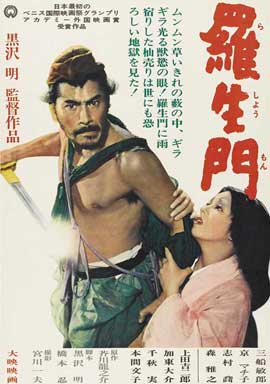
Rashomon (1950)


Rashomon: “Everybody Lies” – Gregory House would love this film

Director: Akira Kurosawa

Cast: Toshiro Mifune (Tajōmaru, the Bandit), Machiko Kyō (The Samurai’s Wife), Masayuki Mori (The Samurai), Takashi Shimura (Woodcutter), Minoru Chiaki (Priest), Kichijiro Ueda (Commoner), Noriko Honma (Miko), Daisuke Katō (Policeman)

Rashomon is one of those films that Stuart Galbraith described everyone as “knowing it even if they haven’t seen it”. Its structure of unreliable narrators telling different versions of the same story has been employed on almost every single recurring drama that has been screened since its making. You’ve seen the Rashomon story, even if you’ve never seen the film.

In the rainy (no-one works with rain visually better than Kurosawa by the way) countryside, at an abandoned house (it’s called Rashomon, so even the title doesn’t really mean anything to the story) a Priest, a Woodcutter and a Commoner discuss a recent crime in the forest. A bandit, a samurai and his wife all met in the forest. The Samurai was killed. In the investigation, the Bandit, the Wife and the Samurai (via the Medium, imagine if Morse could call on her!) all tell different versions of the story, as does a surprise witness to the crime. Which story was true? Or were they all lies?

One of the main differences watching the original Rashomon now is that we have become so used to the concept of multiple versions of the same story being told that we expect a final answer to be presented. Most often now, the final version of the story is the true version and it allows us to understand for ourselves what was true and what was not in the other versions in the story. This is not the case here: there is no answer. The viewer will never know what happened in the glade: we are in the same position as a jury at a trial – we are presented with four compromised, conflicting stories and we need to select for ourselves what (and who) we choose to believe. The camera is as much of an unreliable narrator as the actual storytellers in the film.

Imagine what a, for want of a better word, head-f*ck this must have been back in the 1950s. They’d never seen anything like it before in a film. Characters might lie, but generally the camera never did. This was the time of Hays Code America, where criminals never got away with it, murderers were always revealed in the final frame and justice prevailed. Rashomon is nothing like this: there is no truth, just a series of lies or obfuscations, with the final story potentially as compromised as the rest. In a world where even a character as likeable as Alec Guinness’ in The Lavender Hill Mob has to end the film being hauled off to jail in chains, it must have been unsettling. People must have felt like the Priest does in the film: “Who can I trust? Where is goodness in this world?”

Of course, many theories have sprung up about what is going on here and what the actual story is – some theories place a lot of emphasis on the importance of the knife (Kurosawa indeed lets the camera linger strikingly on this knife, embedded in the ground, in version 1). Even the actors on set allegedly bugged Kurosawa for the solution – but the film isn’t about this. It’s about the lies we tell, and maybe why we tell them, not about the truth. The camera doesn’t even allow us to see the body (except from its POV) so we can’t even make a decision ourselves on the nature of the wounds to help us choose between the two possible murder weapons. The truth is effectively not even a character.

So Rashomon is a revolution in narrative terms – but is it good? David Thomson, in writing on Rashomon, pointed out that the device would work better in a story where everyone believed they were telling the truth. I have to say I think he is right. In fact, that is what I had expected – subtle variations in telling, or in delivery of lines, slight twists from story to story. Each story through is actually pretty much completely different (versions 1 and 4 are the closest to each other, but 2 and 3 are totally different) and that does rather rob the story of some depth. If everyone is just lying because they need or want to, that robs the idea of some strength. Anyone can make something up – but none of us can recall perfectly a moment and what everyone involved in that moment could be doing. A film that reflected on that would really have something to say – by removing this idea, I felt a little bit cheated. This might be tied into the modern expectation of there being some sort of mystery to solve here, but I genuinely think that’s a structure that works better and is more satisfying narratively – probably why that way of telling the story is more common today.

Away from the narrative through, Rashomon is the sort of technically assured, inventive film that’s technique has now been so absorbed into our visual language that we actually don’t notice it any more. But before this film, the sort of revolving tracking shots following the characters around the forest had never been attempted before. The shots looking up towards the sun, showing the light breaking through the leaves, had been thought impossible. Even the fact that the whole thing is shot outside is ambitious. The effect of the rain thundering down on the ruined house throughout the framing device is brilliantly done (apparently the water was dyed black so it showed up on the camera), perfectly reflecting the ambivalent mood of the men discussing the case.

Throughout the film, Kurosawa directs with a visual flair that roots the camera as a key player in the telling of the stories. Shots are cunningly arranged between versions to allow contrast and comparison, with the camera placed in subjective positions rather than objective ones, meaning we “see” in the stories only what the person telling the story would choose us to see. It feels very modern – and watching it you can see why many Japanese cinema aficionados moan about Kurosawa being acclaimed in the West primarily because he has had the most influence on Western film making because in turn he was very culturally influenced by Western film making in the first place. I’m no expert on Japanese film-making (like most people I’m largely limited to Kurosawa), but heck it’s pretty clear that he’s a master film maker.

The performances in the film have a high blown intensity about them that should totter the film into silliness but somehow don’t. Toshiro Mifune, objectively, overacts wildly but he’s such a gifted performer that it becomes a magnetic animalism, a sort of eyeball-searing dynamism. Kyō’s performance is perhaps a little too much, but its wildness and nerveless intensity gradually work within the story. Shimura, Chiaki and Ueda are terrific as the homespun average-Joes discussing the case.

Kurosawa’s Rashomon is an impressive technical and narrative accomplishment of its time, but it can never have the same impact when we watch it today, because it’s been integrated so completely into our story-telling and visual language, that watching it now you find it slightly hard to see what all the fuss was about in 1951. Watching it from a modern perspective, you can see elements of the film’s narrative that could have been done more effectively, and you wonder if it’s perhaps more of a short con played on the audience that works very well than a classic – but it is the first time anything like it was ever attempted, and for that reason, if for no other, it will live on in film history.

23 Paces to Baker Street (1956)


Van Johnson hears something’s up

Director: Henry Hathaway

Cast: Van Johnson (Philip Hannon), Vera Miles (Jean Lennox), Cecil Parker (Bob Matthews), Maurice Denham (Inspector Grovening), Isobel Elsom (Lady Syrett), Estelle Winwood (Barmaid), Liam Redmond (Mr. Murch), Martin Benson (Pillings), Patricia Laffan (Alice MacDonald) 

It’s an age-old truth that the movies always believe we can admire a hero more, if we see them struggling to overcome some form of disadvantage or disability that would normally rule them out of carrying out the actions they are trying to do. So what fits into that mould better than a blind man going up against a gang of criminals?

Philip Hannon (Van Johnson) is a successful American playwright living in London, who has lost his sight. One day in a pub, he overhears a conversation between a man and a woman that he suspects is related to the planning of a crime. But, unable to persuade the police of his suspicions, he has only his former secretary Jean (Vera Miles) and butler Bob (Cecil Parker) to help him investigate.

This is the sort of reliable B movie material, with some decent parts and interesting twists, that usually gets remade as a big-star, big-budget modern Hollywood drama. You know the sort of thing: Russell Crowe is a blind writer investigating a crime. In fact, it’s almost a surprise that this has never been remade, as it is an entertaining, diverting small-scale movie – the sort of thing that you can imagine settling down in front on a wet Sunday afternoon.

It’s a sort of sub-Hitchcock drama –fairly similar in tone to Rear Window – and there are several beats in there that totally fit with the master’s dramatic style. In fact, that’s what makes it such a quintessential B movie: everything about it feels like a slightly cheaper alternative to a major picture. Which isn’t a criticism as such: it’s just a very workmanlike, efficient little thriller, which fits neatly into Hathaway’s CV of safe, unspectacular film making. It’s still well made and does exactly what you would expect, but it’s not going to knock anyone’s socks off.

Van Johnson may similarly be a low rent Jimmy Stewart, but he’s pretty effective in this role, suitably vulnerable in places, while still suggesting enough of the prickly demeanour of the man who doesn’t want to be a victim. He also resists the temptation to overplay the blindness – something the whole film actually does quite well. As the man holding the entire film together he does a good job, and he even manages to be more or less believable as a successful playwright. Watching it, you think it’s a bit of shame he’s not better known today – he’s a good (if unspectacular) actor. Vera Miles offers some good support as a supportive love interest while Cecil Parker is quite droll as the butler.

The mystery itself has a few nice twists in it – the final twist is nicely set-up, enough for you to see it coming as we reach the dénouement (a well-staged confrontation in a darkened flat, which gets a lot of tension from watching our blind lead trying to identify all the lights in the house so he can remove their bulbs). The story sometimes doesn’t give us too much of a chance to work out the twists and turns before key clues are revealed by Hannon, but that’s no major problem. It’s also quite well filmed, with some nice shots of 50s London skylines.

It’s a decent and interestingly done film that gets some fresh content out of the blindness of its hero, never portraying him as a victim but as a proactive and determined man. Claims that this is some sort of lost classic are overdone – it’s never more than a sub-Hitchcock B picture – but it’s still highly watchable, has some engaging characters and some decent thriller sequences, and you care about the lead characters, even if you don’t particularly care about the crime itself and its victims (the victims in particular are pretty vague characters). It also relies rather heavily on the legendary heightened senses that blind always seem to have in Hollywood films. But for something that basically sounds like the plot of an ITV two part drama, this is solid craftsmanship.

One final note: the title means nothing. At one point Hannon guides a man through the fog. Turns out he’s 23 paces from his destination: Baker Street. The Hollywood suits were keen to drop in the “Baker Street” reference, to suggest a link to Sherlock Holmes. So goes to show – Conan Doyle, always good box office!

Mr. Brooks (2007)

Kevin Costner goes for a ride, accompanied only by his imaginary friend. We’ve all done it. Right?

Director: Bruce A. Evans
Cast: Kevin Costner (Earl Brooks), William Hurt (Marshall), Demi Moore (Detective Atwood), Dane Cook (“Mr. Smith”), Marg Helgenberger (Emma Brooks), Danielle Panabaker (Jane Brooks), Ruben Santiago-Hudson (Detective Hawkins)

Apparently when Kevin Costner read the script he thought it was the best script he had read in years. This probably says more about Kevin’s choices since the early 1990s than it does about the script itself but this is still a decent enough thriller with an interesting twist on the psychopath killer story.

Costner’s Mr Brooks is a successful business man and loving family man who also happens by night to be a serial killer. The twist being throughout that he is accompanied in his crimes by his imaginary friend, played with creepy relish by William Hurt. Brooks is consumed by guilt from his “addiction”, visiting AA and constantly claiming he is ready to quit. The film opens with an unexpected curtain being left open during a carefully prepared murder, leaving Brooks open to blackmail from an eye witness with a taste for trying this murdering lark.

The film is performed with such guilty and gleeful relish by Costner and Hurt that it’s incredibly easy to be swept up by its momentum and to forget that out hero is a serial murderer. The film is very careful to give centre stage to the invention and intelligence of its anti-hero which, combined with Costner’s fundamental likeability as a performer, are very attractive traits for any viewer. Only at a few points is the darkness of Brooks explored, most prominently from Costner’s near orgasmic sigh and shoulder roll after committing the first murder of the film. Otherwise the viewer is as seduced by this dark world as Brooks himself has been.

A sub plot about Brooks daughter possibly inheriting her murderous inclinations is much less interesting but does allow Costner to offer an amusing twist on the straight-as-an-arrow American heroes he made his career playing. But it never engages as much as the strange will-he-won’t-he dance Brooks has with his blackmailer  (a fantastic performance of scuzzy bravado hiding cowardice from Dane Cook). Demi Moore also gives a surprisingly effective performance as a hard as nails career copper chasing down the murders.

But it’s the performances of Hurt and Costner that really lift this film up into the higher reaches of the second tier of psychological thriller, along with the neat concept of the childhood imaginary friend gone completely over to the bad. Hurt in particular is terrific, in a performance that is part raging id monster part caring big brother. A dark guilty pleasure I’m not surprised it is slowly gaining cult status.

Touch of Evil (1958)

Orson Welles investigates (though the real mystery is probably Charlton Heston’s Mexican heritage)

Director: Orson Welles
Cast: Charlton Heston (Ramon Miguel Vargas), Janet Leigh (Susan Vargas), Orson Welles (Police Captain Hank Quinlan), Joseph Calleia (Pete Menzies), Akim Tamiroff (Uncle Joe Grandi), Marlene Dietrich (Tanya), Joanna Cook Moore (Marcia Linnekar), Ray Collins (District Attorney Adair), Mort Mills (Al Schwartz), Dennis Weaver (Night Manager)

Has any director ever cast himself in such a physically unflattering role as Welles takes on here? Hank Quinlan is a grotesque, sweaty, grossly obese, lame, mumbling copper with a hinterland of loneliness in his past and a background of missed chances. Yet despite this, it’s Quinlan’s film and despite the terrible things he does in the film (kidnap, two murders, suspect framing) it’s very hard not to feel empathy and sorrow for him. Welles’ immense charisma as a performer is a large part of this, but I think he also recognises the sadness of being the genius who has surrounded himself with mediocrities, the man who knows he could have achieved more in life but for whatever reason never did. If that’s not Welles’ career, what is?

Of course Quinlan isn’t actually the lead. Charlton Heston, curry-coloured but otherwise actually pretty good, plays Vargas, a Mexican law agent (“He don’t look like a Mexican” Quinlan correctly observes) with a new American wife, caught up in an investigation into a bombing of an American citizen in a US-Mexico border-town. Quinlan investigates, finds his culprit quickly and produces evidence – evidence Vargas knows for a fact wasn’t there minutes ago. Accusations of corruption fly and, before you know it, Quinlan (a man flirting with corruption) is forced into alliance with a jumped-up Mexican gang leader to frame Vargas for corruption via implicating his wife in drugs and murder.

The plot, however, largely takes second place to Welles’ virtuoso film-making. The opening sequence of the film – an extended three and a half minute single take that tracks in and out of streets, from close-ups to crane shots – has an astonishing “how did they do that?” quality. But it’s matched by Welles’ brilliance with both actors and camera placement during the equally long continuous takes set in bomb suspect Sanchez’s apartment. He’s adept at jinglingly unsettling imagery, with the murder scene 2/3rd of the way through the film almost queasily twitchy in its fragmented shooting style. The final sequence of the film, as Vargas tracks Quinlan through a filthy oil yard, should be silly but is completely compelling.

Welles of course dominates the film as Quinlan. I love the half smile on his face as his praises are sung by besotted partner Menzies early in the film – the “aw shucks, are you talking about me?” non-modesty – but I also adore the unspoken sadness of his early scene with Dietrich, where he sadly attempts to flirt with this (presumably) lost love (we are never told for certain) only for her to literally not recognise him. Quinlan in many ways is a good copper – he frames the guilty, he doesn’t take bribes, he is reasonably loyal – but he’s also selfish, egotistical and needs the adoration of his position to fill the void in his life. He’s a man who’s corrupt almost without realising it, who sinks into bemused maudlin depression when accused without even recognising that he is in fact guilty.

There are some other equally strong performances in the film. Heston of course looks ridiculous – but look past that and this is one of his best performances, Vargas demonstrating the stand-up, straight-shooting honesty of many of Heston’s roles, combined with arrogant short sightedness and narrow minded determination. Janet Leigh is also absolutely terrific as his wife, despite being saddled with a bizarre subplot of being terrorised in a motel. A note for trivia fans – Leigh actually broke her arm before shooting and it’s in a cast throughout the movie bar one shot (where she doesn’t move her arm) – you can’t spot it until you know.

I was particularly enthralled by a beautiful performance of hero-worship from Joseph Calleia as Menzies, Quinlan’s adoring partner whose entire life has been one of loyal service to Quinlan. In many ways he is the moral centre of the film, and as the film shifts its focus to Quinlan, so it equally explores the changes in how Menzies views his boss. Akim Tamiroff gives a lovely performance of puffed up pomposity as a ridiculous small time gangster with a dodgy wig. Dennis Weaver’s hotel manager is an eccentric collection of manners that is more likely to split opinions, but he doesn’t half go for the oddness. Marlene Dietrich is marvellous in her few brief scenes.

Touch of Evil is one of those films that lingers with you and rewards constant reflection and rewatching. I re-watched large chunks of it again immediately the next morning. As a piece of film making it’s a master class, an immersive, tightly framed, wonderfully shot film that brilliantly uses its filthy, litter strewn locations. The acting is terrific and the final moments strangely moving. Welles was a terrible self-promoter and later he ballooned to the very Quinlan proportions that padding and make-up create here. But when he was on his game, and fully focused, he was terrific. As is the film, which is surely one of the greatest (and last) film noirs ever.

CODA: The coda to this? Of course Welles wasn’t fully focused. He cut the film once, then shot off to Mexico to explore a new film possibility. Studio hands recut the film again. Welles sent a famous 58 page memo suggesting changes. Most of them got ignored for the third cut. Three versions of the film now exist – the two studio recuts and a 1998 recut using the memo (Welles’ original was wiped). I watched the 1998 recut. But it’s always the problem with Welles – a man I always felt who largely lacked the focus to actually finish something. The film bombed on release. Welles never worked in Hollywood again.