
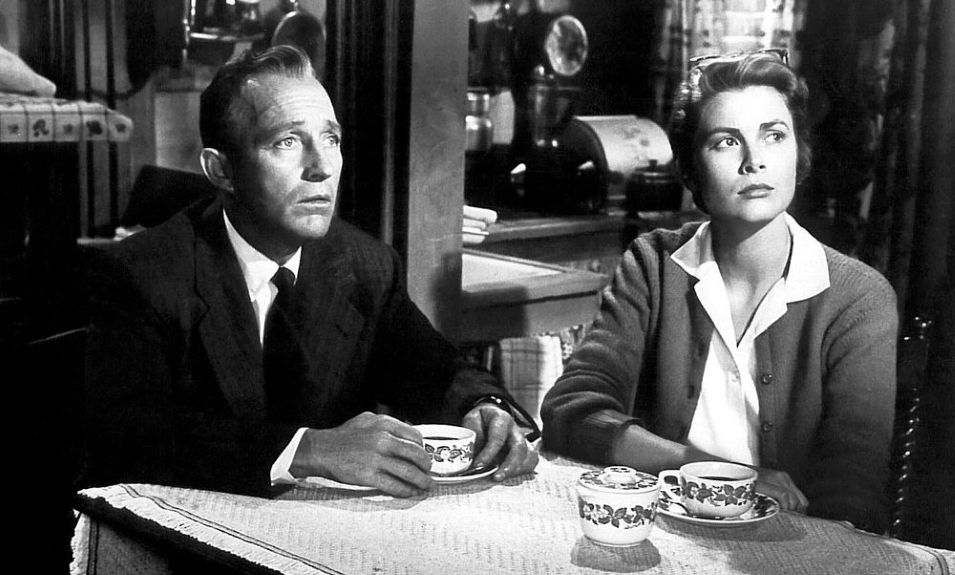
Acting with a capital A in this ultra-serious addiction drama, that makes its points with heavy hand
Director: George Seaton
Cast: Bing Crosby (Frank Elgin), Grace Kelly (Georgie Elgin), William Holden (Bernie Dodds), Anthony Ross (Philip Cook), Gene Reynolds (Larry), Jacqueline Fontaine (Lounge singer)
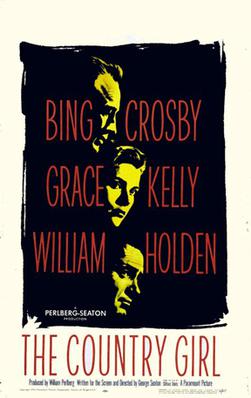
Adapted from Clifford Odet’s play, George Seaton’s The Country Girl is serious with a capital S, with acting with a capital A from its stars, both of whom (to the delight of the Oscars) play wildly against type. Frank Elgin (Bing Crosby) is a faded song-and-dance man, a weak-willed people pleaser who hit the bottle big time, filled with guilt about the death of his young son. He’s married to the dowdy Georgie (Grace Kelly), whose whole life has become an endless chore propping up the feeble Frank. Elgin is hired by hot-shot Broadway director Bernie Dodds (William Holden) for his new musical. Bernie soaks up Frank’s lies that Georgie is a demanding, controlling bully rather than Frank’s go-to comfort blanket. Can Georgie hold Frank together for the previews, despite Bernie’s misguided belief that Frank would fare better if she was shipped home?
The answer, not surprisingly, is no. The Country Girl in many ways, it quite Victorian in its sense of domestic tragedy. The death of Frank and Georgie’s son – killed by traffic when Frank let go of his hand for some publicity photos – has a real classic melodrama ring to it, a feeling added to by the Frank’s memories coming storming back whenever he hears the refrain of the song he had been recording moments before the accident. It’s the cause for a series of scenes of half-cut self-loathing from Frank, who powers his way through life both through the bottle and whining at Georgie to fix his problems.
Frank is an innate people-pleaser, desperate to be adored. (He even pathetically asks a barman, between shots, if he likes him). But behind that is a demanding prima-donna, turned incessant self-pitier. He moans about everything to Georgie – his lack of a dresser, being pestered by his under-study, the pressure of learning the lines and carrying the show – and then instantly assures Bernie moments later that he’s delighted with everything. Worse than that, he spins constant lies that Georgie does everything she can to batter his confidence so can control his life and give meaning to hers.
Frank even shifts his attention seeking suicide attempts and hotel smashing drunken outbursts onto her, painting himself as a victim too decent to fight back against his bullying wife (even using repurposed speeches from his old stage triumphs as material). It’s music to the ears of William Holden’s Bernie, filled with bitterness at his own ex-wife who he sees as a jealous burden holding back his own career. He laps up believing that Georgie’s demands are her self-important power plays rather than filtered demands from his cowardly star.
Bing Crosby took on his biggest acting challenge, miles away from his aw-shucks Oscar-winning Going My Way charm. Crosby put in extreme effort – rather like Frank with Bernie, George Seaton ruthlessly coached him – but the problem is you can see it all. Seemingly every scene sees Bing shaking, on the edge of tears, looking into the middle distance, and battening down the musical richness of his voice into a weak mumble. There is a lot of earnest, sad-eyed starring in The Country Girl and this softly-spoken, rather mannered performance puts everything out there (the film even throws in a few in-play musical numbers, which Crosby delivers as per his usual style, so that we can really soak up the difference in his performance).
It’s similar with Grace Kelly, her glamour disguised as much as humanly possible under an ill-fitting cardigan, glasses and bags painted under her eyes. Much like Crosby, Kelly goes all out to wring every emotion possible out of this bitter, tragic woman who loves and deeply resents her manipulative husband. Kelly won an Oscar – beating Judy Garland in A Star is Born (allegedly by about 6 votes) – and the performance smacks of the sort of Acting Oscar loves (in many ways it’s a miracle Crosby lost to Brando’s subtle work in On the Waterfront). She even has a late speech, where Georgie lets out all her buttoned-down resentment, that has ‘for your consideration’ written all over it. Much like Croby, its very mannered – you admire its professionalism but can see all the effort.
Both stars hard-work is particularly noticeable when compared to the easy naturalism of Holden, who has the least flashy role but is arguably the best thing in it. He subtly downplays the eagerness which Bernie transfers his own marital resentments on to the Elgin’s marriage, just as he lets Bernie’s growing frustrations with both Elgins develop naturally. He even manages to make Bernie’s late intense attraction to Georgie not seem like it comes as wildly out of left field as the script make it.
The Country Girl works through its melodramatic events with a largely predictable series of beats, as Elgin goes from sweating through rehearsals to smashing up a bar, to drying out in his dressing room. The photography adds a lot of atmosphere, with shadow-cast moments adding a real sense of oppression to the film’s gloomy progress (there is a particularly lovely shot of Kelly buried in the shadows in the theatre wings). There are affecting moments, even if the film lays many of them on somewhat heavily with a trowel. But Seaton’s dialogue is strong, even if it is somewhat melodramatic and his directing is sound.
And you can’t deny the effort he gained from the two stars, even if their performances are so earnestly committed that it becomes a little overbearing to see the Acting in action. It’s fascinating to wonder how much more effective The Country Girl might have been if it had not played almost all of its emotional beats so heavily to the max, but had trusted us to discover the emotion for ourselves.







 Movie Musings