Category: Romantic comedy

Smiles of a Summer Night (1955)

Smiles of a Summer Night (1955)

Sexual and romantic comeuppances abound in Bergman’s landmark comedy of manners

Director: Ingmar Bergman

Cast: Eva Dahlbeck (Desirée Armfeldt), Gunnar Björnstrand (Fredrik Egerman), Ulla Jacobsson (Anne Egerman), Björn Bjelfvenstam (Henrik Egerman), Harriet Andersson (Petra), Margit Carlqvist (Countess Charlotte Malcolm), Jarl Kulle (Count Carl-Magnus Malcolm), Åke Fridell (Frid), Naima Wifstrand (Mrs. Armfeldt), Jullan Kindahl (Beata), Gull Natorp (Malla), Gunnar Nielsen (Niklas), Birgitta Valberg (Actress), Bibi Andersson (Actress)
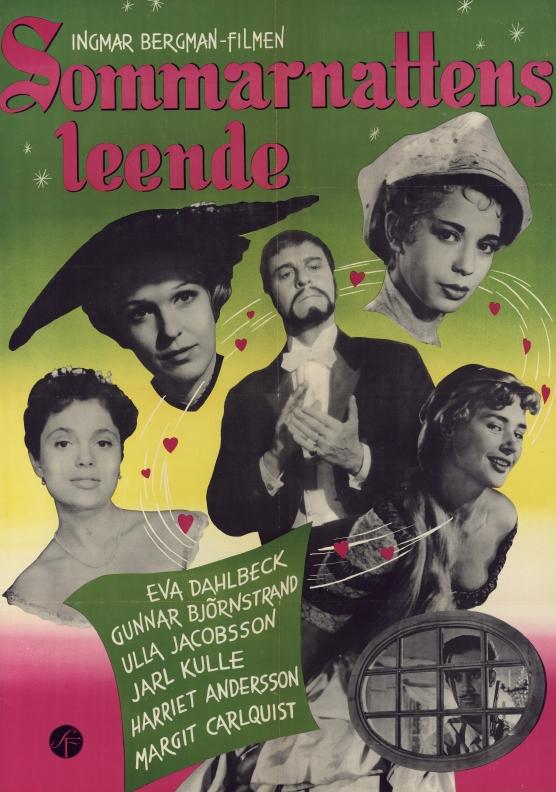
An Ingmar Bergman comedy? Surely a contradiction in terms, right? Like Da Vinci spraypainting graffiti or Austen writing a jingle. The Swedish master is near synonymous with glacial, Scandi-misery, not material that will be transformed into a Sondheim musical. But yet: Smiles of a Summer Night was the big smash-hit that guaranteed Bergman lifetime artistic independence (he followed it with the one-two punch of The Seventh Seal and Wild Strawberries that made him untouchable as Sweden’s premiere Artist). A Bergman comedy was never going to be a Ray Cooney farce, and while there are pratfalls and farce here, this film is an exploration of manners with more than hint of Shaw and Wilde, mixed with echoes of filmic greats like Ophüls and Renoir.

Set in turn-of-the-last-century Sweden, the film follows the romantic and sexual entanglements of a series of would-be couples. Fredrik Egerman (Gunnar Björnstrand) is a respected middle-aged solicitor, who hasn’t consummated his two-year marriage with 19-year old Anne (Ulla Jacobssen). This is partly due to her anxiety about sex. But really both of them are in love with someone else. Fredrik with his old mistress, celebrated actress Desirée Armfeldt (Eva Dahlbeck). Anne with Fredrik’s young son Henrik (Björn Bjelfvenstam) who is also in love with her. Henrik is flirting with house maid Petra (Harriet Andersson), who doesn’t seem averse to a relationship with any member of the Egerman family. Desirée is having an affair with Count Malcolm (Jarl Kulle), whose wife Charlotte (Margit Carlqvist) is considering infidelities of her own just to get his attention.

All of these potential couples merge, swop and work out their feelings overnight at the country house of Desirée’s mother (Naima Wifstrand) during one of the longest days of the year, where the sun hardly sets and people traditionally stay up until dawn. There is more than a touch of the theatrical about all of this – particularly with Bergman’s arch, intelligent dialogue – with the country house as a setting beautifully formal and strangely other-wordly. You can sense the theatrical influences here – Bergman had just directed a production of The Merry Widow – with the characters riffing with Wildean wit and insight, in typically Shavian set-ups.

What we get is a high comedy of manners, that’s also coated in a rich, insightful poetry that gives it a great deal of meaning. There is farce here – including a room with a switch that drags a bed from a neighbouring room (with occupant!) into it. There are several funny lines – many from Jarl Kulle’s hilarious heartless count, who doesn’t care who flirts with his wife until someone actually takes him at his word. There are pratfalls – Henrik has a superbly bleak bit of pure farce near the end that tips into erotic joy (“If the world is full of sin, then I want to sin”). The pompous Fredrik is constantly humiliated, from falling in a puddle to being thrown out of Desirée’s apartment in nothing but a borrowed nightshirt and a pair of slippers. There is no end of sexual suggestiveness, from Harriet Andersson’s gorgeously flirtatious maid (“Hurrah for vice!”) to hints about Mrs Armfeldt’s past (“I was given this estate for promising not to write my memoirs”).

Being Bergman though, this is the sort of romantic comedy that ends with a duelling game of Russian roulette and where we learn as much about human nature as we enjoy the scripted bon mots. Namely, that people – especially men – never seem to know what they want. Fredrik spends a huge chunk of the film persuading himself he is deeply in lust with Anne – although its pretty clear that he’s barely interested. Marriage and relationships in this case are gilded cages that lock people into things they barely want. They don’t even lend themselves to communication – the Malcolm’s marriage doesn’t seem to be based on any communication at all.

So, no wonder it needs a bit of Midsummer Night’s Dream style madness to try and sort it all out. Before that short night, the characters all down a particularly intoxicating wine that they are warned will bring down all their restraining impulses (whether that’s true or not, it certainly does). It’s part of a plot by Desirée – a superb Eva Dahlbeck, serene and glamourous, but also a battle-axe force-of-nature who knows exactly what she wants and how to get it – to resolve all complications for the (her) best, carried out in partnership with Caroline, a woman she’s far to savvy to let something petty like sleeping with her husband get in the way of useful friendship.

Contrasted with all these slightly restrained middle-class people who struggle to understand or express their real feelings, or (like the Egermans) seem to feel a slight guilt at sex anyway, we have the more earthy and free Petra, radiantly played by Harriet Andersson. Andersson gives Petra a flirtatiousness that sees her go from unbuttoning her top to attempt to seduce Henrik, to rolling in a bed with Anna. While the upper classes engage in a formal dance, she seizes life and opportunities – and ends up well-matched with the equally down-to-earth chauffeur Frid (an exuberant Åke Fridell), who like her doesn’t muck around when there is a chance to grab a bit of joy.

Not like the Egermans. Fredrik – a beautifully reserved Gunnar Björnstrand – should want Anna, but all the starring at her photos in the world won’t stop him muttering Desirée’s name while he sleeps. Not that it will allow him to try and rekindle his past relationship with her. Anna (a luminous Ulla Jacobsson), nervous about sex or rather nervous about her feelings with Hendrik, channels her feelings into jealous criticisms of his clothing after catching him naively succumbing to Petra’s flirting. Henrik (Björn Bjelfvenstam, very funny in his bemused wetness) is so inept in his romance of either woman, he barely seems to know what he wants.

Perhaps Desirée recognises all this is a bit of prime, Theatrical nonsense and tries to solve it all accordingly. After all her whole life is the theatre – from treading the boards, to singing and dancing while walking late at night with Fredrik. And it was for Bergman – that and film, which is why perhaps the film has echoes of Jean Renoir’s Le Regle de Jue with its country house romantic intrigues and Max Ophüls partner swopping La Ronde. And Smiles of a Summer Night is a beautifully mounted film, shot with a luscious, poetic beauty by Gunnar Fischer.

The whole film is a complex dance – you can see why it was ripe for Sondheim – that also explores profoundly the romantic and gender clashes between men and women. Men who are in a position to take what they want, but have no idea what that is. Women who know far more, but must be smart about how to achieve their goal – or like Petra willing to embrace a wild abandon to live in the moment. It may be a theatrical, drawing-room, sex comedy of sorts: but it’s also a film about humanity and people’s fates, all under the eyes the suggestively supernatural power of a smiling summer night. Perhaps its not such a contradiction of Bergman terms after all.
Eternal Sunshine of the Spotless Mind (2004)

Eternal Sunshine of the Spotless Mind (2004)

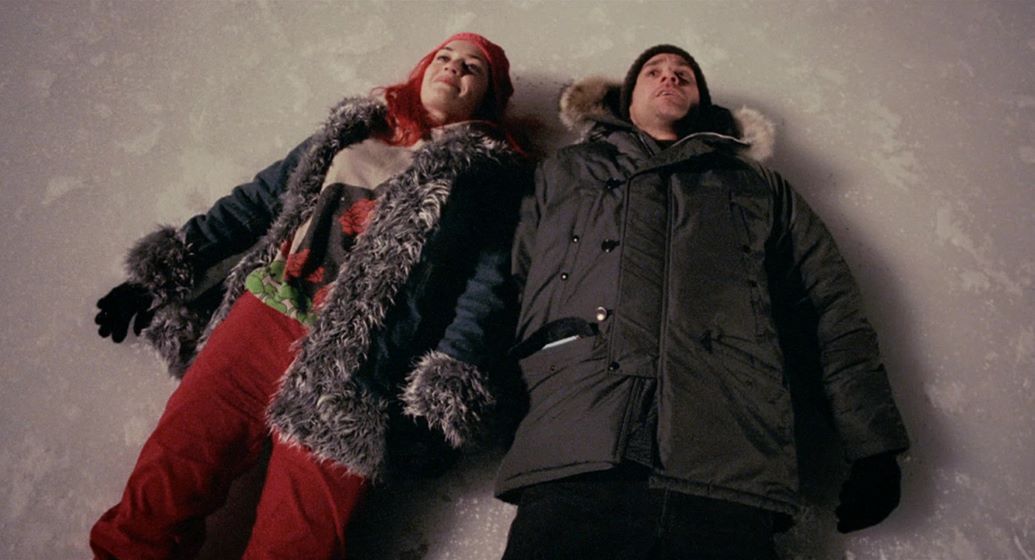
An impulsive decision leads to a wild tour through mind and memory in this mind-bending, desperately romantic classic

Director: Michel Gondry

Cast: Jim Carrey (Joel Barish), Kate Winslet (Clementine Kruczynski), Kirsten Dunst (Mary Svevo), Mark Ruffalo (Stan Fink), Elijah Wood (Patrick Wertz), Tom Wilkinson (Dr Howard Mierzwiak), Jane Adams (Carrie Eakin), David Cross (Rob Eakin), Dierdre O’Connell (Hollis Mierzwiak)

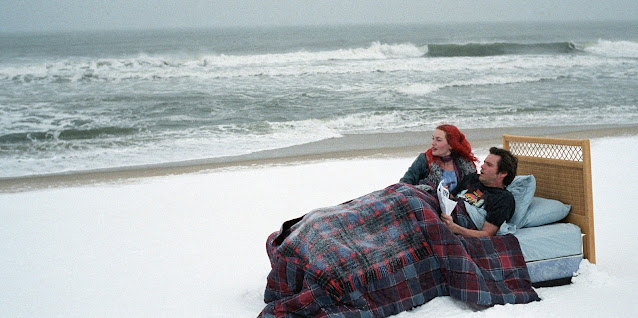
What makes us who we are? If it’s anything, it might just be the sum total of our experiences. The events of our lives, and the emotions they cause in us, shape and define us. If we cut some of them away, what would we be? Is losing painful memories worth it, if we also cut away memories we cling to as treasured possessions? What makes us love someone: instinct or the sum total of our memories with them? Ideas around this and how love works are at the centre of Michel Gondry and Charlie Kaufman’s extraordinarily inventive, imaginative but also romantic and heartfelt Eternal Sunshine of the Spotless Mind, a truly original film crammed with rewarding moments.

Joel Barish (Jim Carrey) wants to make-up with his electric but troubled girlfriend Clementine Kruczynski (Kate Winslet). Imagine his pain when he goes to see her and she seems not to recognise him – and how much worse that might be when he discovers Clementine has erased him from her memory. An experimental surgery, Lacuna, run by Dr Howard Mierzwiak (Tom Wilkinson), offers its clients an unmatchable service: they will erase a person from your memory. Struggling to get over the loss of a partner, wife, friend, child or even dog? No problem, they’ll be gone from your mind and you never need worry about their memory causing you pain again.

Hurt and angry, Joel decides to undergo the same surgery to forget Clementine. While the procedure takes place over night – supervised by techs Stan (Mark Ruffalo) and Patrick (Elijah Wood) and Stan’s girlfriend (and Dr Mierzwiak hero-worshipper) Mary (Kirsten Dunst) – Joel comes to realise in his sub-conscious that he doesn’t want his memory stripped of Clementine. The cost of losing so many good memories isn’t worth it. In his sub conscious he tries to protect his memories – while in the real world the team battle to complete their contract and erase them.

Not many films like that are there? Gondry’s film could have been a slave to its concept. Instead though, it manages to juggle its deeper meanings with a truly heartfelt, winning and very sweet human story about two people who, for all their faults, become people you completely invest in. Kaufman’s script, as you would expect, triumphs as a complex and inventive magic tour but it’s also a wonderfully placed romance and heartfelt relationship story. Effectively the film manages to have something for everyone to invest in, from sci-fi nerds to lovers of romcoms to philosophy students.

It’s also a triumph of style. Set largely in Joel’s mind, the film reflects the fractured nature of the surgery as his memories are assaulted, deconstructed and destroyed. Lights fade, buildings disassemble and disappear, faces melt away from bodies and memories start to crash into each other. In his mind Joel walks through a door in a library to find himself on a beach, or rounds a corner to find himself back in his childhood memories. All of this is filmed with a series of stunning in-camera effects that make characters disappear, duplicate or seem to be in several places at once, all shot in a series of one-take effects that sees buildings disappear in front of us or fascinating memory loops. Visually the film is a feast, a tribute to Gondry’s playful imagination.

But it sticks with people because of the heart at the centre of it. Joel and Clementine become people we care about. We root for Joel to defy the odds and preserve some of his memory. Because, the film makes clear, being consciously aware of his memories being deleted is basically like going through the pain of losing her a second time – only this time knowing you won’t even be left with the parts you want to hold onto. In fact – re-enforced by the distress we see in Clementine when we see her undergoing the panic of being subconsciously aware of memory loss in the real world – Joel’s horror of what he has asked for is likely what all the other patients of Lacuna’s ‘brain damage for your own good’ surgery have gone through.

Superbly played by Jim Carrey and Kate Winslet in cast-well-against-type performances, Joel and Clementine might at times be selfish, frustrating, even irritating people – but it’s clear their love for each other is real. Jim Carrey, dialling down his gonzo mania to an unprecedented degree, is perfect as the shy and gentle Joel, bewitched by this explosive presence in his life. Winslet is electric – cranky, brittle, damaged but also caring and playful. Kaufman’s film shows they hurt and snap at each other, but also that they bring each other happiness they can’t get anywhere else.

So, it comes back to that question: do we accept that part of the price of loving and living is pain? That the people who we love the most, are the ones that may also hurt us the most. The film is also clear that love can’t be forced or replicated. In the ‘real world’ Clementine is being wooed by Elijah Wood’s creepily needy techie, using his records of her romantic memories of Joel to replicate their special moments. The falseness of this isn’t a remote match for the true emotion of the real event: and it’s a testament to the film’s commitment that you can’t forge or force love, and that eventually it might just find a way.

Because, even without our memories, will we still be drawn towards the same people? Can love in fact survive, even if you don’t know who the person who love is anymore? It’s another fascinating thread in this film. Romantic couples throughout find themselves drawn to each other continually, a subconscious emotion surviving the purging of actual memories. It adds even more to the horrific trauma of seeing what’s happening to Joel here. His obvious distress as he realises the implications of what he rashly asked for – and there is plenty of suggestion Clementine feels the same – gets worse and worse as he realises he has signed away his own rights to decide who he loves.

Those ethical questions – is it even possible to make an informed decision here about lobotomizing your memory – mix with those philosophical questions of what makes us what we are. Will Joel and Clementine be the same people or not after this operation? How will they adjust to losing such a hugely important part of their histories? Especially as they won’t even know that they have. Kaufman’s script explores this all carefully, but never once losing track of the emotional story driving it.

So Eternal Sunshine becomes a touching love story, about two people going to huge ends against impossible odds to stay together. That, I think, is what lies behind its appeal. What makes it one of the most lasting films of the 00s is the invention and flair the story is told with – Gondry’s direction and its non-linear structure all only add to the fabulous script from Kaufman and Gondry – and the way it very lightly tackles a whole host of fascinating ideas while never losing track of its nature as an entertainment. It’s a brilliant film.

As Good As It Gets (1997)

As Good As It Gets (1997)

Sparks fly in this straight-forward sitcom set up from James L. Brooks

Director: James L Brooks

Cast: Jack Nicholson (Melvin Udall), Helen Hunt (Carol Connelly), Greg Kinnear (Simon Bishop), Cuba Gooding Jnr (Frank Sachs), Skeet Ulrich (Vincent Lopiano), Shirley Knight (Beverly Connelly), Jesse James (Spencer Connelly), Yeardley Smith (Jackie Simpson), Harold Ramis (Dr Martin Bettes)

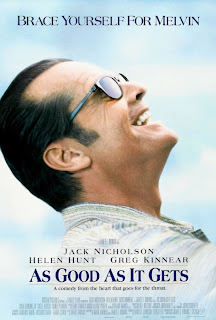
Melvin Udall (Jack Nicholson) is the rude, misanthropic writer of Mills and Boon style novels who suffers from an OCD that sees him keep to a strict series of routines. One of the most important is always having breakfast at the same table of the same restaurant, where the only waitress who will serve him is Carol Connelly (Helen Hunt). Carol is caring for her young son Spencer, who suffers from chronic asthma. All starts to change when the homophobic Melvin is persuaded to look after the dog of his neighbour, gay artist Simon Bishop (Greg Kinnear), after he is assaulted during a robbery. Melvin finds himself getting closer to the dog – and before he knows it, starts to reluctantly build a friendship with Simon and a romantic relationship with Carol.

If you thought that sounds rather like the set-up for a sitcom… you’d basically be right. James L Brooks demonstrates his TV roots again with what could almost be an extended pilot for a TV series, shot with his characteristic functionality. While its an attempt to show how different people can struggle to overcome barriers to connect with each other – be those psychological, social or health – it squeezes this into a trope-filled plot set-up, that swims in sentimentality and gives opportunities for actors to enjoy scenery-chewing, attention-grabbing parts.

None more so than Jack Nicholson, winning his third Oscar as Melvin. To be honest, what Nicholson does he is essentially portray a less complex version of Victor Meldrew from One Foot in the Grave. Melvin is a man who doesn’t suffer fools gladly, and delights in using his wealth to excuse him from saying a host of unacceptable things about everyone he meets (not a single gender, sexuality or race escapes his quick-witted bile).

Of course, the audiences know that it’s alright because it’s Jack, and while he might be a rogue he’s basically got his heart in the right place. Discovering that is basically the purpose of the film: of course, all that rudeness and cruelty is a front to protect an insecure man from the dangers of emotional commitment. Not to mention that the first thing to melt his shell is that most familiar (and sweet) of Hollywood props, a dog. Brooks does manage to demonstrate that Jack’s acts of kindness are at first partly about making life easy for himself – securing an expensive doctor for Carol’s son is about ensuring she doesn’t leave his restaurant and agrees to keep talking to him – but the film is determined to show everyone is basically “decent” and “kind” even if they don’t know it.

Inevitably, the best way of doing this is for that familiar old development, the road trip: for contrived reasons connected to Simon needing to ask his parents in Baltimore for help with medical bills, Melvin, Carol and Simon climb into a car for a cross-country drive. Needless to say, the predictable clashes, confessions, break-ups and reconciliations take place. It being a Brooks movie, this all takes place over an extended two and a half hour run time (indulgent for such a traditional set-up).

What makes it work is that the acting of the three principles is fiercely committed. Oscar-winning Nicholson eats up the cutting dialogue but also manages to mine a lot of “little boy lost” vulnerability from Melvin, a man who throws up barriers of rudeness, aggression and misanthropy to protect himself from getting hurt. Helen Hunt (who won another Oscar) hones years of experience in delivering fast-paced, witty dialogue from Mad About You, also shows real depth making Carol a similarly guarded person, using sass and cynicism as a shield against a world she expects to bite her. Greg Kinnear is a fragile artist, hiding behind his art, tortured by denial about his problems and desperate for an emotional connection.

That theme of the defensive barriers – and crippling effects of our own mental hang-ups – is the deeper message that Brooks manages to bring to the film. Melvin might seem, on the surface, the most obviously maladjusted but at least he’s vaguely happy in his skin at the start of the film. The other characters wear smiles of contentment, but only to hide deep stress and turmoil. It’s Brooks’ TV roots that turns all this into a series of “learning” lessons, where every scene in the final act is accompanied by someone making a profound choice, making a new start or letting something go.

As Good As It Gets is about making the best of things. And Brooks makes a pretty good fist of making this a decent (overlong) romantic comedy with a touch of depth. But its still mired in predictable tropes. Melvin’s OCD expresses itself in the most amusing filmic way possible, essentially as a form of charming eccentricity rather than the crippling disease it can actually be (it ticks all the predictable boxes, from light-switches, to compulsive hand cleaning to not stepping on cracks in the pavement). The film also, rather worryingly, suggests OCD can be overcome just like any other personality problem, simply by opening your heart and learning those lessons.

It’s fine, but you can watch it now and wonder how a film that’s essentially an over-extended dramedy TV-show pilot ended up scooping so many prizes. Entertaining, with some interesting perspectives, with committed acting, but very little that’s new and a lot that’s rather tired.

Working Girl (1988)

Working Girl (1988)

Wall Street gets the Cinderella treatment in this romantic comedy of sexual politics and mega-hair

Director: Mike Nichols

Cast: Melanie Griffith (Tess McGill), Harrison Ford (Jack Trainer), Sigourney Weaver (Katherine Parker), Alec Baldwin (Mick Dugan), Joan Cusack (Cynthia), Philip Bosco (Oren Trask), Nora Dunn (Ginny), Oliver Platt (Jack Lutz), Kevin Spacey (Bob Speck), Robert Easton (Armbrister), Olympia Dukakis (Personnel Director), Amy Aquino (Alice Baxter)

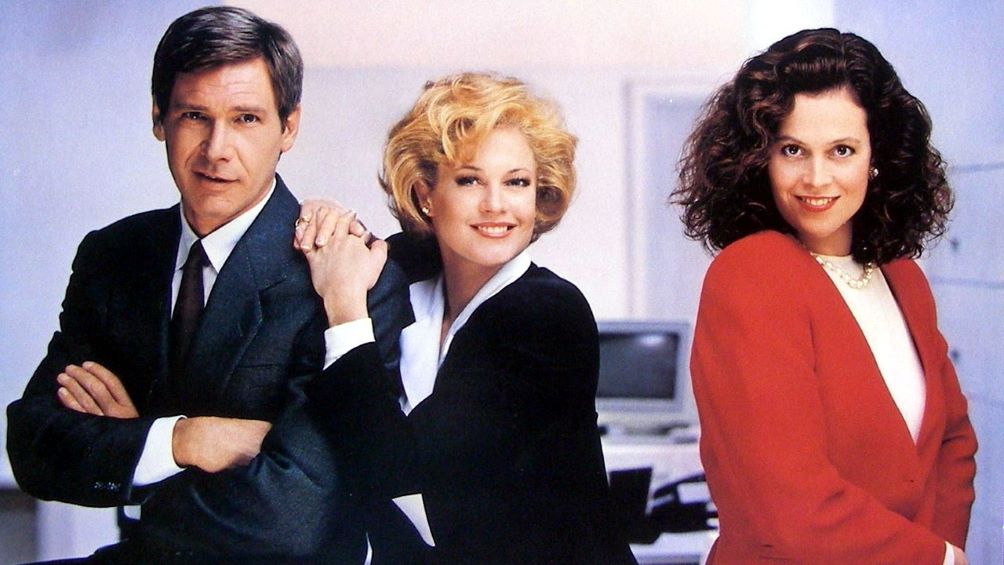
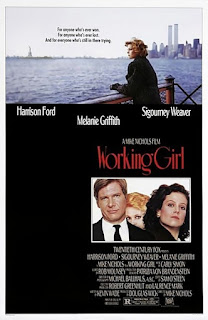
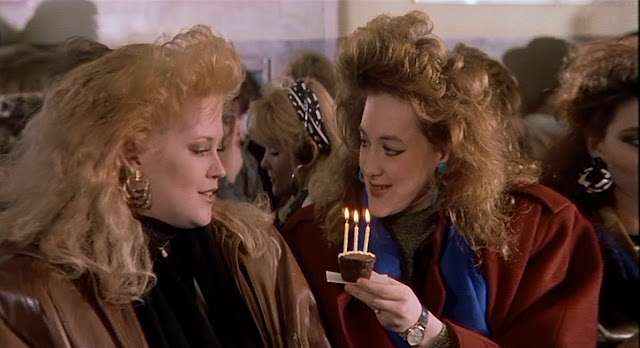
Is there a more 80s film in existence? It’s got the hair, the fashion, the attitudes, the Reagonite go-getting celebration of the guts and glory of Wall Street. Tess McGill (Melanie Griffith) looks and sounds like a dumb secretary, but she’s got the brains for business (but also, as she says, a bod for sin) – just never the opportunity to prove it. It looks like that might change under new boss Katherine Parker (Sigourney Weaver), who’s all smiles and talk of the sisterhood – but pinches Tess’ ideas and passes them off as her own. When Katherine is injured on a ski trip, Tess takes the chance to prove she’s got it by passing herself off as Katherine’s colleague and enlisting the help of mergers expert Jack Trainer (Harrison Ford) to put together a mega-bucks media merger. But what will happen when Katherine finds out?

Working Girl is really a great big Wall Street fairy tale, with Tess as the Cinderella invited to the ball only to have to run away leaving the business equivalent of her glass slipper behind. Katherine is a wicked stepmother, and Jack the handsome prince. It’s the sort of film where the heads of corporations are cuddly figures who place fair-play and honesty above making a buck and goodness, wins out in the end. Basically, it’s about as much a slice of business realism as Pretty Woman (this film could almost be a dress rehearsal for that).

Nichols directs the entire thing with confidence and pizzazz and draws some good performances from the actors, while keeping the entire thing light, frothy and entertaining. He had to fight tooth and nail to cast Melanie Griffith – but it was a battle worth winning as the role is perfect for her. Griffith always finds it hard to get good roles – her light, airy voice has condemned her to a string of airheads and bimbos – but here it’s perfect for a woman everyone assumes is dumb the second she opens her mouth. She’s even thinks of herself as not that bright, accepting her lot in life is settling for second best.

That’s personally and professionally. Her boyfriend, played with a wonderful smarm by Alec Baldwin, is a rat (she walks in to her flat to discover him mid-coitus – “This isn’t what it looks like!” he protests with an unabashed grin), who constantly reminds her that she’s punching above her weight dating him. Tess is at the bottom of an ocean of sexism on Wall Street: traders see her as little better than a perk, slapping her bum or stopping to stare at her behind when she walks past them. She barely avoids sexual assault from a coke-addled trader in the back of a limo (a piece of presciently perfect casting for Kevin Spacey). Her first boss (a puffed-up Oliver Platt) routinely humiliates her.

Oh my God! The Hair!

To be fair, the film makes clear that much of this is a woman’s lot in this poisonous world of Wall Street. Even her boss Katherine has to patiently remove groping hands from parts of her body, and wearily tells Tess that it doesn’t do to kick up a fuss when you never know who might become a vital contact in the future. Working Girl makes some pretty gentle points about workplace sexism – you can’t fail but notice Katherine and Tess are the only two women in the office who aren’t secretaries or HR people, and even Tess is pretending not to be – and the casual objectification of women.

Sadly, it blows a few of those points by still getting Griffith and Weaver to perform scenes in lingerie. Griffith even has a brief scene where she hoovers Weaver’s empty apartment topless. Sure, it’s a bit progressive on women’s rights in the workplace: but still, phroah, look at that.

Nichols gets one of his most relaxed and loose performances from Harrison Ford. Even if Ford at times looks a little abashed, working against such forceful performers as Griffith and Weaver (like a shy teenager in a school play), Nichols helps him feel light and funny without relying on the cool machismo that served him well as Indy or Han. Jack Trainer (such a Harrison Ford character name!), becomes giddy and playful under Tess’ influence and there is a sweet innocence about his courtship of her. It’s one of Ford’s funniest, most naturally instinctive performances.

Equally essential to the film’s success is Weaver, who plays up to perfection her glacial distance as a woman who is all smiles and “us, us, us” in person, but selfish looks and “me, me, me” in private. Weaver is very funny as a ruthless, amoral businesswoman masquerading as a campaigner for her sex and completely recognises that the role is essentially a wicked stepmother, pitching it just right between arch comedy and realism. She was Oscar-nominated, as was Griffith, and Joan Cusack who is triumphantly ditzy and warm as Tess’ best friend.

Working Girl pulls together all the tropes we expect. Tess is made up to look like the professional businesswoman she is aspiring to become, there is a neat bit of low-key farce as she passes off Katherine’s office for her own to Jack, a sweet bit of business chicanery as she Jack sneak into a wedding (the sort of thing that in real life would get you a restraining order) and it all leads into a “love and truth conquers all” resolution with a satisfying coda scene as Tess starts a new life. There is a lovely song by Carly Simon (over-used on the soundtrack – and fans should check out Michael Ball’s cover of it) and plenty of chuckles. It’s a fairy tale of New York.

Some Like It Hot (1959)

Some Like It Hot header
Tony Curtis, Jack Lemmon and Marilyn Monroe make comedy gold in Some Like It Hot

Director: Billy Wilder

Cast: Marilyn Monroe (Sugar “Kane” Kowalczyk), Tony Curtis (Joe/“Josephine/“Shell Oil Jnr”), Jack Lemmon (Jerry/“Daphne”), George Raft (“Spats” Colombo), Pat O’Brien (Agent Mulligan), Joe E Brown (Osgood Fielding III), Nehemiah Persoff (“Little Bonaparte”), Joan Shawlee (Sweet Sue), Dave Berry (Mr Bienstock), Grace Lee Whitney (Rosella), George E Stone (“Toothpick” Charlie)

It’s the funniest comedy that ever started in a hail of bullets. It’s the best chick flick to stare two men. It’s probably Billy Wilder’s sweetest comedy and it’s almost certainly its most beloved. They say Nobody’s Perfect, but you can be pretty sure this film gets as close to it as possible.

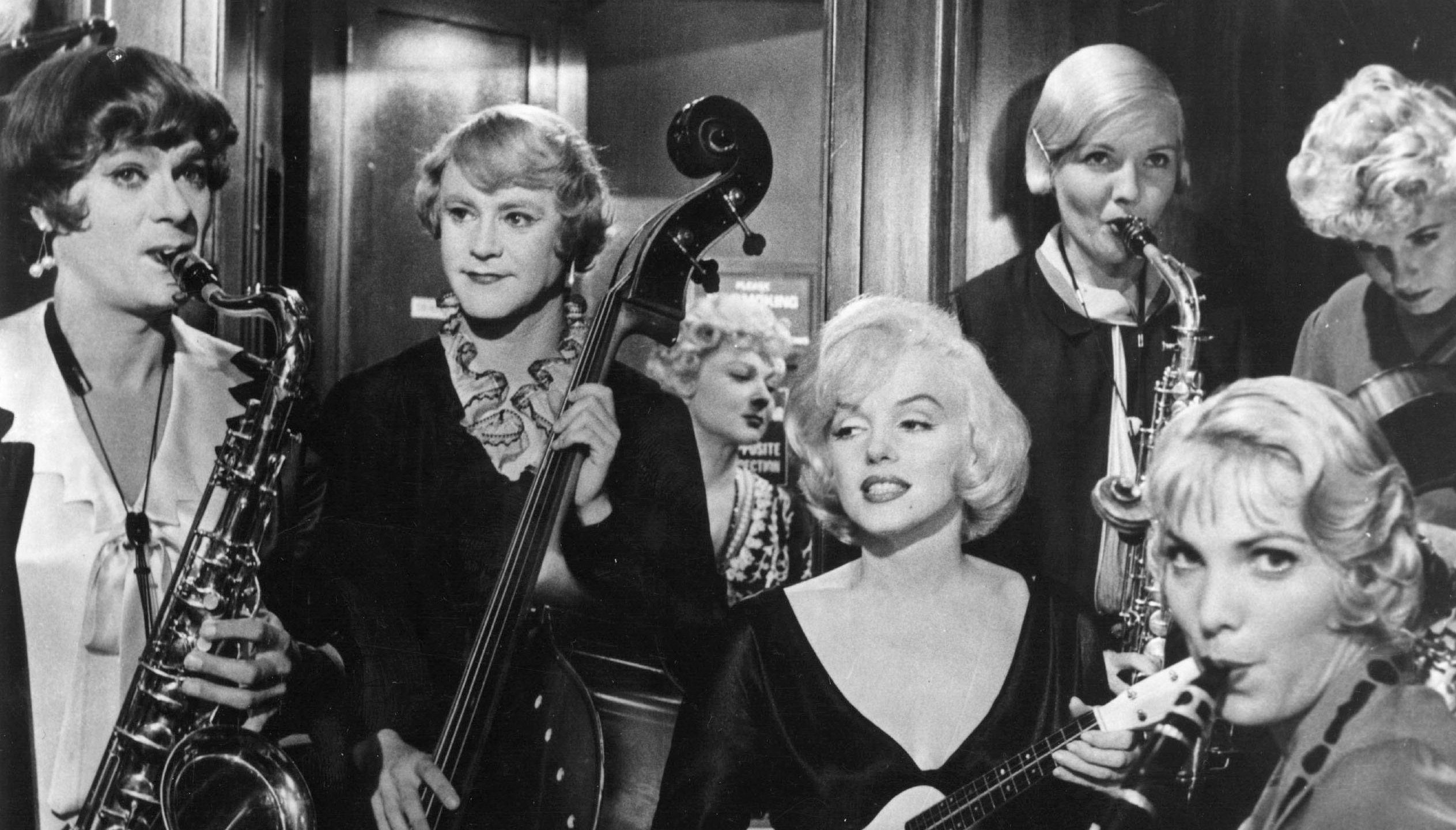
In 1929 in Prohibition Chicago, down-on-their-luck musicians saxophonist Joe (Tony Curtis) and double bass Jerry (Jack Lemmon) can’t get a break. First the speakeasy they are playing gets busted by the feds. They’ve lost all their money at the dog track. And, oh yeah, they accidentally witness gangster “Spats” (George Raft) eliminate his competition in a hail of bullets. They’ve got to get out of town incognito and quick – so what better option but joining an all-female band as “Josephine” and “Daphne”? Problem is, playing at a hotel in Florida, Joe and Jerry find themselves in all-sorts of romantic entanglements: Joe is wooing lead singer Sugar (Marilyn Monroe) in the guise of heir to an Oil fortune, while Jerry is wooed by smitten millionaire Osgood Fielding III (Joe E Brown). And if that’s not bad enough – guess which hotel the mob are having their annual convention at?

Wilder’s comedy is a fast-moving, brilliantly written (by Wilder and IAL Diamond) buddy comedy with a twist that dives into a whole world of gender and identity concepts that puts it way ahead of its time. Shot in luscious black-and-white (Wilder’s preferred style, and colour exposed all too strikingly the drag act look of Curtis and Lemmon), every scene has at a zinger and our heroes fall into one a string of madcap situation through misfortune and rank incompetence.

But the film’s real interest is in how far ahead of its time its gender awareness was. When they first appear disguised at the train station, the camera pans up their legs and behinds in just the way you would expect it to do (and indeed it does seconds later with Monroe) to ogle the women, only to reveal it’s the men striding their way down the platform. Both of them comment (and complain) on the objectification and unwanted physical attention (from slapped bums upwards) from men – “it’s like a red rag to a bull” Joe describes their feminine appearance, before he and Jerry complain they can’t wait to get back to being the bull again. It’s part of the fine tight-walk the film works, where the men are both men and women, victims and hypocrites, open-minded and conservative.

Dressing as women seems to give both of them a new perspective on things. Lothario Joe seems to gain a new sympathy for women – while at the same time, passing himself off as a millionaire to seduce Sugar with a string of lies – and comes to see himself as exactly the sort of lousy bum he probably has been. For Jerry the whole experience is a revelation. It’s part of as fascinating debate as to how much this film is aware of transgender and homosexual urges, and how much it’s just a very wittily delivered joke that’s so respectfully done it can be embraced by one and all. But for Jerry, the whole experience seems to redefine his own internal perception of himself.

It’s there from when he first glances Monroe at the train station: after tripping in his heels, he’s stunned when she works past, not by her looks, but by the ease she moves, his eyes not starring at her behind with lust (as Joe’s does) but with envious admiration. On the train he takes the blame for Sugar’s illicit bourbon – is it a sense of fellowship, or a bizarre way of making a pass at her? This leads to a slumber party in his bunk with the whole band, all in their nightwear – through which he constantly forces himself to remember he’s a boy (seemingly out of sexual excitement). But we very rarely see Jerry out of some layer of feminine disguise: and later confusion seems to abound during his courtship from Osgood, where he delights in the dancing, the jewels and the engagement and has to disappointingly remind himself that he’s a boy. After initial doubts Jerry finds a sort of freedom in dressing as a woman, that Joe never does.

How much is Some Like It Hot aware that it is playing around with fluid gender perceptions, and how much is it a stunningly well delivered joke? It’s not clear – and I doubt any film-maker in 1959 would even have the vocabulary to begin to conceive the sort of conversation the film provokes today.

But does it really matter when the jokes are this good and the performances so brilliant? Jack Lemmon is superb here, the sort of career-defining performance actors dream about. Anxious, fussy, slightly whiny, Jerry becomes the more playful, sassy Daphne – and what Lemmon does brilliantly is make both personalities fully-formed yet existing consistently within the same character. That’s not mentioning his verbal and physical comedic gifts and consistently perfect timing, his performance comedic but not a broad drag act. He makes Jerry/Daphne a living, breathing person anda comedic character, someone we can never imagine meeting in real life but also would not be surprised to sit down next to on a bus. This is skilful acting on another level.

Which is not to do down Tony Curtis, who is very funny as the lothario Joe uncomfortably squeezed into feminine attire. While Jerry comes to relish some of the accoutrements of ladies clothing, Joe is never as comfortable – for him it is practical solution. That doesn’t change Curtis’ hilarious comic timing – or his wicked Cary Grant impersonation (“No one talks like that!” Jerry complains) when taking on a third disguise as a Shell Oil heir, which also seems like a sly parody of Henry Fonda in The Lady Eve. Curtis’ comic timing is as faultless as Lemmon’s, and the two actors produce such a sparkling double act, it’s a shame they didn’t work together again.

As the third wheel, Monroe was never so radiant, culturally iconic and luminous than she was here. Reports are rife of the troubles she caused on set – the hours waiting for her to turn up, the lines she couldn’t or wouldn’t learn, the dozens and dozens of talks she demanded for the even the simplest scenes (this in particular drove Curtis – an instinctive actor whose performance declined with retakes – up the wall – it’s fun to spot how little they actually share the same shot during the film). Wilder later commented she was a terrible actor to work with – but a God-given talent up on the screen. Can’t argue with that, and she turns a character who, on paper, could be a dumb blonde joke into someone very sweet, endearing and lovable, who we never laugh at (Monroe is a generous enough performer to never worry about making it clear to the audience that she is smarter than her character is, or treat her with contempt).

Wilder brings it all together with his genius behind the camera. He cuts the film with superb comic timing – the intercutting between the seductions of Joe/Sugar and Jerry/Osgood are masterfully done – his sense of the momentum is spot-on and he is as skilled with flat-out farce as sophisticated word-play. That’s not to mention the wonder of the tone – he makes a concept that had the suits sweating in 1959, easy to swallow without ever once treating the idea as a revolting perversion, making it funny but never humiliating. The film’s sweetness is partly why its become so loved.

Possibly the funniest film ever made – and it’s also littered with gags about old-school gangster films, taking advantage of its inclusion in the cast of the likes of Raft and O’Brien enjoyably sending themselves up – it’s won a place in the hearts of film buffs and casual moviegoers for generations. And it’s going to continue to do so. With one of the greatest closing scenes ever, it’s always going to leave you wanting to come back for more.

Broadcast News (1987)

Broadcast News header
Albert Brooks, Holly Hunter and William Hurt struggle with the news and love in James L Brooks not very funny or insightful romantic media satire

Director: James L Brooks

Cast: William Hurt (Tom Grunick), Holly Hunter (Jane Craig), Albert Brooks (Aaron Altman), Robert Prosky (Ernie Merriman), Lois Chiles (Jennifer Mack), Joan Cusack (Blair Litton), Peter Hackes (Paul Moore), Christian Clemenson (Bobby), Jack Nicholson (Bill Rorish)

TV news – what is it for? To inform or entertain? It’s a debate James L Brooks tries to explore in his inconsistently toned hybrid rom-com and satire. At the end you very much intended to come out with the view that it should be about one, but is more about the other.

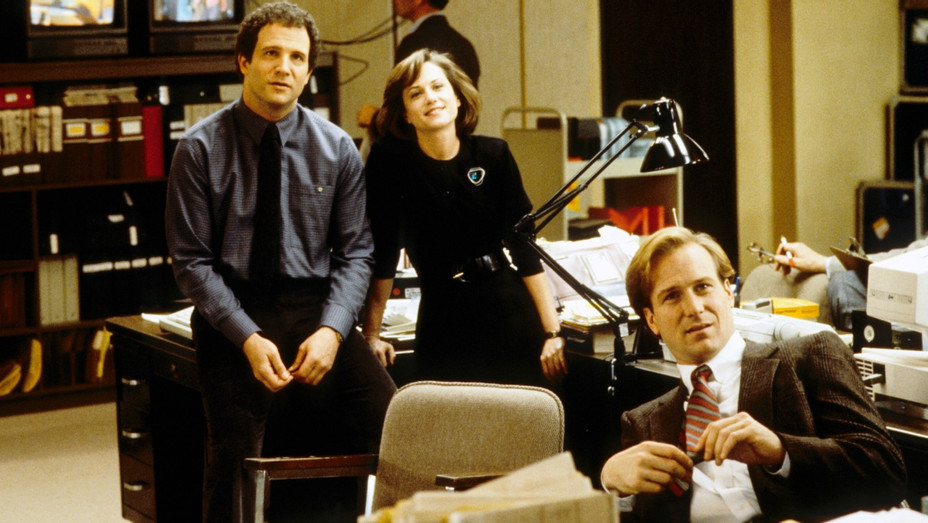
In the Washington branch of an unnamed network, Jane Craig (Holly Hunter) is a rising star producer, prone to daily emotional breakdowns. Her best friend is brilliant, committed reporter Aaron Altman (Albert Brooks), who longs to be the anchorman but lacks social skills. Arriving in their branch is Tom Grunick (William Hurt), handsome and full of TV savvy, set to become an anchor but lacking any real knowledge of either journalism or current affairs. Naturally a romantic triangle develops between these three, along with all sorts of debate about the purpose of TV news.

The film stacks the deck firmly in favour of the view that news should be a comment-free recitation of facts. Brooks’ film bemoans – often in heavy-handed ways – the intrusion of human interest, soft stories and puff pieces in place of hard-hitting questions and challenging coverage. Tom Grunick is the embodiment of this: charming, friendly, reassuring – and totally uninformed, interested in “selling” a story rather than telling it. Meanwhile, to the film’s disgust, the higher-ups at the network frequently value appearances and popularity over tough analysis, and looking good on TV counts for more than journalistic skills. Pity the film: if it feels this network is bad, imagine how it’d feel about Fox News today.

Of course what the film isn’t interested in is acknowledging a certain level of showmanship is an important tool in making the news accessible, engaging and interesting for the audience – making them more likely to pick up the important things in the content. It also overlooks that purists Aaron and Jane may avoid stage-manging their stories as overtly as others – but they’re more than happy to fill them with heart-string-tugging references and shots to get the audience reactions they want. In fact, you can see Tom’s point – what’s really wrong with him interjecting a shot of his own teary face while interviewing a rape victim (a moment he recreates)? Isn’t that basically the same?

Broadcast News tries to outline the difference, but I’m not sure it goes the full distance – or makes the debate accessible or interesting. That might be partly because the film can’t decide whether to give more attention to the satire or the romance – Jane is attracted to Tom (who returns her feelings), but is extremely close with Aaron, who carries a not-even-concealed passion for her. Both plots sit awkwardly side-by-side, getting in each other’s way and not adding insight to each other.

But then the film is fairly shrill. That partly stems from the two characters we are meant to relate to being tough to like. Holly Hunter is dynamic as the forceful, passionate Jane, but she’s also a rather tiresome character. Her purist demands are slightly holier-than-thou and while there are nice touches of humanity (on a date with Tom, she doesn’t want her handbag opened at a security check because she’s put a pack of condoms in it)  the film doesn’t manage to warm this control freak (so domineering she can’t get in a taxi without dictating the route). Jane also has a tendency to burst into tears – a suggestion of some underlying emotional problems the film instead treats as a joke.

That’s nothing compared to Albert Brooks’ Aaron Altman. This is exactly the sort of character beloved by film-makers, but who if you met in real life would come across an an unbearable creep. Like Jane, he’s an uncompromising idealist whose pious self-importance quickly grates. The film doesn’t appreciate the irony that its champion of professional reporting yearns to be the pretty-boy face of the network and resents that he’s neverbeen the popular kid.

His tantrums and rudeness are meant to be signs of his genuineness and the film leaves no doubt that his love for Jane should be requited because he knows what’s best for her. He’s the Nice Guy who doesn’t get the girls even though he really deserves them.  A scene where he furiously berates Jane when she confesses her feelings for Tom, then demands she leaves, then demands she stays so he can lecture her on his pain and why her feelings are wrong smacks of a thousand male script writers who didn’t get the girl they wanted and it was so unfair.

The film’s view of women is often questionable. Today, Aaron looks more like a Proto-Incel, one emotional snap away from strangling Jane because she won’t love him when she SHOULD. The film sees him as a relatable, principled hero. Jane may be smart and principled, but she’s hysterically over-emotional for no given reason (Women! They’re so crazy!), domineering and controlling. The film’s only other female character is Joan Cusack’s production assistant who spends her time either shrieking in shrill panic or talking with nervous incoherence.

So, it might be a fault of the film that the character I related to most was the one we were meant to condemn. William Hurt’s Tom is nice-but-dim, superficial but polite, supportive, hard-working and honest, self-aware enough to feel guilty that he’s not really qualified to do the job. He tolerates being mucked around by Jane far more than many others would and despite being constantly abused by Aaron, offers him no end of support. If Tom is the nightmare shape of TV news, you end up thinking “well heck, is it really that bad?”

Broadcast News overall is an underwhelming experience, not funny or romantic enough to be a comedy, or insightful enough about journalism to be thought-provoking. Brooks directs with his usual televisual lack of flair, but there are some decent comedic set pieces: Cusack has a mad-cap dash through a TV studio to deliver a taped report for a deadline that is a masterclass in physical comedy, while the film’s best set-piece is Aaron’s sweat-laden anchor appearance on a weekend news bulletin. But the film gives too many characters a pass and avoids asking itself the tough questions. It ends up a bit of a slog that probably has more appeal to insiders than audiences.

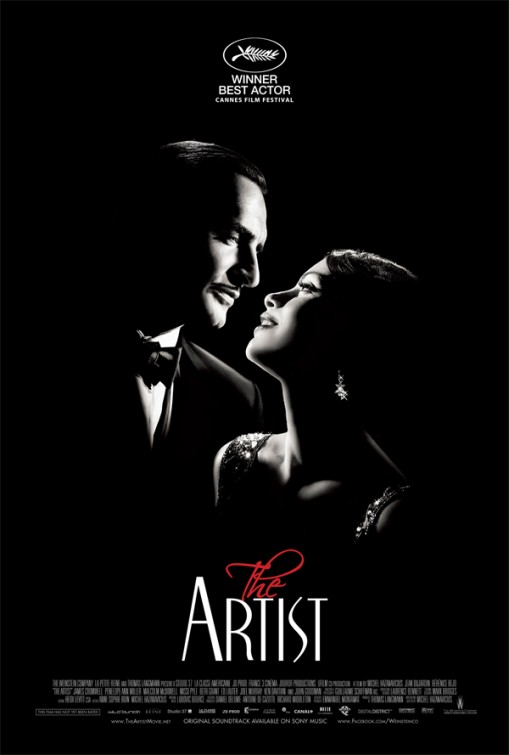
The Artist (2011)

Jean Dujardin and Bérénice Bejo delight in the light, frothy, charming Best Picture winner The Artist

Director: Michel Hazanavicius

Cast: Jean Dujardin (George Valentin), Bérénice Bejo (Peppy Miller), John Goodman (Al Zimmer), James Cromwell (Clifton), Missi Pyle (Constance), Penelope Ann Miller (Doris Valentin), Malcolm McDowell (Butler)

In 1920s Hollywood George Valentin (Jean Dujardin) is King of the Silver Screen. Why would he want anything to change? Surely these ‘Talkies’ are just a passing fad, right? Ooops. Before he knows what has happened, Valentin has gone from top of the world to the very bottom, left behind (like so many real-life silent stars) by change. Meanwhile, Peppy Miller (Bérénice Bejo), the young extra from his glory days whom Valentin briefly mentored, become a star of the Talkies. But Peppy still loves Valentin – and maybe he loves her – even while Hollywood pulls them apart.

Plot-wise, The Artist is pretty conventional. What really makes it stand out is that it’s a silent film about silent film. Perhaps that’s why the whole world went gaga for it (gifting it five Oscars, including wins for Hazanavicius, Dujardin and the Big One) – it was a genuine burst of nostalgia-tinged novelty. Everything old is eventually new again: I remember the novelty myself – sitting in a cinema and suddenly, after the music stops, hearing nothing but silence. Match that with the undeniable charm and energy the story is told with and, boom, you had a hit.

Does The Artist survive repeated viewings? Just about – though it looks increasingly like a slight film, that raises warm feelings but makes little lasting impact (I was surprised how much of it I had forgotten). Hazanvicius’ study of silent cinema has clearly been thorough, and this is undeniably a wonderful love letter to Hollywood’s history. Every technical detail is carefully reproduced, and the pastiche Fairbanks-style adventure stories Valentin stars in is spot on. The actors fully embrace the slightly exaggerated mannerisms of silent acting, telegraphing emotions with urgency.

Hazanvicius uses sound, when it comes, brilliantly. The opening of the film is bathed in music as we watch the premiere of one of Valentin’s films – only for all the sound to drop out the second the film-within-a-film ends. (We even see a “Silence behind the screen” sign before it does). We only hear everyday sounds twice – once in a hilariously haunting dream of Valentin’s where objects make noise but he cannot – and at the end of the film as Valentin finally finds a place in Talking Hollywood. Other than that, it’s scores, speaking cards (some of them witty, like Valentin’s wife’s question “Why do you refuse to talk?”) and all the style of silent cinema.

It’s a sweet and gentle film. There is no trace of the ruthless business Hollywood is, and not a trace of the darkness that touched many of this era. There is never any prospect of Valentin turning into, say, Sunset Boulevard’s Norma Desmond or any of the other washed-up waxworks in her house of broken dreams. Valentin loses everything, but remains a generous and decent guy, firing the loyal chauffer he hasn’t paid in a year (and giving him his car for free!) because otherwise he’ll never leave him. And of course, his dog loves him, so he must be a great guy. (The dog by the way was the break-out star, this charming, brave canine even getting a campaign for best supporting actor).

The film centres a love story between Valentin and Peppy. The two of them have an instant connection – but Valentin is the star, with Peppy the ingenue. This bond can survive nearly everything, even while Valentin resents her success. Hazanavicius manages to make this very sweet, even though Peppy is sometimes tediously saintly in her devotion. Valentin may have mixed feelings about his protégé – but in a housefire, the only thing he saves is footage of the two of them messing around in outtakes from one of his old films.

The film seems unbothered as well by the fact that Valentin is married. The wife (a thankless role for Penelope Ann Miller) doesn’t get a name, let alone any sense of a personality other than (it seems) being some sort of shrew.

You could also see Peppy, if you wanted to be uncharitable, as a bit of a stalker. She buys up (by proxy) all of Valentin’s goods when he goes broke, practically abducts him from the hospital after he is caught in a fire, hires his staff. Tip your head to one side and you can see her boiling a few bunnies. The Artist though sees her as more of a “Guardian Angel” (as per the title of one of Peppy’s movies) – and you can argue that there is something old-fashioned (not always in a good way) about a film where the female lead defines her success only by how it can help the man she loves.

The tinge of creepy to the Valentin-Peppy relationship isn’t helped by using a huge chunk of the Bernard Herrmann Vertigo score to underscore the film’s conclusion, not to mention the left-field melodrama of Peppy racing across town to prevent Valentin from committing suicide (motivated it seems by realising Peppy is his Guardian Angel). It’s an odd mis-step – and the sequence not only feels radically different from the rest of the film, it also seems to heavy for such a light confection.

But, negatives aside, it’s a decent little film. Jean Dujardin is the epitome of charm and old-school Hollywood wit as Valentin – it’s a master-class in physicality and he oozes matinee idol cool, and a certain boyishness. Bejo is very good as the well-meaning, kindly Peppy. The film is a puff of air, and once you get over the novelty, you’ll be amazed how little there is to it. But it’s told with such energy, charm and nostalgic wit (and ends with a lovely dance routine) as well as affectionate nods to old-school Hollywood, you won’t mind too much, even if you’re surprised it won as many awards as it did.

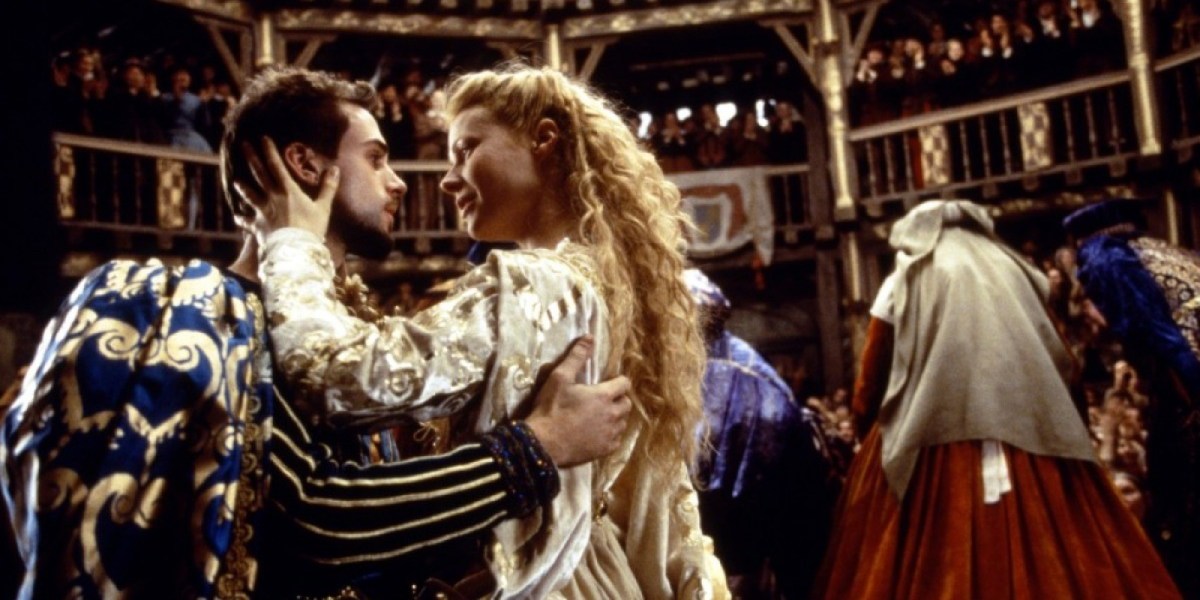
Shakespeare in Love (1998)

Joseph Fiennes and Gwyneth Paltrow juggle love and inspiration in the delightful Shakespeare in Love

Director: John Madden

Cast: Gwyneth Paltrow (Viola de Lessops), Joseph Fiennes (William Shakespeare), Geoffrey Rush (Philip Henslowe), Colin Firth (Lord Wessex), Ben Affleck (Ned Alleyn), Judi Dench (Queen Elizabeth I), Simon Callow (Edmund Tilney), Jim Carter (Ralph), Martin Clunes (Richard Burbage), Antony Sher (Dr Moth), Imelda Staunton (Nurse), Tom Wilkinson (Hugh Fennyman), Mark Williams (Wabash)

It’s become fashionable since 1998 to criticize Shakespeare in Love. It’s one of those films that the Oscar has diminished –you’ll swiftly find someone who’ll say “can you believe it beat Saving Private Ryan?” It doesn’t help that the film become a poster-child for Harvey Weinstein’s Oscar success, his tireless and canny promotion campaign for the film being credited for its sweeping the board. All that buzz is unfair, as it distracts from a hugely enjoyable, very funny, heartfelt and charming film, stacked with scenes that will make you laugh or let out a sad little sigh.

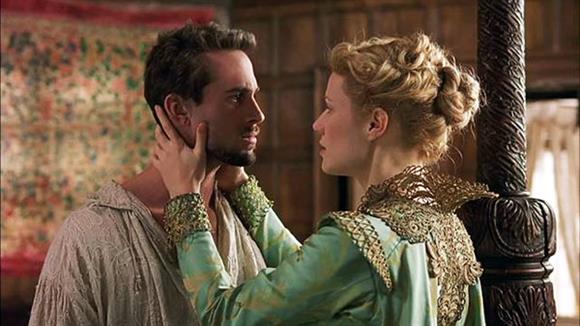
It’s 1593 and Will Shakespeare (Joseph Fiennes) has writer’s block. His latest play, Romeo and Ethel the Pirate’s Daughter just can’t get started despite the fact he’s promised theatre manager Philip Henslowe (Geoffrey Rush) that he’ll have it ready in a few days. Will only begins to find inspiration when he falls in love with Viola de Lessops (Gwyneth Paltrow) – little realising that Viola and the promising young actor in his company, Thomas Kent, are one-and-the-same. Viola, passionate about the theatre, dreams of acting on the stage and falls in love with Shakespeare (while keeping her Thomas Kent identity secret) – but her wealthy parents want her to marry the noble Lord Wessex (Colin Firth). Will these two star-crossed lovers find happiness? Or will their destiny follow the lines of the increasingly dark play about two young Verona lovers, that Romeo and Ethel is morphing into?

The largest part of Shakespeare in Love’s success rests with its script. The original idea had been doing the rounds in Hollywood for several years (Julia Roberts was determined to do it at one point, but only with Daniel Day-Lewis as Shakespeare, who was not interested). Marc Norman developed the concept and a plotline (originally much darker). But the film’s captivating wit and playfulness only really cemented itself when Tom Stoppard adapted the script into the frothy, super-smart comedy it became, crammed with riffs and gags about the Bard, Elizabethan theatre and show business. It’s also got a very funny – and humanising – idea of the world’s most famous writer suffering from writer’s block and then falling in love like he’s in one of his own plays.

Stoppard’s other trick was to repackage the concept into a delightful romantic comedy, centring the love story and downplaying other elements (such as Shakespeare’s quest to go solo and build his theatre career). With that, and the plot brilliantly refracting and reflecting Romeo and Juliet in tone and structure (just like that play, the first half is pure comedy, the second half darker in tone). In particular, the film is crammed with Shakespearean plot points and themes (from cross-dressing to plays-within-plays, mistaken identities, ghosts etc etc) all of which playfully  appear, cramming the film with delightful easter eggs.

It’s a celebration of the joy and magic of theatre – but it also hit big in Hollywood, because it’s essentially a Hollywood-studio comedy transmuted into the 1590s. Henslowe feels like a chancing B-movie producer, in debt who feels that with the idea of promising a share of profits (“there never are any”) instead of a salary, that his financial backer “may have hit on something”. There are puns about the unimportance of writers, billing on posters, the neurosis of creative people (even including an Elizabethan psychiatrist), oversized production credits, forced “happy endings” and sticking to tried-and-tested formulas. Gags call back to show-biz staples (“The show must…” “Go on!”). While it may be set in a theatre, there is a lot of the Hollywood studio in this.

But, with Stoppard at the pen, it was never going to be anything other than a loving tribute to the power of theatre to change lives. Shakespeare’s Romeo and Juliet is presented as a landmark in theatre history, a shift towards putting real-life emotion on stage instead of a few cheeky laughs and “a bit with a dog”. There is a wonderful plotline for Tom Wilkinson’s at-first all-business moneylender Fennyman, who discovers in himself a sense of wonder and delight for the theatre that melts his heart. (Wilkinson is outstanding here, a brutal man turned teary-eyed spectator, thrilled to be playing the apothecary). It weaves its charms so well about the delights of theatre, that you’ll even forgive the cliché of the stammering actor who finds his confidence on the first night. You even get a belting performance of Romeo and Juliet(with all the dull bits removed).

What really sucks in audiences through is the love-story – and Shakespeare in Love has a belter of a romantic plot. Riffing on Twelfth Night, As You Like It and of course Romeo and Juliet among many others, it’s a delightful series of misunderstandings, confusions and then passion, that eventually builds to an ending that’s bittersweet but true. It’s also beautifully played by the actors. Joseph Fiennes is so good here, a masterful display of light comedy tinged with sadness, so quick and electric with inspiration that I’m still amazed he didn’t go onto to better things.

Paltrow’s teary Oscar-acceptance has rather blighted the memory of her performance, but she has an earnestness and innocence that is deeply endearing and brings with it a radiant intelligence and emotional maturity that sees her turn into a realist. Wisely, the film’s ending sheds the other, minor plots, to hone in on an ending that is both sad and hopeful, that reflects real life (Shakespeare was after all, a real man married to someone else in Stratford) and sets up a thematic idea of love and inspiration being a life-long romance, that touches every moment of our lives, even when the loved person themselves is far away.

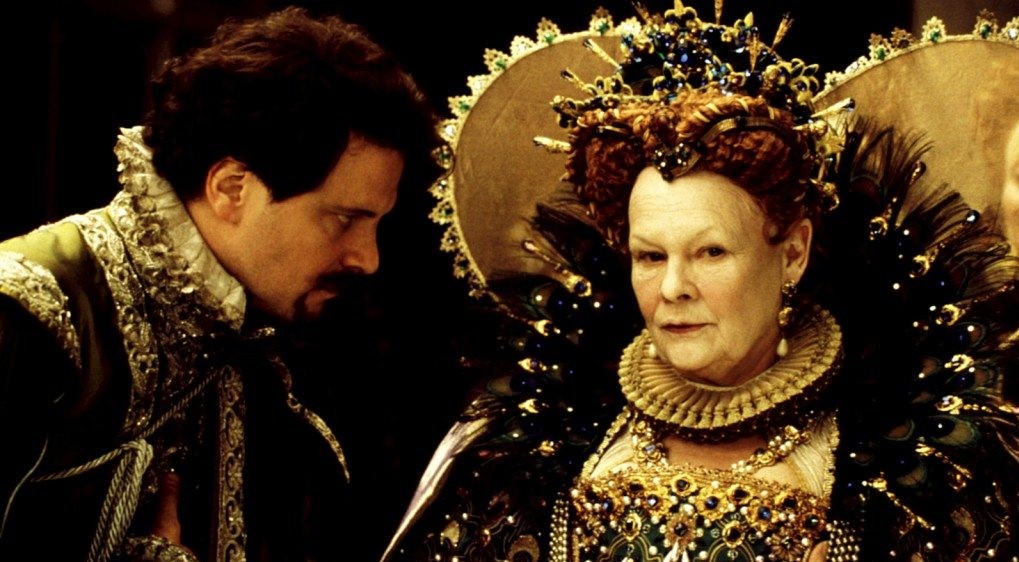
Directed with a smooth, professional sense of pace and joy by John Madden, it becomes a sweeping, surprisingly epic film, with a brilliant reconstruction of Elizabethan England and a luscious musical score by Stephen Warbeck heightening each scene’s emotional impact. The leads are marvellous, and there isn’t a weak-link in the strong cast. Judi Dench famously won an Oscar for her 8 minutes, but then its quality not quantity that matters and Dench’s archness is perfect for the role. Rush is hilarious as the grubby Henslowe, Affleck never better than his grand-actor parody, Colin Firth scowls expertly as “the other man” and Rupert Everett is dry and witty in a brief cameo as Christopher Marlowe, feeding Shakespeare suggestions.

You could say that Shakespeare in Love is just a romantic comedy. In many ways that would be fair. It doesn’t re-invent a genre, like Saving Private Ryan did. But, it’s a brilliantly mounted, intelligent and extremely funny one, with a superb script, some brilliant performances and wonderfully mounted. While it makes some good riffs on theatre, Shakespeare and the nature of love, it’s principle mission is to entertain – a big cinematic entertainment about the greatest playwright ever. And don’t we always say that comedy is exactly what the academy is biased against?

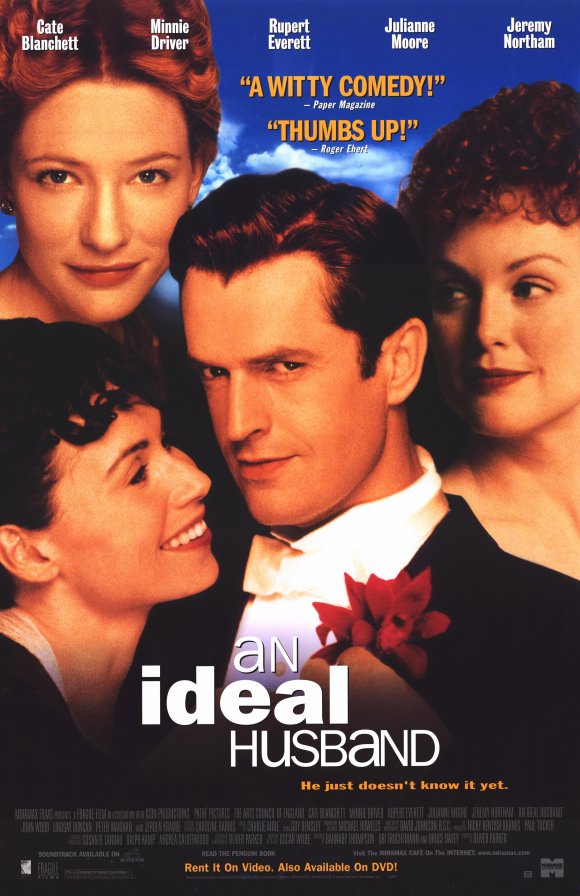
An Ideal Husband (1999)

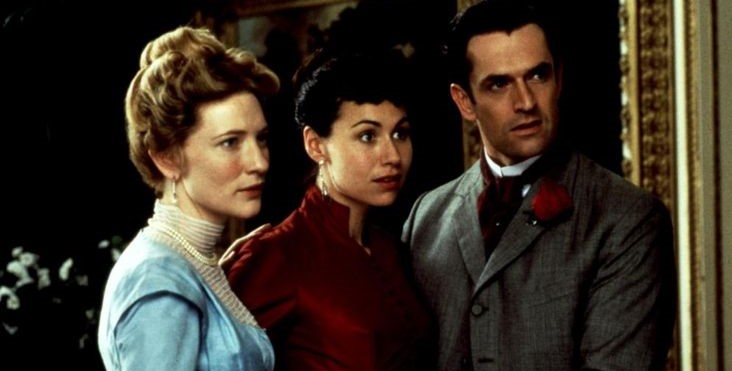
Cate Blanchett, Minnie Driver and Rupert Everett do the best in this Wilde mis-fire An Ideal Husband

Director: Oliver Parker

Cast: Rupert Everett (Lord Arthur Goring), Cate Blanchett (Lady Gertrude Chiltern), Minnie Driver (Miss Mabel Chiltern), Julianne Moore (Mrs Laura Cheveley), Jeremy Northam (Sir Robert Chiltern), John Wood (Lord Caversham), Peter Vaughan (Phipps), Lindsay Duncan (Lady Markby), Simon Russell Beale (Sir Edward), Nickolas Grace (Vicomte de Nanjac)

I have a theory that Shakespearean comedy rarely translates well to screen because what makes it work is its theatricality and how it encourages laughter by interacting directly with the audience. I think you could say the same for Oscar Wilde. Certainly, this film version of An Ideal Husband looks lovely and never misses a single Wildean bon-mot. But it’s overlong, drags rather in its final third and, above all, isn’t particularly funny.

The plot has been freshened up and adjusted in places to make for a more filmic narrative, but the principles are the same from the play. Sir Robert Chiltern (Jeremy Northam) is a pillar of the establishment, famed for his unshakeable dedication to principle and adored by his wife Lady Gertrude (Cate Blanchett) who sees him as a paragon. But all that could be shaken up when Mrs Laura Cheveley (Julianne Moore) re-enters his life, bringing with her shocking revelations that could destroy Sir Robert. So he turns to help to his best friend, the witty and debonair Lord Arthur Goring (Rupert Everett), who is himself in love with Sir Robert’s sister Mabel (Minnie Driver). How will events play out as they start to spiral out of control?

Oliver Parker’s film is cautious, safe and – for all that it tries to open the play out with scenes in parks and Parliament – conservative and safe. You can imagine Wilde himself would probably have wanted something a little more daring had he been involved. As it is, things that work very well on stage (the farcical elements of mistaken identity and a house with a different character hiding behind every door) don’t really work on film. These ideas are inherently theatrical and depend on the heightened unreality of theatre – in the cold hard harshness of cinema, they feel out of place.

Put frankly, the big thing the play misses is the live audience. You can imagine this cast going down an absolute storm in the West End. The lines that demand a wink to the audience, bits of business that invite laughter, just fall flat here. They are rendered lifeless by the demands of being fit into a film, or having to take place in a world that seems real, when Wilde’s plays are all about a sort of bizarre ultra-Victorian world of form covering up a suggestive naughtiness. When the characters go and watch The Importance of Being Earnest at the theatre (a sign of the film’s clumsy opening out, and its lack of wit when left to its own devices) the dialogue style that doesn’t really work in the “real world” of film suddenly feels perfectly natural when we see people speak it on stage.

Parker’s film fails to bring any particular inspiration to events. Instead it seems determined to package Wilde as a heritage product, the sort of thing you can imagine people considering a safe thing for the whole family to sit down and watch. There is no sense of cheek, sex or danger in this like you can get in Wilde. Instead it’s all about attractive actors in period-drama drawing rooms, going about their work with skill. All made to look as pretty as possible with some lovely costumes. It’s Sunday tea-time viewing.

But despite this, some of those performances are spot on. I’m not sure there is an actor alive today better suited to Wilde than Rupert Everett. His imperious drawl, his sardonic wit, his louche manner (not to mention his ability to suggest an illicit wickedness under the surface) make him absolutely perfect. Everett has shown time and again – on film and in the theatre – he has an affinity for the dryness needed for Wilde, as well as being able to communicate the intelligence without smugness. All the successful scenes of the movie revolve around him, and he invariably brings out the best from his co-stars. He’s also far-and-away the funniest thing in the film.

The rest of the cast are more mixed. Cate Blanchett is the stand-out in (sadly) the least interesting main role, the rather stuffy Lady Gertrude (you wish you’d been able to see her let rip as the more wicked Mrs Cheveley) – like Everett she “gets it”. Jeremy Northam also does excellent work in the straight-man role of Sir Robert, but his characteristic dignity and intelligence do very well in the role. Julianne Moore though seems oddly constrained by the period setting as Mrs Cheveley (strange that she did this at the same time as her superior work as a restrained Englishwoman in The End of the Affair) while Minnie Driver lacks impact as Mabel. John Wood and Peter Vaughan – two old pros from the theatre – bring much of the energy and wit in supporting roles.

An Ideal Husband is fine. But watching it you’d wonder what all the fuss about Wilde is about. And that can’t be a good thing. If Wilde wrote a review of it, it would be funnier than anything in the film.

Mr Smith Goes to Washington (1939)

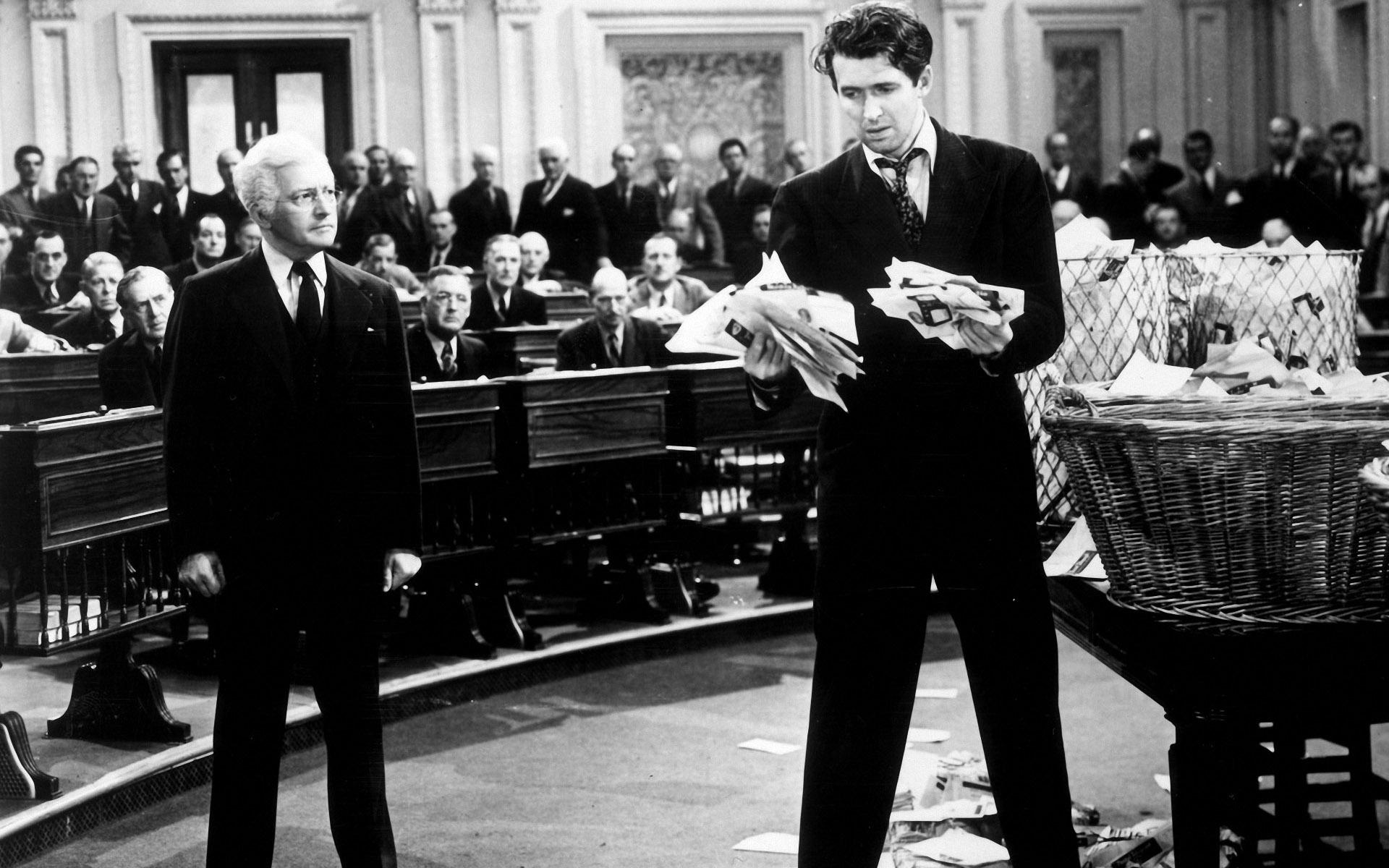
James Stewart campaigns for truth and justice in Capra’s classic Mr Smith Goes to Washington

Director: Frank Capra

Cast: James Stewart (Jefferson Smith), Jean Arthur (Clarissa Saunders), Claude Rains (Senator Joseph Harrison Paine), Edward Arnold (Jim Taylor), Guy Kibbee (Governor Hubert “Happy” Hopper”), Thomas Mitchell (“Diz” Moore), Eugene Pallette (Chick McGinn), Beulah Bondi (Ma Smith), H.B. Warner (Senate Majority Leader), Harry Carey (President of the Senate), Astrid Allwyn (Susan Paine)

Capra’s film are known, above everything, for their fundamental optimism about life, friendship and the American Way. Few films cemented that opinion more than Mr Smith Goes to Washington, the quintessential “one man in the right place can make a difference” movie. And where else would that one man need to be, but Washington? Where laws are framed and ideals come to die. It’s our hope that those at the heart of the political system are there for the good of the people. Of course, even Capra knew most of them were there to line their pockets and do their best for powerful business interests. So who can blame Capra for a little fantasy where naïve, innocent but morally decent Jefferson Smith decides enough is enough?

In an unnamed mid-Western State (the story the film is based on named it as Montana), the junior senator unexpectantly dies. The Governor (Guy Kibbee) needs a new man. Should he go for a reformer or the latest stooge put forward by political power broker in the State Jim Taylor (Edward Arnold). A tricky choice, so he splits the difference by appointing Boy Rangers leader Jefferson Smith (James Stewart) – because he’s wholesome and clean but also naïve enough to manipulate. Jeff heads to Washington, under the wing of Senator Joseph Paine (Claude Rains) – but Paine is in the pocket of Taylor.

Taylor and his cronies want an appropriation bill forced through that includes a clause to build a dam in their state. The dam will be built on land secretly bought up by Taylor and others, making them a fortune from public money. When Jeff announces in the Senate a bill to host a national boy’s summer camp on that same land, it throws a spanner in the works. Despite threats and bribes, Jeff refuses to go along with the shady deal over the dam, so they set out to destroy his reputation. With the help of his secretary Clarissa Saunders (Jean Arthur), Jeff mounts an epic filibuster in the Senate to clear his name, stop the dam and reveal the political corruption in his state.

Capra’s film is earnest, well-meaning and at times even a little bit sanctimonious and preachy – but it gets away with it because it’s also so energetic, honest and fun. It’s strange watching it today to think that the Senate at the time responded so poorly to it. Leading public figures either denounced it’s view of government and even tried to have it banned. Ironically of course, it probably inspired more people to get involved in Government than any other movie.

That was bad news for the corrupt political machines that ran so many parts of America at the time. Capra’s film is remarkably open-eyed about how these machines worked. Powerful business interests at the centre, with a raft of politicians in their pay – from Governors and senators on down. Jim Taylor – very well played with a swaggering, crude, bullying tone by Edward Arnold – only has to snap his fingers to get things done. During the film he mobilises the press, the police, the fire service and an army of heavies to enforce his will in the state and suppress free speech. The Governor (a neatly tremulous Guy Kibbee) is so firmly in his pocket, he can barely tie his shoe-laces without Taylor directing it. Senator Paine is patrician, dignified and has every inch of respectability – but he is soaking in filth up his neck from contact with Taylor.

It’s this system the film has a quiet anger about. Whatever happened to having “a little bit of plain, ordinary kindness – and a little lookin’ out for the other fella too”? Capra’s sprightly film also makes clear that we both don’t look too closely at how our government is really run and are very quick to hoover up any story we get from our political masters and accept it as gospel. An honest, decent man in the middle of all this is as unlikely a sight as you can imagine.

But that’s what these people get with Jefferson Smith – and discover someone who should be easy to manipulate, but doesn’t understand the rules of the game he’s playing. Instead Jeff thinks they are all there to help other people, not to themselves. Now you can argue, as some critics have, that law-making is the art of compromise – and that once the dam is under way, the benefits it will produce to Jeff’s home State (in terms of employment and energy) will be huge. So why shouldn’t Jeff bow down and move his boys camp in order to let the Bill go through?

Well the point is that Jeff isn’t opposed to the dam – he’s opposed to the corrupt profiteering that will spring out of it, and the way the cesspool of Washington (amongst all those fine monuments he so adoringly looks at) doesn’t care. This is a filibuster campaign to put honesty and decency back into American politics – and what’s not to like about that? It’s a film that firmly believes that one good man in the right place (that’s both Jeff and the President of the Senate, who tacitly encourages him) can change the day and save the country from itself.

There was of course no one better for such a job than Jimmy Stewart (and surely it’s this film that made him “Jimmy” to one and all). Capra had James Stewart in mind from the start – and it’s a perfect role for him, an iconic performance that stands as surely one of his greatest roles. Stewart has the skill to make Jeff endearing but not saccharine, naïve but not frustrating, innocent but not a rube, gentle but determined. Despite its corniness (and some of the film is very corny) you relate to his reverence for Lincoln’s memorial and the Capital. Stewart’s homespun charm is perfect, but it’s matched with the steel he could give characters. There is an adamant quality to his filibuster, his refusal to back down and go along with injustice. The final quarter of the film that deals with the filibuster is quite superb stuff, Stewart delivering some very-well written speeches with commitment, passion and bravura. It’s no understatement to say the film would work half as well as it does without him.

But then the entire film is also a feast of great acting, all sparked by a superb script from Sidney Buchman which mixes razor-sharp dialogue with wonderful speeches. Jean Arthur (who actually gets top billing) is very good as a cynical Washington insider who rediscovers her ideals – and finds her heart melting – under Jeff’s honest influence. Claude Rains gives one of his finest performances as the patrician Paine, a man who tries to close his eyes to his own corruption, but swallows down his own guilt and shame every day. Harry Carey gets a twinkly cameo as an amused and supportive President of the Senate. (Both actors were nominated for the Oscar, but lost to Thomas Mitchell for Stagecoach who also appears here in a fun turn as the drunken but principled reporter Diz).

Capra keeps the pace up perfectly, and his direction handles both smaller scale scenes of romance and idealism, with the larger scale fireworks of the Senate (a superb set, that looks so convincing it’s amazing to think it was built on a sound stage). His biggest trick here is to create a film that, in many ways, is a political lecture, but never makes it feel like one. Instead it delivers it’s messages on truth, justice and the American way with such lightness – but yet such pure decency – that it all works. It helps a great deal that the film doesn’t shy away from the corruption and – apart from a final turn that saves the day – resists melodrama and contrivance. Charming, funny but also thoughtful and committed, Mr Smith Goes to Washington is one of Capra’s very best.